Making an Ancient Greek Lyre for my Classics Independent Study

Sabrina Farrell sitting on the quad with the ancient Greek lyre that she built.Echoes of the ancient Greek chelys lyre kept appearing in my courses: Greek pottery depicting a lyrist’s playing technique or ancient literature describing its acoustics. These sources inform our knowledge of the lyre, and can in turn be brought to life by attempting to replicate the lyre itself. Endeavoring to experience the music of the ancient world this winter study, I worked with the Williams College Makerspace, Classics department, and many other incredible sources of help to create a playable, sonorous chelys lyre replica.

The First Vegan Lyre… Ever??

My completed ancient Greek lyre sounds amazing!

My completed ancient Greek lyre sounds amazing!

The ancient Greek chelys lyre, named so for the χέλυς (tortoise) shell used for the soundbox resonator, is said in the Homeric Hymn to Hermes to have first been made by Hermes as an apology gift to Apollo for kidnapping his cows. This was one of the ancient Greek texts I read with my project’s advisor, Visiting Assistant Professor of Classics Marissa Henry, who was an incredible guide throughout the entire project. Reading about the unfortunate tortoise who was first turned into a lyre, I was very glad about my choice to make a fully vegan lyre—no tortoises or cows harmed! In fact, in all my research I did not come across another chelys lyre—ancient or modern—that uses zero animal products. This gave a lot of room for creativity, riffing off of the trial and error of other lyre-makers.

Tortoiseshell Soundbox

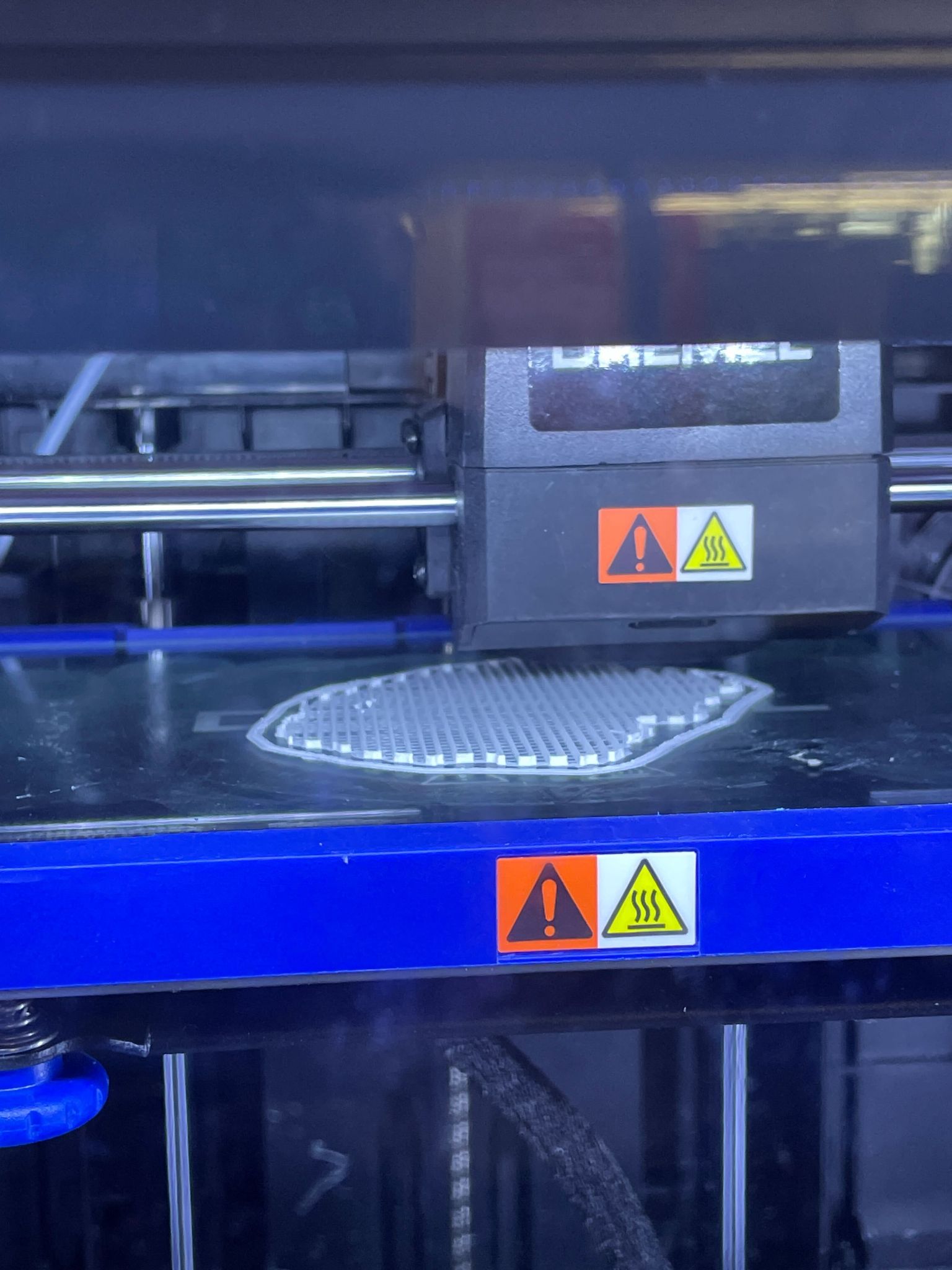
Printing a tortoiseshell replica using the Prusa XL 3D printer to make a fully vegan lyre—no tortoises or cows harmed!

Printing a tortoiseshell replica using the Prusa XL 3D printer to make a fully vegan lyre—no tortoises or cows harmed!

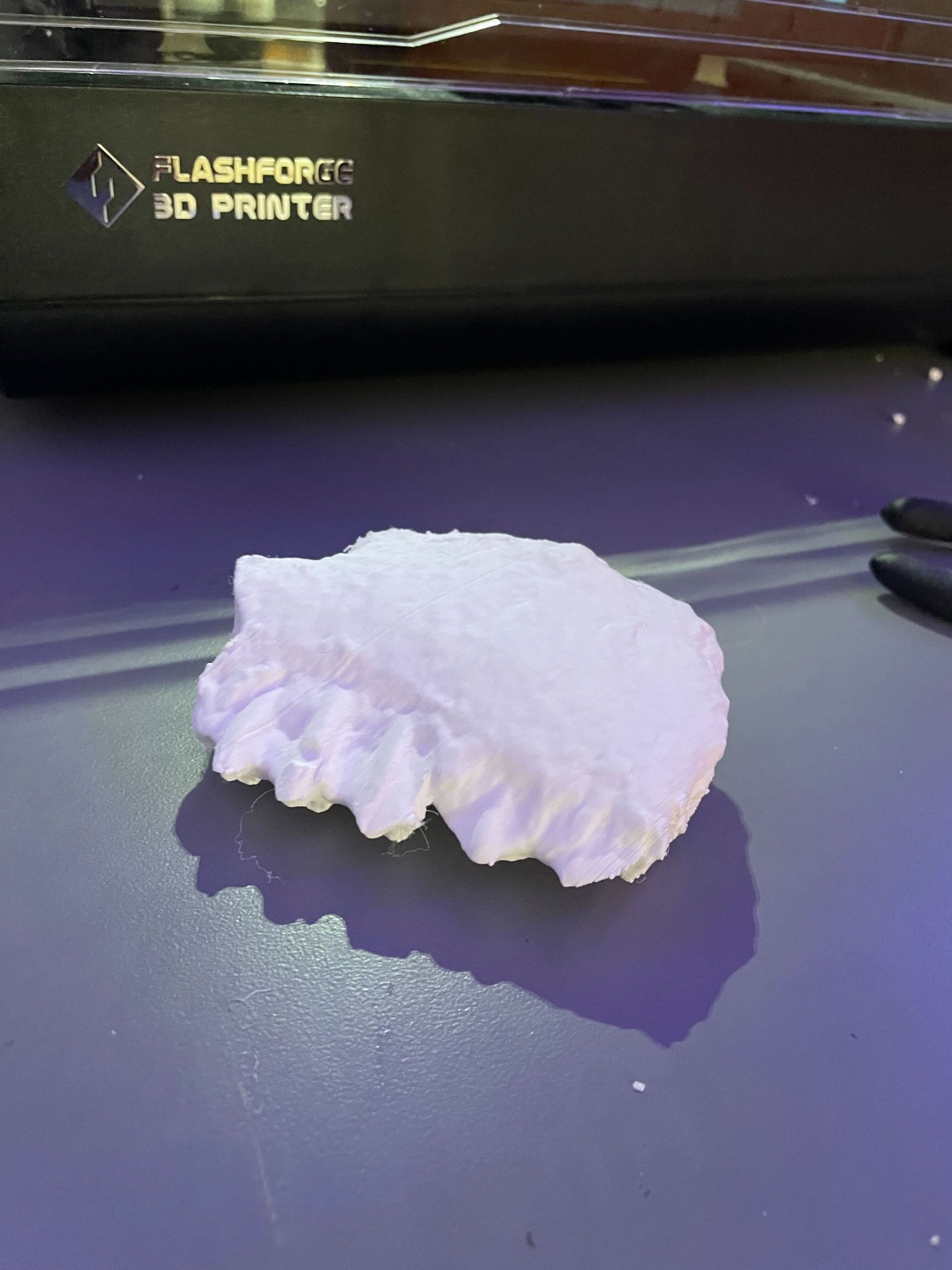
The biggest headscratcher was the tortoiseshell soundbox, which we considered making out of a hollowed-out gourd or a wooden salad bowl. While both are great alternatives, a gourd is quite fragile and unpredictable as a natural object, and a salad bowl felt too easy. Luckily, the Makerspace gives students access to 3D-printers for just this sort of moment. When I asked David Keiser-Clark, the Manager of the Makerspace and FabLab, and a huge contributor to the lyre, if it was possible to 3D print the tortoiseshell, I expected it to be too complicated or not viable—perhaps the material wouldn’t be resonant enough, or a tortoiseshell too complex to print. It turned out to be a fantastic way to replicate the tortoiseshell, using an online 3D scan of a tortoiseshell that I downloaded (as an STL file) and then modified using Fusion 360 and Blender (modeling software) to create strategic holes for the arms of the lyre to enter and the tailpiece to jut out.

Help from an Expert Luthier 

Expert luthier Steve Sauvé at Sauvé Guitars in North Adams, Massachusetts.

Expert luthier Steve Sauvé at Sauvé Guitars in North Adams, Massachusetts.

Next, we had to think about how to build the drumhead of the lyre, usually made by stretching animal skin over the face of the shell. In my research, mylar came up as an alternative, but mylar is not flexible and mouldable in the same way that animal skin is. I learned this and many other luthier insights from Steve Sauvé at Sauvé Guitars in North Adams, Massachusetts. He presented me with an alternative: a mylar banjo head! We decided to fashion it to the lyre by 3D modeling and printing a bespoke insert ring that would snugly support the banjo head, forming the face of the lyre. In the original hymn, the strings of the lyre were made from the guts of Apollo’s cow, and gut strings were primarily used for traditional instruments. For our purposes, nylon proved a great alternative, with ukulele strings being the best fit, which I found with the help of Collar City Guitars in Troy, NY.

And Alumni Woodworkers

Using a bandsaw to cut one of the lyre's arms.

Using a bandsaw to cut one of the lyre’s arms.

Shaping the wood for the lyre was tough to figure out and presented challenges. I had never used power or carving tools, and I was starting from two gorgeous blocks of cherry wood bought from Sauvé Guitars. I learned how to shape and replicate the traditional snaking arms and intricate tuning bulges (these hold the strings and allow them to be adjusted) from the advice of the teachers (all alumni: Seth Rolland, Chris Mullen, and Richard Song) of the winter study course “Introduction to Woodwork: Art, Design and Craft” (WSP 16). They were incredibly helpful, showing me how to safely use a bandsaw to create rough, blocky cuts for the arms and bridge. I called this the “Minecraft version” of the lyre. 

Learning to Use a Wood Lathe

Jason Mativi, Senior Science Center Shop Engineer, and David Keiser-Clark were both huge resources who together helped me learn how to safely use the wood lathe and disc sander.

Jason Mativi, Senior Science Center Shop Engineer, and David Keiser-Clark were both huge resources who together helped me learn how to safely use the wood lathe and disc sander.

The intimidating wood lathe in the Hopper Science Shop was the key to rounding the rectangular crossbars and tuning bulges (pegs) that maintain the tension of the lyre’s seven strings. Jason Mativi, Senior Science Center Shop Engineer, and David Keiser-Clark were both huge resources who together helped me learn how to safely use these tools. David stayed with (always alert) throughout the entire process, offering me a kind balance of support, guidance, and independence.

The lathe was the tool I had to be the most cautious while operating: it spins the wood very rapidly (~2000 RPM) and I used lathe chisels to slowly transform the rough cut block of cherry into a gorgeous cylindrical object with uniform shape and width. I used the lathe to create two crossbars and 14 wood tuning bulges, then used a stationary disc sander to further shape these pieces and add intentional charring to increase visual contrast. I learned how to use a universal metal bender to shape a stock 3/16” straight metal steel rod into a functional “buckle” that I later mounted in the lyre’s tail (below the bridge) and used to tie off the strings.

A close up of using the wood lathe and lathe chisels to turn the 14 tuning bulges.

A close up of using the wood lathe and lathe chisels to turn the 14 tuning bulges.

14 tuning bulges, turned on the lathe, and some have been sanded on the disc sander, while others await that final treatment.

14 tuning bulges, turned on the lathe, and some have been sanded on the disc sander, while others await that final treatment.

Spokeshaves and Flowing Organic Curves

Lee Valley spokeshaves set: flat, round, and concave.

Lee Valley spokeshaves set: flat, round, and concave.

David and I returned to the Makerspace, and he introduced me to using high-quality spokeshaves (like two-handed wood planes) to shape the arms: they pull the wood off in super-thin and satisfying ribbons that result in a smoothly curved and organic shape. 

However, when I began the dry assembly of these nearly completed pieces, it became apparent that the length of the lyre’s arms were too short to allow for tying off the strings below the 8” banjo head. The lyre required a longer tail. Ack! I brought this problem to David and he suggested using a leftover scrap (from our original cherry planks) to create a contoured half-lap woodworking joint to seamlessly extend the arms. I was running out of time, and he volunteered to do this complicated hand work. He returned it to me the next day and I was able to resume the dry assembly. 

Wood joinery: extending the arms by creating a halflap joint, fastened with removable bolts to enable future adjustments.

Wood joinery: extending the arms by creating a halflap joint, fastened with removable bolts to enable future adjustments.

3D Modeling: The Magic of Creating Custom Shapes and Bespoke Parts

The next challenge was to figure out how to securely connect the 3D printed tortoiseshell with the two cherry arms. A shoutout to Anderson Keiser-Clark, 13, for contributing his Blender expertise that modified the digital tortoiseshell to include snug holes for the arms and tail to pass through. He also created a custom lid that bolts to the base (to allow future maintenance) and included a ring on which to securely mount the banjo head. 

3D modeling work with Blender software created exactly matching top and bottom parts that securely hold the arms in place.

3D modeling work with Blender software created exactly matching top and bottom parts that securely hold the arms in place.

Shaping the Bridge and Finally: Assembly!

Sabrina using a coping saw to shape the bridge for the lyre.

Sabrina using a coping saw to shape the bridge for the lyre.

I used a coping saw to shape the bridge and create the desired curves. I stained only the 14 tuning bulges, and then used vegan Walrus oil on all of the wood parts to bring out the beautiful highlights of the grain. And finally, I successfully assembled the lyre and tuned the strings. Amazing!

Learning to Play the Lyre

Sabrina Farrell learning to play the lyre with UVM Professor Rachel Fikes.

Sabrina Farrell learning to play the lyre with UVM Professor Rachel Fikes.

In order to learn the physical technique of playing the lyre, Dr. Henry and I made our way to Vermont to meet with members of the Call of Kinnaru, a group from the University of Vermont who play new ancient music featuring kitharists among other instrumentalists. Professor John Franklin and Rachel Fikes were kind enough to let me play their lyres and introduce me to the incredible process of developing music from what we know of ancient practices. It was especially enriching to physically hold a lyre, so that I could feel exactly what I was working towards.

Inspiration from the New York City Ballet

The symbol of the New York City Ballet Company is the lyre.

The symbol of the New York City Ballet Company is the lyre.

Even outside making the lyre, I got to experience the joy of this instrument in many ways. Artist-in-Residence in Dance Janine Parker, whom I have been learning ballet with since I first came to Williams, took three of us to the New York City Ballet, since the symbol of the New York City Ballet Company is the lyre. Not only that, but it featured a dance called Antique Epigraphs choreographed by Jerome Robbins to music by Claude Debussy, which was an incredible piece inspired by Greek antiquity. This was such an incredible ballet to see and a singularly amazing experience in seeing the ancient embodied.

Teaching Students from the Williamstown Elementary School’s Robotics Team

Members of the Williamstown Elementary School’s Robotics Team.

Members of the Williamstown Elementary School’s Robotics Team.

This independent study also offered me the opportunity to make mini cardboard lyres with 6th grade students from Williamstown Elementary School’s Robotics program, led by Associate Professor of Classics Sarah Olsen. The theme this year for the robotics competition was archaeology! I was so happy to share with them my journey building a lyre and the exercise making cardboard lyres. They are such amazing students and are lucky to work alongside Professor Olsen who first introduced me to ancient Greek language and classics as a whole.

Thank You!

Thank you to everyone already mentioned and all the many others who helped me along the way! This was truly a group effort to build and I’m so thankful for the incredible support in making music.

Starting point was a slab of cherry wood (arms drawn in pencil). Final product is my own custom ancient Greek lyre that is an absolute joy to play!

Starting point was a slab of cherry wood (arms drawn in pencil). Final product is my own custom ancient Greek lyre that is an absolute joy to play!

See Related Articles

The Williams Record: The Artist Otherwise Known As: Sabrina Ferrell ’28 (May 7, 2026, by Edward Maxam)

Classics department hosts evening of ‘new ancient Greek music’ (April 23, 2025, by Rosario Carranza and Tahlia Gerger)


Making Time: Reimagining Ancient Greek Paradigms through 3D Printing

ChatGPT-generated image of Chronos and symbols of linearized time such as the hourglass and clock gears

ChatGPT-generated image of Chronos and symbols of linearized time such as the hourglass and clock gears

For the final project of my Winter Study course, COGS 10: Minds, Machines, and the Making of Meaning taught by Dr. Charles Kaufmann, I was asked to “integrate the scientific, philosophical, computational, and experiential strands of the course into a single, coherent act of meaning-making.” Having recently read an article about bioprinting—a form of 3D printing that uses organic matter, often including living cells, to create new tissue—I was inspired to cap off my learning experience with some form of material creation.

A simple Google search of “Williams 3D printing” led me to the Makerspace, the on-campus hub for all things related to innovation, creativity, and hands-on learning. I was particularly moved by the idea of Critical Making which combines critical thinking and material design into a unified mode of expression and inquiry. I knew this was how I wanted to approach my culminating reflection.

Minds and Machines Behind the Project

The crux of my project was to explore how minds and machines interface to create meaning, specifically through the lens of different ancient Greek models of time as represented by three deities: Chronos, Aion, and Kairos. That process of intellectual discovery was enabled by the following:

Minds and Machines Behind the Project

Minds and Machines Behind the Project

Getting to Know the Space

At the outset of the project, I lacked confidence, having no prior training in 3D modeling of any kind. When I reached out to Mr. David to talk through the specifics of my project idea and gauge the possibility of its completion in a compressed timeframe, I feared that my inexperience would make my goals unfeasible. On my first tour of the Makerspace a few days later, however, my trepidation was quickly melted away by Mr. David’s nonpareil enthusiasm and encouragement. I was pleasantly surprised to hear that my idea was realistically achievable, that he would help through the entire process, and that I could learn first-hand to perform some of the techniques involved.

The Process: From Red Spaghetti to Hellenic Models

Left to Right: (1) ChatGPT-generated image of Chronos and symbols of linearized time such as the hourglass and clock gears; (2) 3D model of Chronos produced by MeshyAI and Hitem3D software, based on the original image; (3) Editing the 3D model in PrusaSlicer to achieve proper scale and supports

Left to Right:
(1) ChatGPT-generated image of Chronos and symbols of linearized time such as the hourglass and clock gears
(2) 3D model of Chronos produced by MeshyAI and Hitem3D software, based on the original image
(3) Editing the 3D model in PrusaSlicer to achieve proper scale and supports


Left to Right:; (1) Big red spaghetti ball: the colorful fun of a failed print; (2) Successfully printed model of Chronos with supports; (3) Finished print of Chronos with all supports removed

Left to Right:
(1) Big red spaghetti ball: the colorful fun of a failed print
(2) Successfully printed model of Chronos with supports
(3) Finished print of Chronos with all supports removed


Final Thoughts

Collaborating with the Makerspace was incredible! With the zealous help of Mr. David, I was able to transform my project idea into a reality in about one week. Creation has never felt so possible. I would encourage anybody and everybody to visit the Makerspace. You never know when immersing yourself in a new environment and connecting with the experts and student workers involved will spark the desire to make something new. While every creative endeavor has a unique set of technical demands, ranging in complexity, getting started really is as simple as dropping by during Open Hours or sending a friendly email. I found this process enriching, fun, and informative, and I will definitely be working with the Makerspace team again soon.

My finished prints! From left to right: Chronos, Aion, and Kairos. Below: red spaghetti :)

My finished prints! From left to right: Chronos, Aion, and Kairos. Below: red spaghetti 🙂


For explanations of the different paradigms of time these deities represent and the symbols included in the prints, please feel free to check out my final project!


Mayan Tenon: Bringing the Past to Life with 3D Printing

Background

Mayan "Human Head Emerging from Monster Jaws", Late Classic, 600-900 CE, 125 lb., Object number: 1870.1.2

Mayan “Human Head Emerging from Monster Jaws”, Late Classic, 600-900 CE, 125 lb., Object number: 1870.1.2

College campuses hold a wealth of history, blending the stories of their institutions and community with those of the wider world. The epitome of this fascinating history can be found in the Williams College Museum of Art (WCMA). Among the thousands of objects housed here, some carry tales of adventure, cultural exchange, and intrigue that transport us back in time. Between 1870 and 1871, two Williams students took a Lyceum-sponsored trip to Honduras and Belize where they acquired two Maya tenons in the town of Corozal and brought them back to Williams College, where they remain today. These tenons are now studied as part of anthropology and art history courses at the college and have been on view in Object Lab and other exhibitions at WCMA. More information about these artifacts can be found in a student research paper written in 2019. 

Given their fascinating history with the college, the WCMA wanted to send the above pictured tenon, object number 1870.1.2, to the Beatriz Cortez x rafa esparza: Earth and Cosmos exhibition in New York City. The Earth and Cosmos exhibit celebrates cultural and artistic ties to ancient civilizations, making the tenon a fitting addition. However, the tenon is fragile, sculpted from soft limestone, and heavy, about 125 pounds. If it were to be shipped to the show, it would have been a miracle if it arrived in one piece. This logistical nightmare prompted Beth Fischer, WCMA’s Assistant Curator of Digital Learning and Research and Lecturer, to reach out to the Makerspace and request a 3D printed copy at a 1:1 scale model. She even shared the high-resolution photogrammetry 3D scan that she had completed during the pandemic. 

Although shipping a reproduced object eliminates any fear of damage to the original, 3D printing still raises a series of challenges. First, the tenon is significantly larger (23 1/4″ × 8 1/2″ × 18″) than our largest printing bed, meaning we must print it in quadrants and glue them together in the post-processing stage. Second, 3D-printed objects can be fragile, and they may chip or crack if they are jostled during shipping. Third, how do you best transform a 100% plastic object into a material resembling aged limestone?

One quadrant of the 3D printed tenon fills most of the available bed space on the Makerspace's Prusa XL 3D printer; note the "tree supports" are still attached

One quadrant of the 3D printed tenon fills most of the available bed space on the Makerspace’s Prusa XL 3D printer; note the “tree supports” are still attached

Printing

We resolved the oversized nature of this object by dividing our model into four roughly equal parts. We printed each quarter separately, and the actual printing times ranged between 10 and 34 hours per each quarter—for a total of about four days of nearly continuous printing.

We briefly experimented with adding mass to the 3D print by pausing the print midway through, then adding steel BBs into the hollow interior infill, and then completing the print. We decided there was little benefit to adding mass, as the object would be on display and would not be handled by the public. We instead focused on durability for shipping purposes. We selected our settings and printed a test piece (representing 1/32 of the entire object) that we then dropped and kicked to subject it to the kind of rough handling it might experience during shipping. We found that a 3mm shell provided a sturdy and durable object. We printed in Sunlu PLA Meta 1.75mm filament (white) with the following specifications: 0.2mm layer height (speed), 15% infill density, triangular fill pattern (low density, strong, fast), and organic tree supports (easy to remove). We configured the Prusa XL to auto-swap filament rolls as each successive 1kg PLA roll ran out. For the largest (34-hour prints), we used 2.3 rolls, and this hot-swapping meant increased efficiency because we did not have to babysit it. 

We created the model’s stone-like appearance using a post-processing technique that the Williams Makerspace learned last spring semester from two (then) local 5th graders: Elizabeth Heeringa (she invented the technique) and Anderson Keiser-Clark. Together they applied this technique to a pair of large-format 3D printed Spruces Lions that supported Giuseppina Forte’s ARTS 222 Critical Practice of Architecture: Theories, Methods, and Techniques course. These lions were exhibited in the Williams 2024 Spring Big Arts Show.

Post-Processing Recipe

We used luthier’s woodworking tools (scrapers) to remove extraneous plastic from the flat sides of each quadrant. We then superglued the four quadrants together with CA (cyanoacrylate) glue, and applied three layers of 3M Bondo (a thick epoxy putty used in automobile repair) to hide the seams. We let that dry and then hand-brushed two thin coats of DRYLOK Original Concrete & Masonry Waterproofer; this helped convert the plastic PLA surface texture to the more sandy and gritty nature of the DRYLOCK paint.

We used luthier's woodworking tools (scrapers) to smooth the flat sides of the PLA blocks

We used luthier’s woodworking tools (scrapers) to smooth the flat sides of the PLA blocks

Mayan "Human Head Emerging from Monster Jaws", Late Classic, 600-900 CE, 125 lb., Object number: 1870.1.2

3D printed tenon: 3 of 4 printed quadrants (organic tree supports remain on the lower right block)


3D printed tenon: 4 of 4 printed quadrants (organic tree supports remain on the two blocks on right side)

3D printed tenon: 4 of 4 printed quadrants (organic tree supports remain on the two blocks on right side)

Applying the third layer of 3M Bondo (a thick epoxy putty used in automobile repair) to hide the seams

Applying the third layer of 3M Bondo (a thick epoxy putty used in automobile repair) to hide the seams


Finally, we created an acrylic wash solution by filling two spray bottles (one black, one brown) with a solution of 15% acrylic paint and 85% water. We sprayed on 4 coats, allowing 24 hours to dry between each. It sprays on quite dark, but then dramatically lightens as it drips off. Iterative coats allowed us more control over achieving our final desired outcome.

The 3D printed tenon after being painted with two coats of DRYLOK Original Concrete & Masonry Waterproofer

The 3D printed tenon after being painted with two coats of DRYLOK Original Concrete & Masonry Waterproofer

We were excited to accidentally discover that using a painting hood with strong ventilation (to reduce our exposure to the DRYLOK fumes) changed the spray bottle output and turned it into a very fast-moving and fine mist (think: atomized), and that nearly eliminated drippy streaks. We attempted to use our two colors to recreate the variegated tones of natural limestone by adding extra solution to nooks and crannies, and then we dry-brushed the visual highlights with a stiff, fine brush (using pure acrylic paint) to add some texture. Our goal was never to color match the original Mayan tenon, but rather to create a realistic looking substitute that could be interpreted as being limestone. The painting was completed by Lisa Dorin, Deputy Director of WCMA, and David Keiser-Clark, Makerspace Program Manager.


Lisa Dorin, Deputy Director of the WCMA, spraying the 3D printed tenon with an acrylic wash

The 3D printed tenon after being painted with two coats of DRYLOK Original Concrete & Masonry Waterproofer

Side view of the final 3D printed tenon, after post-processing, weighs about 20 pounds

Side view of the final 3D printed tenon, after post-processing, weighs about 20 pounds

Front view of the final 3D printed tenon, after post-processing, weighs about 20 pounds

Front view of the final 3D printed tenon, after post-processing, weighs about 20 pounds


NYC Exhibition

The final 3D printed tenon was visually stunning, weighed about 20 pounds, and was successfully shipped to Earth and Cosmos, where it is being exhibited from January 29 through May 17, 2025. Beatriz Cortez was very happy with the result and hopes to be able to borrow the print again for future exhibitions. This exhibition-quality 3D print acts as a fascinating interface between artistic expression and cutting-edge technology. Although it was artificially fabricated, it still carries the history and cultural significance of the original piece in a manner that can be transported from location to location and shared with the broader community. This work is a part of Williams College’s story, but also a part of many other stories, and I’m thankful to have had the opportunity to share it. 

3D printed tenon being wrapped for shipment to exhibition in New York City

3D printed tenon being wrapped for shipment to exhibition in New York City

3D printed tenon on display at Earth and Cosmos exhibition, New York City

3D printed tenon on display at Earth and Cosmos exhibition, New York City


Acknowledgments

This project was made possible thanks to the collaborative efforts of Beth Fischer and Lisa Dorin (WCMA) and Makerspace student workers Harris Longfield ’27 (me) and Elena Sore ’27, with support from David Keiser-Clark.

Publications Mentioning this Work


Resurrecting the Ancient: A 3D-Printed Chinese Oracle Bone Finds a New Home at Williams

When students in ASIA 325 / ARTH 325: The Arts of the Book in Asia walk into class, they are greeted by an object that feels both ancient and cutting-edge: a 3D-printed replica of a 3,000-year-old Chinese oracle bone. What they may not realize is the complex and fascinating journey that brought this piece into their classroom, a story of international collaboration, digital preservation, and creative craftsmanship.

The 3D-printed replica

The 3D-printed replica.

From Oracle to Object

Using open-access scans from the Cambridge University Library, and with permission from Professor Dominic Powlesland, who co-holds copyright with Cambridge, the team downloaded and processed a high-resolution 3D model of Oracle Bone CUL.52.

“We don’t have any oracle bones on campus, and it wouldn’t be ethical to acquire one. But thanks to digital tools and Cambridge’s generosity, we can still bring one into students’ hands,” said Anne Peale.

3D print ready for resin.

3D print ready for resin.

The etchings after resin.

The etchings after resin.

From Data to Artifact

The project’s journey from digital file to physical artifact unfolded in several stages:

  • January 30, 2023: STL files arrived from Cambridge.
  • February 1: The first prototype was printed using FDM (fused deposition modeling).
  • February 7: A final resin print was scheduled, scaled to preserve the original details.
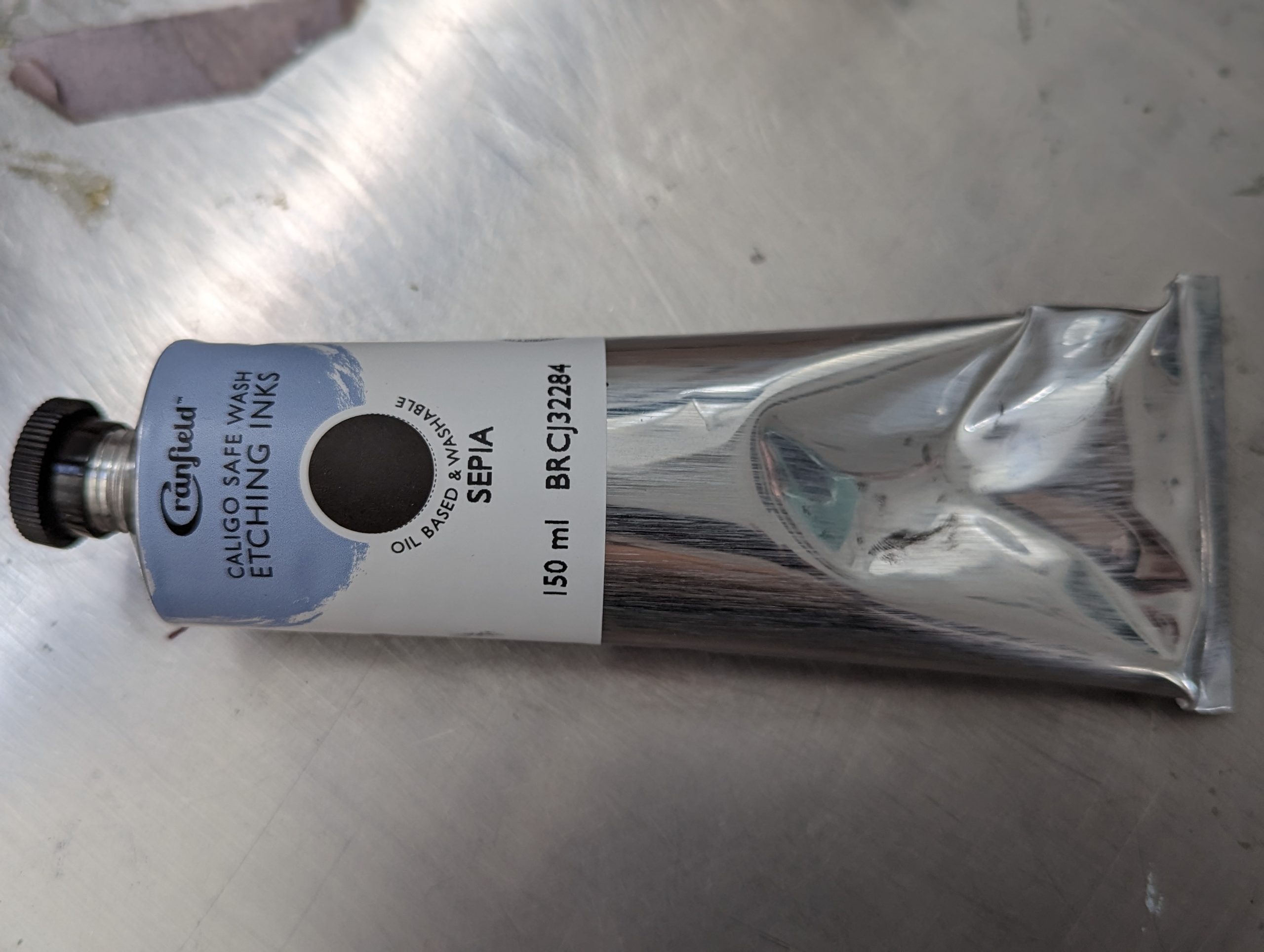
  • March 16: Print studio technician Javier Robelo applied etching ink, transforming the object’s surface from shiny resin to an aged, textured finish.

“To my eyes, the etching ink transformed the resin print into something that feels older and more authentic,” said David Keiser-Clark.

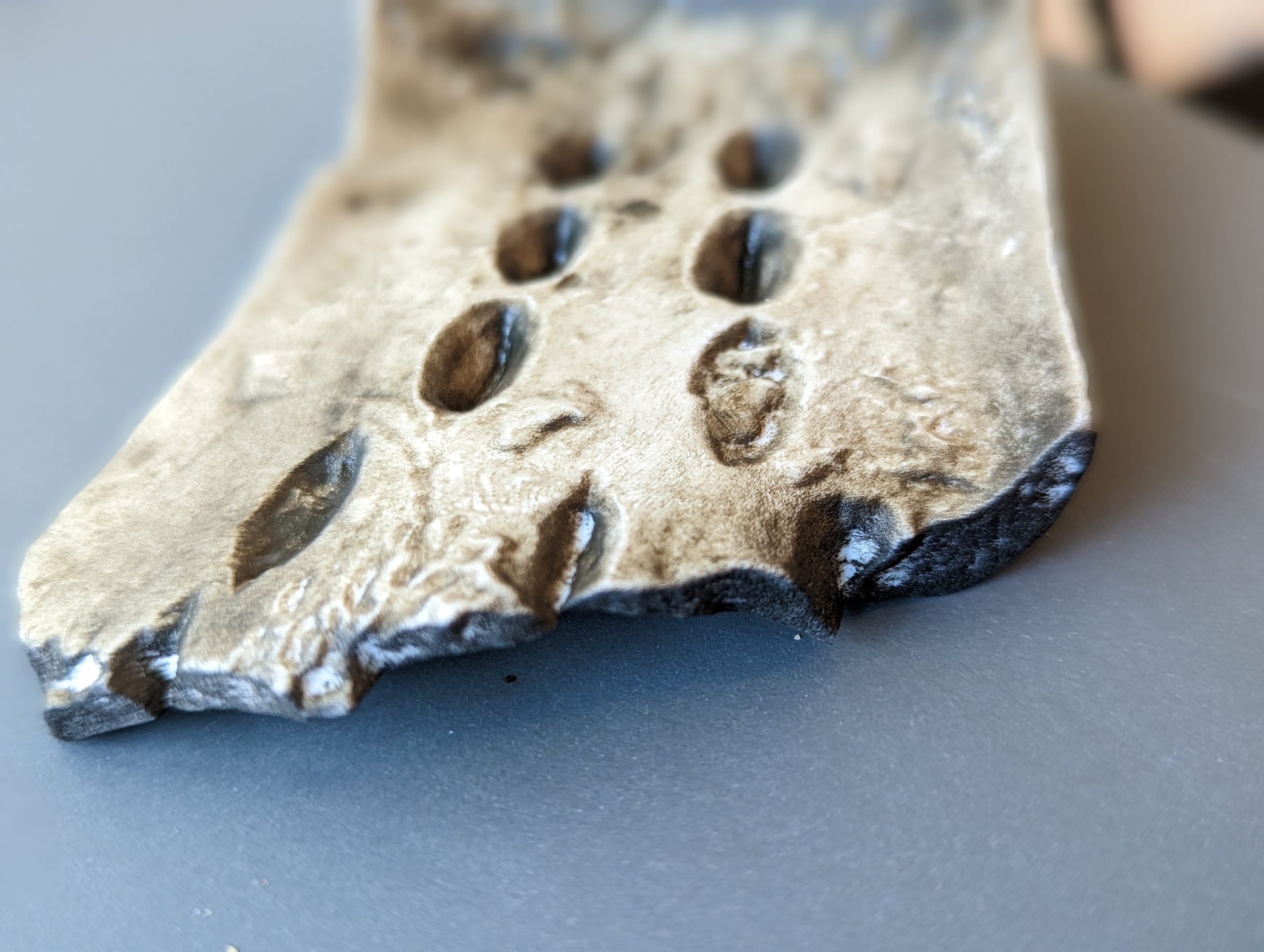
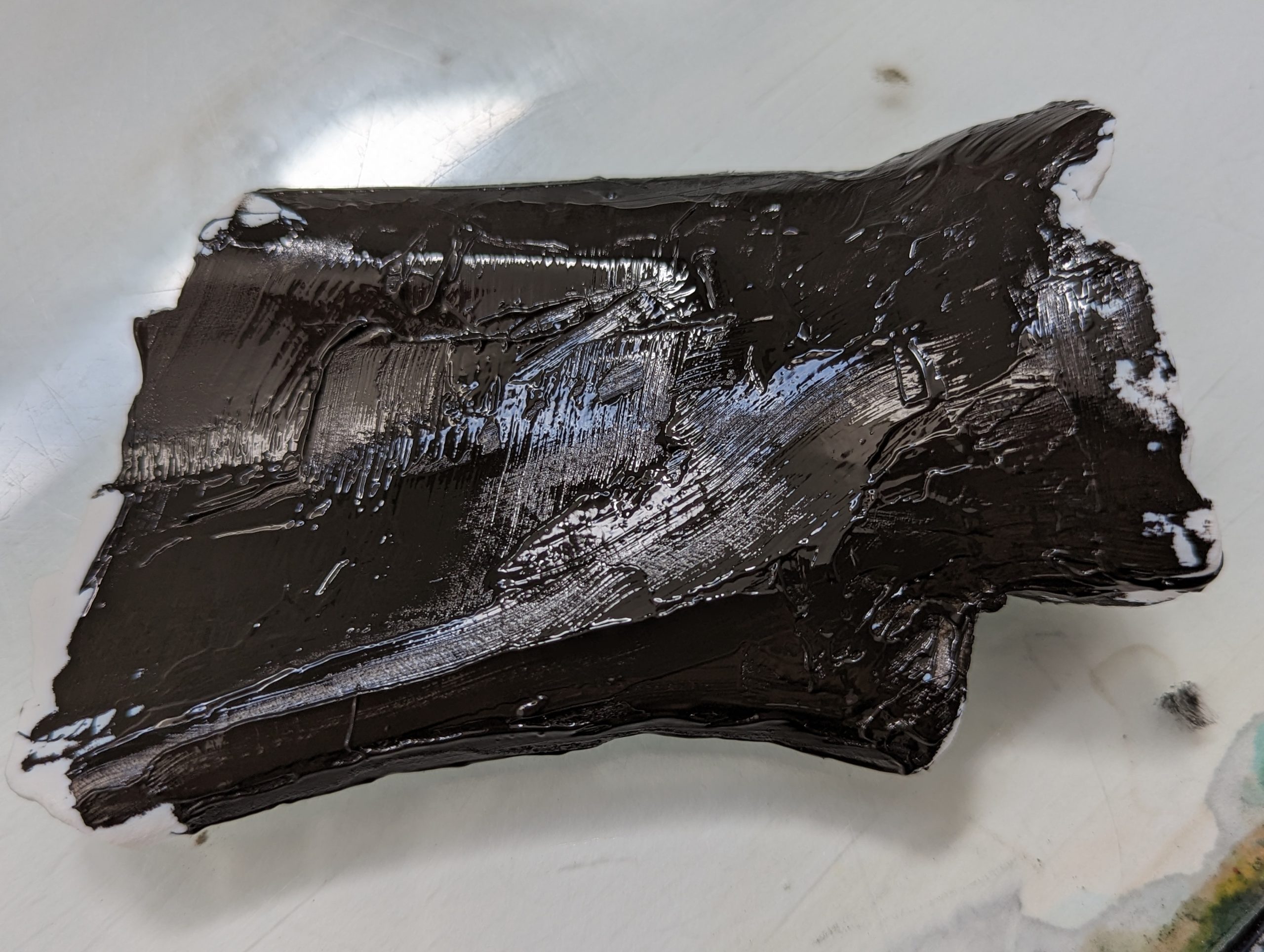
Ink covered 3D print.

Ink covered 3D print.

Ink resin used to age the 3D print.

Ink resin used to age the 3D print.

A Teaching Tool with Character

Javier Robelo (Print Studio Technician) added water soluble etching ink to the resin print, then wiped it off using tarlatan wiping fabric. This process allows only the ink within the crevices to remain and that greatly the enhances visible contrast of the 3,000 year old markings.

Javier Robelo (Print Studio Technician) added water soluble etching ink to the resin print, then wiped it off using tarlatan wiping fabric. This process allows only the ink within the crevices to remain and that greatly the enhances visible contrast of the 3,000 year old markings.

By late March, the project reached completion. Both Peale and Mumtaz were impressed by how the replica captured the visual depth and tactile quality of the original oracle bones.

“WOW, what a transformation! I can’t believe how much more visible the characters have become. May I share this with Dominic at Oxford?” wrote Peale in response to the final version.

“It is really looking like the real deal now! We would be delighted to teach with this,” added Mumtaz.

Acknowledging the Origins

This project would not have been possible without the digital preservation work of Cambridge University Library and Professor Dominic Powlesland. All future educational materials will include the following acknowledgment:

Oracle Bone, CUL.52. With thanks to Cambridge University Library and Professor Dominic Powlesland for making these scans available for research and teaching.

What’s Next

A second resin print, featuring the same inked detailing, will be produced as a gift for Professor Powlesland. The team is also exploring new materials and inking techniques to enhance texture and durability. The replica will continue to be a highlight of ARTH 325: The Arts of the Book in Asia, giving students a tangible connection to early Chinese history and script. Through this collaboration, ancient writing and modern technology meet in a way that deepens understanding and preserves cultural heritage.

From Teeth to Time: Discovering Siwalik Hills’ Past Through Archaeology

How did we get here? Where do we come from? What does our future encompass? As an aspiring scientist, I have always been fascinated by these (and many more!) questions about the evolution of humanity and the cosmos. Specifically, the modern ways in which experts around the world are working towards finding a unifying, concrete answer about the theory of evolution and dispersal of early humans. To my pleasant surprise, scientists at Williams College are making wonderful discoveries and progress on this topic, and I was able to contribute — even just a tiny bit — to some of their work this semester!

Some Background

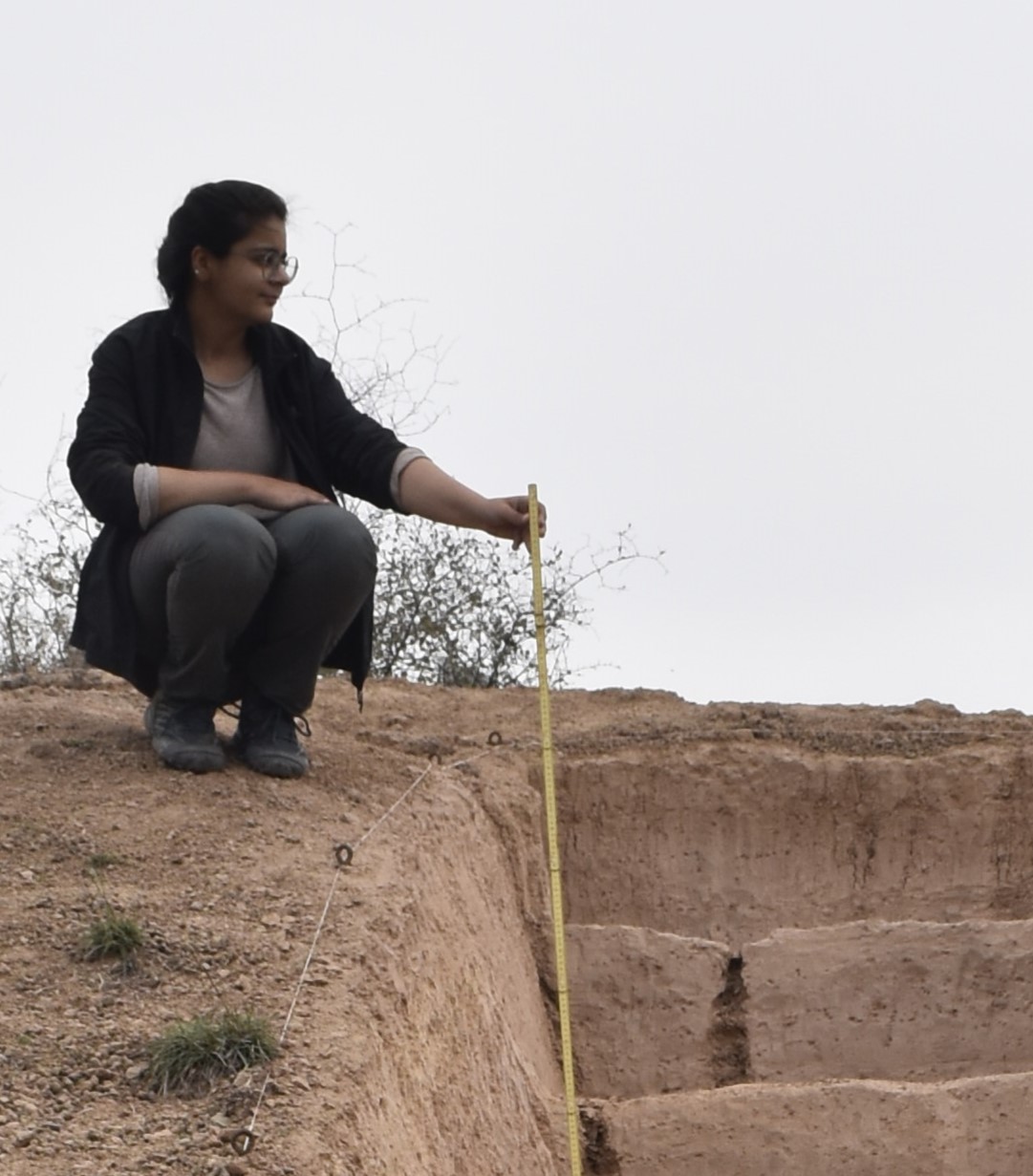
Anubhav Preet Kaur

Anubhav Preet Kaur pictured working at the ESR Lab at Williams College

Scientists believe that early humans dispersed throughout the world because of changing global climates. The specific routes that these early humans took are still inconclusive. However, there are several hypotheses about the possible areas they inhabited, given early Pleistocene evidence of hominin occupation in those areas. Thus, the hypothesis I will explore in this blog post will be related to the pieces of evidence of hominin occupation from regions around the Indian subcontinent: i.e., Dmanisi, Nihewan, and Ubeidiya—just to name a few sites.

One of the supporters of this hypothesis is Anubhav Preet Kaur, an archeologist conducting a paleoanthropological research project that seeks to identify if the Siwalik Hills in India were a likely dispersal path for early humans. As Anubhav states: “The fossils of Homo erectus, one of the first known early human species to disperse outside of Africa, have been discovered from Early Pleistocene deposits of East Europe, West Asia, and Southeast Asia, thereby placing Indian Subcontinent in general—and the Siwalik Hills, in particular—-as an important dispersal route.” The problem is that no fossil hominin remains or evidence attributed to any early hominin occupation have ever been uncovered in that area. Thus, her project seeks to paint a clearer prehistorical picture of the region’s ecology by precisely dating faunal remains from her dig sites. She hopes to indicate if the Siwalik Hills, already famous for yielding many paleontological and archeological finds over the past hundred-plus years, would have had fauna and ecological conditions during these migratory time periods that would have supported early humans. And precisely dating these faunal remains requires the skills of Dr. Anne Skinner, a renowned lecturer at Williams College. 

Anne is a distinguished Williams College emerita chemistry faculty member who is an expert in electron spin resonance (ESR) and specializes in applying ESR techniques to study geological and archaeological materials. Anubhav is a Smithsonian Institute Predoctoral Fellow and presently a doctoral student at the Indian Institute of Science Education and Research in Mohali, India. Anubhav spent three seasons, between 2020-2022, doing paleontological field surveys and geological excavations at the Siwalik Hills region in India. She led a team of undergraduate and graduate field assistants and volunteers in searching for clues that might indicate if the conditions were suitable for hominins. Ultimately, she brought a selection of her fossils to Williamstown, MA, so that Anne could begin to teach her the process of utilizing ESR to date her objects. 

What is ESR?

ESR is a technique used on non-hominin remains that allow scientists to measure the amount of radiation damage a buried object—in this case, several partial sets of animal teeth—has received to provide insights into its geological and biological history. The Siwalik Hills region is a particularly important site for archaeologists because they are home to a variety of rich deposits of fossil remains that date back from the Miocene to Pleistocene periods; however, Anubhav’s sites in particular, contain remains from the Pliocene and Pleistocene. The periods that she studied in her site are relevant as those are the periods in which she theorizes a dispersal could have happened, making the study of the remains more effective. The region is located in the northern part of India (near the border of Pakistan) and covers an area of about 2,400 square kilometers. The fossils Anubhav and her team collected (~0.63-2.58 Myr) include the remains of Pleistocene mammals, such as bovids, porcupines, deer, and elephants. Thus, they and have been used as a tool for archaeologists to learn more about the region’s past climate and ecology

The Story Starts Here

On January 9, 2023, Anne and Anubhav visited the Williams College Makerspace and inquired if we could create high-quality 3D models that would persist as a permanent scientific record for four sets of Pleistocene mammalian teeth that would soon be destroyed as a consequence of ESR dating. Electron spin resonance is currently the most highly specific form of dating for objects up to 2 Mya, and is used only with animal remains as the dating process requires crushing the material into powder in order to analyze with highly sensitive equipment. Hominin remains are widely considered too rare and valuable to allow destructive dating, while animal remains are relatively more frequent. Creating high-quality 3D objects allows researchers with a means to effectively consult and do further research on a digital reconstruction of the model at a future date. In addition, the 3D objects are the basis for creating 3D prints of the object for physical study and handling. 

Furthermore, ESR is a rare and expensive technique that is only available at a limited number of sites throughout Australia, Japan, Brazil, Spain, France, and the United States. Williams College is, in fact, the only facility in all of North America with ESR equipment, and Anne is the only ESR specialist at Williams. 

My Job

This spring, I collaborated on this 3D modeling project with David Keiser-Clark, the Makerspace Program Manager. We divided the job so that each of us was in charge of producing two unique 3D models of the highest quality. We began the project by holding a kickoff meeting with Anubhav and Anne to discuss project needs and to receive four sets of prehistoric teeth. Throughout the project, we held additional meetings to discuss progress and, finally, to present finished 3D digital and printed models. Despite the fact that this was my first photogrammetry assignment, I embraced the challenge head-on, working autonomously and engaging with stakeholders whenever necessary.

To build the 3D models, I used a photographic method known as photogrammetry. This required putting together many orbits of images using software to create a three-dimensional object. I participated in two workshops offered by Beth Fischer, Assistant Curator of Digital Learning and Research at the Williams College Museum of Art, to develop knowledge of this procedure. Her thorough understanding of the intricate workings of our photogrammetry software, Agisoft Metashape, was incredibly helpful. Beth was a great resource and was willing to meet with us numerous times. Moreover, I shared what I learned with David (and the entire Makerspace team) so that we could update the Makerspace’s new documentation on photogrammetry. By sharing my experiences, I helped to guarantee that the documentation addressed a wide range of challenging edge-case scenarios and would serve as a thorough and useful reference for future student workers.

Here is a walkthrough of the photogrammetry process:

Taking the Pictures

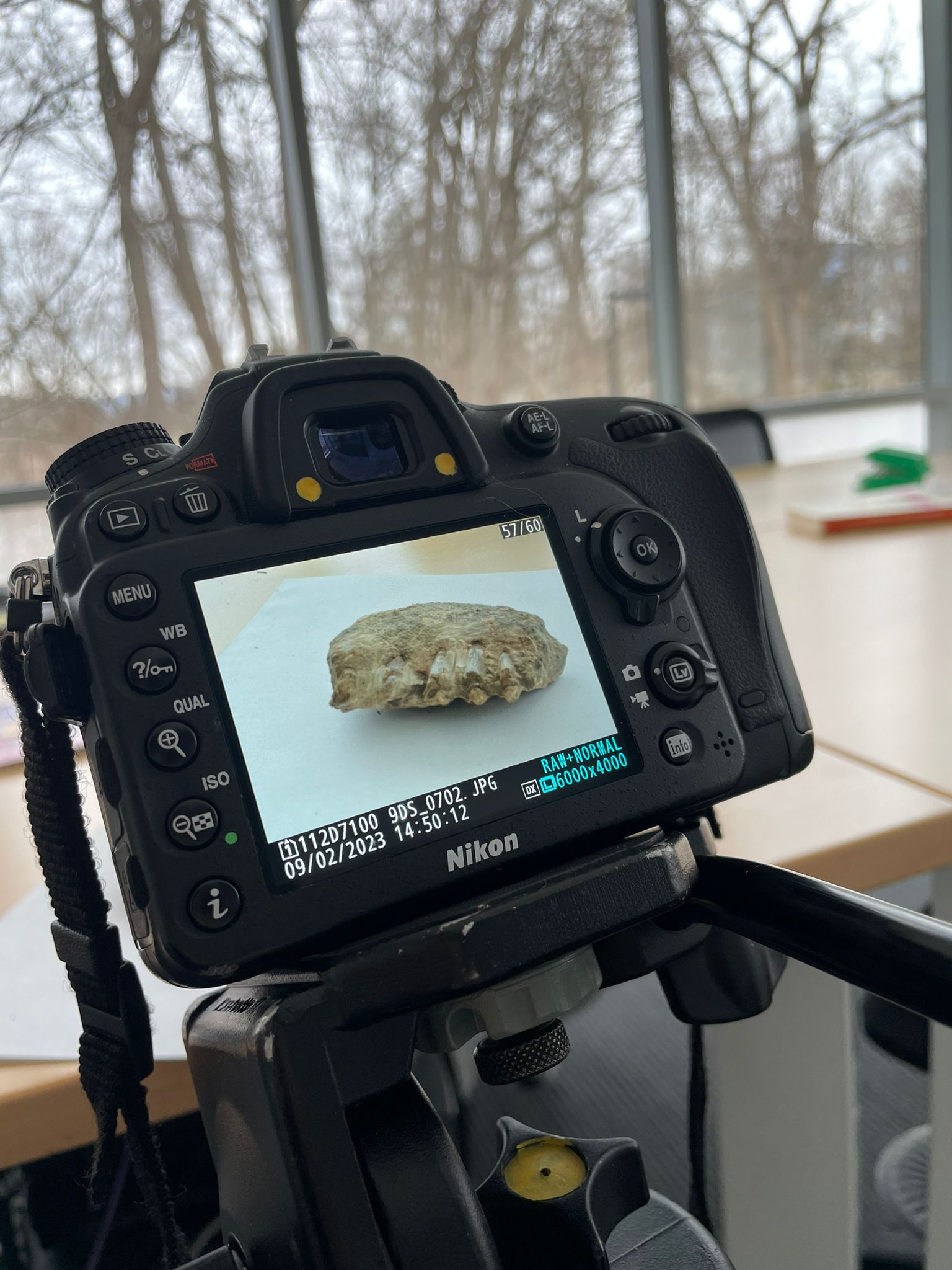
Valeria and David took an average of 341 pictures for each of the four sets of teeth (a total of 1,365 photographs).

Valeria and David took an average of 341 pictures for each of the four sets of teeth (a total of 1,365 photographs).

I collaborated with David to take clear images from every aspect and dimension. We took a hands-on approach, testing different angles and lighting settings to look for the best approach to photograph each tooth. I first relied on natural lighting and a plain background. After a couple of runs, however, David pushed the concept to the next level by adding a photography lightbox, which allowed us to shoot higher-quality photographs with bright lighting and without shadows. These photos served as the foundation for subsequent work with the photogrammetry software.


Meeting with Anubhav

Valeria interviewed Anubhav Preet Kaur before starting the 3D model process.

Valeria interviewed Anubhav Preet Kaur before starting the 3D model process.

I wanted to know more about the scope of the project and what function my contribution might provide. In order to have a better understanding of the scientific process, I interviewed Anubhav, whose important insight provided light on the significance of her research within the larger scientific field. This interaction helped me understand the purpose of the 3D models I was making, especially given the impending pulverization of the teeth via the ESR process. Furthermore, it emphasized the critical need to have an accurate digital 3D model, as well as a physical model, that would endure beyond the impending destruction of the original objects.

Using Photoshop to Create Masks: What is a Mask?

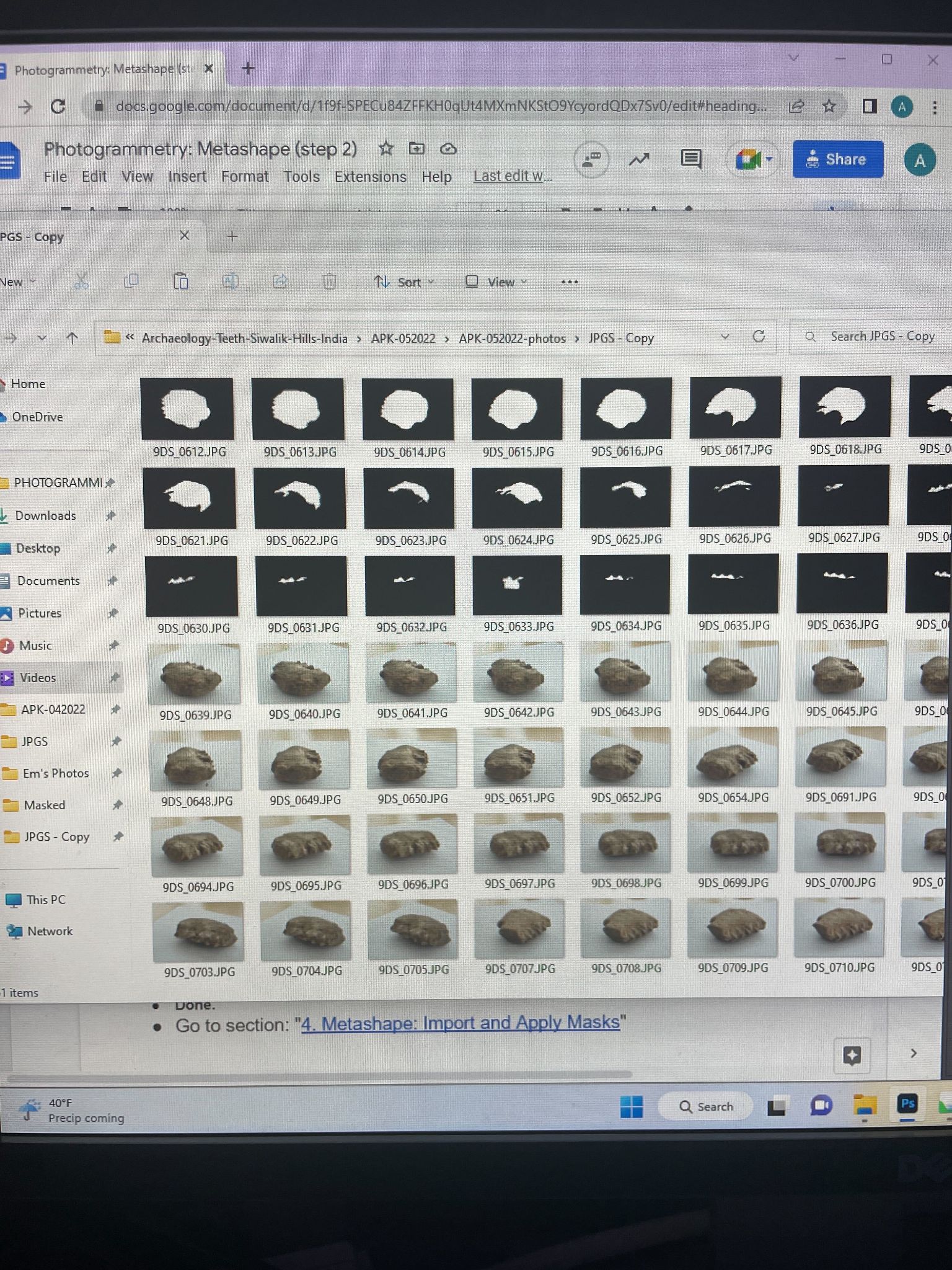
Valeria encountered several challenges when importing masks. However, Beth supported her in her journey, and they overcame those obstacles together.

Valeria encountered several challenges when importing masks. However, Beth supported her in her journey, and they overcame those obstacles together.

Masks play a crucial role in the model-building process in Agisoft Metashape as they provide precise control over the specific portions of an image used for generating the model. This level of control ensures the resulting reconstruction is accurate and detailed by eliminating irrelevant or problematic features. I used Adobe Photoshop to create masks for each set of teeth, and this proved to be one of the most challenging aspects of the entire project. Because the sets of photos had varying angles and lighting conditions, I collaborated with Beth Fischer to troubleshoot and overcome these obstacles. This collaborative effort deepened David’s and my own understanding of the process. This enabled him to document the issues I faced and their corresponding solutions for future students. After approximately one month of persistent trial and error and several meetings with Beth, we successfully identified effective solutions to the encountered problems.

Using Metashape to Create the 3D Model

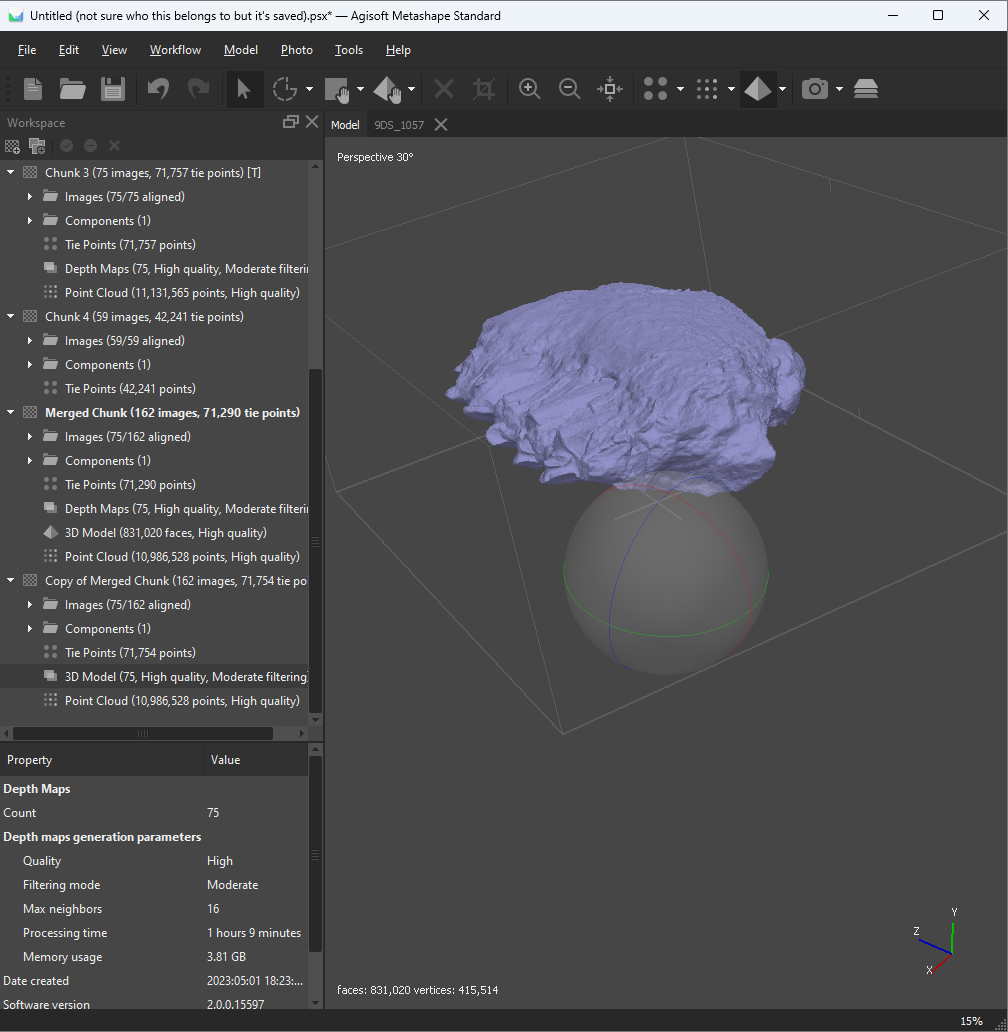
Using Agisoft Metashape to construct the 3D Model by importing the photographs and generated masks.

Using Agisoft Metashape to construct the 3D Model by importing the photographs and generated masks.

When you use Metashape, it starts by scanning each image and looking for specific points that stand out, like a small group of dark pixels in a larger area of light pixels. These distinctive points are called “key points,” and the software only searches for them in the unmasked areas of the image. Once it finds these key points, Metashape starts to match them across multiple images. If it succeeds in finding matches, these points become “tie points.” If enough points are found between two images, the software links those images together. Thus, many tie points are called a “sparse point cloud.” These tie points anchor each image’s spatial orientation to the other images in the dataset—it’s a bit like using trigonometry to connect the images via known points. Since Metashape knows the relative positions of multiple tie points in a given image, it can calculate an image’s precise placement relative to the rest of the object. After that process, I made the model even more accurate by using “gradual selection” to refine the accuracy of the sparse point cloud, and then I “optimized cameras” to remove any uncertain points (yay!). 

Using Agisoft Metashape to construct the 3D Model by importing the photographs and generated masks.

Using Agisoft Metashape to construct the 3D Model by importing the photographs and generated masks.

Later on, I moved on to building the “dense cloud.” This process utilizes the position of the photos previously captured to build a refined sparse cloud. Metashape builds the dense cloud by generating new points that represent the contours of the object. The resultant dense point cloud is a representation of the object made up of millions of tiny colored dots, resembling the object itself. I then cleaned the dense cloud to further refine it by removing any noise or uncertain points.

Using Agisoft Metashape to construct the 3D Model by importing the photographs and generated masks.

Using Agisoft Metashape to construct the 3D Model by importing the photographs and generated masks.

Now it was time to build the geometry! This is what turns the point cloud into a solid, printable surface. Through this process, Metashape connects the dots by forming triangular polygons called “faces.” The more faces the model has, the more detailed it will be (it also uses more memory!). As a point of comparison, early 3D animations often appeared to be blocky objects with visible facets, and that was because those models had low face counts. High face counts offer greater refinement and realism.

Lastly, I textured the model. Metashape uses dense cloud points to identify the color of each spot on the model. Texturing the model offers further realism because it applies the actual colors of the object (as photographed) to the resultant 3D model. 

And that’s the general process I followed to turn a set of images into a high-quality 3D object using Metashape!

Printing the Model

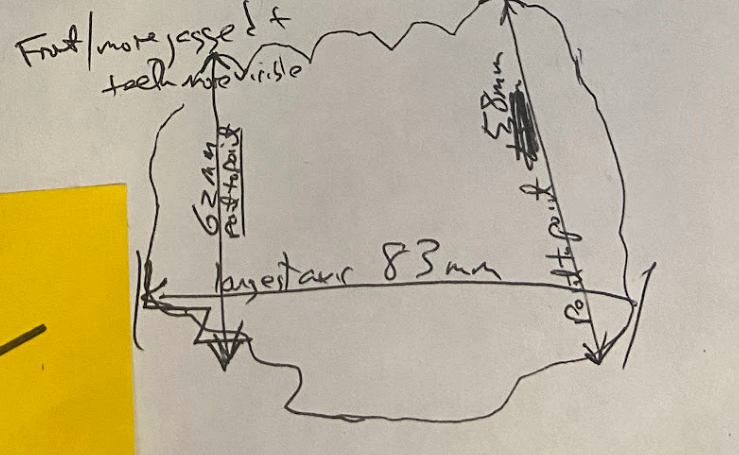
We used calipers and recorded those measurements for later use with accurately scaling the digital object.

We used calipers and recorded those measurements for later use with accurately scaling the digital object.

To print the final 3D model of the set of teeth, Beth and David worked on scaling it in Metashape. Earlier in the project, David had measured each set of teeth with calipers and recorded metric measurements. Then, Beth marked the endpoints of two sets of David’s measurements and set the length between them. Based on those known measurements, Metashape was then able to figure out the proportionate size of the rest of the model to within 0.1 mm.


Valeria and David began printing a rough draft of how the models will look once the materials are set. 

Valeria and David began printing a rough draft of how the models will look once the materials are set.

Valeria and David completed printing a rough draft to verify that the size is accurate.

Valeria and David completed printing a rough draft to verify that the size is accurate.


Next Steps

The final steps, which are scheduled to take place this summer, will be to:

  • Clean up the file structure of the four digital projects in preparation for permanent archiving in the college library;
  • Send the final digital files to Anubhav Preet Kaur in India; we will include .stl files so that she may 3D print her models locally.

Post Script (Feb 23, 2024)

We have completed and shared all four photogrammetry projects with Anubhav Preet Kaur. Each project includes the following:

  • All original photos
  • Final Metashape digital 3D photogrammetry objects, including texturing
  • A .stl and .3mf file, each of which can be used to 3D print the digital object
  • Each project also includes a README text file that offers an overview of the project

We hope to add these 3D objects to this post later this year as rotatable, zoomable objects that can be viewed from all angles.

Post Script (Sept 15, 2025)

Electron Spin Resonance (ESR) dating of fossil mammals from the Pinjor Formation, Upper Siwaliks, India (Quaternary International, Authors: Anubhav Preet Kaur, Anne Skinner, Rajeev Patnaik)

Sources

  1. Chauhan, Parth. (2022). Chrono-contextual issues at open-air Pleistocene vertebrate fossil sites of central and peninsular India and implications for Indian paleoanthropology. Geological Society, London, Special Publications. 515. 10.1144/SP515-2021-29. https://www.researchgate.net/publication/362424930_Chrono-contextual_issues_at_open-air_Pleistocene_vertebrate_fossil_sites_of_central_and_peninsular_India_and_implications_for_Indian_paleoanthropology
  2. Estes, R. (2023, June 8). bovid. Encyclopedia Britannica. https://www.britannica.com/animal/bovid
  3. Grun, R., Shackleton, N. J., & Deacon, H. J. (n.d.). Electron-spin-resonance dating of tooth enamel from Klasies River mouth … The University of Chicago Press Journals. https://www.journals.uchicago.edu/doi/abs/10.1086/203866 
  4. Lopez, V., & Kaur, A. P. (2023, February 11). Interview with Anubhav. personal. 
  5. Wikimedia Foundation. (2023, June 1). Geologic time scale. Wikipedia. https://en.wikipedia.org/wiki/Geologic_time_scale#Table_of_geologic_time 
  6. Williams College. (n.d.). Anne Skinner. Williams College Chemistry. https://chemistry.williams.edu/profile/askinner/ 
  7. Agisoft. (2022, November 4). Working with masks : Helpdesk Portal. Helpdesk Portal. Retrieved June 16, 2023, from https://agisoft.freshdesk.com/support/solutions/articles/31000153479-working-with-masks
  8. Hominin | Definition, Characteristics, & Family Tree | Britannica. (2023, June 9). Encyclopedia Britannica. Retrieved June 16, 2023, from https://www.britannica.com/topic/hominin

Cave Bear Tooth: Preserving the Past with Pixels

A prehistoric cave bear tooth (a molar), excavated from Divje Babe, a cave site in Slovenia that also houses evidence of Neanderthal activity. The tooth is estimated to be 80,000 years old.

A prehistoric cave bear tooth (a molar), excavated from Divje Babe, a cave site in Slovenia that also houses evidence of Neanderthal activity. The tooth is estimated to be 80,000 years old.

What happens when a scientific technique meant to illuminate the past threatens to erase it? That’s the puzzle at the heart of an interdisciplinary project at Williams College, where Chemistry Senior Lecturer Anne Skinner and a team of Makerspace collaborators including Sebastian Tabit ‘25, Sam Samuel ‘26, Alessandra Menjívar ‘26, Camily Hidalgo ‘26, Tazmin Appiah ‘25, and myself set out to solve a very modern problem using very ancient material.

The object in question? A prehistoric cave bear tooth, excavated from Divje Babe, a cave site in Slovenia that also houses evidence of Neanderthal activity. The tooth is estimated to be 80,000 years old—far beyond the limits of radiocarbon dating.

Enter Electron Spin Resonance (ESR) dating, the technique Anne specializes in. ESR is powerful because it can measure radiation damage in buried objects up to several hundred thousand years old, making it one of the few methods capable of dating a sample this old. But here’s the catch: ESR dating destroys the sample. Once the tooth is tested, it’s gone forever.

A prehistoric cave bear tooth (a molar), excavated from Divje Babe, a cave site in Slovenia that also houses evidence of Neanderthal activity. The tooth is estimated to be 80,000 years old.

A prehistoric cave bear tooth (a molar), excavated from Divje Babe, a cave site in Slovenia that also houses evidence of Neanderthal activity. The tooth is estimated to be 80,000 years old.

So, how do you preserve something that can’t be preserved?

The Solution: Photogrammetry and High-Resolution 3D Printing

The Metashape software displays "orbits" of the many flat digital photos that were required to accurately construct the 3D object of the tooth (viewable in the center of the photo).

The Metashape software displays “orbits” of the many flat digital photos that were required to accurately construct the 3D object of the tooth (viewable in the center of the photo).

Before an object like this tooth is subjected to ESR, we set out to create a permanent, high-resolution, 360-degree digital record of it. Our goal: generate a 3D model so detailed that paleontologists decades from now could examine the tooth’s grooves and ridges as closely as if they held the original.

This wasn’t just an exercise in academic curiosity. Teeth are one of the most species-specific anatomical features in mammals. Species designations often hinge on subtle differences in tooth structure. Given that mammal species are generally constrained by both time and environment, the ability to revisit the shape of this tooth even digitally is essential to maintaining scientific accuracy.

Beth Fischer, Assistant Curator of Digital Learning and Research at the Williams College Museum of Art, led two photogrammetry workshops that covered photography and using the Agisoft Metashape software. These workshops were well attended and incredibly helpful to us.

These are views of the digital model within Metashape's software. Clockwise from top left: (1) a wireframe of 203,000 triangular vertices; (2) a color map that represents the software's confidence in the digital reconstruction (blue = high confidence, red = low confidence); (3) a solid rendering of the object; (4) a model that includes color texturing.

These are views of the digital model within Metashape’s software. Clockwise from top left:
(1) a wireframe of 203,000 triangular vertices; (2) a color map that represents the software’s confidence in the digital reconstruction (blue = high confidence, red = low confidence); (3) a solid rendering of the object; (4) a model that includes color texturing.

Using photogrammetry, a technique where detailed 3D models are made by stitching together a series—typically between 60 and 300—of high-resolution photos, we generated a complete digital scan of the tooth. This method is especially powerful in the field, where researchers may only have time to snap photos before reburial or transfer.

Anne’s verdict? The Makerspace’s digital rendering of the cave bear tooth was “highly satisfactory.” Even the resulting resin 3D print produced with the Science Shop’s in-house Stratasys printer was “quite satisfactory and usable.” However, our rapid FDM (Fused Deposition Modeling) 3D print of standard PLA, while helpful for quick prototypes, lacked the fine detail required for scientific documentation.

What We Learned (and What Comes Next)

This project was as much about process as it was about product. We asked:

  • Establishing the dimensions of the digital 3D tooth (in Metashape) so that it exactly matches the real life tooth's measurements taken using calipers.

    Establishing the dimensions of the digital 3D tooth (in Metashape) so that it exactly matches the real life tooth’s measurements taken using calipers.

    Can we scan all surfaces of an object ourselves? With a carefully positioned camera, proper lighting, and a rotating turntable, yes. But for even better results, investing in multi-angle structured light scanning or more robust photogrammetry rigs would help.

  • Can we print highly detailed models ourselves? Our current tools (Prusa MK2, MK3, and Dremel Digilab) are great workhorses, but not yet up to the task for archival-quality replicas. High-resolution SLA (stereolithography) printers, especially those with resin-based technology, offer much finer detail with smoother surfaces.
  • Can we replicate the feel of bone? We’re intrigued by the idea of creating our own 3D filament using bone powder though this would take experimentation (and a safety check!). Another challenge is capturing the color variations between bone and embedded soil. While current printers work with uniform filaments, full-color printing or texture mapping onto the 3D model in digital environments might be a viable workaround for now.

A Window into Ancient Minds

Why does all this matter? Because the site of Divje Babe is home not just to teeth and bones but also to what many believe could be the world’s oldest known musical instrument. A pierced bone, long thought to be part of a bear, has holes that some researchers argue form a flute. It’s a controversial claim challenged largely by those who underestimate the cognitive and cultural capabilities of Neanderthals.

But that’s the point.

Every preserved tooth, every digitally immortalized fragment, helps rewrite the story of who we are. This project isn’t just about technology or teeth. It’s about legacy ensuring that the data of today can still speak clearly to the scientists of tomorrow.

Looking Ahead

This pilot project was a success. Anne has already begun applying the lessons learned to future samples, including those from students conducting honors theses on sites across Europe and Asia. We’re now exploring expanded collaboration across departments: Chemistry, Biology, Geosciences, and beyond and even considering an independent study to deepen this research into 3D scanning and scientific preservation.

Comparison of an 80,000 year old cave bear tooth (on left) with a 3D printed resin tooth derived from student photogrammetry work (on right).

Comparison of an 80,000 year old cave bear tooth (on left) with a 3D printed resin tooth derived from student photogrammetry work (on right).

We’re excited about the possibilities about pushing the limits of what can be preserved, even when the object itself must be sacrificed.

Thanks to Anne Skinner’s vision and the incredible work of our student team, we’re one step closer to ensuring that prehistoric stories can still be told even in a future filled with lasers and layers of resin.