Astral Sea: Weaving Memory, Migration, and Movement at Williams College

This year, Williams College collaborates with the Clark Art Institute to become a vital site for the next chapter of Astral Sea, an ongoing series by multidisciplinary artist Tsedaye Makonnen. Known for blending performance, sculpture, and textile arts, Makonnen’s work explores the intertwined themes of resilience, memory, and migration. Her residency at Williams extends this exploration through a series of collaborative workshops, performances, and community engagements that invite both participation and reflection.

Kusika dancers shroud themselves in fabric for Makonnen’s performance. (Photo courtesy of Brad Wakoff.)

Kusika dancers shroud themselves in fabric for Makonnen’s performance. (Photo courtesy of Brad Wakoff.)

The Vision Behind Astral Sea

Tsedaye Makonnen unpacking and seeing the woven mylar demo for the first time.

Tsedaye Makonnen unpacking and seeing the woven mylar demo for the first time.

At its core, Astral Sea is about creating immersive, multi-sensory experiences that transcend traditional performance boundaries. The project weaves together live dance, sculptural installations, soundscapes, and reflective textiles, many of which are inspired by Makonnen’s light sculptures. These elements come together to embody themes of diasporic memory, spiritual resilience, and the cosmic connections between people and places.

In this iteration, produced by Williams College and presented at the Clark, Makonnen collaborates closely with Kusika, the college’s African dance and percussion ensemble, and a broader network of faculty, students, and staff across departments like WCMA, Theater, Dance, Makerspace, FabLab, Science Shop, and the Sculpture Studio. This partnership is supported by the Gaudino Fund and fosters a unique interdisciplinary environment where art, technology, and community engagement converge.

Materials as Storytellers

Staff and faculty examining Zea Barker's fabric for Tsedaye Makonnen’s Astral Sea series. From left to right: Kyle Yager, Samantha Pasapane, Tsedaye Makonnen, and Sandra Burton.

Staff and faculty examining Zea Barker’s fabric for Tsedaye Makonnen’s Astral Sea series. From left to right: Kyle Yager, Samantha Pasapane, Tsedaye Makonnen, and Sandra Burton.

A central feature of Astral Sea is its sculptural textiles—large, flowing fabrics adorned with shimmering materials that move and reflect light during performances. These are not just aesthetic choices; they are vessels for storytelling. Makonnen and her collaborators have been experimenting with a range of unconventional materials:

Blue fabrics and appliqué

Custom-made textiles in various sizes, embellished with symbols, mylar cut-outs, mirrored acrylic, and smelted aluminum disks. These components create a dynamic visual and acoustic experience as performers interact with the fabrics.

Upcycled aluminum: Samantha Pasapane of the Sculpture Studio worked with the team’s requests to forge and cast aluminum—from the Science Shop’s CNC shavings —into blocks. Samantha smelted the aluminum, cast it as a rectangular block, cut a slice with a metal bandsaw, and then polished that to a mirror reflective finish. This was one of many material experiments that the team conducted to determine what kinds of materials would function most effectively being sewn into the fabrics. There were even discussions of sourcing aluminum from cans collected at the U.S.-Mexico border, linking the material to Makonnen’s broader themes of displacement, asylum, and echoing global migration. Like a variety of materials tested, this particular process was not selected for adorning the final textiles.

Aluminum shavings from the Science Shop's CNC machines were repurposed and cast into aluminum blocks.

Aluminum shavings from the Science Shop’s CNC machines were repurposed and cast into aluminum blocks.

Samantha Pasapane of the Sculpture Studio experiments with forging aluminum from CNC shavings into blocks, and then polishing to a mirror reflective finish. Left: cutting a slice with the bandsaw; Middle: polishing with a drill mounted 3M abrasive pad; Right: the final slice is highly polished.

Samantha Pasapane of the Sculpture Studio experiments with forging aluminum from CNC shavings into blocks, and then polishing to a mirror reflective finish. Left: cutting a slice with the bandsaw; Middle: polishing with a drill mounted 3M abrasive pad; Right: the final slice is highly polished.

Mirrored acrylic and mylar

Laser-cut into symbolic shapes, these reflective elements catch light during performances, amplifying the visual impact and connecting to Makonnen’s signature light sculpture motifs.

Jason Mativi of the Science Shop uses the Epilog Laser Helix machine to cut mylar for decorating fabric.

Jason Mativi of the Science Shop uses the Epilog Laser Helix machine to cut mylar for decorating fabric.

Mirrored acrylic was also laser cut in the Science Shop on an Epilog Laser Helix machine.

Mirrored acrylic was also laser cut in the Science Shop on an Epilog Laser Helix machine.

Bells and sound elements

Some fabrics incorporate bells and metal disks, adding an auditory layer that enhances the sensory immersion of the piece.

Every material choice is intentional, contributing to a tapestry of textures, sounds, and reflections that mirror the complexity of human migration and spiritual continuity. The fabrication process itself is a collaborative effort, involving professionals like Zea Barker (Textile Fabricator) and numerous student volunteers, ensuring both technical precision and educational engagement.

The Process: Collaboration in Motion

The residency at Williams has been punctuated by a series of workshops designed to engage students and community members in the making of Astral Sea. These include:

Textile and Soft Sculpture Workshops

Participants learned about the materials and techniques used to create the sculptural fabrics, from cutting mylar symbols to sewing reflective appliqués.

Weaving reflective mylar into Tsedaye Makonnen's Astral Seas project. Left: Before weaving the mylar, the loom must be threaded to create a warp. Middle: Creating a demo weaving in the FabLab to demonstrate a variety of mylar widths and explore looser or tighter weaving of materials. Right: Final woven demo. Weaver: David Keiser-Clark.

Weaving reflective mylar into Tsedaye Makonnen’s Astral Seas project. Left: Before weaving the mylar, the loom must be threaded to create a warp. Middle: Creating a demo weaving in the FabLab to demonstrate a variety of mylar widths and explore looser or tighter weaving of materials. Right: Final woven demo. Weaver: David Keiser-Clark.

Movement Workshops

Led by Makonnen and Kusika director Sandra Burton, these sessions explored how performers embody and interact with the textiles, integrating dance, ritual, and improvisation.

Oral History Workshops

Led by Makonnen and WCMA Curator Roz Crews, these sessions explored storytelling as a critical component of the performance.

Technology Integration

The Makerspace, FabLab, Science Shop, Sculpture Studio, and Zea Barker explored innovative elements like muscle wires (shape-memory alloys), body-mounted fans to billow fabric, an air curtain, and even virtual reality body tracking tools to map movement and choreography. In addition, these teams tested a variety of materials that could connect with the billowy fabric including: varying weights and types of handle attachments; hand-woven mylar that could serve as a trim; 3D printed rainsticks to add sound. These experiments reflect a commitment to pushing the boundaries of performance through interdisciplinary exploration.

Iterating with a variety of fans to explore billowing effects for the dancer's fabric. From left to right: Kyle Yager, Tsedaye Makonnen, and Jason Mativi. Out of frame: David Keiser-Clark.

Iterating with a variety of fans to explore billowing effects for the dancer’s fabric. From left to right: Kyle Yager, Tsedaye Makonnen, and Jason Mativi. Out of frame: David Keiser-Clark.

Using powerful fans to create billowing effects. From left to right: Kyle Yager and Jason Mativi. Out of frame: Tsedaye Makonnen and David Keiser-Clark.

Using powerful fans to create billowing effects. From left to right: Kyle Yager and Jason Mativi. Out of frame: Tsedaye Makonnen and David Keiser-Clark.


Looking Ahead: Performance and Community

The culminating performances for this phase of Astral Sea are set for Fall 2025, including a major presentation at the Clark Art Institute. These events will activate the sculptural textiles through dance, light, and sound, transforming spaces into living canvases of migration, memory, and cosmic connection.

Through these efforts, Astral Sea is not just an artwork—it is a living, breathing collaboration between artist, institution, and community. It offers a platform for reflection on shared histories and futures, reminding audiences of the unseen threads that connect us across time, space, and culture.

A student rehearsal of Tsedaye Makonnen’s Astral Sea series.
A student rehearsal of Tsedaye Makonnen’s Astral Sea series.
More Information

Darkroom Meets MakerSpace: How 3D Printing Transformed a Photography Class

What happens when a darkroom tool goes extinct, but twenty students still need it? The class had everything: a large-format camera, a darkroom, and eager students. It lacked only one thing: a negative holder that no longer existed. A negative holder is a device that keeps a piece of photo flat and steady during printing or scanning, and it is crucial because it ensures the image stays sharp, properly aligned, and free from distortion or damage.

The solution? Make One.

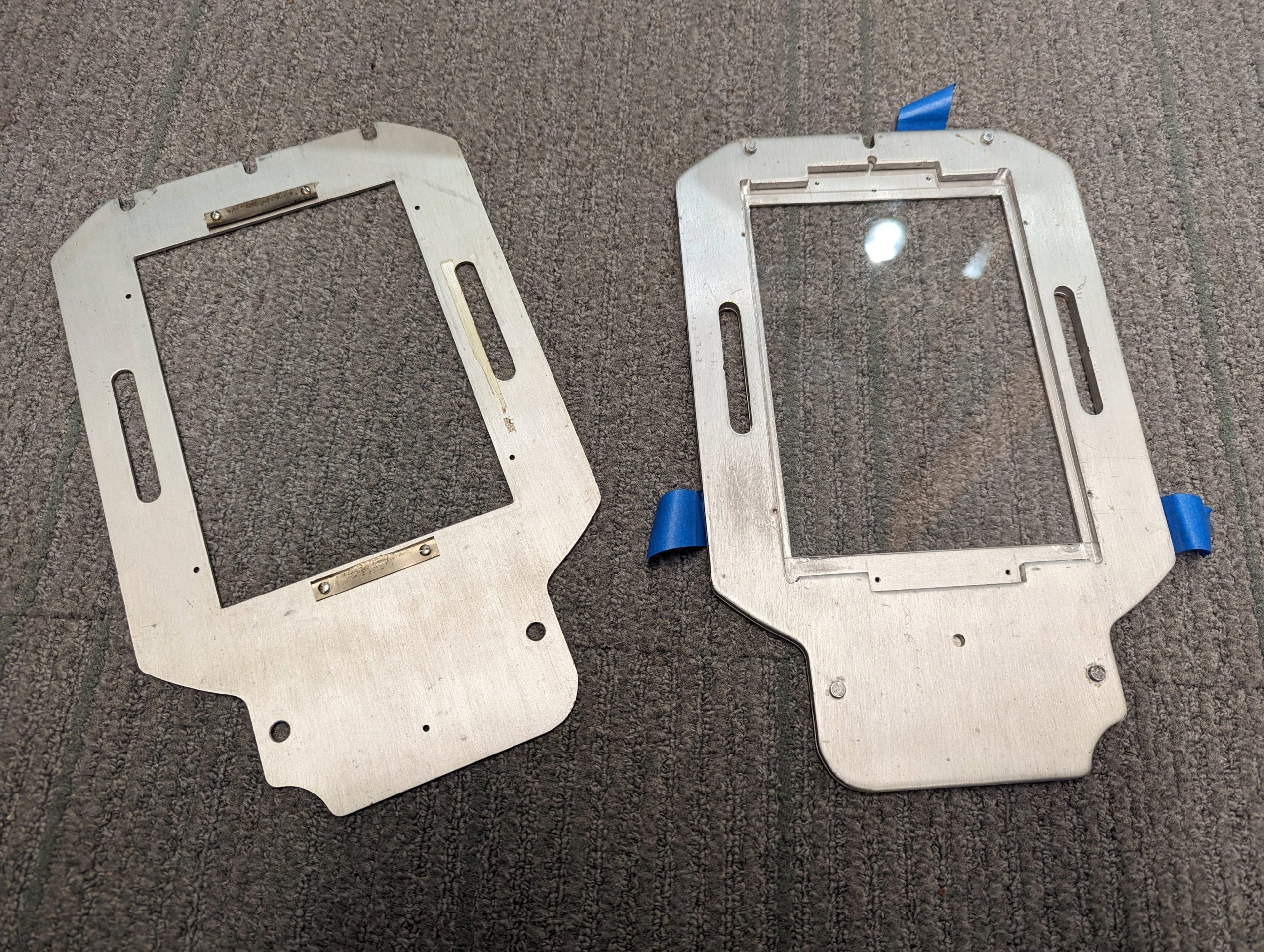
The original, nearly impossible to find, negative holders

The original, nearly impossible to find, negative holders

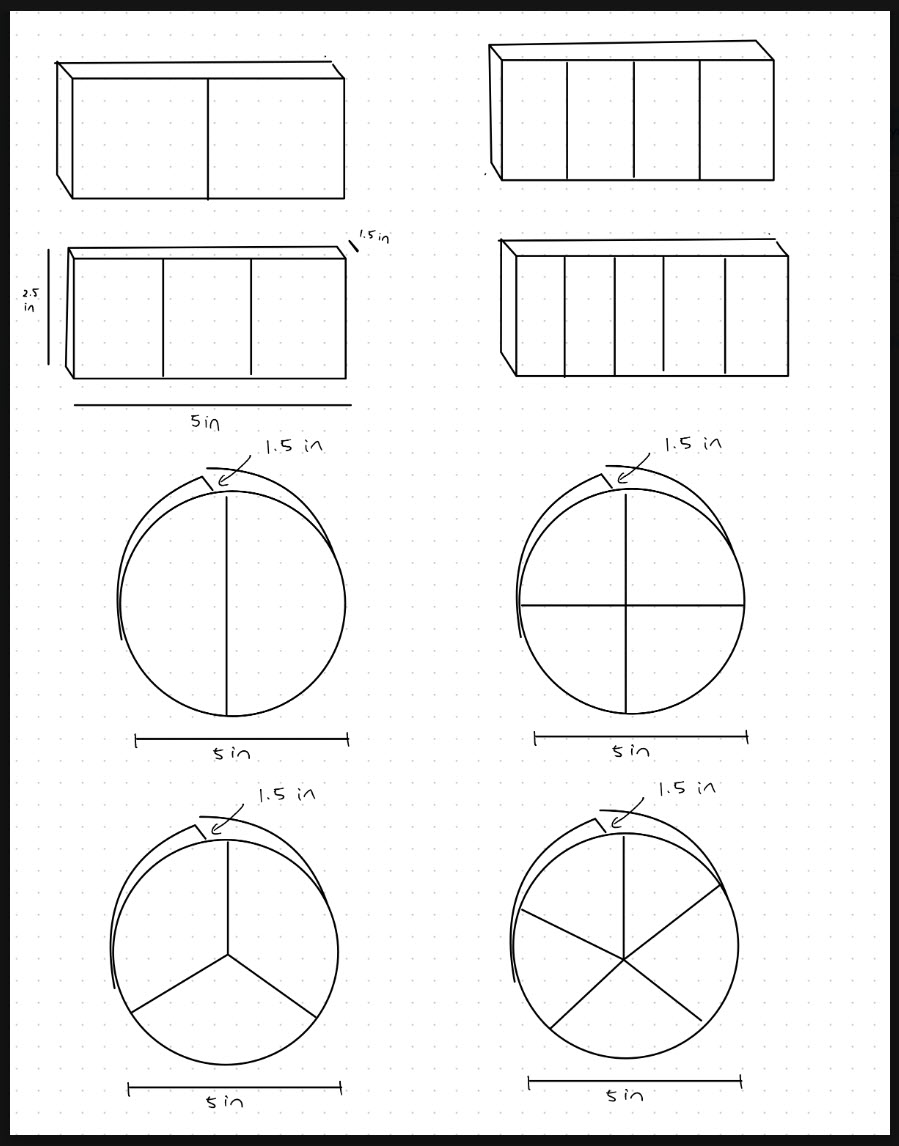
Last Winter Study, Daniel Goudrouffe, the Photo Technician for the Spencer Art Building, taught a winter study class called “Creative Portrait in the Darkroom,”  where students experimented with black-and-white film and created photomontages. The class utilizes a large-format view camera that produces 4×5-inch negatives, perfect for cutting, collaging, and combining with digital negatives to create layered portraits. However, there was one obstacle: the darkroom’s negative holders, which were essential for fitting these large negatives into the enlarger, were impossible to find online. The school’s enlarger was a rare, older, and slightly larger 5×7-inch model.

How We Solved the Problem

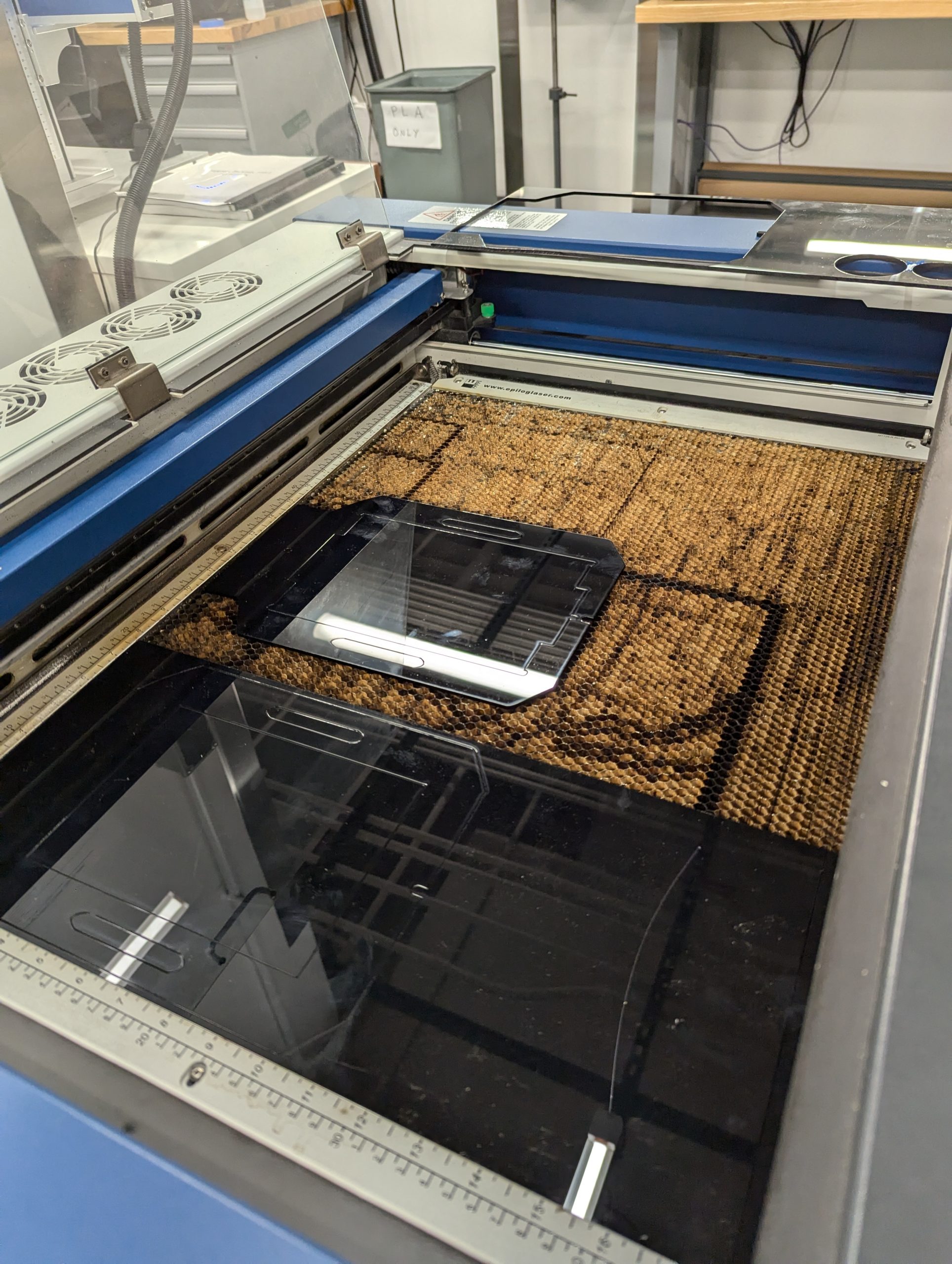
Using the Epilog to laser cut the negative holders.

Using the Epilog to laser cut the negative holders.

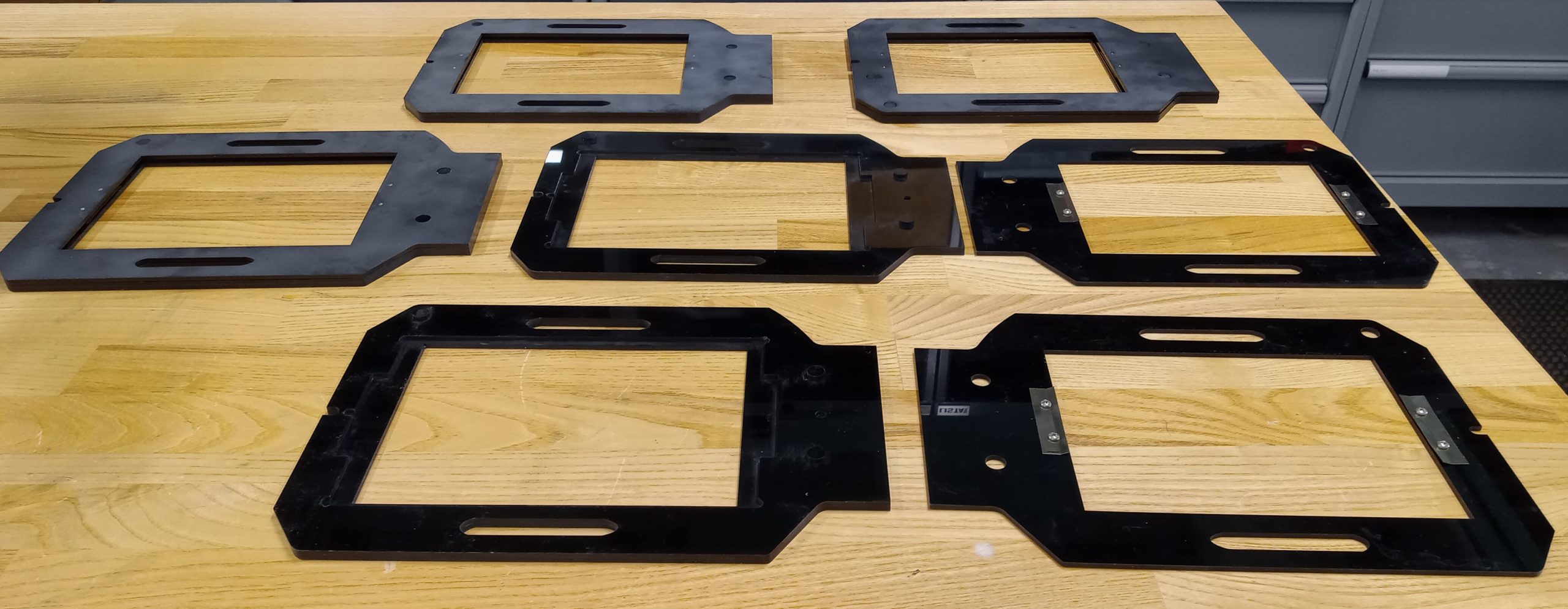
Daniel collaborated with Harris Longfield ‘27, a fellow makerspace worker, and Jason Mativi, Senior Science Center Shop Engineer, to design new holders from scratch. First, using Fusion 360, Harris and I carefully traced the original holder’s dimensions, while Mativi laser-cut and 3D-printed prototypes. After testing the first model and correcting a few asymmetries, the final versions worked flawlessly. The extra holders made a huge difference: instead of waiting in line for a single holder, ten students could now pair up and share five holders.

With the new equipment, students took their projects to the next level, pushing them further than ever. Instead of cutting paper prints, a traditional photomontage method, they cut and layered actual negatives, both film and digitally produced, to craft a one-of-a-kind composition. The larger 5×7 enlarger provided extra space around the 4×5 negatives, allowing them to add new visual elements and more information. This combination of old-school technique and modern tools opened a world of possibilities for image-making.

The five laser cut negative holders

The five laser cut negative holders

Perhaps the most striking result was how effortlessly the 3D-printed holders fit into the darkroom workflow, showing no loss of quality compared to the originals. By blending engineering with art, the project not only solved a practical challenge but also expanded the creative possibilities of analog photography, which shows how new technology can enhance and support classic film practices.

Surprises!

What surprised me most about this project was how naturally problem-solving morphed into a creative discovery. Initially, I viewed the missing negative holder as a straightforward hardware issue that required a technical solution, but I ultimately learned more: how to sketch and model a design, how to test and refine it, and the importance of teamwork in an environment where ideas are constantly evolving.

More importantly, I realized technology and art aren’t two separate worlds–they can actually amplify each other. By designing the new 3D-printed negative holders, we didn’t just replace a piece of equipment; we opened up new possibilities for creative image-making and expanded the possibilities of what a darkroom class could be. For me, that was a powerful reminder that creativity doesn’t exist in isolation: it grows when collaboration, technical skill, and art intersect. I’ll carry that forward into future projects, whether it’s prototyping or approaching any problem with both imagination and practical thinking.

Next Steps

Looking ahead, I can imagine this project leading to a shared toolkit for photographers everywhere. With tools like 3D printers and open-source design platforms, we can expand the idea by posting our files and guides online, making it possible for other darkrooms to thrive despite having vintage tools. I’d love to see this small innovation grow into a network that preserves classic practices and continually improves them through modern engineering. 


Wood, Memory, and Heritage: The Making of Engraved Gifts for Repatriation

Before: red maple wood discs, sliced from a fallen tree in Hopkins Forest

Before: red maple wood discs, sliced from a fallen tree in Hopkins Forest

Last spring, I worked on a project in the Makerspace that involved creating engraved wood slices as gifts for a reburial ceremony. This event was the reburial of the ancestors of the Stockbridge-Munsee Community. The Makerspace collaborated with Bonney Hartley, the Historic Preservation Manager at the Stockbridge-Munsee Historic Preservation office, to work on these slices. They were intended as a token of appreciation to the museums that assisted during the repatriation process. The reburial held deep significance; it was not only about returning the ancestors to the earth, but also about restoring wholeness and dignity to a community that had long been separated from its history.

The event aimed to reunite the ancestors’ remains with the funerary objects originally intended to accompany them. Over time, many of these items had been separated, often displayed in museums as artworks or stored away in boxes and plastic bags. The process of carefully unpacking, organizing, and preparing the materials for reburial required significant effort. Under the Native American Graves Protection and Repatriation Act (NAGPRA), the team undertook considerable legal and logistical work to ensure the ancestors and their belongings could be returned. Before the repatriation, they were in 10 different museums or federal collections agencies across various collections.  After years of collaboration, the team successfully reunited and reburied them, working in partnership with organizations such as the National Park Service and the U.S. Fish and Wildlife Service.

Connection to Place and Heritage

This process was deeply grounding for Bonney and the community, reaffirming their connection to place and heritage. This process restored and further grounded a sense of identity and place in the world. To them, it was truly meaningful to rebury ancestors, reunite them with the objects they were intended to be buried with, and return them to the earth.  It was, to some extent, a way to repair the past, the harm of being separated from their final resting place. It was a profound act of healing and restoration.

The wood slices were not only to appreciate the museum, but also all the people who supported them during this process. It was also an opportunity to express gratitude to the numerous staff members and individuals who work at these museums and federal institutions that hold the collection, and to appreciate those who dedicate significant time and energy to collaborating with them. Even though the focus was on the ancestors, there were people in the scenes who made it happen through goodwill and hard work. To Bonney, this gift is akin to a traditional practice and a form of reciprocity, acknowledging the mutual relationship that exists between them.

Bonney said, “It was hugely meaningful to have a piece of our homelands…” emphasizing how sharing these wood slices extended the Tribe’s tradition of gift-giving and reciprocity. Through the wood slice, in collaboration with the Makerspace and Williams College, they helped offer this gift at the reburial ceremony, and to give one piece of our homeland here in this other location for the reburial. It helps to continue the tradition of gift-giving during such an emotional and spiritual moment, restoring some aspect of the Tribe’s history.

The process of creating these gifts involved a lot of reflected care and intention:

Sanding

We began by carefully making the surfaces even to prepare the wood for engraving.

Sanding: We began by carefully making the surfaces even to prepare the wood for engraving.

Sanding: We began by carefully making the surfaces even to prepare the wood for engraving.

Laser Engraving

The Tribal Seal was then laser-engraved into each slice, and all the details were captured.

Using the Epilog Laser Engravier

Using the Epilog Laser Engravier

Finishing with Natural Oil

A few coats of natural oil protected the wood in order to enhance its texture and grain.

Applying non-toxic Walrus wood oil finish

Applying non-toxic Walrus wood oil finish

Adding Hardware

Finally, hardware was attached so each slice could be hung on a wall.

Back: hardware was attached so each slice could be hung on a wall

Back: hardware was attached so each slice could be hung on a wall

Project completed!

Project completed!

Reflection

For me, making the wood slices was more than a creative task; it was an act of participation in collective healing. It reminded me that craftsmanship can carry history and serve as a bridge between institutions and Indigenous communities.. Through this experience, I gained a deeper understanding of the history of the Stockridge-Munsee Community and the cultural significance behind the reburial event. It was truly moving to witness the respect, collaboration, and care that went into every step of the repatriation process. It’s also remarkable how the Makerspace’s efforts can be part of such a significant event, bringing together creativity, heritage, and community in a powerful way. 

LIFT Program at the Makerspace

Casen working with the Prusa XL 3D printer

Casen working with the Prusa XL 3D printer

The Learning Interventions for Teens (LIFT) program is a mentorship-based program held at Williams every winter study. This program pairs Williams College students with teenagers involved with the Berkshire County juvenile justice system. It offers teenagers an opportunity for personal growth, skill-building, and creative exploration. Over the course of three weeks, students engage in hands-on projects centered around art, photography, 3D printing, and other disciplines.

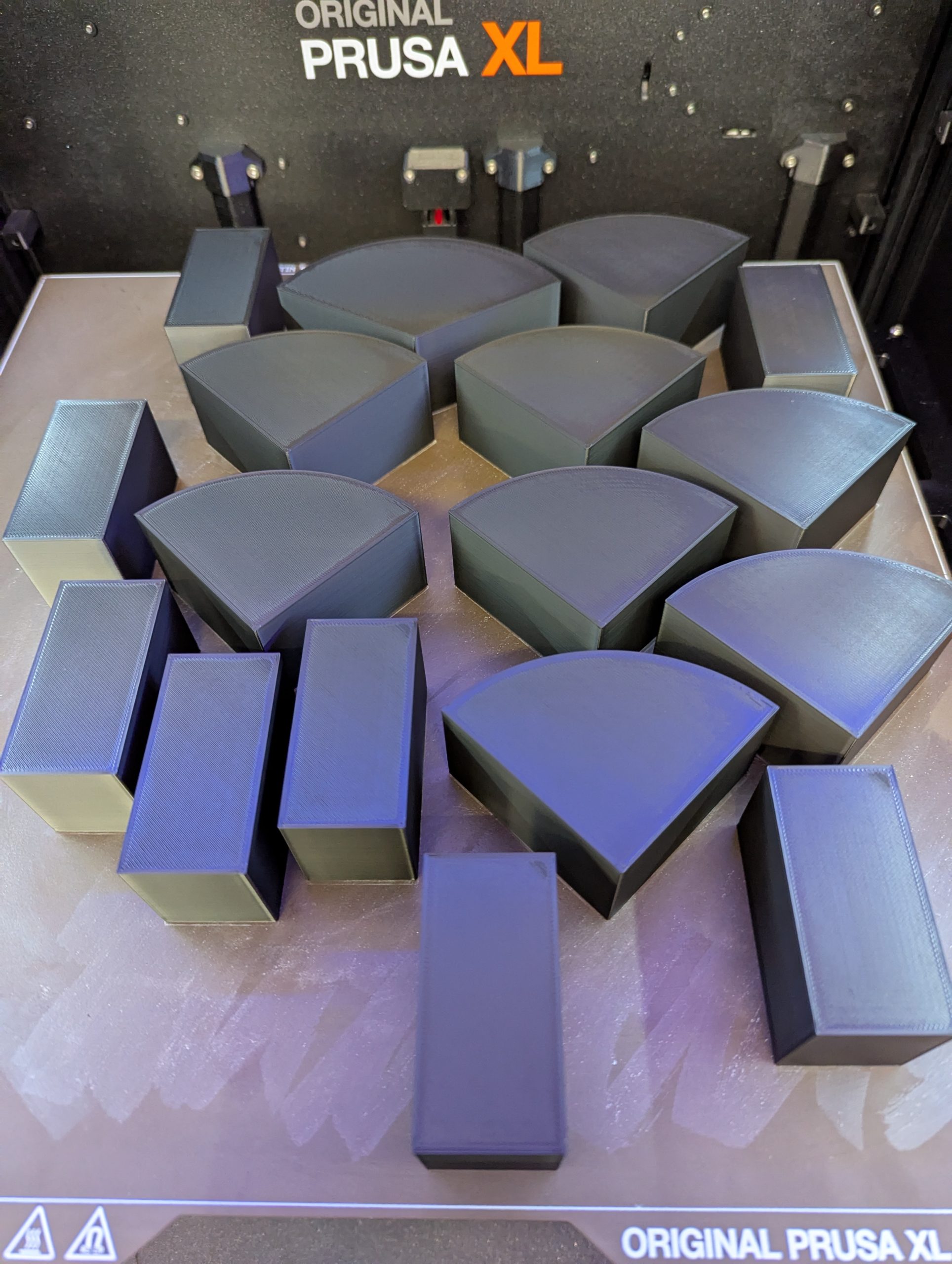
During our 2025 winter study, the Makerspace partnered with one of the mentor-mentee pairs, Sarah Sousa ’28 and Casen, respectively. Casen was interested in 3D printing and was eager to learn more about how he could use it for his project. Casen was interested in printing two cars that he envisioned using a black filament. David Keiser-Clark, the Makerspace Program Manager, and I gave Sarah and Casen a tour of the Makerspace and shared an overview of all the resources and tools that were available to them. I then worked with Casen and showed him the entire procedure involved in 3D printing, starting from slicing the 3D models to loading the filament and eventually initiating the print. After our demonstration, Casen was ready to implement the entire 3D printing process by himself.

One of Casen's 3D printed model cars

One of Casen’s 3D printed model cars

Altogether, the printing process for both cars took two days to complete. Once the prints were finished, the task of removing the supports—structures that help to stabilize the print during the process—was still a challenge. Removing the supports is usually straightforward, but it was a tricky process for these cars, yet Casen carefully removed them without damaging the prints. He was very patient with it and developed his own innovative techniques to remove them. 

During this time, Casen and Sarah also worked together on their final presentation—which I had the chance to attend on the last day of Winter Study. It was exciting to see all of the interesting projects that students in the program had been working on. The projects covered a range of topics, including nail art, attorney mentorship, and music. It was also lovely to see mentors and mentees receive their certificates of completion. I felt genuinely inspired to see how Williams’ resources helped Casen and other students explore and build upon their interests.

Soft Robots, Hard Ideas: Injection Molding Potential at a Liberal Arts College

An example of a silicone injection molding product, showcasing the material's flexibility.

An example of a silicone injection molding product, showcasing the material’s flexibility.

You might think that silicone injection molding sounds like something reserved for manufacturing plants. Yet, here at the Williams College Makerspace, we can find ways to bring this exciting technology to life using everyday construction tools and 3D printing. This isn’t just engineering—it’s a creative exploration, turning seemingly ordinary objects like caulking guns into tools for building soft robots. At its core, a silicone injection molding project attempts to push the boundaries of what can be done in a liberal arts setting. It sees engineering as a form of art, a craft, and a discipline that invites exploration. As we work towards a silicone injection molding setup, we’re also building a community of thinkers and creators who can look at a caulking gun and see a tool for designing robots. With support, we’ll be able to take projects like these further, offering more students the chance to bridge art and science in new and unexpected ways.

By bringing injection molding to the Makerspace, we’re making a bold statement: at a liberal arts college, the sky’s the limit. Whether you’re a computer science major, a robotics enthusiast, or just someone curious about hands-on creation, this is a project where technology meets artistry and creativity knows no bounds.

Why Construction Tools in a Liberal Arts College?

At first glance, using caulking guns, mixing nozzles, and blowout adapters might seem unusual at a college better known for Shakespeare than silicone molds.

Jack Scissor Stand platform used under the mold to align it perfectly with the nozzle; prevents leaks or uneven filling.

Jack Scissor Stand platform used under the mold to align it perfectly with the nozzle; prevents leaks or uneven filling.

Yet, in our Makerspace, we’ve discovered ways to effectively combine conventional tools (i.e., wrenches, bolts), digital tools (e.g., 3D modeling and printing software), and small machines (3D scanners and printers) to explore hands-on solutions to academic problems. We are able to use these accessible tools to achieve effective results without needing expensive, industrial-scale equipment. These tools can be potent gateways into multidisciplinary learning. By blending traditional tools with advanced (or emerging) digital technologies, we encourage students from diverse academic backgrounds—ranging from studio art, history, and philosophy, to computer science—to collaborate, share perspectives, and approach problem-solving creatively. More than just crafting parts, we’re cultivating a vibrant, interdisciplinary community at Williams.

A caulking gun. This is the primary tool used to push the silicone through the cartridges and into the mold. It provides the necessary pressure for injection.

A caulking gun. This is the primary tool used to push the silicone through the cartridges and into the mold. It provides the necessary pressure for injection.

2-part Silicone Cartridges. These hold the silicone material (typically a 1:1 ratio of two parts that mix and cure into a flexible silicone).

2-part Silicone Cartridges. These hold the silicone material (typically a 1:1 ratio of two parts that mix and cure into a flexible silicone).

Static Mixing Nozzles. These ensure that the two parts of the silicone mix properly before being injected into the mold.

Static Mixing Nozzles. These ensure that the two parts of the silicone mix properly before being injected into the mold.

A blowout adapter. This tool helps clean the cartridges so that they can be reused, reducing waste and ensuring a cleaner process.

A blowout adapter. This tool helps clean the cartridges so that they can be reused, reducing waste and ensuring a cleaner process.


Robots with a Gentle Touch

A soft robot arm picks up a piece of celery. Credit: Soft Robotics, a Cambridge-based robotics company.

A soft robot arm picks up a piece of celery. Credit: Soft Robotics, a Cambridge-based robotics company.

Imagine crafting robots capable of gently handling fragile objects—robots that sense touch, pressure, and temperature, just like living organisms. Silicone injection molding is a fantastic way to create complex, flexible parts with incredible precision. Using a 2-part silicone system and a caulking gun, we’re designing a setup where liquid silicone is injected into a mold and cured, resulting in strong and flexible parts. By experimenting with this technology, we learn the practicalities of fabrication and expand what’s possible in soft robotics research on campus. Each part we make brings us closer to designing robots that can perform tasks with a gentle touch and responsiveness that other kinds of (rigid) robotics can’t achieve. At the core, the process is surprisingly simple yet fascinating. Imagine squeezing liquid silicone into an optimally crafted mold, where it settles and cures, creating detail with precision. It’s like utilizing a high-tech caulking gun, but with a twist—turning liquid into a finely molded solid form.

Our silicone injection molding project opens up some interesting real-world applications. For example, soft robotics has applications in healthcare by aiding minimally invasive surgical procedures and using silicone-molded tools to handle tissues carefully.

These aren’t just fascinating theoretical ideas; they’re practical innovations being explored at Williams, especially within our Computer Science Department under Professor Jim Bern. Specifically, it is intended for use in classes like CSCI 345 – Robotics and Digital Fabrication, aligning closely with Professor Bern’s research interests in soft robotics.

Harvard researchers equipped soft robotic grippers with embedded sensors that can sense diverse inputs such as movement, pressure, touch, and temperature. Credit: Ryan L. Truby/Harvard University

Harvard researchers equipped soft robotic grippers with embedded sensors that can sense diverse inputs such as movement, pressure, touch, and temperature. Credit: Ryan L. Truby/Harvard University

Researchers at Cornell University have developed a soft robotic hand with a touch delicate enough to sort tomatoes and find the ripest one. Credit: Huichan Zhao/Organic Robotics Lab, Cornell University

Researchers at Cornell University have developed a soft robotic hand with a touch delicate enough to sort tomatoes and find the ripest one. Credit: Huichan Zhao/Organic Robotics Lab, Cornell University


Optimization: Making The Most of Things

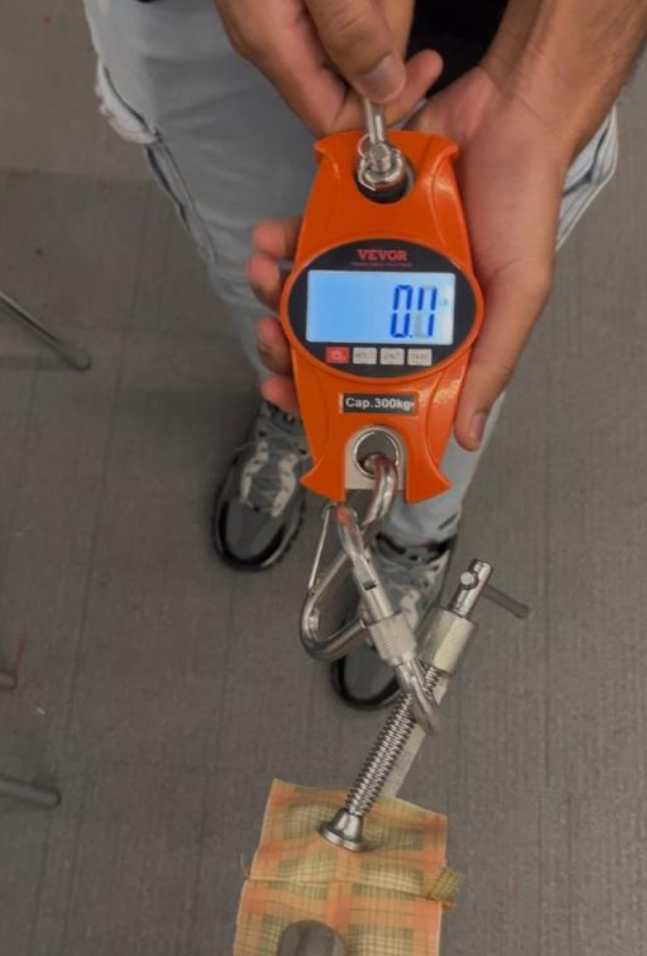
One of the biggest lessons was in optimization when conducting equipment research. When you’re given a budget and a task, you need to be efficient with your use of money and essentially get the most bang for your buck. In concrete terms, if you find two sets of static mixing nozzles—one that costs $45 and another that delivers the same results that goes for $15—you’d optimally pick the latter. Researching various construction tools to create a concept model of our DIY silicone injection molding device reinforced to me how impactful thorough pre-production research and budgeting can be. 

An example of a DIY Silicone Injection Molding device.

An example of a DIY Silicone Injection Molding device.

Reflection

Working on technological projects has transformed my educational journey. The Makerspace isn’t just a workshop. Here, I’ve learned that exploration, trial and error, and collaboration are as crucial as technical proficiency. By engaging with staff, faculty, and peers, my understanding of the larger world of technological innovation has deepened significantly, showing me just how powerful hands-on learning at a liberal arts institution can be.

Special thanks to Divya Sijwali (’28) and David Keiser-Clark, Makerspace Program Manager, for supporting this blog post!