Stuffed Cats and Stubborn Needles: A Beginner Sewing Workshop

The promotional poster created by the communications team at the FabLab.

The promotional poster created by the communications team at the FabLab.

The goal of this workshop was to have participants (a total of 8 people attended) learn basic sewing and cutting skills through the process of making a small stuffed cat. We started out by picking colors for our felt and thread, and then I instructed students how to thread a needle and sew on eyes. This part seemed to be the most challenging for people who have never sewn before, as threading a needle can be frustrating, and figuring out how to properly sew buttons can be a bit tricky. But after this step, everyone seemed much more comfortable and required less induction on how to sew both sides of the felt together. 

Success: Everybody Made One

A photo of our participants hard at work.

A photo of our participants hard at work.

There was an option to attach a keychain to the stuffy, which some people chose.

Since attaching the keychain can be challenging, I took the lead, giving a detailed explanation of what I was doing. By the end of the workshops, all participants were able to make at least one stuffy, with a few making more than one. We’re hoping to do another sewing session soon, maybe expanding beyond cats to other animals or characters based on participant suggestions. I’m hoping next time we get returning participants who enjoyed the community-building aspect of the workshop. 

Finished Projects

A cat stuffy made by Franz-Hank.

A cat stuffy made by Franz-Hank.

A bat stuffy made by Alessandra.

A bat stuffy made by Alessandra.

A Piece of Fall on Your Desk: Making Wire Trees in the FabLab

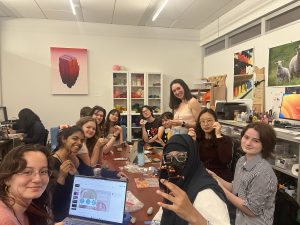
A group of participants in the FabLab working on their wire trees.

A group of participants in the FabLab working on their wire trees.

It’s autumn in the Berkshires, and the hillsides have transformed into a living mosaic of yellow, orange, and red. Every bend in the road feels like a painting. It’s the kind of season that makes you slow down and breathe deeply, and that invites reflection and creativity alike. As the temperatures drop and daylight shortens, people naturally turn toward warm, tactile projects, something to do indoors while still feeling connected to the changing world outside.

Inside the FabLab at Williams, the tables were covered with coils of copper wire, bowls of fall-colored beads, and smooth palm-sized rocks gathered from nearby paths. Students filled the space, laughing, chatting, and ready for some creativity. More than a crafting session, it was a moment of community. Some students designed these fall wire tree centerpieces as gifts for friends or family, and others planned to display theirs on desks or windowsills, a reminder of the Berkshires’ fleeting colors. 
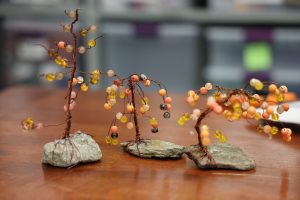
Examples of the completed wire trees.

Examples of the completed wire trees.

To get started, you need only a few simple tools: a ruler, a rock, a pair of wire cutters, hot glue, and of course, plenty of wire and beads. It’s helpful to measure and cut the wire strands ahead of time to about 5 inches per strand. 

The process of creating a fall wire tree centerpiece begins quite simply with the rock. The base grounds the wire tree. A flat, stable rock works best, especially since the finished tree can grow unexpectedly heavy once adorned with dozens of beads. The balance of weight and width matters: you want the stone to hold the span of the tree’s branches so that the sculpture stands upright.

Once the base is chosen, the creativity begins. You start from the ground up, forming the roots, then the trunk, and finally the branches. When it comes time to form the trunk, a bit of strength is required. You twist multiple boughs together, compressing them into a single sturdy column. It’s worth studying real tree forms or even looking at reference photos online to understand how trunks curve and how roots flare out. This reminder of how art is connected with ecology is part of an idea called biomimicry, the study of how nature’s solutions inspire sustainable human innovation (to read more, see the Biomimicry Institute here).

Once the trunk is done, it helps to focus on the primary branches, and then the smaller offshoots. After that comes the most time-consuming but perhaps most rewarding step: adding the foliage. Every bead must be threaded, secured, and adjusted, one at a time. Each leaf cluster begins by threading a bead onto a wire strand and looping it in place, twisting the ends together to secure it. It is meditative work. Some students in the FabLab played quiet music as they worked, and others chatted about classes or what they did on Mountain Day. 

Twisting the roots around the rock is the next step, and though it is not always visible in the final display, it’s vital to the sculpture’s integrity. After securing the tree to its base, students used a bit of hot glue to hold the tree down, then gave it one last round of adjustments.

Beyond its aesthetic beauty, this project embodies something larger. Crafting a fall wire tree centerpiece merges creativity with design thinking, transforming simple materials into a meaningful object through a process of iteration and visualization. As Susan Biali Haas reports in Psychology Today, research even shows that working with our hands strengthens spatial reasoning and fosters mindfulness (read more here). 

By the end of my workshop, the sun was dipping low behind the Berkshire hills, setting the horizon ablaze with pink and orange. The students packed up their tools, chatting about weekend plans, when they would see each other next, and ideas for future workshops I could hold. 

While real leaves will soon scatter and decay, the copper wire and fall-colored beads will continue to catch the light long after the snow begins to fall.

Fablab wire tree blog post

Honoring Heritage Through Craft

Divine Uwimana ‘27 sands the circular wood slices to prepare them for their laser engravings.

Divine Uwimana ‘27 sands the circular wood slices to prepare them for their laser engravings.

In spring 2025, the Williams College Makerspace partnered with the Stockbridge-Munsee Community to create truly meaningful engraved wooden appreciation gifts for museums that supported the repatriation of ancestors and sacred items. The gifts were presented at the Community’s reburial ceremony on April 24, 2025.

Each circular wood slice, roughly nine inches wide, is engraved with the Stockbridge-Munsee Tribal Seal and the words “Anushiik / Oneewe 2025”  meaning “thank you” in Munsee and Mohican. These tokens were designed to express gratitude, respect, and remembrance.

From Idea to Creation

Divine Uwimana ‘27 puts non-toxic wood oil on the appreciation to protect and enhance the grain.

Divine Uwimana ‘27 puts non-toxic wood oil on the appreciation to protect and enhance the grain.

Makerspace Program Manager, David Keiser-Clark, and Makerspace partner Divine Uwimana ’27 worked closely to bring the Community’s vision to life. Using existing wood slices from David’s collection, they carefully sanded and treated each one with natural oil to highlight the grain.

The engraving process balanced tradition and precision. The Tribal Seal, provided by the Community, was transferred into engraving software and etched using a laser or CNC machine. A small eyelet hook and twine were added to each piece so they could be easily displayed.

Challenges and Creative Solutions

Because each wood slice had natural variations in size and shape, the team adjusted engraving placements to keep the designs centered. Tight deadlines also meant careful scheduling from design approval in March to production and finishing in April.

The Final Pieces

The finished plaques feel both grounded and symbolic. The wood’s natural texture connects to the earth, while the engraved seal ties the pieces to heritage and identity. Together, they represent gratitude and shared stewardship between the Stockbridge-Munsee Community and museum partners.

Sustainability and Learning

This project emphasized sustainability, reusing wood, choosing natural oils, and minimizing waste. It also provided hands-on learning in digital design, engraving, and collaborative creation across cultural contexts.

A Gesture of Gratitude

The engraved wood appreciations are more than gifts; they are acts of respect. They honor the return of ancestors to their homeland and recognize the partnerships that made it possible, a reminder that craftsmanship can help carry forward stories of reconciliation, heritage, and care.

Special thanks to the Stockbridge-Munsee Community for their guidance and cultural leadership, and to the Williams College Makerspace and Science Shop for their support.

Finished engraved wood appreciations ready to be presented at the Community’s reburial ceremony.

Finished engraved wood appreciations ready to be presented at the Community’s reburial ceremony.

Folding Culture into Craft: 3D Pop-Up Cards at the FabLab

As part of International Education Week at Williams College, the FabLab hosted a 3D Pop-Up Gift Card Workshop, offering students a hands-on way to explore cultural expression through craft and design. Making pop-up cards is beginner-friendly and accessible, so the event welcomed participants of all skill levels. The focus? Create something personal: cards that reflected cultures, holidays, traditions, memories, or just artistic inspirations on paper.

One of the many amazing cards made during the workshop! This 3D pop-up gift card made by Carmen (photo taken by Carmen).

One of the many amazing cards made during the workshop! This 3D pop-up gift card made by Carmen (photo taken by Carmen).

The workshop setup was simple and inviting. Tables were covered in colorful pieces of paper, scissors, glue sticks, markers, and any materials for card making. Some students followed sample templates, while others sketched out their own ideas. There were Christmas trees and Diwali lamps, abstract patterns and handwritten poems. One student made a theater inspired card that showcased her favorite drama productions, while someone else made a card for a friend they missed back home. Another said, “This one’s for me, because self-love deserves representation.”

The process itself had its challenges and charm. Some folds took five tries. One student spent 15 minutes getting a single crease right, then yelled, “I DID IT!” loud enough to scare the glue sticks. Others discovered that lining up a pop-up platform just right takes a surprising amount of patience. But by the final hour, even the people who walked in saying “I’m not an art person” were holding up their cards like trophies.

And while it was all about creativity, the workshop naturally became a space for cultural exchange. As students worked, conversations unfolded about holidays celebrated differently across the world. Two students realized they celebrate the same holiday but with totally different traditions, and ended up swapping design ideas. Others shared music playlists or childhood stories while layering paper and ink.

Some cards were destined for family back home. Others were given to friends on campus, or tucked away as keepsakes. Whatever the purpose, each card became a small, folded expression of identity, memory, or experience. The FabLab provided the materials, but the room was filled with shared experience, laughter, and little victories.

In a fast-moving semester, this workshop reminded us to slow down and take the time to make something with our hands. It wasn’t just about making art; it was about creating space for connection, reflection, and a little fun. And when the last cards were folded and the scraps swept into the recycling bin, what remained was a room full of people who had built something: on paper and in a diverse community.

Participants creating their unique versions of 3D gift cards for their friends and family during the International Education Week (photo by Carmen).

Participants creating their unique versions of 3D gift cards for their friends and family during the International Education Week (photo by Carmen).