Astral Sea: Weaving Memory, Migration, and Movement at Williams College

This year, Williams College collaborates with the Clark Art Institute to become a vital site for the next chapter of Astral Sea, an ongoing series by multidisciplinary artist Tsedaye Makonnen. Known for blending performance, sculpture, and textile arts, Makonnen’s work explores the intertwined themes of resilience, memory, and migration. Her residency at Williams extends this exploration through a series of collaborative workshops, performances, and community engagements that invite both participation and reflection.

Kusika dancers shroud themselves in fabric for Makonnen’s performance. (Photo courtesy of Brad Wakoff.)

Kusika dancers shroud themselves in fabric for Makonnen’s performance. (Photo courtesy of Brad Wakoff.)

The Vision Behind Astral Sea

Tsedaye Makonnen unpacking and seeing the woven mylar demo for the first time.

Tsedaye Makonnen unpacking and seeing the woven mylar demo for the first time.

At its core, Astral Sea is about creating immersive, multi-sensory experiences that transcend traditional performance boundaries. The project weaves together live dance, sculptural installations, soundscapes, and reflective textiles, many of which are inspired by Makonnen’s light sculptures. These elements come together to embody themes of diasporic memory, spiritual resilience, and the cosmic connections between people and places.

In this iteration, produced by Williams College and presented at the Clark, Makonnen collaborates closely with Kusika, the college’s African dance and percussion ensemble, and a broader network of faculty, students, and staff across departments like WCMA, Theater, Dance, Makerspace, FabLab, Science Shop, and the Sculpture Studio. This partnership is supported by the Gaudino Fund and fosters a unique interdisciplinary environment where art, technology, and community engagement converge.

Materials as Storytellers

Staff and faculty examining Zea Barker's fabric for Tsedaye Makonnen’s Astral Sea series. From left to right: Kyle Yager, Samantha Pasapane, Tsedaye Makonnen, and Sandra Burton.

Staff and faculty examining Zea Barker’s fabric for Tsedaye Makonnen’s Astral Sea series. From left to right: Kyle Yager, Samantha Pasapane, Tsedaye Makonnen, and Sandra Burton.

A central feature of Astral Sea is its sculptural textiles—large, flowing fabrics adorned with shimmering materials that move and reflect light during performances. These are not just aesthetic choices; they are vessels for storytelling. Makonnen and her collaborators have been experimenting with a range of unconventional materials:

Blue fabrics and appliqué

Custom-made textiles in various sizes, embellished with symbols, mylar cut-outs, mirrored acrylic, and smelted aluminum disks. These components create a dynamic visual and acoustic experience as performers interact with the fabrics.

Upcycled aluminum: Samantha Pasapane of the Sculpture Studio worked with the team’s requests to forge and cast aluminum—from the Science Shop’s CNC shavings —into blocks. Samantha smelted the aluminum, cast it as a rectangular block, cut a slice with a metal bandsaw, and then polished that to a mirror reflective finish. This was one of many material experiments that the team conducted to determine what kinds of materials would function most effectively being sewn into the fabrics. There were even discussions of sourcing aluminum from cans collected at the U.S.-Mexico border, linking the material to Makonnen’s broader themes of displacement, asylum, and echoing global migration. Like a variety of materials tested, this particular process was not selected for adorning the final textiles.

Aluminum shavings from the Science Shop's CNC machines were repurposed and cast into aluminum blocks.

Aluminum shavings from the Science Shop’s CNC machines were repurposed and cast into aluminum blocks.

Samantha Pasapane of the Sculpture Studio experiments with forging aluminum from CNC shavings into blocks, and then polishing to a mirror reflective finish. Left: cutting a slice with the bandsaw; Middle: polishing with a drill mounted 3M abrasive pad; Right: the final slice is highly polished.

Samantha Pasapane of the Sculpture Studio experiments with forging aluminum from CNC shavings into blocks, and then polishing to a mirror reflective finish. Left: cutting a slice with the bandsaw; Middle: polishing with a drill mounted 3M abrasive pad; Right: the final slice is highly polished.

Mirrored acrylic and mylar

Laser-cut into symbolic shapes, these reflective elements catch light during performances, amplifying the visual impact and connecting to Makonnen’s signature light sculpture motifs.

Jason Mativi of the Science Shop uses the Epilog Laser Helix machine to cut mylar for decorating fabric.

Jason Mativi of the Science Shop uses the Epilog Laser Helix machine to cut mylar for decorating fabric.

Mirrored acrylic was also laser cut in the Science Shop on an Epilog Laser Helix machine.

Mirrored acrylic was also laser cut in the Science Shop on an Epilog Laser Helix machine.

Bells and sound elements

Some fabrics incorporate bells and metal disks, adding an auditory layer that enhances the sensory immersion of the piece.

Every material choice is intentional, contributing to a tapestry of textures, sounds, and reflections that mirror the complexity of human migration and spiritual continuity. The fabrication process itself is a collaborative effort, involving professionals like Zea Barker (Textile Fabricator) and numerous student volunteers, ensuring both technical precision and educational engagement.

The Process: Collaboration in Motion

The residency at Williams has been punctuated by a series of workshops designed to engage students and community members in the making of Astral Sea. These include:

Textile and Soft Sculpture Workshops

Participants learned about the materials and techniques used to create the sculptural fabrics, from cutting mylar symbols to sewing reflective appliqués.

Weaving reflective mylar into Tsedaye Makonnen's Astral Seas project. Left: Before weaving the mylar, the loom must be threaded to create a warp. Middle: Creating a demo weaving in the FabLab to demonstrate a variety of mylar widths and explore looser or tighter weaving of materials. Right: Final woven demo. Weaver: David Keiser-Clark.

Weaving reflective mylar into Tsedaye Makonnen’s Astral Seas project. Left: Before weaving the mylar, the loom must be threaded to create a warp. Middle: Creating a demo weaving in the FabLab to demonstrate a variety of mylar widths and explore looser or tighter weaving of materials. Right: Final woven demo. Weaver: David Keiser-Clark.

Movement Workshops

Led by Makonnen and Kusika director Sandra Burton, these sessions explored how performers embody and interact with the textiles, integrating dance, ritual, and improvisation.

Oral History Workshops

Led by Makonnen and WCMA Curator Roz Crews, these sessions explored storytelling as a critical component of the performance.

Technology Integration

The Makerspace, FabLab, Science Shop, Sculpture Studio, and Zea Barker explored innovative elements like muscle wires (shape-memory alloys), body-mounted fans to billow fabric, an air curtain, and even virtual reality body tracking tools to map movement and choreography. In addition, these teams tested a variety of materials that could connect with the billowy fabric including: varying weights and types of handle attachments; hand-woven mylar that could serve as a trim; 3D printed rainsticks to add sound. These experiments reflect a commitment to pushing the boundaries of performance through interdisciplinary exploration.

Iterating with a variety of fans to explore billowing effects for the dancer's fabric. From left to right: Kyle Yager, Tsedaye Makonnen, and Jason Mativi. Out of frame: David Keiser-Clark.

Iterating with a variety of fans to explore billowing effects for the dancer’s fabric. From left to right: Kyle Yager, Tsedaye Makonnen, and Jason Mativi. Out of frame: David Keiser-Clark.

Using powerful fans to create billowing effects. From left to right: Kyle Yager and Jason Mativi. Out of frame: Tsedaye Makonnen and David Keiser-Clark.

Using powerful fans to create billowing effects. From left to right: Kyle Yager and Jason Mativi. Out of frame: Tsedaye Makonnen and David Keiser-Clark.


Looking Ahead: Performance and Community

The culminating performances for this phase of Astral Sea are set for Fall 2025, including a major presentation at the Clark Art Institute. These events will activate the sculptural textiles through dance, light, and sound, transforming spaces into living canvases of migration, memory, and cosmic connection.

Through these efforts, Astral Sea is not just an artwork—it is a living, breathing collaboration between artist, institution, and community. It offers a platform for reflection on shared histories and futures, reminding audiences of the unseen threads that connect us across time, space, and culture.

A student rehearsal of Tsedaye Makonnen’s Astral Sea series.
A student rehearsal of Tsedaye Makonnen’s Astral Sea series.
More Information

Capping Off the Journey: A Senior Celebration

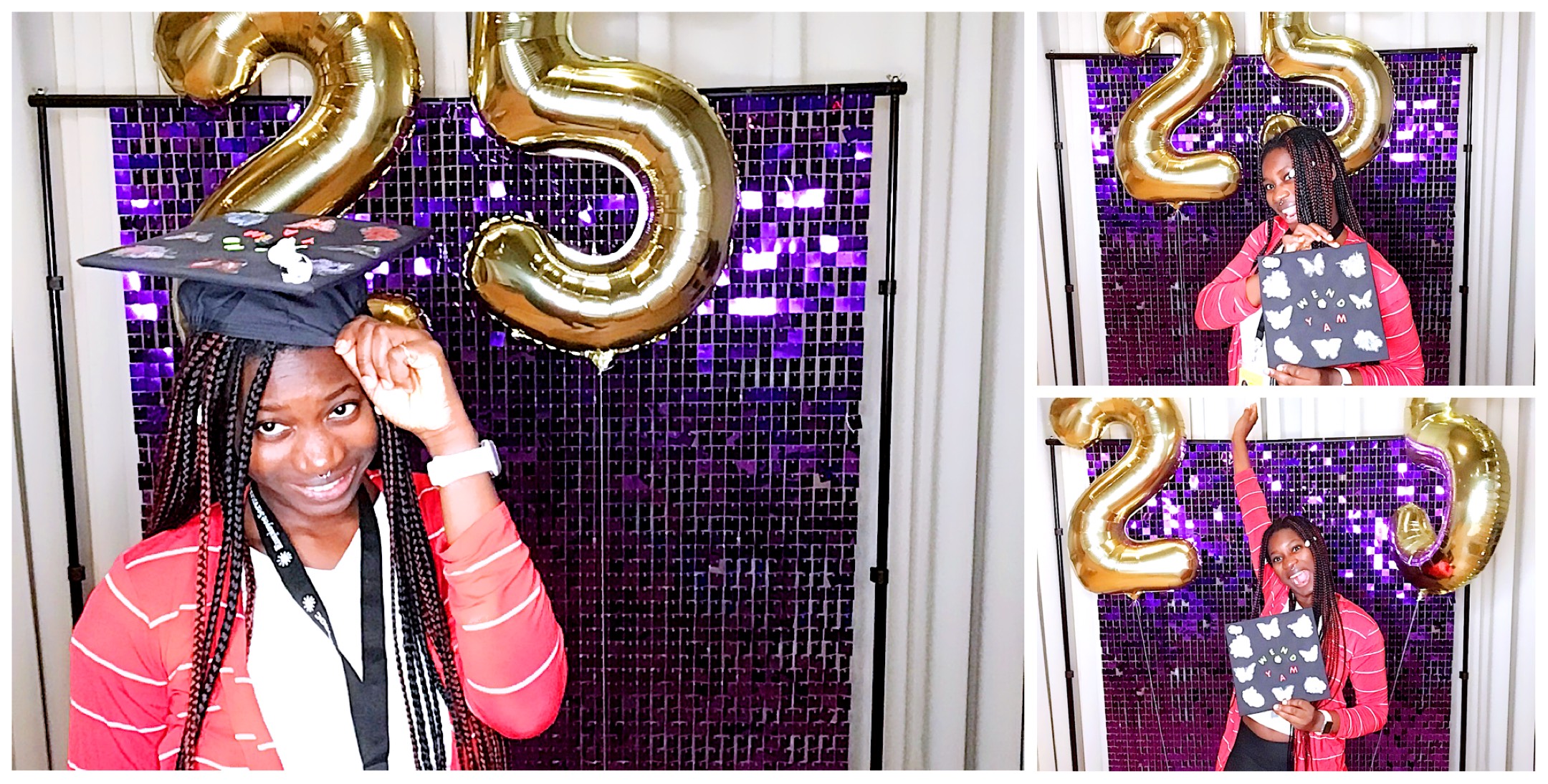
2025 Graduating Senior!

2025 Graduating Senior!

This February, seniors gathered at the Davis Center for a creative afternoon of cap decorating, laughter, and celebration. The event, held on Friday, February 14th from 3–5 PM during Winter Carnival, gave graduating students the chance to personalize their mortarboards before Commencement and take a breather before the whirlwind of spring really sets in.

The idea for the event came from College Marshal Lee Park and Director of Academic and Presidential Events Lauren Barenski, who wanted to create a relaxed and joyful space to encourage students to pick up their caps and gowns early and to add a little extra sparkle to Commencement.

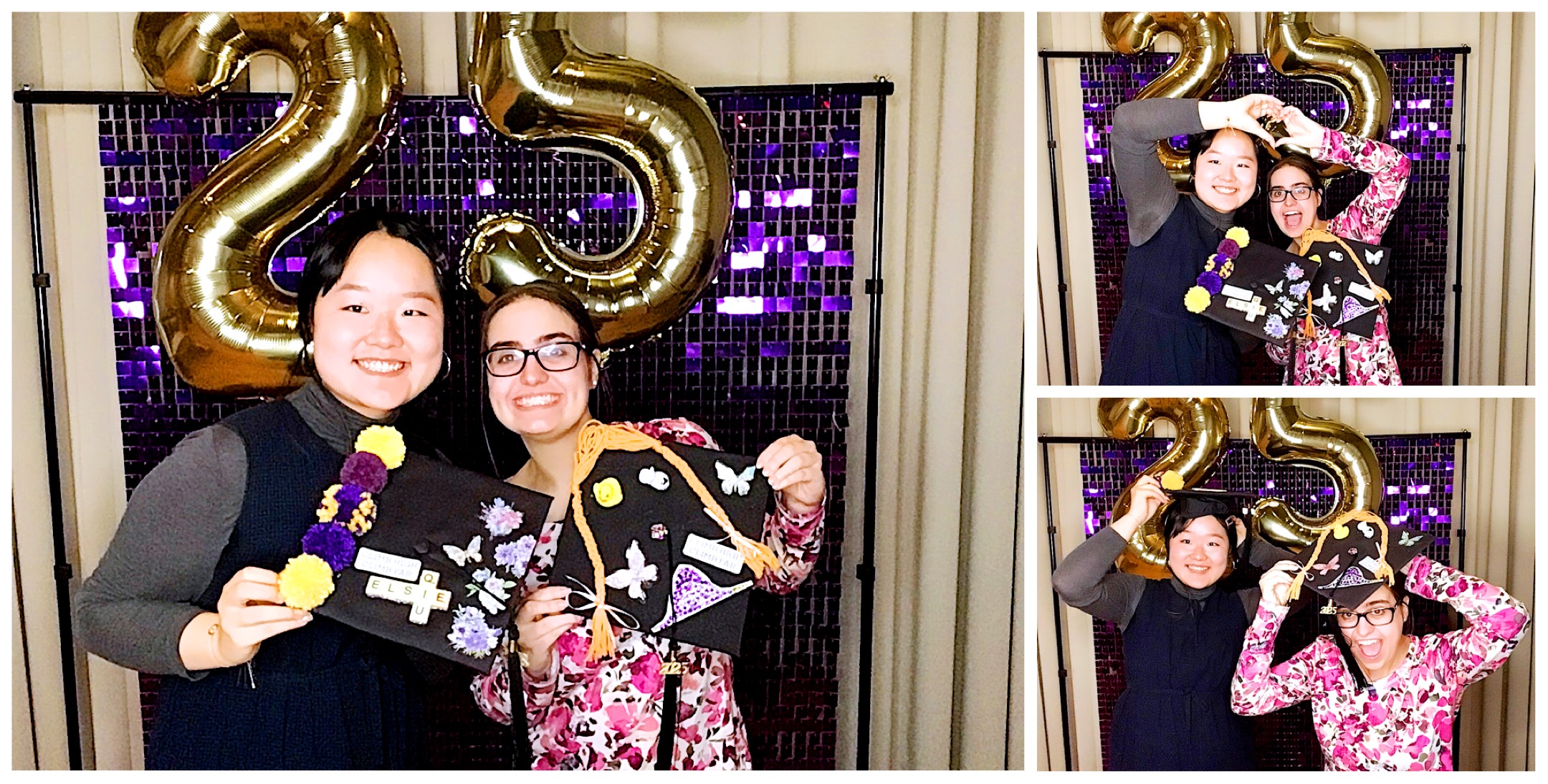
2025 Graduating Seniors!

2025 Graduating Seniors!

Decorating supplies were in no short supply. Thanks to the efforts of the FabLab, Campus Life, and the Makerspace, the room was filled with all the artsy bits and pieces anyone could ask for: scrabble tiles, glitter glue, rhinestones, stickers (including some donated by Alumni Engagement), ribbon, rubber duckies and cows, hot glue guns, pom pom makers, and even silk screens designed just for the event. For anyone who wanted to go big, the FabLab also had Cricut machines and power strips ready to go, and student workers were on hand to show folks how to use everything. One student even added braids to her cap in honor of Pippi Longstocking and a statistics class that changed her life!

As students designed their caps, they could also swing by the photo booth for fun graduation pics complete with props and plenty of smiles. Lauren Barenski kindly took the lead on managing the booth, making sure everyone got their moment to shine. This video promo shared beforehand reminded students to bring their caps (and ideas!) and offered helpful tips like sketching out your design first, spacing letters evenly, and testing materials before gluing things down permanently. Although turnout wasn’t as high as hoped, the students who came definitely got into it, creating beautiful, meaningful designs that reflected their time at Williams.

Looking ahead, there’s more fun to come! With leftover supplies on hand, the team hopes to collaborate with the student All Campus Entertainment (ACE) group to host another cap decorating event during Senior Week—so stay tuned for details. This cap-decorating gathering wasn’t just about craft supplies or fun photos. It was about community, creativity, and carving out time to reflect on the journey through Williams. In the sea of matching gowns this June, these personalized caps will speak volumes about each student’s story, passions, and memories—and it all started on a snowy February afternoon at the Davis Center.


Upcycling with Purpose: Breathing New Life into the Makerspace

When you walk into the Makerspace this summer, you might notice a few new additions that don’t quite look “new.” That’s the point.

This summer, the Makerspace team of Divine Uwimana ‘27, Qi Wang ‘26, and David Keiser-Clark, Makerspace Program Manager, brought new meaning to old materials, transforming pieces of Williams history into functional, beautiful tools for creativity and collaboration.

Apothecary Cabinets

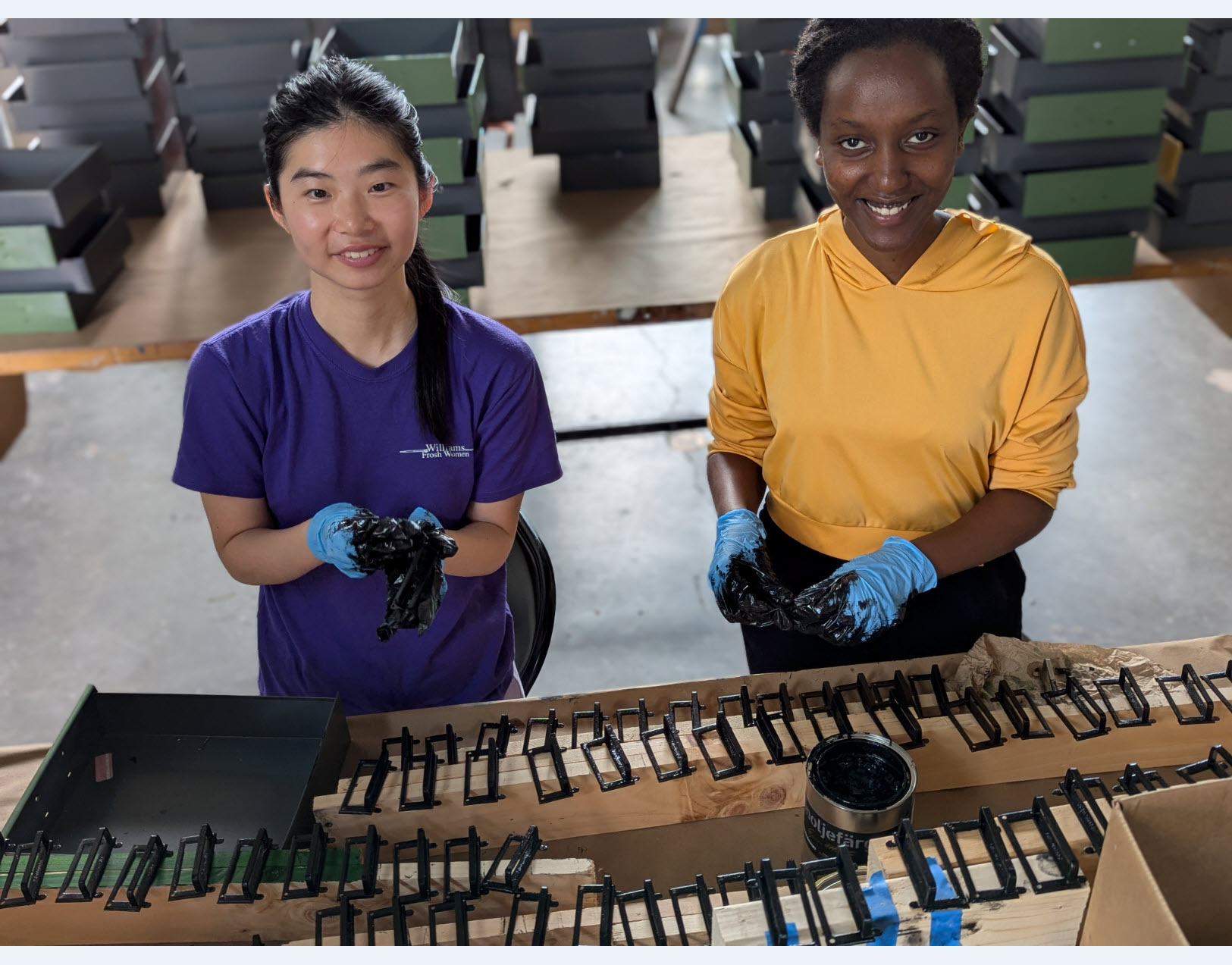
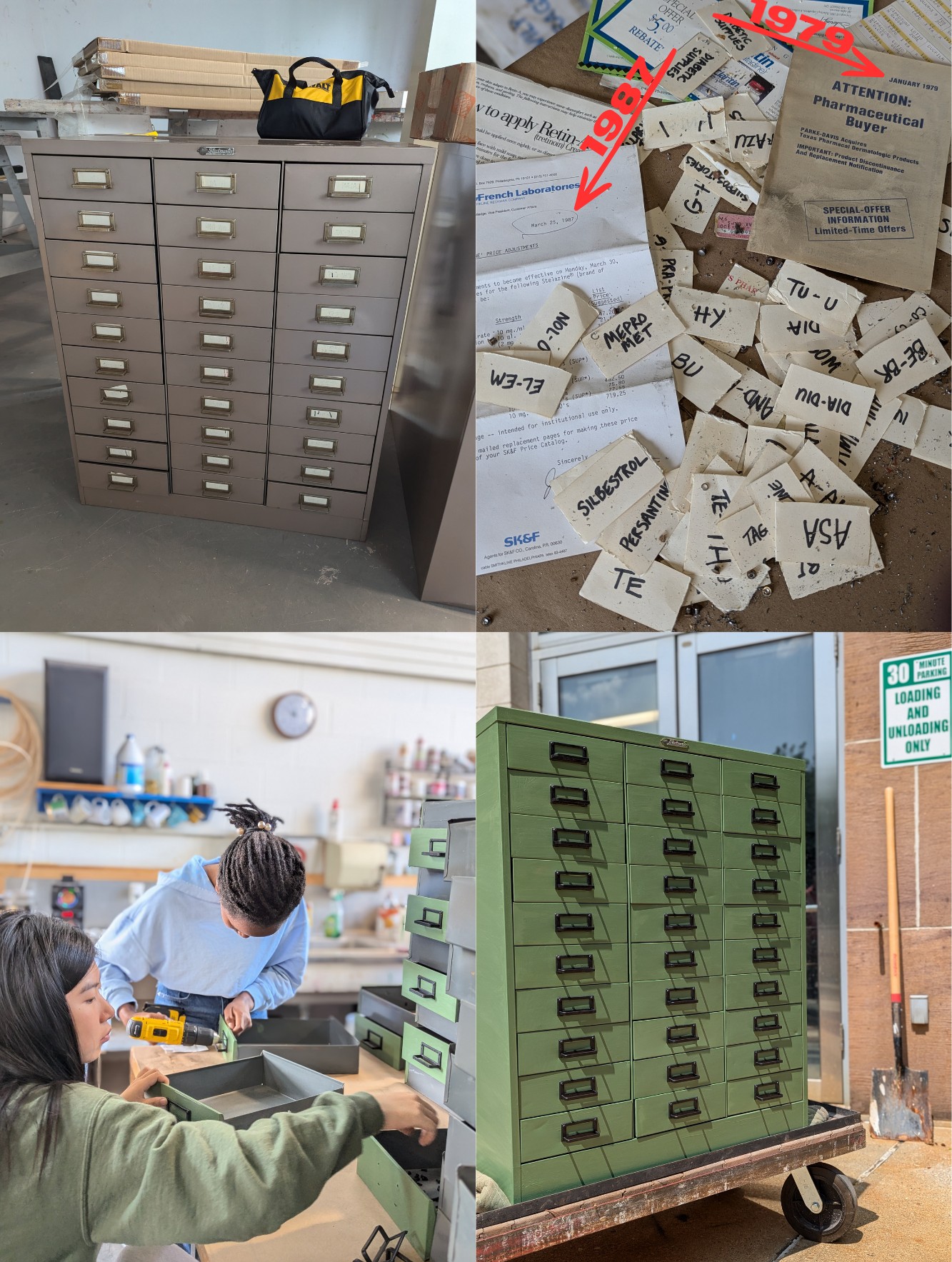
Upcycled three apothecary cabinets, rescued from the former Purple Dragon store on Spring Street, and that date back to Hart’s Pharmacy. The photo in top-right is of papers discovered when cleaning and painting the cabinets.

Upcycled three apothecary cabinets, rescued from the former Purple Dragon store on Spring Street, and that date back to Hart’s Pharmacy. The photo in top-right is of papers discovered when cleaning and painting the cabinets.

Take the three apothecary cabinets, for example. These dusty, beige, medicinal storage units were rescued from the former Purple Dragon store on Spring Street—once Hart’s Pharmacy and now just a memory. They now help organize the Makerspace’s growing inventory of electronics, mechanical fasteners, adhesive tapes, small tools, and material supplies in neat little drawers, right where they belong. 

  • Restoration: removed handles, vacuumed, painted with non-toxic Ottosson Linseed Oil Paint
  • Next steps: Collaborate with the Spencer Print Studio and their Risograph (it’s like a Xerox copier that outputs vivid screen prints) to create artistic drawer labels.
The summer Makerspace team of Divine Uwimana ‘27 and Qi Wang ‘26 transformed these apothecary cabinets.

The summer Makerspace team of Divine Uwimana ‘27 and Qi Wang ‘26 transformed these apothecary cabinets.

Magazine Rack

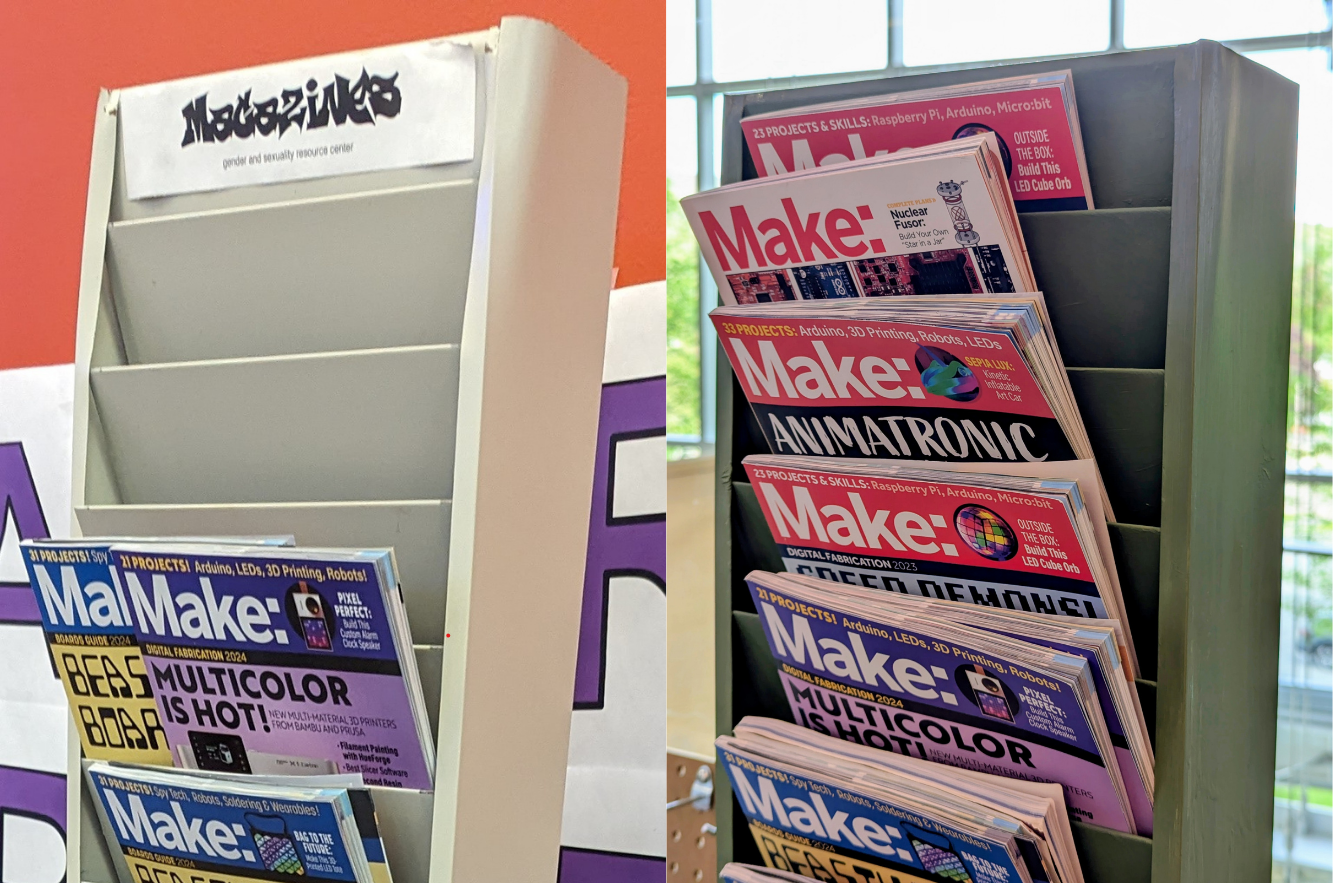
Or the tall metal magazine rack, once tucked away in Room 204 of Bascom House before the Davis Center moved to its new building. Rather than becoming scrap, it’s now a sleek storage solution helping Makerspace users find inspiration through printed guides and materials.

Upcycled one magazine rack from the old Davis Center in Bascom House.

Upcycled one magazine rack from the old Davis Center in Bascom House.

Cubby Organizer

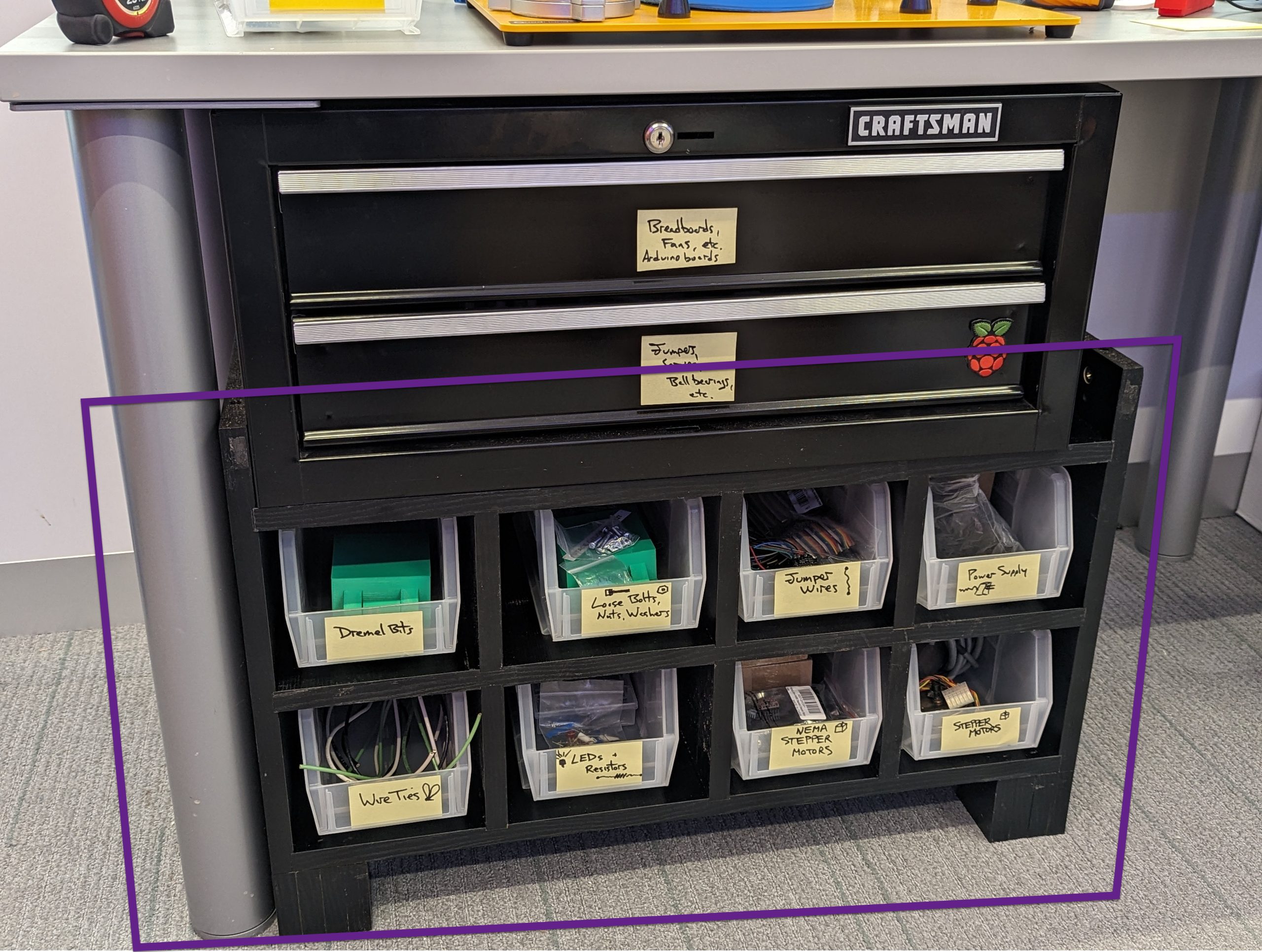
And then there’s the cubby organizer, which tells a particularly satisfying story of transformation. What began as a broken particle board box used to store printer resin was reborn, after a careful sun cure, some table saw finesse, and a lot of ingenuity, into a functional storage cubby, proving that even sticky beginnings can lead to tidy endings.

  • Restoration: Salvaged usable particle board, cut and routered, and reshaped into a purpose built cubby for our organizer trays
Repurposed a broken and trashed particle board box and David recrafted it into the Makerspace's first custom organizer. Less material for the landfill, and it's actively in use.

Repurposed a broken and trashed particle board box and David recrafted it into the Makerspace’s first custom organizer. Less material for the landfill, and it’s actively in use.

Work Tables

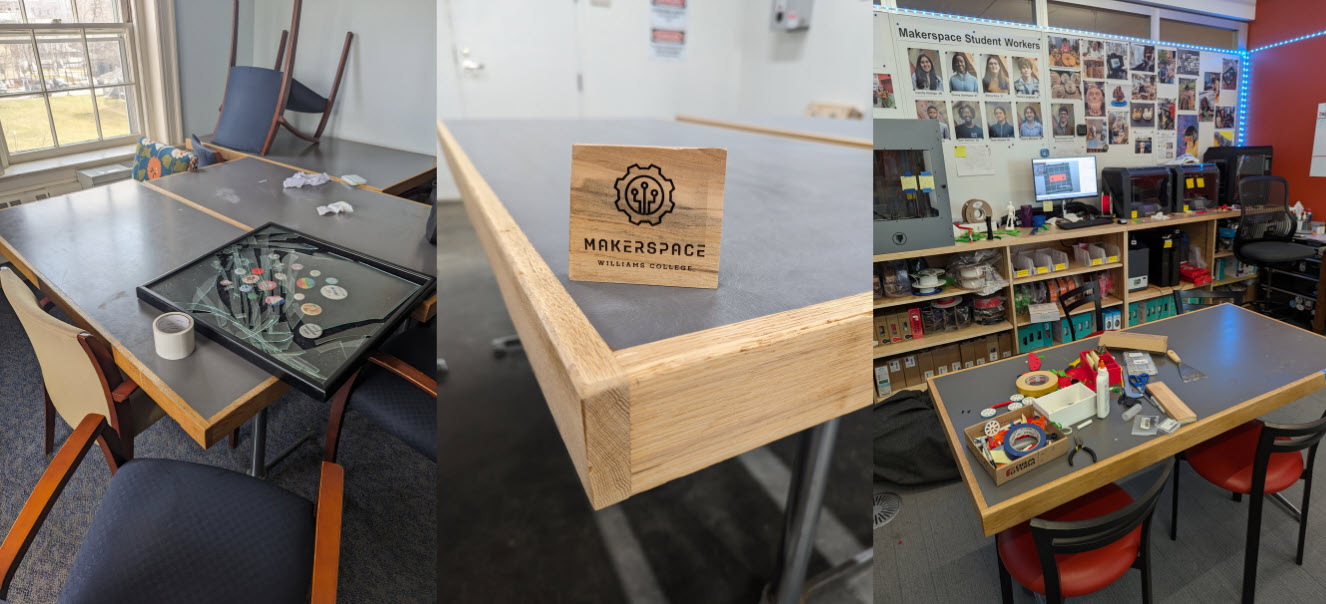
We also welcomed three sturdy tables from Bascom 204, each measuring 60″ by 30″, providing generous surface space for sketching, soldering, and brainstorming. These pieces carry with them the spirit of student collaboration from their previous home and now continue their journey in a space built on invention.

  • Restoration: removed blemishes and splinters by sanding formica top and oak edges, and then our awesome Facilities crew sprayed them with a coat of polyurethane
Repurposed three tables, also from the former Davis Center that was in Bascom House. David sanded, oiled, and applied a topcoat of polyurethane. These tables have never looked better, and are staples now in the Makerspace and FabLab. Zero dollars spent on furniture.

Repurposed three tables, also from the former Davis Center that was in Bascom House. David sanded, oiled, and applied a topcoat of polyurethane. These tables have never looked better, and are staples now in the Makerspace and FabLab. Zero dollars spent on furniture.

Workbench

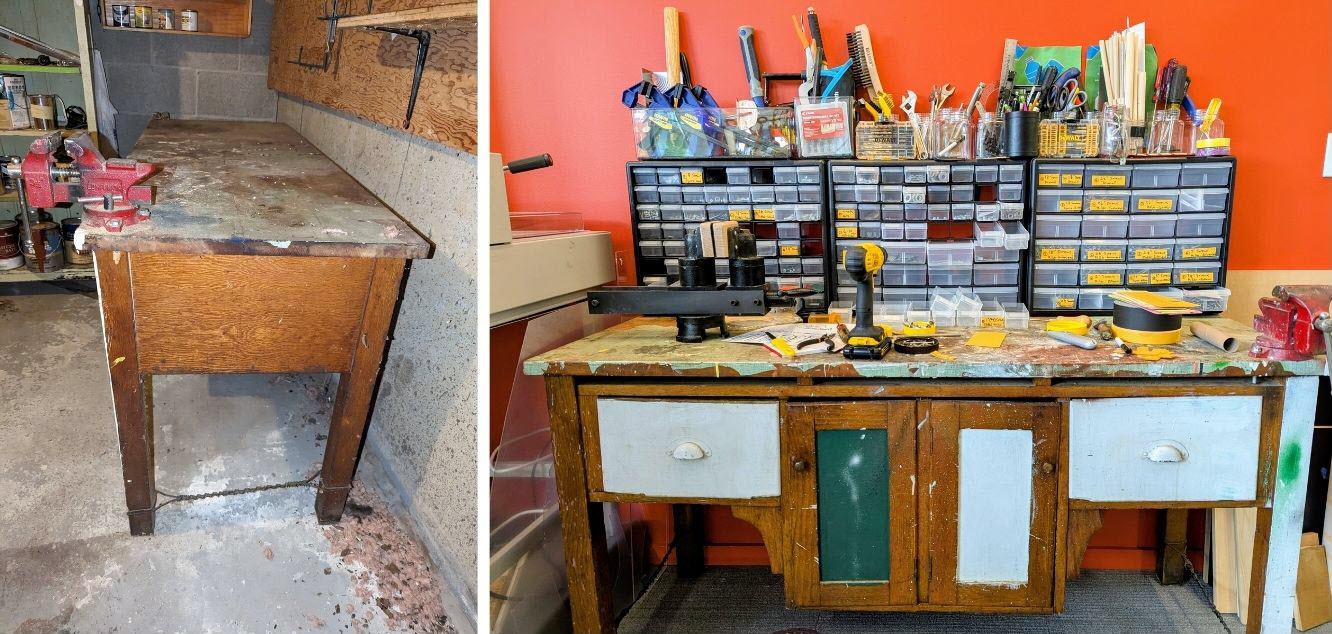
Finally, the new workbench carries a deeply personal legacy. Donated by Carolyn Behr, it once belonged to her late husband Robert “Bob” Behr, Class of 1955. After decades of serving as the heart of his home workshop, it now anchors our own, a quiet nod to generations of builders past and present.

This workbench was donated by Carolyn Behr. It had belonged to her late husband Robert “Bob” Behr, Class of 1955. After decades of serving as the heart of his home workshop, it now anchors our Makerspace, a quiet nod to generations of builders past and present.

This workbench was donated by Carolyn Behr. It had belonged to her late husband Robert “Bob” Behr, Class of 1955. After decades of serving as the heart of his home workshop, it now anchors our Makerspace, a quiet nod to generations of builders past and present.

The Makerspace: Practicing Sustainability

These upcycling projects are more than just practical solutions—they are a reflection of how the Makerspace values sustainability, storytelling, and thoughtful design. Every scratch, label, and drawer has a history. And now, a future.

Stay tuned for more stories like this as we continue to build with care—for the planet, the past, and each other.