
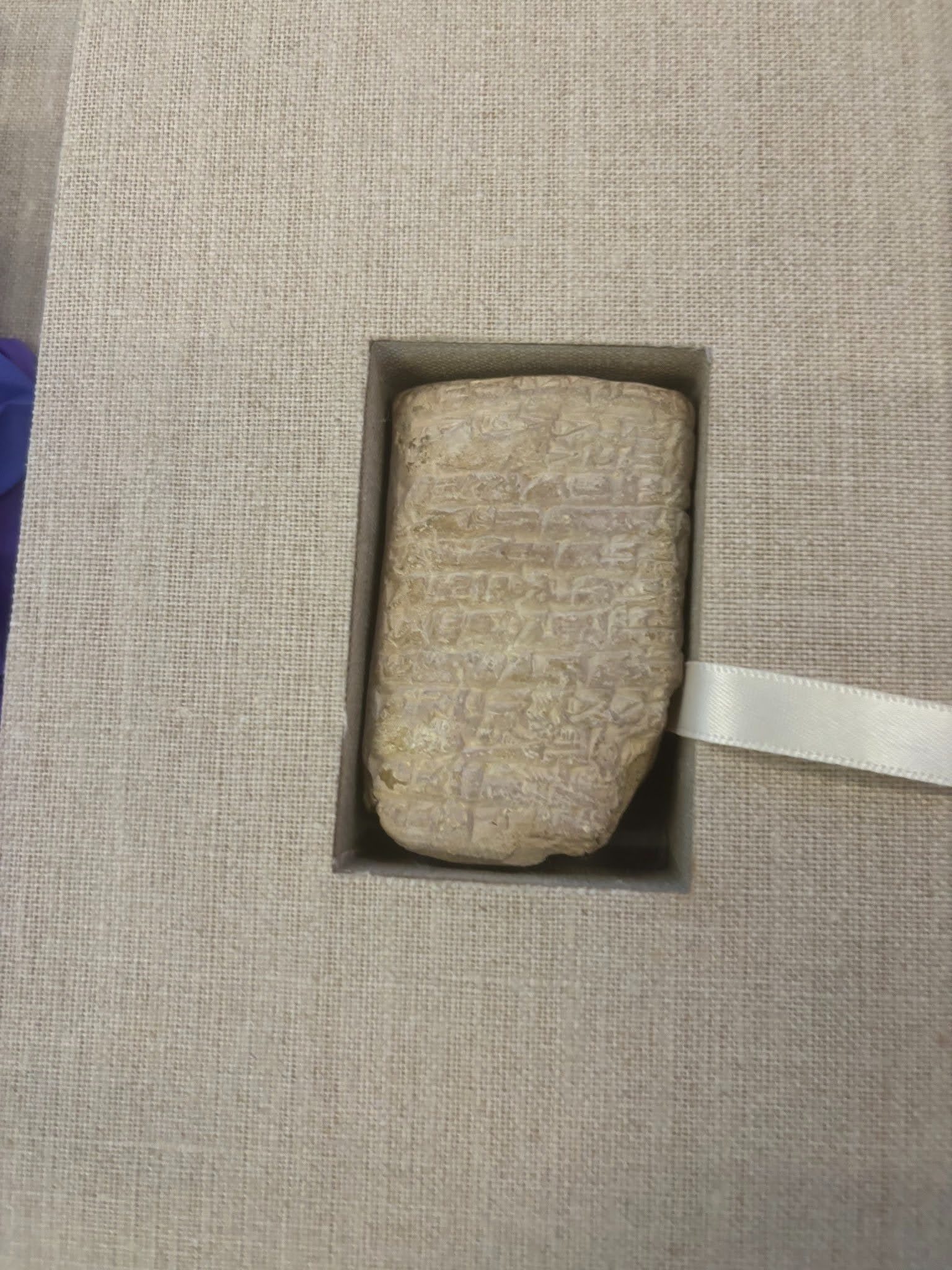
Preserving History: How I used 3D scanning to preserve an ancient cuneiform tablet

I have always been someone who is interested in different languages. My passion sparked when me and my family moved to the United States from Venezuela, and I needed to learn English fast to help my family navigate this country, since they had less time to learn English than I did. Although I didn’t have an English tutor to formally teach me English, I taught myself most of my English through reading, which made me develop a love for languages in written form. Now, at Williams, I am a prospective Chinese Language major because I fell in love with the language after taking CHIN 101! So when I was given the opportunity to work on a project that was so related to my interest in languages, I jumped on it immediately.

Cuneiform is regarded as the earliest known writing system. These words are written into clay and then baked into a sturdy, but fragile tablet. I was also really surprised to learn that cuneiform was used to write several languages. I had the pleasure to work with When we got to work, I was filled with excitement, but also some anxiety about the unknowns. Anne Peale, a librarian that works closely with the college’s special collections. She taught me that this particular cuneiform tablet was (insert interview details here). She plans to use the 3D printed tablet for educational purposes, because the characters in the tablet are very legible and hold information about a person’s taxes. Not only would 3D printing the cuneiform tablet allow several iterations of it to be used outside of the special collections library, it also allows us to make the tablet bigger, which makes the writing a lot easier to read. I was really excited about all of this, and it honestly made me want to learn how to read this type of cuneiform!

When we got to work, I was honestly really nervous. I didn’t know what to expect. This project required a way to record the tablet’s intricate wedges and patterns in a way that makes the writing completely legible, so we decided to use the unfamiliar Creality scanner to 3D scan the cuneiform, digitizing it into a file form. In my opinion, the Creality software was really intuitive. It was fairly easy to connect it to the computer, and to figure out how to correctly configure the scan. The most challenging part of this project was figuring out how to scan the tablet in a way that fully recorded the writing. We had some challenges with this, as the most detailed scanning mode included stickers that told the scanner its location, and since we couldn’t place the stickers on the cuneiform, we had to place them in its perimeter, something that became really hard to deal with when we began to turn the scanner sideways to get the sides of the tablet, since it could no longer recognize the stickers due to the angle change. Another challenge we had was that the tablet was really hard to place in a balanced way that didn’t topple over, so we ended up putting a small weighted cushion to hold it up.

Since we couldn’t place the tablet in a way that was possible for us to capture all four sides in one scan, we had to do a scan for each of all four sides. Each side of the tablet took about twenty minutes to complete, and the Creality scanner is really heavy! Anne and I had to take turns scanning, and we were both so sore! Creality records 3D items by scanning each and every point on the item, and this tablet was so intricate that it had over a million points for each side! The more we scanned, the fewer points that were recorded, so we had to go around the item a lot slower and with a lot more complex angles to make sure we recorded every character.

After two hours, all sides were scanned. Now, the only thing that was left was to find a way to merge the different scans into the composite model of the tablet. Although the Creality software comes with a scan merging option, this did not work on our scans, so blender was used to merge it.

After a month, the 3D scanned cuneiform was ready! It was a lot bigger than the tablet, and a lot less fragile, and best of all, we now had a file that could be used for printing as many of these tablets as we want! I was really excited because it was also my first time getting to see a 3D scanned object up close, as well as hold it.

One side of the tablet is clearer than the other, so we are going to reprint the file as a resin print, because the material may help to raise the clarity of the 3D print. 

Working on this project was a true journey of growth for me. The complexity of 3D scanning and the delicate nature of the cuneiform tablet made every step a learning experience. There were moments when I felt challenged, uncertain about the technical aspects or the best way to handle the fragile tablet. But with each hurdle, I gained more confidence, honed my problem-solving skills, and improved my ability to think creatively under pressure. I have always been really interested in languages, and this project sparked an interest in the digital humanities and language preservation.The potential of 3D scanning in the field of digital humanities is endless. From preserving endangered artifacts to making them accessible to scholars and students around the globe, this technology ensures that history is no longer bound by geography or fragility. I couldn’t help but think, what other treasures could we preserve this way?

Soft Robots, Hard Ideas: Injection Molding Potential at a Liberal Arts College

An example of a silicone injection molding product, showcasing the material's flexibility.

An example of a silicone injection molding product, showcasing the material’s flexibility.

You might think that silicone injection molding sounds like something reserved for manufacturing plants. Yet, here at the Williams College Makerspace, we can find ways to bring this exciting technology to life using everyday construction tools and 3D printing. This isn’t just engineering—it’s a creative exploration, turning seemingly ordinary objects like caulking guns into tools for building soft robots. At its core, a silicone injection molding project attempts to push the boundaries of what can be done in a liberal arts setting. It sees engineering as a form of art, a craft, and a discipline that invites exploration. As we work towards a silicone injection molding setup, we’re also building a community of thinkers and creators who can look at a caulking gun and see a tool for designing robots. With support, we’ll be able to take projects like these further, offering more students the chance to bridge art and science in new and unexpected ways.

By bringing injection molding to the Makerspace, we’re making a bold statement: at a liberal arts college, the sky’s the limit. Whether you’re a computer science major, a robotics enthusiast, or just someone curious about hands-on creation, this is a project where technology meets artistry and creativity knows no bounds.

Why Construction Tools in a Liberal Arts College?

At first glance, using caulking guns, mixing nozzles, and blowout adapters might seem unusual at a college better known for Shakespeare than silicone molds.

Jack Scissor Stand platform used under the mold to align it perfectly with the nozzle; prevents leaks or uneven filling.

Jack Scissor Stand platform used under the mold to align it perfectly with the nozzle; prevents leaks or uneven filling.

Yet, in our Makerspace, we’ve discovered ways to effectively combine conventional tools (i.e., wrenches, bolts), digital tools (e.g., 3D modeling and printing software), and small machines (3D scanners and printers) to explore hands-on solutions to academic problems. We are able to use these accessible tools to achieve effective results without needing expensive, industrial-scale equipment. These tools can be potent gateways into multidisciplinary learning. By blending traditional tools with advanced (or emerging) digital technologies, we encourage students from diverse academic backgrounds—ranging from studio art, history, and philosophy, to computer science—to collaborate, share perspectives, and approach problem-solving creatively. More than just crafting parts, we’re cultivating a vibrant, interdisciplinary community at Williams.

A caulking gun. This is the primary tool used to push the silicone through the cartridges and into the mold. It provides the necessary pressure for injection.

A caulking gun. This is the primary tool used to push the silicone through the cartridges and into the mold. It provides the necessary pressure for injection.

2-part Silicone Cartridges. These hold the silicone material (typically a 1:1 ratio of two parts that mix and cure into a flexible silicone).

2-part Silicone Cartridges. These hold the silicone material (typically a 1:1 ratio of two parts that mix and cure into a flexible silicone).

Static Mixing Nozzles. These ensure that the two parts of the silicone mix properly before being injected into the mold.

Static Mixing Nozzles. These ensure that the two parts of the silicone mix properly before being injected into the mold.

A blowout adapter. This tool helps clean the cartridges so that they can be reused, reducing waste and ensuring a cleaner process.

A blowout adapter. This tool helps clean the cartridges so that they can be reused, reducing waste and ensuring a cleaner process.


Robots with a Gentle Touch

A soft robot arm picks up a piece of celery. Credit: Soft Robotics, a Cambridge-based robotics company.

A soft robot arm picks up a piece of celery. Credit: Soft Robotics, a Cambridge-based robotics company.

Imagine crafting robots capable of gently handling fragile objects—robots that sense touch, pressure, and temperature, just like living organisms. Silicone injection molding is a fantastic way to create complex, flexible parts with incredible precision. Using a 2-part silicone system and a caulking gun, we’re designing a setup where liquid silicone is injected into a mold and cured, resulting in strong and flexible parts. By experimenting with this technology, we learn the practicalities of fabrication and expand what’s possible in soft robotics research on campus. Each part we make brings us closer to designing robots that can perform tasks with a gentle touch and responsiveness that other kinds of (rigid) robotics can’t achieve. At the core, the process is surprisingly simple yet fascinating. Imagine squeezing liquid silicone into an optimally crafted mold, where it settles and cures, creating detail with precision. It’s like utilizing a high-tech caulking gun, but with a twist—turning liquid into a finely molded solid form.

Our silicone injection molding project opens up some interesting real-world applications. For example, soft robotics has applications in healthcare by aiding minimally invasive surgical procedures and using silicone-molded tools to handle tissues carefully.

These aren’t just fascinating theoretical ideas; they’re practical innovations being explored at Williams, especially within our Computer Science Department under Professor Jim Bern. Specifically, it is intended for use in classes like CSCI 345 – Robotics and Digital Fabrication, aligning closely with Professor Bern’s research interests in soft robotics.

Harvard researchers equipped soft robotic grippers with embedded sensors that can sense diverse inputs such as movement, pressure, touch, and temperature. Credit: Ryan L. Truby/Harvard University

Harvard researchers equipped soft robotic grippers with embedded sensors that can sense diverse inputs such as movement, pressure, touch, and temperature. Credit: Ryan L. Truby/Harvard University

Researchers at Cornell University have developed a soft robotic hand with a touch delicate enough to sort tomatoes and find the ripest one. Credit: Huichan Zhao/Organic Robotics Lab, Cornell University

Researchers at Cornell University have developed a soft robotic hand with a touch delicate enough to sort tomatoes and find the ripest one. Credit: Huichan Zhao/Organic Robotics Lab, Cornell University


Optimization: Making The Most of Things

One of the biggest lessons was in optimization when conducting equipment research. When you’re given a budget and a task, you need to be efficient with your use of money and essentially get the most bang for your buck. In concrete terms, if you find two sets of static mixing nozzles—one that costs $45 and another that delivers the same results that goes for $15—you’d optimally pick the latter. Researching various construction tools to create a concept model of our DIY silicone injection molding device reinforced to me how impactful thorough pre-production research and budgeting can be. 

An example of a DIY Silicone Injection Molding device.

An example of a DIY Silicone Injection Molding device.

Reflection

Working on technological projects has transformed my educational journey. The Makerspace isn’t just a workshop. Here, I’ve learned that exploration, trial and error, and collaboration are as crucial as technical proficiency. By engaging with staff, faculty, and peers, my understanding of the larger world of technological innovation has deepened significantly, showing me just how powerful hands-on learning at a liberal arts institution can be.

Special thanks to Divya Sijwali (’28) and David Keiser-Clark, Makerspace Program Manager, for supporting this blog post!