Accenture PLC is a multinational consulting and technology company, offering Marketing and Business Strategies, Supply Chain Management, and Operation Models as well as several processing services ranging from Intelligence Operations and Digital Infrastructure to clients. In addition to its two major services, the company commits to research and investment. Accenture Insights, the predominant research department focused on innovations in Artificial Intelligence, Blockchain, and Cloud Technology. Accenture Venture, the Venture Capital department conducts engagements, investments, and prospective subsidiaries for future services. Founded in 1989, Accenture has since moved its headquarters and incorporation title to Dublin, Ireland.
Investment Reasoning:
Accenture’s recent strategy in establishing itself as a major player in the Cloud and AI Technology space as well as a primary financier for Blockchain projects point to an expanded outreach in the post-pandemic economy. In September 2020, Accenture unveiled a $3 billion investment project into the new Accenture Cloud First program set to accelerate their client’s digital transformation to the Cloud. Amid the pandemic, several smaller companies have transitioned to the Cloud digital network to overcome the speed, structure, and reliability necessary in the ongoing crisis.
Accenture fundamentally believes that the dramatic growth in “Cloud-first” companies is here to stay in a post-pandemic economy. Thus, Accenture Cloud First’s services in cloud migration, infrastructure, and application services capitalize on these conditions. The company’s strong investment history in Applied Intelligence capabilities, such as its April 2021 acquisition of Core Compete, are directed towards integrating client supply chains into the Cloud. Accenture also lined out a detailed plan about Edge Computing’s role in centralizing company data.
Investors should understand that Accenture is experienced in operating large IT infrastructure and a grand expansion into an advanced technological network would play well to the company’s strength. As more industries command higher efficiency, Accenture’s vision of a general migration to the Cloud from 20% of business in September 2020 to 80% will only be increasingly realized. Thus, the demand for Accenture services is on the rise, evidenced by the nearly 22 Cloud blueprints and over 100 Cloud solution strategies developed in the program so far.
Likewise, Accenture has been a leader in coordinating the Banking and Financial sectors’ transition to Blockchain technology. As a revolutionary method to enable secure access to shared data across peer organizations, the rise of Blockchain is simultaneous with an increase in Artificial Intelligence dependent on trustworthy data to operate. Accenture’s Ventures holdings in Blockchain not only offer market presence in the field, but are ultimately investing back into its AI Development programs. A particularly notable decision in September 2020 was Accenture’s investment in Baseline Protocol, the predominant server technology to upgrade the popular Ethereum cryptocurrency.
Competition:
Accenture’s diverse investment strategies all culminate to an increased demand in services in a Cloud-first interconnected business world. Though already with $11 billion in revenue from Cloud technology, its recent strong evaluations come from the early fruition of these 2020 investments in Artificial Intelligence, Blockchain, and the Cloud. This multifaceted approach creates a unique advantage over its competitors. In the traditional sense, Accenture faces steep challenges from major consulting firms such as Bain & Co. and McKinsey & Co. How Accenture will fare against stronger, more reputable financial consulting is difficult to estimate. However, in the technology development sphere, Accenture is positioning itself strongly against Capgemini and IBM. As the Cloud technology industry is already predicted to grow to $850 Billion dollars by 2025, a CAGR of 17.5% compared to 2020 values, it seems intuitive that Accenture will benefit immensely from this growth.
Financials:
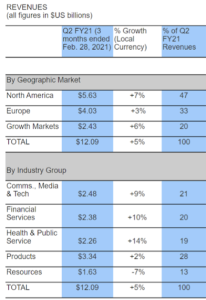
Revenue Growth has increased significantly in the North American Cloud storage market with a 7% growth for Fiscal Year 2021. Communication, Media & Tech, as a whole, generates the majority of Accenture’s service-based revenue and is expected to have strong showings in nominal and percent growth.
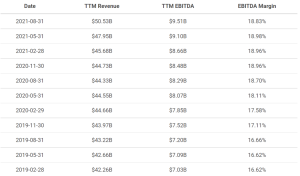
EBITDA over the last year has grown as a margin of revenue, showing positive signs of stronger profits in the coming years. The new revenue coming from the Accenture Cloud First Program has demonstrated higher percent profitability compared to traditional revenue streams. We see this as the EBITDA margin has grown and stabilized at just shy of 19% percentage points over FY21, with a $1.22 Billion nominal TTM revenue growth compared to a $960 million growth in TTM EBITDA. Accenture’s program demonstrates strong profitability and earnings compared to IBM’s declining earnings.
Competitor IBM EBITDA:
2020$12,854
2019$15,955
2018$16,672
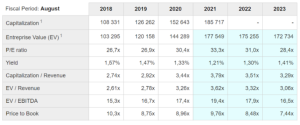
As of now, Accenture’s P/E ratio has hit major peaks and investor sentiment has responded. With EV/Revenue and EV/EBITDA set to gradually decline, Accenture’s revenue streams are likely to meet current valuations in the coming years as it continues its expected growth patterns. For investors, these growths will be matched with optimistic stock valuations well into 2023.
*Note that the declining EV is largely from this particular evaluation that Accenture stock will fall from overconfidence, that has little to do with the financial fundamentals.
Conclusion:
My recommendation is to take a Long Position in Accenture. Accenture’s upside potential greatly outweighs its risks as its major programs have shown early signs of success, generating a 3% revenue growth over the last 6 months. Most of this new growth is leading to higher profit margins than previous revenue increases. Compounded with the declines in other technology consulting companies, it is fair to assume Accenture will acquire a stronger role in the post-pandemic market. In the short term, Accenture has stabilized at a somewhat overvalued stock price: it’s P/E ratio’s rise by nearly $10 evidence of an incredibly optimistic demand; therefore, it may be wise for investors to buy in after any shift in unwarranted market decline.
In the middle of the Nevada desert stands a 195m tower surrounded by an army of shiny, flat objects in a scene not entirely unlike something one would find in a sci-fi novel. This structure, however, serves a much more mundane, albeit necessary, purpose – the storage of energy.
This structure is called a “concentrating solar power” plant. It works like this: the plethora of mirrors surrounding the tower direct solar rays to the top, where a vat of molten salt sits to absorb the heat energy that can eventually be utilized as electricity. It’s been said that this energy storage method “has the most promise for energy generation and storage from solar power.” Just think about that for a moment though. A tower with special salt is one of our best options for renewable energy storage. Plus, it’s not like the whole world is covered in deserts that are waiting around for us to build salt towers on them.So what other options do we have?
Let me introduce to you solid oxide fuel cells. They promise to produce and store electricity for months after said electricity was produced. What’s more, they need only hydrogen as an input and when run in reverse as an electrolyzer produces hydrogen. In other words, solar and wind energy can be used as inputs to produce hydrogen, which can then be used to produce electricity. For more details on how they work, refer to the above diagram.
These new types of fuel cells are currently produced by only one company – Bloom Energy (NYSE: BE). If they can deliver on their promise of clean, long-lasting energy storage, the implications for the feasibility of renewable energies as our primary – if not only – energy source are massive.
The primary existing energy storage method, lithium batteries, of course has its strengths. It is relatively long-lasting and high in terms of energy density, for example. However, lithium is itself a very troublesome resource in that it is itself a non renewable resource and mining it is extremely water intensive. To illustrate this last point, I ask you to consider the fact that in a given year lithium mining consumes a full 65% of Chile’s entire water supply, which is simply ridiculous.
The batteries themselves are not without issues either. One minor (actual major) one is that they are prone to exploding if they are not carefully monitored. Usually this problem isn’t significant for smaller applications like electric vehicles (EVs) where software is capable of carefully monitoring the battery’s health and status. But in large energy storage plants that contain thousands of lithium batteries there are bound to be accidents. Also, I would be remiss in not reminding you of the notorious tendency of lithium batteries to lose capacity over time. And last of all, lithium batteries are simply too expensive.
Consider California, which produces more than 8 million megawatt-hours (MW) of surplus energy during the summer and yet can only store 150000 MW of it. Why? Because buying the lithium batteries necessary to store it all would cost a grand total of $2.5 trillion. Again, that’s simply ridiculous.
Now let’s return to Bloom. In addition to its innovative solid oxide fuel cells, the company already has a massive presence in developing countries like India that will inevitably consume increasingly large amounts of energy per capita as their economies continue to grow. However, the US also promises to become a huge factor in Bloom’s further growth.
With the election of PresidentBiden and a Democratic congress, the likelihood of a substantial, perhaps even once-in- a-lifetime, environmental aid package has skyrocketed. Biden has already made itabundantly clear that he intends to pass such a package. Such a package will undoubtedly include provisions for increased spending on renewable energy implementation. It really doesn’t take a genius to figure out how Bloom might benefit of such a plan were passed.
So why do I believe that the market hasn’t already priced this possibility into Bloom’s stock price? In short, I don’t. Rather, I believe that because of the uncertainty surrounding the final details of an environmental package and whether it could pass at all, the current stock price still has potential to rise if said package should pass congress.
So why do I believe that an enormous environmental package will definitely pass congress? In short, I don’t. Rather, I believe that even if said package never comes to fruition, the inevitable march towards greater renewable energy adoption continues will present opportunities to Bloom regardless. Such adoption is not only morally justified, but also economically. It is now a fact that fossil fuels cost more per unit of energy produced than renewable energies.
Lastly, I would like to take a quick look at Bloom’s financials, more specifically its EBITDA values.
Based on EBITDA values projected by the S&P’s Capital IQ financial database, I was able to project future EV/EBITDA values with 10X, 15X, and 30X multiples. Using these EV/EBITDA values I project that with conservative 10X and 15X multiples we might be able to expect -61.94% and -36.76% equity upsides, respectively. However, the potential upside seen in the numbers along with the broader trends in politics and society might make this investment nonetheless attractive for certain investor profiles. In short, Bloom Energy (NYSE: BE) presents an interesting, perhaps underestimated opportunity for investment.
Fox Corp is a media conglomerate operating in two main segments, TV and Cable.. The TV segment has local stations covering <40% of the US population, the Fox channel, and digital operations like Tubi, Fox.com, Fox Nation SVOD, Fox Soul AVOD, etc. The Cable segment has Fox News, Fox Sports, Fox Business, FoxNews.com, etc. Both the Cable and TV segments are monetized by “affiliate revenues” (i.e. subscription $ from providers) and “ad revenue”. The misc. segment includes a fin-tech called Credible, an animation studio Bento, and Fox Studios.
The company’s core assets — the Fox channel, Fox local news, Fox News, Fox Sports, and Fox Business — are high quality, durable crown jewels generating steady cash flows. Its other tech-focused assets like Tubi and Credible are grossly undervalued by the public markets. This memo will split Fox Corp’s business into five segments and value each by piece.
Fox’s channels are considered to be the most valuable asset of a cable or broadcast bundle, exemplified by the propensity of cable companies to eat up Fox’s affiliate fee hikes of ~10%/year. Fox’s digital strategy – across the online radio, web, social media, and Fox Nation – develops online engagement. Finally, Fox can capture the upside as users move from traditional TV to free ad-supported on-demand content, especially as advertisers pay to target Tubi’s young users, ~90% of whom cannot be reached via trad. cable. Interestingly, Fox has a stake in fintech Credible, sports betting through Flutter/FanDuel, livestreaming via Caffeine + a $1.5B tax shield
Broadcast Television
Projected 2024 EBITDA
$884mm
EV/EBITDA Multiple
6x
EV of Segment
$5.3B
This segment includes the Fox channel, which is the most-watched broadcast station, with ratings 31% higher than the #2. Fox Corp also owns 29 local news channels (11 are duopolies) covering 40% of the US, where the local news industry has grown at 4% CAGR since 2015. Importantly, roughly 80% of its content across this segment is viewed “live” 90% of the time (e.g. news, sports, etc.), not O.D. However, this is the least compelling segment as it’s not a premium offering with margins <10%.
Tubi
Projected 2024 Revenue
$351mm
EV/Revenue Multiple
6x
EV of Segment
$2.1B
Tubi is an extremely interesting opportunity for Fox. Tubi provides an on-demand platform of free-to-watch content supported by ads (aka “AVOD”). AVOD is very important in the streaming world as it provides a free on-demand streaming option for younger audiences, 81% of which want to accept ads for free content (especially as Netflix/Hulu keep hiking prices). This digital-streaming solution is highly prized by Wall St. since it represents the post-cable future. Comps trade at ~6x revenues and roughly $20-30 valuation/user. Given Fox already has a vast collection of content, it can “recycle” it for free on Tubi and generate valuable digital ad revenues (targeted digital ads are worth much more than OTT-broadcast TV ads). Tubi grew +100% last year and now has close to 40m registered users. Very importantly, 87% of Tubi’s users cannot be reached by cable advertising, so they are a highly valuable user base. Fox bought Tubi in early 2020 for $450m, after selling its stake in Roku for a $300m profit. Tubi’s revenues are expected to surpass Fox’s primetime broadcast-ad revenues (which I estimate to be close to $400m). I estimate Tubi’s valuation as of 01/21 to be ~$700m (so, 2x long-term revenue vs. 6x+ comp.). The long-run value and potential of the AVOD business is exciting, yet not baked in the market value of Fox.
Cable Television
Projected 2024 EBITDA
$2.7B
EV/EBITDA Multiple
12x
EV of Segment
$32.8B
Fox News, Fox Business, and Fox Sports are premium offerings available through cable subscriptions + supplemental online content, podcasts, radio, digital, etc.. Controversy and political bias aside, Fox News is the highest rated cable TV channel and Fox Business has higher ratings comparable to CNBC. Both are watched by relatively affluent audiences (better ad dollars). FoxNews.com is a digital leader with 11x as many impression-minutes as ABC.com, 7x CBS.com, 6x NBC.com, and 2x NYtimes.com. Its supplemental subscription digital offering, “Fox Nation”, has a loyal base with a 80%+ convert from free trial to paying subscriber. Overall, this is a premium, high-quality, durable segment which operates at ~50% EBITDA margins and warrants at least a 12x multiple.
Credible
Projected 2024 Revenue
$220m
EV/Revenue Multiple
5x
EV of Segment (67% stake)
$737m
Fox acquired 67% of Credible for $265m in 10/19. Credible is an online financial technology company offering loan comparison tools. Previously, Credible was publicly traded. The revenues doubled from 03/19 to 03/20, and now likely crossed $100m in annual run-rate revenue. Credible has some synergies with Fox Business, and was fast-growing before the Fox relationship. On its own, Credible is disruptive, and successful, but the specific synergies between the two businesses are unclear.
Other Fox a few other interesting features:
3% ownership in Flutter and an option to acquire up to 18.5% of FanDuel
Synergy between increasingly legalized sports betting market and Fox Sports
Stake currently worth ~ $400m (but poised for growth as sports betting expands)
Full ownership of Bento, which is a well-respected animation studio (behind Bob’s Burgers, Central Park, etc.)
Full ownership of Fox Studio Lot
Minority ownership of Caffeine, a social-media live-streaming start-up ($600m valuation)
PayPal Holdings Inc. operates as a technology platform and digital payments company that enables digital and mobile payments on behalf of consumers and merchants worldwide. Its payment solutions include PayPal, PayPal Credit, Braintree, Venmo, Xoom, and iZettle products. The company’s payments platform allows consumers to send and receive payments, withdraw funds to their bank accounts, and hold balances in their PayPal accounts in various currencies. It also offers gateway services that enable merchants to accept payment online with credit or debit cards as well as digital wallets. Founded in 1998 and headquartered in San Jose, CA.
Investment Catalysts
PayPal has done a great job showing how a top notch fintech firm can take advantage of the changes brought by the COVID-19 crisis, face the challenge of a disruptive economy, and come out on top. COVID has accelerated the rise of digital payments with many physical retailers closed and more and more consumers shopping from the comfort of their homes. As stores have reopened, touch free payments are sought after due to concerns with handling physical cash, and inertia will likely keep these gains in place for the years to come. Of those in the digital payment sector, PayPal in particular has experienced astounding growth and boasts strong financials: 15.2 Million Net New Active Accounts were added in Q320 alone, the strongest quarter in company history despite the major recession and economic turmoil in the broader economy and market.
Total Payment Volume (TPV) growth was impressive as well: 4 Billion payment transactions and $247B TPV in Q320, up 30%, with Venmo alone processing $44B in TPV (up 61% from Q2). GAAP EPS up 121% to $0.86 in Q320, and a share buyback of 1.8 million shares returning $350 Million to shareholders projects confidence of management in the future of the company.
PayPal also recently introduced their Venmo credit card issued by Synchrony (NYSE: SYF) and powered by Visa network, stepping into the credit card game after the success of the Venmo credit card and capitalizing on Venmo’s steady young user base and shows a partnership with competitor Visa. This is part of PayPal’s efforts to diversify Venmo’s monetization, having grown from relying solely on merchant fees on websites and mobile apps for revenue to moving further into the physical retail space as well. The Venmo Credit Card and Debit Card both feature a custom QR code that allows easy peer-to-peer payment and tap to pay functionality, building on Venmo’s social aspect with the option for users to share transaction activity to their Venmo feeds if they wish. The company also announced a partnership with CVS (NYSE: CVS) in which they pledged support for QR code PayPal and Venmo transactions in 8,200 of its stores in the US by the end of 2020. Additionally, Venmo charges fees for certain account transactions such as instant cash withdrawals and peer-to-peer payments made using a credit card account.
PayPal’s business model contains broad exposure and diversification in the digital payment world. PayPal provides its flagship gateway platform with a mostly older user base, and fast-growing Venmo offers a large young user base and social media like aspect that generates strong loyalty and network externalities. The company also has strong opportunities for further growth. Internationally, Venmo is US only right now, with great potential to expand to other markets abroad. PayPal has also been making bold moves in the crypto world, as in late 2020 they rolled out their new service enabling users to buy hold and sell crypto directly and make it available as a funding source at its 26 million merchants worldwide. The feature has seen strong early demand and drove a spike in downloads of the PayPal app on Apple’s App store.
Competition
PayPal is part of a crowded industry, with strong competition from Square (CashApp), Zelle, Apple’s Apple Pay, traditional credit card companies such as Visa and Mastercard, and recent addition Google’s Google Pay. The digital payment industry experienced solid growth in the 2010s that is projected to continue in the coming years, with an expected CAGR of 13.5% for 2020-2025.
PYPL
SQ
V
MA
Revenue growth from 2019
19.15%
76.72%
-4.92%
-4.18%
EBITDA growth from 2019
23.76%
-60.51%
-4.35%
-2.02%
P/E ratio
86.71
0.0
43.41
52.67
EV/EBITDA
Market share
Net profit margin
15.48%
4.05%
49.74%
43.13%
Analysts recently have been buzzing about the addition of Google Pay to the playing field. On the surface Google Pay could pose a challenge to PayPal, considering the influence of Google and its integration with popular Android technology. However, I believe PayPal and Venmo are poised well to hold Google at bay, due to both the solidity of PayPal’s success and Google Pay’s lack of a strong foothold in the fintech sector so far. Google Pay currently serves about 150 million users, less than half of PayPal’s 361 million active accounts. However, many of those payments likely originate from the Google Play store where Google Pay is the default option for all Android users. Google Pay isn’t in even the top 10 of Apple’s App Store finance app rankings as of late December, while Square’s Cash App, PayPal’s Mobile Cash, and Venmo are all in the top five. Additionally, according to McKinsey’s 2019 Digital Payments Survey Google Pay isn’t one of the top three methods for in-app payments, online payments, or peer-to-peer payments. Only in in-store payments did Google Pay gain a significant foothold where it still is far away from Apple Pay, and which are not part of PayPal and Venmo’s main business model.
Lululemon Athletica Inc (“Lululemon”) is a technical athletic apparel brand that offers a variety of products, from fitness clothing and accessories to yoga classes. Despite its competition against larger wholesalers and sportswear companies, Lululemon has built its image as a “lifestyle” brand and a loyal consumer base by personally connecting with customers through ambassador programs and free yoga classes. With 515 stores in 17 countries worldwide, the brand’s continuous international expansion, especially in China and Europe, has led international sales to grow 45% in revenue just last quarter. Lululemon generates $4.07 billion in revenue and has a market capitalization of approximately $45.36 billion.
Thesis
As of December 31st 2020, Lululemon is trading at $350.78 per share, up 51.41% on the year. Due to Covid-19, the sportswear market faced a big drop in sales in physical stores, yet Lululemon fared relatively better than its competitors like Nike. Compared to the third quarter of fiscal 2019, net revenue rose 22%, primarily due to its shift to e-commerce. While comparable store sales decreased 17%, direct to consumer (DTC) revenue increased 94% (accounting for 42.8% of total revenue at the end of Q3). Lockdowns and work from home (WFH) culture have favored this segment of the retail market, proving to be the silver lining during the pandemic. As more competitors enter this market with the surge in athleisure consumption, Lululemon looks toward innovation and various expansion opportunities to differentiate itself.
Opportunities
While Lululemon’s revenue is highly concentrated in the United States and Canada, comprising 68.5% and 16.0% of total revenue, respectively, revenues outside of North America represent 15.5% of total revenue. Though the brand is still in the early stages of international expansion, it is on track to executing its five-year growth plan of quadrupling international revenue ($1.44B by 2023). Recent Q3 results show that international revenue grew 44.6% (at a 5 year CAGR of 38.0%). On a broader scale, the global sportswear market reached $181B in revenue in 2019 and is expected to reach $208B by 2025, indicating a continued traction in this market. The brand is eyeing China and Europe as their next key drivers in revenue in the coming years, and just during fiscal 2020, Lululemon has opened eight new stores in China (515 stores open as of November 2020).
In addition, Lululemon has implemented several initiatives to be at the forefront of product expansion and innovation. On July 7, 2020, the company acquired Mirror, an interactive fitness platform featuring live and on-demand classes, for $500M. As the brand continues to integrate Mirror within its ecosystem, Mirror is expected to generate $150M in revenue in fiscal 2020. By 2023, Mirror could expect to reach 600,000 subscribers and $700M in revenue.. The booming growth of this interactive fitness market is expected to grow at a 32.6% CAGR and is a hopeful indicator that Mirror also becomes a promising channel of potential returns. Competitors like Peloton, whose revenue grew to 232% year over year in the previous quarter, greatly benefited from the pandemic and surge in at-home fitness demands.
Lululemon’s expansion of sizes and men’s products have also strengthened its business amid the pandemic. Offering more sizes played a role in the increase of 22% in sales of women’s clothes last quarter, as the brand was able to attract a broader set of customers. Revenue from men’s apparel rose 38% in the last quarter, and the brand’s goal is to double the size of men’s revenues by 2023. Just last year, men’s products made up 21% of Lululemon’s sales. As WFH continues and demand for athleisure rises, Lululemon’s acceleration of the men’s division will help the brand achieve its goal. Lululemon is also looking to step into the footwear market and launch its first collection in early 2022, increasing revenue streams in the long-run.
Financials
Lululemon’s current EV/EBITDA = 37.8x
Company
EV/EBITDA
Nike
37.4x
Adidas
28.1x
Gap
6.3x
Under Armour
35.6x
Puma
31.8x
Nordstrom
24.7x
Peloton
184.8
Median
27.3x
2020 (LTM)
2021E
+14%
2022E
+14%
2023 E
+14%
2024 E
+12%
2025 E
+10%
Revenue
4.07B
4.67B
5.29B
5.98B
6.70B
7.37B
+ $450m for revenue of non-growth-pillar related business lines.
= $7820 total 2025 estimated revenues
@25.5% EBITDA margin (up from 23% in 2020)
= $1.99B EBITDA
@ 27x EV/EBITDA
=$54B EV
= $52B market cap
= $400/share [~30% further upside]
Risks and Competitors
As Lululemon is in a large, fast-growing market, it will be increasingly difficult to defend its market share against competitors like Nike, Athleta by Gap, Target, and others. Many of these new entrants are already market leaders in the retail space and their scale allows them to quickly go to market and leverage their large customer base. A month ago, even Kohl’s announced that they would be starting a new brand to compete in the athleisure market.
Such brands have the greater advantage of having longer operating histories, broader supply chains, extensive customer bases, and greater brand recognition. This is a significant risk for Lululemon, as it aims to increase the number of worldwide stores and quadruple international revenues. If customers in countries like Europe and China prefer to purchase domestic brands or the large apparel companies, it would prove more difficult to overcome the long presence and reputation of those sellers.
Along with the ongoing impact of Covid-19, the acquisition of Mirror has incurred significant costs for the brand and may limit its operating flexibility, if the potential benefits and returns are not fully realized. Not only does the brand need to attract and maintain subscribers to MIRROR, but it must also provide engaging classes, innovative technology, and assurance of data privacy in order to grow the business and level of subscriptions. If such expectations aren’t reached, Lululemon may run the risk of failing to reach the level of profitability. With other in-home fitness platforms, like Peloton and Tonal, Lululemon will have to find ways for Mirror to differentiate itself as a brand and its services.
Internally, Lululemon should be wary of losing their brand identity as it launches many products and services too quickly. While being a brand for everyone can serve a wider audience, this may not sit well with the existing customer base, especially for a company that has built its brand on high-end utility wear. Gap had similarly failed in efforts and has taken steps back, cutting newer product lines and focusing on customer needs. By attempting to appeal to customers of all ages, races, and sizes in the early 2000s, the brand had lost its steam and identity, being called too “basic” to consumer’s tastes.
Conclusion
My overall recommendation is to buy Lululemon. Lululemon’s resilience during the pandemic and striking e-commerce sales has put the company in a better position than its competitors that faced greater losses. Total revenue significantly rose 22% year over year in the fiscal third quarter, compared to the mere 2% in the previous quarter. The potential profitability of the recent acquisition of Mirror and increase in revenue streams (international and menswear) will allow the brand to increase its dominance in the market share. In an industry growing at a CAGR of 5.1% with a positive outlook for athleisure demand, these long-term growth and expansion opportunities make the stock an attractive buy.
Kroger’s successful physical stores and ventures into online shopping present a twofold profit mechanism that have not only helped it succeed during COVID, but have expanded and innovated on its revenue streams for the future. Though Kroger continues to face tough competition from both big-box competitors and gourmet grocers, as well as questionable growth in the hypercompetitive delivery space, it mitigates these risks with infrastructure developments and key acquisitions that its competitors are not doing. Assuming a P/E multiple of 15x and an EPS of $3.00, conservative increases from current values of 12x and $2.75, respectively, investors can expect a share price target for Kroger of $45, a 40% premium.
Company Description
The Kroger Group (KR), founded in 1883, is a Cincinnati, Ohio based retail company. KR operates supermarkets, pharmacies, jewelry stores, petroleum stations, and multi-level department stores through one of its many subsidiaries throughout 35 US states and the District of Columbia. KR has over 400,000 employees and over 2,700 individual stores, making it one of the largest employers in America.
Company and Industry
KR is the United States’ largest supermarket by revenue, with $121.16 billion of revenue for fiscal year 2019, and the second-largest general retailer in the country, only behind Walmart (NYSE: WMT). KR, like Walmart and many of its other peer competitors, offers customer loyalty programs, online ordering and contactless delivery of its grocery and retail products.
The grocery space today is generally occupied by three types of retailers: gourmet groceries, local supermarkets, and big-box hypermarkets. KR, for instance, mainly operates in the big-box space, but also owns various regional supermarkets and groceries. Throughout the United States, grocery sales in general have been up 29.3% since March 2019, largely due to COVID-19 pandemic restrictions on restaurant operations and quarantine mandates, limiting consumer’s food options.
Company Comparables as of January, 2021
Company
EV
EV/EBITDA
EPS
P/E
Walmart (WMT)
456B
11.4x
$5.68
21.0x
Costco (COST)
156B
18.5x
$10.24
37.1x
Dollar Tree (DLTR)
34B
7.3x
$6.07
26.6x
Sprouts (SFM)
4B
5.4x
$1.82
9.9x
Kroger (KR)
44B
5.8x
$2.75
12x
Source: Koyfin, Public Filings
Investment Catalysts
KR’s low EV/EBITDA and P/E multiples compared to industry competitors, indicating a cheaper valuation, yet consistently even performance with competitors in terms of store growth and online presence indicate that KR has the legs and space for growth until its multiples better align with competitors.Interestingly, despite a recent flurry of acquisitions and partnership, analysts have not yet priced this into KR, mainly due to uncertainties from the COVID pandemic. That said, these acquisitions pose KR well for competition in the retail space, which is increasingly becoming automated/online. First, KR made news when it acquired ClusterTruck, one of the first ghost kitchens. Ghost kitchens deliver meals to customer’s doorstep without the physical footprint of a restaurant. ClusterTruck has locations throughout the midwest, further building into KR’s dominance in the region. Additionally, KR entered into an exclusive partnership with Orcado, which focuses on direct to consumer delivery of groceries and household goods
In addition, KR analysts have raised expectations for sales and profits forecasts for 2021, largely fueled by increased home-cooking during COVID-19 extending throughout the coming year. Earnings are also forecasted to rise as online infrastructure and supply chain near completion. Increasing ventures into retail space, which require low capital expenditure, open new revenue streams, even considering competitors occupying the space currently. Assuming that KR’s acquisitions go smoothly, and they are indeed able to improve in quality, we can assume a conservative growth in profits and valuation.
KR – 1 Year
KR – 3 Year
As of January 21, 2021, provided by the TD Ameritrade
Key Highlights
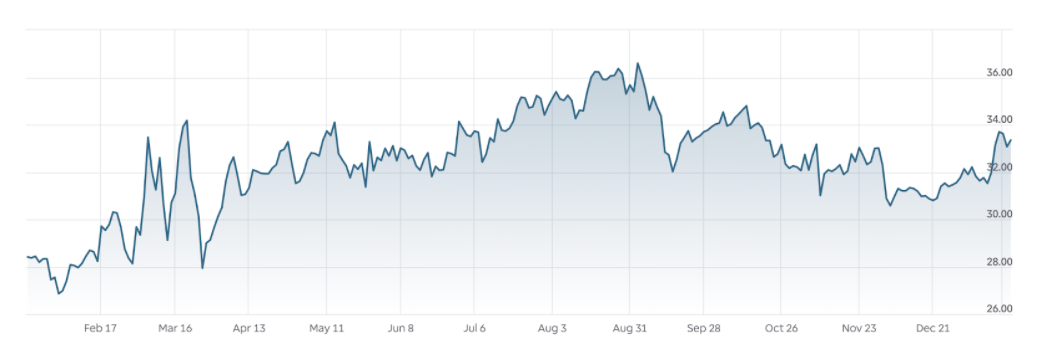
When looking at Chart II, it seems that the largest impact of COVID-19 (typical consensus is mid-March 2020) caused a significant drop in KR stock price. However, using some further analysis we can see from Chart III that while a pullback was noticeable, KR both recovered quickly and continued growing beyond its previous 3 Year high. KR was smart in navigating the pandemic. Its ability to bounce back and take advantage of increased at home cooking can be seen in its ability to lessen the impact of economic uncertainties in the market. Returning our attention to Chart II, we can see a dip beginning in September 2020 after a strong run to $36. This dip can be accounted for by announcements of vaccines and a general loosening of restrictions in many states, especially midwestern states where KR operates and which had looser restrictions throughout the pandemic anyways.
Though it may seem that we are too late and will miss out on any COVID-related upside, recent discussions of a “second wave” and the Biden administration’s likely strong stance on enforcing quarantines means that restaurant operations will be limited for a least the next few quarters, again which can be seen by KR’s rise end of Q4 2020. Stepping back, this insight is also important because it speaks to a potential stickiness of KR in society post-COVID. While people may eventually go out 1-2 times more a week than during quarantine, where they weren’t going out at all, their positive experiences at KR stores and online means that the consumer base will either stay at pre-COVID levels or increase. As can be seen in Chart III, KR was rising Q4 2019, which we can extrapolate to a post-COVID society in 2021.
Risks
As mentioned previously, KR’s biggest short-term risk is a restaurant recapture of lost market-share and KR’s investments lacking a targetable market. With restaurants returning, it feels that trips to the grocery are slowing down. Has KR lost its momentum just when it needs it most? After all, KR lacks a strong differentiator from either its big-box competitors or local and regional high-end stores. From one end, KR is squeezed by restaurants and delivery apps like DoorDash. Consumers feel less inclined to run the supermarket for a meal they need to cook, and more inclined to press a button on their phone for already prepared food. From the other end, KR doesn’t have the global reach like a Walmart, nor the cultural influence like a Whole Foods.
Second, and possibly even more concerning, is that even if KR has market access and a differentiated product, it still has a long way to go before it fully develops the delivery infrastructure for both its online shopping and direct to consumer services. Against established online competitors like Walmart and Amazon Fresh, and even some meal kit services like BlueApron and HelloFresh, time may be the one thing KR can’t afford to waste.
Importantly, KR is trying to mitigate these risks in both the short and long term. First, KR is partnering heavily with Google’s Cloud AI software, which it hopes to use to improve the search functionality on its website for consumers looking to order groceries and consumables online. Additionally, KR’s recent investment in Mirakl, an e-marketplace for B2B and B2C retail, seems to be a keystone in its plan to rapidly bring its ambitious delivery goals to scale.
Conclusion
KR presents an interesting play for investors looking for blue-chip stocks that not only have traditionally strong dividends and stability, but are actively seeking new avenues of growth and acquiring innovative companies to achieve their goals despite instabilities and competition in the market. It does this in two ways. First, KR is setting itself up well for a competitive post-COVID 19 economy, where retail especially will most likely be geared toward online and contactless delivery and pickup. Undoubtedly, the distribution of a vaccine will lead to celebration from consumers, many of which will be eager to leave their homes and spend more time than usual going out to shop. In this scenario, KR is positioned to take advantage of its traditionally strong store presence. That said, many consumers will continue to be wary to shop in highly concentrated areas, and will continue to choose delivery. Even more so, consumers may find the speed of delivery and pickup to outweigh the experience of shopping in person, and will choose them out of convenience rather than fear. In these scenarios, KR’s investments in ClusterTruck and Orcado help KR compete with both restaurants and online groceries. These investments als allow KR to test recipes, food preparation and advertising methods, crucial consumer data it can then apply to its physical stores.
Second, KR has anchored its place at or near the top of the retail industry for the future not due to a shift in corporate values, but thanks to its flurry of acquisitions and partnerships with software and technology companies. Partnerships with Google Cloud AI and Mirakl, for example, will enable KR to quickly and effectively compete with established players in the online retail space. Overall, investors should expect steady or modest returns through the rest of 2021, with the potential for exponential growth once KR finishes developing its infrastructure of modern delivery services. Assuming a P/E multiple of 15x and an EPS of $3.00, conservative increases from 12x and $2.75, respectively, expect a share price target of $45.
KR is trading at $33.21 (+0.42%) as of close Thursday, January 21, 2020
Goldman Sachs (NYSE: GS) is one of the most recognizable names in finance, yet in recent years the company has been overlooked by investors searching for high flying growth stocks. Yet, value is traditionally one of the first areas to recover post recession and it is time to give value plays another look. Goldman is also an incredibly safe play as downside risk is limited as the company trades near book value, which nearly always acts as a floor for banking stocks in a market full of stretched valuations. In addition to this, Goldman offers strong growth opportunities as the company increases its presence in consumer banking and tech. I would advise investors looking to capitalize on the trend towards value to buy Goldman as the company provides a solid value investment with promising growth as it expands into new sectors.
Strength of Revenue Streams:
Goldman breaks its revenues into four sources (Annual 2020):
Investment Banking — According to Goldman’s Q4 2020 earning results “the firm ranked #1 in worldwide announced and completed mergers and acquisitions, worldwide equity and equity-related offerings and common stock offerings for the year.” Goldman’s dominance in M&A is well timed as low interest rates and newfound interest from corporations in owning and operating supply chains encourages new M&A deals 2021. While the rise of SPACs poses an alternative to traditional IPOs, SPACs do not pose a threat to Goldman’s revenue. Instead, Goldman stands to benefit from an increased number of companies going public through SPACs as the firm manages a large number of SPAC offerings and commands higher fees for its services in SPAC mergers than traditional IPOs. It is also worth noting that Goldman currently faces a backlog of M&A projects and expects elevated demand for their services to continue through 2021.
Global Markets — If you were to conduct a “man on the street” survey where you asked random Americans how Goldman makes money they would undoubtedly point to the global markets segment of Goldman Sachs. They would do this for good reason, Goldman’s global markets division is one of the best on Wall Street and provides nearly half of Goldman’s total revenue. Emerging from the Covid-19 driven recession, Goldman’s global markets division is well positioned to capitalize on a new bull market that will likely last years. However it is worth noting that some of the remarkable revenue global markets produced in 2020 may be hard to replicate as volatility in the market cools off.
Asset Management — Goldman’s asset management division, which manages the firm’s loans and equity investments returned 11% less revenue in 2020 than 2019, reflecting less net revenue from private equity and lower rates of return from loans. A return to normalcy post-covid should raise revenue in this segment. Goldman also increased its loan loss provisions throughout 2020 and has now drawn down its loss provisions to buy back shares as the worst fears of the recession haven’t realized.
Consumer & Wealth Management — Goldman is rapidly growing its consumer and wealth management division and returned a record $6 billion in revenue for 2020. CEO David Solomon considers this segment a key component to the firm’s future and has expanded the wealth management division to better compete with Morgan Stanely. At the same time, the firm has launched its consumer bank Marcus and has its partnership with Apple to issue the Apple Card. Net revenues in consumer banking were up 40% year over year and 10% for wealth management. This news is particularly positive as Goldman is still far from finishing its expansion in consumer and wealth management and revenue will continue to experience large year over year growth.
Growth Catalysts:
Marcus — Goldman offers exciting growth potential in consumer banking with Marcus. Launched in 2016, Marcus is a completely online bank that offers high yield savings accounts, CD’s, personal loans and helps users learn about their financial health. The bank earned #1 in personal loan satisfaction by JD Power and has over $96 billion in deposits. Goldman believes the bank will be a key part of the firm’s future as Marcus becomes a full service consumer bank. Marcus is launching a checking account and Marcus Invest, which will give users investment tools with as little as $1,000. Here Marcus is well positioned to compete against traditional consumer banks and fintech startups. On the traditional banking front, Marcus will benefit from millennials and gen-z transitioning to higher yield online banks like Marcus. At the same time, Goldman’s recognizable name and long history gives Marcus a sense of legitimacy and stability that fintech start-ups cannot replicate. Taken together, this gives Marcus a unique position in online banking that it can leverage over its competitors.
Marcus has also partnered with Amazon to compete with traditional banks to offer small business owners who sell on Amazon.com revolving lines of credit at 6.99% to 20.99%.. This is a major step for Goldman as the firm pushes to offer financing for “Main Street”. The partnership with Amazon legitimizes Goldman’s expansion into tech and provides the firm with access to a massive amount of harvestable data from Amazon sellers.
While Marcus’s revenue was only $1.213 billion in 2020, revenue is up 40% year over year and will rise even faster as Marcus’s offerings expand to fully disrupt consumer banking and compete against brick and mortar banks. Goldman’s valuation is also likely to increase as Marcus grows as we have seen fintech stocks command higher valuations than traditional banks.
Apple Card — In 2019, Goldman partnered with the world’s most valuable company and launched the Apple Credit Card. The card aims to disrupt the credit card industry and reimagine how consumers spend money, encouraging primary use through Apple Pay. Only four months after its launch in November 2019, 3.1 million Americans (2.2% of American credit card holders) had an Apple credit card. Even better, card owners tend to be millennials with higher incomes and 60% consider it their primary credit card. While neither Goldman nor Apple release data on the revenue they collect from the card, Goldman has repeatedly called the launch of the card the most successful in history. Additionally, Goldman has successfully tied itself to Apple’s incredibly loyal customer base. This has led to increased interest in the Marcus checking account, with 50% of card users stating they would open an account when available. With an average revenue per user of about $300 for Marcus[1] [2] , this would be an additional $450 million in revenue without accounting for decreased cost per user added. As such, the Apple Card is beneficial to the company whether or not it is profitable. The true success is Goldman’s new relationship with Apple customers that ensures it is on the cutting edge of how consumers spend their money.
Private Wealth Management — Goldman has provided wealth management for the ultra-wealthy for some time. Now Goldman plans to further push into this space, leveraging its ultra-recognizable brand to win over new clients with smaller fortunes in order to better compete with Morgan Stanley and other firms. Goldman is also expanding its private wealth management business to smaller investors with Marcus Invest. With Marcus Invest the firm will offer a range of ETFs to investors with as little as $1,000. While the firm has not offered what its specific management fee will be it will likely be the industry average of 0.25%. Given the growing interest in investing in the general public and the popularity of Goldman’s ETFs with its wealthier clients Marcus Invest is expected to be popular. The firm has not offered guidance on how much additional revenue this will create. However it is noteworthy there will be very little additional investment necessary for the venture as most of the investment options will just be an expansion of services the firm already offers.
A Great Stock With a Cheap Price:
Goldman is an incredibly safe play as downside risk is limited as the company trades at 1.05 book value. Book value nearly always acts as a floor for banking stocks. In a market full of stretched valuations this downside protection is rare.
Goldman has greatly outperformed earnings expectations on the past three quarterly reports. Looking forward, Goldman is expected to continue delivering strong earnings, with 2022 EPS being 27.73. This implies a 2022 forward price to earnings ratio of 10.5, considering that Goldman will at this point likely have a significant presence in fintech the company is trading at a massive discount relative to fintech peers.
Valuation:
Despite Goldman’s recent rise, the share price remains undervalued, trading at only 1.05 price to book. This is lower than the industry average of 1.36, which is historically low as well. Given the strength of recent earning reports and the Fed’s recent decision to allow share buybacks once more, both Goldman’s and the industry’s book value can be expected to rise.
While Goldman trades at a higher price to earnings than several competitors, the valuation is justified by the corporation’s lack of a loan portfolio that has negatively impacted competitors as fears of Covid-19 driven defaults abound. In fact, when comparing Goldman to JP Morgan, who also faces less risk from loan defaults, Goldman’s price to earnings ratio seems reasonable and trades at less than JP Morgan.
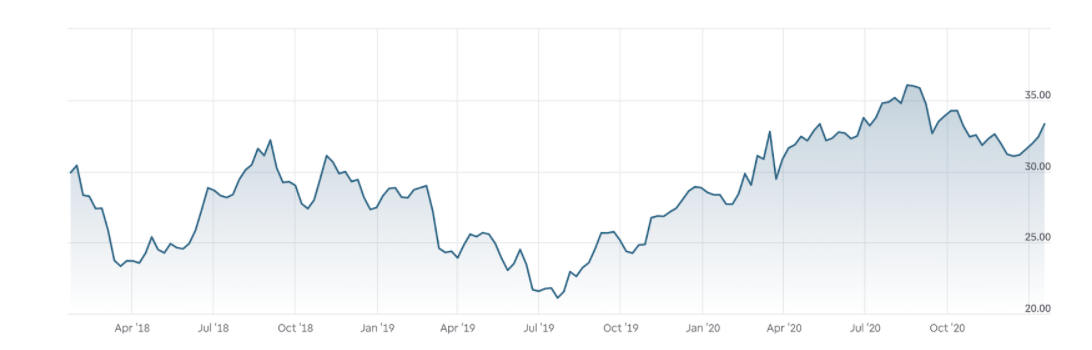
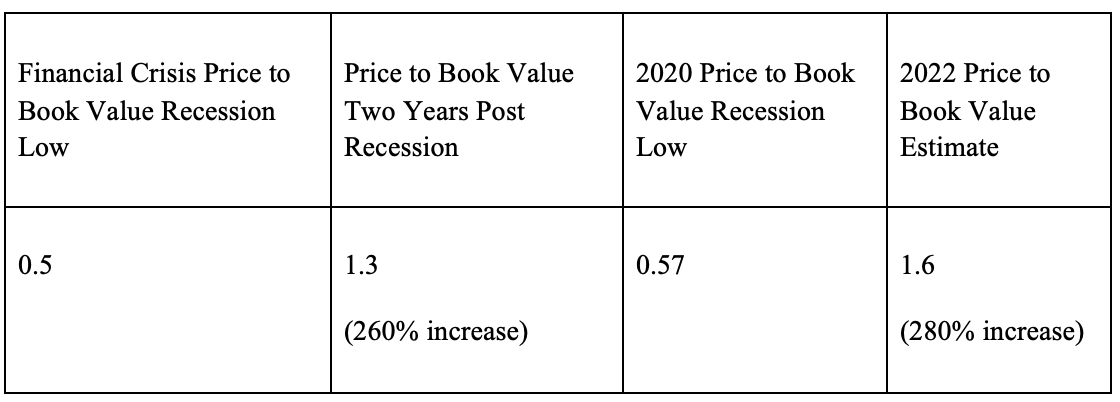
Historically, the financial sector has been one of the first industries to recover from recessions. I will use a price to book estimate for a valuation for 2022. Following the most recent recession, the Financial Crisis that lasted from December 2007 to June 2009, Goldman’s price to book ratio rallied from a low of 0.5 in December of 2008 to 1.3 price to book two years later. During this recession, Goldman’s price to book ratio reached its low in March, falling to 0.57. Using the Financial Crisis as precedent, a significant rise in Goldman’s price to book ratio can be expected in the coming two years. Goldman is much better financially emerging from this recession than it was in 2009 and does not have the negative press nor massive fines it did following the Financial Crisis. Considering these factors, Goldman can be reasonably expected to be trading at a higher price to book value two years from now than it was after the Financial Crisis. Here I will be conservative and assign a price to book value of 1.6 in 2022, which is only 0.3 above today’s industry average.
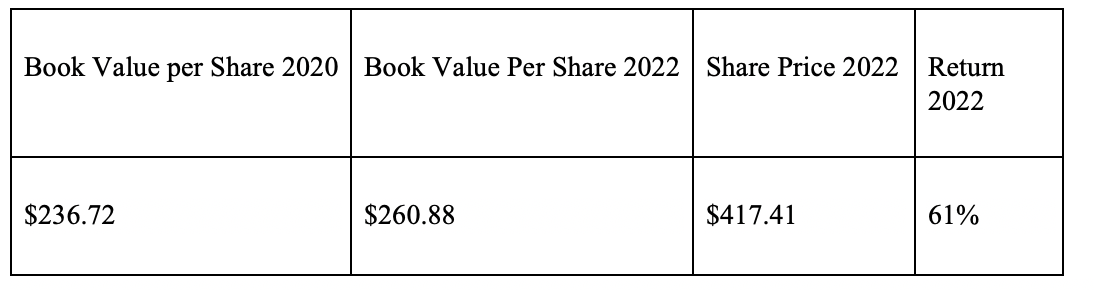
Goldman has an annualized increase in book value of 5% over the past 3 years. Given a current book value per share of $236.72, I forecast book value per share in 2022 will be $260.88 assuming the similar 5% year over year increase continues. Trading at 1.6 book value, share price is estimated to be $417.41, a 61% return from December 28th’s share price of $259.59.
With the Biden administration in power and democrats having unified control of Congress, one market in particular watches with bated breath – Student Loan Asset Backed Securities. With student debt forgiveness becoming an increasingly important message within the Democratic Party as a whole, SLABS have now taken on a deeper political significance, warranting an introductory look into the asset class for investors and non-investors alike.
What are Student Loans?
Student loans in the United states now make up $1.56 trillion of total outstanding consumer debt, trailing just behind mortgage debt to be the second largest consumer debt category. Student loans have historically played a more significant role in the US higher education system compared to other countries, due to higher tuition costs combined with the cultural perception that higher education in the US is the primary mode to entering the middle class. Private loans are largely handled by Sallie Mae, while federal loans have been spun off into a separate branch, Navient. Federal Family Education Loans, which are reinsured by the government, ended in 2010. Both private and federal student loans are securitized, though the most attractive of these, Federal Family Education Loans, which are reinsured by the government, ended in 2010.
After the 2008 global financial crisis, a meltdown largely caused by the collapse of the housing market and the reckless structuring of Mortgage Backed Securities, many were worried that SLABS could be the grounds of the next subprime crisis. Three main points distinguish SLABS from MBS. , Firstly they are not collateralized, unlike mortgages which are backed by housing. Secondly, the derivative market for student loans is much smaller than that for MBSs, meaning that leverage is limited and any shocks in the market are unlikely to cause further knock-on effects on the global economy like in 2008 (the macro effects of student loans in general are beyond the scope of this article). And third, student loans are much harder to discharge in bankruptcy compared to other private loans. This last point has made SLABS particularly attractive to investors due to the perceived low default risk
Even before the exogenous shock of COVID-19, there were warning signs that the student loan market could be in dangerous waters. With debt per capita steadily climbing higher but graduate income remaining stagnant, many analysts were skittish on the prospect of mass defaults. Student debt already has the highest 90 day delinquency rate for household debt, and according to the Fed, figures are likely to be understated due to various education loan policies that allow for grace periods and deferments.
What does the Biden Administration mean for the SLABS market?
The perennial question is then: is a student loan crisis imminent? In the case of asset backed securities, one popular metric is examining the delinquency rates of the underlying debt. If delinquency rates are higher than projected, then the value of the income stream is reduced, and the value of the ABS correspondingly drops.
During the 2008 financial crisis, investors such as Michael J Burry and Steve Eisman were able to predict the forthcoming financial crisis by analysing the underlying mortgages that supported the MBS/CDO/CDS structure, and realising how risky they actually were compared to their ratings. Post-2008, significant reforms have been made to credit rating agencies. The most notable of these have been the Dodd-Frank Act which have sought to improve the accuracy of credit ratings, but the inherent incentive problem within the system (with issuing firms themselves paying for ratings), leads many to question its reliability, although some argue that such issues may be overblown .
Data Analysis
We draw data from publicly available delinquency rates from the Federal Student Aid board and use it as a proxy for the entire debt market, noting that delinquency rates for private loans are likely to be lower (given the lower interest rates for Federal loans, many prioritize payment for private loans).
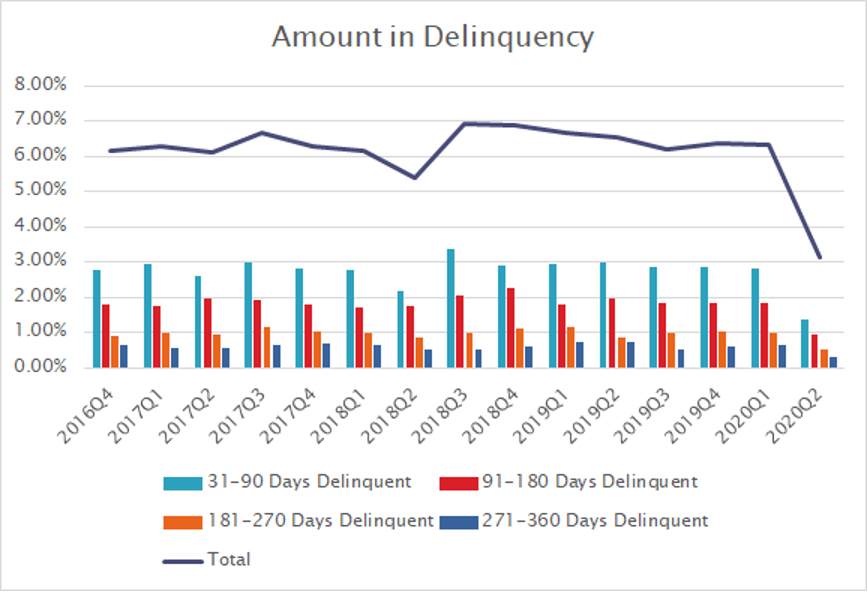
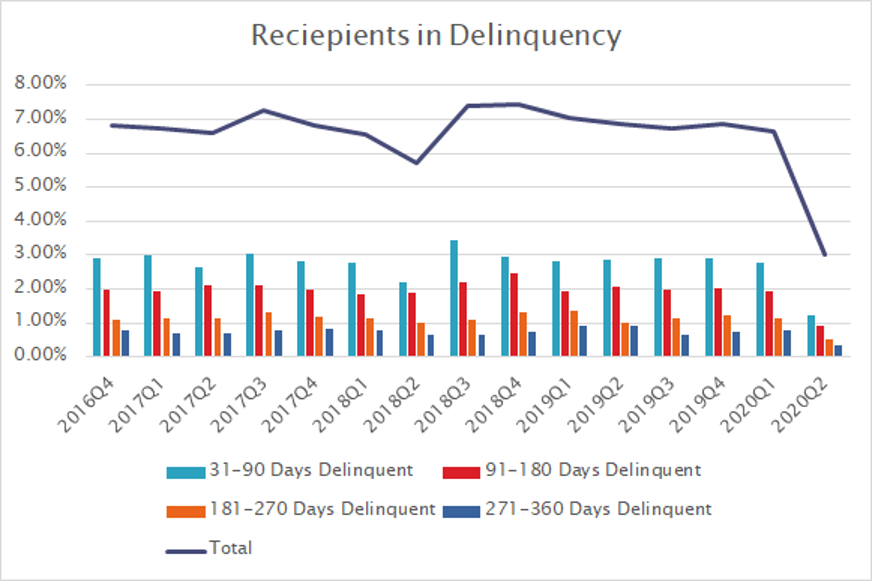
Analysing the available delinquency statistics at first glance, it seems that outcries over default are overblown. Delinquency rates show no obvious upward trend on a percentage basis, both in terms of dollars outstanding and raw number of recipients (in fact, these two figures seem to trend closely together, contrary to expectations with regards to recent trends of higher borrowing amounts per capita).
Here we note the significant dip in delinquency rates in the 2020 period, attributed to COVID-19 emergency debt relief for Department of Education (ED) -held student loans. This is significant as the economic impact of COVID-19 has not been factored into these statistics. While US unemployment figures have fallen to new lows in recent months owing to the pandemic, analysts warn this likely underestimates the true scale of unemployment, due to an overall decrease in active labour force size as well as furloughed staff. Furthermore, loans which are currently held in deferment or forbearance are also not reflected within these statistics, which amounted to roughly $255 billion in Q3 of 2019.
The Future of Student Loans
Ultimately, the sentiment on Student Loans depends heavily on a number of factors. By order of importance, they are: 1. Any form of student loan forgiveness that the Biden administration may push through 2. The economic outlook and recovery for the US post COVID-19. 3. Changes in laws regarding student loan bankruptcy, especially after the Rosenberg ruling in January 2020, where the courts ruled in favour of discharging the student loans of a Navy veteran.
With 1 looking increasingly unlikely, I doubt that SLABS are going to be the next hot investment. But I also believe that doomsayers are overblowing the situation. Even in the case of a rough economic downturn and massive unemployment, we would additionally have to see a record number of loans discharged in bankruptcy courts, as well as a complete failure on the part of issuers to renegotiate the terms of the loans and bonds. Lingering skittishness over similarities to the 2008 MBS crisis should be tempered with a reminder that said crisis was rootly caused by a bubble in the US housing market. And while there are some arguments that the value of a college degree may be overstated, most literature finds that there are definite returns on wage from a tertiary education – far from a bubble.
Overall, student loan asset backed securities seem to be a “hold” investment at best. Given the lack of macroeconomic consensus on the effect of student loan forgiveness, we are unlikely to see any sweeping policy changes to the fundamental loan structure in America any time soon. That, combined with increasingly mandatory (and expensive) university degrees means that SLABS as we know them are here to stay.
—-
This article is part of a series of publications created in cooperation with LSE SU Investment Research Group. Investment Research Group is a London School of Economics Society of 80+ analysts, dedicated to teaching financial skills and publishing articles on a wide range of categories such as: equities, fixed income, macro trends and alternative markets. To find more articles like this one click here: https://medium.com/lse-irg
Bryan Ling is a Research Associate for Fixed Income at the London School of Economic’s Investment Research Group, reading Economics.
Our publications do not offer investment advice and nothing in them should be construed as investment advice. Our publications provide information and education for investors who can make their investment decisions without advice. The information contained in our publications is not, and should not be read as, an offer or recommendation to buy or sell or a solicitation of an offer or recommendation to buy or sell any securities. Our publications are not, and should not be seen as, a recommendation to use any particular investment strategy.”
Below is a collection of “blurbs” as we call it: brief snapshots and hot takes on a variety of market-related topics. From analyses on Bloomin’ Brands’ role in the restaurant space to the future of mortgage backed securities, we hope our short pieces will provide you with some Insight on the way we’re viewing market movements in the coming months.
Enjoy!
– The Insight Leadership Board
Our Fed-Fueled Outlook for Navigating a V/W/L/U Shaped Recovery
By Maria Chapman and Saamia Khan
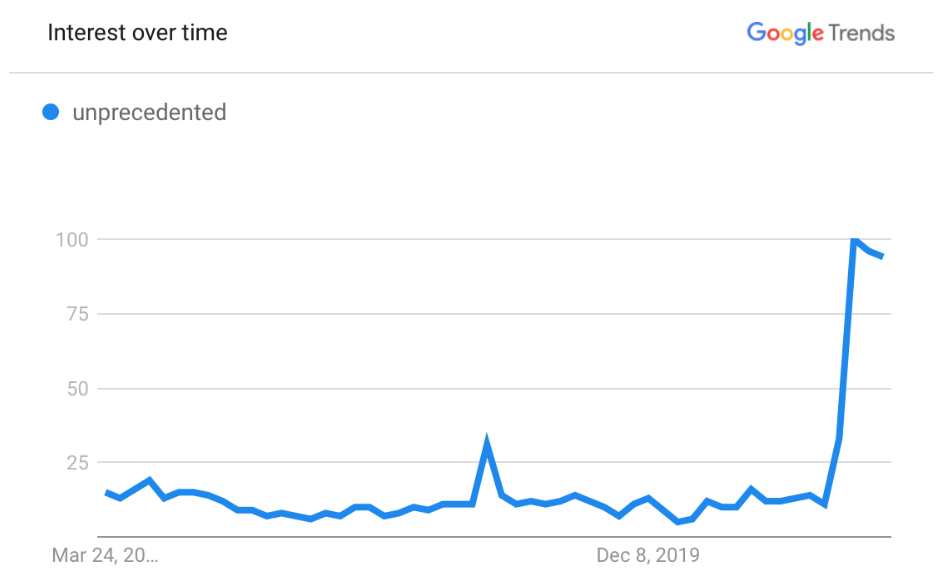
Figure 1: According to Google Trends, use of the word “unprecedented” has skyrocketed since early March, right when the global pandemic forced countries all over the world to go on lockdown
Along with other “unprecedented” situations we’ve seen in the first half of 2020, the Fed has stood out for its extraordinarily unprecedented measures over the last few months in its attempt to triage the effects of Covid-19 on the global economy. In the past few months, we have seen the central bank acting proactively to quell the financial panic that ensued as the U.S. and other countries began lockdown, holding true to its mantra of forward guidance. On March 15, 2020, we saw many of the expected moves: targeting the Fed Funds rate to effectively zero, removing the reserve requirement, declaring a new round of quantitative easing (QE), and encouraging the use of the discount window. The actions that have followed can certainly be categorized as “unprecedented.” The Fed has taken it upon itself to ensure unlimited liquidity in the markets by buying up assets in areas they have never before touched (i.e. municipal bonds, ETFs, individual corporate bonds).
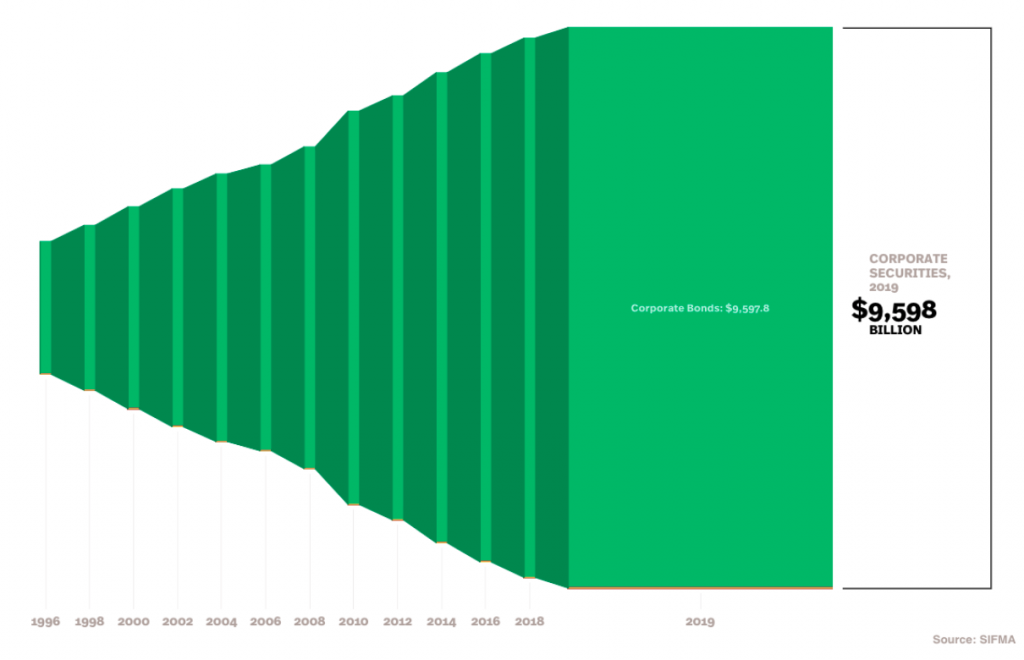
While the Fed has succeeded in making market participants jubilant, we as Insight-ers have had countless conversations about whether or not the market valuations we are seeing are indeed reflective of corporate, and overall economic health. One particular area of concern, as Janet Yellen pointed out on March 30, 2020 during a Brookings Institution video broadcast, are the ever-rising levels of corporate debt. Prior to the coronavirus, a low interest rate environment coupled with investor demand for return encouraged firms to issue massive amounts of debt, often to repay old debt, pay dividends or perform stock buybacks. With companies having to issue even more debt to stay afloat, we could be in for a shock with a surge in company defaults. We are already seeing a massive rise in company bankruptcies.
Figure 2: Corporate debt levels have risen from $5.5T in 2008 to $9.6T in 2019—the Fed’s recent actions in creating a low interest rate environment will only cause this trend to continue
Another foreseeable risk is the illusion of a healthy market as the technology sector outperforms others. The five largest companies in the S&P 500 are in tech and make up about 20% of the market value of the index. Retailers like JC Penney and Pier 1 Imports have filed for bankruptcy while Macy’s (NYSE: M) is down more than 60% since February. Meanwhile, tech giants such as Apple, Amazon, Netflix and Zoom stock have been continuously hitting all-time highs despite the pandemic. Although tech may be the future of our world, the present reality is that the significant performance drops in other sectors such as retail, transportation and travel are affecting the market, even if it’s not always apparent.
We want to emphasize that the Fed has certainly shown that it is more than willing to support the country’s economic recovery through forward guidance. At the same time however, there are inherent risks to striving for a perfect V shaped recovery, risks that should certainly not be overlooked when assessing our market play for summer 2020. Ultimately, we believe no number of stimulus packages nor asset purchases can alleviate the human health-related woes that have inflicted our once strong economy. But shoutout to Jerome Powell for leading us through a volatile first half of 2020 and ensuring liquidity in the markets.
Are MBS-Related Fears Warranted?
By Nathan Szeto
With the recent outbreak of the novel coronavirus, businesses of all kinds have taken to a remote style of work that has resulted in many office buildings being vacated and leases cancelled. Many homeowners, having lost a steady source of income, have found themselves unable to make payments on their mortgages. This situation has led many to question the future prospects of mortgage-backed securities (MBS). More specifically, will MBS cause another financial disaster like that of 2008? The answer is almost certainly no.
First, an important distinction must first be made between agency and non-agency MBS. Essentially, agency MBS are backed by the U.S. government via Freddie Mac and Fannie Mae and constitute 63% of the $11.1 trillion mortgage market as of now. The Fed is currently purchasing MBS and Treasuries at a rate of about $120 billion a month in order to keep the markets running smoothly. Non-agency MBS, aka private-label MBS, are those issued by entities other than Freddie Mac and Fannie Mae and therefore lack the backing of the U.S. government.
Concerns have been raised about non-agency MBS and more specifically the creditworthiness of certain borrowers in what seems to be a situation similar to that of 2008. In fact, ProPublica reports that housing prices have been subject to up to 30% inflation by banks in order to make properties seem more valuable than they actually are. However, what is important to note is that in 2007, there was $2.4 trillion in non-agency MBS, while in 2019 that figures stood at $443 billion. This fact, in addition to the reality that little evidence for the existence of a “housing bubble” exists, leads to the conclusion that even if the non-agency MBS market collapsed, the impact on the economy would not come close to that of the 2008 financial crisis.
One last topic of interest is the awkward position in which mortgage servicers have been placed. The recent CARES Act stimulus package has mandated that all federally-backed mortgages can enter forbearance for a period of one year. While this package is obviously beneficial for homeowners who as a result can continue living in their homes, it puts a great burden on mortgage servicers as they are still expected to make payments to investors for a period of four months after loans become delinquent or enter forbearance. Already at least 7.54% of all mortgages have entered forbearance and that number is expected to grow as the pandemic continues, according to the chief economist at the Mortgage Bankers Association. The increased risk of mortgages has resulted in more stringent regulations for potential borrowers that may persist even beyond the current crisis, according to the economic forecasting firm Oxford Economics. In any case, while the stimulus package does not provide funds to mortgage servicers, loans in forbearance as well as delinquent loans will now be allowed to remain in MBS pools beyond the typical 4 month period. Lastly, to support the functioning of the mortgage market, Fannie Mae and Freddie Mac have been authorized to purchase loans in forbearance according to the Federal Housing Finance Agency.
Flying Blind: Trading Airline Stocks
By Michael Davis
Despite an expected 90% revenue drop for Q2, the airline industry’s stocks have begun to take off, with stocks like American Airlines (AAL) up over 100% from their COVID low. Much like the virus itself, however, the market is fickle. As of today (7/2/20), AAL now sits at $12.50, down 38.5% from a month ago. Now you, dear reader, may be asking: what to do with this volatile yet necessary industry? Short answer: look out for breaking news.
As a whole, the big five stocks in the airline industry are JetBlue (NAS:JBLU), American Airlines (NAS:AAL), Delta (NYSE:DAL), Southwest (NYSE:LUV), and United (NAS:UAL). Within this top five, JetBlue and Southwest standout as the most positive buys. JetBlue has no debt and its EV/EBITDA of 5.29 is well below the transportation industry median of 8.77. Southwest, on the other hand, has a cash-to-debt ratio of .87, well above the transportation industry median of .26 and has a an EV/EBITDA of 5.79, again below the industry median of 8.77. The other three, while larger industry players, all operate with much less cash/more debt and at comparatively worse EV/EBITDA ratios, meaning that while they will stick around, their business models are likely to be impaired for far longer.
As the market stands now, it seems that airline stocks, much like the rest of the market, are handcuffed to any COVID-related news. Vaccine possibility? Look for a rise. Dr. Fauci says there’s an imminent second wave? Look for the fall. After all, air travel is necessary, and as they stand, most airline stocks are probably undervalued. That said, air traffic most likely will not return to its pre-COVID volume for three or more years, meaning that stock movements will be underpinned not by company performance, but by the market’s predictions for the future. The bottom line? Buy with one hand but have the other one ready to sell.
Not-So Bloomin’ Brands?
By Danny Irvine and Chris Bassett
As a result of COVID-19, many firms in the food industry have been hit hard financially from the lack of foot traffic of quarantining and social distancing. Some have fared better than others thus far, with the restaurants already proficient in takeout and delivery such as Domino’s Pizza able to operate more normally than those who offer more of a dine-in experience.
Bloomin’ Brands is a restaurant holding company that owns several American dine-in restaurant chains, including Outback Steakhouse, Fleming’s, Bonefish Grill, and Carrabba’s Italian Grill, typically located in the Northeast. These are higher-end chains, meaning they rely less on takeout as customers prefer the experience of more expensive food in a dine-in restaurant environment. Now, restaurants around the country are starting to open more and more of their locations as social distancing restrictions are lessened. It is unclear how the public will respond at this point in time as fears of the virus may prevent sit-down dining from being as prevalent as before, however there are a few reasons why Bloomin’ Brands may be positioned better than its competitors.
Just prior to the pandemic hitting the US, Bloomin secured a long-term exclusive deal with delivery service, DoorDash, for their Outback Steakhouse brand. The partnership ensures that despite the pandemic, customers can still purchase from Outback, adding an additional component to Bloomin’s revenue stream that their CEO, David Deno, could not have predicted would be especially useful during the proceeding pandemic.
Because Bloomin brands has access to cash, it is more likely to withstand the pandemic. Similar to the majority of companies over the past few months, Bloomin Brands took a loss during the first quarter of 2020 of $34mm, which distinctly contrasts their prepandemic quarterly net income of $65mn. However, over the last few months Bloomin raised $505mm in debt, and after using a portion of that sum to repay some previous borrowings and addressing other financial obligations, they have a $336mn net increase in cash this quarter, which means they have an additional $321mm in cash compared to this time last year. Because their financials were strong prior to the pandemic, they could take on debt to keep their various brands afloat. Bloomin Brands has made between ~$100mm and ~130mm in annual net income each year over the last three years. Therefore, the debt that they took on can be easily paid off over time, once they can safely serve customers in their storefronts again. Thus, although the pandemic wiped out their profitability this quarter, Bloomin brands was able to secure sufficient funding via debt to stay afloat that they can effectively pay down when their normal streams of income return. Notably though, it will take some time to pay down this new debt, meaning that a full recovery for Bloomin looks to be 5-7 years out.
Looking Beyond: A Glimpse into BYND
By Mohammad Mehdi Mojarradi and Michael Bedard
Beyond Meat (BYND) is a rising plant-based food company that went public in Q2 of 2019. BYND’s diversified revenue stream has allowed it to stay afloat during the COVID-19 crisis. Despite 42% of its revenue coming from food services, the hit on restaurants has not had a debilitating effect on BYND unlike some of its competitors, namely Impossible Foods. The company’s primary source of revenue, grocery stores and supermarkets (58%), have been relatively steady. In fact, while BYND reported an adjusted EBITDA loss of $2.1 million in the year-ago period, their Q1 2020 adjusted EBITDA was reported at $12.7 million, despite restaurants getting destroyed as a consequence of COVID-19. Evidently, BYND handled the massive shift in demand from food service to retail adequately. It is important to note that since COVID-19 became a global issue only in the last two weeks of Q1, BYND’s performance in Q1 cannot be viewed entirely in conjunction with COVID-19. However, because it can be for Q2, we believe BYNDs performance in Q2, which has been promising thus far, will be most telling of how the company will emerge from this crisis.
As of March 28th, BYND reported that it has taken adequate steps to ensure liquidity in the wake of the Coronavirus outbreak with roughly $250 million in cash with an outstanding debt of just over $30 million. With their fiscal safety secured, BYND leadership has said that part of their plan is expansion into real-meat territory as several meat processing facilities in the U.S. have large outbreaks. According to Tyson Foods executives, roughly half of the company’s pork processing capability has been halted due to these coronavirus outbreaks in their facilities. As gaps in the market open, BYND hopes to slide in by providing larger-than-normal discounts on their products to big retailers in an attempt to minimize the price difference between their product and beef. Currently pricing their products at around double or triple the price of regular beef products, BYND can stand to make solid territorial and financial gains in the upcoming quarters as they lower prices and become more appealing to the average consumer.
Wrapping Up: Two Cents from Jack Sercu ’22
By Jack Sercu
All, I hope you’re well and staying safe at this time. An economic outlook is intriguing to write at this time, and I think cannot be properly considered without looking at the social change our country is currently going through. I believe we are perfectly positioned as liberal arts students – at an extremely diverse institution – to weigh the various factors and come up with a vision for the future. I will look at two different categories and how they will alter the business environment of the future. First, I will examine the push for ends to systemic racism and injustice. Second, I will look out for when we do rebound from COVID, which is not an exact time period, but more so the year after the country/world opens up again. So, without further ado, my fellow Americans, Jack Sercu’s economic outlook/two cents.
It would be ignorant to speak of the future without looking at how the changing political sentiment in our country will affect business. The resource gap for minorities is completely tied to income – no law in it of itself states that blacks should receive worse education, healthcare or other support. However, due to America’s gut-wrenching history where our systems did prevent certain races from most resources/privileges, these gaps have held pretty steady. Picture doing a 100m race where white people start 50m ahead. Anyways, the wave we have witnessed on social media from a combination of friends and celebrity endorsements is to support minority owned local businesses. I believe reallocating your resources as such is a fantastic way to empower minorities. This will not breakup big business and topple capitalism, but I do believe it will lead to more balance between small and large. Attention to small businesses has increased because of COVID, as many have witnessed their favorite local spots struggling or going out of business and are more aware of their power as consumers… Continued here.
All, I hope you’re well and staying safe at this time. An economic outlook is intriguing to write at this time, and I think cannot be properly considered without looking at the social change our country is currently going through. I believe we are perfectly positioned as liberal arts students – at an extremely diverse institution – to weigh the various factors and come up with a vision for the future. I will look at two different categories and how they will alter the business environment of the future. First, I will examine the push for ends to systemic racism and injustice. Second, I will look out for when we do rebound from COVID, which is not an exact time period, but more so the year after the country/world opens up again. So, without further ado, my fellow Americans, Jack Sercu’s economic outlook/two cents.
It would be ignorant to speak of the future without looking at how the changing political sentiment in our country will affect business. The resource gap for minorities is completely tied to income – no law in it of itself states that blacks should receive worse education, healthcare or other support. However, due to America’s gut-wrenching history where our systems did prevent certain races from most resources/privileges, these gaps have held pretty steady. Picture doing a 100m race where white people start 50m ahead. Anyways, the wave we have witnessed on social media from a combination of friends and celebrity endorsements is to support minority owned local businesses. I believe reallocating your resources as such is a fantastic way to empower minorities. This will not breakup big business and topple capitalism, but I do believe it will lead to more balance between small and large. Attention to small businesses has increased because of COVID, as many have witnessed their favorite local spots struggling or going out of business and are more aware of their power as consumers. The guilt or discomfort that many feel can also be satisfied through spending, and I think this is an underrated factor that will help change. Simply put, people being able to tell themselves “I buy food from the local black-owned deli, I buy cannabis (legally) from the local black-owned dispensary (which I have seen many Seatteites encourage their friends to do), etc” will actually make a difference. That isn’t the best method to change our mentalities, but I do think it is a good supplementary action – put your money where your mouth is! Well done > well said. These are easier changes that allow people to maintain their personal savings rates, an important factor to keep in mind when many have had recent changes in employment/income.
Consumers can aid in the empowerment of minority-owned businesses, but I believe more formal investment vehicles are a faster method for change. SoftBank stepped up and created a $100m fund called the Opportunity fund, which will only invest in minority-owned companies. It is amazing that they put this together so quickly, and it will make a difference, but $100m seems like a drop in the bucket of systemic racism. The minimum investment from their (largely laughable) Vision fund was $100m, and the size of that fund is $100bn. Funding is a barrier that is often difficult for minority founders to access, and this fund will hopefully have amazing ripple effects across the industry.
Another important industry to look at is personal security/defense. These have already been extenuated by COVID, but civil unrest and talks of defunding police will heighten the importance of security more than ever. Firearm and ammunition sales have increased since the start of the outbreak, with gun sales increasing by 85% YOY in March and 71% YOY in April. Home security system sales also have increased significantly. Both of these markets should continue to gain steam as sentiment and legislation moves forward about defunding the police. An interesting distinction between the guns/ammo market and the security system market is the finite nature of guns/ammo. Once a few weapons are owned in one household, the majority of people do not need to purchase more. These people are buying for defense reasons, and do not need a large amount or variety to feel secure. Those who are connoisseurs of weapons for sport will not be affected by COVID or worries of civil unrest, and will consume as usual (barring slightly different behavior from income changes). Ammunition is a small recurring expense, but most who own firearms for defense reasons are not at the range burning through boxes of ammo on a weekly basis.
Security systems, on the other hand, operate more as SaaS companies. Many have little to no installation costs and offer subscription pricing models, which provides recurring revenue. To remain protected, people must remain subscribed, especially after a system is installed. The hardware involved makes switching costs high, so it is unlikely that consumers will switch security companies. Hence, the battle for new consumers will be crucial to revenue growth. It is a real pain to have old systems removed and new systems installed to save cents on the dollar, especially when you are a boomer who has to figure out how to work these systems. This is much different than switching between Zoom/MSFT Teams/WebEx for cost reasons, showing how unique the security market is within the broader SaaS scene. I also hope that the investing scene can fuel developments in public security, especially the use of AI and pattern recognition to remove racism and police discretion from the streets. The low cost of borrowing and large amounts of dry powder that investment vehicles have saved up can be put to good use.
The third important category — when we rebound fully — whenever that may be. Nobody knows. Stocks will go up. There is talk that the market is overvalued at the moment, as evidenced by the increase of recreational trading and various valuation metrics. Stocks are somewhat close to pre-COVID levels, so I do not understand where they will go once earrings rebound to pre-COVID levels. If share prices were to grow proportionally to their increases in earnings/revenue during the rebound, we will essentially have increased the Y-Intercept by 7-9%. I think a bubble has to burst somewhere, as so many people bought into the equity markets based on the principle that stocks will continue to go up. I do not see how expected downfalls can be priced into the market. But we will see. If I was to boil my rebound results into one sentence: There will be a bubble somewhere, but stocks will still go up before/after the market gets a quick reset to their actual performance, in the long run.