Porsche – An Iconic Symbol of Wealth that Might Just Help You Grow Yours

Authored by Luke Graupmann


Porsche – An Iconic Symbol of Wealth that Might Just Help You Grow Yours


Overview:

Porsche SE Holdings (OTCMKTS: POAHY) trades as an ADR over the counter in the US with a convoluted holding structure that mostly owns Volkswagen equity. To be clear, when investors buy Porsche SE, they are not directly buying the iconic car company, which is known and will be referred to in this article as Porsche AG. This limits investor enthusiasm but creates a compelling opportunity to buy Volkswagen at a ~37% discount compared to its own shares. Beyond this discount, Volkswagen itself is positioned for significant multi-year earnings growth as it transitions to electric vehicles and it gains market share in Europe. Finally, while providing stable returns through its Volkswagen investment, Porsche SE’s stock offers the chance for massive returns from a spinoff of Porsche AG (the actual car company) for an IPO listing. In this article I will first dig into Porsche SE’s financial structure and why it offers a discounted price on Volkswagen equity before examining Volkswagen’s underlying business and the implications of an IPO listing of Porsche AG. 


Financial Structure:

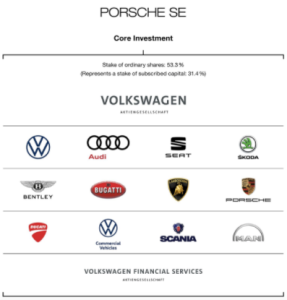
In a complex financial structure Porsche SE owns 53.3% of Volkswagen’s equity. Volkswagen itself then owns and manufactures its car brands, including Porsche AG. This breakdown is seen below. 
 

Beyond Volkswagen, Porsche SE also holds promising investments in industries auxiliary to automotives, specifically companies specialized in automotive software, lidar, 3d printing, traffic analytics, satellites and their launches and the semiconductor industry. 
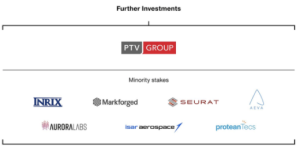


While these investments are promising and offer some upside, over 90% of Porsche SE’s invested capital is in Volkswagen, so I will now turn my attention to how Porsche SE equity is valued compared to its underlying investment in VW. 


Since Porsche SE owns 53.3% of VW’s equity, its market cap should be roughly 53.3% of Volkswagen’s $135.2 billion market cap, about $72 billion. 


However, Porsche SE’s current market capitalization is only $28.5 billion, 60% less than the implied market cap. While part of this discrepancy can be attributed to the $10.8 billion in legal claims against the holding company, this does not fully account for the discrepancy. Even if Porsche were forced to pay the maximum amount of legal claims against it, which seems significantly unlikely given comparable rulings against VW, Porsche SE still trades at only 54.6% of its underlying equity in VW and means that as an investor you are getting Porsche SE’s auxiliary investments for essentially nothing.
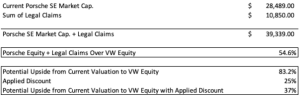


This discount is likely due to the complex financial structure of Porsche SE and has historical precedent. In each case where such a discount in Porsche compared to VW equity has occurred before, Porsche SE has eventually caught up to within 25% of VW’s valuation. Applying this discount, Porsche SE becomes a compelling arbitrage opportunity, providing roughly 37% upside from current valuation when compared to its underlying investment in Volkswagen and subtracting 25% to account for the discount. However, investors should not just use Porsche as a quick arbitrage opportunity but buy its stock as a long term investment in VW at a discounted price.


Volkswagen’s Transition:

In 2015 Volkswagen appeared to be a company near collapse. So called “dieselgate,” where the company programmed cars to lessen their emissions when tested for regulatory compliance then increase emissions when on the road for better performance and fuel efficiency had just been uncovered and the company faced tens billions in recalls, buybacks and legal fees. In just a few months the stock halved and calls to break up the conglomerate emerged. Since then, Volkswagen’s stock has not only recovered but returned 141% since 2016, outperforming the S&P by 20%. VW’s sizable investment in battery technology, electric vehicles and portfolio of high margin luxury vehicles promise to accelerate these returns over the next five years. 


VW research has committed ~$81 billion to battery factories, tech and charging stations through 2025 and completely phase out gas cars by 2030. This massive investment is needed, the company’s investments in EVs and rollout of EV cars has fallen behind both new EV companies like Tesla and legacy automakers like GM and Ford in their EV transition and innovation. However, the company has now committed to producing 1 million EVs by 2023, a goal it is currently on track to achieve. It also plans to expand its European charging network to 18,000 charging stations, which will allow it to collect recurring revenue from its EVs on the road and further market its EVs as practically useful. Volkswagen already has several EVs on the road across a spectrum of brands from premium to affordable, allowing it to compete with Tesla on all fronts and extract high margins on its luxury Porsche and Audi EVs. 


Volkswagen also has a locational advantage among legacy automakers in the EV race. With 26% of automotive market share in Europe and 20% of market share in China VW is well positioned to to roll out its EV lineup to a receptive market. Together Europe and China represent the two largest EV markets, respectively making up 43% and 41% of the entire EV market. This creates a competitive advantage for VW compared to Tesla and legacy automakers in the two largest EV markets as it leverages existing relationships into EV sales in two critical automotive markets that will likely decide who wins the EV race. This is particularly important in the short term as EV margins for the short term are expected to be lower than traditional cars due to battery development costs. VW can help makeup some of its lost profits from margins with higher volume, which appears likely as they leverage existing market share into future EV sales in critical markets.


3 Year Valuation: 

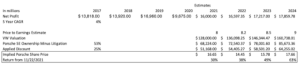
Volkswagen’s EV transition should also help increase its earnings multiple, which is currently only 7.7 price to earnings. This is below major competitors despite a similar EV strategy, strong battery tech, higher EBITDA margins and dominant market share in strategic markets. Looking at GM, Ford, Daimler, BMW and Toyota for comparison, the industry average is 10.5, however this average is skewed by Ford, which trades at 26.4 price to earnings, more than double the nearest competitor. Thus, for conservative estimates I will ascribe VW a multiple of only 9 in 2024. Modelling earnings, I estimated that earnings will continue to grow at its historical 5 year CAGR, which is conservative given the EV transition in Europe is expected to expand VW’s market share and long run margins should be similar to ICE cars. This results in a 2024 earnings of $28.3b, which multiplied by 9 implies a valuation of Volkswagen of $229.4b. From here valuing Porsche just requires multiplying VW’s valuation by Porsche’s ownership stake. Once again, to be conservative I have subtracted Porsche’s total possible litigation expense from its valuation and a 25% discount. This gives a 2024 share price of $17.66, returning a respectable 63% from 11/3/2021.
Spinoff

There is also a significant chance that Volkswagen chooses to spin off Porsche into a separate company with an ipo listing sometime within the next few years. Such calls have been repeatedly called for by major investors and management appears receptive to the idea because of the high probability for a higher valuation of Porsche separately (makes up the largest portion of VW’s profits and is a higher margin, more stable business than the other brands). Such a spinoff also have historical precedent as Fiat Chrysler spun off Ferrari in 2015. This spinoff was a major success, investors in Fiat Chrysler were given shares in the new company (which has since quadrupled in value and trades at a much higher valuation) and Fiat Chrysler stock more than doubled in the next few months. A similar outcome that gives Porsche Holdings cash and investors direct shares in Porsche AG appears likely where Porsche AG to be spun off.


Overall:

Overall Porsche is a compelling investment that offers a 37% discount to VW’s equity while accounting for a 25% equity discount. At the same time, VW itself is a strong investment. Because of this, Porsche is a buy.
Goldman Sachs: A Financial Gem

By Luke Graupmann

Goldman Sachs (NYSE: GS) is one of the most recognizable names in finance, yet in recent years the company has been overlooked by investors searching for high flying growth stocks. Yet, value is traditionally one of the first areas to recover post recession and it is time to give value plays another look. Goldman is also an incredibly safe play as downside risk is limited as the company trades near book value, which nearly always acts as a floor for banking stocks in a market full of stretched valuations. In addition to this, Goldman offers strong growth opportunities as the company increases its presence in consumer banking and tech. I would advise investors looking to capitalize on the trend towards value to buy Goldman as the company provides a solid value investment with promising growth as it expands into new sectors.

Image for post

Strength of Revenue Streams:

Goldman breaks its revenues into four sources (Annual 2020):

Image for post

Investment Banking — According to Goldman’s Q4 2020 earning results “the firm ranked #1 in worldwide announced and completed mergers and acquisitions, worldwide equity and equity-related offerings and common stock offerings for the year.” Goldman’s dominance in M&A is well timed as low interest rates and newfound interest from corporations in owning and operating supply chains encourages new M&A deals 2021. While the rise of SPACs poses an alternative to traditional IPOs, SPACs do not pose a threat to Goldman’s revenue. Instead, Goldman stands to benefit from an increased number of companies going public through SPACs as the firm manages a large number of SPAC offerings and commands higher fees for its services in SPAC mergers than traditional IPOs. It is also worth noting that Goldman currently faces a backlog of M&A projects and expects elevated demand for their services to continue through 2021.

Global Markets — If you were to conduct a “man on the street” survey where you asked random Americans how Goldman makes money they would undoubtedly point to the global markets segment of Goldman Sachs. They would do this for good reason, Goldman’s global markets division is one of the best on Wall Street and provides nearly half of Goldman’s total revenue. Emerging from the Covid-19 driven recession, Goldman’s global markets division is well positioned to capitalize on a new bull market that will likely last years. However it is worth noting that some of the remarkable revenue global markets produced in 2020 may be hard to replicate as volatility in the market cools off.

Asset Management — Goldman’s asset management division, which manages the firm’s loans and equity investments returned 11% less revenue in 2020 than 2019, reflecting less net revenue from private equity and lower rates of return from loans. A return to normalcy post-covid should raise revenue in this segment. Goldman also increased its loan loss provisions throughout 2020 and has now drawn down its loss provisions to buy back shares as the worst fears of the recession haven’t realized.

Consumer & Wealth Management — Goldman is rapidly growing its consumer and wealth management division and returned a record $6 billion in revenue for 2020. CEO David Solomon considers this segment a key component to the firm’s future and has expanded the wealth management division to better compete with Morgan Stanely. At the same time, the firm has launched its consumer bank Marcus and has its partnership with Apple to issue the Apple Card. Net revenues in consumer banking were up 40% year over year and 10% for wealth management. This news is particularly positive as Goldman is still far from finishing its expansion in consumer and wealth management and revenue will continue to experience large year over year growth.

Growth Catalysts:

Marcus — Goldman offers exciting growth potential in consumer banking with Marcus. Launched in 2016, Marcus is a completely online bank that offers high yield savings accounts, CD’s, personal loans and helps users learn about their financial health. The bank earned #1 in personal loan satisfaction by JD Power and has over $96 billion in deposits. Goldman believes the bank will be a key part of the firm’s future as Marcus becomes a full service consumer bank. Marcus is launching a checking account and Marcus Invest, which will give users investment tools with as little as $1,000. Here Marcus is well positioned to compete against traditional consumer banks and fintech startups. On the traditional banking front, Marcus will benefit from millennials and gen-z transitioning to higher yield online banks like Marcus. At the same time, Goldman’s recognizable name and long history gives Marcus a sense of legitimacy and stability that fintech start-ups cannot replicate. Taken together, this gives Marcus a unique position in online banking that it can leverage over its competitors.

https://www.marcus.co.uk/uk/en

Marcus has also partnered with Amazon to compete with traditional banks to offer small business owners who sell on Amazon.com revolving lines of credit at 6.99% to 20.99%.. This is a major step for Goldman as the firm pushes to offer financing for “Main Street”. The partnership with Amazon legitimizes Goldman’s expansion into tech and provides the firm with access to a massive amount of harvestable data from Amazon sellers.

While Marcus’s revenue was only $1.213 billion in 2020, revenue is up 40% year over year and will rise even faster as Marcus’s offerings expand to fully disrupt consumer banking and compete against brick and mortar banks. Goldman’s valuation is also likely to increase as Marcus grows as we have seen fintech stocks command higher valuations than traditional banks.

Apple Card — In 2019, Goldman partnered with the world’s most valuable company and launched the Apple Credit Card. The card aims to disrupt the credit card industry and reimagine how consumers spend money, encouraging primary use through Apple Pay. Only four months after its launch in November 2019, 3.1 million Americans (2.2% of American credit card holders) had an Apple credit card. Even better, card owners tend to be millennials with higher incomes and 60% consider it their primary credit card. While neither Goldman nor Apple release data on the revenue they collect from the card, Goldman has repeatedly called the launch of the card the most successful in history. Additionally, Goldman has successfully tied itself to Apple’s incredibly loyal customer base. This has led to increased interest in the Marcus checking account, with 50% of card users stating they would open an account when available. With an average revenue per user of about $300 for Marcus[1] [2] , this would be an additional $450 million in revenue without accounting for decreased cost per user added. As such, the Apple Card is beneficial to the company whether or not it is profitable. The true success is Goldman’s new relationship with Apple customers that ensures it is on the cutting edge of how consumers spend their money.

Private Wealth Management — Goldman has provided wealth management for the ultra-wealthy for some time. Now Goldman plans to further push into this space, leveraging its ultra-recognizable brand to win over new clients with smaller fortunes in order to better compete with Morgan Stanley and other firms. Goldman is also expanding its private wealth management business to smaller investors with Marcus Invest. With Marcus Invest the firm will offer a range of ETFs to investors with as little as $1,000. While the firm has not offered what its specific management fee will be it will likely be the industry average of 0.25%. Given the growing interest in investing in the general public and the popularity of Goldman’s ETFs with its wealthier clients Marcus Invest is expected to be popular. The firm has not offered guidance on how much additional revenue this will create. However it is noteworthy there will be very little additional investment necessary for the venture as most of the investment options will just be an expansion of services the firm already offers.

A Great Stock With a Cheap Price:

Goldman is an incredibly safe play as downside risk is limited as the company trades at 1.05 book value. Book value nearly always acts as a floor for banking stocks. In a market full of stretched valuations this downside protection is rare.

Goldman has greatly outperformed earnings expectations on the past three quarterly reports. Looking forward, Goldman is expected to continue delivering strong earnings, with 2022 EPS being 27.73. This implies a 2022 forward price to earnings ratio of 10.5, considering that Goldman will at this point likely have a significant presence in fintech the company is trading at a massive discount relative to fintech peers.

Valuation:

Despite Goldman’s recent rise, the share price remains undervalued, trading at only 1.05 price to book. This is lower than the industry average of 1.36, which is historically low as well. Given the strength of recent earning reports and the Fed’s recent decision to allow share buybacks once more, both Goldman’s and the industry’s book value can be expected to rise.

Image for post

While Goldman trades at a higher price to earnings than several competitors, the valuation is justified by the corporation’s lack of a loan portfolio that has negatively impacted competitors as fears of Covid-19 driven defaults abound. In fact, when comparing Goldman to JP Morgan, who also faces less risk from loan defaults, Goldman’s price to earnings ratio seems reasonable and trades at less than JP Morgan.

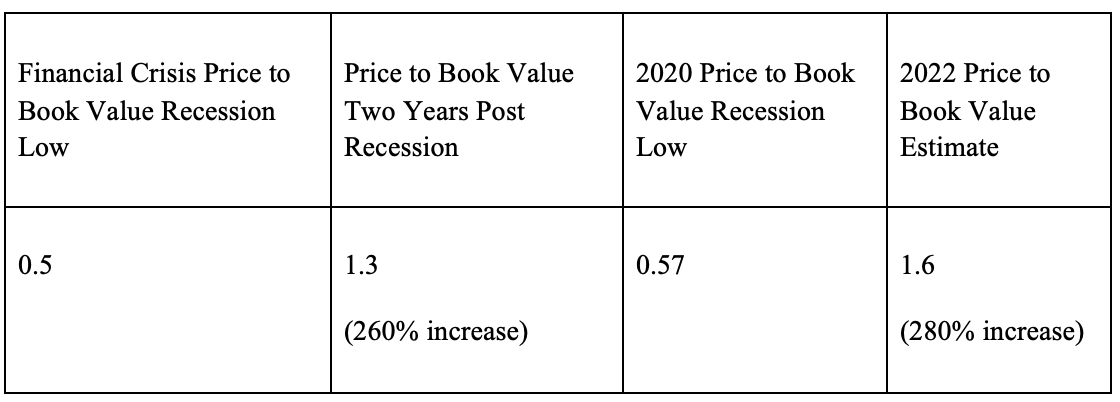
Historically, the financial sector has been one of the first industries to recover from recessions. I will use a price to book estimate for a valuation for 2022. Following the most recent recession, the Financial Crisis that lasted from December 2007 to June 2009, Goldman’s price to book ratio rallied from a low of 0.5 in December of 2008 to 1.3 price to book two years later. During this recession, Goldman’s price to book ratio reached its low in March, falling to 0.57. Using the Financial Crisis as precedent, a significant rise in Goldman’s price to book ratio can be expected in the coming two years. Goldman is much better financially emerging from this recession than it was in 2009 and does not have the negative press nor massive fines it did following the Financial Crisis. Considering these factors, Goldman can be reasonably expected to be trading at a higher price to book value two years from now than it was after the Financial Crisis. Here I will be conservative and assign a price to book value of 1.6 in 2022, which is only 0.3 above today’s industry average.

Image for post

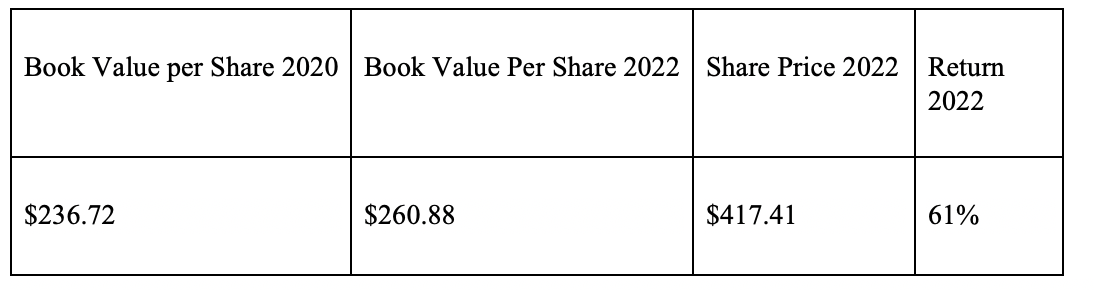
Goldman has an annualized increase in book value of 5% over the past 3 years. Given a current book value per share of $236.72, I forecast book value per share in 2022 will be $260.88 assuming the similar 5% year over year increase continues. Trading at 1.6 book value, share price is estimated to be $417.41, a 61% return from December 28th’s share price of $259.59.

Image for post