Our Summer 2020 Outlook

Dear Readers,

Below is a collection of “blurbs” as we call it: brief snapshots and hot takes on a variety of market-related topics. From analyses on Bloomin’ Brands’ role in the restaurant space to the future of mortgage backed securities, we hope our short pieces will provide you with some Insight on the way we’re viewing market movements in the coming months.

Enjoy!

– The Insight Leadership Board

Our Fed-Fueled Outlook for Navigating a V/W/L/U Shaped Recovery

By Maria Chapman and Saamia Khan
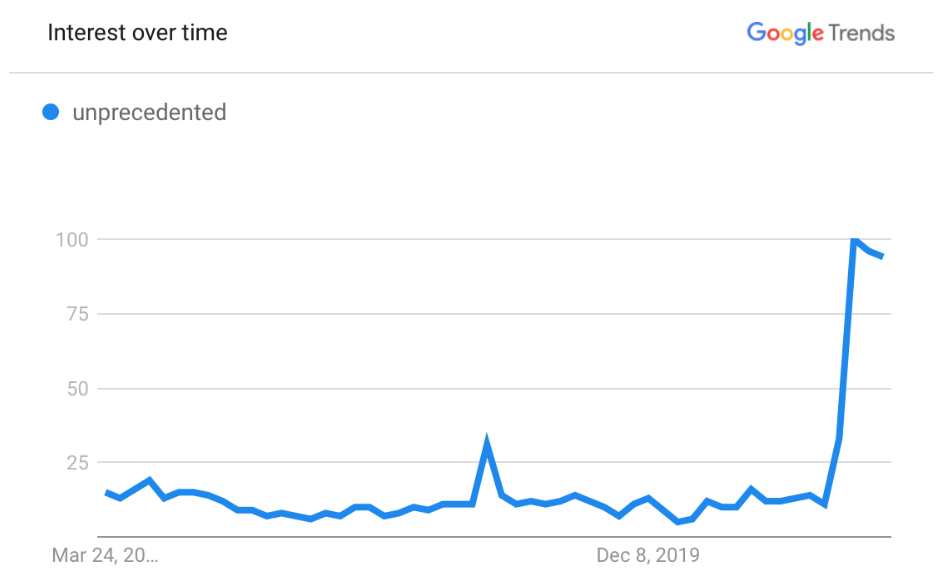
Figure 1: According to Google Trends, use of the word “unprecedented” has skyrocketed since early March, right when the global pandemic forced countries all over the world to go on lockdown

Along with other “unprecedented” situations we’ve seen in the first half of 2020, the Fed has stood out for its extraordinarily unprecedented measures over the last few months in its attempt to triage the effects of Covid-19 on the global economy. In the past few months, we have seen the central bank acting proactively to quell the financial panic that ensued as the U.S. and other countries began lockdown, holding true to its mantra of forward guidance. On March 15, 2020, we saw many of the expected moves: targeting the Fed Funds rate to effectively zero, removing the reserve requirement, declaring a new round of quantitative easing (QE), and encouraging the use of the discount window. The actions that have followed can certainly be categorized as “unprecedented.” The Fed has taken it upon itself to ensure unlimited liquidity in the markets by buying up assets in areas they have never before touched (i.e. municipal bonds, ETFs, individual corporate bonds). 

While the Fed has succeeded in making market participants jubilant, we as Insight-ers have had countless conversations about whether or not the market valuations we are seeing are indeed reflective of corporate, and overall economic health. One particular area of concern, as Janet Yellen pointed out on March 30, 2020 during a Brookings Institution video broadcast, are the ever-rising levels of corporate debt. Prior to the coronavirus, a low interest rate environment coupled with investor demand for return encouraged firms to issue massive amounts of debt, often to repay old debt, pay dividends or perform stock buybacks. With companies having to issue even more debt to stay afloat, we could be in for a shock with a surge in company defaults. We are already seeing a massive rise in company bankruptcies. 
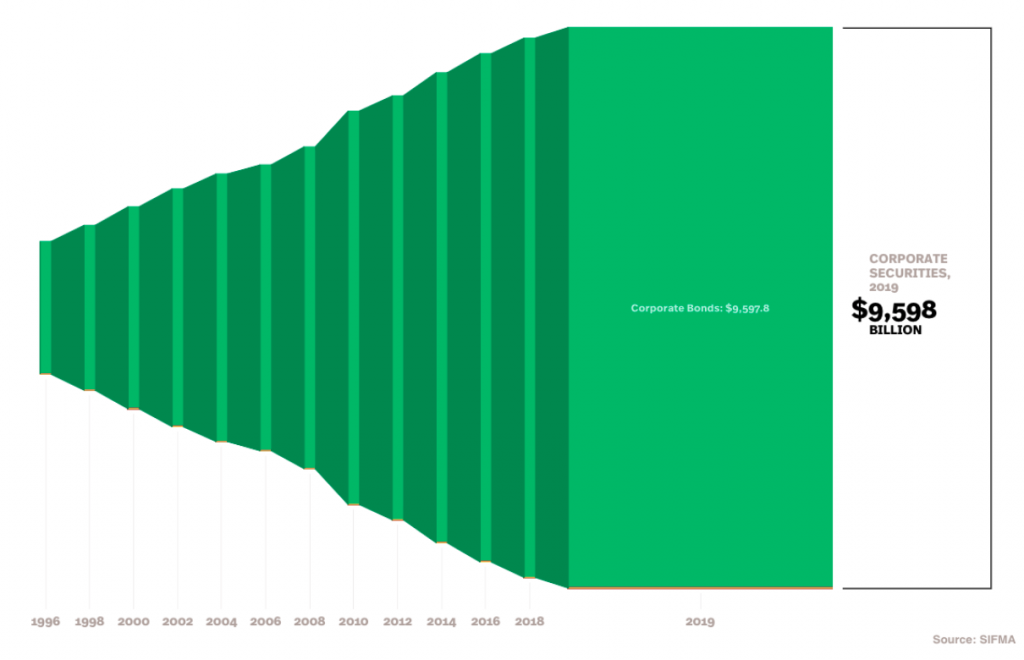
Figure 2: Corporate debt levels have risen from $5.5T in 2008 to $9.6T in 2019—the Fed’s recent actions in creating a low interest rate environment will only cause this trend to continue


Another foreseeable risk is the illusion of a healthy market as the technology sector outperforms others. The five largest companies in the S&P 500 are in tech and make up about 20% of the market value of the index. Retailers like JC Penney and Pier 1 Imports have filed for bankruptcy while Macy’s (NYSE: M) is down more than 60% since February. Meanwhile, tech giants such as Apple, Amazon, Netflix and Zoom stock have been continuously hitting all-time highs despite the pandemic. Although tech may be the future of our world, the present reality is that the significant performance drops in other sectors such as retail, transportation and travel are affecting the market, even if it’s not always apparent. 

We want to emphasize that the Fed has certainly shown that it is more than willing to support the country’s economic recovery through forward guidance. At the same time however, there are inherent risks to striving for a perfect V shaped recovery, risks that should certainly not be overlooked when assessing our market play for summer 2020. Ultimately, we believe no number of stimulus packages nor asset purchases can alleviate the human health-related woes that have inflicted our once strong economy. But shoutout to Jerome Powell for leading us through a volatile first half of 2020 and ensuring liquidity in the markets. 

Are MBS-Related Fears Warranted?

By Nathan Szeto

With the recent outbreak of the novel coronavirus, businesses of all kinds have taken to a remote style of work that has resulted in many office buildings being vacated and leases cancelled. Many homeowners, having lost a steady source of income, have found themselves unable to make payments on their mortgages. This situation has led many to question the future prospects of mortgage-backed securities (MBS). More specifically, will MBS cause another financial disaster like that of 2008? The answer is almost certainly no.

First, an important distinction must first be made between agency and non-agency MBS. Essentially, agency MBS are backed by the U.S. government via Freddie Mac and Fannie Mae and constitute 63% of the $11.1 trillion mortgage market as of now. The Fed is currently purchasing MBS and Treasuries at a rate of about $120 billion a month in order to keep the markets running smoothly. Non-agency MBS, aka private-label MBS, are those issued by entities other than Freddie Mac and Fannie Mae and therefore lack the backing of the U.S. government.

Concerns have been raised about non-agency MBS and more specifically the creditworthiness of certain borrowers in what seems to be a situation similar to that of 2008. In fact, ProPublica reports that housing prices have been subject to up to 30% inflation by banks in order to make properties seem more valuable than they actually are. However, what is important to note is that in 2007, there was $2.4 trillion in non-agency MBS, while in 2019 that figures stood at $443 billion. This fact, in addition to the reality that little evidence for the existence of a “housing bubble” exists, leads to the conclusion that even if the non-agency MBS market collapsed, the impact on the economy would not come close to that of the 2008 financial crisis.

One last topic of interest is the awkward position in which mortgage servicers have been placed. The recent CARES Act stimulus package has mandated that all federally-backed mortgages can enter forbearance for a period of one year. While this package is obviously beneficial for homeowners who as a result can continue living in their homes, it puts a great burden on mortgage servicers as they are still expected to make payments to investors for a period of four months after loans become delinquent or enter forbearance. Already at least 7.54% of all mortgages have entered forbearance and that number is expected to grow as the pandemic continues, according to the chief economist at the Mortgage Bankers Association. The increased risk of mortgages has resulted in more stringent regulations for potential borrowers that may persist even beyond the current crisis, according to the economic forecasting firm Oxford Economics. In any case, while the stimulus package does not provide funds to mortgage servicers, loans in forbearance as well as delinquent loans will now be allowed to remain in MBS pools beyond the typical 4 month period. Lastly, to support the functioning of the mortgage market, Fannie Mae and Freddie Mac have been authorized to purchase loans in forbearance according to the Federal Housing Finance Agency.

Flying Blind: Trading Airline Stocks

By Michael Davis

Despite an expected 90% revenue drop for Q2, the airline industry’s stocks have begun to take off, with stocks like American Airlines (AAL) up over 100% from their COVID low. Much like the virus itself, however, the market is fickle. As of today (7/2/20), AAL now sits at $12.50, down 38.5% from a month ago. Now you, dear reader, may be asking: what to do with this volatile yet necessary industry? Short answer: look out for breaking news.

As a whole, the big five stocks in the airline industry are JetBlue (NAS:JBLU), American Airlines (NAS:AAL), Delta (NYSE:DAL), Southwest (NYSE:LUV), and United (NAS:UAL). Within this top five, JetBlue and Southwest standout as the most positive buys. JetBlue has no debt and its EV/EBITDA of 5.29 is well below the transportation industry median of 8.77. Southwest, on the other hand, has a cash-to-debt ratio of .87, well above the transportation industry median of .26 and has a an EV/EBITDA of 5.79, again below the industry median of 8.77. The other three, while larger industry players, all operate with much less cash/more debt and at comparatively worse EV/EBITDA ratios, meaning that while they will stick around, their business models are likely to be impaired for far longer.

As the market stands now, it seems that airline stocks, much like the rest of the market, are handcuffed to any COVID-related news. Vaccine possibility? Look for a rise. Dr. Fauci says there’s an imminent second wave? Look for the fall. After all, air travel is necessary, and as they stand, most airline stocks are probably undervalued. That said, air traffic most likely will not return to its pre-COVID volume for three or more years, meaning that stock movements will be underpinned not by company performance, but by the market’s predictions for the future. The bottom line? Buy with one hand but have the other one ready to sell.

Not-So Bloomin’ Brands?

By Danny Irvine and Chris Bassett

As a result of COVID-19, many firms in the food industry have been hit hard financially from the lack of foot traffic of quarantining and social distancing.  Some have fared better than others thus far, with the restaurants already proficient in takeout and delivery such as Domino’s Pizza able to operate more normally than those who offer more of a dine-in experience.  

Bloomin’ Brands is a restaurant holding company that owns several American dine-in restaurant chains, including Outback Steakhouse, Fleming’s, Bonefish Grill, and Carrabba’s Italian Grill, typically located in the Northeast.  These are higher-end chains, meaning they rely less on takeout as customers prefer the experience of more expensive food in a dine-in restaurant environment.  Now, restaurants around the country are starting to open more and more of their locations as social distancing restrictions are lessened.  It is unclear how the public will respond at this point in time as fears of the virus may prevent sit-down dining from being as prevalent as before, however there are a few reasons why Bloomin’ Brands may be positioned better than its competitors.

Just prior to the pandemic hitting the US, Bloomin secured a long-term exclusive deal with delivery service, DoorDash, for their Outback Steakhouse brand. The partnership ensures that despite the pandemic, customers can still purchase from Outback, adding an additional component to Bloomin’s revenue stream that their CEO, David Deno, could not have predicted would be especially useful during the proceeding pandemic. 

Because Bloomin brands has access to cash, it is more likely to withstand the pandemic. Similar to the majority of companies over the past few months, Bloomin Brands took a loss during the first quarter of 2020 of $34mm, which distinctly contrasts their prepandemic quarterly net income of $65mn. However, over the last few months Bloomin raised $505mm in debt, and after using a portion of that sum to repay some previous borrowings and addressing other financial obligations, they have a $336mn net increase in cash this quarter, which means they have an additional $321mm in cash compared to this time last year. Because their financials were strong prior to the pandemic, they could take on debt to keep their various brands afloat. Bloomin Brands has made between ~$100mm and ~130mm in annual net income each year over the last three years. Therefore, the debt that they took on can be easily paid off over time, once they can safely serve customers in their storefronts again. Thus, although the pandemic wiped out their profitability this quarter, Bloomin brands was able to secure sufficient funding via debt to stay afloat that they can effectively pay down when their normal streams of income return. Notably though, it will take some time to pay down this new debt, meaning that a full recovery for Bloomin looks to be 5-7 years out.

Looking Beyond: A Glimpse into BYND

By Mohammad Mehdi Mojarradi and Michael Bedard

Beyond Meat (BYND) is a rising plant-based food company that went public in Q2 of 2019. BYND’s diversified revenue stream has allowed it to stay afloat during the COVID-19 crisis. Despite 42% of its revenue coming from food services, the hit on restaurants has not had a debilitating effect on BYND unlike some of its competitors, namely Impossible Foods. The company’s primary source of revenue, grocery stores and supermarkets (58%), have been relatively steady. In fact, while BYND reported an adjusted EBITDA loss of $2.1 million in the year-ago period, their Q1 2020 adjusted EBITDA was reported at $12.7 million, despite restaurants getting destroyed as a consequence of COVID-19. Evidently, BYND handled the massive shift in demand from food service to retail adequately. It is important to note that since COVID-19 became a global issue only in the last two weeks of Q1, BYND’s performance in Q1 cannot be viewed entirely in conjunction with COVID-19. However, because it can be for Q2, we believe BYNDs performance in Q2, which has been promising thus far, will be most telling of how the company will emerge from this crisis.

As of March 28th, BYND reported that it has taken adequate steps to ensure liquidity in the wake of the Coronavirus outbreak with roughly $250 million in cash with an outstanding debt of just over $30 million. With their fiscal safety secured, BYND leadership has said that part of their plan is expansion into real-meat territory as several meat processing facilities in the U.S. have large outbreaks. According to Tyson Foods executives, roughly half of the company’s pork processing capability has been halted due to these coronavirus outbreaks in their facilities. As gaps in the market open, BYND hopes to slide in by providing larger-than-normal discounts on their products to big retailers in an attempt to minimize the price difference between their product and beef. Currently pricing their products at around double or triple the price of regular beef products, BYND can stand to make solid territorial and financial gains in the upcoming quarters as they lower prices and become more appealing to the average consumer.

Wrapping Up: Two Cents from Jack Sercu ’22

By Jack Sercu

All, I hope you’re well and staying safe at this time. An economic outlook is intriguing to write at this time, and I think cannot be properly considered without looking at the social change our country is currently going through. I believe we are perfectly positioned as liberal arts students – at an extremely diverse institution – to weigh the various factors and come up with a vision for the future. I will look at two different categories and how they will alter the business environment of the future. First, I will examine the push for ends to systemic racism and injustice. Second, I will look out for when we do rebound from COVID, which is not an exact time period, but more so the year after the country/world opens up again. So, without further ado, my fellow Americans, Jack Sercu’s economic outlook/two cents. 

It would be ignorant to speak of the future without looking at how the changing political sentiment in our country will affect business. The resource gap for minorities is completely tied to income – no law in it of itself states that blacks should receive worse education, healthcare or other support. However, due to America’s gut-wrenching history where our systems did prevent certain races from most resources/privileges, these gaps have held pretty steady. Picture doing a 100m race where white people start 50m ahead. Anyways, the wave we have witnessed on social media from a combination of friends and celebrity endorsements is to support minority owned local businesses. I believe reallocating your resources as such is a fantastic way to empower minorities. This will not breakup big business and topple capitalism, but I do believe it will lead to more balance between small and large. Attention to small businesses has increased because of COVID, as many have witnessed their favorite local spots struggling or going out of business and are more aware of their power as consumers… Continued here.

 

When Life Gives You (Lulu)lemons, Buy LULU Shares 

By Saamia Khan

Back in 1998, Lululemon Athletica founder and former CEO Chip Wilson attended a yoga class where inspiration struck. Coining the term “yoga pants,” Wilson created a company based on women’s yet-to-be-discovered need for a comfy pants. Fast forward 20 years, yoga pants and athleisure as a whole have skyrocketed in popularity, reflecting the changing American fashion landscape. In 2014, teens preferred elastic-waistband pants, overtaking the ever-popular pair of jeans. Athleisure as a whole has grown to a massive $167B industry, and will take up an even larger portion of clothing sales as the shift in preferences continues. 

Since its founding in 1998, Lululemon has established a total of 460 stores, mainly in the U.S. and Canada. It has evolved from selling just yoga pants to becoming an icon for all types of athletic wear, outerwear, and shoes (partnering with Athletic Propulsion Lab) for women, men, and girls. Recently, they launched a new line (“Lab”), a high-end streetwear separate brand with a price range of $80-$500 per item. With its $100 leggings feeding into nearly $3.3B of revenue in 2018, LULU stock has been gaining significant traction in the investment world, especially over the past year. With an EPS of $4.51, the stock’s recent high of $229.65 on November 29th is a more than 100% increase since its 52 week low of $110.71. 

While recognizing it does not trade cheaply, we believe Lulu is undervalued as the company sets itself apart with its tremendous yet realistic growth opportunities. LULU is a buy. 

Three-Pronged Approach for a 5-year plan (“Power of Three”)

Lululemon has three main target areas that feed into its optimistic mid-teens revenue growth numbers: an expansion into the international arena, increasing menswear sales, and doubling online sales. 

1. International Growth: 

Lululemon plans to greatly expand in Europe and Asia by 2024. The Asian market is one that Lululemon has yet to crack, and the next 5 years will be an important pivot to a greater global presence. The company currently operates 29 stores in China, and expects to open an additional 55 by 2024. In Europe, Lululemon has 12 stores and aims to open another 40 in the next 5 years. Overall, the company aims to have a total of 670 stores worldwide by 2024, a significant increase from its current 460.

2. Menswear

Though initially catering only to women, Lululemon expanded its offerings to men in 2015. Since its menswear launch, the company has struggled with the issue of being recognized as a dual-gendered brand. However, in recent quarters, the line has kicked off following the launch of their most popular men’s item, the ABC pant. Menswear sales increased by 28% in Q2 2019. The line is poised to continue its expansion in the coming years, and is set to more than double in sales in the next two years with the help of an ambitious marketing strategy. In the words of COO Stuart Haselden: “It’s growing faster than our women’s business.”

3. Online Sales

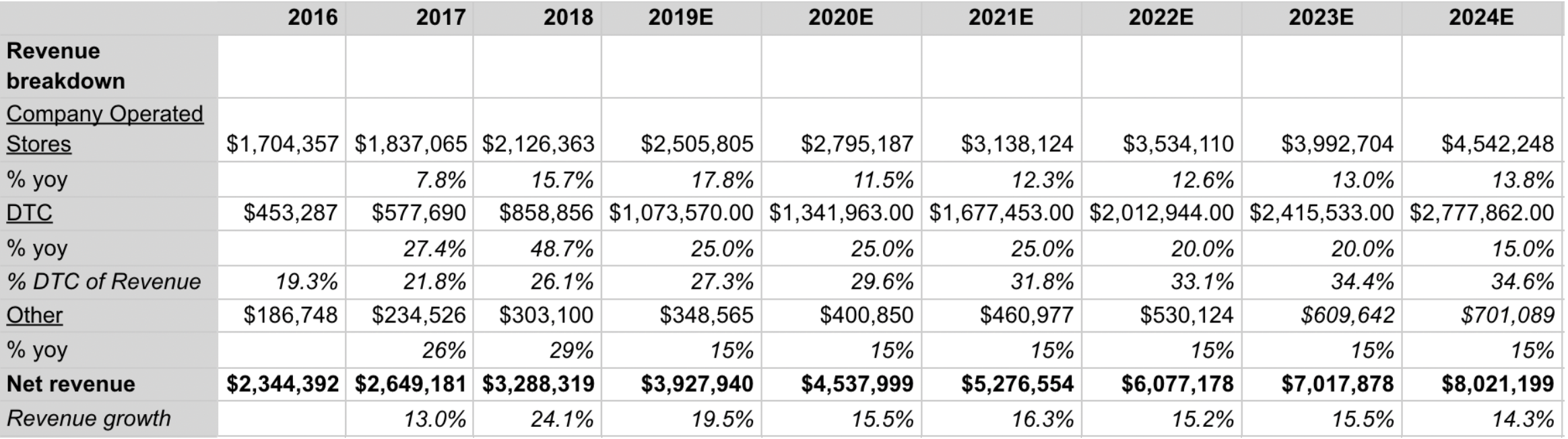
Lululemon has projected that direct-to-consumer (DTC) sales will at least double by 2024, a reasonable target given the company’s ability to drive online traffic in recent quarters. Online sales were up nearly 50% in the past year. In terms of profitability, online sales eliminate a plethora of costs between manufacturing and delivery to the consumer, hence allowing for margins of over 40%, compared to ~20% with in-store sales. These increased margins will help power overall company margins and offset costs in other areas. 

—

 In considering this three-pronged approach, it is apparent that Lululemon Athletica is exploring new avenues for revenue growth, having only just commenced its worldwide expansion. We assume a consistent revenue stream for each store opened until 2024 based on current figures. We also expect online sales to continue its growth in the double digits and subscription-based revenue growth of 15% per year (Other). Putting the above three revenue avenues together, we predict that Lululemon is poised for consistent revenue growth in the mid-teens through 2024. 

Just a Trend? On Brand Strength and Loyalty.

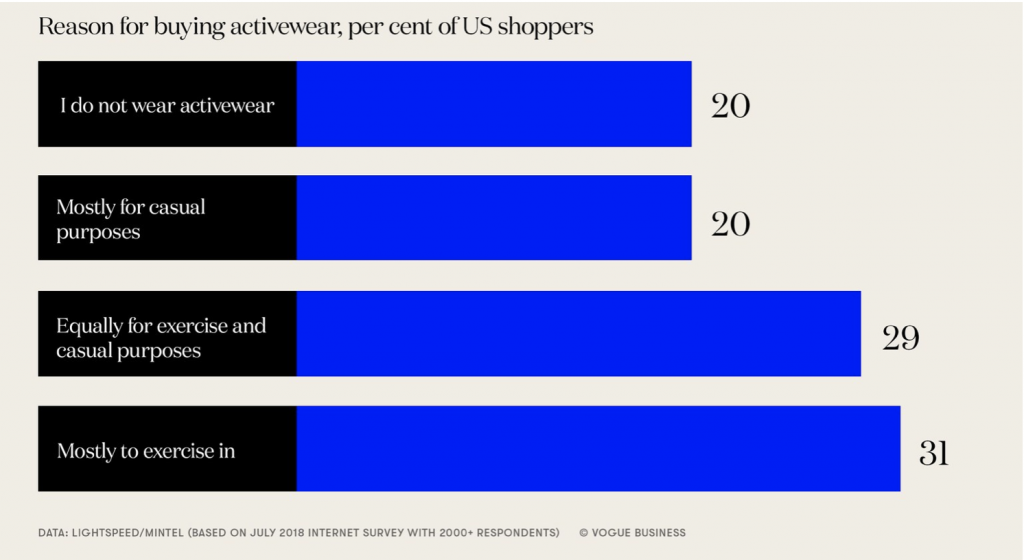
Lululemon’s projected success detailed above is contingent not only on the attraction of its products, but on the general success of the athleisure industry as a whole. There is a general push towards “wellness,” and buying goods that feed into this mindset. In fact, a growing percentage of Americans buy activewear not just for athletic activities, but as everyday wear.

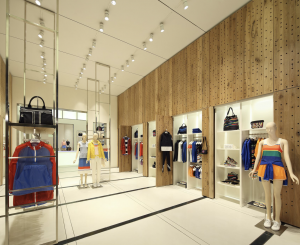
Images from Lululemon’s experiential store in Chicago offering smoothies and yoga classes, reflective of the company’s push to integrate customers into a larger ecosystem.

Moreover, Lululemon has emerged from its position as a mere retailer. It is no longer a brick-and-mortar shop where purchasing athletic gear is the only appeal. First, the Lululemon brand is especially prominent and the name-value brings with it a host of advantages, a feature its customer base is most definitely aware of. The distinct reflective horseshoe logo has become a recognizable symbol of wellness and athleticism. As mentioned above, in addition to in-store and direct-to-consumer sales, a third portion of revenue comes from subscriptions. Lululemon has recently made a large push towards incorporating customers into a greater ecosystem, offering yoga classes and membership to running clubs. Its new paid loyalty program, similar to a program that current Lululemon CEO Calvin McDonald implemented during his tenure as CEO at Sephora, ensures customers return for limited-edition products, free expedited shipping, and other perks. As of Q3 2019, the program has had positive “results [that] have been well above our expectations going in very favorable,” according to McDonald. They have teamed up with SoulCycle to offer custom-made gear, solidifying its name in the high-end athletic space. 

From Lululemon’s website: a look into its differentiating technology

Lululemon also sets itself apart due to its technology. The company’s research and development lab within its headquarters, Whitespace, is made up of around 50 employees that include scientists and physiologists. Lululemon’s quality goods contribute to the company’s strong ability to retain customers while demanding a high price point.

Strong Financials

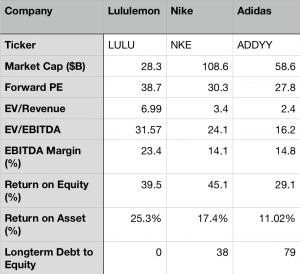
Lululemon has a great balance sheet, especially for a more than 20-year-old company, the main takeaway being that they have no long-term debt. With continued revenue growth and higher margins, we expect cash flow to sustain and reflect in shareholder’s equity.

Comps

In comparison to its largest competitors, Nike and Adidas, Lululemon certainly seems to be the most overvalued. Despite its high EV/Revenue and EV/Revenue numbers, Lululemon’s small market cap in comparison to Nike and Adidas is indicative of its immense growth opportunities. Moreover, its return on asset figure is higher than competitors, an attractive quality for growth valued company.

Risks: A Discussion

I will address a few potential risks to Lululemon’s revenue growth.

Tory Burch’s luxury athletic wear store, Tory Sport, on Fifth Avenue

A main worry in the athleisure industry is the low barriers to entry and the resulting competition. Seeing Lululemon’s high margins, it is an attractive industry for outsiders. In recent years, Nike and Adidas have greatly expanded their women’s lines in an effort to compete with Lululemon. Many higher-end names such as Tory Burch alongside streetwear brands such as KITH have also waded into the athleisure space. However, as discussed earlier, Lululemon has and continues to integrate customers into a larger Lulu ecosystem, making Lululemon more than just a retailer. At the same time however, changing preferences and trends could potentially have large impacts on Lulu’s profitability. 

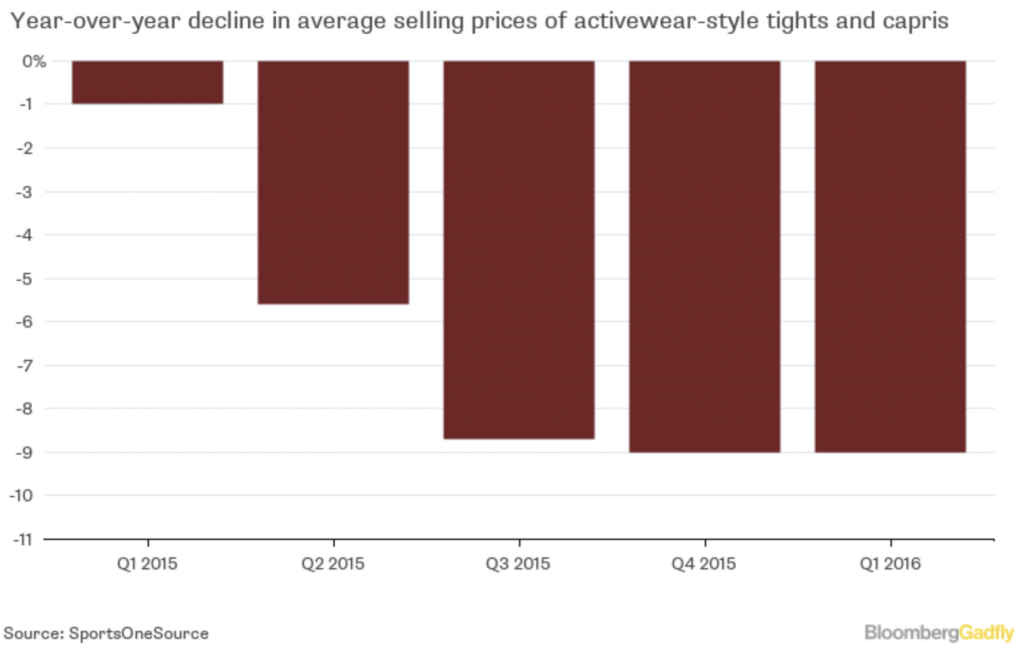
Another concern with low barriers to entry is the possibility of a drop in prices of similar goods. For the past few years, Lululemon has been able to sell nearly all of its inventory at no discount, due to a deliberate strategy to lower supply and entice customers. However, in recent quarters, the company’s sale section has been expanding, and many so-called “less-trendy” leggings go for as low as $60. Whether this new pricing strategy feeds Lululemon’s profitability is yet to be determined.

Given the current political climate, the possibility of U.S-China trade tensions affecting profitability is a valid concern. However, in its most recent quarterly report, Lululemon claims that only 6% off its total inventory would be affected by import tariffs; it has recently pushed to diversify its manufacturing bases, and most of which now occurs in Vietnam and Cambodia. 

Conclusion

Lululemon Athletica is a company with strong financials and an even stronger growth potential. By tapping into yet-to-be-explored markets, we expect to see Lululemon continue its emergence as a worldwide player. Its unique ability to innovate and dedication to creating quality products coupled with an overall shift towards comfortable clothing will allow Lulu to sustain its high customer retention rates. 

All Small Businesses Lead to… Square?

by Saamia khan

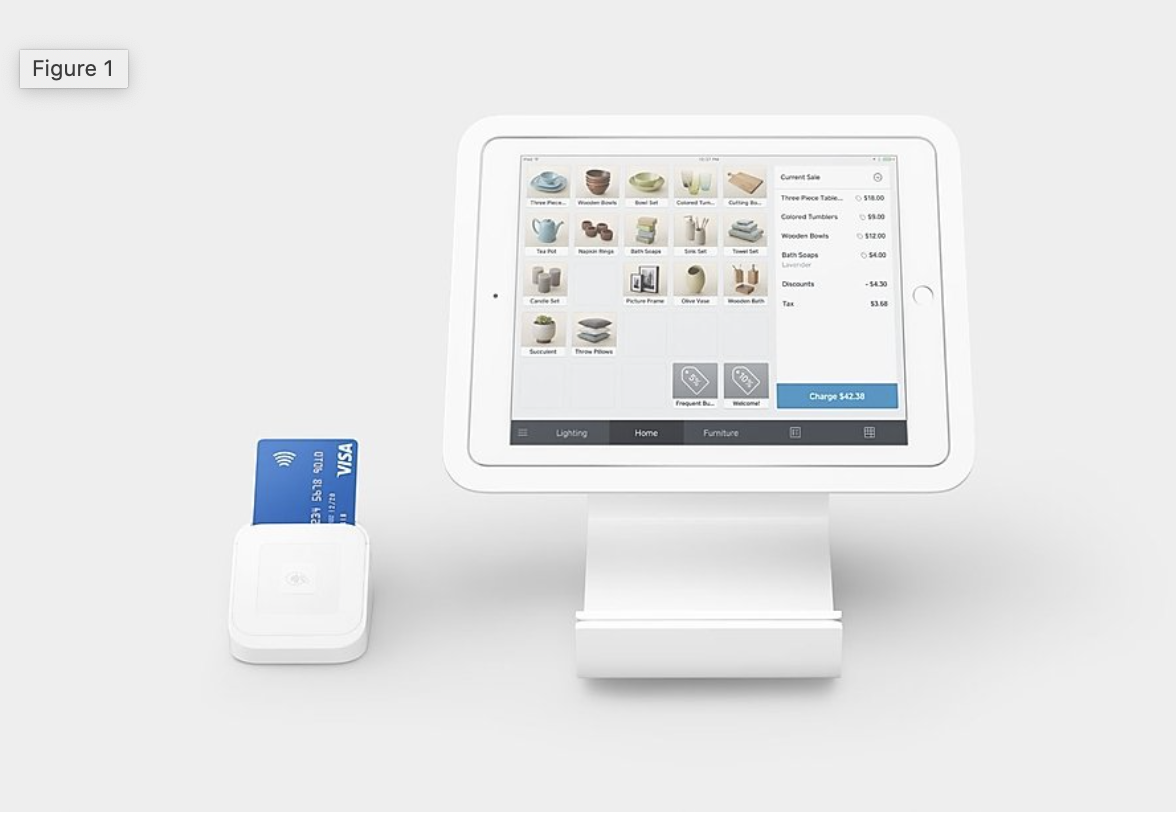
Up until late last year, Square (SQ) enjoyed massive growth in its share price in 2018; reaching a peak of nearly $100/share in late September, its share price quickly plummeted nearly 50% to $51/share by late December. Square’s mobile payment processing apps, credit card readers, small business organizational tools, and even a children’s book (My First Bitcoin and the Legend of Satoshi Nakimoto) among other products have made Square a company to put on the watchlist. Small businesses like coffee shops, restaurants, and hair salons have been swift to adopt Square’s recognizable white stands that turn iPads into payment processors. While this share price volatility coincided with an overall market downturn, and is typical of an early stage growth stock, I would argue that Square’s current share price of $66/share is overvalued. Depending on the economy’s health in the medium term, shares could decline to as low as $40/share.

Square hopes to become a one-stop-shop for small businesses by creating an entire financial ecosystem. In pursuit of this goal, the company has rolled out an array of innovative hardware and software products to help facilitate small business operations. Its original product, the Square Reader allows businesses to accept credit card payments on the go. Used concurrently with the Square Dashboard app, owners can track and compare real-time sales data. Square Appointments combines the payment system with easy access to managing bookings and clients. Square has even started to dabble in high-end food delivery services with the acquisition of the startup, Caviar. The theory goes that if a business adopts even one of Square’s products, it is likely to try others as well. Square hopes to increase its online presence, and to this end, it has acquired the website creation company, Weebly.

Within the past few quarters, Square started offering loans to small businesses, coining the name Square Capital. In the last year, they have seen a 34% increase in loan volume. More recently, Square has applied to become a licensed bank, allowing the company to have greater autonomy with loaning while also allowing them to take deposits. Jacqueline Reses, the would be chairman of the bank said in a statement, “Square Capital is uniquely positioned to build a bridge between the financial system and the underserved, creating access for small businesses to both capital and the economy.” In giving out loans, Square may be doing a favor to small businesses that generally have trouble financing their operations through other means. For Square however, this spells trouble should these loans perform poorly; according to the U.S. Small Business Administration (SBA), only about 50% of small businesses survive longer than five years, and more than 1 in 6 SBA-backed loans went into default between 2006 and 2015.  In loaning funds primarily to small businesses, Square exposes itself to an unparalleled risk.

Evidently, Square has created a detailed organizational plan aimed at small businesses with its hardware and software products and loans. However, what’s concerning lies in the fact that Square is starting to look a lot more like a bank than a tech company. Traditionally, the market is willing to pay a higher multiple of earnings for tech companies. Square’s current valuation may reflect this sentiment. And although revenue has increased through each quarter of 2018, earnings have only just edged into positive territory in the third quarter. This points to the fact that Square’s share price may currently be overvalued.

The company’s success relies heavily on booming sales in the small business industry. Not only is this a somewhat worrying business model in the face of a looming recession (economists forecast a 25% probability of a recession within one year), with a Beta of 4.25, the company is especially vulnerable to market swings— Square’s share price has dropped almost 50% since its peak in late September 2018— coinciding with an overall weak S&P 500 performance. Moreover, Square’s dependency on small businesses may result in problems in the future. Conventional wisdom says that during a recession, consumer spending decreases. Although this consumer spending drop affects all businesses, smaller companies bear a greater brunt. Figure above illustrates small businesses identifying poor sales as the “Single Most Important Problem Associated with Weak Economic Conditions.” During the most recent recession, employment decreased by 10.4% for businesses with less than fifty employees, while all other businesses saw a 7.5% decrease, a significant difference (Figure below). Although small businesses do have more flexibility in laying off workers, recessions evidently seem to accentuate small business operation difficulties, coupled with evidence of higher rates of bankruptcy. Given that Square derives much of its revenue from small businesses, a drop in consumer spending may result in unpaid loans and simply a smaller volume of sales, signaling decreasing profits for Square.

When Jack Dorsey and Jim McKelvey founded Square in 2009, its idea for an on-the-go credit card processing service aimed at small businesses was fairly novel. However, competition since then has increased. PayPal, Intuit, Capital One, and Shopify all offer quite similar products in terms of basic credit card readers. To the average small business, it is not expensive to switch credit card readers to a cheaper alternative. If a small business is not already integrated with the rest of Square’s apps like Square Dashboard and Square Appointments, there is little incentive to stick to Square if the costs are greater. To this end however, Square has tried to distinguish itself, rolling out a number of supplements to its main credit card processing terminal. Future quarters will reveal whether or not Square’s push to retain clients has proven to be a success.

Square’s focus on a niche sector of commerce— doing business with micro-merchants— may end up exposing the company to great uncertainty. Expanding its base to larger businesses may help alleviate some of this business cycle dependent risk. If Square can continue finding ways to distinguish itself from competitors, this may pay off in the long run. Nevertheless, with a view of a potential recession in the medium term, SQ is a sell.