Field Trip – A New Industry Primed for Profits

Authored by Emma Schulman

FieldTrip

Fieldtrip is a Toronto-based psychedelics firm that offers psychedelic-assisted therapy. Their current stock price is $5.14, traded under FTRP.  It is an early stage company, founded in April 2019 and entered the United States stock market this past summer. The firm is one of the leading authorities in the medical and scientific re-emergence of plant-based psychedelic enhanced therapies. They have been quickly expanding as the psychedelic industry is growing, with a growing revenue of $2.62 million. The company’s shares have offered investors returns exceeding 77% year-to-date and it has a market cap of over $360 million. 

Their approach and treatment programs are based on accumulating evidence that support treating mental health disorders with psychedelics. During a typical clinic, patients wear eyeshades and listen to electronic music and Tibetan chanting, as they are administered six ketamine injections over the course of several weeks. A typical course of four sessions starts at $4,100, though some insurance companies reimburse patients for a portion of the cost.


Why Fieldtrip?


FTRP is a fast growing psychedelic company and is one of the top most competitive firms in the industry. They are among the first to take an integrated approach to psychedelic medicine and are also currently the global leader in the development and delivery of psychedelic therapies. They are the leader of an industry that, as discussed below, is about to boom. 

Fieldtrip has been establishing itself as an innovator in the field. They are working on building digital tools that aid with psychedelic experiences, thus separating themselves from other competitors in the industry. Furthermore, Fieldtrip is rapidly expanding. They recently built psychedelic-assisted therapy centers in Seattle, Vancouver, and Fredericton. 


The Psychedelic  Industry


Mental health awareness is growing rapidly across the US, and the world. Our generation acknowledges the importance of addressing and treating mental health. A great deal of research has been done evaluating which treatments are safe and effective. Each year, 16 billion dollars is spent for anxiety disorder and depression treatment, and $238 billion is spent on mental health services. Unfortunately, despite all of the research, many of these treatments still induce bad side effects, such as weight gain, fatigue, insomnia, headaches, etc. Psychedelics, however, do not share many of these bad side effects. 

According to a study by Data Bridge Market Research, the global market for psychedelics is growing and will reach a value of over $6 billion within the next five years. In 2019, it was $2 billion. This represents a CAGR of over 24% for the industry. The effectiveness of psychedelics and the growth in the industry has turned the heads of the biopharma sector. Giants such as Pfizer are beginning to look into psychedelic firms as there is a surge in demand for antidepressants and these firms could be a source of revenue. The psychedelic industry is just beginning to break out and is an industry to which Wall Street has paid little attention to. 

Psychedelic-enhanced psychotherapy is quickly gaining traction in response to clinical research. Academic studies have provided compelling evidence in addressing the growing mental health crisis globally. At Williams College, the senior seminar in the fall of 2021 for the Neuroscience concentration was all about psychedelics. As more and more research is done on the effects of psychedelics, more and more people are accepting of the revolutionary effects psychedelics can have. Although under federal law it is a schedule 1 drug, psychedelics have started to make their way into the medicinal market. 


Risks


Since Fieldtrip is a relatively upcoming company, there is high risk associated with it. In the short term, it is incredibly volatile and has to continuously compete with competitors in the industry. Furthermore, the psychedelic industry is not growing in a linear fashion. The medicinal usage of psychedelics is a new concept with more research coming out every day. Psychedelics are not socially accepted or even completely legalized. 

 However, political and social trends are moving towards acceptance. The nation’s top universities such as Yale, John Hopkins, and UCal Berkley are racing to set up psychedelic research centers, and investors are pouring millions of dollars into a pack of start-ups. Even governments are relaxing: Johns Hopkins Medicine won the first federal grant to study psilocybin, U.K. Prime Minister Boris Johnson said he would examine its legalization, and Seattle recently joined cities relaxing laws around plant-based psychedelics. Furthermore,  Republicans, a group that has traditionally opposed the liberalization of drug laws, are starting to come around. In April 2021, the former Texas governor Rick Perry, citing the high rates of suicide among war veterans, called on his state’s legislators to support a Democratic-sponsored bill that would establish a psilocybin study for patients with PTSD. Thus, in the long run, Fieldtrip holds promise. While growth may not be as high as predicted, there is little thought that the psychedelic industry will fail. Since Fieldtrip is among the top and most competitive firms in the industry, there is a high chance that an investment now will lead to high returns in the future. 

Furthermore, there is risk that the psychedelic industry could follow a similar path to that of medicinal marajuana-where the market did not perform as high as anticipated. But, marajuana and psychedelics have many underlying differences. Fieldtrip is more focused on clinical trials that seek to prove on a case-by-case basis that classic psychedelics can treat specific ailments. In addition, there is no plan for widespread recreational use. Many psychedelic companies serve an evolving ecosystem designed to personalize a patient’s experience at treatment centers. Overall, the psychedelic industry is bound to grow in the next few years. The main risk is how much the industry will grow, and if Fieldtrip will be the beneficiary of such growth or if they will ceed leadership to other competitors.  


In conclusion


Now is the time to buy Fieldtrip-and hold onto it. Fieldtrip continues to expand, research, and innovate, helping outperform its competitors. While it is a part of a new industry, research done into psychedelics has proven its incredible potential. There is high potential for growth in the industry and Fieldtrip is among the top performing firms.


https://www.meetfieldtrip.com/home/default.aspx

https://www.texastribune.org/2021/04/13/veterans-ptsd-psychedelics-texas/

https://medicine.yale.edu/psychiatry/education/residency/interest/psychedelic_science_group/

https://www.nytimes.com/2021/05/09/health/psychedelics-mdma-psilocybin-molly-mental-health.html
 

Chipotle – As Good of an Investment as Their Burritos Are Delicious

Authored by Daniel Pompi


Overview:


Chipotle offers a wide range of Mexican dishes at a competitive price made from high quality, fresh, and healthy ingredients. With over 2800 stores in the US alone, and dozens more across 4 international countries, they pride themselves in fast service, and convenience. Chipotle’s menu is focused on serving dishes that align with their signature dining experience. 


As a return to office-work continues, and the worst of the Covid-19 pandemic hopefully over, restaurants benefit from an influx of patrons and support. 


Chipotle Mexican Grill (NYSE: $CMG)


Highlights:


During the Covid-19 pandemic, restaurants were crippled by a sharp decline in revenue, leading to a declined industry growth rate of only 4% in 2020: the lowest in years. However, during this same period, Chipotle saw an increase in revenue by over 7%, nearly double the rate of the rest of the industry. Chipotle has outperformed its competitors by similar margins in both 2018 and 2019. 


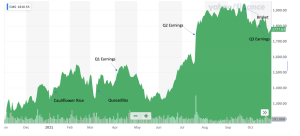
In 2021, the restaurant industry is projected to grow by 9%, suggesting a positive trend for a hard hit industry. Chipotle’s quarterly reports indicate they will continue to outperform their competitors for the fourth year in a row. Following their Q3 earnings on October 21, 2021, Chipotle announced a 21.9% increase in revenue, beating their counterparts who posted increases hovering just below 15%. In the previous two quarters, Chipotle posted similar results including a 38.7% increase in revenue between Q1 and Q2. 

Another catalyst for growth has been Chipotle’s introduction of new menu items. During 2021, Chipotle introduced cauliflower rice, brisket, and quesadillas. These introductions have been well accepted by the public. The announcement of each new menu item has been met with a roughly 2% increase in the share price of Chipotle. Chipotle’s menu innovation, and aggressive Chief Restaurant Officer, Scott Boatwright, support a compelling product lineup to increase traffic and sales over the upcoming years. 


Each of these promising components of Chipotle’s outlook for 2021 and beyond can be realized by the red-hot multiples when compared to those of other, similarly capitalized, fast casual restaurants. While they may flicker signs that the company could be overvalued, I view these as signs of investor enthusiasm of what is to follow in 2021.

Risks:


Chipotle does have risks that should be taken into consideration.. Purely based on Chipotle’s 36% increase in share price since January 1, 2021,Chipotle’s growth may be unsustainable. In the same period where the S&P returned over 25%, Chipotle has outperformed what many consider to be the benchmark for the market. While I do not believe that Chipotle’s share price will grow at such a high rate in 2022, that is by no means any indication that its growth is complete. 


Chipotle’s multiples are far higher than their competitors. is a stock that has grown 36% YTD overvalued? While Chipotle’s multiples are high compared to other fast casual chains, none of these other corporations are in direct competition with Chipotle, and most have a dissimilar business model. While Chipotle focuses on a healthy, focused, appropriately priced menu, the same cannot be said for competitors such as KFC, Burger King, or Popeyes, whose primary goal is to produce incredibly cheap food. Therefore, it is difficult to compare Chipotle’s multiples to other fast food chains crowding the market. Panera would offer a great comparison, though they went private in 2017. 


Based on evidence of Chipotle’sinnovative menu and consistently high earnings,Chipotle’s high multiples are a result of investor enthusiasm for continued business practices into 2022. 

Finally, any further resurgence of a new Covid variant is another risk that may make investors uneasy. That said,Chipotle’s increase in accessibility outside the dining room has them covered. With delivery service revenue accounting for a greater percentage of total revenue and drive-through “Chipotlanes” being implemented into a record number of stores, consumers have more options to get their food without stepping foot in the store. Should any new restrictions be implemented, Chipotle is well prepared to serve record numbers of customers as they have done throughout 2021.


Industry Outlook & Catalysts:


As noted above, the restaurant industry as a whole is expected to grow at a CAGR of 9% during 2021, a number that Chipotle is well positioned to exceed. Chipotle benefits from limited direct competitors such as Qdoba and Dos Toros, in addition to a barrier to entry for new firms in the market for healthy, fast, Mexican cuisine. 


Delivery service and Chipotlane revenue have continued to grow at a record pace, indicating Chipotle is more easily accessible than ever before. Currently, Chipotle has implemented their drive through lanes in 9% of their stores. Following their report that stores with Chipotlanes have generated 15% higher sales on average than stores without them, Chipotle has announced that they plan to implement them in 30% of their stores by 2025. Chipotle has also committed to, and are on track to open over 200 stores in 2021, bringing their total number of establishments to just under 3000 across five countries.


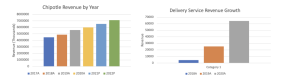
One of Chipotle’s most promising streams of revenue is that of their delivery options. Through promotions on popular delivery apps such as UberEats, it is easier than ever to have Chipotle delivered to your door. The revenue growth from their delivery services has nearly tripled between 2019 and 2020, shown in the graph above. As this trend continues and Chipotle further incorporates technology into their business model, digital sales will account for a larger percentage of overall sales, and delivery service revenue will account for a larger percentage of overall revenue, further boosting Chipotle’s share price. 


Chipotle’s introduction of new menu items has been a reliable catalyst for growth. Their introduction of new menu items in 2021 each were well received by the public, and Chipotle’s leadership team will continue to aggressively implement new menu items to increase traffic and sales well into 2022, while maintaining their concentrated menu. 


A final catalyst for growth will occur when the return to office is complete. Many of Chipotle’s patrons are office workers who are in search of a quick, healthy, affordable lunch. As firms announce their commitment to the return to office, we will see Chipotle’s sales traffic increase steadily. This will mark the increase in Chipotle’s traffic in the final of three ways: 1.) Chipotlanes, 2.) Delivery Service, 3.) Traditional Sit Down.


Conclusion + Recommendation:

Based on the catalysts discussed above, and the limited downside, I suggest a buy of Chipotle at a share price of $1799. While this is not a short term recommendation, nor a recommendation for a high growth company, I do believe that Chipotle will continue to experience moderate growth throughout 2022. Therefore, it is a safe stock to own in any well-diversified portfolio.


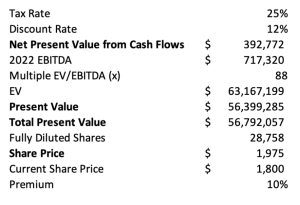
To arrive at my price target, I implemented a discounted cash flow model where I increased Chipotle’s revenue growth assumptions to align with historical data. Additionally, I valued the company at 85% of its current EV/EBITDA multiple to price it similarly to other similar-cap fast casual corporations. With these assumptions in place, I drew the following conclusions:

Based on my analysis, I recommend a buy of Chipotle at its current price of $1799, with a price target of $1975 by the end of 2022, a 10% premium. Even if Chipotle does not continue its record-paced 2021 growthChipotle will experience strong moderate growth over the following year, which makes it a valuable stock to own in any portfolio.

Brunswick – Strong Fundamentals With Attractive Upside

Investment Thesis:

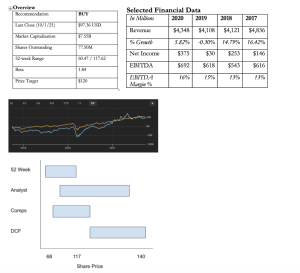
Brunswick Corporation (BC) presents an attractive buying opportunity for long investors, offering aggressive bull upside potential if the firm is able to capitalize effectively on its industry-leading branding in the boating industry, a strong base case as a market leader expanding into higher margin businesses in a space with significant barriers to entry, and an opportunity investment opportunity as a hedge for cyclical downside environments. Modeling BC’s financial statements then discounting its projected future cash flows, I recommend a buy of BC at a price target of $120 within two years, a premium of 22% over its current stock price of $98.


Company Overview:

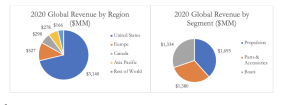
BC is a travel and leisure company that designs and manufactures recreational boating equipment. Though BC’s historical roots are in consumer products generally, BC underwent an entire corporate shift in 2019 and is officially focused today on the boating industry exclusively. BC’s business lines can be segmented into Boats, Propulsion Systems, and Parts & Accessories. These business segments contributed 30%, 38%, and 32%, respectively to overall 2020 revenue of $4,407MM. That said, the company’s Parts and Accessories business is its fast growing segment, and the company is taking active steps to capitalize on the higher-margin segment. The company is headquartered in Mettawa, Illinois, and primarily operates its manufacturing and logistics facilities out of the United States, but also operates select manufacturing plants throughout Europe and East Asia. 


Industry Overview:

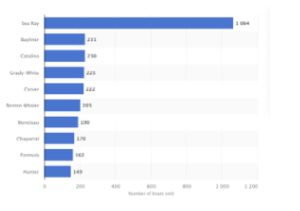
The recreational boating market was valued at $35 billion USD in 2020 and is expected to grow at a 6.5% CAGR from 2021 to 2027. BC has nearly 13% of the total market share and continues to dominate the small-mid size yachting and fishing market, with leading brands such as Sea Ray and Boston Whaler. BC also controls the marine propulsion market, as its Mercury propulsion brand is the largest builder of propulsion systems in the world.


BC’s recent success in this industry is driven by its industry-leading propulsion systems and targeted acquisitions that drive synergies within its niche industry vertical. In the boating segment, products within the mid to mid-high-end recreational vehicles have been historically dominated by a few leading players such as Sea Ray and Boston Whaler. In the propulsion segment, BC’s subsidiary Mercury is one of the oldest and largest propulsion engines for marine vehicles. Of note, BC’s Parts and Accessories business is both its fastest growing segment, as well as its most profitable. Historically, margins within the boating and propulsion segments industry wide have been narrow, whereas margins within the Parts and Accessories segment have been historically wide. After all, if an owner cannot start their $2million yacht’s engine, they are willing to overpay on a $200 part to get the vehicle out on the water. 


Generally, new boats are sold through independent dealers, meaning that players such as BC which can offer attractive recurring revenue opportunities, financing support, and marketing for dealers are often the brands that get their new boats on the showroom floor. Historically, owners have held onto marine recreational vehicles longer than other typical hobby investments such as cars and RVs, and the boating industry has a strong secondary market. Thus, while it is crucial for BC to first get customers to purchase boats, once a boat is out on the market, unlike other cyclical industries Brunswick is able to capture significant recurring revenue through its Parts and Accessories businesses.


I recommend a BUY in BC for the following reasons:

  1. Strong Consumer Demand Driving Industry Tailwinds

First, the COVID-19 pandemic pushed a significant portion of wealthy consumers to value recreational opportunities as they were stuck at home, or at their waterfront vacation homes, during quarantine, or while working from home. Many consumers, a significant number new to boating itself, will continue to purchase boats and need propulsion systems and parts. BC is uniquely able to cater to all aspects of downstream customer demand. Specifically, BC’s Parts and Accessories segment offers an attractive reason for investors to get excited. BC’s focus on Parts and Accessories highlights management’s focus on stickier, recurring revenue. This can act as a safeguard against cyclicality, in addition to aggressive upside opportunities as margins expand.


  1. First Step Advantage to Capturing the Nascent International Market

While the US market continues to dominate recreational boat spending, growing markets such as the Asia Pacific and Europe will drive some of the largest consumer demand over the next decade. As a result, competitors who possess the preexisting infrastructure and distribution systems will be the most capable of getting products to market to win over customers. BC recently solidified its supply chain with its acquisition of SemahTronix, a wire manufacturer for highly complex industries. In addition to shoring up supply chains for product distribution, BC is a step ahead of the competition when it comes to market awareness. For example,  BC’s recent acquisition of the boating club company Fanautic will enable it to better understand and market to Fanautic’s European user base. In fact, BC’s acquisitions are able to synergize well not just with BC’s leading brands, but with its other, targeted vertical integrations. As the last example of BC’s aggressive acquisitions practice, its 2021 acquisition of Navico, a Norway-based leader in OEM equipment internationally, will help BC penetrate the very markets that Fanautic plays toward. Navico reported revenues of $441MM in the 12-month period ending May 2021. Interestingly, Navico was bought at a 13x EBITDA multiple valuation and is now marked at a 10x multiple post-synergy, indicating an accretive acquisition for BC. Supporting this, BC management remains optimistic that the Navico acquisition will help their Parts and Accessories business exceed $2billion in revenues, and recall that BC’s Parts & Accessories business is their most profitable segment. 


  1. Barriers to Entry

Recreational boating and all that is required thereof is not an industry easily entered, even more so than other traditional luxury, hobby markets. BC’s current and potential competition will be unable to penetrate the market at a rate at which to compete with BC’s entrenched branding and historical legacy without significant investment risk or unique niche market focus. Even if a competitor were to enter, BC’s aggressive acquisition strategy and historical acquisition synergies will cement BC as the acquirer of choice. In effect, these inorganic bolt-ons will likely make the moat more remote than it otherwise would have. Beyond its acquirer of choice status, BC’s consolidation indicates that it intends to build up its moat not just with suppliers, but also with customers. Incumbents have mindshare and opportunities to continually reengage with customers to determine future consumer demand. That said, one of BC’s largest and most current risks, which will be touched on in the next section, is the cyclicality of its industry segment. However, increasing mindshare in consumers is one way upfront to mitigate this risk.


Risks and Considerations:

  1. Cyclical Nature of BC’s Products

BC’s revenue is almost solely driven by the manufacturing and sale of durable, capital-intensive products such as boat propulsion systems and entirely manufactured aquatic recreational vehicles. These products are typically highly procyclical with the economic health of consumers, as can be seen by the company’s beta of 1.84. While after the COVID-19 pandemic a rush of consumer spending helped drive purchases, it is entirely possible that a downturn in the markets caused by rising inflation rates and debt burdens may hamper future market penetration. That said, BC’s balance sheet cash assets make it strongly positioned to capitalize on a downturn instead of falling behind revenue targets. For a current example, look toward the hotel industry, a similarly cyclical market subject to economic conditions. Investors tended to shy away from the industry and industry leaders like Hilton (HLT), and this was even before COVID nearly wiped out the tourism industry.  But now Hilton is an entirely evolved company, reflected in its fast-rising stock price. As discussed, BC’s similar mindshare with customers, its vertical integrations, and shift of focus onto Parts and Accessories will help insulate it during economic downturns, and may actually offer a source of increased opportunity.


  1. Unclear Ability for Acquisitions to Drive Further Growth

Historically, BC has maintained revenue growth through key acquisitions of both downstream manufacturers of boats as well as upstream acquisitions of OEMs. While the insular nature of the supply chain is helpful to maintaining and improving margins, BC would need to continue aggressively acquiring target companies to sustain a significant portion of its growth if it does not commit to R&D internally. Additionally, BC’s acquisitions today reflect its continued vertical integration. Even if these acquisitions were to not drive further growth in and of themselves, vertical integration will offer downside protection, shielding BC from revenue hits during economic downturns better than its competitors in the durable, capital-intensive industry.


Catalysts:

  1. Strategic Acquisitions Driving Synergies throughout the Value Chain

BC’s short-term growth will be driven by its strategic acquisitions and aggressive marketing tactics. Two key acquisitions that BC has made recently are into the European Fanautic Boat Club and the global wire supplier SemahTronix. Additionally, BC’s appearances and wins at prestigious events such as the Cannes Boat Show have solidified its status as the market leader in recreational boating. BC’s management continually reemphasizes how it aims to utilize cash today to buy companies to grow EPS down the road. Based on the evidence provided by acquisitions like Navico and BC’s stock price strength, it seems that investors agree that management is successful in executing what it can and will continue to do.

  1. Increased Margins in a post-COVID Economy

BC’s long-term growth will be buoyed and supported by the stickiness of customer demand for recreational boating products as well as the ability to increase margins through control of the vertical supply chain. Additionally, acquisitions of industry leaders in the OEM segment such as Navico reflect BC’s continued belief that its Parts and Accessories business will drive increased revenues and profits going forward. BC’s Parts and Accessories business, and its tangential relationship with the second-hand market, are going to help maintain BC’s pricing power over the cycle and further the distance between itself and its competitors.


Attachments:

Sources:

https://www.wsj.com/market-data/quotes/BC/company-people

https://www.brunswick.com/investors/company-information/faq

https://www.uchicagodsp.com/uploads/1/2/0/6/120693146/sample-stock-pitch-v1.pdf

https://d1io3yog0oux5.cloudfront.net/_1a47265cd3fe34719b74f69108aca41e/brunswick/db/671/8882/file/21_BRN_CB_AnnualReport_Wrap_v5+Report.pdf

https://www.globenewswire.com/news-release/2021/09/14/2296514/36093/en/Brunswick-Corporation-reports-record-showing-at-Cannes-Boat-Show.html

https://www.streetinsider.com/Corporate+News/Brunswick+%28BC%29+Acquires+SemahTronix/18958055.html

https://www.statista.com/statistics/752966/leading-recreational-boat-brands-in-terms-of-units-sold-us/

 https://www.tradeonlytoday.com/post-type-feature/brunswick-acquires-navico

Asana – The Next SaaS Headliner?

Asana Enterprise (NYSE: ASAN)

Price (as of 11/21/2021): $100.75

Market Cap: 18.54B

Daniel Chang


Asana–The Next SaaS Headliner?


Company Overview


Asana Enterprise was founded in 2008 by Facebook veterans co founder Dustin Muskovitz and engineering lead Justin Rosenstein. It’s one of the up and coming small cloud based companies riding on the hyper-growth wave of the software as a service (SaaS) trend. Asana is an emerging leader in the workplace and project management software industry and since its IPO in 2020, has seen its market capitalization swell from $4 billion to over $23 billion. As with most other SaaS companies, its revenue stream consists of product leasing via online subscription service in contrast to more traditional methods of software installation. Over the past year, Asana’s stock has shot up roughly 500% on positive quarterly revenue growth, and has beat analyst earnings expectations for the past 4 consecutive quarters. While investor sentiment may cool following such an incredible run-up, there are many long term growth factors for Asana over the next few years.


The potential market for Asana’s product is undoubtedly massive. Many companies–from 50 person development teams to trillion dollar software companies–require digital workplace management. The key product Asana offers is the Work Graph: a software which centralizes all the projects, tasks, goals, and milestones of a firm. Theoretically, this would save a company time otherwise spent on internal communication between groups and individuals; instead of time-consuming emails, briefings, and memos, workers can easily track real time work progress across group projects through Work Graph’s interface. Since its founding in 2008, many team collaboration tools such as Trello have emerged over the years, and Asana currently sits within a highly competitive playing field occupied by companies like Monday.com, Microsoft, ServiceNow, Workfront, Airtable, Planview, and Salesforce. However, in many cases, Asana is not in direct competition with these companies and has integrated its platform with various productivity tools offered by software companies such as Microsoft and Salesforce. 


Asana expects its TAM to grow to $32 billion by 2023. In upcoming years, the project management software/service industry in the US is expected to expand significantly with a CAGR of 13%. Within the industry are advantages for first movers due to high switching costs for consumers. Companies that opt to switch software for their employees have to undergo retraining costs and periods of lost productivity in employee adjustment to new software. Thus, early user growth is crucial to building a robust business moat as most users will be unwilling to switch to other services. Over the past year, Asana has done well in consumer growth, significantly expanding the number of paying customers spending $5,000 or more on an annualized basis in 2020 by 53% to a total of 11,272 users.  Notably, its most expensive subscription package–customers spending $50,000 on an annualized basis–has grown over 92% over the past year to 485. It was also with this group of customers which Asana saw its highest dollar based net retention rates at over 140%.  In comparison with its peers, Asana offers a more attractive freemium model. Similar tools such as Wike, JIRA, and Trello, either don’t offer free subscriptions or the full functionality and flexibility of Asana’s product. When coupled with a conversion rate of 4.7% for premium subscriptions (compared to the industry average of 2.35%), many investors believe Asana is in a great position to expand its pool of potential customers.


Risk Factors/Valuation


Asana is a high risk investment given it is currently trading at a handsome valuation of 60x sales; second highest among its peers within this industry who trade on average 18x sales. Additionally, it is projected to not turn a profit for the next three years. However, much of the disparity in valuation is hidden behind extensive investments in R&D and sales/marketing which amount to 45% and 67% respectively of Asana’s top line. With a gross margin of 87% versus the SaaS industry average of 70%, Asana’s path to profitability appears to be relatively straightforward for tech investors. Currently, the numbers indicate that Asana’s leadership is heavily investing in user growth, retention, and conversion; a move which will solidify Asana’s competitive advantage in the long term. Over the last few years, Asana has landed major partnerships and added to users of its project management software an impressive list of big name brands which include the likes of Amazon, Google, Disney, Spotify, and Adobe. Recent insider buying also points to long term optimism; in September and October of this year, CEO Muskovitz purchased $123 million worth of stock at a price of roughly $100 per share.

Conclusion


Based upon growth opportunities and company fundamentals, Asana is a great long-term investment for an aggressive growth portfolio. However, given that it’s currently trading at inflated multiples and large swings in stock price are to be expected throughout the next year, Asana’s current stock price justifies a hold consensus. 


Sources:

https://nira.com/asana-history/

https://seekingalpha.com/article/4461129-asana-stock-forecast-the-danger-below

https://www.fool.com/investing/2020/10/14/why-you-must-keep-asana-on-your-watchlist/

https://akfpartners.com/growth-blog/Why-tech-and-product-leaders-need-to-think-about-gross-margins#:~:text=Many%20software%20companies%20today%20have,product%20market%20fit%20is%20achieved.

https://techcrunch.com/2021/09/17/the-value-of-software-revenue-may-have-finally-stopped-rising/


Accenture: The Future of Technology Consulting

Accenture PLC (NYSE: ACN)

Market Cap: $237.41B

P/E Ratio: 39.49


Authored by Masaki Lew


Overview:


Accenture PLC is a multinational consulting and technology company, offering Marketing and Business Strategies, Supply Chain Management, and Operation Models as well as several processing services ranging from Intelligence Operations and Digital Infrastructure to clients. In addition to its two major services, the company commits to research and investment. Accenture Insights, the predominant research department focused on innovations in Artificial Intelligence, Blockchain, and Cloud Technology. Accenture Venture, the Venture Capital department conducts engagements, investments, and prospective subsidiaries for future services. Founded in 1989, Accenture has since moved its headquarters and incorporation title to Dublin, Ireland. 


Investment Reasoning:


Accenture’s recent strategy in establishing itself as a major player in the Cloud and AI Technology space as well as a primary financier for Blockchain projects point to an expanded outreach in the post-pandemic economy. In September 2020, Accenture unveiled a $3 billion investment project into the new Accenture Cloud First program set to accelerate their client’s digital transformation to the Cloud. Amid the pandemic, several smaller companies have transitioned to the Cloud digital network to overcome the speed, structure, and reliability necessary in the ongoing crisis. 


Accenture fundamentally believes that the dramatic growth in “Cloud-first” companies is here to stay in a post-pandemic economy. Thus, Accenture Cloud First’s services in cloud migration, infrastructure, and application services capitalize on these conditions. The company’s strong investment history in Applied Intelligence capabilities, such as its April 2021 acquisition of Core Compete, are directed towards integrating client supply chains into the Cloud. Accenture also lined out a detailed plan about Edge Computing’s role in centralizing company data. 


Investors should understand that Accenture is experienced in operating large IT infrastructure and a grand expansion into an advanced technological network would play well to the company’s strength. As more industries command higher efficiency, Accenture’s vision of a general migration to the Cloud from 20% of business in September 2020 to 80% will only be increasingly realized. Thus, the demand for Accenture services is on the rise, evidenced by the nearly 22 Cloud blueprints and over 100 Cloud solution strategies developed in the program so far.


Likewise, Accenture has been a leader in coordinating the Banking and Financial sectors’ transition to Blockchain technology. As a revolutionary method to enable secure access to shared data across peer organizations, the rise of Blockchain is simultaneous with an increase in Artificial Intelligence dependent on trustworthy data to operate. Accenture’s Ventures holdings in Blockchain not only offer market presence in the field, but are ultimately investing back into its AI Development programs. A particularly notable decision in September 2020 was Accenture’s investment in Baseline Protocol, the predominant server technology to upgrade the popular Ethereum cryptocurrency.


Competition:


Accenture’s diverse investment strategies all culminate to an increased demand in services in a Cloud-first interconnected business world. Though already with $11 billion in revenue from Cloud technology, its recent strong evaluations come from the early fruition of these 2020 investments in Artificial Intelligence, Blockchain, and the Cloud. This multifaceted approach creates a unique advantage over its competitors. In the traditional sense, Accenture faces steep challenges from major consulting firms such as Bain & Co. and McKinsey & Co. How Accenture will fare against stronger, more reputable financial consulting is difficult to estimate. However, in the technology development sphere, Accenture is positioning itself strongly against Capgemini and IBM. As the Cloud technology industry is already predicted to grow to $850 Billion dollars by 2025, a CAGR of 17.5% compared to 2020 values, it seems intuitive that Accenture will benefit immensely from this growth.


Financials:

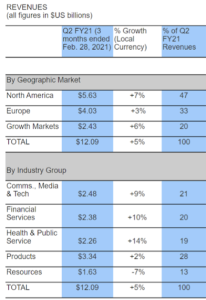
Revenue Growth has increased significantly in the North American Cloud storage market with a 7% growth for Fiscal Year 2021. Communication, Media & Tech, as a whole, generates the majority of Accenture’s service-based revenue and is expected to have strong showings in nominal and percent growth.

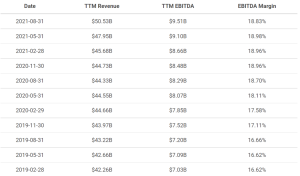
EBITDA over the last year has grown as a margin of revenue, showing positive signs of stronger profits in the coming years. The new revenue coming from the Accenture Cloud First Program has demonstrated higher percent profitability compared to traditional revenue streams. We see this as the EBITDA margin has grown and stabilized at just shy of 19% percentage points over FY21, with a $1.22 Billion nominal TTM revenue growth compared to a $960 million growth in TTM EBITDA. Accenture’s program demonstrates strong profitability and earnings compared to IBM’s declining earnings. 


Competitor IBM EBITDA: 

2020 $12,854

2019 $15,955

2018 $16,672

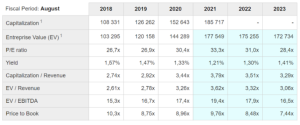
As of now, Accenture’s P/E ratio has hit major peaks and investor sentiment has responded. With EV/Revenue and EV/EBITDA set to gradually decline, Accenture’s revenue streams are likely to meet current valuations in the coming years as it continues its expected growth patterns. For investors, these growths will be matched with optimistic stock valuations well into 2023.

*Note that the declining EV is largely from this particular evaluation that Accenture stock will fall from overconfidence, that has little to do with the financial fundamentals.


Conclusion:


My recommendation is to take a Long Position in Accenture. Accenture’s upside potential greatly outweighs its risks as its major programs have shown early signs of success, generating a 3% revenue growth over the last 6 months. Most of this new growth is leading to higher profit margins than previous revenue increases. Compounded with the declines in other technology consulting companies, it is fair to assume Accenture will acquire a stronger role in the post-pandemic market. In the short term, Accenture has stabilized at a somewhat overvalued stock price: it’s P/E ratio’s rise by nearly $10 evidence of an incredibly optimistic demand; therefore, it may be wise for investors to buy in after any shift in unwarranted market decline.


Sources: 

https://newsroom.accenture.com/news/accenture-cloud-first-launches-with-3-billion-investment-to-accelerate-clients-move-to-cloud-and-digital-transformation.htm 

https://aithority.com/it-and-devops/cloud/accenture-acquires-core-compete-expands-capabilities-and-talent-in-ai-powered-supply-chain-cloud-and-data-science/ 

https://finance.yahoo.com/news/former-cftc-chair-us-needs-to-take-leadership-on-central-bank-digital-currencies-194621839.html 

https://cointelegraph.com/news/ethereum-enterprise-adoption-wins-accenture-s-support-with-baseline-protocol 


Data:

https://newsroom.accenture.com/fact-sheet/ 

https://www.macrotrends.net/stocks/charts/ACN/accenture/ebitda-margin 

https://www.marketscreener.com/quote/stock/ACCENTURE-PLC-11521/financials/