Category Archives: Software

Posts about software and software distribution at Williams College

Java Config file and excepted sites deployment

Some older Java-based websites are so out-of-date that Java refuses to run unless the web site is in the “excepted sites” list. This is normally a user-specific setting however you can set this up as a system wide exception list.

On windows —-
in c:\Program Files (x86)\Java\\lib\
(replace with the correct java release directory for your system)
place a file called “deployment.config”

deployment.system.config= file:///c:/williams/java/deployment.properties
deployment.system.config.mandatory=true

Then in c:\williams\java\
place a file called “deployment.properties”

deployment.webjava.enabled=true
deployment.security.level=MEDIUM
deployment.security.level.locked
deployment.user.security.exception.sites=c:\williams\java\exception.sites

(There are many, many properties you can use here …)

And in c:\williams\java\
place another file called “exception.sites”

http://phet.colorado.edu/
http://csi.chemie.tu-darmstadt.de/
http://winter.group.shef.ac.uk/

Once configured this way, you can update the excepted sites by pushing out a new “exception.sites” list to the computers.

For additional documentation see the websites at:

http://docs.oracle.com/javase/7/docs/technotes/guides/jweb/jcp/properties.html

http://www.adminarsenal.com/admin-arsenal-blog/manage-javas-control-panel-and-exception-site-list/

For Macs :

Create a folder called “Deployment” in: /Library/Application\ Support/Oracle/Java/

In that folder create another folder called “Security”

The files “deployment.properties” and “deployment.config” go in the “Deployment” folder, while the “exception.sites” file goes in the “Security” folder. Here is a screen shot of what you’ll have when you are done:
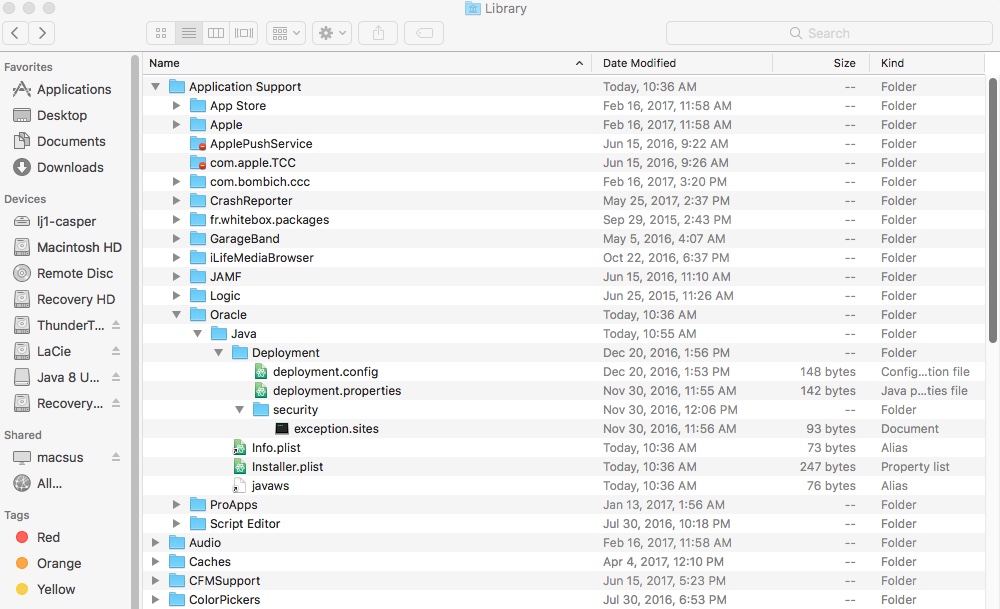
Keep in mind the Mac OS is always case sensitive on file names you should a plain text editor like “Atom” to edit these files (avoids RTF crap that TextEdit adds by default) and the URL file pointer for the deployment.config files looks like:
deployment.system.config=file:////Library/Application\ Support/Oracle/Java/Deployment/deployment.properties

For Williams College peeps – Current copies of these files can be found in macsus and JAMF.
Windows 10 – Installing .Net 3.5 Framework

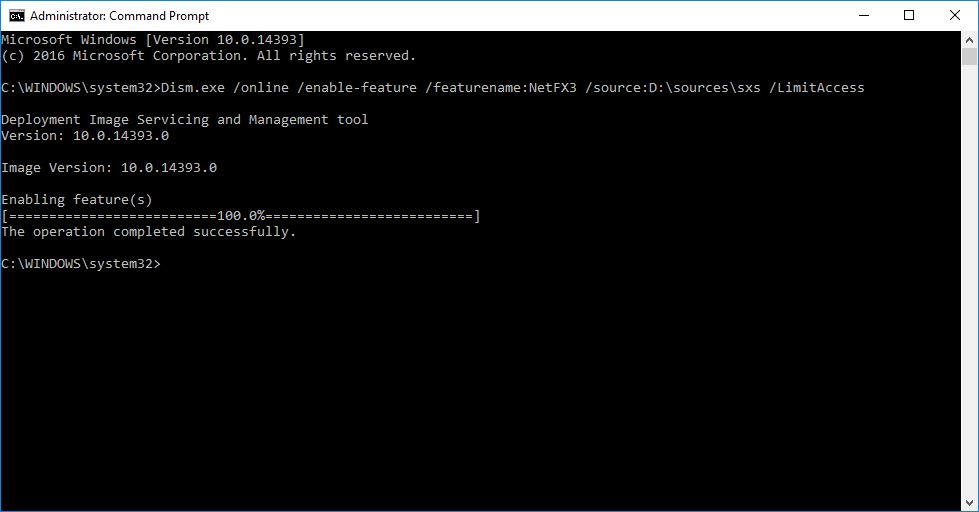
Only .NET 4.0 framework is included in Windows 10 by default. However, many applications still require the .NET 3.5 Framework so to enable/install this 3.5 Framework load your install DVD into the drive and give the following command at an administrative command prompt:

Dism.exe /online /enable-feature /featurename:NetFX3 /source:D:\sources\sxs /LimitAccess

net35install

For more details see:
https://answers.microsoft.com/en-us/insider/forum/insider_wintp-insider_install/how-to-instal-net-framework-35-on-windows-10/450b3ba6-4d19-45ae-840e-78519f36d7a4?auth=1

Windows 10 – Word could not create the work file error

After an upgrade to windows 10 LTSB 2016 “anniversary” edition MS word is giving the error:
“Word could not create the work file. Check the temp environment variable”

According to Microsoft this error occurs when Word doesn’t have permission to write temporary files. To fix this they suggest changing the location of the Internet Explorer Temporary folder or change the registry pointer for Word to a correct temporary location with:
HKEY_CURRENT_USER \Software\Microsoft\Windows\CurrentVersion\Explorer\User Shell Folders
Set the “Cache” to:
%USERPROFILE%\AppData\Local\Microsoft\Windows\Temporary Internet Files

For Details See: https://support.microsoft.com/en-us/kb/2285187

Windows 10 – Windows To Go Enterprise Deployment Steps

Using a “Windows To Go” USB boot disk to provide course-specific windows programming environments

Microsoft’s overview is at: https://technet.microsoft.com/en-us/library/hh831833(v=ws.11).aspx

In the Fall of 2016 – Williams will be piloting one computer science programming course using windows to go drives.
In the Fall of 2018 – Williams also began using these to “Dual-Boot” macs!

To create the environment:

1) A very fast read/write USB drive is needed. In the above link Microsoft recommends certain devices, we used the Samsung T3 250 GB portable drives.

2) Create a windows to go drive using the windows to go control panel on any windows 10 computer. You can point this at a WIM file you created from a syspreped windows environment.

  • Do not encrypt the drive and do not set it to boot automatically

3) Once complete, boot that created disk on any device like an iMac.

For other ideas on deployments see the website at:
https://technet.microsoft.com/en-us/itpro/windows/deploy/deploy-windows-to-go

Windows 10 – Sideload windows store apps

On the lab/classroom image I need to disable the windows app store from allowing random individuals to install random apps. However, there may be a time when I need to install a windows app store app and, of course, there’s an answer for that …. it’s called “sideloading” …. Details can be found at: https://msdn.microsoft.com/en-us/library/windows/hardware/dn938326%28v=vs.85%29.aspx

Windows – Self-extracting installer with auto-install

With the application WinRar from: http://www.rarlab.com/

Select files, right click and select Add to Archive
Use Browse.. to create the archive in the folder above
Change Archive Format to Zip
Enable Create Archive Format
Select Advanced tab
Select SFX Options
Select Setup tab
Enter setup.exe or msiexec /i xxx.msi into the Run after Extraction field ( No quotes or other stuff … )
Select Modes tab
Enable Unpack to temporary folder
Select text and Icon tab
Enter a more appropriate title for your task
Select OK
Select OK

This was mostly swiped from the bottom of:
http://stackoverflow.com/questions/27904532/how-do-i-make-a-self-extract-and-running-installer

Adobe – Photoshop – crashes but not in remote login session

Found an issue where Photoshop would crash after loading but only when using the computer directly. If remoted into the computer Photoshop worked fine. That indicated a display driver issue. I tested at the local computer by putting the display adapter in basic VGA mode and photoshop worked.

The “Fix” — stolen from web forum below …

go to device manager again and put the graphics driver in VGA mode. You can do it by choosing “Browse my computer for driver software” and then select “let me choose option” select standard VGA from the list Then go to ” Control Panel\All Control Panel Items\Programs and Features” and uninstall AMD catalyst control centre. Once it is done, go to AMD website and choose auto detect feature to detect you GPU from “http://support.amd.com/us/gpudownload/windows/Pages/auto_detect.aspx”. Once you find the updated drivers install them and check whether the issue is fixed or not. You can also use this link to uninstall AMD catalyst “http://support.amd.com/us/gpudownload/windows/Pages/catalyst-uninstall-utility.aspx”.

Then restart ….

See details at:
https://forums.adobe.com/thread/1295044