Monthly Archives: October 2016

The Happy, the Sad, and the Open-Ended

By Ashley Zhou

Our relationship with nature has always been an uneasy one once we learned how to manipulate our surroundings to fit our needs. In a time when 150 to 200 species go extinct every day and just five countries produce half of the world’s 32 billion tons of carbon dioxide emissions from fossil fuels, now may be too late to start panicking. We are scrambling to stop and reverse the deleterious consequences of the Industrial Revolution, but at the same time, many of us are loath to relinquish our luxuries and exorbitant consumerism that continue to harm the environment. While blindly trying to find a solution, we support oil industries that spill millions of gallons of oil into the oceans and businesses that clear forests to provide more pasture land. What is it that allows us to make these choices that go against our moral obligations? Comfort, greed, and ignorance? Culture tells us to take a side, either with nature or against it, and to stick with it. But the path to understanding the problem starts with recognizing that there is no side to pick, an opposition to the dualist ideology we are constantly being fed.

In recent decades, the issue of sustainability and our relationship with nature has edged more and more into the public eye. Up until not so long ago, perhaps a few centuries in the 6,000-year history of civilization, we have shamelessly decimated natural resources, indifferently altered the Earth’s physiology, and killed those who refused to embrace “modernization”—all in the name of mechanical progress. As cities grew and everything else died, we began to pay more attention to our indelible footprints in the natural world. The media did not waste any time broadcasting the frightful crises of pollution, global warming, or depletion of vital resources, often spinning the issues into full-blown apocalyptic imaginations. Blockbusters like Dances with Wolves (1990), WALL-E (2008), and Avatar (2009) entranced audiences with depictions of the cataclysmic consequences that arise from the struggle between industrialization and the environment, all of which show a clear winner and loser.

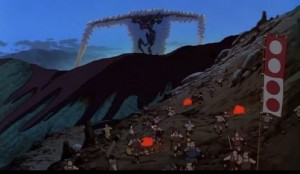
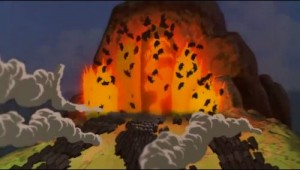
Princess Mononoke is a 1997 Japanese animated film, written and directed by Hayao Miyazaki, that defies this binary solution. As the Forest Spirit restores life to the land, the opposing sides, Irontown and the forest gods, return to their respective realms after incurring heavy losses. Many forest gods have died to protect their forests, their bones and flesh consumed by the poison of the iron bullet. The resemblance of the metal stone in their bodies to the bezoar eerily represents the death of the gods as an antidote to technological barriers. On the other hand, although winning skirmishes, the entire village is destroyed as a result of decapitating the Deer god (also the Forest Spirit), whose manifestation oozes throughout the lands like melted iron ore. Both parties have lost, and Deer god or no Deer god, Mononoke’s world is split between industrial capitalism and militant environmentalism.
boar-death

The extinction of the boar clan

town-ruin

The headless Deer god destroys the land while looking for his head

It is no big surprise that many militant environmentalists are anti-capitalist. Capitalism runs on maximized profits. If Lady Eboshi, the leader of Irontown, has to kill every god in every forest to ensure the survival and prosperity of Irontown, you better bet she will. She is admired as a one who is not afraid of gods, for the drive for iron far outweighs the costs of destroying nature. Her people are a hodgepodge of workmen, prostitutes, and lepers, all taken under her wing for the sole purpose of producing iron for a profit. Every person is working for the continuation of Irontown, from the men collecting the ironsand, to the prostitutes working the bellows to the melt the iron, to the lepers inventing stronger, lighter rifles. The assembly line transcends and incorporates all the social groups. Just as Irontown’s singular purpose is to salvage all the iron in the forests no matter the cost, the forest inhabitants are pretty set on destroying the humans. The boar clan knowingly commits suicide when it charges at the town across a field planted with mines, and the ape tribe has resorted to eating human flesh, supposedly to gain human strength and fight back. Each is trying to survive by destroying the other. Looking at the film from today’s perspective, it is easy to blame Eboshi for being so uncaring towards the environment, but in the movie’s world, she is trying to support her town the only way she could, and her people’s adoration and trust in her reflect this.

So which side are you supposed to root for? It is ambiguous because both are just trying to ensure their own survival. (An evil that the film does warn against is pure greed and excessive consumerism that the emperor embodies when he demands the Deer god’s head in order to gain immortality. The emperor’s motivation differs from the town’s in that he wants more than he needs, perhaps lending a vision of what the capitalist Irontown will become in the future.) However, the movie did have to have an ending, and as in all stories, Mononoke attempts to coax the audience into believing that the movie’s resolution provides a viable solution to the crisis. The only problem is that it doesn’t do a very convincing job.

Let me first give a few examples of ideology’s workings in films so it may be easier to see how Mononoke differs. Terminator 3 (2003) is a generic killer robot movie about the rise of artificial intelligence who are the reason for the human apocalypse. The plot involves two robots from the future: one is outdated and male, the other is “smart” and female. Throughout the entire movie, the audience cheered as the Terminator bashed away at the surprisingly hardy Terminatrix’s head; after all, the male robot is good and the female robot is evil. Viewers breathed a sigh of relief as the Terminator finally obliterated the Terminatrix, which concluded the film. It was then easy to forget that, while the direct threat was gone, the protagonists actually failed to stop the apocalypse. Saving the world was the main issue and the movie glides over the abortive mission with a victorious Terminator blowing up the Terminatrix by sticking a fuel cell down her throat…which exemplifies the underlying ideology that the movies actually focuses on: the patriarchy must be kept alive and well even when obsolete. If this notion of putting women back in their place through rape were clear in the film, it would have had a hard time getting greenlighted. The ideological plot that the movie stresses with scene after scene of the two robots fighting has a solution, but it is one that no one in the right mind would endorse in the real world, only through the fictitious characters and events in the movie.

Avatar (2009), unlike Princess Mononoke, portrays humans as ruthless militants with no compassion for nature. Set in the year 2154, humans have even more advanced guns, tanks, and dreams, and it seems like a pitiful joke for the Na’vi tribe to be expected to defend themselves. But the Na’vi don’t just defend themselves, they expel a whole establishment of leaders, soldiers, and scientists off their planet. This ending runs counter to the entire history of colonization and basically every White encounter with indigenous people. So how do the Na’vi do it? The indigenous animals suddenly decide to fight the humans in a collective effort, as if understanding the direness that humans impose, giving the indigenous people a fantastical boost. Hammerhead Titanothere herds stampede through the forest like tanks and airborne predators serve as airpower for the Na’vi. The movie significantly amplifies the strength of the bow and arrow just enough to overcome gun and steel. Avatar achieves a happy ending by giving the indigenous people an imaginary advantage to rival the White people’s technology, but the pretense that indigenous tribes can win is, well, just that—imaginary.

banshee

Dragons to the rescue!

Terminator 3 and Avatar affirm that stories work by providing imaginary solutions to real crises, but Mononoke specifies that the lack of a political fantasy reveals the true nature of environmental ideology of the real world. The town and the forest’s goals exactly align with the destruction of each other, and that is where the plot fails to offer a believable solution. In the end, idyllic greenery miraculously returns to the land, the protagonist’s curse is lifted, and everyone is optimistic that things will be different after a near-apocalypse. The land has undergone a dramatic transformation of death and rebirth, marked by the reappearance of kodama, spirits that signify a healthy forest. The casual viewer (as I was when I first watched the movie a few years ago), at best, might turn off the TV with a sense of emotional satisfaction and confidence in the industrial world’s peace treaty with nature. But upon deeper analysis, it does not take much to realize the plot is not offering a solution at all—fantastical or not. After the ultimate battle, both sides are diminished, and now they are supposed to coexist agreeably. Miyazaki seemed to recognize that this ideal was a fantasy, ending the film with Lady Eboshi, simply declaring: “We’ll start over again. We’ll build a good village.” But what does “a good village” mean? Surely a Muromachi-era town dependent on ironsand and thus deforestation isn’t supposed to suddenly start innovating ways to survive and grow without exploiting nature. In human history, nature’s loss was imperative to technological advancement in the first place, so only after we reach the point of sustainability can we retroactively try to fix the damage that we caused to get there. In the movie’s own terms, it is inevitable that Irontown and the forest inhabitants will clash again, but that is left open-ended.


1

7

The Deer god instantly revives the land

Whereas Terminator 3 and Avatar offer emotional release, Princess Mononoke refuses to resolve the environmental issue with a cop-out such as killing Eboshi. Instead, the false hope that closes the film offers viewers an illusory view. At the same time, the naïve easiness of it all and cursory wrap-up indicate a deeper discovery which allows the viewers to realize the fiction in the ideology. Even the imaginary world does not provide a solution. Miyazaki’s unsatisfactory ending reflects the political messiness of the real world and even the hopelessness that accompanies it. Our catastrophic relationship with the environment throughout history is not explicitly shown in Mononoke’s “happy ending,” but it is hidden beneath such a superficial optimism that people understand the film provides a fantasy which is at odds with the circumstances of the real world. Through the viewpoint of an ambivalent protagonist, whose undertaking is to journey to the west and “see with eyes unclouded,” Miyazaki portrays a crisis that cannot be solved by simply creating a winner or loser. Even though the film criticizes excessive consumerism, a large portion of the world does not participate in this kind of lifestyle; if anything, they are not getting enough to consume. It is not possible to condemn these people who live much like the Irontown folks do. Unlike other environmentally-focused films, Mononoke is not supposed to justify industrialism’s dominance over nature or inspire penitence for all the cruelty against our environment, but to delineate the current situation through the loss and destruction of both parties.


Note: Some ideas in this essay come from a conversation I had with Professor Christian Thorne on October 13, 2016.


Images:

Mononoke images were screenshot from movie.

Avatar image: http://james-camerons-avatar.wikia.com/wiki/Scorpion_Gunship
Stomachable Propaganda: “The Breakfast Club” and Reagan’s Politics

By Dew Panalee Maskati

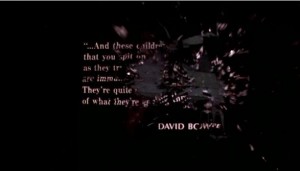
Pop culture was in it’s prime during ‘80s America, with the release of popular classics such as “Karate Kid” and “The A-Team”, and the advent of synthesisers and digital recording in music. It was the age of self-reinvention and rising consumerism — glamour, now on sale at your nearest mall — laced with political turmoil, increasing unemployment rates, rising inflation, and xenophobia.  It was in this spirit of dissatisfaction and idealism that “The Breakfast Club” was made. Five high school tropes —“athlete” Andrew, delinquent Bender, Brian the “brain”, “basket case” Allison, and “princess” Claire— overcome their initial aversion to each other to unite in friendship and defy the disciplinarian, Mr. Vernon; they are armed, of course, by the teen rebel’s trustiest weapons: drugs and rock and roll. From its opening title, ‘The Breakfast Club’ establishes itself as a patron of rebellion by paying homage to David Bowie, the nullifier of category and God of self-reinvention, with an excerpt from “Changes”:

“And these children

that you spit on

as they try to change their worlds

are immune to your consolation

they are quite aware

of what they are going through”.

These lines highlight how the movie corroborates the image of the defiant and heroic teen rebel — the counter-culture revolutionary yet untainted by the adult world — and in consequence, is full of vicarious appeal to the teenager’s angst-filled heart. But the movie’s premise and resolution is entirely a fabrication, a fact made visually apparent in the opening sequence, as the camera zooms in beyond the shattering black television screen, and draws us into a realm beyond reality. This heartwarming tale is, in effect, a mask for an underlying, sinister ideology, one gets the viewer to think more favourably of conformity by marketing it as unity. Tropes aren’t transcended; rather, certain accepted stereotypes are subliminally reinforced over others.

The opening title sequence

Opening title sequenceThese stereotypes are so pervasive that the students do not formally learn each other’s names until half-way through the movie. As soon as they do, further labelling is generated: “Claire” is a “fat girl’s name”. Bender as a human being “may as well not even exist in this school”, as Andrew says, because in the eyes of others he is but the stereotype of a criminal. Certain issues remain unaddressed, and are subsequently reinforced, such as male chauvinism: Bender, looking to “impregnate” Claire, does have his wish granted – they fall in love – Claire “couldn’t ignore [him] if [she] tried”. The movie is unsuccessful even in its self-proclaimed mission — abolishing high school stereotypes — because in their final moments of detention, the teenagers each dance in a style that parodies their tropes. Some might interpret this as a euphoric moment of acceptance, but really, it soberingly demonstrates a lack of change — these teenagers still conform.
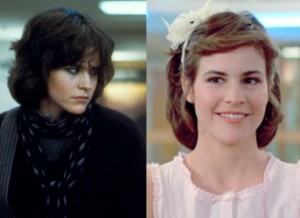
However, the movie goes beyond this: it seeks to favourably portray the elimination of diversity — more specifically, to see stereotypes deigned unacceptable by society abolished. Let’s take, for example, the outcasts Allison and Bender: due to social conditioning that encourages wariness when confronted by nonconformists, their crude, sexual language and atypical manner, initially gave them the most disdain from other characters and viewer alike.  Claire’s response to Bender’s graphic description of sex is to ask “do you want me to puke?”.  Allison, on the other hand, embodies the uncivilised: feral behaviour; wild appearance; her endorsement of the “mountains”, “Afghanistan or Israel” over the Chicago “streets”. Yet, they are the most perceptive of all the characters. It is the distance between them and society that cultivates comments such as Allison’s iconic “it’s unavoidable, it just happens… when you grow up your heart dies”, or the critical eye on social convention that leads to Bender’s rejection of Claire’s ability to apply lipstick with her breasts — a bourgie talent that highlights her superficiality and privilege. The others reject their discomforting comments: Andrew has been socially conditioned to interpret Bender’s insight as “insult” when Bender is really just “being honest, asshole!”.

Allison presciently realises that there is no escape from being labelled, by pointing out that once Claire reveals the truth behind her enigmatic sex-life, she will be skewered by a triple-pronged sword: categorised as either a “prude”, “slut” or a “tease”. And indeed, rather than a movement towards acceptance of their quirks, the movie sees Allison and Bender normalised into socially acceptable stereotypes. Allison is given a makeover that turns her into a cookie-cutter doll — note the aggressive way in which she is made to conform through makeup — “don’t stick that in my eye”. She only truly receives Andrew’s approval — “it’s good” — after the transformation. If she had outwardly remained a “basket case”, would Andrew have kissed her? Bender’s indoctrination is less explicit: he puts on Claire’s earring, a trinket from the upper classes. So yes, “The Breakfast Club” does champion acceptance — but only at the price of individuality. Mr. Vernon’s obviously devilish character masks the true evil in the movie: Andrew and Claire, instruments of a cultural ideology that instills “sameness”.

Allison’s makeover

Let’s explore this dichotomy a bit further: students are good and adults, evil. Mr. Vernon’s character actualises the quasi-dictator that haunts every student’s educational experience; more importantly, he embodies Althusser’s “educational state apparatus” and elements of the “repressive state apparatuses” — instruments within a system of oppression (society) that seek to excise individuality and maintain the existing social order by doing so.  He shares in their dehumanising methods when he snaps his fingers and repeats commands at Andrew as if to a dog, and exercises their repressive violence through language that goads and humiliates. To the other students: “look at [Bender], he’s a bum”.  “What’s the matter, John? You gonna cry?”. The other prominent adult, Carl the janitor, has a characteristic that, at first glance, seems to spare him from the general criticism: he understands.  Although an incongruously angelic figure in the prison-like school, what he says bears a disconcerting semblance to totalitarian propaganda from the likes of George Orwell’s “1984”: “I listen to your conversations — you don’t know that but I do”; “I am the eyes and ears of the institution”. Add to this his identification with the lower classes — “you guys think I’m some untouchable peasant… serf” — and he has, in effect, become the voice of Adorno’s “culture industry”. Therefore, the audience is disinclined to sympathise with them.
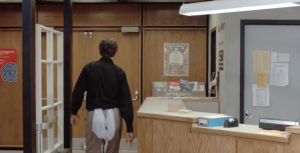
Since the audience directs its sympathy according to human-object interaction, the objects in the movie reinforce the contest between vessels of a repressive culture (adults) and adolescent resistance. Objects antagonise Mr. Vernon multiple times: to the students’ and the viewer’s amusement, he is proved wrong (and importantly, Bender proved right) when the chair meant to hold open the door springs out of position, thereby granting the teenagers their privacy. Other slapstick instances include coffee spilling over his table, and, unbeknownst to him, toilet paper dangling out of his pants. On the other hand, objects function harmoniously with the students; they reinforce the viewer’s support for the teenagers’ cause. The viewer too, feels victorious when Bender scales the mountain of school supplies to escape solitary confinement. But beyond this, the objects are implementing an equally important task on the viewer’s subconscious: the cues that polarise teenagers against adults have created a battlefield of the school building — a stomachable replica of the ‘Nam, bringing to mind public fear during the Cold War. The students utilise tactics of guerrilla warfare to combat Mr. Vernon — stealth when avoiding him, and “fire and movement” strategy when Bender distracts for the others’ safety.

screen-shot-2016-10-15-at-3-02-33-pm

Dominant during the 1980s was general disgruntlement with the shortcomings of liberal government (the old order) and a favourable view of modern conservatism. National industries faced losses, increased layoffs; Japanese technology and products outstripped the West’s. The Cold War reached its apex, and the generally displeased public agreed with Reagan’s claim that Carter’s liberal government should have chosen to, but did not, “stay the course” in regards to Vietnam. This political divide pervades the movie: the teenagers and adults represent two existing orders, the new and the old, which are at war; its battle ground, the classroom. Mr. Vernon says as much: “these kids have turned on me”. Ultimately, the teenagers emerge victorious: free to do what they please from the second half of detention onwards, Mr. Vernon’s authority ultimately overturned, and stronger in their unity. Andrew gives a strikingly industrial description of his dad as “this mindless machine” programmed to “Win! Win! Win!” that he proceeds to reject; here again, is the dismissal of an archaic, ineffective order. Therefore, the movie’s heartwarming ending insinuates triumph of a new, conservative order over the old — conforming to public sentiment that perceived a weak, ineffective, liberal government. By guiding the audience firmly onto the teenagers’ faction, the movie succeeds in indoctrinating Reagan’s political propaganda.

What’s more, the implications go beyond America’s borders, creating an ideological conflict of international proportions— but with America, of course, as its heroic centre. During the 1980s, Japan and America were in contest for technological superiority, and it was obvious as to which country was emerging as the dominant force. This was a time in which the American public felt alienated by the imported commodities around them — dissatisfaction that culminated in demonstrative destruction of Japanese cars. The movie overturns this dynamic; it provides the average american with an illusory resolution that appeases fear of their country’s growing global impotence against Japan’s booming economy. The teenagers, symbolic of Reagan’s America and therefore vessels of an ideology along the lines of “Let’s Make America Great Again”, operate in harmony with objects. Meanwhile, the enemy, Mr. Vernon, is obstructed and humiliated by the products around him. An alternate picture is painted: within this constructed conflict, America emerges victorious and the ultimate commander of products. So, through cues that align the viewer’s sympathy with the teenagers’ cause, the movie sentimentalises American patriotism and xenophobic distrust of the foreign — effective even on a present-day audience. The teenagers impress acceptance of Reagan’s politics, as well as illusory American supremacy over the Japanese, on the viewer’s mind.


Sisterly Love: A Deviation from Mainstream Disney

By Amanda Reisman

Is all love the same? No! Bear with me, and I will explain how love varies in depth and meaning. I don’t mean that our love of Harry Potter differs from our love of food. I’m talking about people. We all love in different ways. Some people love more, and some love less. Some try to hide their love, and some love too much. How do we learn to control the love that seems to consume and conquer us? We become subjects to whatever our hearts desire. Who we love and what we love becomes a part of who we are. We perceive this love in its many different forms. There is forbidden love, idolized love, fake love, and real love. Where do we draw the line? Is the love we see in media real? Can we tell if our love is true?

The culture we consume has generally portrayed love as the ultimate goal. This creates a real world desire among people to find their “soulmates.” I put the word soulmates in quotation marks to emphasize how the idea of finding our one true love has been produced and implemented into our culture through media. The belief that we each have a soulmate, a person who we are designed to be with, is quite controversial. How can we know who that is? What if we haven’t met that person? Regardless, media has instilled a concept of finding our own Prince Charming. Children watch movies where princes and princesses fall in love and live happily ever after. The prince is idolized and made out to be the ideal soulmate. The princesses sing song after song about finding their prince. They become entranced by just the thought of seeing their lover again. The practicality of these movies is absurd. Frozen, the first break in the seemingly never-ending stream of Disney princess movies, has stemmed away from this culturally produced notion of love.

Frozen (2013) is centered around a princess named Anna whose sister, Elsa, has ice powers. Her sister accidentally freezes Anna’s heart, and only an “act of true love to thaw her frozen heart.”

screen-shot-2016-10-15-at-3-17-54-pm

Elsa accidentally freezes Anna’s heart

https://www.youtube.com/watch?v=KqDE95-gP6M

The movie initially revolves around Anna’s mission to find Hans, a prince who she met and immediately fell in love with. She was so focused on finding “the one” that she declares Hans to be her soulmate immediately after she meets him. Needing love to save her, Anna journeys to find him for an act of true love. This act of true love is immediately perceived as a true love’s kiss. A true love’s kiss immediately references another Disney movie: Sleeping Beauty. Sleeping Beauty waits for Prince Phillip’s kiss to save her from her deep sleep. The idea of a true love’s kiss solidifies Disney’s focus on how only real, romantic love can save us from evil. This love is seemingly the only form of protection from evil. The beginning of Frozen seems to fall right in line with Sleeping Beauty. The search for love as the savior from death is common in both of these movies. True love’s kiss wakes up Sleeping Beauty; however, Anna, of Frozen, realizes she has been blinded and tricked by her desires.

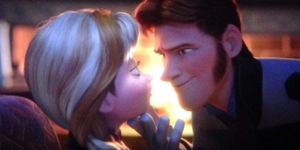
You are now probably wondering why I explained the similarities between an old classic Disney princess movie and Frozen. Disney, by creating Frozen, is ironically mocking their previous movies. Now before you immediately disregard my assertion, just listen to what I have to say. After Anna finally finds Hans, she is dying and in need of an act of true love. Believing Hans is her knight in shining armor, Anna asks for a true love’s kiss. He rejects her attempt and reveals how he only pretended to fall in love with her to become the next King of Arendelle. Her obsession with finding her one true love resulted in her thinking that Hans was the one. What she thought was true love couldn’t save her. Her infatuation deceived her. There was seemingly no happily ever after.

screen-shot-2016-10-15-at-3-18-02-pm

Hans reveals his true intentions

https://www.youtube.com/watch?v=KqDE95-gP6M

Anna has been tricked! What? Disney, who? The prince and princess are supposed to fall in love and live happily ever after. What happened? This unprecedented twist of events is unlike any Disney princess movie ever made. The man has deceived the woman for power! Now that definitely couldn’t be Disney!

To continue my thoughts on the divide between Frozen and previous Disney movies, I would like to compare the opposing plots from Frozen and Cinderella (1950). In the movie Cinderella, Prince Charming, after dancing with Cinderella at the ball, needs to find her again. He believes he has found his true love and is relentless in finding her. Eventually, they reconnect and live happily ever after. On the other hand, Frozen’s Anna is fighting to find Hans! This is the first Disney movie where the girl is desperately trying to find the boy. She feels that she “needs” to find him to survive. Despite proving that Disney is mocking their previous work with this idea of needing a man to “survive,” the beginning of Frozen draws attention to this role reversal, which is just one difference between these two movies. Cinderella follows right along Disney’s classic princess movie mold. The girl meets the boy, and they fall in love. Some evil thing happens that attempts to separate them, but they find each other again and live happily ever after. This structure is mocked by Frozen. The girl meets the boy, and the girl thinks she found true love. Some evil thing happens, and the boy leaves the girl to die in order to take over her kingdom. The change in plot makes a joke out of every classic Disney princess movie by showing how completely unrealistic and farfetched those movies actually are. Love at first sight is actually not a realistic notion! Not everyone is who they say they are or who we want them to be!

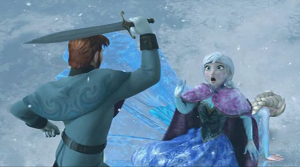
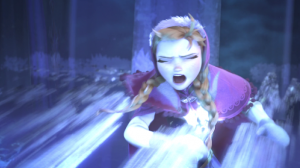
After Hans abandons Anna, she manages to find her sister. Hans, in order to become King, needs both Anna and Elsa to die. However, Anna steps in front of Hans’s sword to save Elsa and freezes there. By sacrificing herself, she performs an act of true love and suddenly unfreezes and returns to her normal health.

screen-shot-2016-10-15-at-3-18-11-pm

Anna sacrificing herself for her sister

https://www.youtube.com/watch?v=b2xn0jDmiTw

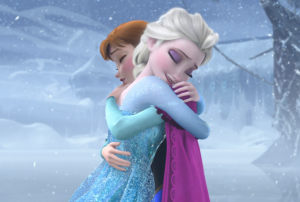
Their sisterly love saves them. Anna is cured, and Elsa learns to control her powers through love. Family is the most important part of our lives! The love we feel for our family is insurmountable. This unbreakable bond will protect us from everything! Frozen broke away from mainstream Disney princess movies by changing its view on powerful love. Previously, the love between a prince and a princess was enough to stop evil. In Frozen, the love between two sisters is stronger than any relationship or any impending danger. Only “love can thaw a frozen heart.” The notion that “love thaws” is crucial to the ideals present in Frozen. Love defrosts; it unfreezes; it warms. Love removes the cold. Only true love can save us! Real love can be found, where Disney has never before represented it, within our families.

This stress on familial love instead of romantic love was a significant change for Disney to make. Their target audience being children is vital to how they construct their movies. Kids watch these movies and immediately associate with/desire to be the princesses. Previous Disney princess movies have instilled ideas of soulmates, “Prince Charmings,” and true love into the minds of 5 year-olds. That’s ridiculous! We should be teaching kids about family, loving your family, and putting your family above all else. Frozen is the perfect demonstration of familial values, and Anna is the greatest example of bravery and selflessness in all of the Disney princess movies.

Frozen is an unprecedented creation where love triumphs all and combats evil. There are some movie critics who would disagree with the facts I have stated about Frozen. Elizabeth Weitzman, of the New York Daily News, claims that there is still something missing from Frozen. “What’s crucially missing, however, is a hissable villain” (Weitzman, Elizabeth, Frozen, Movie Review). I’m sorry…what? A “hissable villain!” Why would we create movies geared for kids where powerful villains are the enemy? These kids learn to hate the Evil Queen or Maleficent without truly understanding why these characters are seemingly inherently evil. The classic Disney movies provide no solutions to help cure these villains of their evil intentions. The prince and princess simple defeat their villains. However, Frozen has no specific villain. Hans is definitely a despicable character, but as a viewer, I can understand why he was so evil. He wanted to become King! He is ultimately defeated by Elsa and Anna’s realization that love thaws! No matter what evil comes about, their unwavering love for each other will win at all costs. In classic Disney princess movies, there is no such revelation. There is only romantic love defeating evil!

Other critics have stated that Frozen is just another Disney love story. On http://www.imdb.com/title/tt2294629/reviews,  a critic under the username rford191 had a particularly interesting and astonishing review of Frozen. This reviewer said one con of Frozen was “plot idiocy…If fear is the enemy, why do you seclude/terrorize the princess with insecurities? How/why does “love” recall winter? Didn’t Elsa love her family all along? Wasn’t there “love” present all this time? There was zero explanation for how this worked. Just “love”” (rford191, “An Astonishing Disappointment” IMDb Reviews and Ratings for Frozen). This critic may be right to some extent, but, until the end of Frozen, there was never a direct declaration of love or any act displaying sisterly love. Anna, despite her sister’s neglect, sacrificed herself. This act of pure love cannot be surpassed by anything else. The ultimate declaration of love is putting someone else’s life ahead of your own; sacrifice. In the video clip that I added, Anna clearly chose to save her sister over herself by running away from Kristoff to stop Hans’s sword. Additionally, Anna’s growth as a character is crucial to the plot. Her flaws are transformed into bravery. She overcomes her past with her sister’s neglect and the loss of her parents to realize what she truly wants and who she wants to be with. She discovers who the important people in life are and who she can trust and count on. Anna does have many weaknesses. She is tricked and deceived because of her willingness and hopefulness in the world of love. She is the only Disney character who has these prevalent insecurities. Anna is not perfect, which separates her from all the idolized princesses of previous movies. Ultimately, she overcomes these imperfections through courage and sisterly love. The love she feels for her sister was always there, but she needed to be brave in order to save Elsa (thus displaying her love). Love, a warm feeling, is ultimately what recalls the eternal winter. This is a slightly abstract idea, but that’s just Disney! It’s the underlying messages sent by the presence of warmth and sisterly love that are important in differentiating Frozen from previous Disney princess movies.

Many critics have claimed that Anna is just another princess who falls in love and lives happily ever after. I will admit that part of that statement is true. She finds love with Kristoff, and we are expected to believe that they will live happily ever after. However, she doesn’t end up with the prince, the first boy she meets! Kristoff, the ice man, is from a different world.

screen-shot-2016-10-15-at-3-18-21-pm

He comes from no wealth or power, and she actually takes the time to get to know him. She fell in love over a period of time rather than just instantly! This also distances her from almost every other Disney princess who falls in love with the prince who saves her. Additionally, Kristoff doesn’t save Ana! She actually saves herself her willingness to protect her sister. It is important to note that Anna is the hero of her own story. This is the first time the princess has ever been the hero in any Disney princess movie! Anna overcomes her previous family issues, her internal struggles, and her obstacles with love in order to save Elsa and help recall the eternal winter.

Do you see it now? Frozen has provided us with a deviation from the never-ending stream of perfect princesses and princes riding off into the sunset. We have struggles of love, power, and trickery! The main character is flawed, but she surmounts her imperfections in order to survive. Frozen’s value of sisterly love in order to stop evil differs from previous classics in which romantic love is the ultimate goal.

screen-shot-2016-10-15-at-3-18-29-pm

These plot twists are new for Disney. They have thrown the cookie-cutter model out the window, thus proving why this movie was so successful. Everything about this movie was unexpected from Hans’s duplicity to how sisterly love saves Anna. It provides the viewers with a new take on love, deception, and family! Disney has diverged from its previous mold of romantic love, idolized princesses, and heroic princes.

To finally solidify all of my points, the break between Frozen and classic Disney movies are a perfect example of distinction within a similar realm of culture. Disney has been producing these princess movies for decades, but “for the first time in forever” they have provided a counterculture. This counterculture outright rejects the uniformity of mass produced culture. Adorno is a critic of cultural theory, and he believes that when culture is mass-produced (for example, Disney movies are mass produced) it is in danger of becoming the same. Adorno’s word of choice (“sameness”) is a very close-minded view of culture and is a very ambiguous description. I have spent this essay explaining to you the visible break between classic Disney princess movies and Frozen. This division is clearly not “sameness.” It is a totally different new realm of culture that has stemmed from a mass produced system. Adorno claims that despite appearing different, culture all lands in the same place. To counter Adorno’s view on the sameness of mass produced culture, Frozen is the perfect break from previous Disney movies by exemplifying sisterly love, strong female characters who overcome their flaws, and women becoming the unexpected heroines of their own stories.

Images from Google, and Video clips from Youtube.

Brainwashing: One Disney Film at a Time

A fragile, gentle princess cries endlessly for help from a distance in hope that someone will save her from the villain keeping her hostage. News then travels to the princess’ hometown informing residents that she’s been caught; and as they get ready to attack the villain head-on, in swoops a robust, tall prince to save the day. Through clever tact and superhuman strength, the prince rescues the princess and wins her love. They get married and live happily ever after.

This simplistic mold has been the primary archetypal plot for Disney animated films since the debut of Snow White in 1937. Disney “princess films” have always followed the same model: a beautiful, yet helpless princess saved by the manly, chiseled-face prince. Children and adults alike have seen this classic plot repeated through countless movies such as Snow White and Cinderella. But are audience members aware of the model’s effect and relayed message? It’s seemingly obvious that these films emphasize gender norms and traditional patriarchal beliefs, and, although Disney has recently drawn female main characters as autonomous and strong, in films such as Tangled and Frozen, the stereotypes seen in the classics remain concealed in other forms. And if we know how these movies carry out their plots, why do we keep watching them?

Though it all began with Snow White and Cinderella, the latent sexism and hegemonic masculinity in the company’s films were all-encompassing in Beauty and the Beast (Disney’s fifth princess film). The male main character in this film is a man turned beast, and the destined princess lived to care for her father in a town where she is expected to aspire to marriage. Aside from the beast, Disney also presents us to the male figure Gaston, an egotistical hunter who’s in love with Belle, the “housewife” turned princess. And despite his goal to win her love, Gaston assumes that he already has her heart for there is no other man like him in town.    

Through characters like Gaston, Beauty and the Beast slaps you in the face with its almost overwhelming display of hegemonic masculinity. Gaston’s character is sketched to ensure that he seems as “manly” as possible–his biceps are huge, his shirt is stretched by his immense muscles, and he has sharp, chiseled facial features that compliment his menacing and patronizing smirk, the constant reminder to others of his ultimate superiority. Furthermore, Disney artists made sure Gatson would appear significantly larger than the other characters in the film. Simply put, everything about Gaston says, “I’ll always be better than you.” As if his physical appearance was not enough to emphasize his superiority and intimidating influence in the small town, Disney gives Gaston an entire musical number in which the villagers around him gleefully sing, “No one’s slick as Gaston. No one’s quick as Gaston. No one’s neck’s as incredibly thick as Gaston. For there’s no man in town half as manly. Perfect, a pure paragon. You can ask any Tom, Dick or Stanley. And they’ll tell you whose team they’d prefer to be on” (Beauty and the Beast). Glorification for his strength and looks is a common occurrence. Disney even gives him, what seems like, superhuman strength. In one scene he bullies the short, ugly men in a bar to remind both the townsmen and the audience that he is a force to be reckoned with. Further still, in this same scene, background women admire Gaston and deem him attractive. Finally, having already demonstrated narcissism and an enormous ego in the tavern scene, Gaston also proves to be sexist, displaying the traditional belief that women should consider neither autonomy nor education important. His attitudes are made clear when he throws Belle’s book to the mud,  and tells her to focus on the more significant things in life, such as himself. If nothing else, Gaston performs one role perfectly with his exaggerated physical strength, narcissism, aggression, impulsivity, and brash sexism –the embodiment of hegemonic masculinity.

The large inability to sight the subtle hyper-masculine qualities present in these types of characters has grown out of their normalization in both film and society. The details are clouded by other cinematographic aspects of the film, especially so in animated media — where bright colors and voices divert attention away from the underlying parallels between the values of the movie and of actual society. This is where Disney’s Beauty and the Beast is unique. The movie is their first real instance where the role of the male “hero” is called into question, and where Disney provides us with not just two views of what it means to be a man, but two severely different views, forcing his audience to identify the archetype and its complexities right alongside an alternative male ideal and model.

Another especially important element distinguishing Beauty and the Beast from its surrounding films is the form taken by the main male character and eventual hero: that of a Beast. When comparing this film to its sister films, it takes no expert to notice that the princes and saviors of the other stories are almost always human. Not only that, but those heros are presented as near “perfect” males, with characteristics that mirror Gaston’s — tall, handsome, and distinctly attractive to the point of standing out from the rest of the characters in the film. Disney, however, introduces us to a new type of hero in this film, a Beast — a former human who is unable to love. A hero with a flaw so grave, it masks his role as hero. Beast’s animalistic transformation, stripping him of his human form, was the result of a witch’s curse who deemed the former prince incapable of expressing and feeling compassion, thus unworthy of being human. Disney artists made sure to strip him of human-like characteristics, and estrange the Beast with a massive stature, making him the biggest character in the movie, not to mention the scariest. Disney didn’t even make Beast into a specific animal, but a conglomerate of creatures, commonly known as a chimera — a Greek mythological being with the head of a buffalo, the body of a bear, the jaws and mane of a lion, and the legs and tail of a wolf. Consequently, Beast’s form makes his former self-unrecognizable, and makes anyone who sees him too afraid to try and comprehend his situation or person. This resulting alienation and loss of former status as a prince ultimately leave Beast alone to develop great insecurities in his ability to be humane and empathetic.

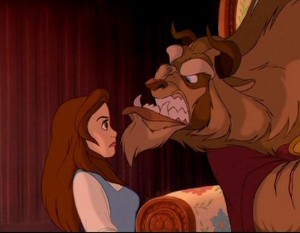
Furious encounter between Beast and Belle.

Furious encounter between Beast and Belle.

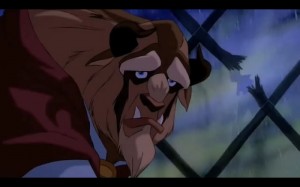
Beast lamenting about the curse placed upon him

Beast lamenting about the curse placed upon him

Beast, however, eventually has to face and conquer his inner conflict : to overcome his shame over his monstrosity and show empathy towards others despite the risk of being misunderstood, feared, and rejected; After all, part of the curse is that Beast becomes the object of the very attitudes that once spurred him to act cruelly towards others when he was human. In order to reclaim his humanity, Beast must learn compassion, and leave behind his learned indifference to human emotion  from his days  as a prince. Because of his upbringing,  Beast’s  cold and inconsiderate personality keeps him from  understanding his own capability to express love and hospitality. These new and deeply-rooted sources of shame for Beast, though, are the very elements that make his transformation into a better man all the more admirable and meaningful. Through observing and adopting Belle’s compassion and accepting his own emotional vulnerability, Beast eventually discovers his capability to feel empathy and in effect reclaims his humanity. Disney’s rewarding of this new and improved image of Beast with his former human form suggest a better and improved image of man.

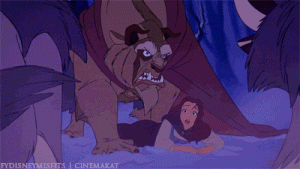
In danger, Belle is saved by Beast.

In danger, Belle is saved by Beast.

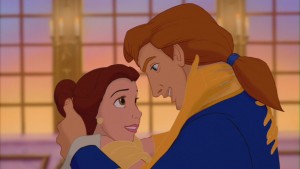
After finally learning to emphasize and love, Beast returns back to his former, human self.

After finally learning to emphasize and love, Beast returns back to his former, human self.

So what does Beauty and the Beast have to do with anything? If you think about all the sexism and the poor portrayal of female characters and the exaggerated portrayal of men in the movie, it seems odd Disney would want kids to be entertained by it. In other words, to restate the question presented in the beginning of this essay: why keep watching? It’s blatantly obvious that Disney has done a lot over the years to continually emphasize the dominance men have over women, and we have seen this since 1931. They, however, have only mirrored the social values of each era. Aside from being blinded by the slight variations in character and plot of each movie, we are pre-exposed to a society that continues to uphold values of sexism and masculinity. So it’s no surprise that we are so used to seeing skewed portrayals and assignment of labels based on social expectations and norms, especially in the Disney animated films of today.

Not only the adults, but the children who continue watching these movies know about the ongoing sexism that’s omnipresent in the world we live in. Though they don’t go around talking about it or fully understanding it, they do comprehend that they have to act and live a certain way depending on their gender. Even before birth, children are expected to accept predetermined identities that follow them throughout their lives and shape their daily interactions and behaviors. Boys specifically are expected to be strong and self-reliant, as communicated by “tough” characters in film and other media. They do not question where this stereotype originated nor do they question if it’s right. After all, children  look up to their elders and imitate their exact moves in order to feel a sense of belonging, and eventually a sense of “maturity.” For girls, these Disney films reinforce to their audiences the importance of physical appearance and the belief that a girl’s worth is determined by the degree to which she is thin, gentle, and beautiful. And the female characters in these movies hardly get active roles, as the films enforce traditional and sexist images of women limited to skills of housekeeping and subsequently having no business in performing any strenuous work that could ruin their appearance.

These beliefs on what women and men should do are extremely relevant examples of ideologies – beliefs that, although usually unquestioned, are widely accepted, spread, and viewed as legitimate. They are illusions created by social structures to define certain roles in society. These ideologies unite people through their misinterpretation of the real world, giving them a false sense of security and enabling them to develop a “relationship” with the real world. The real problem though is not the illusion, but its omnipresence and enslavement of those in its grasp; there’s no escaping the influence of ideology, especially when supported and hyped by media we are exposed to on the daily. Our dependence on communication with one another traps us all in a bubble that repeatedly and constantly reinforces the implementation of ideologies, and as these beliefs change and evolve, so do our perceptions of “reality.”

When looking at the movie through a critical standpoint, Beauty and the Beast demonstrates how society has become desensitized to gender-related stereotypes. Thus, the films’ audiences are inherently influenced by these messages and consequently spurred to act the way their gender is presented on screen. Because children tend to naively imitate what they see without question, their social lives are forever governed by these ideologies enforced upon them in media. With no history to back the ideals and without having a creator, audiences -composed of both children and adults- mindlessly follow these beliefs, allowing media to govern their lives by  ideologies, simple claims and beliefs unsupported by history and unquestioned with respect to their creators.


The Circle of Life

Image from http://www.ebay.com/bhp/lion-king-poster

Disney children’s movies epitomize the embedded ideology that drives all forms of entertainment. All Disney movies have a central message that they’re trying to teach young children about being “good” citizens. As we get older and our entertainment becomes more “complex” the ideology presented doesn’t change, but just continues to reinforce the ideas instilled in us since childhood, but with a more complicated façade. The core messages of most movies, television shows, and songs are the same regardless of their intended audience. The audience only determines whether it’s packaged as rap or pop, cartoon or real life, modern or conservative, but the underlying messages never change. Entertainment functions as a Xanax to help stave off the depression that takes root when you begin to realize how powerless you are as an individual. We, as people, are inherently greedy and self interested, but somehow we manage to coexist and function in an ordered, hierarchical society where a lot of our rules aren’t actually written law just unspoken expectations. How do we convince people to go against their instincts and buy into a society where they may or may not be prioritized? The answer lies in our social conditioning that occurs from the moment our parents plop us in front of a television to watch a Disney movie (that we’ll eventually see at least 20 times) to keep us from annoying them. Everyday we are assaulted with ideology taking on countless forms and molding us into people that ultimately are willing to play the role that society deems is crucial for the system to keep functioning. The Lion King, a popular, benign children’s movie, is the perfect example of entertainment shaping how we look at our role in the world from an early age.

The Lion King on the surface functions as an excellent way to keep the kids I’m babysitting occupied, but if we look at it a little bit deeper it functions as a teaching tool for what is right and what is wrong or more specifically what society deems is right and wrong. And if we look even deeper into this children’s movie, the message is clear that every person (or in this case animal) has a specified role that is unavoidable and necessary for the good to win out. The plot is centered on Simba running away from his home because he thinks that his community will ostracize him for his father’s death, but essentially he is running away from his duty to rule as king. Simba ends up reluctantly returning to his home years later after he realizes he can’t shirk his responsibility to the other member’s of his pride. The movie emphasizes his responsibility to everyone else, and how it’s crucial not to be selfish. When he finally comes back, prosperity returns to the land and the movie ends just how it began with the birth of a new lion symbolizing the unavoidable, cyclical nature of life and death. This theme of the hero trying to deny his destiny and then realizing that it’s his duty to fulfill what he was born to do is so commonplace it’s on the verge of boring (i.e. Terminator 3). And to drive home the point the good guys always have to win because that’s how it is in real life. This dominant ideology that your role in life is predestined and no matter how hard you work it won’t change your situation leads people to be more accepting of social mobility barriers and lead life in an unquestioning attitude.

As someone who has recently joined Air force Reserve Officer Training Corps (AFROTC), which overtly emphasizes complete standardization and compliance with your chain of command, it has become apparent how similar our military training is with the social conditioning we’ve been receiving all of our lives. One of the Air Force core values is service before self, which I’ve had to stand at attention and repeat at least 50 times in my short six weeks with the program, and although I’m not claiming that watching Disney movies is that intense, their function is essentially the same. The Lion King makes the same assertion about service before self in the scene where Nala and Simba reunite. During this scene Nala and Simba argue about his responsibility to well-being of the other creatures inhabiting the Pride Land. The movie makes it clear that “right” choice for Simba is to return in the interest of putting other people’s needs at the forefront of his responsibilities. Now if we look for this ideology in other areas of our lives, it’s scary how often the same message is repeated to us. At school what we learn both academically and socially is centered on praising the concept of service before self. Good behavior is civic-minded behavior that favors the whole over the individual. This is apparent because even the know-it-alls, who may meet every standard academically, but are looked down upon collectively because they’re viewed as selfish. At Church the idea of being a good citizen is taken to the extreme, as it is considered godly to completely put others above yourself and following the life set out in front of you without challenge. The Church even offers you the prize of paradise in the afterlife for your acceptance of the belief that putting other people first makes you a better person. And while the concept of looking out for your common man and helping other people inherently is a good thing and seems like a necessary ideology to instill in a population of people trying to live and work together, it is just one small part of a larger message being forced on us.

On one side we can look at The Lion King as a way to push us to be better community members, on the other we can look at it as sacrificing our excellence, creativity, and individuality for comfortable mediocrity. I know I sound like a terrible person saying this, but if we truly want to produce an excellent culture should we really put others before ourselves, is it really a necessary part of being a member of a community or is it a way to keep the social hierarchy intact? When does be a good person and help others turn into be the person we want you to be and do what you’re told to do. I have a hard time being okay with finding similarities between military training, which largely centers on making the cadets all the same and being comfortable with following your chain of command, and social shaping. It makes sense that in order to function cohesively in a large unit rapidly and efficiently that not everyone can be entitled to think about their own safety in the face of a threat larger than the individual, but what enemy is society mobilizing us against? What threat is so great that we need to sacrifice our individuality for the greater good? In my opinion, the “threat” we’re guarding, as a society, so preciously against is change. There’s nothing that we fear more than the unknown and ideological reinforcements keep the status quo and the different classes sated about their position in society.

The Lion King emphasizes the necessity for the keeping of the status quo at every turn, but perhaps the most pointed example of this ideology is in the focus on the circle of life. The “Circle of Life” lyrics explicitly state that we’re all on the same conveyer belt from the moment we’re born until the moment we die. One chorus of the song reads:

“Keeps great and small on the endless round

It’s the circle of life

And it moves us all

Through despair and hope

Through faith and love

Till we find our place

On the path unwinding

In the circle

The circle of life”

The ideology behind this song supports the belief that we’re not all equal, and subtly suggests to the viewer that inequality is normal. If we see this idea enough and from an early age, it becomes commonplace and slowly alters our perception of what is “fair”. This constructed version of fairness reduces us to sheep because it blinds us from recognizing the agency we possess over how the system is constructed, and leads us to unknowingly replicate the culture that created this ideology in the first place.   So do we stop watching The Lion King? As it is my favorite movie, I’d vote no. This ideology is so embedded in who we are already, that if we even attempt to arm ourselves against all that we consume we’d be fighting a losing battle. Not only is it everywhere, in everything from art to music to television shows, the ideology is embedded in every individual with very few exceptions for those who truly isolate themselves from society as a whole.

Image from http://i.quoteaddicts.com/media/quotes/2/85018-lion-king-circle-of-life-quotes.jpg

While my commentary may read as slightly pessimistic and perhaps verging on paranoid, I truly believe that The Lion King epitomizes the manipulation of people’s perception that occurs in our culture. But while some lack of control over our belief systems, may just be a necessary evil in order to coexist with other people, modern culture seems to have gone too far in its attempt to shape the people that we are. Ultimately, we as individuals are insignificantly apart of the play the world is putting on and have no power to change something so embedded in our culture, that I say sit back, grab some popcorn, switch on The Lion King, and “Hakuna Matata”!

A Dispiriting Tale

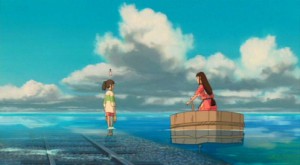
My adolescence has been long haunted by sensations that I will never know: the bliss of biting into a dumpling made of whipped clouds, the warmth of jasmine bath waters, the serenity of a solitary train traversing a glass sea.

For these moments of unattainable euphoria I have to thank Hayao Miyazaki, esteemed director of animated classic, “Spirited Away.” Sensory snapshots like these, communicated through breathtaking imagery, are at once imagined and impossibly real—the mark of true fantasy. The film’s most arresting scenes are the transitional ones, the bits of stillness in between action, like the image of a placid lake cut effortlessly by a crossing train. The water is massless and unbounded, and the train’s motion is smooth.

a stunning landscape

a stunning landscape

It’s the lake’s sheerness that captivates us, and we catch glimpses of it in clouds, smoke plumes, or the redundant windows of city offices. We carry Miyazaki’s illustrations throughout our daily lives, animating mundane routines like eating, bathing, even riding public transportation with cinematic wonder and sublimity.

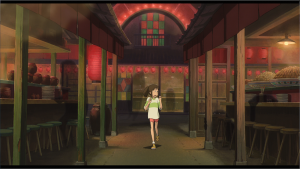
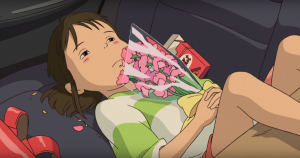
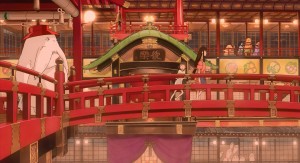
It is a movie you cannot forget, and one you long to relive in daily performance. As we return to our cubicles and screens, we wish the harsh florescent strips to be replaced with lanterns, bulbous and secretive. We imagine them emitting a haze that feels and looks second-hand, with the gentleness of a childhood nightlight, far gone and packed up in cardboard boxes. Suddenly, we are returned the scene of awakening spirits. Red lamps stir and awaken as shadows wander the festival streets. Slowly, we follow the movie’s heroin, a young girl named Chihiro as she explores the empty festival soon to be enjoyed by the gods. 

 spirited_away_03_alone_with_the_spirits

So it’s a film that has been praised for it’s mastery of fantasy: it makes us feel things that are wholly otherworldly. It takes us to places and elicits sensations and emotions that are extra-human, and then prompts us to infuse them in every day life. Partly because it is so visually stimulating, the movie transcends the limitations of a target audience. Children and adults, homesick college students and their nostalgic professors, citizens of all nationalities and speakers of all languages alike have cherished the movie and its experience. But despite its success and reach, the narrative is structured around a relentless and multi-faceted moral statement, which is a rarity amongst popular cinema. (It is incredibly rare to find a cultural artifact accepted and popularized by mainstream media that is not forwarding a destructive ideology, but instead works to consciously undermine one.)

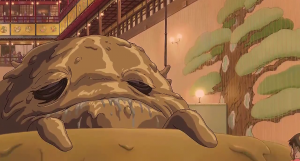
Most obviously, the movie holds humans accountable for their constant mistreatment of the natural environment, and it criticizes gluttony and greed. None can deny the underlying currents of environmentalism. We all remember the stink monster that enters the bathhouse, and when cleaned, is discovered to be a feeble river spirit. Chihiro undoubtedly leaves the bathhouse having learned lessons in hard work, obedience and the repercussions of avarice.

The disgusting stink monster

The disgusting stink monster

A bicycle is pulled from the stink monster's side, unleashing a heap of trash

A bicycle is pulled from the stink monster’s side, unleashing a heap of trash

A river god emerges and thanks Chihiro for her service

A river god emerges and thanks Chihiro for her service

But as my phrasing suggests, these conclusions are glaringly obvious. I reject the movie’s hook to be its fantasy, or any surface-level motif. To forward either as the main thrust of the film is to underestimate or disrespect the subtlety of Miyazaki’s writing. In truth, the film evokes themes far more insidious, far more trenchant, and far less recognizable. I assert that this movie contains incisive political threads, that are deeply rooted in its narrative and wholly involved with the cultural context of Japan at the time of cinematic production.

What is difficult to discern, and what will be the focus of this essay, is how the movie hints at the grisly pervasiveness of child trafficking in Japanese contemporary culture and history. The movie, stripped of its aesthetic beauty and child-like wonder and viewed through the eyes of a conscious citizen, is the story a young girl forced into prostitution by the greed and piggishness of her parents, a chilling and all-too-common tale. Thus, a movie especially adored by children for its splendor reveals itself to be a commentary on child prostitution.

Let’s break it down. The essence of the film lies in its dual premise. Conflict stems from the fluid interaction between two worlds: spirit, and human. In both realms alike, the good and the bad dwell together. The presumed oppressors of each sphere are not fully evil, just like the heroin is intrinsically flawed.

To continue it will be necessary to elucidate the dynamic roles of good and bad, starting with the human realm:

Human world:

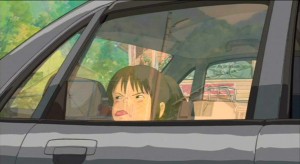
  1. The bad: The movie opens on Chihiro’s family moving across the countryside of Japan. Immediately, Chihiro strikes us as annoying and puerile— the typical trope of the whiny 12-year-old girl whose softie parents have spoiled her all her life. 
    An apathetic Chihiro in the back seat of the car

    An apathetic Chihiro in the back seat of the car

    Very mature, clearly

    Very mature, clearly

  2. The good: In contrast, her parents are portrayed as calm and patient, persuasive but not bossy. The mother’s voice is soothing and sympathetic, the father’s, assured and playful.

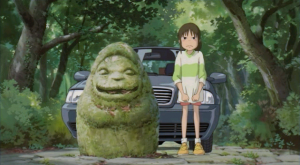
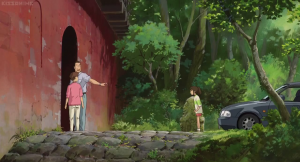
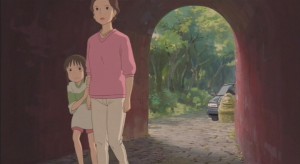
When the parents pull over to explore a side road, Chihiro is cowardly and uncooperative, while her parents are curious and adventurous (remarkably so, given that they have a pre-teen daughter). As the parents venture through the gates that separate the two worlds, their calm demeanors paint Chichiro as needlessly nervous.

Chihiro stubbornly tells her parents to stop exploring

Chihiro stubbornly nags her parents to come back

Her parents tell her to wait in the car if she doesn't want to come

They tell her to wait in the car if she doesn’t want to come

She eventually follows, but clings to her mother's arm

She eventually follows, but clings to her mother’s arm

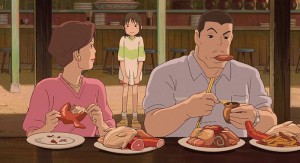
The parents sit down to sample a buffet, unknowing it has been reserved for the gods. If you’ve seen the film, you know this to be the screaming moment, when you want to throw your popcorn at the computer and warn the parents of the evil in those dumplings— satan in a sac of dough. But even to the knowing audience, the food is made to look so tempting, the chicken, so tender as it droops delicately from the father’s chopstick that we can’t blame the parents for their actions. In fact, many of us would choose those juicy chunks of ambiguous poultry over any of our own whining children, sisters or next-door neighbors.

Yumm!

yum

Meanwhile, Chihiro tensely bunches the bottom of her shirt, expressing her worry that they’ll get it trouble. Dad responds, “Don’t worry, you’ve got daddy here. He’s got credit cards and cash!” as he fills three heaping plates with food. She pleads for them to stop with the desperation of a desperate toddler in want of a sweet. And that truly is what Chihiro sounds like: a toddler. In a visual work where actors are replaced with drawings, the intonation and quality of the voiceovers carry incredible weight. Where we are unable to decipher emotion in the subtleties of facial expression—animation can only be so precise—we can in the characters’ voices. We can sense tenderness and innocence in their cadences, levity in their lilts. And Chihiro sounds like a whiny rascal of a child.

still yum

still yum

The parents ignore her protests and eat the food. Suddenly, they morph into pigs with disturbing human features (pig-dad retains his buzz cut and the pig-mom has her purse, still) and we realize this scene to be the fulcrum of the film’s conflict: the separation of Chihiro from her parents. Left all alone, Chihiro is forced to find a job at a bathhouse in order to survive as a human in the spirit world, and the rest of the movie progresses as she works to rescue her family.

In retrospect, the image of the parents’ pig-ification and those leading to it are wildly important: they symbolize the enslavement of Chihiro due to the gluttony and negligence of her parents. With or without realizing it, the parents sell their daughter into slavery for a few divine dumplings.

But the real kicker here is that Chihiro is not the helpless girl sold into slave labor by her greedy parents— rather, she is the whiny, hyper-sensitive child. The parents are the unassuming, innocent adventurers driven by opportunistic hunger. So the movie forces us to sympathize with them in the situation of Chihiro’s abandonment. (After all, we’ve all been tempted by that steaming plate of noodles before.) In fact, the moment is made to be so banal, and the parents’ actions, so understandable that we ourselves enact the indirect selling of our daughter into slavery.

What should be a moment of betrayal and abandonment becomes something of understandable coincidence: The parents just ate the food and then turned into pigs. And then Chihiro was left alone in a foreign world, forced to relinquish her name and free-will to the ruler of the bathhouse. It sort-of just happened. No ill-will involved. In simple terms, the effect of this situation is to normalize the circumstance of a child trapped in physical slave labor.

Going one step further, this scene does more than make Chihiro’s abandonment palatable to the viewer. It does more than absolve the parents of blame. The effect—by making Chihiro intolerably annoying, with a pouting grimace and a high-pitched, head-ache-inducing whine—is to make us believe Chihiro deserving of her predicament. It is to make us thankful for her enslavement, for her silencing. We are made to prefer her quiet whimpers to screaming protests.

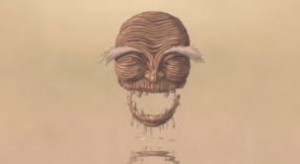
While this is itself disturbing enough, the situation is complicated when we observe Chihiro’s response to her abandonment and how her actions are portrayed. She learns to scrub floors, deliver water tokens, greet customers. She learns discipline and tenacity. She braves flying paper monsters, scales the exterior of the bathhouse, runs along rusty pipes, and confronts a witch-like antagonist who’s giant face holds enough wrinkles for a small child to get lost in. She learns courage. She finds comfort in fellow bathhouse maids, learning camaraderie and trust. But by far the most persistent motif, she denies constant bribes from a lonely spirit called “No Face.” At every turn of the story, she declines money, treasure, toys, feasts. So, she rejects capitalism and materialism but endures forced physical labor.

Chihiro’s survival tale teaches viewers to value discipline, courage and hard work over greed. In Miyazaki’s own words, Chihiro “manages not because she has destroyed the ‘evil,’ but because she has acquired the ability to survive…” Thus, the film prompts young girls confronted with hardship, or left in isolation, to bear their strife with stoicism—to endure it. Don’t fight the evil, just do what you can to survive within your circumstances. In fact, Miyazaki praises the patience, and fortitude with which Chihiro accepts and submits to the labor she is forced into by her parents’ overindulgence. Indeed, amusement is the spectacle of strife, and the fortitude with which the characters bear it placates us to our real-world struggles.

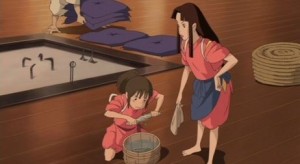
Sweeping floors

The maids sweeping floors

and cleaning out the baths

and cleaning out the baths

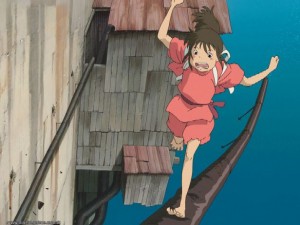
this

and running across pipes

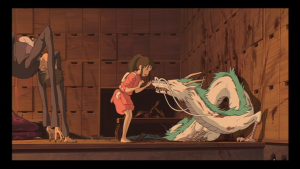
and caring for injured dragons

and caring for injured dragons

Though my fondness for the movie will never fade, it is difficult to see this story as one of mere slave labor when we are cognizant of Japan’s history of prostitution and sex trafficking. The country’s war-time narrative is marked by a painful, gut-wrenching report of sexual slavery. During WWII, hundreds of thousands of comfort girls were forced to service Japanese army camps, recruited through abduction or deceit, subjected to daily rape, and tortured if they disobeyed. Even after the war, the Japanese government established facilities that provided organized prostitution to expats of Allied nations. When in 1958 Japan made explicit prostitution illegal, soaplands, or in Japanese, sopu were designed for the men to be washed and sexually served by the female workers. A popular theory amongst internet super-fans, there are subtle implications that the bathhouse is a guise for such a Japanese brothel. Seeing that the only westerner in the film is the bathhouse overlord, Yubaba, who forcibly employs young Japanese girls and robs them of their names and tips, it isn’t unreasonable to view the house as an analogy for a Japanese whorehouse established apropos western occupation.

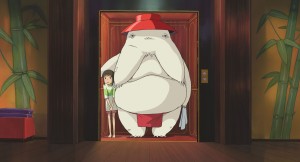
Given the resemblance between the bathhouse and the brothels of post-war Japan, we begin to remember the film’s subtle allusions to sex labor, like when the maids laugh wantonly as their skirts puff up in the wind, or when Chihiro is trapped in an elevator with the Radish spirit, whose giant tentacles we can take to be giant phalluses and whose heavy panting makes our skin itch, or when Chihiro’s name is contractually replaced upon employment, or the image of Chihiro pulling the single bicycle handle that has clogged the River God mistaken for a stink monster.

The girls run from the radish spirit

The girls run from the radish spirit

unfortunately he catches up to them...

unfortunately he catches up to them…

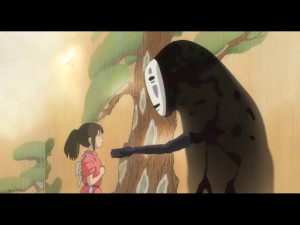
But then we remember the strange relationship between Sen (Chihiro renamed) and No Face, a gold-producing monster. No Face is a lonely spirit who persistently offers Sen nuggets of gold, plates of food, anything to win her friendship. Yet she adamantly refuses all of his bribes.

No face offering Chihiro gold

No face offering Chihiro gold

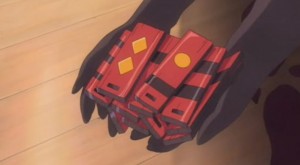
and bath tokens

and bath tokens

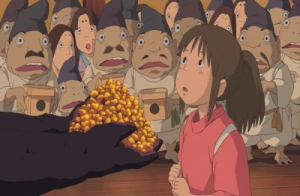
and more gold

and more gold

This is telling. Sen’s genuine dislike of money starkly contrasts a conviction popular among Japan’s sex workers of the 90’s and early 2000’s, when the movie was in the height of production. On the cusp of the 21st century, a new wave of media coverage exposed the fast proliferation of schoolgirl prostitutes in Tokyo (where the legal age of consent was 14 at the time). Many journalists maintained that the increase in pre-teen prostitutes, described as a growing epidemic, was not due to the symptoms of poverty but to a culture of rampant materialism. A 1996 article in the Wall Street Journal paints the schoolgirl prostitutes as apathetic, vapid and brand-obsessed, insinuating that girls in the 2000’s began choosing prostitution to fund their expensive tastes for designer bags. This is a reality in direct contrast with images of war-time and post-war prostitution in the far east, which portray the battered  “Oriental” girl, abandoned or sold off by her parents and forced to subject her body to the white man.

So the movie, as a cultural artifact whose context matters, is vacillating between contrasting images of prostitution, namely, the faces of its old and new manifestations. On one hand, the film endorses a mindset that enables a traditional version of prostitution, where one finds the means to survive in the event of her parents’ betrayal or death— where one endures suffering, rather than fighting larger evils. On the other hand, it simultaneous criticizes an attitude that fueled channels of prostitution circa 1996, namely, that of the petty consumer.

The movie includes both a praise of gritty perseverance in the face of undeserved abandonment, and a criticism of materialism and greed. The young girl of the past, coerced or tricked into prostitution is portrayed as noble and admirable because she endures her situation with dignity, while the young girl of today, tempted into prostitution by the allure of bags and brand names is vain and selfish, like the very slobbering pig-demons that consume Chihiro’s parents.

Prostitution is admirable when one is forced into it out of necessity, but wrong when one chooses it to fulfill her fate as a consumer. This is a movie about choice and the degrees of agency with which women conduct their bodies.

A more literal interpretation would uphold a bolder claim: Miyazaki is calling for a return to traditional prostitution with respect to its modern materialistic founding. He calls out the extravagance that is herding profligate girls into prostitution, and offers as its solution a revival of its older manifestation, wherein girls found the strength to survive in the face of adversity, where girls swallowed their pride and made not a single yen doing it.

Michael Scott and Middle Class America

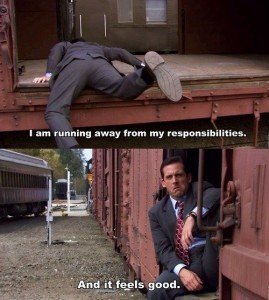
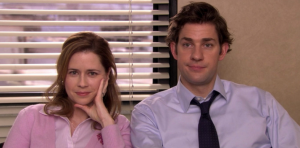
Last night I watched The Office instead of doing homework. I missed my boyfriend, who I haven’t seen in almost two months, I missed my dad, who is dead, and I felt exceedingly average after having been told by a professor “not to try to sound too smart, anymore” in one of his comments. So I watched the one where Michael goes broke, or, more accurately, the one where Jan (former boss of Michael, current manipulative lover) maxes out Michael’s credit cards buying carpet and Micael tries to declare bankruptcy (by declaring the word “bankruptcy”), eventually fleeing to a stationary boxcar like a vagabond, “running away from [his] responsibilities.”

 the-office-2

Jan finds him and brings him back to the office. They break up within the next few episodes and Michael never takes off financially, as far as I know. By the end of it, I forgot about the work I was supposed to do and went to bed well before eleven o’clock.

It seems unnecessary to introduce The Office. Anyone with access to the internet, and therefore anyone reading this, has heard of The Office. There is no doubt in my mind. Anyone who watched the 2008 Super Bowl, wherein the wildcard New York Giants decimated the previously undefeated New England Patriots, was greeted with a new episode of The Office, afterwards. The sudden popularity of “that’s what she said” jokes in the mid to late aughts—this was at the hand of Michael Scott. Still, for the sake of comprehensiveness, it’s important to note that The Office is not a typical Seinfeld/Friends-style sitcom from NBC, but rather documentary style show that details the banality of everyday life working in an office for a paper company. The walls are beige, the computers are bulky, the desks are ones you might find in a college dorm room. The Office is unglamorous, mundane, and is a comedy of characters rather than circumstance. This is why people love it.

In the realm of production and structure and critical analysis, there are a number of reasons to like The Office. The writing, for at least the first five seasons, is genuinely funny and creative. The one shot filming without any laugh track makes the humor almost deadpan, while the interviews that are interspersed within the plot are famous for their confessional humor. Characters feel whole and not like schticks or archetypes, and the very plot of each episode feels like a pop culturally relevant comedy of errors. There is a reason that The Office is so critically acclaimed, winning an Emmy for Outstanding Comedy Series only a year after it had been on air. With the original cast and writing ensemble, The Office is a technically good show, with clever writing, full characters, and intelligent filming. But technical skill only gets a TV show so far, and Emmys and Golden Globes aren’t voted on by the people. So what makes a show like The Office so beloved? And what does it say about the general population that a show like The Office can become so deeply ingrained in the hearts of the people?

The magic of a show like The Office lies in its ability to mirror real life. The Office takes the conventions of reality TV and flips them, where with reality TV everyone knows it’s supposed to be real but is actually fake, consumers can watch The Office, knowing that it’s fiction but feeling as though there is some deeper, resonating reality to it. There’s a safety in fiction that The Office capitalizes on, and a magic in the mundane that makes it so compelling. 

penn-paper

For one thing, The Office is set in Scranton, Pennsylvania— a place that, nowadays, few people have been to but most people recognize. The ambiguous familiarity that viewers feel towards Scranton is half the battle. Unlike New York, Boston, or LA, all of which are too extraordinary and well known to resonate with viewers, Scranton provides a familiar basis while allowing viewers to fill in the details. Scranton can be the place where city where they grew up, the place their grandparents moved from to start a better life, or the town outside of the college they went to. Either way, viewers recognize Scranton within the realm of their own life. The workplace, then, only makes this familiarity tenfold, appealing to the middle class worker everyone in America presumes that they are. Aesthetically, everything about The Office is unremarkable and commonplace in a way that makes it accessible to even the teenagers watching who’ve never stepped foot in a workplace. Like florescent lights and white tile are enough to tell the viewer “hospital”, like car horns, windchill, and cloudy skies are telltale for New York, The Office and Scranton are conventional signifiers of middle class America, desk jobs, and unfulfilled dreams.

The other half of it, then, is the people. Like Scranton is your uncle’s hometown, Jim is your best friend, Michael is you incompetent boss, Angela is the holier-than-thou know-it-all who sat next to you in high school and Phyllis is your great aunt you see every five years. These are people you know, people you work with, people you went to school with—this is us, collective.

So the real sucker punch of The Office is that it tells middle class America’s story back to middle class America, only with more office antics and more that’s what she said jokes than average. Now the question remains— what does this say about us, as a people?

As with most things, there are a few ways of looking at it.

Part of me, and I think part of all of us, wants to say that our love for The Office, for any workplace comedy or drama, is comforting. It’s like going to the same house for Thanksgiving every year, it’s like hearing the song your dad used to sing while making coffee—The Office is our everyday lives, packaged into something funnier, more hopeful, and just as complicated. We watch Jim work a job that is below his intelligence level, that is unsatisfying and banal, but we also watch him fall in love, get the girl, and start a family of his own. He transcends his career level unhappiness to find true, familial and romantic happiness. It’s not overly romantic nor is it the consuming plot of each episode, but it is always there, and it’s always hopeful. The same could be said for Michael and Holly, or for Dwight and Angela, only in more complicated and less conventionally romantic ways. The other part of it is that despite financial, romantic, and emotional crises, The Office is a generally happy show, with generally happy characters who are not all that put out by the average conditions of their existence. We watch Jim leave brokenhearted for Stamford, Pam’s failed engagement, branch mergers, the sale of Dunder Mifflin, the heartbreak of Dwight, the strain between Jim and Pam, and relative financial instability of both the company and all of its employees—and, still, The Office is a comedy. The happiness of it is a hopefulness for every viewer, watching their own lives unfold on screen and being told that they, too can be happy. We, too, can find the love of our life at a desk job. We, too.

the-office-4

But there is another side to it. There’s a placation, an acquiescence, a platitude in The Office that, sure, comforts us but, at the same time, makes us stagnant, quiet, and appeased. Pam, a receptionist, wants to be an artist. When she shows her work at a local gallery, Michael is the only one to show up, while Oscar and his boyfriend muse from afar that her work is “unimaginative” and “motel art”. Later in the series, Pam quits a Pratt School of Design summer program and becomes a paper salesman, and then the office manager. Jim always wanted to be a Philly sports writer. Instead, he works as paper salesman, for a short time becomes a branch manager, and then creates his own sports management company—which he eventually abandons to co-founder Darryl in order to keep his family together. Michael never gets promoted beyond manager. Dwight waits eight years to become manager and, even then, he’s only truly happy when he finally marries Angela in the series’ final episode. And somehow this is still a comedy. Still, we find it funny. Still, we are convinced, they are happy. The truth is that watching The Office is more than just comforting and entertaining—it’s reassurance that we’re not wasted potential, that we’re not nobodies, that we’re not cogs in the American business machine. Every art school dropout, failed dreamer, average joe with above average imagination is tole “it’s okay, you are not alone, and you will be okay.” In watching The Office, we are given an inside look at the banality of everyday office workers, shown their intimacies and their idiosyncrasies, and told that we, too are special. We, too, can be satisfied in an unsatisfying circumstance. The comfort derived from The Office is more than simple recognition of a life like our own, but rather a twisted reassurance that the circumstances of middle class America are not all that unsatisfying, because if Jim and Pam are happy then who’s to say you and you’re husband can’t be?

What The Office tells us is to be happy with the little things, because the big things aren’t changing any time soon. And while this might seem like sound, motherly advice, it also ends up placating the legitimate, constructive grievances one might have with their situation. It’s valid to dislike your job, to find it unsatisfying, to lose patience with an incompetent superior. And while there is nothing innately wrong with working a desk job (it is, in fact, a first world luxury that can only be complained about in such a context), it’s still legitimate to feel frustrated, to be unhappy—and it is important to act on those feelings. To want something better, more stimulating, more fulfilling, is not wrong. To quit is not wrong. Middle and working class America have a list of grievances a thousand pages long and, in a larger, cultural sense, The Office works to appease those grievances, but never fix them. In the opposite way in which shows like American Idol or The Voice tell people “this could be you”, The Office delivers the message “this is you, now laugh along” to the same viewers. Work, in The Office, becomes each character’s whole life. Family, friends, love—none of these are independent of the workplace. And while that’s obviously a function of the fact that its set in an office and literally titled “The Office”, it also presents a reality where work is the main function of people’s lives, the common ground of relationships, and the only source of stimuli. While this is inevitable and true for most all working class Americans, it doesn’t mean it has to be desirable in the way that Dunder Mifflin and The Office make it seem.

After watching The Office the other night, I woke up the next morning having not read Paradise Lost for my 8:30 English class. My boyfriend is still three hours away, my dad is still dead, and I still don’t know what my professor wants me to do with my writing if he doesn’t want me to “try to sound too smart.” I didn’t accomplish anything other than a good night’s sleep. Nothing was done, the circumstances of my life or my work habits hadn’t changed, the world in Williamstown and I, too, remained the same— it was fine, comforting, even. I got out of bed, brushed my teeth, and got to class by 8:25.

The Hidden Value in Repetitive Culture

Picture: two enemy groups, battling for prestige and engaged in a spiteful war until a scandalous love blossoms between a young male and female from the opposing sides, eventually resolving the group’s conflicts. Now, name that plot– a tricky task, as there are dozens of modern titles that present this familiar love-versus-war dilemma. It’s a commonly used theme and plot line in cultural products, with Shakespeare’s Romeo and Juliet widely credited as the origin. Much of modern culture is simply repackaged; art that proves successful is twisted, modernized, copied, and fed to the consumer again. Materials are repeatedly disguised under new movie titles, new star characters, or new settings. Cultural critics argue that economic success in production is valued over the public’s desires and imaginations; the culture industry and producers are entirely absorbed in what will make money, even when this results in products that are entirely lacking in variety and creativity (Adorno). Superficially, these arguments present our culture in an entirely negative and somewhat hopeless light, but this is simply not the case– there is still hope for our culture, however much it may recycle concepts. It is important not to confuse a lack of originality with a lack of worth; our culture still has value despite its repetitive qualities.

Romeo and Juliet is a tale of jinxed love. Both man and wife commit suicide shortly after marriage due to an unfortunate miscommunication in Shakespeare’s famous tragedy in the midst of a raging family feud between the Capulets and Montagues. The familial conflict twists and thickens when Montague son Romeo and Capulet heartthrob Juliet lock eyes and fall in love. However, miscommunications lead Romeo to believe that his beloved Juliet is dead, so he poisons himself. Juliet follows suit, as when she sees Romeo dead, she stabs herself, and the lovers die unlucky deaths. The tragedy is heart-wrenching, and it is painful as the deaths unfold, especially because they are caused by fickle family feuds. The families do eventually throw aside their differences in honor of their losses once they realize their foolishness, however.

3-romeo-and-juliet-quotes

(Come, Death, and Welcome!)

While it is maddening to watch both Romeo and Juliet die mistakenly, the deaths strike a chord in the heart of the consumer and make us resent the family feud. Thus the tale pushes for love, and emphasizes the pointlessness of fighting, a meaning that culminates in the deaths of two innocent lovebirds. This valuable moral leads us to why recycling culture is an accepted practice. Relevant to this day as violence is so precedent in the world, the lessons of Romeo and Juliet are applicable anywhere. Furthermore, because the morals behind the story are so applicable, the tale can be versatile– and successful– in the same ways. As long as we continue learning from Romeo and Juliet and other classics, producers will continue to churn them out in new and surprising ways.

Theatre World Award-winning Broadway show West Side Story, for example, features a battle between the Puerto Rican “Shark” gang and the all-white “Jet” gang based on New York City’s West Side that is eventually mediated by a beautiful relationship between Jet Tony and Shark Maria.

West Side Story's Tony and Maria embrace despite their different backgrounds

West Side Story‘s Tony and Maria embrace despite their different backgrounds (Tony and Maria)

Another popular Broadway show, Grease, which showed for eight years– quite a run for Broadway– delivered a similar message as summer lovers Danny and Sandy end up at the same high school, where their romance is tested by clique lines. However, in a heartwarming musical finale to the catchy tune of “We Go Together”, the lovers are reunited despite their clique boundaries. Love trumps all, especially when accompanied by a Broadway dance riff.

Everyone's happy after love beats the clique boundaries in Grease

Everyone’s happy after love wins out over clique boundaries in Grease (Grease Live Animated GIF)

Romeo and Juliet’s storyline has also entered into the modern movie industry. Warm Bodies is a 2013 film based on the 2010 novel that takes “love versus war” to the vampire level, as vampire R falls for human Julie– interesting name selections by author Isaac Marion. Their relationship catalyzes a human versus vampire fight and is the beginning of a peaceful coexistence. Another modernized Romeo and Juliet tale, Romeo Must Die presents a kung-fu war between the Asian and black gangs. The film ends peacefully when– guess what– Asian macho man Han falls for African-American Trish.

Even modern cartoons are getting in on the action. Gnomeo and Juliet is a garden gnome spinoff in which red-hat gnomes fight blue-hat gnomes, until one fantastically moon-lit night when red-hat Juliet meets blue-hat Gnomeo. They, of course, fall in love, eventually bringing peace and love to the garden. Lion King 2 also features an animated Romeo and Juliet-like tale. Lion leader Simba’s daughter Kiara falls in love with Kovu, a banished lion. Kovu and Kiara’s beautiful relationship eventually sparks peace amongst the clans, and all of the lions live happily ever after.

Lion King 2 teaches a peaceful lesson: "What differences do you see?"

Lion King 2 teaches a peaceful lesson: “What differences do you see?” (What Differences do you See?)

Everyone loves this kind of story; even cartoon lions and gnomes are now getting in on the romantic Romeo and Juliet love-trumps-violence lesson. There are hundreds of spinoffs in various forms and genres out there in today’s culture– even Shakespeare’s version was based on an older poem. Producers simply can’t help themselves from recycling what’s proven successful, and they’ll feed consumers classics like Romeo and Juliet forever if it works (Adorno). The industries are looking for money, and they fire out movies and books at a relentless pace. Not only is it easier to reproduce an idea than to make something original, but it is also economically safer to build upon a basic tale that has already earned its place in the hearts of the masses. Success is practically guaranteed, furthermore, when a product’s base is a tale as beloved as Romeo and Juliet. However, this trend is not only applicable to this particular Shakespeare piece, as story reproduction in general has been greatly successful and has brought about countless renditions of all types of products. Essentially, a huge portion of modern cultural products are simply reproductions of older literature and ideas (Adorno). Our culture is indeed quite repetitive.

Consequently, modern culture gets a bad rap because of the nature of these retellings. Gnomeo and Juliet, for example, is the recipient of many bad reviews not only because it is a retelling of a story that everyone knows already, but also because it appears to trivialize the lessons presented by the great Shakespeare in his timeless classic Romeo and Juliet. This is the case with many modern retellings. Furthermore, sometimes the lessons presented by modern cultural pieces are considered lessers to those of old literature (Leavis)– a view that is rather unfounded, because if our culture is truly an endless recycling circle, then these “bad” lessons presented in modern culture have origins in these idealized “classics”. It is for these reasons that culture, foolishly, will not accept many modern pieces as its own. These accusations of lack of originality and worth that are cast upon modern cultural products, however, are not deserved.

"An epic tale on a tiny scale"-- Gnomeo and Juliet in a nutshell!

“An epic tale on a tiny scale”– Gnomeo and Juliet in a nutshell! (An Epic Tale on a Tiny Scale)

The repetitive nature of modern culture does indeed entail the reflection of many of the same lessons, but that does not take away their value. The values behind Romeo and Juliet— that love is more powerful than war– provide an extremely important life lesson. Modern times are pockmarked by the countless acts of terror we’ve experienced recently, from school shootings to marathon bombings, rapes, ISIS, cop violence, and everything in between. Consequently, we all could use a pleasant story of love to remind us that violence is bad and love and peace can prevail. It’s a lesson we forget sometimes, and one that the world desperately needs to remember. Humans tend to forget the lessons they have been taught, so there is no harm in a quick review. Although superficially, the sameness of culture is depressing and makes product consumption feel pointless, there is still value in ideas that may have been repeated.

Additionally, while Shakespeare might have been horrified if he knew that his classic Romeo and Juliet tale was being remade with the help of gnomes and lions, it speaks to the power of the tale that such products are out there. Clearly, people appreciate the lesson enough for it to have been so timelessly popular, and now it can be even more transcendental. Anyone can learn from Romeo and Juliet’s love nowadays, regardless of originality. The versatile methods of lesson delivery can also simply reach a large audience– young children can begin to learn the value of love and peace amidst violence if they watch Gnomeo and Juliet, whereas a Shakespeare reader must be educated and much older to see through the tragedy’s complex wording and fully appreciate the meaning. Those of all walks of life can now appreciate the lesson of Romeo and Juliet because of the volume of its renditions.

Romance in Gnomeo and Juliet

(Romance in Gnomeo and Juliet)

Furthermore, it is easier for a consumer to relate to a product when it connects to their own life, so having many different styles of presentations drastically increases the reach of the lessons. Romeo Must Die, for example, will likely hit home with an African-American whose life has been touched by racial violence more so than Shakespeare’s version. Grease works in the same way, as a popularity-driven teenager might be able to see past class lines and exclusion to the value of love more so than he or she would be able to by reading a dense book. Additionally, we must address the idea that people forget things they are taught. Most high schoolers read Romeo and Juliet, and are led to the meaning behind it, but they will likely forget what they have learned about love and life until they watch the West Side Story play years later. The heart can still be warmed by a concept it has already experienced; the lessons will simply be refreshed and deepened upon each new experience. Therefore, there is true value in the variety of presentations of classic tales that consumers have access to in modern culture.

This variety is due to the endless recycling of material that has proven successful in the modern cultural industry. Producers identify the popular stuff– Romeo and Juliet, for example– and twist it in countless ways (West Side Story, Warm Bodies, Lion King 2, and many others) to continue to benefit economically, which leads to an apparent degradation of culture. Culture is shamed for its repetitive nature, but not deservingly. Although cultural products are increasingly similar, there is no harm in variations of the same idea– Gnomeo and Juliet gets the point across just as successfully as Shakespeare did. The basic stories are successful because they are valuable; they possess lessons and morals that everyone needs to learn and experience, like the importance of love and peace despite adversity. The recycled quality of Romeo and Juliet— and most other works of modern culture– brings significant variety to how consumers can experience the work and, therefore, increases the understanding and benefit derived from the lessons presented, as well as the audience to which these lessons are available and relatable to.


Works Cited

An Epic Tale on a Tiny Scale. Digital image. Gnomeo and Juliet Image Quotes. HippoQuotes, 2015. Web. 15 Oct. 2016.

Come, Death, and Welcome! Digital image. Movie Quotes. IMovie Quotes, 2015. Web. 15 Oct. 2016.

Grease Live Animated GIF. Digital image. Grease Live. Giphy, n.d. Web. 15 Oct. 2016.

Horkheimer, Max, and Theodor W. Adorno. “The Culture Industry: Enlightenment as Mass Deception.” Dialectic of Enlightenment: Philosophical Fragments. Ed. Gunzelin Schmid Noerr. Stanford, CA: Stanford UP, 2002. 94-136. Print.

Leavis, F.R. “Literature and Society.” The Common Pursuit. New York: George W. Stewart, 1952. 182-94. Print.

Romance in Gnomeo and Juliet. Digital image. Gnomeo and Juliet Image Quotes. HippoQuotes, 2015. Web. 15 Oct. 2016.

Tony and Maria. Digital image. Fanpop. Townsquare Entertainment News, 2016. Web. 15 Oct. 2016.

What Differences do you See? Digital image. Top Tumblr Posts. Rebloggy, Aug. 2014. Web. 15 Oct. 2016.

Happily Ever After?

By Joyce Tseng

(Warning: This essay includes movie spoilers)

Gregory Peck and Audrey Hepburn's iconic image from "Roman Holiday" (1953)

Gregory Peck and Audrey Hepburn’s iconic image from “Roman Holiday” (1953)

We’ve all heard the story. Boy meets girl, boy and girl hit it off, boy and girl conflict, boy and girl are lost without each other—often involving a lonely scene in the rain, a revelation occurs, boy and girl kiss and make up. Happily ever after. It is the predictable, cheesy love story that we can’t help but watch. Love is inextricable to the human experience of life; it is a pervasive component of our social world as we search for it, deny it, or are head over heels in it. Countless renditions of love and romance that exist in our culture perpetuate an idealistic, cliché notion of true love, which is to say that, happily ever after is always attained in the end by the perfect couple. Just take a look at Disney. For the majority of the current young, female adult population, the message drilled into our minds as children was that one day our own Prince Charming would come. We as a society have been indoctrinated to believe that we find the one, fall in love, and have a stable, committed relationship that is topped off with holy matrimony. This is how we have been taught to define love. This is what our culture tells us love looks like. Yet, this doesn’t seem to be the consensus anymore.

Romantic comedies have been one of the most enduring film genres through the history of cinema. Reflective of gender roles, social constructs of family, marriage, and love, romantic comedies have served as key indicators of political agendas and social attitudes towards the private sphere of love in a light-hearted, humorous manner. From William Wyler’s 1953 classic, Roman Holiday, staring Audrey Hepburn, to 21st century films such as Love Actually and No Strings Attached, it is clear that romantic comedies have undergone a striking transition. We’ve seen the female lead occupy a more empowered role, an increased openness to sexuality, and even a disillusionment of the institution of marriage. Arguably, the purity and privacy of love have transcended into a raunchier, non-committal rendition. Perhaps this portrayal of love holds more true to our modern reality and escapes the predictable formula for love that is incessantly shredded by moviegoers and film critics of rom-coms.

Ivan Reitman's "No Strings Attached" (2011)

Ivan Reitman’s “No Strings Attached” (2011)

Over the last decade, romantic comedies have been more or less the same, each following the conventions of the genre with their own variation. A staple for a rom-com is the “meet-cute.” This is when the two protagonists encounter for the first time, often under an awkwardly adorable circumstance that makes hearts flutter and the audience smile like idiots. Often a comic clash of personalities is presented during the meet-cute, falling in line with the notion that “opposites attract.” For instance, in Woody Allen’s classic Annie Hall (1977), Annie, portrayed by Diane Keaton, first converses with Alvy Singer at a clubhouse following a game of tennis set up by mutual friends. The exchange illustrates a contrived attempt to sync schedules with one another, laden with cringe-worthy lines. Annie asks Alvy if he would like a lift, Alvy agrees and asks where she’s headed; Annie says, “I’m going downtown,” to which Alvy says, “Oh, I’m going uptown.” Annie immediately changes her answer and says, “Oh, right! I’m going uptown too.” Alvy proceeds to question Annie why she initially said she was going downtown, resulting in a concoction of rambling and flirtation. Yet, the awkwardness doesn’t deter us, rather it persuades us to root for the couple.

Following the meet-cute, the characters go through obstacles of the narrative. One of the most common conflicts used is that of social rank or class. For instance, Audrey Hepburn plays a European princess who falls in love with an American reporter in Roman Holiday. Martha Coolidge’s The Prince and Me (2004) depicts the romance between a Danish prince and an American college girl, which stems from his attempts to escape his regal duties. Each film differs in what these obstacles specifically are, but they all share the resolution that the couple comes out the other end hand in hand. It is shown time and time again that the ingredients for true love are loyal commitment, an undying desire to empathize and understand each other, and original, meaningful romantic gestures. In the narrow realm of the romantic comedy narrative, these specific inputs guarantee the output of “happily ever after.”

Diane Keaton and Woody Allen in "Annie Hall" (1977)

Diane Keaton and Woody Allen in “Annie Hall” (1977)

I have a confession to make. I like to watch rom-coms because I can bank on a resolution. There is a certain mentality, or cinematic flavor one desires when choosing to watch a rom-com. It is a feel-good genre that leaves us with more faith and optimism in life’s path. However, on the opposite end is the romantic drama, which does not always end happily. Take Nicholas Sparks’ The Best of Me as an example. During my first viewing of the film, I spent a solid seventy percent of it sobbing and frustrated with Sparks’ literary decisions. The film tells the story of high school sweethearts, who drift apart, but reunite after many years following the death of a mutual friend. The film presents a series of flashbacks to their happier days as adolescents as well as their troubled origins. The male lead, Dawson, comes from a broken home dominated by his abusive, alcoholic father; the female lead is the pretty, witty, and relatively wealthy Amanda, who has micro-managing parents. A series of unfortunate events follow, including an accidental shooting of Dawson’s friend during a brawl between Dawson and his junkie father and brothers, jail time on Dawson’s part as a consequence, and Amanda’s unhappy marriage. Upon reuniting after many years, the two rekindle their romance. Dawson apologizes for neglecting Amanda during his imprisonment and confesses that she would eternally be the love of his life. Following their brief escape into the past, Amanda returns to her normal life, but before long, she has an epiphany to seek a divorce to return to Dawson. A dramatic voice message is left for him, detailing Amanda’s reciprocated love, but before this message reaches him, Dawson is shot dead by his father on the streets.

The Best of Me was one of the few movies that I couldn’t let go. I felt robbed by the story and its conclusion. When presented with a narrative that didn’t fit the traditional, idealistic social construct of love, it was unsettling and even distressing to accept. However, if we look at reality’s statistics, since the late 1960s divorce rates have been on the rise. After the presence of women in the workplace became more common, society showed a trend in delaying marriage. This social phenomenon also contributed to a new variation of comedy, referred to as “screwball comedy,” present in many rom-coms. Stemming from the 40s, the nuanced genre portrays the novel power play of the female as the dominant, rather than the male. Masculinity in the relationship is challenged, revealing a battle of the sexes and providing comic content. Old rom-coms that depicted the man as a sex-driven, flirtatious figure and the woman as the naïve damsel-in-distress role was no longer the case. For instance, The Proposal (2009) features a female high-powered editor who essentially blackmails her male secretary into forging an engagement with her in an attempt to evade impending deportation back to her home country, Canada. The woman here uses the male to serve her needs in between her work-driven existence. The modern-day consensus seems to be that career, especially the female’s career, takes priority of love and relationships, deviant from the traditional rom-com.

Another prevalent change is how rom-coms address sexuality. The “hook-up culture” currently spans from high school, well through into adult life, skewing the previously established chronology of romance. Casual sexual relationships and multiple-marriages are now more acceptable than the historically shown. Judd Apatow’s Trainwreck (2015) staring Amy Schumer claims to reflect this “modern” spin on romance. Following the life of Amy, a men’s magazine editor, the film is explicit in its message right off the bat. The opening scene, as well as its official trailer, features a flashback to Amy’s childhood when her father was informing his two middle-school daughters of his divorce with their mother. The father saliently directs the two young girls into reciting after him: “Monogamy isn’t realistic.” This concrete, unexpected claim is weirdly refreshing to see on a rom-com screen and forces us to adjust our palettes to consider an alternative way to experience love. As we fast forward through Amy’s adult life, we see the pattern of alcohol, drugs, and casual sex with a variety of random men. In the trailer, Amy proclaims, “I am just a modern chick who does what she wants.” It is worthwhile to recognize that though rom-coms reflect the attitudes of society towards love, it is more precise to say that it reflects society’s escapist fantasies and desires in relation to love. In Trainwreck, we see an independent woman with a stable job, with no committal ties to a single person; she is simply having fun exploring her sexuality.

Amy and Nikki listen attentively to Aaron's phone call the morning after their hook-up.

Amy and Nikki listen attentively to Aaron’s phone call the morning after their hook-up.

The movie gets interesting when Amy is assigned to cover a story on a male sports surgeon (Aaron), to which the interview results in a dinner date and adult sleepover—an one-off event as Amy forbids herself to stay the night with any hook-up. In a farcical scene the morning after, Amy and her female coworker and friend panic when Aaron calls Amy. She immediately assumes that she was butt-dialed, but after learning that the call was intentional, the friend quickly says, “Hang up. He’s obviously, like, sick or something.” Following up to hang out after a night of sex is clearly portrayed to be a social no-no, ironically the reverse of what we have been wired to think.

The bulk of the movie shows Amy and Aaron’s relationship blossoming, despite her volatile familial situation. Having previously being drilled into believing that monogamy wasn’t realistic, her ailing, disapproving father takes a toll on her relationship with Aaron. The death of Amy’s father ultimately serves as the catalyst for Aaron and Amy to call it quits. Amy reverts back to her ways of drinking and partying, but she no longer sees any value in those ways. For a film that clearly sets itself up as a distinguisher from the rest of the rom-com pack, the conclusion is unsurprisingly familiar. Amy commits to a grand gesture of love, including a jumbotron and coordinated dance sequence with the Knicks City cheerleaders. She is successful and a triumphant pop tune accompanies the credits.

Similar to films like No Strings Attached and Friends with Benefits, Trainwreck plays off the fantasy of having the sexual freedom and benefits of relationships, minus the complicated, emotional baggage. These are features claimed to be indicative of our new, modern manifestation of love. And yet, all of these films insist on still concluding with the familiar “happily ever after.” Why? Has it become embedded into our culture, in which the narratives of rom-coms cannot escape? Would an alternative ending similar to The Best of Me still be classified as a rom-com? Despite the disapproval of monogamy and attempts to break free from emotional efforts and commitments to another person, which are present in our fantasies, we still find ourselves resolving romantic conflict with the very notions we were originally trying to escape. It becomes clear that there is a reason the same narrative arc of the romantic comedy is fed to us by our culture time and time again. There is a reason why we still choose to consume this culture, despite its repetition. At our core, our outlook on love, as exemplified through romantic comedies, has changed very little. Beneath the lace, flowers, and sentimental orchestral tunes, the fundamental message remains the same: we as a society still strongly believe that our one true love will prevail all obstacles.


Images Courtesy of imdb.com Gallery


The meaning of culture

There’s something innately funny about Merriam-Webster’s announcement, earlier this month, that “culture” is their 2014 Word of the Year. “Culture” is the “Scary Movie” of words of the year, which, ordinarily, are supposed to reflect culture (“vape,” “selfie”) without actually being “culture.” Merriam-Webster’s editors are at pains to clarify that they weren’t trying to be meta (which, incidentally, would’ve made a great word of the year back in 2000). The word “culture,” they explain, was simply the word that saw the biggest spike in look-ups on their Web site. Confusion about culture was just part of the culture this year. People were desperate to know what “culture” meant.


Joshua Rothman, The New Yorker — December 26, 2016