Author Archives: Abby Lloyd

Peace, Love, Empathy, and Capitalism: The Commodification of the Grunge Movement

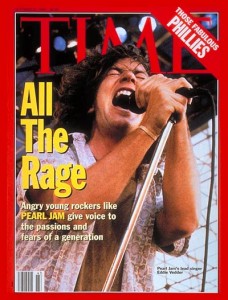
In October of 1993, two years after the release of their debut album, Ten, Eddie Vedder appeared on the cover of Time Magazine, screaming into a microphone with the caption “Angry young rockers like Pearl Jam give voice to the passions and fears of a generation.” Like George W. Bush saying that he listens to Kanye or Hillary Clinton wearing Adidas Superstar’s, Time’s cover was the voice of mothers everywhere asking about “that Eddie Vedder” and why he was so angry. Your parent finally knew why you were wearing flannel, Kurt Cobain scoffed, and Eddie declined comment, fearing the article was “the nail in the coffin” for the rock band who’s first two albums had already reached Billboard’s Top 10. It’s like giving a Nobel Prize to Bob Dylan— he never asked for this. You’re ruining his street cred, Mom.
eddie

When I brought up the idea of this essay in the context of grunge music, a friend of mine wondered if grunge was even rebellious and not just “a lot of angst and whining”. She then suggested I talk about the Sex Pistols or the Clash, real punk rock and mosh pits and combat boots and the implicated violence that followed. And she had a point. Sid Vicious might be our model for rebellion, especially considering the BBC kept God Save the Queen off of FM for as long as legally possible. But to dismiss grunge as angst rather than rebellion is both an inadequate depiction of the grunge movement itself and a disservice to the meaning of rebellion, as if to rebel must be insidiously violent or threatening—as if the act of angst and anger and suffering of grunge were not itself an act of rebellion. Grunge might not have the hair spikes or the safety pins, but its emergence during a time when heavy metal and synth music rained, and its crusade for authenticity and “realness” after weathering Reagan’s Morning in America, sets up grunge and the Seattle sound to be one of pop culture’s finest rebellions. This works itself out in a number of ways, some more obvious than others.

The most obvious is the very attitude of grunge, encapsulated in an “I don’t care” sneer that’s just as damning as the “fuck you” smirk of punk. The music itself, loud, aggressive, all garage-rock and sludge guitar and (conventionally) lacking melody, is a rejection of grunge’s predecessors. The style is almost just as important. In a time when Bowie is wearing elaborate costumes and assuming alternate identities and hair bands are all the rage, grunge bands promote their authenticity in their clothes. Flannel shirts, thrift shop shoes, band t shirts and the same jeans you wore to work that day—all culminating in oft unwashed hair. They don’t care what they’re supposed to be. They don’t care about presentation. They don’t care about your rules of hygiene. Much of what made grunge a rebellious movement was the context in which it blossomed. Cobain and Cornell and Mark Arm didn’t want to be Axl Rose, they didn’t even want to be Andy Wood. They rejected the theatrics, the performance, the costume and adornment. Grunge revolved around authenticity, and during the early 90s, authenticity was itself a rebellion.
grunge_021_slide-2d380b21d2cb11dbc302c3dd18c61e4e73f56e4f-s1000-c85

It’s deeper than that too, though. In many ways, the authenticity of grunge produced a vulnerability and, in particular, a male vulnerability that had never been heard in rock. Beneath the “I don’t care” attitude and head thrashing beats are lyrics and frontmen from broken homes and unhappy childhoods. Vedder laments the lies and loss of his father in singles “Alive” and “Release”, the perverse lyrics of Nirvana’s “Rape Me” are more unsettling than they are either sexual or violent, and Temple of the Dog’s hit single in response to Andy Wood’s overdose and subsequent death describes the guilt of living, saying “I don’t mind stealing bread/ from the mouth of decadence/ But I can’t feed on the powerless/ when my cup’s already over-filled”. This is a male fragility that’s hardly displayed in society, front and center in grunge’s biggest acts. Joe Levy of Rolling Stone describes it in a Pearl Jam documentary saying: “Never before and never since, really, had men so successfully talked about the problems of, well, being men… In rock and roll that doesn’t usually happen.” Suddenly, the performance of masculinity that took form in the lyrics of everyone from Bon Jovi to Metallica was discredited. The sexual prowess of the hair bands and the violence of heavy metal was no longer axiomatic with being a man. Grunge rebelled from the conventional forms of masculinity and permitted men to feel, deeply, too, in a way that rock and roll had never before seen.

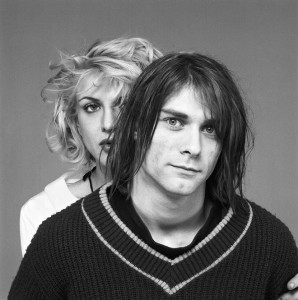
More than that, grunge went so far as to subvert traditional gender norms and to advance the feminist perspective, if only marginally. That Pearl Jam’s “Daughter” is written in the perspective of woman, and that it’s rejecting both the title and role of “daughter” given to her by an evidently oppressive father is not insignificant. Furthermore, cultural theorist Karen Aubrey credits the grunge movement with a certain amount of “gender-bending” in her essay Body Piercing: Gender Nihilism in the 90s. She describes the androgynous quality of grunge’s so-called uniform, claiming that the look is “based on the indistinguishable covering of those areas of the body which identify us as male or female… Standards of conventional sexual attractiveness, which encourage emphasis of gender designating body parts, are thereby not just ignored, but defied.” So we get Kurt Cobain and Courtney Love sharing a wardrobe and, if they’re both wearing glasses, we don’t know which is which. The flannels and baggy t-shirts are more than just the designated slacker uniform, in fact they’re a rebellion against the hetero and cisnormativity that characterizes the very world they’re railing against. Grunge is a formal de-sexualization of the body. Obscuring the of body shape, the gender bending of Kurt’s feather boas, but also the unwashed hair, Eddie Vedder launching himself from stage scaffolding into the crowd, and the utter lack of sexual content in most grunge songs all refute the body as a sexual object. In the same way that grunge rejects traditional masculinity, it also rejects the sex-god status of it’s predecessors. My body is not yours to sell, they might as well be screaming.

And then of course there’s Pearl Jam boycotting Ticketmaster and taking them to court, Pearl Jam refusing to do music videos and then, for a time, refusing to give interviews, Kurt Cobain dismissing MTV Video Music awards, Kurt Cobain dismissing Grammy nominations, Kurt Cobain attempting to reinforce his authenticity by calling Eddie Vedder “careerist”. All of this amounts to John Lennon asserting that the Beatles are bigger than Jesus, just multiplied by a few frontmen and repeated continuously for five or six years.

But nothing gold can stay.

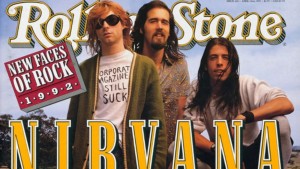
In 1992 Nirvana appeared on the cover of Rolling Stone, Dave Grohl long-haired and gangly, Kris Novoselic bearded and good-natured, and Kurt Cobain wearing a t-shirt that reads “corporate magazines still suck”. By then, Nevermind, the band’s second record and first produced on a major label, was already certified gold and had replaced Michael Jackson as number one on the Billboard charts. It didn’t matter if corporate magazines still sucked, because Kurt would continue his rise to Gen-X messiah even after criticizing Pearl Jam’s Time cover, withdrawing from the public, cancelling tour dates, and eventually killing himself. NAFTA had been signed, Wall Street was deregulated, and the market was in control, even of the very thing that claimed to rage against it.
rolling

Carl Swanson characterizes the capitalisms co-opting of grunge in an article for New York Magazine, linking the commodification of rebellion with the rise of Bill Clinton and neoliberalism and ultimately asserting that “niche markets were becoming mainstream propositions—and soon gave us the entire gloriously fractured culture we’re unavoidably (and more often than not wirelessly) connected to today.” Atlantic Records bought an indie label, Marc Jacobs came out with a grunge line, and somehow Pulp Fiction was popular in the mainstream. Consumer culture had caught on with rebellion and began reproducing it tenfold.

Grunge’s authenticity is over almost before it begins. In Milan, the Perry Ellis collection that Marc Jacobs debuted for his 1993 spring show featured models in thousand dollar dresses, adorned with wool caps, unlaced doc martens, and “flannel” shirts tied around their barely-their waists (the “flannel” was actually silk and Jacobs claimed there wasn’t a single thread of polyester in the collection). Soon, grunge fashion appeared in department stores like Macy’s, only ten times the price of the thrift store jeans Novoselic is wearing on tour. Later that year, when Vedder would appear on the cover of Time, he denounced the idea of success that came along with it, claiming that it “could destroy everything. It can destroy what’s real…which is your life. It can make it a commodity.” In his suicide note, Cobain languishes for the lack of passion he feels for music, feeling as though he “should have a punch-in time clock before [he] walk[s] out on stage.” What was once an expression of anger and disgust and poetry is now an hourly wage job. What was once a revolt against the man has now been structured by the man. It’s no coincidence that you can buy t-shirts with Cobain’s hand-written suicide note across the chest. Peace, love, empathy, capitalism, right?

marc-jacobs

The music industry itself seemed to cannibalize grunge, too, not only exploiting and over-playing the already existing grunge bands, but searching everywhere for mildly angsty threesomes that they could dub “the next Nirvana”. Like The Monkees after The Beatles, bands that hailed from far outside of the Pacific Northwest were anointed “grunge” while Mudhoney and the Melvins remained fairly stuck in Seattle. Pearl Jam was recording with Epic Records, Nirvana left founding grunge label SubPop for Geffen, and Alice in Chains was with music conglomerate Columbia Records. Bands like Stone Temple Pilots, who were based in the corporate world of San Diego, were marketed as grunge band of the Pacific Northwest despite being an evolving alt-rock and glam-rock band. STP sold 40 million copies of their debut album Core while British band, Bush, and Australian band, Silverchair, found a seat on the bandwagon, each respectively considered one of the best grunge bands of all time. So much for Seattle.

In a genre that was founded on authenticity, and whose authenticity was rebellious in its very nature, the culture and music industries capitalized on the aesthetic of grunge while destroying its very basis. Without the angst and tortured introversion of Kurt and Eddie, without their humble upbringings and conscious efforts to subvert what was normal, what was dubbed the “Grunge Movement” became nothing more significant than greasy hair and a new way of dressing. The culture industry figured out how to co-opt the signifiers of youth rebellion and sell them as the real thing, voiding grunge of its vitality and filling consumers with pretensions of counter-culture.  Fashion and guitar cords and attitudes are easy to adopt and milk for all they’re worth—it’s the authenticity that was left at the wayside.

“Everybody loves us/ Everybody loves our town/ That’s why I’m thinking lately/ The time for leaving is now” – Overblown, Mudhoney

It’s three days into writing this paper by now and I’ve revisited all of my favorite documentaries and dug up old articles that repeat the same information, the same bits of the few MTV interviews that Pearl Jam and Nirvana actually did, the same grand message—these are tortured souls, thrust into a spotlight they never wanted, coming to terms with what it means to be authentic, what it means to be an artist, what it means to be a voice of a generation. I keep coming back to the moment during Pearl Jam’s 1994 performance on SNL, only days after Cobain’s suicide, where Eddie Vedder touches the “K” that was sharpied onto his shirt and ends their song Daughter with a whisper of Neil Young; “My my/ hey hey/ rock and roll will never die/ there’s more to the picture than meets the eye.” Cobain’s suicide letter (still available for purchase) famously quotes the line “it’s better to burn out than to fade away” of the very same song, shifting the unbearable burden of speaking for an entire generation to the shoulders of Young. Perhaps for Cobain the weight was finally lifted.
grunge_017_sq-d957fc43d0f25aae248a02add017f94b68603ac9-s1000-c85

At the time of his death, Cobain’s estimated net-worth hovered somewhere around $100 million and, by 2015, had reached $450 million as Nirvana singles continued to sell and be streamed online. Forever 21 sells t-shirts to teenage girls with Nirvana’s cross-eyed smiley face on the front while Timberland and Doc Marten stocks have continued to rise since the grunge era and Pearl Jam never did take down Ticketmaster. Along with the grotesque sums of wealth amassed with grunge’s commodification came the myriad of critical reviews (not unlike my own) that call Cobain and Vedder and the whole movement a sham for being so undefinable. Grunge, outside of the definition that corporate America has given it, is remarkably difficult to pin down, particularly in terms of sound. Nirvana is not Pearl Jam is not Alice in Chains is not Tad is not Mudhoney—often they don’t even sound alike. What’s lost in all the theory and analytics and claims for authenticity is the very real, very tangible, human toll. Cobain is dead, Vedder was close, Pearl Jam is the only band from that era still playing, and grunge has become a cultural phenomenon and Kurt Cobain a token phrase, disassociated from the very real man, the very real sufferer that he was. The effect of the commodification of grunge, of any counter-culture movement, is the dehumanization of the subject and an exercise in making protest, art, poetry, and expression desperately futile. We, the consumers, are estranged from the very people we believe to be our very own individualized prophets, and they, are rendered martyrs for a cause they set out to defy.
The New Basement Tapes: Fan Art in its Highest Form

In 1965 Bob Dylan went electric at Newport and everyone fucking hated it. Ok, not everyone—there were boos and cheers, after all. Later that year he got married, got strung out on heroin, and the following summer almost killed himself in a motorcycle accident. He didn’t emerge from the woods of New York for over a year, only releasing Nashville Skyline and playing at a memorial concert after Woody Guthrie’s death. Dylan wouldn’t tour for another eight years.

Then we got The Basement Tapes.

bt

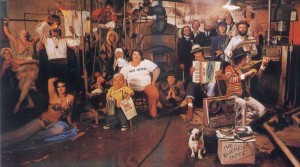
Post Judeo-Christian lyrics and Johnny Cash duets, Columbia Records releases The Basement Tapes in 1975, approximately eight years after Bob Dylan and the Band (then the Hawks) recorded them in the basement of his Woodstock refuge.

Not unlike when he went electric, Dylan changed the game, singing 107 stripped down, low fidelity ballads that sounded like a whisper under psychedelic rock’s recent explosion. It’s not even so much the songs themselves as what they created— a reemergence of Americana, room for bleakness during the summer of love, not to mention the sheer quantity of the recordings (which has a Jack Kerouac single-spaced, taped together On the Road manuscript type magnitude). Rolling Stone ranked The Basement Tapes #292 on their list of 500 greatest albums and it’s widely regarded that, while lauded on their own merits, The Basement Tapes is what put the Band on the map.

So taking all this in—the circumstances for Dylan, the vastness of recordings, the return to folk for a guy who killed himself going electric, and the legacy it left for singer/songwriters forever (think Wilco, the Waterboys, Billy Bragg)— and now imagine that there are more. That’s right. Unrecorded, half-written, scribbled Dylan songs unknown to the world until 2014.

If you’re a music guy, like T Bone Burnett, this is like finding the library of Alexandria didn’t burn after all. And if you’re smart, like T Bone Burnett, you figure out how to do something with these pieces of lyrical gold.

And that’s how we got The New Basement Tapes.

Week of August 4

Week of August 4

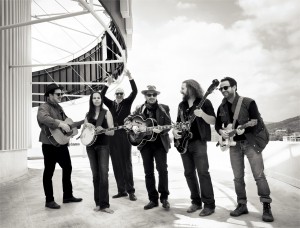
Recording of The New Basement Tapes started when songwriter and producer T Bone Burnett got Elvis Costello, Rhiannon Giddens, Jim James, Taylor Goldsmith, and Marcus Mumford all in a studio at Capitol Records, 47 years after Dylan penned the songs they would record. The only catch was, there was no music. Handwritten lyrics in Dylan’s careless scrawl, sure, but no melody, no notes, no instruments, not even “guitar solo here?” scribbled in the margins. The group, then, was undertaking the not so trite task of putting music to the lyrics of one of the greatest songwriters of all time.

So they did.

Over two weeks the group wrote, recorded, experimented, rerecorded, called in Johnny Depp, and rererecorded over 30 songs, 20 of which made the album. With no lineup and a plethora of talent, the group switched parts and instruments, Mumford singing lead on one of the most popular songs, Kansas City, Goldsmith leading the charge on rewriting the music for it, and Giddens bringing in gospel singers to help her find the right melody for Lost on the River.

In Showtime’s documentary of the recording sessions, Lost Songs: The Basement Tapes Continued, Jim James of My Morning Jacket brings his distinctive voice and penchant for the funk and blues inspired, Goldsmith lobbies for his version of Kansas City, (the version that ends up on the album) over Mumford’s, and Burnett refuses to let anyone leave—refuses to let any interpretation go unheard. Burnett describes those two weeks, saying: “What transpired during those two weeks was amazing for all of us. There was a deep well of generosity and support in the studio at all times, which reflected the tremendous trust and generosity shown by Bob in sharing these lyrics with us in the first place.” What’s left is a bold, musically adventurous, deeply curious, and exceedingly fun album of 20 songs that can almost make you forget who wrote them in the first place.

Week of September 1

Week of September 1

What’s often lost behind names like Elvis Costello and Marcus Mumford is the fact that The New Basement Tapes is, ultimately, a fan album. I’ll concede that it’s hard to think of professional musicians as fans, no matter how languidly they praise other bands or distill their musical pedigree—but this aspect of them is not to be lost. Before Goldsmith was twelve, I can bet he was learning Bob Dylan songs on the guitar. When Jim James goes to a Wilco concert, it’s not as Jeff Tweedy’s compatriot but as a member of an audience. It takes a concerted effort to remember musicians in their humanity—that is, their capacity to still be a fan. To not make this effort would ignore the foundation of the album as a creative effort of fans, albeit very talented fans, to do justice to the work of another artist. Exempting the Costello and Giddens and Mumford from their role as fans would be a disservice to both them and Dylan. Because, when we’re talking about Bob Dylan, sorta like Jesus, no one’s an equal and everyone’s a fan—fans with professional careers of their own, studio time, and the pull to call in Johnny Depp to play guitar on a track—but fans, nonetheless.

Less stigmatized and perhaps more fruitful, The New Basement Tapes is not altogether unlike popular fanfiction or fan art that is a product of fandoms ranging from books like Twilight to TV shows like Fox’s Glee, except, of course, The New Basement Tapes gets advantage of having Dylan’s actual lyrics. Cover songs in general, while sometimes simply mimicking artists, are more often creative and resourceful interpretations that stand on their own merit—making them works of a fan and works of art. The two are not mutually exclusive. Kurt Mosser gives the example of Jimi Hendrix’s cover of Dylan’s All Along The Watchtower in his essay “Cover Songs”: Ambiguity, Multivalence, Polysemy, saying: “Hendrix… takes an austere and minimalist recording of lyrics that are, even for Dylan, obscure and polysemous and changes it into a driving rock n’ roll song featuring extended displays of Hendrix’s guitar work.” Later, Mosser invokes a philosophy of linguistics, often referenced as “cluster theory”, to show that the very use of the words “cover songs” “indicates that there is a relationship between the cover song and its base,” through referential communication. It is not only the art itself, but the way we—consumers— approach and understand this art that recognizes an inherent connection to an original work of art, while still seeing the newly created, or “cover”, as merited in its own existence. Cover songs, like fan art and fanfiction, just more direct, link the artist with the consumer in a way that makes the consumer an artist, too—if only because they consumed in the first place. Far from the only example, Hendrix’s cover is still perhaps the best at getting at the heart of cover songs as both inextricably linked (and indebted to) the work of the original artist, while still being an independent work of art.

Now take All Along The Watchtower, take away any preexisting musical version, increase the required innovation, and multiply it by 20. That’s The New Basement Tapes.

Week of August 18

Week of August 18

On their own, The New Basement Tapes are a remarkable feat of musical ingenuity and collaboration. But it’s status as a quasi fan/cover album resurrects a bias for original work and the dismissal for any art that’s directly based off another’s. Less critiqued because of the commonality of Dylan covers, the genre of fan art and cover art is largely swept under the category of art* where the asterisk says “but not really”.  In his essay Like a Version: Cover Songs and the Tribute Trend in Popular Music, George Plasketes gives a number of examples of cover and tribute albums before sweepingly asserting that “the recent proliferation of cover and tribute recordings is culturally characteristic of the repetition mode of postmodern times—retrieving , repeating, rewinding, and resurrecting virtually everything into an exhaustive cycle of retreads.” Ok, is that enough to make Mumford say “ouch”? Plasketes and the like-minded music reviewers he cites devolve cover music into the art of the lazy and unoriginal—those not good enough to write for themselves, or too complacent to do so. Broadened to all fan and cover art and suddenly entire genres and works of art are discounted on the basis of their relationship to the art that came before it. If we can already conclude that consumers are interactive and creative in their relationship with art, as is proved with the very existence of professional cover-bands like the Grateful Dead’s “Dark Star Orchestra” and the plethora of fanfiction posted on sites like tumblr and reddit, then Plasketes argument is that sure, fans make things, but it’s not creative and it’s sure as hell not good. Once mindless consumers are, in this argument, regarded as merely third grade artists redrawing exactly what’s in front of them.

But this argument is too easy. Not only is it reductive of entire swaths of fan-made art, it rests on its laurels in equating “unoriginal” and “repetitive” with bad, despite giving no critique of the genre other than its straightforward description: art made in the image (or sound) of other art.

The New Basement Tapes are perhaps the highest functioning form of this art and avoid criticism like Pasketes by its virtue of being so well done—it is, however, very much the paradigm of what Plaskete criticizes. More than anything, it’s important to see that The New Basement Tapes is very much the rule for fan and cover art, and not the exception—not in terms of quality (not everyone can sing, not everyone has access to Capitol Records, this is a given) but in the creativity and ingenuity it inspires in the consumer. That art is able to, at the very least, inspire its consumers to create their own work, regardless of quality, is a testament to the critical engagement of the consumer. The New Basement Tapes wouldn’t exist without Bob Dylan or his lyrics, and in this way it’s exactly like 50 Shades of Grey and Twilight, Kirk/Spock slash fiction and Startrek. Each “cover” owes something to its “original”— but complacent, simple-minded replications of their respective originals they are not. Regardless of the social stigma attached or lacking to each of these forms of fan/cover art, and with little emphasis put on their varying qualities (i.e. good/bad), they all arise from the same circumstances of a consumer interacting with its culture, a fan reading and listening critically, and then deciding that they, too, can create something.

So they do.

basement-tapes-5

Burnett and the group he assembled manage to record one of the most musically complex and wide ranging albums of the 2000s. Whether or not you like the album (Rolling Stone loves it, Pitchfork is ambivalent), The New Basement Tapes occupies a space as one of the most creative and experimental cover albums of Dylan’s work. Rather than a carbon copy of Dylan’s simplicity and growling voice, The New Basement Tapes incorporates instruments unknown to Dylan’s work and lets the music breathe. In Matt Melis’ review of the album, which appears on the music-news website consequenceofsound.net, he concludes the article by surmising that the listener “[gets] the sense that Dylan’s greatest gift to the band may not have been his lyrics. The real gift may have been giving Burnett and these five musicians an excuse to go and chase down their own Basement Tapes.” To generalize this claim is to get at the very heart of fan/cover art, or any art directly influenced by a single force, which is that while the content of the original art is imperative, it’s the opportunity for creativity, collaboration, and ingenuity that it creates, and which the consumer seizes, that makes it so important.

We may call Bob Dylan a musical god but we certainly don’t treat him like it. Music, in this way, is not prescriptive. Jim James doesn’t listen to Dylan like the prophet Muhammed and worship at his feet but rather brings goddamn psychedelic Kentucky blues-rock to songs written while Dylan was reading way too much Bible and stripping down his recordings. Giddens, a black woman from the band Carolina Chocolate Drops, brings a soul that white people have been trying to replicate since Alan Lomax went recording local folk songs all over the American south. Taylor Goldsmith comes in as the young, unknown guy from a mid-level band that’s best known for its first album, and fights to the death with Marcus Mumford (of slightly more fame…) to get his (better) version of a song recorded. The New Basement Tapes is not a tribute album, it’s not an homage to Dylan—by the time it’s recorded, it’s not even a Dylan Manifesto. The New Basement Tapes is full fledged musical ingenuity that springs from the handwritten lyrics of a guy they all admire; a guy they’ve all called a genius, once or twice.

Where Dylan would have liltingly sung, Costello belts. Where Dylan would go acoustic, James shreds and Giddens wails. Where Dylan might mope, Marcus goes passionately rueful, as if to say “I’m not finished yet.” These songs, while a gift from Dylan, exist in their own merit. They take liberties with Dylan’s lyrics, are made of a style all their own, and are the product of a critical, creative process of engaging with a music legend’s work. To ignore the impact of Bob Dylan in creating this record would be empirically wrong– he is undeniably the source of inspiration and the well from which these songs were recorded. But to dismiss The New Basement Tapes as a recreation or a carbon copy with no merit or originality of its own would be deaf to the music on the album. More than anything, The New Basement Tapes embodies the relationship between consumer and artist; fan and artist; artist and artist. In it, the very real link between consuming and creating becomes tangible, resulting in a creative product of its own merit, made possible only by the existence of fan and artist and the active, engaging relationship between the two.

Michael Scott and Middle Class America

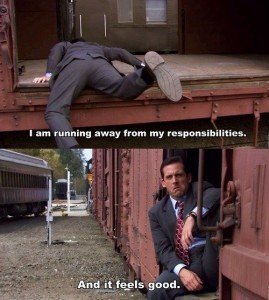
Last night I watched The Office instead of doing homework. I missed my boyfriend, who I haven’t seen in almost two months, I missed my dad, who is dead, and I felt exceedingly average after having been told by a professor “not to try to sound too smart, anymore” in one of his comments. So I watched the one where Michael goes broke, or, more accurately, the one where Jan (former boss of Michael, current manipulative lover) maxes out Michael’s credit cards buying carpet and Micael tries to declare bankruptcy (by declaring the word “bankruptcy”), eventually fleeing to a stationary boxcar like a vagabond, “running away from [his] responsibilities.”

 the-office-2

Jan finds him and brings him back to the office. They break up within the next few episodes and Michael never takes off financially, as far as I know. By the end of it, I forgot about the work I was supposed to do and went to bed well before eleven o’clock.

It seems unnecessary to introduce The Office. Anyone with access to the internet, and therefore anyone reading this, has heard of The Office. There is no doubt in my mind. Anyone who watched the 2008 Super Bowl, wherein the wildcard New York Giants decimated the previously undefeated New England Patriots, was greeted with a new episode of The Office, afterwards. The sudden popularity of “that’s what she said” jokes in the mid to late aughts—this was at the hand of Michael Scott. Still, for the sake of comprehensiveness, it’s important to note that The Office is not a typical Seinfeld/Friends-style sitcom from NBC, but rather documentary style show that details the banality of everyday life working in an office for a paper company. The walls are beige, the computers are bulky, the desks are ones you might find in a college dorm room. The Office is unglamorous, mundane, and is a comedy of characters rather than circumstance. This is why people love it.

In the realm of production and structure and critical analysis, there are a number of reasons to like The Office. The writing, for at least the first five seasons, is genuinely funny and creative. The one shot filming without any laugh track makes the humor almost deadpan, while the interviews that are interspersed within the plot are famous for their confessional humor. Characters feel whole and not like schticks or archetypes, and the very plot of each episode feels like a pop culturally relevant comedy of errors. There is a reason that The Office is so critically acclaimed, winning an Emmy for Outstanding Comedy Series only a year after it had been on air. With the original cast and writing ensemble, The Office is a technically good show, with clever writing, full characters, and intelligent filming. But technical skill only gets a TV show so far, and Emmys and Golden Globes aren’t voted on by the people. So what makes a show like The Office so beloved? And what does it say about the general population that a show like The Office can become so deeply ingrained in the hearts of the people?

The magic of a show like The Office lies in its ability to mirror real life. The Office takes the conventions of reality TV and flips them, where with reality TV everyone knows it’s supposed to be real but is actually fake, consumers can watch The Office, knowing that it’s fiction but feeling as though there is some deeper, resonating reality to it. There’s a safety in fiction that The Office capitalizes on, and a magic in the mundane that makes it so compelling. 

penn-paper

For one thing, The Office is set in Scranton, Pennsylvania— a place that, nowadays, few people have been to but most people recognize. The ambiguous familiarity that viewers feel towards Scranton is half the battle. Unlike New York, Boston, or LA, all of which are too extraordinary and well known to resonate with viewers, Scranton provides a familiar basis while allowing viewers to fill in the details. Scranton can be the place where city where they grew up, the place their grandparents moved from to start a better life, or the town outside of the college they went to. Either way, viewers recognize Scranton within the realm of their own life. The workplace, then, only makes this familiarity tenfold, appealing to the middle class worker everyone in America presumes that they are. Aesthetically, everything about The Office is unremarkable and commonplace in a way that makes it accessible to even the teenagers watching who’ve never stepped foot in a workplace. Like florescent lights and white tile are enough to tell the viewer “hospital”, like car horns, windchill, and cloudy skies are telltale for New York, The Office and Scranton are conventional signifiers of middle class America, desk jobs, and unfulfilled dreams.

The other half of it, then, is the people. Like Scranton is your uncle’s hometown, Jim is your best friend, Michael is you incompetent boss, Angela is the holier-than-thou know-it-all who sat next to you in high school and Phyllis is your great aunt you see every five years. These are people you know, people you work with, people you went to school with—this is us, collective.

So the real sucker punch of The Office is that it tells middle class America’s story back to middle class America, only with more office antics and more that’s what she said jokes than average. Now the question remains— what does this say about us, as a people?

As with most things, there are a few ways of looking at it.

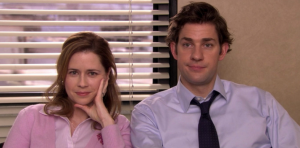
Part of me, and I think part of all of us, wants to say that our love for The Office, for any workplace comedy or drama, is comforting. It’s like going to the same house for Thanksgiving every year, it’s like hearing the song your dad used to sing while making coffee—The Office is our everyday lives, packaged into something funnier, more hopeful, and just as complicated. We watch Jim work a job that is below his intelligence level, that is unsatisfying and banal, but we also watch him fall in love, get the girl, and start a family of his own. He transcends his career level unhappiness to find true, familial and romantic happiness. It’s not overly romantic nor is it the consuming plot of each episode, but it is always there, and it’s always hopeful. The same could be said for Michael and Holly, or for Dwight and Angela, only in more complicated and less conventionally romantic ways. The other part of it is that despite financial, romantic, and emotional crises, The Office is a generally happy show, with generally happy characters who are not all that put out by the average conditions of their existence. We watch Jim leave brokenhearted for Stamford, Pam’s failed engagement, branch mergers, the sale of Dunder Mifflin, the heartbreak of Dwight, the strain between Jim and Pam, and relative financial instability of both the company and all of its employees—and, still, The Office is a comedy. The happiness of it is a hopefulness for every viewer, watching their own lives unfold on screen and being told that they, too can be happy. We, too, can find the love of our life at a desk job. We, too.

the-office-4

But there is another side to it. There’s a placation, an acquiescence, a platitude in The Office that, sure, comforts us but, at the same time, makes us stagnant, quiet, and appeased. Pam, a receptionist, wants to be an artist. When she shows her work at a local gallery, Michael is the only one to show up, while Oscar and his boyfriend muse from afar that her work is “unimaginative” and “motel art”. Later in the series, Pam quits a Pratt School of Design summer program and becomes a paper salesman, and then the office manager. Jim always wanted to be a Philly sports writer. Instead, he works as paper salesman, for a short time becomes a branch manager, and then creates his own sports management company—which he eventually abandons to co-founder Darryl in order to keep his family together. Michael never gets promoted beyond manager. Dwight waits eight years to become manager and, even then, he’s only truly happy when he finally marries Angela in the series’ final episode. And somehow this is still a comedy. Still, we find it funny. Still, we are convinced, they are happy. The truth is that watching The Office is more than just comforting and entertaining—it’s reassurance that we’re not wasted potential, that we’re not nobodies, that we’re not cogs in the American business machine. Every art school dropout, failed dreamer, average joe with above average imagination is tole “it’s okay, you are not alone, and you will be okay.” In watching The Office, we are given an inside look at the banality of everyday office workers, shown their intimacies and their idiosyncrasies, and told that we, too are special. We, too, can be satisfied in an unsatisfying circumstance. The comfort derived from The Office is more than simple recognition of a life like our own, but rather a twisted reassurance that the circumstances of middle class America are not all that unsatisfying, because if Jim and Pam are happy then who’s to say you and you’re husband can’t be?

What The Office tells us is to be happy with the little things, because the big things aren’t changing any time soon. And while this might seem like sound, motherly advice, it also ends up placating the legitimate, constructive grievances one might have with their situation. It’s valid to dislike your job, to find it unsatisfying, to lose patience with an incompetent superior. And while there is nothing innately wrong with working a desk job (it is, in fact, a first world luxury that can only be complained about in such a context), it’s still legitimate to feel frustrated, to be unhappy—and it is important to act on those feelings. To want something better, more stimulating, more fulfilling, is not wrong. To quit is not wrong. Middle and working class America have a list of grievances a thousand pages long and, in a larger, cultural sense, The Office works to appease those grievances, but never fix them. In the opposite way in which shows like American Idol or The Voice tell people “this could be you”, The Office delivers the message “this is you, now laugh along” to the same viewers. Work, in The Office, becomes each character’s whole life. Family, friends, love—none of these are independent of the workplace. And while that’s obviously a function of the fact that its set in an office and literally titled “The Office”, it also presents a reality where work is the main function of people’s lives, the common ground of relationships, and the only source of stimuli. While this is inevitable and true for most all working class Americans, it doesn’t mean it has to be desirable in the way that Dunder Mifflin and The Office make it seem.

After watching The Office the other night, I woke up the next morning having not read Paradise Lost for my 8:30 English class. My boyfriend is still three hours away, my dad is still dead, and I still don’t know what my professor wants me to do with my writing if he doesn’t want me to “try to sound too smart.” I didn’t accomplish anything other than a good night’s sleep. Nothing was done, the circumstances of my life or my work habits hadn’t changed, the world in Williamstown and I, too, remained the same— it was fine, comforting, even. I got out of bed, brushed my teeth, and got to class by 8:25.