Author Archives: Emma Ticknor

Racial Undertones in Pop Culture and their Divisive Impact on Viewers

Happy Feet seems to be a pleasing and lighthearted children’s film about bravery and independence. The film tells a story about a penguin named Mumble who is excluded by his fellow Emperor penguins because he is unable to sing as they can. Mumble can only dance, and the other penguins dislike him for this difference. Eventually, however, Mumble and some other outcast friends are able to resolve the famine that plagues the penguins by convincing humans to stop fishing in the area, an achievement that is rewarded with acceptance back into Emperor Land. While seemingly positive and pleasant, Happy Feet is grossly misunderstood, as it is actually shadowed by deep racial undertones. Racial scripts are thus present in popular movies like Happy Feet, but what are their implications?
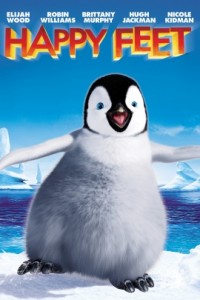
http://www.warnerbros.com/happy-feet/about

http://www.warnerbros.com/happy-feet/about

The image of whiteness is a complex matter. Aside from appearances, white identity is a complex and pervasive web that frequently evades recognition (Leonard 224). This is largely because whites are not limited by their race– white privilege– so there theoretically are no obvious white properties to be named (Dyer 39). Furthermore, the differences that are brought forth relegate whiteness as a cultural norm, rather than as a race like all others, which are simply diversions from it (Dyer 1, Ilmi 219). Happy Feet therefore racializes by presenting characters with non-white-esque characteristics that seem far removed from white culture.

The most obvious racializing in Happy Feet is of Hispanics. Mumble stumbles upon a group of outcast penguins named Ramon, Raul, Nestor, Lombardo, and Ronaldo who have nicknamed themselves “The Amigos”. The Amigos all have hispanic accents and speak with slang language (“Kiss it [my ass]”, “Come on, bro”, “You’re loco, man” (Happy Feet)). The Amigos also resemble stereotypical hispanics in their appearances; they are short and fat in comparison to the Emperor penguins. The Amigos are clearly meant to represent Hispanics within the penguin community; they are therefore outcast from Emperor Land.
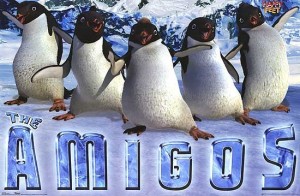
The Amigos. http://www.warnerbros.com/happy-feet/about

The Amigos. http://www.warnerbros.com/happy-feet/about

Several other minority groups are also represented in the penguin world of Happy Feet. There are a group of darkly colored hawks that speak with stereotypically African-American accents; furthermore, this group is quite violent in that they try to kill Mumble and attack one another in pursuit of the meal. There is also an outcast penguin who claims to be a fortuneteller– he has been “bestowed by magical beings” with a “sacred” plastic 6-pack wrapper around his neck. In the end, however, he is exposed as a fraud; this appears to be an attack upon Native Americans and their emphasis on spirituality. Yet another racialized animal group comes in a group of elephant seals who have long, sac-like noses that strongly resemble penises, which they suck until a white, cum-like substance sprays Mumble and the Amigos in the face (Happy Feet). These elephant seals are portrayed as not only unabashedly foul, but also as seemingly queer.

Elephant seal. http://www.dfiles.me/elephant-seal-happy-feet-1.html

Elephant seal. http://www.dfiles.me/elephant-seal-happy-feet-1.html

Mumble is also thrown into the group of outcasts, in part because of his coloring, which is much less distinct than the clear, divisive lines between black and white skin of the other Emperor penguins. Although he is technically white, Mumble is not “pure” like the emperors, who are able to distinguish themselves clearly from the “minority” penguins, like the clear-cut colors on their backs. There is one scene in particular that highlights these color differences; at the penguin’s school graduation, the graduates toss some of their cleanly white feathers in the air, while Mumble’s lone grey fuzzy feather floats sadly on the wind (Happy Feet). This color contrast adds to the list of characteristics that inferiorize certain penguins in Happy Feet.

While Happy Feet typifies non-whiteness in penguins through their language habits and physical appearances, whiteness is much more difficult to represent. White people are not limited by their race because of white privilege; since race is most obviously biological and of the body, this also means that white people are not contained by, or limited to, their bodies. “Above all, the white spirit could both master and transcend the white body, while the non-white soul was a prey to the promptings and fallibilities of the body” (Dyer 23). This bigger-than-the-body white ideal has also been furthered by the principles of Christianity. “Not only did Christianity become the religion, and religious export, of Europe… it has also been thought and felt in distinctly white ways for most of its history… It posits that somehow there is in the body something that is not of the body which may be variously termed spirit, mind, soul, or God” (Dyer 17, 16). Whiteness has come to be associated both with Christianity and with the ability to transcend the body.

Penguin hierarchy in Emperor Land is determined in both of these ways. The head penguin speaks religiously in sermons, and is named like so as Noah. He says things like “our forefathers forsook our flippers”, and encourages the other Emperor penguins to be “sincere in their praise” while leading them in chanting prayers (Happy Feet). He also speaks with a Scottish accent, which epitomizes him as belonging one of the “most white” nationalities. These types of Christian and Scottish similarities bring along connotations of “whiteness” such as purity, holiness, and cleanliness of blood– none of which are present in any way in the Latino-esque group of penguins.

http://www.alamy.com/stock-photo/happy-feet--2006-animation.html

http://www.alamy.com/stock-photo/happy-feet–2006-animation.html

The Christian, and therefore white, ability to transcend the body is also highlighted in Happy Feet. The penguins of Emperor Land believe in the power of “heart-songs”, which are songs borne naturally to a penguin’s soul. The quality of a penguin’s heart-song and of their singing voice plays a big role in their social status; at one point, onlooker penguins say “A penguin without a heart song is hardly a penguin at all” (Happy Feet). The deeper significance of a beautiful heart-song and voice, however, is the ability to leave the body through sound, which is a distinctly white characteristic. Mumble, therefore, is a lesser penguin because he lacks the fundamental white trait of body transcension in his lack of a heart-song. This is also how he gets his name; to mumble is to fail to expel a sound successfully.

Mumble is stuck inside his body, so he is forced to turn to dancing to express himself. Dancing, however, is something that in modern culture is associated with minorities, particularly latinos and blacks. “White people can’t dance”– a superficial joke about white people, but it points to the fact that blacks and latinos can. This logic also applies to modern sports, as African-Americans are typically seen as more athletic than whites (Leonard 220). These forms of expression imply bodily trappings in the case of non-whites. Mumble, cast as an outcast alongside the minority-resembling penguins, is chastised by his father, “I wouldn’t do that around folks, son… it just ain’t penguin, okay?” (Happy Feet). Mumble’s dancing resembles the bodily trappings of non-whites, therefore making him an inferior penguin in Emperor Land.

These differences serve distinct purposes in Happy Feet; they make the non-Emporer penguins seem so far from the Emperor penguins that they are outcast until the very end. The minority penguins are eventually accepted into Emperor land, but only after they are able to stop humans from fishing in their waters, thereby proving themselves as worthy of acceptance to the Emperor penguins. This theme is recurring in many popular and children’s movies; How to Train Your Dragon, for example, tells the story of a Viking boy who is outcast for his favorability to a jet-black dragon– a color choice that likely presents racial undertones– until he unintentionally assists the Vikings in discovering the dragon’s nest, thereby proving his worth despite the unusual company he keeps. In addition to the setup for a later acceptance, another purpose of differentiating certain characters is to provide for the trivialization of their roles. Happy Feet’s tendency to incorporate minorities in an insignificant way, for example, resembles Laura Mulvey’s argument about women; “The presence of women is an indispensable element of spectacle in the normal narrative film, yet… ‘In herself the woman has not the slightest importance’” (Mulvey 398). Characters such as the homosexual elephant seal and the seemingly African-American hungry hawks exist purely to make the viewers laugh, but their insignificance also contributes to the racializing in Happy Feet.

Mumble dancing unabashedly. Note his grey coat-- he's different than the other Emperor penguins. http://www.nytimes.com/2006/12/28/movies/28happ.html

Mumble dancing unabashedly. Note his grey coat– he’s different than the other Emperor penguins.
http://www.nytimes.com/2006/12/28/movies/28happ.html

Laura Mulvey argues that modern movie technology and director choices have become so developed that movies can feel like real experiences for viewers. She describes Hitchcock, “[the] hero does see precisely what the audience sees… Hitchcock draws the spectator’s deeply into his position” (Mulvey 401). This state means that viewers are easily imprinted upon, and this viewing lens is equatable to a “white gaze” through which minorities are depicted as racialized others (Ilmi 218). Films “construct social meanings… ‘Media culture also provides the materials out of which many people construct their sense of class, of ethnicity and race… of ‘us’ and ‘them.’ Movies manufacture the way we see, think of, feel and act toward others’” (Leonard 223). It is through the often unrealized power of the media that pop culture is able to adjust viewer’s attitudes towards race.

Viewers absorb lessons from and are impacted by movies they watch (Mulvey); in the case of race, pop culture often increases viewers’ propensity to see minorities as “other” by highlighting differences; Happy Feet does this through bodily appearances, the ability to transcend the body, accents and language tendencies, and the need for those who are different to prove themselves as worthy of acceptance. “Mass culture is the contemporary location that both publically declares and perpetuates the idea that there is pleasure to be found in the acknowledgement and enjoyment of racial difference” (Hooks 424). Identification and emphasization of differences between people– even meaningless ones that have nothing actually to do with biology– feature in pop culture far more frequently than viewers realize. The presence of this ideology in pop culture consequently plays a big role in influencing race in modern society– often in negative, divisive ways. Those whose differences are highlighted in popular movies, “whose image has continually been stolen and used for this end, cannot view the decline of the traditional film form with anything much more than sentimental regret” (Mulvey 403).

Works Cited

Dyer, Richard. “Entertainment and Utopia.” 1977. N.p.: n.p., n.d. 271-83. Print.

Hooks, Bell. “Eating the Other: Desire and Resistance.” Media and Cultural Studies: Keyworks. By Meenakshi Gigi Durham and Douglas M. Kellner. Malden, MA: Blackwell, 2001. 424-38. Print.

Ilmi, Ahmed. “The White Gaze vs. the Black Soul.” Race, Gender & Class 18.3/4 (2011): 217-29. JSTOR. Web. 14 Dec. 2016.

Leonard, David J. “Do You Believe in Miracles? Whiteness, Hollywood, and a Post-9/11 Sports Imagination.” All-Stars and Movie Stars: Sports in Film and History. N.p.: U of Kentucky, 2008. 219-36. JSTOR. Web. 14 Dec. 2016.

Mulvey, Laura. “Visual Pleasure and Narrative Cinema.” The Sexual Subject: A Screen Reader in Sexuality. New York: Routledge, 1992. 393-404. Print.

Popular Culture as an Escape from Everyday Life

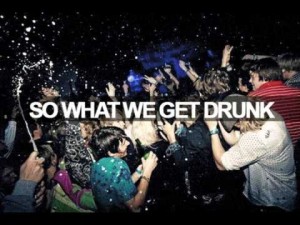
“Young, Wild & Free” by Snoop Dogg and Wiz Khalifa paints a picture of a carefree life. The artists encourage audiences to live freely, particularly through the acceptance of illicit substances. The lyrics are quite blunt in this regard– “So what we get drunk? / So what we smoke weed? / We’re just having fun” (“Young, Wild & Free”). To some, this open acceptance about illegal or socially or religiously frowned upon activities is horrifyingly lowbrow. Such themes are commonplace in many popular songs today, though; LMFAO’s “Party Rock Anthem” demands “One more shot for us, another round…Everybody just have a good time / And we gonna make you lose your mind” (“Party Rock Anthem”). These types of lyrics, while common, overflow with references to alcohol and sex; they border on offensive and socially unacceptable. How can such activities be openly discussed, even encouraged?

In Rabelais and His World, Mikhail Bakhtin describes the phenomenon of the carnival. Rooted in the tendency of Middle Age clowns and fools to mimic serious rituals and feudal traditions for the purpose of laughter– often crude and regarding bodily functions and the grotesque– the carnival was a popular lifestyle (Duncombe 83-84). The carefree heart of the Carnival provided an escape from the drags of everyday life; “[the] carnival celebrated temporary liberation from the prevailing truth and from the established order; it marked the suspension of all hierarchical rank, privileges, norms, and prohibitions” (Duncombe 87). In modernity, the truest form of carnival that exists is Mardi Gras– a freeing celebration of rejection of societal standards regarding bodily appearance, behavior, hierarchy and law. Pop culture, however, reflects closely on the same values.

"So what we get drunk?" (Source: https://www.youtube.com/watch?v=kKx9j3KaGAM)

“So what we get drunk?” (Source: https://www.youtube.com/watch?v=kKx9j3KaGAM)

Snoop Dogg and Wiz Khalifa’s “Young, Wild, & Free”, for example, exemplifies a modern carnivalesque, carefree lifestyle as encouraged by Bakhtin. The repeated drug references in the lyrics, as well as the value placed on living without cares, fits the carnival’s disregard for typical societal standards. Bakhtin describes, “During carnival time life is subject only to its laws, that is, the laws of its own freedom… [it was] the second life of the people, who for a time entered the utopian realm of community, freedom, equality, and abundance” (Duncombe 87). Essentially, the carnival has its own laws separate from those of real life, which provides a second, more free and welcoming, world. Some lyrics in “Young, Wild, & Free” openly encourage the breaking of real laws through use of drugs and alcohol. Although some may find these references offensive, religiously sinful, or wrong, “Young, Wild, & Free” relishes any opportunity for escaping social boundaries and living freely.

“Young, Wild, & Free” is part of the Mac and Devin Go to High School movie soundtrack, a film described in its iTunes preview as the “ultimate stoner comedy with a star-studded hip-hop soundtrack” (“Mac and Devin Go to High School”). In the music video, Snoop Dogg and Wiz Khalifa parody the structure of high school as they wreak havoc during a day trip to the teenage years. The music video shows students “Mac” and “Devin” (Wiz and Snoop) fittingly passing their first day at N. Hale High “N. Hale”-ing, as well as their drug trips; the hallways are twisted once each as snow-dusted, an underwater ocean scene, and a cartoon bird haven. Mac and Devin also complete a project for “science class” in which they prepare their own drugs and experiment with THC. Furthermore, throughout the whole video, there is only one appearance of an authority figure, in a screaming adult male, but he does not return again. The carnival rejects all things official and conventional; Mac and Devin certainly achieve a carnivalesque level of freedom in the music video of “Young, Wild, & Free” as they lead the student body in a wild day at school and prevail over authority.

Mac and Devin's "science project". (Source: https://www.videogram.com/comic_embed/2997c0f0-87f4-4fcb-9dcd-42cde0276998)

Mac and Devin’s “science project”. (Source: https://www.videogram.com/comic_embed/2997c0f0-87f4-4fcb-9dcd-42cde0276998)

Bakhtin furthers his description of the carnival, “Carnival is not a spectacle seen by the people; they live in it, and everyone participates because its very idea embraces all the people” (Duncombe 86). In order for a carnival to completely reject all forms of hierarchy and structure, it is vital that all types of people participate (Karimova 48, 38). The carnival celebrates the community, and therefore must be inclusive. “Young, Wild, & Free” exemplifies this trait in the featuring of many types of students– the preppy female, the nerd, the athlete, the fat boy in a wheelchair– and shows them all embracing the carnival at school in unison. “The carnivalesque is in brief a celebration of… community; it liberates people and brings them together and induces them to participate in communal living” (Bell 105).

maxresdefault

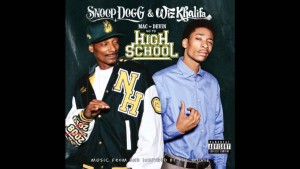
Album Cover of “Young, Wild, & Free” (Source: https://www.youtube.com/watch?v=KEddeCFhExA)

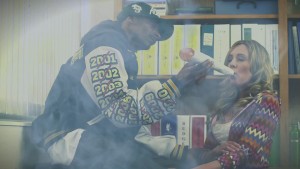
The music video for “Young, Wild, & Free” shows all types of students taking part in the fun as an entire, inclusive student body, rather than as divided by homogenous or exclusive social boundaries. Snoop Dogg lights a huge joint for a preppy white female, and an obese boy in a wheelchair expertly puffs smoke rings. The all-out party at the end of the music video also displays great diversity in the crowd. The point of including all people is also displayed on the album cover; Snoop Dogg is dressed athletically in a varsity jacket, while Wiz Khalifa appears nerdy in a button down. Despite the stigmas regarding these types of students, all of them partake in the festivities and in letting loose and ignoring school authority.

4731201_l2

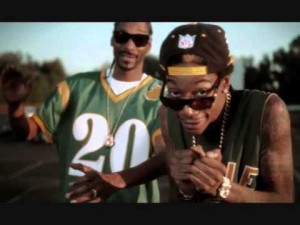
Snoop Dogg shares the love in the “Young, Wild & Free” music video. (Source: http://veehd.com/video/4731201_Snoop-Dog-And-Wiz-Khalifa-ft-Bruno-Mars-Young-Wild-And-Free-mp4)

The wide reach of the “Young, Wild, & Free” lifestyle is also apparent in the background of the song. Wiz Khalifa and Snoop Dogg are both African American, while featured artist Bruno Mars is from Hawaii; the “Smeezingtons” group that composed the song consists of an African-American, a Caucasian, and Hawaiian Bruno Mars. The artists also reject typical lifestyles; Snoop Dogg (formerly Calvin Broadus) was in and out of jail for drug use for several years, and yet has grown into an incredibly successful musician. Neither Snoop nor Wiz Khalifa (formerly Cameron Thomaz) attended college or are married. Both openly attest to cannabis use. Wiz and Snoop both live atypically of societal standards in these ways; encouraging audiences to live in a carnivalesque fashion requires not just telling, but also showing.

“Young, Wild, & Free” is also able to directly influence real life because it helps dancers let loose– the song is no stranger to dance parties. The chorus is catchy, simple, and fun, so when it comes on the speakers, many a dance floor erupt with passionate singing and unembarrassed dancing. Dancing provides easy means to let go of social boundaries, and therefore everyday access to Bakhtin’s carnival; its role is in “inciting the participants to ‘the greatest exaltation of their symbolic faculties’ into play, and triggering ‘the whole pantomime of dancing, forcing every member into rhythmic movement’” (Stam 89). When everyone on a dance floor partakes unabashedly in dancing together, they are bringing the carnival to real life. “The carnivalesque is not restrained to popular culture texts, but transcends to ‘everyday’ life encompassing… those of audiences” (Karimova 37). “Young, Wild, & Free” provides an easy trigger to an unrestricted dance party– a modern carnival.

(Source: https://www.youtube.com/watch?v=9E8_f7ek84c)

(Source: https://www.youtube.com/watch?v=9E8_f7ek84c)

A truly inclusive environment, furthermore, is hard to come by in modern society. There are always limiting factors to the extent of a shared experience; money is a frequent concern. A dance floor, however, is one experience that transcends economy. Although the song does encourage certain endeavors that may not be available to all classes, the experience that the song itself provides is. On the other hand, encouraging flashy, crazy parties may seem unwise; however, the benefits of rejecting structure are reaped in the sheer fun to be had. Additionally, although the music video only depicts one school day– a temporary escape– the lesson has been presented (in a readily available song) and viewers must elect to follow in Mac and Devin’s footsteps. The message, furthermore, is widely applicable. Although the song may only be well known to today’s younger generations, the ideals behind it should still be paid attention to by people of all ages. N. Hale High and its liberating wild spirit is a dream come true for students as well as adults bored by the structure and lack of freedom in their lives.

Essentially, Bakhtin’s carnival provides an escape from everyday life via fits of crude humor and unabashed free living, and focuses on welcoming all members of a community despite background, and the rejection of authority, hierarchy, structure, boundaries, and standards (Duncombe 84). Popular culture today, like Snoop Dogg and Wiz Khalifa’s song “Young, Wild, & Free”, strives to achieve these carnivalesque qualities through explicit lyrical content and acceptance of substances typically frowned upon by society, the inclusion of all types of people in the fun, and the deliverance of these qualities to real life. “Carnival changes over time, and if Medieval carnival was a ‘second life’ for people, the contemporary carnival is ‘everyday’ life” (Karimova 46). Ordinary pop culture therefore has become our modern carnival; we must embrace it as an escape from reality and to strive for a “Young, Wild, & Free” lifestyle.

————————-

Works Cited
Bell, Michael Mayerfield, and Michael Gardiner. Bakhtin and the Human Sciences. London: Sage Publications, 1998. Print.
Dogg, Snoop, and Wiz Khalifa. Young, Wild, & Free (feat. Bruno Mars). The Smeezingtons, 2011. Web.
Duncombe, Stephen. “A Politics That Doesn’t Look Like Politics.” Cultural Resistance Reader. London: Verso, 2002. 82-88. Print.
Karimova, Gulnara. “Interpretive Methodology from Literary Criticism: Carnivalesque Analysis of Popular Culture: “Jackass, South Park”, and ‘Everyday’ Culture.” Popular Culture Association in the South 33.1 (2010): 37-51. JSTOR [JSTOR]. Web. 15 Nov. 2016
“Mac and Devin Go to High School.” iTunes Preview. iTunes, n.d. Web. 15 Nov. 2016.
LMFAO. Party Rock Anthem (feat. Lauren Bennett & GoonRock). LMFAO, 2011. Web.
Stam, Robert. Subversive Pleasures: Bakhtin, Cultural Criticism, and Film. Baltimore: Johns Hopkins UP, 1989. Print.

The Hidden Value in Repetitive Culture

Picture: two enemy groups, battling for prestige and engaged in a spiteful war until a scandalous love blossoms between a young male and female from the opposing sides, eventually resolving the group’s conflicts. Now, name that plot– a tricky task, as there are dozens of modern titles that present this familiar love-versus-war dilemma. It’s a commonly used theme and plot line in cultural products, with Shakespeare’s Romeo and Juliet widely credited as the origin. Much of modern culture is simply repackaged; art that proves successful is twisted, modernized, copied, and fed to the consumer again. Materials are repeatedly disguised under new movie titles, new star characters, or new settings. Cultural critics argue that economic success in production is valued over the public’s desires and imaginations; the culture industry and producers are entirely absorbed in what will make money, even when this results in products that are entirely lacking in variety and creativity (Adorno). Superficially, these arguments present our culture in an entirely negative and somewhat hopeless light, but this is simply not the case– there is still hope for our culture, however much it may recycle concepts. It is important not to confuse a lack of originality with a lack of worth; our culture still has value despite its repetitive qualities.

Romeo and Juliet is a tale of jinxed love. Both man and wife commit suicide shortly after marriage due to an unfortunate miscommunication in Shakespeare’s famous tragedy in the midst of a raging family feud between the Capulets and Montagues. The familial conflict twists and thickens when Montague son Romeo and Capulet heartthrob Juliet lock eyes and fall in love. However, miscommunications lead Romeo to believe that his beloved Juliet is dead, so he poisons himself. Juliet follows suit, as when she sees Romeo dead, she stabs herself, and the lovers die unlucky deaths. The tragedy is heart-wrenching, and it is painful as the deaths unfold, especially because they are caused by fickle family feuds. The families do eventually throw aside their differences in honor of their losses once they realize their foolishness, however.

3-romeo-and-juliet-quotes

(Come, Death, and Welcome!)

While it is maddening to watch both Romeo and Juliet die mistakenly, the deaths strike a chord in the heart of the consumer and make us resent the family feud. Thus the tale pushes for love, and emphasizes the pointlessness of fighting, a meaning that culminates in the deaths of two innocent lovebirds. This valuable moral leads us to why recycling culture is an accepted practice. Relevant to this day as violence is so precedent in the world, the lessons of Romeo and Juliet are applicable anywhere. Furthermore, because the morals behind the story are so applicable, the tale can be versatile– and successful– in the same ways. As long as we continue learning from Romeo and Juliet and other classics, producers will continue to churn them out in new and surprising ways.

Theatre World Award-winning Broadway show West Side Story, for example, features a battle between the Puerto Rican “Shark” gang and the all-white “Jet” gang based on New York City’s West Side that is eventually mediated by a beautiful relationship between Jet Tony and Shark Maria.

West Side Story's Tony and Maria embrace despite their different backgrounds

West Side Story‘s Tony and Maria embrace despite their different backgrounds (Tony and Maria)

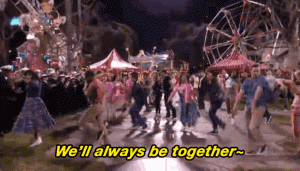
Another popular Broadway show, Grease, which showed for eight years– quite a run for Broadway– delivered a similar message as summer lovers Danny and Sandy end up at the same high school, where their romance is tested by clique lines. However, in a heartwarming musical finale to the catchy tune of “We Go Together”, the lovers are reunited despite their clique boundaries. Love trumps all, especially when accompanied by a Broadway dance riff.

Everyone's happy after love beats the clique boundaries in Grease

Everyone’s happy after love wins out over clique boundaries in Grease (Grease Live Animated GIF)

Romeo and Juliet’s storyline has also entered into the modern movie industry. Warm Bodies is a 2013 film based on the 2010 novel that takes “love versus war” to the vampire level, as vampire R falls for human Julie– interesting name selections by author Isaac Marion. Their relationship catalyzes a human versus vampire fight and is the beginning of a peaceful coexistence. Another modernized Romeo and Juliet tale, Romeo Must Die presents a kung-fu war between the Asian and black gangs. The film ends peacefully when– guess what– Asian macho man Han falls for African-American Trish.

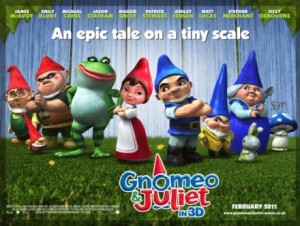
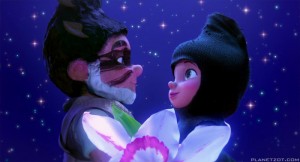
Even modern cartoons are getting in on the action. Gnomeo and Juliet is a garden gnome spinoff in which red-hat gnomes fight blue-hat gnomes, until one fantastically moon-lit night when red-hat Juliet meets blue-hat Gnomeo. They, of course, fall in love, eventually bringing peace and love to the garden. Lion King 2 also features an animated Romeo and Juliet-like tale. Lion leader Simba’s daughter Kiara falls in love with Kovu, a banished lion. Kovu and Kiara’s beautiful relationship eventually sparks peace amongst the clans, and all of the lions live happily ever after.

Lion King 2 teaches a peaceful lesson: "What differences do you see?"

Lion King 2 teaches a peaceful lesson: “What differences do you see?” (What Differences do you See?)

Everyone loves this kind of story; even cartoon lions and gnomes are now getting in on the romantic Romeo and Juliet love-trumps-violence lesson. There are hundreds of spinoffs in various forms and genres out there in today’s culture– even Shakespeare’s version was based on an older poem. Producers simply can’t help themselves from recycling what’s proven successful, and they’ll feed consumers classics like Romeo and Juliet forever if it works (Adorno). The industries are looking for money, and they fire out movies and books at a relentless pace. Not only is it easier to reproduce an idea than to make something original, but it is also economically safer to build upon a basic tale that has already earned its place in the hearts of the masses. Success is practically guaranteed, furthermore, when a product’s base is a tale as beloved as Romeo and Juliet. However, this trend is not only applicable to this particular Shakespeare piece, as story reproduction in general has been greatly successful and has brought about countless renditions of all types of products. Essentially, a huge portion of modern cultural products are simply reproductions of older literature and ideas (Adorno). Our culture is indeed quite repetitive.

Consequently, modern culture gets a bad rap because of the nature of these retellings. Gnomeo and Juliet, for example, is the recipient of many bad reviews not only because it is a retelling of a story that everyone knows already, but also because it appears to trivialize the lessons presented by the great Shakespeare in his timeless classic Romeo and Juliet. This is the case with many modern retellings. Furthermore, sometimes the lessons presented by modern cultural pieces are considered lessers to those of old literature (Leavis)– a view that is rather unfounded, because if our culture is truly an endless recycling circle, then these “bad” lessons presented in modern culture have origins in these idealized “classics”. It is for these reasons that culture, foolishly, will not accept many modern pieces as its own. These accusations of lack of originality and worth that are cast upon modern cultural products, however, are not deserved.

"An epic tale on a tiny scale"-- Gnomeo and Juliet in a nutshell!

“An epic tale on a tiny scale”– Gnomeo and Juliet in a nutshell! (An Epic Tale on a Tiny Scale)

The repetitive nature of modern culture does indeed entail the reflection of many of the same lessons, but that does not take away their value. The values behind Romeo and Juliet— that love is more powerful than war– provide an extremely important life lesson. Modern times are pockmarked by the countless acts of terror we’ve experienced recently, from school shootings to marathon bombings, rapes, ISIS, cop violence, and everything in between. Consequently, we all could use a pleasant story of love to remind us that violence is bad and love and peace can prevail. It’s a lesson we forget sometimes, and one that the world desperately needs to remember. Humans tend to forget the lessons they have been taught, so there is no harm in a quick review. Although superficially, the sameness of culture is depressing and makes product consumption feel pointless, there is still value in ideas that may have been repeated.

Additionally, while Shakespeare might have been horrified if he knew that his classic Romeo and Juliet tale was being remade with the help of gnomes and lions, it speaks to the power of the tale that such products are out there. Clearly, people appreciate the lesson enough for it to have been so timelessly popular, and now it can be even more transcendental. Anyone can learn from Romeo and Juliet’s love nowadays, regardless of originality. The versatile methods of lesson delivery can also simply reach a large audience– young children can begin to learn the value of love and peace amidst violence if they watch Gnomeo and Juliet, whereas a Shakespeare reader must be educated and much older to see through the tragedy’s complex wording and fully appreciate the meaning. Those of all walks of life can now appreciate the lesson of Romeo and Juliet because of the volume of its renditions.

Romance in Gnomeo and Juliet

(Romance in Gnomeo and Juliet)

Furthermore, it is easier for a consumer to relate to a product when it connects to their own life, so having many different styles of presentations drastically increases the reach of the lessons. Romeo Must Die, for example, will likely hit home with an African-American whose life has been touched by racial violence more so than Shakespeare’s version. Grease works in the same way, as a popularity-driven teenager might be able to see past class lines and exclusion to the value of love more so than he or she would be able to by reading a dense book. Additionally, we must address the idea that people forget things they are taught. Most high schoolers read Romeo and Juliet, and are led to the meaning behind it, but they will likely forget what they have learned about love and life until they watch the West Side Story play years later. The heart can still be warmed by a concept it has already experienced; the lessons will simply be refreshed and deepened upon each new experience. Therefore, there is true value in the variety of presentations of classic tales that consumers have access to in modern culture.

This variety is due to the endless recycling of material that has proven successful in the modern cultural industry. Producers identify the popular stuff– Romeo and Juliet, for example– and twist it in countless ways (West Side Story, Warm Bodies, Lion King 2, and many others) to continue to benefit economically, which leads to an apparent degradation of culture. Culture is shamed for its repetitive nature, but not deservingly. Although cultural products are increasingly similar, there is no harm in variations of the same idea– Gnomeo and Juliet gets the point across just as successfully as Shakespeare did. The basic stories are successful because they are valuable; they possess lessons and morals that everyone needs to learn and experience, like the importance of love and peace despite adversity. The recycled quality of Romeo and Juliet— and most other works of modern culture– brings significant variety to how consumers can experience the work and, therefore, increases the understanding and benefit derived from the lessons presented, as well as the audience to which these lessons are available and relatable to.


Works Cited

An Epic Tale on a Tiny Scale. Digital image. Gnomeo and Juliet Image Quotes. HippoQuotes, 2015. Web. 15 Oct. 2016.

Come, Death, and Welcome! Digital image. Movie Quotes. IMovie Quotes, 2015. Web. 15 Oct. 2016.

Grease Live Animated GIF. Digital image. Grease Live. Giphy, n.d. Web. 15 Oct. 2016.

Horkheimer, Max, and Theodor W. Adorno. “The Culture Industry: Enlightenment as Mass Deception.” Dialectic of Enlightenment: Philosophical Fragments. Ed. Gunzelin Schmid Noerr. Stanford, CA: Stanford UP, 2002. 94-136. Print.

Leavis, F.R. “Literature and Society.” The Common Pursuit. New York: George W. Stewart, 1952. 182-94. Print.

Romance in Gnomeo and Juliet. Digital image. Gnomeo and Juliet Image Quotes. HippoQuotes, 2015. Web. 15 Oct. 2016.

Tony and Maria. Digital image. Fanpop. Townsquare Entertainment News, 2016. Web. 15 Oct. 2016.

What Differences do you See? Digital image. Top Tumblr Posts. Rebloggy, Aug. 2014. Web. 15 Oct. 2016.