Monthly Archives: October 2016

Give This Guy a Grammy: Justification of a Modern Great Work

RJ Shamberger

http://wiux.org/2014/12/18/j-cole-2014-forest-hills-drive/Romeo and Juliet

When your community does not accurately value anachronistic literature, you are conditioned to mimic its views and never realize that the answers to life that you are so desperately searching for may loom in a book. When you are struggling to find ways to feed your family in a capitalist society, you don’t pause your day to read a Shakespearian play or any of the other novels considered to be ‘Great Books.’ Likewise, what could William Shakespeare – a white man whose last breaths were taken five hundred years ago in the United Kingdom – possibly know about the current struggles of an African-American family? Why would I ever feel the need to study Shakespeare’s works or any other orthodox great work of literature? Instead, I would gravitate towards art forms that I can relate to and believe will help me better my situation, which is what I have done? Thus far in my life, I have found comfort and knowledge in songs that are written by people who not only look like me but speak directly to me – rap music. I would even go as far as to say that it is more important to study these songs than great orthodox works of literature and that they have given me a head start towards becoming a better human being. One of such rap songs is “Love Yourz” by J. Cole which I believe can alone challenge the purpose of the great books in its mere three minutes and thirty-two seconds of run time. I will now share my beliefs to why “Love Yourz” should be considered a great work of literature, if it has given me a head start on the path of human perfection, and if it has helped me make me fit for humane existence.


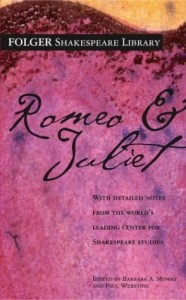
So what makes a great work of literature? I will begin by analyzing William Shakespeare’s “Romeo and Juliet” – one of the most well-known pieces of literature and consensually considered great work. The tragic love affair “Romeo and Juliet” details the lives of two star-crossed lovers destined to be separate due to a long-lasting family feud. Within the play are themes of the strength of love and friendship as well as darker themes of irrational violenceand vengeance. Strong themes along with Shakespeare’s beautiful prose has seen the play last centuries and vast cultural changes, and today it stands as a great work of literature. Similarly, J. Cole’s “Love Yourz” delivers an uplifting ballad of loving yourself, valuing your life regardless of your situation and the struggles of success. The song showcases equally strong themes of love and happiness as well as pain and regret. J. Cole then substitutes Shakespeare’s prose for talented and well-placed wordplay. And as of today the song’s impact has lasted all of three years and will continue to live. As far as literature I consider each delicately crafted great works, but I believe that it is the differences of the two that reveal how “Love Yourz” is a far better piece. I’ll begin with the authors. William Shakespeare was born into an affluent white family wasn’t subjected to particular struggles do to his situation – his father a successful business and his mother a member of a prominent surname – and lived a comfortable childhood. J. Cole’s was born into a working-class family – his father nonexistent and his mother a mail carrier – and lived a tumultuous childhood where he was subject to financial and identity struggles as a black youth born in Germany to a white mother. Due to his background, I cannot see how Shakespeare could relate to me or how I could even apply to writings to my life. Although Shakespeare’s themes are similar to J. Cole, the application of his ideas are far-fetched, and I cannot implement them into my life. The plot of “Romeo and Juliet” contains more twists than naturally possible; also I must acknowledge that the work is a piece of fiction. Conversely, J. Cole’s lyrics to “Love Yourz” speak directly from his modern day experiences that are also similar to mine. J. Cole does in mere minutes all of what Shakespeare does in more than one hundred pages while also connecting to his audience proves that his song is a great work of literature according to the standard.

2016 Billboard Hot 100 Festival - Day 2Do the great orthodox works give their readers a head start on the path of human perfection? Shakespeare’s “Romeo and Juliet” teaches its readers of the many shortcomings of humanity as well as provides an ideal purpose to live by – love. The themes in the play present great dilemmas, and Shakespeare delivers his perspective on what would happen in those situations. However, I again cannot relate the conflicts in Shakespeare to my modern day problems. My fractured family cannot compare to those of either Romeo or Juliet nor am I a star-crossed lover kept from partner due to such conflicts. When I read Romeo and Juliet, I enjoy the fairy tale of the young couple, but there is no point while reading that I can take away any lesson to help me reach human perfection. If the purpose of the great works is to give their readers a head start on the path of human perfection, when does it do so? Instead of providing me with tools to become a better person “Romeoand Juliet” taught me that love kills. Although the play splendidly conveys its themes, those themes did not help me yet “Love Yourz” provides its readers with a clear model and purpose.  J. Cole opens the song with the line, “No such thing as a life that’s better than yours.” From the line J. Cole teaches the reader to value their life regardless of where they are in life. J. Cole’s first few words immediately contradict Shakespeare’s words that detail the murders and deaths of multiple characters as well as the senseless violence portrayed. Continuing in explaining his message J. Cole later states, “Think being broke was better.” This quote is significant because J. Cole associates his views with the capitalist society in which I live and apply them. Through his words, he tells his listeners that he understands the circumstance that they may be in and teaches them to continue striving for self-love. When I see my parents struggle to make ends meet, I harp on the lyrics and refuse to value myself as anything less than exceptional. J. Cole dives deeper into the topic with, “What’s money without happiness?” In entirety I absorb the lyrics to debunk exactly how to get a head start on life – be happy and do so by loving yourself. If I believe that my life is valued regardless of what is going on and that I can it so by finding happiness, J. Cole has given me a firm head start that Shakespeare could not. It makes me wonder if the tragic events in “Romeo and Juliet” would have occurred had they heard J. Cole’s? Regardless of how Shakespeare romanticized it, Romeo and Juliet each ceased to believe in the purpose of their life and chose to commit suicide.
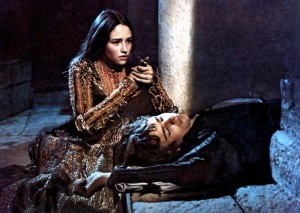
Have the great works made me a better person concerning those around me? Do I now have a positive effect on the lives of those around me? Not only has J. Cole’s “Love Yourz” made me a better human as I have stated above but it has helped me affect others. The teachings that I have from the song bleed out into my life and touch others, such as when I see someone who is in the Romeo and Juliet mindset thinking that he cannot continue on the path to human perfection. In my community, I often come across people who are depressed because they are struggling to provide for their families, and in these instances, I can spread first that money does not directly equal happiness. I teach people to value what they have just as I have begun to do so. Again it makes me wonder if J. Cole’s lyrics could have saved the lives of the tragedy-laden Romeo and Juliet. If either of the two were living exhibiting a humane existence, they would have been able to more positively respond to their situation, especially when Romeo mistakenly kills himself. Shakespeare’s does not exemplify proper characteristic for people to model their lives by and thus cannot help make me fit for a humane existence since it doesn’t teach people to be better.

The characteristics of great work of literature are its ability to convey strong themes through its exceptional prose, and its effect will last throughout a significant period. Although there are orthodox pieces of literature that hold these features such as Shakespeare’s classic “Romeo and Juliet” to model what a great work of literature should be, in the modern age using the similar criteria a song like J. Cole’s “Love Yourz” can rival the classics or even better them in the message they convey and effect they have. Not only is “Love Yourz” an example of a great work of literature, but it has also given me a head start on the path of human perfection, and it has helped me make me fit for a humane existence.


“Shakespeare’s Life.” Folger Shakespeare Library. Creative Commons, 03 May 2016. Web. 18 Oct. 2016.

@themusictimes. “J. Cole Talks Rough Childhood On ‘2014 Forest Hills Drive'” Music Times RSS. Music Times, 09 Dec. 2014. Web. 18 Oct. 2016.

Cole, Jermaine. “Love Yourz.” 2014 Forest Hills Drive. Dreamville Records, 2014. CD.

Empire Looks Better in a Cape

The Dark Knight is “clearly one of the top conservative films ever made,” in the eyes of Breitbart, a news organization dedicated to satiating racists. (Shapiro) It identifies right-wing politics with a protagonist that “utilizes full scale surveillance, beats up a terrorist during an interrogation, and takes heat while doing it, all in order to save civilization from monsters,” placing the Christopher Nolan film at the center of authoritarian aggression-and delighting in it. Batman becomes a weapon of state authority against the Other, and does so while flouting liberal checks. Meanwhile, John Ip from the University of Auckland claims the film proves that “society ideally should not rely on heroic vigilantes, that the people themselves need to show resoluteness and courage, and that, in the long run, the law—together with the legitimacy it confers—is not a liability, but an asset,” arguing the film’s politics value civic virtue. (229) Ip refuses to valorize the vigilante, but rather finds the blockbuster’s hero in unnamed civilians who refuse to give in to their baser instincts while finding refuge in civic institutions. These views fundamentally clash- Breitbart’s demeaning of governing checks can’t be reconciled with Ip’s celebration of the rule of law. Each critic places a separate ideology across Batman’s shoulders, conscripting the movie into political service. But the film itself doesn’t buckle under the weight of varied political views. Rather, the movie accepts and promotes simplistic politics.

Simple, partially because it’s so familiar. Comic books and the accompanying film genre carry with them plenty of associations. Capes, chiseled chins and criminal masterminds ensure you don’t confuse it with anything else. When critics praise The Dark Knight as “the first superhero film that makes a serious bid to transcend its burgeoning genre,” they mean that it retains genre trappings while seemingly filmed with minimal access to sunlight. (Orr) Or, alternately, that the movie concerns itself quite clearly with its own importance. The Dark Knight refuses to accept being ‘just’ a superhero movie. Its plot is overlaid with overt political references.

After all, Christopher Nolan can be accused of many things; subtlety isn’t one of them. The Dark Knight exults in brash symbolism. Harvey Dent’s coin conveniently burns one of its two faces, and the camera rests, languorously, upon the altered side. Don’t you get it? Now he’s been turned into a different person, just like the coin has changed. The movie’s politics similarly shout to be noticed. I want to spend the next few paragraphs nailing down these images-not because of any inherent complexity, but because the sheer amount of effort devoted to the symbolism by Nolan.

First, let’s focus on the film’s animating force: Heath Ledger’s Joker. One critic came close to describing the essence of Ledger, who “seems less the creation of a living self than the annihilation of one, an exercise in the center not holding,” as he embodies an intentionally confusing evil. (Orr) The Joker’s aims to disrupt the established order for the purpose of disruption. He employs suicide bombers and continuously jerry-rigged (or, say, improvised) explosive devices, importing the tactics of the Green Zone to Gotham. Shaky, handheld videos of hostages unnerve, and proclaim a kinship of style with Osama Bin Laden’s video messages or hostage videos worldwide (take a look at the embedded image and video to see). Even when his violence doesn’t fit neatly within preexisting categories, it fits the understanding of terrorism as aimed at terrifying the populace. Dead bodies slam into glass, pencils pierce eye sockets-the violence is used for shock value, as ways to distinguish him from any other criminals. After all, he just wants to “watch the world burn.” In one unsuccessful attempt, the Joker impersonates an officer and launches an attack on an elected official. Of course, the infiltrator had a clear-as-day mark of his irregularity on his face. Not his skin color (this time), but the type of simple signifier that “extreme vetting” could notice. Harvey Dent names this threat accurately at the press conference-the Joker is a “terrorist,” which in America means a Muslim man. To make explicit what Nolan almost does, the Joker is a stand-in for Islamic terrorism. He’s the sort of caricatured enemy that “hates us for our values,” and delights in violence in pursuit of an anarchic ideology.

(watch through 0:21)

This screenshot comes from a hostage crisis with an ISIS-affilate in the Philippines.

This screenshot comes from a hostage crisis with an ISIS-affilate in the Philippines; clearly after the movie, but bearing a stylistic resemblance to the clip in a way all-too-many images do

Next, I’ll turn to the hero of The Dark Knight: Batman, the caped crusader (or is it Crusader?) and his attempts to save his city, his woman, and his moral code. The valiant fighter combatting a shifting order amidst moral decrepitude. Batman aspires to be omnipresent-the primary fictional invention of the movie allows Batman to hear and see everything. His retort to Alfred asking him to be more cautious is to proclaim his power, for “Batman has no limits.” The superhero’s attempts at control extend far beyond the city of Gotham; “Batman has no jurisdiction,” as he reminds us. Unlimited, across the globe, Batman wages a unilateral war on evil. Ring any bells? This distillation of Bush-era imperialism is enlivened by the movie’s portrayal of certain acts from the War on Terror. Batman drops a crime-lord from a building, snapping his ankles, so he can ask a few questions. He mercilessly beats the Joker. Torture is justified- it gets him the information he wants about Rachel and Harvey Dent. And with the Joker, there’s no sign we should even care about the torture. The recipient of the beating laughs through it. The irrational enemy doesn’t suffer pain like we do; they don’t need the protections we do, either. After that, we see Batman create an expansive surveillance system- through our cellphones- to save the city. While the movie was released before the Snowden leaks, knowledge of broad surveillance programs created under the Patriot Act already existed. The empire depended upon surveilling at home to monitor threats. Batman serves as a not-so-subtle stand-in for American empire post-9/11, and his violence should be understood as our own.

Batman proudly claims Hong Kong's skyline as his own

Batman claims Hong Kong’s skyline as his own

With the dual structural supports for the politics of The Dark Knight in place, the rest of the symbolic framework can be sketched in. Like, for example, the geopolitical hints created by character’s nationalities. The mob coopted by the Joker prominently contains “the Chechen”. The quintessentially American Wayne Enterprises almost enters into a major business relationship with a Chinese company-but doesn’t, because China’s accounting is rigged. Nolan takes care to dismiss Hollywood’s other geopolitical bogeymen. The USSR exists only as a small-time cog in a criminal machine and China’s rise depends upon a willful suspension of disbelief. The real threat comes from Muslims. If nothing else, the film argues for its own existence, for its fictionalized account of a social threat as most deserving your attention.

The story’s symbolism continues. Like, for example, the technological wizardry of Lucius Fox. He describes his plan for extracting Batman and Lau as inherited from an old CIA plot, and that’s probably a good way to start understanding him. He creates new technologies for Batman, like a new suit. What changes are made to Batman’s armor? It becomes more flexible in response to new threats. With a military now asked to fight asymmetric threats, the movie’s focus on armor carries the paradigmatic shifts of the armed forces. Fox, then, doesn’t just stand-in for the CIA; he’s the director of a vast national security apparatus. In this capacity, he reconnoiters abroad, and controls surveillance at home. He even intimidates an admittedly-craven whistleblower. If Batman fights for American empire, Lucius Fox sits at the helm of its bureaucracy.

More time could be devoted to this symbolism. Harvey Dent as the false hope of elected officials; the wizened Alfred representing his own country and its faltering empire; the unnerving clown masks, which substitute for the visual shorthand of brown faces with beards. But I’d like to address some of the critic’s views of the film’s politics, put them to the test of the movie’s persistent symbolism, and see the consequences.

First, let’s explore John Ip’s view of the movie as a testament to civic virtue. He accepts the War on Terrorism motif, but sees the movie’s relationship to Bush-era human rights abuses as reflecting negatively upon them. His qualms are too legalistic to accurately deny the movie’s political goals. Ip claims the overseas capture of Lau “cannot be interpreted as any kind of endorsement of the Bush Administration’s practice of extraordinary rendition, because…it is not that kind of rendition,” which imposes a knowledge requirement on the layman in the theater. (216) Distinguishing between the legal terms ignores the imagery of the vigilante traveling overseas to snatch a criminal away for prosecution at home. The only unusual aspect of the capture is the inverted nature of certain imperial escapades of the past; this time, empire entered under the guise of corporate interests, instead of the other way around. Ip next dismisses the film’s use of torture as providing little useful information. While true, the characters don’t blame the torture for this as much as they blame their inability to act sooner. The film doesn’t indict the torture; instead, as discussed above, it ignores its potential for real pain. The injured mobster continues a conversation despite his shattered ankles. The Joker laughs it off. Torture should be ignored, because even the Batman can’t cause all that much pain. Ip similarly addresses Wayne Enterprises cell-phone based mass surveillance, claiming it differs in type from the actual War on Terror and thus can’t be understood as a defense of the same. Part of the strength of the film’s endorsement comes from its dissimilarity to real actions. Rather than bear the burden of advocating mass surveillance, it defends a specific, fictionalized instance. After all, the stand-in for our national security bureaucracy doesn’t even want the surveillance. Someone in a position of power will look out for us, because authority figures abide by the audience’s moral standards.

(note, as an aside, the way the complex debate over surveillance is reduced to less than 80 seconds)

Other critics attempted to identify the film’s central premise. Like, for example, one argues that its “less a film about good versus evil than about order versus chaos.” (Orr) That broad claim ignores the way the film merges the two. The film’s evil is chaos. The Joker substitutes sewing chaos for a fleshed-out ideology. Even his backstory is murky- he always tells different stories about he received his scars. Nothing can explain the Joker, as the movie reminds us. Islamic terrorism lacks history, and thus a motivating purpose. The Joker can’t be traced back to anything at the county jail-not fingerprints, DNA, a single prior identity. Viewing the Joker in this light vindicates us of any possible role in creating the monster society must deal with.

Orr also posits that the “film [is] about politics by other means,” which necessarily evokes von Clausewitz’s famous formulation: “war is the continuation of politics by other means.” Complete the circle and say it with me: The Dark Knight’s about war. Not just any war, but a Huntington-esque clash of civilizations. The War on Terror can’t be rationalized. Instead, it pits the impenetrable mystique of the Other against the just empire. As much as I dislike claiming this, Breitbart’s analysis rings true. When it claims Batman “save[s] civilization from monsters,” it accurately diagnoses the film’s biggest fear: America subjugated by Islam.

I want to jump to the end of the film. After Batman sacrifices his reputation for that of Harvey Dent, Jim Gordon’s son points out plaintively that Batman “didn’t do anything wrong.” The child seems to be voice of reason. Empire just saved everyone, and it’s sent to hide away (in its luxurious mansion). The movie’s sense of outrage isn’t derived from shattered bones but from the morally immaculate empire being scorned. The Dark Knight seems to answer most of its own questions, but leaves this one hanging. Why don’t you defend empire? After all, Nolan spent the previous two hours and thirty-two minutes doing the best he could. American empire needs you; will you answer the Bat-Signal?


The Help: And Other Remedies for White Guilt

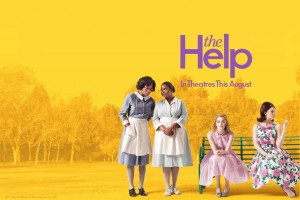
the-help_big

We so often assume that the best way to combat bigotry and ignorance is through awareness, that injustices of the past can be alleviated with the right knowledge and appreciation. Through history, we reason, the errors of the past are clear and guide us in improving the present and future. We delegate months to celebrate the specific histories of oppressed groups, produce films about their movements, and immortalize their leaders. In terms of social justice and oppression, the right move is always to talk about it, to remember. This makes perfect sense before considering the way we look at race today; we naturally can’t help but overlook the basic and purposeful ideological motives that lie behind contemporary forms of normalized racism. Though it is hard to stomach, widespread racist assumptions exist today just as the belief of the inferiority of black people existed in the 1930s. Denying this all together is naive and idealistic, on par with the suggestion that we live in a post-racial world. I am not arguing in any way that we should stop remembering and learning about civil rights movements, just that the way we present them (and everything, for that matter) is subject to our fundamental ideologies. Oftentimes these ideologies are so elusive to identification that they are often perceived as instances of racial harmony, friendship, and progress.

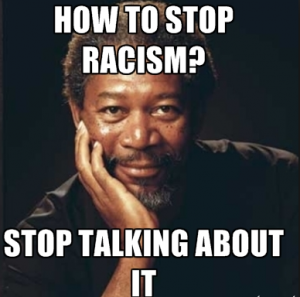
          This is a difficult distinction to make, but after having done so, I am reminded of an unintentionally hilarious interview of Morgan Freeman, in which he proclaims that the best way to end racism is to simply “stop talking about it.” As seemingly nonsensical as this first seems, it also makes a lot of sense– oftentimes when we attempt to discuss or portray racial struggles, ideological biases cloud our reasoning. They can incline us to be overly optimistic and make false assumptions the same way that pictures of black and white children holding hands on Facebook can convince your aunt that we live in a racially harmonious and equal society.

Meme of Freeman's famous quote from described interview

Meme of Freeman’s famous quote from described interview

          A well-documented formula for the depiction of race in film is seen in the trope of the “white savior” that cuts across almost every genre and era of entertainment. In more modern examples, films with this archetypal structure frequently masquerade as stories of redemption and justice in which a white character rescues a poor non-white character from their suffering. Presented without any form of autonomy, minorities in white savior films are presented as helpless and primitive, in need of the redemption that a white savior brings to improve their menial lives. Movies like The Blind Side and The Freedom Writers portray this motif all too clearly– depicting white women who use their resources and intellect to “get through” to black and latino/a youth, forever transforming their lives and creating an awareness in them that they can forge a path out of the struggle they were so unfortunately born into.  

skeeter

Eugenia “Skeeter” Phelan: The Savior

          Even in our depiction of slavery and segregation this trope resurfaces its ugly head, often misinterpreting and devaluing key aspects of the civil rights movement. And rarely is it ever so compelling as it is in The Help, a film directed by Tate Taylor based on the novel by Kathryn Stockett that follows the ambition of Eugenia “Skeeter” Phelan as she writes a novel from the perspective of black maids who raise the children of prominent white families during the early 1960s. Skeeter (as a typical white savior) is the catalyzing force of change in the film, as her bravery and acceptance of the black maids is depicted as the only reason anything significant even happens in the previously-stagnant town of Jackson, Mississippi. Rather than the culmination of decades and decades of racism inspiring black leaders to unite the black community and inspire change, the fact that it is impressed by an oddball, white, feminist figure primarily driven by the emotional attachment she had for her childhood maid not only devalues the history of the civil rights movement, but also proposes an uncomfortable proposition that black people wouldn’t have been able to strive for justice if it wasn’t for compassionate white people.

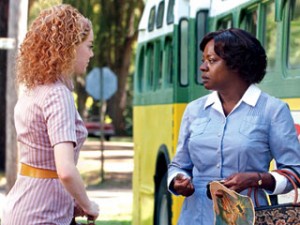
Skeeter approaches Aibileen at a black bus stop

Skeeter approaches Aibileen at a black bus stop

          Not only is Skeeter the typical white savior, she is also inexplicably clueless regarding the accepted social norms that govern interactions between black and white people in Jackson. The first maid Skeeter reaches out to is Aibileen, with the purpose of getting her help to write a cleaning advice column. Skeeter later tells Aibileen about her idea for the novel excitedly, obviously without having considered how dangerous such a pursuit could be for a black woman. Skeeter then approaches Aibileen again for an answer at a black bus stop,  completely oblivious to how strange it looks for her to be there, a detail that is conveyed cinematically through the obvious confusion of the white people observing the interaction in the background. Skeeter assures Aibileen that they will be safe, to which a disgruntled Aibileen notes responds “this already ain’t safe” and that the way Skeeter is going about creating this novel “scares [her] more than Jim Crow.” Only is it after Aibileen agrees to participate and the two meet up that Skeeter says she “know[s] now that what [they’re] doing is illegal.” The extent of Skeeter’s cluelessness regarding commonplace racial interactions and taboos in her hometown has no real explanation. Sure, she went away to Ole Miss for college for four years, but after having spent at least seventeen years in Jackson before leaving, it’s fair to say that she should have at least a rudimentary understanding of the power balances between black and white people in her home town (especially when it comes to potentially endangering her primary ally Aibileen). Her apparent “color-blindness” and empathy for black women make her an anachronistically perfect savior in a society that would be more realistically portrayed as overwhelmingly and monotonously racist.  

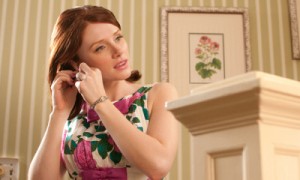
Mrs. Hilly Holbrook: The Villain

Mrs. Hilly Holbrook: The Villain

          Hilly, the villainous racist of the novel, is the exact opposite of Skeeter. Basically a racist mean girl-esque socialite bully, Hilly pushes for legislation requiring the help have separate bathrooms in every home, and tries to frame Aibileen for stealing silverware to have her arrested. Where Skeeter is unaware of certain social conventions, Hilly epitomizes them. She is the president of the Junior League, and maintains power over the other white women of Jackson thorough blackmail and threats. She sticks staunchly to her pro-segregation beliefs, readily punishing those who disagree, and even fires her maid Minny Jackson for using her toilet. Despite this, through much of the film she is shown to be preoccupied with her charity efforts for the “Poor Starving Children of Africa Fund.” In this way The Help almost seems to be mocking the white savior complex– depicting the faulty logic behind the Junior League of Women who would never offer to help the children of their maids, but work instead to send food to the starving children in Africa. This detail functions as a not-so-subtle jab at Hilly, who in a previous scene refused to give her maid Yule May Davis a fifty dollar advance to allow her to send both of her sons to school, leaving her with the choice of deciding which one to send.

Minny Jackson (Left) and Aibileen Clark (right)

Minny Jackson (Left) and Aibileen Clark (right)

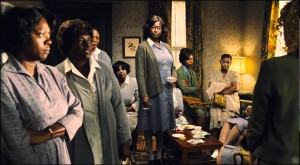
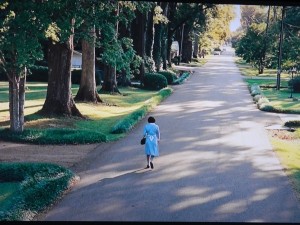
          Trapped between these hero and villain figures are the maids. Particularly Minny Jackson and Aibileen Clark, the latter being the most central maid in novel (also the narrator of the film), as the first to talk to Skeeter and as a connection to the rest of the black community. One of the most important things Aibileen does is reach out to other maids to tell their stories, explaining that she and Skeeter “ain’t doing no civil rights” but rather “telling stories like they really happen.” This is the most recognizable point in the movie that depicts Aibileen’s initial submissiveness to the racism that permeates her life. The apparent dissatisfaction in Aibileen is connected to her son’s death in a senseless accident that plants a “bitter seed” in her that severely lessens her patience with her boss, Mrs. Leefolt. Despite this, she maintains a torturous yet quiet obedience, never does it seem that she is criticising or objecting to the racism of the south so much as enduring it expectantly. In a dramatic scene at the end of the movie, Aibileen strides into the sunlight after being fired by Mrs. Leefolt, recounting how being able to tell the truth to Skeeter was “liberating” to her as she decides to leave her life as a maid behind her and pursue a life dedicated to writing the stories of those around her– just as Skeeter had done for her. Aibileen’s transition from the stereotypical obedient, matronly, and religious maid to an activist dedicated to those around her happens quite suddenly in the film and is very clearly only a result of the actions of Skeeter.

Maids inspired by Aibileen to speak to Skeeter

Maids inspired by Aibileen to speak to Skeeter

          So why is it important that Skeeter is white, and so unaware of the social conventions of Jackson, and that Hilly is the epitome of these conventions at play? Where does Aibileen come in in the mix? The answer to the first of these questions is that having a completely pure, positive white character is a surefire way to absolve the sensitivities of white audiences dealing with the inherent conflict they have viewing and living in such a racial world. Many white moviegoers constantly feel victimized by racially-based conflicts in film. Thus, saviors like Skeeter play an integral role in alleviating their tiredness with the topic, by depicting a white person going the extra mile for people of color who can’t. In doing this, the film essentially provides white people a reason to feel better when looking back to times such as the civil rights movement. Skeeter’s presence in the plot line of The Help is what makes it, for many, an uplifting movie about racial cooperation rather than a black movie about civil rights. Thus the fictional trope of the white savior functions to solve a very real problem– the modern “tiredness” and guilt white people have living in  a racial world so clearly attributed to the actions of white people that must be completely absolved for a movie such as The Help to be successful.

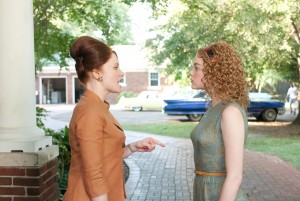
Mrs. Hilly vs. Skeeter

Mrs. Hilly vs. Skeeter

          So what exactly is the cost of  placating white audiences whenever race is a topic of interest in film? In essence, the feelings of white viewers are placed over those of minorities by compromising the representation of minorities in film.  The instances of cooperation and friendship between Skeeter and the maids subverts the concept of white supremacy at a higher level, confronting segregationist, KKK-level racism,  but it also exists more subliminally, weakening the characterization of black figures, oftentimes conveying less obvious messages of white supremacy through the stereotypes of black dependency and white paternalism. In the film, characterization of Skeeter and Hilly as opposites brings us to a generic conversation of good versus evil, a much too simple juxtaposition when considering the complexities of race in the 1960s or today. Hilly’s complete entrenchment in the social norms of society versus Skeeter’s complete rejection of these norms is a dichotomy that is depicts a lot about the function of how we view race ideologically. It concludes that racism exists in the binary: white or black, racist or not. It further attributes racism as a whole to the anger and brokenness of a few “bad eggs,” rather than any sort of organized and systematic oppression. Skeeter is not racist because she is an educated, wholesome person. Hilly is because she is vindictive, mean, and manipulative. The time period and culture they were both born into is given no weight at all. Minorities, in the meantime, are secondary to this conflict of good versus evil. Hilly and Skeeter make all of the moves, battling out the fate of the help who do little more than observe and obey them. The biggest step the black women make is in the decision to talk to Skeeter, which as evident through my discussion of this earlier, is ultimately nothing more than a show of black dependence.

End scene: Aibileen walks into the sun, contemplating her new path as a writer

End scene: Aibileen walks into the sun, contemplating her new path as a writer

          The trivialization of black characters in order to minimize white  guilt through the usage of a white savior is not only indicative of normalized racial ideologies that each of us is likely to be carrying around with us, it also goes to show how Morgan Freeman could be correct in some regard about talking about racism. Though I disagree and still see value in realistic discussions regarding race, it is interesting to question how the discussed ideological motives will continue to permeate in our thoughts. In other words, what if  the same desire to create awareness that led to films like The Help and other white savior movies is still leading us further from the actual significance of history and deeper into a new undecipherable ideological mess? At that point I’d definitely be ready to stop talking about it. But hell if I know.


________________________________________________________________________________________

Hughey, Matthew W. “White Savior Films: The Content of Their Character.” The White Savior Film: Content, Critics, and Consumption. N.p.: n.p., n.d. N. pag. Print.

Weiss, Joanna. “‘The Help’: America Pats Itself on the Back.” Boston.com. The New York Times, 16 Aug. 2011. Web. 17 Oct. 2016.             <http://archive.boston.com/bostonglobe/editorial_opinion/oped/articles/2011/08/16/the_help_america_pats_itself_on_the_back/>.


Segregation, or Integration?

The idea of the white savior is simple: a white, typically privileged character helps the non-white characters in their struggle and by doing this, he/she becomes a morally enlightened human. Take The Blind Side, for example. Leigh Anne Tuohy (Sandra Bullock) is an white upper class woman, bored with her daily routine as a suburban mother and socialite, who rediscovers meaning in her life when she adopts a homeless black boy, Michael (Quinton Aaron), and helps him succeed as a student and athlete. Or look at The Help, which tells the story of Skeeter (Emma Stone), a girl of the Southern Debutante class, who wishes to pursue her career as a writer, and in doing this, allows the voices of the black housemaids to be heard. These characters are often presented in blaringly obvious ways; Leigh Anne Tuohy is rich and white, Michael Oher is poor and black. But the white savior can exist in subtler forms. Now I will diverge from the mainstream white savior archetype and discuss a more peculiar form, in which the saviors are no longer superior to, but rather identify with those they save.

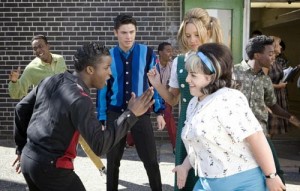
Whether you have or have not seen Hairspray (2007), you probably associate it with its eccentric costumes, fun songs, and dances, all of which are based on the culture of Baltimore in 1962. The movie tells the story of Tracy Turnblad, an overweight, white, high school girl. Her dream is to dance on the Corny Collins Show, a local TV show that features “nice white kids” who dance and sing to the latest hits. One day, Tracy decides to pursue her dream and audition for the show, but she is rudely rejected by Velma Von Tussle, the snobby manager and mother of the show’s star performer, when she says, “And so my dear, so short and stout, you’ll never be in so we’re kicking you out!”. Right off the bat, the viewer sides with Tracy as the underdog. That same day in detention, Tracy meets and befriends a group of black kids (Seaweed and his friends), who are infatuated by her confidence and stylish dance moves. They tell her, “you one of us” since she fits with their crowd. Seaweed and his friends later face an identical rejection when Von Tussle tells them that Negro Day (the one day per month when they are allowed to perform) is officially over. Tracy and Seaweed (and his friends) have similar struggles, experiences, and dreams to perform on the Corny Collins Show. Though each briefly get the chance to perform, both face discrimination and cannot pursue their dreams because of physical appearance.

Tracy (right) and her best friend, Penny, dance to the Corny Collins Show.

Tracy (right) and her best friend, Penny, dance to the Corny Collins Show.

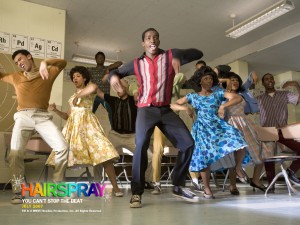
Seaweed and his friends dance in detention.

Seaweed and his friends dance in detention.

Given everything I have discussed about this movie so far, (this being very little), it is easy to think that the issue with this particular type of white saviorism requires less attention than the more typical type, since Tracy is depicted as equal to, rather than superior to, the black people. I will tell you why this idea is wrong, but first let me ask this question: to what extent can society’s criticism of bodies (commonly known as fat shaming) be viewed with equal importance as the issues of racism and segregation? This seems especially egregious in Baltimore, a city that still today faces immense racial separation and socioeconomic divides. I cannot imagine putting fat shaming into the same category as segregation and racism, given their historical significance and impact on our nation. The movie, Hairspray (2007) diminishes the importance of the segregation faced by the black characters by comparing them to the problems Tracy faces as an overweight person.

The initial interaction between Tracy and Seaweed and his friends takes place in detention. Tracy enters the room and is immediately taken by the smooth moves of the kids around her. When she joins in, she is warmly received by the group, who all clap after she puts on a little solo. Contrastingly, when Link Larkin, the Corny Collins Show’s lead singer and heartthrob, attempts to join in, he is given the cold shoulder. The movie equates Tracy and the black characters by situating them both in detention, and then reinforces that exclusively Tracy is one of them when Link is outwardly rejected. Following Tracy’s brief fame on the Corny Collins Show, the detention room suddenly transforms into the coolest room on campus. When Penny, Tracy’s friend, appears at the door, Tracy casually says, “She’s with me” the way a rock star would give a friend access to the VIP section. She makes detention, a previously negatively connoted space, a hip place for her new friends to hang out in and feel good about. This scene enforces that Tracy can be compared to the black characters because of their similarities.

Tracy and Seaweed dance while Link watches.

After detention lets out, Seaweed and Tracy dance while Link watches.

A similar trend appears later on in the movie. Tracy, in her role as white savior and agent for change suggests “If we can’t dance, let’s march” to Maybelle (Seaweed’s mother). Soon thereafter, a non-violent march processes through the streets of Baltimore. Tracy, with her “Integration Not Segregation” sign in hand, leads the pack until they meet face to face with the Baltimore Police. They cannot proceed, but Tracy will not back down without a fight. When the police officer turns his back on the protesters, Tracy hits him on the back with her sign. The police officer then threatens to “take the whole lot in”, and the scene erupts into violence.

Seaweed, Maybelle, and Tracy lead the march.

Seaweed, Maybelle, and Tracy lead the march.

Now I am coming closer to making my point. The movie reinforces over again the depiction of Tracy as an ally to the black characters. So, it is believable that Tracy would actively participate in the march, stand at its forefront, and even hit a police officer for a cause she believes in. But in presenting Tracy in this way, Hairspray gives the impression that Tracy, because of her struggles as an “outsider”, truly can identify with the black characters and their struggle with racism. However, this is wrong. She is not an outsider just because she is overweight, even though the movie portrays her as such. The fact that she is white and will never experience what a black person experienced in Baltimore in 1962 brings me to my point that Hairspray trivializes the real struggles that people faced in their fight for civil rights when Tracy, who is also presented as facing social discrimination, effortlessly unites people and creates change for civil rights.

That a march for civil rights could have been led by a teenage girl as easily as Tracy did in the movie, or that protesters could have escaped police arrest and violence as easily as Tracy and others did in this movie, brings me to my next point, which concerns the misrepresentation of Baltimore in the 1960s.

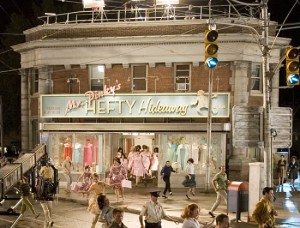
In the “Welcome to The 60s” scene, Tracy drags her hermit mother out of their house for the first time in ten years. To Edna’s surprise, the whole world has changed for the better! The scene is full of vivid colors, action shots, and lots of sparkles. The 1950s did not cater to the plus size woman, but the 1960s do! Edna walks out of a dress shop in a pink sequined dress, a dramatic contrast to the drab clothing she previously wore. The scene implies that the coming decade will bring a new and improved version of everyone and everything. But the song misrepresents the reality of life in Baltimore in the 1960s, and puts an idealized, white washed version on display instead. The Dynamites, three beautiful black female performers, ironically sing, “take your old-fashioned fears, and just throw them away”, and “the future’s got a million roads for you to choose.” In reality, black people had a lot to fear in the coming decade; the Riot of 1968 brought on deeper racial divides, police violence, and anything but “a million roads for you to choose” from. The movie’s representation of Baltimore in the 1960s shows what a white girl might see in her own idealized future, but ignorantly overlooks the fact that this was not at all the case for black people, which is ironic considering the story is supposed to be about racial integration.

Tracy and her mother, Edna, walk out of Mr. Pinky's Hefty Hideaway in their new pink sequined dresses.

Tracy and her mother, Edna, walk out of Mr. Pinky’s Hefty Hideaway in their new pink sequined dresses.

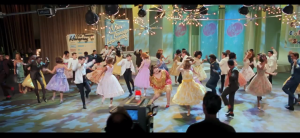
Performers on the Corny Collins Show are now integrated.

Performers on the Corny Collins Show are now integrated.

The final scene, “You Can’t Stop The Beat” really hits home my final point. The characters, all different colors and sizes, come together on The Corny Collins Show in the grande finale. Tracy and her black friends have succeeded! But what exactly have they succeeded in? Throughout the movie, Tracy wishes for her own right, and for the right of black people to perform on television, but in obtaining this goal, the group becomes homogenized to the white way of doing things. After performing solo, Little Inez wins “Miss Hairspray”, a traditionally white prize and status. The integrated group of dancers perform to “You Can’t Stop The Beat”, a song that views the future with immense optimism for all people. But the song is white-sounding, especially when compared to “Big, Blonde and Beautiful” or “Now Run and Tell That”, both of which are performed by black characters in the movie, and both of which also have a traditionally black, soulful sound. So, Tracy triumphs in the successful integration of the Corny Collins Show, but Hairspray the movie ultimately enforces the idea that the white way is the right way.

Give me your tired, your poor, Your Americanized masses

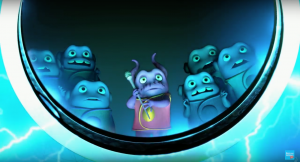
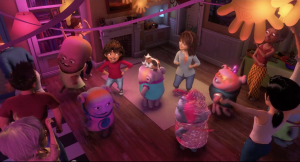
            According to Rotten Tomatoes’ critical consensus, DreamWorks Animation’s 2015 animated film Homeis “Colorful, silly, and utterly benign… a passable diversion” (Home(2015)). The premise of the movie centers around a semi-purple, six-legged alien race called the Boov as they flee across the universe and resettle on Earth to escape their enemy the Borg, along the way displacing the planet’s human residents. Oh, a sincere, socially ostracized young Boov, sees his species’ relocation as the opportunity to finally win over his fellow Boov and make friends. In his excitement to invite his “best friend Kyle” to a welcome party, Oh nearly alerts the Borg to the Boov’s whereabouts and so he is forced into hiding where he meets Tip, a young human who is searching for her mother. By the end of the film, after a series of misadventures, Tip, Oh, and the Boov reach their fairly classic DreamWorks endings: Tip is reunited with her mom, Oh makes countless friends, and the Boov and humans coexist peacefully. Everyone is happy. It is a “colorful, silly, and utterly benign” ending. At least until it is viewed against a modern political backdrop. When analyzed in the context of recent backlash against immigration and refugees in the United States, Home, 2015’s family friendly DreamWorks Animation movie, begins to embody a strong xenophobic political ideology aimed directly at the most impressionable members of our society.

The Boov moving to Earth

The Boov moving to Earth

First, let’s address the idea of the Boov as refugees. Homeland Security defines a refugee as “a person who is unable or unwilling to return to his or her country of nationality because of persecution or a well-founded fear of persecution on account of race, religion, nationality, membership in a particular social group, or political opinion” (Martin). The Boov fit this definition to a T. The catalyst of the entire movie is that the Boov are being relentlessly hunted by the Gorg. When the viewer is introduced to this concept, the film writers give no reason for the animosity between the two species, nor do they provide an adequate description of any cultural, theological, ideological, etc. differences. Because of this void of information, the viewers derive the aliens’ shared fundamental distrust of each other from the only difference they have been able to observe: their species. The filmmakers have crafted, through omission of information, a scenario in which one group appears to have fled their home to escape persecution from another. As a matter of semantics, though the definition doesn’t include species (because the policy makers were only addressing human conflicts), in a the Official Trailer #1, DreamWorks first identifies the Boov as a “nomadic race,” bringing them linguistically under the arch of the definition. Additionally, the descriptor further intertwines the two groups by assigning to the Boov the qualification of nomadism, which is characterized by continuous movement from place to place and is a core trait of refugees.

The "nasty" Gorg

The “nasty” Gorg

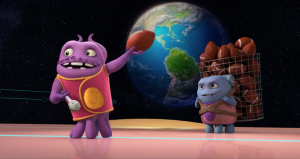
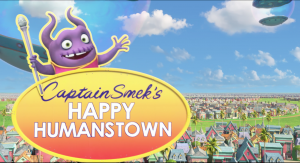
Beyond this textbook definition, however, the Boov are decidedly outsiders to “American” society. The first spoken line of the movie makes this clear. As the Boov’s blue mothership comes into view and Oh’s narration begins, we hear “Today is best day ever!” To start the movie with a snippet of monologue spoken in imperfect English sets the tone of “otherness.” English is not their first language, therefore they are foreign. In addition to this, the Boov consistently show a thorough misunderstanding of both frivolous and essential elements of American life. Within the first six minutes of the movie, Oh cooks a cookbook, decorates with toilet paper, and brushes his teeth with a toilet bowl cleaner. Captain Smek mistakes footballs (a staple of american sports culture) for fruit, tires for headbands and evening wear (but that one’s a euphemism for an extra layer of fat around the waist), oranges for shoes, a vacuum for a horse, etc. Besides simple misconceptions about objects used in daily life, the Boov believe they “are best at deciding what is useful. And what is not,” so when they begin their settlement, they create enormous floating balls of everything they deem “useless,” ranging from toilets and chairs, to bikes and grand pianos.

screen-shot-2016-10-16-at-7-59-32-pm

Balls of “useless” things

screen-shot-2016-10-16-at-8-03-34-pm

Captain Smek demonstrating the use of footballs

screen-shot-2016-10-16-at-8-02-20-pm

Oh brushing his teeth

Now all that’s left to determine is which group of refugees are the Boov supposed to represent. The Boov show important societal variances from Americans that indicate Eastern origins. They exhibit none of the stereotypical American friendly and outgoing personality traits. They are instead more reserved, a trait often assigned to Middle Eastern and Asian cultures, indicating that the Boov are a reference to Syrian refugees.

So hopefully you’re convinced that the Boov represent Syrian refugees and are outsiders in American society. But featuring characters from different cultures and backgrounds hardly makes a movie xenophobic. In fact, it really only indicates inclusivity. So how did the creators of “Home” turn inclusivity into xenophobia? They did it in three steps:

Firstly, the movie begins by playing on American ideals to build a pathos against refugees. While the initial trailer defined the Boov as a “nomadic race,” Oh’s own definition of his people is that the Boov are the “Best species ever at running away!” To an American audience, running away means defeat and defeat means weakness. Weakness is a deplorable quality to many Americans. The nation is locked in a constant struggle to prove itself to be the strongest and the fiercest in the world. The average movie goer would find it incredibly difficult to empathise with characters who consider vulnerability a trait of which they should be proud. And the Boov certainly take pride in it. Captain Smek, the commander of the Boov, lists his admirable leadership skills as “cowering, running, and pulling a skedaddle.”  In American culture, there are heavy, negative connotations associated with these words and ideas because they run in direct opposition of American heroism. The film writers craft the Boov’s dialogue so that these negative connotations are in turn transferred onto the act of fleeing violence and danger. If the Boov had not fled their home planet they would have died but the gravity of that is undermined by the negative pathos of the language of the film. The viewer is instinctively led to look down on the Boov, and, subconsciously, the refugees they mirror.

Frightened Boov

Frightened Boov

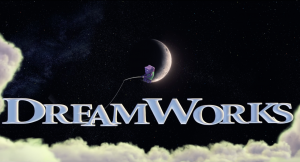
Secondly, the film plays into two American anti-immigrant and refugee fears. A 2013 Stanford Business School article reports that, “one recent survey found 70% of Americans thought allowing more immigrants would make it harder to find jobs”(Zacharia). This scenario is quite literally the first thing you see happen in the movie. Well, more accurately, before the movie even starts. Within the first 30 seconds of the opening credits, the classic DreamWorks boy on the moon is sucked up and replaced with a Boov. The first representation of the refugee aliens feeds off of a very real fear in the modern American psyche. This singular abduction is amplified a thousand fold when the Boov descend on the planet, remove all the people, and relegate them to a false suburbia in Australia. This drives home the point that when outsiders come, they have the potential to significantly disrupt American way of life.

The new DreamWorks Boy

The new DreamWorks boy

screen-shot-2016-10-16-at-8-21-10-pm

The looming threat of the Gorg invasion gets to the second fear. A month and a half before the movie came out, abcNews published a story that opened with “Top U.S. counterterrorism officials say they worry a potential terrorist could be hiding among refugees who are looking to come to the United States after escaping the brutal war in Syria”(Fishel). There is a substantial fear felt across the country that as the government invites in refugees, it also opens the door to the terrorists the refugees are fleeing. This sentiment has been growing for years and continues on today. Presidential hopeful Donald Trump bolstered his campaign by engaging with this fear and proposing a ban on all muslims and refugees coming into the United States. The movie also capitalizes on this when Oh mistakenly notifies the Gorg about the Boov’s location, nearly resulting in the destruction of the planet. This storyline magnifies the audience’s investment in the plot of the film because it reinforces fears that are prevalent in their own lives.

The e-vite approaching the Gorg mothership

The e-vite approaching the Gorg mothership

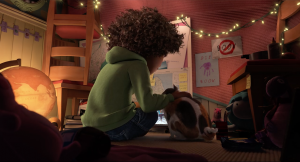
The film hammers the final nail into the proverbial, xenophobic coffin with the concluding message of the film: you are not welcome here unless you adopt our ways. This idea develops through the relationship between Tip and Oh. When we first see Tip, she is watching a video of mom playing in the snow. As the camera pans out, you see tacked on the walls drawings that say DIE BOOV, small Boov cutouts with pins sticking out of their hearts, and a dartboard with a Boov face covered in darts. She thoroughly despises them for ripping her family apart but by the end of the movie, Oh is her best friend. What spurred this transition? The Boovs learned how to be American.

Tip's decorations

Tip’s decorations

Throughout the journey, Tip instructs Oh about Western culture. She explains that animals don’t need to serve a purpose outside of companionship, elements of gender when she kicks him out of the women’s restroom, and the general idea of holding on to hope and persevering through hardship, rather than giving up. But for all that she’s teaching Oh, Tip never bothers to learn anything about his culture. She consistently brushes off all of his attempts to share. Perhaps the most outright the movie comes in revealing this discrepancy is at a moment when Oh tries to play Tip Boov music and she immediately rejects it and puts on Western music. She tells him “If you want humans to not hate you, you could start by liking some of our stuff.” This is a blatant revelation that the Boov, and therefore refugees, will only find a place in society if they abandon their culture and embrace America’s. Tip serves as a model for transition. Her family immigrated from Barbados and she learned to share American ideals. Once she learned how to “fit in” with the American kids, she was “finally happy.” In the end, the refugee Boov must change their entire way of life to fit into American society.

The Boov are dancing at a party with friends, three things they are never supposed to do

The Boov are dancing at a party with friends, three things they are never supposed to do

This is not a new theme in entertainment but what makes it so shocking is its source. “Home” was carefully and meticulously crafted by DreamWorks Animation SKG inc. Jeffrey Katzenberg, president of DreamWorks Animation, is the largest Democratic donor and fundraiser in Hollywood and anyone in the film industry could tell you that his studio reflects that party’s liberal beliefs (Daunt). Heck, anyone who’d watched a Dreamworks movie could probably tell you that. They tend to challenge societal prejudices about marginalized groups and incorporate messages of acceptance. “Home” is a sharp and utterly abrupt departure from that mold. The xenophobic ideology of the film is so unexpected and deeply buried under the guise of inclusivity that it makes liberally inclined people agree to cultural homogenization.

Chaos and Order: Post 9/11 America


the-dark-knight-2

Louis Althusser, a French philosopher writes, “All stories work by doing two things: First, they make vivid some real social crisis (or conflict); and then they provide imaginary solutions to that crisis.” He believes that any story or movie can create an underlying crisis in our society and provide a solution to that problem by providing a solution within the movie. This is very evident in the movie The Dark Knight. Christopher Nolan’s The Dark Knight is a chaos driven movie that shows how the true nature of humans react when pushed to their limits of order. The Joker represents the chaos that terrorism creates through merciless attacks against people and places. Batman, the protector of Gotham, represents the order that is enforced through our military and police force. Batman, dressed in all black, fights crime throughout Gotham and strikes fear into his enemies. The Joker, a crazed psychopath, pushes the people to their limits and forces them to make irrational decisions. The battle between the Joker and Batman is very similar to the United States’ War on Terror. These two battling directly correlates to the U.S. fighting terrorists and how the terrorists influence U.S. citizens. Now I want to pose two points about the movie. First, when all else fails who do the people of Gotham turn to in their time of need? The authoritarian, fascist Batman. Yes, Batman is a Fascist. He runs (and glides) around Gotham under no rules with no one to answer to and delivers “justice” to criminals in the city. The People would rather let an uncontrolled vigilante loose on the streets to protect them than let the men and women of the police force and military do their job. They would give up their rights if it meant they would be safer from all the chaos. The only way to bring order is not by fighting the bad forces with the good, but with other bad forces. And this is why I pose my next point: The Joker is the actual hero of Gotham. Before Joker, Gotham was a mess, the crime mobs ran freely in the streets, police officials were corrupt, and people had little hope. What happened after the presence of the Joker? Everything changed. People needed that chaos the Joker delivered to allow for the order they wanted and so needed. They were willing enough to give up their rights to have to security and social order they desired; sound familiar? (I’ll get to this later). This is because only through chaos can we have order in our society.imgres

Now it may or may not surprise you for me to say that Batman is a Fascist. I mean just look at the guy’s actions. Sure he has one rule to not kill anyone, but that’s it. Is that really the only excuse he needs to do as he pleases? To have to most advanced technology at his disposal, to be one of, if not the most, skillful fighters in the world and not have to answer to anyone makes him a very dangerous person. He acts on his own wishes, does what he wants and does so through fear and intimidation. He has complete control over the city and protects its people by beating criminals to a pulp. And the people allow him. Why? Because they need someone/something that will claim dominance over them. They feel they need something above the law to protect them. The more chaotic it becomes the more power they give him.911-planes

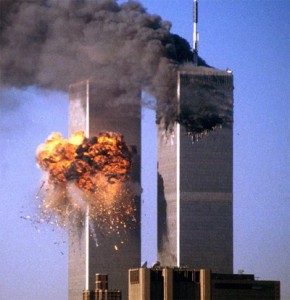
October 26th, 2001, the PATRIOT Act was signed. The act, created because of the terrorist attack on 9/11, was made so the United States was able to fight terrorism domestically and around the world easier and stronger. The act was a tremendous accomplishment for the War on Terror and greatly enhanced the United States’ ability to fight terrorism and keep its citizens safe. But the act also violates many citizen’s constitutional rights. It infringes on their right to privacy, right to a trial, right to free speech and many more. People loved the act so much that they were willing to give up their sacred rights given to them that this nation was founded on. Some people say the politicians who signed the act didn’t even read it. They were so desperate to end terrorism that they didn’t care what the costs would be as long as it would make them safer. The act has authoritarianism written all over it. It gives the government complete control when dealing with terrorist attacks and pretty much says they can do whatever they want to stop them from happening. And it works. The country is much safer than it was before the 9/11 attacks. National defense has improved, flying on airplanes has become much safer, and the government is keeping a much closer eye on possible terrorist attacks. The more of a threat the terrorist seemed to be the more power the people gave to the government. This authoritarian piece of law keeps the United States’ and its citizens much safer from attacks and maintains order within the country. And what was the cause that created this document? The terrorist attacks. Without them, this document would’ve never been passed.

Now I’m not saying to thank the terrorists for killing over 3,000 people in one day. I’m simply saying that without that event the PATRIOT Act would’ve never been signed and we wouldn’t be as safe of a country. Without the terror that filled every American that day they would’ve never felt the need to improve their security and push for better defense. The terrorist created chaos in a country that was already having trouble. It is very similar to how the Joker’s chaos led to a safer Gotham.

dark-knight-joker-560

Before Joker arrived, organized crime ran free, corrupt police infested the system, the city was in worse shape than ever, people didn’t feel great about living there. Now, you might say the Joker was a twisted, evil-minded psycho that killed for fun. He created chaos throughout the city and made the people do things they wouldn’t normally do like try to kill a man who knows the identity of batman so the Joker wouldn’t blow up a hospital. He killed plenty of people and seemed to have no motivation except to create chaos. But who was the majority of the people he killed? Mob bosses, bank robbers, corrupt city officials. He practically wiped out the city’s crime problem all by himself. He took out almost all head mob members, and the ones he didn’t kill he brought under his command. He both exposed and killed many of the corrupt police officers. And at the end of the day, the spirit of Gotham’s citizens was brightened. He did more in a few weeks than Batman was able to do the entire time he fought crime. Although he constantly said he didn’t have a plan, that he “just does things”, it’s a complete façade. He has a very calculated plan throughout the movie and executes that plan perfectly. From the first bank robbing scene to wanting to get caught by Commissioner Gordon. Everything he does is with purpose and it is with this purpose that he was able to accomplish all his goals. It was only with the Jokers chaos was Gotham able to have peace and order. So in this sense the Joker was much more successful in improving Gotham than Batman ever was and is, in some sense, a hero to Gotham. He was hero they needed, but not the one they deserved.

Going back to post 9/11 America, we see a very different America than we saw before the attacks. The attacks woke a sleeping giant. American military force woke up and deployed overseas to combat terrorists. Back home American pride grew and was much stronger before the attacks. The Bush administration took control of the country and gained power through the citizens to combat the War on Terror. They gave the government the power to do what was necessary to keep them safe. They pretty much gave the government unlimited power to do as it wants. Through this, the government was able to combat terrorism and a scale they weren’t able to do before and greatly increased the level of security in our country, which is still apparent today. It was because the terrorist creating chaos that America became a much safer place and a much prouder country for standing up to terrorism. The acts of those few terrorists on that one day, changed America forever. They were the ultimate reason for America being the way it is today.

dent-batsignal_zps3ed9d88dSo how did the Joker create so much good through such bad actions? It’s the same way Batman couldn’t create good through doing good; he, in some sense created bad. Batman was never a hero of Gotham; he was just whatever they needed him to be. Like Alfred said many times throughout the movie, he was able to make the decisions that no one else could. He tried to inspire a city by showing that common people can stand up and rise above the ordinary to make the city a better place. But the reason he failed was because you can’t fight bad with good; you have to get your hands dirty. This is why the Joker is so glorious in establishing order. He knows Batman’s technique will never work, he knows that the only way to stop the crime in Gotham is to plunge the city into chaos. He shows the city of Gotham what real anarchy looks like, they experienced the terror he brought on them, and they came out a better people and a better city. You have to fight fire with fire, chaos with chaos. And it is only through chaos that we can have established order.
When people are pushed to their limits, on the verge of death, or in the face of chaos, their true nature comes out. They show who they really are. In Joker’s ferry experiment, the people, and criminals, of Gotham show their true nature. When evacuating the city, the city loads two ferries to leave Gotham; one with criminals from jail, the other with civilians. As part of his plan the joker rigs the boats with explosives and gives them each the detonator to the other ship. He tells them if one boat switches the detonator to the other boat that boat will live (they only had about thirty minutes to decide). The movie switches between the two boats and shows how at first the passengers want to pull the trigger right away. But they can’t decide what to do. The boat with the civilians takes a vote, which ends up being an overwhelming amount in favor of detonating. But no one can do it. When finally, one man volunteers to do it, he gets up, walks over, takes the detonator out the box, holds it in his hand, puts his finger on the key…and freezes. When on the brink of taking hundreds of lives, putting his beliefs to the test, he couldn’t do. He showed that at his core, he wasn’t a killer. Even on the ferry of criminals, one man stood up, took the trigger and threw it out the window. This goes to show that even in the city’s darkest hour, when everyone thought all hope was lost, the people showed that they are better than who they show. That deep down, they are not all as ugly as the chaos they were thrown into. It was through Jokers actions and him pushing them to their limits that he was able to bring out the true nature within them, their good and belief in each other.

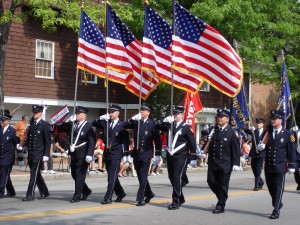
memorial-day-parade-with-flagsWhen the 9/11 attacks occurred heroes were born. In one of the darkest hours this generation has seen, the common people of America rose up and became part of something greater than themselves. The first responders showed the courage within themselves to help protect and rescue the civilians in harm’s way. Regular citizens too rose up to the call, and instead of running away, ran into the flames or chaos and helped those injured from the attacks. It is in these times of great duress, brought upon by an outside force, that humans show their true colors. It is only through chaos that people see who they really are. This chaos shows the flaws in systems, the injustices hidden, and the good within. The Dark Knight shows us that only through chaos is order able to be established in our society. It shows how the 9/11 attacks, though were a terrible event in our nation’s history, ended up creating good in our society and created a safer nation.
Human Perfection in the Midst of Cannibalism

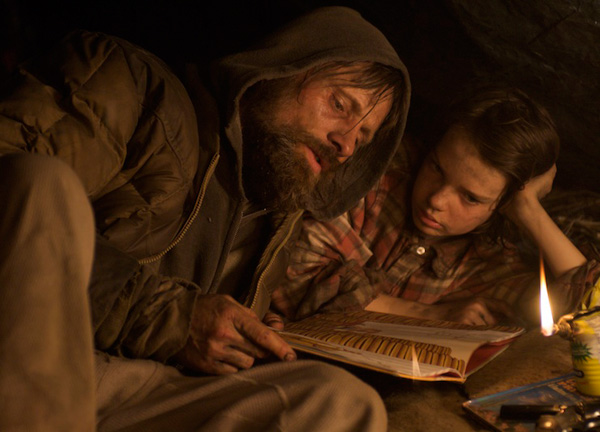
the-road-la-carretera-004

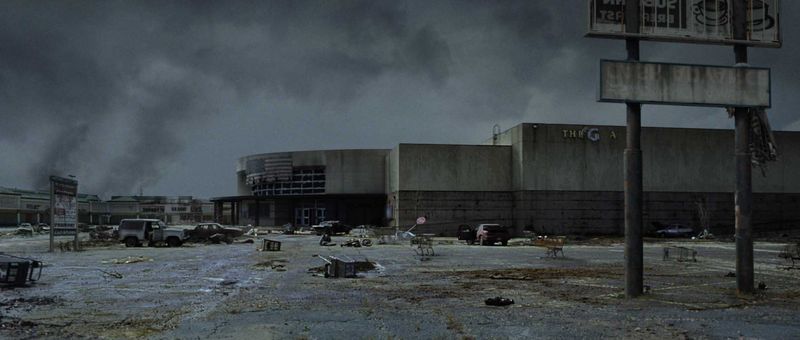
The land was gullied and eroded and barren. The bones of dead creatures sprawled in the washes. Middens of anonymous trash. Farmhouses in the fields scoured of their paint … all of it shadowless and without feature. A marsh where the dead reeds lay over the water. Beyond the edge of the fields the sullen haze hung over earth and sky alike. (McCarthy 177)

Lengthy descriptions such as these are frequent in Cormac McCarthy’s The Road, and comprise the majority of the novel’s content. So, in response to passages like this one, many readers are justifiably led astray to think of the work as simplistically hopeless and forlorn, and lacking in real depth or worth. One reader and online reviewer even summed up the book as follows: “A boy and his father travel south in a post-apocalyptic United States, then the father dies” (Sullivan). Despite what this summary suggests, I find that the novel actually strives, through somber description, to make us discover the vein of goodness that runs deep in its story. A tale riddled with desperate wandering and repulsive human acts, this books exposes the goodness in humanity that we, as humans in the modern world, attempt to rediscover, or even create, in our similarly troubled everyday lives.

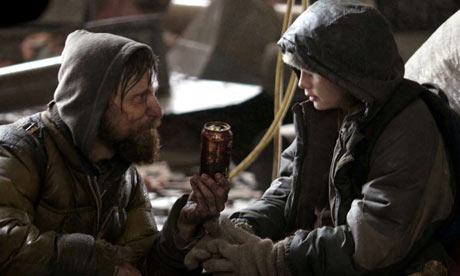
The tale follows a father and son’s journey through the vast expanse of an unspecified, post-apocalyptic world. The man’s son is all he has left, and it is clear from the very onset of the novel that every action the father takes is for the betterment of his son’s life, character, and humanity.  McCarthy clearly portrays the man’s selfless objective through the father’s actions towards and teachings to his son. Although there are several instances in which the father demonstrates his deep desire to better his son’s life, the earliest instance of this occurs when the father finds a can of Coca Cola and hands it to his son. McCarthy writes this of the scene:

What is it, Papa?

It’s a treat. For you … Go ahead, he said.

The boy took the can. It’s bubbly, he said.

Go ahead.

… You have some, Papa.

I want you to drink it.

You have some.

He took the can and sipped it and handed it back. You drink it, he said. Let’s just sit here.

… Okay, the boy said. (McCarthy 23)

d87e6f38-5694-471f-82a7-c44b9b7665f4

Acts of kindness such as these, all the more powerful and striking in the post-apocalyptic context of the novel, contrast distinctly with the cruelty of the greater world surrounding the main characters. Most importantly, they are difficult acts to demonstrate in the world is so different from the one the father knew. And although the son does already seem to possess some level of innate altruism, as seen by his returned generosity with the drink, and the father undoubtedly examples selfishness at times, I argue that the father maintains a continuous role of moral teacher by becoming responsible for the instillation of rationality, that I will further explain later.

Furthermore, it is important to note that throughout this entire work McCarthy writes the story and actions of unspecified characters; neither the boy nor the man are ever named. They are never described. They may easily be any and every man or child. Additionally, the story’s third-person voice makes moments in which, the author directly addresses the reader, in lieu of the father, especially clear. The multitude of instances where McCarthy breaks this fourth wall suggests the author’s aim to be a foil of sorts to the father, and, in this way, make the reader a parallel of the son. By then establishing this real relationship beyond the pages, McCarthy actually relays the father’s wisdom, as the fictional character does to his son, to the reader.  The reader becomes the recipient of the father’s moral lessons – at times even being substituted as the father – and it becomes clear that McCarthy’s true intent is to inspire readers to act selflessly even in the face of dire situations, and to desire that their children do as well.

One of the most important aspects to the father’s goal of instilling positive characteristics in the boy is reminding him that they “are the good guys” (McCarthy 67). Continuing the previous interpretation of subject ambiguity, good guys are to be taken as people who resist the loss of not only hope, but cultural/societal knowledge as well. The father portrays this when he alludes to the old world’s explicit customs, an event seldom seen, but in which there are distinct attempts to preserve old ways:

He’d carved the boy a flute from a piece of roadside cane and he took it from his coat and gave it to him. The boy took it wordlessly. After a while he fell back and after a while the man could hear him playing. A formless music for the age to come. Or perhaps the last music on earth called up from out of the ashes of its ruin. (McCarthy 77)

When the father passes on these ways of the past to his son, of how to make music, of playing card games, of not resorting to cannibalism no matter what, his son is made better and distinct from the “bad guys” for having learned and kept more of the past, suggesting the notion of “good” being retention of the past (McCarthy 67). McCarthy furthers this notion by utilizing comparison to the positive connotation of music – the high, soft notes of a flute – in a way that creates appreciation for the opportunity to carry a remnant of the past into “the [coming] age” (McCarthy 77). And it is when the boy’s music is thought to be the last that will ever exist, that the past is depicted as a ruin covered in ashes. By viewing the father and son as simple representations of necessary teaching and change across generations, this imparting and receiving of knowledge is indicative of the now commonplace role of family and schools, and their “wordless” exchange.  Although some readers may point out that the boy later throws away the flute, and thus the knowledge given to him, the actions of the boy do not alter the hope and necessity the father felt in providing the boy with the opportunity to preserve the knowledge of the past. The boy’s later action stuns the father, so it seems clear that it is neither expected nor wanted and actually supports the claim I make here – that McCarthy pleads us to find gratitude for the past and the envoys for its proliferation, if only because family and school keep beauty and human knowledge in our world. But those envoys do not do so alone.

The father has become their aid, taking on the role of both the family and the school, the singular entity that can provide his child with what he needs to be moral and human. Again, the notion of each character representing separate generations comes into play when interpreting this peculiarity, of dual roles that are split with fervor in today’s society. In this case, the past generation becomes responsible of assuring that the most essential of knowledge, the most important facets of humanity, are passed down into the new generation. This may be most explicitly stated in the symbolic “fire” of goodness that the boy imagines the father to be holding throughout the entire novel (McCarthy 129). It is only in the father’s dying breaths that the son takes the fire, by finally understanding its significance and true nature:

You have to carry the fire.

I dont know how to.

Yes you do.

Is it real? The fire?

Yes it is.

Where is it? I dont know where it is.

Yes you do. It’s inside you. I can see it. (McCarthy 278-279)

The boy has by this point associated the fire to whatever keeps them alive and “good”, from the father’s survival skills to his opposition to cannibalism, and in this moment those essential facets of being human are passed down. The father acknowledges s that he has given what he can, and he has brought his son closer to human greatness by ensuring the passing down. Ultimately, McCarthy tells the reader, “You, as what will become the past, are the most important factor in giving the next generation a head start towards human perfection.”

the-road-movie-image

The “fire” inside the boy – the goodness, humanity, and knowledge within him – that the father keeps alive must be protected and fostered because it is what makes life worth living, especially in the toughest of times. When readers allow themselves to be receptive without criticality, the novel provides lessons of morality that lead us to an understanding of what offers a head-start on the path to universal human perfection. It is important to study great works of art, and especially great works of literature such as The Road, because they give you a head start on the path of human perfection without raising readers to the defensive. They help make you fit for a humane existence, and help you plan out a life worth living.


The Road. Directed by John Hillcoat, performances by Viggo Mortensen and Kodi Smit-McPhee. Icon Productions, 2009.

McCarthy, Cormac. The Road. New York: Alfred A. Knopf, 2006. Print.

Sullivan, Robin. “A Review of the Road.” Goodreads, 31 Jan. 2009, http://www.goodreads.com/review/show/35257193?book_show_action=true&from_review_page=1.

Finding Ideology

Finding Ideology

Tristan Colaizzi

Have you ever seen Finding Nemo? Were you ecstatic to hear that Finding Dory was hitting theaters? Do you have more lines memorized from The Emperor’s New Groove than you do of To kill a Mockingbird? So does our entire generation. When I was a kid Finding Nemo was the first movie that I saw in theaters, and after that I watched countless Disney movies from Lelo and Stitch, to Ratatouille, to The Jungle Book. From those movies I could quote countless lines, sing songs by heart, and reenact many scenes without a second thought, but if you told me to quote To Kill a Mockingbird I would be at a loss for words. So my question is, what shaped me more? What has molded my generation into who we are today?

To answer that question we must look at what actually shapes a child. In a study done in 1962 by Albert Bandura, it was found that a child is significantly more likely to change their moral judgment if presented with a model that displayed a different moral judgment from their own. In other words children are shaped by seeing other individuals act and react with the world. But how does that relate to Finding nemo? It does in one very important way: Disney is the model that children grow up seeing. It is the model that has shaped an entire generation almost every day of our lives through movies like Finding Nemo. One might say, yes we did watch those movies as children, but we also went to school and spent time with our parents, and I can’t refute that. What I can say is that in all the time you spent in school, were you ever exposed to as many stories, with as many conflicts and as many solutions as you were with Disney? In an article released in 2015 from BBC it was found that children spend on average six and a half hours in front of a screen every day. School is usually seven hours a day, five days a week, so from a purely mathematical perspective children really do spend more time on screens. I understand that this time is not all spent watching Disney movies, but they still are a big part of a child’s experience. Disney simply gave us as children more examples of how people interact in the world than we could have ever received from sitting in school reading To Kill a Mockingbird, and the stories that we saw from Disney were far more memorable than those from school. All this is to say that, Disney has created an ideology that we all follow, and that ideology screams throughout Finding Nemo.

The first question that we must answer in order to understand the Disney Ideology is who is the audience in Finding Nemo? Now this may seem like an easy question to answer, that it is simply whomever is watching the movie, and that is true, in the sense of the physical person sitting on the other side of the screen, but the audience is actually created by Disney. Finding Nemo for those who are not familiar follows Marlin, a clownfish, on his quest across the ocean to find his son Nemo. Not to spoil the movie, but Marlin with some help from his new amnesic friend, Dory, ends up Finding Nemo. In the opening scene, Marlin is enamored by the beautiful middle class country style home, or rather anemone, he has obtained for his wife Coral, so much so that he exclaims “a fish can breathe out here.”  By exclaiming “breathe” Disney does two things: first it asserts small coral fish as humans, and second, it names Marlin’s family as a middle class suburban family living a comfortable lifestyle. Not convinced? Well Coral then points out how nice the neighborhood is, as we see adolescent fish swimming around playing joyfully together. If you still don’t get it, watch the movie, or at least the opening scene) From this opening scene we know, and any child watching would know, that Marlin is the “good guy”, the fish whose eyes we will watch the movie through, and whose emotions we will side with. The thing is, Marlin is the white middle class American, and that is the audience that Disney has created, regardless of who is literally watching the movie. Now some of you I’m sure are thinking, Hell no, you can’t assume that he is white. That’s a fair point until you look at how other fish are portrayed.

The first fish we see that is not from the coral reef is a barracuda. He is menacing, much bigger and much darker than the bright clown fish. He approaches from the ocean with a growling noise and a sharp set of teeth that snap in Marlin’s face, before he kills Coral and all but one of Marlin’s children, Nemo. Hold on to the snapping teeth, we will come back to it. Now it might seem counterintuitive, but I am going to suggest that the open ocean is representative of the ghetto in a city. When I hear the word ghetto the first thing that comes to mind is a poorly lit street, with one light flickering on and off on a dirty block of close quartered dilapidated townhouses. The ocean is obviously the opposite in its grand size, but it fits the bill everywhere else. It is much darker and clearly dirtier in the clarity of water as depicted by Disney. Perhaps the most key thing to note is where it is geographically compared to the coral reef. There exists a clear separation between the two, and a physical barrier called the “drop off” separates the unknown dangerous ocean from the safe coral reef. The ocean, or ghetto, is literally a drop off in quality of life compared to the coral reef, or suburbia. It is where the “other” lives. Just like in real life the individuals that stereotypically live in the ghetto are physically darker and perceived as bigger and more dangerous.

So what did Finding Nemo teach you and me to think, or rather what political agenda is Disney pushing? I’m not going to answer that yet because we must first further our understanding of the “other” beyond the fish on the other side of the “drop off.” This may seem to contradict itself at first but bear with me. The second type of “other” in Finding Nemo are humans. Their foreignness is all in the subtleties in how they are presented. The first human we see rises from below, wearing full scuba diving gear. His face is unrecognizable, looking more like a green and black monster than a person at all. There is even ominous music to accompany his entrance and therefore perception as evil and powerful. The Humans come in and take whatever they want from the reef, including Nemo, by overpowering all of the fish. The question therefore is what do they represent? To answer that I’ll turn our attention to the next time humans enter the movie, a dentist office. I don’t know about you but pretty much everyone I have met hates the dentist office, if you disagree then you’re either insane or have never been to the dentist, in which case, Go! Dentist offices are simply a horrible place to be, they don’t make you healthy like a doctor, but they go in and drill your gums to pieces, what a perfect profession for Disney to choose for their villain to turn humans from siding with our own species, to siding with a clownfish. In short, we hate this powerful evil massive monster that takes what he wants from the coral reef fish, the middle class, but that is not a political agenda Disney is pushing, because it’s not really a political agenda. What Disney is pushing is a Marxist revolution. That may be a big jump from us not liking the dentist, but let me fill in the gap. To do so I will take us to the end of the movie, once Nemo has been found by Marlin and they are all ready to go home. At this moment a fishing boat, trawling with a massive net to catch a school of grouper, scoops up Dory, Marlin and Nemo. Nemo is able to unite all the fish in the net, who are approaching death to all swim down and break free of the net by snapping it. To me that sounds like a revolution, but what makes it a Marxist revolution? Well if you think about what the humans represent, a powerful machine that takes from the middle class, then you can see how revolting against their industry by releasing fish, food, back into the ocean is really a massive redistribution of wealth, or in this case life. If that doesn’t scream Marxist revolution, I don’t know what does. Look, I know someone is thinking that it’s just a commentary on the environmental harm caused by trawling, and maybe it is, but you cannot deny that there is a political agenda being pushed here, to revolt against the big powerful monsters that take everything from the middle class American.

I told you we would come back to the snapping teeth so here we go. There are three different categories of living creatures in Finding Nemo: Good fish like Marlin, who we categorized as middle class, menacing snapping fish, the first “other,” which I think we can call minorities, and humans, who we just classified as the government or second “other.” Let me clarify the first “other” with two additional instances on why we can call this group minorities, and what political agenda Finding Nemo is trying to push about them. The first instance is a convoluted interaction when Marlin runs into Bruce the shark. Just like the barracuda Bruce introduces himself with an aggressive snap of his teeth after coming onto the screen with a big bloody smile. Bruce fills every stereotype of a minority from the ghetto in his first few seconds on the screen. He is physically darker, clearly dirtier and so on, but then he says ”fish are friends not food.” Bruce befriends Marlin and Dory, which would argue that there is hope in the minority class. That there are good individuals, who break their stereotypes. I urge you not to jump too quickly to that conclusion, because if you continue to watch this scene play out, Bruce smells Dory’s blood and reverts back to his stereotypical behavior of killing. The setting of the phrase “fish are friends not food” is as important as the phrase itself. The sharks are in an Alcoholics Anonymous type meeting, which is quite interesting because it suggests that they are trying to get over an addiction to killing fish. By framing the sharks this way Disney is suggesting that the actions of minorities are a twisted addiction they should try to get over. The dimensions of this addiction doesn’t stop there. If the sharks don’t kill fish, then they are killing nothing, meaning they are eating nothing. If the sharks are not eating anything then they are dying. So if Disney is pushing any agenda it is that minorities are fed by harming the middle class.

The second place where Disney’s agenda becomes clearer is in the following scene. If the Sharks weren’t bad enough Marlin and Dory must dive deep into the darkness of a trench, where they confront a light. The light is like a flickering streetlight in the ghetto. It lights up part of the unknown darkness that Marlin and Dory have found themselves in, but it doesn’t do enough to show the whole picture. In fact the light is the antenna like appendage sticking out of an angler fish, who uses it to draw fish in and then kill them with one bite from their even more menacing set of teeth. Now just apply that image to the ghetto and I think you get the point that I am trying to make, this movie is not about a dad trying to rescue his son. It’s about Disney pushing a political agenda for the middle class white American to continue to fear minorities.

To explain how all of this translates to Finding Nemo and Disney at large creating the ideology of our generation I really don’t think I need to do that much. On the surface Finding Nemo really is just a fun family movie, it has some nice morals and a little bit of bathroom humor, who wouldn’t want to watch it. But Finding Nemo really is a piece of political propaganda under a seemingly unpolitical family movie façade, and that’s why it is successful. No child watches this movie and thinks, huh now I know to be afraid of minorities and revolt against the government. But it is the ideology that they are infused with.  It is the generation who grew up watching Finding Nemo and Disney who might elect Donald Trump as President, a racist bigot who constantly preys on minorities. It is our generation who almost gave Bernie Sanders the nomination so he could radically redistribute wealth away from the rich and into the hands of us, the middle class. It is not a stretch, all you have to do is look up to see that we internalized the political agenda that Disney gave us. We accepted their ideology.

Althusser, Louis. Ideology and Ideological State Apparatuses (Notes towards and Investigation)     (La Pensée, 1970. English Translation: Lenin and Philosophy and Other Essays, Monthly    Review Press 1971)

Bandura, Albert. Social Learning through Imitation. (Lincoln, NE: University of Nebraska Press,            1962)

Wakefield, Jane. Children spend six hours or more a day on screens (BBC News, March 27th         2015) http://www.bbc.com/news/technology-32067158

Disney. Finding Nemo (Disney, Pixar. 2003) http://www.imdb.com/title/tt0266543/


An Imagined Solution to a Real Problem: Political Correctness and South Park

Trey Parker and Matt Stone have something important to say – something that might be somewhat difficult and uncomfortable to come to terms with. Something that throws a wrench into a certain line of thought that claims to devote itself to the fair treatment and well-being of all people. That is to say, a movement that might be called “Political Correctness,” or “PC,” has the ability to be morphed from a well-intended attempt at inclusivity into something with sinister undertones. In the minds of Parker and Stone, PC commodifies and hurts the very people it aims to help and deprives those who partake in it of autonomy and free thought.

This point reveals itself in the 19th season of the animated series, South Park, in the way that the show makes vivid a real social crises and then proposes an imagined (and flawed) solution to that crisis. Season 19 tells of South Park’s attempt to reshape its image from a vulgar and intolerant town to one that is inclusive and, in the show’s own words, PC.

Image result for south park season 19

South Park season 19 DVD cover

Perhaps the show presents Political Correctness as the solution to the issue of social injustice. PC Principal is ushered in as the new principal of South Park Elementary to reform it into a more tolerant school after someone made a rape joke (the show would later reveal that it was Mackie, the counselor, who made the joke). Kyle, one of the central characters, is excited for these changes, saying he looks forward to South Park becoming a place “where people can begin to have a dialogue.” While Political Correctness is displayed as having its faults – its most ardent followers are college-aged white males who live in a fraternity house together and are prone to prioritize women and alcohol over social justice – these faults are mostly worked through by the end of the season, and South Park is a happy town that embraces PC ideals.

The idea that PC is the imagined solution to the real problem of social injustice, however, is a red herring. If one looks deeper, PC culture itself is presented as the real social crisis in need of a solution. It all starts with the demographic of those partaking in PC culture. It is very curious that none of the people partaking in this PC culture are a part of any of the marginalized groups that they claim to defend. This leads to an interesting issue when PC Principal tries to indoctrinate Jimmy, a physically handicapped student, in the ways of Political Correctness. This is problematic, since there is no way PC Principal knows more about being handicapped than Jimmy does, having not actually had this experience himself. It becomes evident through this exchange that PC Principal cares more about his own smug sense of satisfaction that he gets from pointing others’ transgressions out to them than he cares about actually achieving positive social change. The relationship between PC and marginalized groups then, is not that of a protector and the protected, like it might seem to be at first glance, but something else.

The PC frat house  during a party. All the members are straight white males (Source: southpark.wikia.com/wiki/PC_Delta)

But what, then, is the relationship between PC culture and those it claims to defend? Parker and Stone use several instances throughout the season to suggest that this relationship that of a consumer to a product. Take for example the episode “The City Part of Town,” in which the people of South Park try to get a Whole Foods (which is used here as a symbol of PC culture and of gentrification). The grocery chain sends a representative who asks to visit a classroom. In the classroom, a handicapped child and an African-American child – who is by no coincidence named Token – are conspicuously displayed in the middle of the front row. If one pays attention to other depictions of the class without the Whole Foods representative, one sees that this is not the normal seating arrangement. So we have two people who are part of the marginalized groups that PC culture claims to defend being used as commodities or bargaining chips to push PC’s own agenda to get a Whole Foods, an agenda which is harmful to one marginalized group – the poor – in particular, for reasons that will be discussed later.

This consumer/product relationship is further fleshed out in the episode “Tweek x Craig.” When rumors start of a gay relationship between Tweek and Craig start, the entire town wants to show its support. The way that the people of South Park do this is by giving the two supposed lovers money. When the two face disciplinary trouble for fighting, PC Principal refuses to punish them because they are gay, and instead sends them home with $100 each. This puts a price tag on the identities of Tweek and Craig, showing how those who are PC act as consumers and commodify marginalized groups. Viewed this way, PC culture is more about the fulfillment of the egos of those who practice it than it is about social change, since giving money to gay couples does little more than make the donors feel good about themselves.

Another way that PC is depicted as a social crisis is that it brings with it gentrification. Early in the season, the run-down part of South Park is renovated as a revitalized arts and foods district called Sodosopa (this includes the aforementioned Whole Foods). This district is built up around Kenny’s old, derelict house, which is left standing with Kenny and his family still living in it. This is an example of further commodification by PC culture of those it claims to defend, since Kenny’s house is advertised as a novelty, a remnant of the past – to bring more consumers to Sodosopa. Any contentment that Kenny and his family had with their small, private home was lost as they were forcefully thrust into the heart of the busiest part of town as something not unlike a carnival attraction. Kenny represents one of the groups that PC culture claims to defend: the poor. In the case of Kenny, the wants and needs of the poor are ignored in favor of PC’s own selfish wants.

Image result for Sodosopa

Sodosopa, South Parks gentrified arts and foods district, with Kenny’s house, center (Source: http://wiki.southpark.cc.com/wiki/Sodosopa)

Related to gentrification is perhaps the most significant way in which PC is a social crisis: it leads to a loss of autonomy and free thought. While hints of this phenomenon are evident throughout the season – PC Principal turns to physical violence to repress people who say politically incorrect things more often than he has a dialogue with them – its most notable instance is in the development of a conflict between PC culture and sentient advertisements. These advertisements look and talk like people, and ultimately have an agenda to gentrify the human race to extinction by making necessities too expensive to afford.

Before looking into what this conflict means, it is important to realize the function of advertisements in our day-to-day lives. The job of advertisers is to make you, the consumer, buy their product. Through methods like catchy jingles or marketing to impressionable young children, advertisements deprive consumers of autonomy.  More often than not, the products you decide to buy are based more on the quality of the ads you’ve seen than the quality of the product itself.

So it should say a lot about what Parker and Stone think of PC when the ads manage to push their agenda on the back of PC culture by taking advantage of the fact that the two are nearly indistinguishable. One character, Nathan, explicitly states the similarities between ads and PC: “what is PC but verbal form of gentrification? You spruce everything up, get rid of the ugly in order to create a false sense of paradise. Only one thing could live in that world — ads.”  Ads and PC function in the same way and have the same agenda: they both deprive people of autonomy and seek to do away with the ugly and leave the pretty.

So Parker and Stone depict Political Correctness as a social crisis. What, then, is the imagined solution to this crisis? The solution starts with Mr. Garrison, a proxy for Donald Trump. Garrison gets angry at the influx of illegal immigrants from Canada in South Park early in the season, and he kicks off a political campaign based on the idea that the illegal immigrants should be “rounded up and f*cked to death.”

Image result for mr garrison fuck them all to death

Mr. Garrison on the campaign trail. Garrison’s hat and the “Make America Great Again” poster, right, are meant to draw a comparison to Donald Trump (Source: southpark.cc.com)

It might be tempting to call Mr. Garrison anti-PC, but this is not quite the case. When one considers that his running mate is Caitlyn Jenner, whom the Politically Correct consider to be “stunning and brave,” the question of why Parker and Stone made the decision to pair these two arises.

The answer to this question lies in the show’s depiction of Jenner. The viewer is not allowed to forget about the time she committed a hit and run – she runs a person over (and presumably kills them) with a car in every episode that she appears in. This shows that despite being the object of PC culture’s affection, she is still a bad person. Furthermore, there exists for Garrison and Jenner a physical removal from PC culture, since the two leave South Park to campaign for most of the season, helping to put them outside the sphere of PC culture altogether.

Image result for south park caitlyn jenner hit and run

Caitlyn Jenner hits a pedestrian every time she takes the wheel in season 19 (source: dailymail.co.uk)

When Garrison and Jenner return near the end of the season to help fight the advertisements, the two take on the role of protagonists, by virtue of the fact that they help to save the human race from extinction. In the very end of the season, Jenner and Garrison team up with those who are PC, and all the people of South Park decide to shun gentrification and pursue a continuing fight against the ads emphasizing human unity.

Parker and Stone are caught in a moment of fantasy here. They made the viewer cheer for a rapist and murderer, then implied that the solution to PC culture’s flaws is to be inclusive of them. This solution is problematic: The fact that no action was taken against Garrison and Jenner, both of whom committed murders, is disappointing. The implication is that criminals should be allowed amnesty without any consideration – that everybody deserves inclusion. Furthermore, recalling that Garrison is a proxy for Donald Trump, this might be seen as an implicit endorsement of Trump (recall that season 19 was created during the primaries). This is an noteworthy if for no other reason than that South Park is often seen as dismantling ideology rather than displaying it.

Despite Parker and Stone’s unsatisfying solution to the problem of PC culture, there is a hint of a better solution that exists in the South Park school newspaper, for which Jimmy is the editor. Jimmy refuses any sponsored content (i.e. ads), and the paper seems to be a place of legitimate discourse, providing a place for the dialogue that PC culture promotes but does not provide. There is little censorship, which runs contrary to the deprivation of autonomy by PC culture. The South Park school newspaper is a much better alternative to PC than that proposed by Parker and Stone. Perhaps the real answer to PC culture lies in having a no-holds-barred civil discord about the very real social problems that are faced by groups of people.

We Got Both Kinds: Rap and Country

“We got both kinds. We got country and western” (The Blue Brothers). A classic line from a classic movie. The joke of course is that country and western are almost one genre. If not almost one genre, they just flat out are one. The movie from which this quote comes was made in 1980, a long time ago for popular culture. By the time of the movie The Blues Brothers, country and western music had fully transformed from separate, regional entities into one conglomerate. Who is to blame for this merger? Hollywood of course. Producers wanted to promote the dying image of a cowboy using music that sounded to them close enough, so they combined musical styles from the western US with Appalachian styles in the “singing-cowboy” genre. Country-western was born. But enough already about the glory of the olden times, of actors who are long dead or significantly overweight. (Yes, that was the fate of the Blues Brothers.) Those times are long gone. The eighties are over. Before leaving the olden days, however, one question remains? Could a similar event happen again? The world is a different place now. Hollywood’s cowboys of the silver screen endured a mass extinction around the year 2000, and even their deaths were well after their heydays. The southwest is now, one would at least hope, no longer an empty patch of desert administered by the mafia. The question still remains: can history repeat itself? Will the events that befell the regional styles of country and western music happen again? Will two different styles come together to form a conglomerate genre? The responses to these questions would have to account for modern twists.
bluesbrothers

First for a brief history of country music. Country music originated in Tennessee in the 1920s. Over the years it merged with other sounds including western and rock to form a new style called country but with original country having a minority influence, much like how United and Continental Airlines merged to form a new entity called United even though Continental management retained a controlling stake. After starting to come closer to pop in the 1980s, country became a sensation in the 1990s before leaving the Appalachian mountains in the early 2000s. Country began to make its way to big producers on the West Coast. This merge allowed country stars to transition to pop stars. Think Miley Cyrus and Taylor Swift. Cyrus even acknowledge it herself with her single “Party in the USA,” claiming that her life in Los Angeles was “definitely not a Nashville party.” She was right, and country music as a packaged industry was born.
Now to change styles and discuss what many people consider to be one of the most sophisticated and artsy forms of music: rap. Rap as a movement began in the 1980s as a style created mostly by artists trying to be different or independent. Even well into the 1990s, rap producers were generally regional and outside of mainstream music production. Rap and its creation were off the grid. Rap was a style that could not be emulated by Hollywood, by big companies. Many rappers were furious when the first major executives began working with rap. O’Shea Jackson, commonly known by his stage name Ice Cube, wrote “No Vaseline,” a song deploring rappers who worked with large production companies. By the end of the decade, however, rap began to undergo major changes. The 2000s ushered in an era of rap produced by large recording studios offering lucrative contracts. Unlike country music, rap did not move far physically, but socially it changed enormously. Rap as an industry was born.
At this point it is time to zone in on one artist. One from a place that is not the birthplace of either country or rap. One from the metropolis of St. Louis, Missouri, home of the famous St. Louis Arch. Cornell Haynes, or Nelly, began his career as a musician around the turn of the millennium. His debut album Country Grammar included the song “Ride Wit Me,” which was later released as a single. “Ride Wit Me” is a little bit more laid back sounding than most rap songs before it. There is less anger, less anxiety, less haste. It still has a noticeable beat and a definite rhyme scheme, but the hard edge is gone. The slow guitar in the back, it almost sounds like… country. Somehow rap and country music wove themselves together. Unlike country-western, country-rap is not considered to be one genre, but country and rap can, as demonstrated by Nelly, come together. Somehow, in this song by this artist, country and rap became the same.
Looking back at the histories of country and rap, the timing makes sense. Both styles became mainstream around the same time. Close to the year 2000, country and rap moved from the status of local style to that of global, mass-marketed phenomenon. With similar timing come similar environments and similar people. Executives saw both genres at the same time and were willing to combine them. The blur of the line between country and rap happened the instant someone with money, power, and the willingness to mass-produce became involved.

nelly_featuring_city_spud_-_ride_wit_me_cd_cover
Mass-production caused the merger. Mass-production created the sameness. Mass-production is by its very nature hegemony. The concept of mass-production is that everything will be the same. All items that come off the assembly line will be identical. This concept works on two levels. First all copies of a single type of object will be the same. All iPads, all ethernet cables are exactly the same. Second, everything is made in a factory, either metaphorical in the case of music or literal in the case of objects, which means everything is created using the same methods of production. Items created using the same methods of production tend to be similar. A motorcycle and a car have similar types of engines because they both use the type of engine that is best mass-produced. The company Achates Power recently tried to fundamentally change the design of the car engine because it would have been more fuel efficient and less likely to break. The idea never caught on because the new engine design was non-trivially harder to produce cheaply in a factory. Music functions the same way. The type of music needs to be able to be created on a mass scale. Because the methods of production of country and rap music became the same, the styles did as well.
In combining country and rap, Nelly may have been a visionary. He took two styles and out of them created one the world had never before heard. The merge of country and rap was an invention, it was an epiphany. “Ride Wit Me” added to cultural growth in making a new form of music, one that included elements from geographically and socially diverse areas. The combination of country and rap was ingenious. It required creativity to be able to blend both style in a way that sounded cohesive and appealing. “Ride Wit Me” was a work of genius. A new style and a new sound are not everyday occurrences, and the harbinger of this new genre truly encapsulated the ability of new culture to be born.
Except that “Ride Wit Me” may not have been the new culture it was promised to be. The merge of country and rap did not take genius or creativity. The major producers can turn anything into a new style in their sleep. If their own talents fail, producers have computer programs to determine for them which new styles to create and explore. Skill and talent are not involved in the creation of a new genre such as country rap. The two styles are not from geographically diverse areas. Nelly’s music was not a combination of Compton and Tennessee, it was a combination of mass-market production and other mass-market production. Two sounds can combine by being played at the same speed at the same time. “Ride Wit Me” is an example not of a new style but of one that was destined to be created from the day that rap and country both became nationally marketed commodities. New culture was not born. Culture shrank. Two formerly separate, local entities merged into a nationally-marketed conglomerate, reducing cultural and musical variety. What had formerly been two became one as samess took hold.
What happened to country and rap music with the rise of Nelly and his single “Ride Wit Me” leads to one basic conclusion. When culture is mass produced, all art is in danger of becoming the same. Rap and country music became commodities and therefore became the same as each other. The mass-marketers are smart; they know what sell and what does not. They know how to make a product people are willing to buy. They know what is required for their products to be successful. Most importantly they know that if something works, repeat it. Fit what you are given into a certain form and reproduce that form “over and over again.” (Pun alert!) After hearing “Ride Wit Me” and the rest of Country Grammar, producers decided to have Nelly collaborate with country singer Tim McGraw on “Over and Over Again.” Producers and marketers use this approach for all kinds of culture from songs to visual art to fiction novels to movies. Mass produced culture becomes an identical mush devoid of any differences.220px-nellyoverandover
Mass culture produces sameness. That sentence sums up what happened to Nelly and so many other artists whose work became mass-produced. Even though, new developments can sometimes crop up on the fringes of society. Most dissipate quickly, but some, such as rap, gain a following. They grow and grow until the culture giants take them and transform them into mass-marketed commodities. This pattern almost feels like a chase. New developments attempting to outrun industrialized culture producers. As shown by The Blues Brothers, the chase, while a long process, can be destructive and often end up bringing about the end of an era for the people even tangentially involved.