Author Archives: Joyce Tseng

Shoes, Shimmer, and Shorts Skirts: What Men Want from Women

Joyce S. Tseng

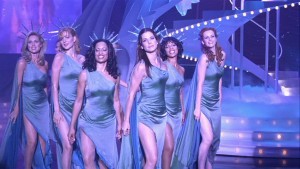
miss_congeniality_424

Let’s face it: all movies are about gender. It is ubiquitous. Biologically, sure, there are only two categories of sex. But over time, gender has grown increasingly messy—increasingly transgressive. The simple issue of gender influences the reception of a movie more than we realize. Split-second assumptions are made about characters based on their gender all the time. We immediately assume the incompetence of Elle Woods in Legally Blonde to get into Harvard Law. And of course, power dynamics could not be established in the same way without the distinction between males and females. We aren’t as terrified of Harley Quinn as we are the Joker. Popular culture is embedded with gender scripts, reflective of evolved sexist stereotypes and attributions. However, there is a salient rise of gender fluidity in modern society—gender is much more confused than it historically has ever been. But what we see movies do with this reality is guide the colors back within the lines.

“Makeover movies” are a standard storyline of Hollywood films. I’m talking about the ones where the ugly, geeky girl is magically transformed into a sexy, chic woman. In these movies, the makeover highlights fashion as the driving tool—a stereotypically female-attributed matter. The movie’s message goes beyond the upgrade of a woman’s frumpy wardrobe though and proves the need for alterations in her personality and lifestyle too. These movies try to get at some sort of moral development of the woman, as a consequence of their makeover, tailoring them to fit the mold of the acceptable, ideal woman. Grease’s Sandy goes from a conservative prude to a leather-wearing fox—and this is praised.

If we turned our attention to feminine men, they have historically not done well in Hollywood movies, or at least, feminine men are never the protagonists. The disdained antagonist of Silence of the Lambs (1991) is a psychopathic transvestite. Dr. Frank N. Furter in The Rocky Horror Picture Show is depicted to be an alien transvestite, whose name is a clear spin-off of a classic gothic monster, but also alludes to a phallic symbol. Though male-makeovers are not as common, the idea of remasculinization is not new to Hollywood. The quintessential example is Clark Kent, a glasses-wearing newspaper reporter turned into a superhero hunk with perfectly gelled hair. Each makeover renders the image of the ideal, which has proven to be attractiveness-oriented and sexualized. Similar to the moral development of women, several movies have addressed the emotional, behavioral meaning of masculinity. Tyler Durden in Fight Club spends his days selling soap, but is provoked out of boredom to join an underground fight club. He uses fist fighting as a means of liberation, reverting him back to primal masculine functions. The film serves to show men what it means to be men. The popularity and prominence of makeover movies suggest that we, as consumers of film, desire to see people combat the threats to their archetypal form of gender. But, here is the problem. If we insist this demand and desire to be true, then we succumb to an inescapable, exclusively male point of view. Gender and cultural studies professor Brenda Weber asserts, “American masculinity has long been predicated on the values of the self-made man.” The male-makeover is autonomous and upholds individualism. However, in the case of women, the transformation is rarely self-made and actually works to serve men.

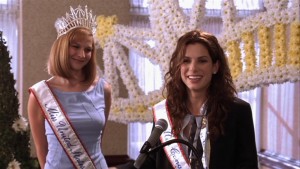
Let’s consider movies about women learning how to be women. Donald Petrie’s Miss Congeniality (2000) does just that. The uncomplicated premise of a female FBI field agent, Gracie Hart, who goes undercover as a contestant in the Miss USA beauty pageant sets the stage perfectly for the argument of guiding a woman to her idealized form. The specific casting of Sandra Bullock as Gracie asserts much about the character. Bullock’s charm is not one that fits the stereotypical symmetric, doe-eyed, blonde haired beauty; she brings an air of quirkiness and boyish athleticism with her presence, which becomes conspicuous in the scenes where is surrounded by the other beauty contestants. Gracie’s less than elegant mishaps and unfeminine mannerisms, like her pig-ish snorts when she laughs, pin her as a feminine outcast. Though her tomboyishness allows her to fit enough into the male dominated field of the bureau, it is clear she can never truly assimilate into the group because of her gender. She is notably asked by a stranger in a bar, upon learning of Gracie’s occupation, “Do all the women in the bureau really have to wear those masculine shoes?” Here and throughout the movie, Gracie’s occupation as an FBI agent is consistently reduced down to her body, etiquette, and fashion, forcing her back within the realms of femininity.
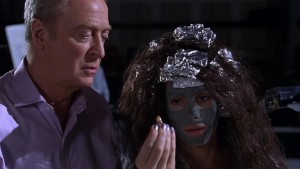
miss_congeniality_125

The irony of the plot lays in the notion that a woman can learn how to be a woman when taught by men. Gracie’s beauty pageant coach Victor Melling, played by Michael Caine, embodies the poise that Gracie does not. He “glides” when he walks, speaks with a posh British accent, and frequently sports immaculate suits with pink accents. He is the driving force of Gracie’s makeover: picking out the dresses she wears, teaching her how to walk gracefully, and introducing her to feminine products like plastic breast paddings. It is important to notice that Petrie intentionally decided for the pageant coach to be male, but more importantly for Victor Melling to be gay. He is essentially male, but not quite the archetype. He is the primary tool in the makeover but cannot be the ultimate goal of Gracie’s transformation—that is, she is not changing herself to woo Victor. But his function to the story makes it so that Gracie’s makeover cannot be “self-made.” The movie demands that Gracie is guided away from her boyishness and fulfill her female body as it ought to be, but makes a point to show that this package is a man-made construct.
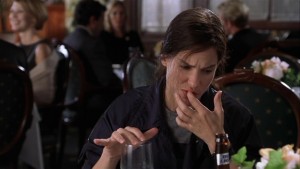
miss_congeniality_106

We must realize that the plot of the movie conveniently makes it so that Gracie’s gender is the primary reason why she is chosen to go undercover when the Miss USA beauty pageant is targeted. The audience knows all along that Gracie is the one for the job, but it takes the male agents a session of computerized photoshopping of agents into a one-piece female swimsuit to realize the fact. The scene is comical, featuring a group of strong, grown men huddling around a computer, playing dress up. The agents cringe and laugh at different women of different shapes and ages as they are subject to their man-controlled game. The political implications here are clear. The men critique every inch that a woman aesthetically has to offer, and pass their judgment on what is acceptable or not. What is interesting is that Gracie also partakes in this activity. She plays along with the men, mocking the women on the screen, feeding into the fixation on the female body. When the agents finally settle on Gracie being the most believable option, Gracie’s amusement immediately shuts off and she tells the guys to cut it out. It is only when fellow agent Eric Matthews tells her, “Don’t kid yourself. No one thinks of you as a woman,” that she begins to take the mission seriously. So, here we have a woman, not wanting to be considered a woman because of the beauty pageant contestants carrying the implications of being unintelligent and materialistic.miss_congeniality_060
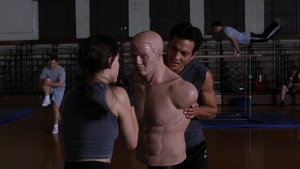
However, it is easy to miss that Gracie’s transformation actually revolves around Agent Matthews. He coaxes her and encourages by saying, after a couple of “butt-shaping exercises”, she would fit right in at the contest. The absurdity of this scene is because it takes place in the training room, while Gracie is kickboxing—an intensive, strength-oriented workout.  Here, Agent Matthews is advising an obviously physically fit woman to alter her workouts towards more aesthetic purposes and toning, as opposed to muscle building. It takes Agent Matthews’ comment that Gracie is not considered a woman for her to take the mission. Throughout the movie, he repeatedly pokes fun and ridicules Gracie during her efforts to become a believable pageant contestant, mocking her with doughnuts when she has to diet, sarcastically cooing at her when she is dolled-up. Yet—not surprisingly—by the end he falls in love with her and successfully asks her out on a date. To the audience, the movie makes clear that for women, turning yourself into something of a pageant girl will win you male recognition.

Thus, within the film narrative, the audience Gracie caters towards is men, namely Agent Matthews. But, Petrie also incorporates the literal audience of the movie and subjects them to a male perspective. Film theorist Laura Mulvey’s concept of “the male gaze” claims that no matter who you are as an audience member, because the camera is treated as if it were male, you have no choice but to view the movie as a male too. Let me explain. Mulvey suggests that a film camera stimulates the voyeuristic tendencies of the audience; we are awakened and find pleasure in viewing others, specifically in private domains from which we are usually concealed. In Miss Congeniality, Gracie is set up with several spy cameras when she goes undercover, thus unlocking the backstage, dressing room world of the beauty pageant to the male FBI agents. The men gather around the screens, and in one scene even bring popcorn, to view the women in bathrobes, hairnets, and swimsuits. The way these sequences are edited place us in the shoes of the men, watching the room from Gracie’s point of view, which is also the view the male agents have an in on. We as an audience are included as peeping Toms, encouraged by the agents ogling at the women on the screen.
miss_congeniality_575

Admittedly, makeover movies tend to fall under the category of “chick flicks,” implying that they target a predominantly female audience; but if we delve deeper and ask what these movies are encouraging women to take away from the narrative, it is chiefly male-centered. By watching these films, women are taught to desire a materialism-triggered moment of recognition and men are reaffirmed of their approval of the makeover. Gracie accepting the “Miss Congeniality” award and giving a speech about how grateful she was to have been a part of the pageant and from the mission, how she has changed as a person for the better is the way the film reconciles its plot and gender dilemma. The award and what it stands for literally celebrates Gracie’s ability to have adapted to suit her personality and behavior to the taste of others. We go from watching a kickboxing, self-assured woman turn into a tamer, peace loving appeaser—and we applaud this ending and call it a success.


Bibliography

Ferriss, Suzanne, and Young, Mallory, Chick Flicks: Contemporary Women at the Movies. London: Routledge, 2008.

Ford, Elizabeth A., and Mitchell, Deborah C., The Makeover in the Movies: Before and After in Hollywood Films, 1941-2002. North Carolina: McFarland, 2004.

Weber, Brenda R., “What Makes The Man? Television Makeovers, Made-Over Masculinity, and Male Body Image,” International Journal of Men’s Health 5.3 (2006).


This essay was written in the style of David Foster Wallace.

This essay was peer edited by Dew Maskati.
 

Take Cover: Solace In Utopia

Joyce S. Tseng

Cultural criticism finds itself faced with the final stage of the dialectic of culture and barbarism. To write poetry after Auschwitz is barbaric.

—Theodor W. Adorno (Prisms, 34)

Totalitarianism. Aryan soldiers; a Jew in hiding. Conformity; defiance. Brutality; survival. War fiction has continued to flourish as one of the most popular genres, especially to the audience of young-adults, of novels and film. These narratives are packed with the passion of patriotism, the horrors of violence, and the rawness of human experience. A state of war reflects a metaphysical, and physical, extremity of existence, which perhaps drives our fascination towards stories inspired from it. For the majority of the current young-adult population, it is unlikely for us to experience anything close to the realities of WWI and WWII; our only medium to the period is through fiction and our imaginations. This year, according to vice president and publisher of Scholastic David Levithan, “We’re seeing more publishing on [historical fiction on WWII] than we have ever before.” Various colleges today even hold courses dedicated to intensive analysis on the phenomena of utopias and dystopias, which perhaps is ultimately indicative that we, as consumers of stories, are drawn towards worlds outside of our own realities—the more extreme and different, the more we are lured into them.

German philosopher, Theodor W. Adorno, in his collection of essays Prisms, discusses cultural criticism and society, and specifically alludes to Nazi Germany to illustrate his point. He claims that the modern world is becoming increasingly like “an open-air prison,” suggesting an overarching system that holds the façade of free will for the people, but in actuality is carefully manipulated and controlled. This concept is also made clear in a different essay of Adorno’s that disproves free will and choice, and that the “culture industry,” as he phrased it, is in extensive control. Adorno goes further in Prisms to claim that “to write poetry after Auschwitz is barbaric.” This is to say, there must have been a path of culture that paved the way towards the brutality of Nazi rule—the deteriorating economy, the volatile political climate all contributed to the state of society and culture of the time. Here, Adorno is saying that to continue on that path of culture after such an atrocity to humanity like the Nazi regime would be a detriment to human society. Various analyses of culture claim that the homogenization and uniformity of society are problematic. It is robbing us of the true value of the ideal form of culture. The “culture industry,” as coined by Adorno and fellow German philosopher Max Horkheimer, mass-produces a standard program of socially accepted products of culture. This heavily controlled and systematic depiction of culture and society is paramount in totalitarianism. This is why it is valuable to examine war literature. Why does the readership of such a gruesome period of history continue to grow? I claim that even in the most heartbreaking, dire, and barbaric stories, there exist pockets of utopia that reflect our desires to see change, onto which we latch and by which we become engrossed.

Liesel Meminger reading to Max Vandenberg in the basement of the Hubermanns'

Liesel Meminger reading to Max Vandenberg in the basement of the Hubermanns’

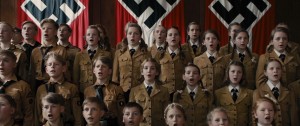
The Book Thief by Australian author Markus Zusak is a prime example of war literature that has consistently received high ratings. In 2013, the novel—first published in 2005—was depicted on film, directed by Brian Percival. The story, narrated through the perspective of Death, follows the young female protagonist, Liesel Meminger, a German girl who is sent away to Molching in the heart of Nazi rule because her mother, a Communist, is in danger of Nazi removal. From the beginning, Liesel is depicted to be a thief of books; she steals The Gravedigger’s Handbook during the burial of her younger brother when he dies of disease. The commodity of books comforts Liesel though she is illiterate. This proves to become an important, binding theme of the novel. Her foster parents, Hans and Rosa Hubermann, each their own distinct characters, share a genuine, unconditional care for Liesel. They enroll her in the Hitler Youth and Liesel assimilates into Nazi culture. Even though we see the Hubermanns exhibit internal conflicts to Nazi ideology, ultimately, they abide by the totalitarian regime out of necessity for survival.

Liesel attending Hitler Youth

Liesel attending Hitler Youth

Nazi book-burning ceremony on the streets of Molching

Nazi book-burning ceremony on the streets of Molching

A poignant moment in the novel occurs during a Nazi book-burning ceremony, which Liesel and Rudy, her Aryan neighbor and classmate, attend with the Hubermanns and the entire town of Molching. They stand amidst the crowd under the surveillance of Nazi soldiers. Liesel is distressed by watching the books disintegrate in the body of flames before her, and is later further provoked by the coercion of a classmate to throw a book in herself. It is clear that being unpatriotic or at odds with Nazi beliefs would lead to being socially ostracized. Rebellion is a clear threat to one’s survival. After the crowd and Nazi officers leave the scene, Liesel steals a book from the pile of ash and tattered pages. In this moment, defiance highlights the seizing of control back from an oppressive system. This is what unlocks utopia. In a totalitarian society, such as Nazi Germany, personal control is taken away and all the facets of life, including culture, lay in the hands of the state. The books that Liesel steals as the narrative unravels serve as constant indicators of her holding onto something that the state repeatedly tries to take away—as illustrated by book burning ceremonies. She insists on clinging onto the prohibited, suggestive of her personal desires for an alternative reality. This is the essence of utopia. Acting upon these feats of resistance, against a dangerously powerful organization like the Nazis, for the majority can only exist as a fantasy. But, that desire for change is indeed real.

Liesel steals a book from the pile

Liesel steals a book from the pile

The symbolism of books for Liesel is a thread that runs across the narrative and is depicted beautifully in the film rendition. One of the most memorable moments of the story occurs when Liesel delivers laundry as part of the Hubermanns’ business to the mayor of Molching’s house. Back during the book burning ceremony on the streets, Liesel is in fact unaware that the wife of the mayor, Ilsa Hermann, spotted her steal the book from the pile. Frau Hermann descends from the grand wooden staircase to bring money to Liesel for the laundry service. She recognizes Liesel immediately as the book thief. She stands formidably with a stoically stern look and utters, “So, you like books?” Liesel is instantly anxious and fearful that her cover has been blown. But to the surprise of both Liesel and the audience, Frau Hermann walks to the adjacent doors and opens them to mayor’s private library and invites Liesel in. A panorama of classic, polished, wooden bookshelves glisten from the golden raised bands in the warm light of antique lamps. The cinematic, simplistic piano melody that accompanies the scene highlights the stark segregation between the pristine sanctuary of the library and the ramshackle streets decorated with Swastikas. This is an imperative moment as it physically captures the dichotomy Liesel experiences during the war. She suddenly has a whole collection of things to affirm her inner desire to hold onto what she believes in, despite it being against the tyrannical system. It is a statement of her utopia, expanding it and adding weight to it. It gives Liesel—and the audience—hope.

Liesel in Mayor Hermann's library

Liesel in Mayor Hermann’s library

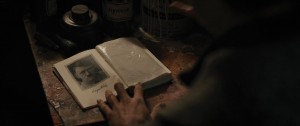
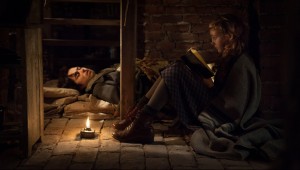
Later in the novel, in the height of war and Nazi control, the Hubermanns take in a Jewish fist-fighter, Max Vandenburg. The character development of Max also offers many examples of utopia. During his escape from home to the Hubermanns’, Max’s saving grace is Hitler’s autobiographical book Mein Kampf, which he uses as his fraudulent stamp of being German. As Max and Liesel become closer, she visits him more and more in the basement where he resides and together they develop a love for words and stories. Max covers the pages of Mein Kampf with white paint and handwrites a story for Liesel in its place. This act itself is utopian. He recognizes he doesn’t need his saving grace to convince the outside world that he is German anymore because the basement is his new reality and future. He literally paints over, overtly rejecting and silencing, the voice of the most powerful figure of Nazi Germany, trashing the ideologies of the system to instead scribble in his own thoughts and doodle complementary cartoons. Max knows that there will be no consequences because there is no one to apply the consequences to him. He turns the dark truth that he is stuck in a basement, his existence essentially extinguished, into a medium to act out in his own form of defiance. In a scene with Liesel, Max teases her when she is being secretive, encouraging her to let him in on the secret by chuckling, “Who am I going to tell?” The irony of Max’s lightheartedness about his grim reality is utopian.

Max painting over Hitler's "Mein Kampf"

Max painting over Hitler’s “Mein Kampf”

The dense stories of war fiction crave such moments. Reflective of a natural coping mechanism, we orient ourselves towards optimism in the face of grave seriousness; or, at the very least, a distraction. We generate an internal world in which we have control and in there, we unleash our inner desires. War literature lets us in on these internal worlds of minorities, the victims, groups that were oppressed by tyrannical rule. To return to Adorno’s quote that “to write poetry after Auschwitz is barbaric,” we see that in war literature, authors with the benefit of hindsight make an active choice to include utopian moments of victims to underline a revised form of “poetry,” aligning with Adorno’s claim. As historian Stephen Greenblatt stated, “Great historical novels provide a powerful hallucination of presence, the vivid sensation of lived life.” It is a reconstruction of black and white fact, colored in by serious, human fantasies. By illustrating that even those in the derogated portion of society, plagued with trying war times, could hold onto the desire for an alternate reality, “poetry”—that is, culture—can continue to exist after such an inhumane regime, without being a detriment to society. The example of war literature in application to current society is perhaps to show us that a controlling world, obviously not the same degree of extremity, where a “culture industry” persists, ignites rebellious desires in us to overturn such homogenization in order to cope with our reality.

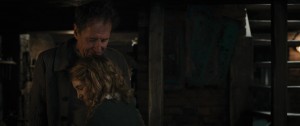
Hans Hubermann and Liesel Meminger

Hans Hubermann and Liesel Meminger

References:

Theodor W. Adorno (1981) “Cultural Criticism and Society,” in Prisms, translated by S. and S. Weber, (Cambridge, MA: MIT Press), accessed November 12, 2016, https://representingtheholocaust.wikispaces.com/file/view/Adorno_Cultural+Criticism.pdf

Lucy Ives, “How Archival Fiction Upends Our View of History,” New Yorker (2016), accessed November 12, 2016, http://www.newyorker.com/books/page-turner/how-archival-fiction-upends-our-view-of-history

Theodor W. Adorno and Max Horkheimer, “The Culture Industry: Enlightenment as Mass Deception,” English 117 Cultural Theory Course Packet.


Happily Ever After?

By Joyce Tseng

(Warning: This essay includes movie spoilers)

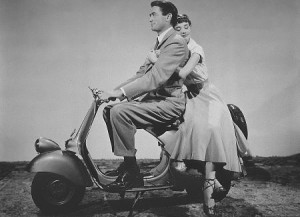
Gregory Peck and Audrey Hepburn's iconic image from "Roman Holiday" (1953)

Gregory Peck and Audrey Hepburn’s iconic image from “Roman Holiday” (1953)

We’ve all heard the story. Boy meets girl, boy and girl hit it off, boy and girl conflict, boy and girl are lost without each other—often involving a lonely scene in the rain, a revelation occurs, boy and girl kiss and make up. Happily ever after. It is the predictable, cheesy love story that we can’t help but watch. Love is inextricable to the human experience of life; it is a pervasive component of our social world as we search for it, deny it, or are head over heels in it. Countless renditions of love and romance that exist in our culture perpetuate an idealistic, cliché notion of true love, which is to say that, happily ever after is always attained in the end by the perfect couple. Just take a look at Disney. For the majority of the current young, female adult population, the message drilled into our minds as children was that one day our own Prince Charming would come. We as a society have been indoctrinated to believe that we find the one, fall in love, and have a stable, committed relationship that is topped off with holy matrimony. This is how we have been taught to define love. This is what our culture tells us love looks like. Yet, this doesn’t seem to be the consensus anymore.

Romantic comedies have been one of the most enduring film genres through the history of cinema. Reflective of gender roles, social constructs of family, marriage, and love, romantic comedies have served as key indicators of political agendas and social attitudes towards the private sphere of love in a light-hearted, humorous manner. From William Wyler’s 1953 classic, Roman Holiday, staring Audrey Hepburn, to 21st century films such as Love Actually and No Strings Attached, it is clear that romantic comedies have undergone a striking transition. We’ve seen the female lead occupy a more empowered role, an increased openness to sexuality, and even a disillusionment of the institution of marriage. Arguably, the purity and privacy of love have transcended into a raunchier, non-committal rendition. Perhaps this portrayal of love holds more true to our modern reality and escapes the predictable formula for love that is incessantly shredded by moviegoers and film critics of rom-coms.

Ivan Reitman's "No Strings Attached" (2011)

Ivan Reitman’s “No Strings Attached” (2011)

Over the last decade, romantic comedies have been more or less the same, each following the conventions of the genre with their own variation. A staple for a rom-com is the “meet-cute.” This is when the two protagonists encounter for the first time, often under an awkwardly adorable circumstance that makes hearts flutter and the audience smile like idiots. Often a comic clash of personalities is presented during the meet-cute, falling in line with the notion that “opposites attract.” For instance, in Woody Allen’s classic Annie Hall (1977), Annie, portrayed by Diane Keaton, first converses with Alvy Singer at a clubhouse following a game of tennis set up by mutual friends. The exchange illustrates a contrived attempt to sync schedules with one another, laden with cringe-worthy lines. Annie asks Alvy if he would like a lift, Alvy agrees and asks where she’s headed; Annie says, “I’m going downtown,” to which Alvy says, “Oh, I’m going uptown.” Annie immediately changes her answer and says, “Oh, right! I’m going uptown too.” Alvy proceeds to question Annie why she initially said she was going downtown, resulting in a concoction of rambling and flirtation. Yet, the awkwardness doesn’t deter us, rather it persuades us to root for the couple.

Following the meet-cute, the characters go through obstacles of the narrative. One of the most common conflicts used is that of social rank or class. For instance, Audrey Hepburn plays a European princess who falls in love with an American reporter in Roman Holiday. Martha Coolidge’s The Prince and Me (2004) depicts the romance between a Danish prince and an American college girl, which stems from his attempts to escape his regal duties. Each film differs in what these obstacles specifically are, but they all share the resolution that the couple comes out the other end hand in hand. It is shown time and time again that the ingredients for true love are loyal commitment, an undying desire to empathize and understand each other, and original, meaningful romantic gestures. In the narrow realm of the romantic comedy narrative, these specific inputs guarantee the output of “happily ever after.”

Diane Keaton and Woody Allen in "Annie Hall" (1977)

Diane Keaton and Woody Allen in “Annie Hall” (1977)

I have a confession to make. I like to watch rom-coms because I can bank on a resolution. There is a certain mentality, or cinematic flavor one desires when choosing to watch a rom-com. It is a feel-good genre that leaves us with more faith and optimism in life’s path. However, on the opposite end is the romantic drama, which does not always end happily. Take Nicholas Sparks’ The Best of Me as an example. During my first viewing of the film, I spent a solid seventy percent of it sobbing and frustrated with Sparks’ literary decisions. The film tells the story of high school sweethearts, who drift apart, but reunite after many years following the death of a mutual friend. The film presents a series of flashbacks to their happier days as adolescents as well as their troubled origins. The male lead, Dawson, comes from a broken home dominated by his abusive, alcoholic father; the female lead is the pretty, witty, and relatively wealthy Amanda, who has micro-managing parents. A series of unfortunate events follow, including an accidental shooting of Dawson’s friend during a brawl between Dawson and his junkie father and brothers, jail time on Dawson’s part as a consequence, and Amanda’s unhappy marriage. Upon reuniting after many years, the two rekindle their romance. Dawson apologizes for neglecting Amanda during his imprisonment and confesses that she would eternally be the love of his life. Following their brief escape into the past, Amanda returns to her normal life, but before long, she has an epiphany to seek a divorce to return to Dawson. A dramatic voice message is left for him, detailing Amanda’s reciprocated love, but before this message reaches him, Dawson is shot dead by his father on the streets.

The Best of Me was one of the few movies that I couldn’t let go. I felt robbed by the story and its conclusion. When presented with a narrative that didn’t fit the traditional, idealistic social construct of love, it was unsettling and even distressing to accept. However, if we look at reality’s statistics, since the late 1960s divorce rates have been on the rise. After the presence of women in the workplace became more common, society showed a trend in delaying marriage. This social phenomenon also contributed to a new variation of comedy, referred to as “screwball comedy,” present in many rom-coms. Stemming from the 40s, the nuanced genre portrays the novel power play of the female as the dominant, rather than the male. Masculinity in the relationship is challenged, revealing a battle of the sexes and providing comic content. Old rom-coms that depicted the man as a sex-driven, flirtatious figure and the woman as the naïve damsel-in-distress role was no longer the case. For instance, The Proposal (2009) features a female high-powered editor who essentially blackmails her male secretary into forging an engagement with her in an attempt to evade impending deportation back to her home country, Canada. The woman here uses the male to serve her needs in between her work-driven existence. The modern-day consensus seems to be that career, especially the female’s career, takes priority of love and relationships, deviant from the traditional rom-com.

Another prevalent change is how rom-coms address sexuality. The “hook-up culture” currently spans from high school, well through into adult life, skewing the previously established chronology of romance. Casual sexual relationships and multiple-marriages are now more acceptable than the historically shown. Judd Apatow’s Trainwreck (2015) staring Amy Schumer claims to reflect this “modern” spin on romance. Following the life of Amy, a men’s magazine editor, the film is explicit in its message right off the bat. The opening scene, as well as its official trailer, features a flashback to Amy’s childhood when her father was informing his two middle-school daughters of his divorce with their mother. The father saliently directs the two young girls into reciting after him: “Monogamy isn’t realistic.” This concrete, unexpected claim is weirdly refreshing to see on a rom-com screen and forces us to adjust our palettes to consider an alternative way to experience love. As we fast forward through Amy’s adult life, we see the pattern of alcohol, drugs, and casual sex with a variety of random men. In the trailer, Amy proclaims, “I am just a modern chick who does what she wants.” It is worthwhile to recognize that though rom-coms reflect the attitudes of society towards love, it is more precise to say that it reflects society’s escapist fantasies and desires in relation to love. In Trainwreck, we see an independent woman with a stable job, with no committal ties to a single person; she is simply having fun exploring her sexuality.

Amy and Nikki listen attentively to Aaron's phone call the morning after their hook-up.

Amy and Nikki listen attentively to Aaron’s phone call the morning after their hook-up.

The movie gets interesting when Amy is assigned to cover a story on a male sports surgeon (Aaron), to which the interview results in a dinner date and adult sleepover—an one-off event as Amy forbids herself to stay the night with any hook-up. In a farcical scene the morning after, Amy and her female coworker and friend panic when Aaron calls Amy. She immediately assumes that she was butt-dialed, but after learning that the call was intentional, the friend quickly says, “Hang up. He’s obviously, like, sick or something.” Following up to hang out after a night of sex is clearly portrayed to be a social no-no, ironically the reverse of what we have been wired to think.

The bulk of the movie shows Amy and Aaron’s relationship blossoming, despite her volatile familial situation. Having previously being drilled into believing that monogamy wasn’t realistic, her ailing, disapproving father takes a toll on her relationship with Aaron. The death of Amy’s father ultimately serves as the catalyst for Aaron and Amy to call it quits. Amy reverts back to her ways of drinking and partying, but she no longer sees any value in those ways. For a film that clearly sets itself up as a distinguisher from the rest of the rom-com pack, the conclusion is unsurprisingly familiar. Amy commits to a grand gesture of love, including a jumbotron and coordinated dance sequence with the Knicks City cheerleaders. She is successful and a triumphant pop tune accompanies the credits.

Similar to films like No Strings Attached and Friends with Benefits, Trainwreck plays off the fantasy of having the sexual freedom and benefits of relationships, minus the complicated, emotional baggage. These are features claimed to be indicative of our new, modern manifestation of love. And yet, all of these films insist on still concluding with the familiar “happily ever after.” Why? Has it become embedded into our culture, in which the narratives of rom-coms cannot escape? Would an alternative ending similar to The Best of Me still be classified as a rom-com? Despite the disapproval of monogamy and attempts to break free from emotional efforts and commitments to another person, which are present in our fantasies, we still find ourselves resolving romantic conflict with the very notions we were originally trying to escape. It becomes clear that there is a reason the same narrative arc of the romantic comedy is fed to us by our culture time and time again. There is a reason why we still choose to consume this culture, despite its repetition. At our core, our outlook on love, as exemplified through romantic comedies, has changed very little. Beneath the lace, flowers, and sentimental orchestral tunes, the fundamental message remains the same: we as a society still strongly believe that our one true love will prevail all obstacles.


Images Courtesy of imdb.com Gallery