Monthly Archives: November 2016

Death in Utopia: How Pop Culture Gets Away With Murder

The promise of a perfect world, a perfect society free from social ills and injustice, the utopia has enchanted and enthralled humanity for generations. Since the publication of the novel that coined the phrase, Utopia by Thomas More, it has fixated the imaginations of creators and audiences alike for centuries. In modern media and popular culture, there are few attempts to create pure utopia. Instead, authors, screenwriters, directors, carefully infuse their work with utopian elements. This trend reappears countless times throughout modern pop culture and one, perhaps somewhat unexpected example, is detective fiction.

death_in_paradise_titlecard

Since trying to argue my point with every detective story as proof would quickly become messy, I will focus on one specific series: Death in Paradise. The show follows a reluctant English Detective Inspector (D.I.), Richard Poole, who is “temporarily” relocated to an island in the Caribbean called Sainte Marie to work with local law enforcement.  In each episode, the team is confronted with a new impossible, wildly creative murder that only the brilliance of the D.I. and the tenacity of the team can solve. So, though it has a few distinguishing features that come with the paradise locale, it fits the general detective fiction trope rather nicely, not at all out of place amongst the dozens of other detective shows the BBC airs.

fd07733adc0b472a67f1c64af3780a18d9ae6d25

A core goal of utopian societies is a concerted effort to perfect institutions. This seems an inherent part of the detective story. The detective serves as something of an indicator species: a brilliant member of the police force who unfailingly solves crime and locks away dangerous criminals is evidence of an institution operating at its highest possible capacity. And when they start watching, the audience takes it on faith that, in the end, the detective and his team will stop the bad guys. Their belief in the detective is transferred onto the police force as a whole, allowing them to experience a second-hand utopia through this perfected institution.

Further than just believing in the ability of the detective, the audience must trust his goodness. The main detective of a show is never corrupt and often storylines will revolve around him rooting out misconduct amongst his peers. Death in Paradise tackles this trope in the first episode of the series. D.I. Poole’s first case ends in the arrest of one of the local police officers for abusing the benefits awarded her position to smuggle goods into the country and for murdering her accomplice. This one episode very deftly proves to the audience the virtue of the remaining members of the team and assures them that the D.I. will prevent any future corruption of the system.

screen-shot-2016-11-29-at-9-30-23-pm

Professor George Grella analyzes a final way in which detective fiction perfects the system: the act of the murder itself and the concluding capture of the murderer. In his paper “Murder and Manners: The Formal Detective Novel,” Grella writes that “the detective novel features two expulsions of ‘bad’ or socially unfit characters: the victim and the murderer” which in turn “ ensures the continued happiness of those remaining” (Grella 41). Grella reasons that to merit being killed, and to make a compelling story that involves multiple suspects, the victim must either be a particularly detestable person or have done something particularly detestable. A possible exception to this is if a person is murdered accidentally, but even then, the murderer believes they are killing the horrible person, not an innocent stand in. For example, in season one, episode two “Wicked Wedding Night,” a hotel butler mistakes a newlywed bride for a serving girl who had refused his advances but actively sleeps with other people in the hotel. Though the bride had done nothing wrong, she was killed in the butler’s attempt to eliminate someone who had violated the social code and in the end, the maid ends up dead.

screen-shot-2016-11-29-at-9-42-53-pm

In this sense, death in a detective series serves a very different function than death in  perhaps a drama or a thriller. In these types of stories, the audience is meant to empathize with the victim and detest the murderer for killing them. In detective stories, the victim must be viewed unfavorably by the audience because they are meant to remain impartial, the death serving as  merely an opportunity for them to test their wits and logic. This disparity is the reason death only exists as utopia in detective novels.

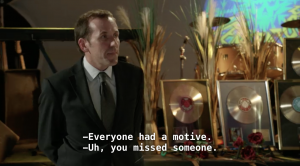
So, by killing the victim the murderer completes the first “expulsion” and the detective then completes the second by arresting him. The murder is necessary for the first expulsion because the victim is truly only guilty of social infractions and is therefore out of the detective’s hands. By killing a socially undesirable person, the murderer serves a function in the utopia but in doing so, they have themselves committed a violation, risking the security of the society which can only be restored by their removal. In season one, episode seven “Music of Murder,” the lead singer of a local band is killed before a reunion show. In the exposition scene, D.I. Poole reveals motives for five of the six suspects. The victim had wronged nearly everyone close to him but none of his actions directly violated law. His death was the only way to expel him from society to ensure the happiness of those around him. The detective then comes along to tidy up the mess by removing the person who killed him. In this way, each installment of detective system cleanses the system.In these three ways, detective fiction offers the audience a partial utopia.
screen-shot-2016-11-29-at-9-42-08-pm

A second, essential feature of the utopia is that it must be felt universally. The word itself derives from “eu-topos – denoting a region of happiness and perfection” (Munker). Linguistically, the term encompasses the entirety of a place, not simply a single person which implies that there must be a general sense of well being and goodness. The means of achieving this widespread happiness inevitably varies from person to person but the overall effect must always be the eradication of injustice. Detective fiction does this neatly and rather surprisingly. Murder, and the resulting bubble of suspicion, crosses all social bounds. Anyone can be murdered, anyone can be guilty. By confronting us with humanity’s universal flaws and weakness, detective fiction forces us to regard everyone, regardless of real-world social stigma, as existing on the same plane. While this method is crude and not as sunny as many imagine a perfect system should be, it is, undoubtedly, equalizing. Beyond this fundamental equality, there is a sense of universal improvement that comes at the end of every story that ties back to the “expulsions” mentioned earlier. A systematic and habitual purge of all the bad apples must mean that the remaining society is, as a whole, good and therefore better.

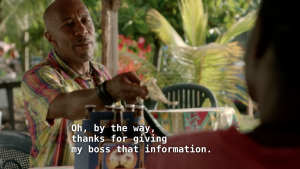
Death in Paradise, along with many other modern detective series, particularly American ones, has taken the theme of equality further and has made concerted efforts to diversify their casts and advance the roles of women. The show holds true to Caribbean demographics. Three of the four members of the Santa Maria police force, as well as the police commissioner, are of African descent, leaving the detective inspector as the sole primary Caucasian character. This in not merely for the sake of appearances. Within the show, there is an ingrained appreciation of local knowledge.  Dwayne, the longest standing member of the force and the show’s primary source of comedic relief, frequently relies on his contacts in the local community to move along a case, despite facing derision and judgment from his fellow officers. In season three, episode two “The Wrong Man,”  a key witness refuses to speak to the police without first being offered a bribe. Fidel, Dwayne’s superior officer refuses to pay despite Dwayne’s insistence that the man will never budge otherwise. The witness only spills because Dwayne, while sitting down for beers with him at the end of the episode, pays him under the table saying, “ I knew [Fidel’d] never get it out of you any other way.  It’s only his first few months as sergeant.”  The show makes the point that without an intimate knowledge of the local community success is unlikely.
screen-shot-2016-11-29-at-9-48-47-pm

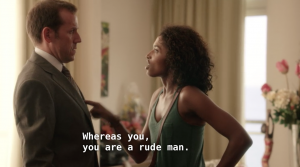
As for the roles of women in the show, again in “Wicked Wedding Night”, Detective Sergeant Camille Bordey effectively reminds D.I. Poole, and therefore the audience, that women are equal to men.  After he spends the first 10 minutes of the show bossing her around and dismissing her inputs, Camille  pulls D.I. Pool aside and tells him frankly:

I am a Detective Sergeant in the Sainte-Marie Police Force. I graduated top of my year, I have three

commendations for bravery, I have been shot twice and I could almost certainly beat you in a fist

fight. Whereas is you, you are rude man. You are ignorant, full of your own self-importance,

expecting everyone to follow you around and hang on your every word? From now on, you treat me

with a little more respect I’ll be forced to forget that I’m a police officer.

This scene sets a precedent for mutual respect  between men and women that carries on throughout the show.
screen-shot-2016-11-29-at-9-43-40-pm

A final, vital characteristic of the utopia is a replacement of the repetition and dullness of the current system with newness and excitement. A detective show changes every week: new victim, new murderer, new suspects. This demands that the series constantly introduces new characters and new adventures. Thinking of increasingly brilliant murderers gives the writers artistic freedom to think up unimaginable scenarios and so the show is never stagnant, never dull. More than that though, detective stories are so appealing because they can be interpreted to possess a comic function. In his analysis of the genre, Grella writes:

The central puzzle provides the usual complication, which the detective hero must remove; and its

difficulty ensures a typically comic engagement of the intellect. The whodunit’s plot, full of

deceptions, red herrings, clues real and fabricated, parallels the usually intricate plots of comedy,

which often depend upon mistaken motives, confusion, and dissembling; it also supports the

familiar romantic

The complexities of a detective story have the same effect on the audience as the twists and misadventures of comedies. In this way, each installment is a rejuvenation of the system.

There is one way in which the detective fiction is repetitive: it always has a happy ending. Though the detective might be stumped for most of the story, in the end, he will pull through. This is true of all 40 episodes of  Death in Paradise. However, it is important to distinguish this repetition from the repetition of the system being replaced. By repeating the motif of victory in every episode, the show reinforces the sense of the reliability of the institution (police force) and the safety of the general society. It gives rather than detracts from the utopia.

What this all boils down to is a reinvigoration of the current system in which it is purified, equalized, and charged with a sense of excitement. By watching a show or reading a book which revolves entirely around murder and crime, people are truly experiencing a partial utopia.

protectedimage-php


Pursing Propaganda: The Danger of Films

By RJ Shamberger


The United States promises its people many freedoms and presents itself as the land of opportunity where anything is achievable; however, the United States portrays itself as far greater than it is through constant propaganda. The propaganda is everywhere. In our television advertisements. In our history textbooks. In the words of our politicians. And in all forms of our entertainment. The real United States is not a reflection of the image it portrays, and there are immense problems especially of social mobility and racial injustice. The United States is not perfect, yet the movie industry often misrepresents the hardships and inequality in the country. Many Hollywood films downplay the significance of social mobility and racial inequality issues, and this leads to further problems in the country.

Take the movie The Pursuit of Happyness as an example of the constant propaganda that American entertainment feeds the unknowing public, as it perfectly guides its viewers into believing in the presence of social mobility. The Pursuit of Happyness tells the miraculous rags to riches story of Christopher Gardner Sr. whose net worth compounds over a million times fold within the two-hour movie. The film details perhaps the harshest year possible for anyone as Gardner loses his home and wife and goes to the streets with his young child, Christopher Jr., yet he somehow holds on to his hope, and the American Dream beautifully rewards his efforts with riches through his hard work and perseverance. Within two hours the audience witnesses Gardner seemingly rise from the working-class into the middle-class as he invests his savings in a company that sells bone density scanners in 1980s San Francisco. The investment leads to his eventual financial downfall as the scanners become more of a burden than an asset as Gardner learns that he cannot sell the machines to earn a steady income, but he remains under contract as a salesman. Eventually fed up with his inability to provide, his wife who financially supports the family chooses to leave Gardner and his son behind for New York. Without her, Gardner finds himself homeless and caring for his son, all while engaging in a competitive internship at Dean Witter Reynold’s stock brokerage.

The film carefully detracts from Gardner’s actions to continually remind the viewers of the magical promises that the American Dream promises. The film’s opening image is a glimpse of the Declaration of Independence, and the title pays homage to the “life, liberty, and pursuit of happiness” quotation. Further resembling a perfect piece of propaganda, the movie neglects telling its audience that Gardner’s actions are miraculous as it never addresses the social injustices he faces or reasons to his severe poverty.  Through consistently conveying the idea of social mobility being a direct result of hard work, the film avoids challenging the words of the Founding Fathers or the reason behind Thomas Jefferson’s specific wording as the title suggest.


Below is the opening scene (beginning at 0:20). Through proper sequencing, the scene tells the audience everything they need to know in the film as it first shows the Declaration of Independence then Gardner and his son. Through analyzing the images, the film outright tells the audience that the plot will be about the United States and its greatness first – evidence of its most important document – then about Gardner’s story.


Instead of dealing with the apparent inconsistencies and conflicts in the United States, The Pursuit of Happyness carefully dances around the problems modern society presses on its main characters. The film completely neglects to acknowledge that Gardner is indeed a black man in the United States during the Ronald Reagan era. There is no instance in which the film addresses Gardner’s blackness, and no one ever refers to him as poor or struggling. In fact, I believe the film scoffs at his poverty in various moments. One scene, in particular, shows an office executive badgering Gardner for cab fare when he exiting the office building. Gardner checks his wallet only to find around eight dollars to which he then gives five of to the executive. In a way, the film says to Gardner “hey, we get it you’re poor, but that doesn’t matter.” Knowing Gardner cannot afford to lose any more money, the film detracts from his reality by forcing him into a moment where his poverty does not matter and instead he must please the executive. In a different scenario, Gardner does not lend the man any money in a more thoughtful decision since he legitimately cannot afford to lose any more money. In fact, this exact situation happens a second time in the film as Chris rides in a cab along with another office executive who then does not pay his fare leaving Gardner with the burden. Obviously unable to afford the fare, the film embarks on a comical section as Gardner must run away from the cabbie and loud profanity aids the moment. Throwing Gardner into near identical scenarios then laughing at him shows how the film wants the audience to his poverty – it doesn’t matter.

Also, the audience must acknowledge the film’s time placement – the Ronald Reagan era. Driven by the uprising of the stock exchange especially on Wall Street in the 1980s the United States’ economy steadily grew under President Ronald Reagan; however, there were still flaws in Reagan’s administration such as worsening race relations and the wealth gap between the rich and ordinary Americans which grew significantly. These were two apparent conflicts in the United States during the Reagan era and given the perfect character and platform to address them the film blatantly fails. No matter how the film tries to portray him, Gardner exists in the period in which there are prevalent social mobility and racial injustice issues, yet the film acts as though the problems do not exist. Yes, Gardner thrives under his situation, but there are underlying issues that he faces throughout his struggle.


In actuality, The Pursuit of Happyness‘s blatant ignorance to the country’s turmoil during the period is quite utopian. Through refusing to address the issues, the film creates a utopian like the world for the audience to infuse themselves into. In the movie exists a society abundant in social mobility and racial equality, and it uses Gardner’s situation as a platform to prove that the two are present even in perhaps one of the most difficult time periods for such to exist. The film engages its audience into the world that is massively better despite the hardships Gardner experiences. There is no utopia as there can never be complete equality of opportunity and no discrimination amongst people in the real world. So the film presents the issues that Gardner faces. However, it does so inadequately because it includes utopian aspects that do not exist. Even though Gardner miraculously does make it out of poverty, the film does not show the truth of the situation that many people similar to him face on a daily basis and are not as fortunate to make it out of poverty.


More than the film, the entire American movie industry is at fault for selling its audience a utopian world that does not exist – a world that is massively better – and selling it as the reality in the country. The movie industry produces an abundance of propaganda without evident government intervention and through films the country maintains a belief that anything is possible, and that the institutional absence of social mobility or equality for certain groups is a minor problem. Feel good movies like The Pursuit of Happyness are mere pawns in an industry that consistently teaches the audience that the United States is good enough as it is. Throw in a few quotes by the Founding Fathers, taken out of context, and the America the film presents becomes a reality to the audience. By glossing over the negative aspects of the country, the movie industry helps frame the United States as a near utopian society, and that individual can always overcome any of the nation’s problems.

There are repercussions of the movie industry’s actions, and they are dangerous. The person who does not witness struggles similar to Gardner are unable to adequately understand his situation or the barriers he faces before eventually bringing himself out of poverty. Often those very same people who simply do not understand the struggle find themselves in positions of power and their actions or inaction in some cases leads to the recreation of Gardner’s situation for many other people. Maureen Grzan, Rachel Lee, Kevin Pham and Tasha Mamoody support the idea with the following quote from Film as Propaganda in America during WWII: “Movies completely inject into the minds of viewers, with no personal filters or ability for the viewer to think for himself. This leads to a general fear of movies and the ways in which they could control the public’s way of thinking.”  The creators of The Pursuit of Happyness do not positively affect the lives of those similar to Gardner because they portray his tale through an incomplete lens. Thus films give propaganda detailing the lack of crucial issues in the United States a route to spread to those unknowing individuals. The film and many others like it continue to misrepresent the situation of black people and those in poverty in the United States and do not provide outsiders with a proper understanding of their status.

Although the movie industry may not directly cause social mobility and racial inequality problems in the United States, it does play a significant role in moving towards a solution which it has not. Instead, the movie industry creates even more issues that reach the greater community of those who are unaware of the struggles of particular people in the country and cause them to neglect the issues just as the industry does. Through consistently misrepresenting the stories that it tells, films present more danger to the United States than most realize and the audience must become aware of the propaganda the films present.


Bibliography


“The Pursuit of Happyness.” Directed by Gabriele Muccino. Produced by Todd Black, Jason Blumenthal, Steve Tisch, James Lassiter, and Will Smith. By Steve Conrad. Performed by Will Smith. Accessed November 24, 2016.


“Film as Propaganda in America during WWII.” History of Information. Accessed November 24, 2016. http://blogs.ischool.berkeley.edu/i103su09/structure-projects-assignments/research-project/projects-and-presentations/film-as-propaganda-in-america-during-wwii/


Vidal, David. “Propaganda in War Reporting on the U.S. War in Iraq.” Stanford. Accessed November 24, 2016. https://web.stanford.edu/class/e297a/War%20Reporting%20on%20the%20U.S.%20War%20in%20Iraq.htm


Latino Punk: A Subculture Within a Subculture?

“Because you’re young, you’re angry, you can break a bone and you just don’t care. If you like punk rock, kids that are angry, primal stuff, backyards are like the place to do it. Nobody’s going to tell you what to do. They’re going to applaud you” (Cuevas). From the outside, punk represents a certain aesthetic: Angsty yet apathetic teens in unkempt clothing sporting multiple piercings and worn-down spiked leather jackets. This one-sided view, and lack of understanding of its origins thereof, have spurred a general aversion to the seemingly dark, haunting group, and fueled an antagonistic attitude that has led to a rise in school bullying incidents and public scorn/disapproval. This omnipresent attitude directed towards punk culture, coupled with society’s perception of them as ‘other’, serve to justify the ostracization of the social group. This isolation is a defining characteristic of what it means to be considered a subculture: a community that subverts mainstream norms by creating a safe environment for what is usually a particular type of deviant self-expression.

punks2

Examples of punks

The punk subculture can be dated all the way back to the 1970’s, when it emerged from musical, philosophical, and political movements in the United Kingdom, Australia, and United States. Original participants embarked on a quest for independence from the culture industry, which controlled rock and roll in the 70’s. As part of its individualist doctrine, the punk lifestyle aims to renounce hypercommercialism and the prevailing media culture, which are known to be suggestive of mass behavior and standards for the norm (Moore). Punk culture thus counters mass consumption, and promotes one’s personal agency. Supplementing these notions, the punk ideology follows a ‘do-it-yourself ethic’, which in part encourages an insistent avoidance of major corporations and media outlets. The scene’s original product distribution consequently earned the admiration of thousands of teens and young adults who valued unrestricted means to “create [their] own identity and be in a network of like-minded individuals” (Moran).

Furthermore, since procuring punk music involves little to no money at all, the community appeals to those who come from low income backgrounds. Punk music is the epitome of subculture, spreading its ideas and messages through its own form of art that is almost always produced with minimal effort – a DIY approach that supports anybody’s ability to contribute (Moran). In fact, the group’s promotion and endorsement of its ideologies depend on the socialization that their original works generate. Thus, music enables the subculture to distribute media without relying on mass production. This gives the members of the subculture a sense of accomplishment because they can entertain the punk community independently. As a part of this type of production and distribution, many independent punk record labels have been established, ultimately building a social network between punks in which the musicians can travel to various cities and venues to keep the subculture alive on a worldwide scale (Moran). Fanzines, amateur-esque magazines and other “expressions of self philosophy,” are also distributed throughout the punk community to promote the importance of self-expression and individuality. The DIY production of fanzines and music in the punk scene caters to a group of people who do not have an incredible or unique talent or skill to feel included in the subculture; anyone has the capability to do anything, without the prerequisite of any singing, performing or writing expertise – everyone can share their songs in front of other punks or distribute their writing as entries in a fanzine (Moore). As a result, everything produced in the punk subculture is raw, natural, and all-inclusive – a testament to the core punk values of abandoning popular culture, deviating from commercialism, and countering mass media.


Despite punk’s goal of addressing the needs of a certain minority, the reality is that this community is predominantly white. From the start, punk has appealed to middle-class “straight white boys,” who think that they are too good for mainstream rock, yet still feel inclined to express themselves through music (Nomous). Because the punk culture preaches individualism and resistance against the norm, part of this behavior is exercised by punk teens as an additional rebellion against parental authority and to what is usually the white middle-class privileged lifestyle (Nomous). Therefore, the teens that are breaking from both their privilege and parental authority are trying to escape something they are exposed to on a daily basis. These are the kids who, overwhelmed by consumerism and mass production, have the flexibility to break free and seek individualism through controversial norms such as the punk scene (Nomous). Hence, the punk scene proves to emerge from a place of concentrated privilege and financial security, explaining the racial exclusivity of the culture in that white punks have different aspects of life to worry about than punks of color.

Not only is punk culture mostly white, but it also fails to include minority groups or directly address the marginalization they face. Because race is a social construct that creates deep-seated divisions, the punk community makes an effort to disregard race by denying its existence altogether, assuming that everyone, regardless of race, can be a part of the group as equals (Nomous). Despite this attempt to unify everyone by disregarding race, ignoring this significant piece of identity actually makes punk exclusive, in that it assumes everyone has the same experience or background.

Otto Nomous, a punk of color, recalls an experience he had with white punks during the anarchist movement:

I have received quite a few very negative and defensive reactions from white anarchists whenever I would mention the words “white” and “middle class” in the same sentence. Some of them defiantly point out that they’re actually “working class” because they grew up poor or have to work. What they fail to realize is that it doesn’t change the fact that they are able to blend in and benefit from the current anarchist scene which is predominantly middle class, and from white skin privilege (Nomous).

Nomous explains a conflict between the subculture’s ideologies and practices, in particular how the element of race contributes to the homogenized subculture and why this intentionally excludes racial minorities. Although the community aims to be inclusive, they simply cannot cater to issues beyond those within a “white” sphere – unifying all white people across a spectrum of economic backgrounds. Frankly, race begins to unfold into additional problematic layers when analyzed from a socioeconomic perspective, which is why the group simply cannot accommodate to race-related issues in the backdrop of its predominantly white following. While other white members can participate in the unity of the punk scene regardless of socio-economic standing, and have the privilege of commonly being the support and not the ones needing it, a person of color has a completely different identity that they must reconcile to even feel included. There is no mask of uniformity to hide behind in the group (Nomous). The possibility of being subjected to these identity and inclusivity struggles thus exemplifies how the punk scene fails to represent those of other races who may want to join the subculture. In response to this lack of representation, smaller sub-groups that have representation from various different minority groups have emerged. They have also managed to keep in line with a similar “punk” aesthetic and means of communications. Take for example, the punk scene in East Los Angeles – an area teeming with crime and poverty where day-to-day survival is a real concern (Los Punks). In this community, punk has helped teens and young adults to cope with the present hardships of their upbringings in a much more local and radical way than what’s seen in white punk subculture, or recognized by the general public.

Jorge Herrera, born in Guayaquil, Ecuador and lead singer for The Casualties, performing for hundreds of Latino punks.

Corrupted Youth, from East LA, performing in a backyard venue

In predominantly Latino-populated communities such as the one in East LA, music has become a pivotal aspect of the punk subculture. This medium of communication not only creates a safe space for those who refuse to conform to the mainstream, but also enables Latinos to address shared social issues and personal experiences in the community. The documentary Los Punks, takes a closer look at the underground punk music scene, in which dirty backyards are the main attraction for those in the subculture. In the Latino punk scene of East LA, bands travel around the city and perform in backyards for little to no money, with the exception of very small entrance fees. There are many instances in which the money collected during these events have been used to fund a wide range of needs, such as a loved one’s funeral, medical treatment for sick relatives, or charity for of impoverished families in the community.

images-1

Los Punks “We are all we have” encapsulates the importance of the subculture in Latino communities

The punk subculture serves as a panacea for “La Tristeza”– a concept that encapsulates the “sadness of living in the hood” (Los Punks). This term was introduced in the documentary by Boyle Heights native and lead singer for Rhythmic Asylum, Gary Alvarez. His involvement in the punk scene was primarily conscious of what consciously-oriented, since he viewed the subculture as a facilitator of radical change. Moreover, the documentary discusses the stories of many who rely on the punk scene for temporary support and community while they hope for future accomplishments or resolutions of ongoing problems. One member of the Boyle Heights scene explains that he plans to attend law school to help fight injustices among disenfranchised groups. Another Latino punk member, Alex, who is the lead singer of a punk band called Psyk Ward, mentions that his participation in the punk subculture gave him a reason to live after several suicide attempts. The Latino punk subculture provides a community for punks of color to learn from each other and discuss social issues–an opportunity that isn’t typically available to them through other institutions. Many white punks quickly criticized people of color for creating such a subgroup–calling it “self-segregation” (Palafox). They use the scene’s DIY ethic to address all type of concerns and thus enable those in the scene to interconnect, whether it be through music or fanzines. Such a scene does not correlate with the predominately white one, because the struggles of a minority group is something that white people simply cannot relate to (Palafox).

Los Crudos speaking out on the injustices of marginalized people through their songs and performances

Thus, does the racial divide between the Latino and white punk subcultures insinuate that the Latino punk scene is in and of itself a separate subculture altogether? From its definition, a subculture promotes rebelling against the mainstream, but do so as a predominantly white group. Aside from punk, predominantly white subcultures such as emo, goth, and hipster feed off the minority culture, via their music, clothes, etc. and use it to create a community that solely revolves around their problems –as white people appropriating unfamiliar ideas and lifestyles considered deviant from the norm (the norm being inherently white as well). Hence, such subcultures are exclusively white and uniform in their ideologies and beliefs. Latino punk thus has only one thing in common with its predominantly white counterpart– and that is rejecting mainstream media. Except in their case the mainstream is the homogenous white punk scene of the media and history. Their use of the very basic punk aesthetic and founding ethic – to promote a different function of the community – challenges their being simply subculture, because they’re not white. Therefore, against the backdrop of the white punk subculture, the Latino punk scene ultimately proves to be a “subculture within a subculture” (Palafox).


Works Cited


Moore, Ryan. “Postmodernism and punk subculture: Cultures of authenticity and

deconstruction.” The Communication Review 7.3 (2004): 305-327.

Cuevas, Steven. “Documentary Reveals L.A.’s Secretive Backyard Latino Punk Scene.” KQED

News. N.p., 10 June 2016. Web. 21 Nov. 2016.

Moran, Ian P. “Punk: The do-it-yourself subculture.” Social Sciences Journal 10.1 (2011): 13.

Brinkhurst-Cuff, Charlie. “Why Is the History of Punk Music so White?” Dazed.

DazedDigital.com, 12 Nov. 2015. Web. 19 Nov. 2016.

Nomous, Otto. “Home – Colours of Resistance Archive.” Colours of Resistance Archive. N.p.,

n.d. Web. 22 Nov. 2016.

Los Punks. Dir. Angela Boatright. 2016. Film.

Palafox, Jose. “Screaming Our Thoughts: Latinos and Punk Rock.” Alternet. N.p., n.d. Web.

22 Nov. 2016.


Better off a Conformist: Analysis of Hipster Culture

         Azar Dixit

          The title of a popular Onion article, “Two Hipsters  Angrily Call Each Other ‘Hipster‘”, quite humorously and simply highlights an interesting curiosity about hipster subculture: there seems to be a pretty good understanding of what it means to be “hipster,” yet no one group of people accepts this label as their own. Hipster subculture is unique in inspiring universal discomfort in a way that few other subcultures or trends of today can even come close to; the modern conception of the average hipster is convinced of his pretentiousness and annoyingness to the point that even those who subscribe to the understood beliefs, styles, and actions of this subculture consider the label an insult to their authenticity (Greif 1). Mark Greif, New York Times writer, attributes this response to the fact that the label “calls everyone’s bluff” in terms of authenticity and taste. This assertion seems to largely fall short of an entire explanation; the sweeping discomfort brought about by the development of the modern hipster runs much deeper and echoes societal tensions to a degree that a simple distinction between genuine and unoriginal fails to embody.

jejej

Examples of hipster style, specific to Portland, Oregon

          The hipster subculture is primarily composed of affluent millennials who tend to be college educated and politically liberal, live in gentrified neighborhoods, associate with indie/alternative rock music, and dress in styles that subvert mainstream fashion. The crux of hipster ideology is to portray an entirely unique state of being and nonconformity through personal taste, often through choice of music, fashion, and alternative lifestyles (Grief 2). As one of the most prominent new subcultures of the elite, hipsterdom is known for recycling past trends and styles of historically ostracized and oppressed groups, as is seen in the resurfacing of trucker hats and wifebeaters, both of which were previously typical styles of working-class, white Americans.  The word “hipster” itself has a history that reflects this pattern – the term was first used to describe black subcultural jazz artists in the 1940s, and eventually extended to include those artists’ white fans, who embraced the realm of new, exciting, and exotic energy that they admired in their favorite black artists. Hipsters in these decades, both black and white, were convinced of the powerlessness of minorities to make choices about their own lives and insisted upon the importance of personal knowledge gained before being influenced  by what society teaches (Wailer). The term resurfaced in 1999, again likened to the value of knowledge gained before societal influence, now tied to “discovering” fashion and lifestyle trends before the mainstream (Grief 2). The fact that elite culture determines its stylistic preferences in light of both current and historical subcultures of common people is an interesting change. It puts the hipster in an unfamiliar realm – directly in between the recycled aesthetics of other, rebel subcultures and the underlying elite privilege of the dominant culture.

          In his essay, Grief begins to decipher the cultural phenomenon of the hipster by defining taste as the central drive in its appropriation of marginalized cultures, and as their own brand of a seemingly paradoxical elitism. French philosopher Pierre Bourdieu claims that the notion of the elite possessing a superior taste can be explained by the elite’s usage of it ‒ as an affirmation for their right to power and privilege ‒ to oppress the lower class and maintain societal divides. Bourdieu found that taste can accurately be predicted by socioeconomic factors (specifically one’s class at birth and achieved education level), making it predominantly a reflection of environmental factors rather than a representation of individual expression or assertion. Moreover, Bourdieu observed that a sizeable portion of highly-educated French elites showed a marked preference for flea markets ‒ a finding largely reminiscent of the “thrifting” trend brought into the contemporary mainstream by hipster subculture(Bordieu). Bourdieu’s argument would suggest that the hipster notion of cultural supremacy stems solely from economic motives, but this assertion contradicts the quintessential “hipster” as antipodal to those with mainstream tastes and lifestyles, invariable to equivalent social class. Even though the hipster subculture distinguishes itself from others by taste, and therefore has inklings of classism through the implication of superiority over those with lesser taste, it furthers its distinction by separating itself from those in the same class who do conform to the mainstream through intellectual superiority. This doesn’t mean that the “hipster” is a cultural figure that is free of elements that suggest the inferiority of the poor (e.g. few working class people actually have the time and money to maintain the exacting form of authenticity that is tied into being hipster), but rather that its underlying assumptions are, as Bourdieu describes, more a product of the hipster’s place in society than any sort of idea or image specific to the subculture itself. The rejection of those of an equal social class on the basis that they embody the mainstream is a feature of hipsterdom that has been noted by the television show, Portlandia. In a 2011 skit, the show featured a disgruntled hipster who furiously proclaims “It’s over!” after witnessing a clean-cut, white collar man enjoying the same activities and interests as him. The hipster continuously renounces the reflected aspects of himself until he has completely taken on the other man’s original appearance and behavior. What’s interesting about this skit is that it wouldn’t really work if Portlandia’s writers had casted a black man to play the hipster’s counterpart, since “the professional white man” is the mainstream that the hipster avidly avoids.

screen-shot-2016-11-22-at-1-59-23-am

The disgruntled hipster writes “IT’S OVER” on a window to the confusion of the white-collar man sitting in a cafe.

          The hipster’s perception of the lower class innately possessing a lesser taste brings up the question of how race is perceived in the context of this intellectual elitism. In being a supposedly counter-cultural and decidedly liberal subculture, the modern hipster outwardly embraces ideals of racial harmony and progressive reform for marginalized groups. However, the commercialization of hipster culture in recent years has led to controversy over the style’s tendency to appropriate the cultural figures/practices of ethnic minorities, without attempts to credit their origins or appreciate their cultural sanctity. The subculture’s persistent growth has thus begun a trend of increasing rates of cultural appropriation, or at least increasing its publicity. This is particularly so in the fashion of music industries, as concert-goers and performers alike are now more commonly wearing bindis, traditional headdresses, and other culturally significant garb during concerts and music festivals (e.g. Coachella, Burning Man, Lalapalooza, etc.). Although the current version of mainstream cultural appropriation may be new in some ways, it nonetheless derives from a combination of intellectual elitism and liberal political leanings, that together have created an ironic refusal of political correctness amongst its proponents. This tendency has led to the phenomenon coined “hipster racism,” which occurs when racial stereotypes are used ironically under the pretense of a person’s self-perception that he/she is not actually being derogatory (Quart). This can be explained by noting that the higher standing hipsters feel they have over others may have easily evolved into a penchant to diverge from social norms as well as established guidelines of political correctness. There is present a fundamental belief that they have progressed so far from common bigotry that they are permitted to make remarks that would normally even be considered racist, when coming from others less forward-thinking than them. The principal problem with this guise is that the comments are most often representative of discriminatory motifs – the humor in jokes is not always clearly ascribed to any ironies or understanding of minority sufferings. One of the most infamous perpetrators of this kind of disregard for political correctness is the trendy and self-proclaimed “hipster” clothing chain: Urban Outfitters. The company once sold a hugely offensive board game entitled “Ghettopoly,” a knockoff of the classic Monopoly board game, that propagated harmful stereotypes about African Americans who live in ghettos. Land properties in the game had titles like “Cheap Trick Avenue” and “Smitty’s XXX Peep Show,” and bonus cards had descriptions such as “You got yo whole neighborhood addicted to crack. Collect $50” (The Week). Only through the false perception of their being above discrimination could this have had success in a store that attracts droves of young liberals. The underlying justification for the production and sale of this inarguably racist product boils down to blatant acceptance of prejudiced sentiments, with the assurance that the buyer is obviously not prejudiced. In this way, the liberalism of Urban Outfitter’s clientele, alongside the store’s trendy image, overpower norms of political correctness, due to the commercialization of the hipster’s modal “ironic” thinking. The end product of hipster racism, as seen through the example of Ghettopoly, is just as damaging as displays of prejudicial sentiments by poor, right-wing Americans that the consumers of Urban Outfitters would normally be quick to fervently condemn.

tikewfamsd

Image of cover of the board game “Ghettopoly” carried by Urban Outfitters

The hipster as a modern symbol is not much more than a quirky makeover of problems that have challenged American society for years. It is a refined representation of the oppression and “bad taste” of the poor that has allowed elitism to hold hands with progressivism. It is a response from elites that embodies styles of the common people’s subcultures and cherry-picks trends without respect for their sanctity or meaning. They trivialize issues such as race in a way that puts those at the top of society in a position to liberate themselves from political correctness and justify their prejudicial actions. It is heavily implicated that this justification can only occur amongst the intellectually “superior”, while the intellectually “inferior” are labeled backwards bigots for expressing the same ideas. This dichotomy of racist versus accepting or backwards versus progressive is obviously likely to result in broad generalizations that work to either support that elites are so removed from bigotry that they’re entitled to tell offensive jokes while not being part of the problem, and that less educated people displaying similar sentiments are racists or sexists who represent all that is wrong in society. Thus, the strong and largely unanimous discomfort brought about by the initially subcultural figure of the hipster is not just the product of it questioning everyone’s sense of taste, but also of the consequential classist and racist undertones that exist within the concept of taste itself. And if you’re still not exactly convinced of the extremely political existence that hipsters possess, you should check out the German Neo-Nazi party’s recent adoption of hipster style – combining the trendiest hipster fashion and lifestyle with classic Neo-Nazi ideals, the group also differs from American hipsterdom in that it readily accepts the title of “Nipster” (Smith).

hero-both

Advertisement for a Nipster T-shirt line

Works Cited

Bordieu, Pierre. “A Social Critique of the Judgement of Taste.” (1984): 9-169. Monoskop.org. Harvard University Press. Web. 17 Nov. 2016.

Greif, Mark. “The Sociology of the Hipster.” New York Times. New York Times Company, 12

Nov. 2010. Web. 17 Oct. 2016.

Greif, Mark. “What Was the Hipster?” NYMag.com. New York Times, 24 Oct. 2011. Web. 17 Nov. 2016.

Quart, Alissa. “The Age of Hipster Sexism.” The Cut. New York Media, 30 Oct. 2012. Web. 17 Nov. 2016.

Smith, Kyle. “10 Alarming, Hilarious Facts about Nazi Hipsters.” New York Post. NYP

Holdings, 14 Aug. 2014. Web. 17 Nov. 2016.

The Week Staff. “15 Urban Outfitters Controversies.” The Week. N.p., 29 Apr. 2016. Web. 16   

Nov. 2016.

Wailer, Norman. “The White Negro.” Dissent Magazine. Dissent Magazine, 20 Oct. 2007. Web. 17 Nov. 2016.


Up, Up, and Away through Utopia

Bright colors, funky fonts, catchy music—these are the staples of modern day advertisement stunts that are aimed towards a calculated target audience. Children are the next generation of our population and possess the most malleable of minds, arguably making them the easiest and most effective group in society to manipulate. Toy advertisements and picture books inculcate deep, hidden ideological values and beliefs that are extremely subtle. To the average consumer, it is nearly impossible to recognize that we are being fed such propaganda. An equally, if not more widespread, tactical method of expressing these ideas are carried in children’s films. We are persuaded to identify with the film’s characters through their hardships and are drawn towards the visually appealing, happy endings, often times subconsciously supporting the existing social structure. As M. Keith Booker points out, “many American children’s films can be quite effective as works of art, aesthetically fascinating and potentially enthralling to young viewers” (187). The aesthetic appeal to children provides an easy way for these films to ingrain and shape “the mainstream values of our society, which are to an extent constantly in flux, continual change and innovation being a basic and inviolable tenet of consumer capitalism” (184).

Pixar’s 2009 blockbuster Up is a typical children’s film that seems innocuous at first glance, but contains hidden ideological statements and engenders desires for an alternative to the status quo. The film begins with a young boy, Carl, who stares open-mouthed at the adventures of explorer Charles Muntz flickering on the black and white screen of Movietown News, “Spotlight on Adventure.” Carl lives vicariously through his hero, pretending to overcome mountains and canyons with rocks and cracks on the sidewalk. He is consumed by his childish fantasy of growing up and becoming just like Charles, and his passion for adventure is complemented by that of his childhood friend and future wife, Ellie, an equally ambitious and imaginative dreamer. Carl promises Ellie he’ll take their future house to Paradise Falls in South America in a blimp, and they’ll explore the wilderness together there. On the surface, this childhood fantasy seems harmless, but it is rooted in imperialism. Just as the United States has continued to extend its control internationally through economic, cultural, and military imperialism, Muntz embraces the ideas of imperial conquest by going to South America to conquer and catalogue its inhabitants. These values are superimposed on Carl through his idolization of Muntz.

A young Carl is enraptured by the adventurer Charles Muntz

A young Carl is enraptured by the adventurer Charles Muntz

The film first mimics the repressive social structure of our own society by taking us through Carl and Ellie’s life together. Through the years, they build a house, open a zoo, and try to have a baby (but are not successful due to a miscarriage)—perfectly normal decisions to make as serious adults. But at the same time, their dream of becoming adventurers like Muntz and placing their house by Paradise Falls is never fulfilled. Their childhood visions gradually slip away as everyday distractions of adult life occupy their time and exhaust their savings. What happened to their fervor for adventure, for an imaginary world, that they held onto so tightly as children? The mundane tasks of life inevitably overcame this dream, a common occurrence reflected in our own lives.

Here, the movie introduces a utopian solution that appeals to us—an alternative to the nonstop work that takes over our lives. Ellie’s death catalyzes a painful transition for Carl, who believes that by letting go of their childhood fantasy, he and Ellie did not have the chance to live up to their expectations and dreams. Ellie’s death painfully reminds Carl of his broken promise, causing the fantasy to resurface. As Carl wakes up one typical morning, his bored facial expression and dreary surroundings point to the repetitiveness of his life. He eats bran cereal, cleans the house, and goes out to sit on the porch, void of any excitement or expression. The tune of “Habanera” from Carmen plays in the background, whose unheard lyrics sing of fickle love that “comes, goes, then it returns / you think you hold it fast, it flees.” This scene in particular, plays with the utopian desire to “fly away” from the passive, structured life that engulfs everyone around Carl—the construction workers, the shoppers in the city, and the window cleaner. Carl surprises everyone who only thought of him as a senile old man by doing the unexpected: he leaves this modern age and travels, figuratively, back in time to the nostalgic era of exploration and of Charles Muntz.

https://www.youtube.com/watch?v=JRAfm5glLFY

In our society today, capitalism has taken over our practical desires, but we still have innate impulses to do the unexpected and escape the rigidity and passivity of mass consumerism. Russell, a young Asian American boy who joins Carl in his adventure in order to earn his “Assisting the Elderly” badge, has never camped outdoors and does not even know how to build a tent despite being a Wilderness Explorer. Russell’s inexperience with the wilderness suggests our capitalist society’s detachment from nature. Matthew Arnold believed that reading about agrarian society such as poems on nature cultivates us towards the natural world that is not focused on commercialization, thus “through this knowledge, turning a stream of fresh and free thought upon our stock notions and habits, which we now follow stanchly but mechanically” (Arnold 5). Similarly, when Carl decides to fly his house to a far-away land untouched by civilization, the film inspires utopian fantasies to revert back to a time when we were not entirely entrenched in commercialism. The grand depiction of thousands of colorful balloons rippling across the sky contrasts with the gray, static metropolitan society, encouraging utopian hopes and an alternative to the culture industry.

Although the audience is presented with this utopian vision of freedom through Carl and Russell’s crash-landing in South America after enduring a thunderstorm, this dream is slowly but surely deconstructed as they continue on their journey to Paradise Falls. Carl indeed fulfills his promise to his late wife when he lands his house, which he affectionately calls “Ellie,” next to Paradise Falls, but it is a very melancholy achievement. A worn-down Carl enters his house, now in shambles from the bumpy journey, and sits down in silence in the chair that once offered comfort and joy. In a desperate attempt to save the house and preserve the promise to his wife, he relinquishes the human values of family, interdependence, and collectivity by giving Kevin, the “Monster of Paradise Falls” indigenous bird that Russell effectively adopted, over to Muntz. Carl reverts to the individualistic, isolated character that he was at the start of the adventure. In our own society, capitalism prioritizes individualistic gains and tendencies, and we lose sight of communal ideals. The sense of isolation that Carl faces is reflected in us, and we are thus drawn towards the film’s utopian solution of social bonds. Carl ultimately realizes his dream of moving to Paradise Falls is unsatisfactory and worthless compared to the danger of losing his friends, and abandons his imperial fantasy.

Carl finally achieves his dream, but is more broken than before

Carl finally achieves his dream, but is more broken than before

In “Reification and Utopia in Mass Culture,” literary critic Fredric Jameson argues: “the works of mass culture cannot be ideological without at one and the same time being implicitly or explicitly Utopian as well: they cannot manipulate unless they offer some genuine shred of content as a fantasy bribe to the public about to be so manipulated” (144). Ideology or utopia cannot exist without the other, for utopian solutions are needed to manipulate the audience into complacency with existing conditions. Indeed, Up initially leads the viewers to cheer for Carl’s initiative to embark on an imperialistic adventure under the cover of a utopian alternative to the culture industry. At this point, the film manipulates our desire for adventure and spontaneity in order to portray imperialism in a positive light. However, the film diverges from Jameson’s argument that “mass culture [is] a transformational work on social and political anxieties and fantasies which must then have some effective presence in the mass cultural text in order subsequently to be “managed” or “repressed” (141) when the communal ideals overcome the film’s initial support of imperialism. Not only does Carl leave his beloved house behind on Paradise Falls, the movie also portrays Muntz, an embodiment of the imperialistic spirit, as ruthless and single-minded. When Carl finally meets his hero, he learns that Muntz’s search for Kevin, the bird that he has been accused of fabricating, has driven him mad; Muntz has been killing off explorers who come to Paradise Falls, thinking they are trying to steal the elusive bird from him. The audience is supposed to root for Muntz’s demise, for he stands against Carl’s utopian values.

It is also important to note the rejection of the elementary family throughout the film, and especially after Carl embraces social bonds over his childhood dream. The elementary family consists of a man and woman who are married to each other, and their biological children. This family structure has been historically touted as bringing stability to society, especially after the advent of industrialization and early capitalism (“Traditions and Encounters”). Carl and Ellie live happy lives even though they are not able to have children, and Carl’s family ultimately consists of an old white man, an Asian American boy, a talking dog, and a South American bird. This utopian alternative to the patriarchal, monocultural idea of family is made attractive to us because Muntz, whom the film portrays as the antagonist, tries to break apart this family. The film thus reflects our own desires for social progress.

up-fam

Carl’s non-elemental family

Entertainment provides both an ideology and a utopian solution in order to contrast the two, but it does not mean that the utopian values are used as a cover-up for unsettling ideology that manipulates us into obedience towards the status quo. The film stimulates our longing for social bonds and acceptance, directly opposing the pro-imperialism sentiment at the beginning of the film, which was supported by the utopian desire to rebel against the culture industry. What is even more important to remember is what actually sparked Carl’s imperialistic fantasy in the first place—the cinema. As a boy, he took in the cinema’s portrayal of the imperialistic Muntz as a righteous and patriotic adventurer who promises to regain his honor after being denounced as a fraud by bringing back the “Monster of Paradise Falls.” By actively choosing to leave behind this fantasy generated by the media, Carl refuses to let his desires be controlled by the culture industry. Instead of manipulating us to be satisfied with our current social structure, Up leaves us with an anti-culture industry stand only made possible through the utopian feelings of interpersonal relationships.


Works Cited

Arnold, Matthew. Oxford World’s Classics: Culture and Anarchy. Oxford, GB: OUP Oxford, 2006. ProQuest ebrary. Web. 18 November 2016.

Booker, M. Keith. Disney, Pixar, and the hidden messages of children’s films. ABC-CLIO, 2010.

Jameson, Fredric. “Reification and Utopia in Mass Culture.” Social Text, no. 1, 1979, pp. 130–148. www.jstor.org/stable/466409.

“Traditions and Encounters; a Brief Global History.” Reference and Research Book News 22.1 (2007) ProQuest. Web. 20 Nov. 2016.


Pictures were screenshot from DVD

Video clip: https://www.youtube.com/watch?v=JRAfm5glLFY

Fake Perfection

Chris Bender came to producers in 2002 with a story. He heard that Tripp Vinson, a close Hollywood friend, had gone mysteriously missing after his bachelor party in Las Vegas. Vinson woke up the next morning in a strip club with an enormous debt to pay. Screenwriters converted the story of Vinson’s bachelor party into a movie script centralized around the idea of having the ultimate night out, and director Todd Phillips signed off on the production of the movie.

In 2009, The Hangover was released, and it was very successful. Famous actors such as Bradley Cooper, Zach Galifianakis, and Ed Helms combined with a laugh out loud funny script produced the tenth-highest-grossing film of 2009. The film won the Golden Globe Award for Best Motion Picture-Musical or Comedy. The Hangover quickly became arguably one of the most hilarious movies ever made.

screen-shot-2016-11-19-at-11-33-54-pm

Movie critic Betsey Sharkey from the Los Angeles Times sums up The Hangover perfectly. She says, “there is a sort of perverse brilliance or brilliant perverseness to be found in this story of a bachelor party gone terribly wrong.” The success of The Hangover can be attributed to one thing: stupidity. The movie implements the epitome of idiocy and carelessness combined with crazy, unrealistic situations. The lack of maturity present in this movie is absurd but comical. Viewers watch The Hangover and fall out of their seats with laughter. The movie allows us to temporarily vacate our lives and enjoy 99 minutes of completely isolated happiness. We can enter into this new world of laughter and find pleasure and temporarily free us from our responsibilities and obligations. This sounds like the perfect life, right? Wrong. We may be free from reality, but we immediately return to our boring lives of homework and tests. Our escape to utopia is short-lived.

Through laughing at the Hangover, viewers find a new respect and almost admiration for the characters. They can survive a carefree, reckless night and overcome all their difficulties in the morning. Everything works out in the end, and they had fun, even if they don’t remember it!

However, the movie wasn’t titled The Night Out. It was titled The Hangover. The characters struggle to retrace their steps in the morning. Their “hangovers” are essentially the consequences from the night before. They wake up to find a baby, a tiger, missing teeth, etc. After living recklessly for a night, their responsibilities creep back into their lives the next morning. We laugh as the characters’ attempt to put the pieces together from their night, but what are we really laughing at? Was it their careless partying or was it their attempt to remember what happened? The answer is both. We laugh at how much fun they had, and we almost envy them in these moments of complete chaos and stupidity. Honestly, I wish I could live as carefree as they do, but how realistic does that seem? Their hangover honestly seems like my worst nightmare. They don’t remember what happened and everything seems to be spinning out of control. Anything could have happened that night. However, we find their encounters in the morning more comical than the actual events of the night. As viewers, we consider their crazy consequences hilarious because of their absurdity, but if we were in their shoes, I’m sure we wouldn’t be laughing. The effects of their carefree partying make this utopia unrealistic, yet people continue to try to live the “party life.” The party life is appealing because of its freedom, and we often forget about its sustainability and consequences.


The following clip shows the morning after their night out. Their consequences and problems are very apparent.

screen-shot-2016-11-19-at-10-01-40-pm

https://www.youtube.com/watch?v=xlrqaAjBwS4


I can’t talk about The Hangover without mentioning another movie: Ferris Bueller’s Day Off. These movies center around the idea of taking a break from reality. Ferris skips school for a day, and the four main characters in The Hangover go to Vegas to escape. Tired of going to school or work, all these characters live the party life for a day.

Another similarity between the two movies can be found between Cameron and Stu. Cameron, Ferris Bueller’s friend, was initially terrified of disappointing his father. He would never dare touch his car or disobey him in any way. After spending the day with Ferris, Cameron realizes that he can’t live his life in fear of his father. He ruins his father’s car and accepts that he will take responsibility for it. Now more confident than ever before, Cameron will stand up to his father. In The Hangover, Stu, one of the four main characters, is submissive to his girlfriend in every way. Melissa is controlling and dominant. Stu is scared of her and would never tell her that he was going to Vegas. Upon returning from the wine country he was supposedly visiting, Stu, now with a missing tooth, has to confront Melissa. After she accuses him of never doing what she wants him to do, he’s finally had enough and breaks up with her. Cameron and Stu have revelations during their escapes from reality, and they gain confidence and self-respect.

screen-shot-2016-11-19-at-10-05-16-pm

https://www.youtube.com/watch?v=4NvFgoAKOhI


Does living freely make us more confident? When we are stuck in our realities, are we weaker and more submissive? Do we need to be shown that consequences almost don’t matter? Living carelessly doesn’t make us more confident. It allows us to find ourselves. A utopian world can help us discover who we can be, but this world can’t be sustained. We need a world with boundaries, rules, and work. We can’t take that day off because the consequences never leave. If anything they get worse. In The Hangover, the characters solve their problems and move on. This notion is far from a sustainable reality. We, as viewers of The Hangover, are shown that we can take that time off, but we aren’t shown that we can’t live the party life all the time. We need to be aware of how this movie is preventing us from seeing that the party, careless utopia is not stable and not perfect. The Hangover and Ferris Bueller both provide us with unsustainable fake utopians. Breaks from reality can help us find ourselves, but we can’t afford to give up the work life for the party life.


One example of their problems being solved can be seen in the following clip where Alan counts cards at a casino to pay off their debt. He suddenly gains this ability and doesn’t get caught. Their consequences are fleeting.

screen-shot-2016-11-19-at-10-14-45-pm

https://www.youtube.com/watch?v=jxTngPDNqk8


Rotten Tomatoes movie critic Justin Strout says, “As if it wasn’t bad enough to be stuck in Las Vegas with these middle-aged misanthropes, The Hangover does the inconceivable disservice of robbing the audience of that elusive sweet spot of GCA usefulness: the drunken escapade.” He is claiming that The Hangover robs its audience of a great drunken adventure. I will agree that some of the consequences present in the movie are a bit extreme. However, all the problems are solved by the end of the movie, which proves the false perfection that audiences are blind to.

Some people claim that you have to live every day like it’s your last because you don’t want to look back on your life with regrets. I understand that we need to make the most out of every day. However, if you treat each day like you will never live again, you probably won’t live to see the next day. Our desire to live every day like it’s a bachelor party is very common. People with the “party life” mentality feel like their jobs are pointless and that they need to get out more. This freedom is reasonable to want, but it is not a sustainable life style. Skipping work to party is seen as a way to live the perfect life, but we often don’t realize that going to work and providing for ourselves is the most desirable life. As humans, we always want what we don’t have and strive to live the lives that we can’t. If we aren’t well off enough to live the party life, we live it for a day and struggle through the consequences. Sadly, it’s human nature to desire this fake perfection.

The design of The Hangover is unique and allows for viewers to internalize its key messages. The movie initially skips over the events of the night out and goes directly to the consequences. Viewers see the problems resolve themselves as we journey with the characters to discover what happened the night before. This gives the viewers an unrealistically positive outlook on their night out. After laughing at what happens to the characters, we are left with accepting that it’s fun to live freely for a night because everything will work out in the end. The jumping forward aspect of The Hangover prevents the viewers from seeing how having a wild night is a representation of a false perfection. We watch this movie and think of the party life as a utopian lifestyle. The creators of The Hangover wanted to create a hilarious movie that exemplified a night out gone totally wrong. However, their movie design ironically produced the opposite effect and allowed viewers to accept the characters’ crazy actions as being socially desirable.

Slap-stick comedies, Ferris Bueller’s Day Off, and the Hangover are all some form of perfection. The characters escape from their work lives in order to live the party life for a day. However, these utopians are not forms of a sustainable lifestyle. We can’t skip out on our responsibilities and get wasted. The party life, despite how appealing it seems, is not a true form of utopia. The Hangover is a representation of a fake perfection. It’s an unattainable lifestyle that is extremely desirable because of its seemingly utopian nature.

 

References

Bakhtin, Mikhail “Rabelais and His World.” 1965.


Sharkey, Betsey. “The Hangover Review.” Los Angeles Times. Rotten Tomatoes. June 5, 2009.

Web. https://www.rottentomatoes.com/m/10010667-hangover/reviews/?type=top_critics


Strout, Justin. “The Hangover Review.”  Rotten Tomatoes. June 4, 2009. Web.

https://www.rottentomatoes.com/m/10010667-hangover/reviews/?sort=rotten


Images and Videos from Google and Youtube

The City of (Fraudulent) Light

          Amélie, released in 2001, is a French film directed by Jean-Pierre Jeunet that was met with great international success and remains “the highest-grossing French-language film in the United States” (Gibbs). Despite its large popularity and critical acclaim, the movie has been condemned for its “lack of realism” (Ezra 86). Rosemary Wakeman likewise argues that Jeunet crafted qualities of a “beloved, intimate, old-fashioned world” that are not found “in any of the city’s contemporary sites”. Analyses into how this ideal world is formed focus primarily on the motion picture’s digital manipulations (Ezra; Kelly). Although the effects from such manipulations contribute heavily to the film’s fantastical quality, the portrayal of a traditional France and the interactions among minor characters are large players in the film’s perception as amiable and largely better than our own.

Digital-enhancement is the more frequently attributed foundation of Amélie’s overall impression. Producers primarily used digital-enhancement to create a bluer sky and dramatize the entirety of the film. They removed visible graffiti from many of the sets and permeated the film with a continuous golden glow that “imbues even the edgier locales and situations with a tinge of nostalgia” (Ezra 87). These revisions are even more highly criticized for the fact of the film’s setting in Montmartre, where in reality its “[suburban] housing projects … lack [any] kind of ‘conviviality and rootedness’” (Wakeman). The “crime, social exclusion, and institutional racism” present in Paris, and even more so in this locale, is “glossed over” by the edits (Ezra 87). The digital modifications are clearly meant to romanticize Paris, and these revisions exist to produce an experience that entertains and makes its viewers happy. One of the greatest ways to accomplish this goal, and arguably the ultimate mode of entertainment, is through depiction of utopia, markedly so in this film. However, creating a more visually pleasant Paris is not the only contributing factor to its formation; there are reconciliations of society’s shortcomings in many other aspects of the film that together create its renowned “feel-good” liberation (Wakeman).

screen-shot-2016-11-18-at-8-40-47-pm

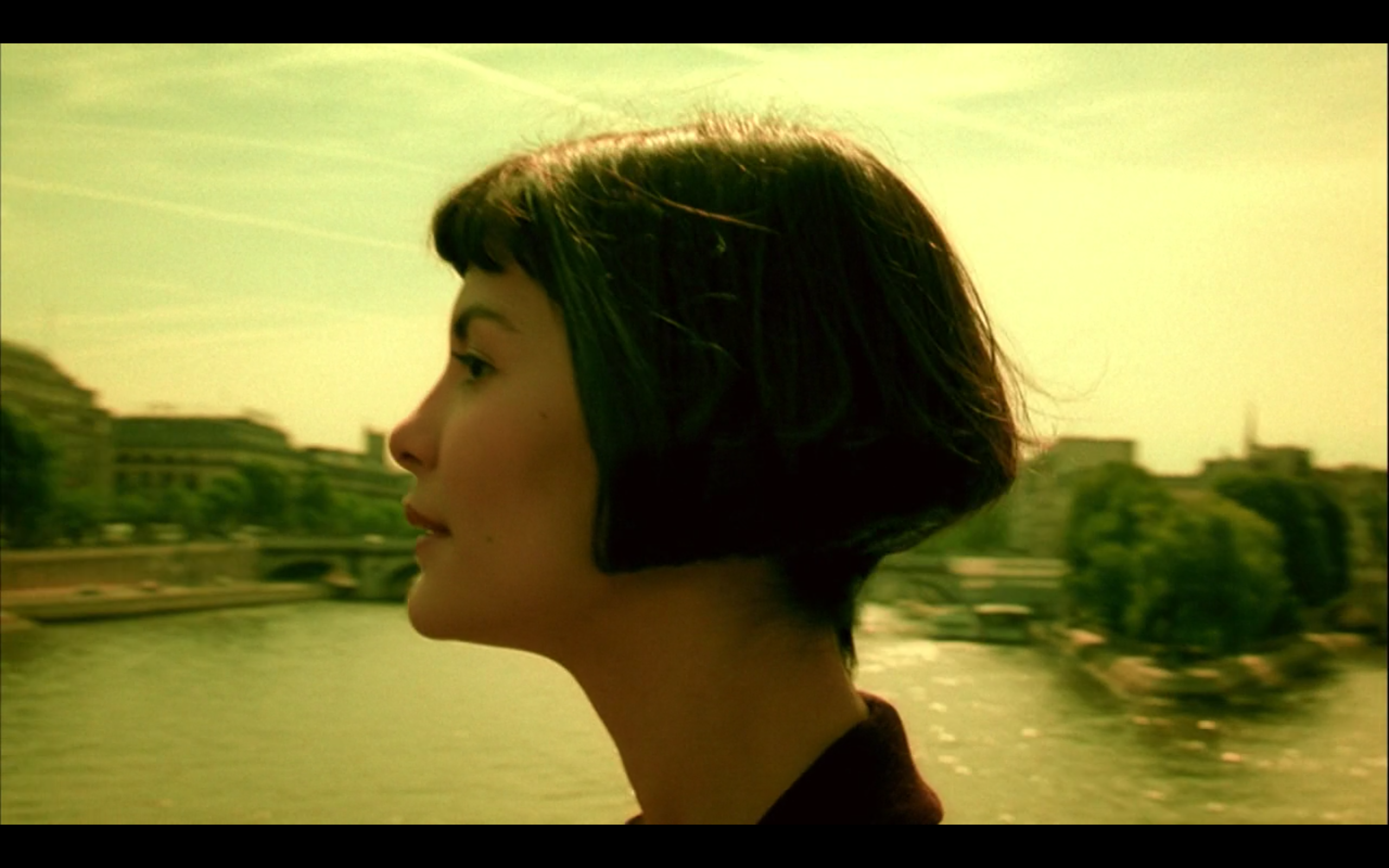
Amélie walks along the Seine after finding joy in helping others.

First, Amélie, the shy, whimsical, and ingenious protagonist of the film, actively decides to become a force of good in others’ lives (15:52; 35:08). In doing so, Amélie necessitates a focus on the formation of community, and the outcomes and experiences of minor characters become immensely important to the success of the protagonist’s quest. One major point of this is that most of, if not all, the people Amélie chooses to help are initially isolated in some way. Georgette, a nervous hypochondriac coworker of Amélie’s, and Joseph, a recently cynical-of-women customer at the diner, experience a short-lived romantic relationship together. It is notably initiated by the transparent and open attitudes they display for each other, and Amélie’s fabrication of those attitudes nonetheless allows for the formation of an honest relationship.

screen-shot-2016-11-18-at-4-30-36-pm

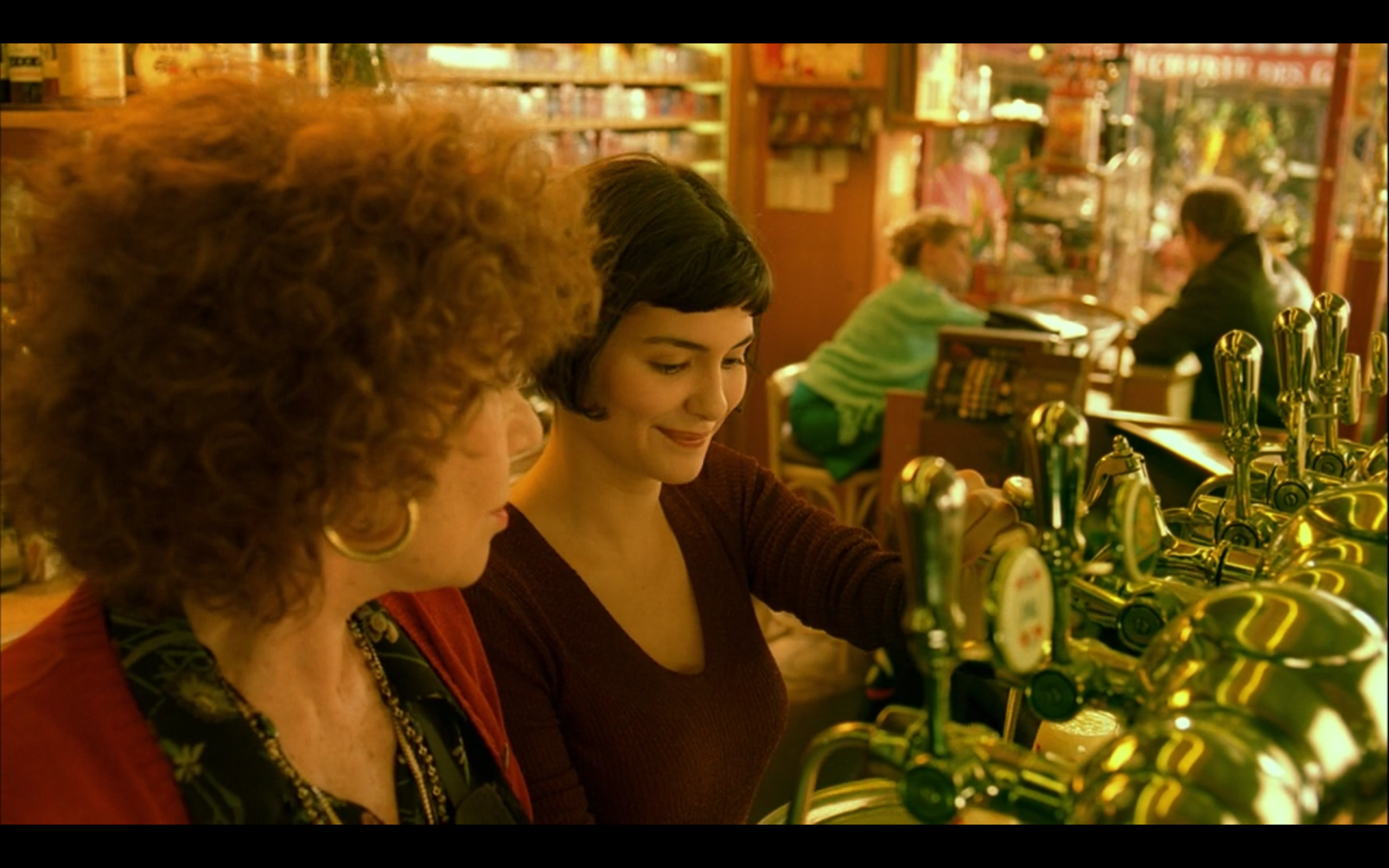
(left to right) Suzanne, Amélie, Georgette, and Joseph at the diner, after Amélie has told Georgette and Joseph they have feelings for each other.

Although the two characters do not continue this relationship past their first sexual relation, they are incorporated into the social world around them in a way they hadn’t been at the start of the movie – a lady notices Georgette and calls, “It’s ages since I saw you, you look good!” (52:13), and Joseph’s overriding characterization as the “jealous ex-lover” is offset by joy and real discussion with others (1:18:25). Yet, these are merely two examples – the film presents improvements in the social lives of multiple characters, with profound effect on each of them, and the community, no matter their temporality.

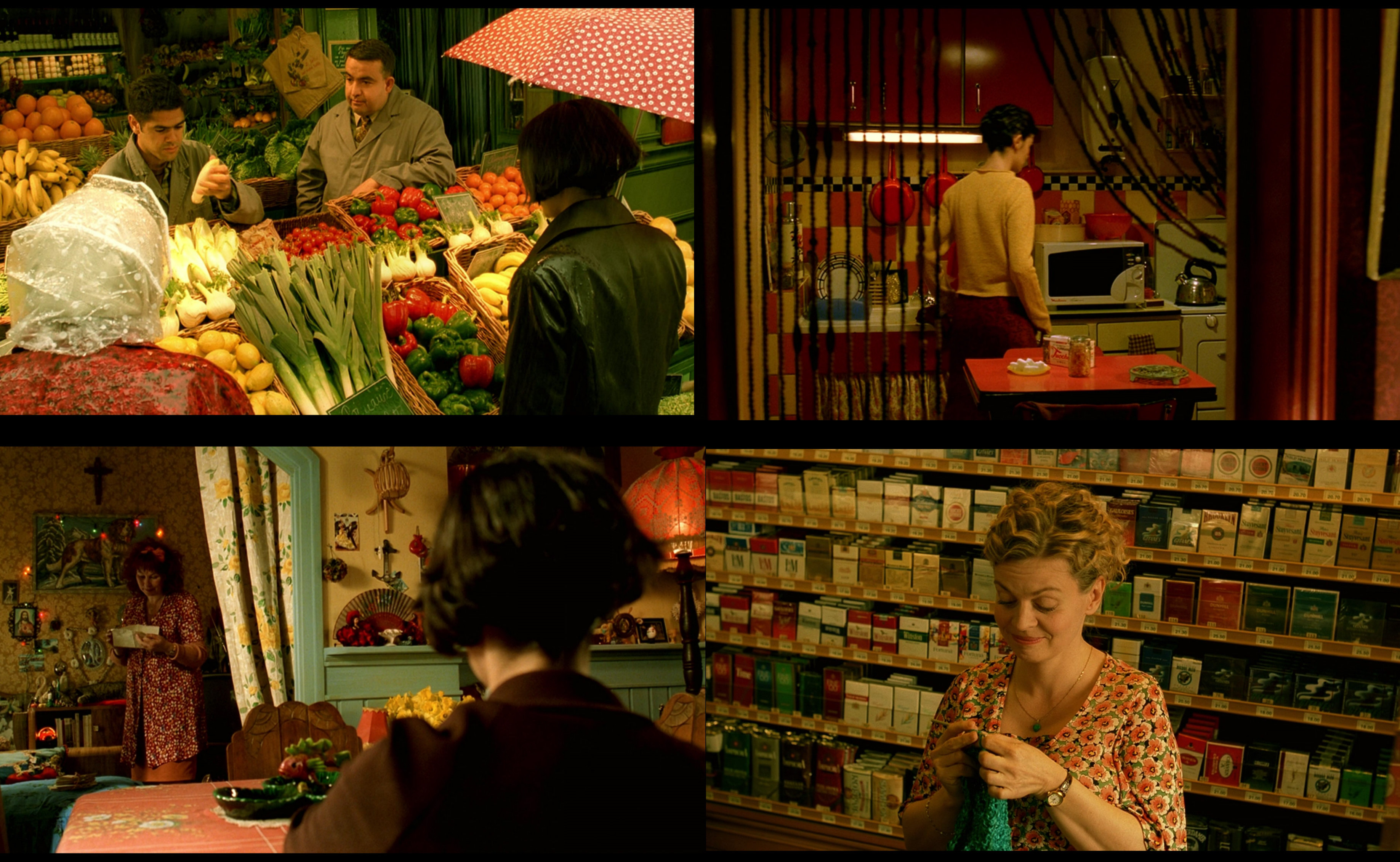
Moreover, it is evident that the film “feels good” in part because of the sheer abundance and simultaneous lack of poverty it portrays. Just in terms of physical profusion, there are countless scenes in which the sets are riddled with “stuff”. For instance: the wall behind Georgette’s counter in the diner is lined with dozens of cigarettes brands; both Amélie’s and Madame Wallace’s rooms are covered in knick-knacks; Nino collects probably hundreds of photos in a large book; and there remain many other instances of plain and simple copiousness.

untitled-1785

(clockwise from top left) The grocery stand where Amélie often goes, Amélie’s kitchen, Madame Wallace’s apartment, Georgette’s counter.

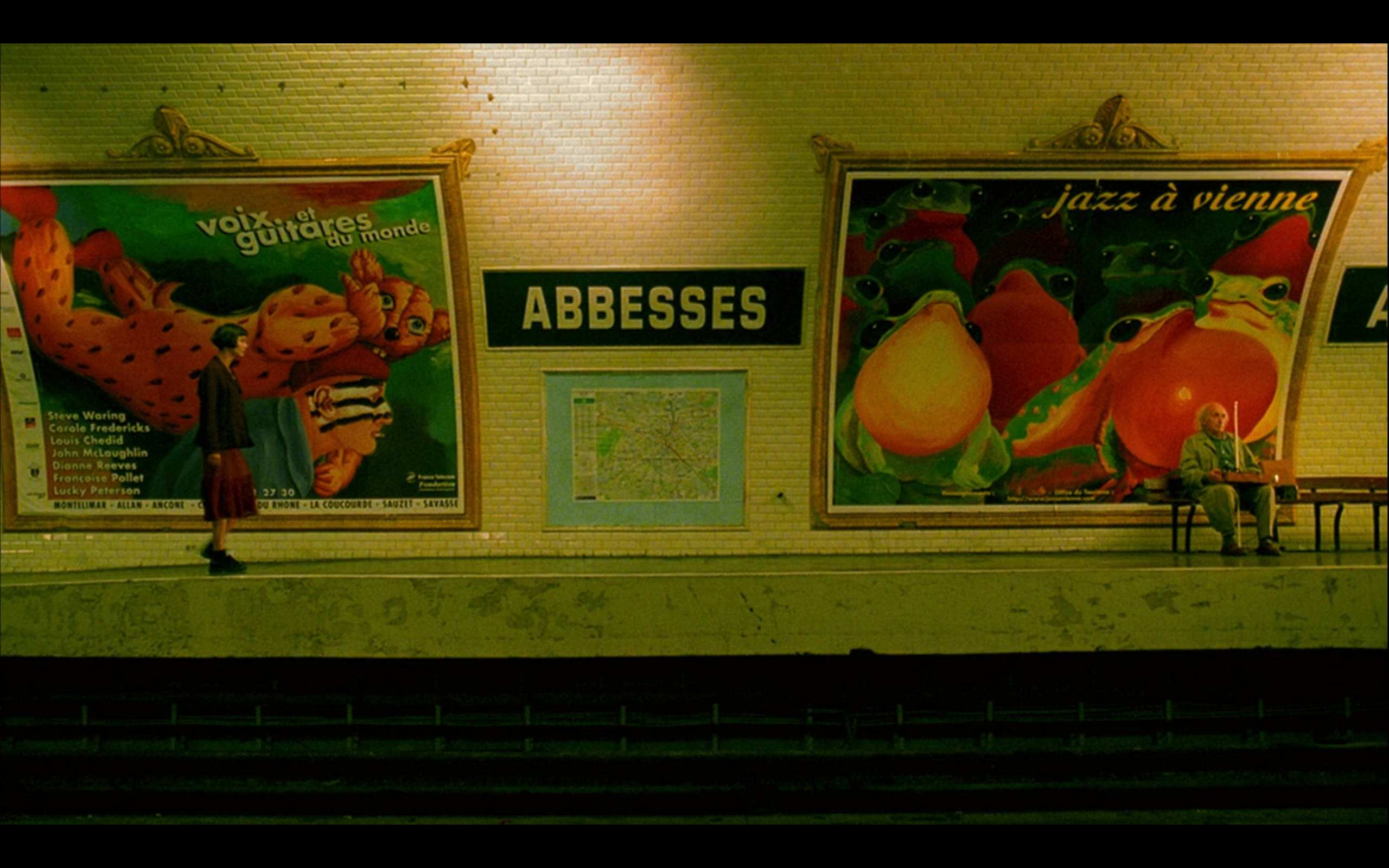
This kind of visual gratification is coupled to the film’s likely deliberate elimination of poverty, or satirizing of it. For example, before going to see her father, Amélie is walking on a train platform and attempts to offer a presumably homeless man some money. He refuses the money and tells her “Non merci ma petite dame, je travailles jamais dimanche,” which translates to “No thanks, madam. I never work on Sundays” (11:25). His refusal, and his claim of having days off, is a complete surprise that cinematic technique communicates as a light moment of blissful happiness, by the inclusion of airy French street-music and smiles from both characters. Even the poor man on the street is happy in this film. Soon after, when Amélie is again going to visit her father, another presumably poor man, in this case now a blind man, is on the subway platform playing Fréhel’s “Si tu n’étais pas là” on a mobile record player. The song is classically French, reminiscent of the early 1900’s “French Chanson”, and its use in conjunction with the poor, blind man has similar effect as the previous example – his status as impoverished is diminished in importance, and he’s just a man listening to music like all the others in the station.

Amélie approaches the poor, blind man on the subway platform.

Amélie approaches the poor, blind man on the subway platform.

The desperately poor are made equal to those who live comfortably by being portrayed as similarly comfortable with obviously less-favorable situations, so that we, as viewers, can find pleasure in knowing that they are just as happy as anyone else.

untitled-167

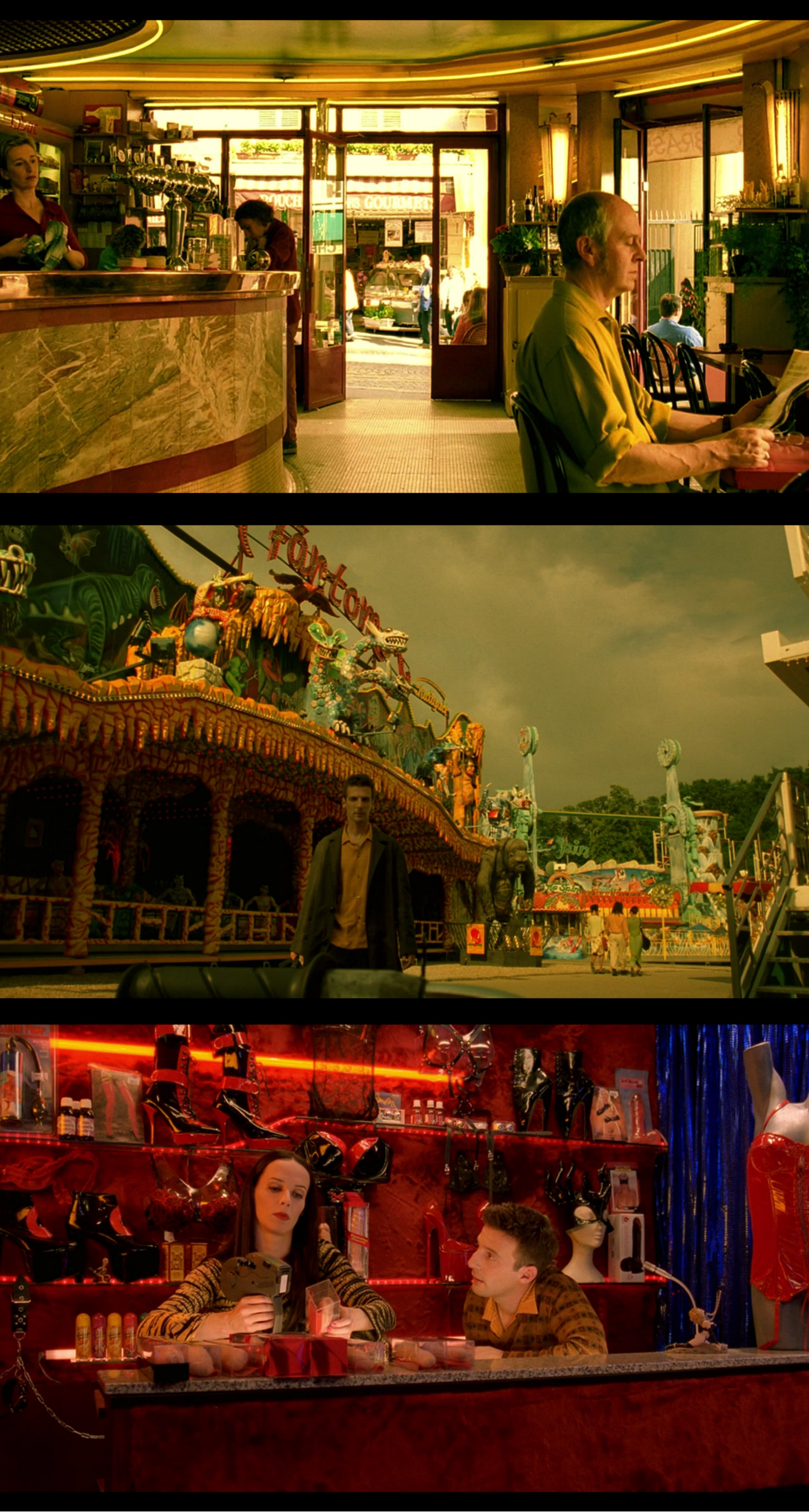
(top to bottom) The diner workplace of Amélie, and the Funfair and Porn Palace workplaces of Nino.

Furthermore, the plot and characters possess continuously great energy and intensity, qualities our regular day-to-day lives often lack. Much of the film takes place in Amélie’s workplace, where she logically spends most of her day; the diner is in no way dull however, and neither are the workplaces of Nino, Amélie’s romantic interest to whom the film also devotes large amounts of screen time. The intensity of the location derives largely from it being the place where the relationships between Georgette and Joseph as well as Amélie and Nino develop, and from it being where a number of Amélie’s creative schemes unfold. By the same token, her first meeting with Nino nearly occurs at his part-time workplace, the Porn Palace, and the excitement and romance of this near-meeting is captured in charming quality that’s imbued to even that locale. She then goes to the Funfair, Nino’s second workplace, to continue what would best be described as a game of cat-and-mouse. Here again, Amélie makes play the central theme of a space where most people would uphold a high level of wearisome uniformity. Instead of doing so, Amélie sends Nino on a scavenger hunt with arrows drawn in blue chalk and made of colorful sprinkles (1:13:15). Alongside these scenes of playfulness, there are similarly utopian scenes of excitement, via rapid progression. One such scene occurs when Amélie takes the blind man we had seen previously by the arm and walks down the main street, past delis and bustling crowds, while describing to him their surroundings. The amalgamation of fast-paced dialogue, swelling accordion/orchestral music, and quick camera movements promotes an intensity for the audience and the man, who is left in a colorful daze of clarity (36:20).

The film thus relies heavily upon core concepts of traditional utopia in entertainment, to consistently provide a sense of what an ideally better world would look like. Without the qualities provided by the series of minor characters, and subsequent idealized-French feel, the extremely utopian element of the film would be lost, and so would the following insight that such an overly utopian cultural artifact can poignantly provide.

Despite the film’s attempt at dreaming up a utopian France, there remains the question of who’s utopia is being presented. By excluding the desires of marginalized groups from this essentially “perfect” imagined-world, those groups’ desires and sufferings are made illegitimate. Therefore, the level of forthright utopia in Amélie, aides in the conveyance of the exclusion of racial and sexual minorities and their struggles in pop media. Not a single racial-minority character is featured, nor is any LGBTQ character, yet the movie experienced astounding success. This is a concept Richard Dyer proposed of all entertainment, as all entertainment harbors secretly utopian elements, and his explanation points to capitalism as the origin for such a lack. It then becomes relevant to note that the communication of cultural entities is currently controlled by a commercial system that relies upon capitalistic determinants for its leaders. And since those who own the productive means for the creation of films are largely rich, white, males, the qualities we desire from pop culture’s depiction of utopia remain unchanged across all forms of it, and the products of pop culture become industrial in their creation.

          Amélie provides a uniquely utopian cultural artifact for the observance of how the current capitalistically-controlled pop culture industry denies the validity of minority group sufferings, and their desires for what should be present in a massively better world. Yes, the film is utopian according to the standards we currently hold for entertainment, but in being so to such a large extent, we can see the deficits of our own industry-imposed criteria.


Works Cited

Amélie. Dir. Jean-Pierre Jeunet. Perf. Audrey Tautou and Mathieu Kassovitz. UGC-Fox Distribution, 2001.

Ezra, Elizabeth. Contemporary Film Directors: Jean-Pierre Jeunet. Champaign, US: University of Illinois Press, 2008. Print.

Gibbs, Ed. “CLASSIC REVIEW.” Sunday Age: 15. Dec 08 2013. Web.

Wakeman, Rosemary. “Paris Dreams, Paris Memories: The City and its Mystique.” French Politics, Culture & Society 32.2 (2014): 151-3. Web.

Apple’s Utopian Core

Dew Panalee Maskati

The Apple way of life provides a spiritual path towards a utopia: one in which people and technology operate in harmony. In the years between Apple’s formation and the turn of the millennium, the relationship between the populace and computers was complex. The computer was seen as a testament to humanity’s ability and expertise — a wealth of information accessible at our very fingertips. It epitomises ideals of the Enlightenment that champion progress through rational thought and scientific enquiry. Indeed, Apple’s logo was deliberately chosen:

“In the Old Testament there was the first apple, the forbidden fruit of the Tree of Knowledge, which with one taste sent Adam, Eve, and all mankind into the great current of History. The second Apple was Isaac Newton’s, the symbol of our entry into the age of modern science. The Apple Computer symbol was not chosen purely at random, it represents the third Apple, the one that widens the paths of knowledge leading toward the future.” Jean-LouisGass, then General Manager of Apple France and former President of Apple Products, 1987:9-10 (Lam Pui-Yan)

The fruit of knowledge


But an understanding of the way in which computers functioned eluded the average consumer. Both tantalising and terrifying, computers acquired a mystical reverence from the populace in addition to being signifiers of hope. For some, this lack of comprehension turned into fear. This is why Apple’s image is arguably one of its most remarkable achievements: it managed to capture the spirit of invention whilst assuaging distrust of the unimaginably powerful ‘black box’. Its software is easier for the average consumer to operate than other brands’, thereby inviting trust. A sentiment commonly echoed by Apple aficionados is that Macs do not “fight back” in the same way that other computers do (Pui-Yan Lam). Consumers grow ever more reliant as smart technology becomes more ubiquitous. Apple devotees can now enshrine themselves in the iHome, a harmonious web of Apple products, a marketing strategy that only works because of the trust that Apple’s products invite. Although any purchase of an Apple product entails a subscription to its harmonious ideal, the loyal superfans exaggerate this utopian element and bring it to fruition — forming in effect, a subculture.

Apple’s image stands unique, because it is a corporate giant that has managed to reject corporate uniformity. The PC, on the other hand, is a computer for the businessman — who is going out of style. From the curved elegance of its minimalist aesthetic down to Steve Jobs’s distinctive black turtleneck and slacks, Apple manages to incorporate “play” and relaxation as one of its core values (Lam Pui-Yan). Apple’s new HQ, the second Apple Campus in Silicon Valley, is designed to epitomise these ideals. Once completed, it will become a site on which the opposing streams of the corporate world and hippie culture from the 60s merge. At this confluence we see an impersonal, profit-seeking foundation finding its expression in soft, organic forms that sing of spirituality and a countercultural edge. Curves are seen as harmonious and natural; the sharp and angular, dominating and evil. It was not designed to simply function as a workspace, but rather, to pioneer a new way of life. In the same way that Disney created their utopian bubble (EPCOT), the second Apple Campus is also meant to be a monument of sorts — to what a progressive future could be (Nikil Saval). In doing so, it counters the angular and sharp oppressiveness of the corporate.

An artist's rendition of what the new Apple Campus will look like

An artist’s rendition of what the new Apple Campus will look like

Here is an extremely successful illusion at work: fans buy into Apple’s pioneering image with products that are meant to enhance their individuality — yet consumers are only offered a distilled selection of a rather small range of products. In contrast, Apple enthusiasts see Apple’s alter-ego, Microsoft and its founder Bill Gates, as profit-motivated corporate entities; consumers are merely part of a self-serving, industry-wide formula. This is because Apple founded itself on humanitarian values: its creators were not simply making boxes, machines or money; they were changing the world. Apple embodies the future — Bill Gates and Microsoft are giants from an oppressive past, to be toppled. To consume an Apple product is to participate in this movement — this philosophy of life — to lesser or greater degrees. Steve Jobs is not the ‘evil’ businessman in a suit, he is both at one with the consumers and their prophet.

And then Apple takes it one step further, overtly associating itself with creative genius. Richard Dreyfus’s poem became synonymous with the “Think Different” campaign: the poem utilises powerful imagery that encouragers rebellion through art, such as “here’s to the… round pegs in the square holes”, “they push the human race forward”, “while some see them as the crazy ones, we see genius”. None of the ads from the “Think different” campaign included any Apple products and that the participating celebrities were given Apple products and money to donate to causes of their choice; the producers took extreme care not to look exploitative. They also advertised in popular and fashion magazines — a bold move at the time — so as to merge style, artistry and practicality; Apple’s products bled out of the sphere of technology and business, and inserted itself into daily life. Here is a utopia in which human achievement sees no horizon, the individual in the masses is finally recognised, and conformity is rejected — one that can be carried around in a bag, a jeans pocket, the palm of your hand.

https://www.youtube.com/watch?v=SswMzUWOiJg

Sacralising the bond between human and technology has led to an Apple consumer base which John Schully, former Apple CEO, describes as a “cult environment” (Pui-Yan Lam). Scientific progress and the championing of rational thought undermines organised religion — so, to subscribe to scientific thought also means, for some, to confront a spiritual absence (Jeffrey Alexander).  This brought a sense of emptiness to people’s lives. Apple capitalised on this feeling to become a spiritual medium by connecting its image with a progressive, utopian philosophy. The unusual outpouring of grief over Steve Jobs’s death — the size of which would have been more appropriate for a revolutionary icon or prophet rather than a successful businessman — is telling enough. Cyberspace has become a modern heaven of sorts, a dimensionless space which liberates us from the constraints of our body and geography: technology allows us to transcend social boundaries. A user on MacWorld says: “for me, the mac was the closest thing to religion I could deal with.” (Pui-Yan Lam)

A certain subset of the Apple fanbase has intimately and profoundly connected with Apple’s appliances. An ardent Mac user describes her physically affectionate relationship with her computer: “I mean there has been times that I hugged my computer and stuff like that. I have never hugged a PC.” (Pui-Yan Lam). Apple has this intimate appeal because Mac’s user-friendly system does not control users’ lives, but seems instead to expand them.

Perhaps even more stunningly, Apple’s most enthusiastic supporters have mobilised to form a subculture of their own. In 1997, David Every pioneered the MacKiDo website as a way to achieve enlightenment through the power of Mac. Every and other enthusiasts see themselves as saviours of humankind, promoting a radical philosophy of life accessible through consuming Apple products — whose light they believe other corporate giants are trying to extinguish.  Notice the heroic, ego-stroking and spiritual language an Apple disciple, known as the Apple Jedi, employs:

If anything characterises the history of Apple and its users, it is their sense of community. Nurture it. Help strengthen it. Guide your actions in harmony with that which binds us all together unseen and yet keenly felt by the Apple Jedi. In the arrogance of its marketing and the nature of its tactics the Dark Side understands not these things, and cannot fight them. And so, it is in the deepening of this community that the greatest responsibility of an Apple Jedi lies, for it is in this power that Mac OS aficionados can find strength to triumph. (Pui-Yan Lam)

So here we have the phenomenon of the mac evangelists — Apple superfans who see themselves as warriors, heroes, and, most interestingly, Jedi. This association with Jedi is tied heavily with the consumer’s search for spirituality: here, it finds its expression in the reductive polarisation of the world of technology into ‘the side of the force’ — Apple and its consumers — and the “Dark Side” — other technology giants, PC users. The Apple Jedi’s mission, amongst this encroaching darkness, is to introduce people to the Apple way of life. And what is this way of life exactly? It is one in which technology is associated with an equalising power, diminishing social constraints and injustices.

The way of the force

The way of the force

“In this profane world, great business people, such as Bill Gates, who seek nothing but financial gains, are rewarded. However, the Mac devotees are looking forward to a utopia created by superior computer technology. In this utopia, people are judged purely on the basis of their intelligence and their contribution to humanity.” (Pui-Yan Lam)

These fans of Apple see computers as a “reflective medium,” crucial to the way in which they form their identity (Pui-Yan Lam). The computer is seen as an extension of the user’s mind, and the brand to which a consumer subscribes provides key insight as to what their life’s philosophy is.

The minority status of Apple fans before the turn of the millennium served to strengthen their subculture. PC users, who were the majority at the time, often derided Macs, calling them “toys” or “pieces of junk”. The harassment the Apple disciples endured seemed to have increased their sense of righteousness. An anniversary issue for MacAddict (now branded as MacLife), a magazine that promotes all things Apple, captured the spirit of the times perfectly:

“We’ve had enough. We’re tired of Apple being carelessly labeled as lagging, failing or dying. We’re tired of people maligning our Macintoshes. We’re sick of the slams, digs, and taunts directed at us by know-nothing PC hacks. It will stop. NOW. We will not surrender to the ‘inevitable’ of passively pray for the health of our platform. No, it’s time for revolution. Tell your family, tell your friends. Join us not just defending the Mac from attacks on all sides but also in an assault on the attitudes that provoke them. Join the Mac resistance.” (Pui-Yan Lam)

From the impassioned tone of this excerpt, it is obvious that Apple’s products stood for more than efficient and aesthetically pleasing technology. This is not only a call to protect Apple’s reputation, but also a declaration of war on the “attitudes” of the opposition: the ignorant consumers of corporations other than Apple were enabling a way of life that promotes business interests and subjugates the individual. By contrast, “mac resistance” is composed of people — “family” and “friends” — that are seeking to undermine the system that controls them.

But it is important to remember that these mac enthusiasts are only a subset of all of Apple’s consumers, and that their movement peaked before the turn of the millennium. Nowadays, Apple has become hip. In fact, the new wave of young consumers has caused older devotees to lament the lack of loyalty of the recent addition to their fanbase. Whilst Apple retains the utopian appeal it held from the beginning, the strong, progressive philosophy that came with the Apple way of life has receded; what seems to be left is the nebulous but attractive aura of a softly fading visionary movement.

Of course, Apple’s utopian image is not perfect. It’s products are becoming ever more similar, losing the visionary quality that made the brand so appealing in the first place: Wired magazine, in its critique of the iPhone 5, describes the smartphone as “completely amazing and utterly boring” (Mat Honan). And the ironic undercurrent that runs parallel to this essay’s argument, that completely undermines Apple and its superfans’ enterprise, is the fact that Apple is ultimately another profit-motivated corporate giant. The truly humanitarian values that may have inspired Apple’s creators have since become perverted: Apple’s utopia is simply an effective marketing strategy — packaging that cloaks Apple’s true profit-motivated interests. The illusion biases Apple fans against reality. Some are content to demonise Bill Gates, even though he is a well-known and respected philanthropist; meanwhile, Apple has recently come under fire for condoning exploitative practises abroad through Asian contractors.  Apple’s products have always been a symbol of wealth and status, a utopian bubble only accessible to some, breeding a subculture founded on privilege.


Bibliography

Lam, Pui-Yan. “May the Force of the Operating System Be with You: Macintosh Devotion as Implicit Religion.” Sociology of Religion 62.2 (2001): 243. Print.

Alexander, Jeffrey. “The Sacred and Profane Information Machine: Discourse about the Computer as Ideology.” Archives De Sciences Sociales Des Religions 69, Relire Durkheim (1990): 161-71. JSTOR. Web. 19 Nov. 2016.

“MacKiDo – Mac Information & More.” MacKiDo – Mac Information & More. Web. 19 Nov. 2016.

Saval, Nikil. “Google and Apple: The High-Tech Hippies of Silicon Valley.” The New York Times. The New York Times, 28 Mar. 2016. Web. 19 Nov. 2016.

Honan, Mat. “The IPhone 5 Is Completely Amazing and Utterly Boring.” Wired.com. Conde Nast Digital, 9 Dec. 2012. Web. 19 Nov. 2016.

Take Cover: Solace In Utopia

Joyce S. Tseng

Cultural criticism finds itself faced with the final stage of the dialectic of culture and barbarism. To write poetry after Auschwitz is barbaric.

—Theodor W. Adorno (Prisms, 34)

Totalitarianism. Aryan soldiers; a Jew in hiding. Conformity; defiance. Brutality; survival. War fiction has continued to flourish as one of the most popular genres, especially to the audience of young-adults, of novels and film. These narratives are packed with the passion of patriotism, the horrors of violence, and the rawness of human experience. A state of war reflects a metaphysical, and physical, extremity of existence, which perhaps drives our fascination towards stories inspired from it. For the majority of the current young-adult population, it is unlikely for us to experience anything close to the realities of WWI and WWII; our only medium to the period is through fiction and our imaginations. This year, according to vice president and publisher of Scholastic David Levithan, “We’re seeing more publishing on [historical fiction on WWII] than we have ever before.” Various colleges today even hold courses dedicated to intensive analysis on the phenomena of utopias and dystopias, which perhaps is ultimately indicative that we, as consumers of stories, are drawn towards worlds outside of our own realities—the more extreme and different, the more we are lured into them.

German philosopher, Theodor W. Adorno, in his collection of essays Prisms, discusses cultural criticism and society, and specifically alludes to Nazi Germany to illustrate his point. He claims that the modern world is becoming increasingly like “an open-air prison,” suggesting an overarching system that holds the façade of free will for the people, but in actuality is carefully manipulated and controlled. This concept is also made clear in a different essay of Adorno’s that disproves free will and choice, and that the “culture industry,” as he phrased it, is in extensive control. Adorno goes further in Prisms to claim that “to write poetry after Auschwitz is barbaric.” This is to say, there must have been a path of culture that paved the way towards the brutality of Nazi rule—the deteriorating economy, the volatile political climate all contributed to the state of society and culture of the time. Here, Adorno is saying that to continue on that path of culture after such an atrocity to humanity like the Nazi regime would be a detriment to human society. Various analyses of culture claim that the homogenization and uniformity of society are problematic. It is robbing us of the true value of the ideal form of culture. The “culture industry,” as coined by Adorno and fellow German philosopher Max Horkheimer, mass-produces a standard program of socially accepted products of culture. This heavily controlled and systematic depiction of culture and society is paramount in totalitarianism. This is why it is valuable to examine war literature. Why does the readership of such a gruesome period of history continue to grow? I claim that even in the most heartbreaking, dire, and barbaric stories, there exist pockets of utopia that reflect our desires to see change, onto which we latch and by which we become engrossed.

Liesel Meminger reading to Max Vandenberg in the basement of the Hubermanns'

Liesel Meminger reading to Max Vandenberg in the basement of the Hubermanns’

The Book Thief by Australian author Markus Zusak is a prime example of war literature that has consistently received high ratings. In 2013, the novel—first published in 2005—was depicted on film, directed by Brian Percival. The story, narrated through the perspective of Death, follows the young female protagonist, Liesel Meminger, a German girl who is sent away to Molching in the heart of Nazi rule because her mother, a Communist, is in danger of Nazi removal. From the beginning, Liesel is depicted to be a thief of books; she steals The Gravedigger’s Handbook during the burial of her younger brother when he dies of disease. The commodity of books comforts Liesel though she is illiterate. This proves to become an important, binding theme of the novel. Her foster parents, Hans and Rosa Hubermann, each their own distinct characters, share a genuine, unconditional care for Liesel. They enroll her in the Hitler Youth and Liesel assimilates into Nazi culture. Even though we see the Hubermanns exhibit internal conflicts to Nazi ideology, ultimately, they abide by the totalitarian regime out of necessity for survival.

Liesel attending Hitler Youth

Liesel attending Hitler Youth

Nazi book-burning ceremony on the streets of Molching

Nazi book-burning ceremony on the streets of Molching

A poignant moment in the novel occurs during a Nazi book-burning ceremony, which Liesel and Rudy, her Aryan neighbor and classmate, attend with the Hubermanns and the entire town of Molching. They stand amidst the crowd under the surveillance of Nazi soldiers. Liesel is distressed by watching the books disintegrate in the body of flames before her, and is later further provoked by the coercion of a classmate to throw a book in herself. It is clear that being unpatriotic or at odds with Nazi beliefs would lead to being socially ostracized. Rebellion is a clear threat to one’s survival. After the crowd and Nazi officers leave the scene, Liesel steals a book from the pile of ash and tattered pages. In this moment, defiance highlights the seizing of control back from an oppressive system. This is what unlocks utopia. In a totalitarian society, such as Nazi Germany, personal control is taken away and all the facets of life, including culture, lay in the hands of the state. The books that Liesel steals as the narrative unravels serve as constant indicators of her holding onto something that the state repeatedly tries to take away—as illustrated by book burning ceremonies. She insists on clinging onto the prohibited, suggestive of her personal desires for an alternative reality. This is the essence of utopia. Acting upon these feats of resistance, against a dangerously powerful organization like the Nazis, for the majority can only exist as a fantasy. But, that desire for change is indeed real.


Liesel steals a book from the pile

Liesel steals a book from the pile

The symbolism of books for Liesel is a thread that runs across the narrative and is depicted beautifully in the film rendition. One of the most memorable moments of the story occurs when Liesel delivers laundry as part of the Hubermanns’ business to the mayor of Molching’s house. Back during the book burning ceremony on the streets, Liesel is in fact unaware that the wife of the mayor, Ilsa Hermann, spotted her steal the book from the pile. Frau Hermann descends from the grand wooden staircase to bring money to Liesel for the laundry service. She recognizes Liesel immediately as the book thief. She stands formidably with a stoically stern look and utters, “So, you like books?” Liesel is instantly anxious and fearful that her cover has been blown. But to the surprise of both Liesel and the audience, Frau Hermann walks to the adjacent doors and opens them to mayor’s private library and invites Liesel in. A panorama of classic, polished, wooden bookshelves glisten from the golden raised bands in the warm light of antique lamps. The cinematic, simplistic piano melody that accompanies the scene highlights the stark segregation between the pristine sanctuary of the library and the ramshackle streets decorated with Swastikas. This is an imperative moment as it physically captures the dichotomy Liesel experiences during the war. She suddenly has a whole collection of things to affirm her inner desire to hold onto what she believes in, despite it being against the tyrannical system. It is a statement of her utopia, expanding it and adding weight to it. It gives Liesel—and the audience—hope.

Liesel in Mayor Hermann's library

Liesel in Mayor Hermann’s library

Later in the novel, in the height of war and Nazi control, the Hubermanns take in a Jewish fist-fighter, Max Vandenburg. The character development of Max also offers many examples of utopia. During his escape from home to the Hubermanns’, Max’s saving grace is Hitler’s autobiographical book Mein Kampf, which he uses as his fraudulent stamp of being German. As Max and Liesel become closer, she visits him more and more in the basement where he resides and together they develop a love for words and stories. Max covers the pages of Mein Kampf with white paint and handwrites a story for Liesel in its place. This act itself is utopian. He recognizes he doesn’t need his saving grace to convince the outside world that he is German anymore because the basement is his new reality and future. He literally paints over, overtly rejecting and silencing, the voice of the most powerful figure of Nazi Germany, trashing the ideologies of the system to instead scribble in his own thoughts and doodle complementary cartoons. Max knows that there will be no consequences because there is no one to apply the consequences to him. He turns the dark truth that he is stuck in a basement, his existence essentially extinguished, into a medium to act out in his own form of defiance. In a scene with Liesel, Max teases her when she is being secretive, encouraging her to let him in on the secret by chuckling, “Who am I going to tell?” The irony of Max’s lightheartedness about his grim reality is utopian.

Max painting over Hitler's "Mein Kampf"

Max painting over Hitler’s “Mein Kampf”

The dense stories of war fiction crave such moments. Reflective of a natural coping mechanism, we orient ourselves towards optimism in the face of grave seriousness; or, at the very least, a distraction. We generate an internal world in which we have control and in there, we unleash our inner desires. War literature lets us in on these internal worlds of minorities, the victims, groups that were oppressed by tyrannical rule. To return to Adorno’s quote that “to write poetry after Auschwitz is barbaric,” we see that in war literature, authors with the benefit of hindsight make an active choice to include utopian moments of victims to underline a revised form of “poetry,” aligning with Adorno’s claim. As historian Stephen Greenblatt stated, “Great historical novels provide a powerful hallucination of presence, the vivid sensation of lived life.” It is a reconstruction of black and white fact, colored in by serious, human fantasies. By illustrating that even those in the derogated portion of society, plagued with trying war times, could hold onto the desire for an alternate reality, “poetry”—that is, culture—can continue to exist after such an inhumane regime, without being a detriment to society. The example of war literature in application to current society is perhaps to show us that a controlling world, obviously not the same degree of extremity, where a “culture industry” persists, ignites rebellious desires in us to overturn such homogenization in order to cope with our reality.

Hans Hubermann and Liesel Meminger

Hans Hubermann and Liesel Meminger

References:

Theodor W. Adorno (1981) “Cultural Criticism and Society,” in Prisms, translated by S. and S. Weber, (Cambridge, MA: MIT Press), accessed November 12, 2016, https://representingtheholocaust.wikispaces.com/file/view/Adorno_Cultural+Criticism.pdf

Lucy Ives, “How Archival Fiction Upends Our View of History,” New Yorker (2016), accessed November 12, 2016, http://www.newyorker.com/books/page-turner/how-archival-fiction-upends-our-view-of-history

Theodor W. Adorno and Max Horkheimer, “The Culture Industry: Enlightenment as Mass Deception,” English 117 Cultural Theory Course Packet.


The Power of Laughter

tc84xhhhzsr4nhpbv4cbzfrqqtq

Laughter, in its purest form, is the best indication of happiness within a person. Laughter can bring people together, make someone feel better, and even increase someone’s quality of life. It is a natural healing agent that is vital to a person’s well-being. It is not just some meaningless reaction expressed as way to “cheat happiness” like Theodor Adorno believes, but rather an uncontrollable release of joy inside that person. They might not always be happy or have an overall happy life but all that matters is how that person is feeling in that exact moment. In the movie Patch Adams, which is based on a true story, a doctor named Hunter “Patch” Adams treats patients by not only giving medical treatment but also by healing them through laughter. As he says repeatedly in the film, “laughter is the best medicine”. Of course, people can’t just receive laughter as a treatment, but the laughter he prescribed drastically improved his patients’ overall quality of life by relaxing them, lowering their blood pressure, decreasing the amount of pain they’re experiencing, boosting their immune systems and many other benefits. Laughter gave these people hope and a reason to fight off their diseases. The patients were able to live more comfortably and enjoy their lives much more because of it. For them, laughter wasn’t just some meaningless action to disguise the fear within them or a quick break from the pain they were experiencing, they laughed because it showed that even in their time of pain and suffering there could still be happiness buried within them. This happiness allowed them to enter a new world where they were freed from the restraints of their current ailments.

According to Mikhail Bakhtin, there are two worlds that we live in; one “official” and one “non-official”. The “official” world is our everyday lives while the “unofficial” world is one that is completely different from the “official” in that it follows no rules and anybody could be anyone. As Bakhtin says, “[the carnival culture] offered a completely different, nonofficial, extraecclesiastical and extrapolitical aspect of the world, of man, and of human relations” (84). By living in this “unofficial” carnival world people can strip themselves of the stress, pain, frustration etc. of the world they live in and adopt a new culture, a new world in which they can be anything they want. It is not just some show they go watch or some book they go read to escape their world. It is something they go live, something they go to experience with others. It is embraced by everyone who goes and lives it. It is a world filled with all different kinds of forms of expression and art. Bakhtin describes carnival as a balance of art and life, “It belongs to the borderline between art and life. In reality, it is life itself but shaped according to a certain pattern of play…Thus carnival is the people’s second life, organized on the basis of laughter” (86). Therefore, if carnival is life itself and is organized on the basis of laughter then that means laughter organizes life itself. Laughter is what people use to create a better world to live in. It isn’t a “sickness infecting happiness…drawing it into society’s worthless totality” (112) as Adorno believes it to be. Rather, laughter is life, it’s what life is built from, it gives meaning to life.hqdefault

In Patch Adams, we see clearly how this is put in effect the real world. Patch creates a homemade hospital where he treats people who can’t afford a real hospital. There he treats people both with real medical treatment and with jokes, happiness, and joy. In a similar way of how carnival is a borderline between life and art, Patch balanced medical treatment with laughter. This balance, although very unorthodox, proved to be very effective. In the movie, the nurses said that since his arrival to the hospital, patients’ optimism greatly increased and the amounts of medication required decreased. The laughter and joy that was given to them through Patch significantly increased their wellbeing and improved their lives. He had such a tremendous impact on the patients’ lives that, even in times of tremendous pain and suffering, he was able to bring out true happiness from within them through laughter. This sort of practice was very different from the one that was common in that time.

The hospitals and doctors of that time were very disconnected from their patients. As shown in the movie, patients were referred to by their room number or bed number or the disease they had e.g. “patient 205” or “the cancer patient”, but Patch believed that there should be a personal connection between the doctor and patient: he believed that instead of calling the patient by a number or disease, doctors should call them by their name, get to know them, and understand the difficulties they are going through. He adopted a very carnivalesque culture in which doctors are not above patients but on the same level. He says in the movie “everyone that comes into my house is both a doctor and a patient”. He believes that patients can learn from doctors just as much as doctors can learn from patients. In essence, when you stepped foot into his hospital, you entered a hospital that embraced a carnival culture built on laughter. It may seem that this laughter was only temporary and that it only was a quick escape from their real lives of pain, but it functioned as something much more than that.

images

Adorno believed that laughter is a “sickness infecting happiness” when in a false society but, as previously mentioned, Patch Adams’ hospital isn’t like the real world: when people enter it, they enter a new world. So, according to Adorno, laughter is just an escape from one’s reality. People only go to temporarily escape their reality, but, at the end of the day, they are still in pain and are suffering from a disease or mental health disorder. The people are scared of death so they go to the hospital to relieve their fear. He is basically saying that they are never truly happy because they are constantly fearing their lives and the laughter they experience is fake laughter, it is just a cover up for the terrible lives they are living. This argument is very far from the true reality of things.

Happiness can be a transient feeling. No one can constantly be happy, but at the same time, no one can constantly be sad. Some people may feel sad or happy more times than the other but they are not constantly feeling that emotion. To say that laughter is a consolation prize for not having a life worth living is very narrow-minded. Throughout the course of life, people experience all different types of emotion, and all these emotions at points in time add up to equal the overall quality of life for the person. Although, at a single point in time, you can’t tell if a person’s overall quality of life is good or bad, those moments will all add up to something that shows a person’s life is worth living and through the laughter they experience, they will ultimately have a life worth living because their temporary breaks from the real conditions of their lives aren’t just breaks.

A break has no meaning; it is something to just stop the thing you’re doing. This second world the people go to is much more than just a break; Bakhtin describes it as, “something must be added from the spiritual and ideological dimension. They must be sanctioned not by the world of practical conditions but by the highest aims of human existence, that is, by the world of ideals” (87). In order for something to be not just a break, but an actual second world, it has to have an ideological meaning that is spiritual. This is exactly what Patch offered. Bakhtin is saying that people going to Patch’s hospital transcend their reality and live in a world where they can all be equal and a world where they are not described by their disease but treated and respected as human beings. They were liberated from the restraints that the real world put on them and went to a world where everyone was equal, i.e. everyone is both a doctor and a patient, and built their relationship off laughter and joy in one another. Patch Adams shows that the patients laughter isn’t just a consolation prize because, though they are sick with disease, their laughter is actually proof they do live a life worth living, proof that their moments of laughter and happiness will add up to something that will transcend the boundaries placed down on them from the real world and free them in the second world they go to live in. This proof is shown countless times in the lives he was able to heal and the joy he placed in the all the souls he touched. People were able to recover more quickly and more easily because they were able to laugh and increase their overall quality of life. Laughter isn’t cheating happiness but rather builds happiness towards a life worth living.patch-adams-robin-williams-640_5d6e918f92c14c6cb142aed28bba98dc

In Patch Adams, a second world is created that isn’t just a break from the real world but rather a place to transcend the real world and get rid of fear, anger, and pain. Patch creates a world built on the foundation of laughter to spread joy to others. This laughter isn’t fake, it isn’t something foreign, it isn’t an emotionless action that they only go to when they don’t receive what they desire. The laughter experienced is pure: it is something that is inside all of them, within all their pain and suffering that, when reached, can lead to the betterment of their lives and create a life worth living.