Author Archives: Isabel Perry

It’s Rebellion Actually

America’s culture is distinctive because of its adolescent nature. From our usurpation against our mother country until now, our culture as a whole has retained distinctive qualities that are clearly adolescent. Clotaire Rapaille in his book The Culture Code explains this observation about American culture while also delving deeper into the exploration of human motivations within a culture. Rapaille claims that the culture in which we live out our early childhoods permanently influences the way we think and more specifically the way we act as adult consumers. Our reasons for choosing one marketing strategy over another are coded in the associations advertisements make with their products. His process into determining what he calls “on code” or “off code” for a specific culture includes looking into the emotional attachments that we form with particular objects and ideas from an early age. As most of us have experienced adolescence is a time where we go from being completely dependent on adults for our survival to a limbo where we’re trying to assert our independence and create an identity away from our parents. In short, adolescence is our rebellious stage, and the United States is stuck in it. As Rapaille would say, rebellion is “on code” in American culture, and the culture industry consciously capitalizes on our inclination towards items associated with rebellion by selling us on rebellion instead of the functionality of the actual product.

The commodification of rebellion can be clearly seen in the 2015 Miss Dior commercial starring Natalie Portman as a runaway bride. Because Dior is a French company that sells in the United States as well as in other countries around the world, my analysis of how it profits off of the American predilection for rebellion will be based off of what the average American consumer might have seen on their television set and not on the official director’s cut. The commercial versus the original short film have many similarities; however, the commercial version is very pointedly aimed at the American consumer while the official cut’s message is a little more obscure as it’s more than twice as long and aimed at a more global audience. All of the thought put into constructing this advertisement, was directed at associating the wearer of this perfume with someone who doesn’t follow social norms. Specifically the dialogue, the color choice, and background music all came together to sell the consumer on this rebellious perfume.


The Dialogue

Throughout the commercial there is very little dialogue, but perhaps the most framing exchange occurs at the beginning between Portman and a bellhop. The scene starts with Portman in her wedding dress opening a hotel room door, and a bellhop offering her a bouquet while saying in a distinctly French accent, “Your flowers, Madam.” To which Portman quickly replies, “It’s Miss actually.” Portman’s response highlights her capacity for independence and shows her reluctance to allow her identity to be tied to a man, a clear feminist sentiment. This distinction between an unmarried and married woman underscores the existence of male dominance, so her correction can be seen as her taking back control. The commercial then plays out by cutting to Portman walking down the aisle, but then stopping right before her and her father reach the groom. Just before she spins around and runs away, she turns to her father and says, “I’m sorry Dad.” This moment clearly reinforces the rebellion that this company is trying to sell you. In this moment, Portman is the teenager not following what her parents want her to do, and in a more general sense a woman defying society’s expectations for her to marry.

The Color Choice

There is a distinctive shift in the filming that parallels Portman’s shift from a traditional female role, i.e. bride and wife, to a modern female in charge of her sexuality. This large shift is illustrated by switching from filming in black and white to filming in color. Inherently we associate black and white television with the mid-twentieth century, where women were still largely oppressed and not seen as equal to men. This can be exemplified in popular black and white television shows in the 1950s including I Love Lucy and The Donna Reed Show. When the camera shifts from black and white to color, the sense of liberation that the viewer feels as she empathizes with Portman, is emphasized by the return to modern, colorful television. This shift from oppression to liberation is subconsciously linked to the use of the perfume this commercial is selling even though the perfume isn’t mentioned until the last 3 seconds of the commercial.

In addition, Portman’s change in outfit is also significant. As soon as Portman reaches the end of the aisle she kicks off her heels, a symbol of her femininity that literally restricts her mobility, and takes off in a run. From this rejection of a typical standard of beauty, the viewer is again reminded of the rebellious nature of Portman. By removing her heels she is removing the control that men have over her life. I think that the fact she is running to another man though allows the commercial to be rebellious and feminist just enough that it’s not off-putting or “off-code”. Another symbolic moment is when she takes off her wedding dress to reveal a shorter black dress underneath. And while she still remains in a dress so as not to completely remove her femininity, the color shift from white to black is significant. White carries the connotations of pure, traditional, orderly and angelic, where black is related with dirty, edgy, chaotic and rebellious. And while we clearly see the feminist undertones in the coloring choices, we also see the reluctance to completely abandon gender norms.

Piece of My Heart- Janis Joplin

The background music in commercials is a key contributor in conveying what the advertiser is attempting to get across. The director of the commercial, Anton Corbijn, said in regards to the choice of a Piece of My Heart covered by Janis Joplin that plays throughout the entire commercial, “It took a long time to find the music, and this choice seemed to fit perfectly from all angles, including the song’s meaning.”(Monlos) Research shows that music is capable of eliciting all different iterations of human emotion (Ahtisaari and Karanam). Advertising exploits music’s direct connection to our emotions. As I said earlier, Rapaille’s argument about distinct culture codes is based in the claim that we form emotional attachments to objects and ideas. If music is the gateway to our emotions, than the choice of music is key in advertisements to tap into our emotional attachment to something and connect it with the product they’re attempting to sell us. Corbijn recognized how crucial the song choice was. He used the background music to set the mood for the commercial.

Joplin’s voice is strong and rough sounding, and it’s accompanied by a distinctly rock instrumental arrangement. The commercial also paired pivotal moments in the commercial with powerful vocal points. For example, as Portman turns her back on the wedding and begins running away the song begins to build through repetition. The lyrics read, “I want you to come on, come on, come on, and take it.” The commercial times the lyrics “take it” with the moment Portman throws her bouquet over her shoulder. This scene in the commercial is another play on rebelling against tradition and social norms. Conventionally, the bride throws her bouquet and the single women at the wedding attempt to catch it because whoever is lucky enough to catch it is superstitiously thought to be the next person to get married. This scene is mocking the tradition as the commercial makes sure the viewer gets a close up of the bouquet landing in the dirt. In a way, this symbolic visual of the bouquet landing in the dirt is a way of insinuating that the idea that women are all just waiting to be married is dead, and this point is furthered by the accompanying dramatic music.


All of these specific choices added together reinforce the idea that advertisements are selling something more than just a product. The Miss Dior perfume bottle isn’t at all present in the commercial until the last three seconds, so one would think that in terms of selling the product it does a poor job, but what the commercial does so successfully is elicit the emotional response of rebellion and then in the final three seconds while these emotions are still fresh leaves you with the perfume. We don’t consciously absorb the attachment made between Miss Dior and rebellion, but that’s what makes a good commercial. The culture industry has recognized the significance of rebellion in our culture and capitalized on this “on code” American ideal. This exploitation our adolescent culture is beyond ironic. Rebellion, what the United State’s mere existence holds up as the path to greatness, is now a commodity to be bought and sold by unthinking consumers.


Works Cited


Adlman, Nicole. “Natalie Portman Is a Runaway Bride in New Dior Commercial—

Watch the Short Film!” E! Online. N.p., 03 Feb. 2015. Web. 13 Dec. 2016.

<http://www.eonline.com/news/621453/natalie-portman-is-a-runaway-bride-in-

new-dior-commercial-watch-the-short-film>.


Ahtisaari, Markho, and Ketki Karanam. “Music and Emotion.” THE SYNC PROJECT

. N.p., n.d. Web. 13 Dec. 2016. <http://syncproject.co/blog/2015/7/21/music-and-

emotion>.


Monllos, Kristina. “Natalie Portman, a Runaway Bride, Gets a Helicopter Rescue in Miss

Dior Ad.” AdWeek. N.p., 6 Feb. 2015. Web. 12 Dec. 2016.

<http://www.adweek.com/adfreak/natalie-portman-runaway-bride-gets-

helicopter-rescue-miss-dior-ad-162790>.


Rapaille, Clotaire. The Culture Code: An Ingenious Way to Understand Why People

            around the World Buy and Live as They Do. New York, NY: Broadway, 2007.

Print.

Coffee with Milk and Pop Culture

We live in a world where terrible things happen daily. Not a day goes by where we are allowed to forget all of the horrible things happening news and social media makes that impossible. What’s even harder to understand is that a majority of these tragedies aren’t random accidents or Mother Nature striking, but rather are the result of people perpetrating acts of senseless violence against each other. Personally, I cannot make sense of the chaos we live in, and if I truly had to think about how horrendous human beings are to each other I would probably be permanently depressed. Entertainment allows us to escape this gruesome reality. The culture industry with its repetition may be subconsciously shaping our tastes, but it is also a way to somehow make sense of the world we live in and give us some sanity. All entertainment provides an escape from our own lives, it gives us something that we’re lacking in our reality, and only by really embracing pop culture can we be freed from the element of it that is repetitive and controlling. This is exemplified through one of my personal favorite television series, Gilmore Girls. This series follows the life of the infamously witty Lorelei Gilmore and her daughter, Rory, as they go through life consuming food and culture in the weird but amazing small town of Stars Hollow. This show exemplifies the counterintuitive idea of why we need to embrace the culture industry in order to avoid being made into its pawns.

Episode 1: “Pilot” (Getting to know the Gilmore girls)

This first episode sets the tone for this feel good television series. This episode is where you’re first introduced to the weird eating habits, quick one-liners, and obsession with coffee that is an integral part of the Gilmore lifestyle. At the end of watching the first episode I was left wishing I liked the taste of coffee and knew enough about pop culture that I could casually reference movies when I talked. Other characters look at their relationship to culture throughout the series with a mixture of bizarreness and envy, but the show seems to claim that this relationship with culture is what set Lorelei free from the oppressive household she grew up in. They embrace everything that intellectuals such as Leavis and Arnold claim is wrong with the culture industry. Lorelei and Rory don’t glorify the classics or hold them up as the only way to become holier than thou in the same way that Leavis does. Leavis claims that there is, “a separation new and abrupt between, sophisticated culture and popular.” (Leavis 188) Gilmore Girls throws that claim out the window, by erasing the line between “high” and “low” culture that Leavis imagines while also showing that our current culture industry isn’t valueless. Rory is depicted as the epitome of a “good girl” through being extremely interested in reading the very books that Leavis and Arnold claim are the path to salvation from the culture industry. Rory’s divergence from their prescription of classics exists in the very sense that she had control over what she read and read not out of desire to be saved from the trash the culture industry produces, but because she is entertained by reading these books, they aren’t a way to save herself. To her these books are the same as sitting down to watch Lord of the Rings for the hundredth time.

http://static.yourtango.com/cdn/farfuture/vQ0uWIJoAI3ZyruP2GaByGWdqIhMEgZaIaUVY1giorY/mtime:1422481704/sites/default/files/image_list/gilmore-girls-

Episode 5: “Cinnamon’s Wake”

            Cinnamon, who is the neighbor’s beloved cat, passes away suddenly and the entire town flies into action to set up a wake. And for anyone who has never seen the show, I will say it again this episode revolves around Stars Hallow putting together a wake for a cat. For me, this episode really highlights how close-knit of a town Stars Hollow really is. Raymond Williams praises the type of working class culture present in Stars Hollow and argues that a lack of money forces people to be dependent on one another and allows for greater bonds of community than in a culture where everything can be purchased and you have to rely on no one. He writes, “I think this way of life, with its emphases of neighbourhood, mutual obligation, and common betterment as expressed in the great working-class political and industrial institutions, is in fact the best basis for any future English society.” (Williams 8) Barbara Ehrenreich’s book Nickel and Dimed, shows tangible evidence from her social of experiment of trying to survive on minimum wage is that thing most vital to your success is the support system you cultivate through your family, coworkers, and neighbors. Where the show begins to disagree with Williams’ theories is his claim that popular, consumer culture and working class culture need to be mutually exclusive.

http://i.onionstatic.com/avclub/4285/36/16×9/960.jpg

Episode 14: “That Damn Donna Reed”

This episode in particular draws attention to the inversion of gender stereotypes that are present in the plot of this show. In the beginning of the episode, Lorelei, Rory and Rory’s boyfriend Dean are all enjoying a night of watching The Donna Reed Show while consuming exorbitant amounts of food. Both Lorelei and Rory mercilessly mock what they view as the absurdity with which Donna Reed, a housewife in the 1950s, tends to her husband’s needs. Dean has a harder time understanding what they view is so wrong with wives preparing dinner for when their husbands arrive home from work, as that is how his family has always functioned. Lorelei in contrast has been on her own since she got pregnant with Rory at sixteen and rejects most gendered stereotypes. She is the sole provider of a single parent household, doesn’t cook, eats crazy amounts of food, is independent, and doesn’t seek a man’s approval. The plotline of this episode follows Rory and Dean coming to terms with why they view The Donna Reed Show so differently. Where he saw a woman happily choosing to devote her life to her family, Rory saw a woman with no other options being forced into a life of servitude to a man. Rory ends up doing research on Donna Reed and learns that Donna Reed did a lot more in real life than being a housewife, and realizes that it is a double standard to not support a woman’s choice to be a homemaker. To make amends with Dean she dresses up in traditional 1950’s garb and cooks an elaborate dinner for him. Dean responds to this whole ordeal by saying, “As amazing as this whole thing was, I mean, the music, the outfit, the dinner, I hope you know that I don’t expect you to be Donna Reed. And I don’t want you to be Donna Reed. That’s not what I meant. This just totally got blown out of proportion. I’m actually pretty happy with you.” The resolution of this simplistic problem, not only provides the viewer with a dose of everything will be okay if we work to understand each other’s perspectives, but the idea that larger problems, like gender oppression, can begin to be solved through consuming pop culture.

Episode 31: “Bracebridge Dinner”

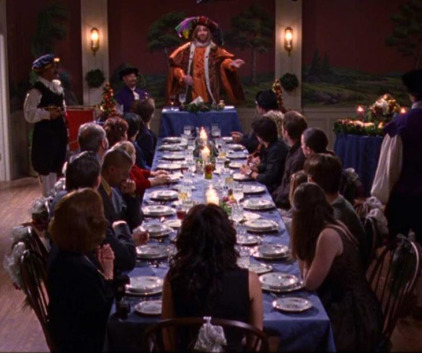
The Bracebridge Dinner is an event Lorelei organizes at her inn. A wealthy customer rents out the entire inn for a dinner that is set during the 19th century. Lorelei and her cook/best friend, Sookie, work to make the dinner as realistic as possible in everything from speaking Old English to playing music from the time period to preparing food from that era. This dinner is the embodiment of luxury. The show never lets you forget that the only reason this dinner is possible is because the group paid a really high price. The group ends up getting snowed in and won’t be able to make it for the dinner. Because everything is all paid for and ready, Lorelei invites all of Stars Hollow to the inn for an impromptu slumber party set in the 19th century. The town allows themselves to become completely emerged in a different era and escape from their daily lives. This dinner brought to life another world in a more direct way than movies and television by blurring the lines between fantasy and reality. Although this specific example doesn’t directly revolve around recreating an element of pop culture or becoming engrossed in pop culture, I think of it as the creativity inspired by pop culture on a rich person’s dime. Entertainment is the common man’s Bracebridge Dinner, it is a chance to escape from the daily craziness, and if you’re privileged enough to expand upon the pop culture you consume it can even inspire you creatively.

https://31.media.tumblr.com/2ed023a29be86a0e88decf2c7d224702/tumblr_inline_nk98irVgw01smmca3.png

Gilmore Girls provides viewers with an escape from reality, by showing them that pop culture isn’t turning us into terrible human beings, but actually providing us with an alternative reality where we can sort through all of the craziness happening around us. The show’s simplistic plot allows us to address real issues that may concern us such as privilege, gender roles, and the structure of society, while at the same time giving us resolutions that make you believe that you can enact change. Lorelei and Rory’s own consumer behaviors make a point of reinforcing that the culture industry is not just sameness and conditioning, but a way to inspire creativity in yourself.


Ehrenreich, Barbara. Nickel and Dimed: Undercover in Low-wage USA. London: Granta,

  1. Print.

Leavis, F. R. “Literature and Society.” (n.d.): 182-93. Print.

Williams, Raymond. “Culture Is Ordinary.” (n.d.): 3-18. Print.

The Circle of Life

Image from http://www.ebay.com/bhp/lion-king-poster

Disney children’s movies epitomize the embedded ideology that drives all forms of entertainment. All Disney movies have a central message that they’re trying to teach young children about being “good” citizens. As we get older and our entertainment becomes more “complex” the ideology presented doesn’t change, but just continues to reinforce the ideas instilled in us since childhood, but with a more complicated façade. The core messages of most movies, television shows, and songs are the same regardless of their intended audience. The audience only determines whether it’s packaged as rap or pop, cartoon or real life, modern or conservative, but the underlying messages never change. Entertainment functions as a Xanax to help stave off the depression that takes root when you begin to realize how powerless you are as an individual. We, as people, are inherently greedy and self interested, but somehow we manage to coexist and function in an ordered, hierarchical society where a lot of our rules aren’t actually written law just unspoken expectations. How do we convince people to go against their instincts and buy into a society where they may or may not be prioritized? The answer lies in our social conditioning that occurs from the moment our parents plop us in front of a television to watch a Disney movie (that we’ll eventually see at least 20 times) to keep us from annoying them. Everyday we are assaulted with ideology taking on countless forms and molding us into people that ultimately are willing to play the role that society deems is crucial for the system to keep functioning. The Lion King, a popular, benign children’s movie, is the perfect example of entertainment shaping how we look at our role in the world from an early age.

The Lion King on the surface functions as an excellent way to keep the kids I’m babysitting occupied, but if we look at it a little bit deeper it functions as a teaching tool for what is right and what is wrong or more specifically what society deems is right and wrong. And if we look even deeper into this children’s movie, the message is clear that every person (or in this case animal) has a specified role that is unavoidable and necessary for the good to win out. The plot is centered on Simba running away from his home because he thinks that his community will ostracize him for his father’s death, but essentially he is running away from his duty to rule as king. Simba ends up reluctantly returning to his home years later after he realizes he can’t shirk his responsibility to the other member’s of his pride. The movie emphasizes his responsibility to everyone else, and how it’s crucial not to be selfish. When he finally comes back, prosperity returns to the land and the movie ends just how it began with the birth of a new lion symbolizing the unavoidable, cyclical nature of life and death. This theme of the hero trying to deny his destiny and then realizing that it’s his duty to fulfill what he was born to do is so commonplace it’s on the verge of boring (i.e. Terminator 3). And to drive home the point the good guys always have to win because that’s how it is in real life. This dominant ideology that your role in life is predestined and no matter how hard you work it won’t change your situation leads people to be more accepting of social mobility barriers and lead life in an unquestioning attitude.

As someone who has recently joined Air force Reserve Officer Training Corps (AFROTC), which overtly emphasizes complete standardization and compliance with your chain of command, it has become apparent how similar our military training is with the social conditioning we’ve been receiving all of our lives. One of the Air Force core values is service before self, which I’ve had to stand at attention and repeat at least 50 times in my short six weeks with the program, and although I’m not claiming that watching Disney movies is that intense, their function is essentially the same. The Lion King makes the same assertion about service before self in the scene where Nala and Simba reunite. During this scene Nala and Simba argue about his responsibility to well-being of the other creatures inhabiting the Pride Land. The movie makes it clear that “right” choice for Simba is to return in the interest of putting other people’s needs at the forefront of his responsibilities. Now if we look for this ideology in other areas of our lives, it’s scary how often the same message is repeated to us. At school what we learn both academically and socially is centered on praising the concept of service before self. Good behavior is civic-minded behavior that favors the whole over the individual. This is apparent because even the know-it-alls, who may meet every standard academically, but are looked down upon collectively because they’re viewed as selfish. At Church the idea of being a good citizen is taken to the extreme, as it is considered godly to completely put others above yourself and following the life set out in front of you without challenge. The Church even offers you the prize of paradise in the afterlife for your acceptance of the belief that putting other people first makes you a better person. And while the concept of looking out for your common man and helping other people inherently is a good thing and seems like a necessary ideology to instill in a population of people trying to live and work together, it is just one small part of a larger message being forced on us.

On one side we can look at The Lion King as a way to push us to be better community members, on the other we can look at it as sacrificing our excellence, creativity, and individuality for comfortable mediocrity. I know I sound like a terrible person saying this, but if we truly want to produce an excellent culture should we really put others before ourselves, is it really a necessary part of being a member of a community or is it a way to keep the social hierarchy intact? When does be a good person and help others turn into be the person we want you to be and do what you’re told to do. I have a hard time being okay with finding similarities between military training, which largely centers on making the cadets all the same and being comfortable with following your chain of command, and social shaping. It makes sense that in order to function cohesively in a large unit rapidly and efficiently that not everyone can be entitled to think about their own safety in the face of a threat larger than the individual, but what enemy is society mobilizing us against? What threat is so great that we need to sacrifice our individuality for the greater good? In my opinion, the “threat” we’re guarding, as a society, so preciously against is change. There’s nothing that we fear more than the unknown and ideological reinforcements keep the status quo and the different classes sated about their position in society.

The Lion King emphasizes the necessity for the keeping of the status quo at every turn, but perhaps the most pointed example of this ideology is in the focus on the circle of life. The “Circle of Life” lyrics explicitly state that we’re all on the same conveyer belt from the moment we’re born until the moment we die. One chorus of the song reads:

“Keeps great and small on the endless round

It’s the circle of life

And it moves us all

Through despair and hope

Through faith and love

Till we find our place

On the path unwinding

In the circle

The circle of life”

The ideology behind this song supports the belief that we’re not all equal, and subtly suggests to the viewer that inequality is normal. If we see this idea enough and from an early age, it becomes commonplace and slowly alters our perception of what is “fair”. This constructed version of fairness reduces us to sheep because it blinds us from recognizing the agency we possess over how the system is constructed, and leads us to unknowingly replicate the culture that created this ideology in the first place.   So do we stop watching The Lion King? As it is my favorite movie, I’d vote no. This ideology is so embedded in who we are already, that if we even attempt to arm ourselves against all that we consume we’d be fighting a losing battle. Not only is it everywhere, in everything from art to music to television shows, the ideology is embedded in every individual with very few exceptions for those who truly isolate themselves from society as a whole.

Image from http://i.quoteaddicts.com/media/quotes/2/85018-lion-king-circle-of-life-quotes.jpg

While my commentary may read as slightly pessimistic and perhaps verging on paranoid, I truly believe that The Lion King epitomizes the manipulation of people’s perception that occurs in our culture. But while some lack of control over our belief systems, may just be a necessary evil in order to coexist with other people, modern culture seems to have gone too far in its attempt to shape the people that we are. Ultimately, we as individuals are insignificantly apart of the play the world is putting on and have no power to change something so embedded in our culture, that I say sit back, grab some popcorn, switch on The Lion King, and “Hakuna Matata”!