Author Archives: Ashley Zhou

All Eyes on X-(wo)men

Superman, Batman, Captain America, Spider-man, Iron Man…The superhero franchise has long been dominated by male heroes who fight against male villains. Superhero films featuring female heroes as the main focus, such as Supergirl (1984), Catwoman (2004), Elektra (2005), and Wonder Woman (2009), are relatively unheard of and do not even garnish a fraction of the attention androcentric superhero films do. Nevertheless, people believe that the role of women have greatly evolved since the inception of the superhero franchise. Over the years, as more and more people care about gender equality and entertainment tries to appeal to both men and women, it should come to no surprise that movies with male leads like the X-men series have included women as fighters in the spotlight, not just useless assistants. In order to determine just how progressive superhero films have become in regards to their inclusion and portrayal of women, let’s focus on two important female characters from X-men 3: Jean Grey and Mystique.

Jean Grey

In X-men 3, we realize that Jean Grey, first introduced to us as an ordinary student of Charles Xavier with the limited power to move small objects, is actually the most powerful mutant in the films. After she sacrificed herself in X-men 2 (2003), her rebirth as “the Phoenix” in X-men 3 gives her strength and power unfathomable to those around her. Armed with telepathy, telekinesis, and immense cosmic forces, she does what she wants whenever she wants and brings down destruction and havoc whenever someone attempts to control her. If the movie had stopped with this description of her, many would have been pleased by how it gave so much independence, free will, and power to a woman. Unfortunately, the Phoenix side of her is unable to control itself and she begins to kill people on the good side.

Despite her power, in her most vulnerable state, Jean is still subject to the male gaze, a term coined by feminist film critic Laura Mulvey, which relegates women to objects created to satisfy male fantasies. As Logan watches Jean lying on the recovery table after her resurrection, the camera adopts a male perspective as it lingers on her breasts. Even though she emerged from the waters fully and modestly clothed, somehow, while she was unconscious after her tumultuous resurrection, she was stripped down into wearing nothing but a skin-tight tank top—the movie didn’t even give her the decency of pants. The viewer, through the eyes of Logan, assumes the role of a voyeur, peeking in on a sleeping, half-naked woman. Even when it is illogical, the movie prepares the woman to be viewed as pleasing from a heterosexual male view, and we as viewers unconsciously take on this perspective simply by watching. We become Peeping Toms as we watch Logan and Jean kiss passionately. Mulvey describes this relationship as “sexual imbalance, pleasure in looking has been split between active/male and passive/female. The determining male gaze projects its phantasy on to the female figure which is styled accordingly” (397). Logan’s attraction to Jean is shown by the camera’s focus on Jean’s breasts and bare legs, and we the viewers subconsciously absorb this male fantasy of Jean’s sexuality.

jean-male-gaze

Logan watching an unconscious Jean

While Mulvey correctly identifies the passivity of the female as male pleasure, the film shifts away from this relationship when the female gains so much power that she subverts the male gaze. The male gaze is intact when Logan is finally able to act on his sexual desires, but we quickly realize something is very wrong once Jean/Phoenix begins to literally suck the life out of Logan. Cultural critic and psychoanalytic philosopher Slavoj Zizek describes this moment in “The Interpassive Subject:” “The object which gives body to the surplus-enjoyment fascinates the subject, it reduces him to a passive gaze impotently gaping at the object; this relationship, of course, is experienced by the subject as something shameful, unworthy.” The gaze of the subject, in other words, the viewer, becomes meaningless once the object of the gaze, Jean, becomes the one acting rather than the one acted upon.  Once she is presented with agency and power in one of her episodes of rage, she cannot be objectified under the male gaze because she is no longer passive and thus cannot be controlled. As Jean unleashes her anguish after realizing she (as the Phoenix) killed her boyfriend earlier when she was resurrected, Logan tells her repeatedly to look at him. The narrative calls the viewer to shift their attention to Logan, and in doing so, we take on Jean’s perspective. At this point, the male gaze is rendered useless, as the object has acquired enough power to refuse objectification.

The film ultimately punishes the woman for her rise to power after leaving a man’s control. Jean joins Magneto, another powerful mutant and leader of the Brotherhood of Mutants who aims to oppose the “cure” that humans have invented to suppress mutant powers. She is led to believe that she is joining on her own terms, egged on by Magneto’s constant reminder that Charles just wanted to contain her powers. However, she is serving as a weapon for Magneto’s use, once again the obedient assistant under the guise of freedom. Jean effortlessly breaks out of Magneto’s control due to her immense powers, but with no one left to control her, she is a menace to all. The film’s solution? Death. While Magneto’s strength and crazy aspirations to kill humans are contained by four needles of the cure to his chest, Jean has to die. When the gender roles reverse and a woman holds and directs the power, she is villainized and killed. She becomes dangerous and is promptly removed from the narrative as soon as she no longer serves the purpose of scopophilia as a passive object. Furthermore, the way she dies is, in itself, peculiar. After a brief lapse back into her normal self, she begs Logan, her on-and-off lover, to “save” her, to which he complies with one thrust of his adamantium claw into her abdomen. Her plea and ecstatic expression after Logan stabs her carry strong sexual undertones (not to mention Logan is half-naked in this scene). When faced with the threat of an uncontrollable woman, the film successfully manipulates us into believing that the male’s sexual conquest of the female is the only way to go.

Mystique

If Jean Grey represents the over-powerful superhero turned villain, it only makes sense to look at the powerful female villain—Mystique. Villain may be too strong a word because she is not evil per se (in the way that the film makes Jean evil), but she is at least on the side that the film wants us to root against. Mystique is a shapeshifter, and in her natural form, she does not wear clothes. At first glance, it can be argued that she is sexualized merely given that she is naked throughout the films and fights with agility and flexibility which evoke sexual imagery. In “Vivacious Vixens and Scintillating Super Hotties,” Richard Gray writes that superheroines are created to be attractive so that their power does not make the viewer uncomfortable: “When balanced, I would suggest that in the last decade, the superheroine offers men a ‘best of both worlds’ scenario: they possess both the physical ass-kicking strength and strong sex appeal that men need in order to satisfy their ‘scopophilic drive’” (81). While Gray may argue that Mystique’s nude form serves to fulfill sexual desire, he is wrong about Mystique to say that “accentuation of ‘physical’ elements largely involves stylized positioning of the body in order to capture certain voyeuristic ‘shots’ (emphasis of the breasts, for example), in order to depict an idealized female form. This somehow diminishes the super-heroine’s superpower” (83). It is in her natural form, naked and free, when Mystique is at her most powerful. I would even go so far as to argue that by choosing to remain in her bare form, she best resists the male gaze. Although Mystique’s body is thin and toned, fully on display for all to see, notice that she is also blue, scaly, and in some sense of the word, scary to look at. Her reptilian yellow eyes penetrate the viewer (reflecting the viewer’s male gaze back at us) and we cannot help but shudder when she shapeshifts from a normal human back into her natural form. The men in her life try to convince her to assume a normal woman’s appearance, and even give up her mutant power. Defying their desires to change her into something that could be ogled at and objectified, the woman maintains free will and overthrows the viewer’s efforts to manipulate her.
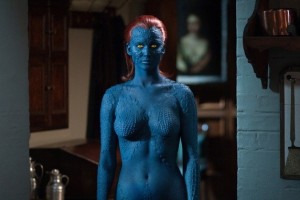
Mystique's natural form

Mystique’s natural form

Mystique’s downfall, then, occurs in order to reestablish the male control of the female body. Mystique sacrifices herself to save Magneto, taking the bullet containing the cure that suppresses mutant powers. As she lies on the ground quivering, her blue skin and scales receding to reveal a beautiful, naked woman with flawless skin, Magneto and the other men stare down at her in shock. No one moves to help her. The stark contrast between the blue-skinned, scaly Mystique and the helpless, truly naked Mystique invites the viewer to sexualize Mystique in a way not possible when she had blue, reptilian skin. Although she is naked in both forms, her blue form enabled her to resist the gaze. By taking her power away, the movie effectively reinstates the male gaze upon Mystique.

https://youtu.be/j0Kf-r5ThLU?t=2m9s

Although the film creates and acknowledges the possibility of powerful female characters, it strips away their power as the plot progresses—a sort of testament to what happens when women ask to become more than just the subservient sidekick. On the one hand, we start with sweet, manageable Jean; this side of her is created and maintained by Charles who uses his telepathic powers to suppress the Phoenix side. But once she breaks out of his control as the Phoenix, she is able to defy the male gaze by claiming her individuality. The film did not think this was an acceptable or viable path for women, so in the end, her freedom is taken away and she is punished by death. On the other hand, we have Mystique—capable, independent, and resistant to objectification in her natural blue form. Once again, the movie rebukes the woman for her dismissal of the male gaze, this time by taking away her mutant power. What this boils down to: female superheroes/villains have to be attractive and can sometimes be strong, but once they find a way to oppose the male gaze, their power, or even their entire character, is exterminated. The dominance of the male gaze cannot be questioned, and in watching mainstream movies that enforce this perspective and penalize alternative ones, we continue to live in a world encoded in patriarchal meaning and point of view.


Works Cited

Gray, Richard J. “Vivacious Vixens and Scintillating Super Hotties: Deconstructing the

Superheroine.” Academia. Academia, n.d. Web. 14 Dec. 2016.

Mulvey, Laura. “Visual Pleasure and Narrative Cinema,” in Media and Cultural Studies: Keyworks, ed. Douglas Kellner and Meenakshi Gigi Durham. Oxford: Blackwell, 2001.

Zizek, Slavoj. “The Interpassive Subject.” Lacan. Centre Georges Pompidou, 1998. Web. 14 Dec. 2016.
Up, Up, and Away through Utopia

Bright colors, funky fonts, catchy music—these are the staples of modern day advertisement stunts that are aimed towards a calculated target audience. Children are the next generation of our population and possess the most malleable of minds, arguably making them the easiest and most effective group in society to manipulate. Toy advertisements and picture books inculcate deep, hidden ideological values and beliefs that are extremely subtle. To the average consumer, it is nearly impossible to recognize that we are being fed such propaganda. An equally, if not more widespread, tactical method of expressing these ideas are carried in children’s films. We are persuaded to identify with the film’s characters through their hardships and are drawn towards the visually appealing, happy endings, often times subconsciously supporting the existing social structure. As M. Keith Booker points out, “many American children’s films can be quite effective as works of art, aesthetically fascinating and potentially enthralling to young viewers” (187). The aesthetic appeal to children provides an easy way for these films to ingrain and shape “the mainstream values of our society, which are to an extent constantly in flux, continual change and innovation being a basic and inviolable tenet of consumer capitalism” (184).

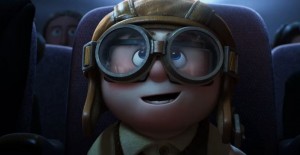
Pixar’s 2009 blockbuster Up is a typical children’s film that seems innocuous at first glance, but contains hidden ideological statements and engenders desires for an alternative to the status quo. The film begins with a young boy, Carl, who stares open-mouthed at the adventures of explorer Charles Muntz flickering on the black and white screen of Movietown News, “Spotlight on Adventure.” Carl lives vicariously through his hero, pretending to overcome mountains and canyons with rocks and cracks on the sidewalk. He is consumed by his childish fantasy of growing up and becoming just like Charles, and his passion for adventure is complemented by that of his childhood friend and future wife, Ellie, an equally ambitious and imaginative dreamer. Carl promises Ellie he’ll take their future house to Paradise Falls in South America in a blimp, and they’ll explore the wilderness together there. On the surface, this childhood fantasy seems harmless, but it is rooted in imperialism. Just as the United States has continued to extend its control internationally through economic, cultural, and military imperialism, Muntz embraces the ideas of imperial conquest by going to South America to conquer and catalogue its inhabitants. These values are superimposed on Carl through his idolization of Muntz.

A young Carl is enraptured by the adventurer Charles Muntz

A young Carl is enraptured by the adventurer Charles Muntz

The film first mimics the repressive social structure of our own society by taking us through Carl and Ellie’s life together. Through the years, they build a house, open a zoo, and try to have a baby (but are not successful due to a miscarriage)—perfectly normal decisions to make as serious adults. But at the same time, their dream of becoming adventurers like Muntz and placing their house by Paradise Falls is never fulfilled. Their childhood visions gradually slip away as everyday distractions of adult life occupy their time and exhaust their savings. What happened to their fervor for adventure, for an imaginary world, that they held onto so tightly as children? The mundane tasks of life inevitably overcame this dream, a common occurrence reflected in our own lives.

Here, the movie introduces a utopian solution that appeals to us—an alternative to the nonstop work that takes over our lives. Ellie’s death catalyzes a painful transition for Carl, who believes that by letting go of their childhood fantasy, he and Ellie did not have the chance to live up to their expectations and dreams. Ellie’s death painfully reminds Carl of his broken promise, causing the fantasy to resurface. As Carl wakes up one typical morning, his bored facial expression and dreary surroundings point to the repetitiveness of his life. He eats bran cereal, cleans the house, and goes out to sit on the porch, void of any excitement or expression. The tune of “Habanera” from Carmen plays in the background, whose unheard lyrics sing of fickle love that “comes, goes, then it returns / you think you hold it fast, it flees.” This scene in particular, plays with the utopian desire to “fly away” from the passive, structured life that engulfs everyone around Carl—the construction workers, the shoppers in the city, and the window cleaner. Carl surprises everyone who only thought of him as a senile old man by doing the unexpected: he leaves this modern age and travels, figuratively, back in time to the nostalgic era of exploration and of Charles Muntz.

https://www.youtube.com/watch?v=JRAfm5glLFY

In our society today, capitalism has taken over our practical desires, but we still have innate impulses to do the unexpected and escape the rigidity and passivity of mass consumerism. Russell, a young Asian American boy who joins Carl in his adventure in order to earn his “Assisting the Elderly” badge, has never camped outdoors and does not even know how to build a tent despite being a Wilderness Explorer. Russell’s inexperience with the wilderness suggests our capitalist society’s detachment from nature. Matthew Arnold believed that reading about agrarian society such as poems on nature cultivates us towards the natural world that is not focused on commercialization, thus “through this knowledge, turning a stream of fresh and free thought upon our stock notions and habits, which we now follow stanchly but mechanically” (Arnold 5). Similarly, when Carl decides to fly his house to a far-away land untouched by civilization, the film inspires utopian fantasies to revert back to a time when we were not entirely entrenched in commercialism. The grand depiction of thousands of colorful balloons rippling across the sky contrasts with the gray, static metropolitan society, encouraging utopian hopes and an alternative to the culture industry.

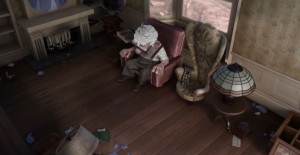
Although the audience is presented with this utopian vision of freedom through Carl and Russell’s crash-landing in South America after enduring a thunderstorm, this dream is slowly but surely deconstructed as they continue on their journey to Paradise Falls. Carl indeed fulfills his promise to his late wife when he lands his house, which he affectionately calls “Ellie,” next to Paradise Falls, but it is a very melancholy achievement. A worn-down Carl enters his house, now in shambles from the bumpy journey, and sits down in silence in the chair that once offered comfort and joy. In a desperate attempt to save the house and preserve the promise to his wife, he relinquishes the human values of family, interdependence, and collectivity by giving Kevin, the “Monster of Paradise Falls” indigenous bird that Russell effectively adopted, over to Muntz. Carl reverts to the individualistic, isolated character that he was at the start of the adventure. In our own society, capitalism prioritizes individualistic gains and tendencies, and we lose sight of communal ideals. The sense of isolation that Carl faces is reflected in us, and we are thus drawn towards the film’s utopian solution of social bonds. Carl ultimately realizes his dream of moving to Paradise Falls is unsatisfactory and worthless compared to the danger of losing his friends, and abandons his imperial fantasy.

Carl finally achieves his dream, but is more broken than before

Carl finally achieves his dream, but is more broken than before

In “Reification and Utopia in Mass Culture,” literary critic Fredric Jameson argues: “the works of mass culture cannot be ideological without at one and the same time being implicitly or explicitly Utopian as well: they cannot manipulate unless they offer some genuine shred of content as a fantasy bribe to the public about to be so manipulated” (144). Ideology or utopia cannot exist without the other, for utopian solutions are needed to manipulate the audience into complacency with existing conditions. Indeed, Up initially leads the viewers to cheer for Carl’s initiative to embark on an imperialistic adventure under the cover of a utopian alternative to the culture industry. At this point, the film manipulates our desire for adventure and spontaneity in order to portray imperialism in a positive light. However, the film diverges from Jameson’s argument that “mass culture [is] a transformational work on social and political anxieties and fantasies which must then have some effective presence in the mass cultural text in order subsequently to be “managed” or “repressed” (141) when the communal ideals overcome the film’s initial support of imperialism. Not only does Carl leave his beloved house behind on Paradise Falls, the movie also portrays Muntz, an embodiment of the imperialistic spirit, as ruthless and single-minded. When Carl finally meets his hero, he learns that Muntz’s search for Kevin, the bird that he has been accused of fabricating, has driven him mad; Muntz has been killing off explorers who come to Paradise Falls, thinking they are trying to steal the elusive bird from him. The audience is supposed to root for Muntz’s demise, for he stands against Carl’s utopian values.

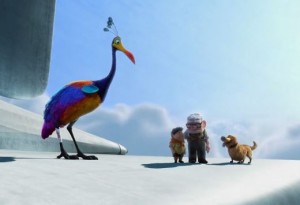
It is also important to note the rejection of the elementary family throughout the film, and especially after Carl embraces social bonds over his childhood dream. The elementary family consists of a man and woman who are married to each other, and their biological children. This family structure has been historically touted as bringing stability to society, especially after the advent of industrialization and early capitalism (“Traditions and Encounters”). Carl and Ellie live happy lives even though they are not able to have children, and Carl’s family ultimately consists of an old white man, an Asian American boy, a talking dog, and a South American bird. This utopian alternative to the patriarchal, monocultural idea of family is made attractive to us because Muntz, whom the film portrays as the antagonist, tries to break apart this family. The film thus reflects our own desires for social progress.

up-fam

Carl’s non-elemental family

Entertainment provides both an ideology and a utopian solution in order to contrast the two, but it does not mean that the utopian values are used as a cover-up for unsettling ideology that manipulates us into obedience towards the status quo. The film stimulates our longing for social bonds and acceptance, directly opposing the pro-imperialism sentiment at the beginning of the film, which was supported by the utopian desire to rebel against the culture industry. What is even more important to remember is what actually sparked Carl’s imperialistic fantasy in the first place—the cinema. As a boy, he took in the cinema’s portrayal of the imperialistic Muntz as a righteous and patriotic adventurer who promises to regain his honor after being denounced as a fraud by bringing back the “Monster of Paradise Falls.” By actively choosing to leave behind this fantasy generated by the media, Carl refuses to let his desires be controlled by the culture industry. Instead of manipulating us to be satisfied with our current social structure, Up leaves us with an anti-culture industry stand only made possible through the utopian feelings of interpersonal relationships.


Works Cited

Arnold, Matthew. Oxford World’s Classics: Culture and Anarchy. Oxford, GB: OUP Oxford, 2006. ProQuest ebrary. Web. 18 November 2016.

Booker, M. Keith. Disney, Pixar, and the hidden messages of children’s films. ABC-CLIO, 2010.

Jameson, Fredric. “Reification and Utopia in Mass Culture.” Social Text, no. 1, 1979, pp. 130–148. www.jstor.org/stable/466409.

“Traditions and Encounters; a Brief Global History.” Reference and Research Book News 22.1 (2007) ProQuest. Web. 20 Nov. 2016.


Pictures were screenshot from DVD

Video clip: https://www.youtube.com/watch?v=JRAfm5glLFY

The Happy, the Sad, and the Open-Ended

By Ashley Zhou

Our relationship with nature has always been an uneasy one once we learned how to manipulate our surroundings to fit our needs. In a time when 150 to 200 species go extinct every day and just five countries produce half of the world’s 32 billion tons of carbon dioxide emissions from fossil fuels, now may be too late to start panicking. We are scrambling to stop and reverse the deleterious consequences of the Industrial Revolution, but at the same time, many of us are loath to relinquish our luxuries and exorbitant consumerism that continue to harm the environment. While blindly trying to find a solution, we support oil industries that spill millions of gallons of oil into the oceans and businesses that clear forests to provide more pasture land. What is it that allows us to make these choices that go against our moral obligations? Comfort, greed, and ignorance? Culture tells us to take a side, either with nature or against it, and to stick with it. But the path to understanding the problem starts with recognizing that there is no side to pick, an opposition to the dualist ideology we are constantly being fed.

In recent decades, the issue of sustainability and our relationship with nature has edged more and more into the public eye. Up until not so long ago, perhaps a few centuries in the 6,000-year history of civilization, we have shamelessly decimated natural resources, indifferently altered the Earth’s physiology, and killed those who refused to embrace “modernization”—all in the name of mechanical progress. As cities grew and everything else died, we began to pay more attention to our indelible footprints in the natural world. The media did not waste any time broadcasting the frightful crises of pollution, global warming, or depletion of vital resources, often spinning the issues into full-blown apocalyptic imaginations. Blockbusters like Dances with Wolves (1990), WALL-E (2008), and Avatar (2009) entranced audiences with depictions of the cataclysmic consequences that arise from the struggle between industrialization and the environment, all of which show a clear winner and loser.

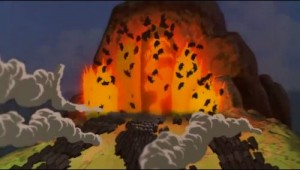
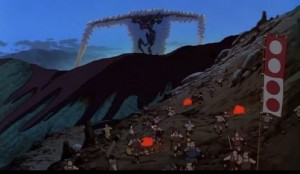
Princess Mononoke is a 1997 Japanese animated film, written and directed by Hayao Miyazaki, that defies this binary solution. As the Forest Spirit restores life to the land, the opposing sides, Irontown and the forest gods, return to their respective realms after incurring heavy losses. Many forest gods have died to protect their forests, their bones and flesh consumed by the poison of the iron bullet. The resemblance of the metal stone in their bodies to the bezoar eerily represents the death of the gods as an antidote to technological barriers. On the other hand, although winning skirmishes, the entire village is destroyed as a result of decapitating the Deer god (also the Forest Spirit), whose manifestation oozes throughout the lands like melted iron ore. Both parties have lost, and Deer god or no Deer god, Mononoke’s world is split between industrial capitalism and militant environmentalism.

boar-death

The extinction of the boar clan

town-ruin

The headless Deer god destroys the land while looking for his head

It is no big surprise that many militant environmentalists are anti-capitalist. Capitalism runs on maximized profits. If Lady Eboshi, the leader of Irontown, has to kill every god in every forest to ensure the survival and prosperity of Irontown, you better bet she will. She is admired as a one who is not afraid of gods, for the drive for iron far outweighs the costs of destroying nature. Her people are a hodgepodge of workmen, prostitutes, and lepers, all taken under her wing for the sole purpose of producing iron for a profit. Every person is working for the continuation of Irontown, from the men collecting the ironsand, to the prostitutes working the bellows to the melt the iron, to the lepers inventing stronger, lighter rifles. The assembly line transcends and incorporates all the social groups. Just as Irontown’s singular purpose is to salvage all the iron in the forests no matter the cost, the forest inhabitants are pretty set on destroying the humans. The boar clan knowingly commits suicide when it charges at the town across a field planted with mines, and the ape tribe has resorted to eating human flesh, supposedly to gain human strength and fight back. Each is trying to survive by destroying the other. Looking at the film from today’s perspective, it is easy to blame Eboshi for being so uncaring towards the environment, but in the movie’s world, she is trying to support her town the only way she could, and her people’s adoration and trust in her reflect this.

So which side are you supposed to root for? It is ambiguous because both are just trying to ensure their own survival. (An evil that the film does warn against is pure greed and excessive consumerism that the emperor embodies when he demands the Deer god’s head in order to gain immortality. The emperor’s motivation differs from the town’s in that he wants more than he needs, perhaps lending a vision of what the capitalist Irontown will become in the future.) However, the movie did have to have an ending, and as in all stories, Mononoke attempts to coax the audience into believing that the movie’s resolution provides a viable solution to the crisis. The only problem is that it doesn’t do a very convincing job.

Let me first give a few examples of ideology’s workings in films so it may be easier to see how Mononoke differs. Terminator 3 (2003) is a generic killer robot movie about the rise of artificial intelligence who are the reason for the human apocalypse. The plot involves two robots from the future: one is outdated and male, the other is “smart” and female. Throughout the entire movie, the audience cheered as the Terminator bashed away at the surprisingly hardy Terminatrix’s head; after all, the male robot is good and the female robot is evil. Viewers breathed a sigh of relief as the Terminator finally obliterated the Terminatrix, which concluded the film. It was then easy to forget that, while the direct threat was gone, the protagonists actually failed to stop the apocalypse. Saving the world was the main issue and the movie glides over the abortive mission with a victorious Terminator blowing up the Terminatrix by sticking a fuel cell down her throat…which exemplifies the underlying ideology that the movies actually focuses on: the patriarchy must be kept alive and well even when obsolete. If this notion of putting women back in their place through rape were clear in the film, it would have had a hard time getting greenlighted. The ideological plot that the movie stresses with scene after scene of the two robots fighting has a solution, but it is one that no one in the right mind would endorse in the real world, only through the fictitious characters and events in the movie.

Avatar (2009), unlike Princess Mononoke, portrays humans as ruthless militants with no compassion for nature. Set in the year 2154, humans have even more advanced guns, tanks, and dreams, and it seems like a pitiful joke for the Na’vi tribe to be expected to defend themselves. But the Na’vi don’t just defend themselves, they expel a whole establishment of leaders, soldiers, and scientists off their planet. This ending runs counter to the entire history of colonization and basically every White encounter with indigenous people. So how do the Na’vi do it? The indigenous animals suddenly decide to fight the humans in a collective effort, as if understanding the direness that humans impose, giving the indigenous people a fantastical boost. Hammerhead Titanothere herds stampede through the forest like tanks and airborne predators serve as airpower for the Na’vi. The movie significantly amplifies the strength of the bow and arrow just enough to overcome gun and steel. Avatar achieves a happy ending by giving the indigenous people an imaginary advantage to rival the White people’s technology, but the pretense that indigenous tribes can win is, well, just that—imaginary.

banshee

Dragons to the rescue!

Terminator 3 and Avatar affirm that stories work by providing imaginary solutions to real crises, but Mononoke specifies that the lack of a political fantasy reveals the true nature of environmental ideology of the real world. The town and the forest’s goals exactly align with the destruction of each other, and that is where the plot fails to offer a believable solution. In the end, idyllic greenery miraculously returns to the land, the protagonist’s curse is lifted, and everyone is optimistic that things will be different after a near-apocalypse. The land has undergone a dramatic transformation of death and rebirth, marked by the reappearance of kodama, spirits that signify a healthy forest. The casual viewer (as I was when I first watched the movie a few years ago), at best, might turn off the TV with a sense of emotional satisfaction and confidence in the industrial world’s peace treaty with nature. But upon deeper analysis, it does not take much to realize the plot is not offering a solution at all—fantastical or not. After the ultimate battle, both sides are diminished, and now they are supposed to coexist agreeably. Miyazaki seemed to recognize that this ideal was a fantasy, ending the film with Lady Eboshi, simply declaring: “We’ll start over again. We’ll build a good village.” But what does “a good village” mean? Surely a Muromachi-era town dependent on ironsand and thus deforestation isn’t supposed to suddenly start innovating ways to survive and grow without exploiting nature. In human history, nature’s loss was imperative to technological advancement in the first place, so only after we reach the point of sustainability can we retroactively try to fix the damage that we caused to get there. In the movie’s own terms, it is inevitable that Irontown and the forest inhabitants will clash again, but that is left open-ended.

1

7

The Deer god instantly revives the land

Whereas Terminator 3 and Avatar offer emotional release, Princess Mononoke refuses to resolve the environmental issue with a cop-out such as killing Eboshi. Instead, the false hope that closes the film offers viewers an illusory view. At the same time, the naïve easiness of it all and cursory wrap-up indicate a deeper discovery which allows the viewers to realize the fiction in the ideology. Even the imaginary world does not provide a solution. Miyazaki’s unsatisfactory ending reflects the political messiness of the real world and even the hopelessness that accompanies it. Our catastrophic relationship with the environment throughout history is not explicitly shown in Mononoke’s “happy ending,” but it is hidden beneath such a superficial optimism that people understand the film provides a fantasy which is at odds with the circumstances of the real world. Through the viewpoint of an ambivalent protagonist, whose undertaking is to journey to the west and “see with eyes unclouded,” Miyazaki portrays a crisis that cannot be solved by simply creating a winner or loser. Even though the film criticizes excessive consumerism, a large portion of the world does not participate in this kind of lifestyle; if anything, they are not getting enough to consume. It is not possible to condemn these people who live much like the Irontown folks do. Unlike other environmentally-focused films, Mononoke is not supposed to justify industrialism’s dominance over nature or inspire penitence for all the cruelty against our environment, but to delineate the current situation through the loss and destruction of both parties.


Note: Some ideas in this essay come from a conversation I had with Professor Christian Thorne on October 13, 2016.


Images:

Mononoke images were screenshot from movie.

Avatar image: http://james-camerons-avatar.wikia.com/wiki/Scorpion_Gunship