Lorde Battles Racism

Between Ourselves is a chapbook that contains seven poems by Audre Lorde, all of which demonstrate Lorde’s contribution to second wave feminism. The cover features two alligators that according to the illustrator, Ashanti Adinkra, “share one stomach, yet they fight over food.” This is a symbolic image for women fighting each other for power when they should be uniting to feed their singular stomach. The book is clad in brown calligraphy and red illustrations with one photograph of Lorde herself at the end. The first poem in Between Ourselves is called “Power.” It is about a boy of color who is shot and killed by a policeman. The poem centers around the boy’s innocence and police brutality. Lorde begins by defining the difference between rhetoric and poetry as “being ready to kill / yourself/ instead of your children.” This contrast comes up again at the end of the poem and makes it come full circle. Lorde is saying that the difference between creative expression in poetry and persuasion in rhetoric is the ability to sacrifice yourself for the next generation. Lorde sacrifices herself in many ways but mostly by putting herself out there with her identity as a black, lesbian, feminist. The poem then details the unjust facts of the case repeating the line “there were tapes to prove it.” This line stresses the matter of fact clarity of the trial. There was no ambiguity, simply prejudice.The cop is set free in the poem after a white jury and a “4’10 black woman” who had been “raked..over the coals” decide to let him free. Later in the poem Lorde lays out the image of a “womb lined with cement” to portray the figurative death of black children before they are born. They are born into a world of injustice without power. They have been buried before birth. . Lorde then states that she is too angry to deal with her emotions at the time. She must control herself or she will “pull the plug” and end up raping an 85 year old white woman. Lorde quotes the public saying “what beasts they are,” referring to blacks as a whole. The treatment of this crime  by the public and the justice system show the lack of power in the black community. This poem serves as an outlet for Lorde’s anger towards these racial issues. Unlike most of her poetry, Lorde confronts the issues and attacks specific people head on. This poem quickly became well-known and served to highlight the incident of police brutality. Lorde travelled the country, reading her poem aloud in congress. This poem drew attention to Lorde as not just a woman but a black woman.
 

Lorde’s poem “A Woman Speaks,” focuses more deeply on her take on racism. In this poem, Lorde  makes herself seem almost witch-like using mystical words like “magic” and “moonlight” to make herself seem ironically eerie and mysteriously creepy. She is comparing her blackness to being witch-like ironically. Lorde says her “magic is unwritten.” She is playing on the phrase “black magic” because she is both black and has feminine powers. Lorde manages to critique the flaws of racism and homophobia in her poem without putting bigots down. She is able to insult them without doing so overtly or aggressively. She says, “I do not mix / love with pity,” meaning she does not want this poem to come off as asking for sympathy for what she goes through. Lorde summons “sisters,” “witches in Dahomey,” trying to form a united group of those who share her identity. However, then she makes clear that she is not only summoning blacks and females but those who support her and can feel her pain. At the end of the poem, Lorde threatens, “beware my smile.” This adds a creepy tone to the poem, as well as a call to action against men. She uses words again like “fury” and “magic” to liken herself to a witch. “I am woman,” she cries, “and not white.” This last line is like a cliff hanger. She threatens using her unique identity. There is no telling what a black woman is capable of.  Lorde also addresses her breast cancer and how she hopes her poetry will leave a lasting effect on the world even when she is gone. She relies on her poetry to keep her spirit going as she realizes the severity of her disease. This poem is exemplary of Lorde’s non attacking side. Lorde never calls anyone out even though she would be just in doing so. She remains calm and simply pokes fun at people’s prejudice by sarcastically comparing herself to a witch.


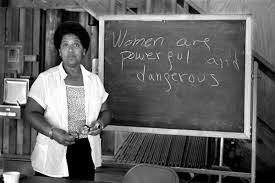
In an interview by Adrienne Rich, Lorde discusses how she taught a class at Lehman college on racism. She tells her class about how there is a “black mother” inside each of them. She is referring to the protectiveness of each one of them of their race and culture. When the “black mother” is rejected by society the  power of all black women weakens.


When I talk about the black mothers in

each of us, the poets, I don’t mean the black mothers in each of us who

are called poets, I mean the black mother-

AR: Who is the poet?

AL: The black mother who is the poet in every one of us. Now when

males, or patriarchal thinking whether it’s male or female, reject that

combination then we’re truncated. Rationality is not unnecessary. It

serves the chaos of knowledge. It serves feeling. It serves to get from

some place to some place. If you don’t honor those places then the road

is meaningless. Too often, that’s what happens with intellect and ratio-

nality and that circular, academic, analytic thinking. But ultimately, I

don’t see feel/think as a dichotomy. I see them as a choice of ways and

combinations.

Sources

“Explore Encyclopedia Britannica.” Encyclopædia Britannica, Encyclopædia Britannica, Inc., www.britannica.com/.

“Audre Lorde.” Poetry Foundation, Poetry Foundation, www.poetryfoundation.org/poets/ audre-lorde.

Lorde, Audre. The Collected Poems of Audre Lorde. W. W. Norton & Company, 2000.


Heresies: The Great Goddess

Heresies: The Great Goddess

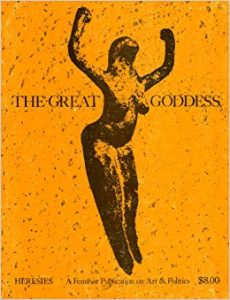
Heresies, an independent feminist publication with a focus on art and politics, explores female spirituality in their fifth issue, The Great Goddess. The cover of the issue has an image of a Venus figurine, complete with exaggerated breasts and thighs, which were prevalent in representations from ancient pagan societies. Whatever their purpose may be, these figurines showcase how venerated women were in these societies; because of this, the cover encourages women to think of themselves in a similar fashion: as goddesses who are leaders of their community and nurturers of the family. However, 

unlike typical American media that expected women to be devoted to their families, Heresies celebrates these roles, as they are a form of autonomy that women are able to have in the patriarchal society they are living in.

Additionally, the issue includes a glossary of different aspects of female spirituality, thus educating women on why they need to think of themselves as goddesses. Even though the issue focuses on goddesses as a subject of female spirituality, the glossary also includes terms relating to witchcraft and its components. Here, the audience can see a connection between the goddess and the witch: both figures are agents of healing, and possess powers that many do not. Cultivating this relationship between the two creates a community of women who can feel empowered by similarities between the goddess and the witch.

Source: “Heresies: The Great Goddess .” Heresies: The Great Goddess , vol. 2, no. 5, 1978.


Cables to Rage by Audre Lorde

 “Fantasy and Conversation” by Audre Lorde 

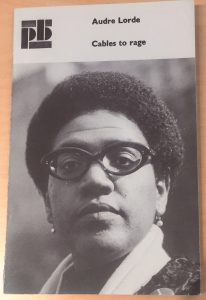
On the cover of the chapbook Cables to Rage by Audre Lorde, the viewer sees Lorde staring directly into the camera, her eyes taking on a defiant stance. With this picture, we are reminded of Lorde’s presence not only as a poet but as a feminist, a woman, a human being. Thus, for many women, Lorde is an example of the unwavering woman, something that Lorde’s poetry wishes to instill in its audience.

Cables to Rage features “Fantasy and Conversation,” a poem which presents witches in a positive light. The narrator of the poem speaks of “turn[ing] frogs into pearls / speak of love, our making and giving.”(19) Lorde explores the powers that witches commonly yield, and instead of these powers being forces of destruction and chaos, the poem creates a space where these powers are used to create love and healing within relationships. Through this poem, Lorde encourages her audience to see the power in their own lives, through their own craft. However, the poem highlights the dual nature of these powers. At the end of the poem, Lorde writes, “shall I strike / before our magic / turns color?” (19) While she is presenting witches and witchcraft in a positive light for the purposes of the feminist movement, Lorde also reminds her audience not to doubt their influence. Thus, she leaves her audience in the wake of the power of the witch, which also serves as a metaphor for the growing influence of the feminist movement as a whole.

Source: Lorde , Audre. “Fantasy and Conversation .” Cables to Rage , 2nd ed., Paul Breman., 1973, p. 19 .


Quest, A Feminist Quarterly


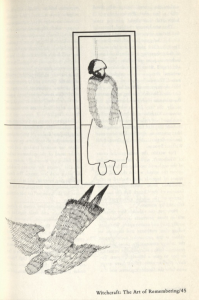
Witchcraft: The Art of Remembering by Morgan McFarland

Morgan McFarlands’ “Witchcraft: The Art of Remembering,” depicts a time, long ago,  when women had total autonomy over their lives. McFarland starts the article by imploring her audience to remember witchcraft and women’s history in it:


There was a time when you were not a slave, remember that. You walked alone full of laughter, you bathed bare-bellied. You say you have lost all recollection of it, remember….You say there are no words to describe this time, you say it does not exist. But remember. Make an effort to remember. Or , failing that, invent. (41)


Here, McFarland constructs the core image of witches that radical feminists propagated during the Second Wave movement. The act of remembering emphasizes the notion that all women used to be witches, and that women were figures of authority in this long forgotten society. It isn’t until newly formed, patriarchal Christian religion becomes the norm that women lose their role as leaders and change bringers in this new society.  With this, witches are forced to exist in oblivion, and those who are allowed, join the Church. Still, the anxiety surrounding witches lingers, and “The Church Militant” (44) plunges the world into the Burning Times. The Burning Times not only heralded the
murder of thousands of the so-called witches bet

ween the fourteenth and sixteenth centuries, but to McFarland, also represented the rise of “homotechnocracy as patriarchy plundered and raped” (46) the Earth. Thus, the author associates both the devaluing of women in society and the destruction of the Earth as a direct consequence of “phallocentric values” (46). However, while feminism spreads, as McFarland notes, the power and influence of witchcraft begins to grow as well. While this article showcases the injustices that witches have had to endure throughout history, it is also an invitation to join such a community “that fosters spontaneity, creativity, excitement, and memory” (47), all of which were characteristics that women were prevented from cultivating. Therefore, McFarland reassures women that they can move through the world knowing that they once had a place in their own society, which will only remind them of why they need feminism in their lives.

Source: McFarland , Morgan. “Witchcraft: The Art of Remembering .” Quest: A Feminist Quarterly , vol. 1, no. 4, 1975, pp. 41–48.

Everywoman vs. the World

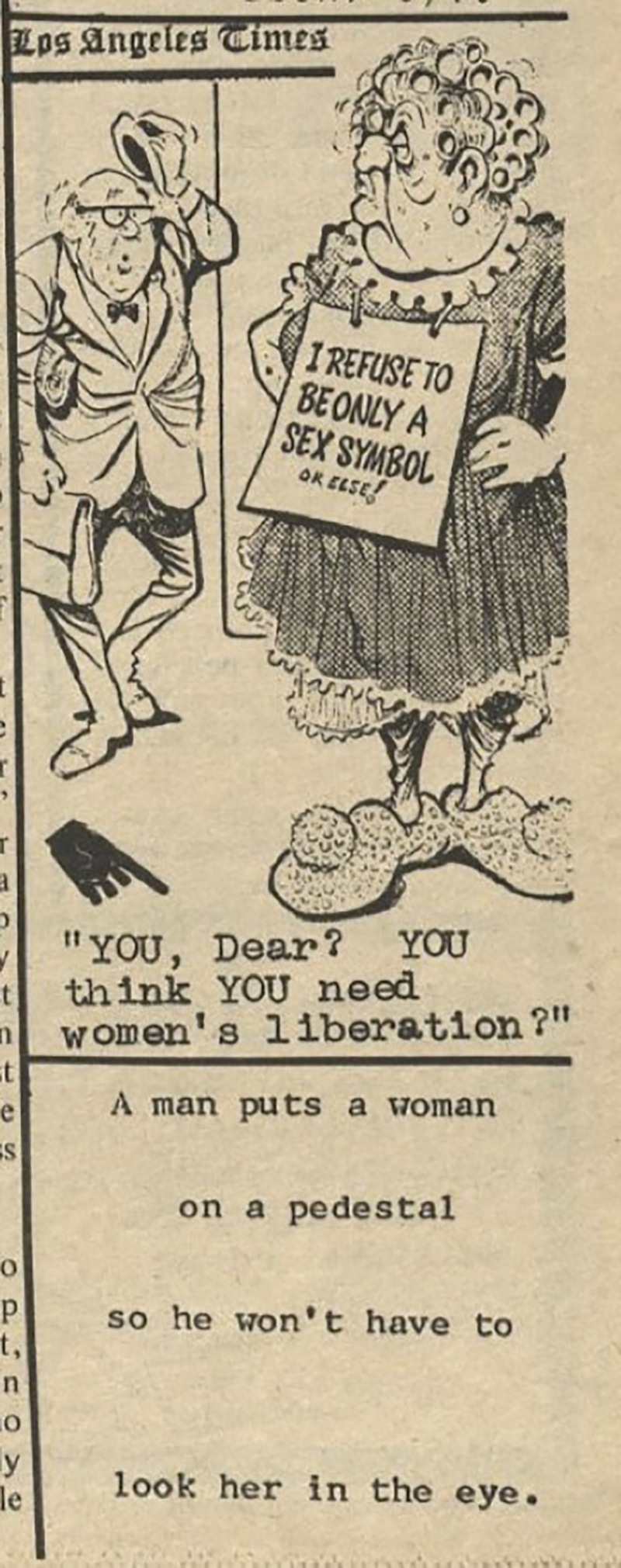
This is a small excerpt taken from Everywoman (Vol. 1, No. 2) that informs the structure of the entire exhibition. A cartoon taken from another newspaper, The Los Angeles Times, is curiously placed above a four-line untitled and unattributed poem with themes that parallel the cartoon. This placement is likely intentional as both these works are a commentary on the appearance of women. The cartoon mocks the appearance of an “ugly” feminist woman by arguing that sexual objectification would not apply to her. It is likely that this cartoon is responding to the Second Wave Feminist Movement. It represents the anti-feminist stereotype that some women are feminists because they are unattractive or masculine. The woman in the cartoon is old, overweight, and disheveled. The humor comes from the fact that this is “wrong” and unexpected for a woman because it subverts societal expectations for feminine bodies. In this context, the woman asserting individuality is seen as unreasonable.

The poem, by contrast, illustrates how men are unable to “look (women) in the eye” and see them as individuals (Everywoman, 7). The poem is a critique of the cartoon. It critiques the irony in the cartoon’s message. The cartoon’s argument that appearances can deny the need for feminist action proves the very necessity of it. The woman is being objectified because the cartoon relies solely on appearance to define her.

The newspaper is filled with juxtapositions like this. Everywoman takes images from other, well known, newspapers and magazines and uses them as proof that society is patriarchal. Then they go on to challenge the arguments of the images, mainly focusing on how humor about women are often insensitive and unfunny to women reading them.    

Sources:

Everywoman, vol. 1, no. 2, 1970.

Posted in Lee

How We Live and With Whom

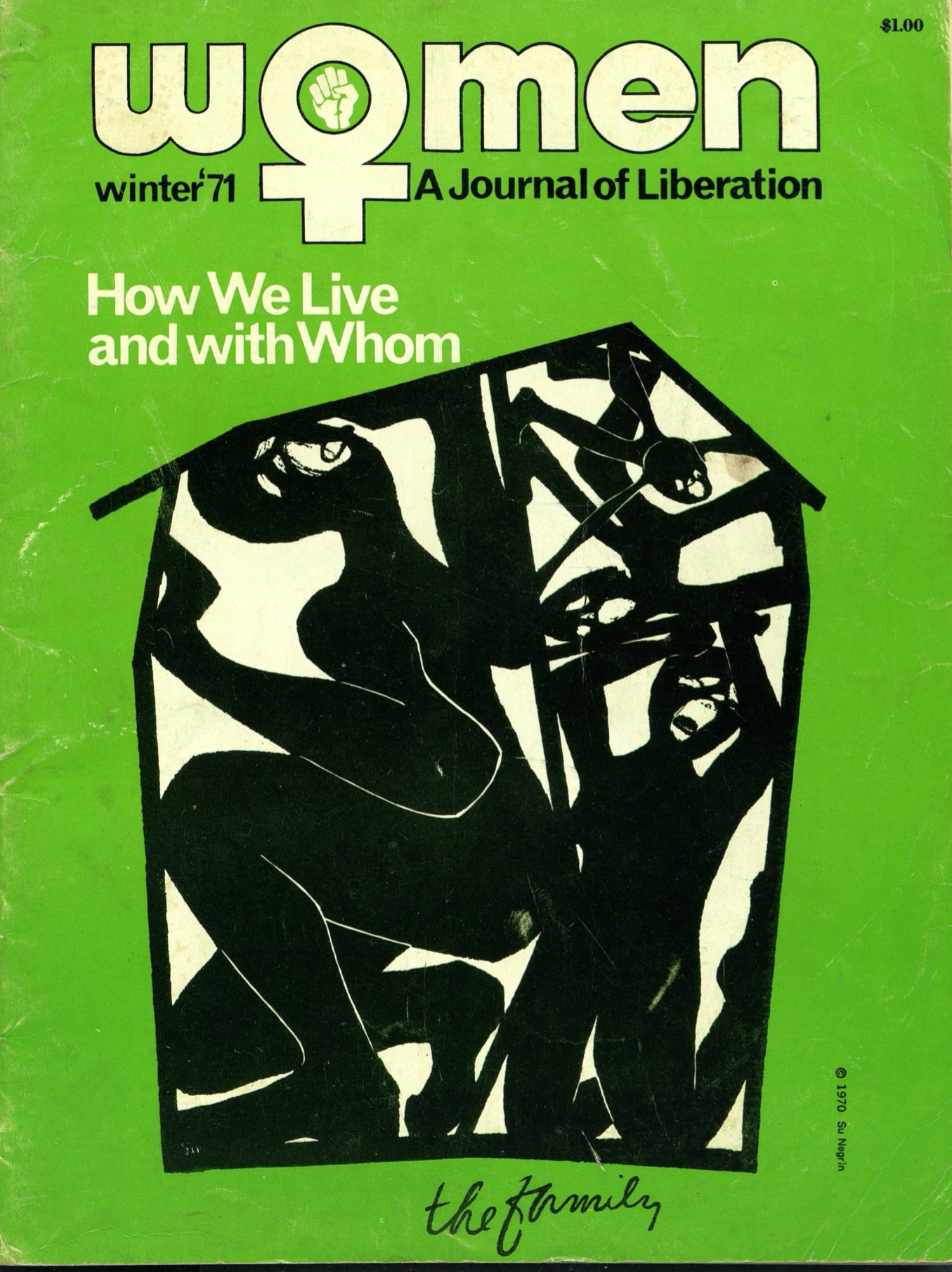
Published in the winter of 1971, the second issue of the second volume of Women: A Journal of Liberation focuses on “How We Live and with Whom.” The journal’s components explore women’s relationships with all members of the family – husband, children, parents, siblings. In addition to explaining these interfamilial relationships, the journal spotlights the ways women have explored, challenged, and transgressed the norms of how we live and with whom.

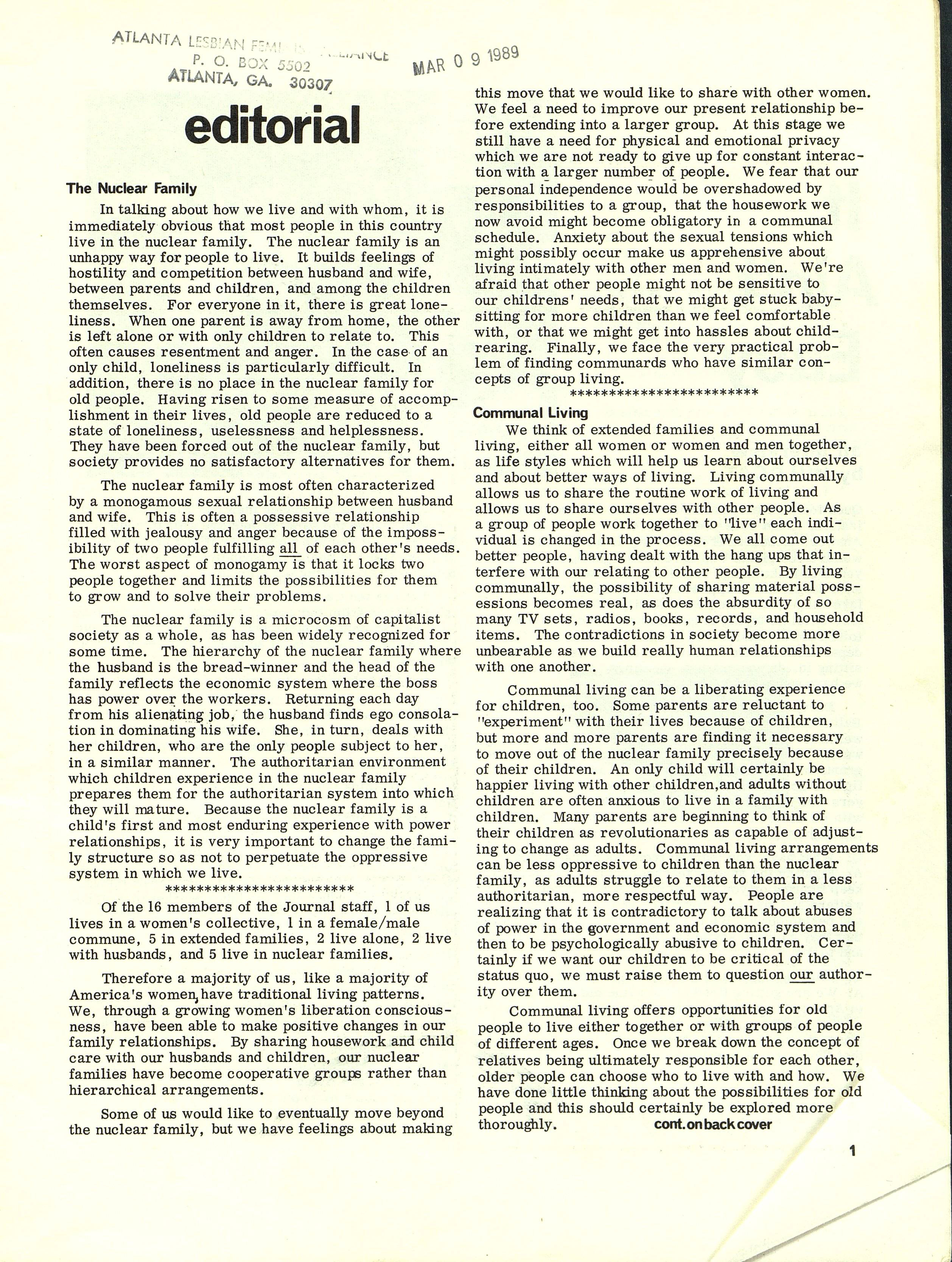
The magazine’s editorial features two sections: The Nuclear Family and Communal Living. The sixteen-member, all-female staff uses the piece to detail the restrictions of the nuclear family, which include the often “possessive [parental] relationship filled with jealousy and anger because of the impossibility of two people filling all each other’s needs” (Women 2.2, 1). Relationships within the family center around “feelings of hostility and competition” (Women 2.2, 1). Children perpetuate the cycle of oppression manifested in the nuclear family because this often harmful and problematic relationship between their mother and father is their “first and most enduring experience with power relationships” (Women 2.2, 1). Still, the staff acknowledges that the majority of its members operate within a nuclear family and that there exist real anxieties about transgressing this structure. Communal living, one alternative to the nuclear family, provides opportunities for productivity, inclusivity, and liberation, the editorial explains. But in addition to the implications of simply defying a so deeply engrained societal norm, fears of losing personal independence, increased sexual tensions, and neglect of the children’s needs are some of the barriers that prevent women from moving away from the nuclear family despite its framework of an “unhappy way for people to live” (Women 2.2, 1). Much of the journal focuses on the means by which we can question and overcome the “authoritarian system” and cycles of oppressive norms that exist in our culture as a result of this family structure (Women 2.2, 1). The editorial proposes one way to combat this challenge: “If we want our children to be critical of the status quo, we must raise them to question our authority over them” (Women 2.2, 1).
The magazine’s cover enhances the theme of the restraints of and tensions within the nuclear family. The cover features a graphic design entitled “The Family” by Su Negrin, author of A Graphic Notebook on Feminism. Against a neon green background, the cover’s artwork is black and white. It features four individuals – two children, a mother, and father – trapped inside of the outline of a house. While the people’s shapes initially catch the viewer’s attention, closer inspection reveals a more hidden detail: the mother, father, and two children are separated by walls between them. This separation serves as a visual representation of the “great loneliness” each member of the family feels (1). Each of the four bodies contort to fit into their small and isolated section of the home. Facial expressions of pain – wide eyes and screaming mouths – depict the “[unhappiness]” the staff describes in the editorial (Women 2.2, 1). The two children, together in one box in the upper right, occupy the least amount of square footage of the house. One child’s face boarders the parents’ boxes. The other child’s face is in the center of the box. The father’s body consumes just less than a third of the house’s space in the bottom right. His head and arms reach up towards his children. The mother inhabits the rest of the house, over half of the total space. Her curvy body crouches to fit into the box that is too small to contain her. The image seems to represent the traditional roles of the husband as the family’s “breadwinner” and the wife as the doer of housework and caregiver to the children (Women 2.2, 1). All four people’s arms and legs press against the boxes they occupy as they strive to escape the confines of the nuclear family. In contrast to the children and husband, though, the wife’s head also presses firmly against the outside of the house – the roof, in particular. Likely unsatisfied by her husband – who “finds ego consolation in dominating [her]” – and children with whom she shares a competitive relationship, the woman reaches for the outside almost as if she is gasping for air; not only does she want to break free of the nuclear family, but she needs it to thrive. While tension fills the house, the remainder of the journal’s cover is empty of illustrations. Despite the structure seemingly ready to burst at the seams, the outside world operates normally, blind by choice to the loneliness and misery within the restrictive household.

Structures for Living

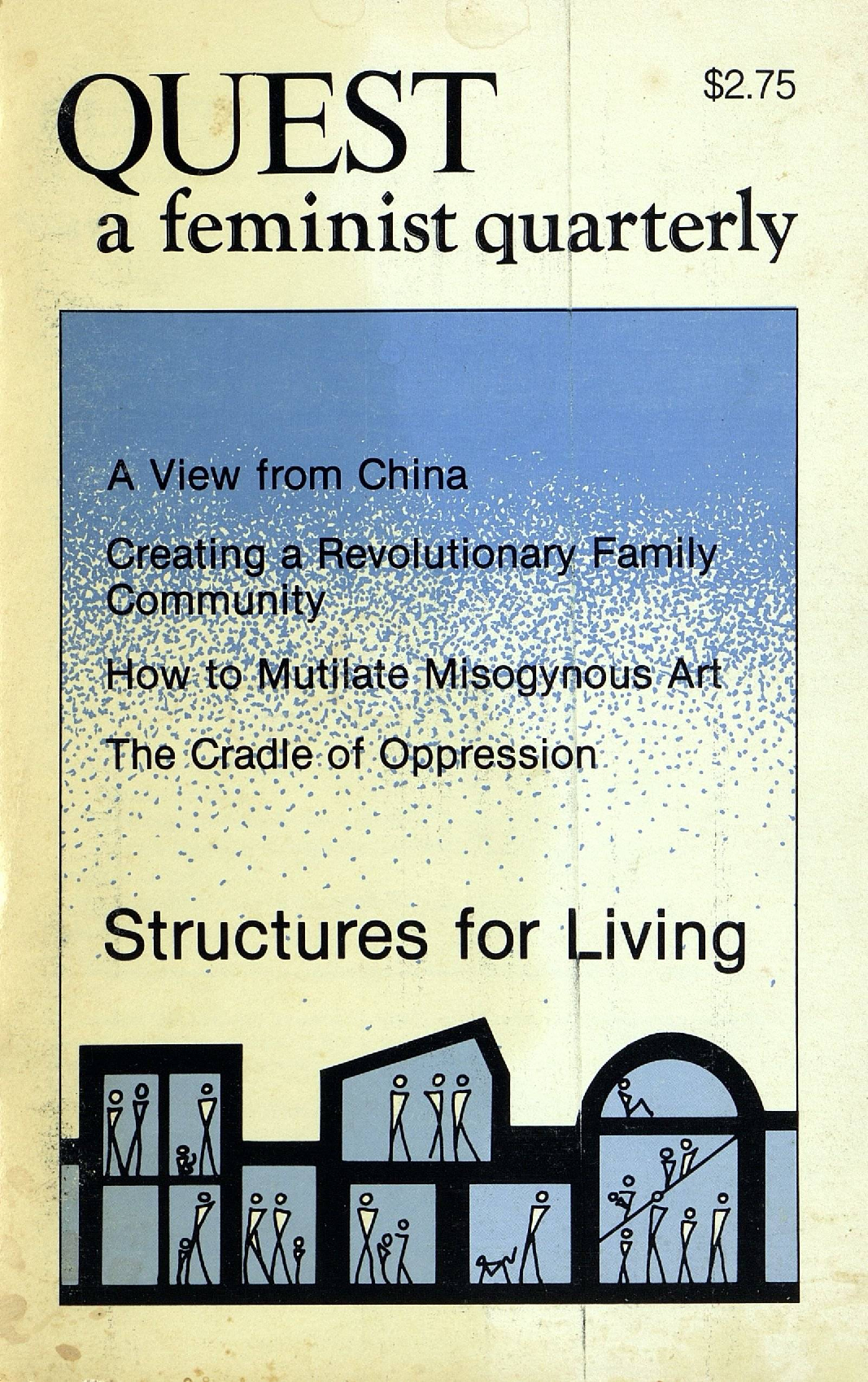
Quest‘s “Structures for Living” issue features a cover with striking similarities to Su Negrin’s artwork on the cover of Women 2.2. A design editor for the magazine, artist Sarah Shepard contributed many pieces in the later volumes of Quest. Her cover here depicts different compositions of families inside closed boxes and shapes. Like Negrin’s cover, the people are confined to the box they are in. However, unlike the tension and pain so evident in the How We Live and With Whom cover, we see family members content in the home. The piece depicts single parents, same sex parents, extended families, and even a single individual home. Notably, one box includes a thin diagonal line across its area. Four individuals are on each side of the line. Presumably, this box represents a communal living situation. As the How We Live and With Whom editorial explains, “communal living can be a liberating experience” that allows us all to “come out better people” (Women 2.2, 1).

The first article in this edition of Quest, Ann Ferguson’s “The Che-Lumumba School: Creating a Revolutionary Family Community,” cites that only 15.9 percent of families in the US have a stereotypical nuclear family. “This gap between reality and the idea [of a nuclear family],” Ferguson explains, “creates a crisis in values for most people” (Quest 5.3, 13). Her article discusses the internal inconsistencies within the nuclear family. She challenges “the breakdown of the public-private split which placed men as breadwinners and women as housemakers” (Quest 5.3, 14). Ferguson proposes a new way to define family. Composed of individuals who may live separately but who contribute to a community of “self-conscious resistance,” her proposed revolutionary family community emphasizes the economic, social, psychological, and political equality of its members (Quest 5.3, 15). Ferguson concludes with a final plea for Quest readers to consider this alternative family structure. “Revolutionary family-communities,” she asserts, “[are] structures we will need for the long haul ahead toward a socialist-feminist revolution” (Quest 5.3, 26).

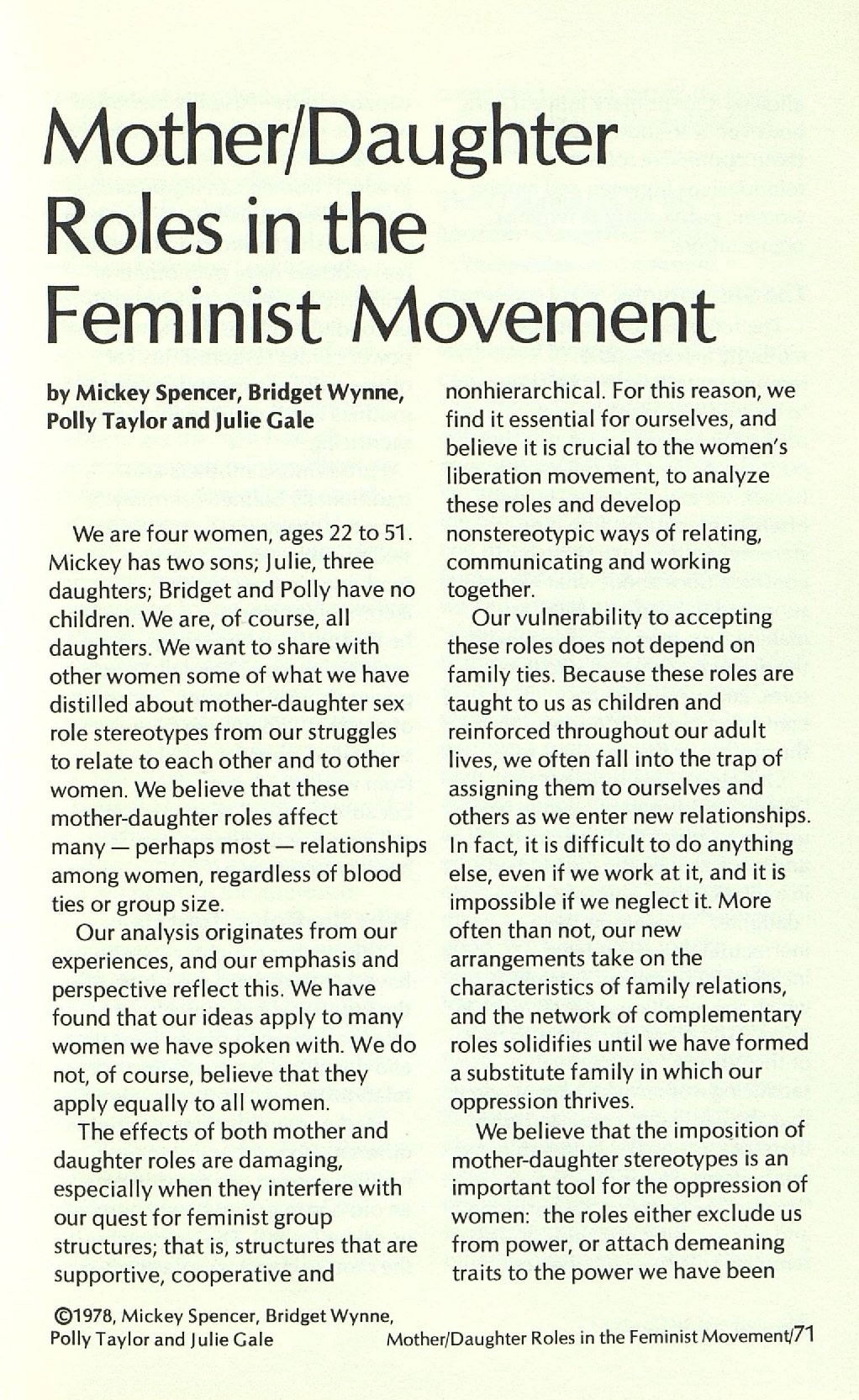
Four women coauthor the article “Mother/Daughter Roles in the Feminist Movement.” Two are mothers and the other two have no children. These women “believe that the imposition of mother-daughter stereotypes is an important tool for the oppression of women: the roles either exclude us from power, or attach demeaning traits to the power we have been allowed” (Quest 5.3, 71). As many women are both daughters and mothers, the authors explain that “whether we are put into the mother role or the daughter one can depend on such factors as appearance, age or power differences” (Quest 5.3, 74). The authors continue, “Traditionally, the only way for women to have even a semblance of power is as mothers” (Quest 5.3, 75). In acknowledging this unfortunate truth, these women make clear that women who do not fit nicely into the structure of the nuclear family face even greater oppression than women who do. Those who cannot or choose not to have children have a greater power discrepancy between themselves and men. The hierarchy among female power, especially that within the family, can be mended, as these female writers suggest, with co-nurturing. “We define co-nurturing,” the authors explain, “as nurturing and caring between equals; unlike mothering, it carries the expectation that the nurturing will be reciprocal and neither will have control over the other” (Quest 5.3, 78). This idea parallels with several other ways of mending the nuclear family discussed in feminist periodicals. Woman‘s “How We Live and With Whom” issue, for example, proposes a way to combat the challenge of oppressive norms that manifest as a result of the nuclear family: “If we want our children to be critical of the status quo, we must raise them to question our authority over them” (Women 2.2, 1).
Sex and Lies

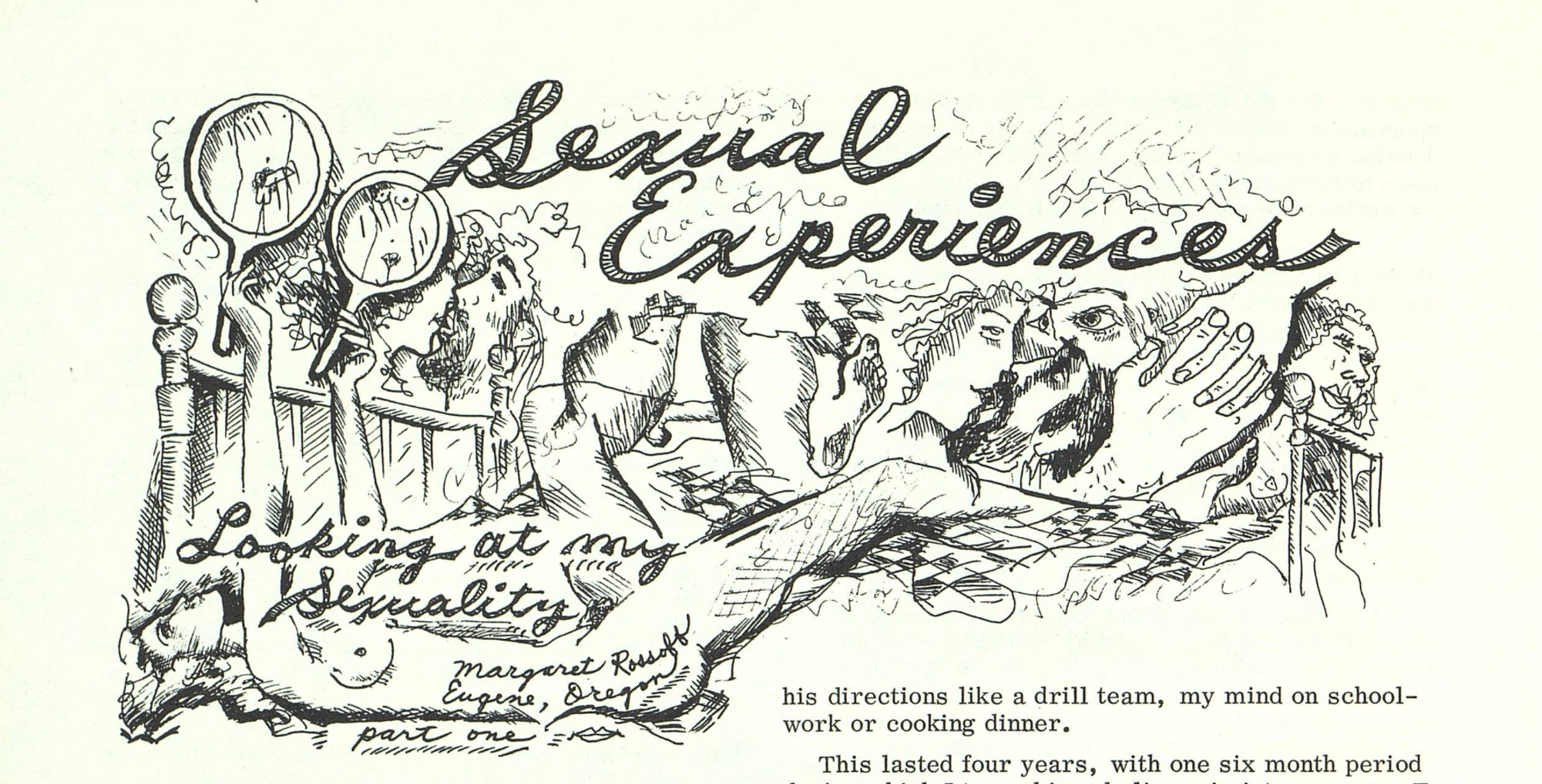
The “Sexuality” issue of Women highlights how stereotypes of the male-female binary are manifested in the family. Stereotypes of males as dominant and females as submissive become evident in women’s recounting of sexual experiences throughout their lifetimes. Two articles in particular illustrate how the nuclear family upholds this power dynamic: “Sexual Experiences: Looking at My Sexuality” by Margaret Rossoff and “Our Sisters Speak: Liberating the Second Sex from the Heterosexual Norm” by various readers. Barbara Brenner Niziolek in the latter article explains the harmfulness of the classic “missionary” sex position. In addition to thoroughly discussing society’s disregard of female pleasure, Niziolek explains that “the sexual roles played by male and female during coitus has always been an extension of the male and female roles played in social interactions” (Women 3.1, 60). Rossoff recounts her actions as a kid. “I used my pajamas and sheets to tie myself to the bed post, while developing a fantasy of enslavement to a man of great power and attractiveness,” she writes (Women 3.1, 44). “I didn’t understand for a long time that this was that notorious activity called sex” (Women 3.1, 44). These women discovered that sex was an intimate act where man’s pleasure is required just as seriously as society seemed to require heterosexuality. Lesbianism and female pleasure alike were considered shameful. Rossoff’s husband, after discovering how tense she was before intercourse, accused her of “not having a hole at all” (Women 3.1, 44). Diminished and objectified, Rossoff notes, “[my] orgasm stopped being mine” (Women 3.1, 45). Sex simply intensified women’s lack of control in the family.

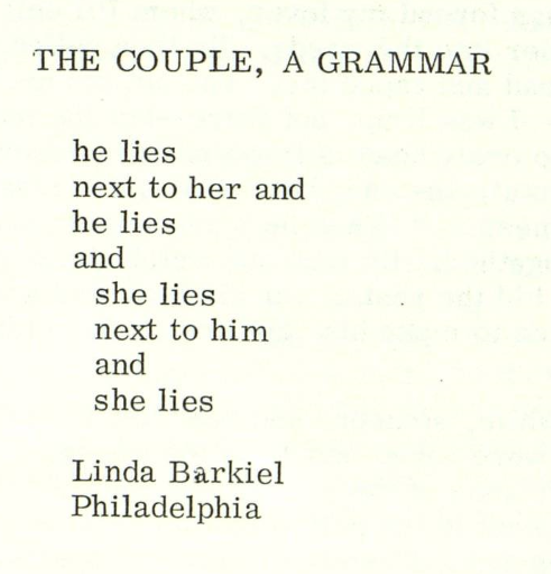
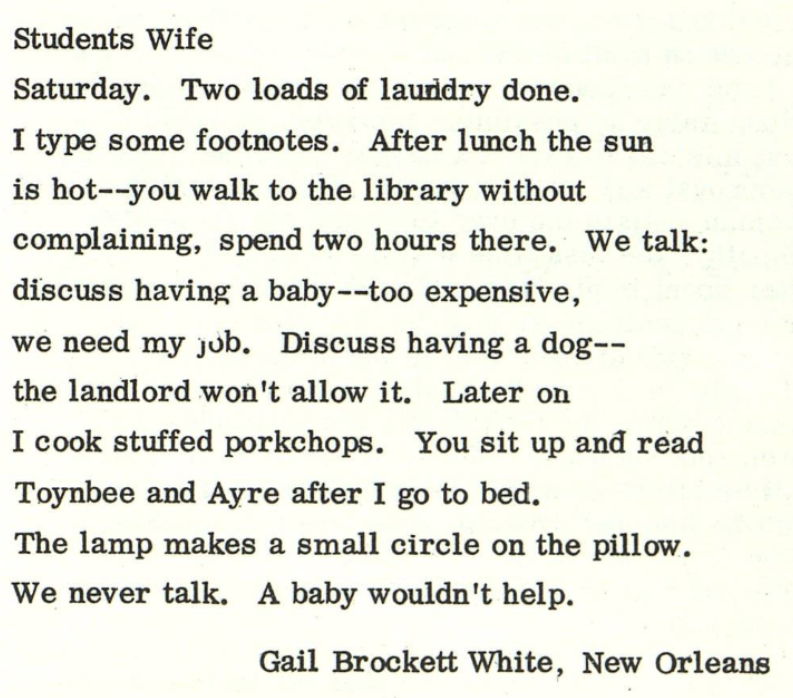
Linda Barkiel explores some of the issues within a nuclear family, headed by a monogamous heterosexual marriage, in her poem “The Couple, A Grammar.” She composes her poem in eight lines using eight different words. She takes advantage of the dual meaning of the word “lies,” using it four times in the short composition (Women 3.1, 17). She uses the word to indicate physical positioning — the couple lies in bed together — and to denote psychological play — the husband and wife tell lies; the couple presents an outward appearance of love while their relationship is riddled with deceit. Written in the third person, Barkiel’s poem makes the husband and wife’s knowledge of each other’s deception ambiguous. Poems like this and Gail Brockett White’s “Students Wife” tell stories of unhappy marriages filled with tension. They confirm the “How We Live and With Whom” editorial’s discussion of the “impossibility” of feeling satisfied in a monogamous relationship (Women 2.2, 1).

White’s poem concludes with the line, “We never talk” (Women 2.2, 13). Just lines before, she asserts, “we talk” (Women 2.2, 13). This contradiction perhaps indicates White’s ambivalence about the relationship or the emptiness of their “talk.” The once exciting passion that drew these two individuals to each other has since faded, and nothing, even having a child, can salvage what once was.

The Selfhood of Women

Quest‘s “The Selfhood of Women” issue spotlights prose and poetry on female identity. In a preview of the issue, Quest writers explain, “the women’s movement is only as strong as the selves upon which it is built, a selfhood largely determined by our sex, our class, our sexuality, our race, our ethnic or geographic background” (Quest 1.2, 82). As we have seen through discussions of relationships and sexuality, many aspects of Second Wave Feminism tie back into home life; selfhood is no exception. Much of the publication centers around women’s identities as mothers, daughters, and sisters within the nuclear family. Karen Kollias, in her piece “Class Realities: Create a New Power Base,” discusses how many of the shortcomings of the women’s movement are rooted in the ways society defines the family. Experiences of those who do not fit into the “educated, white middle-class” label are often excluded from the movement and from the family definition (Quest 1.3, 29). Thus, she argues that excluding black and lower-class women from the feminist movement is a byproduct of their exclusion from the family identity. She proposes group identity as a means by which to resolve the exclusion of “othered” groups from both of these structures, but she acknowledges that caveats must come with how we define this powerful sisterhood: “feminism must allow for flexibility and work with the differences of women rather than ignoring them to get the similarities” (Quest 3.1, 35). As she characterizes different types of families – working class, working poor, lower class – and their struggles related to the movement, Kollias proves that the family and feminist movement are inherently intertwined.

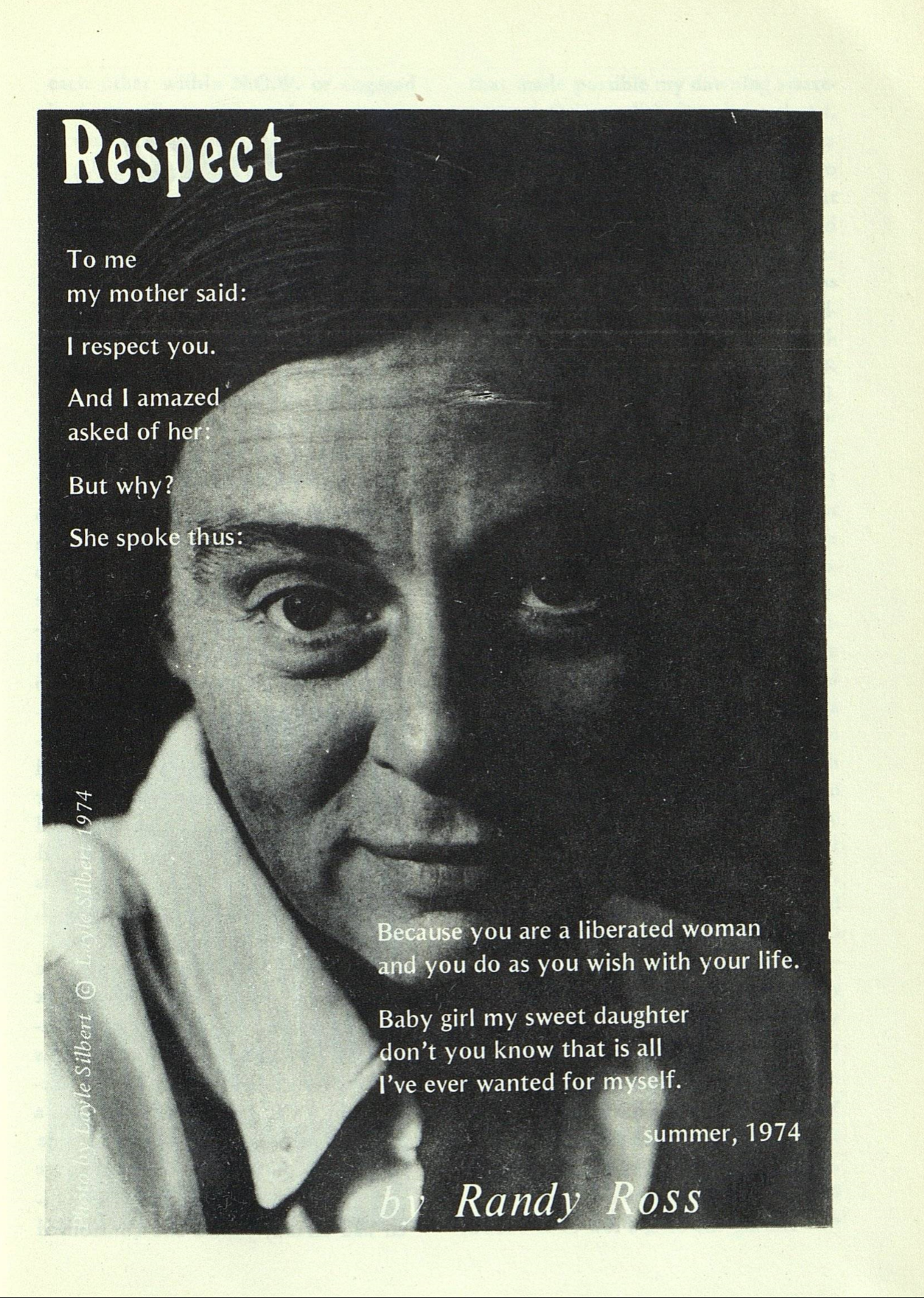
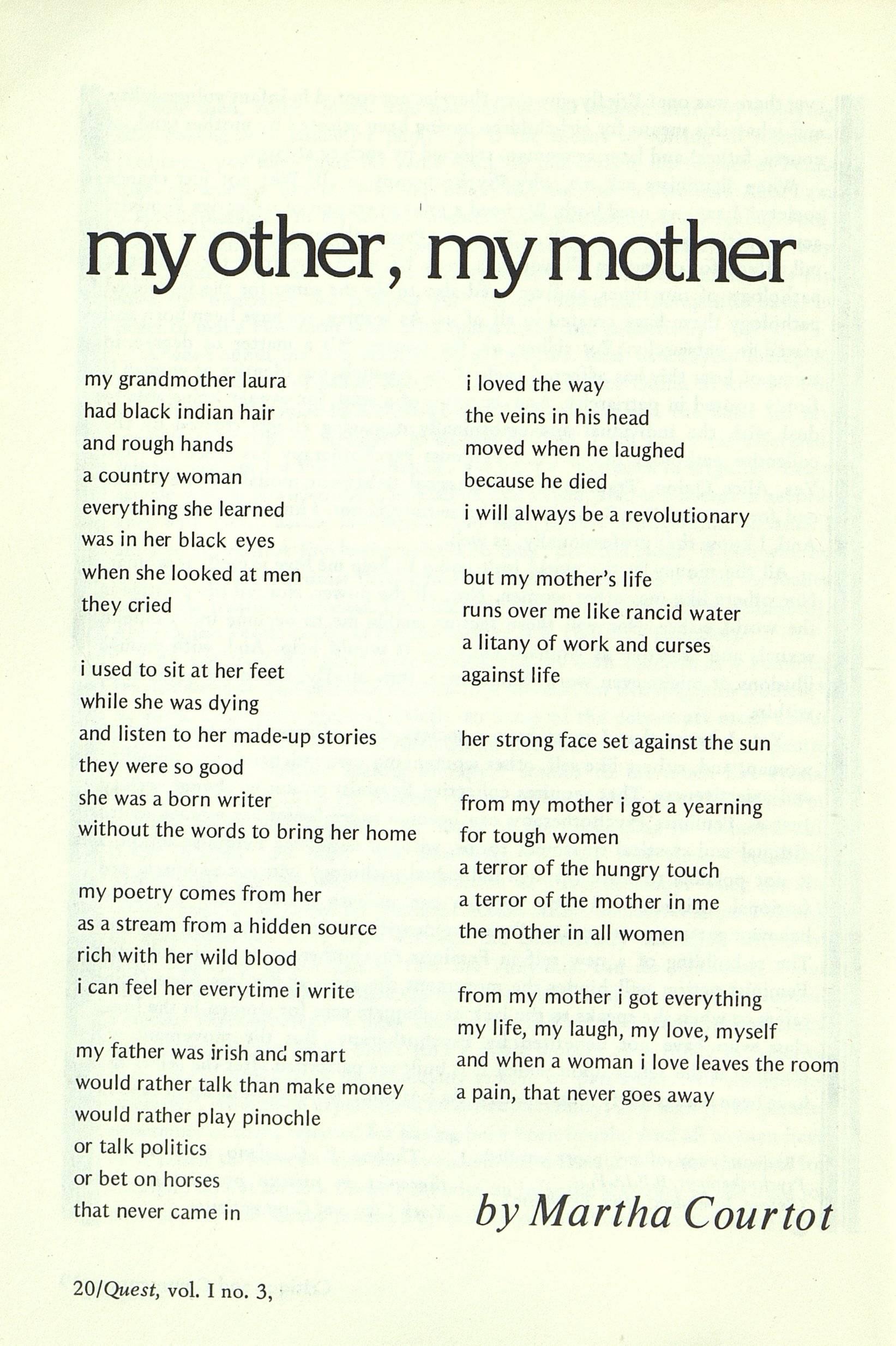
Martha Courtot was a lesbian, activist, mother, grandmother, and prolific poet. Her piece in Quest delves into some of these identities as she places herself in the context of her family. Her poetry comes from her grandmother and her being a “revolutionary” from her father (Quest 1.3, 20). In contrast to the comforting sentimental tales of her other relatives, she speaks of her mother differently. She writes, “from my mother i got…a terror of the mother in me / the mother in all women” (Quest 1.3, 20). She continues, “from my mother i got everything / my life, my laugh, my love, myself / and when a woman i love leaves the room / a pain, that never goes away” (Quest 1.3, 20). Courtot received both happiness and fear, love and pain from her mother. Courtot is afraid of the mother that lies within her and within all women. Yet she still knows, despite the pain her mother has put inside her, that she is a mirror image of her predecessor: “my other, my mother” (Quest 1.3, 20). This bond between mother and daughter is one frequently mulled over in feminist writings. Randy Ross in her poem “Respect” writes that her mother respected her “because you are a liberated woman and you do as you wish with your life” (Quest 1.3, 71). Generational progress could be seen within these interfamilial relationships. As her mother says solemnly, “that is all I’ve ever wanted to myself” (Quest 1.3, 71). Ross’ use of the present tense in “I’ve” solidifies that her mother still is unable to be free from the bonds of womanhood that constrain her. The periodical gives space for all types and strengths of these mother-daughter relationships to be explored, whether these bonds are riddled with “terror” or “respect.”

Lucia Valeska’s article, “If all else fails, I’m still a mother,” explores how the family structure has changed over time and how the once “stable family unit” of the nuclear family has “progressively disintegrated” (Quest 1.3, 56). “Here’s the deal,” the lesbian mother asserts. “The nuclear family is the result of an economic system which has come to depend upon small, tight, economically autonomous, mobile units” (Quest 1.3, 55). The prospect of motherhood was an expectation for women. Many during the feminist movement sought to transform discussion of the possibility into just that: a discussion, rather than a given. Valeska discusses the differences in being “childless” and “childfree,” explaining that “the term ‘childless’ represents our society’s traditional perception of the situation…to be ‘childless’ still carries a negative stigma” (Quest 1.3, 56). “Childfree,” she explains is a term representative of the changing tides due to the work of feminists. Motherhood is no longer the end goal for women, the only means by which they can attain attain social acceptance and economic success. Still, Valeska concedes that, “clearly, with or without children, women are not free in our society” (Quest 1.3, 57). As is the structure of countless feminist articles, Valeska’s concludes with ways we must seek to reform these issues she brings to light: “We must develop feminist vision and practice that includes children. We must allow mothers and children a way out of the required primary relationships of the nuclear family” (Quest 1.3, 63). Her powerful piece so clearly and convincingly demonstrates that if “all else fails,” she is more than just a mother living within the constraints of the toxic nuclear family.


Sources

Blanchard, Margaret. “Speaking the Plural: The Example of ‘Women: A Journal of Liberation.’” NWSA Journal, vol. 4, no. 1, 1992, pp. 84-97, www.jstor.org/stable/4316178.

“How We Live and With Whom.” Women: A Journal of Liberation, vol. 2, no. 2, 1971, http://voices.revealdigital.com/cgi-bin/independentvoices?a=d&d=BGJGDDE19710101.1.1&e=——-en-20–1–txt-txIN-women+how+we+live+and+with+whom————–1.

MacLean, Nancy. The American Women’s Movement, 1945-2000: A Brief History with Documents. Boston, St. Martin’s, 2009.

“The Selfhood of Women.”  Quest: A Feminist Quarterly, vol. 1, no. 3, 1975, http://voices.revealdigital.com/cgi-bin/independentvoices?a=d&d=CCECIDH19750101.1.1&e=——-en-20–1–txt-txIN-nuclear+family————–1.

“Sexuality.” Women: A Journal of Liberation, vol. 3, no. 1, 1972, http://voices.revealdigital.com/cgi-bin/independentvoices?a=d&d=BGJGDDE19711001.1.1&e=——-en-20–1–txt-txIN-sexuality————–1.

Stoner, Tim.  “Nuclear Family.” 2001, watercolor on paper. https://www.saatchigallery.com/artists/artpages/tim_stoner_144_untitled_artists_in_future_exhibitions_hidden.htm

“Structures for Living.”  Quest: A Feminist Quarterly, vol. 5, no. 3, 1981, http://voices.revealdigital.com/cgi-bin/independentvoices?a=d&d=CCECIDH19810101.1.1&e=——-en-20–1–txt-txIN-quest+5.3————–1#.