Playboy’s Parallels with “Letter from a Battered Wife”

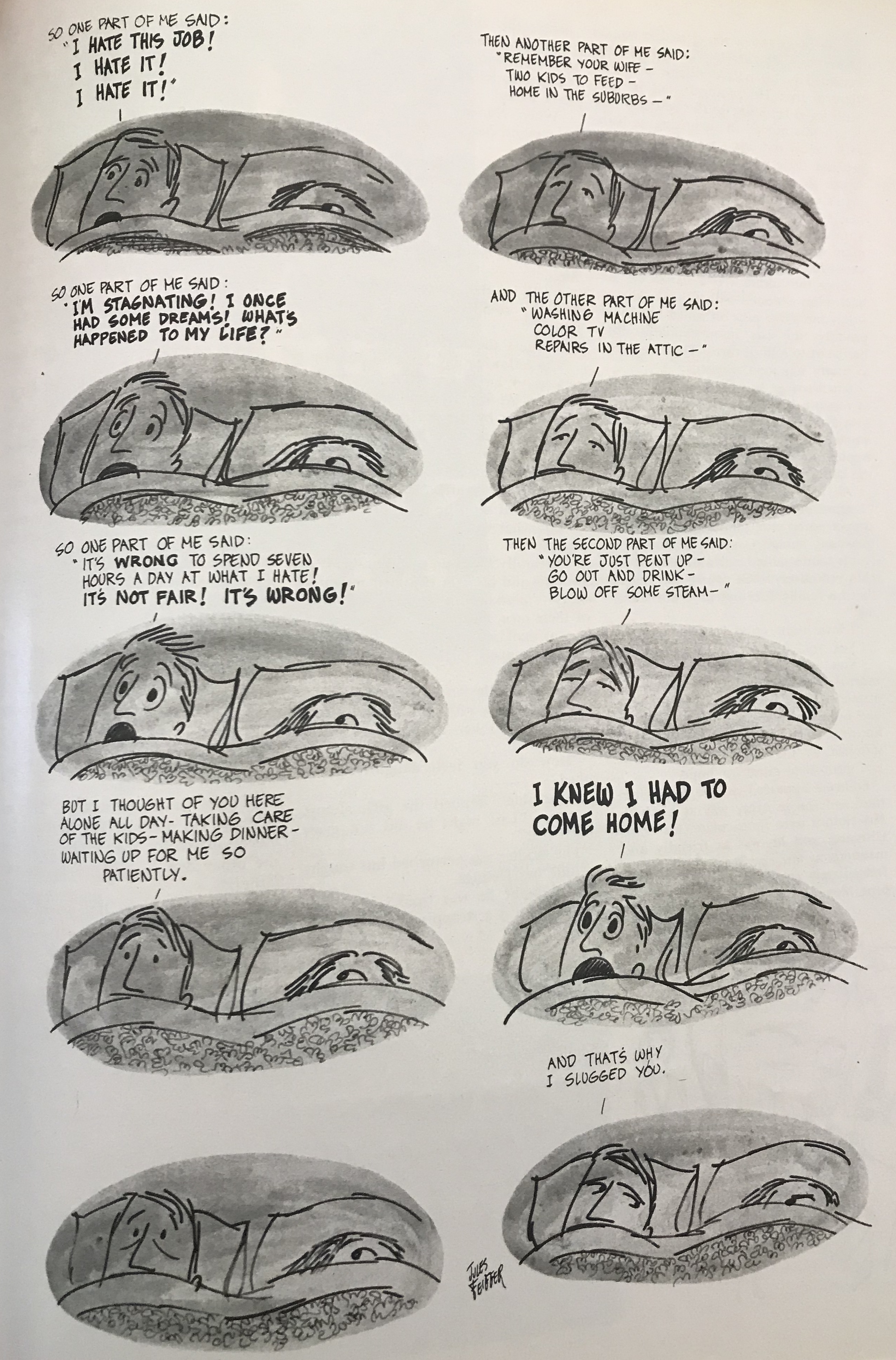
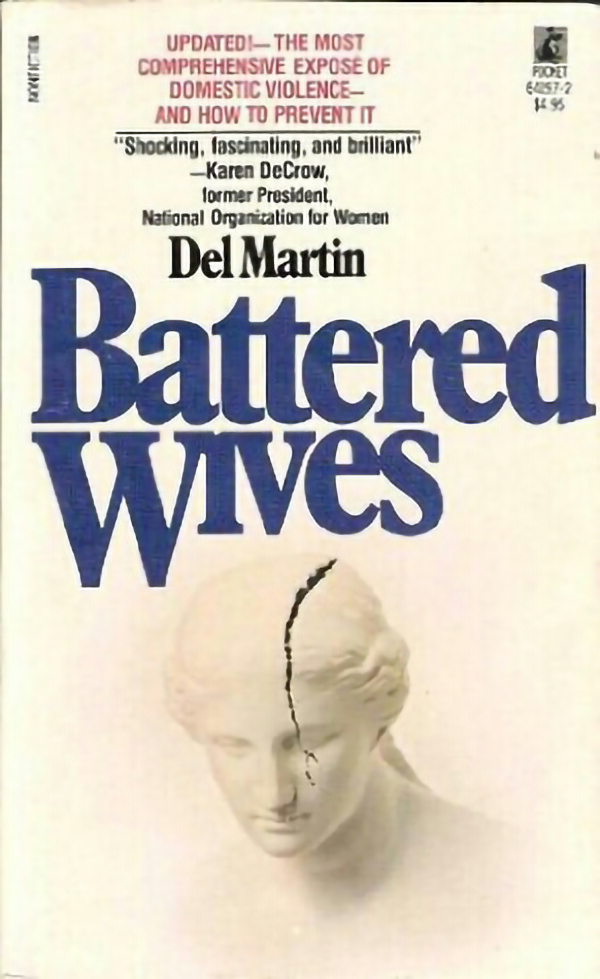
Above is a cartoon from Playboy (vol. 5, no. 10) and an article from The American Women’s Movement titled “Letter from a Battered Wife” that was initially published in Del Martin’s Battered Wives. Both are contrasting portraits of domestic violence. The cartoon is very blunt and unapologetic in its use of an act of violence as a point of humor. The comedic technique being used here is a reframing device. The final line “And that’s why I slugged you” puts both the man and woman’s behavior in the previous panels in a new context. The man’s desire to come home to see his wife is recontextualized as either a desire to relieve stress by beating up another person or to express jealousy of the fact that his wife is not working outside the home and is exempt from the kind of stress he experiences. The woman, meanwhile, conceals her face throughout the comic, and the new context allows the viewer to immediately understand that she most likely is hiding a black eye. If we juxtapose this cartoon with the 1976  “Letter from a Battered Wife,” we can reframe this moment again. Del Martin reminds us of the painful reality of spousal abuse: “Few people have ever seen my black and blue face and swollen lips, because I have always stayed indoors afterwards, feeling ashamed” (Martin, 2). The woman in the cartoon is alone with her husband yet she still hides under the covers. This can be an indicator that she is afraid of her husband but it may also be an indicator that she is ashamed just like the woman in “Letter from a Battered Wife.”
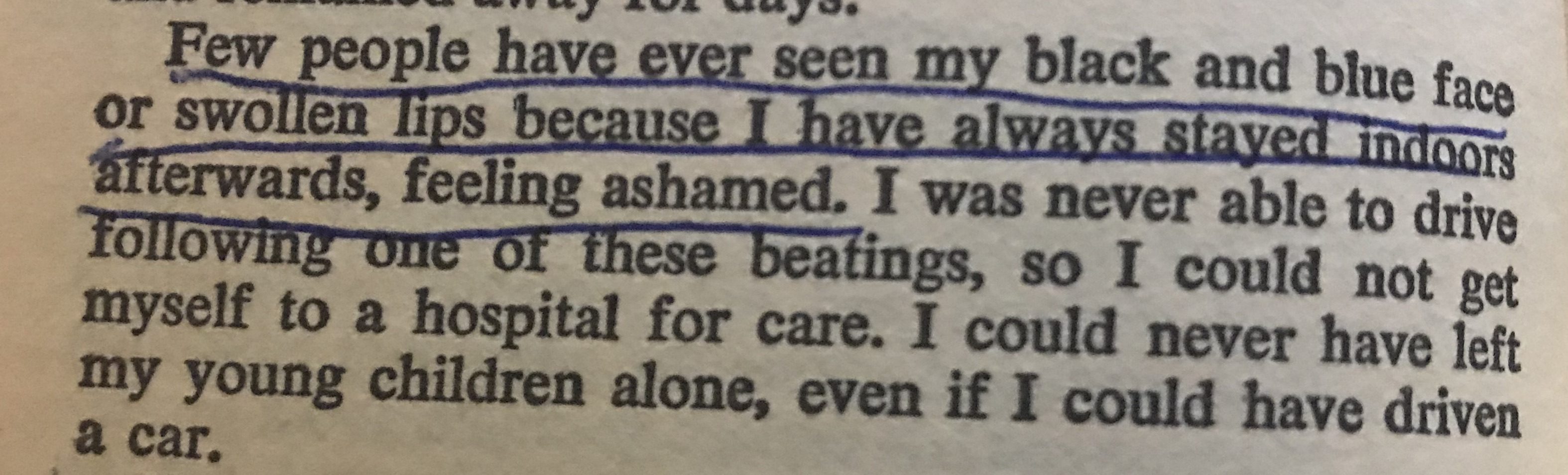
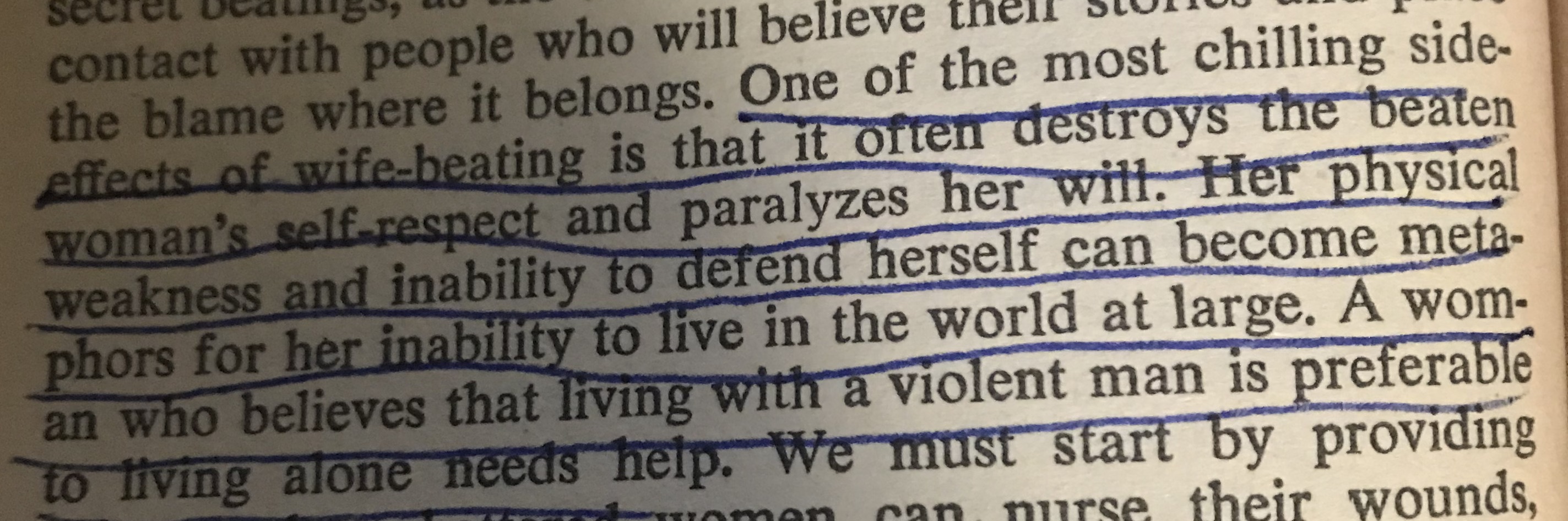
The concealment of the face also reminds the viewer of the isolation victims of domestic violence experience. The letter’s author states that she “cannot depend upon any outside help” because outsiders will “excuse (her) husband for distorting (her) face” but will not “forgive (her) for looking bruised and broken” (Martin, 4). The author goes on to detail this isolation and how it stems from traditional views that no one should interfere with an intimate relationship even if it is abusive. The woman’s lack of movement also reflects the letter’s description of how wife-beating “destroys the beaten woman’s self-respect and paralyzes her will” (Martin, 8). The woman in the cartoon is trapped just like how many victims are trapped.
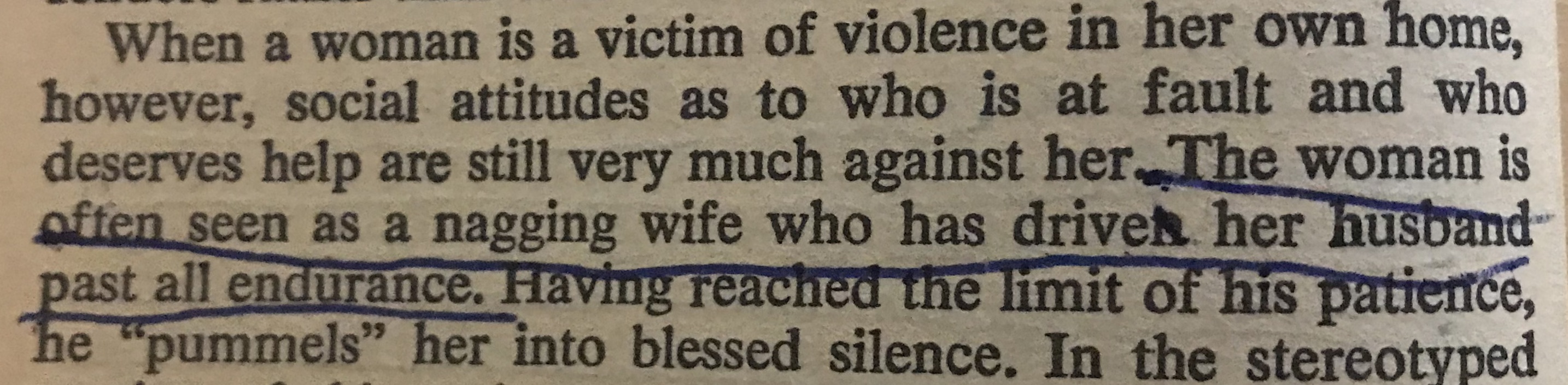
The dialogue from the man also parallels a commentary made by the author explaining how society’s view of domestic violence often rationalizes the situation as “a nagging wife who has driven her husband past all endurance. Having reached the limit of his patience he “pummels” her into blessed silence.” (Martin, 6). The husband is stressed and tired in the comic so it is supposed to make sense that he would take it out on his wife.   
The cartoon was published in Playboy in 1958 while the “Letter from a Battered Wife” was published in 1976, in the middle of Second-wave feminism. The letter ends with an optimistic view of how communities are starting to see domestic violence as a grave social problem thanks to organizations like the National Organization for Women (NOW). However, she continues to push the necessity of treating domestic violence as a public issue.

One of the most significant movements within the Second-wave was the Battered Women’s Movement which worked to frame wife-beating as an epidemic that stemmed from a large scale subordination of women (Schneider, 23). These two images display the initial societal views of domestic violence in the 1950s and the attempt change those views in the 1970s. Prior to the movement, domestic violence was not seen as a very big deal and wife abuse was viewed by law enforcers as “domestic disturbances” that were a private matter. Newspapers refrained from even reporting incidents of domestic abuse until 1974 (Pleck, 182). The cartoon’s heavy-handed depiction of violence, even if it is possibly a critique of the husband, reflects the attitude that law and media had towards domestic violence at the time. “Letter from a Battered Wife” is a direct response to these feelings, emphasizing the personal horror victims experience and giving weight to instances of abuse.


Sources:

Playboy, vol. 5, no. 10, HMH Publishing Co., 1958.

Del Martin, “Letter from a Battered Wife.” The American Women’s Movement, 1945-            2000, edited by Nancy

Schneider, Elizabeth M. Battered Women & Feminist Lawmaking. Yale University Press,        2000.

Pleck, Elizabeth H. Domestic Tyranny: The Making of Social Policy Against Family                Violence from Colonial Times to the Present. Oxford University Press, 1987.


Posted in Lee

“After a first book”

Aside

Paper is neither kind nor cruel
 only white in its neutrality
 and I have for reality now
 the brown bar of my arm
 moving in broken rhythms
 across this dead place.

All the poems I have ever written
 are historical reviews of a now absorbed country
 a small judgement
 hawking and coughing them up
 I have ejected them not unlike children
 now my throat is clear
 perhaps I shall speak again.

All the poems I have ever written
 make a small book
 the shedding of my past in patched conceits
 moulted like snake skin, a book of leavings
 now
 I can do anything I wish
 I can love them or hate them
 use them for comfort or warmth
 tissues or decoration
 dolls or Japanese baskets
 blankets or spells;
 I can use them for magic
 lanterns or music
 advice or small council
 for napkins or past-times or
 disposable diapers
 I can make fire from them
 or kindling
 songs or paper chains

Or fold them all into a paper fan
 with which to cool my husband’s dinner.

Daddy issues in Both Playboy and Plath

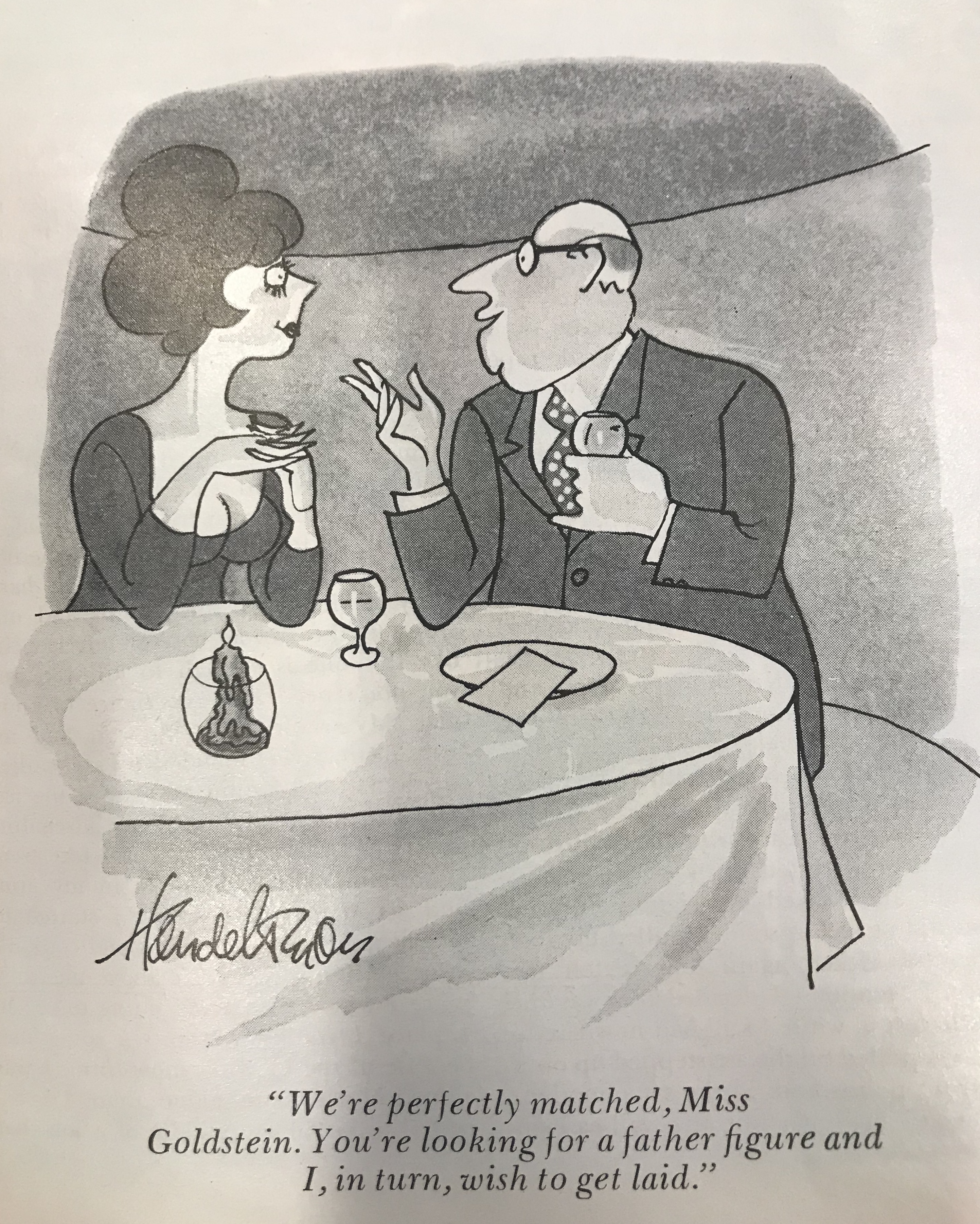
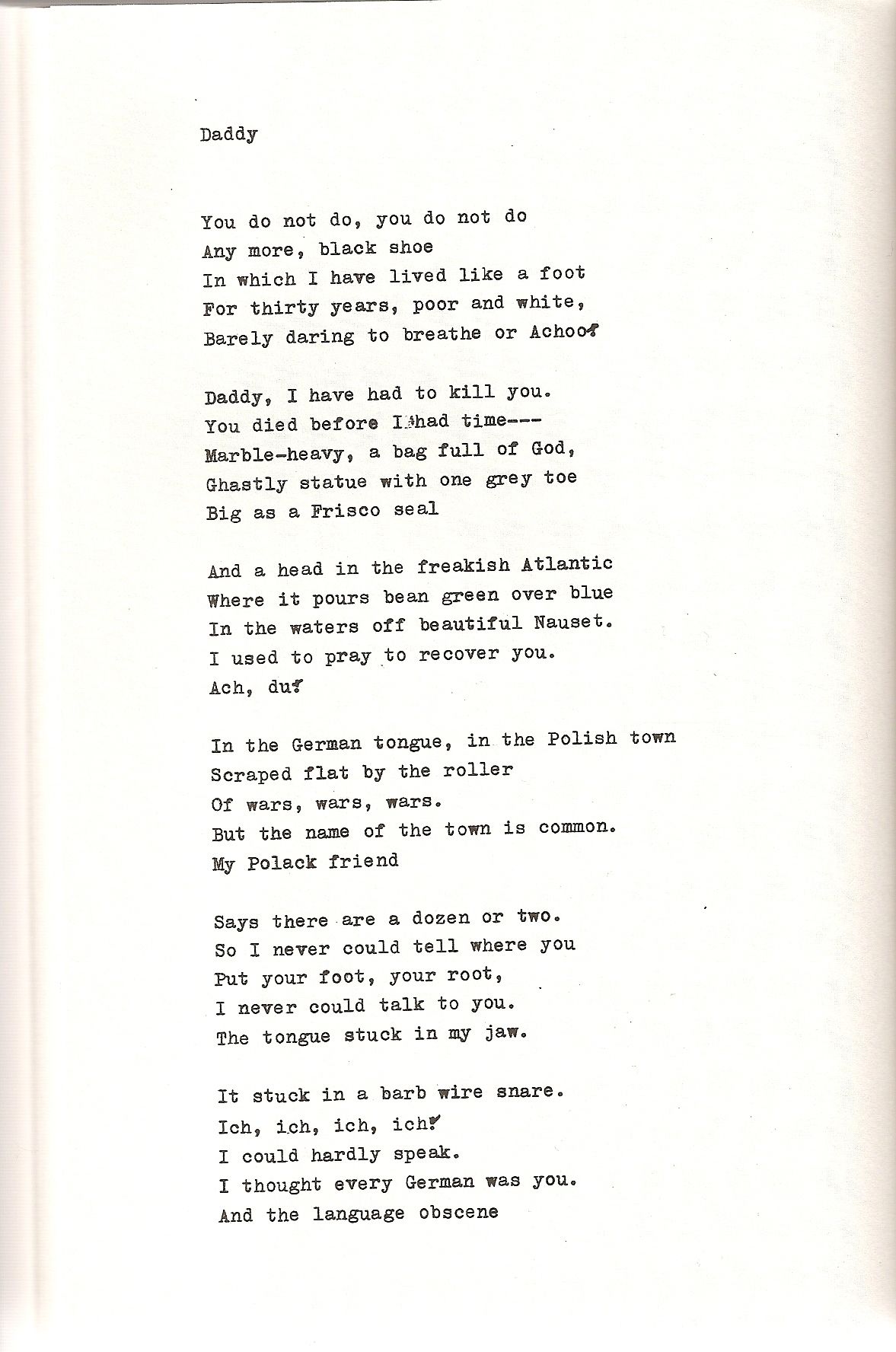
The cartoon above was published in Playboy (vol. 25, no. 2) in 1978, thirteen years after Sylvia Plath published her poem “Daddy.” The connection between these works comes from how they both bring to mind the Electra complex, the female version of the Oedipus complex. Both the woman in the cartoon and the speaker in the poem seek their father in their partners. The cartoon paints this as something quirky and amusing while the poem is deeply disturbing in its description of a father.  

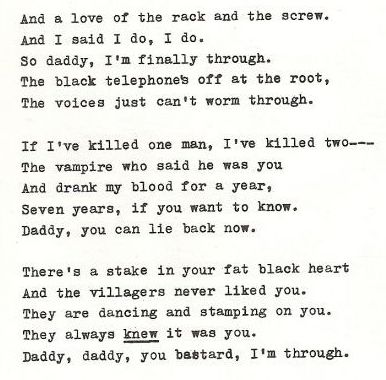
“Daddy” is often viewed as Sylvia Plath’s most famous and controversial poem, according to Linda Anderson  (Anderson,182). While not explicitly feminist, “Daddy” is certainly critical of patriarchal dominance in society. In the last two stanzas, Plath compares both her husband and her father to inhuman vampires that she has killed. The poem was written on October 12, 1962, the twentieth anniversary of her father’s leg amputation and the day she learned Ted Hughes, her husband, had agreed to a divorce (Platizky, 106). This was also around the time of Adolf Eichmann’s trial and execution, who may be the source of the poem’s Nazi imagery. The poem mixes the personal with the impersonal to paint the father as an evil but beloved figure.

The poem is about a woman desperately trying to overcome the male dominance of society. The tragedy comes from the fact that even in death, a father has power over his daughter. When juxtaposed, the cartoon can be viewed as a simplification of Plath’s ideas. Both women are controlled and exploited through their desire for a father. This allows the cartoon to be seen as something deeply tragic with the man reducing something deeply personal into a shallow means for sexual favors.     

Sources:

Anderson, Linda. “Gender, Feminism, Poetry: Stevie Smith, Sylvia Plath, Jo                          Shapcott.” The Cambridge Companion to Twentieth-Century English Poetry,                  edited by Neil Corcoran, Cambridge University Press, Cambridge, 2007: 173–186.

Platizky, Roger. “Plath’s Daddy.” The Explicator., vol. 55, no. 2, 1997, pp. 105–107.

Playboy, vol. 25, no. 2, Playboy, 1978.

Plath, Sylvia. “Daddy .” Poetry Foundation, HarperCollins Publishers Inc., 1992,                   www.poetryfoundation.org/poems/48999/daddy-56d22aafa45b2. Accessed 11             Dec. 2018.

Posted in Lee

“Who Said It Was Simple”


There are so many roots to the tree of anger 
that sometimes the branches shatter 
before they bear.
Sitting in Nedicks
the women rally before they march 
discussing the problematic girls 
they hire to make them free.
An almost white counterman passes
a waiting brother to serve them first
and the ladies neither notice nor reject 
the slighter pleasures of their slavery.
But I who am bound by my mirror
as well as my bed 
see causes in color 
as well as sex
and sit here wondering
which me will survive 
all these liberations.
“Who Said It Was Simple” was published in Lorde’s third volume of poetry, From a Land Where Other People Live in 1973. The brief poem scrutinizes those who define themselves as feminists but continue to accept and benefit from the oppression of other groups. In it, Lorde identifies aspects of her identity that make her unable to approve of such a conditional form of feminism.

This poem focuses specifically on the flawed notion of a “whites-only” feminism, addressing racial oppression through lines like, “discussing the problematic girls / they hire to make them free,” and “the ladies neither notice nor reject / the slighter pleasures of their slavery.” The poem’s climax, which doubles as the piece’s conclusion, is a direct testament of Lorde’s intersecting identities. She writes, “I who am bound by my mirror / as well as by my bed,” referencing her status as a black, homosexual woman. The final lines of the piece read, “and sit here wondering / which me will survive / all these liberations.” Here, Lorde employs irony skillfully, calling attention to the fact that limited liberation movements are inherently oppressive. In obliging readers to process this notion between the lines, Lorde pushes them to reflect more broadly on hypocrisy.

“Who Said It Was Simple” is a more narrative-based piece than most included in “Leaning into Lorde,” especially due to its specified setting of Nedicks, a chain fast food restaurant. It conveys a “practice what you preach” message to readers, encouraging them to be activists beyond organized activities like marches. Ultimately, Lorde uses this poem to emphasize that all social justice movements must be rooted in a foundation of intersectionality to be genuine and effective.

Source: Lorde, Audre. “Who Said It Was Simple.” From a Land Where Other People Live. Broadside Press, 1973.

Two Perspectives on Women in the Workplace

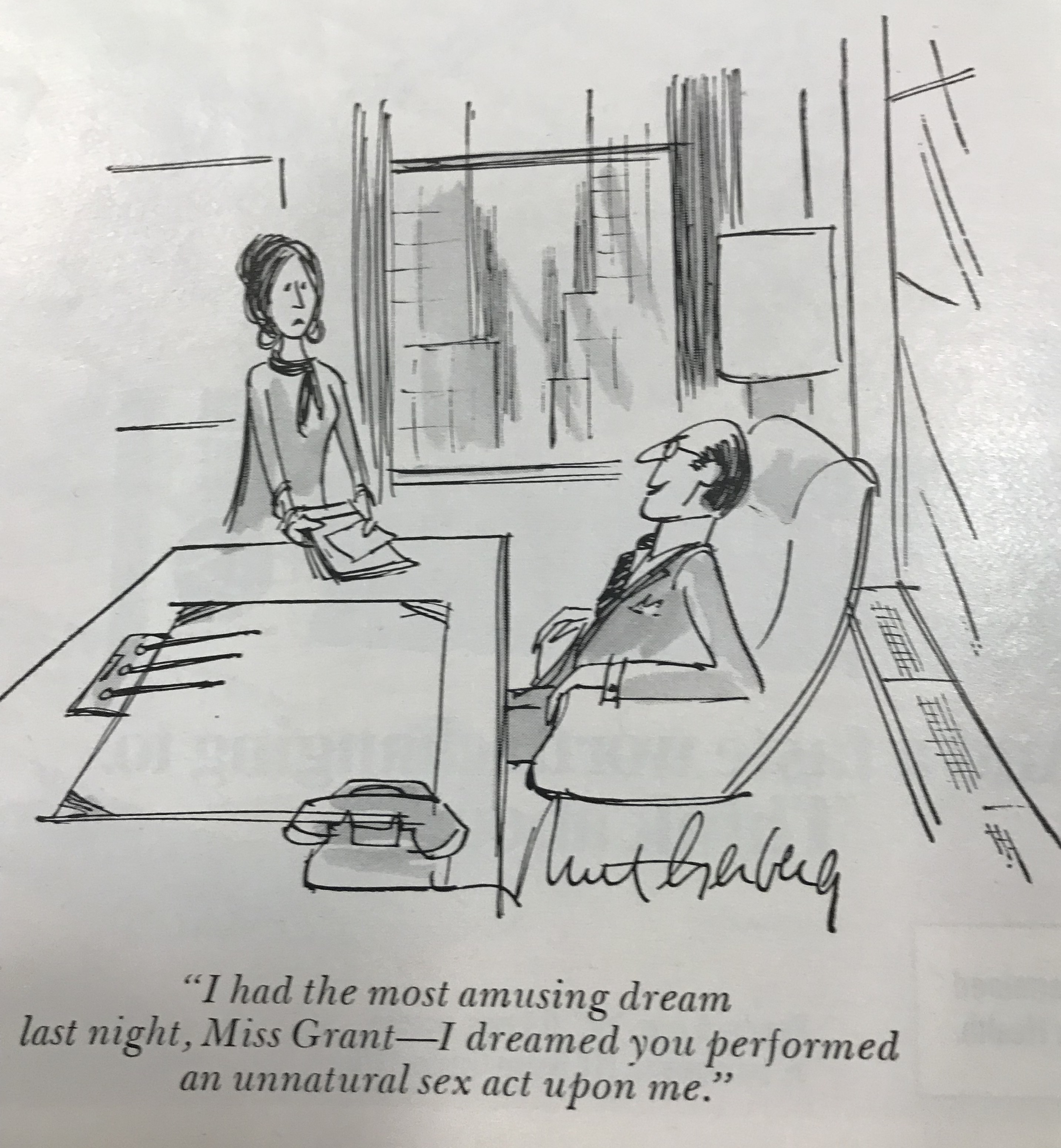
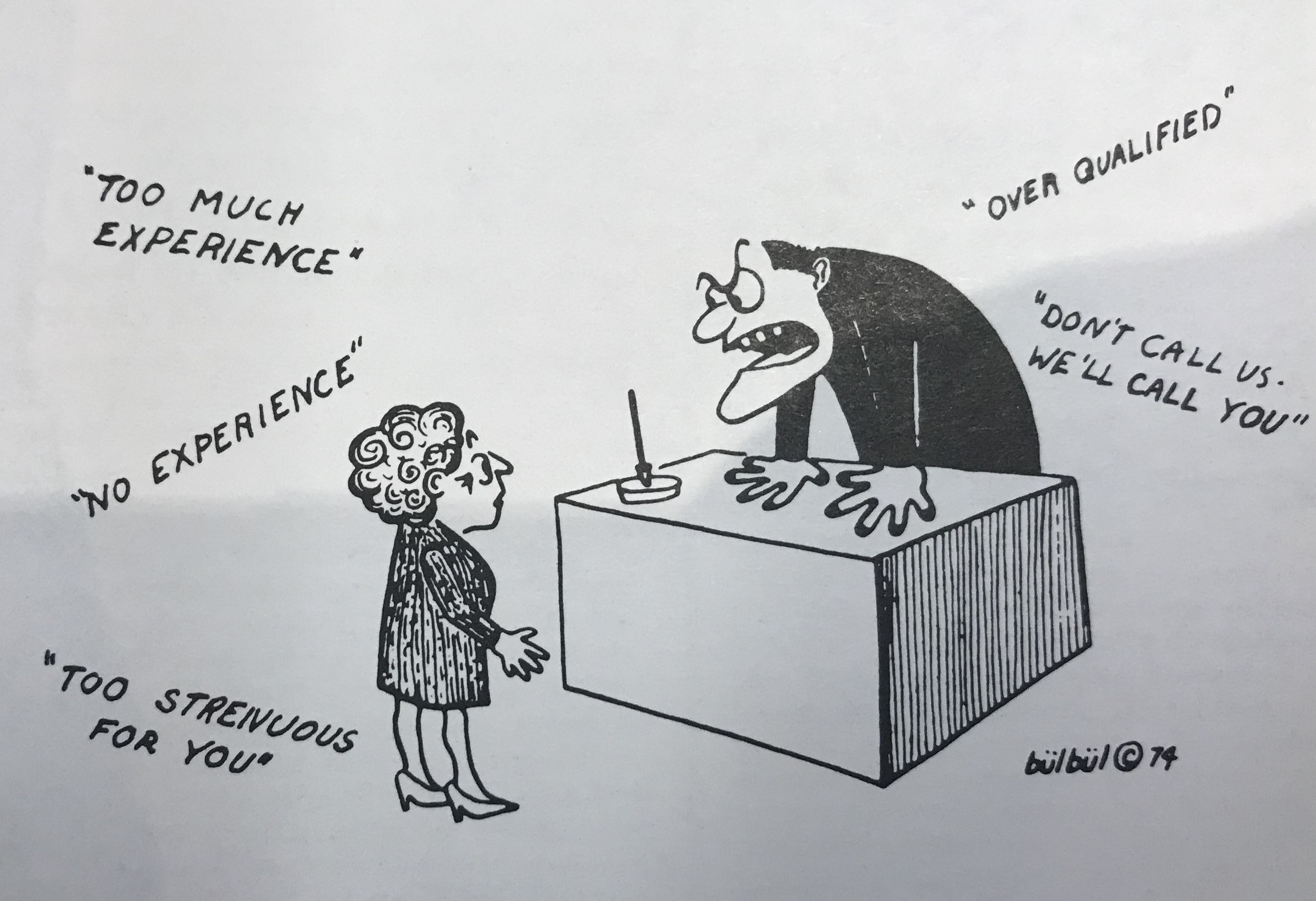
Both these cartoons display gender discrimination in the workplace and how being female can change the attitudes of employers and superiors. The cartoon from a 1958 Playboy (vol. 5, no. 10) illustrates a man sexually harassing an unamused woman with one of his fantasies. It is possible that this cartoon is critical of the man. However, both the time period and the nature of Playboy as a magazine push the idea that this cartoon is supposed to be amusing or arousing for the viewer. Unwanted sexual advances at work were only made legally actionable in 1964 under Title VII of the Civil Rights Act and this was due to lawyers and advocates convincing the American judiciary that harassment was gender discrimination in the first place (MacKinnon and Siegal, 8).

On the other hand, the cartoon from The New Woman’s Survival Sourcebook is certainly critical of the man in how he treats the woman. Rather than being humorous, the cartoon intends to express the difficulty in finding work as a woman and how employers will use convoluted reasoning to avoid hiring women. As described by Betty Friedan in The Feminine Mystique, “fewer and fewer women were entering professional work” in the 1950s to the 1970s because there was a large societal push to keep women in the home (Friedan, 46). Aided by Friedan, the Second-Wave Feminist movement in the 70s would work to challenge this push and combat sex discrimination in the workplace (Maclean, 24). Cartoons like the one from The New Woman’s Survival Sourcebook were drawn during this movement to call our attention to the inability of many men to take working women seriously. This criticism reframes the cartoon from Playboy. From a feminist viewpoint, it is the man who is now seen as unprofessional and incompetent.

Sources:

MacKinnon, Catharine A., and Reva B. Siegel. Directions in Sexual Harassment Law.          Yale University Press, 2004.

Friedan, Betty. The Feminine Mystique. Norton, 1963.

Nancy MacLean, The American Women’s Movement, 1945-2000, Bedford/St. Martin’s,        2009

Playboy, vol. 5, no. 10, HMH Publishing Co., 1958.

Grimstad, Kirsten., and Susan. Rennie. The New Woman’s Survival Sourcebook                  Edited by Kirsten Grimstad, and Susan Rennie. 1st ed., Knopf, 1975.


Posted in Lee

Power, a daydream or a reality?

Women across the nation in the early 20th century were portrayed as weak and in need of a man to swoop in and save them from themselves and the potential “harms” of working, education, and participating in other social spheres. They were sheltered in order to keep them pure and innocent. However, this instead kept them compliant to men’s every desire. They were to exist only for and through their husband and children, as Betty Friedan noted in her groundbreaking study The Feminine Mystique (Friedan, 74). Second wave feminists sought to change that, and fought to liberate women by empowering them.

A basic dictionary definition will tell you that power is the “possession of control, authority, or influence over others” (Power). Women in the 1960s and 1970s pursued power through having control and influence over themselves. This was a struggle, for it was not easy to break past the cookie cutter molds assigned to them. As Nancy MacLean notes in her introduction to the American Women’s Movement, “Collectively, their action showed that the debate was no longer over whether women should participate in public life but over how and towards what ends” (MacLean, 4-5). The power and strength it took women to free themselves from those roles liberated them from continuation in a system that treated them as fragile. Some women did this through self love and body positivity (Processes, 60). Others accomplished this by working outside the home or writing poetry. Poetry was a powerful tool for women in the second wave. “The inner lives of women came into language during that crucial decade and a half, as manifested in poems… because in the process of speaking what was hidden, we began to identify with one another as women, to become a ‘we’” (Moore, xv-xvi). Audre Lorde’s essay “Poetry Is Not A Luxury” speaks to the invaluable tool it is for women:

For women, then, poetry is not a luxury. It is a vital necessity of our existence. It forms the quality of the light within which we predicate our hopes and dreams toward survival and change, first made into language, then into idea, then into more tangible action. Poetry is the way we help give name to the nameless so it can be thought. The farthest horizons of our hopes and fears are cobbled by our poems, carved from the rock experiences of our daily lives. (Lorde, 37)

Many poets used that medium to talk about the struggles they and other women faced in everyday life.

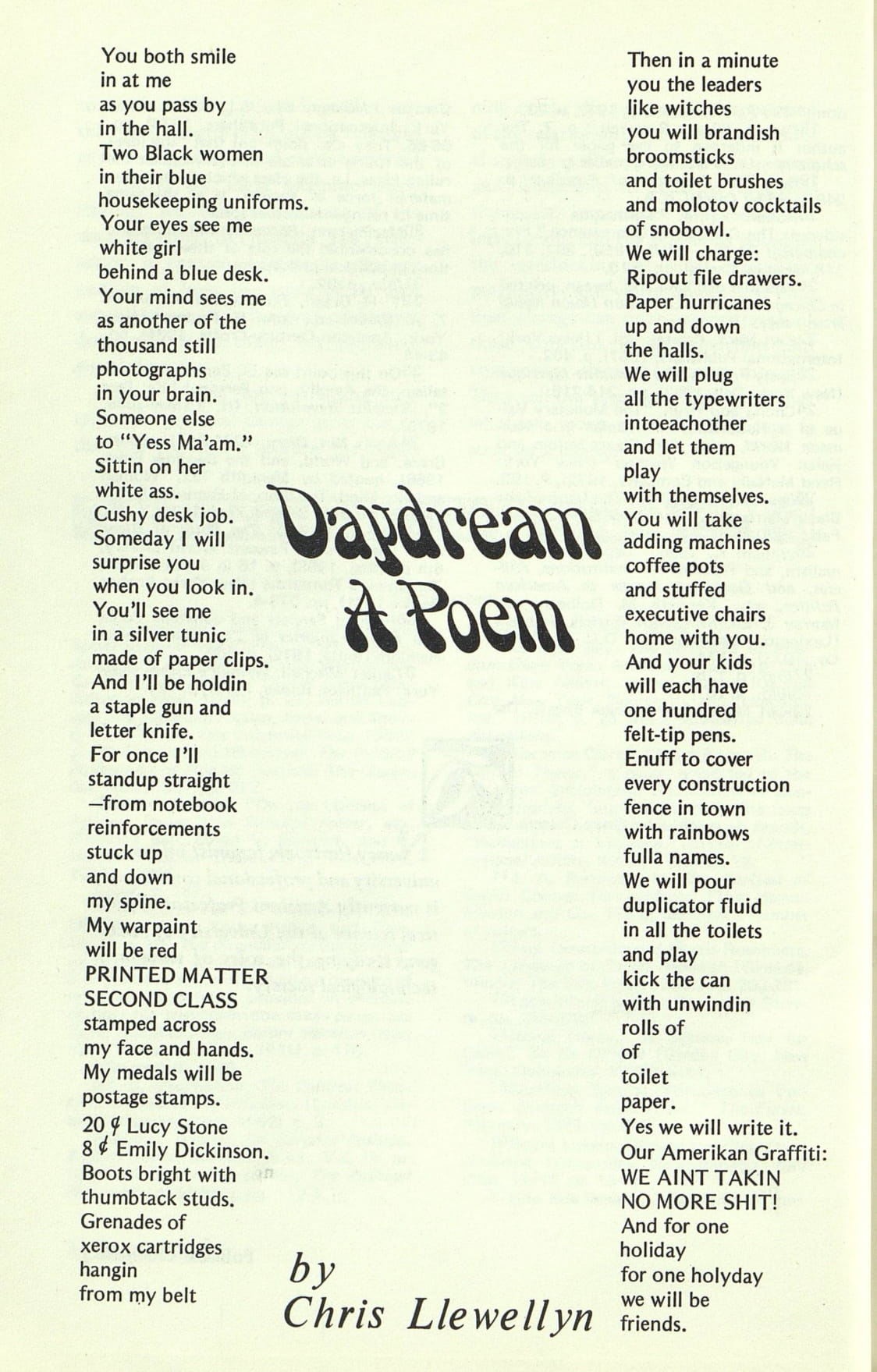
In her poem, “Daydream A Poem,” Chris Llewellyn addresses this shift by painting women as warriors, fighting for women’s rights. She begins her poem with an encounter between two housekeepers and a secretary. There is tension between the women, for the secretary is seen as someone with just a “cushy desk job.”  She continues by saying she will surprise them by becoming a warrior in lines 24-36. Throughout the poem, the three women band together in this fight. The placement of the scene in an office (specifically in the area of a desk where a secretary might sit) speaks to the types of jobs that women commonly were allowed to hold. By the end of the poem, Llewellyn seems to grow tired of this positioning of herself and other women: “Yes we will write it. / Our Amerikan Graffiti: / WE AINT TAKIN / NO MORE SHIT!” Her poem empowers the women in it, and portrays them as everything except weak. They band together to fight the injustices they face in the world.

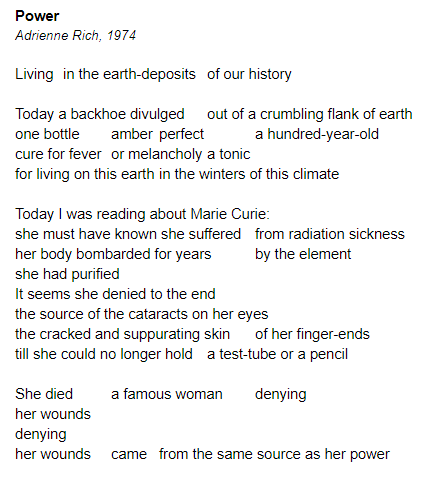
Adrienne Rich further illustrates women’s strength in her poem “Power.” Rich tells the story of Marie Curie, a scientist who conducted research on radioactivity. She was the first woman to win two Nobel Prizes for her work in both physics and chemistry. Curie risked her life to continue her research, which was the “same source as her power.” Curie’s story speaks volumes about the courage and devotion of women throughout history in their continuous pursuit of what they believe in. Rich illustrates this in lines 7-9: “she must have known she suffered from radiation sickness / her body bombarded for years by the element / she had purified.” Her word choice in this poem paints a picture of importance of Marie Curie and her accomplishments.

Coat Hangers to Clinic Doctors

Prior to 1973, nearly every state across the nation criminalized abortion except in instances to save the mother’s life. Approximately 10,000 women a year died from those laws. It was dangerous for women who sought an abortion during this time. Many could not afford one, or they obtained them illegally (MacLean, 24). Feminists during the Second Wave fought for reproductive freedom for women. The landmark court case, Roe v. Wade, overturned nationwide laws that banned abortion, and altered the definition of reproductive rights and privacy as previously understood.

In her testimony, “Hidden History: An Illegal Abortion,” Margaret Cerullo tells about her abortion experience from 1968 (Cerullo). Cerullo highlights the danger and shame from unwanted pregnancy she and other women faced during the time. Her story is one in which she had to make coded phone calls to various places in hopes they could help her. After that was unsuccessful, Cerullo found the number of a council who put her in contact with an illegal clinic in Towson, Maryland. They instructed her to bring $600 in small bills to pay for the procedure. This was a steep price for the time, equating to roughly $4,300 in value in 2018. On her way to the clinic, Cerullo stated, “For the first time, I understood something about what it meant to be a woman in this society– that the lives of women were not of value. And I realized, in an inchoate rage that is with me today as I recall this story, that in this society, because I had sex, someone thought I deserved to die” (Cerullo, 81).

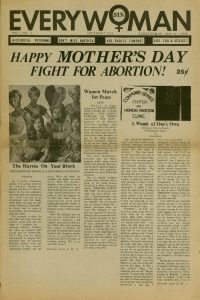
Sadly her story is not an isolated incident. Stories from women all over depict their experiences of reaching out and getting abortions. Those experiences took a significant emotional and physical toll on them. The first issue of Everywoman, a feminist periodical, contains a story similar to Margaret Cerullo’s about a girl named D and her experience in flying to California to get an abortion. The front cover of this issue calls for a “Fight for Abortion!” Many of the issues following this one contain similar messages, until the end of publication in 1972.


Supreme Court Building in Washington, D.C. Picture by McKenzie Stoker

Roe v. Wade, 410 U.S. 113, in 1973 changed the definition of reproductive privacy across the nation. In this landmark Supreme Court case, the Court held in a 7-2 decision that a woman’s right to an abortion is protected by the Fourteenth Amendment. Women were able to abort a fetus through the first trimester, and the decision set guidelines for state interests for limits in the second and third trimesters of pregnancy. This ruling overturned 46 state laws regarding reproductive privacy (United).

After the decision, women were free to choose if they wanted an abortion within the framework of the laws. That choice was no longer criminalized, and fewer women died due to unsafe abortions (Wright). While the decriminalization of abortion brought about legal and some social change, there was still a strong stigma attached to terminating a pregnancy, and women faced significant shame in doing so. Lucille Clifton’s poem, “the lost baby poem,” illustrates the difficulty of this choice. There is tension throughout the poem surrounding the choice of terminating her pregnancy. The mother thinks of her lost child with great sorrow, regret, and shame. A potential reason for undergoing an abortion is the mother’s poverty. The baby would have “been born into winter / in the year of the disconnected gas / and no car.” Without gas to heat the house in the dead of a Canadian winter and a car to get places, the mother might not have enough money to properly take care of the unborn child. Aside from a lack of money, the mother’s attention is focused on her other children, which could be another reason for terminating her pregnancy. “if i am ever less than a mountain / for your definite brothers and sisters / let the rivers pour over my head.” These three lines show the pain it took to end the pregnancy, but the mother’s difficult decision to abort the fetus would not be for nothing. She wants to be a good mother for her remaining children.


Working Housewife

Betty Friedan’s 1963 book, The Feminine Mystique, explores the idea of the “the problem that has no name” (48). Women across America felt the effects of this problem, but denied its existence or could not name it. They felt “empty somehow…incomplete” or as if they “don’t exist” (48). She explains how women were discouraged from working outside of the home after 1949. It was bad to want a career or education, because they were supposed to find life fulfillment in the domestic sphere as a “suburban housewife” (46). However, excerpts she included from domesticated women all contain an underlying theme: a feeling of emptiness, loss of personality, and incompleteness. Friedan coined this unnamed problem the “feminine mystique.” “The feminine mystique,” she explains, “says that the highest value and the only commitment for women is the fulfillment of their own femininity” (70). This was damaging to women, for they were encouraged to ignore the question of their identity in the name of a socially constructed feminine fulfillment. “Culture does not permit women to accept…their basic need to grow and fulfill their potentialities as human beings” (101).

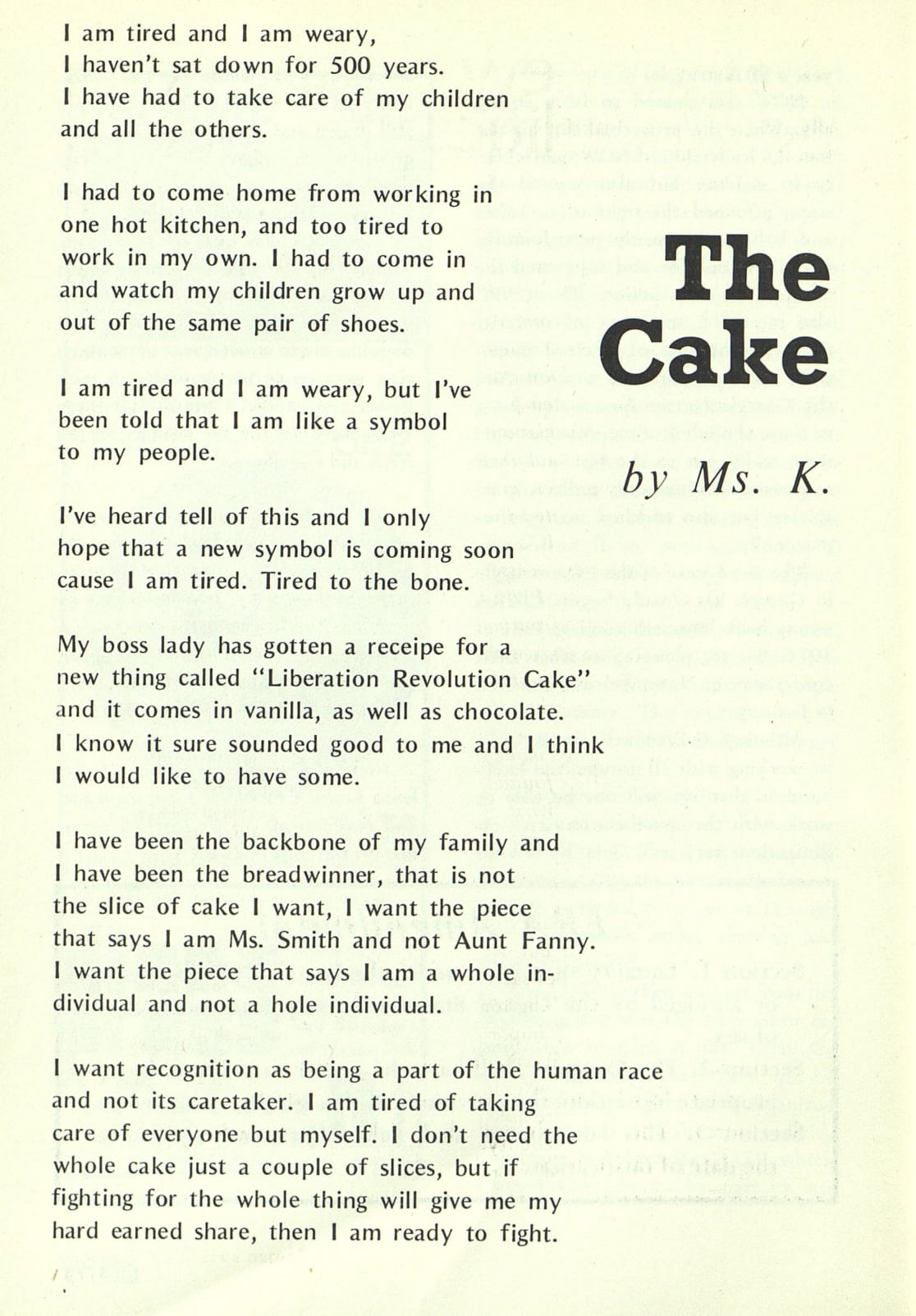
Women were expected to ignore their identity and find fulfillment in domestication. Living up to this expectation was tiring, and left women feeling incomplete and empty. Ms. K illustrates this in her poem “The Cake.” The woman in the poem is exhausted from taking care of her family and working. “I had to come home from working in / one hot kitchen, and too tired to / work in my own.” She further explains this in the seventh stanza, in which she says “I am tired of taking / care of everyone but myself.” Ms. K highlights the lack of recognition women receive for the work they do in and out of the house: “I want recognition as being a part of the human race / and not its caretaker.” Her poem calls attention to the repetitive and tiresome facade women participated in, in attempts to find feminine fulfillment.

However, culture was advancing because of the Women’s Liberation Movement. Women joined and emerged from fields previously dominated by white males. One prominent field for feminists was poetry. Women poets began publishing their work more, and many came together for poetry readings. The Poetry Foundation’s new podcast series, A Change of World, explores books, workshops, and poetry from the time to tell stories of how women formed communities during the Women’s Movement. In their episode “Shattering the Blue Velvet Chair,” Carolyn Forché discusses what she calls the Blue Velvet Chair occupied by women poets. She tells the interviewer that she came up with this label when looking at photographs of American poets. Most, if not all, the people in the photographs were white and male. If there was a woman, she would appear seated in a cushioned chair. It was her way of speaking to the tokenization of women poets during the time. However, women rejected this tokenization, and instead turned to poetry as a way to define culture outside the boundaries imposed on them.

In challenging and changing those boundaries, many women broke out of the cage of domesticity and began to fight for workplace equality. It became more acceptable for women to work and have careers, rather than solely finding fulfillment in being a housewife. This process of change in working social norms eventually led to legal protections. President John F. Kennedy signed the Equal Pay Act of 1963, which prohibited sex-based wage discrimination between men and women in the same place of work who do the same job that require the same skill, effort, and responsibility. One year later, Title VII, as part of the Civil Rights Act of 1964, was signed into law by President Lyndon B. Johnson, which prohibited employment discrimination based on race, color, religion, sex and national origin.

Sources

Cerullo, Margaret. “Hidden History: An Illegal Abortion,” 1968, The American Women’s Movement, 1945-2000: A Brief History with Documents, Ed. Nancy MacLean, Bedford/St. Martin’s, 2009, pp. 79-81, 2009.

Clifton, Lucille. “the lost baby poem.” Poems from the Women’s Movement, Ed. Honor Moore, Library of America, 2009, p. 35.

Friedan, Betty. The Feminine Mystique. W. W. Norton & Company, 1997, ch. 1-4.

Lorde, Audre. “Poetry Is Not A Luxury.” Sister Outsider, Crossing Press, 1984, pp. 36-39.

MacLean, Nancy. The American Women’s Movement, 1945-2000: A Brief History with Documents. Bedford/St. Martin’s, 2009.

“Money, Fame, and Power.” Quest: A Feminist Quarterly, vol. 1, no. 2, Diana Press, 1974, p. 74.

Moore, Honor, editor. Poems form the Women’s Movement, Library of America, 2009, pp. xv-xvi.

“Power.” Merriam-Webster Dictionary, https://www.merriam-webster.com/dictionary/power. Accessed 10 Dec. 2018.

“Processes of Change.” Quest: A Feminist Quarterly, vol. 1, no. 1, Diana Press, 1974, pp. 2-9, 26, 58-64.

“Shattering the Blue Velvet Chair.” A Change of World: Episode 3 from the Poetry Foundation, 20 Mar. 2018, www.poetryfoundation.org/podcasts/143653/shattering-the-blue-velvet-chair. Accessed 10 Dec. 2018.

Rich, Adrienne. “Power.” The Dream of a Common Language, W. W. Norton & Company, 1978, p. 3.

United States, Supreme Court. Roe v. Wade. United States Reports, vol. 410, 22 Jan. 1973, pp. 113-78. Library of Congress, https://www.loc.gov/item/usrep410113/. Accessed 10 Dec. 2018.

Wright, Jennifer. “How Roe v. Wade has saved women’s lives.” New York Post, 6 July 2018, https://nypost.com/2018/07/06/how-roe-v-wade-has-saved-womens-lives/. Accessed 10 Dec. 2018.

Uncorrected Page Proofs of “Half-Lives” and “Fear of Flying”

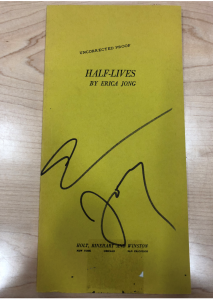
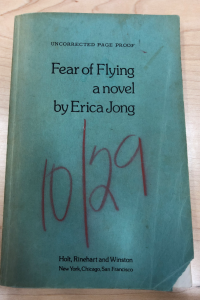
Before the 1973 publishing of Erica Jong’s novel Fear of Flying and her poetry book Half-Lives, editors and reviewers worked through Jong’s uncorrected proofs to ensure correctness and to pose literary criticisms before the works’ publication. Though the notes throughout each work vary, the meanings behind each marginal note remain poignant and interesting when compared to the published work.

In the Half-Lives proof, there are no notes or edits. The only time a pen seems to have touched the paper is to add page numbers. This absence is interesting within itself, as it leaves Jong’s poetic ideas untouched. This reviewer did not take it upon themselves to criticize Jong’s poetry, or make their own remarks surrounding the work. This reader wanted to leave Jong’s work as it was, without the remarks or criticisms of an outside reader.

In the proof of Fear of Flying, however, is the exact opposite. All over the novel are black and red underlinings, as well as one-word notes including “ego-centric” and “over-written.” These small edits and criticisms shed light on the reviewer’s opinions of Jong’s work as well as their purpose in reading the work. The reviewer of the Fear of Flying proof was Terry Stokes, a writer for The New York Times who was charged with writing a review of Jong’s debut novel. Though he seems to think some things are writerly “excess,” the most resounding aspect of his marginal additions is the sheer number of underlines and stars next to passages he finds important for his article. His comments also beg certain questions from onlookers: are Stokes’ comments excessive and if so, why? Is he overly critical of Jong’s work because of its blunt addressing of female sexual fantasy, or does he believe that Jong was gratuitously over-descriptive?

Sources:

Jong, Erica. Fear of Flying. Holt, Reinhart, and Winston Publishers, 1973.

Jong, Erica. Half-Lives. Holt, Reinhart, and Winston Publishers, 1973.