Works Cited

Works Cited

Aukin, Liane. “The Jewish Feminist Woman.” Shifra, vol. 1, no. 1, Dec. 1984.

The Current. Spring 2018, www.columbia-current.org/
queering-her-yiddish-world.html. Accessed 10 Dec. 2019.

Elwell, Ellen Sue Levi, and Edward R. Levenson. The Jewish Women’s Studies Guide. Fresh Meadows, Biblio Press, 1982.

Falk, Marcia. “Mother Nature and Human Nature: The Poetry of ‘Malka Heifetz Tussman.'” JAP Baiting on Campus, edited by Susan Weidman Schneider, special issue of Lilith, no. 17, Fall 1987.

Klepfisz, Irena, and Melanie Kaye/Kantrowitz, editors. The Tribe of Dina. Boston, Beacon Press, 1986.

Koltun, Elizabeth. The Jewish Woman: New Perspectives. New York, Schocken Books, 1976.

Lerner, Anne Lapidus. “Lilith Magazine.” Jewish Women: A Comprehensive Historical Encyclopedia. Jewish Women’s Archive, 27 Feb. 2009, jwa.org/encyclopedia/article/lilith-magazine. Accessed 24 Nov. 2019.

Rubenstein, Judith Allen. “The Graffiti Wars.” JAP Baiting on Campus, edited by Susan Weidman Schneider, special issue of Lilith, no. 17, Fall 1987.

The Fat Underground and the Fat Liberation Manifesto

Women truly come in all different shapes and sizes, and consequently feminism should as well. This is why when mainstream feminism failed to include women of all sizes, there were women who came to fill in the gap through activism with groups like the Fat Underground.

The Fat Underground was an organization that acted as a catalyst in the creation and mobilization of the Fat Liberation movement. Based in LA in the 1970s, the Fat Underground did not fight to change discriminatory laws but rather discriminatory thoughts and practices in different aspects of society. These discriminatory practices included those of doctors and other health professionals who perpetuated the unhealthy habits encouraged by diet culture. This approach to reform the health profession stems from the Fat Underground’s roots in the Radical Therapy movement, which sought to reform the mental health profession. According to the rhetoric of the Radical Therapy movement, people with mental illness were not to host the burden of changing themselves. We are instead supposed to change the stigma surrounding mental health. This “change society, not ourselves” ideology was the foundation for much of the activism in the Fat Liberation movement.
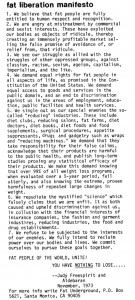
With the idea to reform society and not themselves, the Fat Underground utlized this rhetoric: “Doctors are the enemy. Weight loss is genocide” (Fishman). While colleagues and counterparts in academia and others in the early fat rights movement found this rhetoric harsh and urged the Fat Underground to be less aggressive, they ultimately came to adopt much of the Fat Underground’s logic in their respective fields.
In November 1973, Judy Freespirit and Aldebran published the “Fat Liberation Manifesto” on behalf of the Fat Underground. A manifesto is a written statement declaring publicly the intentions and views of who issued it. In this case, the manifesto outlines the ambitions and views of the Fat Underground, who takes the liberty of speaking on behalf of all fat people. Judy Freespirit and Aldebaran, pioneering members of the Fat Underground, designed these seven points to solidify the desires of the Fat Liberation movement and ended with a call to action. The manifesto first establishes that fat people are entitled to what they were denied on a daily basis: “human respect and recognition.” The other objectives then outline the commercial exploitation of fat bodies by both corporations and scientific institutions. This manifesto marked a key point in the Fat Liberation movement because it is one of the first times there was a public call for unification of fat women and fat people under one common purpose. The rhetoric dictated in this manifesto set the tone for the movement.

Sources: Bracha Fishman, Sarah Golda, “Life in the Fat Underground.” Radiance Magazine Online, http://www.radiancemagazine.com/issues/1998/winter_98/fat_underground.html

Freespirit, Judy, and Aldebaran. “Fat Liberation Manifesto.” Off Our Backs, vol. 9, no. 4, 1979, pp. 18–18. JSTOR, JSTOR, www.jstor.org/stable/25773035.

Sinister Wisdom

Sinister Wisdom is a lesbian feminist quarterly that was founded in 1976 by Catherine Nicholson and Harriet Ellenberger with two burning questions in mind: “How does a woman survive when she steps out from the death process of patriarchy?” and “How does she think without thinking ‘their’ thoughts, dreaming ‘their’ dreams, repeating ‘their’ patterns?” (SinisterWisdom.org). These are questions that were not being answered in popular publications at the time due to the lack of diversity in the world of publishing. So, like many periodicals of the time, Sinister Wisdom was born out of the desire to diversify. However, unlike many of its contemporaries, the founders of Sinister Wisdom strived for diversity beyond gender and created a periodical specifically for lesbian feminists. 

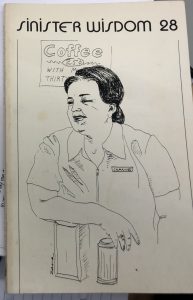
Founded with these values in mind, Sinister Wisdom is also dedicated to representing the diversity within the lesbian community. Sinister Wisdom has been publishing thematic issues in the pursuit of intersectionality since its second issue, which had a focus on Lesbian writing and publishing. Other issues with highlights on specific demographics include Issue 39: “On Disability,” Issue 45: “Lesbians & Class,” and Issue 54: “Lesbians and Religion” Some issues featured works by activists in the fat liberation movement, such as Elana Dykewomon who later was the editor from 1987-1994. Issue 28, pictured here, has a special focus on fatness and body image as well women in the workplace.
The cover art depicts a sketch of a fat woman, presumably a classic working woman at a diner. There is more art centered around fat women that unashamedly depicts their bodies throughout the issue. Depiction of fat women as the subject of these art pieces is uncommon in popular and mainstream art so its placement in this magazine is important because it is representation for fat women in a form of media that often denies them visibility.

Along with the art, there are several poems and essays surrounding the fat body and body image issues but there was one article in particular that connected specifically with the Fat Liberation Movement. It is a thought piece by Susanna J. Sturgis on a question she overheard at one of Elana Dykewomon’s readings: “Is this the new thing we have to be politically correct about?” The “thing” she is referring to is Fat Liberation and the discrimination fat women face. In this question, the unnamed woman who sat near Sturgis trivialized the everyday struggles fat women have to deal with. She, like many other mainstream feminists, dismissed the movement, making her complicit in their oppression. Out of this dismissiveness arose a movement of fat women to validate themselves independently of the opinion of their thinner counterparts.

Source: “History.” Sinister Wisdom: A Multicultural Lesbian Literary & Art Journal, http://www.sinisterwisdom.org/node/2

Sturgis, Susanna J., “Is this the new thing we have to be politically correct about?” Sinister Wisdom, Issue 28, p.16-26


“Who did that to us?: Fat Women’s Self-Perception

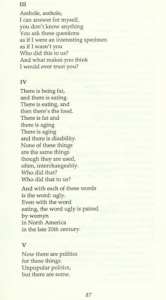
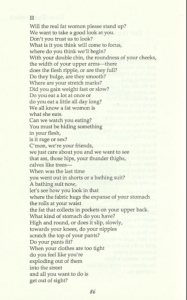
Published in Issue 33 of Sinister Wisdom, this 11-section poem by Elana Dykewomon, who employs the feminist tactic of using “womon” as opposed to woman to imply women are not a derivative of man, creates an honest portrayal of a fat woman’s internal struggles to negotiate their perception of themself with that of society. This struggle can be seen with the repetition of questions such as “who did that to us?,” which is a question posed in sections III and IV as well as other sections through the poem.

Section II of this poem has an invasive tone as the narrator probes “the real fat womon” with intrusive questions (line 34). Many of the questions are personal questions about the woman’s body. The invasiveness of the questions is poorly hidden under the guise of a caring friend, implying that friendship entitles someone to ask probing questions to exoticize and marvel at someone’s body like they are some kind of exhibit. The poem ends with a climactic question: When your clothes are too tight / do you feel like you’re / exploding out of them / into the street / and all you want to do is / get out of sight” (lines 70-74)? This explosive question portrays an unfiltered version of what the “friends” really want to know about the fat woman.  They are probing for her shame, at least the shame they believe her to have.

Section III is seemingly a response to the questions asked in section II. In a switch of perspectives, the narrator begins by calling the “friends,” who asked the questions earlier, assholes. The narrator clearly picks up on the mal-intent of the inquiries and indicates that the questions asked of her be posed “as if [she] were an interesting specimen” rather than another human being (line 79). This illuminates how society was dehumanizing fat women.
Section IV of Dykewomon’s poem mentions several aspects of life that people view as things that lessen the value of women such as fatness, disability, and aging.  The narrator then goes on t0 acknowledge how all of these things are conflated and equated with ugliness. The narrator again asks “Who did that to us?” Who has made women hate themselves and other women with such fervor? This is a question Fat Liberation strived to answer. 

Sources: Dykewomon, Elana. “the real fat womon poems” Sinister Wisdom, Issue 33, 1987, p. 86-87

The Fat Black Woman Remembers by Grace Nichols

While the majority of the members of the Fat Underground were white and most of the information found on the Fat Liberation movement is centered on white women, this does not mean the movement was exclusive. Fat women of color also struggled to find their voice in mainstream second wave feminism. They too used poetry as liberation.


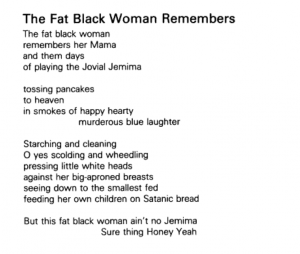
In her 1984 book “The Fat Black Woman’s Poems,” Guyanese-born poet Grace Nichols presents the fat black woman’s body as an object of divinity despite the demonization and fetishization of black bodies. The poem, “The Fat Black Woman Remembers,” is from this poetry anthology and calls upon a stereotype of fat black women: the Aunt Jemima. The image of Aunt Jemima is a caricature that is based in the mammy archetype used in minstrel shows during and after American slavery. Nichols acknowledges the origin of the Jemima stereotype when mentioning that “the Jovial Jemima” pressed “little white heads/ against her big aproned breasts” alluding to the childcare services of a fat female slave due to her assumed matronliness (lines 4, 11-12). This legacy of slavery and oppression shapes the way black women were viewed based on their weight in a way that does not affect women of other races and Nichols uses her poetry to illuminate this fact.

Source: Nichols, Grace. “From ‘The Fat Black Woman’s Poems’.” Ambit, no. 97, 1984, pp. 2–6. JSTOR, JSTOR, www.jstor.org/stable/44339778.

Why socialism was able to not fail in advertising

I sincerely encourage PhD candidates to try to understand and sincerely answer this question of how using socialism fared in a predominantly capitalist society for articulating change. 

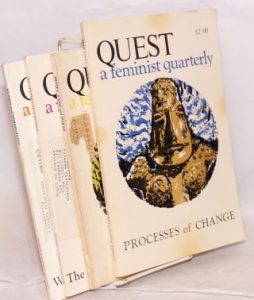
The reason the socialist message was effectively communicated through a periodical such as Quest, a feminist periodical, was due to the reader base of the periodical. What does that mean, a reader base? Well when I consider what a typical Playboy reader looks like I imagine a white man who works some white collar job.  The advertisements in Playboy would make sense for this type of reader base: golf clubs, liquor, cigarettes, naked women scattered through all of the pages- that seems reasonable for white men. When I consider what a Quest reader looks like I imagine a woman (not necessarily white!, and it could be a man who identifies as an ally!) who is trying to further their role for social change and consciousness. Once again, these advertisements in Quest and Conditions make sense: the advertisements they used were on poetry about women, writings on black women in the south, writings on women in prison, writings on socialism, etc. 


The fundamental difference in these advertisements is based in their materialistic value. For a Playboy reader a golf club that is being advertised might be worth every penny and some poetry might be worth nothing to them. For a Conditions reader a book of poems may be worth every penny to them and the golf clubs nothing. While both of these objects may be bought for their advertised price, I argue that because the feminist base is supporting a movement bigger than themselves, they are willing to buy goods and services even if they can’t maximize their utility as consumers. Simply put, if a man didn’t think they would enjoy a round of golf, they probably wouldn’t buy the golf clubs. However, I believe that the feminist base is more likely to buy publications that they aren’t necessarily excited about because they know that their financial contribution makes a lasting impact for a movement they want to see succeed. 

More simply, this means that if golf clubs are being sold for $50 and you are willing to pay $50 because you value them at that price- you buy them. If they cost more than your willingness to pay then you forgo buying them. However, if you’re a feminist and you see that a book of poems that are being sold for $3.50, your willingness to pay may be higher than normal because you are investing into something that has social impact and is aligned with your values.

So how did socialist advertisement effectively communicate their message and not go bankrupt in a capitalist environment? They had readers like Jan Clausen who wanted to make a social impact and pay more than what might be considered normal when compared to Playboy consumers. ?

Quest on a quest


In the 1975 winter edition of Quest, there is an advertisement for Working Papers, a radical left wing publication that advocates for fighting injustices and representing underrepresented voices. It just so happens that in 1976, Working Papers released the following image that is on this post. With the summer 1976 release of Working Papers, the cover reads, “Socialism in One City.” It is clear that while Quest did not advertise exclusively for socialism, they are advertising a publication that is willing to fight and advertise for it.

Just to try and digest the timeline: first comes the Cosmopolitan cigarette advertisement, second comes Jan Clausen with Nellie Wong’s socialist poetry, and thirdly another example of socialist advertisements with Working Papers. At the moment, it’s just a list. What I hope to show with this evolving timeline is that so far, there is an immense difference in substance and theme between mainstream publications and feminist publications. The inclusion of Working Papers works in the same dynamic in which Jan Clausen’s kind words do for Nellie Wong; both instances of inclusion foster support for how a non-capitalistic structured publication can viably function without going bankrupt- the support from dedicated readers!

Jan Clausen is a dedicated reader and supporter of Quest and the second wave of feminism respectively. Her analysis of Wong’s work serves as an advertisement for Quest readers to buy like minded work from a like minded individual. When you consider big alcohol and cigarette companies that advertise in Cosmopolitan and Playboy, as seen from their actions, they are going to advertise what can make them the most money from the biggest spending companies. We don’t know what they stand for. Do they stand for nice golf clubs and extravagant alcohols? Can you even stand for that?  Feminist publishers are making an extremely clear and conscious effort to advertise products that only reflect the message they are trying to share with the world. The readers can see that Quest cares about underrepresented voices in the community. And when you look at what is being advertised by Quest their advertisements deal with underrepresented voices such as black women in prison, women with mental illness, women in high education, etc- the advertisements are perfectly aligned with the greater message of Quest. The same cannot be said for Playboy or Cosmopolitan, when the reader sees advertisements that are from the biggest companies trying to sell products that are detrimental to the health of the user: cigarettes, alcohol, etc, the greater message of the mainstream publications become confusing. What seems clear is that the mainstream publications are advertising whatever will make them the most amount of money and feminist periodicals are not willing to stoop that low to make ends meet. 

 So if this assumption is fair to stand by that big name companies gave more money than small feminist poetry books, how did feminist publications stay in business if they decided to stay away from capitalist money and rely on other feminist writers to finance their periodicals? 

Jan Clausen and Nellie Wong working in tandem

Image


(Jan Clausen)

In Conditions: Four, Jan Clausen gives a supportive analysis of Nellie Wong’s book, Dreams in Harrison Railroad Park. There are a few things going on with this. Firstly, Clausen is not only advertising for a book, she is actively promoting the larger message that is being articulated within Conditions- support of feminism. Secondly, and most important for me, Clausen is introducing a poet within a feminist periodical. This second point is important because socialist rhetoric was running vividly through feminist periodicals, but the poetry in support for socialism was hard to come by. With the introduction to Nellie Wong by Jan Clausen, the gap between socialist poetry and periodicals closed!  

It is clear that mainstream advertisements consist of tobacco, alcohol, and other male products such as suits and golf clubs. From Nellie Wong’s book it is clear that the feminist advertisements are geared not only for women but people that want to try and enact change. This could be men who identify as allies of the movement, or just your typical audience base for feminist work- women. 


An Unlikely Start: Playboy?

Strangely enough my project does not start with feminist work, it starts with Playboy and Cosmopolitan. When reading and looking through dozens of feminist works for our class, I found advertisements in these magazines that seemed pretty standard such as alcohol, cigarettes, life insurance, clothing, etc.  When I open a magazine these are the types of advertisements I expect to see, advertisements that are driven by capitalism and materialism.

When I opened up feminist periodicals such as Quest, Heresies, and Conditions, the advertisements were so non-capitalistic it was concerning.  The advertisements were concerning in the sense that everything that was mainstream and normal (cigarettes, alcohol, etc) could not be found. All of the advertisements I saw in feminist periodicals were exclusively in support of feminist work; these advertisements furthered the message that was being articulated within the periodical. There were no cigarettes, alcohol, or images of big breasted women with golf clubs. Through this post I want to compare mainstream advertisements (Playboy and Cosmopolitan) and feminist advertisements (Quest, Heresies, and Conditions) and try to understand why they might be different. 


Selected Poems of Anne Sexton, ‘Her Kind’

Unlike Lorde’s “Fantasy and Conversation,” Anne Sexton’s “Her Kind” directly confronts the image of the vilified witch. When listening to the live reading of “Her Kind,” the listener no longer hears an esteemed poet but is transported to a forest, sequestered by looming trees. In their wake, witches gather, singing incantations to transmogrify their world. Here, in this space, Sexton endeavors to show us that these are not mere women, but beings able to control forces of nature that so many fail to understand.

Throughout the poem, Sexton explores different figures that have been shunned by patriarchal society: the witch, a lonely old hag, and a woman on her way to her execution. The first stanza highlights typical deviant behaviors of witches, such as “haunting the black air” (18) or “dreaming evil” (18). While radical feminists attempt to reclaim the image of the witch and expel the negative stereotypes surrounding her, Sexton reinforces the mystical powers that so many feared. By doing so, she utilizes that fear and creates a kinship with those who feel misunderstood, the women who “[are] not wom[en] quite” (18). With Sexton claiming these negative images of women, she turns these stereotypes into something that feminists can use for their own gain. “I have been her kind” is woven throughout the poem, thus reclaiming the idea of the witch, and entreating others to do the same.

Source: Middlebrook, Diane Wood, editor. “Her Kind.” Selected Poems of Anne Sexton, by Anne Sexton, Houghton Mifflin, 1988, p. 18

American Poetry Archives. Anne Sexton Reads ‘Her Kind’ 1960. YouTube, YouTube, 19 February 2012, www.youtube.com/watch?v=btz8RZHSQ2Q.