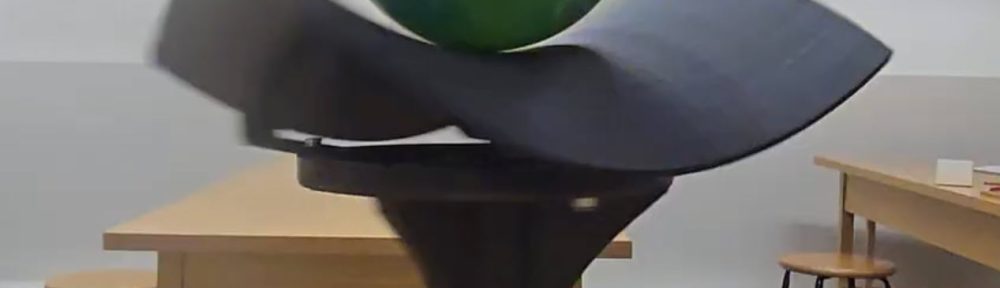

A still photo from a video of a sweeping hyperbolic paraboloid with a ball resting right at its unstable center. Photo courtesy of Brough Morris.
At first glance, the shape looks like a saddle, a sweeping hyperbolic paraboloid with a ball resting right at its unstable center. Under normal conditions, gravity would quickly win, sending the ball rolling away. But the magic begins when the surface rotates. Suddenly, what was once unstable becomes stable: the ball lingers at the top, as though defying gravity. This simple but mesmerizing demonstration is more than a parlor trick. It’s a tangible, mechanical analogy for a Paul Trap, a device used in quantum mechanics experiments to confine ions and electrons with oscillating electric fields.
The idea to bring this demonstration to Williams College originated in conversations with Professor Fred Strauch, who saw its potential for enriching the department’s Quantum Mechanics (PY301) course. Project owner Brough Morris, Instructional Support Specialist for Physics and Astronomy, and Makerspace student worker Alice Sore ‘27 took on the task of designing a version that could withstand repeated classroom use. Their challenge was to improve on an earlier fiberglass prototype, which only managed to keep the ball stable for about five seconds before imperfections in the surface or misalignment caused it to fail.

This photo displays the hyperbolic paraboloid (connected to a base with rotational motor) that the Makerspace 3D printed. Unlike fiberglass models, this included smooth curves and precise geometry and no bumps. The Makerspace has the largest 3D-printer beds on campus.
A 3D-printed model offered a promising solution. Unlike fiberglass, which introduced bumps and inconsistencies, 3D printing could produce smoother curves and more precise geometry. Brough designed the surface to be as wide as possible while still fitting in the Makerspace printer’s build area, which was larger than any other printer available on campus. Multiple design iterations in CAD ensured that the final geometry struck the right balance, shallow enough to reduce instability, but still faithful to the physics of a Paul Trap. Rigidity was also essential: any flexing or vibration in the surface during rotation would send the ball off course. To get the balance right, Brough consulted with Jason Mativi, Senior Science Center Shop Engineer, about print density and material strength, ensuring the final model would be both stable and durable.
The fabrication process involved careful modeling of the hyperbolic paraboloid in CAD. Once the paraboloid was printed and mounted on a rotating base, the demonstration came to life. Smooth, precise, and stable, the 3D-printed saddle surpassed the earlier fiberglass attempt, holding the ball far longer (see video) and illustrating the physics concept in a way that is both intuitive and unforgettable.
A critical addition to this setup is the custom control box that Brough and Kevin Forkey, Lab Supervisor and Lecturer in Physics, built to regulate the motor speed. The experiment only works in a narrow frequency range, around 100 rpm. A little too fast or too slow and the ball will slowly drift away from the center before eventually flying off. At the correct speed, though, the ball doesn’t just sit precariously balanced, it truly stabilizes. If nudged slightly, it self-corrects and returns to the center. This visual proof of a dynamically stable equilibrium makes the analogy to the Paul Trap even more compelling.

Another photo of the hyperbolic paraboloid printed by the Makerspace.
The project draws inspiration from a similar setup at Harvard, but with a Williams Makerspace twist. The collaboration between Brough and Alice highlights how a mix of creativity, technical skill, and persistence can transform abstract concepts into hands-on learning tools. By June 2025, the hyperbolic paraboloid demonstration will be ready for classroom use, giving physics students a chance to see, not just imagine, how stability can emerge from instability. With the wires cleaned up and the motor properly mounted, the demonstration is now classroom-ready and will be used in Quantum Mechanics (PY301) starting June 2025.
What makes this project exciting is not only the final product but what it represents, the blending of mathematical surfaces, modern fabrication techniques, and physics pedagogy. In the classroom, the spinning saddle offers more than a visual spectacle. It anchors a difficult idea: the dynamic stabilization of particles in a Paul Trap in an experience that students can watch unfold before their eyes. It’s proof that sometimes, the best way to teach quantum mechanics is to let a ball roll across a 3D-printed saddle and show that, with the right motion, even instability can be tamed.