To the Political Ontologists

The political ontologists have their work cut out for them. Let’s say you believe that the entire world is made out of fire: Your elms and alders are fed by the sky’s titanic cinder; your belly is a metabolic furnace; your lungs draw in the pyric aether; the air that hugs the earth is a slow flame—a blanket of chafing-dish Sterno—shirring exposed bumpers and cast iron fences; water itself is a mingling of fire air with burning air. The cosmos is ablaze. The question is: How are you going to derive a political program from this insight, and in what sense could that program be a politics of fire? How, that is, are you going to get from your ontology to your political proposals? For if fire is not just a political good, but is in fact the very stuff of existence, the world’s primal and universal substance, then it need be neither produced nor safeguarded. No merely human arrangement—no parliament, no international treaty, no tax policy—could dislodge it from its primacy. It will no longer make sense to describe yourself as a partisan of fire, since you cannot be said to defend something that was never in danger, and you cannot be said to promote something that is everywhere already present. Your ontology, in other words, has already precluded the possibility that fire is a choice or that it is available only in certain political frameworks. This is the fate of all political ontologies: The philosophy of all-being ends up canceling the politics to which it is only superficially attached. The –ology swallows its adjective.

The task, then, when reading the radical ontologists—the Spinozists, the Left Heideggerians, the speculative realists—is to figure out how they think they can get politics back into their systems; to determine by which particular awkwardness they will make room for politics amidst the spissitudes of being. In its structure, this problem repeats an old theological question, which the political ontologists have merely dressed in lay clothes—the question, that is, of whether we are needed by God or the gods. If you have given in to the pressure to subscribe to an ontology, then this is the first question you should ask: Whatever is at the center of your ontology—does it need you? Does Becoming need you? Is Being incomplete without you? Has the cosmic fire deputized you? And if you decide that, no, the fire does not need you—if, that is, you resist the temptation to appoint yourself that astounding entity upon which even the Absolute depends—then you will have yourself already concluded that there is nothing exactly to be gained from getting your ontology right, and you will be free to think about other and more interesting things.

If, on the other hand, you are determined to ontologize, and determined additionally that your ontology yield a politics, there are, roughly speaking, three ways you can make this happen.

First, you could determine that even though fire is the primal stuff of the universe, it is nonetheless unevenly distributed across it; or that the cosmos’s seemingly discrete objects embody fire to greater and lesser degrees. The heavy-gauge universalism of your ontology will prevent you from saying outright that water isn’t fire, but you might conclude all the same that it isn’t very good fire. This, in turn, would allow you to start drawing up league tables, the way that eighteenth-century vitalists, convinced that the whole world was alive, nonetheless distinguished between vita maxima and vita minima. And if you possess ontological rankings of this kind, you should be able to set some political priorities on their basis, finding ways to reward the objects (and people? and groups?) that carry their fiery qualities close to the surface, corona-like, and, equally, to punish those objects and people who burn but slowly and in secret. You might even decide that it is your vocation to help the world’s minimally fiery things—trout ponds, shale—become more like its maximally fiery things—volcanoes, oil-drum barbecue pits. The pyro-Hegelian takes it upon himself to convert the world to fire one timber-framed building at a time.

Alternately—and herewith a second possibility—you can proclaim that the cosmos is made of fire, but then attribute to humanity an appalling power not to know this. “Power” is the important word here, since the worry would have to be that human ignorance on this point could become so profound that it would damage or dampen the world-flame itself. Perhaps you have concluded that fire is not like an ordinary object. We know in some approximate and unconsidered way what it is; we are around it every day, walking in its noontide light, enlisting it to pop our corn, conjuring it from our very pockets with a roll of the thumb or knuckly pivot. And yet we don’t really understand the blaze; we certainly do not grasp its primacy or fathom the ways we are called upon to be its Tenders. You might even have discovered that we are the only beings, the only guttering flames in a universe of flame, capable of defying the fire, proofing the world against it, rebuilding the burning earth in gypsum and asbestos, perversely retarding what we have been given to accelerate. This argument expresses clear misgivings about humanity; it doesn’t trust us to keep the fire stoked; and to that extent it partakes of the anti-humanism that is all but obligatory among political ontologists. And yet it shares with humanism the latter’s sense that human beings are singular, a species apart, the only beings in existence capable of living at odds with the cosmos, capable, that is, of some fundamental ontological misalignment, and this to a degree that could actually abrogate an ontology’s most basic guarantees. From a rigorously anti-humanist perspective, this position could easily seem like a lapse—the residue of the very anthropocentrism that one is pledged to overcome—but it is in fact the most obvious opening for an anti-humanist politics (as opposed, say, to an anti-humanist credo), since you really only get a politics once the creedal guarantees have been lifted. If human beings are capable of forgetting the fire, someone will have to call to remind them. Someone, indeed, will have to ward off the ontological catastrophe—the impossible-but-somehow-still-really-happening nihilation of the fire—the Dousing.

That said, a non-catastrophic version of this last position is also possible, though its politics will be accordingly duller. Maybe duller is even a good thing. Such, at any rate, is the third pathway to a political ontology: You might consider arguments about being politically germane even if you don’t think that humanity’s metaphysical obtuseness can rend the very tissue of existence. You don’t have to say that we are damaging the cosmic fire; it will be enough to say that we are damaging ourselves, though having said that, you are going to have to stop trying to out-anti-humanize your peers. Your position will now be that not knowing the truth about the fire-world deforms our policies; that if we mistake the cosmos for something other than flame, we are likely to attempt impossible feats—its cooling; its petrification—and will then grow resentful when these inevitably fail. You might, in the same vein, determine that there are entire institutions dedicated to broadcasting the false ontologies that underwrite such doomed projects, doctrines of air and doxologies of stone, and you might think it best if such institutions were dismantled. If it’s politics we’re talking about, you might even have plans for their dismantling. Even so, you will have concluded by this point that the problem is in its essentials one of belief—the problem is simply that some people believe in water—in which case, ontology isn’t actually at issue, since nothing can happen ontologically; the fire will crackle on regardless of what we think of it, indifferent to our denials and our elemental philandering. You have thus gotten the politics you asked for, but only having in a certain sense bracketed the ontology or placed it beyond political review. And your political program will accordingly be rather modest: a new framework of conviction—a clarification—an illumination.

Still, even a modest politics sometimes shows its teeth. William Connolly, in a book published in 2011, says that the world-fire is burning hotter than it has ever burnt; the problem is, though, that some “territories … resist” the flame. What we don’t want to miss is the basically militarized language of that claim: “resisting territories” suggests backwaters full of ontological rednecks; Protestant Austrian provinces; the Pyrenees under Napoleon; Anbar. Connolly’s notion is that these districts will need to be enlightened and perhaps even pacified, whereupon political ontology outs itself as just another program of philosophical modernization, a mopping up operation, the People of the Fire’s concluding offensive against the People of the Ice. Don’t fight it, Connolly, in this way, too, an irenicist, instructs the existentially retrograde. Let it burn.

The all-important point, then, is that there is absolutely no reason to get hung up on the word “fire,” in the sense that there is no more sophisticated concept you can put in its place that will make these problems go away: not Being, not Becoming, not Contingency, not Life, not Matter, not Living Matter. Go ahead: Choose your ontological term or totem and mad-lib it back into the last six paragraphs.  Nothing else about them will change.

• • •

Anyone wanting to read Connolly’s World of Becoming, or Jane Bennett’s Vibrant Matter, its companion piece, also from 2011, now has some questions they can ask. The two books share a program:

-to survey theories of chaos, complexity; to repeat the pronouncements of Belgian chemists who declare the end of determinism; and then to resurrect under the cover of this new science a much older intellectual program—a variously Aristotelian, Paracelsian, and hermetic strain in early modern natural philosophy, which once posited and will now posit again a living cosmos a-go-go with active forces, a universe whose intricate assemblages of self-organizing systems will frustrate any attempt to reduce them back to a few teachable formulas;

-or, indeed, to trade in “science” altogether in favor of what used to be called “natural history,” the very name of which strips nature of its pretense to permanence and pattern and nameable laws and finds instead a universe existing wholly in time, as fully exposed to contingency, mutation, and the event as any human invention, with alligators and river valleys and planets now occupying the same ontological horizon as two-field crop rotation and the Lombard Leagues;

-to recklessly anthropomorphize this historical cosmos, to the point where that entirely humanist device, which everywhere it looks sees only persons, tips over into its opposite, as humanity begins divesting itself of its specialness, giving away its privileges and distinguishing features one by one, and so produces a cosmos full of more or less human things, active, volatile, underway—a universe enlivened and maybe even cartoonish, precisely animated, staffed by singing toasters and jitterbugging hedge clippers.

I wouldn’t blame anyone for finding this last idea rather winning, though one problem should be noted right way, which is that Connolly, in particular, despite getting a lot of credit for bringing the findings of the natural sciences into political theory—and despite repeating in A World of Becoming his earlier admonition to radical philosophers for failing to keep up with neurobiology and chemistry and such—really only quotes science when it repeats the platitudes of the old humanities. The biologist Stuart Kauffman has, Connolly notes, “identified real creativity” in the history of the cosmos or of nature. Other research has identified “degrees of real agency” in a “variety of natural-social processes.” The last generation of neuroscience has helped specify the “complexity of experience,” the lethal and Leavisite vagueness of which phrase should be enough to put us on our guard. It turns out that the people who will save the world are still the old aesthetes; it’s just that their banalities can now borrow the authority of Nobel Laureates (always, in Connolly, named as such). Of one scientific finding Connolly notes: “Mystics have known this for centuries, but the neuroscience evidence is nice to have too.” That will tell you pretty much everything you need to know about the role of science in the new vitalism, which is that it gets adduced only to ratify already held positions. This is interdisciplinarity as narcissistic mirror.

But we can grant Connolly his fake science—or rather, his fake deployment of real science. The position he and Bennett share—that the cosmos is full of living matter in a constant state of becoming—isn’t wrong just because it’s warmed over Ovid. What really needs explaining is just which problems the political philosophers think this neuro-metamorphism is going to solve. More to the point, one wonders which problems a vitalist considers still unsolved. If Bennett and Connolly are right, then is there anything left for politics to do? Has Becoming bequeathed us any tasks? Won’t Living Matter get by just fine without us? And if there is no political business yet to be undertaken, then in what conceivable sense is this a political philosophy and not an anti-political one?

The real dilemma is this: There are those three options for getting a politics back into ontology—you can devise an ontological hierarchy; you can combat ontological Vergessenheit; or you can promote ontological enlightenment. Bennett and Connolly don’t like two of these, and the third one—the one they opt for—ends up canceling the ontology they mean to advocate. I’ll explain.

Option #1: Hierarchy could work. Bennett and Connolly could try to distinguish between more and less dynamic patches of the universe—or between more and less animate versions of matter—but they don’t want to do that. The entire point of their philosophical program is a metaphysical leveling; witness that defense of anthropomorphism. Bennett, indeed, uses the word “hierarchical” only as an insult, the way that liberals and anarchists and post-structuralists have long been accustomed to doing. Having only just worked out that all of matter has the characteristics of life, she is not about to proclaim that some life forms are more important than others. Her thinking discloses a problem here, if only because it reminds one of how difficult is has been for the neo-vitalists to figure out when to propose hierarchies and when to level them, since each seems to come with political consequences that most readers will find unpalatable. Bennett herself worries that a philosophy of life might remove certain protections historically afforded humans and thus expose them to “unnecessary suffering.” She positions herself as another trans- or post-humanist, but she doesn’t want to give up on Kant and the never really enforced guarantees of a Kantian humanism; she thinks she can go over to Spinoza and Nietzsche and still arrive at a roughly Left-Kantian endpoint. “Vital materialism would … set up a kind of safety net for those humans who are now … routinely made to suffer.” That idea—which sounds rather like the Heidegger of the “Letter on Humanism”—is, of course, wrong. Bennett is right to fret. A vitalist anti-humanism is indeed rather cavalier about persons, as her immediate predecessors and philosophical mentors make amply clear. The hierarchies it erects are the old ones: Michael Hardt and Toni Negri think it is a good thing that entire populations of peasants and tribals were wiped out because their extermination increased the vital energies of the system as a whole. And if vitalism’s hierarchies produce “unnecessary suffering,” well, then so do its levelings: Deleuze and Guattari think that French-occupied Africa was an “open social field” where black people showed how sexually liberated they were by fantasizing about “being beaten by a white man.”

Option #2: They could follow the Heideggerian path, which would require them to show that humanity is a species with weird powers—that humans (and humans alone) can fundamentally distort the universe’s most basic feature or hypokeinomon. That would certainly do the political trick. Vitalism would doubtless take on an urgency if it could make the case that human beings were capable of dematerializing vibrant matter—or of making it less vibrant—or of pouring sugar into the gas tank of Becoming. But Bennett and Connolly are not going to follow this path either, for the simple reason that they don’t believe anything of the sort. Their books are designed in large part to attest the opposite—that humanity has no superpowers, no special role to play nor even to refuse to play. Early on, Bennett praises Spinoza for “rejecting the idea that man ‘disturbs rather than follows Nature’s order.’” We’ll want to note that Spinoza’s claim has no normative force; it’s a statement of fact. We don’t need to be talked out of disturbing nature’s order, because we already don’t. The same grammatical mood obtains when Bennett quotes a modern student of Spinoza: “human beings do not form a separate imperium unto themselves.” We “do not”—the claim in its ontological form means could not—stand apart and so await no homecoming or reunion.

Those sentences sound entirely settled, but there are other passages in Vibrant Matter when you can watch in real time as such claims visibly neutralize the political programs they are being called upon to motivate. Here’s Bennett: “My hunch is that the image of dead or thoroughly instrumentalized matter feeds human hubris and our earth-destroying fantasies of conquest and consumption.” On a quick read you might think that this is nothing more than a little junk Heideggerianism—that techno-thinking turns the world into a lumberyard, &c. But on closer inspection, the sentence sounds nothing like Heidegger and is, indeed, entirely puzzling. For if it is “hubris” to think that human beings could “conquer and consume” the world—not hubris to do it, but hubris only to think it, hubris only in the form of “fantasy”—then in what danger is the earth of actually being destroyed? How could mere imagination have world-negating effects and still remain imagination? Bennett’s position seems to be that I have to recognize that consuming the world is impossible, because if I don’t, I might end up consuming the world. Her argument only gains political traction by crediting the fantasy that she is putatively out to dispel. Or there’s this: Bennett doesn’t like it when a philosopher, in this instance Hannah Arendt, “positions human intentionality as the most important of all agential factors, the bearer on an exceptional kind of power.” Her book’s great unanswered question, in this light, is whether she can account for ecological calamity, which is perhaps her central preoccupation, without some notion of human agency as potent and malign, if only in the sense that human beings have the capacity to destroy entire ecosystems and striped bass don’t. The incoherence that underlies the new vitalism can thus be telegraphed in two complementary questions: If human beings don’t actually possess exceptional power, then why is it important to convince them to adopt a language that attributes to them less of it? But if they do possess such power, then on what grounds do I tell them that their language is wrong?

Option #3: Enlightenment it is, then. What remains, I mean, for both Connolly and Bennett, is the simple idea that most people subscribe to a false ontology and are accordingly in need of re-education. Connolly describes himself and his fellow vitalists as “seers”—he also calls them “those exquisitely sensitive to the world”—and he more then once quotes Nietzsche referring to everyone else, the non-seers, the foggy-eyed, as “apes.” I don’t much like being called an orangutan and know others who will like it even less, but at least this rendering of Bennett/Connolly has the possible merit of making the object-world genuinely autonomous and so getting the cosmos out from under the coercions of thought. Our thinking might affect us, but it cannot affect the universe. But there is a difficulty even here—the most injurious of political ontology’s several problems, I think—which is that via this observation philosophy returns magnetically to its proper object—or non-object—which is thought, and we realize with a start that the only thing that is actually up for grabs in these new realist philosophies of the object is in fact our thinking personhood. This is really quite remarkable. Bennett says that the task facing contemporary philosophy is to “shift from epistemology to ontology,” but she herself undertakes the dead opposite. She has precisely misnamed her procedure: “We are vital materiality,” she writes, “and we are surrounded by it, though we do not always see it that way. The ethical task at hand here is to cultivate the ability to discern nonhuman vitality, to become perceptually open to it.” There is nothing about her ontology that Bennett feels she needs to work out; it is entirely given. The philosopher’s commission is instead to devise the  moralized epistemology that will vindicate this ontology, and which will, in its students, produce “dispositions” or “moods” or, as Connolly has it, a “working upon the self” or the “cultivation of a capacity” or a “sensibility” or maybe even just another intellectual “stance.” Connolly and Bennett have lots of language for describing mindsets and almost no language for describing objects. Their arguments take shape almost entirely on the terrain of Geist. They really just want to get the subjectivity right.

There are various ways one might bring this betrayal of the object into view, in addition to quoting Bennett and Connolly’s plain statements on the matter. Among the great self-defeating deficiencies of these books are the fully pragmatist argumentative procedures adopted by their authors, who adduce no arguments in favor of their  chosen ontology. Bennett points out that her position is really just an “experiment” with different ways of “narrating”; an “experiment with an idea”; a “thought experiment,” Connolly says. “What would happen to our thinking about nature if…” The post-structuralism that both philosophers think they’ve put behind them thus survives intact. But such play with discourse is, of course, entirely inconsistent with a robust philosophy of objects, premised as it is on the idea that the object exerts no pressure on the language we use to describe it, which indeed we elect at will. The mind, as convinced of its freedom as it ever was, chooses a philosophical idiom just to see what it can do.

This problem—the problem, I mean of an object-philosophy that can’t stop talking about the subject—then redoubles itself in two ways:

– The problem is redoubled, first, in the blank epiphanies of Bennett’s prose style, and especially when she makes like Novalis on the streets of Baltimore, putting in front of readers an assemblage of objects the author encountered beneath a highway underpass so that we can imagine ourselves beside her watching them pulsate. The problem is that she literally tells us nothing about these items except that she heard them chime. One begins to say that she chose four particular objects—a glove, pollen, a dead rat, and a bottle cap—except that formulation is already misleading, since lacking further description, these four objects really aren’t particular at all. They are sham specificities, for which any other four objects could have served just as well. She could have changed any or all of them—could have improvised any Borgesian quartet—and she would have written that page in exactly the same manner. You can suggest your own, like this:

-a sock, some leaves, a lame squirrel, and a soda can

-a castoff T-shirt, a fallen tree limb, a hungry kitten, and an empty Cheetos bag

a bowler hat, a beehive, a grimy parasol, and Idi Amin

These aren’t objects; these are slots; and Bennett’s procedure is to that extent entirely abstract. This is what it means to say that materialism, too, is just another philosophy of the subject. It does no more or less than any other intellectual system, maintaining the word “object” only as a vacancy onto which to project its good intentions.

-The problem is redoubled, second, in the nakedly religious idiom in which these two books solemnize their arguments. That idiom, indeed, is really just pragmatism in cassock and cope. The final page of Bennett’s book prints a “Nicene Creed for would-be vital materialists.” Connolly’s book begins by offering its readers “glad tidings.” Nor does the latter build arguments or gather evidence; he “confesses” a “philosophy/faith,” which is also a “faith/conviction,” which is also a “philosophy/creed.” Bennett and Connolly hold vespers for the teeming world. Eager young materialists, turning to these books to help round out their still developing views, must be at least somewhat alarmed to discover that our relationship to matter is actually one of “faith” or “conviction.” A philosophical account of the object is replaced by a pledge—a deferral—a promise, by definition tentative, offered in a mood of expectancy, to take the object on trust. Nor is this in any way a gotcha point. Connolly is completely open about his (Deleuzian) aim “to restore belief in the world.” It’s just that no sooner is this aim uttered than the world undergoes the fate of anything in which we believe, since if you name your belief as belief, then you are conceding that your position is optional and to some considerable degree unfounded and that you do not, in that sense, believe it at all.

It’s not difficult, at any rate, to show that Connolly for one does not believe in his own book. The stated purpose of A World of Becoming is to show us how to “affirm” that condition. That’s really all that’s left for us to do, once one has determined that Becoming will go on becoming even without our help and even if we work against it. Connolly’s writing, it should be said, is generally short on case studies or named examples of emergent conjunctures, leaving readers to guess what exactly they are being asked to affirm. For many chapters on end, one gets the impression that the only important way in which the world is currently becoming is that more people from Somalia are moving to the Netherlands, and that the phrase “people who resist Becoming” is really just Connolly’s idiosyncratically metaphysical synonym for “racists.” But near the end of the book, three concrete examples do appear, all at once—three Acts of Becoming—two completed, one still in train: the 2003 invasion of Iraq; the 2008 financial collapse; and global warming. All three, if regarded from the middle distance, seem to confirm the vitalist position in that they have been transformative and destabilizing and will for the foreseeable future produce unpredictable and ramifying consequences. What is surprising—but then really, no, finally not the least bit surprising—is that Connolly uses a word in regard to these three cases that a Nietzschean committed to boundless affirmation shouldn’t be able to so much as write: “warning.” Melting icecaps are not to be affirmed—that’s Connolly’s own view of the matter. Mass foreclosure is not to be affirmed. Quite the contrary: If you know that the cosmos is capable of shifting suddenly, then you might be able to get the word out. The responsibility borne by philosophers shifts from affirmation to its opposite: Vitalists must caution others about what rushes on. The philosopher of Becoming thus asks us to celebrate transformation only until he runs up against the first change he doesn’t like.

This is tough to take in. Lots of things are missing from political ontology: politics, objects, an intelligible metaphilosophy. But surely one had the right to expect from a theorist of systemic and irreversible change, one with politics on his mind, some reminder of the possibility of revolution, some evocation, since evocations remain needful, of the joy of that mutation, the elation reserved for those moments when Event overtakes Circumstance. But in Connolly, where one might have glimpsed the grinning disbelief of experience unaccounted for, one finds only the bombed out cafés of Diyala, hence fear, hence the old determination to fight the future. The philosopher of fire grabs the extinguisher. The philosopher of water walks in with a mop.

Thanks to Jason Josephson and everyone in the critical theory group at Williams College.

Illegals, Part 4

PART ONE IS HERE.

PART TWO IS HERE.

PART THREE IS HERE.


ALLEGORICAL COMPLEXITY #2 — Attack the Block

A new problem: What are we to say about stories that feature both allegorical and literal versions of the same thing, of the same class of object or type of person—about True Blood, for instance, whose vampires code comprehensively as queer even though the show also includes among its characters several mortal, day-walking gays and lesbians? This is a real problem, because the show seems to be drawing a distinction, prompting a rigorous reader, one perhaps suspicious of allegory, to insist that the vampires can’t possibly be in some general way stand-ins for queer folk because the show already possesses these latter, and they are not coterminous with the vampires. Placing an allegorical construct in the same room as its literal equivalent doesn’t, as one might suspect, make the allegory stronger or easier to explicate. Quite the contrary: The allegory and the literal referent are going to be locked in a struggle for the relevant name or meaning, and it’s not entirely clear which is going to have the upper hand in that fight. You might think that the literal term has home turf advantage. If a gay person and a vampire are standing next to each other, and I only get to call one of them “gay person,” I’m going to choose the gay person. That’s what it means to say that the presence of the literal term can prevent the allegory from coalescing, like the trace amounts of yolk that ruin your every attempt at meringue. But then hyperbole is at the heart of allegory—you create an allegorical version of x by exaggerating certain features of x—and in that case, the non-literal construct can easily seem like the better version of the thing, more fully and vividly itself, purer, pushed further away from the imaginary average against which all specific difference is gauged. If Dracula and Oscar Wilde double each other, I might decide that it is the vampire who is really queer, whereupon gay and lesbian people will find themselves outflanked, normal by comparison, conceptually maneuvered bank into the ranks of dull humanity. The allegory can poach from the literal term its very name.

If we’re going to make sense of this particular deviant variety of allegory, it will help to have the terms provided by an unreformed structuralism, whose core insight was that all stories begin by generating some opposition or another: A and B, cowboy and Indian. The idea, then, is that since most of us experience oppositions as cockeyed and agitating, the business of nearly any story will be to stabilize its antithesis, though there are different ways a movie or novel or folktale might do this: by subordinating one term to another and perhaps by eliminating it altogether (cowboy defeats, expels, or guns down Indian); or, alternately, by fusing the two together into some unforeseen third (cowboy marries Indian). Storytelling can become more complicated, of course, as it begins shading in intermediate steps that already contravene the central opposition (the half-breed, say, or the white Indian) or as it appends secondary oppositions to its core one: (cowboy and East Coast railroad interest). But nearly all storytelling is at heart a play with oppositions, and the trick when considering a complicated story is to discern the master antithesis (or small set of antitheses) that underpins its many more local conflicts. The remarkable thing, then, about stories that contain allegorical and literal versions of the same thing is that they sabotage this most basic feature of narrative; they monkeywrench the binary by plugging the same term into each of the opposition’s slots—once nakedly and then again in disguise—and thereby create reflexive stories that are not, however, immediately recognizable as such: cowboy and cowboy, teasingly and with the air of paradox.

That such stories pose special challenges should be clear from Spielberg’s War of the Worlds, released in 2005. Nearly every newspaper and magazine reviewer—and, I suspect, most ordinary fans—thought that the movie was about terrorism or that it was 9/11’s conversion into science fiction: It was “the first serious post-9/11 sci-fi movie,” “a 9/11 allegory,” a reminder that “terrorists can take out a big chunk of the Manhattan skyline,” a surprisingly solemn tour of the nation’s “worst terrorism nightmares.” The New York press took to warning its readers off the movie: “merciless,” they called it, and “shocking”—35mm PTSD. And it is certainly true, as the reviewers all mentioned, that the film is crammed with “allusions” and “parallels” and “references” to 9/11: civil emergency in greater New York, panicked urbanites sprinting down city blocks, overwhelmed beat cops, airplane wreckage, a wall of the missing, and—least generically, most jarringly—a rain of ash.

That War of the Worlds is not about terrorism one knows all the same, because it tells you as much, and in so many words—except, of course, one doesn’t know it; everybody missed it. The movie’s hero has two children, and as they escape from the attack, the younger one screams: “Is it the terrorists?”—and gets no answer. Then a minute or two later the older one repeats the question, more calmly this time: “What is it? The terrorists?” “No,” the father says, “this came from someplace else.” All the more remarkably, the film has already by this point identified that Someplace Else or Other Thing, the thing that isn’t terrorism. Some four minutes into the movie, Tom Cruise’s ex-wife instructs him to stay on top of their teenaged son over the weekend, because he has a research report due “on the French occupation of Algeria.” And there it is: The malicious gag underlying the movie is that the invading Martians give a high-school student all the material he needs to write a really bang-up paper about occupation or that they turn his assignment into a family project: This is the weekend everyone learns about empire.

War of the Worlds was thus a thought experiment or indeed a political education—one specific to the middle years of the Bush era: Can you imagine a force powerful enough to do to the US what the US has done to Iraq? Can you imagine, via analogy and extrapolation, a military wielding technological superiority over the US of a kind that the US currently wields over the world’s other nations? Or as one character says of the invaders: “They defeated the greatest power in the world in a matter of a couple of days. … This isn’t a war any more than there is a war between men and maggots.” What the reviewers inexplicably overlooked was that terrorists do not occupy entire countries. And that’s all you need to bear in mind to realize that Spielberg’s movie was is no sense an homage to 9/11—just the reverse—it was a deliberate and principled insult to the instant sanctity of that day, a way of putting 9/11 back into perspective by staging on the same terrain an event of incomparably greater magnitude, a way, that is, of showing the New Yorkers who were told to skip the movie just how much worse it could have been: Baghdad.

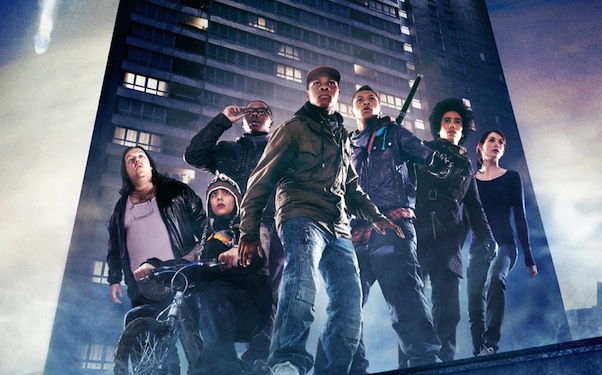
This is the sort of thing that becomes possible when allegory doubles its referent; such doubling is, indeed, one of the only ways that narrative can place the same term on both sides of an opposition; X fights X; the US invades the US; Americans as colonizers, Americans as colonized. This is the structure we’ll need to carry forward with us if we want to make sense now of Attack the Block, which is Super 8’s English twin, the other alien-invasion movie from 2011 that pulls in equal measure from ET and the Goonies: more adventuring tweens, more BMXs, more aliens that seem visible only to the pubescent. But then Attack the Block is also the first movie I’ve named that is openly about race in some entirely literal and earthbound sense. This is first of all a simple matter of casting: Almost none of the movie’s heroes are conventionally, ethnically English; all but one come from African or Caribbean immigrant families. If you haven’t seen the movie, it’s not enough to imagine The Goonies with English accents. You have rather to imagine The Goonies as new-model Cockneys, black and mixed-race and speaking grime patois. But then it’s not just the characters: Attack the Block is also telling a story about race; indeed, it is telling perhaps the most familiar racial story of the last few generations, the one about integration and enfranchisement. All you need to know is the bare outlines of the plot: Once they start fighting the movie’s aliens—and fight they do, to the death; the movie’s resemblance to ET and Super 8 ends there—the boys are transformed from the piece’s villains to its heroes. They begin the movie by mugging a young white nurse, but they end it by saving the day. In other words, it’s not just that Attack the Block is one of the most extensive pieces of black British pop culture yet produced, and in that sense some kind of landmark. The movie is actually walking you through a reassessment of black Britain and can, to this extent, easily seem like an advance on that recent crop of movies that make the English poor seem like the worst people on earth, though it has to be said that those films’ chosen technique for communicating their sour insight is simply to remake Hollywood movies on English soil: Harry Brown, for instance, which casts Michael Caine as an East End vigilante and aitchless Eastwood—it’s there in the title, if you squint: “brown” = “smudged” or “unclean” = Harry Dirty; and especially the remarkable Eden Lake, which is Deliverance transplanted to a not-so-rural Buckinghamshire, with hoodie-wearing poor kids in the place of Georgia hillbillies: 13-year-old proletarians carving up their betters. These movies and others like them leave the impression that the British working class has simply gone feral—the impression, that is, that class relations in the UK have by this point simply snapped or that basic modes of sociability or decency or respect have disappeared, with dehumanized workers and lumpens stuck living in perpetuity on the far side of their old traditions. To a considerable extent, then, Attack the Block asks to be read as a polemical response to this cinema of broken Britain. The movie begins in the mode of Harry Brown and then simply demands that viewers revise their judgments. The respectable white audience’s designated proxy obtrusively changes her mind. At the beginning of the movie she and an older white neighbor commiserate: “They’re fucking monsters.” But by the end of the movie, she is telling the cops to back off from the bruvs: “I know them. They’re my neighbors.”

One way to summarize Attack the Block, then, would be to say that it is a story of uplift and interracial friendship, in which Britain redefines itself in order to make room for its newest members. Nor is it overreaching to mention Britain in this context; the film has the nation unmistakably on its mind. It is set on Guy Fawkes Day, for one, and so asks to be read as a redo of 1605—England’s second saving!—with West Indian yardies performing the patriotic gallantries once reserved for Protestant knights. More to the point, the movie’s 15-year-old hero, propelled in one scene from out a high window, saves himself by un-metaphorically clinging to the Her Majesty’s flag.

The movie, in sum, revises British nationalism by pushing it in a liberal and multiethnic direction, though we will want to note that this observation is dogged by two persistent instabilities.

First: The film’s visuals might be plenty nationalist—all fireworks and Union Jacks—but its dialogue is not. Anything but: The film’s teenagers routinely say that they are fighting only to defend their housing project, their block. Where the movie is John-Bullish, the characters are instead intensely localist: “We wouldn’t have mugged you if we’d known you lived here.” That’s a sentiment available only to someone whose sense of the imagined community stops cold at the corner shop. And to this jingoism of the neighborhood the characters add a working-class or black ethos of self-policing—the code, in the US context, of Stop snitching and jury negation and Walter Moseley novels: “This is the block. We take care of things our own way.” It might be possible, when trying to make sense of the movie, to simply superimpose these two terms—the nation and the locality—in which case we would conclude that Attack the Block is proposing a council-estate nationalism, a black-white alliance of the distrustful and cop-hating poor. There’s something to this idea, and yet the individual components remain visible and not fully resolved into one another.

Second: The movie does almost nothing to revise one’s perception that its heroes are sadistic predators. It merely concludes that sadistic predators are sometimes useful to have around. The film’s few white men are by contrast all emasculated. “I am registered disabled” one of them says; “I’m a member of fucking Amnesty!” shouts another; and the movie’s gibe is that these amount to the same thing, just two different routes to castration, physical and ideological—twin softnesses. This will obviously complicate our sense of the movie as liberal, since even as the movie is promoting a kind of racial liberalization, it is deciding that liberal men aren’t good for much, and the burden of British masculinity will thereby pass over to the nation’s young Trinidadians and Congolese, fourteen-year olds with knives and swords and bats and explosives, a nine-year old with a handgun, announcing that his new warrior name is “Mayhem.” Attack the Block sometimes gives the impression that it is recruiting the child soldiers of South London.

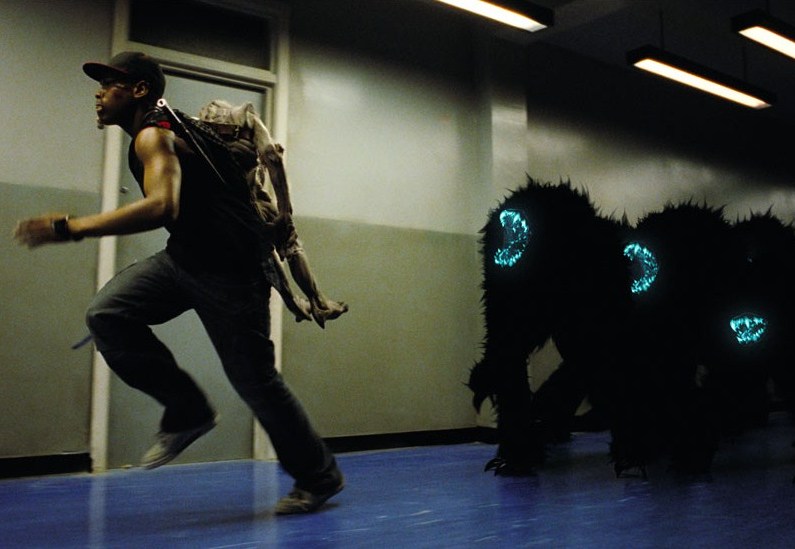
But then those two instabilities are nothing, mere tremors, compared to the movie’s central and defining instability, the oscillation around which it is constructed. I’ve been describing the role of race in the movie at the literal level, but then there is also an allegorical level, in which everything I’ve just described is taken back. This makes for a vast and, I think, unsolvable puzzle, though in many ways Attack the Block’s racial allegory is unusually bald and not in the least puzzling and amounts to this: The aliens are also black—hairy, subhuman, grinning, and black. I don’t actually want to put too much emphasis on the color in isolation. Racial allegory, after all, is not automatic. Lots of black things are not black. Darth Vader is not black. If all we had to go on is that the creatures are inky-dark, I’d say we could let it slide. But that’s not it: The movie is entirely upfront about how it wants us to understand the aliens’ ebony. The kids stand over the first adult monster they kill, and two of them speak out loud what they see: “Wow, that’s black, that’s too black to see. … That’s the blackest black ever, fam. … That’s blacker than my cousin Femi”—which moniker is Nigerian and usually followed by names like Ogumbanjo and Kuti.

The movie, in other words, openly places the creatures on a spectrum of African-ness. What’s more, it has various ways of expanding on this tactic. Only once does Attack the Block’s dialogue turn openly nationalist, when a gang member sticks up for the home country at the expense of Africa, pouring contempt on a white philanthropist off doing aid work in Ghana: “Why can’t he help the children of Britain? Not exotic enough, is it?” Or there’s this: One teenager warns another than an alien is about to attack by shouting “Gorilla!”—and then that’s another clue. Attack the Block is, at the level of its allegory, an inversion of Rise of the Planet of the Apes, a second film about berserking primates, and with the meanings from that other movie largely intact—the meanings, not the judgments. If Rise stages a latter-day slave rebellion—an insurgency against the mass incarceration of black men, an uprising that is at once prison break and revolution—then Attack the Block stages a related event, a bit of colonial turnabout, but asks us instead to cheer its suppression. Anyone who goes into this movie hoping that the Jamaican newcomers are going to battle the white dragon of the West Saxons or cut down the English aristocracy’s heraldic wyverns is going to have to swallow hard. For Attack the Block offers to enfranchise black Britons only by giving them creatures to kill who are blacker than themselves. A group of mostly black teenagers earns its citizenship by systematically cutting down the new crop of even darker arrivals. Conceptually, this is rather astounding: The film is telling two antithetical stories at once—and not via a multiplot—there is no main plot and contrapuntal subplot; it is telling two contradictory stories, but it only has one plot; the same story, then, but susceptible to two radically opposed constructions: a parable about learning to like black immigrants that is at the same time a fantasy about wiping them out—“Kill ‘em! Kill all them things!” The creatures in Attack the Block are so very jet that they often blur into the shadows, but the filmmakers, in what must have seem like an inspired touch, have given them glow-in-the-dark fangs, which means you can only see them when they bare their teeth. There’s an ugly old joke in the American South — something about hunting at night — to which this image is the reinvented punchline.


Illegals, Part 3

PART ONE IS HERE.

PART TWO IS HERE.

ALLEGORICAL COMPLEXITY #1 (CONTINUED)

So… How is the alien most like a Jew? Or rather, what is it that allows you to identify the alien as a disguised Jew in the first place? But then how, equally, is the alien least like a Jew? And what kind of unlicensed fantasy (about Jews) does that discrepancy announce? We can now ask those questions about Super 8. But before we do so, we’ll want to work out the character of its debt to Steven Spielberg. Everybody said the movie owed a lot Spielberg, and they were right, though maybe not as right as they thought. Super 8 does indeed commandeer the stunted bike from ET and the boy-adventurers from The Goonies. The actor in the lead role does look an awful lot like Henry Thomas. There’s a hefty kid. It’s not just Spielberg, though. Super 8 owes money all over town—owes something to Romero and the ‘70s-era zombie film; owes something else again to the sci-fi monster movies of the ’50s and ‘60s. We can think of the movie as counting off the decades or as constructing its own cinematic timeline, and this in turn points to a small struggle internal to the ongoing history of retro culture. The Spielberg (and Lucas) movies of the late ‘70s and early ‘80s elected as their own precursors and retro-models the adventure films of the ‘30s and ‘40s: old Westerns, serials, swashbucklers, Buck Rogers, movies with dirigibles. But JJ Abrams is trying to wrench Spielberg’s corpus from its own chosen roots in order to then insert it into the different, more recent history of the movies that he prefers. The year 1980 is no longer, in the first instance, locked into a historical constellation with World War II, as it was with ET; our own 2011, rather, is locked into a constellation with 1980, which—‘50s, ‘60s, ‘70s—is now just another year in the post-war.

And yet Abrams’s politics are in some fairly precise way still Spielberg’s own: different historical coordinates, same ideological program. The movie puts on display the doctrine of heroic liberalism, in which the boy-sentimentalist emerges as the better man—not just morally superior, but more efficacious, succeeding precisely where the bullies and badasses fail. This much becomes clear even in a plot summary: The Air Force has had a large alien creature in its custody for more than twenty years (in order to study it and because the government wants the alien’s technology). One discharged military scientist, however, wants to set the alien free because he knows it is not the enemy—all it wants is to leave the planet. The movie is thus at once Godzilla and Spielberg’s goose-necked cuddly toy, which is to say that Super 8’s monster plays like a cornered, riled, amok-running ET: Mothra phone home…. The creature rampages around rustbelt Ohio, swatting down the people who want to capture or attack it, and yet—and here’s the key—it does not kill indiscriminately. The creature stops itself from mauling the town’s children when it comes face to face with them, and not just because they are children, but rather because it is psychic, an empath, and it recognizes that the main character—the 12- or 13-year old kid—is compassionate. It doesn’t flatten the boy because it recognizes that he is not an aggressor. We’ll want to note, too, that the movie has given our hero an extensive backstory to explain how he attained the sympathetic wisdom that rescues him: His mother, working in a steel mill, was crushed in a factory accident. That experience has made him quick to spot the sorrow of others. And from out of the reserves of his grief, he says something like: “I know bad things happen. You can still live.”

Super 8 is a useful film, not least in that it reveals how much magical thinking is involved in this version of liberalism. Fellow-feeling is the amulet that wards off attack. And this is where it becomes important to specify the allegory—to identity the real-world referents that accrue around the monster. We’ll want to ask: Which conflicts exactly does the movie think that a kindhearted and downbeat liberalism can resolve? This is a little tricky, in that the movie is operating in two political registers at once, and they don’t line up, not neatly, at any rate. First, in the military sequences, it turns out that the Air Force is as out of control as the monster itself, unable to stabilize the situation, torching the Midwestern town it has covertly come to occupy. It reduces homes to cinders, but is vulnerable to attack when traveling the roads, &c. This, of course, is all War on Terror imagery—or specifically Iraq War imagery of a pre-Surge vintage. The monster is to that extent framed as an Iraqi insurgent or perhaps more generically as an enraged Muslim, since allegories often drift unpredictably across taxa or levels of abstraction, from genus to family—that’s another of their complexities. But then it’s not just political Islam: Other scenes in the movie introduce what is basically a civil-rights language. The boy-detectives discover documentary footage of early Air Force experiments on the creature, and the movie specifies that the reels date from 1963, and the one dissenting military officer in the footage—the one who wants to spring the monster loose—keeps saying things like We shouldn’t be holding it captive … we shouldn’t fear it … it just needs our understanding … this isn’t right. That the military officer is also black puts the seal on the allegory: A black man in the early ‘60s is asking others in the government to reform their policies—to trade in a politics of repression for a politics of recognition. And it is within this framework—with regard to the racial politics of the American mid-century—that the movie’s few references to King Kong do their hardest work: The monster makes off with a pretty blonde; the monster scales a water tower and looks down over the town. Quentin Tarantino was right. The other name for Kong is “the history of the American Negro.”

So the monster is aligned both with aggrieved Muslims and with ‘50s-era black Americans, which produces a kind of allegorical master category, something like, people the US government has done dirt by, which at this point is a pretty large set. If we now add in the movie’s insistent references to ET, then we have to conclude that the movie is referring both of those histories analogically back to the Holocaust—the monster is the imprisoned Muslim in the guise of Emmett Till in the guise of Anne Frank—and the master category therefore becomes broader still: victims of racist violence at the hands of white Christians. From genus to family and now on to order and class.

But the presence of ET in this potage of intertext not only expands the movie’s range of possible meanings. It also sabotages them. It is at this point that we have to ask: How is the monster least like a Muslim or a black American? And the answer to that question is ready to hand. The liberals in Super 8 are the ones who understand that the monster just wants to go home. But what would it mean to say that about either scenario?—the civil rights scenario or the Muslim one? Black people in America do not, in the relevant sense, want to go home. To even suggest as much sounds bizarrely like nineteenth-century proposals for the ethnic cleansing of the US South—Liberia, say, or Garveyite colonization schemes. And though there might be some few scenarios in which a Muslim politics incorporates the language of homecoming—expropriated Palestinians talk about the right of return, and one imagines that the men disappeared into Guantanamo Bay would very much like to go home—the peculiarity of the movie is that it can’t help but generalize from these few instances, when, of course, most Muslim immigrants in the US are here by choice, often enthusiastically. And the very few militants among them are, in fact, determined to deal the US damage. The movie’s historical compactions become untenable. Neither ordinary Muslim immigrants nor the self-proclaimed enemies of the US are trying to get back to Egypt and Saudi Arabia. The monster is a bad stand-in for either.

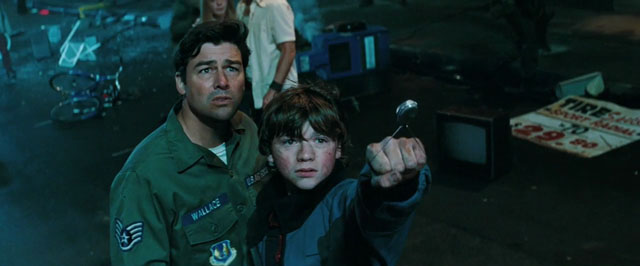
The point is worth dwelling on further, if only because the movie dwells on it for us. Super 8’s final moments incorporate one remarkable detail: The alien is preparing to leave earth, and the giant magnet it has constructed to propel itself to its home planet begins drawing all of the neighborhood’s metal to itself—cars, chain link fences, bottle caps. As the pull of the magnet intensifies, the dead mother’s locket snakes from out of the boy’s pocket—it rises into the air—he grabs it—it stretches taut—the boy strains—but then he thinks better of it and as it were lets his mother go. The movie culminates, in other words, with a successfully culminated act of mourning. It shows us someone who has overcome his loss, who has at this very instant wept his way back to equilibrium. What is so astonishing, then, is that this relinquishing of the beloved object ties up two plot strands at once, which are thereby superimposed.

First, it allows the young liberal to get the girl, the improbably lovely thirteen-year old who honestly looks three years older than her twerpy new boyfriend. There is a complication here, though, or perhaps a revision. The movie is driven by a familiar idea—both principled and class-bound—that the sensitive guy is preferable to the blue-collar tough, the emblem of whom, in Super 8, is the girl’s drunken, shouty, steelworker father. The movie literally ends when we see the girl grabbing the boy-liberal’s hand for the first time. But—and this is a big qualification—it will not allow the liberal to get the girl until it has established to its satisfaction that the sensitive guy is not too sensitive—until, that is, he has proven that he doesn’t have mommy issues. One woman wafts heavenward, and only then can a substitute step directly into her place.

Second, then, this exit-from-melancholy is the film’s way of augmenting its single most important line of dialogue, that one lesson the boy imparts to the monster: “I know bad things happen. You can still live.” In one sense, then, the boy ceding the locket to the skies is simply heeding his own advice. In another sense, though, the film encourages us to see the monster’s leaving as a parallel event, a second act of successfully completed mourning. And then you realize: The movie actually features a childish white liberal instructing an aggrieved victim of US government oppression to just get over it already—you know, the way he has (or soon will). Super 8 grants white liberals the authority to consult their own misfortunes and then tell Muslims and black people that their grievances, too, ain’t no thing. And in the film’s scenario, the white liberal’s tempered compassion will do what mere coercion cannot: It will make those people go away. Super 8 models for us a version of sympathy in which the sensitive guy need have no intention of living alongside the targets of his compassion; he really just wants them to leave. The liberalism that is the film’s official posture is transposed into its opposite. Allegory is treachery.

PART FOUR IS HERE.

Illegals, Part 2

PART ONE IS HERE. 

ALLEGORICAL COMPLEXITY #1—Super 8, eventually :

You can think of this as a tip for reading: When you are trying to make sense of an allegory, it is not enough to list the resemblances between the allegorical construct and its real-world referent, between the spaceman and the Jewish fugitive; you’ll need to catalogue their divergences, as well. For excess is the permanent condition of allegory. An invented creature never fully disappears into its literal equivalents; the alien is not exhausted by the designation “Jewish.” The reader’s task, then, is not to vaporize a given movie’s specificities, not to absorb them into some higher meaning that, once decrypted, would render the movie itself superfluous. Part of the task is to account, rather, for the allegory’s remainders, the scraps of significance that are left over even once the allegorical identification has been successfully announced. These unattached features are the mark of a contradiction that is internal to allegory; they disclose desires that the world’s already existing names cannot satisfy.

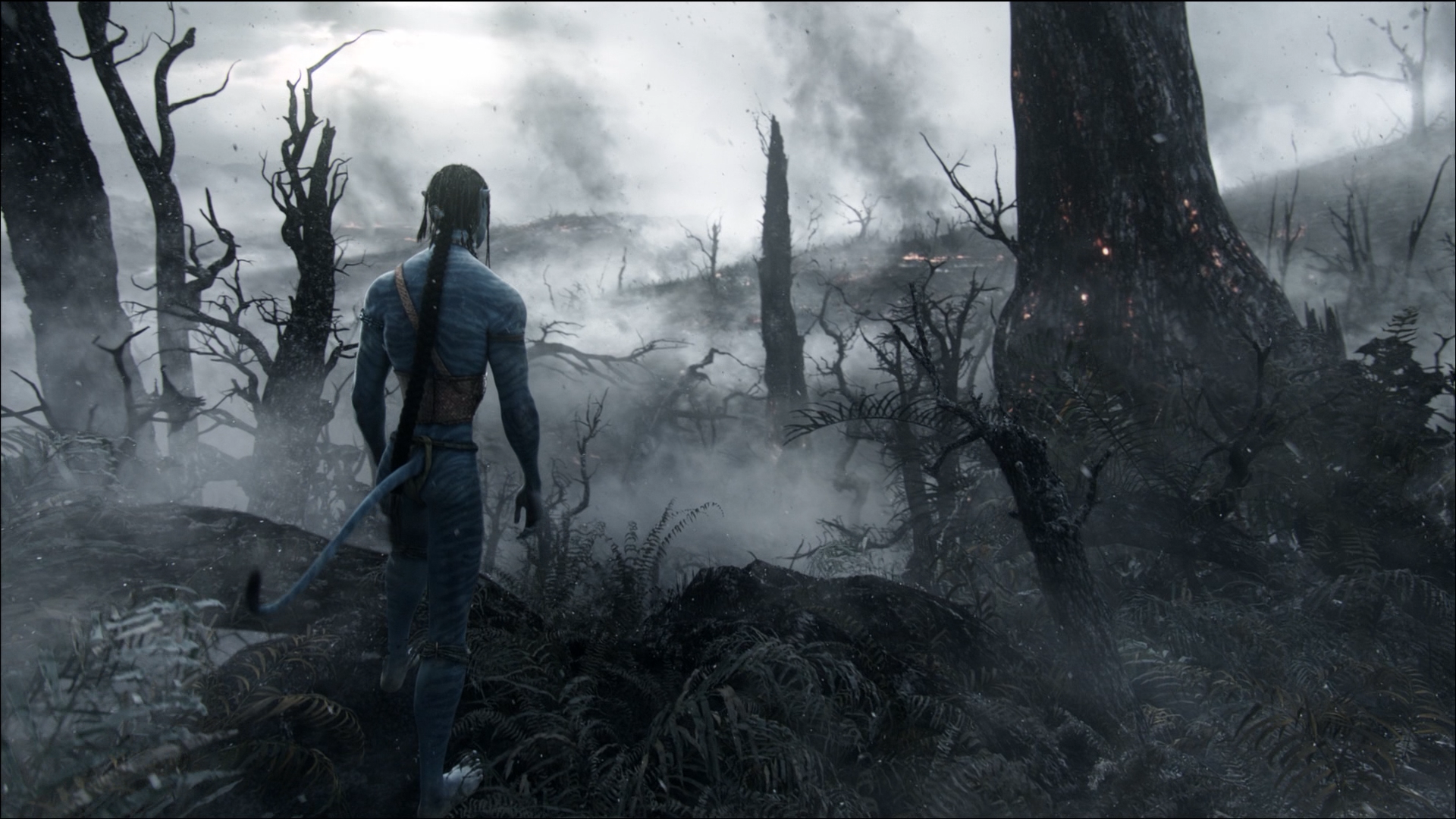
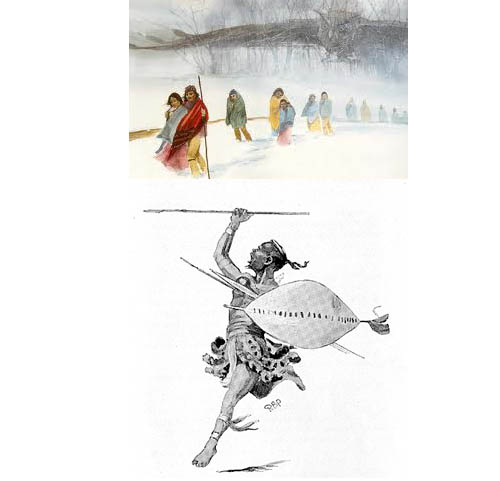
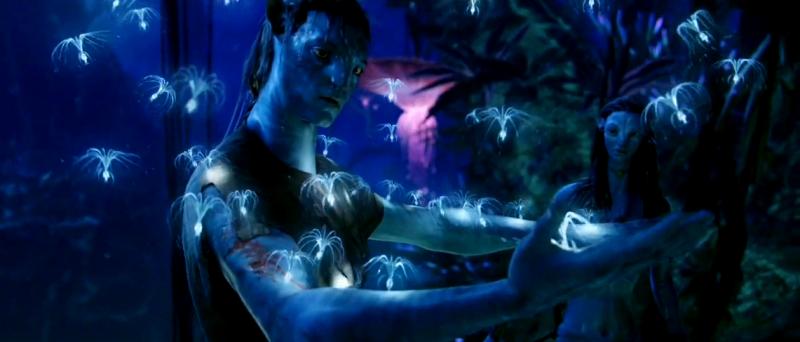
An alien invasion movie of a different kind, then, before we get to Super 8, just to make clear that this point is specific to no one film. The allegory in James Cameron’s Avatar, from 2009, is open-and-shut and, one might object, mostly shut—entirely too neat—elementary and plodding. The movie’s aliens are Indigenous People, a blue-skinned cross between the Chinook and the Zulu, called the Na’vi, which sounds like Navajo + Hopi. But the very obviousness of the allegory ends up producing some interesting effects of its own, for Avatar is so unoverlookably anti-imperialist—anti-imperialist in such a thorough-going way—that no-one who cares about such a politics can afford to just skip it or to write it off too quickly. Its story is certainly familiar; it’s just the twice-told tale about a white guy crossing sides, going native, turning Turk. But a comparative approach would show that the movie actually blows clean past the hedges and outs that typically blight such narratives, and especially the famous recent ones: Dances with Wolves, say, or The Last Samurai. Those movies are easy to hate. The really foul thing about Dances is that Kevin Costner falls in love with an Indian woman, except she isn’t really Indian—she’s the only other white person in the tribe—and you know this because she wears her hair differently, as though the Sioux kept on staff a special whites-only beautician. This only nominally pro-Indian movie goes to completely absurd lengths to prevent inter-racial sex. It is in this sense that the people who insisted that Avatar was nothing more than a live-action replay of FernGully or Disney’s Pocahontas weren’t paying attention. Sure, Avatar borrows from other movies, and yet it distinguishes itself even so by its open-throttle commitment to indigenism and racial treason. Quick—list for me all the other Hollywood movies you’ve seen that end with a vision of white people getting sent back to Europe for good. The movie baptizes everyone who watches it into the end of the American empire.

It does more than that. One of Avatar’s first-order complexities is that the opposing forces on the two sides of its central conflict—the human invaders and the indigenous aliens—have been borrowed from very different periods in the history of empire. The Na’vi call to mind the precolonial Kikuyu or the Algonquin before Columbus, but the movie’s humans are neither Puritan nor pith-helmeted; they are new-model conquistadors, Haliburton-types, the corporate mercenaries of the War on Terror. Avatar asks us to imagine how it would look if the current US army were invading North America or Africa for the first time—What if the Massachusetts Bay Company had employed Blackwater?—which means at the level of the image, the movie manages to insert the Iraq War into some much longer histories, folding Bush-era adventurism into an overarching account of European colonization. To that extent, James Cameron is actually rather smarter about empire than the run-of-the-mill American liberals who talk as though 2003 were some kind of shocking deviation from the fundamental patterns of US history, a freedom-loving nation’s unprecedented deviation into expansion and conquest. And in a similar vein, the movie is willing to dwell, to a quite unusual degree for a blockbuster, on images of imperial atrocity—familiar images, doubtless, if you know that history, but replayed for a global audience with immediacy and renewed grief: The Smurf-Seminoles walk the Trail of Tears.

I also think the movie’s length, about which those prone to headaches might rightfully complain, turns out to be its great asset. And the best thing about those 160 minutes is this: Avatar is a utopia hiding in an action movie. The movie is so indulgent that it can afford to give us a protracted utopian sequence, itself almost as long as an ordinary feature film, when, in fact, there is no genre that commercial film avoids more studiously than utopia. My friends who study the form will get huffy at this point: So yes, absolutely, the utopia in Avatar is badly underspecified; it is not much interested in how the Na’vi feed or govern themselves. It approaches the better society almost only through the natives’ theology. But in some respects, this is actually where the movie is at its most ingenious. Cameron, who as I write is crawling on his hands and knees around the Mariana Trench, has found a way to put his pricey 3D-technology in the service of utopia—or at least of a certain pantheism, which in this case is almost the same thing. As a sensory experience, the movie obviously feels new and exhilarating, and I want to say that in some almost Ruskinite way, the film is determined to revitalize your sensorium, to create a constant sense of wonder at the simple fact that we all live in a three-dimensional world. The movie obviously makes a big deal of the characters being connected, being able to interface with nature, to plug into it, in a way that is both technological and shamanistic, and I think the movie thereby provides its own gloss on its technological ambitions: It’s as though Cameron thinks he can use the most advanced technology that a director has ever commanded to approximate in the viewer a basically vitalist and world-adoring attitude.

But then it is precisely here that instability takes over. It is here, I mean, that we have to shift from naming the ways in which the Na’vi are most like Amazonians to naming where they are least so. Avatar is not only putting in front of us an indigenism; it is putting in front of us a technologized indigenism, and there is something about this latter that is odd and finally unsatisfying. That point comes in a specific form and a general one. Here’s the specific one. The biggest innovation in twentieth-century warfare was air power: the bi-plane, the bomber, firebombing, the atomic bomb, napalm, no-fly zones, shock and awe, assassin drones, death from above. Air power is what has permanently shifted the global balance of power to the hyper-technological nations. And the movie’s trick—ingenious in a sense, but also silly—is to give the indigenous a Luftwaffe: Dragons! The flying monsters, in other words, are the equalizer that makes the movie’s political allegory work, but they are themselves entirely non-allegorizable, which means that the entire system of correspondences actually starts coming unglued around them.

In other words, the movie’s politics are at heart fake, because it is trying to imagine a people who live in harmony with nature, who get by without advanced technology, but it has to give them the equivalent of helicopters, because if they didn’t have the equivalent of helicopters, they would get wiped out by the Helicopter People of Earth. But then the movie is ducking the really hard political question, which is: How might a non-technological people actually survive? How could they defend themselves against the cyborg nations who would steal their land and resources? Avatar dodges those questions, and so ends up being just another impotent historical fantasia.

The broader version of that point, meanwhile, is this: It’s well known that the sci-fi movies that most distrust technology are the ones that rely on it most extensively, but Avatar radicalizes that paradox in both directions. It was upon release the most technologically advanced movie ever made, and yet it is utterly, committedly elfin and eco- in its ideology. But then in another sense, that very antithesis is breached, because the movie devises ways to comprehensively sneak technology back into nature itself. The forest paths light up, as though electrically, when the Na’vi tread on them. The aborigines plug their ponytails into animals and trees as into Ethernet ports or wall sockets. Their manes have slim, wavy organic tendrils, which however also look like fibers or cables. And the Sigourney Weaver character at one point openly compares all this to a computer: the natives are jacking into the planet and downloading information from it. On the one hand, this is itself just allegory for what we take to be “the tribal worldview”—being in touch with nature or what have you—and if we accept the entirely plausible idea that indigenous and stateless peoples have been extraordinarily attentive to ecologies—that they were really good at reading landscapes, &c—then this could merely serve as science-fiction shorthand for that skill. What’s remarkable, though, is that Cameron has translated this into a technological image. That’s the other hand. The non-technological understanding of the world gets its technological allegory. So this is what it means to say that allegory yields contradiction. Is the image of plugging into nature technological or not? It is and it isn’t—and this speaks volumes about the movie’s bad faith. A global viewership sides with a pre-technological people only when it emerges that they have the newest gadgets. Avatar reassures its audience that they could go back to the land and actually give up on nothing—that they could go off the grid and still have the grid—that they could move to the Gallatin Range and keep their every last iPhone.

PART THREE IS HERE…

Special thanks to Crystal Bartolovich, who convinced me to take the role of technology in Avatar much more seriously than I was initially inclined to and who has much more to say on the topic in her forthcoming Natural History of the Common. For a preview of her argument, see also this interview.

Illegals, Part 1


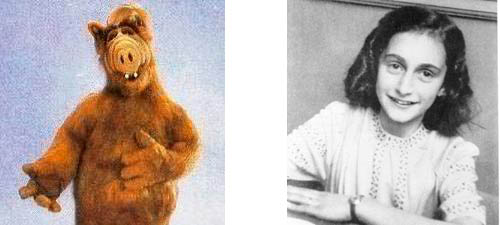
I’ve been thinking a lot about alien invasion movies, and especially about the ones that feature human children, boy-explorers or pre-teen ambassadors to the talking bugs. I suppose it would just be easier to say that I’ve been thinking about ET and its recent imitators: Super 8, Attack the Block. But even this would be a way of sidestepping the truth, which is that mostly I’ve been thinking about ALF. I have, in fact, been thinking about ALF for a very long time. In the very late ‘80s, as a teenager, I spent a year in Frankfurt, and there was nothing that bothered me more in that period of my life than the centrality of ALF to modern German culture. I had gone to the Rhine to learn about Günter Grass and anarchism and was still under the impression that I could outrun network television. I suppose I was mildly surprised that the Germans had, like, vacuum cleaners. ALF was at that point a pretty fair summation of everything I thought I was leaving safely back home in New England. But that show was way more popular in Germany than it ever had been in Massachusetts: Ninja-Turtle-early-Bart-Simpson-eat-my-shorts popular. It seemed like it was always running in the background in every house I visited. The stalls at small-town German street fairs were crowded with long-snooted, rusty yellow puppets, in all the places that a visitor might have expected to see hand-made Christmas decorations or tankards in the shape of castle towers. I should point out that it wasn’t just the Federal Republic; a Eurail pass revealed to me that  the series had a pan-continental following. But only in Germany did the puppet’s voice actor spend three months in the pop charts, with a single called “Hallo ALF – hier ist Rhonda.” And the thing is, when I went back to Germany for a year after college—to Berlin in the mid-90s—ALF, having been off the air in the US for half a decade, was still around, still on T-shirts and decals and school folders. The Germans left stranded by the show’s American cancellation had taken to producing ALF radio plays. Project ALF—a one-off TV movie that ran on NBC in 1996—got a theatrical release and a big rollout in Germany: ALF—Der Film. It played in Berlin’s showcase theaters. Garfield-reimagined-as-warthog looked down from on high upon the Kurfürstendamm.

So the question that posed itself ever more insistently was: Why were the Germans so hung up on this show? And one night in Berlin, an American buddy and I drank our way to clarity. ALF, of course, is a Holocaust story—you knew that already; you’re irritated I didn’t see it sooner—a sitcom about a family hiding someone in its attic, someone the government wants to seize, a permanent exile with no homeland to which he can return. Those oversized ALF dolls turned out to be the only way that a young German could take a Jewish proxy home and fantasmatically keep him safe in a wardrobe or nighttime embrace. They belonged at one remove to the history of extravagantly racialized children’s toys — plastic figurines of Native American braves, Black rag dolls. They were the stuffed animals of genocide comedy. The original NBC production hadn’t gone to any lengths to disguise this: those bushy eyebrows; that schnozz; that gruff, Catskills shtick. The show’s lone and improbable joke was that if the fascists ever took power in America, someone would have to agree to shelter Don Rickles. And with this insight in mind, I made a special trip to the university library in Berlin to chase down a hunch, and it was right: Anne Frank was not the girl’s real name, or at least not her full name. Her name was Annelies Frank: A … L … F.

The show, which premiered in 1986, was also directly derived from—or a Muppet-y riff upon—ET, released in 1982. And in that case, most of what we have to say about ALF can simply be repeated about the movie. Spielberg did not wait until the 1990s to start making films about the Holocaust. When ET came out, he had already just made one—Raiders of the Lost Ark, which ends when the insulted might of ancient Israel obliterates a small army’s worth of Nazis. Light flashes and German flesh renders like tallow: Raiders presents an alternate history in which the Jews possessed a small A-bomb of their own, a game-changer and plague of radioactive locusts for the European war. ET, then, was itself just an extrapolation from a Dutch Holocaust diary and perhaps the first narrative in which suburban Americans were invited to imagine keeping Jews as pets.

Something about this argument we will want to generalize, since alien invasion movies are always going to be, to some degree or another, racial allegories. That can’t come as a surprise to anyone who speaks English, a language in which the word “alien” means both “squid creature from another solar system” and “non-citizen.” But then I should say, too, that lots of serious readers think that allegories—or allegorical habits of interpretation—are conceptually pretty low-rent, the literary equivalent of rebuses. They’re wrong. If you really and truly give up on allegorical reading, you’re going to miss too much of importance—too much of what makes storytelling compelling to us—which means that most literary critics don’t, in fact, give up on it. They just waste a lot of time reinventing it piecemeal under other names. Nor is allegory as straightforward as the sophisticates claim; it generates its own forms of complexity and its own revelatory instabilities. But then this last point partially vindicates the people who don’t like allegory. Naming the allegory is the easy part; it’s really just the beginning. Allegories tell us one thing when they work, but they tell us something else—something arguably more valuable—when they don’t. And allegories never work perfectly. They can’t work perfectly. An impeccably rendered allegorical Jew would no longer be recognizable as allegory. He would just be a Jew. Like a dying werewolf shriveling back into its naked human form, he would revert back to literalness, from extraterrestrial to Ashkenazy. Distortion and mismatch are the preconditions of allegory, the dysfunctions that make it function. If you are reading allegorically, you can never just whip out the decoder ring.

So I want to look over the next few days at those recent homages to ET—one from the US, one from the UK—and I want to name their allegories, but I want to underscore from the outset that these are most interesting where least steady.

PART TWO IS HERE.

Outward Bound: On Quentin Meillassoux’s After Finitude


Il n’y a pas de hors-texte. If post-structuralism has had a motto—a proverb and quotable provocation—then surely it is this, from Derrida’s Of Grammatology. Text has no outside. There is nothing outside the text. It is tempting to put a conventionally Kantian construction on these words—to see them, I mean, as bumping up against an old epistemological barrier: Our thinking is intrinsically verbal—in that sense, textual—and it is therefore impossible for our minds to get past themselves, to leave themselves behind, to shed words and in that shedding to encounter objects as they really are, in their own skins, even when we’re not thinking them, plastering them with language, generating little mind-texts about them. But this is not, in fact, what the sentence says. Derrida’s claim would seem to be rather stronger than that: not There are unknowable objects outside of text, but There are outside of text no objects for us to know. So we reach for another gloss—There is only textain’t nothing but text—except the sentence isn’t really saying that either, since to say that there is nothing outside text points to the possibility that there is, in a manner yet to be explained, something inside text, and this something would not itself have to be text, any more than caramels in a carrying bag have to be made out of cellophane.

So we look for another way into the sentence. An alternate angle of approach would be to consider the claim’s implications in institutional or disciplinary terms. The text has no outside is the sentence via which English professors get to tell everyone else in the university how righteously important they are. No academic discipline can just dispense with language. Sooner or later, archives and labs and deserts will all have to be exited. The historians will have to write up their findings; so will the anthropologists; so will the biochemists. And if that’s true, then it will be in everyone’s interest to have around colleagues who are capable of reflecting on writing—literary critics, philosophers of language, the people we used to call rhetoricians—not just to proofread the manuscripts of their fellows and supply these with their missing commas, but to think hard about whether the language typically adopted by a given discipline can actually do what the discipline needs it to do. If the text has no outside, then literature professors will always have jobs; the idea is itself a kind of tenure, since it means that writerly types can never safely be removed from the interdisciplinary mix. The idea might even establish—or seek to establish—the institutional primacy of literature programs. Il n’y a pas de hors-texte. There is nothing outside the English department, since every other department is itself engaged in a more or less literary endeavor, just one more attempt to make the world intelligible in language.

Such, then, is the interest of Quentin Meillassoux’s After Finitude, first published in French in 2006. It is the book that, more than any other of its generation, means to tell the literature professors that their jobs are not, in fact, safe. Against Derrida it banners a counter-slogan of its own: ““it could be that contemporary philosophers have lost the great outdoors, the absolute outside.” It is Meillassoux’s task to restore to us what he is careful not to call nature, to lead post-structuralists out into the open country, to make sure that we are all getting enough fresh air. Meillassoux means, in other words, to wean us from text, and for anyone beginning to experience a certain eye-strain, a certain cramp of the thigh from not having moved all day from out his favorite chair, this is bound to be an appealing prospect, though if you end up unconvinced by its arguments—and there are good reasons for doubt, as the book amounts to a tissue of misunderstanding and turns, finally, on one genuinely arbitrary prohibition—then it’s all going to end up sounding like a bullying father enrolling his pansy son in the Boy Scouts against his will: Get your head out of that book! Why don’t you go in the yard and play?!

• • •

Of course, Meillassoux’s way of getting the post-structuralists to go hiking with him is by telling them which books to read first. If you start scanning After Finitude’s bibliography, what will immediately stand out is its programmatic borrowing from seventeenth- and early eighteenth-century philosophers. Meillassoux regularly cites Descartes and poses anew the question that once led to the cogito, but will here lead someplace else: What is the one thing I as a thinking person cannot disbelieve even from the stance of radical doubt? He christens one chapter after Hume and proposes, as a knowing radicalization of the latter’s arguments, that we think of the cosmos as “acausal.” In the final pages, Galileo steps forward as modern philosophy’s forgotten hero. His followers are given to saying that Meillassoux’s thinking marks out a totally new direction in the history of philosophy, but I don’t think anyone gets to make that kind of claim until they have first drawn up an exhaustive inventory of debts. At one point, he praises a philosopher publishing in the 1980s for having “written with a concision worthy of the philosophers of the seventeenth century.” That’s one way to get a bead on this book—that it resurrects the Grand Siècle as a term of praise. The movement now coalescing around Meillassoux—the one calling itself speculative realism—is a bid to get past post-structuralism by resurrecting an ante-Kantian, more or less baroque ontology, on the understanding that nearly all of European philosophy since the first Critique can be denounced as one long prelude to Derrida. There never was a “structuralism,” but only “pre-post-structuralism.”

Meillassoux, in sum, is trying to recover the Scientific Revolution and early Enlightenment, which wouldn’t be all that unusual, except he is trying to do this on radical philosophy’s behalf—trying, that is, to get intellectuals of the Left to make their peace with science again, as the better path to some of post-structuralism’s signature positions. His argument’s reliance on early science is to that extent instructive. One of the most appealing features of Meillassoux’s writing is that it restages something of the madness of natural philosophy before the age of positivism and the research grant; it retrieves, paragraph-wise, the sublimity and wonder of an immoderate knowledge. In 1712, Richard Blackmore published an epic called Creation, which you’ve almost certainly never heard of but which remained popular in Britain for several decades. That poem tells the story of the world’s awful making, before humanity’s arrival, and if you read even just its opening lines, you’ll see that this conception is premised on a rather pungent refusal of Virgil and hence on a wholesale refurbishing of the epic as genre: “No more of arms I sing.” Blackmore reclassifies what poets had only just recently been calling “heroic verse” as “vulgar”; the epic, it would seem, has degenerated into bellowing stage plays and popular romances and will have to learn from the astrophysicists if it is to regain its loft and dignity. Poets will have to accompany the natural philosophers as they set out “to see the full extent of nature” and to tally “unnumbered worlds.” The point is that there was lots of writing like this in the eighteenth century, and that it was aligned for the most part with the period’s republicans and pseudo-republicans and whatever else England had in those years instead of a Left. This means that the cosmic epic was to some extent a mutation of an early Puritan culture, a way of carrying into the eighteenth earlier trends in radical Protestant writing, and especially the latter’s Judaizing or philo-Semitic strains. The idea here was that Hebrew poetry provided an alternative model to Greek and Roman poetry: a sublime, direct poetry of high emotion, of inspiration, ecstasy, and astonishment. The Creation is one of the things you could read if you wanted to figure out how ordinary people ever came to care about science—how science was made into something that could turn a person on—and what you’ll find in its pages is a then new aesthetic that is equal parts Longinus and Milton, or rather Longinus plus Moses plus Milton plus Newton, and not a Weberian or Purito-rationalist Newton, but a Newton supernal and thunder-charged, in which the Principia is made to yield science fiction. It is, finally, this writing that Meillassoux is channeling when he asks us—routinely—to contemplate the planet’s earliest, not-yet-human eons; when, like a boy-intellectual collecting philosophical trilobites, he demands that our minds be arrested by the fossil record or that all of modern European philosophy reconfigure itself to accommodate the dinosaurs. And it is the eighteenth-century epic’s penchant for firebolt apocalyptic that echoes in his descriptions of a cosmos beyond law:

Everything could actually collapse: from trees to stars, from stars to laws, from physical laws to logical laws; and this not by virtue of some superior law whereby everything is destined to perish, but by virtue of the absence of any superior law capable of preserve anything, no matter what, from perishing.

Meillassoux’s followers call this an idea that no-one has ever had before. The epic poets once called it Strife.

That so many readers have discovered new political energies in Meillassoux’s argument is perhaps hard to see, since the book contains absolutely nothing that would count, in any of the ordinary senses, as political thought. There are, it’s true, a few passages in which Meillassoux lets you know he thinks of himself as a committed intellectual: a (badly underdeveloped) account of ideology critique; the faint chiming, in one sentence, of The Communist Manifesto; a few pages in tribute to Badiou. With a little effort, though, the political openings can be teased out, and they are basically twofold: 1) Meillassoux says that thought’s most pressing task is to do justice to the possibility—or, indeed, to the archaic historical reality—of a planet stripped of its humans. On at least one occasion, he even uses, in English translation, the phrase “world without us.” For anyone looking to devise a deep ecology by non-Heideggerian means—and there are permanent incentives to reach positions with as little Heidegger as possible—Meillassoux’s thinking is bound to be attractive. The book is an entry, among many other such, in the competition to design the most attractive anti-humanism. 2) The antinomian language in the sentence last quoted—laws could collapse; there is no superior law­—or, indeed, the very notion of a cosmos structured only by unnecessary laws—is no doubt what has drawn to this book those who would otherwise be reading Deleuze, since Meillassoux, like this other, has designed an ontology to anarchist specifications, though he has done so, rather surprisingly, without Spinoza. Another world is possible wasn’t Marx’s slogan—it was Leibniz’s—except at this level, it has to be said, the book’s politics remain for all intents and purposes allegorical. Meillassoux’s argument operates at most as a peculiar, quasi-theological reassurance that if we set out to change the political and legal order of our nation-states, the universe will like it.

Maybe this is already enough information for us to see that After Finitude’s relationship to post-structuralism is actually quite complicated. Any brief description of the book is going to have to say that it is out to demolish German Idealism and post-structuralism and any other philosophy of discourse or mind. But if we take a second pass over After Finitude, we will have to conclude that far from flattening these latter, its chosen task is precisely to shore them up, to move anti-foundationalism itself onto sturdy ontological foundations. Meillassoux’s niftiest trick, the one that having mastered he compulsively performs, is the translating of post-structuralism’s over-familiar epistemological claims into fresh-sounding ontological ones. What readers of Foucault and Lyotard took to be claims about knowledge turn out to have been claims about Being all along, and it is through this device that Meillassoux will preserve what he finds most valuable in the radical philosophy of his parents’ generation: its anti-Hegelianism, its hard-Left anti-totalitarianism, its attack on doctrines of necessity, its counter-doctrine of contingency, its capacity for ideology critique.

Adorno was arguing as early as the mid-‘60s that thought needed to figure out some impossible way to think its other, which is the unthought, “objects open and naked,” the world out of our clutches. “The concept takes as it most pressing business everything it cannot reach.” Is it possible to devise “cognition on behalf of the non-conceptual”? This is the sense in which Meillassoux, far from breaking with post-structuralism and its cousins, is simply answering one of its central questions. It’s just that he does so in a way that any convinced Adornian or Left Heideggerian is going to find baffling. Cognition on behalf of the non-conceptual turns out to have been right in front of us all along—it is called science and math. Celestial mechanics has always been the better anti-humanism. A philosophical anarchism that has thrown its lot in with the geologists and not with the Situationists—that is the possibility for thought that After Finitude opens up.  The book, indeed, sometimes seems to be borrowing some of Heidegger’s idiom of cosmic awe, but it separates this from the latter’s critique of science—such that biology and chemistry and physics can henceforth function as vehicles of ontological wonder, astonishment at the world made manifest. And with that idea there comes to an end almost a century’s worth of radical struggle against domination-through-knowledge, against bureaucracy, rule by experts, the New Class, technocracy, instrumental reason, and epistemological regimes. On the back cover of After Finitude, Bruno Latour says that Meillassoux promises to “liberate us from discourse,” but that’s not exactly right and may be exactly wrong. He wants rather to free us from having to think of discourse as a problem—precisely not to rally us against it, in the manner of Adorno and Foucault—but to license us to make our peace with, and so sink back into, it.

• • •

Lots of people will find good reasons to take this book seriously. It is, nonetheless, unconvincing on five or six fronts at once.

It is philosophically conniving. There are almost no empirical constraints placed on the argumentative enterprise of ontology. Nothing in everyday experience is ever going to suggest that one generalized account of all Being is right and another wrong, and this situation will inevitably grant the philosopher latitude. Ontologies will always be tailored to extra-philosophical considerations, any one of them elected only because a given thinker wants something to be true about the cosmos. Explanations of existence are all speculative and in that sense opportunistic. It is this opportunism we sense when we discover Meillassoux baldly massaging his sources. Here he is on p. 38: “Kant maintains that we can only describe the a priori forms of knowledge…, whereas Hegel insists that it is possible to deduce them.” Kant, we are being told, doesn’t think the categories are deducible. And then here’s Meillassoux on pp. 88 and 89: “the third type of response to Hume’s problem is Kant’s … objective deduction of the categories as elaborated in the Critique of Pure Reason.”

The leap from epistemology to ontology sometimes falls short. At one point, Meillassoux thinks he can get the better of post-structuralists like so: Imagine, he says, that an anti-foundationalist is talking to a Christian (about the afterlife, say). The Christian says: “After we die, the righteous among us will sit at the right hand of the Lord.” And the anti-foundationalist responds the way anti-foundationalists always respond: “Well, you could be right, but it could also be different.” For Meillassoux, that last clause is the ontologist’s opening. His task is now to convince the skeptic that “it could also be different” is not just a skeptical claim about what we can’t know—it is not an ignorance, but rather already an ontological position in its own right. What we know about the real cosmos, existing apart from thought, is that everything in it could also be different. And now suppose that the anti-foundationalist responds to the ontologist by just repeating the same sentence—again, because it’s really all the skeptic knows how to say: “Well, you could be right, but it could also be different.” Meillassoux at this point begins his end-zone dance. He has just claimed that Everything could be different, and the skeptic obviously can’t disagree with this by objecting that Everything could be different. The skeptic has been maneuvered round to agreeing with the ontologist’s position. But Meillassoux doesn’t yet have good reasons to triumph, because, quite simply, he is using “could be different” in two contrary senses, and he rather bafflingly thinks that their shared phrasing is enough to render them identical. He has simply routed his argument through a rigged formulation, one in which ontological claims and epistemological claims seem briefly to coincide. The skeptical, epistemological version of that sentence says: “Everything could be different from how I am thinking it.” And the ontological version says: “Everything could be different from how it really is now.” There may, in fact, occur real-word instances in which skeptics string words into ambiguous sentences that could mean either, and yet this will never indicate that they unwittingly or via logical compulsion mean the latter.

Meillassoux’s theory of language is lunatic. Another way of getting a bead on After Finitude would be to say that it is trying to shut down science studies; it wants to stop literary (and anthropological) types from reading the complicated utterances produced by science as writing (or discourse or culture). Meillassoux is bugged by anyone who reads scientific papers and gets interested in what is least scientific in them—anyone, that is, who attributes to astronomy or kinetics a political unconscious, as when one examines the great new systems devised during the seventeenth century and realizes that they all turned on new ways of understanding “laws” and “forces” and “powers.” Meillassoux’s own philosophy requires, as he puts it, “the belief that the realist meaning of [any utterance about the early history of the planet] is its ultimate meaning—that there is no other regime of meaning capable of deepening our understanding of it.” The problem is, of course, that it’s really easy to show that science writing does, in fact, contain an ideological-conceptual surcharge; that, like any other verbally intricate undertaking, it can’t help but borrow from several linguistic registers at once; and that there is always going to be some other “order of meaning” at play in statements about strontium or the Mesozoic. Science studies, after all, possesses lots of evidence of a more or less empirical kind, and Meillassoux’s response is to object that this evidence concerns nothing “ultimate.” But then what would it mean for a sentence to have an “ultimate meaning” anyway? A meaning that outlasts its rivals? Or that defeats them in televised battle? What, then, is the time that governs meanings, such that some count as final even while the others are still around? And at what point do secondary meanings just disappear? What are the periods of a meaning’s rise and fall? Meillassoux doesn’t possess the resources to answer any of those questions; nor, as best as I can tell, does he mean to try. The phrase “ultimate meaning” is not philosophically serious. It does little more than commit us to a blatant reductionism, commanding us to disregard any complexities and ambiguities that a linguistically attentive person would, upon reading Galileo, discover. We can even watch Meillassoux’s own language drift, such that “ultimate meaning” becomes, over the course of three pages, exclusive meaning. “Either [a scientific] statement has a realist sense, and only a realist sense, or it has no sense at all.” It exasperates Meillassoux that an unscientific language would so regularly worm its way into science writing; and it exasperates him, further, that English professors would take the trouble to point this language out. His response is to install a prohibition, the wholly unscientific injunction to treat scientific language as simpler than it is even when the data show otherwise. It is perhaps a special problem for Meillassoux that the ideological character of science writing is especially pronounced in the very period to which he is looking for intellectual salvation—the generations on either side of Newton, which were crammed with ontologies explicitly modeled on the political theology of the late Middle Ages—new scientific cosmologies, I mean, whose political dimensions were quite overt. And it is definitely a problem for Meillassoux that he has himself written a political ontology of roughly this kind—a cosmology made-to-order for the punks and the Bakuninites—since one of his opening moves is to disallow the very idea of such ontologies. After Finitude only has the implications its anarchist readership takes it to have if its language means more than it literally says, and Meillassoux himself insists that it can have no such meaning.

He poses as secular but is actually a kind of theologian. It is not just that Meillassoux is secular. He is pugnaciously secular or, if you prefer, actively anti-religious. He casually links Levinas with fanaticism and Muslim terror. He sticks up for what Adorno once called the totalitarianism of enlightenment, marveling at philosophy’s now vanished willingness to tell religious people that they’re stupid or at its determination to make even non-philosophers fight on its terms. And against our accustomed sense that liberalism is the spontaneous ideology of secular modernity, Meillassoux sees freedom of opinion instead as an outgrowth of the Counter-Reformation and Counter-Enlightenment. Liberalism, in other words, is how religion gets readmitted to the public sphere even once everyone involved has been forced to concede that it’s bunk. And yet for all that, Meillassoux has entirely underestimated how hard it is going to be to craft a consequent anti-humanism without taking recourse to religious language. At the heart of After Finitude is a simple restatement of the religious mystic’s ecstatic demand that we “get out of ourselves” and thereby learn to “grasp the in-itself”; the book aches for an “outside which thought could explore with the legitimate feeling of being on foreign territory—of being entirely elsewhere.” In the place of God, Meillassoux has installed a principle he calls “hyper-Chaos,” to which, however, he then attaches all manner of conventional theological language, right down to the capital-C-of-adoration. Hyper-Chaos is an entity…

…for which nothing is or would seem to be impossible … capable of destroying both things and worlds, of bringing forth monstrous absurdities, yet also of never doing anything, of realizing every dream, but also every nightmare, of engendering random and frenetic transformations, or conversely, of producing a universe that remains motionless down to its ultimate recess, like a cloud bearing the fiercest storms, then the eeriest bright spells.

No-one reading that passage—even casually, even for the first time—is going to miss the predictable omnipotence language with which it begins: Chaos is the God of Might. Meillassoux himself acknowledges as much. What may be less apparent, though, is that this entire line of argument simply extends into the present the late medieval debate over whether God was constrained to create this particular universe, or whether he could have, at will, created another, and Meillassoux’s position in this sense resembles nothing so much as the orthodox Christian defense of miracles, theorizing a power that can, in defiance of its own quotidian regularities, “bring forth absurdities, engender transformations, cast bright spells.” There have been many different theories of contingency over the last generation, especially among philosophers of history. As a philosopheme, it has, in fact, become rather commonplace. Meillassoux is unusual in this regard only in that he has elevated contingency to the position of demiurge and so returned a full portion of metaphysics to a position that had until now been trying to get by without it. Such is the penalty after all for going back behind Kant, that you’ll have to stop your ears again against the singing of angels. Two generations before the three Critiques there stood Christian Wolff, whom Meillassoux does not name, but on whose system his metaphysics is modeled and who wrote, in the 1720s and ‘30s, that philosophy was “the study of the possible as possible.” Philosophy, in other words, is the one all-important branch of knowledge that does not study actuality. Each more circumscribed intellectual endeavor—biology, history, philology—studies what-now-is, but philosophy studies events and objects in our world only as a subset of the much vaster category of what-could-be. It tries, like some kind of interplanetary structuralism, to work out the entire system of possibilities—every hypothetical aggregate of objects or particles or substances that could combine without contradiction—and thereby reclassifies the universe we currently inhabit as just one unfolding outcome among many unseen others. Meillassoux, in this same spirit, asks us to imagine a cosmos of “open possibility, wherein no eventuality has any more reason to be realized than any other.” And this way of approaching actuality is what Wolff calls theology, which in this instance means not knowledge of God but God’s knowledge. Philosophy, for Wolff—as, by extension, for Meillassoux—is a way of transcending human knowledge in the direction of divine knowledge, when the latter is the science not just of our world but of all things that could ever be, what Hegel called “the thoughts had by God before the Creation”—sheer could-ness, vast and indistinct.

He misdescribes recent European philosophy and is thus unclear about his own place in it. Maybe this point is better made with reference to his supporters than to Meillassoux himself. Here’s how one of his closest allies explains his contribution:

With his term ‘correlationism,’ Meillassoux has already made a permanent contribution to the philosophical lexicon. The rapid adoption of this word, to the point that an intellectual movement has already assembled to combat the menace it describes suggests that ‘correlationism’ describes a pre-existent reality that was badly in need of a name. Whenever disputes arise in philosophy concerning realism and idealism, we immediately note the appearance of a third personage who dismisses both of these alternatives as solutions to a pseudo-problem. This figure is the correlationist, who holds that we can never think of the world without humans nor of humans without the world, but only of a primal correlation or rapport between the two.

As intellectual history, this is almost illiterate. We weren’t in need of a name, because the people who argue in terms of the-rapport-between-humans-and-world or subject-and-object were already called “Hegelians,” and the movement opposing them hasn’t just “sprung up,” because philosophers have been battling the Hegelians as long as there have been Hegelians to fight. Worse still is the notion, projected by Meillassoux himself, that all of European philosophy since Kant must be opposed for leading inexorably, shunt-like, to post-structuralism. This is just the melodrama to which radical philosophy is congenitally prone; the entire history of Western thought has to become a single, uninterrupted exercise in the one perhaps quite local error you would like to correct, the cost of which, in this instance, is that Meillassoux and Company have to turn every major European thinker into a second-rate idealist or vulgar Derridean and so end up glossing Wittgenstein and Heidegger and Sartre and various Marxists in ways that are tendentious to the point of unrecognizability. There are central components of Meillassoux’s project that philosophers have been attempting since the 1790s, and he occasionally gives the impression of not knowing that European philosophy has been trying for generations to get past dialectics or humanism or the philosophy of the subject or whatever else it is for which “correlationism” is simply a new term. Perhaps Meillassoux thinks that his contribution has been to show that Wittgenstein and Heidegger were more Hegelian than they themselves realized. But then this, too, seems more like a repetition than a new direction, since European philosophy has always had a propensity for auto-critique of precisely this kind. Auto-critique is in lots of ways its most fundamental move: One anti-humanist philosopher accuses another of having snuck in some humanist premise or another. One philosopher-against-the-subject accuses another of being secretly attached to theories of subjectivity. And so on. For Meillassoux to come around now and say that there are residues of Kant and Hegel all over the place in contemporary thought—well, sure: That’s just the sort of thing that European philosophers are always saying.

He is wrong about German idealism. Kant, Meillassoux says, is the one who deprived us all of the Great Outdoors, which accusation seems plausible … until you remember that bit about “the starry sky above me.” This is one more indication that Meillassoux is punching air, though the point matters more with reference to Hegel than to Kant. Hegel’s philosophy, after all, turns on a particular way of relating the history of the world: At first, human beings were just pinpricks of consciousness in a world not of their own making, mobile smudges of mind on an alien planet. But human activity gradually remade the world—it refashioned every glade and river valley—worked all the materials—to the point where there now remains nothing in the world that hasn’t to some degree been made subject to human desire and planning. The world has, in this sense, been all but comprehensively humanized; it is saturated with mind. What are we to say, then, when Meillassoux claims that no modern philosopher since Kant can even begin to deal with the existence of the world before humans; that they can’t even take up the question; that they have to duck it; that it is what will blow holes in their systems? Hegel not only has no trouble speaking of the pre-human planet; his historical philosophy downright presupposes it. The world didn’t used to be human; it is now thorough-goingly so; the task of philosophy is to account for that change. And it is the great failing of Meillassoux’s book that, having elevated paleontology to the paradigmatic science, he can’t even begin to explain the transformation. You might ask yourself again whether Meillassoux’s account of science is more plausible than a Hegelian one. What, after all, happened when Europeans began devising modern science? What did science actually start doing? Was it or wasn’t it a rather important part of the ongoing process by which human beings subjected the non-human world to mind? Meillassoux urges us to think of science as the philosophy of the non-human, positing as it does a world separable from thought, a planet independent of humanity, laws that don’t require our enforcing. But does science, in fact, bring that world about? Meillassoux hasn’t even begun to respond to those philosophers, like Adorno and Heidegger, who wanted to pry philosophy away from science, not because they were complacently encased in the thought-bubbles of discourse and subjectivity, but more nearly the opposite—because they thought science was the philosophy of the subject, or one important version of it, the very techno-thinking by which human being secures its final dominion over the non-human. Meillassoux, in this sense, is trying to theorize, not the science that actually entered into the world in the seventeenth century, but something else, an alternate modernity, one in which aletheia and science went hand in hand, a fully non-human science or science that humans didn’t control: gelassene Wissenschaft. But the genuinely materialist position is always going to be the one that takes seriously the effects of thought and discourse upon the world; the one that knows science itself to be a practice; the one that faces up to the realization that the concept of  “the non-human” can only ever be a device by which human beings do things to themselves and their surroundings. There is nothing real about a realism that offers itself only as a utopian counter-science, a communication from the pluriverse, a knowledge that presumes our non-existence and so requires, as bearer, some alternate cosmic intelligence that it would be simplest to call divinity.

(Thanks to Jason Adams, Chris Pye, and Anita Sokolsky. My understanding of Christian Wolff I take from Werner Schneiders’s “Deus est philosophus absolute summus: Über Christian Wolffs Philosophie und Philosophiebegriff.” The ally of Meillassoux’s that I quote is Graham Harman.)


Staying Alive, Part 2.3


Three Theses on Fright Night


THE LONG INTRO IS HERE.

THESIS #1 IS HERE.

THESIS #2 IS HERE.


•THESIS #3: John Travolta must die.

There are three bits of evidence we need to line up. First, the vampire in Fright Night is played by Chris Sarandon, given name Sarondonethes, which means he’s Greek, the darker side of white, not easily confused with Robert Redford or Owen Wilson. Second, the vampire ensnares the hero’s young girlfriend on the main floor of a throbbing disco, wading into the crowd to dance his gorgon’s boogaloo. Third, he is almost always wearing a man’s dress scarf, which generically marks him out as a swell and specifically, in 1985, seemed to insinuate the ultra-wide collars that had just gone out of style: an amplitude of color spreading out from the neck.

More precisely, it was the combination of scarf and popped collar that approximated the polyester wingspan of a few years back. And approximation is very much the point, since Chris Sarandon was plainly cast in Fright Night because he made a passable surrogate for John Travolta. One of the names for the demon-seducer who engrosses to himself all the women is “father,” but his other is “Tony Manero.” And you can, if you like, think of this figure—the Travolta vampire-dad—in terms of a precise historical moment: The entire movie takes shape in the headspace of a child of the late ‘70s and early ‘80s, someone who has grown up under the strains of “You Should Be Dancing” and “If I Can’t Have You” and who has therefore latched onto Vinnie Barbarino and Danny Zuko as the standard of the masculinity that he will never meet. All of Fright Night is premised on a bowel-shaking fear of John Travolta, the dreadful realization that no American man will ever have sex again until Travolta is destroyed. The struggle that Fright Night stages is in this sense something more than Oedipal; it isn’t just a conflict between an under-ripe masculinity and a fully adult one, since its junk Freudianism has been given such an obvious ethnic overlay: a whitebread masculinity squares off against sheerest Ionian potency. The movie’s adolescent fear of older men is intensified by a worry that a preppy, suburban kid—a 15-year old in a tweed jacket!?—is never going to be able to compete with Travolta’s goombah swank. And this obviously brings us back to Valentino and the Lugosi Dracula. Something we said earlier we’ll want to repeat now as a general point: Not just that Lugosi tapped into a fear of Valentino, but that vampire movies as a genre periodically inculcate a fear of Italian actors. And with this in mind, we can return to the clip from Ken Russell’s Valentino and gawp again at its unlikeliness: Nureyev is playing Valentino as Dracula, but Travolta is the scene’s third term, or, if you like, he is proximate double to its devil-sheikh. Lugosi gives us Dracula + Valentino, and Chris Sarandon Dracula + Travolta, but only Nureyev delivers Dracula + Valentino + Travolta in one. The Russell biopic came out in October of 1977, Saturday Night Fever two months later. And Fright Night, at eight years remove, is Disco Demolition Night restaged as a vampire story: A Mediterranean fop dies so that his WASP neighbors will sleep better. A crate of records explodes on a baseball field.

Staying Alive, Part 2.2


Three Theses on Fright Night 


THE LONG INTRO IS HERE.

THESIS #1 IS HERE.


•THESIS #2: The Oedipus complex isn’t quite as stupid as you probably think it is.

Of course, there is a stupid version, the one-sentence rendering, the one that says that you want to sleep with your mother and kill your father. You can put that truncation to one side without much cost. But then there is a slightly less dumb version, which argues that almost every boy child is initially close to his mother, close to her body, at her breast, pressed up against the mother’s nakedness, forming some kind of primal emotional bond against which all others will subsequently be measured. And in this utterly common scenario, the father will usually figure in the child’s mind at some point as a rival, especially if the father sends out any kind of jealous vibe, which often happens, at least in subtle ways: You have to sleep in your own bed. Freud’s point is that this family triangle is a recipe for psychic trouble—and the best thing that could happen for a boy child is to learn to separate from the mother (at least physically and quasi-erotically) and identify with the father instead—and the cleaner the break and the cleaner the identification, the better. So maybe you think that still sounds goofy. But it won’t sound as goofy if you don’t make it a chamber drama with only three players. Maybe the Oedipus complex makes more sense as a general point about anxiety between generations. We could say that Freud is trying to describe the puzzlement and fear that boys feel when looking up at adult men, unsure how to measure up, unsure that they will ever measure up. Young men have to establish their masculinity in competition with older males and father figures. It doesn’t much matter, for our purposes, whether you buy any of this. Even if in your thinking life, you consider the Oedipus complex  just a twentieth-century psychosexual myth, the point is that Fright Night is trying to get you to experience it as compelling—to stage the myth in all its corny grandeur. The central conflict in this movie is as entertainingly overdrawn an example of the Oedipal scenario as you are ever going to find, as witness one more piece of evidence: The teenaged hero in the movie doesn’t have a father—he’s never even mentioned, not even as dead or absent—which creates a pristinely empty slot into which the vampire can slink. In Fright Night, Dracula simply is the father figure. And in this sense, the entire movie occupies—and wants you to share—the mental universe of a befuddled thirteen-year-old boy, psychotically lashing out against an older man whose cocksmanship he both dreads and envies. The vampire is the Oedipal nightmare father who wants all the women for himself—the Father of Enjoyment, some of the Freudians call him. This is hardly the most novel feature of Fright Night — rather more important is its outrageous specification, which we’ll get to next — but it is a step we won’t want to skip: The other name for the Byronic vampire seducer of Gothic fiction is “Dad.”


THESIS #3 IS HERE. 

If you think you’ve got it bad
Try having Dracula for your dad
See how that looks on you!

The Decemberists, “Dracula’s Daughter”


Staying Alive, Part 2.1


THE LONG INTRO IS HERE. 


Three Theses on Fright Night


•THESIS #1: It’s harder than you might think to script a straight vampire.

I don’t normally go in for literary biography, but here’s one case where it can actually help us refine an argument. Some background: Bram Stoker grew up in the same circles as Oscar Wilde, on the fancy side of Dublin, and the two were roughly the same age, close enough at least to evidence an affinity. One year, after Wilde left to go study in England, his parents invited Stoker to spend Christmas Day with them, as though he were a substitute son—as though, that is, Stoker were a plausible stand-in for Wilde. And the Wildes clearly weren’t the only ones who thought this: Stoker went on to marry a woman, a legendary local beauty, whom Wilde had already courted. That Stoker’s most famous novel is by any ordinary measure anti-queer—the sexually peculiar characters are hunted down and killed; it doesn’t get much more anti-queer than that—would seem to give us the key to interpreting the relationship between these men. We would want to say that they were rivals, and this in some sharp and antithetical key: the queer and anti-queer alternatives in the same Anglo-Irish scene, though if that’s the case, then it becomes harder to see how they could so effectively pinch-hit for one another. Here, at any rate, is Oscar Wilde, looking like one of Virginia Woolf’s sisters…

…and here is Bram Stoker, whom one could easily mistake for Ulysses S. Grant.

The eye, in other words, tells us that these were very different men. One begins to suspect that the Dracula story was locked in a death struggle with Oscar Wilde; that the original novel already had its own vexed relationship with male celebrity; and that its plot is at some level an unedifying fantasy about people like Stoker eliminating people like Wilde. But then what do we do with the information that the grown-up Stoker was obsessed with Walt Whitman, writing the poet long letters in which he described himself as a “strong healthy man with a woman’s eyes and a child’s wishes,” confessing to Whitman his longing for a man who could play wife to his soul? Or that the adult Stoker eventually found such a man, a special friend and soul-wife, the alliance with whom was, he said, “as close, as lasting as can be between two men”? Or that he quit his day job to take a position in the London theater, in order to be near this companion, who was an actor? In the wake of those questions, a rather different rendering of Dracula becomes available—not that vampire stories are homicidal fantasies about eradicating queer people, but that it is in vampire stories that queer people begin working out their complicated feelings about their own outlandishness.

I’ve already said that vampire movies are an ongoing meditation on Nietzsche; if I say now that they have been, from the very start, an open-ended reflection on queerness, then that’s almost the same thing anyway. In the 1931 Dracula, the vampire takes as his minion a trim, flustered Englishman who spends much of the movie gazing longingly at the Count; he describes how the handsome foreigner “came and stood below my window in the moonlight,” as though carrying a lute or a dubbed copy of “In Your Eyes”; he goes to pieces when he finds his master carrying a woman matrimonially down a long flight of stairs. Around 1970, there was a bubble of lesbian vampire movies, of which a Belgian joint called Daughters of Darkness, from 1971, is easily the best. Tony Scott’s The Hunger, from 1983, is in this sense a rather belated contribution to the form, and True Blood, which is probably the most extravagant, extended queer allegory that pop culture has ever produced, in which the male vampires gloss as gay even when they’re dating women, achieves its effects only by compiling and concentrating in a single arena eight decades’ worth of camp and code and capes: “God hates fangs.”

So ask yourself again: Could you, even if you wanted to, make a vampire straight? The question is worth lingering over, because Fright Night is an easy movie to underestimate, and that question names the funny little task it has set itself. For Fright Night has, indeed, figured out a way to (mostly) straighten its Dracula figure; it has sent the vampire movie into conversion therapy. The movie devises at least three techniques to this end:

i. It makes the vampire killers queer in place of the vampire. Or if not outright queer, then at least scrawny and boyish and sissified. We’ll want to bear in mind: The movie is remarkably faithful to the Dracula plot, which it self-consciously restages in suburban Los Angeles. A teenaged boy works out that a vampire has moved into the creepy house next door, and he spends the length of the movie recruiting a gang of hunters to help him chase the demon back to its lair, overcoming the skepticism of potential allies, parrying Belial’s preemptive attacks, &c. It’s the devil-tracking posse that most pointedly recalls Dracula, though with a difference. Stoker’s band of brothers were, of course, all kinds of sturdy and sea-captain-ish, but the movie has assembled a team of milksops and pencildicks in their stead. Fright Night’s opening scene shows its main character failing to get his girlfriend into bed—or worse. He eventually does get the girl into bed and then loses interest. First: “Charlie, I said stop it!” Then: “Charlie, I’m ready. … Charlie? … Charlie???” The very first thing the movie wants us to know about its protagonist is that his sexuality is unsteady. That point is then reinforced by two other characters: first, by his best friend—short, twerpish, with a tweedly, still-breaking voice and the shrieking laugh of a girl on a playground; and then by the group’s eldest member and nominal leader: The film’s affectionate joke is that its Van Helsing figure, sought out by our young protagonist, is an aging English actor who used to play a vampire hunter in bad horror movies. Fright Night thus has a certain null value in its central position—not a hero, just a man paid to mime heroism; not a man of action, just an actor—and the movie effortlessly compounds that idea by making the actor a coward to boot. More interesting: The character is clearly modeled on Peter Cushing, who played Van Helsing in the Hammer Dracula series and whose first name Fright Night has lovingly borrowed—Peter Vincent. And yet here Cushing’s place is taken by Roddy McDowell, who is a different actor altogether, entirely devoid of the former’s sonorous and hatchet-faced English machismo. Cushing played Van Helsing the same way he played all his roles, as an ill-tempered headmaster, wielding a wooden stake the way one might a pandybat or a birch switch. But McDowell, from his very first appearance, projects shades of the old queen, dandified and elfin, and he sounds like no-one so much as Winnie the Pooh. The movie thus manages to attribute a functioning heterosexuality to its vampire simply by rejigging the other end of the antithesis. The Dracula figure is a seducer and loverboy, but then that’s almost always been true in vampire movies—nothing remarkable there—and nothing about that role has ever prevented a vampire from functioning as queer. The position, indeed, usually spills over with excess and omnisexual energies. Strictly speaking, this is true even of Fright Night. The vampire lives with another man; we watch him intergenerationally recruit at least one teenaged boy over to his way of life. It’s just that the obtrusively fractured masculinity of the vampire’s enemies will tend, in this one case, to muffle our perception of the monster as queer. None of the men in this movie are typical guys. The vampire, unusually, comes closest.

ii. It borrows from werewolf movies. It’s tempting to put this point in technological terms: The movie was produced in the golden age of the bladder effect, in the aftermath of The Howling and Wolfen and An American Werewolf in London, all of which came out in 1981, the Year the Moon Never Waned, and Fright Night cannot resist the temptation to wrap its actors in hairy, bubbling latex, delivering not just one, but two distinct transformation scenes—werewolf scenes in a movie that isn’t about werewolves. One recently bit human simply metamorphizes into a wolf, and even the Dracula figure, when preparing to feast, turns demonic and feral and at least demi-lupine.


I don’t need to tell you: More recent movies typically conceive of vampires and werewolves as sworn enemies. What’s distinctive about Fright Night, then, is that it completely collapses them together, and this involves rather more than special effects. Werewolves, after all, are the butchest of the canonical movie monsters; they put on display a beserking, hungry, animal male sexuality, brawny and comprehensively bearded. Fright Night is, in effect, trying to borrow the werewolves’ unbridled heterosexuality and re-assign it to the vampires.

iii. It borrows from ‘80s teen sex comedies. Fright Night’s teenaged hero stands at a window watching through binoculars as a bra unclasps. The camera pans over his cluttered bedroom, disclosing a Playboy casually spread across the floor. He is made to speak lines like: “Jesus, Amy, we’ve been going together for a year, and all I ever hear is ‘Stop it!’” The movie lets its viewers briefly think that it’s going to be another Losin’ It or Last American Virgin and then maliciously mutates into a horror movie instead. But then there was always something malicious about teen sex comedies, which were routinely marketed as raunchy and semi-pornographic, but were, in fact, the opposite of porn, precisely so: movies about people not having sex. The shared plot of all these film is that some men want to have sex but can’t, and if you’re going to find such a story diverting, you will have to be able to sign onto a certain understanding of sex: that it’s really hard to get laid—or, more precisely, that some versions of male sexuality are so stunted and hapless as to be a kind of acquired infertility. Sex eludes us. The point is clearer still in the throwback movies that have been made since the ‘80s, like American Pie and Superbad, since in those later films, the women are even willing—eager and squirmy—no longer the self-chaperoning matronettes of the Reagan-era—and the boys still can’t hack it. It will matter, of course, that we’re talking about a particular kind of boy: American Pie wants you to stand up and sing the Hallelujah chorus every time a middle-class white guy manages to maintain his erection.

This matters. If you work out the ways in which Fright Night is and isn’t like Spring Break or Private Resort, you should be able to specify what’s at issue with this particular vampire, what it is that makes this one monster so terrifying—his own singular brand of menace. At the beginning of the movie, our teen hero gawks shyly as a hooker in a mini-dress pulls up in front of his new neighbor’s house—that’s another one of those scenes pilfered from sex comedies—something out of Risky Business or The Girl Next Door. But then the neighbor moves in on the hero’s tenth-grade girlfriend, who has already sized up this new arrival and said: “God, he’s neat.” And worse, his mother, with the keen stammer of an aging lonelyheart, has already said the same thing: “It’s so nice to finally have somebody interesting move into the neighborhood.” Fright Night, in other words, turns the neighbor into the hero’s sexual competitor, and this to an almost ludicrous degree. Your typical teen sex comedy doesn’t feature any enemies; the pipsqueaks just keep getting in their own way. But Fright Night is, as it were, a teen sex comedy with a vampire-werewolf in the middle, which means that it has furnished the virgin with a nemesis, someone he can blame for his sexual impasse. Such is the movie’s particular construction of the vampire, the reason its gives you to beware the fiend: Vampires are to be feared because they hog all the women. The film hijacks the fear that has typically been directed against queer people and directs instead at a certain exorbitant straightness, a heterosexuality so consuming that it has become indistinguishable from its opposite. Fright Night is the movie in which the stud gets f*g-bashed, and how you feel about this is going to depend entirely on your tolerance for turnabout. Dracula, we need to keep in mind, is the guy who will bang your mother and then steal your girlfriend.


THESIS #2 IS HERE.

THE MATERIAL ON STOKER AND WILDE I OWE TO DAVID SKAL’S  HOLLYWOOD GOTHIC.


Staying Alive, Part One


What I have to explain this time round is a little strange, and the road we’ll have to walk to get there is, I think, even stranger. I should note first that I’ve been thinking a lot about vampire movies, about which we might, after rooting around, be able to say something that no-one else has ever said. And if you are to understand this New Thing About Vampire Movies—except it’s not a New Thing; it’s an Old and Secret Thing—then you are going to need to watch a short clip from a movie you’ve almost certainly never heard of, and when you watch it, you’re not going to think that it could possibly hold the key to anything. The movie is so obscure that I could only find the relevant scene dubbed into Russian, and even that sentence, once written, requires two intensifying corrections: I didn’t find the clip so much as fluke upon it while chasing down some other hunch. And the movie isn’t exactly dubbed into anything. It features some Russian language-school dropout—one guy; alone; an unaided Petersburg grumble—spot-translating all the dialogue, with the original soundtrack still running audibly in the background, such that he has to shout. Running this clip will be like trying to watch television in the company of a mean drunk. Plus it’s not even a vampire movie, which is what you were just promised. This is all pretty discouraging, I realize, but you’ll see: The clip does weirdly speak.

The film is Ken Russell’s Valentino, as in Rudy, as in hair anointed with jelly and liniment. It’s a biopic released in 1977, and starring Rudolph Nureyev as Rudolph V. At issue is a short scene in which Nureyev takes Carol Kane out onto a ballroom floor to dance the tango. Give it sixty seconds, and you’ll have seen everything important:

A spare cinematic minute—and yet the clip demands our attention by putting on display three things at once, three things that are intertwined even outside of this movie but whose intertwining is here oddly visible, as though lifted up for our examination. I’ll just count them off.

#1) The first thing you’ll want to bear in mind is who Valentino was. The basic facts will do: that he was Hollywood’s first superstar; that he was considered the prettiest man of his generation; and that he wasn’t American—he was born in Italy. The important point is that nothing in this thumbnail is wholly innocuous. A lot of people were unnerved by Valentino. Each of those bare data can and did yield something uncanny. That he struck so many American women as desirable was unusual precisely because he was Italian. He was the first non-Anglo man, after the big wave of southern and eastern European immigration, that large numbers of Americans deigned to think of as beautiful. People remarked on that a lot; the term “Latin lover” was apparently coined for him, even though, given the racial ductility of early Hollywood, he was most famous for playing an Arab. And there was if anything even more handwringing about Valentino the lover than there was about Valentino the Latin. Lots of male commentators said he wasn’t manly enough to represent their kind: that he was a dandy; that he was too polished; that he looked too soft; that he was a screen David sculpted out of talcum and pomade—and this, not as compared to John Wayne or Clint Eastwood—but as compared to Douglas Fairbanks, who agreed not to wear tights only when offered pantaloons.

But then the resentment of the nation’s swashbucklers did nothing to dent Valentino’s popularity. We’ve become accustomed, I guess, to how overtly libidinal the culture of female fandom is; we don’t much pause to remark on the orgiastic qualities of Justin Bieber’s every public appearance, their improbable pre-teen staging of the Dionysian Mysteries, but it might help to pretend that you’ve never seen archival footage of the Beatles and are thus having to face the squalling girl-crowds for the first time. When Valentino died unexpectedly in 1926—he was 31—there were riots in the streets of New York City. Lady fans started smashing windows and battling the hundred or so cops who were called out to restore order. Reports went out that women were killing themselves. That someone also ordered four actors to dress up as Italian blackshirts and tromp around the Upper East Side, to make it seem as though Mussolini himself had personally sent over an honor guard in Valentino’s memory, begins to sound like one of the day’s more pedestrian details.

#2) This should all help explain what anybody who’s just watched the clip will already have noticed, which is that Ken Russell has plainly instructed Nureyev to play Valentino as though he were Dracula: He silences the band just by raising his magical, mesmeric hand, tearing the sound from the very air…

…he activates what seem to be laser eyes; he leads a transfixed woman away from her circle of helpless male guardians and onto the dance floor, where he strut-hunches over her, arcing his shoulders into an insinuated cape…

…he mimes various attacks upon her neck.

A complicated series of observations follows on from this: We’ll want to say that the figure of Valentino has been filtered back through Dracula, and we can feel the force of that revision if we point out that Valentino was actually half-French and generically Continental-looking—you would not pause if someone told you he was German—and seems to have been typecast in Moorish roles only on account of a Mediterranean accent that no silent-moviegoer would ever hear anyway. Nureyev, on the other hand, is sweltering and Slavic and basically looks way more vampiric than the man he’s playing ever did. This could all easily seem like Ken Russell’s inspiration—to recreate, for audiences in the 1970s, the lost effect of Valentino’s magnetism by wrapping it in the easily read conventions of the vampire movie, with which, after all, it was roughly contemporaneous. You make one icon of early Hollywood intelligible by translating him into a second. It would be like deciding to make a movie about Greta Garbo, but then scripting her as Steamboat Willie.

There’s clearly something to this. But if we adhere tenaciously to that line, what are we going to say about the following images?

There is no mistaking the issue. Tod Browning’s Dracula came out in 1931, just five years after the Sheikh’s passing, and the stage versions that the movie was based on were running throughout the 1920s, when the oversized head of Valentino was first smoldering greyly down upon the bodies of American women. We can say that Nureyev was, in 1977, playing Valentino as Dracula, but we have to set against this the observation that Lugosi was already, in 1931, playing Dracula as Valentino. This is itself strong evidence that people were once scared of Valentino, but then we already knew that people—some people—were scared of Valentino, because he flaunted that off-white and insufficiently rugged form of masculinity, and because American women were really into it—or they weren’t just into it—they seemed hypnotized and made freaky by it. So the 1977 movie makes Valentino look more like a vampire than the real man actually did, but that’s because someone involved in the production intuited that Valentino had been one of the inspirations for the screen vampire to begin with. Heartthrob could be the name of a horror movie.

This all matters, because it helps us specify the contribution of Lugosi’s Dracula to the vampire mythos. This isn’t as easy as it sounds. Nearly everything that makes the 1931 movie tick was taken over directly from Stoker’s 1897 novel, and for most purposes, you would be better off bypassing the movie and going straight to the source. The most efficient, if not perhaps the most perspicuous, way of naming Stoker’s achievement would be to say that he turned the vampire story into an ongoing referendum on the philosophy of Friedrich Nietzsche. For real: Nearly every vampire movie that has ever been made is in one way or another a meditation on Nietzscheanism, deliberating on the idea that some people, the rare ones, might yet overcome morality and thereby form a new caste—or race or even species—a breed that never even pauses to consider what ordinary people think of as right and wrong.  Here’s all the Nietzsche you need:

•The great epochs of our lives come when we gather the courage to reconceive our evils as what is best in us.

•Every exquisite person strives instinctively for a castle and a secrecy where he is rescued from the crowds, the many, the vast majority; where, as the exception, he can forget the norm called “human.”

•We think that harshness, violence, slavery, danger in the streets and in the heart, concealment, Stoicism, the art of seduction and experiment, and devilry of every sort; that everything evil, terrible, tyrannical, predatory, and snakelike in humanity serves just as well as its opposite to enhance the species of “man.”

Enhanced and predatory un-humans living in castles, exquisite people who have turned wickedness into a virtue or an accomplishment—if you’re in an intro philosophy class, and you’re trying to make sense of The Genealogy of Morals for the first time, the easiest way to get a handle on Nietzsche will be to realize that he wants to turn you into a vampire, which is superman’s nearest synonym, another word for Übermensch. Or other way around now: Modern vampire stories work by mulishly literalizing Nietzsche’s language, making you stare the superman in the face on the expectation that you will be sent running by his anaconda grin.

This should all become clearer if we break Stoker’s Dracula back into his component parts. What are the several things that the classic vampire story wants you to be scared of?

•Stoker’s novel wants you to be scared of aristocracy. This is perhaps the most glaring point—that vampire stories are the one horror genre driven by naked class animus. The novel makes Dracula seem wiggy even before he starts doing anything supernatural, and it does this simply by making him lord of the manor. His comportment is excessively formal. He is, the first-time reader is surprised to note, seldom referred to as Dracula; the novel almost only ever calls him “the Count,” as though the key to understanding the character lay in his title. It is the very existence of the old-fashioned nobleman that has come to seem unnatural, which no doubt has something to do with his literally feeding upon the blood of the poor, peasant children stuffed into sacks. The movie updates all this, in some pleasingly goofy way, by putting the vampire in ’20s-era evening wear, the lost joke being that he never wears anything else, that he sports white tie everywhere—a tail-coat to play softball in, an opera cloak for when he’s bathing the dog—as though tuxedos were the only threads he owned. Dracula is the character who, having once put on the Ritz, can never again remove it. The vampire, we are licensed to conclude, is our most enduring image of aristocratic tyranny, generated by a paradigmatically liberal and middle-class fever-dream about the character of the old peerage, and anchored in the simple idea that it isn’t even safe to be in the same room as an aristocrat, so driven are such people to dominate others, so unwilling to tolerate a partner or co-equal. “Come here!”: A duke is the name for the kind of person who barks orders at free men as though they were his subordinates. That’s a routine observation, and it’s what ties Dracula back to the early Gothic novel or even to Richardson’s Pamela. But what’s peculiar all the same about Stoker’s novel is its timing, since by the 1890s, the traditional aristocracy in England was, if not exactly obsolete, then at least much weakened. The novel actually registers this historical turn, since the vampire famously lives not in a castle, but in the ruins of a castle, in the rubble of a superannuated class hierarchy, and—this really is an inspired flourish—he has no servants: he drives his own coach, carries his own bags. The Count is what they used to call come-down gentry, accustomed to apologizing to guests for serving them dinner on chipped porcelain. And the threat he poses is therefore not the menace of one who actually possesses power—this is how he is unlike Richardson’s Mr B or William Godwin’s Falkland—but of one who might yet regain it, the name for which regaining would be “reaction” or “counter-revolution.” Stoker’s Dracula is the greatest of right-wing horror stories, scared of foreigners and queer people and women and sex in general, but it nonetheless harbors a certain curdled Jacobinism, the exasperated sense that the European aristocracy should be dead but aren’t, and that the French Revolution is going to have to be staged over and over again.

So much for aristocracy. About those others…

•Stoker’s novel wants you to be scared of foreigners. This goes back to a simple plot point: Dracula sneaks into England from abroad—hides on a ship—slips past customs officers and curious locals. The vampire, in other words, is an illegal immigrant. You might object that this last is a late twentieth-century category, illicitly projected back onto the 1890s, and that’s true—but “stowaway” isn’t an anachronism, and neither is “smuggling.” What’s more, Stoker expressly aligns vampires, via their bats, with colonies and the Third World. Such creatures come from the “islands of the Western seas” or from South America. One character is pretty sure that this is no English bat! It “may be some wild specimen from the South of a more malignant species.” Perhaps most important, the screen Dracula is the figure who has single-handedly made life miserable for generations of Eastern European immigrants, who have had to endure endless rounds of “I vant … to sahk … your bludd!” in roughly the same way that teenaged Asian-American girls have been, since 1987, routinely subjected to obnoxious white boys quoting “Me so horny.”

•Stoker’s novel wants you to be scared of sex in general, though we can also make the point via the film: The first time we see Dracula attack a woman, all he really does is lean in for a kiss, though the street is dim and London-ish, and his victim is a flower-girl-for-which-read-prostitute, and these details inevitably summon overtones of Jack the Ripper, especially if you think Jack was a gentleman or the Prince of Wales.

The point is extended when, later in the film, one weeping survivor uses rape language to describe her evening with the Count:

Survivor: After what’s happened, I can’t…

Fiancé: What’s happened? What’s happened?!

Survivor: I can’t bear to tell you. I can’t.

At this point we need to make a careful distinction. Those scenes both trigger images of sexual violence. And yet one of the vampire story’s more remarkable features is that it communicates a fear of sex even when that violence is largely removed. Indeed, an encompassing fear of sex—and not just of rape—is coded into some of the genre’s most basic conventions. Nothing in the entire history of the horror film is more iconic than the vampire bite, which, if you pause to think about it, is entirely peculiar: Imagine that vampire stories didn’t already exist … and now imagine trying to convince a Hollywood executive to greenlight your new movie about a creature who kills people by giving them hickeys, an honest-to-Christ Cuddle Monster, but scary, you promise him, enemy of scarves and turtlenecks. Or ask yourself for once why so many movies allow vampires to be repelled by garlic. That’s a simple extrapolation from the idea that if you eat too much spicy food—if you go to bed fetid, the reek of sofrito still on your ungargled breath—no-one will want to sleep with you.

But there’s more…

•Stoker’s novel wants you to be scared of sexual women in particular. There’s an underlying point here that is worth reviewing first: Most viewers think that vampires are foxy, which makes them really unlike other classic monsters. If that point is the least bit unclear to you, you might take a moment now to close your eyes and pretend briefly that you are making out with a zombie. But the most clarifying difference is the one we can draw between the vampire and the werewolf, both of whom are canonically shown perpetrating savage violence upon the bodies of women. What I’d like to bring into view is that both werewolf movies and vampire movies deviate from what is perhaps the most routine scenario in a horror movie—a rampaging monster lumbering after a panicked victim—but they deviate in opposite directions. Werewolf stories are the one horror genre that has a certain reluctance or regret or stop-me-before-I-kill-again shame built right into them. Slashers, who otherwise resemble werewolves, never wake up the next morning hating themselves for what they’ve done. No-one casts a chainsaw to one side in self-loathing. But in a werewolf movie, not even the monster is wholly willing. In a vampire movie, then, the point just gets flipped, in that not even the victim is wholly unwilling. Vampire victims collaborate in their own destruction, for the simple reason that men in capes have game. This means that certain types of utterly common horror sequences are largely excluded from the vampire film: People almost never flee from vampires, which means that the vampire flick is the horror subgenre least likely to borrow from action movies; most likely, in other words, to commit to a languid pacing—no chase scenes!—or rather, if a vampire movie does for once break out into a chase scene, you can be pretty sure it’s the vamp and not the victim who is on the run.

What we can now say is that this little myth about willing victims is most often told, in the vampire classics themselves, about women. The form’s conviction that highborn men are predators is counterbalanced by its confidence that this is exactly what many women want—to be preyed upon. The he-vamp awakens the woman to sexual rapaciousness, and the audience is expected to find this creepy. The survivor does sob and say “I can’t bear to tell you what happened,” but she has also just said: “I feel wonderful. I’ve never felt better in my life.” In Stoker, the woman who proves most susceptible to Dracula’s advances is the one who has already asked, even before the vampire has made his move: “Why can’t they let a girl marry three men, or as many as want her?” More important, the novel makes it clear that becoming a vampire is one good way of getting that wish granted. Once she turns, the sexual woman does indeed get all the men—every major male character in the novel willingly opens his veins to give her blood transfusions—she becomes a kind of sponge, allegorically loose, soaking up all this male donation: a “polyandrist,” one of the men calls her. When the men, bearing whale-oil candles, go to visit her in her crypt, they “drop sperm in white patches” across the floor, like pornographic bread crumbs. They finally put her to rest by assaulting her as a group, standing in a circle while one of their number “drives deeper into deeper” into the “dint in [her] white flesh.” In the novel’s opening sections, three women stand over a young Englishman in the Carpathians: “He is young and strong. There are kisses for us all.”

•Stoker’s novel wants you to be scared of deviant sex above all. One point can be made without qualification: All the vampires in the original Dracula are gender-benders. That this is true of those kiss-hungry Transylvaniennes should be immediately apparent, since it will be true of nearly any she-vamp—these lady-penetrators busting the jugular cherries of straight men.

The vampiress is how the very possibility of a certain rather sweeping gender reversal comes out into the open—becomes visible in everyday life, available for the contemplation of suburbanites and middle schoolers. She and her male victims are pop culture’s only iconic image of pegging. In Stoker, the man “waits in languorous ecstasy” while he assesses for the first time the feeling of “hard dents” against his “super sensitive skin.” The point will seem accordingly less clear with regards to Dracula himself, since a man-vamp sinking into a crumpled woman preserves orthodox sexual roles. That Dracula’s manhood is nonetheless unstable discloses the intensity of the novel’s preoccupation with sexual confusion: In one of the book’s more striking scenes, its several heroes bust into the bedroom of a woman they’ve been guarding and find Dracula clasping her head to his naked breast, which he has just gashed open so that she can lap at his blood. The image is not only a riff on oral rape—though it is that, too: a forced blow job. It is also—and rather more literally—a breast feeding, a demonic nursing, with the vampire willing to set aside all his usual male roles in order to take up the position of the monstrous mother, with a chest that runs red and a child at his bosom struggling to be reborn.

So that’s a dense set of associations—aristocracy, foreigners, sex, women, and queer people—and the film does a reasonably good job of preserving this tissue of meaning, a much better job than, say, Whalen’s Frankenstein does at protecting the many-sided allegory that had originally been built up around its monster. But the movie isn’t just a translation, because to those established associations it adds one of its own. The screen Dracula isn’t just an aristocratic holdover. The vampire is the movie star himself, and in all the famous images of Lugosi we see early film beginning to mediate on itself and on its own eerie power. Or perhaps it would be more accurate to say, not that Browning’s Dracula has simply added a new association to Stoker’s list, but that it has found an innovative way of encapsulating that list’s concerns. The Valentino vampire isn’t just a supplement to or replacement for the queer and foreign aristocrat; he is the queer and foreign aristocrat, issued in a new format. What we see in Dracula is film recoiling from its new modes of supercharged male charisma, and you can begin to make sense of Lugosi’s performance if you think of it in terms of any film set’s hierarchy of actors: Van Helsing kills Dracula; Edward Van Sloan, who you’ve never heard of, kills Bela Lugosi; a character actor kills the leading man on behalf of the drab, male masses for the overriding reason that the women who’ve come to the theater with them find him too dishy.

#3) So those are two of the things that the Nureyev clip intertwines: Valentino and vampires. The third thing has everything to do with Carol Kane’s hair.

There’s real a problem here. The movie has been careful to give Nureyev a tallowy comb-back; he would hardly be credible as Valentino without it. But what’s striking about his partner’s tresses is that they are so obviously of the 1970s. The movie, after all, is set in the 1920s, whose iconic hairstyles for women were all short—bobs and Dutch boys and such—but Carol Kane’s hair has been frizzed and teased into fiberglass—it is simultaneously long and fro-like, a headdress of cotton candy. For comparison…

Valentino with Natacha Rambova

The biopic dancer’s most unflapperish do, in other words, breaks the movie’s historical frame, anchoring the production in its own present of 1977 and allowing that decade to worm back into the Coolidge era. More precisely, it tends to transform the ballroom into a disco and the tango into a proto-Hustle. Look again at that shot of Carol Kane and especially at the lighting: One doesn’t typically think of the 1920s as spangly. What we can say now is that Nureyev isn’t just playing Valentino as a vampire—that idea, at least, we’ve been able to explain; he is playing Valentino as a disco vampire, and this is going to reopen the puzzle of the clip. We know that some people really hated disco, but was anybody actually scared of it? This brings us to another movie—the movie we actually need to be thinking about—which is 1985’s Fright Night. Disco, they once said, sucks.

PART 2 BEGINS HERE…