Category Archives: Articles

Jargon of Authenticity, Day 10

10.

Adorno was just pointing out that the jargon typically works not by coining new words but by repurposing ordinary ones—everyday German locutions whose usage will for the foreseeable future be shadowed by Heideggerian murmurings. He goes on:

What is and is not jargon is decided by whether a word is written with an intonation that positions it as transcending its own meaning; whether individual words are supercharged at the expense of the sentence, the judgment, and the achieved thought. Accordingly, the character of the jargon is profoundly formal: it ensures that whatever it is after is largely sensed and accepted through the mere delivery of the words and without any regard for their content.

The phrase that jumps out here is “written with an intonation,” since intonations, being oral, are precisely what written language lacks—the rising and falling of the voice, some surge of audible feeling or elective emphasis. Adorno seems to be saying, then, that a word can be written in a way that invites flashes of punctual declamation: Say this word with a tremolo. Be sure to elongate the vowel. This is what allows otherwise unexceptional words to function as jargon—they are jargonized by performance. Common nouns obtrude from even commoner sentences when plain-sung as micro-liturgies. The quaver in your voice will signal that workaday x means something more—something finer—than what the schmoes take x to mean. Adorno the musicologist has noticed that some philosophical prose seems to come with implicit mood markings: agitato, lacrimoso, espressivo.

Spotting this claim should now prod us to adjust in one consequential way our sense of what Adorno is up to in this book. I wrote earlier that Adorno was compiling a devil’s dictionary—and he is—but that’s not all he’s doing. It’s the formalism of this last passage that we won’t want to overlook. If Adorno were just writing a devil’s dictionary, he would have to tell us what the German neo-mandarins meant when they talked about “the task” or “an utterance,” and he’d have to explain why what they meant was bullshit: an ideological mystification, an ethical dodge, a misplaced priority. But for now he is claiming that those meanings don’t actually matter, because what the jargon produces is not in the first instance a set of claims whose substance could be parsed and debated. The jargon’s real function is to pump out a vibe of low-rent profundity: numinosity by the fistful.

What Adorno is asking us to do, then, is to step back and consider the ways that a word—any word or at least a great many words—can begin to function as jargon. One reaches immediately for the easily parodied hallmarks of late-stage Heideggerese: the runaway hyphenation (Sich-selbst-vorweg-schon-bei-seiner-Welt-sein), the nouns redoubled as their own verbs (the world worlds, the thing things), the solemn advertence to etymology, which one undertakes in most instances by yanking at a German word’s prefix, tugging it free as though with a pull ring so that the reader can encounter the subsequent root in semiotically recharged isolation: Ent-fernung, Ent-schlossenheit. Even Dasein eventually became Da-sein.

If we now look beyond the Anglo-Heideggerians to consider theory-types more generally—native English speakers who “do theory” and are steeped in the traditions of Continental philosophy and its North American offshoots—then two mannerisms will jump out: two ready-to-hand devices of jargon-creation. These are, of course, verbal stencils.  You don’t need an achieved thought to use them; you just need to apply the grammatical formula. And unsurprisingly, they have both been imported from the German mandarins:

1) Take a noun. Write the everyday adjective derived from that noun. Place a “the” in front of that descriptor and use this new substantialization—this nominalized adjective—in place of the original term. For “politics,” write “the political.” For art, write “the aesthetic.” For society, write “the social.” There are ways to justify this procedure, of course; thinkers determined not to reify politics—resolved to resist its cordoning off into an autonomous social sphere with its own institutions and practices and professionals—might write “the political” in order to make clear that they think that politics is everywhere, in the manner of an aspect or Hegelian Moment, and not just in Carson City. Idealism is, however, the price one pays for this de-reification, as the theorist of the political, having thus sublimated poltiká, fails to say anything of consequence about real political alliances, programs, or struggles. The adjective, once promoted to noun, carries its own quiet negation with it. Often enough, the person writing about “the political” is letting you know that they will not be writing about politics, that they don’t think politics are the point. The terms will now begin to dichotomize: the political will mean “I didn’t say politics”; the aesthetic, “I didn’t say art”; as each nominalization begins to carry its anchoring practices only as a disavowed vacancy: No, not society—I didn’t say society. Anyone who reads extensively in the critical humanities can verify that this Schmitt-tic has by now taken hold of (and etherealized) any number of things once deemed concrete: the curatorial, the sonic, the planetary. I’m told they all have “sites.”

The second mannerism is similar enough to the first that we’ll need to think hard about how they are nonetheless different. The procedure, however, is easily analyzed:

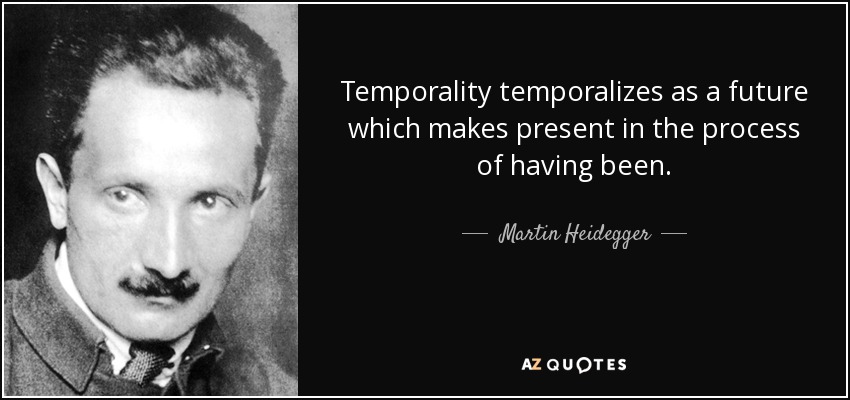
2) Take an already abstract noun: “time,” say, or “space.” Record its adjectival form: “temporal” or “spatial.” Now add whatever ending will turn this back into a noun: “temporality” or “spatiality.” Finally, shelve the shorter word and write the pentasyllable wherever possible. This operation can, like the last, be defended. The idea here is that we shouldn’t give automatic priority to mathematical clock-time or the countable boxes of the Cartesian grid. We shouldn’t treat the stopwatch and surveyor’s tape as though they were the true measures of time and space. The terms “temporality” and “spatiality” are to that extent pluralizing, keyed to the claim that there are lots of different ways of experiencing time and space; or of representing time and space; or of socially constructing time and space.  There is no time per se; there are multiple temporalities. There is no space as such, only multiple spatialities. Newtonianism is just the start of it. The mind, tempted to treat time and space as mere things or neutral containers, must be startled into seeing them again as processes or framings, and the gambit will be to push the terms morphologically further away from object-hood, into second-order abstraction. And yet the -alities are nonetheless rather puzzling. They come directly from Heidegger, for one thing, in the form of Zeitlichkeit and Räumlichkeit, and so simply are the jargon of authenticity, surviving undiminished some sixty years after Adorno tried to put such words to rest. But what kind of screwy and self-sabotaging Heideggerianism is this that convinces its adherents to ditch a well-watered Saxon root like “time” in favor of its Latin equivalent, and then requires that we further distend this bit of Norman-colonial Latinity with an Old French suffix? The terms spatiality and temporality are meant to draw our attention to “the lived experience of x,” but such words automatically sound more academic, formal, and attenuated to English speakers. Each such word is thus pulling in two directions at once, offering to rescue lived experience while accidentally building a linguistic wall that affectively distances the reader from the very experience it is trying to foreground. That process reaches its culmination with those theory-types who write “temporality” even when they mean “time” or “spatiality” when “space” would do just as well. The derived term pivots and swallows up its parent. A professor of media studies at Stanford writes that “Optical effects [in sci-fi movies] … re-integrate the spatiality of the spectacle with the ‘actual’ spatiality of the theater to create a phenomenologically significant experience.” The word “actual” is, of course, the giveaway. On the roster of topos words, “space” is one of the language’s relatively concrete options, at least as compared to geography and topography and topology and chorology and bathymetry The philologists, it’s true, are fond of pitting “space” against “place,” insisting that “place” is the properly particularizing word and that “space” always carries with it the geometric forces of de-localization. There’s something to that, of course, but in everyday usage, “space” is often plenty particular. You can sit in one. All the professor wants to say, therefore, is that the represented space of the movie dovetails with the real space of the movie theater. But instead of writing “real space,” he opts for the de-realized term (spatiality) which he then haplessly nudges back towards concretion (actual spatiality), while insisting via scare quotes that he is doing no such thing (“actual” spatiality). You’re not going to catch him calling a room a room.

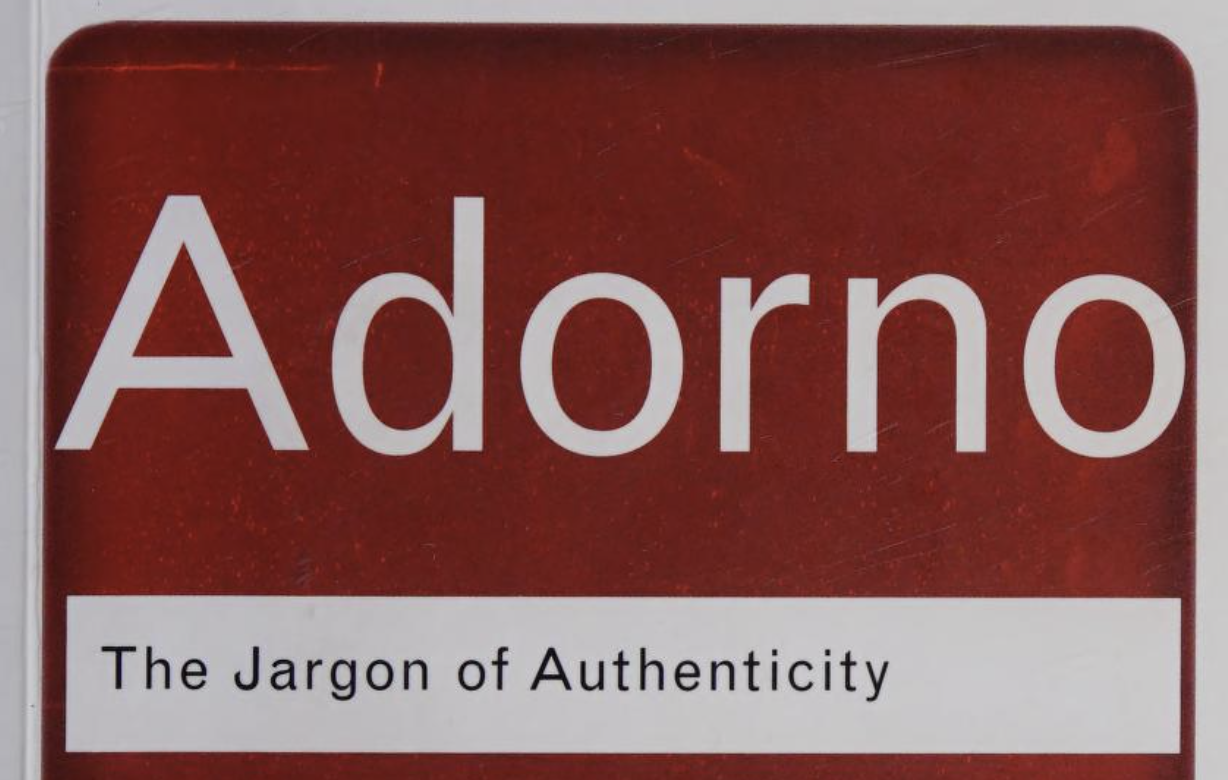
Adorno’s Jargon of Authenticity


I plan over the next couple of days to resume my commentary on Adorno’s Jargon of Authenticity. I thought it might help in the meantime if I gathered in one place all of the entries thus far. So here, as a list, are links to the first nine entries.

Day 1: Why is Adorno going after why Eugen Rosenstock and Franz Rosenzweig?

Day 2: The contradictions of existentialist religion

Day 3: Sacrificing thought to wish away change

Day 4: Heidegger checks in. 

Day 5: Their jargon — and ours. 

Day 6: Repetitively produced profundity.

Day 7: Counterfeiting connection to the world.

Day 8: Routinizing language against routine. 

Day 9: A jargon that sounds like everyday speech. 

Readers who prefer a pdf formatted like a book can find that here.

Hegel’s Lectures on Fine Art, Part 1

I would like to give some encouragement to readers who have been thinking about maybe tackling Hegel’s Aesthetics aka his Lectures on Fine Art. Hegel had a lot to say on the topic; his collected lectures clock in at more than 1,000 pages. Let’s now worry about the sheer daunting expanse of the thing. For now, I will be content to offer some commentary on its much thumbed introduction, following the Knox translation.

But first some groundwork. Anything that Hegel has to say about art is only going to make sense in the context of his system as a whole. Hegel holds that the task of philosophy is to help us conceptualize what he calls the Absolute, by which he means the world apprehended as a network of distributed and mutually constitutive points. But the Absolute is not just any network; it is Hegel’s term, rather, for a network with mind; a thinking network, therefore; a network capable of reflecting on itself and setting its own ends. This distinction—between networks with and without mind—is fundamental to Hegel’s project. It is the difference, saliently, between a free market and a market whose actors are invited to reflect on the economic system in which they are swept up, to make judgments upon that system, and to assign to it moral and political ends. That second kind of network we might not even think to call a “market” any more.

That’s the first important point. The next thing to understand is that Hegel thinks that there are three human endeavors that will all help us apprehend the Absolute. The first is philosophy. The other two are religion and art:

-religion, because, followed through to a certain terminus, it will fix our attention on the work of mind in the world (or spirit in the word—mind and spirit are the same word in Hegel’s German) and so bring us close to the Absolute, which is the fusing of material networks with mind;

-art, because, more simply, it is the mind or spirit in material form.

This last is Hegel’s master claim about art, which we can, for a start, specify in three ways:

1) If I remark now that the reconciliation of subject and object is central to Hegel’s philosophy, then I am once again circling around the Absolute. The canonical early modern philosophers tended to treat subject and object as opposed terms. This was clearest in the matter of epistemology, which was central to European philosophy for several generations. Is the world knowable? How do we know things? How do we know that we know things? Perhaps you can see without special explanation that those questions tend to position the mind as separate from the world—and also to make of the world a Big Puzzle in need of solving. To reconcile the opposition of subject and object requires that we not organize our philosophy around such questions. Is it possible to think of the mind and the world as integrated or unified – not as strangers to each other?

2) Hegel’s big claim about art is that it is great because it has clear ways of doing this (in ways that Kant, Schiller, and the Schlegels had already made identified). But then, Hegel goes on, lots of things can do this—can bring together the material world and the mind: revolution can do this, and so can thoughtful practice, and so likewise can religion. This is one of the ways Hegel is unlike the philosophers he otherwise resembles. He doesn’t think we are especially stuck in this regard. There are several different ways of reconciling subject and object. “Art is one of the means which dissolve and reduce to unity the … opposition and contradiction between … self-concentrated Geist and nature.” (56)

3) And when all is said and done, these other things are probably better than art.


Adorno on beauty, Part 2


       Adorno continues:

However, putting the concept of beauty on the Index — as many psychologies have done with the concept of the soul and many sociologies with that of society — would amount to resignation on the part of aesthetics.

The claim that most needs explaining is the bit between the dashes: Psychology, which is nominally the study of the psyche or soul, long ago dispensed with the category of the soul. That observation probably isn’t all that surprising. It might, in fact, just be a familiar point about secularization. Christians used to think that people had souls, but the psychologists have doubtless convinced you by now that all you really have is a “mind” or a “self.” Give the neurologists a chance and they’ll probably talk you out of having a mind. It’s Adorno’s second example that could make a person wonder: Sociologists often try to get by without a concept of society. Adorno, I hasten to point out, is right about this: Michael Mann begins his great trilogy on The Sources of Social Power by remarking that he would, if he could “abolish the concept of ‘society’ altogether,” though he promptly grants that this “may seem an odd position for a sociologist to adopt.” Maybe it’s not that odd, though. No-one knows better than a sociologist not to treat a society like a thing—not to say that society does x and society does y. It is Mann’s recommendation, therefore, that we treat any society as a congeries of “multiple overlapping and intersecting power networks”—networks whose respective borders are unlikely to line up, meaning that the network of economic power will tend to share some but not all of its territory with, say, the network of administrative power. In nearly all cases, the economy and the administration (and the culture and the military) will have different maps. They won’t coalesce into a single, discrete “society.”

There are other ways of giving up on the concept of society, of course, but Mann’s version is at least perspicuous. What we’ll want to see now is that Adorno’s observation holds quite generally—that disciplines routinely turn against their foundational concepts and name-bestowing objects of study.  The scholars of religion are quick to tell you that the term “religion” isn’t good for much—that no-one has ever come up with a definition of religion that covers all the instances one intuitively wishes to group under that name; or worse, that this particular term—re-ligio, a “re-reading” or a “binding fast”—is heavy with Western-for-which-read-Christian assumptions, in a manner that inevitably misdescribes all other religions, subtly rearranging them in order to make them more like Christianity or at least more intelligible to Christians. The historian of Japanese Buddhism finds late-Tokugawa officials, having just guaranteed New England merchants “freedom of religion,”  turning to each other and asking: What did we just grant them? Freedom of what now? Or again: Scholars of literature are the ones who have had to worry that the distinctions we draw between “literary” and “non-literary” writing are finally quite arbitrary. The avid but amateur reader knows that some books have fully earned their status as literature; the literature professor is less sure. The professors have also had to face the fact that the very term “literature” acquired its current meaning rather late—across the late eighteenth century, if the lexicographers are right—which means that whatever Shakespeare thought he was doing, he couldn’t have been writing “literature.” It is at this point that we will have to worry whether we aren’t making a recondite mistake whenever we read as literature a text that was written before there was “literature.” That’s a claim that can itself be made in impeccably literary terms: The word literature is itself a feat of verbal creation, a category created where formerly there was none. There are no works of literature per se, only works that we describe as literature and that we could equally well describe otherwise.

If you sit with these positions for a minute, you will be in a better position to appreciate how unexpected this sentence of Adorno’s is. For such self-consciousness about one’s central concepts—a reflexive turn heightened unto skepticism—is just the sort of thing that critical theorists are always asking for. A scholar of Buddhism who rejects the category of “religion” is a “critical historian of religion.” The literature professor who told his colleagues circa 1987 that “there was no such thing as literature” had gone over to “theory.” What we can now say is that Adorno is urging us not to do this—he is asking us to avoid the critical turn—at least for now and at least as regards aesthetics. He is suggesting that we not place beauty between scare quotes and so delaying the project of a critical aesthetics. More surprising still, he seems to associate the critical attitude with the apparatus of Catholic censorship—that’s the Index that appears early in the sentence: the pope’s Index Librorum Prohibitorum, the Index of Forbidden Books, which was still in effect when Adorno started work on Aesthetic Theory. Sometimes, one suspects, intense self-consciousness about concepts mutates into the rote policing of language. And Adorno isn’t having it.

Adorno on beauty, Part 1


Can there be an Adornian theory of beauty? It is not a category that one expects Adorno to have been drawn to. In one section of Aesthetic Theory, he calls for “a radically darkened art,” and that, of course, is just Adorno playing to type. That’s the Adorno who has inspired multiple American punk bands to release albums called Minima Moralia. A page or two later, still in Aesthetic Theory, he praises one version of modern poetry for having “defected to the enemy” — for having declared war, I guess, upon poetic things. Adorno would seem to prefer a verse that poisons nightingales and shoots skylarks from the air. Later in the same volume, he dedicates an entire essay to the ugly, and there we will find him praising “the penchant of modern art for the nauseating and physically revolting.” “The apologists for the status quo,” he says, get to ruin the world confident that the artists will beautify at least some of the resulting wreckage. In the midst of general ugliness, they will create pockets of “idle beauty.” So maybe that’s the Adornian theory of beauty right there—and maybe it’s theory you’d been expecting: Beauty is the happy face that kept artists put upon catastrophe.

The surprise, then, is to realize that this is not, in fact, Adorno’s final word on beauty. Yes, fine: Beauty is affirmation and apology and kitsch. But are we willing to consider the possibility that there is more to beauty that its readiness to acquiesce? Can negative dialectics find something worth affirming in beauty—and will that something itself be negative? Can you picture Adorno with a nosegay in his fist?

The way to start answering these questions is to read the essay  on beauty that begins at the bottom of p. 50 in Aesthetic Theory. Here’s the first sentence:

If anything, it is beauty that originated in the ugly, and not the reverse.

And with that, new questions already interpose themselves—specific questions to replace the general ones with which we began. Why, after all, does Adorno start here? What does this sentence even mean? What is he after? The trick will be to figure out who (broadly) Adorno is disagreeing with — and to realize going into it that the answer is likely to involve metaphysics. Why might someone think that beautiful things are primary or original and ugly ones in some sense secondary? Here, then, is a chain of argumentation: A person might not unreasonably hold that all things possess form, each thing its form, and they might think, further, that form typically involves purpose or function. Iron has served many different purposes over the centuries, and each change of purpose has been accompanied by a change in form; iron can come to us variably as a lathe treadle or a hand-crank corn sheller or a smelting ladle. Cartilage, too, takes different forms: it is there, in not readily visualized fashion, in your knee (to protect the bone), but also there, juttingly, in your outer ear (where it captures and directs sound waves into the ear canal). It is this simple point about form—different forms for different purposes—that will do most of the hard work for the classical theory of beauty. We are, after all, in the habit of judging things to be well-formed. That particular phrasing may not come to you intuitively, but this species of judgment surely does. You are accustomed to assessing the fitness of the things. But then I don’t want to just give up on the phrasing, which adds a little something of its own. For if I call something “well-formed,” I might just be saying that it is good, that it was well designed for its purpose. (“In a well-formed watermeadow it is as necessary to keep it perfectly dry at one time as it is to place it under water at another.”) But equally, I might be saying that it is handsome, or shapely; I might even be casting about for a way to call a man beautiful. The word “well-formed,” then, is the term from ordinary language that without strain conjoins the beautiful and the good. My point is that if you continue on in this connection, you might eventually find yourself arguing that the human mind is set up to apprehend fit things as beautiful—or even that fit things simply are beautiful and that the experience of beauty is the delight we take in their fitness. That, then, would be your opportunity to claim that beauty is primary (which — you can glance now back up to the top of the paragraph — is the opposite of what Adorno is arguing): Everything, again, has a form; and a large majority of things are at least moderately well-formed, if only because things that are not well-formed tend not to stick around for very long: the ill-formed, the anomaly, the freak.

The task now is to flip that argument on its head. The view that takes ugliness to be primary will have to adopt a competing metaphysics. Here’s one way to get at the thing: In Virgil’s Aeneid, as in most other classical epics, the stakes of a great many episodes are properly cosmic. As readers, we’re not just following Aeneas—we’re not just concerned for the hero, not just reading to find out what happens to him next, not just hoping that it will fare well with him. We’re reading, rather, to find out what will happen to, well, everything — to the entire cosmos. We are awaiting the verdict on the nature of reality.

  I think this is especially clear in the first book of the Aeneid—ie, early in the poem—when the Trojan ships are first scattered by a great storm. (That’s the tempest that blows Aeneas’ band of refugees to the shores of Dido’s Carthage.) You might remember: Juno has created this storm in order to vex the Trojans, and in order to do so, she has had to approach the divine wind-keeper and seduce him into turning loose the squalls over whom he has custody. As Virgil tells it, the winds are universally known to be dangerous and so kept in prison. Killer squalls, held in a dungeon:

But high in his stronghold Aeolus wields his scepter,
soothing their passions, tempering their fury,
Should he fail, surely they’d blow the world away,
Hurling the land and sea and deep sky through space.
Fearing this, the almighty Father banished the winds
to that black cavern, piled above them a mountain mass
and imposed on all a king empowered, by binding pact,
to rein them back on command or let them gallop free. (Fagles 1.69-76)

What I hope you’ll notice is how generalized the language becomes here—that’s the mark of the epic shifting over to rude ontology. It’s not just that the winds can damage Sardinia or the Florida coast. They can “blow the world away.” We might notice how the poem shifts for a single line into a sublime and elemental sci-fi image: The stuff of the planet whirling in a void. When reading an epic, you should stop whenever you run into sci-fi language like this, because that’s when the epic is turning metaphysical. And what we see here is the possibility of a world of contending and unruly forces; Dryden’s translation of the same pages speaks of “mixed confusion.” But let’s notice, too—because this is crucial—that this disorder is just a possibility, since the gods have undertaken a cosmological effort to keep the world ordered when it is not naturally and by necessity ordered. You might say, then, that there are rival ontologies in the Aeneid—a ontology of order vs. an ontology of disorder (or chaos or strife). The epic isn’t only concerned with the founding of Rome — it’s trying to figure out whether order or disorder is going to win in the cosmos—and of course it superimposes that battle of cosmic principles onto the Roman story. Maybe the more accurate way to put this would be to say that the poem posits a single, riven ontology: the universe is capable equally of order and disorder. Order might be in evidence, but the possibility of cataclysmic disorder can never be discounted. Order is available, but only through commitment and effort—including the efforts of regal gods whose powers are great but not entire.

        What I’m trying to say is that the storm isn’t just an ordinary, old narrative obstacle. If anything, it functions a bit like the especially nasty pre-credit kill with which some horror movies begin. Virgil’s epic starts by flaunting its nightmare and apocalyptic antithesis, as the poet sets off to write against the chaos and mixed confusion that the reader glimpses in the storm. The Trojans, as a people, have been scattered. And Aeneas’ ships have now just been scattered—that’s a scattering within a scattering, a diaspora twice-dispersed. If you can grab hold of the epic’s ontological thread, you might be able to make sense of the Aeneid as a poem against the scattering and against the storm. Early on, Venus tells Aeneas that she has seen “scatt’ring” birds regather into a flock—“all united in a goodly team.”

Such, then, is what it might mean to claim that ugliness comes first and that beauty follows on: The fundamental condition of the cosmos is disorder, chaos, or strife. Order and form and purpose and beauty must accordingly be built (and guarded and, where necessary, repaired). That’s the position that Adorno wants us, at least, to consider—though his opening phrase, “if anything,” is enough to suggest that he doesn’t really credit this version any more than he does its opposite, it being a hallmark of dialectical philosophy that antitheses arrive in pairs, as polarized conceptual fields, and that one couldn’t possibly talk about either “ugliness” or “beauty” if the other weren’t already in view. Let’s agree, then, that the ugly and the beautiful are coeval, but having said that, let’s also consider the status of beauty in a world that is fundamentally geared towards ruin.

Jargon of Authenticity, Day 9

The question that arises at this point is how we can identify a word as belonging to the jargon of German existentialism. The English-speaking reader probably won’t have this problem. If you’re American and reading someone under the spell of German existentialism, chances are you’re going to be able to tell, even if you didn’t know it when you picked up the book. And the reason you’re going to be able to tell is that there will be this set of words that the author will have either left in German or gratuitously capitalized. But the German reader has to make due without these clues, since the word Dasein really is just the German word for “existence.” German also capitalizes the noun form of Being whenever it appears. Adorno, moreover, has noticed that the words that make up the jargon of existentialism aren’t, in fact, the more obviously offbeat entries in the Heideggerian lexicon; they aren’t “the presence presences” or Beyng-with-a-y. For the most part, the jargon is made up of words like “queer” — an ordinary, if contested, English word that became central to the history of American Foucauldianism even though it didn’t originate with Foucault himself.

        So how again do you recognize a word as jargon? Here’s Adorno:

Many of them [the terms in question] could be used in other constellations with nary a wink at the jargon: the word Aussage [“statement” or “utterance”], when an epistemologist needs a concise way of designating the judgments of predication…

Here it is enough to know that the word Aussage [“statement”] shows up routinely in German discussions of Aristotelian or Fregean predication. It’s the term for any claim that we might plausibly judge to be true or false, for which Anglophone philosophers prefer the rather fussier “proposition.”

       So Aussage has a perfectly reasonable use outside the jargon. And so does the word “authenticity” itself:

or the word eigentlich [“authentic”]—though here one must be careful—including as an adjective, whenever the essential is to be distinguished from the accidental…

Adorno says that “authentic” is fair game even when it’s an adjective, and the reason he needs to tack on that extra reassurance is that in German, the word eigentlich is first and foremost an adverb, so common and conversational as to have lost much of its proper meaning. If a German says “Why not?” — in the sense of “Might as well” — he is likely to insert an eigentlich in the middle: “Why eigentlich not?” Or perhaps you’ve made an assumption about your German friend: “You must have hated that movie.” And she responds: “Actually, no. Eigentlich nicht.” Sometimes the word has the force of “anyway” — to indicate that you are getting around impatiently to a question that you’ve been meaning to ask or that you are expressing your belated confusion: “What are you doing anyway?” or “What exactly are you doing?” “Was machst du denn eigentlich?” The point is that no-one is going to tell Germans to stop using eigentlich in any of these several vernacular and semantically bleached ways. It would be silly to even try. But to that implicit concession, Adorno has added two points: First, that eigentlich in its dictionary form is not altogether useless; we will occasionally want to know whether a particular something is “authentic.” Second, that the existentialist use of eigentlich is something else again, deviating importantly from its dictionary usage.

        We’ll also notice that Adorno is a bit nervous about the word “authentic,” even before it was seized on by the existentialists: “here one must be careful” — presumably on by now familiar anti-essentialist grounds. Adorno doesn’t want anybody presiding over who or what gets to count as authentic. One might wonder, then, why he doesn’t just give up on the word altogether. Why include it on his list of the jargon’s innocent uses, when he doesn’t think the word is all that innocent? The answer is simple, which is that he knows he has used the word himself, in earlier writing, and he is pre-empting the hostile reader who might otherwise be tempted to point this out. He finds himself compelled, in other words, to make a little confession, like so: The jargon includes ordinary words, “statement” or “authentic”…

or the word “inauthentic,” where something fractured is meant, an expression that no longer lines up directly with what is expressed: “Radio broadcasts of traditional music, music conceived in the categories of live performance, have as their undercoat a feeling of the as if, of the inauthentic.”

The point not to miss is that the quotation comes from Adorno’s The Faithful Repetiteur, which had only just appeared in 1963, the year before The Jargon was published. Adorno, in other words, is quoting himself. He’s caught himself using the word that this entire volume seems to be arguing against—the word that provides the book with its sneering title—and he accordingly feels compelled to account for himself:

In this case, the word “inauthentic” is performing a critical function, the determinate negation of something illusory. 

It’s not clear to me that what Adorno is describing really is a “determinate negation.” (That’s Hegel’s term for the idea that the mind can grasp any particular thing only in contradistinction to other relevant objects. The mind cannot apprehend the identity of an object directly, in the absence of contrast or opposition; something can be cognized as what it is only by also knowing what it is not.) If anything, all Adorno seems to be doing here is assuring the reader that he, at least, isn’t using the word “inauthentic” ideologically, in order to prop up some other class of objects—in this case performances—as “authentic.” He is simply combating a certain media lie—the illusion that the radio is giving us the real thing—and he is doing this, he implies, by amplifying the feeling of inauthenticity that has been part of our experience of the radio all along.

    He continues:

The jargon, however, extracts “authenticity”—and its opposite—from out of any such context of insight and understanding. 

If I say “Everybody knows that reality television isn’t real,” I am not making strong claims about the nature of reality or our ability to know it. I’m not claiming to be able to give a metaphysical account of how reality is actually constituted. All I’m saying is that this thing that purports to be real is palpably fake (and that its fakeness is widely acknowledged). I also haven’t introduced the word “real” into the conversation; when I say that reality television is not real, I am simply holding the genre to the standard of its own choosing. The problem, then, with the existentialists is that they do claim to know what makes some people authentic and others not, and they are willing to make that determination of anyone and everyone, even of people who never claimed to be authentic in the first place — people, that is, who haven’t invoked the criterion.

But it turns out that you can only go so far in protecting the words from the jargon:

One isn’t about to hold the word Auftrag — an “order,” “errand,” “task,” or “mission” — against a company that has just received one. But possibilities of this kind remain crabbed and abstract. Anyone who presses them too far is headed for a blankly nominalist theory of language, in which words are nothing more than exchangeable tokens, untouched by history. 

This last sentence is trickier than it initially appears. Adorno seems to be warning his readers against nominalism—that’s the idea that most words (all words?) are just names and that the concepts that these refer to don’t rest on anything real. The spin-off of nominalism that most of us are steeped in is some version or another of “the social and discursive construction of reality.” It’s the position you are taking any time you announce that “gender isn’t real” or “race isn’t real”—that these are above all ways of talking. We classify people and things one way; we could just as well classify them lots of other ways. The puzzle here is that Adorno is demonstrably a nominalist, as are nearly all critical theorists and indeed anyone who has read a lot of Nietzsche. It is genuinely odd to find Adorno shoo-ing his readers off the path to nominalism. And recognizing this should allow us to see that Adorno is not, in fact, condemning nominalism as such; he’s not actually promoting the realism that wants us to believe that gender and race aren’t just constructs. It is only a certain extreme nominalism that he wants to guard against—not all nominalism, just the blank and ahistorical kind. The mistake would be to treat each individual usage of a word as though it were a stipulative definition, empowered blithely to elect its own meaning: Let x mean y. And the problem with stipulative definitions is that they instruct us to ignore the entire range of ambiguous and secondary meanings that nearly any word will have accrued. They require us to suppress whatever associations come to mind and are to that extent de-contextualizing, asking us to prescind individual words from their broader verbal and social contexts. (That’s what Adorno means when he says that this approach is “crabbed and abstract.”) The alternative, of course, would be to let the context back in—to let the word be “touched by history.” But in that case, we can’t continue to use the German words enlisted by the right-wing existentialists by pretending that those sub-Heideggerian usages don’t exist or don’t apply. A German speaker’s verbal and social context now includes the jargon, which can’t be wished away.

He goes on:

History makes its way into every word and so blocks each one from retrieving its putative Ursinn, its original definition and primal sense, which is what the jargon is always chasing after. 

The last clause undertakes a characteristically Adornian reversal — so quick and dainty a spatula-flip that a reader could easily read right past it or register it only as a fleeting perplexity. Adorno, after all, wasn’t addressing the people who embrace the jargon; he was addressing the ones who reject it, the ones who want to keep their language uncontaminated by the weird philosophers. What this last clause is saying, therefore, is that the two groups converge on a quintessentially Heideggerian mistake, which is to think that they can resurrect at will the earlier meanings of a word. The jargoneers want to return language to Homeric Greece and the barbarian forests beyond the Roman limes. The anti-jargoneers aren’t as ambitious; they just want to protect the common usages that predated the jargon itself. But at heart, the impulse is the same: if they aren’t careful, the opponents of existentialism will repeat the errors of their enemies.

Jargon of Authenticity, Day 8

The next bit is going to introduce some new terms, and it will help us understand what Adorno is saying if I spend some time first preparing the conceptual ground. His claims here turn on our perceptions of structure and system. This gets at some of the fundamental debates among critical theorists and their cousins over the last seventy-five years. If you are finding your way through critical theory for the first time, you are going to have to work out your own answers to a few fundamental questions, because the theorists you’re reading will give you lots of different answers, among which you will have to choose: Do you think it is the tendency of nature, society, and language to settle into more or less stable structures? And if so, do you think structure is a good thing? The point is that anyone answering these questions in tandem has lots of different options. To wit:

1. Structure is elusive, but it would be better if we had more of it.

2. Structure is our common condition, and that’s just as well.

3. Structure is our condition, and this is our doom. We should labor to dismantle the structures that ensconce us.

4. Structures and systems are themselves myths. Nothing ever coheres as tightly as those words imply. It’s probably too much to even speak of “nature” or “society” or “language,” since those words all imply more structure than the whirlwinds in question actually have. Our problem, then, is never “the system”; we suffer, at worst, from the mistaken perception of system.

If, now, you come out as an anti-systemic thinker — if, that is, you are convinced that structures exist, but announce that you don’t like ’em — there are some further determinations you will have to make. What, for one, do you take to be the alternative to “structure”? Is the idea to arrange the stuff of nature or the stuff of society in some other way — a way that the word “structure” doesn’t capture? You might determine, for instance, that an “organism” is not a “structure,” which word suggests to you an edifice or built design. You might then conclude that organic arrangements are preferable to engineered ones. Alternately, though, you might conclude that the idea is to do away with arrangements altogether, and not just mechanical ones — to liberate the members of a structure, so that they might in an open field fashion their own temporary and shifting relationships, provided, that is, that they don’t prefer simply to do without relationship.

     Adorno is about to claim that the existentialists are muddled in their approach to language-as-system. We know that Heidegger, after the war, wanted to roll back what he saw as the technological takeover of language. He thought that people had increasingly come to treat language as a mere tool — as though English and German were rival communication devices, or as though language in general were some ingenious ancient technology. He also thought that modern linguists tended to conceive of all language on the model of cybernetics and binary code. And he thought that the primal, poetic vocation of language was to disclose to us the stuff of the world, to help the world manifest before us, whereas a language conceived of as mere tool was likely to tote up the world’s many things and re-package them all as “information.”

       Here, then, is Adorno. The jargon prizes authenticity and wants us to have a more authentic relationship with language. But in the process…

The ether is sprayed mechanically about; the atomistic words are freshened up without their being changed. It is thanks to what the jargon calls Gefüge, “structure,” that they are granted precedence over structure itself. The jargon, objectively a system, deploys disorganization as its principle of organization, the decay of language into words by themselves.

Let’s note first: The jargon has its own word for “structure” — a stoutly German word, even though modern German is perfectly happy with die Struktur. This is a jab, of course, at the Heideggerians linguistic nationalism; they have swapped out the Latin word in favor of some nativist alternative. The word, in fact, is artisanal in just the way you might expect — it comes from the verb fügen, which means to fit together in the manner of a woodworker, to connect pieces together to make a more complex object. You could just about translate it as “joinery,” but you might also think about how English-language writers sometimes use the word “fabric” as a gauzier alternative to the rectangular articulations of “structure”, as in”the fabric of society.”

But then what is Adorno’s objection? The problem, as he sees it, is that the followers of Heidegger want to transform our relationship to language in some fundamental way, and they want to make it less technological. And yet their way of doing this, via the jargon, is both piecemeal and weirdly mechanical. What Heidegger thought it would take a poet to accomplish—the rescue of our language from the spirit of technology—the jargoneers think anyone can accomplish just by pushing any of fifteen or twenty verbal buttons. The jargon is at once too much of a system and not nearly enough of one. Not nearly enough of one, because it has given up on the ambition to transform language top to bottom. Convinced of impending verbal catastrophe, it is nonetheless resigned to changing almost nothing, rejuvenating a handful of words on an individual basis, and altering even these almost not at all. A systemic crisis requires a system response, and the jargon isn’t that. But it is also too much of a system, it in that it amounts to a rulebook, a series of steps. Say X and you will be authentic. Say Z and you will undo the Forgetting of Being.

Jargon of Authenticity, Day 7

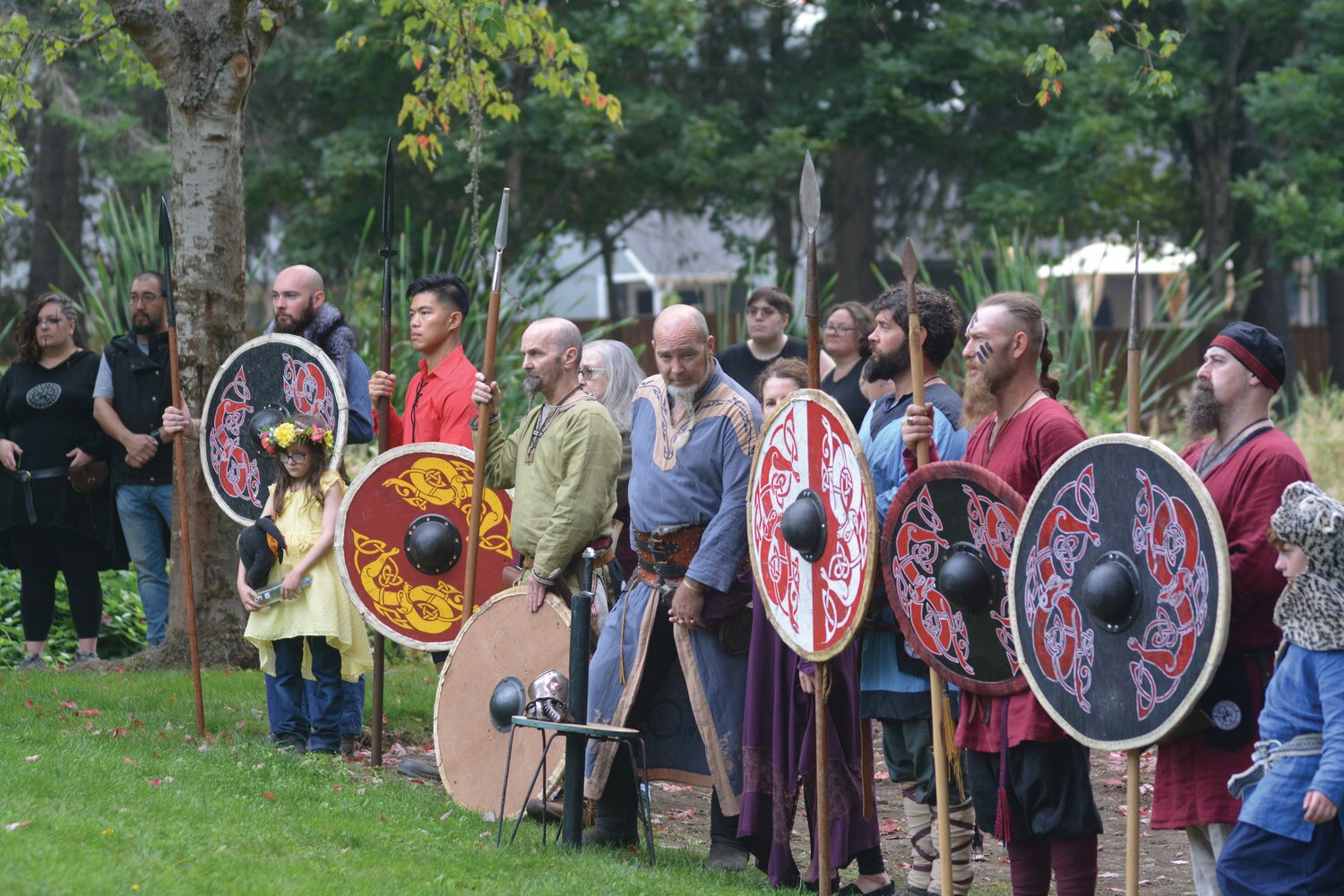
Vikings attending Viking Fest were dialed in to a Sunday morning viking wedding reenactment.


Adorno was just explaining that people who use the jargon treat individual words as though they were magic — and not in a good way. He’s about to elaborate:

The individual word partakes of a secondary transcendence; transcendence ready-made and straight from the factory; a changeling that has been swapped in for the transcendence that was lost. Elements of empirical language are manipulated in their rigidity…

…”massaged,” I think we would say…

…as though they were elements of a language true and revealed; for speaker and listener alike, the empirical familiarity of these sacred words counterfeits a downright bodily proximity. 

An example should make this clear: Let’s say that in a Heideggerian mood, I remark that the words “thing” and “object,” which we typically treat as synonyms, are nothing of the sort. A “thing” is not an “object,” as we should be able to see if we examine the two words’ respective etymologies. In old English, as in the other Germanic languages, a “thing” initially referred to a free people gathering to discuss matters of common concern — a tribal assembly, as it were — and then over time it came to refer, as well, to any one of those matters: something that might concern us, an item, an issue. The German word for object, meanwhile, is Gegenstand — that which stands over and against me. This suggests an entity that, while separate from me, exists only in relation to me. The precise English equivalent is “obstacle.” You might want to pause here to let that one sink in. The ordinary German word for “object” invites us to see all of the world’s things as obstacles. But then the word object is if anything even worse. It shares the prefix ob-, obviously — “in the direction of” or “in front of” — but in the place of sta-, “to stand,” it has iac-, “to throw.” An “object” is something that has been thrown at you or in front of you — a missile, a rock, a fresh obstacle, debris. At best, calling something an “object” should communicate surprise: How the hell did this get here? More likely, it communicates: Duck! Knowing this, I might now resolve to think of the stuff of the world as “things” and not as “objects” — to conceive of the world as an occasion to gather and an invitation to my concern, and not as so much litter or shrapnel.

We can plunge back into the sentence. Maybe we can now see what Adorno meant by “secondary transcendence.” At least in this case, by championing the word “thing,” I am attempting to revive an earlier set of meanings; trying to go back behind even Middle English, which had already lost the sense that “thing” could also mean “assembly”; vowing to remember the Icelandic Althing or Danish Folketing every time I so much as refer to a screwdriver or a lawn chair. I can’t, of course, revive the unfathomably different social conditions under which the word “thing” meant both “object” and “tribal gathering,” but I can convince myself that I am silently invoking that history every time I write the word “thing,” and I can convince myself, too, that rejecting the word “object” will bring me closer to objects, will render them less alien, by training me not to conceptualize them as impediments. But attempted piecewise, via individual words, and without our doing anything to change the general status of objects in capitalist societies (mass-produced, disposable, universally exchangeable), my embrace of the Anglo-Saxon “thing” amounts to little more than philosophical cos-play. I accomplish next to nothing by intermittently looking around my dining room with the eyes of a Norseman.

Jargon of Authenticity, Day 6

Adorno was just listing terms that belong to “the jargon” — and also remarking that many of them are ordinary German words, not immediately recognizable as jargon if cited out of context. He goes on:

The point, then, is not to compile an Index Verborum Prohibitorum of fast-selling noble nouns, but to ponder the linguistic function of such terms in the jargon.

A reader might be wondering here about the phrase “noble nouns.” That’s a single, compound word in the original, which Adorno has formed by attaching the prefix Edel- to the word for “noun.” It is, as best I can tell, Adorno’s coinage, though it follows an established pattern in German. English, like German, refers to helium and neon and the like as “noble gases,” but Germans extend that formulation to many other things, in a way that English speakers don’t, often marking out the high-grade or special members of some class by attaching to it the prefix Edel-. A German gem is a “noble-stone.” Stainless steel is “noble-steel.” That said, we won’t want to overlook the soft oxymoron that Adorno has generated around his coinage: The terms in question are noble, sure, but they are also good business — “fast-selling.” Their very nobility has been diluted or indeed hucksterized, hawked by journalists and pundits, on the lips of every pretender.

     The Latin phrase, meanwhile, is Adorno’s riff on the Catholic Church’s Index of Forbidden Books, for which he has substituted “Index of Forbidden Words,” the idea being, of course, that he is repudiating the role of censor. He wants us to keep track of the jargon, but he’s not going to tell anyone to delete its terms from their vocabulary.

      He continues:

Its lexicon consists of rather more than noble nouns anyway. At times it even seizes upon [otherwise] banal words, holds them aloft and then bronzes them in the fascist manner, which wisely commingles the plebeian with the elite.

The first thing to notice about these two sentences is that they give one good reason to forgo censorship. The jargon, Adorno says for a second time, features many ordinary German words — one is tempted to say “common nouns,” in juxtaposition to those nobles one — and it would be downright silly to interdict basic and everyday terms from the German vocabulary. A contemporary American professor could just about instruct his students to stop using (and mostly misusing) the word “ontology,” but he’s hardly going to tell them to stop using the word “body.”

But this passage is, of course, more alarming than that, since Adorno is beginning to elaborate now on his big point — that something about how educated Germans spoke, as late as the 1960s, still sounded kind of fascist. And this particular observation about fascism’s verbal style — that it employed a mixed idiom that oscillated promiscuously between the demotic and the high-flown — could easily remind the reader of a second book, one that preceded Adorno’s by some sixteen years: This would be Viktor Klemperer’s LTI – Lingua Tertii Imperii, or “Language of the Third Reich,” a set of reflections on the idiosyncrasies of Nazi German, compiled in notebook-form during the ’30s and ’40s by a Jewish-at-birth literature professor and published to great acclaim in 1947. Adorno, in other words, had a model.

        But the writers he is about to name are neither of them Klemperer. Once you know who he’s talking about, in fact, the next sentence is downright alarming:

The neo-romantic poets who drank their fill of the choicest vintages, like [Stefan] George and [Hugo von] Hofmannsthal, by no means wrote their prose in the jargon; many of their intermediaries, however, did — [Friedrich] Gundolf, for instance.

To remark now that Stefan George is usually regarded as the most important German modernist poet — and that Hofmannsthal was his Austrian twin, his sometime collaborator and lifelong frenemy, is not yet to say nearly enough. The most important thing to know about George is that he started his career as a junior member of the Mallarmé circle in Paris, slurring his name to Shorsh in place of the crisply Germanic Gay-yor-guh, and that he ended his career as the official poet of Germany’s hard Right and indeed of the Nazis. He thus enters cultural history as the intermediate step between the queer aestheticism of the 1890s and National Socialism; he was the guy who, while writing poems that typically remind English speakers of Eliot or Pound or Yeats, also helped publish numerous volumes of literary history with swastikas in their front matter and titles like The Poet as Führer. This is explainable: George and his followers — he was famous for having followers — united around a stalwart program to dismantle the institutions of the modern world. They wanted to roll back a whole range of depersonalized social forms: capitalism, large cities, rule-based organizations of any kind, industrialism and its technologies, mass media, mass politics. We should be careful here, since this was at one point a fairly common program and came in lots of different versions, not all of which landed on the political Right. The Rousseauvian Left could still sign onto that platform. So could the Jeffersonian republicans, on the understanding that to be a true American is not to be European, is not to be civilized; to be American is to remake yourself for the better in conditions of relative hardship (away from big cities and settled institutions &c). What made the George Circle distinctive, then, was twofold: First, it championed poetry as the alternative to (over)civilization — poetry and not, say, the frontier. The poet-prophet would play the role that Americans more typically assign to the cowboy or the Nebraska pioneer. Poetry would keep open the possibility of a life lived beyond the industrialized anonymity of mass society. That’s the first distinctive point. The second distinctive point is that the George Circle thought that fascism would make the world safe for aesthetes and queer people — if not the Nazis, then at least some hypothetical other fascism that at least some of them, for a time, mistook for really existing National Socialism.

     What I can add now is that Gundolf was for many years George’s favorite disciple — and the one tasked with translating the Circle’s program into accessible prose. It’s that divvying up of duties that seems to interest Adorno here. We can give the right-wing poets a degree of credit — credit, that is, for not having resorted to a standardized idiom even when writing prose. But it was the literary historian’s job to re-state the tenets of their fascist aestheticism in terms that lent themselves to codification and repetition — to take the rarefied discourse of George’s “Secret Germany” and make it not-so-secret. And what Adorno thinks he has noticed is that the postwar existentialists are still talking in the accents of the fascist-bohemian middlebrow.

      Adorno continues:

Particular words only become jargon through the constellation they deny, through each word’s posing as unique. What the singular word has lost in magic is acquired for it in a dirigiste manner, as though measures had been implemented. 

“What the singular word has lost in magic…” The place to start here is with the observation that words used to have magic but now mostly don’t — that’s clearly a linguistic variant of Weber’s disenchantment thesis. Adorno has omitted an important explanation here that serves as the backdrop to his more targeted comments — namely, that a great many modern intellectuals have regarded poetry as a way to combat disenchantment. Let’s start with one familiar understanding of magic: The sorcerer is the person who can speak something into being, via spell or incantation. Any anti-mimetic theory of literature, then, will ask us to think of poetry as a species of lesser magic. Poets do not merely write down what they see in front of them; they are the inventors of worlds. The fictioner gives ongoing evidence of the mind’s creative powers. But that’s not the end of it. Anyone who subscribes to speech act theory or social constructivism or the doctrine of mind-dependent social kinds is claiming to find this sublunary magic at every turn, IRL, and not just in the library. It turns out that we routinely speak things into being. The word “spell” means both “abracadabra” and “to list in their proper order the letters that make up a word.” At root, the word “incantation” just means “song.” “Grammar” is “grimoire.” A disenchanted language, then, would be one that is unwilling to unleash the powers of alphabet, song, and grammar, content only ever to describe and transcribe and record — a language that makes nothing, backed by a theory of language that sees all words as secondary, as following on from the things they merely designate, a theory that grants language no creative force. To this we need merely add that many modern poets really have tasked poetry with keeping alive the creative force of language — word-magic — in periods when that rival view of language (as so many tokens) has come to prevail; with charming the reader beyond the constraints of analytic understanding; and perhaps even with safeguarding the ancient and esoteric wisdom that mere science has tended to overwrite. For a period, Stefan George belonged to an esoteric circle in Munich that called themselves the Cosmics. W. B. Yeats was a wizard in the Order of the Golden Dawn.

        If you go back now and look at Adorno’s last two sentences, what will jump out is that Adorno is talking still about the jargon and not about poetry. On the basis of this passage alone, we can’t say what Adorno thinks about those properly poetic attempts to restore the magic of language, though in other essays, he does express a guarded admiration for George, and especially for the intransigent, homophile nonconformity of the poète maudit. The point here, however, is that the jargon has its own way of trying to re-enchant language, and that this way is ham-fisted, bullying, and hopeless. The jargon inherits from the poetry to which it is adjacent the project of re-enchanting language, but is really bad at it. I’d go so far as to say that this short passage offers a theory in passing of what makes jargon jargon; it teaches you how to recognize when a word has been annexed to some jargon. The problem with jargon is that it claims to produce the thing that it names — that’s the magic bit — without the speaker having to make any additional effort. Someone speaks the word “identity” and concludes that they have thereby fashioned a stable persona, without having to understand how selves get assembled or pausing to worry about how our ego constructs tend to come unstuck over time. I speak the word “intersectionality” and believe that I have thereby already done the hard work of solidarity. Having been told that networks of oppression typically overlap, I spare myself the labor of figuring out just how they are articulated — here, now — and I find myself with nothing to say about how the matted skein of domination might yet be unraveled. Each term pretends singly to some such power, even though they are all interlinked, tending, in fact, to be defined in terms of one another: “intersectionality” gets defined with reference to “identity”; anyone explaining “identity” asks first if you understand “positionality” and so on. And the terms themselves are rhetorically quite flat. Repetition alone will tend to routinize them and so strip them of their verbal mojo. The jargon will never achieve the insinuating and uncanny character of the well-turned poetic line, that weird cadence that can make verse sound like an improvised hex: “And I will show you something different from either / Your shadow at morning striding behind you / Or your shadow at evening rising to meet you; / I will show you fear in a handful of dust.” Words like “identity” and “intersectionality” have been assigned their bogus magic by professorial explanation and glossaries compiled on college websites. They are magic only by decree, pedantically enchanted.


Jargon of Authenticity, Day 4

Heidegger enters the scene on the third page. Here’s the paragraph in full:

This [Kracauer getting shown the door by the Rosenstock circle] was well before the publication of Being and Time. In that work, Heidegger introduced authenticity par excellence, in the context of an existential ontology and as a philosophical term of art; so, too, did he pour into the mold of philosophy the object of the Authentics’ less theoretical zeal; and in that way he won over all those in whom philosophy strikes a vague chord. It was through Heidegger that confessional demands became unnecessary. His book acquired its nimbus by describing as full of insight — by presenting to its readers as an obligation true and proper — the drift of the [German] intelligentsia’s dark compulsions before 1933. Of course in Heidegger, as in all those who followed his language, a diminished theological resonance can be heard to this very day. The theological obsessions of those years have seeped into the language, far beyond the circle of those who at that time set themselves up as the elite. Nevertheless, the sacred quality of the Authentics’ language belongs to the cult of authenticity rather than to the Christian cult, even when — for temporary lack of any other viable authority — the Authentics end up resembling Christians. Prior to any consideration of particular content, their language molds thought in such a way that it adapts to the goal of subordination even when it thinks it is resisting that goal. The authority of the absolute is overthrown by absolutized authority. Fascism was not simply a conspiracy, although it was that; it originated, rather, in a powerful current of social development. Language provides it with a refuge; in language, the still smoldering disaster speaks as though it were salvation. 

A reader might launch into this passage and think they have arrived at the main event, the smackdown, Adorno vs. Heidegger. This is what I came to see. That would be wrong — consequentially so. For anyone trying to make sense of The Jargon of Authenticity, nothing is more important than noticing that Adorno is taking much of the onus off of Heidegger, who was at most an important relay for a malign turn in German intellectual life that happened well before he started writing. Stripped of all detail, what this page is saying is that the problem goes well beyond Heidegger. Focusing too much on Heidegger lets too many other intellectuals off the hook.

       I’d like to go ahead and extract three theses from this paragraph — they are, I think, the book’s major claims — and pause to ask what implications they might have for anyone trying to reckon with the revival of fascism in our own generation.

        Thesis #1) Anti-fascists, when studying fascist thought, should be prepared to cast the net widely. At some level, Adorno’s approach isn’t all that unusual. On the basis of this paragraph alone, we could think of The Jargon of Authenticity as his attempt at an Intellectual Origins of National Socialism, and we might note that the book appeared at more or less the same time as the classic volumes on that topic: Stern’s Politics of Cultural Despair (1961); Mosse’s Crisis of German Ideology (1964). It’s just that Adorno proposes figures of his own, alongside the agrarian ethno-nationalists and anti-Semites and pan-German Wander-birds unearthed by Mosse and Stern. He thought that the early existentialists had something important to contribute to the making of fascism — an authoritarian cast of mind that typically posed as religious and sometimes even posed as free. But unlike Mosse and Stern, Adorno was also interested in the survival, after 1945, of this proto-fascism. The fundamental task of all historical study is to judge matters of continuity and rupture — to identify what in any historical constellation has been inherited and what has been made anew. And there is perhaps no period for which this most basic of historiographic questions has higher stakes than Germany in the 1950s. What did the Germans (and their minders) manage to remake after the war, and perhaps build from scratch? And what was carried over from the 1930s and ’40s? (Who rebuilt the bombed-out cities if not Nazi architects? Who staffed the reopened public schools if not Nazi teachers?) Adorno, at any rate, is offering his own version of what we might too innocuously call the Continuity Thesis.

      Thesis #2: Even radical philosophy has a way of remaking itself as an idiom, a set of verbal commonplaces, a lingo for the educated classes. This indicates a break with Adorno’s usual method. You can pick up Negative Dialectics if you want to see Adorno grapple with the technicalities of Heidegger’s philosophical program — if, that is, you want to watch him crawl inside of that program and flush out its impasses and contradictions from the inside. The reason, one concludes, that Adorno decided finally that The Jargon of Authenticity did not belong in that volume is that he is in this case not interested in philosophy qua philosophy, and certainly not interested in its subtle failures. If anything, he is interested in the success of modernist German philosophy, but as something other than philosophy — interested, I mean, in the making of a Heideggerian-existentialist patois that got spoken, apparently, by a lot of people who weren’t philosophers — people “far beyond the circle” of adepts. What I’d like us to notice for now is that this position is doubtless repeatable. Adorno hands us a question that we might want to ask and at intervals re-ask: How does the late-modern Bildungs-bourgeoisie deploy to its own ends the philosophical argot with which its professors have equipped them? We might, for instance, want to chart the fate of critical theory itself as it moves from the classroom to Left Twitter and Left Tumblr and various workplaces. And when we ask that question, we will want to avoid a certain temptation, which will be to blame the speakers of this or that philosophical jargon for not getting it; we will have to choke back the lecture that we have at the ready, the one that pronounces ex cathedra that That’s not what Heidegger (or Foucault or Butler) really said. If Adorno is right, then philosophy attains its (malleable) historical force only in reduced form, as a vulgate. It’s the crude version that we should be keeping an eye on.

       Thesis #3: Fascism draws some of its intellectual energies from people who do not regard themselves as fascists and who may even take themselves to be anti-fascist. I can specify the matter like so: Many of the intellectuals that Adorno sees as preparing the way for Heidegger and for what he is content to call fascism were Jewish — either active Jews (like Rosenzweig or Buber) or men from Jewish families (like Rosenstock or the Ehrenbergs). In fact, the one figure that Adorno has cited approvingly (Borchardt) was way closer to the fascists than the unnamed figures he is now attacking. This is bound to shake up our understanding of fascism. Hans Ehrenberg was a vocal member of the movement that defied the Nazi takeover of the Protestant churches. Rosenzweig and Buber made landmark contributions to the revival of modern Jewish philosophy. Adorno’s argument is outrageous if wrong and disturbing if right: Your positions, as they enter the world, will not remain *your* positions. Even your anti-fascism can be transposed into a fascism. Call it the ruse of un-reason.

One way to capture the force of Adorno’s theses would be to update them, speculatively, for the revival of fascism in our generation. You could, if you wanted, enter the ranks as an anti-fascist philosophical watchdog. You could tell us that members of Trump’s inner circle have been reading Julius Evola, that they’ve met with Aleksandr Dugin. You could warn us again about Nick Land and the lure of Dark Enlightenment. You can bone up on de Benoist and the French Nouvelle Droite. But if we follow the page in front of us, then this isn’t nearly enough and may be something of a distraction.  For a decade, Nick Land was a professor of Continental philosophy at the UK’s most famously left-wing university. Alain de Benoist was first introduced to American readers by a journal founded by Lukacsians. Fascism, if it is to succeed, will have to find a perch in ordinary discourse, including educated discourse. And some of that discourse is likely to be your own. The Benoist circle call themselves Les Identitaires.