The New Way Forward in the Middle West


A few quick observations about Zowie Bowie’s Source Code, from earlier this year.

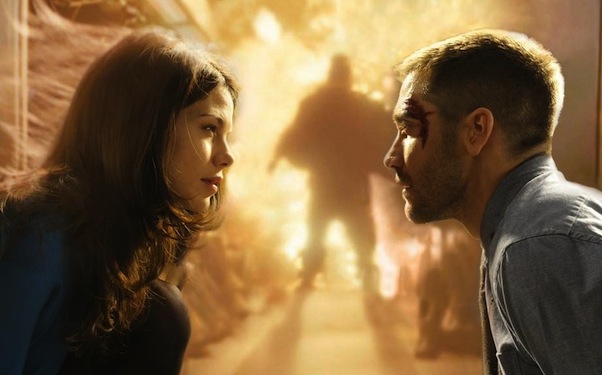
But first, the plot: A terrorist has just blown up a commuter train on the outskirts of Chicago, killing hundreds, and is headed downtown to hit Play on a dirty bomb, which will kill thousands more. Government scientists send a US soldier back in time—onto the train, ante-boom—and instruct him to identify the bomber. The soldier, however, is operating under two major constraints: First, he hasn’t exactly been teleported onto the train. He is, in fact, already dead; portions of his brain are being kept alive; and it’s only his consciousness that has been lobbed backwards into the day’s bad start. In order to conduct his investigation, therefore, he will have to occupy the body of some civilian already on the train; he will have to take as his avatar one of the attack’s imminent victims. Second, the government’s time-travel technology can only project him back eight minutes before the event, which interval he will have to relive over and over again until he can give the government a name: eight minutes—whoosh!—mass death—almost had it—and again, please—a fresh eight minutes are on the clock, like injury time….


•OBSERVATION #1:

The movie is set almost entirely in Chicago, and yet its plot is closely modeled on the invasions of Afghanistan and, especially, Iraq. That the detective-soldier is actually an Air Force helicopter pilot recently shot down by the Taliban is enough to establish that the movie has the war on terror on its mind. But it’s the soldier’s character arc—the transformation he has to undergo in the course of the film—that most powerfully channels the history of the past decade. What’s notable about Source Code—what makes it rather unlike an ordinary action movie—is that its hero keeps failing; he keeps letting the train blow up. The movie thinks it can provide an explanation for this, that it can make clear why an American soldier might be rather bad at stopping terrorists. Or rather, it thinks it can teach you—by teaching him—the difference between anti-terrorism and hapless, counterproductive bullying. At first, the soldier panics; he starts yelling at people; he engages in a little racial profiling; he throws a few punches and before long has drawn a gun on the other passengers. One onlooker asks: “You’re military? You spend a lot of time beating up civilians?” The turning point comes when the living officer running the mission from a government super-computer tells our undead hero: “This time try to get to know the other people on the train.” And from that point on, he just keeps ratcheting it down; stops confronting people; gets in nobody’s face; begins coolly collecting information; and finally, in one last triumphant replay of those endlessly fatal eight minutes, slips handcuffs onto the terrorist before anyone else on the train even knows they’re living amidst emergency. The movie, in other words, thinks it knows the right way to prevent a terrorist attack, and in this regard it simply mirrors David Petraeus, whose film this is. The soldier only succeeds, in other words, because halfway through he is given a new counterinsurgency manual, and the difference between hero-at-beginning-of-movie and hero-at-end-of-movie is meant to communicate the difference between Iraq in 2004 and Iraq in 2008. Source Code is, in sum, a Surge movie—it is, to my knowledge, the only Surge movie—with the New Way Forward staging itself in Illinois instead of Anbar, and with science-fiction conventions serving to communicate the panic and steep learning curve of the early occupation. The film’s hyper-repetitive structure is quite peculiar here. It could—and perhaps for a few minutes in the movie’s middle depths even does—convey the infernal quality of the war on terror, the way in which the “vigilance” to which we are enjoined is already a doom: One gets up every morning required again to avert Armageddon. But that’s not really Source Code’s vibe. Repetition in this movie soon stops seeming demonic and becomes instead the medium for learning and self-improvement—this is more somber Groundhog’s Day than it is trashy Sisyphus—and the film’s understanding of recurrence as basically harmless gets at the first of its interlinked fantasies, which is that the US should be able, at no cost, to keep trying to round up the terrorists until it gets it right. The movie to that extent signs on to the central myth of the Surge, which is that it was empire’s magic do-over in Iraq, a geopolitical mulligan.


•OBSERVATION #2:

That first point requires that we read Chicago as Baghdad in disguise, but if we instead take the movie’s North American setting at face value, then the movie’s politics become somewhat harder to parse. This difficulty goes back to the military-civilian mish-mash that is at the story’s core: The US soldier has requisitioned the body of some suburban schoolteacher—deputized the dead schmo—drafted his virtual corpse into war without end. Like any such in-between or crossbred figure, this character can be described in two contradictory ways at once, such that Source Code is simultaneously a story about a military guy becoming less militarized and a story about a civilian conscripted into special ops without his even knowing it. At the end of the movie, the soldier, having just arrested the madman and saved morning drive-time, gets to stay in his host body; he just skips off into the city with a pretty girl. At that level, the movie is an innocuous fairy tale about undoing some of the damage the US government is inflicting on a generation—not just giving a soldier his discharge papers and sending him honorably back into street life—but unkilling him, making stupid amends. But the equal-and-opposite story of the civilian who can suddenly break up terror plots sponsors a rather different fantasy, bespeaking the desire for a less obtrusive war on terror, a war less punishing to the Iraqis and the Afghanis, and kinder to Americans, as well—a war on terror without full body scanners at airports or the kind of heavy police presence that makes even white people nervous. In this sense, the movie gets us to wish that the war on terror were even more covert than it already is—that it were all undercover—its representative figure the plainclothes air marshal, the old-fashioned name for whom is Secret Police. Let me repeat a sentence I’ve already written: At the end of the movie, the soldier gets to stay in his host body, which means that the schoolteacher never gets his person back, and Source Code’s happy ending requires not that civilian life be rescued, but that it be negated.


•OBSERVATION #3:

Even by the low standards of Hollywood sci-fi, the movie’s fake science is notably addled and underexplained. Worse, having already committed to bushwa in its first act, it just ups and changes the rules in the last ten minutes, which I generally imagine is the one thing that a science-fiction screenwriter has got to promise you he’s not going to do. The audience has been told throughout the movie that the hero cannot change history; he is not really in the past; he has been inserted, rather, into a simulation built up from the memories of dead people; he can therefore only retrieve information; he will never actually save the train. But then in the last ten minutes we discover that each simulation has created an alternate universe after all, and the viewer has had the good fortune to arrive at last in the lone scenario in which every American gets to work on time. That’s feeble, to be sure, and irritating, but there’s something remarkable about it all the same. The single most striking thing about Source Code is that it brings to bear all the dopey arcana of cut-rate science fiction—the full arsenal of time-travel pataphysics and pop Leibniz—in order to generate … the world we already live in. It has maneuvered American normalcy—the AM commute, a commonplace Tuesday, just another trek to the office—into the position of the bizarro world or utopia you might otherwise have expected. The movie’s happy ending feels entirely rote, yeah, until, that is, you realize that it exists only in ontological brackets. By the time Source Code finishes, the Midwestern everyday—the one in which trains don’t blow into the sky—has become thinkable only as a science-fiction scenario, a bit of extravagant speculation. It has shriveled down to the implausible thing that a genre movie must scramble unconvincingly to achieve.

Tarantino, Nazis, and Movies That Can Kill You – Part 2

PART 1 IS HERE

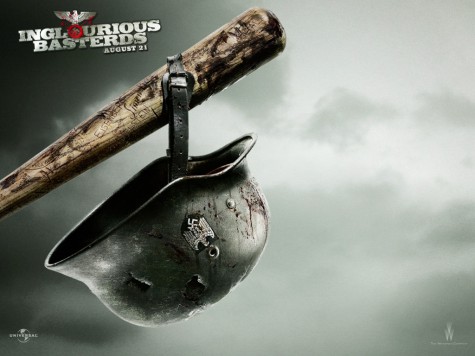
Again, if you want to make sense of Inglourious Basterds, the questions are three: 1) Why take the triumphalist American history of WWII and make it even more triumphalist? 2) Why channel our perceptions of the 1940s via the 1970s? 3) And why commit mass murder upon the audience?

Here are some answers.

Tarantino is on record as saying that Inglourious Basterds is his “bunch-of- guys-on-a-mission film”—which would mean that it’s a version of the Dirty Dozen or The Guns of Navarone. Like almost everything else that Tarantino says in interviews, I think that sentence is a lie or a trick, which should become clear if you pause to consider how uninterested the movie is in the Basterds as Nazi hunters; we see them fighting Nazis almost not all. In fact the Shosanna plot is entirely separate from the Basterds plot and commands our attention every bit as intently. I’d like to say this isn’t really a men-on-a-mission movie; this is first and foremost a revenge movie; and you might say Why can’t it be both?—and yeah, sure, it’s both, but Tarantino has also decided to make nearly all the Basterds Jewish, which means that the revenge framework actually spills over from the Shosanna plot and colonizes the mission plot, too. It’s like the revenge movie is sucking the war movie into its field of gravity. Revenge is the common term that unites the two separate plots. Plus we know that Tarantino is deeply engaged with revenge movies, which were a staple of the ‘70s grindhouse circuit: Last House on the Left, Death Wish, Thriller: En Grym Film, I Spit On Your Grave, movies like that. Tarantino, in fact, has already made an epic revenge movie—that’s Kill Bill—so we can’t be all that surprised to see him returning to the form here.

OK—but if it’s a revenge movie, it’s an unusual one, because it has that oddly doubled narrative—not just one, but two revenge plots, unspooling side by side, and eventually converging, though without either revenge-party ever knowing about the other. And what you think is at stake in the revenge plot will depend in large part on whether you decide to emphasize the Basterds or Shosanna. So ask yourself which agent of revenge your heart favors.

If you emphasize the Basterds, then what really jumps out in the movie is the image of the tough-guy Jew. There’s a word that is common in Hebrew slang—and that Hebrew has bequeathed to Israeli English—and that’s frier, which means something like “pushover” or “sucker”—and it’s become one of the most distinctive Israeli insults. Nobody in Israel wants to be a frier; nobody wants to be pushover. My Israeli friends boast proudly that the country has the world’s highest incidence of fatal car crashes—and I don’t know if that’s true—but I do know that my friends brag about it, which tells me all I need to know—and the explanation they always give is that no Israeli in a car will ever back down, as in: yield the right of way. So all I want to say is that testosterone has become a very big deal in some corners of modern Jewish culture, for reasons that are not hard to reconstruct, and you could think of Inglourious Basterds as playing into this, by projecting an IDF-style masculinity back into the 1940s. And this curious notion obviously goes back to one of the classic, nagging questions in the historiography of the Second World War: Why didn’t European Jews resist the fascists in larger numbers? If Inglourious Basterds generates a compensatory fantasy, it is surely here; it’s not fantasizing about Americans winning the war; it’s fantasizing about Jews winning the war; and this is a fantasy it shares, roughly, with other tough-Jew movies, like Defiance, which features Daniel Craig as the Bärenjude. Those movies ask the question: What if the Warsaw Ghetto Uprising had spread? Or: What if there had already been a Mossad to counteract the SS?

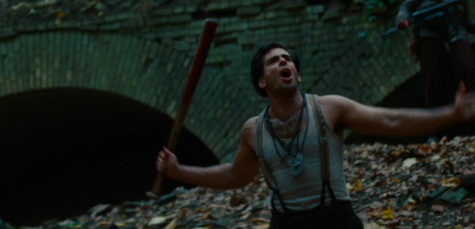
Here’s the thing: If we focus instead on Shosanna, the movie will look rather different. Shosanna of course is also Jewish and also tough, so we can to some extent just fold her into that last point. But only to some extent. Why? Because the image of Eli Roth one handing a baseball bat is obviously an image of Jewish machismo, but the image of a burning movie theater is not.

What I mean is that Shosanna’s method of taking revenge is so different from the Basterds’ that it raises some new issues for us to think about. The blazing screen does not trigger the same set of real-world associations. Shosanna gets her revenge through film: She makes a movie passing judgment on the fascists, whom she then immolates in the flames of burning nitrate reels. So it’s not just that we see a filmmaker killing Nazis; it’s as though film itself were able to strike fascists dead. There are, I think, two different ways of clarifying what Tarantino is up to here.

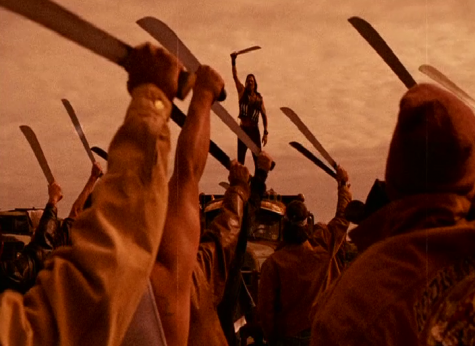
1) One way to understand the film Shosanna makes and that we eventually see is as Tarantino’s homage to postwar French cinema—and to the kind of anti-fascist film that people like Buñuel were making even before the war. She makes a guerilla film, on the cheap: a technically rough, experimental, low-budget and anti-fascist film. It’s as though Tarantino were trying to engineer a history in which Buñuel never left for Mexico, or trying to backdate Godard by about fifteen years. The movie literally stages a showdown between fascist film and the anti-fascist film of the postwar Left. And this alone licenses us to say that Tarantino is deeply invested in the possibility of anti-fascist film. He has just given us, as hero, an anti-fascist director. Now would be the moment to be point out that he and his associates often seem to think that trash cinema is the continuation of anti-fascist film. If you’ve seen Robert Rodriguez’s Machete—or even just the fake trailer for  the non-existent ‘70s drive-in movie that was the movie’s original incarnation—the point will not be lost on you: An army of illegal immigrants rises up against white bosses and politicians by repurposing as weapons the garden tools of a day laborer.

There’s plenty of precedence for this: One of the key blaxploitation movies is this film from 1976 called Brotherhood of Death, which is about a group of black Vietnam vets who return to the US and start using what the army taught them to fight the Klan. So we know that Tarantino and Rodriguez are fixated on grindhouse, but what they’re too cool to say out loud is that they basically think of grindhouse as a people’s cinema—crude and insurgent—a precious collection of movies about black people taking out the Klan and women turning the knife back against the men who attack them and kung fu masters sticking up for Native Americans.

2) What I’m saying, basically, is that Quentin Tarantino is our Woody Guthrie; he is the Woody Guthrie of mondo and the midnight movie. That is not a joke. The most famous picture of Woody Guthrie gives the viewer a clear look at the folk-singer’s guitar, across which is scrawled: “This machine kills fascists.”

We need to think hard about the fantasy that is communicated by that sentence—because we’re trying to make sense of this image—

—and that sentence provides the second important clarification. Woody Guthrie didn’t just want to sing about justice; he didn’t just want to “inspire his listeners” or get them to raise their voices in the spirit of peace or whatever it is that we usually think folk singers do; he was trying to imagine a music so powerful that it would actually bring justice into the world; he wanted to strum justice into existence; wanted an art that wouldn’t just be in the service of revolution, but that would itself be the completed revolutionary act. And that’s exactly what Tarantino gives us at the end of the movie: “This movie screen kills fascists.” That fantasy—the fantasy of a fully revolutionary art—turns out to be very old. As early in the 1590s, some English poets were trying to write plays that not only depicted revenge, but actually achieved it; they were trying to imagine plays that could actually kill corrupt courtiers and oppressive princes, as though blank verse could actually draw blood. Or if we flash-forward to 1969, we will find Amiri Baraka writing these lines, in a poem called “Black Arts”:


We want ‘poems that kill.’

Assassin poems, Poems that shoot

guns. Poems that wrestle cops into alleys

and take their weapons leaving them dead.


What we can say now is that Tarantino is paying homage to the history of anti-fascist film; and he is also trying to imagine a movie that could not only describe justice but actually achieve it. And of course, we need to put those points together and say that he is trying to imagine the perfect anti-fascist film—a film so righteously anti-fascist that it literally levels any fascist who wanders into its projected light; a film that fascists cannot watch; a film that turns fascists to dust. So maybe now we can say, or begin to say, explain why Tarantino has rewritten the history of 1944. Inglourious Basterds wants to give credit for the victory in World War II to someone other than the US and Soviet armies; to nominate, as the virtual heroes of some secret history, badass Jews and cinema itself. It’s an extraordinary idea.

…except I think that’s it all wrong. None of what I’ve just written actually works; or rather, the movie does in fact put in play the two fantasies I’ve been describing—the fantasy of a muscular Judaism and the fantasy of the perfect anti-fascist film—but then it takes them back—or at least makes them harder to occupy. First it gets us to share those fantasies and then it starts calling the fantasies into question. There are two good reasons to think this.

The first I will mention only briefly and ask you to think about on your own time. One of the plain ways we have to describe who Shosanna is and what she does in this movie is to say that she is a suicide bomber. If you want to get fancy, you will say that she is a twentieth-century Samson, pulling the roof down on the heads of the Jews’ celebrating enemies, but if you go back and read the Samson story, you’ll be forced to conclude before long that he, too, was a suicide bomber, so it’s really the same point anyway. At that point we will recall that there was a bomb attack on a movie theater in northern India in 2007; another in Mumbai during the wave of coordinated attacks in 2009; an especially bad movie theater bombing in Algeria in 1998; and so on. The movie undoubtedly produces an image of a heroic Judaism, but only at the cost of letting it mutate visibly into one of its putative opposites, which is the Muslim terrorist.

That’s one of the big surprises hidden away in the movie’s fantasies. The second is easiest to communicate through a series of paired images:

1)

2)

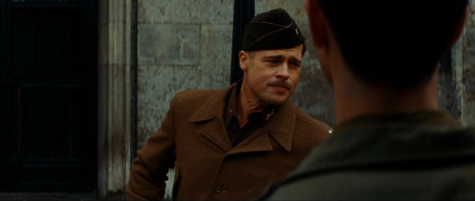
“You know something, Utivich? I think this might just be my masterpiece.”

3)

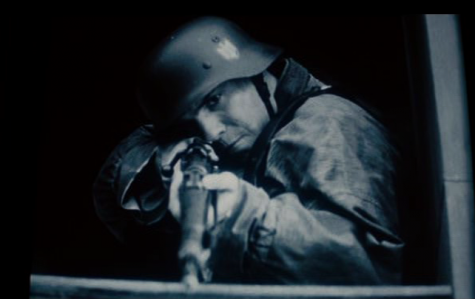
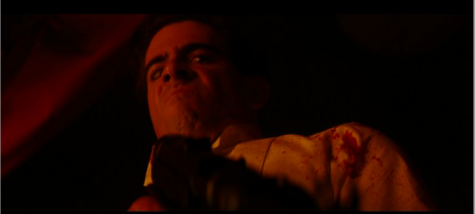
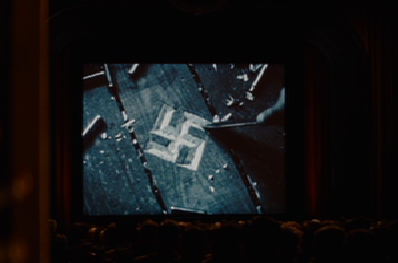
Here’s my gloss on that sequence. 1) We see a Nazi soldier, shot from below, mowing down an improbable number of the gathered enemy. Then we see an American soldier doing the same thing—and in a similar shot. 2) We see an American soldier mutilating an enemy officer and calling it his masterpiece; and we see Hitler telling Goebbels that he has made his masterpiece. 3) We see a fascist turn to the camera in black-and-white and address the audience directly, speaking English for the first time. And then we see the anti-fascist turn to the camera in black-and-white and address the audience directly, speaking English for the first time. We can see what this adds up to. Tarantino has built in unmistakable visual rhymes between the fascist movie and its putatively anti-fascist alternatives. Just to be clear: There are three movies in play here—the movie we are watching, Tarantino’s movie; the fascist movie; and Shosanna’s anti-fascist movie. So two anti-fascist movies and a fascist movie. And the point is that each of the two anti-fascist movies plainly, demonstrably resembles the fascist movie. Everything in the movie starts bleeding into fascism. Two more pairings, to coax over the disbelieving:

4)

An American soldier carves a swastika with a Bowie knife.

A German soldier carves a swastika with a Bowie knife.

5)

“Our battle plan will be that of an Apache resistance.”

But of course what’s true in miniature is also true globally: The fascists are watching a patriotic war movie about the grotesquely exaggerated exploits of a national hero. And you can’t even get that sentence out of your mouth without realizing that, yes, we too have been watching a patriotic war movie about the grotesquely exaggerated exploits of our national heroes. The anti-fascist movie we thought we were watching outs itself as fascism’s secret twin. There’s a lot to say here, but the short version is that I think we are in the presence of a filmmaker losing his confidence in grindhouse as a people’s cinema and trying to find a way to make trash cinema yield a critique of itself instead. This all comes down to the audience: What I find most striking about the shots of the audience in this movie is how attentive they are to the immediate effects of screen violence upon a group of viewers. Let me put it this way: I saw the movie twice in a theater, and each time I saw it, when the movie screen went up in flames, someone in the room clapped—not a full-palmed ovation, just three fingers of one hand in the heel of the other, the quick little rat-a-tat of a person overcome by excitement. But then of course Inglourious Basterds, in four or five different shots, shows a movie audience of fascists whoop-whooping to a blood orgy. Let me come at it from another angle. In the movie, we see one audience member laughing. I’m guessing many people were laughing when you saw the movie; you might have laughed yourself. This gets at something important, because as long as Tarantino has been making movies, high-minded critics have fretted that he makes violence entirely too pleasurable: Michael Madsen slices off a man’s ear, and the audience are bopping in their seats because “Stuck in the Middle With You” is chiming on the soundtrack. You grin as Bruce Willis trades up from hammer to baseball bat to chainsaw to samurai sword. The only movie I have ever walked out on because of the audience was the Coen brothers’ Blood Simple—close cousin to Reservoir Dogs or Pulp Fiction—and I left it because the rest of my row was cracking up while Dan Hedaya was getting buried alive, shrieking keen through mouthfuls of dirt. So how dare anyone make death funny? You have to imagine that Tarantino has always shrugged off that accusation; you can call up YouTube videos of him shrugging it off in interviews—except now he has conceded it. And we know he has conceded it because here’s the one person we see laughing at the violence:

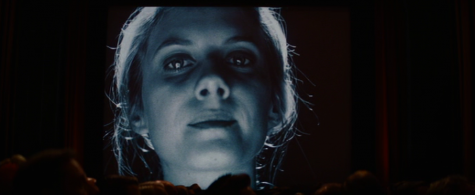
There is only one person laughing, and it is mother-loving Hitler. That is the sight of a filmmaker profoundly alienated from his own fans, wigging out at the ability of the movies he most loves to produce in us a quasi-fascist joy in violence. So why does Tarantino hate us so much? He hates us for liking his movies the way we do; he hates us because he can so easily bring us round to enjoying the sight of people being gathered into a closed space so that they can be exterminated. He hates you for how easily you can be pushed into the Nazi position, as long as the people getting killed are themselves Nazis. He hates you because you are the fascist and you don’t even know it. And he proposes the self-consuming grindhouse solution to this grindhouse dilemma, which is that people like you have to die. You will uphold your death sentence with your applause.


Tarantino, Nazis, and Movies That Can Kill You – Part 1

I think I can show that Inglourious Basterds is not really a revenge movie, which, if you’ve seen the movie — well, you’re not going to believe me. It’s an implausible point, hard to make stick — and I’d rather start easy. So maybe I’ll just ask a few questions about the film, and then try to answer them, though maybe the questions are really the hard part, after all. It will be harder, I think, to get the questions right than to get the answers right; Basterds is so diabolically entertaining that a person could easily overlook how complicated a thing it really is. So I’m thinking that if we can just name the movie’s complications—if we can lift out its puzzles—the answers might start taking care of themselves.

My questions are three.

First question: Is Inglourious Basterds a historical movie? Is it a period piece? …or not? In some sense, yes, plainly, of course it is. It takes place at a specified moment in history—1944; the story unfolds against the backdrop of a major world event—World War II; it transforms real historical personages into minor fictional characters—Hitler, Goebbels, and the like—and it freely intermixes these “real people” with characters of its own invention. Those are the hallmarks of historical fiction in the mode of Walter Scott or Tolstoy. Scott’s Waverley features the real Scottish prince who, in the middle of the C18, tried to seize the throne of England and Scotland. War and Peace, in turn, actually has Napoleon as a character—a fairly central character, even, at least for part of the novel.

But there’s an obvious problem with this comparison, which is that Tarantino’s movie completely rewrites the history it has chosen to recount. And I can already hear the English professors amidst whom I work murmuring: But wait, historical fiction always, in myriad subtle ways, rewrites the history that it recounts. And they’re right. But Inglourious Basterds is not subtle about this; it does not even pretend to historical insight. It gleefully concocts an alternate history, in a manner that is impossible to overlook. In case anyone has forgotten: American Jews did not storm the Nazi high command and gun Hitler down in an act of heroic retribution. This is not a historical fiction in the usual sense, but rather a kind of fantasia or historical reverie—and the movie makes no effort to hide this. Not even in Tolstoy does Napoleon keep hold of Moscow.

But then this is where things really get strange. So the movie is a flight of fancy on a historical subject. OK; I think I can take that on board, because I’ve seen it before. In science-fiction circles, alternate histories have become a genre in their own right: What would England look like in the C20 if it had stayed Catholic—if, that is, there had never been a Protestant Church of England? What would the world look like today if Europeans had been wiped out in the fourteenth century by the Black Death?—a world without white people; I’ve always rather liked that one. Or closest to the day’s concerns: What would the US look like now if Hitler had never been defeated? Those books all exist and lots more like them: Historical novels about histories that never happened. But then we need to think about which event the movie has chosen to rescript: It doctors the end of World War II, and if we’re going to think about that, then let us call to mind another obvious thing: America actually defeated the Germans in World War II; or rather the Allies did. And Americans defeat the Nazis in the movie, too, with some help from French resisters. It’s worth pausing to register how odd that is. I mean, it’s not like the movie has taken a tale of American failure or hesitation and turned it into an American triumph. If you try to imagine Inglourious Basterds as a Vietnam movie, you’ll begin to see what I mean. There was a period in the mid-‘80s when Hollywood started churning out movies—like Delta Force or the second Rambo joint—in which the US Army was granted some kind of magic do-over in South-East Asia. In Rambo, Sylvester Stallone actually speaks the question: “Do we get to win this time?” And his commanding officer responds: “Yes, Rambo. You get to win this time.” What’s going on there isn’t especially hard to grasp. The historical record—or, if you prefer, popular historical pseudo-memory—contains, in reference to Vietnam, all sorts of ambivalence: feelings of failure, complicity, shame, and so on—and those feelings are a breeding ground for compensatory fantasies. But Tarantino has scripted an alternative to D-Day, of all things, which means he has replaced the most heroic moment in twentieth-century US history—a history that is already fully triumphalist, entirely devoid of ambivalence—with something even more triumphalist, but weirdly, ferociously so. He has scripted a fictional way of winning a war that the US won anyway. So what’s going on? That’s  the first question.

I have a second question that also involves the ways this is not a straightforward historical movie. I want to be careful here: Historical fictions are always complicated, because they always require you to think at the same time about two different historical moments; if you’re reading a historical novel, you need to think about when the book was set, but you also need to think about when the book was written. So take Toni Morrison’s Beloved, which is the one recent historical novel you can count on someone having read. That book is set in the 1870s, but it was written in the 1980s. And a person might ask: What’s the difference between a book written in the 1870s, like Thomas Hardy’s Far From the Madding Crowd, and one set in the 1870s? That second book, Beloved, has a historical shadow dimension that the first book doesn’t. Historical novels belong, as it were, to two historical moments at once. They are always implicitly putting two historical moments in front of you and asking you what connects them or what they share. So Beloved is a novel about America in the nineteenth century—it’s about the aftermath of slavery—but it is also a novel of the 1980s. The 1870s and the 1980s get held up next to each other. If you want to understand Beloved, you have to understand both what Toni Morrison is saying about the past and what she is saying to her contemporaries. It’s Reconstruction; and it’s the Reagan-era; and they’re side by side. Same deal with Inglourious Basterds. Tarantino was talking about this movie as early as 2001; he wrote different versions of the screenplay across the last decade; two or three times, he announced he was going into production only to change his mind; and then he finally began filming in October 2008—a month before the Obama-McCain election, if you want to think of it that way. So this movie is about 1944, but we can also think of it as pretty much the last movie of the Bush administration. And it’s a war movie—and we mustn’t lose sight of this—which recasts WWII as a settling of scores. And few viewers will have overlooked that it’s also a Western. The opening scene has a French farmer living in what you could mistake for the timber shack of a Montana frontiersman; there’s a shootout in a saloon where desperadoes are drinking whiskey; and so on. So who thinks about war as a Western? Six days after 9/11, George Bush stood up in front of the press corps and said: “I want justice. And there’s an old poster out West, I recall, that said: ‘Wanted, Dead or Alive.’”

We seem to be making headway. But the point I’m after is that Inglourious Basterds is actually more complicated than this. Historical fictions are always complicated, and this movie is more complicated still, not least because it is so obviously stitched together out of parts from other movies. Now we know that this is what Tarantino likes to do; he’s got a mash-up aesthetic. So that opening scene?—it’s borrowed from John Ford; and the scene where the French Jewish beauty and the young Nazi hero kill each other?—that’s ripped from a John Woo movie. Now again, movies and novels are always borrowing from other movies and novels, so maybe you’re thinking Big deal. But most movies and novels take some pains to cover their tracks; they don’t want you to spot their borrowings; they invite you to sink into the story, so that you can trick yourself into thinking that you are watching the past unfold organically before you. And Tarantino simply will not let you sink into the story. He does not hide his sources. The most obvious example is the moment when the movie introduces Hugo Stiglitz for the first time; suddenly the movie has a narrator, and the narrator is Sam Jackson, in voiceover, and with an underlay of boom chicka wawa, and every time you hear those pimped-out cadences, you get airlifted briefly out of 1944 and deposited in the mid-‘70s instead—so Sam Jackson, but Sam Jackson in his incarnation as latter-day soul brother.

That’s the single most intrusive moment in the movie; the visible incursion of another film genre into the World War II movie; but it’s hardly the only one. There’s the spaghetti Western soundtrack, which provides an ongoing temporal counterpoint to the action. Or there’s the title. I dutifully went and watched the 1978 Italian movie from which the title Inglourious Basterds has been filched only to discover that it bears absolutely no resemblance to the movie Tarantino made. The later film is in no way a remake of the earlier one. But then knowing that should help us see how programmatic Tarantino’s retro aesthetic is: He wants you to think his movie is a remake even when it isn’t a remake. In the event, the title is something like an all-purpose footnote; it doesn’t do much more than point you, broadly, to the entire body of late ‘60s and ‘70s-era trash movies that we all know Tarantino loves; and the music does the same thing; and so does Sam Jackson. Someone out there was disappointed to discover that Richard Roundtree wasn’t playing Hitler. So the movie doesn’t just whisk us back to 1944; and it doesn’t even really whisk us back to its alternate-reality 1944. Rather, it forces us to contemplate 1944 through a scrim of other movies, and I want us to think of this as an almost geological act of historical layering. This is how Inglourious Basterds is different from an ordinary historical fiction: There aren’t just two historical moments in play, there are at least three. Hence my second question: Why, in 2009, make a ‘70s-style movie about 1944?

One quick point to make, in passing, because it will be important to some people’s experience of the movie: This might be a trash movie; and it might rewrite history in preposterous ways; but its use of historical detail is nonetheless meticulous. The movie’s evident precision begins with its attention to language. It’s a tri-lingual movie, and the German in the movie is impeccable—entirely unlike the Halt!-und-Schnell! that you get in Schindler’s List and other graduates from the Hogan’s Heroes School of War Cinema. And beyond that, the movie is full of historical references that aren’t in the least offhand—references, I mean, that are knowing and apt. Tarantino works in references to early twentieth-century German children’s literature; he briefly introduces, as a character, a cat named Emil Jannings, who was 1) a real German actor of the period; 2) the first person ever to win an Oscar; 3) and a prominent Nazi. And on and on. Now if you’re in a position to appreciate these details—which basically means if you’re German—the experience of the movie has got to be all the more bewildering. The puzzles I’ve been describing intensify, because in lots of ways the movie seems unusually committed to 1944—the movie’s erudition, I mean, can’t help but convey a certain respect for the movie’s historical materials—and yet at the same time 1944 is constantly slipping from sight.

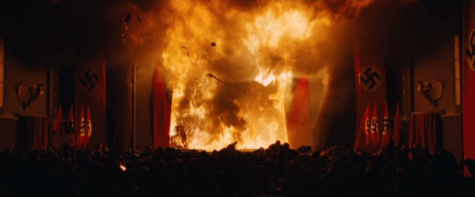
So … a second question. My third question is easier to explain, though it’s probably also the most important one. It all comes down to this image and to the scene that contains it:

We have to be clear about what’s going on here. I can imagine a person being keyed up enough at the sweet sight of all those Nazis getting killed to overlook the second thing that’s going on in the movies climactic scenes—not a second event—but a second, equally plausible way of describing that one event: The movie is showing a Jewish woman wreaking vengeance upon Germans, but it is also showing a filmmaker killing her own audience. That’s amazing; and serious thinking about the movie has got to start there. We need to think hard about the conditions under which some of us saw this movie. If you were lucky enough to see Inglourious Basterds during its original run—and so not on DVD—then you sat in a movie theater and watched people in a movie theater get wiped out. You might have been rooting for Shosanna or the Basterds—I know I was—but the people getting offed were, at the moment of their death, unmistakably like you. The aspect of the movie that most leaps out, I think, is its extraordinary hostility towards the audience. So my third question is: Why does Quentin Tarantino hate us so much?

So those are my three questions: 1) Why take the triumphalist American history of WWII and make it even more triumphalist? 2) Why channel our perceptions of the 1940s via the 1970s? 3) And why commit mass murder upon the audience? I will next attempt some answers.


…MORE TO COME…

Telling Stories about Superweapons; or, There’s Only One Way This Can End


•1.

The only way I know how to make sense of the Iron Man sequel is to talk first about the original Godzilla, which is, in some complicated way, the later movie’s model and second precursor. Everyone knows that Godzilla had something to do with the nuclear bomb—that it was, like rocket-styled Chevys and bomb-expectant country gospel tunes, one of the key artifacts of atomic-age pop—but the point nonetheless needs to be clarified. So let yourself say the obvious: Without Hiroshima and Nagasaki there would have been no Godzilla. But then let me chime in that this is true in a way that is at once more straightforward and more complicated than you think.

A simple plot point gets us going: In Godzilla, the beast’s emergence is openly linked to nuclear testing in the Pacific. Nothing unusual there—variants on this conceit remained popular in horror movies throughout the ‘50s and ‘60s: that x-and-such a monster was caused by radiation. Usually, though, the idea had the character of a MacGuffin, a vacuous pseudo-explanation about which a given movie mostly didn’t care. And it turns out that this observation will hold for lots of different horror movies, in fact, and not just the radiated ones, since horror cinema has never been all that interested in what it is that makes its monsters walk: nuclear fallout, gypsy curses, chemical spills, ancient spells, passing comets, viruses, all of them more or less cursory and pretextual. This is what makes the ongoing debate among the fanboys over whether viral zombies are, because not technically dead, really zombies so inane, because in cinematic terms, back-from-the-crypt zombies and disease-bred zombies share pretty much everything but their pseudo-science, including the exponential logic of infection. Noting as much should make clear one of the things that is most unusual about Godzilla: It is one of those rare horror movies that really does care about origins. In lots of ways, it cares more about its atomic backstory than it does about the reptile’s morphology, which carries almost none of the former’s ideological charge. One way to start registering this point is to notice that the movie spends quite a long time allowing its characters to work through the nuclear explanation, showing Japanese people reacting to the news, following their debate about how to respond to this latest atomic threat. One man advocates keeping the information secret—not letting the world know that the country is still stalked by nuclear destruction—so as not to alarm Japan’s trading partners and political allies. The movie thereby registers the real Japan’s moment of nuclear repression or willed historical oblivion, its strenuous insistence, in the 1950s, on a Westernizing and post-atomic normalcy.

But then the movie itself serves to counter that very repression. The single most important thing about the monster is that he himself possesses the powers of nuclear destruction, and the movie’s most famous scenes are essentially one long re-staging of the Catastrophe: buildings tumble, entire cityscapes burn, medical workers check children with Geiger counters. When the monster breathes fire, the screen flashes and people shriek as they burst into flame. Refugees huddle. The movie seems determined, in some utterly straightforward way, to get on screen images from 1945, when this very directness would otherwise have been difficult just eight years after the war, setting out, as it were, to circumvent the psychic censorship that remained even after various official American bans had been lifted, performing the kind of end-run around repression that popular culture often undertakes—the service that stupid movies reliably perform for the political unconscious. The movie’s motivating fear, then, is easily named, which is simply that the bombs could hit again; that peace could evaporate; that it’s not over; eight years later and here we go again. The next time you hear someone say that horror movies traffic in “our fear of the unknown,” Godzilla is how you tell them that they’re wrong. When the movie came out, Nagasaki and Hiroshima weren’t even a decade back. Some people live in fear of the entirely known.
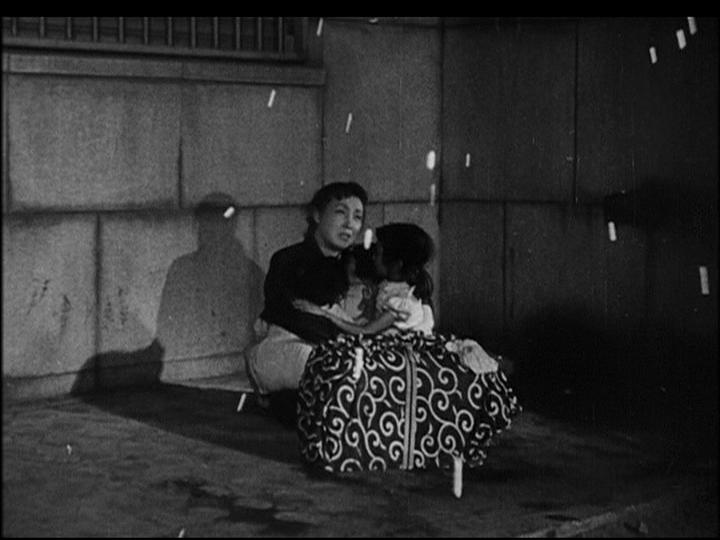
This is the sense in which the movie’s incorporation of its historical materials is almost alarmingly direct, without the intricacies and displacements that are otherwise the hallmark of allegory. And yet that allegory harbors a certain difficulty all the same. For Gojira, though unleashed by the atomic bomb, is not in fact a mutation, which is how you might have remembered the story. He seems, rather, to have been flushed out of some ecological hidey-hole when his coral reef got torched; he absorbed the bomb’s radiation and lived, like some indomitable and mountainous cockroach. But then what does it mean to turn the nuclear threat into a dinosaur or to let a prehistoric creature be the allegorical stand-in for the Enola Gay? This is all a little odd; odd first because it sutures together twentieth- century hyper-technology with something utterly primal; and odd, too, because the figure of the dinosaur—any dinosaur—calls to mind extinction, which in a nuclear movie means Our Possible Fate, but only if we think of the thunder lizard as a casualty (of a meteor, say, or volcanic gas from India) and not as the annihilating force. This peculiarity is evident in the movie in a small subplot concerning a paleontologist who doesn’t want the government to kill Godzilla; who wants time, rather, to study him, to work out how he has survived across the millennia. In one sense, this can be read as the movie’s meditation on “pure science,” in which the paleontologist appears as cousin to those real-world physicists who become fixated on the problem of fission in the abstract and don’t care that the nuclear winds are blowing across Nevada. And yet by allegorically making Godzilla a living creature, the movie generates a kind of eco-pathos for him that one couldn’t possibly feel for a warhead and indeed transfers to the Bomb itself some of the sympathy we might feel for its eventual species victims.

But then the movie also features a second scientist who also has marked affinities to Oppenheimer and Fermi, and it is with regards to him that the movie turns curious for real. The film’s inevitable question is: How can Gojira be defeated?—which we have to imagine also means something like: Can we imagine the overcoming of nuclear destruction? What is going to stop Japanese cities from burning again? And to this end, the film introduces a young physicist who has invented a fearsome technology, a small machine with the ability to suck all the oxygen from vast reaches of the ocean. He calls it an Oxygen Destroyer—and tellingly, he only ever says the words in English, even in the undubbed original, which phrasing associates the weapon with the US and so marks it as the-kind-of-infernal-device-the-Americans-might-have.

Here, then, is an unsurprising point: The movie features an unusually long debate about the ethics of using the machine—fifteen minutes that seem to have been scripted by the Union of Concerned Scientists. We can discern in this interlude a certain fantasy or thought experiment: a Japanese movie staging the debate that the Americans should have had with themselves and plainly didn’t. The local scientist, in fact, is determined not to hand over the technology—make a note of this, because that’s where Tony Stark comes in—and he seems to be modeling a moral relationship to science, a willingness to withhold destructive knowledge. In genre terms, this is rather fascinating: The physicist is plainly a Victor Frankenstein figure; the completely unexplained eye patch that he wears means that the movie wants us to see him as cracked and Gothic. But when he opens his mouth, he does not rave; he speaks instead with clarity, restraint, and concern, even as he stands there looking like a pirate in a lab coat. The mad scientist reflects on the ethics of technology and so crawls back from his genre-dictated insanity.

And now here’s the really surprising point: Having convincingly made the case for disarmament, the scientist then relents and agrees to press the death-button, and the movie mutates in an instant from an anti-nuclear broadside into an argued defense of mad science. I want to say this again, because I still don’t really believe it myself: The original Japanese Godzilla is not an anti-nuclear movie; it is in its own way entirely pro-bomb, rehearsing the agonized conversation over deploying such technology only to conclude that, yes, mass destruction is sometimes necessary to overcome threats that can’t be defeated by conventional armies.

But then it must be allowed that this decision is carefully framed and hedged. The scenario that the movie has identified has the character of an arms race or military competition or the structural compulsion to adopt the force of annihilation, and this is true because the readiest referent for “a threat that can’t be defeated by conventional military means” is itself nuclear weaponry. Godzilla is a stand in for the nukes, and so is the Oxygen Destroyer. The allegorical rebus reveals the same term on both sides of the equation. Dangerous technology can only be countered by dangerous technology. It’s the feeling one often gets watching Japanese movies or reading manga—that everything, once decoded, refers back to the bomb, every last robot and pixie and smurf. Hence the movie’s melancholy and its repetition compulsion: It is replaying images from war’s end because it can’t imagine a clear alternative in the present to the nuclear arsenal and is to that extent convinced that 1945 will ever be with us. It can’t imagine how to stand up to a nuclear power in a way that wouldn’t involve nuclear weapons.

So there is in the movie no authentically Japanese refusal of the atom. And yet Godzilla does nonetheless attempt a certain national solution: The scientist agrees that the weapon has to be used against Godzilla; but there is only one such device and he won’t share the blueprints; and then he dives into the ocean to confront Godzilla himself and refuses to resurface, thus ensuring that the oxygen destroyed will include his own. The movie, in other words, is trying to imagine the conditions in which a nuclear weapon could be used ethically, and its provisions are two: 1) That the weapon be utterly singular, not just single-use, since no bomb bangs twice, but irreproducible, incapable of being spread; and 2) that Oppenheimer be willing to strap himself to the bomb and ride it Kubrick-like to his own destruction. The notion that the Japanese have a more ethical relationship to destructive technology is thereby preserved in the movie, though in much modified form and not in the direction of a pacifism—just the contrary, rather—by resurrecting a few hallowed images from Japanese military history: the honor suicide, mostly. What the Manhattan Project lacked was the samurai code. The Japanese are more moral because they still have kamikaze.

•2.

It is important to keep Godzilla in front of us, because doing so is our best shot at noticing how fretful a movie Iron Man 2 really is, when we might otherwise mistake it for just another round of Downey-doing-his-thing: impish, blithe, getting by on muttery charm, a $200 million action movie with the cadences of screwball comedy—that’s what a lot of the critics said, and they were basically wrong. It’s the tone of the movie that the reviewers consistently bungled. “To find a comic-book hero who doesn’t agonize over his supergifts”—this is The New Yorker—“and would defend his constitutional right to get a kick out of them, is frankly a relief.” But nothing in Iron Man 2 breathes relief, and agony is in fact its prevailing mode, in a manner that is entirely at odds with the hero’s jive and patter, itself suspended for long stretches of the movie anyway. For Tony Stark is the Japanese scientist of the American Empire, the inventor who will not share his invention, the engineer who withholds the newest technology of death so that only he can command it: “You can’t have the suit. … I’m not giving you the suit. … You’re not getting the suit.” What the new movie shares with Godzilla is the notion that the perfect and ethical weapon would have to be entirely singular—there would literally only be one of them—and so would not be available for manufacture: a permanent prototype, forever in beta. Such is the importance of the many workshop scenes in both Iron Man installments, those oddly protracted sequences in which we watch our hero sketch and solder and glue. By investing the killer armor with artisanal qualities, as though ICBMs could be blacksmithed, they suggest that the weapon’s uniqueness could be maintained into the future, since it is the hallmark of any handcrafted object that it is in some strict sense unrepeatable. That’s a fantasy, yes, but it’s an unsettled one; unease is simply built into its scenario. The conceit of an unshareable weapon comes with a worry automatically attached, which is simply that one will become two. Arms proliferate, and then so do anxieties, in their wake.

It is this apprehension that Godzilla explores in its dialogue and that Iron Man 2 builds an entire plot around, which isn’t to say that the movies aren’t actually quite different. For the two Iron Men are both trying to imagine the imperial monopoly on violence, sovereignty at the level of the globe, force concentrated in American hands. This is the big difference between the old Japanese movie and its recent Hollywood counterparts, and it’s also why we can’t imagine Tony Stark heroically sacrificing himself—because imperial sovereignty requires that technological superiority be indefinitely preserved, on the understanding that it has desirable political effects, that it fosters order and lawfulness across the planet. Early on in the sequel, Tony calls this order by its proper name, which is the pax Americana. What’s remarkable, then, is that the movie can’t actually envision how the American peace is to be kept, even by its superhero and unofficial sovereign, to the point where either we have to think of IM2 as scrambling to keep its imperial fantasy running, and this in increasingly frantic and unconvincing ways, or we have to think of it as providing a spontaneous and unexpected dissent from that very fantasy.

Let’s just count the problems:

The most obvious threat in the movie is multipolarity, the simple idea that other actors in rival nations might have access to the suit and so might limit the American peacekeeper’s scope of action. Here the menace of a post-American world takes the form of Mickey Rourke’s Ivan Vanko, whose very body announces a Russia tattooed and resurgent, even as his mock-Ukrainian name smuggles into the movie memories of Dolph Lundgren and the Cold War inanities of Rocky IV. The Vanko-plot also provides the first good indication of just how nervous this movie is, because the Russian’s ability to improvise a pretty good facsimile of the Iron Man suit—to pirate, as it were, Tony Stark’s best handbag—means that the American is, in the movie’s own terms, just plain wrong, because he claims that other countries are years away from acquiring the technology, and they aren’t. The movie starts out from the premise that Tony Stark doesn’t fully understand the dangers of his own invention.

He understands some of them though, and from that perspective the movie is wary not only of foreign governments but also, and much more curiously, of the American one. This again goes back to a plot point: The people we most often see Tony Stark refusing to share the suit with are politicians and military officers. The anxiety here is in some sense easy to gloss, because it really is the Oxygen Destroyer all over again: Sharing the technology with the government would make it replicable and would put the design in the hands of the unreliable many. Indeed, to redesign the suit for combat would inevitably be to put it into mass production and so to make the weapon studiable by every battlefield scavenger and enemy spy. Committed to sovereignty at the level of the globe, the movie nonetheless resists centralization at the level of the nation—it doesn’t trust the U.S. government to inhabit its sovereignty well and worthily—which leaves it trying to conceive of an American imperialism without a strong American state. The empire can only perform its functions if there are private actors stronger than Washington.

That last point is going to have a certain type of reader crying Capitalism!—but you anarcho-socialists can just zip it, because the movie is every bit as wary of the market, which is, of course, the true vector of arms proliferation, the kindergarten classroom in which the nuclear flu spreads. It’s true that IM2 is a little muddy on this score, exaggerating an ambiguity that was already present in the first film. Initially, the movie fully commits to a vision of corporate rule and hence to a kind of Haliburton-speak: Tony boasts within the first ten minutes that Stark Industries has “successfully privatized world peace.” But the movie then shows him resigning from his own company and has him spend the balance of its running time fighting a rival arms manufacturer who wants his factories to start turning out suits in quantity, as though they were bike locks. Many of the newspaper critics complained that the movie was, in the usual manner of sequels, overstuffed or unwieldy; they accused the movie in particular of having too many villains. This makes the plot a little hard to keep up with, it’s true, but for once too-many-villains is very much the point, since Iron Man 2 is tracing out a certain problem, in the form of a network, whatever it is that connects the U.S. military to arms manufacturers to the foreign powers who also buy the Yankee guns. It is to this extent misleading to call Tony Stark a “supercapitalist,” as some of the reviews did, since he spends the entire film trying to keep his most important discovery off the market. The movie has as its center of gravity the notion that a certain class of objects should not become commodities.

But then—and here’s the real kicker—the movie doesn’t really trust Tony Stark either. If the first movie was telling a story about how a middle-aged playboy reinvented himself as a man of imperial purpose, then the sequel, which is careful to insert scenes of its superhero drunk, boastful, and reckless, is haunted by Tony’s bad behavior, hence by the possibility that the empire might backslide into loutishness. It’s a remarkable scene—the one in which Tony staggers around his Malibu house, suit on, visor up, laser-blasting holes into his own walls, recalling as it does, despite being set in civilian California, bad memories of some Manila bar, hooched-up sailors in port carrying their still loaded sidearms. The movie is thus able to internalize a dissenting view of US superpower, the perspective that colonized peoples have ever had of their occupiers, by allowing Iron Man to act out some of the American empire’s more minor crimes: U.S. soldiers taunting Iraqi children with bottled water; an American sergeant asking two uncomprehending Arab boys if they are going to grow up to be terrorist and gay.

So foreign powers can’t be trusted with the suit; and the US government can’t be trusted with the suit; and arms manufacturers can’t be trusted with the suit; and even Tony Stark probably can’t be trusted with the suit. A certain rift thus runs all the way through Iron Man 2. Visually, the movie continues to treat the suit as a techno-fetish or bucket full of whizbang, staging its best action scene in Monte Carlo and thereby ensuring we will spend the remainder of the movie seeing its hero as a kind of human Lamborghini. But in plot terms, the suit is less magic armor than monkey’s paw, a cursed object that produces more instability than it prevents. Iron Man 2 simply cannot work out a good relationship to its super-technology or to the dominion that such technology conveys.

…which isn’t to say that it doesn’t try. Its attempted solutions are two, one of which is easy to read but dumb, the other of which is much harder to specify—and also pretty dumb.

1) The business with Tony’s heart—the battery in his chest is poisoning him and he has to engineer a new one—is a tidy parable of recent oil politics and the search for renewable energy. The thing that fuels you will also kill you, and you will only survive if you can invent an alternate energy source. The idea is puzzling in many ways, all of which suggest how stuck the movie really is. First, Iron Man 2 tries to assure its audience that sovereignty has been restored to the American entrepreneur because in the battle for technological superiority he has acquired the next-generation model, the key to which is clean energy. This is something like the Obama-esque claim, endlessly repeated in the press over the last few years, that the US will maintain its global supremacy only if it can make (and patent) the breakthroughs that will lead the planet to renewable energy, if, that is, it can figure out how to run golf carts on eggshells and sewage plants on moonbeams. The movie’s version of the program is notable because it takes this run-of-the-mill futurism, which usually involves speculation about the American economy, and shifts it over into an openly military register, in the process laying bare the lethal dimensions of this green-capitalist fantasy, in which visions of ecological balance are yoked together with visions of permanent American ascendancy. But then this fantasy is hapless as it is lethal: the movie attempts a technological solution to its political problems having already conceded that technological monopolies of this kind cannot be preserved. Stranger still, Tony Stark only discovers clean energy because his dead father has left him its secret (in code!). American technological preeminence is thus framed as a passing of the generational baton, a paternal bequest, which invites us to think of  sun- and wind-power not as an innovation—which is how we more typically conceive of it: the Solar Revolution—but as a simple extension of the past, a way of keeping the American Century going—and this from the position of 1974, the date on the message-bearing movie-within-the-movie that Papa Stark has left behind—a date here designated as the age of American hope … 1974 now, the year of Watergate and the oil crisis, with the Vietnam War long since turned sour and illegal. Iron Man 2 wants us to recapture the can-do spirit of the Nixon administration’s final months.

2) Late in the movie, Tony Stark says “I need a sidekick” and then addresses another character as “partner.” Lines such as these would require no comment in any other superhero movie, but in IM2 they announce a program, because the very word “partner” means that power is being shared, and if power is being shared, then Tony is no longer functioning as the classic sovereign. This gets us to the movie’s preferred solution, which is to provide Tony Stark with allies and collaborators, an extended support network, arriving in the form of cameos and subplots and independent action sequences, all of which contribute, no less than the multiple and redundant desperadoes, to the movie’s sense of overload. Scarlett Johansson is on hand, strangely doubling Gwyneth Paltrow, whose own role is nonetheless expanded and not diminished, and then Samuel L. Jackson appears out of nowhere, and Don Cheadle starts getting more lines. The movie is trying, in other words, to craft a situation in which the sovereign, the proprietor of the peace-creating superweapon, need not stand alone, in which he can count on others—buddies and semi-heroes—to back him up and keep him in check: a civil society of comic-book characters. But then perhaps “civil society” isn’t quite right, because the role of the state in this new justice league remains unclear to the end and is in fact adorned by a set a elaborate hedges and ambiguities. Let me just list the uncertainties:

a) Johansson and Jackson both play agents from something called SHIELD, but there is no way of knowing, on the basis of the movie alone, without separate consultation of Wikipedia or a fanboy, what kind of agency SHIELD is. Is it an independent superheroes’ union? Does the D stand for “department” or “division”? Division of what? The US government? The United Nations? Please tell me the H doesn’t stand for “Homeland.” When we learn that the organization is recruiting Iron Man, it’s impossible to say what it is he is being recruited to.

b) And then the movie rescinds this already unclear offer: SHIELD is not recruiting Iron Man after all, though it may occasionally consult with him in any additional sequels. So Tony is and isn’t aligned with an agency that may or may not be governmental.

c) In the movie’s final action sequence, Tony Stark fights alongside a lieutenant colonel from the air force, to whom he has in fact given a second suit, which is a clear sign that the movie has given up on trying to imagine non-proliferation and has gone over to devising scenarios in which shared technology is the solution instead. More: The last scene before the credits roll shows him receiving a medal from a senator at a government function. The movie comes surprisingly close, in other words, to drafting Iron Man into the US government—but then doesn’t. And this might suggest something like the “private-public partnership” that has been at the core of centrist political rhetoric for the last few decades, but that observation would be more convincing if Tony Stark were a properly corporate man, which he isn’t.

d) Even the basic meaning of the expanded cast is unclear. The network of allies could mean that sovereignty has been shared out and to some small degree decentralized, which would of course entirely change its character as sovereignty. Or it could mean that Iron Man is being worked back into some government-military command structure and thus reinserted back into a sovereignty higher than himself. And there is simply no way to tell.

This much I can say: There is no category of film more routinely scorned than the sequel. Sequels are formulaic, yes, and derivative and all but instantly shark-jumping—they import into film, at great expense, some of the worst instincts of network television—and they are of considerable analytic interest all the same—because whatever an original movie’s ideological accomplishment, a sequel will have to undo some portion of this if it is to have any story at all to tell, which means that even a moderately thoughtful follow-up will spontaneously have the character of self-interrogation or auto-critique. It will compulsively pick at whatever in the first movie’s ending was least convincing to begin with. The sequels that extend a hit movie into a franchise are also the agents of that movie’s unmaking. So the first Iron Man entry was as amiable a story about the American empire as Hollywood has yet produced. But Iron Man 2 speaks its doubts about American power and then can’t figure out how to get them unspoken. The film’s final sequence shows a terrorist strike on New York City—a big one, carried through to its ka-bam!, unprevented and set in motion by the arms race around the suit. But Downey kissed Paltrow, and you probably thought it was a happy ending.


Postmodernism Is Maybe After All A Historicism, Part 3

PART ONE IS HERE.

PART TWO IS HERE.

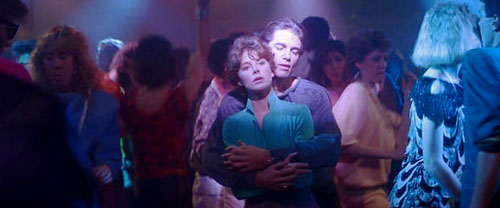
You’re going to understand De Palma’s Body Double better if you understand why Theodor Adorno liked Mahler. Somebody might have told you once that Adorno championed difficult art in general and atonal music in particular: string quartets made to skirl; the mathematically precise caterwaul of that half-stepping dozen, the series chromatic and uncanny. This isn’t exactly wrong, and it is the regular stuff of encyclopedia entries and intro classes, but it’s not exactly right either. For Adorno did not want an art entirely without subjectivity, which is what serial music sometimes suggests, a pure and as it were automatic music that would never suggest to anyone listening a link back to human utterance or expressiveness; that would never once yield a tune that someone, at least, would want to sing; a music, in fine, that was all system. What he was seeking, rather, was an art organized around antitheses, in which the conflict between subject and system would become audible; and he worried there were different ways an artwork could instead obliterate any sense we had of a living person struggling to come to speech within it, and he didn’t like any of these. Traditionalism was the obvious problem: the expert mimicry of older styles, the striking of already petrified poses, the chanting of sentences already spoken. Adorno said of Stravinsky that he was a U2 tribute band. But then a radical aesthetic can beat its own experimental path to the same deadly place, one he identified in the fully developed versions of twelve-tone music, in Webern, that is, and the late modernists of the ‘60s: serial music become oppressive because now wholly itself, without any concession to its historical rivals or predecessors, routinized and ascetic, sealed off inside its own rigors and formulae.

It is this rejection of Webern that should clarify Adorno’s championing of both Alban Berg and Gustav Mahler, which is to say both a composer conventionally classified as atonal and one typically reckoned not, the point being that each of these two absorbed into his music the opposition that musical history tries to construct only between them. Mahler and Berg can be conceptualized together as the Composers of the Break, neither tonal nor atonal, but first-one-and-then-the-other, by turns and in shifting ratios or proportions. If it’s misleading to say that Adorno was one of the great theorists of serial music, then that’s because it was this music-at-the-cusp—and not the purity of The Twelve—that he meant to recommend. At issue were compositions in which the conflict between entire aesthetic periods or modes of cultural production was openly theatricalized, and from this perspective, a composer’s starting point was irrelevant. You could fill your music with tunes, but let them curdle on occasion into noise; or, alternately, you could plunge your listeners into noise, but remind them occasionally of what tunes used to sound like. Either way, you would be staging a face-off between the entire history of human songfulness and some other, radically new aesthetic mode in which art no longer takes our pleasure as its aim and limit. And here, perhaps, is the most curious point: These last are scenarios in which either term, tonality or atonality, can count as subject and either as structure. You can say that the fine old tunes sustain us as subjects and that the mere math of the twelve-tone series recreates for us in the concert hall the experience of structure and rationalization. But you can just as plausibly say that those tunes are sedimented and mindless convention, at which point we might welcome dissonance as the opening out of the composer’s idiom—or simply as the afflicted yowl of anyone who wishes the radio would for once play something different.

We can’t make listeners choose between Mahler and Berg, because it is really easy to find Mahler in Berg. If we want to get back to Body Double, all we need to do, then, is generalize Adorno’s argument in a direction he probably wouldn’t have; to insist that antithesis, far from being the special achievement of these two Austrians, is the inevitable condition of most artworks, nearly all of which absorb into themselves piecewise the styles and conventions of various historical periods, social classes, and political tendencies. You can call this “liminal art” if you want, as long as you are prepared to add that threshold never becomes room. The struggles that a Gramscian reader thinks go on between artworks are usually reproduced one by one within those same works, which, if patiently read, will generate maps of the broader cultural fields of which they are also a part. What we can say now of postmodern art is that it is almost never wholly itself, that in order even to be recognized as postmodern, it will have to announce its own distinctiveness, marking itself off from its modernist counterparts, which it will have to after a fashion name and in naming preserve. The sentences regularly encountered in Jameson in which x artist is declared to be a postmodern revision of y modernist are thus oddly self-defeating. How often do you find yourself wanting to remind Jameson of how the dialectic works?—stammering, in this case, that one cannot name a break between two terms without simultaneously positing their continuity. If you want to lift out what was new in the movie Body Heat, having first spotted that it was, as Jameson has it, a “remake of James M. Cain’s Double Indemnity,” then you have yourself already conceded that the one was really, actually, finally a lot like the other. When we designate a work as “postmodern,” the superseded and modernist version thereof will persist, as its not-really negated shadow, and this shadow will, in turn, vitiate our sense of postmodernism as ahistorical. You can say that Body Double is a movie about other movies, but that very reliance on other films—prior films—will be a prompt to historical thinking. Postmodern Body Double preserves within itself the memory of movies that weren’t yet postmodern. But then this or something like it is going to be true of most really existing postmodernism, which we now have to reconceive as the arena of a certain fight—the showdown between the various modernisms and a postmodernism available only as ideal type.

This point is available, first, at the level of genre. There’s a remarkable moment about an hour into Body Double when we witness our hero decide to take matters into his own hands, make his own inquiries about the murder, get to the bottom of things. The spectator-actor prepares himself to assume the detective functions of classic crime narrative. And at just that moment, when the movie seems ready at last to lead us back behind the spectacle—to, you know, strike the set—it instead amplifies by the pageantry by launching into a full-fledged music video—for Frankie Goes To Hollywood’s “Relax,” complete with shots of lip-synching lead-singer Holly Johnson. What makes the sequence even more compelling is that the music video stands in for hardcore porn; it’s the point in the movie when the hero is trying to infiltrate a porn set by pretending to be a hired stud, and De Palma is letting FGTH’s lubricious, post-disco electro-march substitute for the obscenities he cannot show. The movie thereby directs our attention neither to porn nor to MTV, but to whatever it is rather that the two share—and thus to an entire set of new or newly prevalent video genres, characteristic of the last few decades and defined by their collective willingness to abandon narrative or at least scale it back to some barely-more-than-sequential minimum. From our own vantage, we would want to add, above and beyond the raunch and the Duran Duran, YouTube shorts, initially capped at ten minutes and now majestically extended to fifteen, and new-model movie trailers, which, following Jameson, deserve to be considered as a form in their own right, with their own conventions and feature-usurping pleasures.

This is what it would mean to talk about Body Double not as postmodern but as a conflict-ridden composite of postmodernism and the pop modernism of the detective story, which still thinks of itself as a device for disclosing hidden truths. The competing genres are entirely visible within the movie. And then the all-important point to be made in this regard is that the detective story more or less wins out, and not only because the movie ends with a literal unmasking, latex pulled from a face. The movie does indeed document the spectator’s inability to act, though even here its procedure is basically satirical, in a manner that depends on our memory of other heroes having once done something, a memory counterposed to which postmodernity will register not as a schizoid intensity but only as a vacuity. Check your Jameson: The movie’s parody isn’t all that blank, because its very genre provides a set of expectations against which its innovations will be judged. But even beyond this, Body Double seems dedicated to the idea that certain forms of agency remain available even in the society of the spectacle. The movie’s hero doubles himself—he is both spectator and actor—and then this pairing is itself in some sense doubled, because spectator and actor both come in a second version that we could call juridical or epistemological, and not just inactive or image-consuming. There has after all always been an affinity between the spectator and the detective, with the latter now understood as the-one-who-watches, the one who arrives on the crime scene like an apparition, pledged to leave no mark, to pollute no object, to minimize the observer effect by leaving the murder bed unmade. To this we need merely append the observation that performer-cops are also a familiar species, called “narcs” or “undercover agents,” and that acting, too, can be a form of information gathering. Body Double does to this extent grant its cipher a certain limited effectivity, within the bounds of acting and spectating, as gumshoe and mole. The once corrosive insight that the detective is like a voyeur is thus replaced by its opposite, a reminder that the detective functions might in fact survive, that epistemological and moral purpose can still be roused from within the position of the spectator.

This last is a point to be made at the level of genre as a whole. But we can make a few similar observations if we start calling out the titles of specific movies, or at least of one specific movie. For Body Double’s relationship back to Rear Window also contains its own historical argument. De Palma updates his Hitchcock in one absolutely crucial way: In the later movie, the spectator-hero is meant to see the murder, which is to say that his spectatorship has been factored in in advance. We can think of the matter this way: Rear Window was still easily explained within the usual Enlightenment paradigm of truth and knowledge, the magical version of which is the usual stuff of crime stories, in which once the solution is announced and the murderer identified, everything automatically sets itself to right: culprits march themselves off to jail, widows and fatherless children return to their business suddenly unbereaved, &c. Hitchcock had some good questions to put to that paradigm, epistemological questions, for one—about whether one really knows what one thinks ones knows—and also psychoanalytic questions—about the relationship between the knower and the peeper and hence about the sneaky way in which desire rides in on knowledge’s back. De Palma, however, radicalizes this scenario by inventing a murderer who wants to be seen, a murderer, in other words, whose plans depends on the existence of a manipulated witness. The shift from Hitchcock to De Palma thus secretes a certain periodization, marking out the difference between a society in which the media exercise independent oversight functions over the government and other major actors, like corporations, and a society in which government and corporations have already reckoned the cameras into all their calculations and so incessantly stage themselves for the public, which means that watchdogs are called upon only to play an already scripted role. Body Double is really and truly a meditation on that condition, but within the narrow parameters of the thriller.

This brings us to the big point: There was always something unresolved in Jameson’s postmodernism argument, and especially in his claim that postmodern culture tends to jettison historical thinking. It’s not just that narrative forms are never going to be able to revert back to some zero degree of history-less-ness, though that’s also true. The issue is rather that Jameson was making two claims that are finally rather hard to square with one another: that under names like “retro” and “vintage,” postmodernism revived the copycat historicism of the nineteenth-century art academy … and also that it wasn’t a historicism. The best chance you’ve got of making this argument work is by making it accusatory, because you have to be able to say that postmodern historicism isn’t really historical, that it is fake history, history reduced back to image or consumer good, just so many styles for the donning, as when the ‘50s mean Formica and the ‘70s Fiestaware. Sometimes that blow is going to land. But if you’re doing anything other than designing your kitchen—if you’re making a movie or writing a novel or metering out a poem—the citations you introduce will often be, not an aping farrago, but their own path to chronology, an exercise in temporal counterpoint or Ungleichzeitigkeit, a dozen arrows pointing us outside the present, and so a request that we resume the project of historical thinking only just terminated.

Postmodernism Is Maybe After All a Historicism, Part 2

PART ONE IS HERE

The question I’ve been asking myself is: Can you make a movie about postmodernity? Or rather: Can you make a postmodern movie about postmodernity? Can you make a movie about a historical period in a style that isn’t designed for recording history? And our hunch has got to be no. An artwork that is postmodern should not be able to register its own postmodernity, should not be able to draw attention to what is historically novel about its own condition.

Such, then, is the unexpected interest of Brian De Palma’s Body Double, from 1984—that it might be the movie that invites us to revise this conclusion. Jameson was able to show how historical thinking runs dry even in a novel, Ragtime, that on the face of it seems fully and commitedly historical. The task now is to reverse this procedure by scanning postmodernism’s amnesiac mediascape to see what historical signposts have escaped unflattened within it. If we set out from the idea that postmodernism isn’t just a mistake—if we posit, perhaps just as a thought experiment—that it is on some level a faithful report on lives lived out in the society of the spectacle, then we should be able to discover, amidst its intertextuality and in jokes and obligatory ironies, a descriptive or materialist moment. Once you’ve said that postmodernism elevates meta-fiction to the status of realism, you can, if you choose, read even meta-fiction as realist.

Body Double, I would grant, is not a movie that anyone would spontaneously describe as reportage—a movie, rather, so fully of the early ‘80s that you can’t even summarize its plot without pointing out how goddamn postmodern it all is. You call from the pulpit that postmodernism went in for citations or flaunted its unoriginality … and I’ll respond that Body Double is a Hitchcock vs. Hitchcock mashup of Rear Window and Vertigo. You call that postmodernism erased the line between high art and low … and I’ll say that Body Double has a naked lady where Grace Kelly used to be. It’s the movie, in other words, that cemented De Palma’s reputation as his generation’s trash Hitchcock. And so here’s what Rear Window would look like if its title were a dirty pun: An out-of-work actor is given a place to stay in Los Angeles by a new friend, another actor who’s going to be out on the road doing repertory work. Each night he’s in this new place he watches a woman in a building across the way strip down and put her hand between her legs, and before long he realizes she’s in trouble: a man she knows is pushing her around, plus someone else seems to be watching her, too. The actor, fascinated and feeling responsible towards his masturbating neighbor, starts following the woman around, whereupon he discovers that the other voyeur is also on her tail. He approaches her, reaches out, tries to talk, but can’t get through. The third night in, he is stuck watching as Voyeur #2—an oversized Chicano fella who looks something like Danny Trejo without the moustache—breaks into her apartment and murders her with a jackhammer. He reports this all to the police, who don’t suspect him of the crime, but still denounce him for a pervert. Then comes a chance clue: Stanching his grief with porn, the Tom notices a stripper-starlet doing the same distinctive, clam-happy dance he’d seen out his window and realizes that something isn’t right, that there must have been two women where he’d thought there was only one. So he pretends to be a porn actor in order to gain access to the actress; and then, once close, pretends to be a porn producer in order to get her alone and ask her some questions, whereupon it all falls into place. He’s been set up: His new friend—the other actor—hired the porn star to grind in that lit window, the idea being to keep his gaze fixed on the facing apartment so that he would see “the Indian” kill the woman—the other woman; the real woman—and the police wouldn’t suspect the actual culprit, who is of course the hero’s friend. What our guy doesn’t work out until the last minute, during a brawl over an open grave, is that there is also no Indian, because the murderer was really just the new friend in blame-the-darkie brownface.

One of the things that is most likeable about Body Double is that it is fully pretending to be stupid, which makes it in this one respect not like the Tarantino movies it otherwise resembles, since these always pause to parade their intelligence. De Palma’s movie you could get through convinced only of its tastelessness. There is, however, a spoofiness to the thing—a preoccupation with its own movie-ness—that indicates a secondary program beyond the baring and butchering of flesh. All I mean to say is that Body Double never lets you forget that you are watching a movie, and this more than anything has earned it the tag “postmodern.” It begins and ends on a movie set; its first line is spoken by an unseen director, which might be enough to make newcomers watching it on DVD think they’ve accidentally turned on the commentary track; a grand old deco hotel on Hollywood Boulevard is filmed to look like Dracula’s castle; when characters drive, the movie has them in stationary cars against back projections, such that one begins to hallucinate Doris Day in the passenger’s seat; the early-morning window in one shot, its light still without tint or hue, might be an old black-and-white movie thrown up onto yet another screen; when two characters kiss outdoors, the movie shifts from live background to a washed out rear projection of same; the opening credits are all bucket-of-blood, creature-feature retro-sleaze, like something off the cover of a Cramps album.

So there it is—some of the evidence that this is meta-film. The standard line on this would frame its point in epistemological terms: The movie is giving us a crash course in skepticism, teaching us not to mistake representations of objects for the objects themselves or at least taunting us for our compulsive committing of that error. Characters wander out in front of painted backdrops, gesso-and-canvas mountains with the real San Gabriels still visible in the background, when of course by “real” I mean “filmed,” which is precisely the correction the movie is demanding that I make: Be careful what you call real. The stylistic tricks have an utterly straightforward relationship back to the plot, because the movie’s viewers and its hero are in the same position—just so many watchers. The character has to work out that what he’s watching is just a staging—he’s been duped—and the movie is constantly reminding us of the same point—that we are suckers to what we see—but our version of that point comes in a radicalized form, since the character, at least, is allowed a moment of genuine insight; allowed, that is, to look behind the curtain and encounter there something he can call truth. He has solved a mystery. But if we’ve twigged to the movie’s games, then we will have to conclude that even this insight—this uncovered reality—has been scripted and staged … for us … by a movie. We never get to go back behind or to the bottom of anything.

This, again, is the standard line, and it comes in one major variation, which is ethical, in which case you might conclude that you are fixated on images not because you’re a philosophical realist but because you’re a reprobate. It is, indeed, one of Body Double’s many charms that it silently classes positivists among the debauched. The main character is, of course, caught out as voyeur, and since the movie goes out of its way to establish the correlation between him and us—as people who hang about in dark rooms watching other people go about their business—then we are sooner or later bound to realize that we are his accomplice and co-ogler, just one of the title’s many doubles. “You’re a peeper,” the cop tells him, therefore you. “In my book, that’s a pervert and a sex-offender”—which is one way to make clear to viewers that their sincere concern for the woman at the moment of her killing—their wanting to call out to her, their wanting her to escape the murderer’s clutches—was messily entangled with their delight at having had a good look at her nipples. De Palma, it should be noted, saves the movie’s most salacious softcore shots for the movie’s very end, by which point the viewers can consider themselves thoroughly pre-accused. Either way, though, whether we follow the epistemological line or the ethical one, we get to say that Body Double is a movie about movies and that this vitiates cinema’s usual reality effect … brackets its referentiality … voids the claim, implicitly made by nearly every film, to be about something other than movies.

Now that line works as far as it goes, but it’s not enough. Body Double is about a spectator who gets involved in the events he’s been watching—this is what it most shares with Rear Window. And that meditation on spectators—on what it means to be part of an audience, on the limitations and obligations of that position—is certainly what makes the movie meta-. But it simultaneously introduces into the film a certain unconventional realism, because “the spectator” is not an already established movie type, not a cowboy or a gumshoe or a rogue cop. In the place of these heroes, all of them more or less mythical, the movie has inserted someone pathetically like us, somebody whose first impulse is always to stand and stare and only belatedly to punch someone. Body Double’s project is to take the spectator and make him the hero in a crime thriller, on the understanding that the spectator is a historically novel and rather alienated social position, truncated, passive, precisely not heroic. The movie is to that extent calling out genre film on its basic lie or paradox: Most blockbuster movies present us with a world bustling with dynamic people, mostly men, riding in, rumpusing, getting ‘er done, and yet even this incessant display of intact heroism, far from modeling for us a masculinity we can adopt in turn, will tend to make of us only bystanders. Most movies expect us to lionize the Deed from a position of mass immobility, lined up in inert rows.

Body Double wants to tackle this problem head on. How would a genre film have to change if it took as its raw material the real human stuff of the present? Or more broadly: In the society of the spectacle, in which we are all onlookers, how does anything ever get done? The movie’s spectactor-hero registers to this extent as an intrusion from the real world, such that we might just about conceive of the film as a Purple Rose of Cairo in reverse—or as a sinister Pleasantville—a movie, that is, in which someone from the audience has crawled magically onto the screen and has to shuck-and-jive his way through whatever role John Travolta has just vacated. De Palma’s most inspired move, back in 1983, was simply to cast a bad actor in that part, or if you like, to miscast a bit player in a starring role—an actor more typically associated with one-off appearances on LA Law or Murder, She Wrote, a bonier Bill Maher, we might say now. This is the movie’s most specifiable intrusion, its most overt tampering with your complacent expectations: The schmo is occupying a role that you had thought would go to someone else—Harrison Ford, maybe, or Michael Douglas—not, at any rate, to one Craig Wasson. You could call the character one of Hitchcock’s ordinary men, but then you’d still have to make clear: He’s really ordinary … and not just Cary Grant standing in for average.

The movie’s first order of business, then, is to take its hero and establish him as a schlemihl and human yo-yo. Some of its devices are entirely conventional: He gets fired, discovers his girlfriend cheating on him, is variously dogged and dressed down. The problem with setting a movie in LA is that there are no rain puddles for taxis to splash on a sad sack’s best suit. One of its devices in this regard is moderately interesting: During a guided memory at an acting lesson, he is told to cry out—to wail in what is in some complicated way his own voice—and he can’t do it … can’t find the air … can’t even find a sound inarticulate. It’s the sort of shift Jameson would want us to note: from The Scream to the un-scream, from a world of suffering to a world so stage-managed by spectacle that you can’t even holler if it’s not in the script. And then one device along these lines is really very fine: The movie begins with the hero working on a cheap horror movie, as its monster, except whenever it comes time to crawl from the tomb, he seizes up. Within the inherited vocabulary of the drive-in movie, that’s an ingenious image of castration: a vampire who cannot leave his coffin, the undead about to lose its animating prefix, and also an actor who cannot heed the call to “Action!”

And then this now gets at something deep in the movie: The first thing we see in Body Double is nothing happening, and we will immediately want to generalize the point: What’s missing from the movie is die Tat: feats, exploits, interventions. The only thing the hero is good at doing is watching. The movie itself, meanwhile, is at its best when trying to find ways of signaling its hero’s scopophilia, and this in a way that underscores its resemblance to the movie-going that anyone watching the thing is by definition doing right at that very moment. De Palma is so adept at this particular provocation that it can leave you a little contemptuous of Hitchcock, who, one now realizes, was making things easy for himself in Rear Window when he strapped Jimmie Stewart to a chair, dimmed the lights, and then furnished him with a multiplex of illuminated oblongs across the way. The cinematic likeness in those sequences could hardly be more obvious. But De Palma gets his hero up off the upholstered seat, puts him on the move, sends him out into the city, following the woman, and still manages to call to mind movie-going, for which he has to find an accordingly more elaborate set of visual approximations. One in particular stands out: The hero follows the neighbor woman to Santa Monica; climbs up to a balcony on a beach house; and then watches while she makes her way down the same house’s lower terraces and then out onto the sand, at which point the balcony he’s standing on reclassifies itself, inconspicuously, as a gallery or theater box. The effect would be easy to miss, except at one point he leans in as though to talk to her from afar, his mouth moving silently to form unspoken words, which is recognizably the behavior of somebody stopping himself from talking to a movie: Watch out. There’s somebody behind you.

If we call that example #1, we can promptly add two more.

2) During that same acting lesson, the hero is telling a story about playing hide-and-seek as a child—or rather he’s re-experiencing the ordeal of a game gone wrong: He’d gotten wedged behind a refrigerator, pinned into his hidey-hole, and was frozen with fear. So yes, hide-and-seek … a discovery game, which is thematically relevant … the movie is what you might call “highly designed.” But more important, the hero is reliving this childhood paralysis and has gone to stone on the classroom stage, and the teacher, trying to snap him out of it, shouts: “You have to act!” What this means is, of course, entirely unclear. The entire scene has been arranged to bring out the everyday paradox of that word in English—“to act”—which means both “to really do something” and “to not really do something.” The voyeur-hero in Rear Window was a photographer by trade, a professional watcher. It is another of De Palma’s small innovations over Hitchcock to make his voyeur an entertainer, somebody who works in front of the camera, and so to allow him to encapsulate the only two social positions that are left to us in the society of the spectacle: the spectator and the performer in one. The epigrams start writing themselves: Acting swallows up the category of the Act. The actor is the one who will never act. In postmodernity, “action” is a type of movie, and an “act” is one third of a play.

3) The movie’s final showdown is an elaborately dry gag. The hero has been tossed into a freshly dug grave, and again his claustrophobia sets in. From this moment on, two things will stand out. First, we get the hero’s POV from underground; he’s looking up at the rectangle of the pit’s opening, which, for no diegetic reason, has been floodlit—lit to white—such that it resembles a blank movie screen, with our guy again in darkness and the killer’s figure looming out from the sky’s fabric. The image has to be understood as a taunt or a warning or a buzzer attached to your theater seat. The cinema is a grave; if you remain a spectator you are going to die. Second, the movie carries its contrivance so far that the hero doesn’t actually contribute to his own survival. At just the moment when you think he is going to absorb the imperative to act and so model for you what it might mean to leap for once from your living room sofa, you and he learning together to shed the passivity of the spectator—a dog appears nearly out of nowhere; jumps the murderer; and pulls him to his death over the face of a dam. The Act puts in one final non-appearance. That sequence condenses into three short shots one of the things about this movie that is hardest to get at, which is its rather bracing willingness to disappoint. For Body Double is, by most of the usual standards, a pretty lousy crime thriller: a collection of set pieces variously abridged and aborted, resolved to perform upon itself and at the level of genre the castration that it laments in what for structural reasons alone I persist in calling its hero. Try to imagine a Dirty Harry movie in which Clint Eastwood had been replaced by an inanimate object, a box elder, say, or a chaise lounge.

And yet it is this very badness that is the movie’s best thing—its carrier of history—its invitation to memory …

PART 3 IS HERE.

Postmodernism is Maybe After All a Historicism, Part 1

Can you make a movie about postmodernity?

That probably sounds like a pretty stupid question. The scholars who first proposed the term “postmodernity” wanted it to mean something like the Age of Developed Capitalism, the global and all-consuming version, driven by its own distinctive and world-transforming technologies—long-distance communication, the media, computers, the Internet—and facing no obvious competitors. One clarification is immediately required: These scholars—Frederic Jameson, mostly—thought of postmodernity not as breaking with capitalism’s basic and long-term trends but precisely as intensifying them, which intensification we will begin to register if we simply list some of the things that have gone missing over the last half century: socialism, organized anti-imperialism, nature, the Left—capitalism’s historical rivals, in other words—the various attempted counter-modernities. This means that the term “postmodernity” was always something of a mess and bound to spread confusion, because on most accounts capitalism is one of modernity’s chief features—in lots of contexts, the word “modern” is a near-synonym or even euphemism for “capitalist”—in which case “postmodern” actually means something like “fully modern” or “hyper-modern.” Postmodernity comes after lots of things, but modernity isn’t one of them.

Now if you accept that periodization, the question, again, is going to seem pretty pointless. The word “postmodernity” is a way of naming our present and of marking out some of its more salient features. And since most movies are unselfconsciously set in the present—and since all of them engage with the present even when set in the past or the future or in unreal worlds with made-up histories—they are all to that extent “about postmodernity.” Maybe you take the word “postmodern” to mean something more bounded; maybe it inevitably calls up for you memories of 1982 and the first time you heard Cabaret Voltaire; but then there are movies for you, too, movies about the years when people started describing themselves as postmodern, movies that work to produce “the Eighties” as an object of historical scrutiny or puzzlement: The Squid and The Whale, say, and especially Donnie Darko.

I still think the question is a viable one, but it is up to me to explain why. One of postmodernity’s most pronounced features has been what Jameson calls “the cultural turn.” The argument here follows on from Debord and Baudrillard. Commercial media and the new technologies have created a world that is, to a historically unprecedented degree, saturated with “culture”—completely soaked with images and stories and music. This suggests an unusual process of de-differentiation, in which “culture” is no longer a special realm unto itself, governed by its own institutions, with its own rules and idioms (museums, libraries, philosophical aesthetics, &c.), but has become the universal medium for all other spheres—the economy, the law, the state, religion, &c—all of which must now learn to stage themselves, again to a historically unprecedented degree, at the level of image and story.

This “rise of culture” has in some sense meant the end of art—its apotheosis, yes, but also its termination—the end of art, that is, as something to be pursued in redemptive isolation, away from the state and the marketplace. Postmodernism—and we can now, at last, swap out suffixes—arrived as the liquidation of certain valuable aesthetic projects. It had once been the project of realist literature to help us cognize the composite and dispersed social systems of capitalism; realism broke with the experience of everyday life, allowing readers to hold in their heads the complexity of a capitalist city in a way that no person could do spontaneously. Modernism, meanwhile, which is usually thought of as having been consecrated to the New, is perhaps better conceived as a series of failed rescue projects, so many bids to preserve a realm of experience outside of the workplace and the shopping arcade; to get back to the objects so that they might be boosted by the doting armful from the market stalls and boutique vitrines; to give back to choking people their swallowed tongues; to salvage language … and sound … and paint … by reinventing them; to use each Adamically and as though for the first time; to model for us all an expanded realm of freedom, in which persons and objects would exist without function or fixed purpose. Postmodernism marked the collapse of all that—the end of a certain hard-won intelligibility, the end of search-and-rescue—and so the triumph of a generalized market culture.

We can say now that when Jameson started talking about “postmodern art,” what he meant was something like “fully capitalist art”—though he was more cunning than that and would never have put it that baldly. And “fully capitalist art” isn’t quite right anyway, because even postmodern art retained a complex and transitional character, cultivating some minimal allegiance to art’s inherited forms and institutions—paintings hung in galleries, long novels published by prestige presses—while nonetheless opening these latter up to Hollywood and rock & roll and comic books and advertising. What we witnessed in postmodernism was not, in this sense, the final abandonment of art—not the old avant garde’s rather more liberating fantasy of actually burning down the museums, thereby forcing artists to paint the streets—but a process still visibly underway and captured in freeze-frame—commercial culture’s ongoing expansion into the regions of its former quarantine. Marilyn vanquishes the naiads.

Another quick way to get a handle on what was going on in postmodern art is to imagine that it all began with a realist operation. Even impeccably realist novelists would, if trying to itemize the everyday life of contemporary North Americans, have to register the massive presence of the media in the lives of such people and so introduce into their realism the shadow world of television and the Internet, codes and whispers and images and memes, all taken now as social facts in their own right, at which point the accustomed distinction between realism and meta-fiction would become untenable, because postmodernity promotes meta-fiction to the status of realism. The least realistic thing about most horror movies is that, when the beasties attack, no-one shouts: “This is just like a horror movie”—which is, of course, the very first thing you or I would say. There is no getting around the Realm of Appearance; everything travels through it. The hallmark of High Postmodernism, then, at the level of style, was its commitment to the Code or to Seeming, not to seeming this way or that way, but to seeming as such; its wholly deliberate and upfront play with media images; its bracketing of the world’s objects; its bracketing, too, of what in other circumstances we might have called self-expression; its sense that we are all living in an enclosed videodrome where the signs will ever chatter.

What Jameson wanted to do, back in 1983, was lay out a certain trade off. It’s not that postmodernism didn’t have its pleasures. Postmodern art offered its admirers a sequence of free-floating and discontinuous intensities—this was its delight and its achievement—though we’ll want to note right away that such an achievement basically repeated the experience of channel surfing or listening to FM radio. The problem as Jameson saw it was this: Anyone wanting to pursue these joyous shavings or shards of vividness would have to give up on some of our older ways of trying to make sense of the world—entire vast and intricate modes of historical or structural understanding. For a while there, Jameson was especially drawn to aesthetic artifacts where you could actively experience the swapping of intelligibility for schizoid intensity, where you could sense some inherited expectation of understanding being violated and then feel that ticklish vertigo or camp sublimity creep in behind: great big buildings that make no effort to orient their visitors, that cheerfully allow guests to get lost in them, the luxury hotel as corn maze; historical novels in which the past is never properly retrieved, never allowed to march in review, in which distant events keep slipping away from readers until they realize finally that they are stuck in the present.

It’s that last we’ll want to hang on to: Postmodernism gave up on historical thinking and sometimes seemed to give up on narrative as such. Of course Marx was making the point as early as the 1860s that capitalism made it hard to think historically, simply by introducing into our daily lives an unprecedented degree of social complexity and so blocking our customary understanding of where objects come from. Factory production and long-distance trade fill our lives with mysterious things. And Lukács, similarly, was trying as early as the 1920s to describe an order in which commodities were entirely “constitutive of … society,” in which “the commodity structure [penetrated] society in all its aspects and [remolded] it in its own image”—a society, that is, in which capitalism had completed its historical mission to rob us of our bearings. That’s Jameson’s postmodernism, and there is a certain tone you need to hear in his argument, as though spoken back to Lukács: You thought you had it bad… Surely the sharpest bit of literary criticism that Jameson has ever written are those three pages on Doctorow’s Ragtime in the landmark postmodernism essay: “This historical novel can no longer set out to represent the historical past; it can only ‘represent’ our ideas and stereotypes about that past (which thereby at once becomes ‘pop history’).” There is high drama in that sentence—postmodern ahistoricism comes crashing in to historical thinking’s last literary redoubt—though Jameson could have made matters easier on himself, since there was a whole string of straightforwardly anti-historical novels published between the late ‘60s and the early ‘90s, novels about professional historians and history teachers who abandon the practice of history, who conclude that historical knowledge has decisively eluded them: Grass’s Local Anaesthetic (1969), Swift’s Waterland (1983), Updike’s Memories of the Ford Administration (1992), Gass’s Tunnel (1995). There’s no mistaking what’s going on in those novels. Doctorow, on the other hand, you could misread as Walter Scott with an oddly clipped prose style.

So the question I really want to ask is: Can you make a postmodern movie about postmodernity? And that isn’t a stupid question because the term postmodernity is fully historical in a manner that is inimical to postmodernism itself. What we’ve been asking is: Can you make a movie about a historical period in a style that isn’t designed for recording history? And our hunch has got to be no. An artwork that is postmodern should not be able to register its own postmodernity, should not be able to draw attention to what is historically novel about its own condition.

More soon, because I think I’ve found the movie that fits the bill….

PART TWO IS HERE.

PART THREE IS HERE.

On Agamben’s Signatures

Let’s say you don’t believe that wholes or totalities exist. You don’t believe that people and objects inhabit underlying structures that assign to them meanings or functions. Whatever it is that is bigger than us, the space within which we move, is neutral terrain, not exactly empty, but unstriated, a field of constantly shifting singularities. It’s going to help to have a name for this space, this wire cage in which the lottery balls blow, though it’s unclear what that name is to be. There is a lot that you can’t call it, many words that, believing as you do, you are going to have to give up. You can’t talk about structure or system or any of their derivatives: There are no ecosystems, and there is no world; there are no political or economic or legal systems, no capitalism, then, no empire, nothing global. It would be safer, conceptually purer, to shut up about the state and society. There can be no talk of rules and laws, because such things either constitute structure or are assigned by it. You’ll also want to toss out any terms that refer to big blocks of time. You can start with the word “modernity.”

That people who claim not to believe in totalities routinely talk about all these things suggests only that they are not yet disbelieving with their hearts, like Christian teenagers pretending to be more badass than they really are. Yer average copy of Anti-Oedipus is, in this sense, a prop cigarette. But it doesn’t have to be that way. It is the virtue of Giorgio Agamben’s recent book on method, The Signature of All Things, to remind us what a painstaking post-structuralism can look like. And yes, this is the first thing to know about the book: that it is post-structuralist, in some wholly precise sense of that term, still, in 2008, when it was first published in Italy, and not just because its author quotes Foucault a lot. What matters is that Agamben is still actively trying to purge the concept of “structure” from his thinking; still trying to jimmy that e from his typewriter; still scanning old volumes of philosophy so he can accusingly annotate the passages where schemes sneak in unbidden; still trying to devise something to put in their place.

We can see how this works in the second essay, from which this little book takes its title, and in which Agamben asks us to start thinking again about a basic problem in structural linguistics: How does language pass from words to utterances? Or if you like: How does the mind get from inert words, archived dictionary-like in lists, to living sentences that actually carry meaning? The usual answer to that question would have something to do with rules or laws: There are rules governing how words get combined. Your mind doesn’t only know words and their definitions; it’s absorbed the guidelines for their use. But Agamben doesn’t want to say this, because the word “rules” makes language sound like a government agency. Nor are the usual alternatives much better: Any talk about the “structure of language” is going to bring in resonances of the state or capitalism or the administered world. We could try to identify the mind’s “devices for building sentences,” but that would turn language into a technology. We could wonder how words get “processed,” but that would be either bureaucratic—words as case files or credit-card applications—or again technological—words as refined sugar. Agamben is in the market for a way of thinking about language that does not go through a juridical model of laws and rules …  or a political model of the system … or a technical model of the machine.

His proposal, derived from synopses of Paracelsus and Jakob Böhme, is that we learn to think of language as magic. Magic is what will substitute for structure, in which case one synonym for post-structuralism is “the occult.” Agamben wants magical signs; this, roughly, is what he means by “signatures,” signs that aren’t just neutral stand-ins for things, tokens or pointers, but charmed symbols vibrating with their own energies, signs that have “efficacy,” “efficacious likenesses,” not marks that you write down but marks that are written across you. Every spoken sentence changes the world and is in that sense a spell or hex. This is probably the clearest instance of the “regression” that Agamben makes central to his method: “the opposite of rationalization,” he calls it. If you are serious about your critique of enlightenment, you are going to need an enchanted epistemology.

So … at least it’s not the same old anti-foundationalism—a post-structuralism, then, with new emphases and possibilities. Indeed, one of the more conspicuous features of Agamben’s reflections on “method” is that they actually add up to some pretty strong and decidedly un-skeptical claims about the nature of social reality. How one studies the world is premised on an already robust idea about how the world really is. This is clearest in the book’s first essay, which explains Agamben’s notion of “paradigms”—it would help if you could set to one side whatever you currently think that word means and let Agamben explain it for himself. He is, above all, trying to explain what Foucault had in mind when he said that the panopticon was the nineteenth century’s representative institution, or what Agamben himself wants to say when he makes the same claim, for the twentieth century, about the concentration camp. These two, the panopticon and the camp, are paradigms—not their respective eras’ most powerful institutions, at least not by any of the usual metrics, and not their most frequently encountered institutions—but the pattern or model for all manner of other agencies, and so the key to the latter’s intelligibility. To examine in detail a Regency-era prison is actually to describe five or six other institutions all at once: hospitals, elementary schools, mental asylums, army barracks, nearly any public street in Britain in 2010. The prison itself serves as a kind of extended sociological analogy, even a kind of “allegory”—the word is Agamben’s own. Everything is now like x.

You’ll be able to make up your own mind about the “paradigm”—about how useful it is as an explanatory device—if you bring into view its competitor concepts, the notions that it most nearly resembles and so means to replace. These are basically two: the symptom and the function. We could try to discover what functions prisons or concentration camps play in the social order at large. This would require that we attempt something like a political economy of the camps, that we try to work out what it is in the modern European state or in organized capitalism that tends to produce camps. If, alternately, we called the camps a “symptom,” we would be positing not so much function as dysfunction; the camp would be the visible mark or felt sign of an underlying sociopolitical disorder, one whose pathways and mechanisms, because not available to the eye, would still have to be analytically reconstructed. Either way, if we talk about functions or symptoms, the task in front of us is to relate camps and prisons back to the underlying order that has at least partially produced them. And this is precisely the job that Agamben is now calling off. What he likes most about the notion of “the paradigm” is that it bypasses any talk of the totality or system; it spares us from having to reconstruct anything. If you call the camp a “paradigm,” you are saying that nothing “precedes the phenomenon.” Camps and prisons are “pure occurences” that persist “independently of reference” to other institutions—“positivities,” he calls them and doesn’t blush. They are representative institutions, and they conjure up parallel institutions, but only as a string of singularities, the relationships between which are to be left, as a matter of principle, unelucidated. It isn’t even an open question, to be settled empirically, whether prisons and this or that capitalism require one another. The question is methodologically disallowed. There is pride in not asking it. His sense is that the agencies of a given historical period might congeal into a set, might adopt similar designs and follow similar procedures, might come to resemble one another, without, however, being functionally related, and the task of the social historian is only to chart the spontaneous mutation in some free-floating logic of institutions.

Here’s Agamben: “According to Aristotle’s definition, the paradigmatic gesture moves not from the particular to the whole and from the whole to the particular but from the singular to the singular.” You can attribute that idea to Aristotle, but it also sounds an awful lot like the “constellations” of Benjamin and Adorno—assemblages of singular things, not subsumed under a category or master term, but linked all the same, except only just, minimally unified, scattered fragments carefully re-collected, scraps joined with twists of wire, like an early Rauschenberg combine, the unity-of-unity-and-difference with difference dialed high in the mix. Agamben and Adorno share the idea that singularities might be linked together directly and so circumvent the abstractions that typically manhandle them. And saying as much should help us identify what is peculiar about Agamben’s thinking. For Adorno, of course, preserves the moment of the totality or the whole—he continues to speak of “capitalism” or “the administered world”—to which the constellation of singularities nonetheless provides an alternative. Hence Adorno’s in some sense entirely conventional reliance on the aesthetic: He thinks we need a better way to cognize objects and thinks, too, that art might provide it; that in the aesthetic encounter we for once apprehend objects in their singularity, without immediately subsuming them under models or formulas. In rare moments, we stop thinking like administrators and lose the names for things. The constellation is an alternative mode of cognition, a utopian counter-term, and in that sense a project, rather than, as Agamben has it, a method—a counter-systemic thinking and not a post-structuralism. The bizarre thing about Agamben—although this is a peculiarity he shares with lots and lots of other thinkers—is that he thinks that this utopian counter-term already describes our political and economic reality. It is the mistake endemic to the breed. What in Adorno remains a political task Agamben and sundry others turn into proclamation. Fired by the idea that the world should not be organized into structures and systems, they convince themselves that the world is not so organized, though where they used to take the epistemological shortcut to singularity, they are now more likely to take the ontological one: sameness cannot exist; it is existentially excluded; there is only multiplicity.

If there is a big point here, then we’ve just hit it: You can be counter-systemic, or you can be post-structuralist, but you cannot coherently be both, because once you’ve declared that there is no structure, you cannot then say you want to overturn it. Adorno thinks that a transformed world—let’s call it communism, though he wouldn’t have, as others were hogging the word—would be one in which people and objects can exist as free but linked singularities; and he thinks that we can proleptically work out the epistemology of that world-that-is-not-yet-ours, such that we can sometimes experience objects and others as though already redeemed. Agamben thinks that this utopian epistemology—the knowing of linked singularities—accurately describes the world we already inhabit, which is the society of camps and prisons.

I don’t mean to suggest that Agamben has anything nice to say about prisons and concentration camps. This is manifestly not the case. He typically presents himself as a thinker of The Catastrophe—the destruction of experience, the permanent state of exception, the generalization of Dachau, the merging of the concentration camp with everyday life, Buchenwald without end. There is, if anything, an apocalypticism in his writing, modeled again on the late Adorno and a Benjamin-about-to-die. And yet a certain utopian misdescription of the concentration camp is built into his arguments all the same, simply because he has taken the redemptive moment from negative dialectics—Adorno’s inevitably temporary reminders of how objects would appear to us once liberated from the abstractions of the exchange relation and bureaucratic reason—and locked it in place as a uniform method. The strain of this argument is often evident, as here—Agamben is trying again to sum up what he means by “paradigm”:

We can … say … that a paradigm entails a movement that goes from singularity to singularity and, without ever leaving singularity, transforms every singular case into an exemplar of a general rule that can never be stated a priori.

This is a version of what we’ve already seen: Singularities are directly joined, flush up against each other. A certain generality can be achieved, but a miraculous generality that doesn’t come at the expense of singularity, a generality without abstraction. What Agamben is saying here really isn’t all that complicated. All he means is that when you write about a prison or a concentration camp, you are writing about our general condition, but you need never exit the detail and fine grain of your description in order to make this point separately and in its generality. You can just motor on with your individualized account, immersed in the singularity of that particular institution, confident that it will stand in for other similar institutions. The problem, in this light, is the term “a priori,” which Agamben has grabbed from Kant. The rule of prisons, like the rule of camps, cannot be stated a priori. To which one would like to reply: Of course not. Of course these “rules” can’t be formulated a priori, because Agamben and Foucault are offering us a method for historical study; they are talking about historical periods, trying to identify shifts in historical experience, and historical experience is by definition not a priori. That is one of things one knows a priori about the term “a priori.” The claim, in other words, isn’t wrong. Quite the contrary: it is troublingly evident, because definitional. It’s the sort of truth you can’t insist on without making other people wonder whether you’ve really grasped the underlying issues. We can be certain, at least, that we are not dealing with a distinctive virtue of Agamben’s method; there is no philosophy whatsoever that could deliver to us a priori knowledge of Sachsenhausen or the Alleghany County Jail. What is true of “the paradigm”—what Agamben makes his boast—is true of every other historical methodology, without exception. One suspects, then, that this sentence cannot mean what it plainly says, that Agamben wants to use the term a priori to suggest a rather different claim: not that the general historical rule can’t be stated a priori, but that it can never be stated in its generality, as an abstraction. But Agamben can’t put it that way, because in that form the claim is just false. Anything that can be said about the panopticon paradigmatically could also be said generally, as an observation about a system or set of institutions, without our even having to mention the panopticon. So that’s one way to make it seem as though you have excised from your thought the structures or totalities that have not vanished from the world: You argue the obvious in order to insinuate the wrong.

The spun sugar of destruction

The task today is to explain a movie that reviewers have described, unvariously, as “gonzo,” “beyond the pale,” “surreal,” “indefinable,” “gone, baby, gone,” and “totally inexplicable.” The movie is Nobuhijo Obayashi’s Hausu, from 1977, a horror film of sorts that has, at last, been playing in American theaters here and there over the past year, and, yes, the damnedest thing, the kind of movie that can turn any hour into midnight. A teenaged girl gets into a kung fu showdown with a wall phone. A stygian fruit stand turns a high-school teacher into a pile of ripe bananas, the bunches heaped high at his steering wheel, still wearing cap and spectacles, as though waiting to speed away, “Bananas everywhere!” his dying words, except you can’t really make them out over the rockabilly and the lounge jazz. The severed head of a recently decapitated young she-glutton chomps the assflesh of another teenaged girl, like a farmer wide-mouthing the season’s first crisp apple, and then tilts back to show a ragged neck packed with watermelon pulp.

And yet Hausu really isn’t all that hard to explain, as long as you’re willing to ask the obvious questions, to start with what is most familiar in the movie and work your way up to what is most bum-biting and outlandish. For Hausu is, at heart, really just a haunted house movie. Its Engrish-language title is telling you as much. A high-school student takes six of her girlfriends out to the countryside to visit her dead aunt, and the house attacks them, one by one, then pairwise, such that none ever returns.

Yes, there’s also a white cat with green laser eyes, but for the moment that will only confuse the issue. For now, we need merely plod, putting to Hausu the questions we would put to almost any ghost story. In some ways ghosts are unusually hard to talk about, because the ghosts one encounters in film and literature are so much more varied than the werewolves and the vampires and the zombies: they come in different shapes; they have different powers; different vulnerabilities. It could seem harder to generalize about them, to find any pattern of meaning amidst all that variation. But one point stands out, and I don’t think it’s hard to grasp. Ghosts are almost always figures for something you think should be gone, but isn’t. That’s it. A haunting just means that a trace of the past has come back. The ghost almost always announces some disruption in the order of time; the ghost is history itself, perceived as a problem; the disturbing persistence of history into the present. It is history that refuses to go away.

So when you watch a ghost movie, your chief task is to figure out how the movie understands the relationship between the past and the present; that is, you need to figure out what the movie has indentified as the salient features of the present; what it has picked out as the salient past; and then you need to figure out what they have to do with one another. Hausu makes this easy, by giving us a few minutes of fake newsreel, in early ‘40s black and white, in which we learn that the undead aunt is a kind of war widow, engaged once to a Japanese airman, who never returned and for whom, having made a pinky promise, she eternally waits. The movie, in other words, nominates its own past by shooting it on a different film stock: We have an older generation that is still pledged, in occult measure, to pre-war Japan, which here means not only thimbly tea cups and a population in fancy pajamas, but the Japanese empire and Japanese militarism. The aunt is witch-priestess of that Japan, endlessly mourning it, awaiting its return or re-rising sun.

The way the movie captures the present is necessarily more diffuse and so a little harder to pin down, though not much. The movie’s main characters are all teenaged girls, seven of them, with dwarflike names to match that number: Gorgeous, Prof, Sweet, Melody, Kung Fu, Fantasy, and Mac. This already gives us a lot to work with. The first thing that leaps out is the total absence of men, so first: a feminized Japan. Two of the girls—Prof and Kung Fu—conspicuously occupy roles customarily allotted to men, as the gang’s braniac and warrior-guardian, respectively, and so suggest a historical transition over to female self-sufficiency: a society that’s all ladies. But then fully four of the girls have English nicknames: “Gorgeous” and “Prof” are the subtitles’ translations of Japanese originals; “Kung Fu” is neither Japanese nor English; but Sweet, Melody, Fantasy, and Mac all are Anglo-monikers, English already in the dialogue, and so register a certain Americanism, except the movie’s subtitlers have gotten ahead of themselves, because “Fantasy” is actually, as spoken, “Fanta,” which means that one girl is named after a soda and another after a hamburger, so: A Japan so Westernized that children nickname themselves after value meals. The other thing to know about Hausu is that its dialogue is all a-titter, effervescent, silly, the opposite of mournful; the movie uses schoolgirl giggling the way Harold Pinter used to use pauses. The bundle of associations is the usual one: a feminized, consumer Japan; given over to the young; post-heroic, maybe even post-masculine. The movie can seem to pitch giddy, pop girl power against the imperial melancholy of their parents and grandparents.

This all makes for a reasonably straightforward ghost story, in which the present is pitted against the past—a generational battle, then. In those terms, the movie puts in front of us a failed present, which is what usually happens in a ghost story—a present that hasn’t extricated itself from the past. The old Japan reasserts itself: This is clearest in the movie’s coda, when we see the ghost-aunt’s niece, Gorgeous, now mistress of the old house, and so spectral in her own right, or atavistic, dressed in a kimono, fluidly opening shoji. In fact, we also see her welcoming—and then killing—her father’s new fiancée, and the important fact here is that at the beginning of the movie, the stepmom was described as “surprisingly good at cooking and other things.” The movie has thereby registered the questionable domesticity of modern Japanese women, and we can understand the house as busy trying to undo that shift, by relegating the powerpuff girls back to the old roles of maid and helpmeet. The movie’s title is in this sense oddly precise; it can dispense with the word “haunted” because it is premised on the observation that all houses are haunted or possessed, because all feed on their members, and especially on their less muscular ones, as this house does literally. The girls are to this extent the unlikely bearers of a feminism, whose defeat the movie will, with horror, recount. In place of fiends and demons, the movie has washrags and feather dusters, which all turn out to be the same anyway: Things that can destroy a carefree girl. One girl gets killed by the bedding.
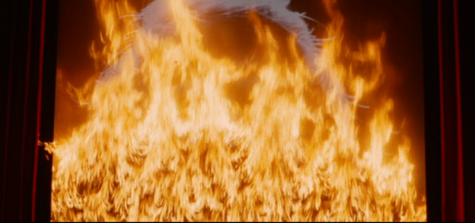
But the movie is actually more complicated than this, because it also admits of a second reading, which runs concurrently alongside the first. Even as it pits the duty-bound war generation against the pop feminists of the mid-‘70s, the movie establishes a certain vexing continuity between the war widow and the girls and thereby forces us to consider the possibility that the girls are vulnerable to the Japanese past because fully its heirs.

A little background: It will help to know that there has been a lot of Japanese art over the last few decades that condemns its post-war addressees for being too too childish or too girly—a backlash, this, against Japan’s more or less official culture of cuteness: whatever it is that drives grown men to put stickers on their cell phones, or convinces Japan’s governors to assign each political district—they’re called prefectures—a certified cartoon mascot: a walking yellow fire hydrant with parsley on its head or a blue eel with jet engines strapped to its sides. To outsiders, Japan is at this point associated above all with manga and anime and children’s games and cosplay and the jailbait tartans of school uniforms. The point is that some Japanese commentators think that this trend has gotten way out of hand. That idea is most recognizable as a kind of right-wing nationalism—though there are variations—which nationalism holds that Japan’s atomic defeat destroyed the country’s great martial traditions; it destroyed the established forms of Japanese masculinity; it made it impossible for the Japanese to be real men. The military was largely disbanded; the imperial throne was turned into an empty symbol; the country became an American protectorate. Instead of a warrior Japan, one now finds the Neon Archipelago, overrun with women and children and shoppers.

There’s lots of evidence for this backlash. The position was codified in the glut of post-war samurai movies grieving for the vanished Japanese warrior class. But you might also consider Hirokazu Koreeda’s Nobody Knows, from 2004, a movie about children who have literally been abandoned to raise themselves, because no-one in Japan wants to be the adult; the adults in that movie wear cute little backpacks and carry cute little dogs, while their children starve and sit in their own filth and die: a cuteness that kills. Or you could have a look at Big Man Japan, from 2007, a movie about how modern Japanese people don’t even appreciate their own superheroes; a man with superhuman strength can’t get respect from the Japanese any longer, even when all he wants to do is defend Japan, the collective castration has cut so deep. That the superhero in that movie has a reality show is, at this point, a tired joke. The better joke is that nobody watches it.

In some sense, these are the movies that run counter to Hausu, depicting the same generational battle but reversing our allegiances, until we recoil in disgust from a Japan that has allowed itself to be infantilized, a whole country of overgrown kids. So here’s the thing: Hausu partly gives you that other, anti-girl reading of Japan, too. When the movie runs its three minutes of newsreel, from 1941, one of the schoolgirls says in voiceover: “Men were so much manlier back then”—and that at least puts the de-masculinization narrative in play. But the most important detail here is that the girls—and especially Fanta—are in the same position as the war widow, waiting for a man to show. The movie gives you four or five chances to spot the correspondence: The girls are expecting that a man will arrive to save them from the house, and he never comes. The movie, then, has a strong sense of the cycle of traumatic repetition. The ghost-widow is trapped eternally wishing for the return of Japanese manhood, and the girls are made to share her desire. If the teenagers prove unable to overcome the threat of the imperial past, then this is because they are themselves entirely too much like that past—a replica of the war widow and not her antithesis, like her the product of the early ‘40s, endlessly living out Japan’s defeat.

So what interests me about Hausu is that the movie invites a certain feminist reading: Bad-ass girls fight an encroaching domesticity. But it also invites an anti-feminist reading: A nation unhinged by the absence of men. It’s at this point that we have to start accounting for the movie’s fever-dream style, which is what those reviewers were mostly responding to. The movie is a cascade of lo-tech special effects and film tricks: garishly painted backdrops, dancing marionettes, psychedelic wipes, crude animation scratched right onto the negative, every possible lens filter, in seemingly random rotation. This all communicates a certain joie du cinéma, but it also makes the movie feel diabolical, completely cracked, and so unlike ordinary haunted house movies, which have always been the most genteel members of the horror canon—talky, sedate and goreless, with Merchant-Ivory production values—long steady shots of corridors well papered, dolly shots tracking invisible presences, protracted enough that you can pause to admire the sconces. Next to that—next to The Haunting and The Innocents and the aesthetic these share with home-improvement shows—Hausu plays like a stone freak-out.

But there’s a danger here, that in saying this I will make the movie sound experimental or avant-gardist. That would be misleading, because the easiest way to communicate what Hausu is up to would be to say that it has borrowed most of its techniques from children’s television and TV ads. When your cinephile buddy tells you that Hausu reminds him of some Kenneth Anger joint, you need to say in return that it looks like an episode of Captain Kangaroo or an old Peppermint Pattie commercial. If you can imagine a horror movie stitched together out of 200-some 30-second ads, you’ll begin to get a sense of what it’s like to watch Hausu. There’s one detail that is decisive in this regard—one amazingly simply device that transforms a viewer’s experience of the movie and shifts it irretrievably into the realm of the commercial—and that’s the movie’s pop soundtrack, which not only has almost no discernible relationship to what’s happening on screen, but—and this is the important part—is turned up much too high in the audio mix, competing with the dialogue, like music in TV and radio ads, but not like ordinary movie music.

What most matters, then, is that these last two observations mostly coincide: The movie seems demonic and its style is borrowed mostly from children’s television and TV spots. The movie asks you to imagine what it would be like to live inside a kiddie show and decides that it would be terrifying. This shunts us straight back to the movie’s doubleness. At the end of Hausu, you have to ask yourself, does the movie’s insistent, camp cuteness distract from the horror or merely add to it? The slapstick and the dumb jokes and the storybook cartoonishness—do these counteract the film’s Gothic qualities—or do they amplify the horror in a new direction?—such that Japan seems completely mad even before the haunted house starts exacting its toll. In other words, you might choose to see this as a movie in which cuteness squares off against horror (and then cuteness tragically loses)—and that reading just about makes sense. But you might also see it as a movie in which cuteness and horror get grafted onto one another, in which case you end up with cute horror or a horrible cuteness—in which case Hausu would be like a hundred other movies that wish the Japanese would just sack up. Check the poster: The movie’s presiding demon is a white cat, Hello Kitty as hell’s familiar. And at one point, the movie, for no apparent reason, runs maybe two seconds of nuclear footage, the mushroom cloud, and one of the girls chimes, in voiceover: “Oh, look, it’s cotton candy”—and you think: Wait … was that…? Did I see…? Atrocity? Candyfloss? Atrocity? Candyfloss? In an alternate history, the bomb that fell on Hiroshima was called Little Girl.
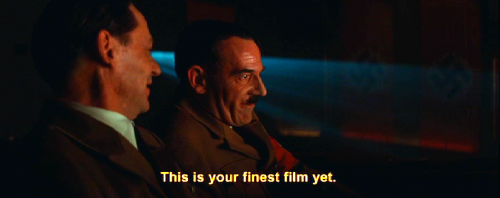
He Who Has Ears

1. Jens Lekman –“A Postcard to Nina”

A Scandinavian Curtis Mayfield tune, R&B tremulous and open-hearted, in which the singer offers to serve as beard to a German lesbian, and a lesson in the realness of fake things.

2. Sleigh Bells – TREATS

Sure, it heralds the whitewashing of M.I.A.’s sound, replacing her favela dubstepping and worldbeat from the Planet of Slums with pseudo-samples of songs you already have on your iPhone. Where Maya had aborigine children, Sleigh Bells are content to offprint The Pixies. They manage to take an old P-Funk cut and leave it sounding like “Sugar Sugar.” But I like The Pixies—and The Archies, too—and an ecstatic whiteness is better than most.

3. Jay-Z – THE BLUEPRINT

…because I’ve been watching Season 4 of The Wire, and I miss Stringer Bell, and this helps.

4. Cat Power – “Colors and the Kids”

5. Willie Nelson – NAKED WILLIE

6. Keegan DeWitt – “Say La La”

7. Modest Mouse – NO ONE’S FIRST & YOU’RE NEXT

8. Karen O & The Kids – “Hidaway”

9. Beeda Weeda – “Baserock Babies”

10. Hayes Carll – “She Left Me For Jesus”