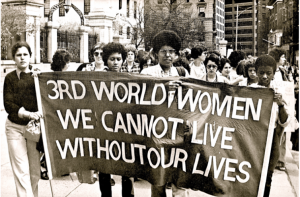
In Chrystos’s “I Walk in the History of My People,” printed in all four editions of This Bridge Called My Back beginning in 1981, the speaker also embodies the history of her ancestors and the heritage they have passed on to her. Her physical body holds the pain of “my people” who are “prisoners / of a long war” (4th ed., lines 9, 15-16). Though her “joints,” “blood,” “tendons,” “marrow,” and “knee” sting with the pain of these people, she continues to walk, to resist, and to know “How I Am Still Walking” (1, 3, 5, 7, 17, 26).
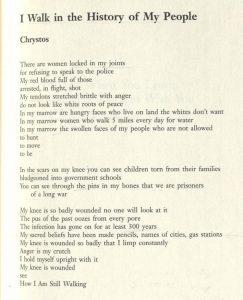
“I Walk in the History of My People,” as printed in the fourth edition of This Bridge Called My Back.
Specific images of human suffering dwell within the parts of her body. Her “red blood” is “full of those / arrested, in flight, shot” and in her marrow live the “hungry faces who live on land the whites don’t want” (3-4, 7). Women in particular suffer and cause her suffering: women who are “refusing to speak to the police” and “women who walk 5 miles every day for water” (2, 8). Anger too, subsists in her physical body, as she confesses that “my tendons stretched brittle with anger / do not look like white roots of peace” (5-6). Her tendons, the roots that connect her muscles and tissue, cannot blossom into fruitful “roots of peace” (6). Although her anger prevents her from finding or creating peace, she indicates that “anger is my crutch” which allows her to “hold myself upright” and continue to walk (22, 23). Her anger both pains and supports her.
The interpretations of history in “I Walk in the History of My People” and “I am Brown” diverge. In “I am Brown,” the speaker derives a mystical power from the history of her ancestors, while the speaker in “I Walk in the History of My People” likens the past to an “infection” that “has gone on for at least 300 years” and “oozes from every pore” (18, 19). The speaker lives in spite of, not in union with, this history of pain and violence. She refers to colonialism, at the root of this infection, which has existed in the Americas since the seventeenth century, approximately 300 years before the publication of this poem in This Bridge Called My Back.
In four editions published between 1981 and 2015, This Bridge Called My Back has honored the struggles of women like the speaker in “I Walk in the History of My People” for decades. This anthology of “writings by radical women of color” honors these experiences and calls for women of color to resist their oppressors and march on, just like the speaker in this poem.
Sources:
Anzaldúa, Gloria, and Moraga, Cherríe, editors. This Bridge Called My Back: Writings by Radical Women of Color. 4th ed., State University of New York Press, 2015.
Chrystos. “I Walk in the History of My People.” Anzaldúa, Gloria, and Moraga, Cherríe, editors. This Bridge Called My Back: Writings by Radical Women of Color. 4th ed., State University of New York Press, 2015.

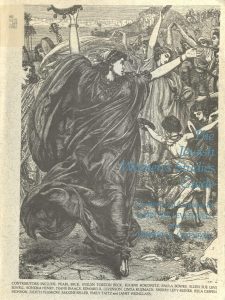 Jewish Women’s Studies Guide,” compiled by Ellen Sue Levi Elwell and Edward R. Levenson, laid out curricular models to incorporate women into historical, spiritual, and cultural Judaic studies. The guide especially considered new models of learning that strove to reconcile progressive, justice-oriented Judaism and equity between men and women within the religion. In other words, the guide went beyond the simple inclusion of female figures and elevated them to an important status on par with traditional male characters. The guide outlined courses, such as “Women in the Hebrew Bible,” that attempted to promote the already existing female characters in the Hebrew Bible, and also courses such as “Feminist Theories of Religion: The Implications for Judaism” that navigated the existential place of women in a faith constructed by and for men. The compilers of this volume state their inspiration for their work in the introduction: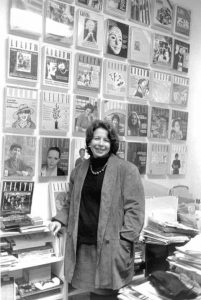
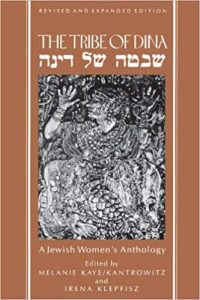 Dina is a Biblical character, the only daughter of Jewish forefather Jacob and his wife Leah, whose brothers founded the twelve tribes of Israel. Dina is only referenced as an accessory to her powerful male relatives, except for a short anecdote about how she left Israel to seek other women. “The Tribe of Dina” is presumably the women Dina sought out in response to her controlling brothers. In using this title, editors of the periodical Melanie Kaye/Kantrowitz and Irena Klepfisz reclaim the potential of the tribe of women that never materialized. As the purpose of Sinister Wisdom is to foster a specific lesbian-feminism that includes all women across any number of diversities, “Dina” (as this issue came to be known) is a microcosm of this principle. The editors used this special issue to create a community of Jewish feminists that bridges generations, classes, races, ethnicities, sexual orientations and cultural contexts.
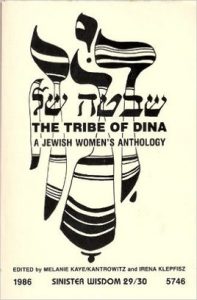 In their editor’s notes, Melanie Kaye/Kantrowitz and Irena Klepfisz write that “Dina” has a dual purpose: first, to create “coalitions among Jews…..and to connect Sephardic and Ashkenazi Jews, observant and secular, gay and heterosexual, on issues of concern to some or all of us” (345), and second, to fight antisemitism as it intersects with sexism, racism, xenophobia, and classism to oppress Jewish women and all women. Kaye/Kantrowitz and Klepfisz partition the periodical by themes common in Jewish liturgy and communities. The sections each contain poetry, fiction writing, scholarship, and records of family histories: “My Ancestors Speak,” “The Women of Our Family,” “I am the Present Generation,” “Lot’s Wife Revisited,” “Kol Haisha: Israeli Women Speak,” and “Bread and Roses.” The back of the issue contains a glossary of Yiddish and Hebrew words and the graphic credits. Unlike other issues of Sinister Wisdom, “Dina” contains text in three languages (Yiddish, Hebrew, and English), as well as what appear to be family photographs. For example, an ornate border decorates the title page of the chapter “The Women of Our Family” and encloses a grouping of photographs of the writers featured in the chapter. They are of different ages, generations, ethnicities, and religious traditions. This grouping of portraits support “Dina’s” overarching theme of generational connection between Jewish women that is used as a model for creating other types of connection in the literature. As traditional Jewish cultures emphasize the bonds between generations of Jews, “Dina” strives to forge connections between Jewish women beyond those of similar lineage.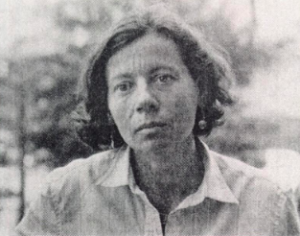
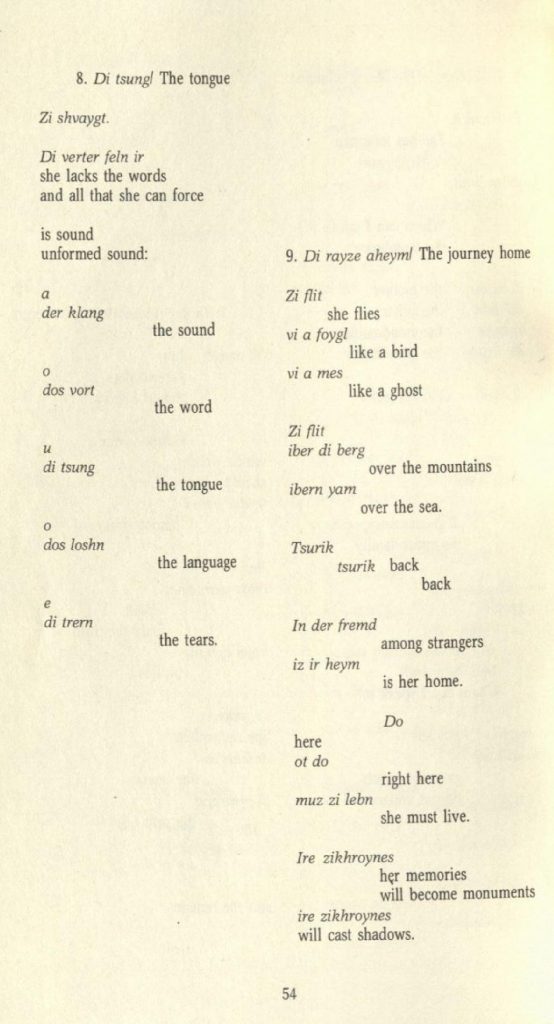
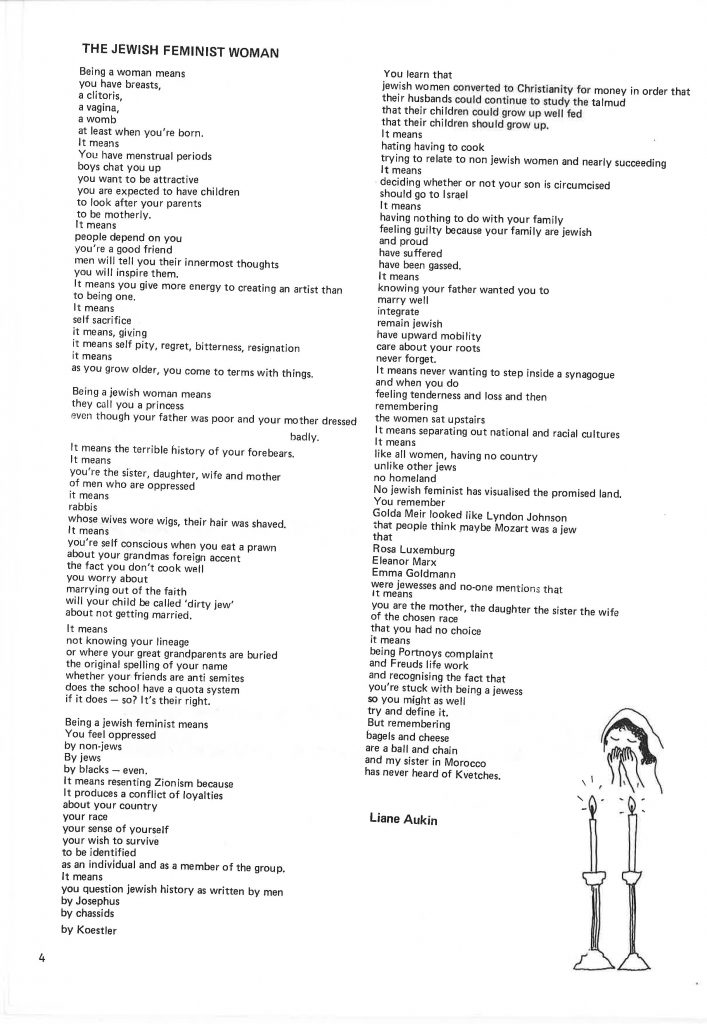 editorial statement, she writes about “resenting Zionism because / it produces a conflict of loyalties” (51-52) and “remembering / bagels and cheese / are a ball and chain / and my sister in Morocco / has never heard of Kvetches” (124-128). Both of these statements reflect the way Aukin relates Jewish feminism to other social justice movements, such as the desire for peace in the Middle East and “Third World Feminism” expressed by the recognition of the shared oppression of both Western and non-Western women. While noting that the expectation that Western Jewish women are housekeepers is oppressive (“bagels and cheese / are a ball and chain”), Aukin makes sure to dually recognize that her “sisters” in the non-Western world are faced with different and no less important oppressions. Aukin also invokes the memories of “Rosa Luxemburg / Eleanor Marx / Emma Goldmann” (109-11), all radical communist activists, pushing her feminism farther to the economic left than other liberal second-wave feminists of the time.
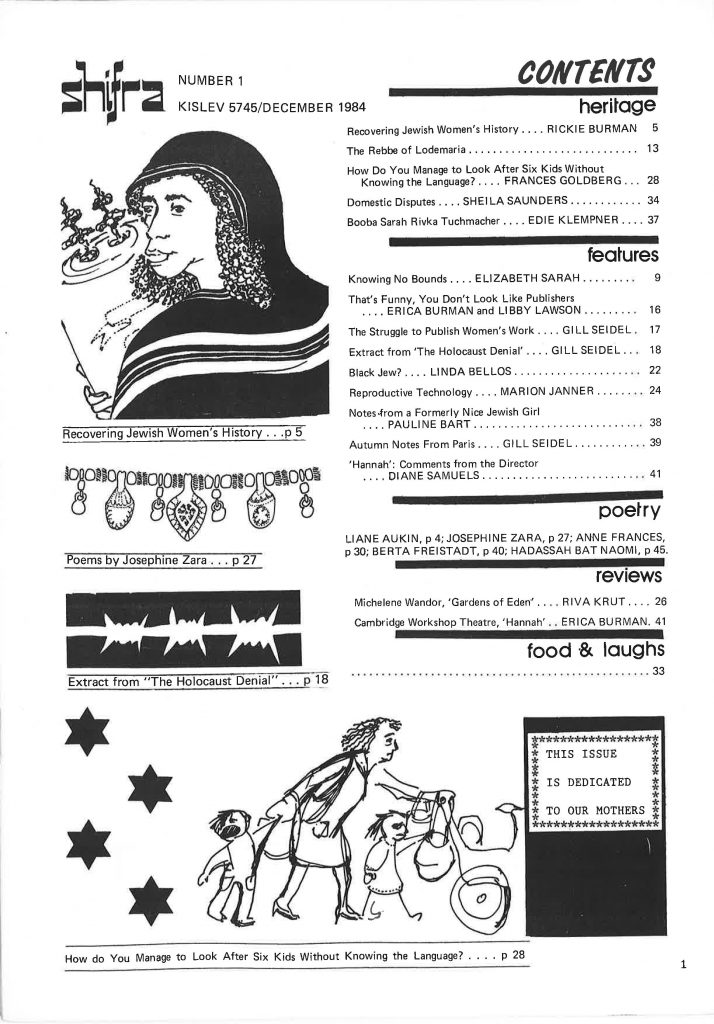 a strong, effective presence which comes from the experiences of our foremothers, and is firmly part of the Women’s Liberation Movement. The Struggles of Jewish women, past, present and future, live in Shifra (2).”
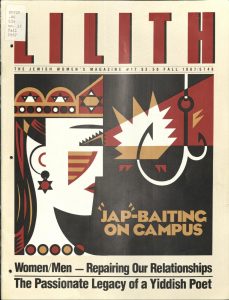 The ethnic insult rests on the stereotype that all American Jewish women are materialistic, wealthy, socially inept, and sexually available. In a series of non-fiction articles, Lilith addresses the direct relationship between sexism, anti-Semitism, white supremacy, and violence in an effort to demonstrate to its readers that “JAP jokes” are not jokes at all, but an expression of age-old prejudice that endangers those targeted by such “humor.” The articles pay specific attention to Syracuse University, which the magazine notes as having a large and growing Jewish population and a growing anti-Semitic backlash problem. In his research of the anti-Semitic graffiti that popped up all over campus, sociology professor Dr. Gary Spencer documented and categorized the graffiti in the library carrels and told Lilith that the experience left him “literally shaken” and “nauseated” (9). Dr. Spencer noted that the graffiti ranged from sexist (“all JAPs are sluts”) to annihilationist (“give Hitler another chance” or “this is a warning to
 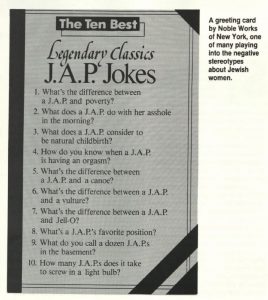 American JEWS. We will kill you all”) to stand-alone slurs (“kikes”). The professor concluded that “these days, the anti-JAP graffiti have been replaced with vile anti-Semitic slogans….people no longer feel the need to hide an anti-Semitic comment behind a JAP joke” (7). Lilith here attends to an important issue that likely would have resonated with a lot of its audience: female college-age and educated Jewish feminists. By demonstrating the connection between sexism, anti-Semitism, and white supremacy, Lilith reinforces the importance of intersectional solidarity in Jewish feminism, while reminding readers that the fight for Jewish women’s safety and equality was not over yet.
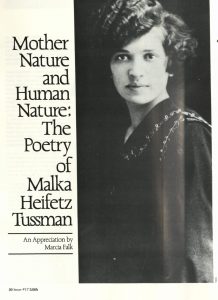 The author of this article is Marcia Falk, a Jewish educator and poet born into the baby boomer or post World War II generation. Falk celebrates Tussman as a midcentury Yiddish literary figure, activist, mother, and mentor. Tussman, born in the 1890s in Ukraine, wrote poetry and short stories in four languages including Russian, Hebrew, English, and Yiddish. Tussman only began to publish once she moved to Chicago in 1912. Falk first met Tussman at a Jewish arts festival in Berkeley, California, and afterwards began to translate Tussman’s poetry into English. The two women became friends and often exchanged poetry, letters, and recipes. In the summer of 1973, Falk lived in Berkeley with Tussman as they feverishly worked to translate eighty Yiddish poems that were later published as a chapbook (“Am I Also You?” published by Tree Books, 1977). The two women recognized the importance of preserving Jewish women’s literary legacy across time and place, embodying the very virtue of the intergenerationality that Jewish feminists in years to come would regard as necessary to the second-wave struggle.
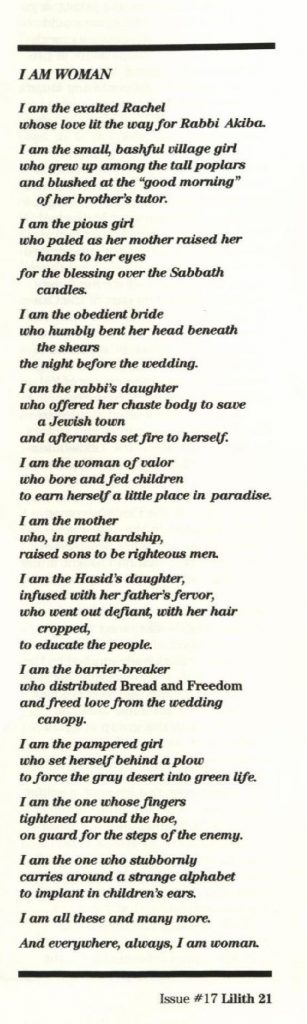 There is a turning point in the poem where Tussman writes “I am the mother / who, in great hardship, / raised sons to be righteous men” (24-26). Here, the woman’s power is not derived from the men in her life, but vice versa: part of her mightiness is the ability to raise “righteous” sons despite struggle. Their power originates in hers. After this line, the speaker of the poem declares herself an able rebel, a “barrier-breaker / who distributed Bread and Freedom / and freed love from the wedding canopy” (29-31). “Bread and Freedom” is a reference to Tussman’s work in Chicago’s anarchist-socialist political scene of the 1920s, where she advocated for economic justice and Marxism at the risk of deportation and arrest. This woman seems very different from the “obedient bride” who was exalted earlier in the poem, but is given equal weight, attention, and praise in Tussman’s poem. Tussman begins by honoring traditional women who have worked within the patriarchy and finishes by paying tribute to activist women who engage in the different work of activism. While neither of these types of women seem more privileged or powerful than the other, it is important to note that by finishing the poem with the activist woman, Tussman creates a developmental arc that begins within patriarchal norms and ends outside of such norms.