Monthly Archives: December 2016

Shoes, Shimmer, and Shorts Skirts: What Men Want from Women

Joyce S. Tseng

miss_congeniality_424

Let’s face it: all movies are about gender. It is ubiquitous. Biologically, sure, there are only two categories of sex. But over time, gender has grown increasingly messy—increasingly transgressive. The simple issue of gender influences the reception of a movie more than we realize. Split-second assumptions are made about characters based on their gender all the time. We immediately assume the incompetence of Elle Woods in Legally Blonde to get into Harvard Law. And of course, power dynamics could not be established in the same way without the distinction between males and females. We aren’t as terrified of Harley Quinn as we are the Joker. Popular culture is embedded with gender scripts, reflective of evolved sexist stereotypes and attributions. However, there is a salient rise of gender fluidity in modern society—gender is much more confused than it historically has ever been. But what we see movies do with this reality is guide the colors back within the lines.

“Makeover movies” are a standard storyline of Hollywood films. I’m talking about the ones where the ugly, geeky girl is magically transformed into a sexy, chic woman. In these movies, the makeover highlights fashion as the driving tool—a stereotypically female-attributed matter. The movie’s message goes beyond the upgrade of a woman’s frumpy wardrobe though and proves the need for alterations in her personality and lifestyle too. These movies try to get at some sort of moral development of the woman, as a consequence of their makeover, tailoring them to fit the mold of the acceptable, ideal woman. Grease’s Sandy goes from a conservative prude to a leather-wearing fox—and this is praised.

If we turned our attention to feminine men, they have historically not done well in Hollywood movies, or at least, feminine men are never the protagonists. The disdained antagonist of Silence of the Lambs (1991) is a psychopathic transvestite. Dr. Frank N. Furter in The Rocky Horror Picture Show is depicted to be an alien transvestite, whose name is a clear spin-off of a classic gothic monster, but also alludes to a phallic symbol. Though male-makeovers are not as common, the idea of remasculinization is not new to Hollywood. The quintessential example is Clark Kent, a glasses-wearing newspaper reporter turned into a superhero hunk with perfectly gelled hair. Each makeover renders the image of the ideal, which has proven to be attractiveness-oriented and sexualized. Similar to the moral development of women, several movies have addressed the emotional, behavioral meaning of masculinity. Tyler Durden in Fight Club spends his days selling soap, but is provoked out of boredom to join an underground fight club. He uses fist fighting as a means of liberation, reverting him back to primal masculine functions. The film serves to show men what it means to be men. The popularity and prominence of makeover movies suggest that we, as consumers of film, desire to see people combat the threats to their archetypal form of gender. But, here is the problem. If we insist this demand and desire to be true, then we succumb to an inescapable, exclusively male point of view. Gender and cultural studies professor Brenda Weber asserts, “American masculinity has long been predicated on the values of the self-made man.” The male-makeover is autonomous and upholds individualism. However, in the case of women, the transformation is rarely self-made and actually works to serve men.

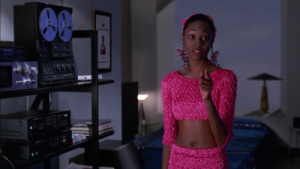
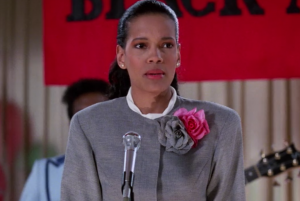
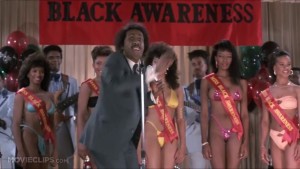
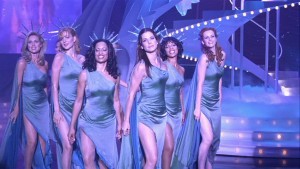
Let’s consider movies about women learning how to be women. Donald Petrie’s Miss Congeniality (2000) does just that. The uncomplicated premise of a female FBI field agent, Gracie Hart, who goes undercover as a contestant in the Miss USA beauty pageant sets the stage perfectly for the argument of guiding a woman to her idealized form. The specific casting of Sandra Bullock as Gracie asserts much about the character. Bullock’s charm is not one that fits the stereotypical symmetric, doe-eyed, blonde haired beauty; she brings an air of quirkiness and boyish athleticism with her presence, which becomes conspicuous in the scenes where is surrounded by the other beauty contestants. Gracie’s less than elegant mishaps and unfeminine mannerisms, like her pig-ish snorts when she laughs, pin her as a feminine outcast. Though her tomboyishness allows her to fit enough into the male dominated field of the bureau, it is clear she can never truly assimilate into the group because of her gender. She is notably asked by a stranger in a bar, upon learning of Gracie’s occupation, “Do all the women in the bureau really have to wear those masculine shoes?” Here and throughout the movie, Gracie’s occupation as an FBI agent is consistently reduced down to her body, etiquette, and fashion, forcing her back within the realms of femininity.
miss_congeniality_125

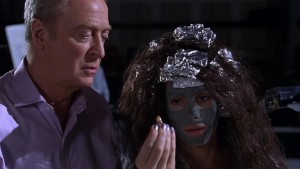
The irony of the plot lays in the notion that a woman can learn how to be a woman when taught by men. Gracie’s beauty pageant coach Victor Melling, played by Michael Caine, embodies the poise that Gracie does not. He “glides” when he walks, speaks with a posh British accent, and frequently sports immaculate suits with pink accents. He is the driving force of Gracie’s makeover: picking out the dresses she wears, teaching her how to walk gracefully, and introducing her to feminine products like plastic breast paddings. It is important to notice that Petrie intentionally decided for the pageant coach to be male, but more importantly for Victor Melling to be gay. He is essentially male, but not quite the archetype. He is the primary tool in the makeover but cannot be the ultimate goal of Gracie’s transformation—that is, she is not changing herself to woo Victor. But his function to the story makes it so that Gracie’s makeover cannot be “self-made.” The movie demands that Gracie is guided away from her boyishness and fulfill her female body as it ought to be, but makes a point to show that this package is a man-made construct.
miss_congeniality_106

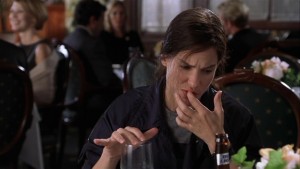
We must realize that the plot of the movie conveniently makes it so that Gracie’s gender is the primary reason why she is chosen to go undercover when the Miss USA beauty pageant is targeted. The audience knows all along that Gracie is the one for the job, but it takes the male agents a session of computerized photoshopping of agents into a one-piece female swimsuit to realize the fact. The scene is comical, featuring a group of strong, grown men huddling around a computer, playing dress up. The agents cringe and laugh at different women of different shapes and ages as they are subject to their man-controlled game. The political implications here are clear. The men critique every inch that a woman aesthetically has to offer, and pass their judgment on what is acceptable or not. What is interesting is that Gracie also partakes in this activity. She plays along with the men, mocking the women on the screen, feeding into the fixation on the female body. When the agents finally settle on Gracie being the most believable option, Gracie’s amusement immediately shuts off and she tells the guys to cut it out. It is only when fellow agent Eric Matthews tells her, “Don’t kid yourself. No one thinks of you as a woman,” that she begins to take the mission seriously. So, here we have a woman, not wanting to be considered a woman because of the beauty pageant contestants carrying the implications of being unintelligent and materialistic.miss_congeniality_060
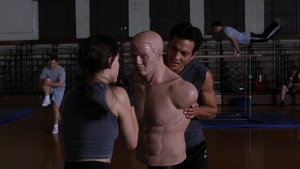
However, it is easy to miss that Gracie’s transformation actually revolves around Agent Matthews. He coaxes her and encourages by saying, after a couple of “butt-shaping exercises”, she would fit right in at the contest. The absurdity of this scene is because it takes place in the training room, while Gracie is kickboxing—an intensive, strength-oriented workout.  Here, Agent Matthews is advising an obviously physically fit woman to alter her workouts towards more aesthetic purposes and toning, as opposed to muscle building. It takes Agent Matthews’ comment that Gracie is not considered a woman for her to take the mission. Throughout the movie, he repeatedly pokes fun and ridicules Gracie during her efforts to become a believable pageant contestant, mocking her with doughnuts when she has to diet, sarcastically cooing at her when she is dolled-up. Yet—not surprisingly—by the end he falls in love with her and successfully asks her out on a date. To the audience, the movie makes clear that for women, turning yourself into something of a pageant girl will win you male recognition.

Thus, within the film narrative, the audience Gracie caters towards is men, namely Agent Matthews. But, Petrie also incorporates the literal audience of the movie and subjects them to a male perspective. Film theorist Laura Mulvey’s concept of “the male gaze” claims that no matter who you are as an audience member, because the camera is treated as if it were male, you have no choice but to view the movie as a male too. Let me explain. Mulvey suggests that a film camera stimulates the voyeuristic tendencies of the audience; we are awakened and find pleasure in viewing others, specifically in private domains from which we are usually concealed. In Miss Congeniality, Gracie is set up with several spy cameras when she goes undercover, thus unlocking the backstage, dressing room world of the beauty pageant to the male FBI agents. The men gather around the screens, and in one scene even bring popcorn, to view the women in bathrobes, hairnets, and swimsuits. The way these sequences are edited place us in the shoes of the men, watching the room from Gracie’s point of view, which is also the view the male agents have an in on. We as an audience are included as peeping Toms, encouraged by the agents ogling at the women on the screen.
miss_congeniality_575

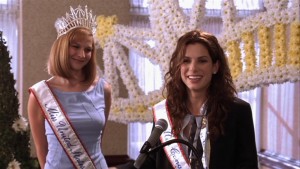
Admittedly, makeover movies tend to fall under the category of “chick flicks,” implying that they target a predominantly female audience; but if we delve deeper and ask what these movies are encouraging women to take away from the narrative, it is chiefly male-centered. By watching these films, women are taught to desire a materialism-triggered moment of recognition and men are reaffirmed of their approval of the makeover. Gracie accepting the “Miss Congeniality” award and giving a speech about how grateful she was to have been a part of the pageant and from the mission, how she has changed as a person for the better is the way the film reconciles its plot and gender dilemma. The award and what it stands for literally celebrates Gracie’s ability to have adapted to suit her personality and behavior to the taste of others. We go from watching a kickboxing, self-assured woman turn into a tamer, peace loving appeaser—and we applaud this ending and call it a success.


Bibliography

Ferriss, Suzanne, and Young, Mallory, Chick Flicks: Contemporary Women at the Movies. London: Routledge, 2008.

Ford, Elizabeth A., and Mitchell, Deborah C., The Makeover in the Movies: Before and After in Hollywood Films, 1941-2002. North Carolina: McFarland, 2004.

Weber, Brenda R., “What Makes The Man? Television Makeovers, Made-Over Masculinity, and Male Body Image,” International Journal of Men’s Health 5.3 (2006).


This essay was written in the style of David Foster Wallace.

This essay was peer edited by Dew Maskati.

 

A Fine-Tuning of Male Dominance: Eddie Murphy’s “Coming to America”

       Eddie Murphy’s 1988 romantic comedy Coming to America was a huge commercial success upon its release, despite unanimous critical distaste for the film. The romance in the story falls flat, the comedy resorts to slapstick humor. Critics bemoaned the film’s mediocre acting, especially Eddie Murphy’s, whose characteristic liveliness was drowned in his own script. (Carlson) It wasn’t until recently, however, that people started talking about the film’s anachronistic and ahistorical portrayal of Africa– which gives the sense that the Africans in the fictional country of Zamunda are nothing more than Europeans dressed in Africanities, speaking sophisticated English and sipping champagne. The eurocentricity of the characters seems at odds with their location: outside of the palace, elephants and rhinos lumber across the background and a loud merchant sells Dashikis (Jacobs). The flaws in Coming to America are evident in its whitewashed portrayal of Africa, but cannot be articulated without assessing the position of women in the film– both African and American.

giphy

Prince Akeem is bathed by his servants

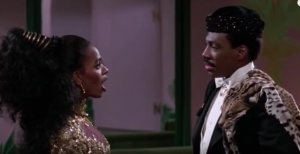
       The most objectified bodies are those of African women that appear early on in the film, before Eddie Murphy’s character, prince Akeem, leaves Zamunda to find true love outside of arranged marriage. The film uses the objectification and submissiveness of African women as grounds to permit their exploitation– their supposed inferiority legitimizes the male desire to dominate women through the male sexual utopia that is Zamunda. Aside from the queen, the only African woman that speaks more than one line in the film is Akeem’s initial bride-to-be, who is depicted as robotic and mindless— the only thing she says “no” to is Akeem’s insistence that she doesn’t need constantly obey him. Since she has been trained since birth to serve him, and is thus dependent on his existence, she refuses to see that she can exist outside of him. The rest of the African women have few lines, all related to their status as servants. In Zamunda’s generalized perception of Africa, unrelenting roots of colonialism and patriotic nationalism depict what is considered the lack of an obviously superior Western ideology– despite clear whitewashing, the customs of Zamunda are depicted as completely and irrevocably sexist. Inherent in the Africanness of the Zamundians is an extreme dichotomy of masculinity and femininity that churns out legions of uniformly obedient and mindless African women that accept their own exploitation (especially sexual exploitation) eagerly and unwaveringly. Zamunda, and presumably all of Africa, is so good at ingraining the virtue of obedience in women that Akeem feels he must leave the entire continent to have a shot at finding true love with a woman who satisfies his intellect “as well as his loins.”

screen-shot-2016-12-15-at-3-18-00-pm

Following Akeem’s order to bark

          The dismissal of African women as mentally incapable to justify their exploitation  permits their complete objectification, with the effect that the sexual enjoyment Akeem gets from his bathers is depicted not just as as erotic, but expected. The movie justifies this expectation through the characterization of Akeem as singularly righteous– a symbol of progressive, western thought trapped in a backwards society. The most central and thematically well-represented example of this is his reluctance to have an arranged marriage, a major part of the plot that highlights Zamunda’s foreignness. Arranged marriage is a custom widely-regarded by viewers as barbaric and existent wholly outside of modern Western culture, and Akeem’s rejection of it and general dissatisfaction with the culture (that is rigidly obeyed by others around him) aligns him with the Western audience and fuels its perception of his moral integrity.

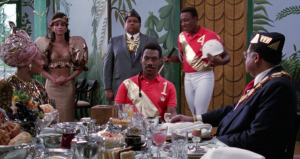
         This conception of Akeem is crucial when he details his qualms with palace life to his father, saying that “it is not just [the rose petals thrown wherever he walks] it is everything. The cooking, the pampering, the dressing, the bathing…” before admitting slyly that he actually “rather enjoy[s] the bathing.” Clearly his qualms with life in the palace stem from a desire for autonomy rather than specific ideological differences with the culture of Zamunda. Not to mention, his desire for autonomy and individualism strengthen the perception of his westernness and masculinity. His admitted enjoyment of the African servant women ultimately permits the viewer to desire or accept their exploitation by trusting Akeem’s moral correctness due to his distinction from the flawed, but erotic traditions of his country.

screen-shot-2016-12-15-at-3-21-57-pm

Akeem’s conversation with his parents

        Thus the crucial bathing scene is the most direct depiction of an erotic male utopia in which men are allowed the desire to dominate African women. They are absolved of guilt over this  desire by the perception of African women as mindlessly compliant sexual servants and  the fact that Akeem (a symbol for western thought, and righteousness) holds the desire himself. With this, the fundamental core of the scene becomes clear– Akeem’s exploitation of African women is acceptable only because their culture (which is inherently inferior to western culture) is one that is less intellectual, thus creating mindless and valueless women who are seen as nothing more than ornamented bodies with which to have sex. This idea of intellectual inferiority, as depicted primarily through Akeem’s arranged almost-wife, draws an uncomfortable connection to a colonialist mentality and the obsession with the “exotic” and “forbidden” African woman’s body (through which the will to dominate a country was, and still is, expressed as sexual violence against local peoples (Nih)).  

          The extreme irony in this is the film’s premise is a clear attempt to avoid the issue of colonialist thought: Akeem’s riches challenge the trope of poor, starving Africans, and his position of wealth is utilized to mock white people who visit Africa. “Look! Real Americans!” he says as he observes three old men bickering in a barber shop. Putting a black face on a movie whose plot is reverse-colonialist in so many senses, and supporting this character in his rebellion against his homeland’s culture, allows for a comparison of Western and African ideology that affirms the West’s superiority without carrying racial implications. Men are thus allowed to overlook the implications of their own sexual desires and pin them on the ideological inferiority of Africa as a whole, which in turn manifests as the inferiority and justified exploitation of African women.

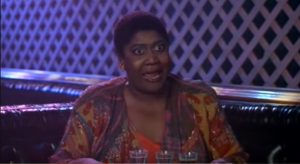
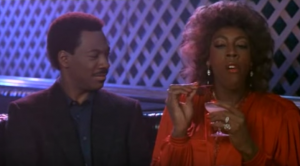
         The film shifts its message about women as Akeem arrives in America– the dominion of men over women here is refined in a way that begrudgingly acknowledges the empowerment of American women, presented in the film through the punishment and stigmatization of female sexuality. After arriving in New York, Akeem and his servant Semmi go to nightclubs to meet women in scenes that function comedically in characterizing the women at the bar as deviant– be it sexually or in some other social regard. From devil worshippers to narcissists, they reveal a fear of female sexuality that renders a woman expressing her sexual desires as cheap or degraded. Semmi, as Akeem’s foil and the prototypical horny guy, smiles at one woman’s statement of interest in a threesome, while Akeem, serious about finding a wife, frowns. This distinction ties into a male perception of female sexuality– it is put on show not just for comedic purposes but also to demonize sexual women, to denote them as unworthy of anything but sex (Gummow). While American women are not mindless like African women, those that are not “clean” and go to clubs do not warrant a man’s respect. Another woman worth noting in this scene downs two shots before proclaiming:  “Now that’s the problem! I can’t find a man who can satisfy me. Some guys go an hour, hour and a half, that’s it! A man’s got to put in over time for me to get off.”  A reflection of the cinematic trope of the angry black woman, she is the only one in this scene to have short, natural hair, and is clearly meant to be perceived as less traditionally attractive than most of the other women presented in the scene. The importance of this is that her comments can do nothing to hurt the masculinity of the viewer– her presentation as undesirable is exacerbated by her expression of sexuality, and, in addition to being tied to a form of blackness that is deemed undesirable, her short hair and sexual frustration liken her to a man. And as an almost-too-perfect culmination of this idea, the end of this scene features a sexually aggressive trans woman, instantly recognizable as the actor who plays Semmi in drag, detailing, to their disgust, how she’d like to “rip [Akeem and Semmi] apart.”

screen-shot-2016-12-15-at-3-25-09-pm

Sexually frustrated woman from the bar scene

screen-shot-2016-12-15-at-3-25-24-pm

Trans woman (played by the same actor who plays Semmi) from the bar scene


        The only primary character in the movie who is shown making sexual advances on men is Patrice, the sister of Akeem’s love interest. She is introduced dancing in her living room as questioning Lisa who she is having sex with when she receives a gift in the mail. Her characterization as a sexual being continues throughout the film– she puts her hand on Akeem’s crotch at a basketball game and has relations with Semmi. Patrice’s sexuality is so central to her character that the film ingrains the audience with a clear answer to her question of why Lisa “gets all the good ones”–  that it’s ‘by not being a slut.’ Patrice is also paralleled to the African women at the beginning of the film, especially in comparison to her sister Lisa. She displays her bodiliness as she dances sexually, critically antipodal to Lisa’s intelligence and respectability (think mindfulness) as she reads on the couch. Important to mention too is Patrice’s appearance: she has darker skin and curlier hair than Lisa, and is characterized (stereotypically) as sassy. Similarly to the sexually-frustrated woman portrayed in the club scene, aspects of Patrice’s blackness are shunned and tied to her sexual promiscuity. Thus, the film manages to propagate negative stereotypes about the sexuality of black women, despite having an all black cast, by using stereotypes and afrocentric features to delineate women considered by the audience as more prototypically black as sexually deviant and thus less valuable.


400px-coming_to_america_apartment

Patrice

screen-shot-2016-12-15-at-3-30-32-pm

Lisa’s introduction in the film

maxresdefault-1

Bikini Pageant preceding Lisa’s introduction


The film relies on the distinctions between Patrice and Lisa as a way to divide American women and determine whether or not they can be dominated by men. Patrice’s domination is rather clear from what was just discussed: as an impure and invaluable woman, the message is that men will continue to reject her in all ways except sexually– and her own actions are at fault for warranting this treatment. Conversely, Lisa, a “good woman,” is the only woman in the film with any sort of control. She rejects Daryl’s proposal when he and her father try to force her to accept it, and stays with Akeem despite her father’s initial disapproval. After the proposal, Daryl becomes a symbol of machismo– having told Akeem that all women “want a man to take charge, to tell them what to do,” and Akeem, by way of his character differences from Daryl, becomes one resembling a feminist stance (or at the very least, of anti-female domination).

         Not only does this late shift in the movie further bury the fetishized African servant woman as inconsequential, it gets the viewers of the movie to applaud the preservation of Akeem’s masculinity via the domination of African women while blending into American society, where such overt domination is culturally inappropriate. His departure from Africa is attributed to the mindlessness of African women, preserving his masculinity and reassuring the male gaze of its morality– which would be lost if the humanity or degraded position of African women was acknowledged. This and the film’s tenacious impression of Akeem’s integrity, which is so pervasive that he is a relatively static character throughout the film, implies that his character alone pits him against Daryl and by association against the control of women. This is why he never has to learn how Americans treat women the way he has to learn how to dress, work, and speak– his being on the virtuous side of this conflict is a given to the audience. So as Akeem experiences America and falls for Lisa, the message of the movie is not that all women are valuable and intelligent, but that most aren’t. A man who accepts and fantasizes about the domination of powerless women and the devaluation of sexual women is nonetheless capable of being considered the “good guy,” provided he doesn’t attempt to dominate a “good woman” like Lisa.


References:

Carlson, Daniel. “Is It Just Me, or Does Every Woman in New York Have a Severe Emotional

       Problem?” Pajiba. Disqus, 05 May 2009. Web. 8 Dec. 2016.

Gummow, Jodie. “Unveiling the ‘Madonna-Whore’ Complex.” Alternet. N.p., 9 Sept. 2013. Web.

       7 Dec. 2016.

Jacobs, Sean. “Africa on Film: Coming to America.” Africa Is a Country. N.p., 14 Apr. 2015.

       Web. 10 Dec. 2016.

Tih, Felix N. “Rape of Africans by Europeans: An Ongoing Colonial Habit.” The Anadolu Post.

       Anadolu Agency, 18 Sept. 2015. Web. 7 Dec. 2016. 

A Matter of Black and White: Race in the Twilight saga

The Twilight saga is a story with many threads. It tells the story of a love triangle between Bella Swan, a vampire named Edward Cullen, and a werewolf named Jacob Black. It tells a story of gender roles, as decisions about Bella’s well-being are often made by Edward and Jacob; not by her. It weaves together threads about abstinence, as Edward is afraid of having sex with Bella because if he doesn’t show restraint he could kill her. The saga even tells a story about Mormonism.

Operating in a manner that is sometimes more covert and often more insidious than these stories, however, is one about race. In “White,” Richard Dyer asserts that racial images pervade popular culture, even, or especially, where race seems unimportant. If Dyer’s argument is to be believed, then even though Twilight is not explicitly about race, it still tells a racial story and adjusts our attitudes towards it.
To assess Dyer’s claim, let’s examine how race is represented in three character types in the Twilight films: humans, vampires, and werewolves.

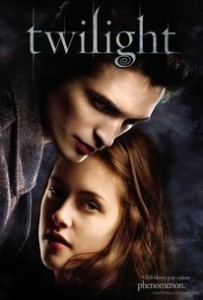
twilight-cover

Cover art for Twilight


Humans

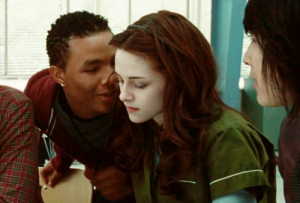
Twilight makes it hard not to be conscious of skin color from the opening minutes. As soon as Bella starts high school in Forks, Washington, she is subjected to the romantic and sexual advances of several boys. The advances made by these boys differ in tactics and in the response generated, and these differences parallel racial differences in the characters who make them.

A white character, Mike Newton, is always nervous around Bella and constantly fumbles over his words when he talks to her. Most of the time, when he gets the nerve to, say, ask Bella to prom, she simply blows him off. The one time she does accept his offer to go to a movie (on the condition that their friends can also come), Mike gets sick because the movie was too gory. With Mike gone, Jacob takes the opportunity to be forward about his feelings for Bella. It’s hard not to feel sorry for Mike in this case. He didn’t do anything wrong. The poor kid just lost his chance to get his girl.

The films picture different tactics that elicit different responses when a black student, Tyler Crowley hits on Bella. In one scene, Tyler runs up behind Bella at lunch and kisses her on the cheek; Bella responds with unmistakable annoyance. Tyler doesn’t ask her if she would like to be kissed, and he doesn’t seem phased by her annoyance. This kiss, between a black male and a white female, was sexual harassment.

bella-and-tyler

Bella is visibly annoyed when Tyler kisses her on the cheek 

Besides Tyler, the only other named black human in the saga is a man named J. Jenks, who makes fake IDs and passports. Black humans in Twilight commit crimes. One role of white humans in the series, then, is to hold black humans accountable for their actions. Bella’s father, Charlie, is a cop; it’s his job to arrest people like J. Jenks. And when Tyler kisses Bella on the cheek, Mike Newton is the one to chase him away.


Vampires

The vampires in the Twilight films are noted as having skin like porcelain or alabaster. An overwhelming majority of the vampires prior to Breaking Dawn are played by Caucasian actor. One exception is Laurent, who is played by a black actor (Edi Gathegi); however, Gategi wears makeup to lighten his natural skin tone. It seems that the act of being made into a vampire confers a special paleness or whiteness. This notion is strengthened by the color symbolism prevalent in the films: vampires are represented by white. Breaking Dawn extensively uses white and red to represent vampires and humans, respectively. When Bella is turned to a vampire in part one, the film shows her red blood vessels crystalizing and becoming white. Part two opens with several scenes that juxtapose white and red, like the dawn on a snowy mountain top. Vampires are extensively associated with whiteness in the films.

According to Dyer, white people are depicted as pure and god-like, and as transcending the body. He also notes that whiteness is fraught with paradoxes. If Dyer is correct, then we should be able to see these observations come to fruition in the Twilight films.

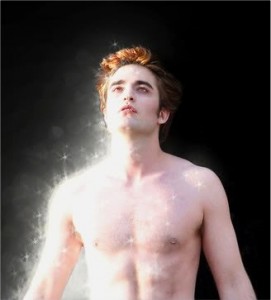
Vampires are often associated with god- or Christ-like qualities in the films. In the sunlight, their skin shimmers and sparkles. In the texts, Bella uses the word “angelic” to describe Edward when he shows her this (Wilson); Bella’s reaction in the film appears to capture the same awe Meyer describes in the books. Some vampires add to the Christ-like metaphor by resisting the temptation to feed on humans by instead feeding on animals. Edward’s father Carlisle even has the discipline to be a doctor, constantly tempted by human blood. In a similar manner, Jesus was constantly tempted to sin, but through immense discipline was able to avoid doing so. Furthermore, Edward and Bella never do more than kiss before they marry, in part because Edward doesn’t want to test his restraint and risk killing Bella, but also because he has somewhat traditional (read: Christian) morals, which champion abstinence. Christian morals are seen elsewhere in the series: in Breaking Dawn, Rosalie encourages Bella not to try and terminate her pregnancy despite the fact that it may kill her; she’s staunchly pro-life, a stance which has been associated with Christians by modern popular culture. There is a clear association between vampires, especially the Cullens, and Christianity and purity. Vampires also often transcend the body using special abilities. Edward can read others’ minds, and so his being extends to the minds of others. Alice can see the future, and so her awareness transcends time itself.

edward-shimmer

Edward’s skin shimmers in the sunlight

Dyer notes that whiteness is also paradoxical. As a color, whiteness is both the combination and the absence of all colors. The manifestation of this principle in race is messy and varied, allowing whiteness to appear pervasive and attainable for all. One example of paradox has already been explored: how can one be granted the ability to transcend the body by their skin color, a characteristic of the very body they transcend? There are other examples of paradox in Twilight; for example, despite their strong association with whiteness, vampires (unlike all other species in the series) can be doubly associated with blackness. This distinction serves to demarcate the good vampires (those like the Cullens who feed on animals) and bad vampires (those who feed on humans). While the Cullens and other “good” vampires are extensively associated with white, other vampires that feed on humans and are otherwise coded as bad are associated with blackness. The Volturi are one group of vampires that are associated to blackness in addition to whiteness. One way that blackness is coded into the Volturi is that they all wear black robes. Such blackness carries connotations of evil and corruption: the Volturi are depicted as the corrupt oligarchs of vampire-kind, who act in their own interests, and also feed on humans. In Breaking Dawn, they attempt to destroy the Cullen coven for having a half-vampire, half-human child. They justify their politics using a rhetoric of fear: humans for the first time have weapons capable of destroying vampires, so it is more important than ever to keep secret. Anything that produces uncertainty, then, must be destroyed.

The story of Laurent, the black vampire, adds to the vampires’ sense of paradox. Laurent is a friend to the Cullens: he travels to Forks in New Moon to warn them that one of the vampires in his own coven is coming to kill Bella. Despite his occasional goodness, Laurent also does things that are contrary to the characteristics that the saga idealizes in the Cullens. In addition to feeding on humans, Laurent is impulsive (in contrast to the restraint shown by vampires who feed on animals). In New Moon, he crosses Bella in the wilderness and after telling her of Victoria’s plan to kill her, he said he couldn’t resist the urge to do it himself. This led intervention by a werewolf, who killed Laurent. Later, at Bella and Edward’s wedding, one animal-feeding vampire tells Edward that “(Laurent) wanted to be like us.” Laurent, it seems, envied the restraint, the likeness to Christ, the whiteness embodied by the Cullens.

The effect of the double-association granted to vampires like the Volturi is that, while they are unmistakably associated with whiteness, they are not strictly confined to it. As such, the actions of one vampire can hardly be made to represent all vampires – if a vampire does evil, that’s blackness; not all vampires are like that. Other characters, like the werewolves, are not afforded such flexibility.


Werewolves

If whiteness represents likeness to Christ, transcending the body, and paradox, we expect the opposite to be true for blackness in Dyer’s model.

Sure enough, these associations with blackness are seen in the case of the werewolves. Werewolves are the natural enemies of vampires, and so there is plenty of juxtaposition between the two groups in the films. On the whole, the werewolves are thoroughly associated with darkness. They are without exception Quileute Indians, having copper skin and dark features. Sam Uley becomes a jet black werewolf, and Jacob’s last name is even Black.

With the associations between werewolves and darkness in mind, let’s examine how the associations with whiteness seen in the vampires are flipped for werewolves. In vampires, likeness to Christ equates to Christian morals and restraint, and werewolves possess neither of these things. Melissa Burkley points out in Psychology Today that Sam Uley (whose wolf form is jet black, furthering his association with blackness) is an especially immoral character. After learning of Bella’s pregnancy in Breaking Dawn, Sam decides that Bella and her unborn child must be killed for no other reason than that he doesn’t know what to expect from a half-vampire child. Note that Sam has the same response as the Volturi, who are characterized by the double association with white and black. Sam’s immorality is furthered by his history of domestic abuse. His wife, Emily, has a scarred face from one instance when he was angered and struck her (presumably in werewolf form). This particular instance of immorality also begins to illustrate the werewolves’ lack of restraint. Of course Sam didn’t intend to permanently scar his wife; he got upset and it just happened. Impulsivity in werewolves extends beyond Sam: it is inextricably linked to their nature. When Quileutes first transform into werewolves (usually in their late teens), they act erratically and sometimes lose control of their own actions. Just before Jake transforms for the first time, he nearly starts a fight with Mike Newton for no reason in particular. Werewolves, in their darkness, are immoral and impulsive.

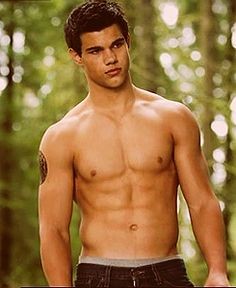
Furthermore, the films place a heavy emphasis on the bodies of the Quileutes. Bella greets Jacob in the beginning of New Moon: “Hey, muscles. You know, anabolic steroids are really bad for you.” Bella makes the viewer acutely aware of Jacob’s very muscular build, and the film builds on this by taking every opportunity to depict Jacob and the other young Quileutes with their shirts off. So the Quileutes’ bodies are sexualized in a way that the vampires’ bodies are not. Even though the Quileutes are shapeshifters and can literally escape their bodies, the films make an impressive effort to tie their identities to their bodies in the minds of the viewers. Ironically, vampires cannot escape their bodies in the same way as the Quileutes, but the films still lead the viewer to associate them with transcending the body.

jacob

Jacob’s body is often put on display for the viewers

___

While Twilight is not about race, it is still inundated with racial undertones. The racial story told by the saga associates whiteness and blackness with the characteristics Richard Dyer proposes in “White.” Given this, it is evident that race and racial associations are at play even in places where we wouldn’t expect to find them.


Sources:

Wilson, Natalie. “Got Vampire Privilege?: The Whiteness of Twilight.” SeducedByTwilight. WordPress, 2010.

Burkley, Melissa, PhD. “Is Twilight Prejudiced?: Is Racism a Major Theme in Twilight?” Psychology Today (2011).

From Batman’s Nemesis to Transgender Hero

By Tristan Colaizzi

Since the creation of the Joker in DC Comic’s original Batman in 1940, he has been known as the green haired villain to the bat. From the original comics to the most recent round of batman movies and now Suicide Squad, the Joker has been played by many actors and characterized by numerous artists, taking on a variety of different forms to fit the changing times. Canonized by his purple coat and manacle laugh, the Joker is on par with Darth Vader and Hannibal Lecter as one of the most recognizable villains of all time. A quick internet search will show the breadth of following and obsession that he has created and the variety of forms he has taken on. In the most recent interpretation, even the villainry of the Joker is modified as he’s portrayed as a hero, not an evil villain. His desire throughout Suicide Squad is to save Harley Quinn, and when he comes so close, but fails to and dies, we feel devastated. In the end, however, the Joker returns and rescues Harley Quinn from her cell.

It should come as no surprise, then, that in a turbulent world pertaining to the rights and discrimination of sexual identity and queerness that the latest rendition of the Joker does not fit the heterosexual male mold he has in the past. In Suicide Squad, while still maintaining the classic image of the Joker, he, or rather she, becomes the villain you root for in a movie that has flipped good and evil, straight and queer.  In order to deconstruct the movie’s gendered sub-plot, a revenge of the transgender, let’s focus on three key elements of his character: the actor who plays the Joker, the physical appearance of the Joker, and the actions of the Joker.


The Actor

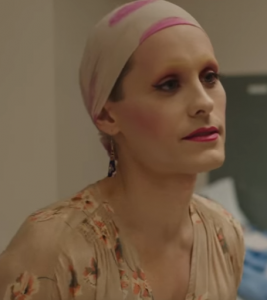
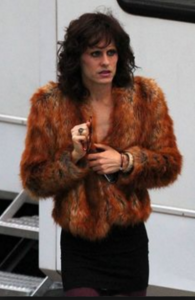
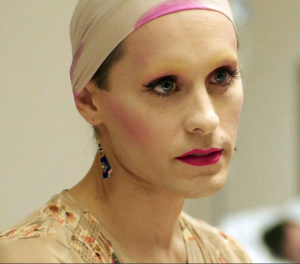
Suicide Squad’s Joker is not a cartoon from a DC comic. Instead, He is a Jared Leto, a carefully picked actor. It is important to note the associations that Leto carries with him. Although being known for looking like a twenty-first century Jesus, Leto is a rumored bisexual, and although that is a very different identity from that of being trans, it still falls under the category of queer, or rather not heteronormative. More importantly, Jared is known for his Golden Globe and Academy award performance as Rayon, a transgender dying of AIDS, in Dallas buyers’ club. Rayon is always in drag, focused more on her beauty and femininity than her life threatening disease. She is the trans that millennials know best and conforms to every trans stereotype imaginable. Jared’s association with Rayon cannot be overemphasized, as it is an identity that will now color ever performance he does. The casting directors of Suicide Squad are undoubtedly aware that they not only are casting Jared, but are also in a way casting Rayon.  Furthermore, Jared’s facial structure, although a male face, caries feminine traits. His narrower nose and thinner, sharper lower facial structure is far from the idealized masculine face as reported in The Morphometrics of “masculinity” in Human Faces which found that, “male faces with a higher masculinity attribution tended to have wider faces with a wider inter-orbital distance, a wider nose, thinner lips, and a larger, more rounded lower facial outline.” (Mitteroecker) This distinction is clear when comparing Jared’s more feminine face to that of Matt Damon’s masculine facial features below. It cannot be ignored that the new Joker is played by a man that is most associated with not being a man. In many respects Rayon is the prelude, of sorts, to Suicide Squad’s Joker. From her facial structure to hair to dress to makeup and everything in between.

 12

The appearance

345

The Joker’s appearance can be read as a distancing from the old Joker, and into a new Joker dressed in Drag. It must be noted that, “Modern transgender performance is most widely known through drag” and therefore when examining a cultural piece such as Suicide Squad any crossdressing or drag performance can be equated to being transgender. (Miller 42)

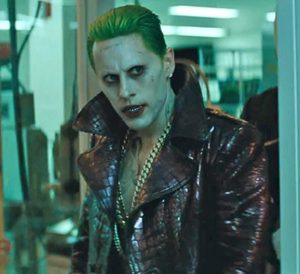
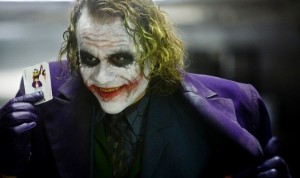
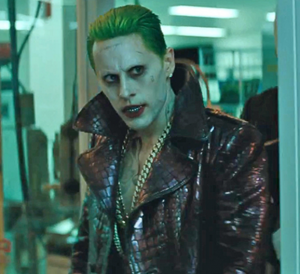
Notice his makeup, his clothing, and his hair as they are unlike any Joker’s that we have seen before. His lipstick is noticed first, in 2008 the Joker had red lipstick sloppily drawn across his face that covered literal scars he had cut into his cheeks, making him look especially villainous and evil, like he was wearing a mask. In contrast, the new Joker’s red lipstick appears to be carefully applied, like a woman at a ball. The new Joker’s eyeshadow is quite light and tasteful, sexualizing the eyes instead of demonizing them as the old Joker’s eyeshadow does. Finally, there is the matter of paleness that all Jokers have on account for being a clown. The 2008 Joker has cracks in his white foundation and other makeup clearly smudging around his face. It appears as though he did a poor job applying clown makeup. In sharp contrast, the new 2016 Joker’s foundation can almost be missed on account for how well it was put on. The appeared effort and cleanliness, as well as feminine manner that new Joker’s makeup is applied is easily relatable to the makeup of Rayon in her drag.  By making the two characters look so similar, the director is intentionally forcing you to picture the new Joker with any non-male person in mind, particularly Rayon.

Paying close attention to the new Joker’s hair reveals that it is much more similar to the style of Rayon than that of the 2008 Joker. In 2008, his hair is longer and is a faded disheveled green, falling in front of his face, whereas Suicide Squad’s Joker has well-kept slicked back hair. There are a few places that we can see this style of hair. One is in the early twentieth century where men often slicked back their hair as it was the popular style of the day, however, more likely (as this movie holds no other similarities to that time period) is that the Joker’s hair is slicked back because it is ready to be put up in a do rag, like the one we see on Rayon, or it is being prepared for a wig, as any short hair would have needed to be controlled and minimized to make the appearance of the wig natural.

In the final layer, the Joker’s famous purple jacket, we can see an important distinction between the two interpretations. In 2008, it was put over a green vest, dress shirt and tie. The three-piece outfit was dirty and too big, but nonetheless masculine, turning the joker into more of a twisted businessman than anything else. But, in 2016 we see no shirt, not tie and no vest. His jacket, now made out of alligator skin, a material largely associated with high feminine fashion, is shiny and unbuttoned with a popped collar and is much longer, going all the way to his shins, resembling something closer to a ballroom gown with too much cleavage than a three-piece businessman’s suit. Particularly noting that the Joker’s jacket almost always covers his nipples, but nonetheless shows a striking amount of cleavage, allows us to draw close analogy to the dress of Rayon as pictured below. This all is to say that the Joker is dressed in drag, complete with a gown and makeup only different from Rayon in the lack of brunette wig, which the Joker could never have and still fit the comic book picture that has existed for over 60 years.

 678

The Actions

910


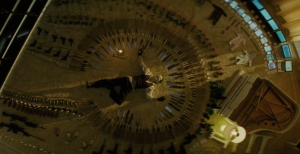
The masterstroke, and final peace to the puzzle that turns the Joker from male to transgender are actions. The clarifying scene is in what appears to be a penthouse living room. The scene is pictured above and shows the Joker lying in the middle of a circle with a hammer and lightbulb, surrounded by knives, roses and baby clothes.

The lightbulb and hammer go hand in hand to symbolize an idea or rather a desire for enlightenment facilitated by a tool that is the hammer. It is not the physical hammer that will achieve the enlightenment, but rather the idea that technology and tools are needed to achieve enlightenment.  The brilliance of this shot comes from the layers of items that surround the Joker. At the center, are the knives, which traditionally symbolize destruction, and in a movie where the Joker never uses knives as a weapon, their placement in this shot must be purely symbolic. The knives exist to destroy, or rather surgically cut away, the part of the Joker that restrains him from becoming transgender. In destroying that part of him, his penis, he can reach the next level of the circle, that of the roses. Roses are symbolic of love and in this case self-love of a physically transitioned Joker, because he has moved through the layer of knives to get to the roses. The roses complete the circle that really isn’t a circle, but rather a womb.  The womb having only one opening that leads out of the penthouse. The Joker’s exiting of the penthouse is therefore an exiting of the womb, a rebirth into a new physical state as well as mental state. Then there is the matter of what is outside of the womb, three baby outfits. The inclusion of these outfits only further solidifies the concept of rebirth into a new body. The joker has destroyed the part of him that he dislikes and in doing so is enlightened as he has found self-love in rebirth.

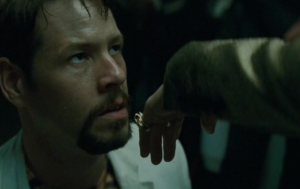
In the next scene, immediately after exiting of penthouse, the Joker takes on much more sexual, feminine, and queer characteristics. She enters the next scene purring at the man who is being interrogated. The Joker then presents her hand to be kissed. It is important to notice how she presents her hand, not as a fist, but rather like a queen or woman would present her hand to a man. By making the straight man kiss her hand the Joker, now fully transgendered, is asserting dominance over the heterosexual norm. This concept is completed when the Joker sits on the man’s lap, crotch to crotch and sexually growls again. Her dominance in this scene, although subtle, sets up a new power dynamic in the movie. It does so because the man who was being interrogated once held all the power over Harley Quinn and therefore, by the Jokers obsession of freeing her, the power over the Joker. The establishment of this power dynamic is completed in the final scene of the movie, where the Joker breaks into the jail that houses Harley Quinn and frees her, giving the Transgender the final move and final laugh.

Taken together these three elements create a new Joker that we have never seen before. We have a transgender villain that instead of being a villain is the hero that we root for, and in the end is the person with the most power. We see a movie that has redefined gender dynamics in a comic book world where men have historically ruled.

As a movie it is entertaining.

As a story it is revolutionary.


Written in the style of Jake Romm

Edited by Abby Lloyd


Sources

Miller, Jeremy Russel. “Crossdressing Cinema: An Analysis of Transgender Representation in Film.” PhD diss., Texas A&M University, 2012. Accessed December 13, 2016. http://oaktrust.library.tamu.edu/bitstream/handle/1969.1/ETD-TAMU-2012-08-11672/ MILLER-DISSERTATION.pdf.

Mitteroecker, Philipp. “The Morphometrics of “Masculinity” in Human Faces.” PLOS one, February 11, 2015. http://journals.plos.org/plosone/article?id=10.1371/journal.pone.0118374.

Ledger, Heath. Dark Night. Directed by Christopher Nolan. DC entertainment, 2008.

Leto, Jared. Suicide Squad. Directed by David Ayer. DC entertainment, 2016.

Leto, Jared. Dallas Buyers Club. Directed by Jean-Marc Vallee. Voltage Pictures, 2013.


As He Stood Rapping

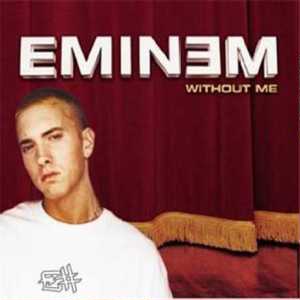
The song came out of the album, following the others through its production. It made its way half a decade later than the first of them, but it fared better than the first ever could. “Without Me” came right from his mouth to the market with not even than three months in between. The song is an introduction, three verses, and a chorus throughout all of which there is a beat that runs so cleanly it gets inside the mind of everyone who tries to give it a listen. Eminem’s song stands back from the rest in its desire for change, trying to be different, hitched to the idea that it can make a change in this world. “Without Me,” like all that came before it, wants to rebel against a system, but what system at first is a mystery. In its creation and content inside, “Without Me” follows the rap, rap, rap, of the song and the beat while all the while saying it the opposite.
Everything can be reduced to the timing in the analysis of its creation. Eminem put “Without Me” into the world right when he finished with his production of 8 Mile, which he created to honor none other than his own story. All the production came intertwined with his story in a movie, a movie about himself no less. Whatever it is, announcing “Guess who’s back/ back again/ Shady’s back/ tell a friend” sure has a nice egotistical ring to it. If that man were honestly trying to break some kind of system, he would surely not announce it with the fullest intent of getting caught, about which he does not stop bragging. All while announcing his intentions in his actions by making a movie, Eminem surely could not be rebelling in earnest.

eminem_-_without_me_cd_cover
Onto the structure of the song, something seems a bit out of touch the way he tries to cram words together into a pattern that he can make fit the message. All the rhymes seem complicated in a way that shows off and provides some form of inaccessibility to whomever tries to emulate the style. All the words come together in a pattern that flows like a stream but is as easy to figure out as thick mud. The rhymes and rhythms take on lives of their own as they twist and turn and ebb and flow through a song on top of, what seems at first, seems to be a simple background beat that gets wildy more complicated the more it is examined. A man trying to rebel and start his movement would keep things simple, but this one cannot be just a regular person. He has to be an icon. Whatever attitude of rebellion he tries to claim goes whish, whish, whish right out the door with those lyrics all strung together in their unnaturally neat and unnaturally tidy order. Every rhyme and every word in it is too complicated to be simple.
All the ways the words come together comes with the words themselves, organized into three not-so-neat verses and a chorus desperate to carry meaning.
The first verse of “Without Me” enters rebellious, strong, and willing to incite anger. A violent alter ego named Slim Shady takes control of the words in his attempt to return from a limbo land between albums and between influences. Shady insults the then-Vice President, all the while screaming about his heart problems and his wife; the words desperately trying to take on insubordinate lives of their own. Even while Eminem seemed to know he was making something for the mainstream, Slim Shady insists on being a nonconformist with his claims that he is “on the rag and ovulating.” Right at the end of the verse the words come together to threaten to take action against the Federal Communications Commission, immediately and harshly. This piece of music tries to intimidate the mainstream while actually being a part of it, the words ending while perpetually lingering.
The song then turns to the second verse after it makes its way through the chorus. Slim Shady or whoever is narrating stops his cause of actively rebelling with his self-conscious incitements of anger to shift over to a mockery of the rebellion he has just been trying to emulate. The words narrate a child, one who is “embarrassed” his parents still subscribe to that old-time rebellion and “listen to Elvis.” The words go on to tell a story of watered-down rebellion, the kind that those who are the mainstream continue to embrace. How bad it is to be a “rebel” when everyone is buying millions of copies of a song and providing a nameless man millions of dollars in profit. At the end of the second verse, the story goes to a line with the illuminating power needed to analyze the song. After that line the song gets easier, more understandable. The narrator offers his “ten cents, [his] two cents is free/ a nuisance, who sent for me?” The first half of the line deals with money and advice, advice and money. The advice is to get money somehow. Earn a ticket out is the advice. The second half provides the attitude toward rebellion that Slim Shady takes to extreme in the first verse. The rebellion is desired and wanted, feeding on consumers to make it happen, waiting for someone to buy the song and embrace the thinned version of rebellion it tries so hard to present.
The rhyme structure and the lyrics all lead down a path toward a fake revolution that is not one but pretends to be. No real rebel would come within a mile of “Without Me” and its central message, but the song tries to be devilish and fool listeners into thinking some would. Rebellion has become an official aesthetic of consumer society. The ones who are against consuming and consumerism are the spokespeople for it. According to some psychologists, rebellion against a perceived authority in this fashion “is really an act of dependency” (Pickhardt). “Without Me” and its claims to be rebellious are fictitious declarations stemming from consumerism acknowledged by the end of the song in its final verses.
In the 1950s, a theorist named Richard Hoggart published The Uses Of Literacy in which he argues revolution is a commodity with which to sell consumerist cultural products. Watered-down rebellion is thickened blood of mass-produced culture. 1) According to Hoggart, culture-producing corporations take money. 2) They drain the actual revolutionary spirit. 3) They replace it with fake cries for revolution. 4) The new fake revolution enters the marketplace masquerading as what it used to be. 5) People like the fake revolution and succumb to it. 6) Except. 7) Not all people are stupid. 8) Some people can deal with stress. 9) Eminem is not stupid and can deal with stress. 10) “Without Me” criticizes the fake revolution. 11) So the fake revolution does not go unnoticed. 12) Fake rebellion sells culture. 13) It weirdly makes sense.
Over thirty years after Hoggart wrote The Uses of Literacy, Dave Marsh, a song critic, published The Heart of Rock and Soul in which he analyses songs for their components. Everything from the artist to the album to the beat to the lyrics to the remakes to the general influence of a song is something for Marsh to consider as he ranks which songs are the best and which ones deserve to bear the honor of being one of the one thousand and one most influential songs the world has so far seen. Songs that cross racial lines are often good as far as Marsh is concerned for the purposes of his list. The 1950s was arguably the first time that white Americans created culture including songs with influences from other groups instead of trying to erase the culture and styles of people previously deemed inferior. Songs since the 1950s are Marsh’s study, and many of them are good. “Without Me” is a song by a white American written well after the 1950s.

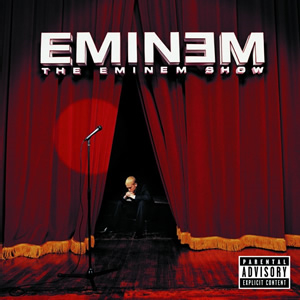
the_eminem_show
“Without Me” has revolution against the old like many songs. The first verse comes from an angry alter-ego, its voice forming words that clash with the notions of control, of regulation, of restricting what gets played by radios or people’s mouths. The vice president and his wife are subjects for derision and anger, venting, screaming, protesting. The system almost buckles crack, crack, crack as it is under attack.
What “Without Me” provides is an acknowledgement of the co opted rebellion that forms its industry. The narrator becomes less hostile and acknowledges the new form of culturally allowable rebellion that has taken hold of the industry that the first verse laments. The difference between the old and the new, the actual rebellion and the sanctioned form, become apparent in the words of the song as with the song itself. Rap is not the rebellion it used to be; is has had a “tremendous influence on mainstream” (Blanchard). “Without Me” shows the issues presented by mass industrial rebellion to be too complex, rebellion industry some could call it.
Rebellion is no longer the act of rebellion it used to be but instead a central aesthetic of a consumer society. Opponents of the system are now its controllers and ideologues. “Without Me” starts with rebellion, if rebellion ever was there, then shifts to mocking the rebellion it proposed. In so many ways, Slim Shady is the definition of anti something or rebelling against whatever. Loud, strong, aggressive, insouciant. In so many other ways, though, Slim Shady is the opposite. Sanctioned, permissioned, mainstream, warranted. All of Slim Shady or Eminem’s “lawsuits are settled.” He has no more issues with society or consumer culture in the way it twists him or them into the image of defiance it so desperately wants to convey. At least he was smart enough to realize what was happening. At least he knew that whatever watered-down form of countering something he produced was what listeners wanted to hear. The FCC may have tried to ban him, but he got airplay nonetheless. Marsh knew it. Hoggart knew it. Apparently the real Slim Shady knew it too.
The song is a rabbit.