Author Archives: Ajar Dixit

A Fine-Tuning of Male Dominance: Eddie Murphy’s “Coming to America”

       Eddie Murphy’s 1988 romantic comedy Coming to America was a huge commercial success upon its release, despite unanimous critical distaste for the film. The romance in the story falls flat, the comedy resorts to slapstick humor. Critics bemoaned the film’s mediocre acting, especially Eddie Murphy’s, whose characteristic liveliness was drowned in his own script. (Carlson) It wasn’t until recently, however, that people started talking about the film’s anachronistic and ahistorical portrayal of Africa– which gives the sense that the Africans in the fictional country of Zamunda are nothing more than Europeans dressed in Africanities, speaking sophisticated English and sipping champagne. The eurocentricity of the characters seems at odds with their location: outside of the palace, elephants and rhinos lumber across the background and a loud merchant sells Dashikis (Jacobs). The flaws in Coming to America are evident in its whitewashed portrayal of Africa, but cannot be articulated without assessing the position of women in the film– both African and American.

giphy

Prince Akeem is bathed by his servants

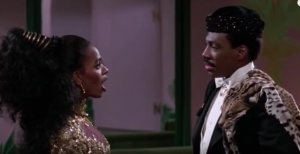
       The most objectified bodies are those of African women that appear early on in the film, before Eddie Murphy’s character, prince Akeem, leaves Zamunda to find true love outside of arranged marriage. The film uses the objectification and submissiveness of African women as grounds to permit their exploitation– their supposed inferiority legitimizes the male desire to dominate women through the male sexual utopia that is Zamunda. Aside from the queen, the only African woman that speaks more than one line in the film is Akeem’s initial bride-to-be, who is depicted as robotic and mindless— the only thing she says “no” to is Akeem’s insistence that she doesn’t need constantly obey him. Since she has been trained since birth to serve him, and is thus dependent on his existence, she refuses to see that she can exist outside of him. The rest of the African women have few lines, all related to their status as servants. In Zamunda’s generalized perception of Africa, unrelenting roots of colonialism and patriotic nationalism depict what is considered the lack of an obviously superior Western ideology– despite clear whitewashing, the customs of Zamunda are depicted as completely and irrevocably sexist. Inherent in the Africanness of the Zamundians is an extreme dichotomy of masculinity and femininity that churns out legions of uniformly obedient and mindless African women that accept their own exploitation (especially sexual exploitation) eagerly and unwaveringly. Zamunda, and presumably all of Africa, is so good at ingraining the virtue of obedience in women that Akeem feels he must leave the entire continent to have a shot at finding true love with a woman who satisfies his intellect “as well as his loins.”
screen-shot-2016-12-15-at-3-18-00-pm

Following Akeem’s order to bark

          The dismissal of African women as mentally incapable to justify their exploitation  permits their complete objectification, with the effect that the sexual enjoyment Akeem gets from his bathers is depicted not just as as erotic, but expected. The movie justifies this expectation through the characterization of Akeem as singularly righteous– a symbol of progressive, western thought trapped in a backwards society. The most central and thematically well-represented example of this is his reluctance to have an arranged marriage, a major part of the plot that highlights Zamunda’s foreignness. Arranged marriage is a custom widely-regarded by viewers as barbaric and existent wholly outside of modern Western culture, and Akeem’s rejection of it and general dissatisfaction with the culture (that is rigidly obeyed by others around him) aligns him with the Western audience and fuels its perception of his moral integrity.

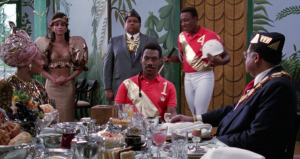
         This conception of Akeem is crucial when he details his qualms with palace life to his father, saying that “it is not just [the rose petals thrown wherever he walks] it is everything. The cooking, the pampering, the dressing, the bathing…” before admitting slyly that he actually “rather enjoy[s] the bathing.” Clearly his qualms with life in the palace stem from a desire for autonomy rather than specific ideological differences with the culture of Zamunda. Not to mention, his desire for autonomy and individualism strengthen the perception of his westernness and masculinity. His admitted enjoyment of the African servant women ultimately permits the viewer to desire or accept their exploitation by trusting Akeem’s moral correctness due to his distinction from the flawed, but erotic traditions of his country.
screen-shot-2016-12-15-at-3-21-57-pm

Akeem’s conversation with his parents

        Thus the crucial bathing scene is the most direct depiction of an erotic male utopia in which men are allowed the desire to dominate African women. They are absolved of guilt over this  desire by the perception of African women as mindlessly compliant sexual servants and  the fact that Akeem (a symbol for western thought, and righteousness) holds the desire himself. With this, the fundamental core of the scene becomes clear– Akeem’s exploitation of African women is acceptable only because their culture (which is inherently inferior to western culture) is one that is less intellectual, thus creating mindless and valueless women who are seen as nothing more than ornamented bodies with which to have sex. This idea of intellectual inferiority, as depicted primarily through Akeem’s arranged almost-wife, draws an uncomfortable connection to a colonialist mentality and the obsession with the “exotic” and “forbidden” African woman’s body (through which the will to dominate a country was, and still is, expressed as sexual violence against local peoples (Nih)).  

          The extreme irony in this is the film’s premise is a clear attempt to avoid the issue of colonialist thought: Akeem’s riches challenge the trope of poor, starving Africans, and his position of wealth is utilized to mock white people who visit Africa. “Look! Real Americans!” he says as he observes three old men bickering in a barber shop. Putting a black face on a movie whose plot is reverse-colonialist in so many senses, and supporting this character in his rebellion against his homeland’s culture, allows for a comparison of Western and African ideology that affirms the West’s superiority without carrying racial implications. Men are thus allowed to overlook the implications of their own sexual desires and pin them on the ideological inferiority of Africa as a whole, which in turn manifests as the inferiority and justified exploitation of African women.

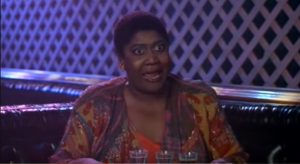
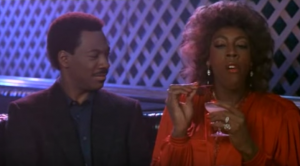
         The film shifts its message about women as Akeem arrives in America– the dominion of men over women here is refined in a way that begrudgingly acknowledges the empowerment of American women, presented in the film through the punishment and stigmatization of female sexuality. After arriving in New York, Akeem and his servant Semmi go to nightclubs to meet women in scenes that function comedically in characterizing the women at the bar as deviant– be it sexually or in some other social regard. From devil worshippers to narcissists, they reveal a fear of female sexuality that renders a woman expressing her sexual desires as cheap or degraded. Semmi, as Akeem’s foil and the prototypical horny guy, smiles at one woman’s statement of interest in a threesome, while Akeem, serious about finding a wife, frowns. This distinction ties into a male perception of female sexuality– it is put on show not just for comedic purposes but also to demonize sexual women, to denote them as unworthy of anything but sex (Gummow). While American women are not mindless like African women, those that are not “clean” and go to clubs do not warrant a man’s respect. Another woman worth noting in this scene downs two shots before proclaiming:  “Now that’s the problem! I can’t find a man who can satisfy me. Some guys go an hour, hour and a half, that’s it! A man’s got to put in over time for me to get off.”  A reflection of the cinematic trope of the angry black woman, she is the only one in this scene to have short, natural hair, and is clearly meant to be perceived as less traditionally attractive than most of the other women presented in the scene. The importance of this is that her comments can do nothing to hurt the masculinity of the viewer– her presentation as undesirable is exacerbated by her expression of sexuality, and, in addition to being tied to a form of blackness that is deemed undesirable, her short hair and sexual frustration liken her to a man. And as an almost-too-perfect culmination of this idea, the end of this scene features a sexually aggressive trans woman, instantly recognizable as the actor who plays Semmi in drag, detailing, to their disgust, how she’d like to “rip [Akeem and Semmi] apart.”
screen-shot-2016-12-15-at-3-25-09-pm

Sexually frustrated woman from the bar scene
screen-shot-2016-12-15-at-3-25-24-pm

Trans woman (played by the same actor who plays Semmi) from the bar scene


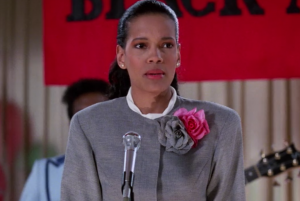
        The only primary character in the movie who is shown making sexual advances on men is Patrice, the sister of Akeem’s love interest. She is introduced dancing in her living room as questioning Lisa who she is having sex with when she receives a gift in the mail. Her characterization as a sexual being continues throughout the film– she puts her hand on Akeem’s crotch at a basketball game and has relations with Semmi. Patrice’s sexuality is so central to her character that the film ingrains the audience with a clear answer to her question of why Lisa “gets all the good ones”–  that it’s ‘by not being a slut.’ Patrice is also paralleled to the African women at the beginning of the film, especially in comparison to her sister Lisa. She displays her bodiliness as she dances sexually, critically antipodal to Lisa’s intelligence and respectability (think mindfulness) as she reads on the couch. Important to mention too is Patrice’s appearance: she has darker skin and curlier hair than Lisa, and is characterized (stereotypically) as sassy. Similarly to the sexually-frustrated woman portrayed in the club scene, aspects of Patrice’s blackness are shunned and tied to her sexual promiscuity. Thus, the film manages to propagate negative stereotypes about the sexuality of black women, despite having an all black cast, by using stereotypes and afrocentric features to delineate women considered by the audience as more prototypically black as sexually deviant and thus less valuable.

 

400px-coming_to_america_apartment

Patrice

screen-shot-2016-12-15-at-3-30-32-pm

Lisa’s introduction in the film

maxresdefault-1

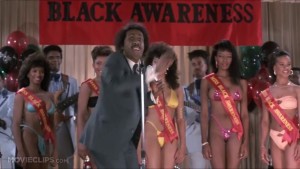
Bikini Pageant preceding Lisa’s introduction


The film relies on the distinctions between Patrice and Lisa as a way to divide American women and determine whether or not they can be dominated by men. Patrice’s domination is rather clear from what was just discussed: as an impure and invaluable woman, the message is that men will continue to reject her in all ways except sexually– and her own actions are at fault for warranting this treatment. Conversely, Lisa, a “good woman,” is the only woman in the film with any sort of control. She rejects Daryl’s proposal when he and her father try to force her to accept it, and stays with Akeem despite her father’s initial disapproval. After the proposal, Daryl becomes a symbol of machismo– having told Akeem that all women “want a man to take charge, to tell them what to do,” and Akeem, by way of his character differences from Daryl, becomes one resembling a feminist stance (or at the very least, of anti-female domination).

         Not only does this late shift in the movie further bury the fetishized African servant woman as inconsequential, it gets the viewers of the movie to applaud the preservation of Akeem’s masculinity via the domination of African women while blending into American society, where such overt domination is culturally inappropriate. His departure from Africa is attributed to the mindlessness of African women, preserving his masculinity and reassuring the male gaze of its morality– which would be lost if the humanity or degraded position of African women was acknowledged. This and the film’s tenacious impression of Akeem’s integrity, which is so pervasive that he is a relatively static character throughout the film, implies that his character alone pits him against Daryl and by association against the control of women. This is why he never has to learn how Americans treat women the way he has to learn how to dress, work, and speak– his being on the virtuous side of this conflict is a given to the audience. So as Akeem experiences America and falls for Lisa, the message of the movie is not that all women are valuable and intelligent, but that most aren’t. A man who accepts and fantasizes about the domination of powerless women and the devaluation of sexual women is nonetheless capable of being considered the “good guy,” provided he doesn’t attempt to dominate a “good woman” like Lisa.


References:

Carlson, Daniel. “Is It Just Me, or Does Every Woman in New York Have a Severe Emotional

       Problem?” Pajiba. Disqus, 05 May 2009. Web. 8 Dec. 2016.

Gummow, Jodie. “Unveiling the ‘Madonna-Whore’ Complex.” Alternet. N.p., 9 Sept. 2013. Web.

       7 Dec. 2016.

Jacobs, Sean. “Africa on Film: Coming to America.” Africa Is a Country. N.p., 14 Apr. 2015.

       Web. 10 Dec. 2016.

Tih, Felix N. “Rape of Africans by Europeans: An Ongoing Colonial Habit.” The Anadolu Post.

       Anadolu Agency, 18 Sept. 2015. Web. 7 Dec. 2016. 

Better off a Conformist: Analysis of Hipster Culture

         Azar Dixit

          The title of a popular Onion article, “Two Hipsters  Angrily Call Each Other ‘Hipster‘”, quite humorously and simply highlights an interesting curiosity about hipster subculture: there seems to be a pretty good understanding of what it means to be “hipster,” yet no one group of people accepts this label as their own. Hipster subculture is unique in inspiring universal discomfort in a way that few other subcultures or trends of today can even come close to; the modern conception of the average hipster is convinced of his pretentiousness and annoyingness to the point that even those who subscribe to the understood beliefs, styles, and actions of this subculture consider the label an insult to their authenticity (Greif 1). Mark Greif, New York Times writer, attributes this response to the fact that the label “calls everyone’s bluff” in terms of authenticity and taste. This assertion seems to largely fall short of an entire explanation; the sweeping discomfort brought about by the development of the modern hipster runs much deeper and echoes societal tensions to a degree that a simple distinction between genuine and unoriginal fails to embody.

jejej

Examples of hipster style, specific to Portland, Oregon

          The hipster subculture is primarily composed of affluent millennials who tend to be college educated and politically liberal, live in gentrified neighborhoods, associate with indie/alternative rock music, and dress in styles that subvert mainstream fashion. The crux of hipster ideology is to portray an entirely unique state of being and nonconformity through personal taste, often through choice of music, fashion, and alternative lifestyles (Grief 2). As one of the most prominent new subcultures of the elite, hipsterdom is known for recycling past trends and styles of historically ostracized and oppressed groups, as is seen in the resurfacing of trucker hats and wifebeaters, both of which were previously typical styles of working-class, white Americans.  The word “hipster” itself has a history that reflects this pattern – the term was first used to describe black subcultural jazz artists in the 1940s, and eventually extended to include those artists’ white fans, who embraced the realm of new, exciting, and exotic energy that they admired in their favorite black artists. Hipsters in these decades, both black and white, were convinced of the powerlessness of minorities to make choices about their own lives and insisted upon the importance of personal knowledge gained before being influenced  by what society teaches (Wailer). The term resurfaced in 1999, again likened to the value of knowledge gained before societal influence, now tied to “discovering” fashion and lifestyle trends before the mainstream (Grief 2). The fact that elite culture determines its stylistic preferences in light of both current and historical subcultures of common people is an interesting change. It puts the hipster in an unfamiliar realm – directly in between the recycled aesthetics of other, rebel subcultures and the underlying elite privilege of the dominant culture.

          In his essay, Grief begins to decipher the cultural phenomenon of the hipster by defining taste as the central drive in its appropriation of marginalized cultures, and as their own brand of a seemingly paradoxical elitism. French philosopher Pierre Bourdieu claims that the notion of the elite possessing a superior taste can be explained by the elite’s usage of it ‒ as an affirmation for their right to power and privilege ‒ to oppress the lower class and maintain societal divides. Bourdieu found that taste can accurately be predicted by socioeconomic factors (specifically one’s class at birth and achieved education level), making it predominantly a reflection of environmental factors rather than a representation of individual expression or assertion. Moreover, Bourdieu observed that a sizeable portion of highly-educated French elites showed a marked preference for flea markets ‒ a finding largely reminiscent of the “thrifting” trend brought into the contemporary mainstream by hipster subculture(Bordieu). Bourdieu’s argument would suggest that the hipster notion of cultural supremacy stems solely from economic motives, but this assertion contradicts the quintessential “hipster” as antipodal to those with mainstream tastes and lifestyles, invariable to equivalent social class. Even though the hipster subculture distinguishes itself from others by taste, and therefore has inklings of classism through the implication of superiority over those with lesser taste, it furthers its distinction by separating itself from those in the same class who do conform to the mainstream through intellectual superiority. This doesn’t mean that the “hipster” is a cultural figure that is free of elements that suggest the inferiority of the poor (e.g. few working class people actually have the time and money to maintain the exacting form of authenticity that is tied into being hipster), but rather that its underlying assumptions are, as Bourdieu describes, more a product of the hipster’s place in society than any sort of idea or image specific to the subculture itself. The rejection of those of an equal social class on the basis that they embody the mainstream is a feature of hipsterdom that has been noted by the television show, Portlandia. In a 2011 skit, the show featured a disgruntled hipster who furiously proclaims “It’s over!” after witnessing a clean-cut, white collar man enjoying the same activities and interests as him. The hipster continuously renounces the reflected aspects of himself until he has completely taken on the other man’s original appearance and behavior. What’s interesting about this skit is that it wouldn’t really work if Portlandia’s writers had casted a black man to play the hipster’s counterpart, since “the professional white man” is the mainstream that the hipster avidly avoids.

screen-shot-2016-11-22-at-1-59-23-am

The disgruntled hipster writes “IT’S OVER” on a window to the confusion of the white-collar man sitting in a cafe.

          The hipster’s perception of the lower class innately possessing a lesser taste brings up the question of how race is perceived in the context of this intellectual elitism. In being a supposedly counter-cultural and decidedly liberal subculture, the modern hipster outwardly embraces ideals of racial harmony and progressive reform for marginalized groups. However, the commercialization of hipster culture in recent years has led to controversy over the style’s tendency to appropriate the cultural figures/practices of ethnic minorities, without attempts to credit their origins or appreciate their cultural sanctity. The subculture’s persistent growth has thus begun a trend of increasing rates of cultural appropriation, or at least increasing its publicity. This is particularly so in the fashion of music industries, as concert-goers and performers alike are now more commonly wearing bindis, traditional headdresses, and other culturally significant garb during concerts and music festivals (e.g. Coachella, Burning Man, Lalapalooza, etc.). Although the current version of mainstream cultural appropriation may be new in some ways, it nonetheless derives from a combination of intellectual elitism and liberal political leanings, that together have created an ironic refusal of political correctness amongst its proponents. This tendency has led to the phenomenon coined “hipster racism,” which occurs when racial stereotypes are used ironically under the pretense of a person’s self-perception that he/she is not actually being derogatory (Quart). This can be explained by noting that the higher standing hipsters feel they have over others may have easily evolved into a penchant to diverge from social norms as well as established guidelines of political correctness. There is present a fundamental belief that they have progressed so far from common bigotry that they are permitted to make remarks that would normally even be considered racist, when coming from others less forward-thinking than them. The principal problem with this guise is that the comments are most often representative of discriminatory motifs – the humor in jokes is not always clearly ascribed to any ironies or understanding of minority sufferings. One of the most infamous perpetrators of this kind of disregard for political correctness is the trendy and self-proclaimed “hipster” clothing chain: Urban Outfitters. The company once sold a hugely offensive board game entitled “Ghettopoly,” a knockoff of the classic Monopoly board game, that propagated harmful stereotypes about African Americans who live in ghettos. Land properties in the game had titles like “Cheap Trick Avenue” and “Smitty’s XXX Peep Show,” and bonus cards had descriptions such as “You got yo whole neighborhood addicted to crack. Collect $50” (The Week). Only through the false perception of their being above discrimination could this have had success in a store that attracts droves of young liberals. The underlying justification for the production and sale of this inarguably racist product boils down to blatant acceptance of prejudiced sentiments, with the assurance that the buyer is obviously not prejudiced. In this way, the liberalism of Urban Outfitter’s clientele, alongside the store’s trendy image, overpower norms of political correctness, due to the commercialization of the hipster’s modal “ironic” thinking. The end product of hipster racism, as seen through the example of Ghettopoly, is just as damaging as displays of prejudicial sentiments by poor, right-wing Americans that the consumers of Urban Outfitters would normally be quick to fervently condemn.

tikewfamsd

Image of cover of the board game “Ghettopoly” carried by Urban Outfitters

The hipster as a modern symbol is not much more than a quirky makeover of problems that have challenged American society for years. It is a refined representation of the oppression and “bad taste” of the poor that has allowed elitism to hold hands with progressivism. It is a response from elites that embodies styles of the common people’s subcultures and cherry-picks trends without respect for their sanctity or meaning. They trivialize issues such as race in a way that puts those at the top of society in a position to liberate themselves from political correctness and justify their prejudicial actions. It is heavily implicated that this justification can only occur amongst the intellectually “superior”, while the intellectually “inferior” are labeled backwards bigots for expressing the same ideas. This dichotomy of racist versus accepting or backwards versus progressive is obviously likely to result in broad generalizations that work to either support that elites are so removed from bigotry that they’re entitled to tell offensive jokes while not being part of the problem, and that less educated people displaying similar sentiments are racists or sexists who represent all that is wrong in society. Thus, the strong and largely unanimous discomfort brought about by the initially subcultural figure of the hipster is not just the product of it questioning everyone’s sense of taste, but also of the consequential classist and racist undertones that exist within the concept of taste itself. And if you’re still not exactly convinced of the extremely political existence that hipsters possess, you should check out the German Neo-Nazi party’s recent adoption of hipster style – combining the trendiest hipster fashion and lifestyle with classic Neo-Nazi ideals, the group also differs from American hipsterdom in that it readily accepts the title of “Nipster” (Smith).

hero-both

Advertisement for a Nipster T-shirt line

Works Cited

Bordieu, Pierre. “A Social Critique of the Judgement of Taste.” (1984): 9-169. Monoskop.org. Harvard University Press. Web. 17 Nov. 2016.

Greif, Mark. “The Sociology of the Hipster.” New York Times. New York Times Company, 12

Nov. 2010. Web. 17 Oct. 2016.

Greif, Mark. “What Was the Hipster?” NYMag.com. New York Times, 24 Oct. 2011. Web. 17 Nov. 2016.

Quart, Alissa. “The Age of Hipster Sexism.” The Cut. New York Media, 30 Oct. 2012. Web. 17 Nov. 2016.

Smith, Kyle. “10 Alarming, Hilarious Facts about Nazi Hipsters.” New York Post. NYP

Holdings, 14 Aug. 2014. Web. 17 Nov. 2016.

The Week Staff. “15 Urban Outfitters Controversies.” The Week. N.p., 29 Apr. 2016. Web. 16   

Nov. 2016.

Wailer, Norman. “The White Negro.” Dissent Magazine. Dissent Magazine, 20 Oct. 2007. Web. 17 Nov. 2016.


The Help: And Other Remedies for White Guilt

the-help_big

We so often assume that the best way to combat bigotry and ignorance is through awareness, that injustices of the past can be alleviated with the right knowledge and appreciation. Through history, we reason, the errors of the past are clear and guide us in improving the present and future. We delegate months to celebrate the specific histories of oppressed groups, produce films about their movements, and immortalize their leaders. In terms of social justice and oppression, the right move is always to talk about it, to remember. This makes perfect sense before considering the way we look at race today; we naturally can’t help but overlook the basic and purposeful ideological motives that lie behind contemporary forms of normalized racism. Though it is hard to stomach, widespread racist assumptions exist today just as the belief of the inferiority of black people existed in the 1930s. Denying this all together is naive and idealistic, on par with the suggestion that we live in a post-racial world. I am not arguing in any way that we should stop remembering and learning about civil rights movements, just that the way we present them (and everything, for that matter) is subject to our fundamental ideologies. Oftentimes these ideologies are so elusive to identification that they are often perceived as instances of racial harmony, friendship, and progress.

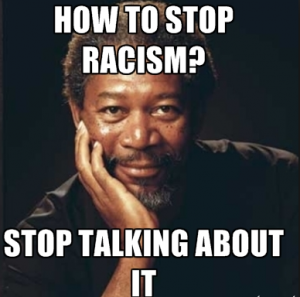
          This is a difficult distinction to make, but after having done so, I am reminded of an unintentionally hilarious interview of Morgan Freeman, in which he proclaims that the best way to end racism is to simply “stop talking about it.” As seemingly nonsensical as this first seems, it also makes a lot of sense– oftentimes when we attempt to discuss or portray racial struggles, ideological biases cloud our reasoning. They can incline us to be overly optimistic and make false assumptions the same way that pictures of black and white children holding hands on Facebook can convince your aunt that we live in a racially harmonious and equal society.

Meme of Freeman's famous quote from described interview

Meme of Freeman’s famous quote from described interview

          A well-documented formula for the depiction of race in film is seen in the trope of the “white savior” that cuts across almost every genre and era of entertainment. In more modern examples, films with this archetypal structure frequently masquerade as stories of redemption and justice in which a white character rescues a poor non-white character from their suffering. Presented without any form of autonomy, minorities in white savior films are presented as helpless and primitive, in need of the redemption that a white savior brings to improve their menial lives. Movies like The Blind Side and The Freedom Writers portray this motif all too clearly– depicting white women who use their resources and intellect to “get through” to black and latino/a youth, forever transforming their lives and creating an awareness in them that they can forge a path out of the struggle they were so unfortunately born into.  

skeeter

Eugenia “Skeeter” Phelan: The Savior

          Even in our depiction of slavery and segregation this trope resurfaces its ugly head, often misinterpreting and devaluing key aspects of the civil rights movement. And rarely is it ever so compelling as it is in The Help, a film directed by Tate Taylor based on the novel by Kathryn Stockett that follows the ambition of Eugenia “Skeeter” Phelan as she writes a novel from the perspective of black maids who raise the children of prominent white families during the early 1960s. Skeeter (as a typical white savior) is the catalyzing force of change in the film, as her bravery and acceptance of the black maids is depicted as the only reason anything significant even happens in the previously-stagnant town of Jackson, Mississippi. Rather than the culmination of decades and decades of racism inspiring black leaders to unite the black community and inspire change, the fact that it is impressed by an oddball, white, feminist figure primarily driven by the emotional attachment she had for her childhood maid not only devalues the history of the civil rights movement, but also proposes an uncomfortable proposition that black people wouldn’t have been able to strive for justice if it wasn’t for compassionate white people.

Skeeter approaches Aibileen at a black bus stop

Skeeter approaches Aibileen at a black bus stop

          Not only is Skeeter the typical white savior, she is also inexplicably clueless regarding the accepted social norms that govern interactions between black and white people in Jackson. The first maid Skeeter reaches out to is Aibileen, with the purpose of getting her help to write a cleaning advice column. Skeeter later tells Aibileen about her idea for the novel excitedly, obviously without having considered how dangerous such a pursuit could be for a black woman. Skeeter then approaches Aibileen again for an answer at a black bus stop,  completely oblivious to how strange it looks for her to be there, a detail that is conveyed cinematically through the obvious confusion of the white people observing the interaction in the background. Skeeter assures Aibileen that they will be safe, to which a disgruntled Aibileen notes responds “this already ain’t safe” and that the way Skeeter is going about creating this novel “scares [her] more than Jim Crow.” Only is it after Aibileen agrees to participate and the two meet up that Skeeter says she “know[s] now that what [they’re] doing is illegal.” The extent of Skeeter’s cluelessness regarding commonplace racial interactions and taboos in her hometown has no real explanation. Sure, she went away to Ole Miss for college for four years, but after having spent at least seventeen years in Jackson before leaving, it’s fair to say that she should have at least a rudimentary understanding of the power balances between black and white people in her home town (especially when it comes to potentially endangering her primary ally Aibileen). Her apparent “color-blindness” and empathy for black women make her an anachronistically perfect savior in a society that would be more realistically portrayed as overwhelmingly and monotonously racist.  

Mrs. Hilly Holbrook: The Villain

Mrs. Hilly Holbrook: The Villain

          Hilly, the villainous racist of the novel, is the exact opposite of Skeeter. Basically a racist mean girl-esque socialite bully, Hilly pushes for legislation requiring the help have separate bathrooms in every home, and tries to frame Aibileen for stealing silverware to have her arrested. Where Skeeter is unaware of certain social conventions, Hilly epitomizes them. She is the president of the Junior League, and maintains power over the other white women of Jackson thorough blackmail and threats. She sticks staunchly to her pro-segregation beliefs, readily punishing those who disagree, and even fires her maid Minny Jackson for using her toilet. Despite this, through much of the film she is shown to be preoccupied with her charity efforts for the “Poor Starving Children of Africa Fund.” In this way The Help almost seems to be mocking the white savior complex– depicting the faulty logic behind the Junior League of Women who would never offer to help the children of their maids, but work instead to send food to the starving children in Africa. This detail functions as a not-so-subtle jab at Hilly, who in a previous scene refused to give her maid Yule May Davis a fifty dollar advance to allow her to send both of her sons to school, leaving her with the choice of deciding which one to send.

Minny Jackson (Left) and Aibileen Clark (right)

Minny Jackson (Left) and Aibileen Clark (right)

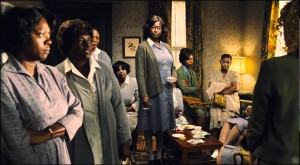
          Trapped between these hero and villain figures are the maids. Particularly Minny Jackson and Aibileen Clark, the latter being the most central maid in novel (also the narrator of the film), as the first to talk to Skeeter and as a connection to the rest of the black community. One of the most important things Aibileen does is reach out to other maids to tell their stories, explaining that she and Skeeter “ain’t doing no civil rights” but rather “telling stories like they really happen.” This is the most recognizable point in the movie that depicts Aibileen’s initial submissiveness to the racism that permeates her life. The apparent dissatisfaction in Aibileen is connected to her son’s death in a senseless accident that plants a “bitter seed” in her that severely lessens her patience with her boss, Mrs. Leefolt. Despite this, she maintains a torturous yet quiet obedience, never does it seem that she is criticising or objecting to the racism of the south so much as enduring it expectantly. In a dramatic scene at the end of the movie, Aibileen strides into the sunlight after being fired by Mrs. Leefolt, recounting how being able to tell the truth to Skeeter was “liberating” to her as she decides to leave her life as a maid behind her and pursue a life dedicated to writing the stories of those around her– just as Skeeter had done for her. Aibileen’s transition from the stereotypical obedient, matronly, and religious maid to an activist dedicated to those around her happens quite suddenly in the film and is very clearly only a result of the actions of Skeeter.

Maids inspired by Aibileen to speak to Skeeter

Maids inspired by Aibileen to speak to Skeeter

          So why is it important that Skeeter is white, and so unaware of the social conventions of Jackson, and that Hilly is the epitome of these conventions at play? Where does Aibileen come in in the mix? The answer to the first of these questions is that having a completely pure, positive white character is a surefire way to absolve the sensitivities of white audiences dealing with the inherent conflict they have viewing and living in such a racial world. Many white moviegoers constantly feel victimized by racially-based conflicts in film. Thus, saviors like Skeeter play an integral role in alleviating their tiredness with the topic, by depicting a white person going the extra mile for people of color who can’t. In doing this, the film essentially provides white people a reason to feel better when looking back to times such as the civil rights movement. Skeeter’s presence in the plot line of The Help is what makes it, for many, an uplifting movie about racial cooperation rather than a black movie about civil rights. Thus the fictional trope of the white savior functions to solve a very real problem– the modern “tiredness” and guilt white people have living in  a racial world so clearly attributed to the actions of white people that must be completely absolved for a movie such as The Help to be successful.

Mrs. Hilly vs. Skeeter

Mrs. Hilly vs. Skeeter

          So what exactly is the cost of  placating white audiences whenever race is a topic of interest in film? In essence, the feelings of white viewers are placed over those of minorities by compromising the representation of minorities in film.  The instances of cooperation and friendship between Skeeter and the maids subverts the concept of white supremacy at a higher level, confronting segregationist, KKK-level racism,  but it also exists more subliminally, weakening the characterization of black figures, oftentimes conveying less obvious messages of white supremacy through the stereotypes of black dependency and white paternalism. In the film, characterization of Skeeter and Hilly as opposites brings us to a generic conversation of good versus evil, a much too simple juxtaposition when considering the complexities of race in the 1960s or today. Hilly’s complete entrenchment in the social norms of society versus Skeeter’s complete rejection of these norms is a dichotomy that is depicts a lot about the function of how we view race ideologically. It concludes that racism exists in the binary: white or black, racist or not. It further attributes racism as a whole to the anger and brokenness of a few “bad eggs,” rather than any sort of organized and systematic oppression. Skeeter is not racist because she is an educated, wholesome person. Hilly is because she is vindictive, mean, and manipulative. The time period and culture they were both born into is given no weight at all. Minorities, in the meantime, are secondary to this conflict of good versus evil. Hilly and Skeeter make all of the moves, battling out the fate of the help who do little more than observe and obey them. The biggest step the black women make is in the decision to talk to Skeeter, which as evident through my discussion of this earlier, is ultimately nothing more than a show of black dependence.

End scene: Aibileen walks into the sun, contemplating her new path as a writer

End scene: Aibileen walks into the sun, contemplating her new path as a writer

          The trivialization of black characters in order to minimize white  guilt through the usage of a white savior is not only indicative of normalized racial ideologies that each of us is likely to be carrying around with us, it also goes to show how Morgan Freeman could be correct in some regard about talking about racism. Though I disagree and still see value in realistic discussions regarding race, it is interesting to question how the discussed ideological motives will continue to permeate in our thoughts. In other words, what if  the same desire to create awareness that led to films like The Help and other white savior movies is still leading us further from the actual significance of history and deeper into a new undecipherable ideological mess? At that point I’d definitely be ready to stop talking about it. But hell if I know.


________________________________________________________________________________________

Hughey, Matthew W. “White Savior Films: The Content of Their Character.” The White Savior Film: Content, Critics, and Consumption. N.p.: n.p., n.d. N. pag. Print.

Weiss, Joanna. “‘The Help’: America Pats Itself on the Back.” Boston.com. The New York Times, 16 Aug. 2011. Web. 17 Oct. 2016.             <http://archive.boston.com/bostonglobe/editorial_opinion/oped/articles/2011/08/16/the_help_america_pats_itself_on_the_back/>.