A Passage to What?


If you stick with this one, I think I’ll be able to explain how it is that fascism can be made appealing to ordinary Americans, and no fooling. I want to be clear that by “ordinary Americans,” I do not mean Birthers and Teabaggers. I mean the rest of us: suburbanites, semi-sophisticates, people who sometimes vote for Democrats, carriers of canvas tote bags. And by “fascism” I don’t mean any politics to the right of my own; I don’t mean traffic cops and my gym coach. I mean unpleasant Italians in the 1920s, Teutonic ghastliness, the Spanish clampdown. I’m not saying that I can show you how a generically right-wing politics appeals to the American Right; there’s not much that needs explaining on that front. I’m saying, rather, that I can show how something rather like National Socialism can be made appealing to you.

It all starts with Salon.com, which is, I grant, an unlikely place to begin a conversation about fascism. Salon, after all, is an unmistakably “progressive” undertaking: based in San Francisco, founded by a former editor at Mother Jones, temperately anti-war, feminist, queer-friendly, &c. The site represents a kind of publication that has never really existed in print form or on glossy paper: a lifestyle magazine for middle-class liberals, a site where you can get in one click from some fairly trenchant analysis of the US government’s misplaced “imperial priorities” to recipes for “the best burger I ever had” (and in the event, also pretty good). Salon is perhaps the closest thing Statesiders now have to an American version of the UK Guardian, the sort of magazine that will occasionally let itself engage in utopian speculation, when no idiom is more foreign to official writing about politics than that. One recent article introduced its argument with a brief thought experiment about an “imaginary classless society.” But if you look just a little bit harder at that same article, it turns out that such a society would have a “universal middle class.” Socialism as the apotheosis of the middle classes, their driving of all other players from the field: that’s Salon.

Earlier this summer, Salon decided to start a book club: the magazine’s readers would all read the same long novel, at roughly the same time, and would have a public, on-line discussion about it over the course of three weeks. The first book that Salon chose was The Passage, a new vampire apocalypse by a writer who teaches at Rice named Justin Cronin. It’s a little misleading to single out Salon for pushing The Passage this way. The novel has been getting all sorts of attention: declarations of love from Time and The Guardian, a book deal so big that it was reported as a news item in its own right in 2007. Ridley Scott has already bought the rights. There has been touting. Salon was making sure it kicked things off with a novel lots of people were going to be reading anyway.

They were also making a clean break with Oprah, by throwing boy-readers a book they could gnaw at. There are at least two different ways of telegraphing what it’s like to read The Passage. One way is to note its literary affiliations: The novel basically just takes the premise of Richard Matheson’s slender, economical I Am Legend—vampires have taken over the world—and bulks it out to a length that is prolix and Tolkienian: so not just one survivor, as in Matheson, but an entire village of survivors, then a quest narrative, which eventually ramps up into an out-and-out war story, a cage match cosmic and Manichean, between the men of the West and what are really just bioluminescent orcs.

The other way is easier: The Passage is a fast-zombie movie in prose. One suspects that Cronin has called his monsters “vampires” only because, in the fashion cycle of collective dread, vampires are back. Gone, mostly, are the zombies of the last decade—the dilatory, the dawdling, the pointlessly milling dead. Pop culture once again prefers its ghouls to have purpose and penetrating stares. Cronin’s cannibals resemble bloodsuckers in some respects, and the walking dead in others; five years ago he would have called them zombies; but it’s 2010, so he calls them vampires. I want to be careful here. At some level, it’s pointless to try to segregate out from one another Hollywood’s vampire and zombie populations. Monsters routinely intermarry. There have been lots of vampire-zombie splicings, not the least of which is I Am Legend itself. Or rather: I Am Legend was, via its first film version—not 1971’s The Omega Man, but a 1964 Italian production starring Vincent Price—one of the major sources for Romero’s Night of the Living Dead, which means that the zombie movie as we know it actually began as a mutation in the vampire code. But we can just as well leave that history aside. The broader point is that any time a movie, 30 Days of Night, say, has its vampires attack in numbers—any time it deploys them against humans in formations larger than three or four—it’s going to start looking, whether it means to or not, like a zombie pic. Humans will board up their windows and huddle in locked rooms. They will fall to multiple, scrabbling hands.
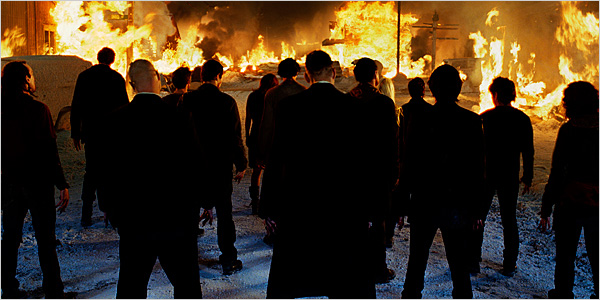
So vampires often look like zombies. And then there’s the simple point that filmmakers and especially novelists have woven so many variations on the vampire that they, like the queer people they are often made to resemble, come in all possible forms: vampire politicians, vampire mechanics, the vampire homeless. It seems useless to insist that vampires are really one way and not another. One wishes to say all the same that the genre’s anchoring works—the stories and novels that have set the horizon for the form: Polidori, Stoker, Anne Rice—have always given special emphasis to aristocracy, etiquette, seduction, intelligence. For a creature to register emphatically as a vampire—for it to be recognizable as something other than a zombie—it needs to seem like a superior being, Luciferous and more than human; and it needs to be something you could possibly make the mistake of falling in love with. All I mean is that a certain Byronism is pretty well wired into the thing.

Cronin’s “vampires,” meanwhile, are dim and scavenging herd animals, not superhuman but rather the opposite: degenerate and cretinous. Rigor commands that I also list the ways they are not like zombies: They are light-sensitive; they don’t turn everyone they bite; a very small number of them emit their memories and commands in a manner extrapolated from antique vampire mind-control or mesmerism; they are fairly hard to kill. But these are secondary characteristics, whereas the monsters’ zombie traits are central to one’s experience of the novel: They don’t have manners, and they (mostly) don’t have minds. Most important: They come in nests and pods and swarms and packs and scourges and hordes.

I want to stick with “hordes.” It’s important to get the matter of genre right, because to opt for the fast zombie, as your particular horror niche, is to place in front of a readership a distinctive set of historical or sociopolitical concerns, concerns that are at this point built into those monsters. Here’s the quick-and-dirty version: Fast zombies, as cinematic and now literary figures, are built almost entirely out of perceptions of Asians and Middle Easterners and Africans and native Americans, some of them new—fast zombies sometimes get framed as terrorists—most of them old: they are above all savages. (They are in this sense unlike slow zombies. I’ve argued out the distinction here.) This was already true of the landmark fast-zombie movies—28 Days Later and Zack Snyder’s Dawn of the Dead remake—and Cronin simply follows suit on this front. When the zombie epidemic erupts, the novel begins to incorporate all sorts of Bush-era GWOT-speak, which means that its vampire apocalypse is at some level nothing more than the War on Terror imagined as lost. But then Cronin has at the same time found a way to reactivate some very old colonial nightmares: One scene has a settlement of human survivors—the creepy survivors; the bad survivors—readying a human sacrifice, to placate the vampire-zombies, in what is clearly a replay of early Spanish lore about the Aztecs. This association is then cemented by Cronin’s notion of where vampirism comes from: It is a virus, let loose from deepest Bolivia, a kind of bat-Ebola, and its sinister work will be to make the United States equatorial. Fast-zombie stories take civilization as their highest good—that might sound like an uncontroversial proposition, but it isn’t—lots of stories don’t. They then designate the zombies as that-which-can-cancel-civilization, a baggy category that can include both al Qaeda and Zulus. Or to put this another way: Fast-zombie stories are devices for making palatable some of the old imperial beliefs, or, if you like, for manufacturing neo-imperial anxieties, though they have their own distinctive way of doing this, one that rather than flaunting the sturdy supremacy of civilization, emphasizes instead the latter’s tenuousness and so the possibility that culture and progress and refinement could collapse in their very hubs and capitals.

What I want to do at this point is list a number of things that early reviewers have said about The Passage; itemize this generic praise back into its commonplaces; and then work out what those vague and blurbish abstractions, with particular reference to this specific novel, actually mean.

•1) Reviewers have routinely described the book as “epic.” This was inevitable, because the book is long, 750 pages and counting. But for once that tag seems appropriate; it seems to indicate something more than just length. The Passage shares with the classical epics—Homer, Virgil, Dante, and the like—techniques and scenes that one doesn’t typically find even in other big, multiplot novels: above all, a vast and prophetic time scheme that, strictly tallied, covers more than a thousand years. The novel falls roughly into three sections: The first part recounts the outbreak of the zombie contagion and the collapse of the US government and American society; the second part jumps ahead a century and describes the workings of a survivor colony living behind walls in the interior of California; the third part follows a band of adventurers as they peel away from that colony and march across the American West, battling zombies, briefly joining a sinister counter-colony, and then enrolling, some of them, in the rump US Army—or rather the Army of the Republic of Texas, which it turns out has been on the ground all along and is the novel’s rootin’-tootin’ deus.

What Cronin shares with the Mediterranean and Mediterranean-style epics, in other words, is their long-durée concern with the Fate of Civilizations, a concern that requires his distended and decidedly non-novelistic narrative canvas, the span of generations. It is from the epic, too, that he has borrowed his descriptions of the zombie armies, though perhaps unwittingly and at two or three removes. Epics are utterly fixated on the distinction between fully settled people and still tribal or semi-nomadic ones. The final books of The Aeneid describe a small army of Trojan survivors as they invade Italy and conquer its indigenous people. Milton’s Paradise Lost describes Adam and Eve as two dwellers in the wilderness, naked foragers in “the new world.” The first American epic, Timothy Dwight’s Conquest of Canaan, recounts in heroic terms a righteous people’s war of extermination against a nation of savages whose land they regard as earmarked. The affinity matters because it is in some of its epic qualities that The Passage is least like a fast-zombie movie, since the films generally have compressed time-frames; are interested only in the apocalypse and its immediate aftermath; and almost never show survivors successfully fighting back. This is how we know that Cronin is not just cashing in—because to write a fast-zombie epic is something entirely different from, say, just novelizing Dead Alive, simply by virtue of letting the novel proceed past page 250, past the nuclear explosions over Boise and Bend, Oregon—simply, that is, by allowing that there might be, even after the swarming, story left to tell.

This then brings us to the next claim that reviewers have been making, which is that…

•2) The Passage is a wonderfully hopeful book.  Time magazine called it “a story about human beings trying to generate new hope.” One of Salon’s readers remarked that “the post-apocalyptic world feels more hopeful than what preceded it.” Another reader agreed that the book’s middle and late sections are “immensely hopeful.” This hope is one of the things in the novel that most needs specifying, because Cronin has produced a full-on reconstruction narrative. It is hard to stress this point with the banging emphasis it deserves. The mood is one of settler expectancy, of pilgrims surveying a land whose savage inhabitants are dying of an introduced disease, though they still lurk ferociously in forests and canyons. The Passage, in other words, is trying to counter the despondent vibe of the long Iraq-Afghanistan decade by retelling the old America myth the way that public school textbooks are no longer allowed to tell it; by trying to get you to occupy the valiant position of the embattled pioneer, to imaginatively inhabit the geography of early settlement, what we used to call the frontier.

There are actually two major historical models that Cronin has incorporated into his book. The first is medieval Europe, especially in its early stages, the systole and diastole of contraction and expansion, the post-Roman heartbeat: villages in Normandy gathering in their borders like so much extra fabric; towns building walls; lords building castles; and then—back out into the wastelands; the outgrowth of an armed agrarianism; planned settlements for serfs beyond the Elbe, generous terms, no labor service, five years rent-free!; Teutonic Knights; Frankish machine-men with their monster-horses and their death-arrows; northern crusades into the heathen Baltic; the Spanish Reconquista—and no historical meme looms larger in The Passage than that: the Reconquest of America. The book’s survivors live in a walled city and have something like guilds and wear tunics and have all but abandoned books and carry crossbows, which were the tenth century’s great advance in military technology, a weapon  so unsportingly good at killing people that the Church tried to limit its use. Crossbowmen were briefly pariahs.

The survivors also ride horses, though this image obviously does double duty. For beyond its medievalism, The Passage is most obviously a zombie Western—Cronin himself has said as much—subcategory siege, with the California settlement doubling as fort. Survivors trek across Nevada and Colorado. They cook jonnycake. A man in a remote house pours boiling water into a tub for his pregnant woman and sits watch at night, shotgun across his lap, armed against whatever might come stalking out of the woods.

The Passage, then, generates “hope” only because it’s underlying notion is that we’ve been through this all before; it is telling, through proxies and vampire-puppets, a history whose ending we already know; and so reassuring us of a certain cycle or historical repetition. Cronin’s answer to our usual bum and apocalyptic trip is to help us envision another round of colonization. North America will get to resettle itself. Indian Wars will be refought. To this end, the novel works in five or six documents form the distant future—conference papers from some symposium a millennium down the line—which is our guarantee, from an early point in our reading, that civilization has survived somewhere and in some form.

Another claim out of the reviews…

•3) The Passage is especially interested in what one reader calls “the civic structure of the colony.” This is true—and it’s an extension of the last point—because it involves “hope” again—and not just hope, but this horror novel’s unexpected interest in hope’s proper literary form and vehicle, which is utopia. Absolutely nothing about The Passage is more surprising than the moment that comes about a third of the way through, after you’ve read hundreds of pages of an utterly routine X-Files/outbreak plot, and you turn the page, and that plot is gone, and a full-blown utopia has taken its place, which is another way of gauging Cronin’s sense of his own writerliness, since the genre-swap—from apocalypse to utopia—is among other things a shift over from a heavily cinematic form to a quite peculiarly literary one. I don’t know that film is structurally barred from attempting outright utopias; I do know that it almost never does. Cronin, for his part, goes so far as to reproduce in its entirety the survivor colony’s written constitution, which is how you know that he has the genre’s canonical texts in mind—Thomas More, William Morris, and the like—that he is actually speculating about the daily workings of an alternate political order. That list of basic laws is the token of Cronin’s utopian seriousness (and is one of the feature’s of utopian writing that a commercial film would have the hardest time reproducing). Salon’s book critic, Laura Miller, said that the utopia was her favorite section of the book, but she is professionally disallowed from using that word, so what she actually said was that she “loves stories about how people form and sustain communities.” “Isn’t life in this last city kind of ideal?” a reader asked, “—if you ignore the vampire bit.”

It is under cover of phrases like these—“sustaining community,” “ideal city life”—that the novel’s fascism rides in. This is itself rather fascinating, since utopia often seems like the special province of the political Left, in some another-world-is-possible kind of way. The term itself, officially neutral, nominally harnessed to no particular ideology, was claimed by socialist thinkers early on. Fredric Jameson continues to use it as a euphemism for “communism.” So it is all the more remarkable to watch an American novelist, in apparent sincerity, attempt a utopia with strong fascist elements. There are at least three:

a) The first thing the constitution does is establish sovereignty, a “final authority” charged with “safeguarding DOMESTIC ORDER” and empowered to declare “CIVIL EMERGENCY.” This is Schmittian boilerplate, and generically authoritarian rather than specifically fascist, but it is worth noting that Cronin’s California does, in fact, break with the main lines of Anglo-American political thought, which—with their doctrines of mixed monarchy, the division of powers, check-and-balances, institutional cantilevers and counterweights, programmed-in gridlock and indecision—have always been hostile to sovereignty of precisely this kind. Montesquieu and Madison are among the books that no-one in the future will be reading.

b) This second one will take a little more explaining. Some social historians think that modern politics came into being in the seventeenth century when European governments began allowing themselves to worry about demography, which is to say to worry about the size and health of their populations. This led, in a hundred different ways, to a politics of the body; a medicalized politics of health and hygiene and sanitation; new political initiatives around birth and death; &c. One way of thinking about fascism is that it marked the culmination and cancerous transformation of this centuries-old development, which, however, continues to shape all modern governments, and especially the social democracies, to some greater or lesser degree. The important point about Cronin, then, is that his utopian colony is nakedly biopolitical in just this way, a utopia of eugenics and euthanasia. Fully a third of the constitution’s provisions involve quarantine. There are entire chapters devoted to mercy killings; when colonists are dragged away by vampires, their closest family have to ritually keep watch on the colony’s walls and cut them down if they return. Cronin calls this “standing the mercy.” Women in his utopia are taught trades, but then forced to abandon them when they become pregnant, relegated into compulsory motherhood, in a special building they are not allowed to leave. It is Cronin’s bleak gift to make such a scenario seem reasonable to an ordinary American reader—to make plausible that old physiocratic preoccupation with demography, with keeping the numbers up—by forcing us to imagine a human population reduced to some few hundreds.

c) The colony is also pervasively militarized, which is one of the ways its order is most like a fascism and least like an ordinary authoritarianism, since yer run-of-the-mill authoritarian wants the leadership to preserve a monopoly on force. In Cronin’s future, everyone is taught how to fight. There are weapons ready in every room. This is an ethos of war and blood, a society that has regenerated itself by abandoning the pacifism and potbellies of liberal society, though on a casual read, this all registers only as a low-level Spartanism. Nine-year olds get put through their daily samurai drills: “Where do they come from?” “THEY COME FROM ABOVE!” “And what do we get?” “WE GET ONE SHOT!”

That’s how The Passage looks if you emphasize its utopian qualities, hence its imagined innovations, its breaks with the established order of 2010—and it’s worth underscoring that these add up to a kind of political argument, since Cronin is trying to explain the difference between a society that knows how to survive a terrorist-savage threat and the United States, which, in the novel’s terms, mostly doesn’t. To that extent, these breaks all have the force of recommendations, what the U.S. could have done, but failed to do, to keep itself intact: Streamline the political chain of command, make sure pregnant women stop working, strictly limit the rights of immigrants, lie to the children, seal the borders, build a wall around them, shoot anyone who gets close.

But we can also run the argument in the other direction, and emphasize instead those features of our readerly present that Cronin’s settler-utopians would preserve. The novel’s medievalism, reconsidered from this angle, turns out to be something of a red herring, since its survivors see themselves as the keepers of American techno-civilization; the guardians of illumination in a vampire dark age, though that word, illumination, now refers to halogen lamps and not manuscripts; the ones who can keep running—literally; this is in the novel—the Humvees of the lost world. The novel’s premise is that civilization has collapsed, and yet it remains most interested in the people who have inherited American achievement. Civilization will only be possible again when people figure out how to re-activate its machinery. The middle sections of the novel are accordingly made up of three stock scenes regularly repeated: Characters try to improvise a patch on some machine they consider essential but no longer know, curved-arch-like, how to manufacture. Characters leave the colony to scavenge century-old goods from decaying strip malls and military bases, hunter-gatherers foraging for high-tops like they’re loganberries. Characters encounter some forgotten or never-before-seen device and wonder what it is and how to use it. This aspect of the novel becomes more and more important until it effectively takes over, since the novel’s final order of business is to fold the colonist-survivors into the U.S. Army, which is a techno-survival of an entirely different order, the novel’s strange belated admission that civilization didn’t really collapse after all, certainly not to some zero point. What destroys the first host of vampire-zombies, then, is a nuclear bomb left over from the military—a military solution, then, to a problem created by the military. Salon’s Laura Miller says she likes that the colonists come to the realization that they “need the outside world,” but taken on its own the phrase “outside world” could mean just about anything, when the novel is by necessity much more specific: The colonists need a modern military and heavy ordnance.

The one observation that Miller makes that is flat out wrong is that the novel’s idiom is not ethical or religious. She has said this more than once: “Cronin’s novel isn’t about the clash between good and evil, but about humanity’s struggle to forge a better world.” “Cronin’s characters, unlike [Stephen] King’s [in The Stand], are not caught up in a struggle between Good and Evil.” It’s true that Cronin is being a little sneaky on this front. The survivor colony is nominally post-Christian; they remember Christmas only as a rumor or a legend; they have adopted a new calendar that makes no reference to Domini. But then Cronin makes it his business, in the novel’s final chapters, to smuggle back in all the Christian language that he has up to that point carefully withheld. The Passage, indeed, is so stupidly ethical that it features not only a demonic head vampire whose name contains the word cock, but two supernaturally good characters, as well, the more important of whom is a pre-pubescent girl, and cock and girl appear to one character by turns in a dream and tell him respectively to murder and not to murder a woman in that dream, as in: Cartoon devil on your left shoulder, cartoon angel on your right. That the other radiantly moral figure is a Catholic nun should sufficiently confirm the point. In fact, by the time the novel ends, readers will have to swallow: an immortal nun, an act of heroic martyrdom, characters galvanized upon hearing Bible stories, a set of fiendish counter-apostles called “the Twelve,” and a group fighting these hellhounds led by a man named Peter, about whom sentences like this are written: “He inched his way forward, each step an act of faith.”

More generally, The Passage is packed with writing borrowed from the traditions of sentimental and domestic writing, and this, too, adds up to a kind of shadow Christianity or orthodox morality. It is also another of the ways—indeed, the most pervasive way—in which The Passage tries to make literature out of its cinematic scenario. Everything is POV, free indirect discourse, interior monologue. Events are endlessly focalized, and an intimacy is thereby obtruded on this Gibbonesque-Hobbsean story of civilizations falling and original contracts being formed. It is hard to overstate just how much family writing there is in this book, paragraph upon paragraph describing the ferocious attachments one feels to one’s closest kin: The only moment of love the colony’s leader ever felt was when his daughter was born. One woman reflects at length on how “wonderful” it was “to feel a baby moving inside her.” A tough warrior out on the quest confesses that what he misses most are “the littles.” Time praised the book for its “psychological insight.” Laura Miller said it was a vampire-zombie story “with heart.” In sentences like those we see a hard Right politics being made psychologically credible to a contemporary readership—and the psychology in play is a reassuringly familiar one, the psychology of Uncle Tom’s Cabin or a PTA meeting, the known term that carries you to an unknown place. Fascism is something you do for the kids.

What we can say now, then, is that Cronin’s utopio-fascism is tempered by a certain conservatism. But then fascism, of course, came in all sorts of different forms; it had national variants for one; and each fascist intellectual dreamed up a slightly different fascism, none of which corresponded precisely to any of the fascisms that actually existed on the ground. In the interests of precision, then: Cronin is helping us make our peace with an American fascism, but his is not the fascism of the intellectuals and the avant gardists, not a Nietzschean and anti-bourgeois fascism, which would, let’s face it, probably prefer the vampires. His is a fascism that has in certain key tenets—respect for Christianity and a conventional military hierarchy—joined forces with the conventional Right: a Spanish fascism, if you follow me, rather than a German one.

But then it’s not enough to name, however precisely, which particular historical variant of fascism Cronin is trying to resurrect. The important point, rather, is that Cronin is trying to imagine a version of fascism that has never existed, and this gets us to the crux of the matter: How, after all, do you engineer a fascism that will be palatable to a contemporary American audience, and not just to any audience, but to a Salon audience, a bunch of literate Lefties, the type of people who participate in book clubs? The answer, I think, is quickly given: You subtract race from the equation. For Cronin’s colonists are all multi-racial; the novel makes a big deal of this early on. Racial categories are, like the Jesus story, one of those things from Before that the survivors have heard about but barely understand. The novel is more cunning than this even. The utopian section begins with a kind of oral history recorded by the last person who was born before the vampire apocalypse. And she’s an old black woman, although the novel never out and tells you this; it expects you to hear it in her cadences. That’s a far cry from, say, Tolkien, who is sheerest poison, Wagnerite Anglo-fascism without the tunes. Tolkien’s racialism was always all but overt, just under the surface, like Norplant: all those Celtic-Viking heroes and elephant-riding bad men from the East; that scheming, greedy golem-Jew; those monstrous Urak-hai-sounds-like-Iroquois. So whatever Cronin is up to, it’s not that. Instead, he has worked out a more subtle kind of racial feint; he makes a black woman our gateway into the fascist utopia. The novel actually does something similar in matters of gender, since our colonist-heroes end up visiting two other survivor compounds, each of which treats women much worse than the novel’s central settlement, which means that readers can tell themselves that the colony, whatever its policies on pregnant women, has achieved a fair degree of gender equity. And then that’s it right there: A fascism in which people of all races and genders can participate more or less equally—that’s how one creates a fascism that will pass first-line liberal scrutiny. If you make it so that fascism isn’t primarily racial, an American reader won’t even recognize it as fascism. But then, of course, Cronin can only produce this de-racialized version of fascism because he has transferred the entire apparatus of race onto the zombies, who are sometimes just called “the Many” and who are, of course, a population of the killable. He can loosen racial categories among the survivors, because he has preserved the lethality of race at a higher and more abstract level. Not that any of this is buried in the novel, exactly, since the survivors have a series of different racial epithets for the zombies, one of which is “smokes,” which, well, if you don’t know, you should probably look it up, is all I’m saying. One of Salon’s readers said that “smokes” was “invented language” —and thought it was neat. And it just ain’t … neat, I mean … or invented.


The Running of the Dead, Part 4

PART 1 IS HERE.

PART 2 IS HERE.

PART 3 IS HERE.

28 Days Later: The Set-up, continued

Let’s rewind a few sentences:

Occasionally, a young woman catches herself daydreaming about someone really close to her dying—not because she wishes it—not at all—but because she is compulsively rehearsing in her head how terrible it would be. So she daydreams, despite herself, that her boyfriend is dead and then she rushes to the living boy and surprises him by saying: I love you so much! 28 Days Later is like that, except it’s the government, and not your boyfriend, who has died in the daydream’s car crash or cancer bed. The movie opens up for you the morbid headspace to mourn the government, even though we currently still have one.

There’s a variation on that same sinister reverie that zombie movies regularly spin; we can call it Having to Kill Someone You Love. In 28 Days Later, the harsh lesson goes like this: If a living person turns in your presence, “you have ten or twenty seconds to kill them. It can be your father or your sister or your best friend.” Scenes of this kind, in which intimates get euthanized, are all over the zombie film. They are as basic to the genre as transformation scenes are to werewolf movies. They are, indeed, an adaption of those very scenes: accelerated and moonless turnings in which the dog never makes it out of the vet’s office; lycanthropic kittens drowned in sacks.

But then what we’ve just spotted is a continuity, a convention that carries over from slow zombies to fast. Both types of zombie movies go in for transformation scenes; nothing has changed on that front. And this, in turn, prompts a rather interesting question: How does the Hobbsean orientation of the fast-zombie movie reframe the genre’s usual conventions? 28 Days Later may break with the Romero-era zombie movie in a few basic ways, but most of Romero’s conventions it actually takes over intact. The possibility we now need to consider is that those innovations are so drastic that they change the meanings even of those features that the movies most obviously share, simply by supplying them with a new context.

The best way to follow this out is simply to watch 28’s first mercy killing: A survivor gets infected, looks left, imploringly, past the camera; one of his comrades immediately leaps across the screen—to put him down—except all she has is a machete, and the viewer has to sit through seven sharp, moist swats. That the woman is black and the man white brings to the surface the scene’s historical provocation: A black woman hacks a white guy to death with the Third World’s iconic weapon, the curved blade that Africans and Caribbean islanders have lying around, the knife for whacking bush and coconuts and political rivals. In 2002, the image might still have brought Rwanda to mind, which reference-point is not wholly irrelevant, since one way of summarizing 28 Days Later would be to say that it is asking you to imagine Britain as a “failed state,” when that last is the current Hobbsean term of art.

Now the important point is that if we were watching this scene in a Romero movie, we could probably guess its effects, since Romero specializes in setting up equivalences between zombies and human survivors; in forcing viewers, that is, to conclude that there isn’t very much difference between people and zombies after all (since the condition of zombism is the condition of our stupid, little lives, &c). We could say something similar of 28 Days Later: the scene is quite conspicuously brutal, and the woman with the blade manifestly displays the ferocity of her zombie-opponents, and though this familiar line wouldn’t exactly be wrong, it wouldn’t really be right either. The scene presents an unusually good opportunity, in fact, to specify the fast-zombie movie’s Hobbsean labor: When the living people in Romero start acting like zombies, this discredits them; it makes them scary. And that’s not true of 28 Days Later. The woman commits murder right in front of us, and that act doesn’t discredit her, doesn’t make her scary. Her situation is scary, but she isn’t, because the killing has been explained in advance by the movie’s Hobbsean frame, to the effect that people living without a government don’t have any choice but to act like zombies or savages. The obligation to kill is part of the horror. Hobbes’s entire point is that people living in a stateless condition don’t get to choose to be good people; life without a government requires brutality from everybody. When you slowly realize, watching Night of the Living Dead, that nearly all of the survivors are as violently brain-dead as the zombies, it’s a crushing experience—anyone who remembers that movie’s final credits will know what I mean: They force you to reevaluate everything that’s come before. But in 28 Days Later, the realization comes early and is no kind of surprise; it is simply built into the scenario.

This point is then amplified in a bit of a dialogue a few scenes later. The hero and the woman with the machete are looking at an old photograph, from Before, a smiling middle-class family, cinched in close together, laughing father, beaming mother, ungrudging teenager caught in a group hug. The hero remarks that they look like “good people.”

MACHETE: Good people? … Well, that’s nice, but you should be more concerned about whether they’re going to slow you down.

HERO: Right, because if they slowed you down…

MACHETE: …I’d leave them behind…

HERO: …in a heartbeat…

MACHETE: …yeah.

HERO: I wouldn’t.

MACHETE: Then you’re going to wind up getting yourself killed.

The movie, in other words, turns the photograph into an occasion for a colloquium on the domestic virtues: sentiment, fellow feeling, and the like. The hero is talking like a Christian or benevolent liberal, and it is another one of the distinctive features of zombie movies as a form that they render that position—the position of a generic goodness—utterly impossible. The hero has to be weaned of his decency, and we will know that he has achieved this new moral consciousness when we witness him kill a (zombie) child.

The point is complicated, though. By the time the movie ends, the liberal and the killer will have moved in together, into a northern cottage, with the girl in the photograph as their adopted daughter, and so have reinstituted a humanist ethics or at least a coziness; their values get un-transvaluated. This gets us back to Hobbes and the authoritarian Right, whom we can now distinguish from the Nietzscheans by pointing out that they precisely don’t want the condition of pre- or post-humanist savagery to persist. They don’t want people to have to be beasts. Indeed, they want people to be able to act like Christians or benevolent liberals, but in order for this to happen—and this is the properly political, which is to say structural and so anti-ethical moment in Hobbes’s thinking—in order for this to happen, in order for you to be a decent person, there has to be some fundamental shift in the political order, or rather, politics as such has to be born. Political society has to constitute itself. The problem, then, for a Hobbsean is that liberals and Christians fail to grap the close conjunction between their decency and the exercise of force, fail to grasp that kindness and the police go together, that the police make kindness possible, which means that kindness will never be able to substitute for the police.

28 Days Later has worked out a way of telegraph this idea visually, in what is probably  the most clever sequence in the entire movie. The two survivors—the Hero and Lady Machete—have worked out that there are other living humans in London, at least a few of them, hiding in an apartment high above the city. They sneaky-pete their way up the building’s stairwell and down the corridor toward the apartment’s door, where they see this figure…

…who turns into this figure…

…who turns into this figure…

It’s all something of a sick joke: First we encounter an unmovable paramilitary cop; he mutates into a balaclav’d thug, marching straight for the camera, in a shot borrowed directly from slasher movies; and this killer then peels off his mask and reveals himself to be … Brendan Gleeson, an actor of excellent good cheer, boozy and lummoxing, a kind of human wassail. The idea here is that open-hearted, hospitable middle-class people and the riot police actually go together, though not usually in a single person. Such, at least, is the Hobbsean take on the issue. What the movie has done is taken the two sides of bourgeois society, usually experienced at a confusing distance from one another, and welded them back into a single figure—the softie and the cop, the teddy bear and the guy who’ll push your face in—and thereby bodied forth the interdependence of those positions, which is what liberals putatively never get.

•28 Days Later: The switcheroo

So we can say that 28 Days Later forces us to imagine a certain crisis, the complete breakdown of political order into terrorism and savagery. And in the history of political thought that idea comes with a built-in solution: Strengthen the state, strengthen the police, the military, the executive. Expand the emergency powers of the central authorities. It is this fantasy that the movie puts into play. The first half of the movie follows a group of survivors as they straggle across a de-populated England trying to get to whatever is left of the state: the Army’s last uninfected platoon, garrisoned in an old manor house, chanting the Hobbsean mantra: “We are soldiers. … Salvation is here. … We can protect you.” One of the civilians has preemptively echoed the point: “The soldiers could keep us safe.”

At this point I might as well just out and say what the movie does to this fantasy, which is that it explodes it into little bits. That is the single most important fact about 28 Days Later, that it drives you into the arms of the soldiers, convinces you to look to them for refuge, and then turns the soldiers into monsters in their own right, mostly because they plan to begin a breeding program upon the bodies of the two surviving women and so immediately default on their promises of asylum. There are obvious precedents for this: In the later stages of the movie, Boyle begins borrowing shots from Apocalypse Now, and these are so many visual nudges, reminders that the underlying scenario is straight out of Heart of Darkness: The last outpost of civilization turns out to be a whirring freak show. So a borrowed plot, though it is fascinating all the same to watch a certain Conradianism well up unexpectedly within the horror movie. For Colonel substitute “Major” and for Kurtz substitute “West”—that’s the movie’s human villain—“He’s insane!” someone shouts—Major West, which name is of course allegory reverting back to plain-speech.

But then most people aren’t going to be chasing down the literary history while watching a movie, so perhaps it’s more appropriate to explain 28 Days Later as a basic exercise in emotional manipulation: It sets you up to want the soldiers, to be desperately pro-military, and then once you get your wish and end up face to face with the Tommies, it makes them creepy—not exactly like the monsters—the distinction will matter—but in their own way fiendish. It forces you to experience them as oppressive. No-one calls soldiers “grunts” because they’re polished. And to call them “dogfaces” suggests only that the enemy had better be shooting silver ammo. Such, anyway, is Boyle’s con, his trick. He seems to be making all of the Right’s moves—and just when the time comes to put the Right’s solution in place, he undoes it instead—and thereby makes clear that he was playing a different game all along.

Let me take another crack at it: 28 Days Later swaps out the problem of sovereignty or political order and puts another, entirely different problem in its place. At its most basic level, this is a point about the plot, and so about your actual, minute-by-minute experience of the movie, if you’re watching it for the first time. It looks like it’s going to be a straightforward trek movie, in which the credits will roll once our heroes find the army unit. In a different kind of movie—the kind of movie that Boyle lets you think for a while he has made—the soldiers would constitute a happy ending. But as soon as the survivors arrive at the army’s aristocratic headquarters, the soldiers mutate into a new problem. Authority stops being the solution and becomes instead the crisis. The hero, in other words, will have to learn to fight the soldiers—and not the zombies he thought he was fighting all along. Here’s another way of gauging how curious 28 Days Later is: The movie’s longest fight sequence, its protracted-final-action-horror showdown, involves the zombies barely at all; it pushes them to the periphery, in a clear indication to the audience that they should stop worrying so much about the goddamned zombies already. More: By that point, the hero is, if anything, aligned with the zombies; he is literally fighting alongside them. Boyle, having carefully tutored you into the statist position, is violently reversing course, and will now insist that you take up the anti-statist position. 28 Days Later has the structure of a movie arguing with itself; it is a grindhouse paradox or splattery antinomy.

This plot point—expectations established, then violated—in turn houses a rather sly visual puzzle. It’s a variant of the machete problem: That final fight is spiked with a series of uncanny shots in which it becomes increasingly hard to tell whether the hero has been infected or not, whether or not he has turned zombie.

•The camera pans slowly around an army truck, and catches the hero pressed up against its slats, still and seething, his eyes blotted out by shadow. The sound track supplies what is either a loud wheeze or a soft grunt: a growl. From this point on, we are watching a horror movie run in reverse, in which the hero is inserted into the shots typically reserved for the monsters and the soldier-villains are tricked out with all the visual conventions of victimhood.

•The hero flits past the camera, barely more than a shadow himself, which is another monster shot: two seconds borrowed from an Alien movie. And by bringing in an actual raging zombie just a little after that, the movie makes you wonder for real whether the hero hasn’t been infected, because it puts the contagion on the scene, dangerously close.

•The fight moves to the manor house, where there are two figures on the rampage: the hero and the zombie who doesn’t bake, now unchained. The hero spends the entire sequence wet, bloodied, and shirtless, his face distorting in the old building’s blown glass windows.

The eye’s confusion is actually a political test. The hero is trying to destroy the bearers of authority; our ordinary word for that is revolution. So by the end of 28 Days Later there are three positions available to the characters where earlier there were only two: 1) The savage or the terrorist; 2) the state and its protections; and now 3) the revolutionary. So in these shots the movie is posing another tough question: Is the hero zombie or human? Can you tell the difference between a savage and a revolutionary? Or more to the point: Can you tell the difference between a terrorist and a revolutionary? That’s a profound question, one that has lost none of its moment.

You can also pose a version of that question from inside the revolutionary’s head. The revolutionary has to ask himself what he is doing when he unleashes his own rage or taps into the rage of other people. Can you set that violence loose, direct it, and still rein it in once it has done what you needed it to do? The movie becomes a meditation on the basic problem of revolutionary violence. And the movie doesn’t stay up in the air on this issue. It resolves the paradox by deciding, via its own writerly dictates, that you can do this—you can direct violence to good ends. It comes down on the side of the revolutionary, although revolution is depicted here as a good old-fashioned quest to rescue the maiden from the lair.

It all comes down to this: 28 Days Later, the movie that for all intents and purposes created fast zombies, was already the movie that demystified them. The subgenre stands permanently indicted by its own author and source. Boyle’s movie is not the progenitor to [REC] and Quarantine and the Dawn remake and Justin Cronin’s vampire-zombie novel The Passage; it is their accuser, the one that calls them out on their despotism and aufgehobener race-hate.

A movie that initially expends all of its ingenuity getting us to love sovereignty ends by getting us to love instead sovereignty’s overturning. And there is one more gotcha secreted away inside of that big one: Boyle is an Irish director born in England. All we have to do is keep that in mind and then think about who survives in this movie. At first, there are three adult survivors: an Englishman, a black woman, and an Irishman. The hero is Irish, though the dialogue never once pauses to remind you of this. The first word he speaks, other than “hello,” is “Fadder” — hesitantly addressed to a zombie priest, both question and greeting: “Fadder?” In fact, the actor playing the Englishman is also Irish, so he’s nearly a Dubliner in disguise. The more important point is that the movie kills him off, but then it’s already killed off all the adult English, which means that the people left to repopulate England are the Jamaican woman and the man from Cork, and that the seeds of the new nation will barely include Angles, Saxon, Normans, or anyone else who has typically kept that land in copyhold.

The Running of the Dead, Part 3

PART 1 IS HERE.

PART 2 IS HERE.

28 Days Later: The Set-Up

28 Days Later was a key moment in the history of the zombie movie—the moment when the genre reorganized itself around a taut antithesis, such that its monsters could henceforth march as the avatars either of consumerist hyper-civilization or of that civilization’s very negation, its sacking, though, of course, even Romero’s middle-class zombies were cannibals and so suggested a certain preemptive undoing of the antithesis, a welling up of savagery in the North American heartlands of consumer society, in some socialisme-ou-zombiïsme kind of way. It’s the kind of complexity at which horror movies excel, a sociohistorical rabbit-duck operation in which you can look at a figure and not be sure whether you’re seeing Martha Stewart or an Ostrogoth.

It should be easy, at any rate, to say what kind of associations the zombies carry in 28 Days Later. Boyle’s zombies are fast; that’s really all we need to know in order to guess that they’ll generate the same meanings as Snyder’s terrorist-savage dead. But we don’t have to guess; 28 Days Later comes with a decoder ring.

We know that Boyle’s zombies are terrorists, because his movie has almost exactly the same opening as the Dawn remake: video footage of riot police, Muslim street violence, European protestors getting rowdy. The movie’s sequel, meanwhile, will narrow that range of associations, arranging a full-bore Iraq War allegory in which the zombies are the insurgents.

We know that they are savage because the dialogue says as much: Late in 28 Days Later, one of the characters contemplates a zombie he’s captured and chained—for study—and says: “He’s telling me he’ll never bake bread; plant crops; raise livestock.” The movie’s idiom is overtly civilizational: Zombies, like Huns or the Inuit, are people incapable of settled life. Here, then, is a picture of these Other People, the Loaf- and Lambless:


Sociologically, of course, the correlation posited here—in the feral, careening body of the fast zombie—is bunk. Terrorists do not come from the world’s pre-agrarian populations. Hunter-gatherers do not have access to car bombs. The Taliban fund their operations by selling some entirely successful crops. But allegory can take whatever shortcuts it likes; bundling is one of its great tricks … so the Khoi-San Al-Qaeda it is … the Arctic Circle Hezbollah. And to this already doubtful pairing, 28 Days Later will add a third term, since the movie’s initial villains—or not villains, exactly, but the fuck-ups who precipitate the great catastrophe—are animal-rights activists, the stupid Left, which doesn’t understand animality, doesn’t understand violence, doesn’t understand “rage”—the movie’s key word, that one—doesn’t understand the dangers of freedom. The Left doesn’t understand that if one breaks down too many barriers, everything will spin out of control. Such is the alliance that the movie brings into view and demands that we fear, the standing threat to our ordinary lives: angry Muslims, obtuse student-activist types, and Hottentots.

But then we’ll also want to say what counts as “our ordinary lives.” Just what is it that these aboriginal suicide-bombers and their hippie dupes are out to destroy? Dystopian science fiction typically forces us to imagine the totalitarian thickening of some institution or another—either the state or corporate capitalism or the corporate-capitalist state—but zombie movies are in this respect oddly like utopias in that they are more interested in subtraction, in what society would look like if one peeled away this or that seemingly basic thing. 28 Days Later begins, accordingly, with a long sequence in which we are asked to contemplate a world from which various institutions have vanished.

The end of the family: Very early on, the movie shows a large, street-side message board, entirely papered over with flyers, Xeroxed photographs, hand-drawn pleas to the missing, all clearly modeled on the post-traumatic Litfaßsäulen of Manhattan. And the last flap of paper we see tacked up to this 9/11-wall is a child’s drawing, something that looks a lot like art therapy for abused kids: A scrawled house, two stick figures in pools of paraffin blood, as though Crayola had begun marketing a crayon called “major artery,” and the blocky caption: MommyDaddy.

The end of religion: The first place the movie’s hero seeks refuge is a church, which is also the first place he is attacked by zombies.

The end of Britain: As the hero wanders through the abandoned streets, he steps over scattered heaps of Union Jacks and Big Ben souvenirs. Those patriotic icons catch the eye, but the negative space around them is just as important, since the emptied-out city has become a commonplace of the New Zombie Movie, the visual summation of its various excisions and sociopolitical loppings: the major metropolis as ghost town. For a production company, that’s an expensive stillness to get on film, laborious to stage even in morning’s early, pre-commuter light. And it’s a little bit of a red herring all the same, since movies like 28 Days Later don’t trust cities to begin with. “It started as rioting,” is how one of the characters recounts the zombie outbreak. “Except it was different this time, because it was happening in villages. It was happening in market towns.” It’s the phrase “this time” that we’ll want to pause over, suggesting as it does that the fast zombies had precedence, but only in the cities. London and Manchester have always housed the Furies. What is new is the extension of Brixton tumult into the shires and the B&Bs. The dead, when angry, will make of any city a Baghdad, and of any hamlet a city.

If you’ve gotten even this far into 28 Days Later, fifteen or twenty minutes, you no longer even need to read Hobbes. The movie has already spared you that effort. But the clearest Hobbsean moment in the film comes just a few minutes later, when a guerrilla band of human survivors is breaking the very bad news to the movie’s hero and Rip Van Winkle, who was in a coma and so slept through the Fall of Civilization.

Hero: What about the government? What are they doing?

Survivor: There’s no government.

Hero: What do you mean? Of course there’s a government. There’s always a government.

The oddly pungent quality of that exchange—the thing that pushes it decisively over into Hobbes’s territory—is the sense of complacency in what the hero says: “There’s always a government.” The movie wants to snap you out of your usual blithe confidence in the government as the sun-that-will-always-rise. It wants you to stop taking the government for granted. That is how a movie can give you a crash course in seventeenth-century political philosophy, at least at the level of your gut. Fast-zombie movies offer up emotional lessons in Hobbesean thought, forcing you to contemplate the state of nature more effectively than Hobbes ever managed to, simply by bringing it to life before your eyes. The idea, I think, is that once you have had to play that scenario out in your heads—life without government—then you should learn to love government, love the government that promises to keep you safe, love it deep down, learn to feel grateful for it, learn not to question it, because you have had to imagine how sad you would be if it were gone. Occasionally, a young woman catches herself daydreaming about someone really close to her dying—not because she wishes it—not at all—but because she is compulsively rehearsing in her head how terrible the loss would be. So she envisions, despite herself, that her boyfriend is dead, and then she rushes over to the living boy and surprises him by saying: I love you so much! 28 Days Later is like that, except it’s the government who has died in the daydream’s car crash or cancer bed. The movie opens up for you the morbid headspace to mourn the government, even though we currently still have one.

PART 4 IS HERE.

The Running of the Dead, Part 2

PART ONE IS HERE.

…so making zombies fast changes everything.

If you want to see this for yourself, all you need to do is ask one basic question  — the one you should always be asking anyway when watching a horror movie (or a science-fiction movie or a fantasy movie): What are the real-world associations that the movie is triggering? Nobody thinks that vampires and Vulcans and elves are real, but they do inevitably call real people to mind, and the interpreter’s most important trick is simply to let those resemblances through. The questions in front of us are easy ones, really: What do slow zombies remind you of? And what do fast zombies remind you of? And what’s the difference between the two?

One word, first, about zombies in general: Zombie movies are always going to be about crowds. People-in-groups are the genre’s single motivating concern. Other classic movie monsters are like malign superheroes, possessed of special powers, great reserves of speed and strength. What’s peculiar about zombies, when put alongside vampires or werewolves or aliens, is that they are actually weaker than ordinary human beings. They are really easy to kill for a start, because their bodies are already moldering. Their arms will tear clean off. They go down by the dozen. You’re in no danger of being outwitted. They can kill only because they have the numbers, and so that’s the menace that zombie movies are always trying to clarify: The threat of multitudes.

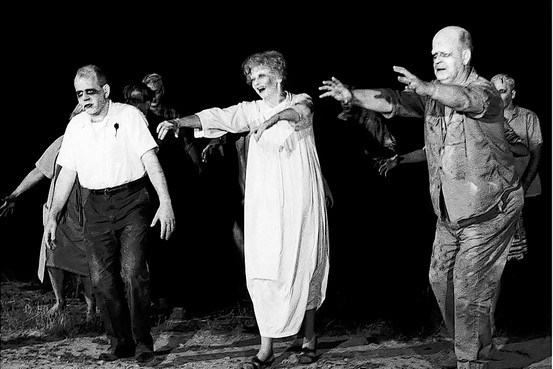
If, with that point in mind, you look at the classic Romero-era zombie—your standard-issue undead sluggard, the drunk-going-in-for-a-hug—three things are going to stand out. 1) They have an insatiable hunger; the only thing they know how to do anymore is eat. 2) In Night of the Living Dead, which is the movie that, in 1968, set the ideological horizon for the entire genre, the walkers are the recently dead, which means they are still wearing their funeral gear. They are dressed in formal wear; dressed conservatively, I mean, in black suits and Sunday frocks. Old white people are overrepresented. 3) There’s more to say about this last. The young Romero couldn’t afford any special effects, so just about the only makeup he employs is powder, but this he uses in quantities typically associated with the Duchess of Luxembourg, to give the zombies a death-like pallor. The faces of the undead are conspicuously washed-out, extra pale, whiter than white, and this whiteness is underscored by the film’s casting, since Night is the first American horror movie to feature a black hero. So that’s one kind of crowd right there: Night of the Living Dead is trying to evoke for you what it feels like to be up against a white and all-consuming middle class.

And if that’s the meaning that you think zombies carry—because in the modern zombie movie it is the meaning zombies have almost always carried—then Dawn of the Dead remake is not going to make one lick of sense. So let Dawn run and the first thing you’ll notice is that the opening credits have found footage in them; real video footage; news footage, one imagines, interspliced with handheld zombie shots. And then that’s an opportunity, right?—because it means that the movie is introducing upfront its own real-world associations; it’s actually bringing them in, documentary-style.

So here’s what you see:

Such are the movie’s visual footnotes, the historical context that it nominates for itself: Muslims at prayer; riots someplace poor—India, perhaps, or Pakistan; and, if you keep watching, armored police; barricades; minarets. The movie is, at this early point, preparing to dispense with our exegetical labors, since it is offering its own entirely overt gloss on the zombies, which is that they are Muslims, or rather violent Muslims, for which, obviously, read “terrorists.” This point is then confirmed by the movie’s pre-credit sequence—one of the very scariest in recent horror film—in which we watch a suburb of Milwaukee fall apart, spinning into primal and fiery anarchy. The shot that most viewers remember shows, in one, an ambulance hurtling off a town road, plowing into a bank of gas tanks, and from there: blooey. So one might quickly conclude that Dawn is yet another war-on-terror movie, part of the cinema of national emergency: 9/11 in the upper Midwest.

That’s certainly true in one sense, but the matter is actually a lot more complicated than this, and saying why should help us see how improbably and precisely Hobbsean fast-zombie movies really are. The central concern of nearly all such movies is the general breakdown of order; that’s what marks them as Hobbsean in some general, not-yet-precise sense. They push themselves to imagine in detail what is usually called the war of all against all, which Hobbseans think is the condition of life in the absence of strong governments. A radio announcer early in Dawn notes flatly that “civil unrest is still being reported.” The tricky point, though, is that the images of unrule, in Hobbes as in the fast-zombie movie, both are and aren’t racial. This is the unusual ideological form that they share. Hobbes, in the middle of the seventeenth century, had unmistakably been absorbing travelers’ reports from the Americas. Lots of thinkers in the period were trying to figure out the difference between living in a state and living outside of one, and none of their writing will make sense if we don’t factor in the Europeans’ epoch-making encounter with native America; the Spaniards and the British and the French were running into lots of people who didn’t have governments in anything like the usual sense of the word. It is a genuinely useful shorthand to say that what worried Hobbes was savagery, but the problem with such conceptual abbreviation is that it risks making Hobbes sound like a run-of-the-mill Indian hater, when in fact the distinctive feature of his system is that he thinks the problem of savagery is not confined to other, non-European societies, safely cordoned off behind the quarantine lines of Appalachia and the Sahara. Any colonist eyeing a patch of Ohio Valley land could concoct a few reasons not to trust Indians. Hobbes’s incomparably more corrosive suggestion was that Europeans, too, remained permanently capable of savagery. The distinction between an Iroquois and an Englishman was finally rather thin. Hobbes’ procedure is easily named: He begins with what is plainly a racial perception—Cherokees and Amazonians are savages—but then he deracializes it. And that’s also how fast zombies get made. The Dawn remake openly instructs you to think of zombies as Muslim terrorists—not strictly a racial category, but racial in its functioning—except then it isn’t actually about Islam or the Taliban, not even allegorically so, since none of the zombies substantially resemble Sunnis or Shiites or Arabs or Middle Easterners or Afghans. The rampaging dead are neighbors and fellow countrymen, almost every last one of them, to the point where, by the time the movie is over, those opening credits could seem like an odd intrusion. The fast zombie, in other words, is the terrorist minus the vexing overlay of race. Like radical Islamists, but not radical Islamists: Americans. Like terrorists, but not terrorists: You.

…none of which is to say that the movie isn’t authoritarian. Quite the contrary. Authoritarianism reveals itself to be a universalized fear of savagery, a generalized racism in which the category of “the lesser race” expands uncontrollably to include all people. It is racism extrapolated into paranoia, though one of the many curious things about Dawn is how compulsively, in that opening documentary footage, it preserves its racial sources. The movie, when all is said and done, has so little to do with terrorists that it could just as well have dispensed with the Islam-baiting, but it doesn’t. And the same is true of Hobbes, when he says that tribal life was nasty and short, and especially when he says that it was brutish: a remark that smacks of colonialism in a book that has almost nothing to say about colonization.

Hobbes also says that “Man is a wolf to man”—Lupus est homo homini—and this gets us rather more directly over to the fast-zombie movie. The philosopher is interested in the problem of a certain transition. What makes society possible? How does any group of people make the leap from primal chaos to safety and comfort and achievement? And his answer is: Authority—authority so strong that you can’t talk back to it. Civilization requires someone you are not allowed to argue with. It should be clear by now that this is a politics driven by fear—not by the other emotions commonly found on the Right; reverence for the old traditions, say, or love of country—but by sheer blithering panic: a Politics of the Heebie-Jeebies. Hobbes himself was completely upfront about this. At one point he wrote that: When I was born my mother gave birth to twins: me and fear—or words to that effect. His undying accomplishment in the history of political philosophy was to open the Right up to complete pusses.

To this observation we need merely add that it is the business of fast-zombie movies to instill this particular fear in you, and that’s why speed changes everything. Slow-zombie movies are a meditation on consumer society—on a certain excess of civilization, as it were; and fast-zombie movies are pretty much the opposite. So the simple question: In the Dawn remake, how do the zombies look? And the simple answer is: They look like rioters or encamped refugees. If you say that zombie movies are always about crowds, a person might respond: Yeah, I see, the mob—but if you’re talking about George Romero and the slow-zombie movie, the word “mob” isn’t quite right, since white people in formal wear aren’t exactly the mob, and, casting a glance at Romero’s original Dawn, shoppers aren’t either, except on the day after Thanksgiving. Fear of the mob has usually been the hallmark of an anti-democratic politics. The phrase “mob rule” remains common enough; eighteenth-century writers used to call it “mobacracy.” And that’s not what Romero’s after. Romero is worried that the crowd isn’t democratic enough, and one of his more remarkable achievements, back in 1968, was to start a cinematic conversation about the dangers of crowds that ducked the problem of “the mob,” that bracketed that concept out. This couldn’t have been easy to do, since the one term substitutes so easily for the other. And the pokeyness of the zombies is central to this feat, because corpses that look like they’re wading through gelatin are going to seem grinding and methodical or maybe doped and so not like looters or protestors or the Red Cross’s Congolese wards. By making the zombies fast—or rather, by merely accelerating them back to normal human speeds—Snyder allows his dead to seethe and roil. Once the movie’s survivors decide they have to leave the mall where they’ve been hiding—once they head out, in armored buses, into the teeming parking lot—they have entered an American Gaza.

Here are some more things that happen in Snyder’s Dawn: A recently infected, still human man placidly asks to be killed, like the perfect McCarthyite, who, upon looking up from his books and realizing he’s been reading Trotsky, asks his children to shoot him. The survivors come up out of a manhole and discover that the zombies have turned suburban Milwaukee into a ghetto: black people mill about the trash-strewn street. The survivors look on aghast as a mixed-race baby is born—and promptly kill it. The soft-spoken white guy, played by a Brit, emerges as the group’s leader and sanest voice. But then the most important thing about the Dawn remake is what doesn’t happen. The movie, again, is set in a mall, and the uproariously unsubtle joke driving Romero’s original was that if you’re trying to stay hidden from brain-dead consumer-drones, the mall is the worst place to go. The movie is accordingly full of zombie shoppers, banging into Orange Julius stands, condemned to wander for eternity the aisles of J.C. Penney. But in Snyder’s Dawn there are literally no images of shopping zombies. What there is instead is this:

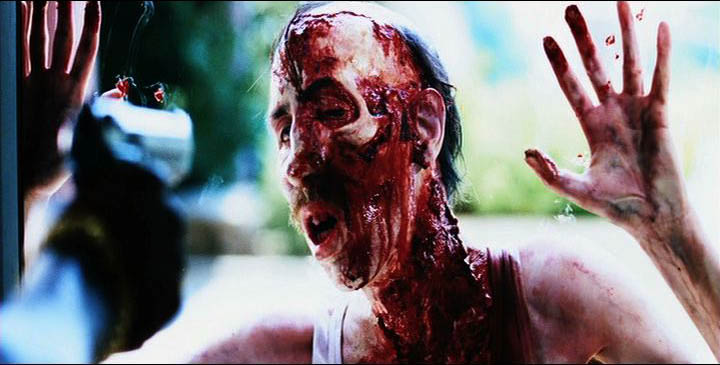
One notes the redneck wifebeater and the Raising-Arizona moustache. One also notes the face pressed up against the glass, its longing slack and resigned. Snyder’s zombies are the people who can’t get into the mall, which is thereby transformed, unironically, into a refuge and citadel, the last beleaguered outpost of civilization: BestBuy recast as the Alamo. This all adds up to a completely gripping lesson in what it means to change a genre’s convention, since Zack Snyder undertakes the central change—from-slow-to-fast—from within the shell of Romero’s own movie, using Romero’s own scenario, Romero’s own setting, roughly Romero’s own characters—and that one change is enough to reverse the movie’s ideological polarity. It would have been much, much harder for Snyder to make the zombies odiously poor and black-even-when-white if he hadn’t first made them fast. One begins to wonder what would change, unpredictably, if we started tinkering with other conventions: What if zombies were all really tall? Would that matter? What if superheroes wore fur stoles instead of capes? Come to think of it: Why do superheroes wear capes? What if werewolves turned into coyotes or lynxes or armadillos?

PART 3 IS HERE.

PART 4 IS HERE.


He Who Has Ears…

1. Connie Converse – “Talkin’ Like You”

2. K’naan – TROUBADOUR

3. Goran Bregovic – “Gas Gas Gas”

4. Kako & His Orchestra – “Shingaling Shingaling”

5. Titus Andronicus – “Titus Andronicus”

6. Shy – ASTORIA

7. Peter Nalitch – “Gitar”

8. Dr. Dog – “Shadow People”

9. The Bundles – THE BUNDLES

10. Manu DiBango – “The Panther”

The Running of the Dead, Part 1

Zombies sprint in

•360 Years Later

The first thing a person is going to need to know about Danny Boyle’s 28 Days Later, from 2002, is that it’s one big trick. That’s one good reason to like the movie, in fact—that it is punking you. I don’t think I can explain the movie’s trick right away; we need to do the groundwork first, but it is the point to keep in mind: 28 Days Later is a bit of the thimblerig. Don’t let your eye off the ball.

The second thing to know is that of all the zombie movies, 28 Days Later is the one most steeped in political philosophy. One way to come at this is to call to mind something that George Bush said in 2006. A reporter at a White House press conference was second-guessing him on some issue—it hardly matters what—and Bush responded like this:

I listen to all voices, but mine’s the final decision. … I hear the voices, and I read the front page, and I know the speculation, but I’m the decider, and I decide what’s best.

A lot of people made fun of those sentences. I definitely made fun of those sentences. The word “decider” is maladapted, obviously, and it’s the bit that most of us kept quoting, but the idea that Bush was hearing voices is also pretty funny. The thing is, though: “I’m the decider” might sound inane, but it isn’t just another Bush malaprop. “I’m the decider” is not “misunderestimate” or “putting food on your family,” because unlike these others it has a clear sense to it, one that we should bother trying to understand. More: It turns out that this sentence, dopey as it is, has a long philosophical history behind it. I absolutely guarantee it: People with PhDs in political theory were whispering in Bush’s ear. They fed him that line. “The human being and fish can coexist” was his alone.

My suggestion, then, is that if we understand the political philosophy behind that sentence, we will understand 28 Days Later, too; that what is at stake in this movie, as one of the important documents of the early transatlantic-Bush era, is what it means to have (or not to have) A DECIDER. And if we’re going to understand that philosophy, we’re going to need a refresher course on Thomas Hobbes, who is the single most important philosopher in the history of the political Right, or at least of one of its strands: not the free-market Right, and not the Christian Right, but the authoritarian Right, the party of SWAT-teams and strong leadership.

The basic facts on Hobbes are that he was writing in the 1640s, 1650s, 1660s, and that he was a royalist: He thought that all societies needed strong central authorities and that no-one had the right to question the state, let alone oppose it. More properly: He thought that governments should establish the parameters of official belief and that anyone dissenting from the state religion or state science, even a kind of state metaphysics, should be silenced.

In and of itself, this position didn’t make Hobbes unusual, since there were lots of royalists in the seventeenth century. What made Hobbes unusual, rather, is how he got to his royalism, the arguments he used to defend kingship. Run-of-the-mill royalists generally argued that ordinary people should accept kingly rule because it was God’s will: God likes kings; God is himself a kind of king; kings are therefore his representatives here on earth. Or they argued that kings were natural: that human groups always coalesce around strong men; that the first human groups were families, and then, when larger groups—like clans or tribes—began accreting, one figure began acting as father to them, and so on, until we reach the condition of modern states, where the king functions as father-to-the-nation.

Now consider the opposite position: There were, in fact, people in the seventeenth century who didn’t like kings; they took an axe to at least one of them. But even those people didn’t have any democratic theory on tap to explain why kings were a bad idea. So the anti-royalists generally looked around history for counter-examples to monarchy, for examples, that is, of human groups that didn’t form around strong men. And they found lots of examples: they found tribes, both in the Americas and in early European history; and they began lifting out of that history the times and places when ordinary people had assembled, deliberated, passed the conch. The anti-royalists granted that lots of tribes had had leaders, but thought they could show that these leaders had themselves been chosen, which meant that power had to be conferred on them by their followers, which meant that the followers were the original power-holders and so not finally or fully followers at all.

Those were the ideas that counted as radical in the seventeenth century. Hobbes’s feat, in this light—and if you pause here, you might see how nifty this is—was that he worked out a way of starting with Position #2 and getting back to Position #1. He thought, in other words, that he could grant the radicals their main point and still make you see that monarchy was the only one way to go. Yes, all power was originally with the people, but even if you are convinced of that idea, you should still sign on to something rather like dictatorship.

If you want to see how he pulls this off, there are two specific argumentative sequences you’ll need to understand. The first goes back to two simple observations.

•1A. Everything wants to live. Or, if you put in this in terms of political theory, every person has a right to defend him- or herself against attack. One of the few observations we can make about the world that seems all-but universally true—true everywhere at every time—is that people (and animals and even plants) will do what they need to do to stay alive.

•1B. Being an early human must have sucked. This is actually the heart of Hobbes’s argument: If you reflect on the earliest stages of human history, you’ll see that it must have been hard to stay alive. Anybody could have done to you anything they wanted. The only thing standing between you and every passing rapist was your own fist.

But, Hobbes says, people aren’t stupid, and they want to stay alive. So what must have happened is that they all got together and agreed, in a kind of contract, to appoint one person who would settle all disagreements and resolve all conflicts. That would be the king. And here’s the sick genius of his argument: The contract is a one-time deal; it can never be renegotiated; because once you have agreed to give all power to the king, just to be sure that your next-door neighbor doesn’t tear your throat out, you can’t afford to disagree with the king any longer. In fact, it becomes nonsensical to talk about disagreeing with the king, because the king is the one who settles disagreements. It is part of the original contract that the king is always right.

One other point to drive home: Hobbes was a kind of peacenik. We usually think of the peace movement as belonging on the Left, but Hobbes loved peace; peace was the whole idea; he was a right-wing pacifist, and in a sense, there have always been lots of these, though “pacifist” is not usually what we call them. We call them “law-and-order types,” and their politics goes back to the Hobbsean idea that nothing—absolutely nothing—is more important than suppressing the possibility that war might break out from within the tissue of society.

So that brings us to Hobbes’s second argumentative sequence, which was that…

2. War is always looming, always threatening to break out from within the tissue of society. Primal conflict is always lurking in society’s cracks. This isn’t just paranoia on his part. Hobbes agrees with modern liberals on one easy point, which is that life is full of disagreements, and that these disagreements can’t help but seep into our social and political institutions. Another way to put this would be to say that our institutions are shot through with gaps—holes of uncertainty. All institutions involve ideas, propositions or arguments: “People have a right to life, liberty, and the pursuit of happiness” or “There is no God but God.” And these institutional ideas will always lead to an entire series of problems or puzzles, mostly because such propositions can never be self-interpreting, which means that any institution will tend to generate competing schools or factions or parties, as people inevitably and in good faith begin to disagree about what the body’s guiding propositions mean. Worse: Most institutions are involved to some degree in fact-gathering. Police departments, scientific agencies, central banks—they all collect information about the world, and that information is also going to need interpreting. None of it is going to have plain meanings. And here, too, there are inevitably going to be disagreements—disagreements that on a philosophical level will be interminable. You cannot show beyond a shadow of a doubt that “all men are created equal” or that “global warming is real.” You just can’t. Doubt is always possible.

So this is where the king comes in: The king is there to decide. This is one of the classic theories of the king (or the sovereign or the executive). And you have to keep in mind: This theory has absolutely nothing to say about what the king should decide. It has absolutely no recommendations to make about which interpretation the king should choose. The whole point of theory, in fact, is that the decision is arbitrary. That has to be true by definition, if you think about it, since if it weren’t arbitrary, it wouldn’t be a decision. It would be a conclusion. There are all these void spaces in the political system where doubt and uncertainty fester; and a leader simply has to come in and plug that vacuum. The government, in other words, has to set the terms for religion—or people are going to war over religion; it has to set the terms for law—or people are going to war over law; it has to set the terms for science—or people are going to war over science.

That’s what Bush meant. Someone has to decide, and the decision will always be arbitrary. “The decision,” it’s true, isn’t Hobbes’s word for this position. The cat who reformulated Hobbes’s argument around the concept of “the decision” was Carl Schmitt, who was the most important political theorist among the German fascists. “I’m the decider” is the best evidence we have that someone was really and truly — dead literally — feeding George Bush Nazi political thought. But let’s not get hung up on the Nazi business. The interesting philosophical point is that Bush wasn’t claiming to be right. He was saying: I don’t have to be right. In fact, right-and-wrong is the wrong way to think about it. The king’s decision—or the president’s decision—can’t be right or wrong, because no-one can tell for sure. Someone just has to decide, period. Political beings never choose between right and wrong. They choose between respecting the decision and … well, something else. Civil war. Chaos. Zombies.

•Of Zombies Fast and Slow

A different movie now, and a confession: I’ve never felt so puzzled by a movie as I was the first time I saw Zack Snyder’s Dawn of the Dead remake, from 2004. I walked away from that movie not understanding anything. It was my own personal Mulholland Drive. I had liked it well enough, but just couldn’t get it to add up. The problem was I went in cocky. I figured: This is, in its bones, a Romero movie—Romero’s Dawn, the second of the Dead movies, came out in 1978—and I know how such movies work; I’m on my home turf. And then the confusion snuck up on me. I got all the way through that first screening convinced that the new Dawn was staying, by remake standards, pretty faithful to the original. It had the mall; it had black actors in central roles; it had strife among the survivors. Three of the actors from the original showed up in cameos, and once I’d spotted them, I was pretty sure I was watching an homage. I was in the mood to watch an homage.

But then I walked away from the movie, trying to get it straight in my head, and I couldn’t make it tally; I couldn’t figure out what the movie was doing. I went in with expectations derived from, yes, a certain reverence for Romero, and by those standards everything seemed wrong—or off—and I couldn’t figure out what had changed.

Or rather one thing had changed: The zombies were fast. But then I knew this going into the theater, because the press had made a big deal about it. It was the Big Innovation. 28 Days Later had introduced the novelty. The Dawn remake made it seem like a trend: the living dead, lickety-split. Three quick thoughts about this:

•Fast zombies are not, in fact, an innovation; I mean, even in ’02 or ‘04, they weren’t an innovation. The press was just wrong on that count. Breakneck zombies had been introduced years earlier, in Return of the Living Dead, from 1985, which is also the movie that gave us the chiming, Karloffian B’raaaaains, spoken like breath across a beer bottle.

• That said, the underlying convention had remained more or less intact. The late ‘80s and ‘90s were a fallow period for zombie movies, so the few fleet corpses of the Reagan era hadn’t really led anywhere, and this allowed the press to feel, when 28 Days Later was released, that its creatures were next-generation zombies. We remembered zombies as slow, and these weren’t. But then does that change really make a difference? I mean in some sense, it’s obviously an improvement. Boyle and Snyder ditched that staggering, shambolic gait, which was always the easiest thing to parody about zombies. The new zombies were limber and belligerent, and to that extent just scarier. To get caught by a Romero-style zombie always required a signal lapse of attention. One could reasonably conclude, then, that fast zombies were an improvement in horror-movie technique, a kind of engineering advance. But other than that, I mostly walked away from Dawn of the Dead thinking that the change from slow to fast was neutral, that it didn’t actually change any of the meanings that a zombie could carry. It’s was like putting a new engine in a chassis you really like: Romero with more oomph, Romero all souped up. And the Dead shall book.

•I was completely wrong. It turns out that up-shifting the zombies from slow to fast changes everything; it entirely re-frames the zombie movie as a genre. I find this utterly fascinating. It seems like a small change, little more than a tweak, like defragmenting your hard drive. And it leaves nothing untouched.

PART TWO IS HERE.

PART THREE IS HERE.

PART FOUR IS HERE.

He Who Has Ears…

1. The Roots – GAME THEORY

2. Yoko Ono – “Walking on Thin Ice (1981 Re-edit)”

3. Noah and the Whale – “Blue Skies”

4. Lee Fields – “Honey Dove”

5. Thao & The Get Down, Stay Down – WE BRAVE BEE STINGS AND ALL

6. Andrew Wartts & The Gospel Storytellers – “Peter and John”

7. Karen Dalton – “Are You Leaving for the Country?”

8. Iggy Pop – “Gimme Danger”

9. The Fall – “Y.F.O.C. / Slippy Floor”

10. Karen Elson – “The Ghost Who Walks”

Iron Man in Afghanistan

If you want to understand the force of the first Iron Man movie—Jon Favreau’s Iron Man, from 2008—it will help to know the writings of Andrew Bacevich, who is a professor of international relations at Boston University. Bacevich was one of the first scholars to put the concept of an “American empire” back into discussion, in 2002—even before the invasion of Iraq, in other words—in a book of that name and has gone on to become one of the intellectual heroes of the anti-imperial Left. He often gets mentioned in the same breath with Chomsky and Chalmers Johnson. The Nation likes to interview him. He’s all over HuffPo.

Bacevich’s original insight was that the Clinton-era doctrine of global “openness” had committed the US to ever-expanding police actions across the planet. As he saw it, the consensus position that emerged in both major parties by 2000—a position that Bacevich considered just plain delusional—was that the US should take on the role of a just and moral superpower without limits and prepared to use violence as a matter of course. The 1990s buzzword, in this regard, was “leadership,” which sounds innocuous enough but actually heralded a new round of imperial expansion: Only the US could lead the planet. The roots of this belief are obviously rather old. A certain providentialism—the idea that the US has been singled out by God to play a unique role in the earth’s history—is older than the country itself. But the ‘90s introduced some innovations of its own. It was, all expectations to the contrary, the decade—Bacevich’s words now—“in which US foreign policy,” let off the Cold War leash, “became increasingly militarized”—the decade of offhanded force or casually dropped bombs.

Here, then, is the interesting thing about Bacevich: He is not, in fact, a man of the Left. He’s retired military—he was a colonel in the army—and calls himself a “Catholic conservative.” This is in one sense precisely why the Left likes to lean on him so much: He projects the authority of the disaffected warrior. But then his conservatism, if that’s what it is, is also what gives his arguments a distinctive resonance—it’s what separates him out from the pacifists and anti-globalizers and the old potheads still hating on Nixon. Bacevich has a soldier’s dislike of consumer culture, some right-leaning attachment to old-fashioned republican citizenship, which he is willing to call patriotism. His writing often laments the complete discrediting of “the nation” or of “nationalism” and the rise in their place  of a facile multiculturalism. It’s not wrong, then, to say that he is a critic of the American empire, but it would be more precise to say that he is a critic of liberal empire—a counter-intuitive but nonetheless pervasive amalgam of liberalism and imperialism—which has produced in US foreign policy a bizarre combination of ruthlessness and half-heartedness: fantasies of omnipotence alongside stark limitations on how power gets exercised; an absurd sense of responsibility for the entire planet’s well-being alongside a consumer ethos that is finally anti-political.

Reading Bacevich turns out to be an odd experience, because once you work out that it’s actually this liberal imperialism he despises, it’s no longer clear what it is in this position that he dislikes more, its imperialism or its liberalism. His repugnance for US adventurism often seems heartfelt, but just as often—on the important last page of American Empire, for instance—he seems to be saying that the Clinton-Bush empire could have worked better if only it had had genuine moral purpose, a stronger sense of duty, some old-fashioned civic principles. Empire, he says, needs a real ethics: not the wishy-washiness of a “postmodern, postindustrial, postheroic democracy bent on remaking the world in its own image.”

The question that urgently demands attention—the question that Americans can no longer afford to dodge—is not whether the United States has become an imperial power. The question is what sort of empire they intend theirs to be. For policymakers to persist in pretending otherwise—to indulge in myths of American innocence or fantasies about unlocking the secrets of history—is to increase the likelihood that the answers they come up with be wrong. That way lies not just the demise of the American empire but great danger for what used to be known as the American republic. (244)

On its final page, in other words, a book that almost all readers have taken to be anti-imperialist outs itself as in its own way fully imperialist: There is no non-imperial option. Bacevich’s main recommendation, accordingly, is that we drop the charade and get serious about our imperialism—and above all that we adopt a set of properly imperial virtues. At that point, one can look back over the book and see that he has been of two minds all along, lamenting both the drift towards a militarized foreign policy—and the way the country has been half-assing its very militarism. Bacevich seems, in effect, to be willing himself into becoming a different type of right-winger. He had been a classical republican, dedicated to some textbook sense of America’s highest political traditions. But his hope now seems to be that since those virtues are already extinguished anyway, then at least empire might resurrect some notion of duty, though only if one commits to its militarism—and to what’s best about that militarism: honor, sacrifice, &c.—and not only to what is worst. He also has a strong sense of the old imperial paradox—and this sometimes makes his writing sound like something out of 1780s Britain, as though he were trying to get us to vote for Pitt: The problem with empire is that it generates so much wealth for the imperial nation that it becomes effeminizing, corrupting. Empire makes the metropolis so soft that its residents no longer make good imperialists. Only a kind of imperial counter-program, of militarization and re-masculinization, can undo this. It’s the McCain presidency that could have been.

This gets us over to Iron Man, whose most conspicuous location—Afghanistan!—already procures for it an imperial frame of reference.  Superheroes don’t normally fight in countries the US has invaded. Plasticman never shipped out to Mogadishu. Another way to come at this first point would be to say that there has probably never been a superhero movie less urban that Iron Man, and this simple fact actually marks a sharp turn in the genre, the moment when the avenger leaves the no-longer-crumbling-and-crime-choked American city—the sundry proxy Manhattans over which the form has typically kept watch—and sought out instead more remote territories to guard. Superman’s New York was called “Metropolis,” and that’s already half of a vintage colonial couplet right there. Iron Man‘s Afghanistan supplies the missing term; Favreau should have renamed it Periphery.

But it’s not enough to suspect that Iron Man has something to do with empire or US global dominion. We’ll want to be able to say just what that something is. This is why Bacevich is so helpful, because at the center of Iron Man’s plot there stands a transformation, and Bacevich helps us say what is at stake in that makeover: An American playboy—shaker of dice, baller of women—learns that what can give his life purpose is the endless task of keeping the world’s people safe. I want to be careful here. Almost all superhero movies document the making of a new man—or at least their first installments do, and one might suspect that these all more or less meet Bacevich’s requirements: a paladin is fashioned; some joe or schlub molts and is Thor; postheroic America loses its weasly prefix. That’s true to a degree, and yet superhero origin stories are actually quite varied, and surprisingly few of them are cut to Bacevich’s specifications. Spiderman comes close. But Superman’s origins—at least in their classic form—are very much an early twentieth-century story and so no longer our own: A nation of farmers, ingenuous and meek, surprises itself by discovering that it is the world’s most powerful thing. And the last Batman reboot—Batman Begins, from 2005—actually takes Bruce Wayne’s strength and capacity for violence as given; at no point in that movie is he yer average guy; what that movie is trying to imagine—and this nearly reverses the usual trajectory of a young superhero—is that American might could in some sense be scaled back, or at least that it could yet be brought back within ethical bounds or some framework of legitimacy: “You’re not a vigilante! … Am I vigilante? … I’m not a vigilante!”

This last actually brings us close again to Iron Man, but then everyone’s always known that Iron Man was just Marvel’s hot-rod Batman anyway: the rich boy with gadgets instead of superpowers. But then if we put Iron Man—or this Iron Man—smack alongside Batman, it’s still the differences that are going to matter. You might think of the question this way: How far does the superhero have to travel to get from his civilian persona to his ass-kicking one? If we can answer that question, then we can get a glimpse of what kind of changes a given superhero movie would like to enact upon us. And then the point would be that the Batman scenario minimizes the gap: Christian Bale’s Batman begins as a bruiser and ends as a bruiser in a costume. Even the classic Batman is a philanthropist who is also a vigilante, when of course philanthropy was always a form of vigiliantism to begin with. Or the other way round, if you must: Vigilantism is bare-knuckled benevolence. But Iron Man lets the gap yawn wide. It gives its champion much further to travel, because Tony Stark is less heroic than Bruce Wayne—a lout, a lad—and Iron Man is if not more heroic than Batman then certainly more powerful, a bigger caliber, with way more weapons than can fit on a belt. If you pay close attention to where Iron Man plants its flags, from A to B, from starter’s gun to finish line, you’ll see that it is murmuring aloud Bacevich’s quiet wish: One man decides that he can no longer be just another pleasure-seeking consumer and entrepreneurial technophile and becomes instead a man of principle and action. Tony Stark rediscovers the vanished imperial duties.

All I really want to say is that the movie occupies what by the usual standards of American political debate is actually quite an unusual little niche and that nearly every commentator has accordingly misread it. When the newspaper and magazine critics said that they liked the movie because its characters were, by comic book standards, “well-rounded”—or because the movie documented a “spiritual conversion” or, more modestly now, a “rehabilitation” (picture Downey passed out in his neighbor’s house)—then, again, it is Bacevich’s story that they are hearkening to without quite seeming to realize it: the making of imperial commitment. The really baffling thing about the reviews on this one, in fact—and the reason, finally, that it’s worth pausing to bring some clarity to Iron Man—is that it was mostly read as a left-leaning film: “an action movie for liberals,” New York magazine said. It’s a parable of disarmament — lots of critics said that. Tony Stark is a peacenik; he wants to turn off the arms pipeline. Let this one sink in: Our politics are in such a muddle that expert viewers can routinely describe as “pacifist” a character who spends the entire movie designing a superweapon or as “liberal” a character who wants to keep that weapon in American hands, so that it may be used at his discretion in any jungle or desert on the planet.

This is madness, though it’s not hard to figure out why the critics were confused. The movie is certainly anti-corporate: the people in Iron Man who most need protecting are ordinary Afghans, and in order for imperial peace to be established, Tony Stark is going to have to rein in not only the movie’s Taliban-by-another-name, but also American weapons manufacturers, whose aim it is to arm every last Indonesian widow and Kirghiz orphan. In fact, the movie’s plot, which funnels down to that final showdown with Obadiah Stane—trading punches with the COO!—works by shifting the geography of our concern back from tribal Asia back to the US. In that sense the movie proves only semi-interested in what empire will require of the US abroad, but very interested in what empire will require of Americans in their own country, how the nation will have to be refashioned if it is to take on its allotted Roman-British role. And sure enough, the movie’s sense is that someone is going to have to roll back corporate power, but Favreau’s is an anti-capitalism of the Right, and this is a position that has become so uncommon that watching Iron Man is like spotting a rare woodpecker in the wild. History, however, furnishes the precedent that American political rhetoric lacks: For most of the eighteenth century, British holdings in India were literally governed by a corporation. I’m not saying that  British officials subcontracted out important government services to a corporation or that a corporation exercised undue influence over India’s colonial government. Not at all. The East India Company, which traded openly on the British stock exchange, was the government of British India. This will sound like most to us like the nightmare scenario of dystopian science fiction: The government of India was organized for profit. One could buy shares in it. This scenario didn’t change until the 1780s, when, after a series of colonial scandals, the British government began, though only gradually, to sideline the company so that it could assume direct political control over the region. That policy was in some entirely literal sense anti-corporate. It was also the beginning of what most of us think of as the British Empire proper—imperialism for real. That’s Iron Man in a nutshell: Warren Hastings retried.

So the movie’s point is, classically, that businessmen do not make good imperialists and that they will have to acquire extracurricularly the paramilitary skills they did not learn at Wharton. But then we’ll want to note where Iron Man breaks with imperial precedent, and not just where it follows it. The movie is trying to imagine a forthright shift over to a relatively de-commercialized version of empire, and yet it is unwilling to transfer the basic political and military tasks of colonial rule to the US government. At issue is Tony Stark’s ambiguous institutional location. Corporate, but not corporate: He remains head of Stark Industries but seems to be withdrawing the company from its core product lines and won’t allow it to so much as market his latest invention. Military, but not military: He has close ties to the US occupying forces—he has an attaché-sidekick even—but says at one point that the Iron-Man jet-pack-weapon-suit is “not for the military.” That suit, let it be quickly said, is in large part a meditation on the new, hyper-technological military as it really exists: It is the smart weapon that US brass keep promising and never quite deliver; and also an extrapolation from the American machine-men or earth-astronauts currently in the field: begoggled, sat-linked, wandering Kandahar in their Kevlar-swaddling. Stark’s refusing to share the suit, meanwhile, is an utterly conventional image of the imperial monopoly, the exclusive control of force on which a properly global sovereignty would depend—the way that nuclear weapons were meant to function but haven’t. What the movie can’t find a way to do in good conscience is assign this sovereignty undivided to the US government. The movie, in other words, is careful to preserve the superhero’s customary independence, which is, of course, hard-wired into the genre; it’s just that in the current instance that independence articulates a rather surprising distrust, given that the movie’s politics otherwise seems to be pointing towards a state-driven solution. This is where the movie shifts over to sheerest fantasy, since there is nothing and no-one in the real world that even approximates Tony Stark’s position in the film, part-government, part-corporation, but finally neither: a vigilante NGO or bunker-busting Red Cross. Here, too, historical memory echoes: The movie’s first act, in which Tony Stark spot-welds his first crude metal suit from spare parts in some Afghani cave, provides the visual, picture-encyclopedia gloss on the Iron Man moniker: With its steely-grey visor and creaking arm joints, it is plainly a suit of armor, and Tony Stark turns out to be a knight, which is of course the model that European history supplies for the free-lance imperialism that is the movie’s hope and plan: A white man dons metal and heads east, having adopted a new code of nuclear chivalry.

But then “chivalry”—really?—boy, that sure sounds ponderous. This, then, helps us identify Iron Man’s most unusual achievement, which all goes back to Downey’s performance, flip and unforced, in which we find the promise of a new imperial style, the reassurance that we can all get serious about empire without, however, having to act serious; a chivalry, then, without gravitas; an imperialism fuelled by sheer exuberance. We’ve had a pretty good lesson already this past decade in how to flatten cities. What we haven’t yet properly learned is how to strut through the rubble.

Iron Man's first suit