Category Archives: Articles

Staying Alive, Part One


What I have to explain this time round is a little strange, and the road we’ll have to walk to get there is, I think, even stranger. I should note first that I’ve been thinking a lot about vampire movies, about which we might, after rooting around, be able to say something that no-one else has ever said. And if you are to understand this New Thing About Vampire Movies—except it’s not a New Thing; it’s an Old and Secret Thing—then you are going to need to watch a short clip from a movie you’ve almost certainly never heard of, and when you watch it, you’re not going to think that it could possibly hold the key to anything. The movie is so obscure that I could only find the relevant scene dubbed into Russian, and even that sentence, once written, requires two intensifying corrections: I didn’t find the clip so much as fluke upon it while chasing down some other hunch. And the movie isn’t exactly dubbed into anything. It features some Russian language-school dropout—one guy; alone; an unaided Petersburg grumble—spot-translating all the dialogue, with the original soundtrack still running audibly in the background, such that he has to shout. Running this clip will be like trying to watch television in the company of a mean drunk. Plus it’s not even a vampire movie, which is what you were just promised. This is all pretty discouraging, I realize, but you’ll see: The clip does weirdly speak.

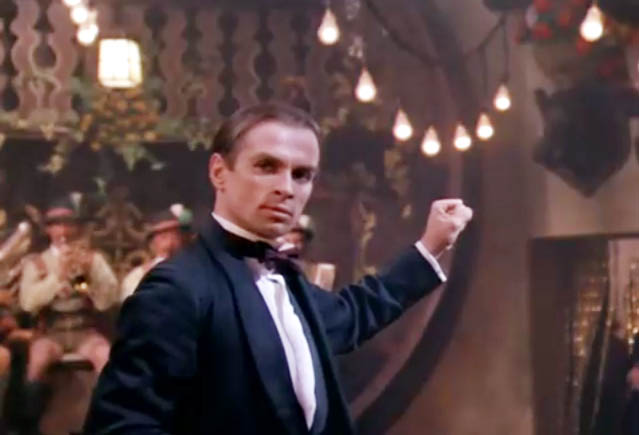
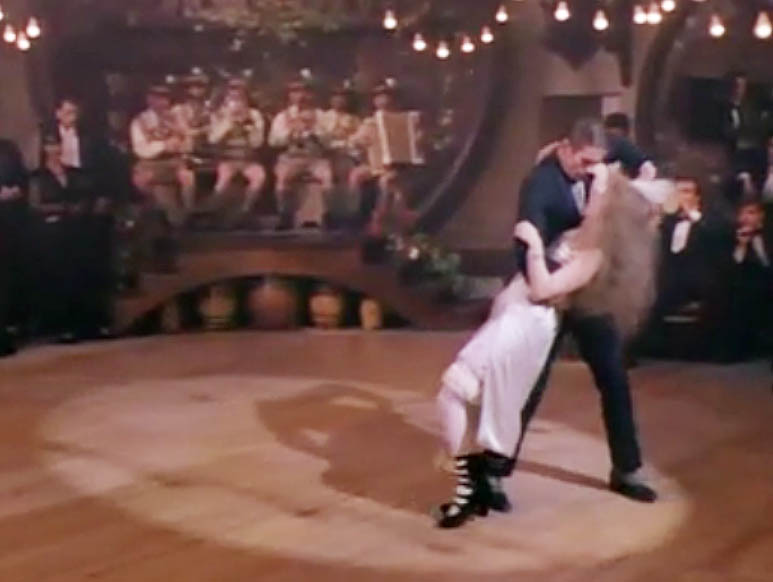
The film is Ken Russell’s Valentino, as in Rudy, as in hair anointed with jelly and liniment. It’s a biopic released in 1977, and starring Rudolph Nureyev as Rudolph V. At issue is a short scene in which Nureyev takes Carol Kane out onto a ballroom floor to dance the tango. Give it sixty seconds, and you’ll have seen everything important:

A spare cinematic minute—and yet the clip demands our attention by putting on display three things at once, three things that are intertwined even outside of this movie but whose intertwining is here oddly visible, as though lifted up for our examination. I’ll just count them off.

#1) The first thing you’ll want to bear in mind is who Valentino was. The basic facts will do: that he was Hollywood’s first superstar; that he was considered the prettiest man of his generation; and that he wasn’t American—he was born in Italy. The important point is that nothing in this thumbnail is wholly innocuous. A lot of people were unnerved by Valentino. Each of those bare data can and did yield something uncanny. That he struck so many American women as desirable was unusual precisely because he was Italian. He was the first non-Anglo man, after the big wave of southern and eastern European immigration, that large numbers of Americans deigned to think of as beautiful. People remarked on that a lot; the term “Latin lover” was apparently coined for him, even though, given the racial ductility of early Hollywood, he was most famous for playing an Arab. And there was if anything even more handwringing about Valentino the lover than there was about Valentino the Latin. Lots of male commentators said he wasn’t manly enough to represent their kind: that he was a dandy; that he was too polished; that he looked too soft; that he was a screen David sculpted out of talcum and pomade—and this, not as compared to John Wayne or Clint Eastwood—but as compared to Douglas Fairbanks, who agreed not to wear tights only when offered pantaloons.

But then the resentment of the nation’s swashbucklers did nothing to dent Valentino’s popularity. We’ve become accustomed, I guess, to how overtly libidinal the culture of female fandom is; we don’t much pause to remark on the orgiastic qualities of Justin Bieber’s every public appearance, their improbable pre-teen staging of the Dionysian Mysteries, but it might help to pretend that you’ve never seen archival footage of the Beatles and are thus having to face the squalling girl-crowds for the first time. When Valentino died unexpectedly in 1926—he was 31—there were riots in the streets of New York City. Lady fans started smashing windows and battling the hundred or so cops who were called out to restore order. Reports went out that women were killing themselves. That someone also ordered four actors to dress up as Italian blackshirts and tromp around the Upper East Side, to make it seem as though Mussolini himself had personally sent over an honor guard in Valentino’s memory, begins to sound like one of the day’s more pedestrian details.

#2) This should all help explain what anybody who’s just watched the clip will already have noticed, which is that Ken Russell has plainly instructed Nureyev to play Valentino as though he were Dracula: He silences the band just by raising his magical, mesmeric hand, tearing the sound from the very air…

…he activates what seem to be laser eyes; he leads a transfixed woman away from her circle of helpless male guardians and onto the dance floor, where he strut-hunches over her, arcing his shoulders into an insinuated cape…

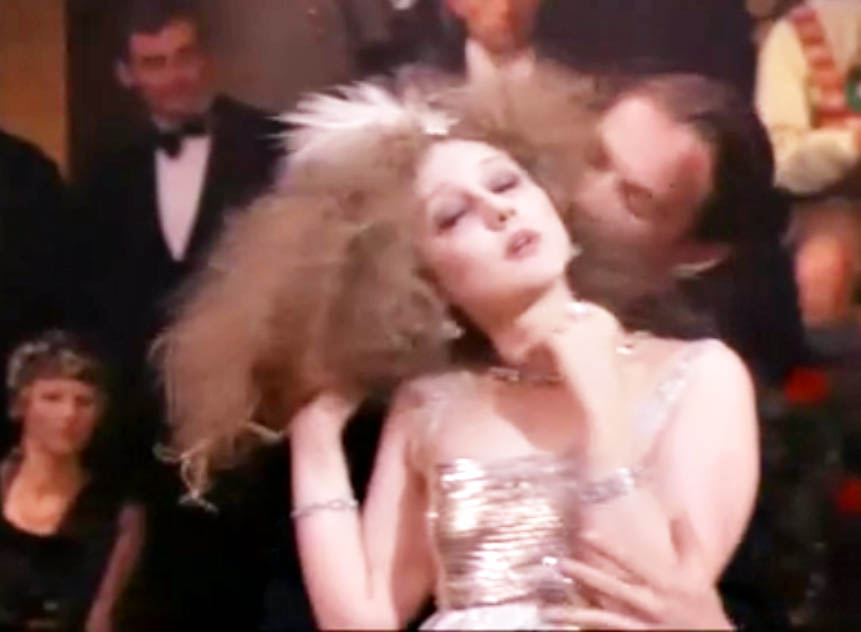
…he mimes various attacks upon her neck.

A complicated series of observations follows on from this: We’ll want to say that the figure of Valentino has been filtered back through Dracula, and we can feel the force of that revision if we point out that Valentino was actually half-French and generically Continental-looking—you would not pause if someone told you he was German—and seems to have been typecast in Moorish roles only on account of a Mediterranean accent that no silent-moviegoer would ever hear anyway. Nureyev, on the other hand, is sweltering and Slavic and basically looks way more vampiric than the man he’s playing ever did. This could all easily seem like Ken Russell’s inspiration—to recreate, for audiences in the 1970s, the lost effect of Valentino’s magnetism by wrapping it in the easily read conventions of the vampire movie, with which, after all, it was roughly contemporaneous. You make one icon of early Hollywood intelligible by translating him into a second. It would be like deciding to make a movie about Greta Garbo, but then scripting her as Steamboat Willie.

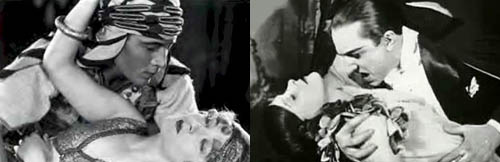
There’s clearly something to this. But if we adhere tenaciously to that line, what are we going to say about the following images?

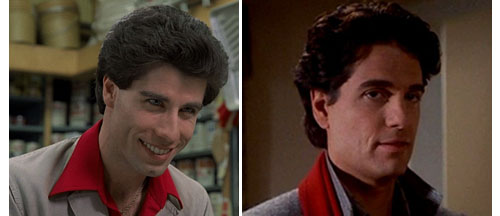
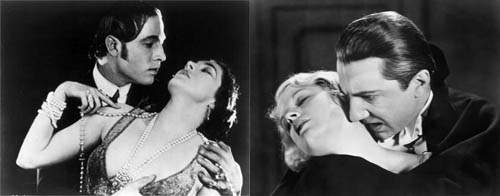
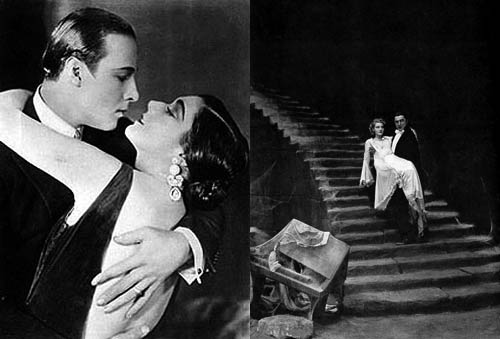
There is no mistaking the issue. Tod Browning’s Dracula came out in 1931, just five years after the Sheikh’s passing, and the stage versions that the movie was based on were running throughout the 1920s, when the oversized head of Valentino was first smoldering greyly down upon the bodies of American women. We can say that Nureyev was, in 1977, playing Valentino as Dracula, but we have to set against this the observation that Lugosi was already, in 1931, playing Dracula as Valentino. This is itself strong evidence that people were once scared of Valentino, but then we already knew that people—some people—were scared of Valentino, because he flaunted that off-white and insufficiently rugged form of masculinity, and because American women were really into it—or they weren’t just into it—they seemed hypnotized and made freaky by it. So the 1977 movie makes Valentino look more like a vampire than the real man actually did, but that’s because someone involved in the production intuited that Valentino had been one of the inspirations for the screen vampire to begin with. Heartthrob could be the name of a horror movie.

This all matters, because it helps us specify the contribution of Lugosi’s Dracula to the vampire mythos. This isn’t as easy as it sounds. Nearly everything that makes the 1931 movie tick was taken over directly from Stoker’s 1897 novel, and for most purposes, you would be better off bypassing the movie and going straight to the source. The most efficient, if not perhaps the most perspicuous, way of naming Stoker’s achievement would be to say that he turned the vampire story into an ongoing referendum on the philosophy of Friedrich Nietzsche. For real: Nearly every vampire movie that has ever been made is in one way or another a meditation on Nietzscheanism, deliberating on the idea that some people, the rare ones, might yet overcome morality and thereby form a new caste—or race or even species—a breed that never even pauses to consider what ordinary people think of as right and wrong.  Here’s all the Nietzsche you need:

•The great epochs of our lives come when we gather the courage to reconceive our evils as what is best in us.

•Every exquisite person strives instinctively for a castle and a secrecy where he is rescued from the crowds, the many, the vast majority; where, as the exception, he can forget the norm called “human.”

•We think that harshness, violence, slavery, danger in the streets and in the heart, concealment, Stoicism, the art of seduction and experiment, and devilry of every sort; that everything evil, terrible, tyrannical, predatory, and snakelike in humanity serves just as well as its opposite to enhance the species of “man.”

Enhanced and predatory un-humans living in castles, exquisite people who have turned wickedness into a virtue or an accomplishment—if you’re in an intro philosophy class, and you’re trying to make sense of The Genealogy of Morals for the first time, the easiest way to get a handle on Nietzsche will be to realize that he wants to turn you into a vampire, which is superman’s nearest synonym, another word for Übermensch. Or other way around now: Modern vampire stories work by mulishly literalizing Nietzsche’s language, making you stare the superman in the face on the expectation that you will be sent running by his anaconda grin.

This should all become clearer if we break Stoker’s Dracula back into his component parts. What are the several things that the classic vampire story wants you to be scared of?

•Stoker’s novel wants you to be scared of aristocracy. This is perhaps the most glaring point—that vampire stories are the one horror genre driven by naked class animus. The novel makes Dracula seem wiggy even before he starts doing anything supernatural, and it does this simply by making him lord of the manor. His comportment is excessively formal. He is, the first-time reader is surprised to note, seldom referred to as Dracula; the novel almost only ever calls him “the Count,” as though the key to understanding the character lay in his title. It is the very existence of the old-fashioned nobleman that has come to seem unnatural, which no doubt has something to do with his literally feeding upon the blood of the poor, peasant children stuffed into sacks. The movie updates all this, in some pleasingly goofy way, by putting the vampire in ’20s-era evening wear, the lost joke being that he never wears anything else, that he sports white tie everywhere—a tail-coat to play softball in, an opera cloak for when he’s bathing the dog—as though tuxedos were the only threads he owned. Dracula is the character who, having once put on the Ritz, can never again remove it. The vampire, we are licensed to conclude, is our most enduring image of aristocratic tyranny, generated by a paradigmatically liberal and middle-class fever-dream about the character of the old peerage, and anchored in the simple idea that it isn’t even safe to be in the same room as an aristocrat, so driven are such people to dominate others, so unwilling to tolerate a partner or co-equal. “Come here!”: A duke is the name for the kind of person who barks orders at free men as though they were his subordinates. That’s a routine observation, and it’s what ties Dracula back to the early Gothic novel or even to Richardson’s Pamela. But what’s peculiar all the same about Stoker’s novel is its timing, since by the 1890s, the traditional aristocracy in England was, if not exactly obsolete, then at least much weakened. The novel actually registers this historical turn, since the vampire famously lives not in a castle, but in the ruins of a castle, in the rubble of a superannuated class hierarchy, and—this really is an inspired flourish—he has no servants: he drives his own coach, carries his own bags. The Count is what they used to call come-down gentry, accustomed to apologizing to guests for serving them dinner on chipped porcelain. And the threat he poses is therefore not the menace of one who actually possesses power—this is how he is unlike Richardson’s Mr B or William Godwin’s Falkland—but of one who might yet regain it, the name for which regaining would be “reaction” or “counter-revolution.” Stoker’s Dracula is the greatest of right-wing horror stories, scared of foreigners and queer people and women and sex in general, but it nonetheless harbors a certain curdled Jacobinism, the exasperated sense that the European aristocracy should be dead but aren’t, and that the French Revolution is going to have to be staged over and over again.

So much for aristocracy. About those others…

•Stoker’s novel wants you to be scared of foreigners. This goes back to a simple plot point: Dracula sneaks into England from abroad—hides on a ship—slips past customs officers and curious locals. The vampire, in other words, is an illegal immigrant. You might object that this last is a late twentieth-century category, illicitly projected back onto the 1890s, and that’s true—but “stowaway” isn’t an anachronism, and neither is “smuggling.” What’s more, Stoker expressly aligns vampires, via their bats, with colonies and the Third World. Such creatures come from the “islands of the Western seas” or from South America. One character is pretty sure that this is no English bat! It “may be some wild specimen from the South of a more malignant species.” Perhaps most important, the screen Dracula is the figure who has single-handedly made life miserable for generations of Eastern European immigrants, who have had to endure endless rounds of “I vant … to sahk … your bludd!” in roughly the same way that teenaged Asian-American girls have been, since 1987, routinely subjected to obnoxious white boys quoting “Me so horny.”

•Stoker’s novel wants you to be scared of sex in general, though we can also make the point via the film: The first time we see Dracula attack a woman, all he really does is lean in for a kiss, though the street is dim and London-ish, and his victim is a flower-girl-for-which-read-prostitute, and these details inevitably summon overtones of Jack the Ripper, especially if you think Jack was a gentleman or the Prince of Wales.

The point is extended when, later in the film, one weeping survivor uses rape language to describe her evening with the Count:

Survivor: After what’s happened, I can’t…

Fiancé: What’s happened? What’s happened?!

Survivor: I can’t bear to tell you. I can’t.

At this point we need to make a careful distinction. Those scenes both trigger images of sexual violence. And yet one of the vampire story’s more remarkable features is that it communicates a fear of sex even when that violence is largely removed. Indeed, an encompassing fear of sex—and not just of rape—is coded into some of the genre’s most basic conventions. Nothing in the entire history of the horror film is more iconic than the vampire bite, which, if you pause to think about it, is entirely peculiar: Imagine that vampire stories didn’t already exist … and now imagine trying to convince a Hollywood executive to greenlight your new movie about a creature who kills people by giving them hickeys, an honest-to-Christ Cuddle Monster, but scary, you promise him, enemy of scarves and turtlenecks. Or ask yourself for once why so many movies allow vampires to be repelled by garlic. That’s a simple extrapolation from the idea that if you eat too much spicy food—if you go to bed fetid, the reek of sofrito still on your ungargled breath—no-one will want to sleep with you.

But there’s more…

•Stoker’s novel wants you to be scared of sexual women in particular. There’s an underlying point here that is worth reviewing first: Most viewers think that vampires are foxy, which makes them really unlike other classic monsters. If that point is the least bit unclear to you, you might take a moment now to close your eyes and pretend briefly that you are making out with a zombie. But the most clarifying difference is the one we can draw between the vampire and the werewolf, both of whom are canonically shown perpetrating savage violence upon the bodies of women. What I’d like to bring into view is that both werewolf movies and vampire movies deviate from what is perhaps the most routine scenario in a horror movie—a rampaging monster lumbering after a panicked victim—but they deviate in opposite directions. Werewolf stories are the one horror genre that has a certain reluctance or regret or stop-me-before-I-kill-again shame built right into them. Slashers, who otherwise resemble werewolves, never wake up the next morning hating themselves for what they’ve done. No-one casts a chainsaw to one side in self-loathing. But in a werewolf movie, not even the monster is wholly willing. In a vampire movie, then, the point just gets flipped, in that not even the victim is wholly unwilling. Vampire victims collaborate in their own destruction, for the simple reason that men in capes have game. This means that certain types of utterly common horror sequences are largely excluded from the vampire film: People almost never flee from vampires, which means that the vampire flick is the horror subgenre least likely to borrow from action movies; most likely, in other words, to commit to a languid pacing—no chase scenes!—or rather, if a vampire movie does for once break out into a chase scene, you can be pretty sure it’s the vamp and not the victim who is on the run.

What we can now say is that this little myth about willing victims is most often told, in the vampire classics themselves, about women. The form’s conviction that highborn men are predators is counterbalanced by its confidence that this is exactly what many women want—to be preyed upon. The he-vamp awakens the woman to sexual rapaciousness, and the audience is expected to find this creepy. The survivor does sob and say “I can’t bear to tell you what happened,” but she has also just said: “I feel wonderful. I’ve never felt better in my life.” In Stoker, the woman who proves most susceptible to Dracula’s advances is the one who has already asked, even before the vampire has made his move: “Why can’t they let a girl marry three men, or as many as want her?” More important, the novel makes it clear that becoming a vampire is one good way of getting that wish granted. Once she turns, the sexual woman does indeed get all the men—every major male character in the novel willingly opens his veins to give her blood transfusions—she becomes a kind of sponge, allegorically loose, soaking up all this male donation: a “polyandrist,” one of the men calls her. When the men, bearing whale-oil candles, go to visit her in her crypt, they “drop sperm in white patches” across the floor, like pornographic bread crumbs. They finally put her to rest by assaulting her as a group, standing in a circle while one of their number “drives deeper into deeper” into the “dint in [her] white flesh.” In the novel’s opening sections, three women stand over a young Englishman in the Carpathians: “He is young and strong. There are kisses for us all.”

•Stoker’s novel wants you to be scared of deviant sex above all. One point can be made without qualification: All the vampires in the original Dracula are gender-benders. That this is true of those kiss-hungry Transylvaniennes should be immediately apparent, since it will be true of nearly any she-vamp—these lady-penetrators busting the jugular cherries of straight men.

The vampiress is how the very possibility of a certain rather sweeping gender reversal comes out into the open—becomes visible in everyday life, available for the contemplation of suburbanites and middle schoolers. She and her male victims are pop culture’s only iconic image of pegging. In Stoker, the man “waits in languorous ecstasy” while he assesses for the first time the feeling of “hard dents” against his “super sensitive skin.” The point will seem accordingly less clear with regards to Dracula himself, since a man-vamp sinking into a crumpled woman preserves orthodox sexual roles. That Dracula’s manhood is nonetheless unstable discloses the intensity of the novel’s preoccupation with sexual confusion: In one of the book’s more striking scenes, its several heroes bust into the bedroom of a woman they’ve been guarding and find Dracula clasping her head to his naked breast, which he has just gashed open so that she can lap at his blood. The image is not only a riff on oral rape—though it is that, too: a forced blow job. It is also—and rather more literally—a breast feeding, a demonic nursing, with the vampire willing to set aside all his usual male roles in order to take up the position of the monstrous mother, with a chest that runs red and a child at his bosom struggling to be reborn.

So that’s a dense set of associations—aristocracy, foreigners, sex, women, and queer people—and the film does a reasonably good job of preserving this tissue of meaning, a much better job than, say, Whalen’s Frankenstein does at protecting the many-sided allegory that had originally been built up around its monster. But the movie isn’t just a translation, because to those established associations it adds one of its own. The screen Dracula isn’t just an aristocratic holdover. The vampire is the movie star himself, and in all the famous images of Lugosi we see early film beginning to mediate on itself and on its own eerie power. Or perhaps it would be more accurate to say, not that Browning’s Dracula has simply added a new association to Stoker’s list, but that it has found an innovative way of encapsulating that list’s concerns. The Valentino vampire isn’t just a supplement to or replacement for the queer and foreign aristocrat; he is the queer and foreign aristocrat, issued in a new format. What we see in Dracula is film recoiling from its new modes of supercharged male charisma, and you can begin to make sense of Lugosi’s performance if you think of it in terms of any film set’s hierarchy of actors: Van Helsing kills Dracula; Edward Van Sloan, who you’ve never heard of, kills Bela Lugosi; a character actor kills the leading man on behalf of the drab, male masses for the overriding reason that the women who’ve come to the theater with them find him too dishy.

#3) So those are two of the things that the Nureyev clip intertwines: Valentino and vampires. The third thing has everything to do with Carol Kane’s hair.

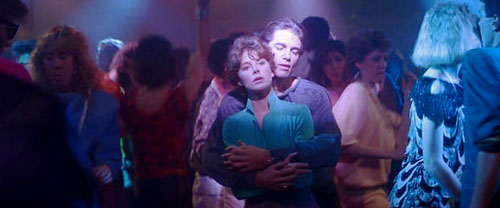
There’s real a problem here. The movie has been careful to give Nureyev a tallowy comb-back; he would hardly be credible as Valentino without it. But what’s striking about his partner’s tresses is that they are so obviously of the 1970s. The movie, after all, is set in the 1920s, whose iconic hairstyles for women were all short—bobs and Dutch boys and such—but Carol Kane’s hair has been frizzed and teased into fiberglass—it is simultaneously long and fro-like, a headdress of cotton candy. For comparison…

Valentino with Natacha Rambova

The biopic dancer’s most unflapperish do, in other words, breaks the movie’s historical frame, anchoring the production in its own present of 1977 and allowing that decade to worm back into the Coolidge era. More precisely, it tends to transform the ballroom into a disco and the tango into a proto-Hustle. Look again at that shot of Carol Kane and especially at the lighting: One doesn’t typically think of the 1920s as spangly. What we can say now is that Nureyev isn’t just playing Valentino as a vampire—that idea, at least, we’ve been able to explain; he is playing Valentino as a disco vampire, and this is going to reopen the puzzle of the clip. We know that some people really hated disco, but was anybody actually scared of it? This brings us to another movie—the movie we actually need to be thinking about—which is 1985’s Fright Night. Disco, they once said, sucks.

PART 2 BEGINS HERE…


The New Way Forward in the Middle West


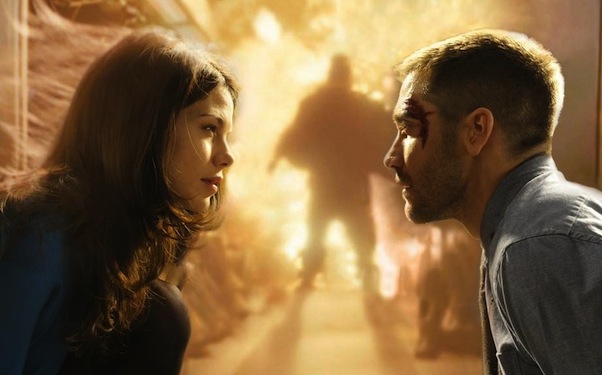
A few quick observations about Zowie Bowie’s Source Code, from earlier this year.

But first, the plot: A terrorist has just blown up a commuter train on the outskirts of Chicago, killing hundreds, and is headed downtown to hit Play on a dirty bomb, which will kill thousands more. Government scientists send a US soldier back in time—onto the train, ante-boom—and instruct him to identify the bomber. The soldier, however, is operating under two major constraints: First, he hasn’t exactly been teleported onto the train. He is, in fact, already dead; portions of his brain are being kept alive; and it’s only his consciousness that has been lobbed backwards into the day’s bad start. In order to conduct his investigation, therefore, he will have to occupy the body of some civilian already on the train; he will have to take as his avatar one of the attack’s imminent victims. Second, the government’s time-travel technology can only project him back eight minutes before the event, which interval he will have to relive over and over again until he can give the government a name: eight minutes—whoosh!—mass death—almost had it—and again, please—a fresh eight minutes are on the clock, like injury time….


•OBSERVATION #1:

The movie is set almost entirely in Chicago, and yet its plot is closely modeled on the invasions of Afghanistan and, especially, Iraq. That the detective-soldier is actually an Air Force helicopter pilot recently shot down by the Taliban is enough to establish that the movie has the war on terror on its mind. But it’s the soldier’s character arc—the transformation he has to undergo in the course of the film—that most powerfully channels the history of the past decade. What’s notable about Source Code—what makes it rather unlike an ordinary action movie—is that its hero keeps failing; he keeps letting the train blow up. The movie thinks it can provide an explanation for this, that it can make clear why an American soldier might be rather bad at stopping terrorists. Or rather, it thinks it can teach you—by teaching him—the difference between anti-terrorism and hapless, counterproductive bullying. At first, the soldier panics; he starts yelling at people; he engages in a little racial profiling; he throws a few punches and before long has drawn a gun on the other passengers. One onlooker asks: “You’re military? You spend a lot of time beating up civilians?” The turning point comes when the living officer running the mission from a government super-computer tells our undead hero: “This time try to get to know the other people on the train.” And from that point on, he just keeps ratcheting it down; stops confronting people; gets in nobody’s face; begins coolly collecting information; and finally, in one last triumphant replay of those endlessly fatal eight minutes, slips handcuffs onto the terrorist before anyone else on the train even knows they’re living amidst emergency. The movie, in other words, thinks it knows the right way to prevent a terrorist attack, and in this regard it simply mirrors David Petraeus, whose film this is. The soldier only succeeds, in other words, because halfway through he is given a new counterinsurgency manual, and the difference between hero-at-beginning-of-movie and hero-at-end-of-movie is meant to communicate the difference between Iraq in 2004 and Iraq in 2008. Source Code is, in sum, a Surge movie—it is, to my knowledge, the only Surge movie—with the New Way Forward staging itself in Illinois instead of Anbar, and with science-fiction conventions serving to communicate the panic and steep learning curve of the early occupation. The film’s hyper-repetitive structure is quite peculiar here. It could—and perhaps for a few minutes in the movie’s middle depths even does—convey the infernal quality of the war on terror, the way in which the “vigilance” to which we are enjoined is already a doom: One gets up every morning required again to avert Armageddon. But that’s not really Source Code’s vibe. Repetition in this movie soon stops seeming demonic and becomes instead the medium for learning and self-improvement—this is more somber Groundhog’s Day than it is trashy Sisyphus—and the film’s understanding of recurrence as basically harmless gets at the first of its interlinked fantasies, which is that the US should be able, at no cost, to keep trying to round up the terrorists until it gets it right. The movie to that extent signs on to the central myth of the Surge, which is that it was empire’s magic do-over in Iraq, a geopolitical mulligan.


•OBSERVATION #2:

That first point requires that we read Chicago as Baghdad in disguise, but if we instead take the movie’s North American setting at face value, then the movie’s politics become somewhat harder to parse. This difficulty goes back to the military-civilian mish-mash that is at the story’s core: The US soldier has requisitioned the body of some suburban schoolteacher—deputized the dead schmo—drafted his virtual corpse into war without end. Like any such in-between or crossbred figure, this character can be described in two contradictory ways at once, such that Source Code is simultaneously a story about a military guy becoming less militarized and a story about a civilian conscripted into special ops without his even knowing it. At the end of the movie, the soldier, having just arrested the madman and saved morning drive-time, gets to stay in his host body; he just skips off into the city with a pretty girl. At that level, the movie is an innocuous fairy tale about undoing some of the damage the US government is inflicting on a generation—not just giving a soldier his discharge papers and sending him honorably back into street life—but unkilling him, making stupid amends. But the equal-and-opposite story of the civilian who can suddenly break up terror plots sponsors a rather different fantasy, bespeaking the desire for a less obtrusive war on terror, a war less punishing to the Iraqis and the Afghanis, and kinder to Americans, as well—a war on terror without full body scanners at airports or the kind of heavy police presence that makes even white people nervous. In this sense, the movie gets us to wish that the war on terror were even more covert than it already is—that it were all undercover—its representative figure the plainclothes air marshal, the old-fashioned name for whom is Secret Police. Let me repeat a sentence I’ve already written: At the end of the movie, the soldier gets to stay in his host body, which means that the schoolteacher never gets his person back, and Source Code’s happy ending requires not that civilian life be rescued, but that it be negated.


•OBSERVATION #3:

Even by the low standards of Hollywood sci-fi, the movie’s fake science is notably addled and underexplained. Worse, having already committed to bushwa in its first act, it just ups and changes the rules in the last ten minutes, which I generally imagine is the one thing that a science-fiction screenwriter has got to promise you he’s not going to do. The audience has been told throughout the movie that the hero cannot change history; he is not really in the past; he has been inserted, rather, into a simulation built up from the memories of dead people; he can therefore only retrieve information; he will never actually save the train. But then in the last ten minutes we discover that each simulation has created an alternate universe after all, and the viewer has had the good fortune to arrive at last in the lone scenario in which every American gets to work on time. That’s feeble, to be sure, and irritating, but there’s something remarkable about it all the same. The single most striking thing about Source Code is that it brings to bear all the dopey arcana of cut-rate science fiction—the full arsenal of time-travel pataphysics and pop Leibniz—in order to generate … the world we already live in. It has maneuvered American normalcy—the AM commute, a commonplace Tuesday, just another trek to the office—into the position of the bizarro world or utopia you might otherwise have expected. The movie’s happy ending feels entirely rote, yeah, until, that is, you realize that it exists only in ontological brackets. By the time Source Code finishes, the Midwestern everyday—the one in which trains don’t blow into the sky—has become thinkable only as a science-fiction scenario, a bit of extravagant speculation. It has shriveled down to the implausible thing that a genre movie must scramble unconvincingly to achieve.

Tarantino, Nazis, and Movies That Can Kill You – Part 2

PART 1 IS HERE

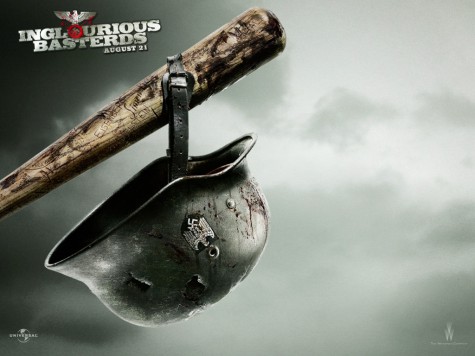
Again, if you want to make sense of Inglourious Basterds, the questions are three: 1) Why take the triumphalist American history of WWII and make it even more triumphalist? 2) Why channel our perceptions of the 1940s via the 1970s? 3) And why commit mass murder upon the audience?

Here are some answers.

Tarantino is on record as saying that Inglourious Basterds is his “bunch-of- guys-on-a-mission film”—which would mean that it’s a version of the Dirty Dozen or The Guns of Navarone. Like almost everything else that Tarantino says in interviews, I think that sentence is a lie or a trick, which should become clear if you pause to consider how uninterested the movie is in the Basterds as Nazi hunters; we see them fighting Nazis almost not all. In fact the Shosanna plot is entirely separate from the Basterds plot and commands our attention every bit as intently. I’d like to say this isn’t really a men-on-a-mission movie; this is first and foremost a revenge movie; and you might say Why can’t it be both?—and yeah, sure, it’s both, but Tarantino has also decided to make nearly all the Basterds Jewish, which means that the revenge framework actually spills over from the Shosanna plot and colonizes the mission plot, too. It’s like the revenge movie is sucking the war movie into its field of gravity. Revenge is the common term that unites the two separate plots. Plus we know that Tarantino is deeply engaged with revenge movies, which were a staple of the ‘70s grindhouse circuit: Last House on the Left, Death Wish, Thriller: En Grym Film, I Spit On Your Grave, movies like that. Tarantino, in fact, has already made an epic revenge movie—that’s Kill Bill—so we can’t be all that surprised to see him returning to the form here.

OK—but if it’s a revenge movie, it’s an unusual one, because it has that oddly doubled narrative—not just one, but two revenge plots, unspooling side by side, and eventually converging, though without either revenge-party ever knowing about the other. And what you think is at stake in the revenge plot will depend in large part on whether you decide to emphasize the Basterds or Shosanna. So ask yourself which agent of revenge your heart favors.

If you emphasize the Basterds, then what really jumps out in the movie is the image of the tough-guy Jew. There’s a word that is common in Hebrew slang—and that Hebrew has bequeathed to Israeli English—and that’s frier, which means something like “pushover” or “sucker”—and it’s become one of the most distinctive Israeli insults. Nobody in Israel wants to be a frier; nobody wants to be pushover. My Israeli friends boast proudly that the country has the world’s highest incidence of fatal car crashes—and I don’t know if that’s true—but I do know that my friends brag about it, which tells me all I need to know—and the explanation they always give is that no Israeli in a car will ever back down, as in: yield the right of way. So all I want to say is that testosterone has become a very big deal in some corners of modern Jewish culture, for reasons that are not hard to reconstruct, and you could think of Inglourious Basterds as playing into this, by projecting an IDF-style masculinity back into the 1940s. And this curious notion obviously goes back to one of the classic, nagging questions in the historiography of the Second World War: Why didn’t European Jews resist the fascists in larger numbers? If Inglourious Basterds generates a compensatory fantasy, it is surely here; it’s not fantasizing about Americans winning the war; it’s fantasizing about Jews winning the war; and this is a fantasy it shares, roughly, with other tough-Jew movies, like Defiance, which features Daniel Craig as the Bärenjude. Those movies ask the question: What if the Warsaw Ghetto Uprising had spread? Or: What if there had already been a Mossad to counteract the SS?

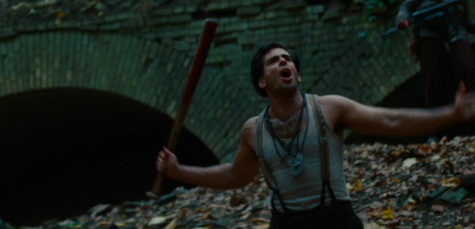
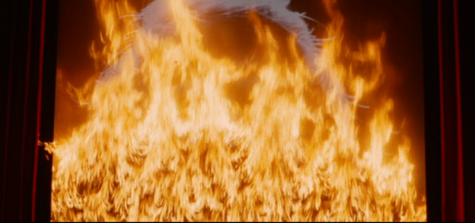
Here’s the thing: If we focus instead on Shosanna, the movie will look rather different. Shosanna of course is also Jewish and also tough, so we can to some extent just fold her into that last point. But only to some extent. Why? Because the image of Eli Roth one handing a baseball bat is obviously an image of Jewish machismo, but the image of a burning movie theater is not.

What I mean is that Shosanna’s method of taking revenge is so different from the Basterds’ that it raises some new issues for us to think about. The blazing screen does not trigger the same set of real-world associations. Shosanna gets her revenge through film: She makes a movie passing judgment on the fascists, whom she then immolates in the flames of burning nitrate reels. So it’s not just that we see a filmmaker killing Nazis; it’s as though film itself were able to strike fascists dead. There are, I think, two different ways of clarifying what Tarantino is up to here.

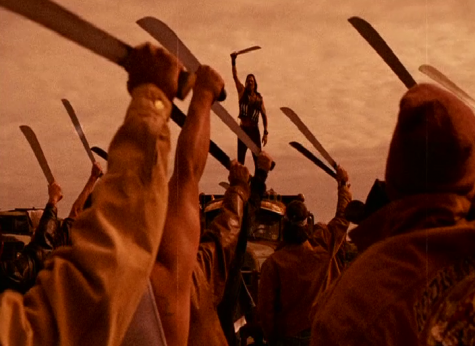
1) One way to understand the film Shosanna makes and that we eventually see is as Tarantino’s homage to postwar French cinema—and to the kind of anti-fascist film that people like Buñuel were making even before the war. She makes a guerilla film, on the cheap: a technically rough, experimental, low-budget and anti-fascist film. It’s as though Tarantino were trying to engineer a history in which Buñuel never left for Mexico, or trying to backdate Godard by about fifteen years. The movie literally stages a showdown between fascist film and the anti-fascist film of the postwar Left. And this alone licenses us to say that Tarantino is deeply invested in the possibility of anti-fascist film. He has just given us, as hero, an anti-fascist director. Now would be the moment to be point out that he and his associates often seem to think that trash cinema is the continuation of anti-fascist film. If you’ve seen Robert Rodriguez’s Machete—or even just the fake trailer for  the non-existent ‘70s drive-in movie that was the movie’s original incarnation—the point will not be lost on you: An army of illegal immigrants rises up against white bosses and politicians by repurposing as weapons the garden tools of a day laborer.

There’s plenty of precedence for this: One of the key blaxploitation movies is this film from 1976 called Brotherhood of Death, which is about a group of black Vietnam vets who return to the US and start using what the army taught them to fight the Klan. So we know that Tarantino and Rodriguez are fixated on grindhouse, but what they’re too cool to say out loud is that they basically think of grindhouse as a people’s cinema—crude and insurgent—a precious collection of movies about black people taking out the Klan and women turning the knife back against the men who attack them and kung fu masters sticking up for Native Americans.

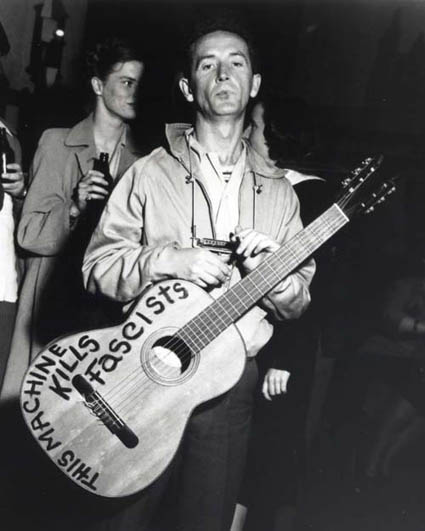
2) What I’m saying, basically, is that Quentin Tarantino is our Woody Guthrie; he is the Woody Guthrie of mondo and the midnight movie. That is not a joke. The most famous picture of Woody Guthrie gives the viewer a clear look at the folk-singer’s guitar, across which is scrawled: “This machine kills fascists.”

We need to think hard about the fantasy that is communicated by that sentence—because we’re trying to make sense of this image—

—and that sentence provides the second important clarification. Woody Guthrie didn’t just want to sing about justice; he didn’t just want to “inspire his listeners” or get them to raise their voices in the spirit of peace or whatever it is that we usually think folk singers do; he was trying to imagine a music so powerful that it would actually bring justice into the world; he wanted to strum justice into existence; wanted an art that wouldn’t just be in the service of revolution, but that would itself be the completed revolutionary act. And that’s exactly what Tarantino gives us at the end of the movie: “This movie screen kills fascists.” That fantasy—the fantasy of a fully revolutionary art—turns out to be very old. As early in the 1590s, some English poets were trying to write plays that not only depicted revenge, but actually achieved it; they were trying to imagine plays that could actually kill corrupt courtiers and oppressive princes, as though blank verse could actually draw blood. Or if we flash-forward to 1969, we will find Amiri Baraka writing these lines, in a poem called “Black Arts”:


We want ‘poems that kill.’

Assassin poems, Poems that shoot

guns. Poems that wrestle cops into alleys

and take their weapons leaving them dead.


What we can say now is that Tarantino is paying homage to the history of anti-fascist film; and he is also trying to imagine a movie that could not only describe justice but actually achieve it. And of course, we need to put those points together and say that he is trying to imagine the perfect anti-fascist film—a film so righteously anti-fascist that it literally levels any fascist who wanders into its projected light; a film that fascists cannot watch; a film that turns fascists to dust. So maybe now we can say, or begin to say, explain why Tarantino has rewritten the history of 1944. Inglourious Basterds wants to give credit for the victory in World War II to someone other than the US and Soviet armies; to nominate, as the virtual heroes of some secret history, badass Jews and cinema itself. It’s an extraordinary idea.

…except I think that’s it all wrong. None of what I’ve just written actually works; or rather, the movie does in fact put in play the two fantasies I’ve been describing—the fantasy of a muscular Judaism and the fantasy of the perfect anti-fascist film—but then it takes them back—or at least makes them harder to occupy. First it gets us to share those fantasies and then it starts calling the fantasies into question. There are two good reasons to think this.

The first I will mention only briefly and ask you to think about on your own time. One of the plain ways we have to describe who Shosanna is and what she does in this movie is to say that she is a suicide bomber. If you want to get fancy, you will say that she is a twentieth-century Samson, pulling the roof down on the heads of the Jews’ celebrating enemies, but if you go back and read the Samson story, you’ll be forced to conclude before long that he, too, was a suicide bomber, so it’s really the same point anyway. At that point we will recall that there was a bomb attack on a movie theater in northern India in 2007; another in Mumbai during the wave of coordinated attacks in 2009; an especially bad movie theater bombing in Algeria in 1998; and so on. The movie undoubtedly produces an image of a heroic Judaism, but only at the cost of letting it mutate visibly into one of its putative opposites, which is the Muslim terrorist.

That’s one of the big surprises hidden away in the movie’s fantasies. The second is easiest to communicate through a series of paired images:

1)

2)

“You know something, Utivich? I think this might just be my masterpiece.”

3)

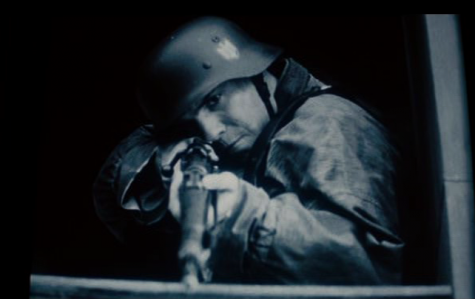
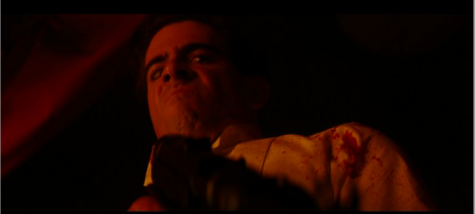
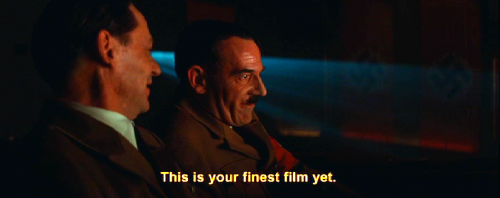
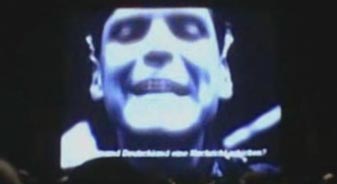
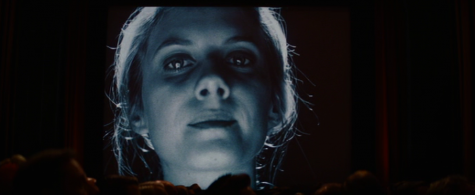
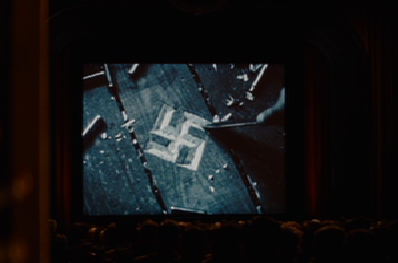
Here’s my gloss on that sequence. 1) We see a Nazi soldier, shot from below, mowing down an improbable number of the gathered enemy. Then we see an American soldier doing the same thing—and in a similar shot. 2) We see an American soldier mutilating an enemy officer and calling it his masterpiece; and we see Hitler telling Goebbels that he has made his masterpiece. 3) We see a fascist turn to the camera in black-and-white and address the audience directly, speaking English for the first time. And then we see the anti-fascist turn to the camera in black-and-white and address the audience directly, speaking English for the first time. We can see what this adds up to. Tarantino has built in unmistakable visual rhymes between the fascist movie and its putatively anti-fascist alternatives. Just to be clear: There are three movies in play here—the movie we are watching, Tarantino’s movie; the fascist movie; and Shosanna’s anti-fascist movie. So two anti-fascist movies and a fascist movie. And the point is that each of the two anti-fascist movies plainly, demonstrably resembles the fascist movie. Everything in the movie starts bleeding into fascism. Two more pairings, to coax over the disbelieving:

4)

An American soldier carves a swastika with a Bowie knife.

A German soldier carves a swastika with a Bowie knife.

5)

“Our battle plan will be that of an Apache resistance.”

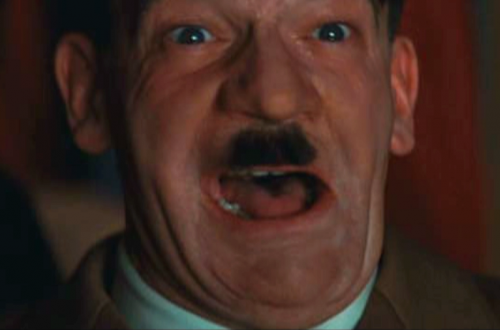
But of course what’s true in miniature is also true globally: The fascists are watching a patriotic war movie about the grotesquely exaggerated exploits of a national hero. And you can’t even get that sentence out of your mouth without realizing that, yes, we too have been watching a patriotic war movie about the grotesquely exaggerated exploits of our national heroes. The anti-fascist movie we thought we were watching outs itself as fascism’s secret twin. There’s a lot to say here, but the short version is that I think we are in the presence of a filmmaker losing his confidence in grindhouse as a people’s cinema and trying to find a way to make trash cinema yield a critique of itself instead. This all comes down to the audience: What I find most striking about the shots of the audience in this movie is how attentive they are to the immediate effects of screen violence upon a group of viewers. Let me put it this way: I saw the movie twice in a theater, and each time I saw it, when the movie screen went up in flames, someone in the room clapped—not a full-palmed ovation, just three fingers of one hand in the heel of the other, the quick little rat-a-tat of a person overcome by excitement. But then of course Inglourious Basterds, in four or five different shots, shows a movie audience of fascists whoop-whooping to a blood orgy. Let me come at it from another angle. In the movie, we see one audience member laughing. I’m guessing many people were laughing when you saw the movie; you might have laughed yourself. This gets at something important, because as long as Tarantino has been making movies, high-minded critics have fretted that he makes violence entirely too pleasurable: Michael Madsen slices off a man’s ear, and the audience are bopping in their seats because “Stuck in the Middle With You” is chiming on the soundtrack. You grin as Bruce Willis trades up from hammer to baseball bat to chainsaw to samurai sword. The only movie I have ever walked out on because of the audience was the Coen brothers’ Blood Simple—close cousin to Reservoir Dogs or Pulp Fiction—and I left it because the rest of my row was cracking up while Dan Hedaya was getting buried alive, shrieking keen through mouthfuls of dirt. So how dare anyone make death funny? You have to imagine that Tarantino has always shrugged off that accusation; you can call up YouTube videos of him shrugging it off in interviews—except now he has conceded it. And we know he has conceded it because here’s the one person we see laughing at the violence:

There is only one person laughing, and it is mother-loving Hitler. That is the sight of a filmmaker profoundly alienated from his own fans, wigging out at the ability of the movies he most loves to produce in us a quasi-fascist joy in violence. So why does Tarantino hate us so much? He hates us for liking his movies the way we do; he hates us because he can so easily bring us round to enjoying the sight of people being gathered into a closed space so that they can be exterminated. He hates you for how easily you can be pushed into the Nazi position, as long as the people getting killed are themselves Nazis. He hates you because you are the fascist and you don’t even know it. And he proposes the self-consuming grindhouse solution to this grindhouse dilemma, which is that people like you have to die. You will uphold your death sentence with your applause.


Tarantino, Nazis, and Movies That Can Kill You – Part 1

I think I can show that Inglourious Basterds is not really a revenge movie, which, if you’ve seen the movie — well, you’re not going to believe me. It’s an implausible point, hard to make stick — and I’d rather start easy. So maybe I’ll just ask a few questions about the film, and then try to answer them, though maybe the questions are really the hard part, after all. It will be harder, I think, to get the questions right than to get the answers right; Basterds is so diabolically entertaining that a person could easily overlook how complicated a thing it really is. So I’m thinking that if we can just name the movie’s complications—if we can lift out its puzzles—the answers might start taking care of themselves.

My questions are three.

First question: Is Inglourious Basterds a historical movie? Is it a period piece? …or not? In some sense, yes, plainly, of course it is. It takes place at a specified moment in history—1944; the story unfolds against the backdrop of a major world event—World War II; it transforms real historical personages into minor fictional characters—Hitler, Goebbels, and the like—and it freely intermixes these “real people” with characters of its own invention. Those are the hallmarks of historical fiction in the mode of Walter Scott or Tolstoy. Scott’s Waverley features the real Scottish prince who, in the middle of the C18, tried to seize the throne of England and Scotland. War and Peace, in turn, actually has Napoleon as a character—a fairly central character, even, at least for part of the novel.

But there’s an obvious problem with this comparison, which is that Tarantino’s movie completely rewrites the history it has chosen to recount. And I can already hear the English professors amidst whom I work murmuring: But wait, historical fiction always, in myriad subtle ways, rewrites the history that it recounts. And they’re right. But Inglourious Basterds is not subtle about this; it does not even pretend to historical insight. It gleefully concocts an alternate history, in a manner that is impossible to overlook. In case anyone has forgotten: American Jews did not storm the Nazi high command and gun Hitler down in an act of heroic retribution. This is not a historical fiction in the usual sense, but rather a kind of fantasia or historical reverie—and the movie makes no effort to hide this. Not even in Tolstoy does Napoleon keep hold of Moscow.

But then this is where things really get strange. So the movie is a flight of fancy on a historical subject. OK; I think I can take that on board, because I’ve seen it before. In science-fiction circles, alternate histories have become a genre in their own right: What would England look like in the C20 if it had stayed Catholic—if, that is, there had never been a Protestant Church of England? What would the world look like today if Europeans had been wiped out in the fourteenth century by the Black Death?—a world without white people; I’ve always rather liked that one. Or closest to the day’s concerns: What would the US look like now if Hitler had never been defeated? Those books all exist and lots more like them: Historical novels about histories that never happened. But then we need to think about which event the movie has chosen to rescript: It doctors the end of World War II, and if we’re going to think about that, then let us call to mind another obvious thing: America actually defeated the Germans in World War II; or rather the Allies did. And Americans defeat the Nazis in the movie, too, with some help from French resisters. It’s worth pausing to register how odd that is. I mean, it’s not like the movie has taken a tale of American failure or hesitation and turned it into an American triumph. If you try to imagine Inglourious Basterds as a Vietnam movie, you’ll begin to see what I mean. There was a period in the mid-‘80s when Hollywood started churning out movies—like Delta Force or the second Rambo joint—in which the US Army was granted some kind of magic do-over in South-East Asia. In Rambo, Sylvester Stallone actually speaks the question: “Do we get to win this time?” And his commanding officer responds: “Yes, Rambo. You get to win this time.” What’s going on there isn’t especially hard to grasp. The historical record—or, if you prefer, popular historical pseudo-memory—contains, in reference to Vietnam, all sorts of ambivalence: feelings of failure, complicity, shame, and so on—and those feelings are a breeding ground for compensatory fantasies. But Tarantino has scripted an alternative to D-Day, of all things, which means he has replaced the most heroic moment in twentieth-century US history—a history that is already fully triumphalist, entirely devoid of ambivalence—with something even more triumphalist, but weirdly, ferociously so. He has scripted a fictional way of winning a war that the US won anyway. So what’s going on? That’s  the first question.

I have a second question that also involves the ways this is not a straightforward historical movie. I want to be careful here: Historical fictions are always complicated, because they always require you to think at the same time about two different historical moments; if you’re reading a historical novel, you need to think about when the book was set, but you also need to think about when the book was written. So take Toni Morrison’s Beloved, which is the one recent historical novel you can count on someone having read. That book is set in the 1870s, but it was written in the 1980s. And a person might ask: What’s the difference between a book written in the 1870s, like Thomas Hardy’s Far From the Madding Crowd, and one set in the 1870s? That second book, Beloved, has a historical shadow dimension that the first book doesn’t. Historical novels belong, as it were, to two historical moments at once. They are always implicitly putting two historical moments in front of you and asking you what connects them or what they share. So Beloved is a novel about America in the nineteenth century—it’s about the aftermath of slavery—but it is also a novel of the 1980s. The 1870s and the 1980s get held up next to each other. If you want to understand Beloved, you have to understand both what Toni Morrison is saying about the past and what she is saying to her contemporaries. It’s Reconstruction; and it’s the Reagan-era; and they’re side by side. Same deal with Inglourious Basterds. Tarantino was talking about this movie as early as 2001; he wrote different versions of the screenplay across the last decade; two or three times, he announced he was going into production only to change his mind; and then he finally began filming in October 2008—a month before the Obama-McCain election, if you want to think of it that way. So this movie is about 1944, but we can also think of it as pretty much the last movie of the Bush administration. And it’s a war movie—and we mustn’t lose sight of this—which recasts WWII as a settling of scores. And few viewers will have overlooked that it’s also a Western. The opening scene has a French farmer living in what you could mistake for the timber shack of a Montana frontiersman; there’s a shootout in a saloon where desperadoes are drinking whiskey; and so on. So who thinks about war as a Western? Six days after 9/11, George Bush stood up in front of the press corps and said: “I want justice. And there’s an old poster out West, I recall, that said: ‘Wanted, Dead or Alive.’”

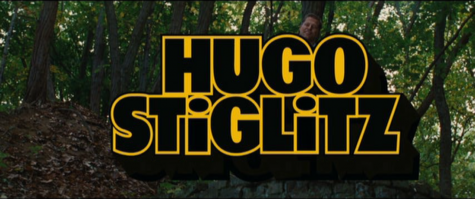
We seem to be making headway. But the point I’m after is that Inglourious Basterds is actually more complicated than this. Historical fictions are always complicated, and this movie is more complicated still, not least because it is so obviously stitched together out of parts from other movies. Now we know that this is what Tarantino likes to do; he’s got a mash-up aesthetic. So that opening scene?—it’s borrowed from John Ford; and the scene where the French Jewish beauty and the young Nazi hero kill each other?—that’s ripped from a John Woo movie. Now again, movies and novels are always borrowing from other movies and novels, so maybe you’re thinking Big deal. But most movies and novels take some pains to cover their tracks; they don’t want you to spot their borrowings; they invite you to sink into the story, so that you can trick yourself into thinking that you are watching the past unfold organically before you. And Tarantino simply will not let you sink into the story. He does not hide his sources. The most obvious example is the moment when the movie introduces Hugo Stiglitz for the first time; suddenly the movie has a narrator, and the narrator is Sam Jackson, in voiceover, and with an underlay of boom chicka wawa, and every time you hear those pimped-out cadences, you get airlifted briefly out of 1944 and deposited in the mid-‘70s instead—so Sam Jackson, but Sam Jackson in his incarnation as latter-day soul brother.

That’s the single most intrusive moment in the movie; the visible incursion of another film genre into the World War II movie; but it’s hardly the only one. There’s the spaghetti Western soundtrack, which provides an ongoing temporal counterpoint to the action. Or there’s the title. I dutifully went and watched the 1978 Italian movie from which the title Inglourious Basterds has been filched only to discover that it bears absolutely no resemblance to the movie Tarantino made. The later film is in no way a remake of the earlier one. But then knowing that should help us see how programmatic Tarantino’s retro aesthetic is: He wants you to think his movie is a remake even when it isn’t a remake. In the event, the title is something like an all-purpose footnote; it doesn’t do much more than point you, broadly, to the entire body of late ‘60s and ‘70s-era trash movies that we all know Tarantino loves; and the music does the same thing; and so does Sam Jackson. Someone out there was disappointed to discover that Richard Roundtree wasn’t playing Hitler. So the movie doesn’t just whisk us back to 1944; and it doesn’t even really whisk us back to its alternate-reality 1944. Rather, it forces us to contemplate 1944 through a scrim of other movies, and I want us to think of this as an almost geological act of historical layering. This is how Inglourious Basterds is different from an ordinary historical fiction: There aren’t just two historical moments in play, there are at least three. Hence my second question: Why, in 2009, make a ‘70s-style movie about 1944?

One quick point to make, in passing, because it will be important to some people’s experience of the movie: This might be a trash movie; and it might rewrite history in preposterous ways; but its use of historical detail is nonetheless meticulous. The movie’s evident precision begins with its attention to language. It’s a tri-lingual movie, and the German in the movie is impeccable—entirely unlike the Halt!-und-Schnell! that you get in Schindler’s List and other graduates from the Hogan’s Heroes School of War Cinema. And beyond that, the movie is full of historical references that aren’t in the least offhand—references, I mean, that are knowing and apt. Tarantino works in references to early twentieth-century German children’s literature; he briefly introduces, as a character, a cat named Emil Jannings, who was 1) a real German actor of the period; 2) the first person ever to win an Oscar; 3) and a prominent Nazi. And on and on. Now if you’re in a position to appreciate these details—which basically means if you’re German—the experience of the movie has got to be all the more bewildering. The puzzles I’ve been describing intensify, because in lots of ways the movie seems unusually committed to 1944—the movie’s erudition, I mean, can’t help but convey a certain respect for the movie’s historical materials—and yet at the same time 1944 is constantly slipping from sight.

So … a second question. My third question is easier to explain, though it’s probably also the most important one. It all comes down to this image and to the scene that contains it:

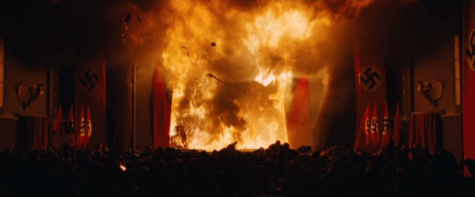
We have to be clear about what’s going on here. I can imagine a person being keyed up enough at the sweet sight of all those Nazis getting killed to overlook the second thing that’s going on in the movies climactic scenes—not a second event—but a second, equally plausible way of describing that one event: The movie is showing a Jewish woman wreaking vengeance upon Germans, but it is also showing a filmmaker killing her own audience. That’s amazing; and serious thinking about the movie has got to start there. We need to think hard about the conditions under which some of us saw this movie. If you were lucky enough to see Inglourious Basterds during its original run—and so not on DVD—then you sat in a movie theater and watched people in a movie theater get wiped out. You might have been rooting for Shosanna or the Basterds—I know I was—but the people getting offed were, at the moment of their death, unmistakably like you. The aspect of the movie that most leaps out, I think, is its extraordinary hostility towards the audience. So my third question is: Why does Quentin Tarantino hate us so much?

So those are my three questions: 1) Why take the triumphalist American history of WWII and make it even more triumphalist? 2) Why channel our perceptions of the 1940s via the 1970s? 3) And why commit mass murder upon the audience? I will next attempt some answers.


…MORE TO COME…

Postmodernism Is Maybe After All A Historicism, Part 3

PART ONE IS HERE.

PART TWO IS HERE.

You’re going to understand De Palma’s Body Double better if you understand why Theodor Adorno liked Mahler. Somebody might have told you once that Adorno championed difficult art in general and atonal music in particular: string quartets made to skirl; the mathematically precise caterwaul of that half-stepping dozen, the series chromatic and uncanny. This isn’t exactly wrong, and it is the regular stuff of encyclopedia entries and intro classes, but it’s not exactly right either. For Adorno did not want an art entirely without subjectivity, which is what serial music sometimes suggests, a pure and as it were automatic music that would never suggest to anyone listening a link back to human utterance or expressiveness; that would never once yield a tune that someone, at least, would want to sing; a music, in fine, that was all system. What he was seeking, rather, was an art organized around antitheses, in which the conflict between subject and system would become audible; and he worried there were different ways an artwork could instead obliterate any sense we had of a living person struggling to come to speech within it, and he didn’t like any of these. Traditionalism was the obvious problem: the expert mimicry of older styles, the striking of already petrified poses, the chanting of sentences already spoken. Adorno said of Stravinsky that he was a U2 tribute band. But then a radical aesthetic can beat its own experimental path to the same deadly place, one he identified in the fully developed versions of twelve-tone music, in Webern, that is, and the late modernists of the ‘60s: serial music become oppressive because now wholly itself, without any concession to its historical rivals or predecessors, routinized and ascetic, sealed off inside its own rigors and formulae.

It is this rejection of Webern that should clarify Adorno’s championing of both Alban Berg and Gustav Mahler, which is to say both a composer conventionally classified as atonal and one typically reckoned not, the point being that each of these two absorbed into his music the opposition that musical history tries to construct only between them. Mahler and Berg can be conceptualized together as the Composers of the Break, neither tonal nor atonal, but first-one-and-then-the-other, by turns and in shifting ratios or proportions. If it’s misleading to say that Adorno was one of the great theorists of serial music, then that’s because it was this music-at-the-cusp—and not the purity of The Twelve—that he meant to recommend. At issue were compositions in which the conflict between entire aesthetic periods or modes of cultural production was openly theatricalized, and from this perspective, a composer’s starting point was irrelevant. You could fill your music with tunes, but let them curdle on occasion into noise; or, alternately, you could plunge your listeners into noise, but remind them occasionally of what tunes used to sound like. Either way, you would be staging a face-off between the entire history of human songfulness and some other, radically new aesthetic mode in which art no longer takes our pleasure as its aim and limit. And here, perhaps, is the most curious point: These last are scenarios in which either term, tonality or atonality, can count as subject and either as structure. You can say that the fine old tunes sustain us as subjects and that the mere math of the twelve-tone series recreates for us in the concert hall the experience of structure and rationalization. But you can just as plausibly say that those tunes are sedimented and mindless convention, at which point we might welcome dissonance as the opening out of the composer’s idiom—or simply as the afflicted yowl of anyone who wishes the radio would for once play something different.

We can’t make listeners choose between Mahler and Berg, because it is really easy to find Mahler in Berg. If we want to get back to Body Double, all we need to do, then, is generalize Adorno’s argument in a direction he probably wouldn’t have; to insist that antithesis, far from being the special achievement of these two Austrians, is the inevitable condition of most artworks, nearly all of which absorb into themselves piecewise the styles and conventions of various historical periods, social classes, and political tendencies. You can call this “liminal art” if you want, as long as you are prepared to add that threshold never becomes room. The struggles that a Gramscian reader thinks go on between artworks are usually reproduced one by one within those same works, which, if patiently read, will generate maps of the broader cultural fields of which they are also a part. What we can say now of postmodern art is that it is almost never wholly itself, that in order even to be recognized as postmodern, it will have to announce its own distinctiveness, marking itself off from its modernist counterparts, which it will have to after a fashion name and in naming preserve. The sentences regularly encountered in Jameson in which x artist is declared to be a postmodern revision of y modernist are thus oddly self-defeating. How often do you find yourself wanting to remind Jameson of how the dialectic works?—stammering, in this case, that one cannot name a break between two terms without simultaneously positing their continuity. If you want to lift out what was new in the movie Body Heat, having first spotted that it was, as Jameson has it, a “remake of James M. Cain’s Double Indemnity,” then you have yourself already conceded that the one was really, actually, finally a lot like the other. When we designate a work as “postmodern,” the superseded and modernist version thereof will persist, as its not-really negated shadow, and this shadow will, in turn, vitiate our sense of postmodernism as ahistorical. You can say that Body Double is a movie about other movies, but that very reliance on other films—prior films—will be a prompt to historical thinking. Postmodern Body Double preserves within itself the memory of movies that weren’t yet postmodern. But then this or something like it is going to be true of most really existing postmodernism, which we now have to reconceive as the arena of a certain fight—the showdown between the various modernisms and a postmodernism available only as ideal type.

This point is available, first, at the level of genre. There’s a remarkable moment about an hour into Body Double when we witness our hero decide to take matters into his own hands, make his own inquiries about the murder, get to the bottom of things. The spectator-actor prepares himself to assume the detective functions of classic crime narrative. And at just that moment, when the movie seems ready at last to lead us back behind the spectacle—to, you know, strike the set—it instead amplifies by the pageantry by launching into a full-fledged music video—for Frankie Goes To Hollywood’s “Relax,” complete with shots of lip-synching lead-singer Holly Johnson. What makes the sequence even more compelling is that the music video stands in for hardcore porn; it’s the point in the movie when the hero is trying to infiltrate a porn set by pretending to be a hired stud, and De Palma is letting FGTH’s lubricious, post-disco electro-march substitute for the obscenities he cannot show. The movie thereby directs our attention neither to porn nor to MTV, but to whatever it is rather that the two share—and thus to an entire set of new or newly prevalent video genres, characteristic of the last few decades and defined by their collective willingness to abandon narrative or at least scale it back to some barely-more-than-sequential minimum. From our own vantage, we would want to add, above and beyond the raunch and the Duran Duran, YouTube shorts, initially capped at ten minutes and now majestically extended to fifteen, and new-model movie trailers, which, following Jameson, deserve to be considered as a form in their own right, with their own conventions and feature-usurping pleasures.

This is what it would mean to talk about Body Double not as postmodern but as a conflict-ridden composite of postmodernism and the pop modernism of the detective story, which still thinks of itself as a device for disclosing hidden truths. The competing genres are entirely visible within the movie. And then the all-important point to be made in this regard is that the detective story more or less wins out, and not only because the movie ends with a literal unmasking, latex pulled from a face. The movie does indeed document the spectator’s inability to act, though even here its procedure is basically satirical, in a manner that depends on our memory of other heroes having once done something, a memory counterposed to which postmodernity will register not as a schizoid intensity but only as a vacuity. Check your Jameson: The movie’s parody isn’t all that blank, because its very genre provides a set of expectations against which its innovations will be judged. But even beyond this, Body Double seems dedicated to the idea that certain forms of agency remain available even in the society of the spectacle. The movie’s hero doubles himself—he is both spectator and actor—and then this pairing is itself in some sense doubled, because spectator and actor both come in a second version that we could call juridical or epistemological, and not just inactive or image-consuming. There has after all always been an affinity between the spectator and the detective, with the latter now understood as the-one-who-watches, the one who arrives on the crime scene like an apparition, pledged to leave no mark, to pollute no object, to minimize the observer effect by leaving the murder bed unmade. To this we need merely append the observation that performer-cops are also a familiar species, called “narcs” or “undercover agents,” and that acting, too, can be a form of information gathering. Body Double does to this extent grant its cipher a certain limited effectivity, within the bounds of acting and spectating, as gumshoe and mole. The once corrosive insight that the detective is like a voyeur is thus replaced by its opposite, a reminder that the detective functions might in fact survive, that epistemological and moral purpose can still be roused from within the position of the spectator.

This last is a point to be made at the level of genre as a whole. But we can make a few similar observations if we start calling out the titles of specific movies, or at least of one specific movie. For Body Double’s relationship back to Rear Window also contains its own historical argument. De Palma updates his Hitchcock in one absolutely crucial way: In the later movie, the spectator-hero is meant to see the murder, which is to say that his spectatorship has been factored in in advance. We can think of the matter this way: Rear Window was still easily explained within the usual Enlightenment paradigm of truth and knowledge, the magical version of which is the usual stuff of crime stories, in which once the solution is announced and the murderer identified, everything automatically sets itself to right: culprits march themselves off to jail, widows and fatherless children return to their business suddenly unbereaved, &c. Hitchcock had some good questions to put to that paradigm, epistemological questions, for one—about whether one really knows what one thinks ones knows—and also psychoanalytic questions—about the relationship between the knower and the peeper and hence about the sneaky way in which desire rides in on knowledge’s back. De Palma, however, radicalizes this scenario by inventing a murderer who wants to be seen, a murderer, in other words, whose plans depends on the existence of a manipulated witness. The shift from Hitchcock to De Palma thus secretes a certain periodization, marking out the difference between a society in which the media exercise independent oversight functions over the government and other major actors, like corporations, and a society in which government and corporations have already reckoned the cameras into all their calculations and so incessantly stage themselves for the public, which means that watchdogs are called upon only to play an already scripted role. Body Double is really and truly a meditation on that condition, but within the narrow parameters of the thriller.

This brings us to the big point: There was always something unresolved in Jameson’s postmodernism argument, and especially in his claim that postmodern culture tends to jettison historical thinking. It’s not just that narrative forms are never going to be able to revert back to some zero degree of history-less-ness, though that’s also true. The issue is rather that Jameson was making two claims that are finally rather hard to square with one another: that under names like “retro” and “vintage,” postmodernism revived the copycat historicism of the nineteenth-century art academy … and also that it wasn’t a historicism. The best chance you’ve got of making this argument work is by making it accusatory, because you have to be able to say that postmodern historicism isn’t really historical, that it is fake history, history reduced back to image or consumer good, just so many styles for the donning, as when the ‘50s mean Formica and the ‘70s Fiestaware. Sometimes that blow is going to land. But if you’re doing anything other than designing your kitchen—if you’re making a movie or writing a novel or metering out a poem—the citations you introduce will often be, not an aping farrago, but their own path to chronology, an exercise in temporal counterpoint or Ungleichzeitigkeit, a dozen arrows pointing us outside the present, and so a request that we resume the project of historical thinking only just terminated.

Postmodernism Is Maybe After All a Historicism, Part 2

PART ONE IS HERE

The question I’ve been asking myself is: Can you make a movie about postmodernity? Or rather: Can you make a postmodern movie about postmodernity? Can you make a movie about a historical period in a style that isn’t designed for recording history? And our hunch has got to be no. An artwork that is postmodern should not be able to register its own postmodernity, should not be able to draw attention to what is historically novel about its own condition.

Such, then, is the unexpected interest of Brian De Palma’s Body Double, from 1984—that it might be the movie that invites us to revise this conclusion. Jameson was able to show how historical thinking runs dry even in a novel, Ragtime, that on the face of it seems fully and commitedly historical. The task now is to reverse this procedure by scanning postmodernism’s amnesiac mediascape to see what historical signposts have escaped unflattened within it. If we set out from the idea that postmodernism isn’t just a mistake—if we posit, perhaps just as a thought experiment—that it is on some level a faithful report on lives lived out in the society of the spectacle, then we should be able to discover, amidst its intertextuality and in jokes and obligatory ironies, a descriptive or materialist moment. Once you’ve said that postmodernism elevates meta-fiction to the status of realism, you can, if you choose, read even meta-fiction as realist.

Body Double, I would grant, is not a movie that anyone would spontaneously describe as reportage—a movie, rather, so fully of the early ‘80s that you can’t even summarize its plot without pointing out how goddamn postmodern it all is. You call from the pulpit that postmodernism went in for citations or flaunted its unoriginality … and I’ll respond that Body Double is a Hitchcock vs. Hitchcock mashup of Rear Window and Vertigo. You call that postmodernism erased the line between high art and low … and I’ll say that Body Double has a naked lady where Grace Kelly used to be. It’s the movie, in other words, that cemented De Palma’s reputation as his generation’s trash Hitchcock. And so here’s what Rear Window would look like if its title were a dirty pun: An out-of-work actor is given a place to stay in Los Angeles by a new friend, another actor who’s going to be out on the road doing repertory work. Each night he’s in this new place he watches a woman in a building across the way strip down and put her hand between her legs, and before long he realizes she’s in trouble: a man she knows is pushing her around, plus someone else seems to be watching her, too. The actor, fascinated and feeling responsible towards his masturbating neighbor, starts following the woman around, whereupon he discovers that the other voyeur is also on her tail. He approaches her, reaches out, tries to talk, but can’t get through. The third night in, he is stuck watching as Voyeur #2—an oversized Chicano fella who looks something like Danny Trejo without the moustache—breaks into her apartment and murders her with a jackhammer. He reports this all to the police, who don’t suspect him of the crime, but still denounce him for a pervert. Then comes a chance clue: Stanching his grief with porn, the Tom notices a stripper-starlet doing the same distinctive, clam-happy dance he’d seen out his window and realizes that something isn’t right, that there must have been two women where he’d thought there was only one. So he pretends to be a porn actor in order to gain access to the actress; and then, once close, pretends to be a porn producer in order to get her alone and ask her some questions, whereupon it all falls into place. He’s been set up: His new friend—the other actor—hired the porn star to grind in that lit window, the idea being to keep his gaze fixed on the facing apartment so that he would see “the Indian” kill the woman—the other woman; the real woman—and the police wouldn’t suspect the actual culprit, who is of course the hero’s friend. What our guy doesn’t work out until the last minute, during a brawl over an open grave, is that there is also no Indian, because the murderer was really just the new friend in blame-the-darkie brownface.

One of the things that is most likeable about Body Double is that it is fully pretending to be stupid, which makes it in this one respect not like the Tarantino movies it otherwise resembles, since these always pause to parade their intelligence. De Palma’s movie you could get through convinced only of its tastelessness. There is, however, a spoofiness to the thing—a preoccupation with its own movie-ness—that indicates a secondary program beyond the baring and butchering of flesh. All I mean to say is that Body Double never lets you forget that you are watching a movie, and this more than anything has earned it the tag “postmodern.” It begins and ends on a movie set; its first line is spoken by an unseen director, which might be enough to make newcomers watching it on DVD think they’ve accidentally turned on the commentary track; a grand old deco hotel on Hollywood Boulevard is filmed to look like Dracula’s castle; when characters drive, the movie has them in stationary cars against back projections, such that one begins to hallucinate Doris Day in the passenger’s seat; the early-morning window in one shot, its light still without tint or hue, might be an old black-and-white movie thrown up onto yet another screen; when two characters kiss outdoors, the movie shifts from live background to a washed out rear projection of same; the opening credits are all bucket-of-blood, creature-feature retro-sleaze, like something off the cover of a Cramps album.

So there it is—some of the evidence that this is meta-film. The standard line on this would frame its point in epistemological terms: The movie is giving us a crash course in skepticism, teaching us not to mistake representations of objects for the objects themselves or at least taunting us for our compulsive committing of that error. Characters wander out in front of painted backdrops, gesso-and-canvas mountains with the real San Gabriels still visible in the background, when of course by “real” I mean “filmed,” which is precisely the correction the movie is demanding that I make: Be careful what you call real. The stylistic tricks have an utterly straightforward relationship back to the plot, because the movie’s viewers and its hero are in the same position—just so many watchers. The character has to work out that what he’s watching is just a staging—he’s been duped—and the movie is constantly reminding us of the same point—that we are suckers to what we see—but our version of that point comes in a radicalized form, since the character, at least, is allowed a moment of genuine insight; allowed, that is, to look behind the curtain and encounter there something he can call truth. He has solved a mystery. But if we’ve twigged to the movie’s games, then we will have to conclude that even this insight—this uncovered reality—has been scripted and staged … for us … by a movie. We never get to go back behind or to the bottom of anything.

This, again, is the standard line, and it comes in one major variation, which is ethical, in which case you might conclude that you are fixated on images not because you’re a philosophical realist but because you’re a reprobate. It is, indeed, one of Body Double’s many charms that it silently classes positivists among the debauched. The main character is, of course, caught out as voyeur, and since the movie goes out of its way to establish the correlation between him and us—as people who hang about in dark rooms watching other people go about their business—then we are sooner or later bound to realize that we are his accomplice and co-ogler, just one of the title’s many doubles. “You’re a peeper,” the cop tells him, therefore you. “In my book, that’s a pervert and a sex-offender”—which is one way to make clear to viewers that their sincere concern for the woman at the moment of her killing—their wanting to call out to her, their wanting her to escape the murderer’s clutches—was messily entangled with their delight at having had a good look at her nipples. De Palma, it should be noted, saves the movie’s most salacious softcore shots for the movie’s very end, by which point the viewers can consider themselves thoroughly pre-accused. Either way, though, whether we follow the epistemological line or the ethical one, we get to say that Body Double is a movie about movies and that this vitiates cinema’s usual reality effect … brackets its referentiality … voids the claim, implicitly made by nearly every film, to be about something other than movies.

Now that line works as far as it goes, but it’s not enough. Body Double is about a spectator who gets involved in the events he’s been watching—this is what it most shares with Rear Window. And that meditation on spectators—on what it means to be part of an audience, on the limitations and obligations of that position—is certainly what makes the movie meta-. But it simultaneously introduces into the film a certain unconventional realism, because “the spectator” is not an already established movie type, not a cowboy or a gumshoe or a rogue cop. In the place of these heroes, all of them more or less mythical, the movie has inserted someone pathetically like us, somebody whose first impulse is always to stand and stare and only belatedly to punch someone. Body Double’s project is to take the spectator and make him the hero in a crime thriller, on the understanding that the spectator is a historically novel and rather alienated social position, truncated, passive, precisely not heroic. The movie is to that extent calling out genre film on its basic lie or paradox: Most blockbuster movies present us with a world bustling with dynamic people, mostly men, riding in, rumpusing, getting ‘er done, and yet even this incessant display of intact heroism, far from modeling for us a masculinity we can adopt in turn, will tend to make of us only bystanders. Most movies expect us to lionize the Deed from a position of mass immobility, lined up in inert rows.

Body Double wants to tackle this problem head on. How would a genre film have to change if it took as its raw material the real human stuff of the present? Or more broadly: In the society of the spectacle, in which we are all onlookers, how does anything ever get done? The movie’s spectactor-hero registers to this extent as an intrusion from the real world, such that we might just about conceive of the film as a Purple Rose of Cairo in reverse—or as a sinister Pleasantville—a movie, that is, in which someone from the audience has crawled magically onto the screen and has to shuck-and-jive his way through whatever role John Travolta has just vacated. De Palma’s most inspired move, back in 1983, was simply to cast a bad actor in that part, or if you like, to miscast a bit player in a starring role—an actor more typically associated with one-off appearances on LA Law or Murder, She Wrote, a bonier Bill Maher, we might say now. This is the movie’s most specifiable intrusion, its most overt tampering with your complacent expectations: The schmo is occupying a role that you had thought would go to someone else—Harrison Ford, maybe, or Michael Douglas—not, at any rate, to one Craig Wasson. You could call the character one of Hitchcock’s ordinary men, but then you’d still have to make clear: He’s really ordinary … and not just Cary Grant standing in for average.

The movie’s first order of business, then, is to take its hero and establish him as a schlemihl and human yo-yo. Some of its devices are entirely conventional: He gets fired, discovers his girlfriend cheating on him, is variously dogged and dressed down. The problem with setting a movie in LA is that there are no rain puddles for taxis to splash on a sad sack’s best suit. One of its devices in this regard is moderately interesting: During a guided memory at an acting lesson, he is told to cry out—to wail in what is in some complicated way his own voice—and he can’t do it … can’t find the air … can’t even find a sound inarticulate. It’s the sort of shift Jameson would want us to note: from The Scream to the un-scream, from a world of suffering to a world so stage-managed by spectacle that you can’t even holler if it’s not in the script. And then one device along these lines is really very fine: The movie begins with the hero working on a cheap horror movie, as its monster, except whenever it comes time to crawl from the tomb, he seizes up. Within the inherited vocabulary of the drive-in movie, that’s an ingenious image of castration: a vampire who cannot leave his coffin, the undead about to lose its animating prefix, and also an actor who cannot heed the call to “Action!”

And then this now gets at something deep in the movie: The first thing we see in Body Double is nothing happening, and we will immediately want to generalize the point: What’s missing from the movie is die Tat: feats, exploits, interventions. The only thing the hero is good at doing is watching. The movie itself, meanwhile, is at its best when trying to find ways of signaling its hero’s scopophilia, and this in a way that underscores its resemblance to the movie-going that anyone watching the thing is by definition doing right at that very moment. De Palma is so adept at this particular provocation that it can leave you a little contemptuous of Hitchcock, who, one now realizes, was making things easy for himself in Rear Window when he strapped Jimmie Stewart to a chair, dimmed the lights, and then furnished him with a multiplex of illuminated oblongs across the way. The cinematic likeness in those sequences could hardly be more obvious. But De Palma gets his hero up off the upholstered seat, puts him on the move, sends him out into the city, following the woman, and still manages to call to mind movie-going, for which he has to find an accordingly more elaborate set of visual approximations. One in particular stands out: The hero follows the neighbor woman to Santa Monica; climbs up to a balcony on a beach house; and then watches while she makes her way down the same house’s lower terraces and then out onto the sand, at which point the balcony he’s standing on reclassifies itself, inconspicuously, as a gallery or theater box. The effect would be easy to miss, except at one point he leans in as though to talk to her from afar, his mouth moving silently to form unspoken words, which is recognizably the behavior of somebody stopping himself from talking to a movie: Watch out. There’s somebody behind you.

If we call that example #1, we can promptly add two more.

2) During that same acting lesson, the hero is telling a story about playing hide-and-seek as a child—or rather he’s re-experiencing the ordeal of a game gone wrong: He’d gotten wedged behind a refrigerator, pinned into his hidey-hole, and was frozen with fear. So yes, hide-and-seek … a discovery game, which is thematically relevant … the movie is what you might call “highly designed.” But more important, the hero is reliving this childhood paralysis and has gone to stone on the classroom stage, and the teacher, trying to snap him out of it, shouts: “You have to act!” What this means is, of course, entirely unclear. The entire scene has been arranged to bring out the everyday paradox of that word in English—“to act”—which means both “to really do something” and “to not really do something.” The voyeur-hero in Rear Window was a photographer by trade, a professional watcher. It is another of De Palma’s small innovations over Hitchcock to make his voyeur an entertainer, somebody who works in front of the camera, and so to allow him to encapsulate the only two social positions that are left to us in the society of the spectacle: the spectator and the performer in one. The epigrams start writing themselves: Acting swallows up the category of the Act. The actor is the one who will never act. In postmodernity, “action” is a type of movie, and an “act” is one third of a play.

3) The movie’s final showdown is an elaborately dry gag. The hero has been tossed into a freshly dug grave, and again his claustrophobia sets in. From this moment on, two things will stand out. First, we get the hero’s POV from underground; he’s looking up at the rectangle of the pit’s opening, which, for no diegetic reason, has been floodlit—lit to white—such that it resembles a blank movie screen, with our guy again in darkness and the killer’s figure looming out from the sky’s fabric. The image has to be understood as a taunt or a warning or a buzzer attached to your theater seat. The cinema is a grave; if you remain a spectator you are going to die. Second, the movie carries its contrivance so far that the hero doesn’t actually contribute to his own survival. At just the moment when you think he is going to absorb the imperative to act and so model for you what it might mean to leap for once from your living room sofa, you and he learning together to shed the passivity of the spectator—a dog appears nearly out of nowhere; jumps the murderer; and pulls him to his death over the face of a dam. The Act puts in one final non-appearance. That sequence condenses into three short shots one of the things about this movie that is hardest to get at, which is its rather bracing willingness to disappoint. For Body Double is, by most of the usual standards, a pretty lousy crime thriller: a collection of set pieces variously abridged and aborted, resolved to perform upon itself and at the level of genre the castration that it laments in what for structural reasons alone I persist in calling its hero. Try to imagine a Dirty Harry movie in which Clint Eastwood had been replaced by an inanimate object, a box elder, say, or a chaise lounge.

And yet it is this very badness that is the movie’s best thing—its carrier of history—its invitation to memory …

PART 3 IS HERE.

On Agamben’s Signatures

Let’s say you don’t believe that wholes or totalities exist. You don’t believe that people and objects inhabit underlying structures that assign to them meanings or functions. Whatever it is that is bigger than us, the space within which we move, is neutral terrain, not exactly empty, but unstriated, a field of constantly shifting singularities. It’s going to help to have a name for this space, this wire cage in which the lottery balls blow, though it’s unclear what that name is to be. There is a lot that you can’t call it, many words that, believing as you do, you are going to have to give up. You can’t talk about structure or system or any of their derivatives: There are no ecosystems, and there is no world; there are no political or economic or legal systems, no capitalism, then, no empire, nothing global. It would be safer, conceptually purer, to shut up about the state and society. There can be no talk of rules and laws, because such things either constitute structure or are assigned by it. You’ll also want to toss out any terms that refer to big blocks of time. You can start with the word “modernity.”

That people who claim not to believe in totalities routinely talk about all these things suggests only that they are not yet disbelieving with their hearts, like Christian teenagers pretending to be more badass than they really are. Yer average copy of Anti-Oedipus is, in this sense, a prop cigarette. But it doesn’t have to be that way. It is the virtue of Giorgio Agamben’s recent book on method, The Signature of All Things, to remind us what a painstaking post-structuralism can look like. And yes, this is the first thing to know about the book: that it is post-structuralist, in some wholly precise sense of that term, still, in 2008, when it was first published in Italy, and not just because its author quotes Foucault a lot. What matters is that Agamben is still actively trying to purge the concept of “structure” from his thinking; still trying to jimmy that e from his typewriter; still scanning old volumes of philosophy so he can accusingly annotate the passages where schemes sneak in unbidden; still trying to devise something to put in their place.

We can see how this works in the second essay, from which this little book takes its title, and in which Agamben asks us to start thinking again about a basic problem in structural linguistics: How does language pass from words to utterances? Or if you like: How does the mind get from inert words, archived dictionary-like in lists, to living sentences that actually carry meaning? The usual answer to that question would have something to do with rules or laws: There are rules governing how words get combined. Your mind doesn’t only know words and their definitions; it’s absorbed the guidelines for their use. But Agamben doesn’t want to say this, because the word “rules” makes language sound like a government agency. Nor are the usual alternatives much better: Any talk about the “structure of language” is going to bring in resonances of the state or capitalism or the administered world. We could try to identify the mind’s “devices for building sentences,” but that would turn language into a technology. We could wonder how words get “processed,” but that would be either bureaucratic—words as case files or credit-card applications—or again technological—words as refined sugar. Agamben is in the market for a way of thinking about language that does not go through a juridical model of laws and rules …  or a political model of the system … or a technical model of the machine.

His proposal, derived from synopses of Paracelsus and Jakob Böhme, is that we learn to think of language as magic. Magic is what will substitute for structure, in which case one synonym for post-structuralism is “the occult.” Agamben wants magical signs; this, roughly, is what he means by “signatures,” signs that aren’t just neutral stand-ins for things, tokens or pointers, but charmed symbols vibrating with their own energies, signs that have “efficacy,” “efficacious likenesses,” not marks that you write down but marks that are written across you. Every spoken sentence changes the world and is in that sense a spell or hex. This is probably the clearest instance of the “regression” that Agamben makes central to his method: “the opposite of rationalization,” he calls it. If you are serious about your critique of enlightenment, you are going to need an enchanted epistemology.

So … at least it’s not the same old anti-foundationalism—a post-structuralism, then, with new emphases and possibilities. Indeed, one of the more conspicuous features of Agamben’s reflections on “method” is that they actually add up to some pretty strong and decidedly un-skeptical claims about the nature of social reality. How one studies the world is premised on an already robust idea about how the world really is. This is clearest in the book’s first essay, which explains Agamben’s notion of “paradigms”—it would help if you could set to one side whatever you currently think that word means and let Agamben explain it for himself. He is, above all, trying to explain what Foucault had in mind when he said that the panopticon was the nineteenth century’s representative institution, or what Agamben himself wants to say when he makes the same claim, for the twentieth century, about the concentration camp. These two, the panopticon and the camp, are paradigms—not their respective eras’ most powerful institutions, at least not by any of the usual metrics, and not their most frequently encountered institutions—but the pattern or model for all manner of other agencies, and so the key to the latter’s intelligibility. To examine in detail a Regency-era prison is actually to describe five or six other institutions all at once: hospitals, elementary schools, mental asylums, army barracks, nearly any public street in Britain in 2010. The prison itself serves as a kind of extended sociological analogy, even a kind of “allegory”—the word is Agamben’s own. Everything is now like x.

You’ll be able to make up your own mind about the “paradigm”—about how useful it is as an explanatory device—if you bring into view its competitor concepts, the notions that it most nearly resembles and so means to replace. These are basically two: the symptom and the function. We could try to discover what functions prisons or concentration camps play in the social order at large. This would require that we attempt something like a political economy of the camps, that we try to work out what it is in the modern European state or in organized capitalism that tends to produce camps. If, alternately, we called the camps a “symptom,” we would be positing not so much function as dysfunction; the camp would be the visible mark or felt sign of an underlying sociopolitical disorder, one whose pathways and mechanisms, because not available to the eye, would still have to be analytically reconstructed. Either way, if we talk about functions or symptoms, the task in front of us is to relate camps and prisons back to the underlying order that has at least partially produced them. And this is precisely the job that Agamben is now calling off. What he likes most about the notion of “the paradigm” is that it bypasses any talk of the totality or system; it spares us from having to reconstruct anything. If you call the camp a “paradigm,” you are saying that nothing “precedes the phenomenon.” Camps and prisons are “pure occurences” that persist “independently of reference” to other institutions—“positivities,” he calls them and doesn’t blush. They are representative institutions, and they conjure up parallel institutions, but only as a string of singularities, the relationships between which are to be left, as a matter of principle, unelucidated. It isn’t even an open question, to be settled empirically, whether prisons and this or that capitalism require one another. The question is methodologically disallowed. There is pride in not asking it. His sense is that the agencies of a given historical period might congeal into a set, might adopt similar designs and follow similar procedures, might come to resemble one another, without, however, being functionally related, and the task of the social historian is only to chart the spontaneous mutation in some free-floating logic of institutions.

Here’s Agamben: “According to Aristotle’s definition, the paradigmatic gesture moves not from the particular to the whole and from the whole to the particular but from the singular to the singular.” You can attribute that idea to Aristotle, but it also sounds an awful lot like the “constellations” of Benjamin and Adorno—assemblages of singular things, not subsumed under a category or master term, but linked all the same, except only just, minimally unified, scattered fragments carefully re-collected, scraps joined with twists of wire, like an early Rauschenberg combine, the unity-of-unity-and-difference with difference dialed high in the mix. Agamben and Adorno share the idea that singularities might be linked together directly and so circumvent the abstractions that typically manhandle them. And saying as much should help us identify what is peculiar about Agamben’s thinking. For Adorno, of course, preserves the moment of the totality or the whole—he continues to speak of “capitalism” or “the administered world”—to which the constellation of singularities nonetheless provides an alternative. Hence Adorno’s in some sense entirely conventional reliance on the aesthetic: He thinks we need a better way to cognize objects and thinks, too, that art might provide it; that in the aesthetic encounter we for once apprehend objects in their singularity, without immediately subsuming them under models or formulas. In rare moments, we stop thinking like administrators and lose the names for things. The constellation is an alternative mode of cognition, a utopian counter-term, and in that sense a project, rather than, as Agamben has it, a method—a counter-systemic thinking and not a post-structuralism. The bizarre thing about Agamben—although this is a peculiarity he shares with lots and lots of other thinkers—is that he thinks that this utopian counter-term already describes our political and economic reality. It is the mistake endemic to the breed. What in Adorno remains a political task Agamben and sundry others turn into proclamation. Fired by the idea that the world should not be organized into structures and systems, they convince themselves that the world is not so organized, though where they used to take the epistemological shortcut to singularity, they are now more likely to take the ontological one: sameness cannot exist; it is existentially excluded; there is only multiplicity.

If there is a big point here, then we’ve just hit it: You can be counter-systemic, or you can be post-structuralist, but you cannot coherently be both, because once you’ve declared that there is no structure, you cannot then say you want to overturn it. Adorno thinks that a transformed world—let’s call it communism, though he wouldn’t have, as others were hogging the word—would be one in which people and objects can exist as free but linked singularities; and he thinks that we can proleptically work out the epistemology of that world-that-is-not-yet-ours, such that we can sometimes experience objects and others as though already redeemed. Agamben thinks that this utopian epistemology—the knowing of linked singularities—accurately describes the world we already inhabit, which is the society of camps and prisons.

I don’t mean to suggest that Agamben has anything nice to say about prisons and concentration camps. This is manifestly not the case. He typically presents himself as a thinker of The Catastrophe—the destruction of experience, the permanent state of exception, the generalization of Dachau, the merging of the concentration camp with everyday life, Buchenwald without end. There is, if anything, an apocalypticism in his writing, modeled again on the late Adorno and a Benjamin-about-to-die. And yet a certain utopian misdescription of the concentration camp is built into his arguments all the same, simply because he has taken the redemptive moment from negative dialectics—Adorno’s inevitably temporary reminders of how objects would appear to us once liberated from the abstractions of the exchange relation and bureaucratic reason—and locked it in place as a uniform method. The strain of this argument is often evident, as here—Agamben is trying again to sum up what he means by “paradigm”:

We can … say … that a paradigm entails a movement that goes from singularity to singularity and, without ever leaving singularity, transforms every singular case into an exemplar of a general rule that can never be stated a priori.

This is a version of what we’ve already seen: Singularities are directly joined, flush up against each other. A certain generality can be achieved, but a miraculous generality that doesn’t come at the expense of singularity, a generality without abstraction. What Agamben is saying here really isn’t all that complicated. All he means is that when you write about a prison or a concentration camp, you are writing about our general condition, but you need never exit the detail and fine grain of your description in order to make this point separately and in its generality. You can just motor on with your individualized account, immersed in the singularity of that particular institution, confident that it will stand in for other similar institutions. The problem, in this light, is the term “a priori,” which Agamben has grabbed from Kant. The rule of prisons, like the rule of camps, cannot be stated a priori. To which one would like to reply: Of course not. Of course these “rules” can’t be formulated a priori, because Agamben and Foucault are offering us a method for historical study; they are talking about historical periods, trying to identify shifts in historical experience, and historical experience is by definition not a priori. That is one of things one knows a priori about the term “a priori.” The claim, in other words, isn’t wrong. Quite the contrary: it is troublingly evident, because definitional. It’s the sort of truth you can’t insist on without making other people wonder whether you’ve really grasped the underlying issues. We can be certain, at least, that we are not dealing with a distinctive virtue of Agamben’s method; there is no philosophy whatsoever that could deliver to us a priori knowledge of Sachsenhausen or the Alleghany County Jail. What is true of “the paradigm”—what Agamben makes his boast—is true of every other historical methodology, without exception. One suspects, then, that this sentence cannot mean what it plainly says, that Agamben wants to use the term a priori to suggest a rather different claim: not that the general historical rule can’t be stated a priori, but that it can never be stated in its generality, as an abstraction. But Agamben can’t put it that way, because in that form the claim is just false. Anything that can be said about the panopticon paradigmatically could also be said generally, as an observation about a system or set of institutions, without our even having to mention the panopticon. So that’s one way to make it seem as though you have excised from your thought the structures or totalities that have not vanished from the world: You argue the obvious in order to insinuate the wrong.

The spun sugar of destruction

The task today is to explain a movie that reviewers have described, unvariously, as “gonzo,” “beyond the pale,” “surreal,” “indefinable,” “gone, baby, gone,” and “totally inexplicable.” The movie is Nobuhijo Obayashi’s Hausu, from 1977, a horror film of sorts that has, at last, been playing in American theaters here and there over the past year, and, yes, the damnedest thing, the kind of movie that can turn any hour into midnight. A teenaged girl gets into a kung fu showdown with a wall phone. A stygian fruit stand turns a high-school teacher into a pile of ripe bananas, the bunches heaped high at his steering wheel, still wearing cap and spectacles, as though waiting to speed away, “Bananas everywhere!” his dying words, except you can’t really make them out over the rockabilly and the lounge jazz. The severed head of a recently decapitated young she-glutton chomps the assflesh of another teenaged girl, like a farmer wide-mouthing the season’s first crisp apple, and then tilts back to show a ragged neck packed with watermelon pulp.

And yet Hausu really isn’t all that hard to explain, as long as you’re willing to ask the obvious questions, to start with what is most familiar in the movie and work your way up to what is most bum-biting and outlandish. For Hausu is, at heart, really just a haunted house movie. Its Engrish-language title is telling you as much. A high-school student takes six of her girlfriends out to the countryside to visit her dead aunt, and the house attacks them, one by one, then pairwise, such that none ever returns.

Yes, there’s also a white cat with green laser eyes, but for the moment that will only confuse the issue. For now, we need merely plod, putting to Hausu the questions we would put to almost any ghost story. In some ways ghosts are unusually hard to talk about, because the ghosts one encounters in film and literature are so much more varied than the werewolves and the vampires and the zombies: they come in different shapes; they have different powers; different vulnerabilities. It could seem harder to generalize about them, to find any pattern of meaning amidst all that variation. But one point stands out, and I don’t think it’s hard to grasp. Ghosts are almost always figures for something you think should be gone, but isn’t. That’s it. A haunting just means that a trace of the past has come back. The ghost almost always announces some disruption in the order of time; the ghost is history itself, perceived as a problem; the disturbing persistence of history into the present. It is history that refuses to go away.

So when you watch a ghost movie, your chief task is to figure out how the movie understands the relationship between the past and the present; that is, you need to figure out what the movie has indentified as the salient features of the present; what it has picked out as the salient past; and then you need to figure out what they have to do with one another. Hausu makes this easy, by giving us a few minutes of fake newsreel, in early ‘40s black and white, in which we learn that the undead aunt is a kind of war widow, engaged once to a Japanese airman, who never returned and for whom, having made a pinky promise, she eternally waits. The movie, in other words, nominates its own past by shooting it on a different film stock: We have an older generation that is still pledged, in occult measure, to pre-war Japan, which here means not only thimbly tea cups and a population in fancy pajamas, but the Japanese empire and Japanese militarism. The aunt is witch-priestess of that Japan, endlessly mourning it, awaiting its return or re-rising sun.

The way the movie captures the present is necessarily more diffuse and so a little harder to pin down, though not much. The movie’s main characters are all teenaged girls, seven of them, with dwarflike names to match that number: Gorgeous, Prof, Sweet, Melody, Kung Fu, Fantasy, and Mac. This already gives us a lot to work with. The first thing that leaps out is the total absence of men, so first: a feminized Japan. Two of the girls—Prof and Kung Fu—conspicuously occupy roles customarily allotted to men, as the gang’s braniac and warrior-guardian, respectively, and so suggest a historical transition over to female self-sufficiency: a society that’s all ladies. But then fully four of the girls have English nicknames: “Gorgeous” and “Prof” are the subtitles’ translations of Japanese originals; “Kung Fu” is neither Japanese nor English; but Sweet, Melody, Fantasy, and Mac all are Anglo-monikers, English already in the dialogue, and so register a certain Americanism, except the movie’s subtitlers have gotten ahead of themselves, because “Fantasy” is actually, as spoken, “Fanta,” which means that one girl is named after a soda and another after a hamburger, so: A Japan so Westernized that children nickname themselves after value meals. The other thing to know about Hausu is that its dialogue is all a-titter, effervescent, silly, the opposite of mournful; the movie uses schoolgirl giggling the way Harold Pinter used to use pauses. The bundle of associations is the usual one: a feminized, consumer Japan; given over to the young; post-heroic, maybe even post-masculine. The movie can seem to pitch giddy, pop girl power against the imperial melancholy of their parents and grandparents.

This all makes for a reasonably straightforward ghost story, in which the present is pitted against the past—a generational battle, then. In those terms, the movie puts in front of us a failed present, which is what usually happens in a ghost story—a present that hasn’t extricated itself from the past. The old Japan reasserts itself: This is clearest in the movie’s coda, when we see the ghost-aunt’s niece, Gorgeous, now mistress of the old house, and so spectral in her own right, or atavistic, dressed in a kimono, fluidly opening shoji. In fact, we also see her welcoming—and then killing—her father’s new fiancée, and the important fact here is that at the beginning of the movie, the stepmom was described as “surprisingly good at cooking and other things.” The movie has thereby registered the questionable domesticity of modern Japanese women, and we can understand the house as busy trying to undo that shift, by relegating the powerpuff girls back to the old roles of maid and helpmeet. The movie’s title is in this sense oddly precise; it can dispense with the word “haunted” because it is premised on the observation that all houses are haunted or possessed, because all feed on their members, and especially on their less muscular ones, as this house does literally. The girls are to this extent the unlikely bearers of a feminism, whose defeat the movie will, with horror, recount. In place of fiends and demons, the movie has washrags and feather dusters, which all turn out to be the same anyway: Things that can destroy a carefree girl. One girl gets killed by the bedding.

But the movie is actually more complicated than this, because it also admits of a second reading, which runs concurrently alongside the first. Even as it pits the duty-bound war generation against the pop feminists of the mid-‘70s, the movie establishes a certain vexing continuity between the war widow and the girls and thereby forces us to consider the possibility that the girls are vulnerable to the Japanese past because fully its heirs.

A little background: It will help to know that there has been a lot of Japanese art over the last few decades that condemns its post-war addressees for being too too childish or too girly—a backlash, this, against Japan’s more or less official culture of cuteness: whatever it is that drives grown men to put stickers on their cell phones, or convinces Japan’s governors to assign each political district—they’re called prefectures—a certified cartoon mascot: a walking yellow fire hydrant with parsley on its head or a blue eel with jet engines strapped to its sides. To outsiders, Japan is at this point associated above all with manga and anime and children’s games and cosplay and the jailbait tartans of school uniforms. The point is that some Japanese commentators think that this trend has gotten way out of hand. That idea is most recognizable as a kind of right-wing nationalism—though there are variations—which nationalism holds that Japan’s atomic defeat destroyed the country’s great martial traditions; it destroyed the established forms of Japanese masculinity; it made it impossible for the Japanese to be real men. The military was largely disbanded; the imperial throne was turned into an empty symbol; the country became an American protectorate. Instead of a warrior Japan, one now finds the Neon Archipelago, overrun with women and children and shoppers.

There’s lots of evidence for this backlash. The position was codified in the glut of post-war samurai movies grieving for the vanished Japanese warrior class. But you might also consider Hirokazu Koreeda’s Nobody Knows, from 2004, a movie about children who have literally been abandoned to raise themselves, because no-one in Japan wants to be the adult; the adults in that movie wear cute little backpacks and carry cute little dogs, while their children starve and sit in their own filth and die: a cuteness that kills. Or you could have a look at Big Man Japan, from 2007, a movie about how modern Japanese people don’t even appreciate their own superheroes; a man with superhuman strength can’t get respect from the Japanese any longer, even when all he wants to do is defend Japan, the collective castration has cut so deep. That the superhero in that movie has a reality show is, at this point, a tired joke. The better joke is that nobody watches it.

In some sense, these are the movies that run counter to Hausu, depicting the same generational battle but reversing our allegiances, until we recoil in disgust from a Japan that has allowed itself to be infantilized, a whole country of overgrown kids. So here’s the thing: Hausu partly gives you that other, anti-girl reading of Japan, too. When the movie runs its three minutes of newsreel, from 1941, one of the schoolgirls says in voiceover: “Men were so much manlier back then”—and that at least puts the de-masculinization narrative in play. But the most important detail here is that the girls—and especially Fanta—are in the same position as the war widow, waiting for a man to show. The movie gives you four or five chances to spot the correspondence: The girls are expecting that a man will arrive to save them from the house, and he never comes. The movie, then, has a strong sense of the cycle of traumatic repetition. The ghost-widow is trapped eternally wishing for the return of Japanese manhood, and the girls are made to share her desire. If the teenagers prove unable to overcome the threat of the imperial past, then this is because they are themselves entirely too much like that past—a replica of the war widow and not her antithesis, like her the product of the early ‘40s, endlessly living out Japan’s defeat.

So what interests me about Hausu is that the movie invites a certain feminist reading: Bad-ass girls fight an encroaching domesticity. But it also invites an anti-feminist reading: A nation unhinged by the absence of men. It’s at this point that we have to start accounting for the movie’s fever-dream style, which is what those reviewers were mostly responding to. The movie is a cascade of lo-tech special effects and film tricks: garishly painted backdrops, dancing marionettes, psychedelic wipes, crude animation scratched right onto the negative, every possible lens filter, in seemingly random rotation. This all communicates a certain joie du cinéma, but it also makes the movie feel diabolical, completely cracked, and so unlike ordinary haunted house movies, which have always been the most genteel members of the horror canon—talky, sedate and goreless, with Merchant-Ivory production values—long steady shots of corridors well papered, dolly shots tracking invisible presences, protracted enough that you can pause to admire the sconces. Next to that—next to The Haunting and The Innocents and the aesthetic these share with home-improvement shows—Hausu plays like a stone freak-out.

But there’s a danger here, that in saying this I will make the movie sound experimental or avant-gardist. That would be misleading, because the easiest way to communicate what Hausu is up to would be to say that it has borrowed most of its techniques from children’s television and TV ads. When your cinephile buddy tells you that Hausu reminds him of some Kenneth Anger joint, you need to say in return that it looks like an episode of Captain Kangaroo or an old Peppermint Pattie commercial. If you can imagine a horror movie stitched together out of 200-some 30-second ads, you’ll begin to get a sense of what it’s like to watch Hausu. There’s one detail that is decisive in this regard—one amazingly simply device that transforms a viewer’s experience of the movie and shifts it irretrievably into the realm of the commercial—and that’s the movie’s pop soundtrack, which not only has almost no discernible relationship to what’s happening on screen, but—and this is the important part—is turned up much too high in the audio mix, competing with the dialogue, like music in TV and radio ads, but not like ordinary movie music.

What most matters, then, is that these last two observations mostly coincide: The movie seems demonic and its style is borrowed mostly from children’s television and TV spots. The movie asks you to imagine what it would be like to live inside a kiddie show and decides that it would be terrifying. This shunts us straight back to the movie’s doubleness. At the end of Hausu, you have to ask yourself, does the movie’s insistent, camp cuteness distract from the horror or merely add to it? The slapstick and the dumb jokes and the storybook cartoonishness—do these counteract the film’s Gothic qualities—or do they amplify the horror in a new direction?—such that Japan seems completely mad even before the haunted house starts exacting its toll. In other words, you might choose to see this as a movie in which cuteness squares off against horror (and then cuteness tragically loses)—and that reading just about makes sense. But you might also see it as a movie in which cuteness and horror get grafted onto one another, in which case you end up with cute horror or a horrible cuteness—in which case Hausu would be like a hundred other movies that wish the Japanese would just sack up. Check the poster: The movie’s presiding demon is a white cat, Hello Kitty as hell’s familiar. And at one point, the movie, for no apparent reason, runs maybe two seconds of nuclear footage, the mushroom cloud, and one of the girls chimes, in voiceover: “Oh, look, it’s cotton candy”—and you think: Wait … was that…? Did I see…? Atrocity? Candyfloss? Atrocity? Candyfloss? In an alternate history, the bomb that fell on Hiroshima was called Little Girl.

A Passage to What?


If you stick with this one, I think I’ll be able to explain how it is that fascism can be made appealing to ordinary Americans, and no fooling. I want to be clear that by “ordinary Americans,” I do not mean Birthers and Teabaggers. I mean the rest of us: suburbanites, semi-sophisticates, people who sometimes vote for Democrats, carriers of canvas tote bags. And by “fascism” I don’t mean any politics to the right of my own; I don’t mean traffic cops and my gym coach. I mean unpleasant Italians in the 1920s, Teutonic ghastliness, the Spanish clampdown. I’m not saying that I can show you how a generically right-wing politics appeals to the American Right; there’s not much that needs explaining on that front. I’m saying, rather, that I can show how something rather like National Socialism can be made appealing to you.

It all starts with Salon.com, which is, I grant, an unlikely place to begin a conversation about fascism. Salon, after all, is an unmistakably “progressive” undertaking: based in San Francisco, founded by a former editor at Mother Jones, temperately anti-war, feminist, queer-friendly, &c. The site represents a kind of publication that has never really existed in print form or on glossy paper: a lifestyle magazine for middle-class liberals, a site where you can get in one click from some fairly trenchant analysis of the US government’s misplaced “imperial priorities” to recipes for “the best burger I ever had” (and in the event, also pretty good). Salon is perhaps the closest thing Statesiders now have to an American version of the UK Guardian, the sort of magazine that will occasionally let itself engage in utopian speculation, when no idiom is more foreign to official writing about politics than that. One recent article introduced its argument with a brief thought experiment about an “imaginary classless society.” But if you look just a little bit harder at that same article, it turns out that such a society would have a “universal middle class.” Socialism as the apotheosis of the middle classes, their driving of all other players from the field: that’s Salon.

Earlier this summer, Salon decided to start a book club: the magazine’s readers would all read the same long novel, at roughly the same time, and would have a public, on-line discussion about it over the course of three weeks. The first book that Salon chose was The Passage, a new vampire apocalypse by a writer who teaches at Rice named Justin Cronin. It’s a little misleading to single out Salon for pushing The Passage this way. The novel has been getting all sorts of attention: declarations of love from Time and The Guardian, a book deal so big that it was reported as a news item in its own right in 2007. Ridley Scott has already bought the rights. There has been touting. Salon was making sure it kicked things off with a novel lots of people were going to be reading anyway.

They were also making a clean break with Oprah, by throwing boy-readers a book they could gnaw at. There are at least two different ways of telegraphing what it’s like to read The Passage. One way is to note its literary affiliations: The novel basically just takes the premise of Richard Matheson’s slender, economical I Am Legend—vampires have taken over the world—and bulks it out to a length that is prolix and Tolkienian: so not just one survivor, as in Matheson, but an entire village of survivors, then a quest narrative, which eventually ramps up into an out-and-out war story, a cage match cosmic and Manichean, between the men of the West and what are really just bioluminescent orcs.

The other way is easier: The Passage is a fast-zombie movie in prose. One suspects that Cronin has called his monsters “vampires” only because, in the fashion cycle of collective dread, vampires are back. Gone, mostly, are the zombies of the last decade—the dilatory, the dawdling, the pointlessly milling dead. Pop culture once again prefers its ghouls to have purpose and penetrating stares. Cronin’s cannibals resemble bloodsuckers in some respects, and the walking dead in others; five years ago he would have called them zombies; but it’s 2010, so he calls them vampires. I want to be careful here. At some level, it’s pointless to try to segregate out from one another Hollywood’s vampire and zombie populations. Monsters routinely intermarry. There have been lots of vampire-zombie splicings, not the least of which is I Am Legend itself. Or rather: I Am Legend was, via its first film version—not 1971’s The Omega Man, but a 1964 Italian production starring Vincent Price—one of the major sources for Romero’s Night of the Living Dead, which means that the zombie movie as we know it actually began as a mutation in the vampire code. But we can just as well leave that history aside. The broader point is that any time a movie, 30 Days of Night, say, has its vampires attack in numbers—any time it deploys them against humans in formations larger than three or four—it’s going to start looking, whether it means to or not, like a zombie pic. Humans will board up their windows and huddle in locked rooms. They will fall to multiple, scrabbling hands.

So vampires often look like zombies. And then there’s the simple point that filmmakers and especially novelists have woven so many variations on the vampire that they, like the queer people they are often made to resemble, come in all possible forms: vampire politicians, vampire mechanics, the vampire homeless. It seems useless to insist that vampires are really one way and not another. One wishes to say all the same that the genre’s anchoring works—the stories and novels that have set the horizon for the form: Polidori, Stoker, Anne Rice—have always given special emphasis to aristocracy, etiquette, seduction, intelligence. For a creature to register emphatically as a vampire—for it to be recognizable as something other than a zombie—it needs to seem like a superior being, Luciferous and more than human; and it needs to be something you could possibly make the mistake of falling in love with. All I mean is that a certain Byronism is pretty well wired into the thing.

Cronin’s “vampires,” meanwhile, are dim and scavenging herd animals, not superhuman but rather the opposite: degenerate and cretinous. Rigor commands that I also list the ways they are not like zombies: They are light-sensitive; they don’t turn everyone they bite; a very small number of them emit their memories and commands in a manner extrapolated from antique vampire mind-control or mesmerism; they are fairly hard to kill. But these are secondary characteristics, whereas the monsters’ zombie traits are central to one’s experience of the novel: They don’t have manners, and they (mostly) don’t have minds. Most important: They come in nests and pods and swarms and packs and scourges and hordes.

I want to stick with “hordes.” It’s important to get the matter of genre right, because to opt for the fast zombie, as your particular horror niche, is to place in front of a readership a distinctive set of historical or sociopolitical concerns, concerns that are at this point built into those monsters. Here’s the quick-and-dirty version: Fast zombies, as cinematic and now literary figures, are built almost entirely out of perceptions of Asians and Middle Easterners and Africans and native Americans, some of them new—fast zombies sometimes get framed as terrorists—most of them old: they are above all savages. (They are in this sense unlike slow zombies. I’ve argued out the distinction here.) This was already true of the landmark fast-zombie movies—28 Days Later and Zack Snyder’s Dawn of the Dead remake—and Cronin simply follows suit on this front. When the zombie epidemic erupts, the novel begins to incorporate all sorts of Bush-era GWOT-speak, which means that its vampire apocalypse is at some level nothing more than the War on Terror imagined as lost. But then Cronin has at the same time found a way to reactivate some very old colonial nightmares: One scene has a settlement of human survivors—the creepy survivors; the bad survivors—readying a human sacrifice, to placate the vampire-zombies, in what is clearly a replay of early Spanish lore about the Aztecs. This association is then cemented by Cronin’s notion of where vampirism comes from: It is a virus, let loose from deepest Bolivia, a kind of bat-Ebola, and its sinister work will be to make the United States equatorial. Fast-zombie stories take civilization as their highest good—that might sound like an uncontroversial proposition, but it isn’t—lots of stories don’t. They then designate the zombies as that-which-can-cancel-civilization, a baggy category that can include both al Qaeda and Zulus. Or to put this another way: Fast-zombie stories are devices for making palatable some of the old imperial beliefs, or, if you like, for manufacturing neo-imperial anxieties, though they have their own distinctive way of doing this, one that rather than flaunting the sturdy supremacy of civilization, emphasizes instead the latter’s tenuousness and so the possibility that culture and progress and refinement could collapse in their very hubs and capitals.

What I want to do at this point is list a number of things that early reviewers have said about The Passage; itemize this generic praise back into its commonplaces; and then work out what those vague and blurbish abstractions, with particular reference to this specific novel, actually mean.

•1) Reviewers have routinely described the book as “epic.” This was inevitable, because the book is long, 750 pages and counting. But for once that tag seems appropriate; it seems to indicate something more than just length. The Passage shares with the classical epics—Homer, Virgil, Dante, and the like—techniques and scenes that one doesn’t typically find even in other big, multiplot novels: above all, a vast and prophetic time scheme that, strictly tallied, covers more than a thousand years. The novel falls roughly into three sections: The first part recounts the outbreak of the zombie contagion and the collapse of the US government and American society; the second part jumps ahead a century and describes the workings of a survivor colony living behind walls in the interior of California; the third part follows a band of adventurers as they peel away from that colony and march across the American West, battling zombies, briefly joining a sinister counter-colony, and then enrolling, some of them, in the rump US Army—or rather the Army of the Republic of Texas, which it turns out has been on the ground all along and is the novel’s rootin’-tootin’ deus.
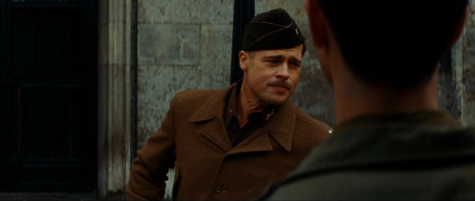
What Cronin shares with the Mediterranean and Mediterranean-style epics, in other words, is their long-durée concern with the Fate of Civilizations, a concern that requires his distended and decidedly non-novelistic narrative canvas, the span of generations. It is from the epic, too, that he has borrowed his descriptions of the zombie armies, though perhaps unwittingly and at two or three removes. Epics are utterly fixated on the distinction between fully settled people and still tribal or semi-nomadic ones. The final books of The Aeneid describe a small army of Trojan survivors as they invade Italy and conquer its indigenous people. Milton’s Paradise Lost describes Adam and Eve as two dwellers in the wilderness, naked foragers in “the new world.” The first American epic, Timothy Dwight’s Conquest of Canaan, recounts in heroic terms a righteous people’s war of extermination against a nation of savages whose land they regard as earmarked. The affinity matters because it is in some of its epic qualities that The Passage is least like a fast-zombie movie, since the films generally have compressed time-frames; are interested only in the apocalypse and its immediate aftermath; and almost never show survivors successfully fighting back. This is how we know that Cronin is not just cashing in—because to write a fast-zombie epic is something entirely different from, say, just novelizing Dead Alive, simply by virtue of letting the novel proceed past page 250, past the nuclear explosions over Boise and Bend, Oregon—simply, that is, by allowing that there might be, even after the swarming, story left to tell.

This then brings us to the next claim that reviewers have been making, which is that…

•2) The Passage is a wonderfully hopeful book.  Time magazine called it “a story about human beings trying to generate new hope.” One of Salon’s readers remarked that “the post-apocalyptic world feels more hopeful than what preceded it.” Another reader agreed that the book’s middle and late sections are “immensely hopeful.” This hope is one of the things in the novel that most needs specifying, because Cronin has produced a full-on reconstruction narrative. It is hard to stress this point with the banging emphasis it deserves. The mood is one of settler expectancy, of pilgrims surveying a land whose savage inhabitants are dying of an introduced disease, though they still lurk ferociously in forests and canyons. The Passage, in other words, is trying to counter the despondent vibe of the long Iraq-Afghanistan decade by retelling the old America myth the way that public school textbooks are no longer allowed to tell it; by trying to get you to occupy the valiant position of the embattled pioneer, to imaginatively inhabit the geography of early settlement, what we used to call the frontier.

There are actually two major historical models that Cronin has incorporated into his book. The first is medieval Europe, especially in its early stages, the systole and diastole of contraction and expansion, the post-Roman heartbeat: villages in Normandy gathering in their borders like so much extra fabric; towns building walls; lords building castles; and then—back out into the wastelands; the outgrowth of an armed agrarianism; planned settlements for serfs beyond the Elbe, generous terms, no labor service, five years rent-free!; Teutonic Knights; Frankish machine-men with their monster-horses and their death-arrows; northern crusades into the heathen Baltic; the Spanish Reconquista—and no historical meme looms larger in The Passage than that: the Reconquest of America. The book’s survivors live in a walled city and have something like guilds and wear tunics and have all but abandoned books and carry crossbows, which were the tenth century’s great advance in military technology, a weapon  so unsportingly good at killing people that the Church tried to limit its use. Crossbowmen were briefly pariahs.

The survivors also ride horses, though this image obviously does double duty. For beyond its medievalism, The Passage is most obviously a zombie Western—Cronin himself has said as much—subcategory siege, with the California settlement doubling as fort. Survivors trek across Nevada and Colorado. They cook jonnycake. A man in a remote house pours boiling water into a tub for his pregnant woman and sits watch at night, shotgun across his lap, armed against whatever might come stalking out of the woods.

The Passage, then, generates “hope” only because it’s underlying notion is that we’ve been through this all before; it is telling, through proxies and vampire-puppets, a history whose ending we already know; and so reassuring us of a certain cycle or historical repetition. Cronin’s answer to our usual bum and apocalyptic trip is to help us envision another round of colonization. North America will get to resettle itself. Indian Wars will be refought. To this end, the novel works in five or six documents form the distant future—conference papers from some symposium a millennium down the line—which is our guarantee, from an early point in our reading, that civilization has survived somewhere and in some form.

Another claim out of the reviews…

•3) The Passage is especially interested in what one reader calls “the civic structure of the colony.” This is true—and it’s an extension of the last point—because it involves “hope” again—and not just hope, but this horror novel’s unexpected interest in hope’s proper literary form and vehicle, which is utopia. Absolutely nothing about The Passage is more surprising than the moment that comes about a third of the way through, after you’ve read hundreds of pages of an utterly routine X-Files/outbreak plot, and you turn the page, and that plot is gone, and a full-blown utopia has taken its place, which is another way of gauging Cronin’s sense of his own writerliness, since the genre-swap—from apocalypse to utopia—is among other things a shift over from a heavily cinematic form to a quite peculiarly literary one. I don’t know that film is structurally barred from attempting outright utopias; I do know that it almost never does. Cronin, for his part, goes so far as to reproduce in its entirety the survivor colony’s written constitution, which is how you know that he has the genre’s canonical texts in mind—Thomas More, William Morris, and the like—that he is actually speculating about the daily workings of an alternate political order. That list of basic laws is the token of Cronin’s utopian seriousness (and is one of the feature’s of utopian writing that a commercial film would have the hardest time reproducing). Salon’s book critic, Laura Miller, said that the utopia was her favorite section of the book, but she is professionally disallowed from using that word, so what she actually said was that she “loves stories about how people form and sustain communities.” “Isn’t life in this last city kind of ideal?” a reader asked, “—if you ignore the vampire bit.”

It is under cover of phrases like these—“sustaining community,” “ideal city life”—that the novel’s fascism rides in. This is itself rather fascinating, since utopia often seems like the special province of the political Left, in some another-world-is-possible kind of way. The term itself, officially neutral, nominally harnessed to no particular ideology, was claimed by socialist thinkers early on. Fredric Jameson continues to use it as a euphemism for “communism.” So it is all the more remarkable to watch an American novelist, in apparent sincerity, attempt a utopia with strong fascist elements. There are at least three:

a) The first thing the constitution does is establish sovereignty, a “final authority” charged with “safeguarding DOMESTIC ORDER” and empowered to declare “CIVIL EMERGENCY.” This is Schmittian boilerplate, and generically authoritarian rather than specifically fascist, but it is worth noting that Cronin’s California does, in fact, break with the main lines of Anglo-American political thought, which—with their doctrines of mixed monarchy, the division of powers, check-and-balances, institutional cantilevers and counterweights, programmed-in gridlock and indecision—have always been hostile to sovereignty of precisely this kind. Montesquieu and Madison are among the books that no-one in the future will be reading.

b) This second one will take a little more explaining. Some social historians think that modern politics came into being in the seventeenth century when European governments began allowing themselves to worry about demography, which is to say to worry about the size and health of their populations. This led, in a hundred different ways, to a politics of the body; a medicalized politics of health and hygiene and sanitation; new political initiatives around birth and death; &c. One way of thinking about fascism is that it marked the culmination and cancerous transformation of this centuries-old development, which, however, continues to shape all modern governments, and especially the social democracies, to some greater or lesser degree. The important point about Cronin, then, is that his utopian colony is nakedly biopolitical in just this way, a utopia of eugenics and euthanasia. Fully a third of the constitution’s provisions involve quarantine. There are entire chapters devoted to mercy killings; when colonists are dragged away by vampires, their closest family have to ritually keep watch on the colony’s walls and cut them down if they return. Cronin calls this “standing the mercy.” Women in his utopia are taught trades, but then forced to abandon them when they become pregnant, relegated into compulsory motherhood, in a special building they are not allowed to leave. It is Cronin’s bleak gift to make such a scenario seem reasonable to an ordinary American reader—to make plausible that old physiocratic preoccupation with demography, with keeping the numbers up—by forcing us to imagine a human population reduced to some few hundreds.

c) The colony is also pervasively militarized, which is one of the ways its order is most like a fascism and least like an ordinary authoritarianism, since yer run-of-the-mill authoritarian wants the leadership to preserve a monopoly on force. In Cronin’s future, everyone is taught how to fight. There are weapons ready in every room. This is an ethos of war and blood, a society that has regenerated itself by abandoning the pacifism and potbellies of liberal society, though on a casual read, this all registers only as a low-level Spartanism. Nine-year olds get put through their daily samurai drills: “Where do they come from?” “THEY COME FROM ABOVE!” “And what do we get?” “WE GET ONE SHOT!”

That’s how The Passage looks if you emphasize its utopian qualities, hence its imagined innovations, its breaks with the established order of 2010—and it’s worth underscoring that these add up to a kind of political argument, since Cronin is trying to explain the difference between a society that knows how to survive a terrorist-savage threat and the United States, which, in the novel’s terms, mostly doesn’t. To that extent, these breaks all have the force of recommendations, what the U.S. could have done, but failed to do, to keep itself intact: Streamline the political chain of command, make sure pregnant women stop working, strictly limit the rights of immigrants, lie to the children, seal the borders, build a wall around them, shoot anyone who gets close.

But we can also run the argument in the other direction, and emphasize instead those features of our readerly present that Cronin’s settler-utopians would preserve. The novel’s medievalism, reconsidered from this angle, turns out to be something of a red herring, since its survivors see themselves as the keepers of American techno-civilization; the guardians of illumination in a vampire dark age, though that word, illumination, now refers to halogen lamps and not manuscripts; the ones who can keep running—literally; this is in the novel—the Humvees of the lost world. The novel’s premise is that civilization has collapsed, and yet it remains most interested in the people who have inherited American achievement. Civilization will only be possible again when people figure out how to re-activate its machinery. The middle sections of the novel are accordingly made up of three stock scenes regularly repeated: Characters try to improvise a patch on some machine they consider essential but no longer know, curved-arch-like, how to manufacture. Characters leave the colony to scavenge century-old goods from decaying strip malls and military bases, hunter-gatherers foraging for high-tops like they’re loganberries. Characters encounter some forgotten or never-before-seen device and wonder what it is and how to use it. This aspect of the novel becomes more and more important until it effectively takes over, since the novel’s final order of business is to fold the colonist-survivors into the U.S. Army, which is a techno-survival of an entirely different order, the novel’s strange belated admission that civilization didn’t really collapse after all, certainly not to some zero point. What destroys the first host of vampire-zombies, then, is a nuclear bomb left over from the military—a military solution, then, to a problem created by the military. Salon’s Laura Miller says she likes that the colonists come to the realization that they “need the outside world,” but taken on its own the phrase “outside world” could mean just about anything, when the novel is by necessity much more specific: The colonists need a modern military and heavy ordnance.

The one observation that Miller makes that is flat out wrong is that the novel’s idiom is not ethical or religious. She has said this more than once: “Cronin’s novel isn’t about the clash between good and evil, but about humanity’s struggle to forge a better world.” “Cronin’s characters, unlike [Stephen] King’s [in The Stand], are not caught up in a struggle between Good and Evil.” It’s true that Cronin is being a little sneaky on this front. The survivor colony is nominally post-Christian; they remember Christmas only as a rumor or a legend; they have adopted a new calendar that makes no reference to Domini. But then Cronin makes it his business, in the novel’s final chapters, to smuggle back in all the Christian language that he has up to that point carefully withheld. The Passage, indeed, is so stupidly ethical that it features not only a demonic head vampire whose name contains the word cock, but two supernaturally good characters, as well, the more important of whom is a pre-pubescent girl, and cock and girl appear to one character by turns in a dream and tell him respectively to murder and not to murder a woman in that dream, as in: Cartoon devil on your left shoulder, cartoon angel on your right. That the other radiantly moral figure is a Catholic nun should sufficiently confirm the point. In fact, by the time the novel ends, readers will have to swallow: an immortal nun, an act of heroic martyrdom, characters galvanized upon hearing Bible stories, a set of fiendish counter-apostles called “the Twelve,” and a group fighting these hellhounds led by a man named Peter, about whom sentences like this are written: “He inched his way forward, each step an act of faith.”

More generally, The Passage is packed with writing borrowed from the traditions of sentimental and domestic writing, and this, too, adds up to a kind of shadow Christianity or orthodox morality. It is also another of the ways—indeed, the most pervasive way—in which The Passage tries to make literature out of its cinematic scenario. Everything is POV, free indirect discourse, interior monologue. Events are endlessly focalized, and an intimacy is thereby obtruded on this Gibbonesque-Hobbsean story of civilizations falling and original contracts being formed. It is hard to overstate just how much family writing there is in this book, paragraph upon paragraph describing the ferocious attachments one feels to one’s closest kin: The only moment of love the colony’s leader ever felt was when his daughter was born. One woman reflects at length on how “wonderful” it was “to feel a baby moving inside her.” A tough warrior out on the quest confesses that what he misses most are “the littles.” Time praised the book for its “psychological insight.” Laura Miller said it was a vampire-zombie story “with heart.” In sentences like those we see a hard Right politics being made psychologically credible to a contemporary readership—and the psychology in play is a reassuringly familiar one, the psychology of Uncle Tom’s Cabin or a PTA meeting, the known term that carries you to an unknown place. Fascism is something you do for the kids.

What we can say now, then, is that Cronin’s utopio-fascism is tempered by a certain conservatism. But then fascism, of course, came in all sorts of different forms; it had national variants for one; and each fascist intellectual dreamed up a slightly different fascism, none of which corresponded precisely to any of the fascisms that actually existed on the ground. In the interests of precision, then: Cronin is helping us make our peace with an American fascism, but his is not the fascism of the intellectuals and the avant gardists, not a Nietzschean and anti-bourgeois fascism, which would, let’s face it, probably prefer the vampires. His is a fascism that has in certain key tenets—respect for Christianity and a conventional military hierarchy—joined forces with the conventional Right: a Spanish fascism, if you follow me, rather than a German one.

But then it’s not enough to name, however precisely, which particular historical variant of fascism Cronin is trying to resurrect. The important point, rather, is that Cronin is trying to imagine a version of fascism that has never existed, and this gets us to the crux of the matter: How, after all, do you engineer a fascism that will be palatable to a contemporary American audience, and not just to any audience, but to a Salon audience, a bunch of literate Lefties, the type of people who participate in book clubs? The answer, I think, is quickly given: You subtract race from the equation. For Cronin’s colonists are all multi-racial; the novel makes a big deal of this early on. Racial categories are, like the Jesus story, one of those things from Before that the survivors have heard about but barely understand. The novel is more cunning than this even. The utopian section begins with a kind of oral history recorded by the last person who was born before the vampire apocalypse. And she’s an old black woman, although the novel never out and tells you this; it expects you to hear it in her cadences. That’s a far cry from, say, Tolkien, who is sheerest poison, Wagnerite Anglo-fascism without the tunes. Tolkien’s racialism was always all but overt, just under the surface, like Norplant: all those Celtic-Viking heroes and elephant-riding bad men from the East; that scheming, greedy golem-Jew; those monstrous Urak-hai-sounds-like-Iroquois. So whatever Cronin is up to, it’s not that. Instead, he has worked out a more subtle kind of racial feint; he makes a black woman our gateway into the fascist utopia. The novel actually does something similar in matters of gender, since our colonist-heroes end up visiting two other survivor compounds, each of which treats women much worse than the novel’s central settlement, which means that readers can tell themselves that the colony, whatever its policies on pregnant women, has achieved a fair degree of gender equity. And then that’s it right there: A fascism in which people of all races and genders can participate more or less equally—that’s how one creates a fascism that will pass first-line liberal scrutiny. If you make it so that fascism isn’t primarily racial, an American reader won’t even recognize it as fascism. But then, of course, Cronin can only produce this de-racialized version of fascism because he has transferred the entire apparatus of race onto the zombies, who are sometimes just called “the Many” and who are, of course, a population of the killable. He can loosen racial categories among the survivors, because he has preserved the lethality of race at a higher and more abstract level. Not that any of this is buried in the novel, exactly, since the survivors have a series of different racial epithets for the zombies, one of which is “smokes,” which, well, if you don’t know, you should probably look it up, is all I’m saying. One of Salon’s readers said that “smokes” was “invented language” —and thought it was neat. And it just ain’t … neat, I mean … or invented.

The Running of the Dead, Part 4

PART 1 IS HERE.

PART 2 IS HERE.

PART 3 IS HERE.

28 Days Later: The Set-up, continued

Let’s rewind a few sentences:

Occasionally, a young woman catches herself daydreaming about someone really close to her dying—not because she wishes it—not at all—but because she is compulsively rehearsing in her head how terrible it would be. So she daydreams, despite herself, that her boyfriend is dead and then she rushes to the living boy and surprises him by saying: I love you so much! 28 Days Later is like that, except it’s the government, and not your boyfriend, who has died in the daydream’s car crash or cancer bed. The movie opens up for you the morbid headspace to mourn the government, even though we currently still have one.

There’s a variation on that same sinister reverie that zombie movies regularly spin; we can call it Having to Kill Someone You Love. In 28 Days Later, the harsh lesson goes like this: If a living person turns in your presence, “you have ten or twenty seconds to kill them. It can be your father or your sister or your best friend.” Scenes of this kind, in which intimates get euthanized, are all over the zombie film. They are as basic to the genre as transformation scenes are to werewolf movies. They are, indeed, an adaption of those very scenes: accelerated and moonless turnings in which the dog never makes it out of the vet’s office; lycanthropic kittens drowned in sacks.

But then what we’ve just spotted is a continuity, a convention that carries over from slow zombies to fast. Both types of zombie movies go in for transformation scenes; nothing has changed on that front. And this, in turn, prompts a rather interesting question: How does the Hobbsean orientation of the fast-zombie movie reframe the genre’s usual conventions? 28 Days Later may break with the Romero-era zombie movie in a few basic ways, but most of Romero’s conventions it actually takes over intact. The possibility we now need to consider is that those innovations are so drastic that they change the meanings even of those features that the movies most obviously share, simply by supplying them with a new context.

The best way to follow this out is simply to watch 28’s first mercy killing: A survivor gets infected, looks left, imploringly, past the camera; one of his comrades immediately leaps across the screen—to put him down—except all she has is a machete, and the viewer has to sit through seven sharp, moist swats. That the woman is black and the man white brings to the surface the scene’s historical provocation: A black woman hacks a white guy to death with the Third World’s iconic weapon, the curved blade that Africans and Caribbean islanders have lying around, the knife for whacking bush and coconuts and political rivals. In 2002, the image might still have brought Rwanda to mind, which reference-point is not wholly irrelevant, since one way of summarizing 28 Days Later would be to say that it is asking you to imagine Britain as a “failed state,” when that last is the current Hobbsean term of art.

Now the important point is that if we were watching this scene in a Romero movie, we could probably guess its effects, since Romero specializes in setting up equivalences between zombies and human survivors; in forcing viewers, that is, to conclude that there isn’t very much difference between people and zombies after all (since the condition of zombism is the condition of our stupid, little lives, &c). We could say something similar of 28 Days Later: the scene is quite conspicuously brutal, and the woman with the blade manifestly displays the ferocity of her zombie-opponents, and though this familiar line wouldn’t exactly be wrong, it wouldn’t really be right either. The scene presents an unusually good opportunity, in fact, to specify the fast-zombie movie’s Hobbsean labor: When the living people in Romero start acting like zombies, this discredits them; it makes them scary. And that’s not true of 28 Days Later. The woman commits murder right in front of us, and that act doesn’t discredit her, doesn’t make her scary. Her situation is scary, but she isn’t, because the killing has been explained in advance by the movie’s Hobbsean frame, to the effect that people living without a government don’t have any choice but to act like zombies or savages. The obligation to kill is part of the horror. Hobbes’s entire point is that people living in a stateless condition don’t get to choose to be good people; life without a government requires brutality from everybody. When you slowly realize, watching Night of the Living Dead, that nearly all of the survivors are as violently brain-dead as the zombies, it’s a crushing experience—anyone who remembers that movie’s final credits will know what I mean: They force you to reevaluate everything that’s come before. But in 28 Days Later, the realization comes early and is no kind of surprise; it is simply built into the scenario.

This point is then amplified in a bit of a dialogue a few scenes later. The hero and the woman with the machete are looking at an old photograph, from Before, a smiling middle-class family, cinched in close together, laughing father, beaming mother, ungrudging teenager caught in a group hug. The hero remarks that they look like “good people.”

MACHETE: Good people? … Well, that’s nice, but you should be more concerned about whether they’re going to slow you down.

HERO: Right, because if they slowed you down…

MACHETE: …I’d leave them behind…

HERO: …in a heartbeat…

MACHETE: …yeah.

HERO: I wouldn’t.

MACHETE: Then you’re going to wind up getting yourself killed.

The movie, in other words, turns the photograph into an occasion for a colloquium on the domestic virtues: sentiment, fellow feeling, and the like. The hero is talking like a Christian or benevolent liberal, and it is another one of the distinctive features of zombie movies as a form that they render that position—the position of a generic goodness—utterly impossible. The hero has to be weaned of his decency, and we will know that he has achieved this new moral consciousness when we witness him kill a (zombie) child.

The point is complicated, though. By the time the movie ends, the liberal and the killer will have moved in together, into a northern cottage, with the girl in the photograph as their adopted daughter, and so have reinstituted a humanist ethics or at least a coziness; their values get un-transvaluated. This gets us back to Hobbes and the authoritarian Right, whom we can now distinguish from the Nietzscheans by pointing out that they precisely don’t want the condition of pre- or post-humanist savagery to persist. They don’t want people to have to be beasts. Indeed, they want people to be able to act like Christians or benevolent liberals, but in order for this to happen—and this is the properly political, which is to say structural and so anti-ethical moment in Hobbes’s thinking—in order for this to happen, in order for you to be a decent person, there has to be some fundamental shift in the political order, or rather, politics as such has to be born. Political society has to constitute itself. The problem, then, for a Hobbsean is that liberals and Christians fail to grap the close conjunction between their decency and the exercise of force, fail to grasp that kindness and the police go together, that the police make kindness possible, which means that kindness will never be able to substitute for the police.

28 Days Later has worked out a way of telegraph this idea visually, in what is probably  the most clever sequence in the entire movie. The two survivors—the Hero and Lady Machete—have worked out that there are other living humans in London, at least a few of them, hiding in an apartment high above the city. They sneaky-pete their way up the building’s stairwell and down the corridor toward the apartment’s door, where they see this figure…

…who turns into this figure…

…who turns into this figure…

It’s all something of a sick joke: First we encounter an unmovable paramilitary cop; he mutates into a balaclav’d thug, marching straight for the camera, in a shot borrowed directly from slasher movies; and this killer then peels off his mask and reveals himself to be … Brendan Gleeson, an actor of excellent good cheer, boozy and lummoxing, a kind of human wassail. The idea here is that open-hearted, hospitable middle-class people and the riot police actually go together, though not usually in a single person. Such, at least, is the Hobbsean take on the issue. What the movie has done is taken the two sides of bourgeois society, usually experienced at a confusing distance from one another, and welded them back into a single figure—the softie and the cop, the teddy bear and the guy who’ll push your face in—and thereby bodied forth the interdependence of those positions, which is what liberals putatively never get.

•28 Days Later: The switcheroo

So we can say that 28 Days Later forces us to imagine a certain crisis, the complete breakdown of political order into terrorism and savagery. And in the history of political thought that idea comes with a built-in solution: Strengthen the state, strengthen the police, the military, the executive. Expand the emergency powers of the central authorities. It is this fantasy that the movie puts into play. The first half of the movie follows a group of survivors as they straggle across a de-populated England trying to get to whatever is left of the state: the Army’s last uninfected platoon, garrisoned in an old manor house, chanting the Hobbsean mantra: “We are soldiers. … Salvation is here. … We can protect you.” One of the civilians has preemptively echoed the point: “The soldiers could keep us safe.”

At this point I might as well just out and say what the movie does to this fantasy, which is that it explodes it into little bits. That is the single most important fact about 28 Days Later, that it drives you into the arms of the soldiers, convinces you to look to them for refuge, and then turns the soldiers into monsters in their own right, mostly because they plan to begin a breeding program upon the bodies of the two surviving women and so immediately default on their promises of asylum. There are obvious precedents for this: In the later stages of the movie, Boyle begins borrowing shots from Apocalypse Now, and these are so many visual nudges, reminders that the underlying scenario is straight out of Heart of Darkness: The last outpost of civilization turns out to be a whirring freak show. So a borrowed plot, though it is fascinating all the same to watch a certain Conradianism well up unexpectedly within the horror movie. For Colonel substitute “Major” and for Kurtz substitute “West”—that’s the movie’s human villain—“He’s insane!” someone shouts—Major West, which name is of course allegory reverting back to plain-speech.

But then most people aren’t going to be chasing down the literary history while watching a movie, so perhaps it’s more appropriate to explain 28 Days Later as a basic exercise in emotional manipulation: It sets you up to want the soldiers, to be desperately pro-military, and then once you get your wish and end up face to face with the Tommies, it makes them creepy—not exactly like the monsters—the distinction will matter—but in their own way fiendish. It forces you to experience them as oppressive. No-one calls soldiers “grunts” because they’re polished. And to call them “dogfaces” suggests only that the enemy had better be shooting silver ammo. Such, anyway, is Boyle’s con, his trick. He seems to be making all of the Right’s moves—and just when the time comes to put the Right’s solution in place, he undoes it instead—and thereby makes clear that he was playing a different game all along.

Let me take another crack at it: 28 Days Later swaps out the problem of sovereignty or political order and puts another, entirely different problem in its place. At its most basic level, this is a point about the plot, and so about your actual, minute-by-minute experience of the movie, if you’re watching it for the first time. It looks like it’s going to be a straightforward trek movie, in which the credits will roll once our heroes find the army unit. In a different kind of movie—the kind of movie that Boyle lets you think for a while he has made—the soldiers would constitute a happy ending. But as soon as the survivors arrive at the army’s aristocratic headquarters, the soldiers mutate into a new problem. Authority stops being the solution and becomes instead the crisis. The hero, in other words, will have to learn to fight the soldiers—and not the zombies he thought he was fighting all along. Here’s another way of gauging how curious 28 Days Later is: The movie’s longest fight sequence, its protracted-final-action-horror showdown, involves the zombies barely at all; it pushes them to the periphery, in a clear indication to the audience that they should stop worrying so much about the goddamned zombies already. More: By that point, the hero is, if anything, aligned with the zombies; he is literally fighting alongside them. Boyle, having carefully tutored you into the statist position, is violently reversing course, and will now insist that you take up the anti-statist position. 28 Days Later has the structure of a movie arguing with itself; it is a grindhouse paradox or splattery antinomy.

This plot point—expectations established, then violated—in turn houses a rather sly visual puzzle. It’s a variant of the machete problem: That final fight is spiked with a series of uncanny shots in which it becomes increasingly hard to tell whether the hero has been infected or not, whether or not he has turned zombie.

•The camera pans slowly around an army truck, and catches the hero pressed up against its slats, still and seething, his eyes blotted out by shadow. The sound track supplies what is either a loud wheeze or a soft grunt: a growl. From this point on, we are watching a horror movie run in reverse, in which the hero is inserted into the shots typically reserved for the monsters and the soldier-villains are tricked out with all the visual conventions of victimhood.

•The hero flits past the camera, barely more than a shadow himself, which is another monster shot: two seconds borrowed from an Alien movie. And by bringing in an actual raging zombie just a little after that, the movie makes you wonder for real whether the hero hasn’t been infected, because it puts the contagion on the scene, dangerously close.

•The fight moves to the manor house, where there are two figures on the rampage: the hero and the zombie who doesn’t bake, now unchained. The hero spends the entire sequence wet, bloodied, and shirtless, his face distorting in the old building’s blown glass windows.

The eye’s confusion is actually a political test. The hero is trying to destroy the bearers of authority; our ordinary word for that is revolution. So by the end of 28 Days Later there are three positions available to the characters where earlier there were only two: 1) The savage or the terrorist; 2) the state and its protections; and now 3) the revolutionary. So in these shots the movie is posing another tough question: Is the hero zombie or human? Can you tell the difference between a savage and a revolutionary? Or more to the point: Can you tell the difference between a terrorist and a revolutionary? That’s a profound question, one that has lost none of its moment.

You can also pose a version of that question from inside the revolutionary’s head. The revolutionary has to ask himself what he is doing when he unleashes his own rage or taps into the rage of other people. Can you set that violence loose, direct it, and still rein it in once it has done what you needed it to do? The movie becomes a meditation on the basic problem of revolutionary violence. And the movie doesn’t stay up in the air on this issue. It resolves the paradox by deciding, via its own writerly dictates, that you can do this—you can direct violence to good ends. It comes down on the side of the revolutionary, although revolution is depicted here as a good old-fashioned quest to rescue the maiden from the lair.

It all comes down to this: 28 Days Later, the movie that for all intents and purposes created fast zombies, was already the movie that demystified them. The subgenre stands permanently indicted by its own author and source. Boyle’s movie is not the progenitor to [REC] and Quarantine and the Dawn remake and Justin Cronin’s vampire-zombie novel The Passage; it is their accuser, the one that calls them out on their despotism and aufgehobener race-hate.

A movie that initially expends all of its ingenuity getting us to love sovereignty ends by getting us to love instead sovereignty’s overturning. And there is one more gotcha secreted away inside of that big one: Boyle is an Irish director born in England. All we have to do is keep that in mind and then think about who survives in this movie. At first, there are three adult survivors: an Englishman, a black woman, and an Irishman. The hero is Irish, though the dialogue never once pauses to remind you of this. The first word he speaks, other than “hello,” is “Fadder” — hesitantly addressed to a zombie priest, both question and greeting: “Fadder?” In fact, the actor playing the Englishman is also Irish, so he’s nearly a Dubliner in disguise. The more important point is that the movie kills him off, but then it’s already killed off all the adult English, which means that the people left to repopulate England are the Jamaican woman and the man from Cork, and that the seeds of the new nation will barely include Angles, Saxon, Normans, or anyone else who has typically kept that land in copyhold.