The Log-Convex Density Conjecture

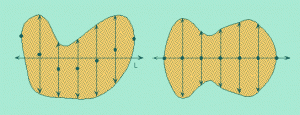
Announcement: proof posted 19 November 2013 by Gregory R. Chambers, student of Regina Rotman and Alex Nabutovsky at Toronto. By spherical symmetrization the problem reduces to planar curves, which he studies very intelligently in great detail. The main idea is that if the generating curve is not a circle about the origin, then from its maximum (on the axis of symmetry) it spirals inward and it eventually turns through 2π before returning to the axis, contradiction. See his 30-second video. “Proof of the Log-Convex Density Conjecture,” J. Eur. Math. Soc. 21 (2019), 2301–2332.

Update August 2, 2022. arXiv:2208.00195. “Approaching the isoperimetric problem in H^m_ℂ via the hyperbolic log-convex density conjecture” by Lauro Silini. Abstract: We prove that geodesic balls centered at some base point are isoperimetric in the real hyperbolic space H^n_ℝ endowed with a smooth, radial, strictly log-convex density on the volume and perimeter. This is an analogue of the result by G. R. Chambers for log-convex densities on ℝ^n. As an application we prove that in the complex and quaterionic hyperbolic spaces, geodesic balls are isoperimetric in a class of sets enjoying a suitable notion of radial symmetry. The hyperbolic plane case was proved by Igor McGillivray: arXiv:1712.07690, “A weighted isoperimetric inequality on the hyperbolic plane.”

Ken Brakke’s Log-Convex Density Conjecture [Rosales et al. Conj. 3.12] says that in Euclidean space with radial log-convex density f(r), balls about the origin are isoperimetric.

A density is just a positive continuous function used to weight volume and perimeter. Log convexity just means that log f is convex. Balls isoperimetric means that any other region of the same weighted volume has no less weighted perimeter.

Log convexity is necessary because it is equivalent to stability. The question is whether it is sufficient. Continue reading ‘The Log-Convex Density Conjecture’ »

Isoperimetric Inequality in Complement of Mean Convex Set Fails at Banff

On March 29 at Banff, Mohammad Ghomi talked on his proof [CGR] with Choe and Ritoré of the isoperimetric inequality in the complement of a convex body K in Rn: the area of a hypersurface enclosing volume V outside the convex body is at least the area of a hemisphere of volume V. I asked whether it suffices to assume K mean convex (nonnegative mean curvature). The answer is no. Continue reading ‘Isoperimetric Inequality in Complement of Mean Convex Set Fails at Banff’ »

Manifolds with Density: Fuller References

SELECTED PUBLICATIONS IN THE HISTORY OF MANIFOLDS WITH DENSITY:

[1959] A. J. Stam, Some inequalities satisfied by the quantities of information of Fisher and Shannon, Indo. Control 2 (1959), 101-112, Eqn. 2.3. Gives a version of Gaussian log-Sobolev inequality, used by Perelman, often attributed to Gross [1975] or sometimes Federbush [1969].

[1966] E. Nelson, A quartic interaction in two dimensions, mathematical Theory of Elementary Particles (Goodman, R. and Segal, I., eds.), MIT Press, 1966, 69-73. Gross [G] says that the entire subject of logarithmic Sobolev inequalities and contractivity properties of semigroups was started in this paper.

[1966] Harper, L. H. Optimal numberings and isoperimetric problems on graphs. J. Combinatorial Theory 1 1966 385-393. Apparently uses measure and metric, cited by Ledoux-Talagrand [1991], both cited by [Ros, §1.4, p. 182].

[1969] Paul Federbush, A partially alternate derivation of a result of Nelson, J. Math. Phys. 10 (1969), 50-52. Gives Gaussian log-Sobolev inequality, used by Perelman, often attributed to Gross [1975], actually probably due to Stam [1959].

[1970] André Lichnerowicz, Variétés riemanniennes a tenseur C non négatif, C. R. Acad. Sci. Paris Sér. A-B 271 (1970), A650-A653. Studies Ric – Hess log density to prove splitting theorems.

[1973] E Nelson, The free Markov field, J. Funct. Analy. 12, 211-227. Gross survey ([G] below) says equivalent form of Gaussian log-Sobolev inequality.

[1975] Christer Borell, The Brunn-Minkowski inequality in Gauss Space, Invent. Math. 30 (1975) 207-216. Also: V. N. Sudakov and B. S. Tsirel’son, Extremal properties of half-spaces for spherically invariant measures, J. Soviet Math. (1978), 9-18 (1974 in Russian). Proof of Gaussian isoperimetric inequality.

[1975] Gross, Leonard, Logarithmic Sobolev inequalities. Amer. J. Math. 97 (1975), no. 4, 1061-1083.  Proves Gaussian log-Sobolev inequality, used by Perelman. Not yet realized that it was trivial consequence of Gaussian isoperimetric inequality via analytic version which [Ros,  §3.4] traces back to Ehrhard [E, 1984] and Bobkov [B7, 1997], first observed by Ledoux ’94 and Beckner ’96 (published [1999]) (see Morgan Blog and email from Milman). Precursors are Stam [1959] and Federbush [1969] (see Gross survey [G]). Continue reading ‘Manifolds with Density: Fuller References’ »

Manifolds with Density

Spaces M with metrics and measures, so-called metric measure spaces or mm spaces (see e.g. Gromov [G]), include very general singular manifolds and weighted graphs. In the smooth case, M is a Riemannian manifold endowed with a smooth positive function or “density” f;  the prescribed measure is just f times the Riemannian volume. In freshman calculus one studies surfaces and solids of revolution via their generating curves and regions in the halfplane {x>0} with density f(x) = 2πx. All quotient manifolds of Riemannian manifolds and homogeneous spaces G/K are Riemannian manifolds with density, and mm spaces were previously called spaces of homogeneous type (see [CW, pp. 587, 591]). Another example, long important to probabilists, is Euclidean space with Gaussian density.

Continue reading ‘Manifolds with Density’ »

Newton’s Principia

In reading prefaces to various works collected in the Harvard Classics (limited edition set no. 1312, purchased by my grandfather but never read, so that I had to slit open the folded pages with a knife), I was struck by the clarity and scope of the preface to Newton’s Principia. Newton announces an explanation of “the system of the World” by deducing the planetary orbits and the terrestrial tides by calculus from his new law of gravity. Then he says he wishes he could similarly derive “the rest of the phenomena of nature” from as yet undiscovered laws of attraction and repulsion between small particles. In the last sentence quoted below he explains how he deals with what was an annoying problem for writers before TeX. Continue reading ‘Newton’s Principia’ »

Functional Isoperimetric Inequalities

In geometry the most fundamental inequalities are isoperimetric inequalities. In this post we will focus on dimension two, although all of the results extend to higher dimensions. In R2, the perimeter and area of a region satisfy

(1)            P ≥ (4πA)1/2,

with equality for a round disc. On the unit sphere, for 0 < A < 4π,

(2)            P ≥ (A(4π-A))1/2,

with equality for a geodesic disc.

In analysis, the most fundamental inequalities relate functions and often their derivatives. Continue reading ‘Functional Isoperimetric Inequalities’ »

Baserunner’s Optimal Path

Note added 13 June 2017: see a video featuring Prof. Johnson at the NESN Clubhouse.

In his senior colloquium last fall advised by Frank Morgan, Davide Carozza ’09 investigated the fastest path around the bases in baseball, assuming a bound of say 10 ft/sec2 on acceleration/deceleration. Following the baseline, stopping at each base, takes about 22.2 seconds. The standard recommended “banana” path follows the baseline maybe halfway to first base and then veers a bit to the right to come at first base from a better angle to continue towards second. That cannot be ideal. It would have been better to start at an angle to the right to head directly to an outer point on the banana path. Davide found that a circular path at 17.8 seconds is roughly 20% faster than following the baseline at 22.2 seconds. Stewart Johnson then computed the following optimal path at 16.7 seconds. The record time according to Guiness is 13.3 seconds, set by Evar Swanson in 1932 (with larger acceleration than our assumed 10 ft/sec2).

Is it legal to run so far outside the base path? Continue reading ‘Baserunner’s Optimal Path’ »

Gauss-Bonnet with Densities

The celebrated Gauss-Bonnet formula has a nice generalization to surfaces with densities discovered by my 2004 undergraduate research Geometry Group. The classical Gauss-Bonnet formula relates the integral of the Gauss curvature G over a disc D to the integral over its boundary of the geodesic curvature \kappa:

\int_{\partial D}\kappa + \int_DG = 2\pi.

One can weight arclength and area by densities:

ds = \delta_1 ds_0, dA = \delta_2 dA_0.

Surfaces with density appear throughout mathematics, including probability theory and Perelman’s recent proof of the Poincaré Conjecture (see Chapter 18 of the 2009 edition of my Geometric Measure Theory book). Important examples include quotients of Riemannian manifolds by symmetries and Gauss space, defined as Rn with Gaussian density  c exp(-r2).

The generalized Gauss curvature is given by

G^\prime = G-\Delta log \delta_1.

Ivan Corwin and I have just written an article about this. The formula for how Gauss curvature changes under a conformal change of metric is a simple special case.

Symmetrization

Write-up of a departmental faculty seminar, October 2, 2009.

Solutions to problems in geometry and physics and even in the social sciences tend to be symmetric. As prime example, the solution to the isoperimetric problem, which seeks the least-perimeter way to enclose given volume in R3, is a sphere, the most symmetric of all shapes. One way to prove this is to show that anything else improves as you make it more symmetric. For thousands of years, mathematicians have been looking for good ways to make shapes more symmetric and to prove that as they get more symmetric they “get better,” for example, enclose the same volume with less perimeter.

My favorite references are Burago and Zalgaller [BZ, §9.2] and Ros [R1, §3.2]. This talk is based on [MHH]. Gromov [G, §9.4] provides some sweeping remarks and generalizations, including most of our results.

1. Steiner symmetrization [St, 1838] replaces every vertical slice of a region in R3 with a centered interval of the same length, as in Figure 1. By calculus, the volume does not change, but one can show that the perimeter decreases (or remains the same).


Figure 1. Steiner symmetrization replaces every vertical slice with a centered interval of the same length. www.math.utah.edu/~treiberg/Lect.html

Continue reading ‘Symmetrization’ »

Sectors with Density in Granada

My undergraduate research Geometry Group and I have been having a great summer here in Granada Spain. We’ve been considering planar sectors of angle 0<\theta<\infty with density r^p (p>0) and the isoperimetric problem: to enclose given weighted area with least weighted perimeter. We’ve proved that there are angles 0<\theta_1<\theta_2 \leq\pi such that the minimizer is:

1. for 0<\theta < \theta_1, a circular arc about the origin;

2. for \theta_1<\theta < \theta_2, an unduloid (half-period of a periodic curve normal to both edges of the sector);

3. for \theta_2<\theta, a semicircle through the origin.

We have lots of evidence that \theta_1=\pi/\sqrt{p+1} and \theta_2=\pi(p+2)/(2p+2), but we have not been able to prove it. Can you help us? Check out our arXiv post.