21st February 2011, 04:19 pm
An interesting class of densities for the isoperimetric problem on Rn is exp(±ra). The Log-convex Density Conjecture says that spheres about the origin are isoperimetric if and only if 0≤a≤1 with the minus sign or a ≥ 1 with the plus sign, known for a=2 [Borell; see Rosales et al.] and in R2 for a≥2 [Maurmann-Morgan]. Henceforth we’ll focus on R2. Continue reading ‘Density exp(±r^a)’ »
20th February 2011, 02:50 pm
Category:
General interest |
Comments Off on Thurston to Speak at Bridges Conference in July
15th February 2011, 10:54 am
Rodrigo Banuelos suggested studying the isoperimetric problem for the radial density 1/(1+r2) corresponding to the square root of the Laplacian just as the most important Gaussian density corresponds to the Laplacian itself.
Proposition. Consider Rn with density 1/(1+r2). For n > 1 minimizers of perimeter for given volume do not exist: the perimeter can go to zero as the region goes off to infinity. On the line, for more than half the volume the minimizer is a ball about the origin, for less than half, the complement, for exactly half, the ball, its complement, or a half-line. In particular, balls about the origin are minimizing while stable, up to radius 1, with (log density)” = 2(x2-1)/(x2+1)2. Continue reading ‘Density 1/(1+r^2)’ »
Category:
Math |
Comments Off on Density 1/(1+r^2)
14th February 2011, 08:27 pm
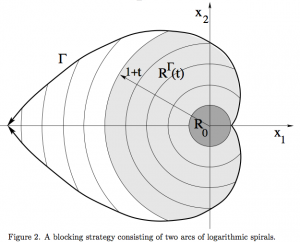
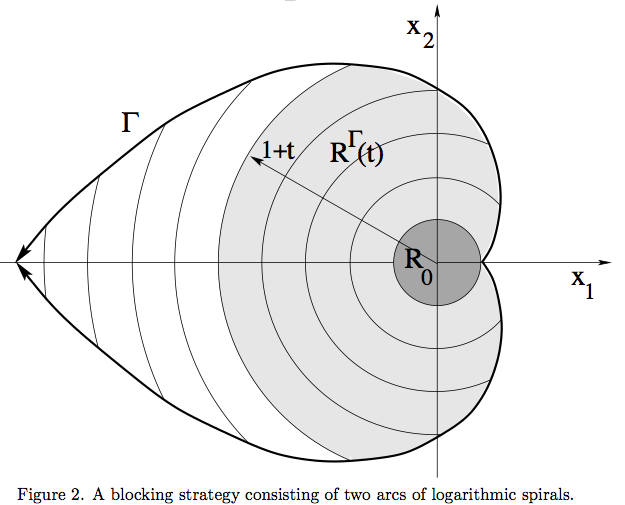
Prof. Alberto Bressan at Penn State offers a $500 prize for proving the optimal firebreak to isolate a forest fire that begins in the unit disc. I guess the answer is the heart shape of his Figure 2, the upper half of which he knows to be optimal in the half-plane. (Happy Valentine’s Day.)
Category:
Math |
Comments Off on $500 For Optimal Fire Line
3rd February 2011, 07:49 pm
Note added February 7, 2011. The announced counterexample was wrong. It does not satisfy the hypothesis of the conjecture. Geodesic circles about the origin in Enneper’s surface are unstable.
The proposed generalization of the Log-convex Density Conjecture to separate densities for volume and perimeter fell at the centennial congress of the Royal Spanish Mathematical Society. The counterexample—Enneper’s Surface—emerged from discussions with participants in the Geometric Analysis session, notably Manuel Ritoré, Antonio Ros, Cesar Rosales, and Antonio Cañete.
Another way of stating the hypothesis for a single density for volume and perimeter is that the generalized Ricci curvature, equal to the Riemannian Ricci curvature (0 for Euclidean space) minus the Hessian of the log of the density be nonpositive. General separate perimeter and volume densities are equivalent to a conformal change of metric together with a density. The counterexample, Enneper’s Surface, is conformally the plane (with unit density) and intrinsically a surface of revolution. As a minimal surface, it has negative curvature. Since the curvature is negative at the origin and approaches 0 at infinity, small balls about the origin have larger perimeter than small balls near infinity, and the generalized conjecture fails.
Preliminary announcement February 4, 2011.
Category:
Math |
Comments Off on Generalized Log-Convex Density Conjecture DIDN’T Fail
3rd July 2010, 06:58 am
Conjecture. The least perimeter to enclose given volume inside an open ball in Rn is greater than inside any other convex body of the same volume. Continue reading ‘Convex Body Isoperimetric Conjecture’ »
25th June 2010, 07:26 am
At an AWIS–NSF meeting in DC, I am learning about implicit bias, that none of us see things objectively, as in the following amazing optical illusions:
The Tables
The Checkerboard (and video)
Squares
Spinning Woman
T-Rex
The following human figures on the left are exactly the same color and shade as those on the right:

For information on similar gender biases, see the brochure by WISELI on “Reviewing Applicants.”
Note added 25 May 2011. AWIS has posted some webcasts. One study found that readers of CVs identical except for a man’s or a woman’s name at the top preferred to hire the man. The same study found no such difference for tenure decisions.
22nd June 2010, 07:45 am
For Rn+1 with volume density f and perimeter density g, for a normal variation u of a surface with classical mean curvature H, the first variation of volume and perimeter are given by:
 ,
,
![\delta ^1P=-\int [(g/f)nH - (1/f)(\partial g/\partial n)] uf](https://s0.wp.com/latex.php?latex=%5Cdelta+%5E1P%3D-%5Cint+%5B%28g%2Ff%29nH+-+%281%2Ff%29%28%5Cpartial+g%2F%5Cpartial+n%29%5D+uf&bg=ffffff&fg=000000&s=0 "\delta ^1P=-\int [(g/f)nH - (1/f)(\partial g/\partial n)] uf") .
.
For a volume-preserving variation, the second variation of perimeter is given by:
 ,
,
where  is the second fundamental form, so that
  is the sum of the squares of the principal curvatures. Continue reading ‘Variation Formulae for Perimeter and Volume Densities’ »
14th May 2010, 07:49 am
We give an oversimplified argument that an amateur investor with capital V should rebalance holdings every

years.
3rd April 2010, 09:56 pm
Here’s a proof of the infinitude of primes that occurred to me when for some reason Delta upgraded me to First Class on a flight April 2. Can anyone provide a reference?
Suppose that the set P of primes and 1 has just n+1 elements. Now every number at most 2k can be obtained by choosing k elements of P with replacement, which can be done in (k+n choose n) ways. Therefore
2k ≤ (k+n choose n) ≤ (k+n)n ,
which fails for k large.

 Welcome to my blog. I also have a blog at the