
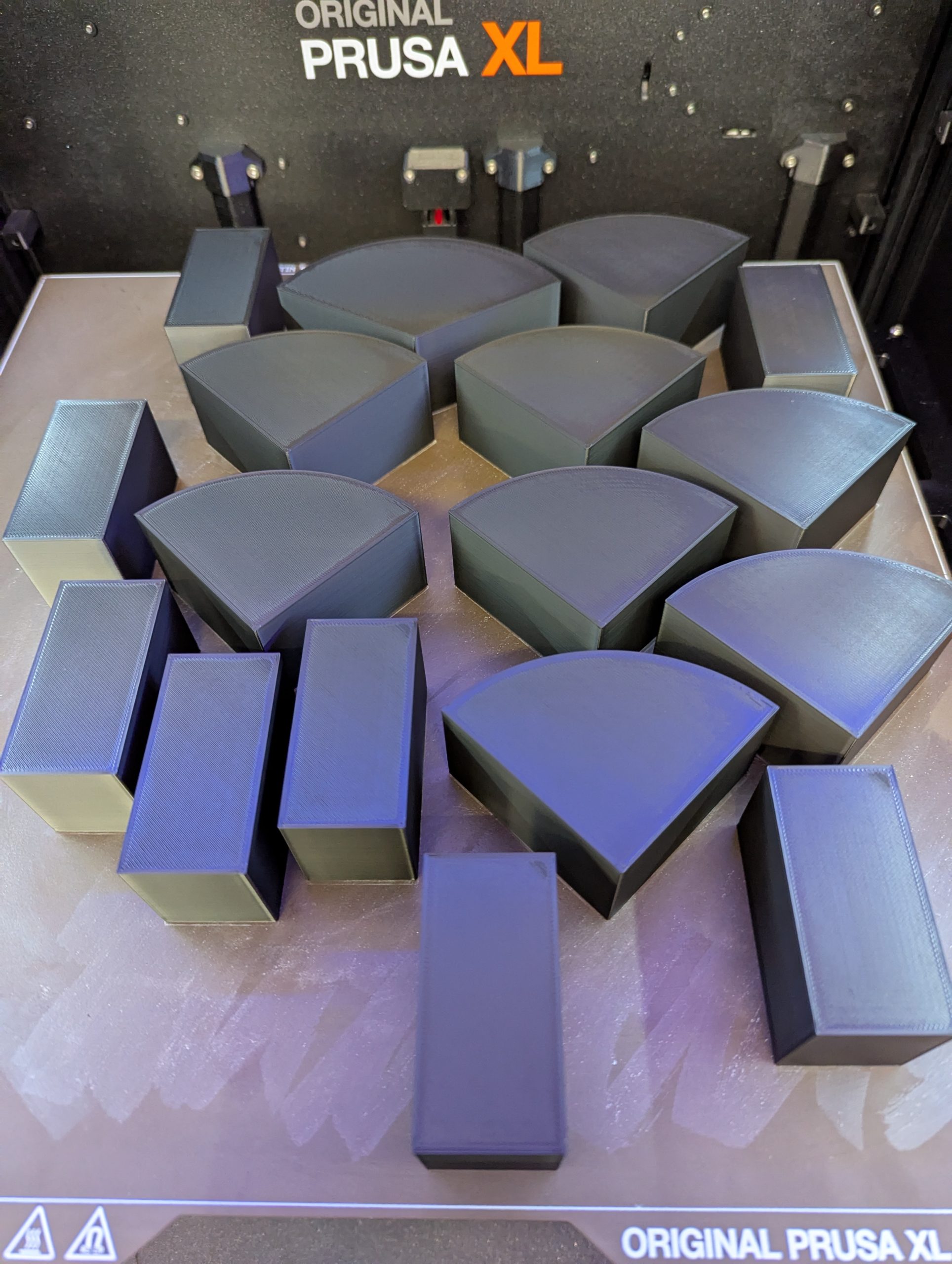
3D printed fractional blocks for our PSYC 332 course.
Williams College maintains a strong relationship with the local education community through the Center for Learning in Action. CLiA facilitates faculty and students working with local schools to research different teaching methods. Eliza Congdon, Assistant Professor of Psychology, and Jackie Lu ‘26, reached out to the Makerspace to assist with a study focused on demonstrating fractional concepts with first graders using physical objects. By using our resources, they hoped to 3D print sets of blocks that could be used in classrooms for learning.
Using CAD to Design the Blocks
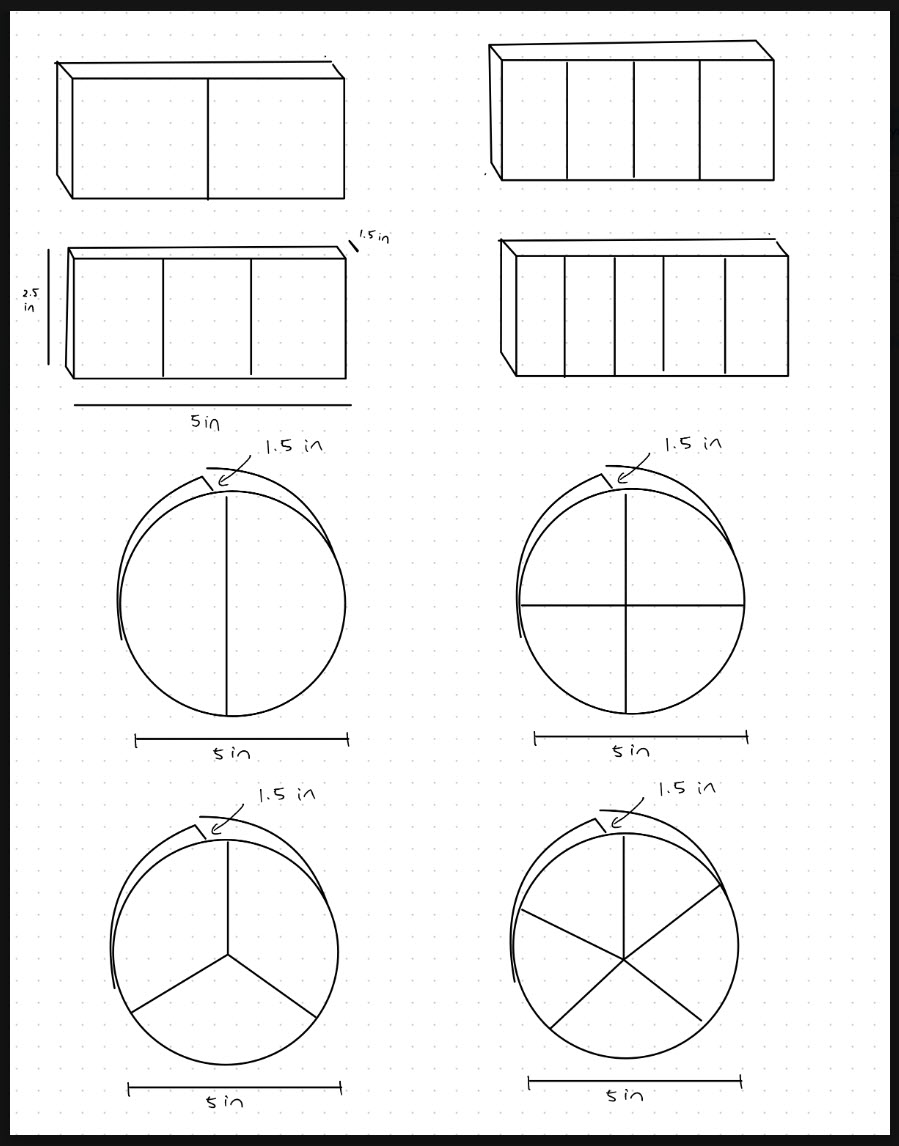
Our plans for creating fractional blocks for our PSYC 332 course.
We used Fusion 360 to create Computer-Aided Design (CAD) files. We designed sets of fractional blocks in 1/2th, 1/3rd, 1/4th, and 1/5th sizes for both rectangles and circles. While we initially modeled them with labels, we ended up removing the labels as the goal was for the students to discover on their own what the blocks represented. Afterwards, we converted the designs into printable files (using PrusaSlicer software) and then used our Prusa XL 3D printer to bring them to life. We printed the blocks using PETG because that material is incredibly durable; in our settings, we intentionally increased the thickness of the perimeters, top layers, and bottom layers to further improve their durability. We designed the blocks to withstand the wear and tear of active classroom use.
Challenges
The first batch warped because the perimeters weren’t thick enough. After adjusting the print settings and restarting the job, the blocks came out sturdy and nearly classroom-ready. The final step involved sanding to remove sharp edges and corners. We hope these blocks will make fractions feel less abstract and more fun to explore
Helping Abstract Math Concepts Come to Life
This collaboration between psychology, education, and Makerspace demonstrates how hands-on design can enrich learning. By putting physical fractions into students’ hands, we’re helping abstract math concepts come to life.