The Distrust that Silenced Women of Color

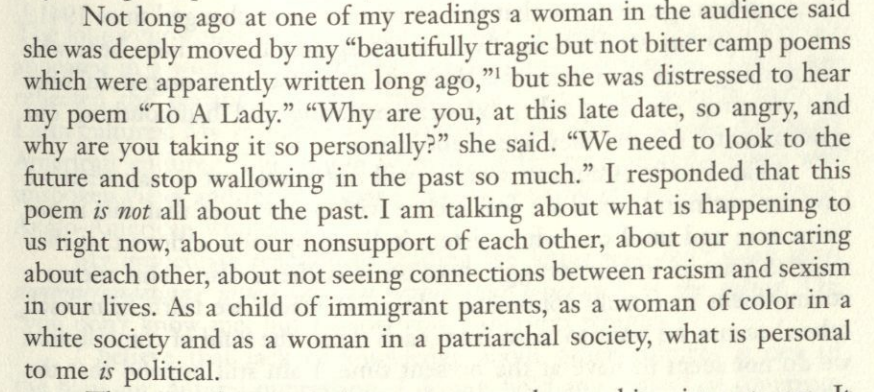
In her essay “Asian Pacific American Women and Feminism,” Mistuye Yamada addresses a common issue faced by women of color during the feminist movement: the struggle of maintaining both your identity as a woman and as a person of color. Yamada explains how women of color are often expected to earn their place in the feminist movement, whereas white women maintain an entitlement to that space. This document examines the exclusion of the voices of Asian American women and other Third World women from Second Wave feminism.

https://tableau.uchicago.edu/articles/2017/05/poetry-mitsuye-yamada

And Yamada recognizes the efforts of feminist organizations that strive to include women of color. However, she argues that these efforts are motivated by the need to appear inclusive, when in reality, women of color included in these organizations are often used as “tokens” (69). Consequently, women of color are used to claim diversity and inclusion, but are not actually listened to when they express their concerns. Women of color have to fight for their place in the feminist movement, but even once they achieve it, their voices continue to be ignored. Yamada explores that sentiment when she claims that every time she speaks in front of an audience it is as though she were “speaking to a brand new audience who had never known an Asian Pacific woman who is other than the passive, sweet etc. stereotypes of the ‘Oriental’ woman” (68). Stereotypes associated with these communities unconsciously invalidate the activism of women of color. 

Yamada explains that when women of color are invited into feminist organizations, they are expected to educate white women on their experiences with oppression. However, when they are asked to speak about their experiences, they are “expected to move, charm or entertain, but not to educate in ways that are threatening to [their] audience” (68), who are predominantly white women. Women of color are burdened with the responsibility of educating white women about their experience but in ways that don’t make their white audience uncomfortable. This form of emotional labor forces women of color to accommodate to white women, thus contributing to a hierarchy within the feminist movement. Even though their participation in feminist organizations creates an illusion that women of color are officially invited into the movement, their experiences continue to be silenced, Yamada argues. 

Many activist women of color are accused of placing their “loyalties on the side of ethnicity over womanhood,” (69) because of their participation in groups that promote ethnic identity, illustrating that these women are expected to choose between their identities in order to validate their voice in the movement. But Yamada argues that different facets of a woman’s identity inform each other. She claims that “as a child of immigrant parents, as a woman of color in a white society and as a woman in a patriarchal society, what is personal to [her] is political” (71).Yamada argues that the relationships between her identities are something that white feminists ought to understand because they establish her acceptance in society. Because of her identities, Yamada is constantly treated as a guest in the home of the dominant group, whether that be in the feminist movement, as a speaker, or as a resident of a neighborhood. When she began advocating for her Fair Housing Bill in the 1960s, for instance, her friends at the neighborhood church asked her, “Why are you doing this to us? Haven’t you and your family been happy with us in our church? Haven’t we treated you well?” (71). These questions illustrate that she is not fully accepted in these communities. Instances such as these explain the distrust found between white women and women of color. Yamada demands that “until our white sisters indicate by their actions that they want to join us in our struggle because it is theirs also,” (72) women of color will not be able to fully participate in the feminist movement. Although Yamada was calling attention to the distrust that pervaded the second wave feminist movement, similar sentiments continue to persist, limiting the ability to establish solidarity among women. 

Sources:

Yamada, Mitsuye. “Asian Pacific American Women and Feminism” This Bridge Called My Back, edited by Cherríe Moraga and Gloria Anzaldúa, 4th ed., State U of New York P, 2015, pp. 68-72.

Tokenism in the Second Wave Feminist Movement

Similarly to Yamada’s essay that challenged the tokenization that occurred in the feminist movement, Jo Carillo’s poem “And When You Leave Take Your Pictures With You” draws attention to the tokenization of women of color by white feminists who consider themselves radical. The speaker challenges “our white sisters radical friends” to think critically about the photos they own of women of color and how they convey false realities of minority communities. The speaker’s repetition of “you,” highlights that she is directing her criticism toward white women and challenging them to recognize the harm they are causing. The audience is meant to be uncomfortable by the speaker’s accusations and encouraged to confront how they participate in the silencing of women of color. By owning photos that contain seemingly positive content, white women are relieved of their guilt, and, consequently, they silence the realities of women of color. For instance, the speaker describes the following photo:

walking to the fields in hot sun

with straw hat on head if brown

bandana if black

in bright embroidered shirts

holding brown yellow black red children

reading books from literacy campaigns

smiling (lines 17-23).

The speaker calls attention to the racial stereotypes represented in the photographs: brown people wear straw hats and black people wear bandanas. This description portrays these racial groups as laborers, which invalidates women of color as activists who are capable of participating in movements. The people in this photo are also described to be “smiling,” which establishes an illusion that “our white sisters radical friends” want to have about their brown sisters. Additionally, this photo advertises literacy campaigns organized to teach less privileged groups how to read. Literacy campaigns, while valuable, are used here to call our attention to the charge that white women do this to feel good about themselves and these photos are the proof for their good deeds. This photo contains children of all racial backgrounds, and they are listed in a way that mimics a checklist. By having a child from each racial background, Carillo is recognizing the performance of an inclusive movement created by white women.

The speaker critiques displaying photos of smiling women of color on their way to work because according to her,

no one smiles

at the beginning of a day spent

digging for souvenir chunks of uranium

of cleaning up after

our white sisters

radical friends (lines 26-31).

In the second part of the poem, Carillo uses her own observations to combat the false representations of women of color in these photos. The stark reality is that “no one smiles” (line 26) because of the position they have been subjected to in society, even though the photos may display another story. Carillo acknowledges the hierarchy that exists within the feminist movement through her description that women of color spend their days “cleaning up after [their] white sisters radical friends” (lines 29-31). White women own photos containing women of color in an attempt to demonstrate solidarity; however, there are no photos that display these communities together. The fact that white women own these photos also draws attention to the power dynamics between white and minority communities. In an effort to include women of color in the movement through the use of these photos, white women are turning women of color back into servants. Women of color are returned to a position of servitude because they are forced to help relieve white women of their white guilt by being the participants of these good works. Carillo’s poem criticizes white feminists who claim solidarity with women of color, but, in reality, this solidarity does not translate into action. How can we build a successful movement, if women cannot even unite amongst themselves?

Sources:

Jo Carrillo. “And When You Leave, Take Your Pictures With You.” This Bridge Called My Back, edited by Cherríe Moraga and Gloria Anzaldúa, 4th ed., State U of New York P, 2015, pp. 60-61.

We Won’t be Silenced Anymore: Third World Women’s Reclamation of Their Voices

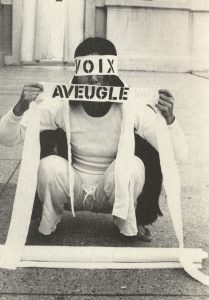
In This Bridge Called My Back, the photo Aveugle Voix (Blind Voice), a 1975 photograph by Theresa Hak Kyung Cha, is found in the section titled “Speaking in Tongues: The Third World Woman Writer.” This section examines language and the power of Third World women’s writing. The Oxford English Dictionary defines the term Third World as “the countries of the world, esp. those of Africa and Asia, which are aligned with neither the Communist nor the non-Communist bloc; hence, the underdeveloped or poorer countries of the world, usually those of Africa, Asia, and Latin America.” Although this term is not as frequently used now, second wave feminists often used this term to describe women of color in America. The use of this term highlights how the solidarity of this community transcends borders because the oppression faced by women of color was not confined to America.

In the introduction to this section, Gloria Anzaldúa unites Third World women writers through her claim that “in [their] common struggle and in [their] writing [they] reclaim [their] tongues” (161). This photo is from a series that captures Cha’s performance art of the same name. The performance illuminates some of the struggles, such as a language barrier, Cha faced when her family immigrated to the U.S. from South Korea in 1962 (University of California Berkeley Art Museum). In contrast to Jo Carillo’s poem, “And When You Leave, Take Your Pictures With You,” which illustrates how white women misrepresented women of color, Cha’s photo demonstrates the reclaiming of voice as she is able to produce her own photo as a woman of color.

Theresa Hak Kyung Cha, Aveugle Voix (Blind Voice), 1975

In the photo, Cha is choosing to silence herself, exhibiting a form of agency that she had previously been denied. Cha represents her silence literally by placing the words Aveugle Voix across her face and eyes, symbolically taking away both her identity and her voice. But the words are reversed: the word “aveugle” (“blind”) covers her mouth and “voix” (“voice”) covers her eyes. In swapping these words, Cha explores the  interconnectedness of one’s voice and sight. Cha is seen squatting and appears to be placing these coverings on herself. Although this position may evoke images of restraint and potentially bondage, it can signal newfound agency, as well. Even though Cha is silenced in this photo, her centrality forces the audience to pay attention and to listen to her. Cha’s work evokes the anxiety of losing one’s voice and the inability to communicate the violence and oppression one faces. Her own art allows her to be an agent rather than just a victim.

Cha’s photo is an example of power restoration for this community because she is illustrating the reclamation of her voice, something that was taken away from her by the dominant society. Aveugle Voix combats the belief that women of color are incapable of producing works that reflect their experiences and reclaims a form of power that has previously been denied to these communities. Anzaldúa’s “Speaking in Tongues: A Letter To Third World Women Writers” is located right after the photo in this section of the anthology and is a written piece that captures Cha’s visual representation of the silencing she endured.

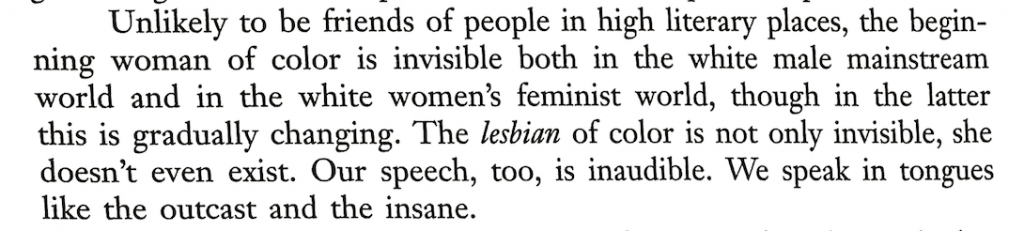
In this letter, Anzaldúa explores her thought process when she writes and recognizes the conditioning she has endured that has discouraged her from writing. As a Third World woman, she had been taught that her speech is inaudible  and that this community “speak[s] in tongues like the outcast and the insane” (163). Anzaldúa acknowledges a recurring voice in her that poses this question to her: “Who am I, a poor Chicanita from the sticks, to think I could write?” (164). Through creation, Third World women are defying the beliefs that they are incapable of doing so, a form of power in itself.

Sources:

Anzaldúa, Gloria. “Speaking in Tongues: A Letter To Third World Women Writers.” This Bridge Called My Back, edited by Cherríe Moraga and Gloria Anzaldúa, 4th ed., State U of New York P, 2015, pp. 163-172.

Cha, Theresa Hak Kyung. Aveugle Voix. 1975. This Bridge Called My Back: Writings by Radical Women of Color, edited by Cherríe Moraga, 4th ed., State U of New York P, 2015, p. 160.

“Theresa Hak Kyung Cha.” University of California Berkeley Art Museum, archive.bampfa.berkeley.edu/art/AN0230. Accessed 4 Dec. 2019.

“Third World | third world, n. (and adj.).” OED Online, Oxford University Press, September 2019, www.oed.com/view/Entry/200854. Accessed 20 November 2019.

“Even Heretics need stakes”: Financial Crisis and Reader Outreach by Heresies

In the late 1960’s through the mid 1970’s, women started a wave of small press feminist publications across the United States. Dedicated to radical ideas and very mission-driven, many of these periodicals tried to enact social change through publishing women’s literature and literary theory. However, the relatively small readership of these publications put them on financially unstable ground. Because of this, the economic recession of the late 1970’s hit small feminist presses particularly hard. In this period, the first pages of Quest, Conditions, Heresies, and other feminist publications came to be dominated by editorial statements asking their readers to help them stay afloat by subscribing and paying higher cover prices. These letters from the editors (and often accompanying reader responses) expanded on the practices of community-building and transparency that already characterized the feminist press.

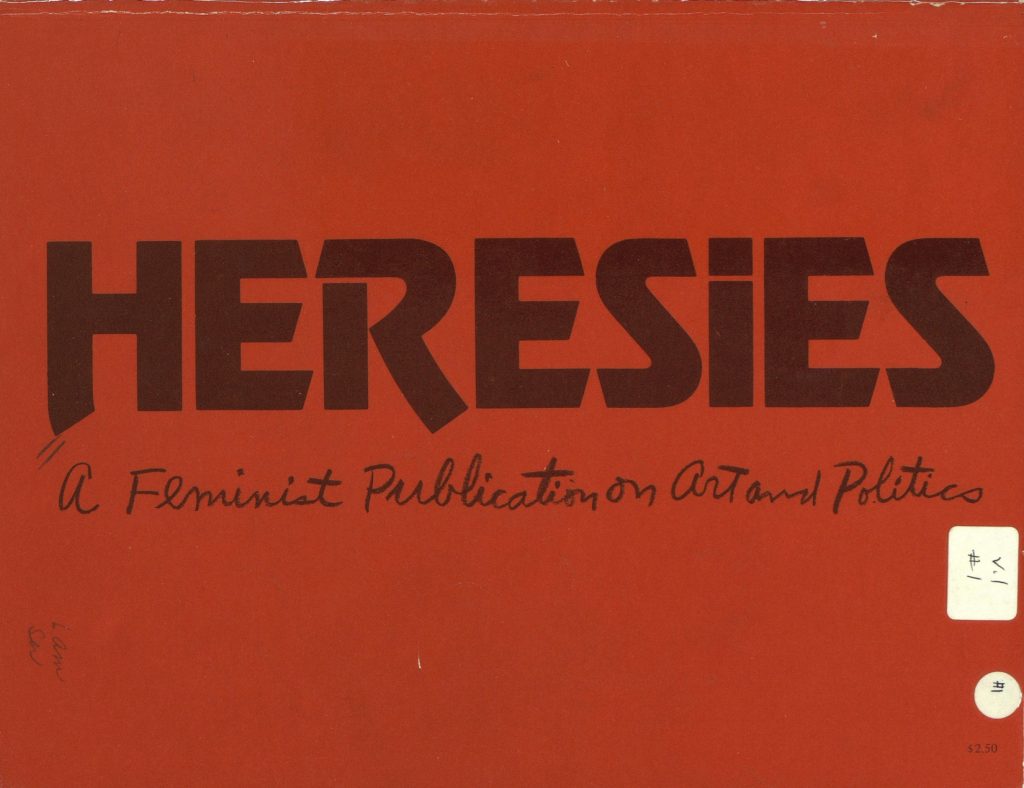
Cover of Heresies' first issue, 1976

Cover of Heresies’ Inaugural Issue, 1976

Started in 1976, Heresies was a relative latecomer to Second Wave periodicals, but it came into the world fully formed. In the first issue, the original collective of twenty-one women outlined how each issue would bring together a new editorial group of several volunteers to curate content under a specific theme. Certain hallmarks of the magazine, like the mission statement, would remain unchanged issue to issue, giving Heresies a sense of continuity, but this large, non-hierarchical rotating staff of volunteer editors would keep the magazine from relying too much on any one woman. Even the core collective that chose themes and made long-term decisions for the magazine was flexible; between issues 1 and 2, it acquired three new members, and by 1980, nine women were full members of the collective, while another eighteen were associate members (Heresies vol. 1, no. 1; vol. 1, no. 2; vol. 3, no. 1). The core collective and rotating editorial groups kept themselves accountable both by accepting letters from readers and holding open evaluation meetings after each issue was released to gather feedback. The location, date, and time of these meetings would be published in the magazine itself. In this way, the many editors of Heresies built a relationship with their readers from the beginning.

A note from the editors of Heresies asking its readers for help

Note from the Editorial Collective, 1980

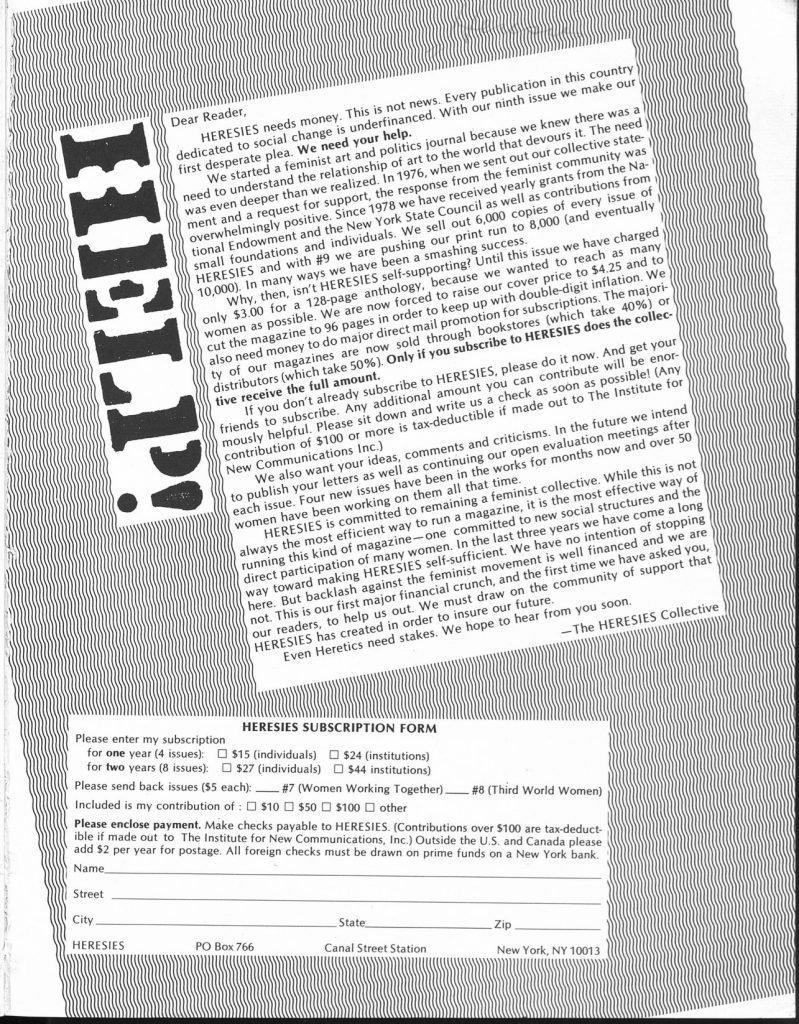
Heresies’ relationship with its readers was crucial when in 1980, the magazine found itself in a financial crisis. In the first pages of issue 9, the Heresies collective published a note declaring in boldface letters, “HELP!” (Heresies vol. 3, no. 1). In it they explained, “Every publication in this country dedicated to social change is underfinanced,” and they were no exception despite selling out of their 6000 copy printing runs every issue and receiving annual grants from the New York State Council and the National Endowment for the Arts. Starting with issue 9, they would be pushing their print run to 8000, raising their price per issue from $3.00 to $4.25, and lowering their page count from 128 pages to 96 while imploring readers to subscribe to avoid the 40% and 50% cuts that bookstores and distributors took. By taking all of these actions simultaneously, Heresies seemed to be able to right itself before getting too far off course and emerge from this period without too much trouble, as they did not publish another similar note in the next five years (HERESIES issues 9-18).

It is worth asking why and how Heresies managed to navigate the gauntlet of the late 70’s and early 80’s relatively unscathed while other small magazines either folded or underwent transformations to stay afloat. Did their unique editorial structure make a difference? Were they able to build a supportive community of readers in a way other magazines could not? Were their larger printing runs the major difference maker? Or was it the government grants? It’s impossible to know without taking an in-depth look at Heresies’ peers during the same time.

Sources:

“Introduction: The Movement that Changed a Nation” The American Women’s Movement, 1945-2000. 33-43.

Heresies: A Feminist Publications of Art & Politics. vol . 1, issue 1, Heresies Collective, 1976.

Heresies: A Feminist Publications of Art & Politics. vol . 1, issue 2, Heresies Collective, 1976.

Heresies: A Feminist Publications of Art & Politics. vol . 3, issue 1, Heresies Collective, 1980.

Conditions of Survival: Endangered Grants and Editorial Turnover

In contrast to Heresies’ broadly-based editorial collective, conditions magazine relied on the same four women to produce each issue, which led to challenges as the magazine aged and its editors felt the strain of years of uncompensated volunteer work in addition to their full-time jobs. Conditions was founded in 1976 by Elly Bulkin, Jan Clausen, Irena Klepfisz, and Rima Shore as “a magazine of writing by women with an emphasis on writing by lesbians” (conditions: one). Conditions’ story of editorial turnover and endangered governmental grants raises questions of how feminist art should be funded and what editorial structures will endure in challenging times.

Editor’s Statement that appeared in conditions: one

In their first couple of years, conditions experienced moderate success publishing fiction, interviews, book reviews, and a good deal of poetry, including the editors’ own work, in biannual book-length collections. However, the publishing business is risky and the editors had no significant backers, so by 1978, they were forced to implement a price increase so as not to increase the personal debt they had gone into to start their publication. Fortunately, they received a grant from the Coordinating Council of Literary Magazines (CCLM) in the same year, which eased their financial situation. However, they still expressed to their readers a desire to make sure grants were not essential to their bottom line, for “we do not believe that any lesbian-feminist organization can rely on grants as a continuous source of income” (conditions: four, p. [vii]). This note in conditions: four would be the beginning of an exciting saga that would play out over the course of the next six years.

After their first note to their readers in 1978, conditions received a major boost from the unprecedented success of conditions: five, the black women’s issue. As one of the first major anthologies of black feminist literature, conditions: five represented a major step forward for feminist publishing. Readers were clearly hungry for this kind of content, as it sold four times as many copies as any previous issue, with print runs totalling 10,000 copies (conditions: six, p. [vi]). This issue also gave the regular editors a break, as it was guest-edited by Lorraine Bethel and Barbara Smith. However, one successful issue did not insure the future of the magazine, and 1980 hit conditions as hard as anyone else.

In conditions: six, the editors provided a rare, in-depth look at the finances of a small publication. In 1979, their total expenses were $18,095 for the combination of printing, typesetting, promoting, distributing, and compensating contributors for conditions: five, as well as paying off the loans they had taken out to start the magazine. Receiving $7,722 of grants that year from the New York Council on the Arts, the Coordinating Council of Literary Magazines (CCLM), and the National Endowment for the Arts (NEA), they were just barely able to break even (conditions: six, p. [vi-viii]). Much like Heresies was doing during the same period, conditions tried to address their tenuous financial ground by increasing their distribution and cover price, and asking a larger portion of their readers to become subscribers, although it is worth noting that unlike other contemporaneous publications, conditions did not decrease its page count at this time. However, conditions was a much smaller publication than Heresies, with print runs only totalling 3,000 copies per issue to Heresies’ 8,000, which made it much more difficult for conditions to become self-sustaining and forced them to rely more heavily on grants. Because of their heavy reliance on grants, it’s worth looking at the governing bodies that awarded grants to small magazines in this time period, specifically the CCLM and the NEA.

The National Endowment for The Arts first began under Lydon Johnson in 1965, largely as a response to cold war era thinking that the United States must work to be culturally superior to the Soviet Union and the nations it claimed leadership over (Levy, 108). From its inception, the NEA was a battleground between the political right’s desire to emphasize mainstream art at the expense of marginalized groups and the left’s desire to emphasize artists at the margins of society, presumably including the lesbian and feminist writers who wrote for conditions (Levy, 107). Both the total annual budget and the distribution of that budget were and continue to be subject to party politics at the NEA and the federal government that oversees it. Two years after the establishment of the NEA, members of its senior staff created the Coordinating Council of Literary Magazines (CCLM) with the goal of aiding noncommercial literary magazines and the individual artists and writers who contribute to them (Uchmanowicz). The CCLM had a budget of $125,000 to support thirty-eight magazines in its inaugural year, and by 1980 that budget grew to almost half a million dollars, with most of that money coming from the NEA (Uchmanowicz). In the intervening years, women entered the CCLM at every level, so that in 1976, four out of the seventeen CCLM board members and consultants were women, a marginal victory to be sure, but probably still better than most governmental boards at the time (Uchmanowicz). However, in 1980 Reagan was elected, and funding for the arts was sure to be cut during his administration.

Early in the Reagan administration, the NEA was forced to withdraw almost all of its financial support for the CCLM, forcing them to seek out funding from private interests (Uchmanowicz). Meanwhile, the value of the NEA itself, which had been rising steadily since its inception, held steady throughout the 80’s at around $160 million (NEA Annual Report 1987). The CCLM did manage to find private funding sources in the 80’s, including Exxon Corporation, the New York Times, the Mobil Foundation, and the Liz Claiborne Foundation, but Nicholas Nyary, the then executive director, found the literary climate of the decade “troubling,” and expressed hopes that magazines would be able to survive until a more favorable time (Uchmanowicz).

The NEA also came under fire in the media for cutting off funding to the CCLM. An opinion piece by the assistant director of literature at the NEA appeared in the New York Times in 1983 in response to claims that the lack of Endowment funding to the CCLM was “likely to mean the death of many of the shoestring operations” (Macarthur). Assistant Director Macarthur argued that the move to cut off funding to the CCLM was actually a maneuver to cut out an unnecessary middleman that would allow the NEA to give more money directly to literary publishers (Macarthur). While it is true that the NEA gave a significant amount of money ($825,000 in 1983 according to Macarthur) to small publications, including grants to both conditions and Heresies, Macarthur offered no evidence that they would balance out the funding they were no longer giving to CCLM and no justification for why they would no longer support the CCLM. While officials like Macarthur may have tried to hide it, Reagan’s 80’s were a time for governmental budget cuts, especially in the arts.

In light of this, we can truly see how deeply precarious conditions’ situation was entering the 80’s relying on government grants. The 1981 fiscal year for conditions looked very similar to 1980, with expenses totalling $18000 and $8000 of grants keeping them afloat, but the editor’s note in conditions: seven expressed great concern Reagan-era budget cuts and legislation, especially the Family Protection Act, which would, among other things, cut off all federal funding for lesbian and gay organizations (conditions: seven). If the bill had passed and conditions could not seek funding from any federal sources, it is difficult to imagine the magazine would have survived. Even without broad-based legislation, conditions’ federal funding was not secure; in 1984, their grant application to the NEA was rejected because “the magazine seems to emphasize lesbianism more than literature” (conditions: ten).
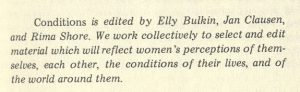
Editor’s Statement in conditions: seven with only 3 editors listed

Conditions’ instability due to insecure funding sources was worsened by editorial turnover. Most small magazines had some editors and staff leave during this period. It was, after all, a period of change for the Women’s Movement. But with only four editors to begin with, editorial turnover became an existential crisis for conditions. The first of the original four editors to leave was Irena Klepfisz. In the conditions: seven editor’s note, we learn that Klepfisz decided to take a “partial leave-of-absence from the editorial collective because of the demands of her paying job” after conditions: six, and by the time conditions: seven was published, she had decided to leave the magazine entirely (conditions: seven). Following conditions: seven, the remaining editors took a publishing hiatus to restructure and rethink their process, and in conditions: eight, they introduced five new editors who would be joining them. At the same time, another of the original editors, Jan Clausen, decided to leave the collective after nearly six years of editorial work (conditions: eight). The new editors had a lot in common, they were all lesbian writers and political activists born in the late 1940’s, but they did add a lot of diversity to the editorial collective; while the original four editors had all been white and middle class, the new had much more diverse backgrounds. Cherríe Moraga even acted as their office manager (conditions: eight). The new collective seemed to function well, putting together an excellent 195-page anthology for conditions: nine. However, the loss of NEA funding shook them to their roots soon after. Four editors left the collective, including Rima Shore, one of the founding editors, leaving Elly Bulkin as the only remaining founder. The remainder of the collective put off the publishing of conditions: ten until they could find women to replace those who had left and alternative funding sources (conditions: ten).

After these years of crisis forced it into a more flexible structure, conditions seemed to stabilize, publishing annually without delay until 1990. Though they did survive, it was only by the skin of their teeth. Conditions’ story demonstrates both the benefits and detriments of government funding for activist art. On one hand, it can allow important publications that would otherwise be financially unviable to exist. On the other hand, it is subject to political forces, putting important publications constantly in danger as they become pawns in a much larger political game. Within this flawed system, conditions was able to survive as a non-profit that could collect donations from a variety of sources. Even when federal funding went away, state funding, grants from various organizations, and individual contributions kept them afloat. Perhaps a less exceptional publication would not have been able to navigate the same crises, but conditions demonstrated over and over that its content was timely and relevant, at the cutting edge of feminism.

Sources:

conditions: one, Bulkin, Elly., Clausen, Jan., Klepfisz, Irena., Shore, Rima. 1977.

conditions: four, Bulkin, Elly., Clausen, Jan., Klepfisz, Irena., Shore, Rima. 1979.

conditions: six, Bulkin, Elly., Clausen, Jan., Klepfisz, Irena., Shore, Rima. 1980.

conditions: seven, Bulkin, Elly., Clausen, Jan., Shore, Rima. 1981.

conditions: eight, Bulkin, Elly., Clausen, Jan., Shore, Rima. 1982.

conditions: ten, Bulkin, Elly., Allison, Dorothy., Clarke, Cheryl., Otter, Nancy Clarke., Waddy, Adrienne. 1984.

Levy, Alan Howard. Government and the Arts: Debates over Federal Support of the Arts in America from George Washington to Jesse Helms. Lanham, MD, University Press of America,1997.

Uchmanowicz, Pauline. “A Brief History of CCLM/CLMP.” The Massachusetts Review 44.1 (2003): 70-87. ProQuest. Web. 20 Nov. 2019.

National Endowment for the Arts. 1987 Annual Report. Washington D.C., Office of Communications of the National Endowment for the Arts,1987. Web. 22 Nov. 2019.

Macarthur, Mary. “Grants Going Nonstop to Little Magazines.” New York Times, 5 April 1983, p. A26. Web. 20 Nov. 2019.

“Work Sonnets”: Notes on Finding Fulfillment by a Departed Editor

Over the course of the five years that Elly Bulkin, Jan Clausen, Irena Klepfisz, and Rima Shore edited conditions together, they must have worked unbelievably hard. All four of them had full-time jobs and ongoing writing projects, but they still managed to do all of the extensive work of putting together a lengthy literary magazine every year without fail. Heresies had dozens of volunteers in their collective rotating in and out for every issue, and Quest had full-time paid staffers, but the editors of conditions managed to put together a peer magazine on their own, including everything from grant applications to advertising to printing. That these four women did all this without compensation is a testament to just how important they felt this work was, but when Irena Klepfisz left the magazine in 1981 “because of the demands of her paying job,” it is easy to empathize with her. No matter how important the larger cause is, anyone can get burnt out from too much office work.

A year after her departure, a Klepfisz poem titled “Work Sonnets” appeared in conditions: eight (conditions: eight, 1982, pp. 76-85). In it, Klepfisz reflects on the mundane reality of doing office work for a corporation in a low level position. This poem gives us a rare insight into a magazine editor’s life and attitude toward work after leaving the project, albeit through the lens of characters that are clearly distinct from Klepfisz, though she uses the first person. The poem is divided into three sections, each with its own experimental structure. The first section intersperses four stanzas describing the yearnings of elements of nature with diary-style prose-poetry describing scenes in a normal workplace. The second section adds flavor to the first section by taking the format of the brainstorming a writer might have done before writing the first section. Finally, the third section features a dialogue between two women, an inspired, aspiring writer seeking to do meaningful work to improve working conditions and an office worker who concludes that even if conditions improve, it won’t matter because her work still won’t be meaningful. Through these sections, Klepfisz wrestles with the possibility of leading a fulfilling life in an American office.

Excerpt from “Work Sonnets”

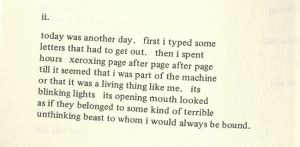
The first section of the poem explores the life of a female office worker with accounts of her frustrations with a Xerox machine, her power struggles with her boss, who is only ever referred to as “him,” and her relationships with her co-workers. At one point, the Xerox machine seems to come alive: “xeroxing page after page / till it seemed like I was part of the machine / or that it was a living thing like me” (76). This poem subverts the conventions of literature and poetry in many notable ways, including its structure and format, but also in its vocabulary. In these lines, “xerox” is used as a verb, allowing workplace vernacular to enter literature and at the same time symbolizing the narrator’s complete integration into a capitalist world of machines. In this world, humans are insulated from their environment as they become part of the company they work for, companies become the products they produce (it is a Xerox machine), and the names of the companies themselves become verbs, mere functions leading to ever higher productivity. There is no room for natural human life and relationships as everything bears the marks and logos of the techno-capitalist system that produced them. This human subordination shows up elsewhere in the poem, including when the retired receptionist’s hearing is “impaired from the headpiece she’d / once been forced to wear” (79), and the narrator shapes her schedule around the seemingly sentient Xerox machine: “when it overheated  i had to stop while it / readied itself to receive again” (77). Not only is the narrator subject to the whims of her boss, who forces her to stay late, she is also subject to the whims of a mass-produced machine.

In section two, “Notes,” Klepfisz seems to switch perspective to the poet who composed section one as she designs a character and debates how she will portray her. Klepfisz seems initially to give us a third person description of the backstory and psyche of the narrator from section 1, whose previous jobs are listed. Klepfisz includes dialogue to illustrate her character traits. Then, the speaker of this section begins to debate how she will go about writing this character: “3rd person opens it [her worldview] up. But it would be too distanced, I think. I want to be inside her. Make the reader feel what she feels. A real dilemma” (82). Even though we don’t know the purpose of the section, the perspective, or how the writing is produced, Klepfisz does open a dialogue about how to portray others in writing, especially when writing from their perspective.

Excerpt from “Work Sonnets”

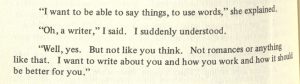
The third section of “Work Sonnets” takes the form of an existentially distressing dialogue between two women who work together about the possibility of fulfilling work. In this section, Klepfisz writes from the perspective of the woman who has no desire to be a writer and resigns herself to an unfulfilling career typesetting for others. The other woman, referred to as “she,” expresses her frustration with her job optimistically and says, “Anyone can do this. And I’ve always wanted to do special, important work” (83). She explains her idea of fulfilling work as socially conscious writing: “I want to write about you and how you work and how it should be better for you” (84). Initially convinced to reverse her earlier statement that “All work is bullshit” (84), the narrator of this section finds herself hopelessly resigned when she realizes that this idea of finding fulfillment in work still requires her to be part of a large, unfulfilled working class: “That certainly sounds good. Good for you, that is. But what about me… because I’m not about to become a writer” (84). This disappointment turns to anger as she accuses the aspiring writer of faking comradery with her now, only to later betray her by considering “that kind of work” to be beneath her. This dialogue illustrates how art and even the work of activist art can end up being exclusively reserved for the upper class, and more boldly asks a tough question without answering it: In a world of tedious office work where we can’t all become artists, how can we all find fulfillment?

Sources:

Klepfisz, Irena. “Work Sonnets.” Conditions: eight. issue 8, 1982. pp. 76-85.

The Quest Not to Fold

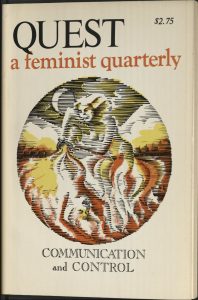
Quest: a feminist quarterly was founded in 1974 with the goal of “seeking long-term, in-depth feminist political analysis and ideological development” (vol. 1, no. 1, p. [i]). Though they included poetry in every early issue, Quest always had a more explicitly political and analytical approach than Heresies, Conditions, or other feminist magazines of the time. In many ways, the side-by-side placement of dense articles about the mechanisms of political change and personal poems about real women’s experiences is emblematic of the Women’s Movement, embodying the slogan “the personal is political” in printed form. As a journal primarily of theory, Quest carved out its niche within the already niche market of feminist publishing. However, a downward spiral of financial troubles, overworked editorial staff, content cuts, and disorganization led to the decline and ultimate collapse of Quest in the early 1980’s. An examination of Quest’s later years evokes questions of the relationship between art and politics, the accessibility of theory, and ultimately what drives the feminist movement.

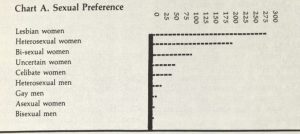
Quest’s story first becomes accessible to us beginning in the fall 1976 issue, when the editors began printing editor’s notes and letters from readers (Quest, vol. 3, no. 2). In that issue, we see that some of the readers of Quest are engaged in a heated debate about lesbian separatism. On one side, a reader wrote that she was not renewing her subscription because “I feel excluded by the increasing focus of your contributors on ‘heterosexist analysis’” (Quest, vol. 3, no. 2, p. 21). Another reader took an opposite stance, saying that “Quest is being very prejudiced against separatism,” and should “Name the enemy–men, their system, their everything– take a stand against it” (Quest, vol. 3, no. 2, p. 23). Although they don’t brand themselves as explicitly lesbian, it appears that was Quest’s reputation within the feminist community. In 1977, a reader wrote in to say, “I recently began my subscription to Quest, partly because I want to learn what my lesbian sisters are saying” (vol. 3, no. 4, p. 62). We don’t have access to demographics for the editors or contributors, but in the next issue Quest published the results of a reader survey, including a question about sexual orientation, that gives us a rare insight into the readership of a small feminist periodical in this period. There were about 275 lesbian, 100 bisexual, 200 heterosexual, and 50 uncertain women who responded to the reader survey, as well as less than 50 in each of the remaining categories: celibate women, heterosexual men, gay men, asexual women, and bisexual men (Quest, vol. 4, no. 1, p. 7). The Quest readership was diverse, but predominantly queer. It was a good place to have a debate about lesbian separatism, but when women stopped their subscriptions in order to make a statement about the issue, it was clear that the debate had become too politically divisive to be productive.

Results of a 1977 Quest reader survey

In addition to political reader debates, Quest struggled with reader comprehension. After apparently receiving feedback, the Quest editors published a note in 1976 saying that “We have often been told that Quest is abstract or ‘too hard to read’” (Quest, vol. 3, no. 2, p. [89]). The note voices these concerns that also appear in various letters from readers, and tries to explain and address them. It suggests that the reason that many contributors write in the style they do is because they “were trained, if at all, to write ‘essays’ and ‘papers’” and suggests that a more journalistic approach may be more accessible. However, the editors do express doubt about whether the same in-depth political analysis could happen in another style. They end by encouraging readers to submit manuscripts, noting that, “Our challenge, as feminists, is to find new ways to express our experiences and our analysis so that they aid us better in changing society” (Quest, vol. 3, no. 2, p. [89]). Despite the earnestness of this pledge to experiment with many different forms, it appears that nothing ever came of it. The editors printed this note, unmodified, in every issue until the magazine folded while continuing to print essays on theory. In fact, in 1981, they even decided not to print any more poetry, even though poetry had proven to be a reliable medium to express women’s experiences and push the movement forward. Clearly, Quest struggled to find an accessible medium for the kind of analysis it wanted to publish; however, any analysis of Quest’s struggles would be incomplete without looking at the practical realities of how the magazine was managed.

Cover art from 1976 with several distinct colors

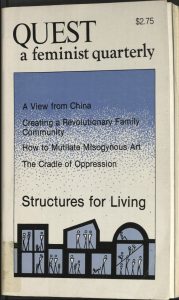
Quest’s troubles with content, connecting with readers, and building community were worsened by a variety of practical factors. When they started, the editors of Quest were allowed to use office space and resources from the Institute for Policy Studies, but in 1977, they were forced out, and suddenly had to take on the costs of rent, equipment, and postage (Quest, vol. 3, no. 4). To accommodate this change, they had to cut down to two, and eventually only one paid staff member, even though they didn’t have the volunteer structure in place to handle the increased workload (Quest, vol. 5, no. 2). Consequently, they fell behind on their mailing schedule, testing the trust and patience of their readers while simultaneously increasing their costs as they lost their status as a class two mail client (Quest, vol. 3, no. 4). From 1978 to 1979, the staff took a full year publishing hiatus in order to try to restructure and solve the issues that were plaguing them. Many of the original staffers left and were replaced, often by multiple “contributing editors” (Quest, vol. 5, no. 1, p. 1). They even considered folding, but “decided the work of Quest had to be continued” (Quest, vol. 5, no. 2, p. 5). In order to decrease their printing costs, they lowered their page count, switched to a staple-bound binding and monochromatic cover art. On the fundraising side, they hired a fundraising consultant and looked for foundations that might be willing to award them grants, but found none, so they held a raffle that raised $1600. However, these efforts proved to be insufficient. The new staff published erratically rather than quarterly–only four times between 1979 and 1982. They found themselves overworked and disorganized, and faced worse mailing mishaps than ever before. In 1981, they sent a note to their readers explaining that “Quest has decided not to print poetry. Our decision was not based on any disregard for poetry or its power; but, rather, was based on taking stock of staff time, energy, and talents” (Quest, vol. 5, no. 3, p. 12). One reader wrote a particularly compelling note critiquing this decision and explaining the virtues of poetry and its power. She said, “I do not underestimate theory or analysis: I do not undervalue good strong prose writing or fiction: but nothing can reach inside a person and touch them and change them more than a good strong poem” (Quest, vol. 5, no. 3, p. 11).

Monochromatic cover art from 1981

By the time that reader letter was published, it was a moot point for Quest; the next issue proved to be their last before folding. No one can say for sure if another string of decisions could have allowed Quest to survive. Some of the events in their short history were just bad luck. Maybe a greater focus on poetry, art, and literature would have appealed to more readers. Perhaps it would have improved their eligibility for CCLM or NEA grants. Whatever the case, I do believe that the discussions Quest tried to spark and the content they published were important to have, and it was tragic to lose them.


Sources:

Quest: A feminist quarterly. vol. 1, issue 1, 1974.

Quest: A feminist quarterly. vol. 3, issue 2, 1976.

Quest: A feminist quarterly. vol. 3, issue 4, 1977.

Quest: A feminist quarterly. vol. 4, issue 1, 1977.

Quest: A feminist quarterly. vol. 5, issue 1, 1979.

Quest: A feminist quarterly. vol. 5, issue 2, 1980.

Quest: A feminist quarterly. vol. 5, issue 3, 1981.

Interpreting Third World Women

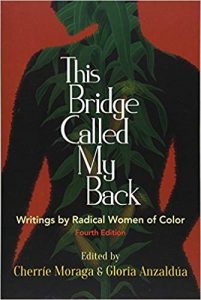
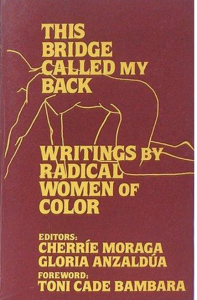
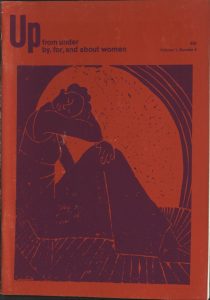
In her preface to the fourth edition of This Bridge Called My Back, Cherríe Moraga, Chicana writer and feminist, announces: “We are ‘third world’ consciousness within the first world. We are…in concert with women across the globe pursuing the same goals: a shared and thriving existence in a world where our leaders have for the most part abandoned us and on a planet on the brink of utter abandonment” (xix-xx). In an article entitled “The Winter Soldier,” on American soldiers in the Vietnam War printed in Up From Under, an anonymous writer declares, “The people dying are Third World, and that has to be brought out” (9). Both Cherríe Moraga, in 2015, and this anonymous writer, in 1971, struggle to define “Third World women”—a term that shaped the Feminist Poetry Movement in the last third of the twentieth century.

The fourth and most recent edition of This Bridge Called My Back, published in 2015.

The first edition of This Bridge Called My Back, published in 1981.

This term divides the world into three distinct categories. “Third World,” as defined by the Oxford English Dictionary, refers to “The countries of the world, esp. those of Africa and Asia, which are aligned with neither the Communist nor the non-Communist bloc; hence, the underdeveloped or poorer countries of the world, usually those of Africa, Asia, and Latin America” (“Third World”). In “Third World,” ideas about race, wealth, colonialism, imperialism, and origin intertwine. Today, in 2019, this term has largely become as obsolete as Cold War Blocs, and is often replaced with the phrase “developing countries.” However, many Second Wave feminists used Third World to describe women of color in America, emphasizing their lasting connection to countries outside of America (Mohanty, Russo, Torres).

To many white feminists, Third World signaled a perpetual “other”: countries and people who lacked resources, education, and wealth. Nevertheless, Third World feminists focused on the perseverance of Third World women in the face of oppression and used this term to express solidarity with women of color around the world. The tension between these usages informs our modern interpretation of the Feminist Poetry Movement.

Up From Under, vol. 1, no. 4, published in 1971.

Sources:

Anzaldúa, Gloria, and Moraga, Cherríe, editors. This Bridge Called My Back: Writings by Radical Women of Color. 1st ed., Persephone Press, 1981.

Anzaldúa, Gloria, and Moraga, Cherríe, editors. This Bridge Called My Back: Writings by Radical Women of Color. 4th ed., State University of New York Press, 2015.

Mohanty, Chandra Talpade, Russo, Ann, and Torres, Lourdes, editors. Third World Women and the Politics of Feminism. Indiana University Press, 1991.

“Third World | third world, n. (and adj.).” OED Online, Oxford University Press, September 2019, www.oed.com/view/Entry/200854. Accessed 20 November 2019.

Up From Under, vol. 1, no. 4, 1971.

“Before I Dare Reach Out and Touch Your Hand”: Up From Under

Up From Under, a feminist periodical “by, for, and about women,” published five times between 1970 and 1973, traces the entrance of Third World narratives into the larger Feminist Poetry Movement. Over time, Up From Under included more information about Third World women, though these articles and poems remain scarce. In all five publications, there are only four poems about Third World women; only one of these poems is written by a woman of color. As the white feminist editors of Up From Under included more prose and poetry about Vietnamese and Black women, they often misinterpreted and manipulated these narratives.

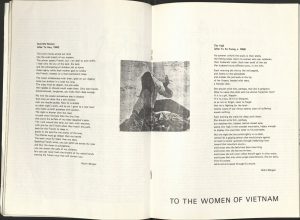
Robin Morgan’s poems, “Guerrilla Woman” and “The Vigil,” published in Up From Under, vol. 1, no. 1.

Two Robin Morgan poems, boldly addressed “To the Women of Vietnam,” lie in the centerfold of Up From Under, vol. 1, no. 1, published in 1970. In “Guerrilla Woman,” a Vietnamese woman waits for her lover to return from the war while she digs ditches “for the French when they march this path, / beds for the French to sleep in, / graves in the land for the enemy of the land” (lines 4-5, 21-24). In the distance, she hears “the whimpering of children left at home” as her hands become “blood-lotioned, ice-gloved” (5, 12). Similarly, in “The Vigil,” a young pregnant woman waits expectantly as “her husband hunts different prey, in the hills,” fighting in the Vietnam War (4). Hoping for his return, seeing him only “behind closed eyes,” she gives birth and finally realizes that her husband will never return home from the war that has killed him (20). In both poems, written by a white woman, Vietnamese women become living victims whose physical bodies bear the pain of a devastating war. Morgan’s poems are the only mention of the Vietnam War and of non-American women in vol. 1, no. 1 of Up From Under. 

The next two publications of Up From Under feature more writing about the Vietnam War, including Betty Thomas Mayhen’s poem “To My Black Sisters,” printed in Up From Under, vol. 1, no. 3, in 1971. In “To My Black Sisters,” the speaker, a white American mother, addresses Black mothers whose sons are also fighting in the Vietnam War, simply stating: “Our sons are dying together / Not here where you and I were always divided, / but in some distant place against another colored people” (1-3). To the speaker, white and Black women, and their children, have always been divided in America, and she acknowledges her own role in this division, admitting that “in my whiteness I looked away from your Black womanhood” (9-10). Finally, she wonders: “How many crimes and corpses must I view to rid myself / of a whiteness not human, / Before I dare reach out and touch your hand” (17-19). As this speaker comes to terms with her own racism, her own mistreatment of Black women and their children, so does Up From Under. Although this poem is written by a white woman, it represents a shift in Up From Under as the editors try to “reach out and touch your hand”—and unite with American women of color (19).

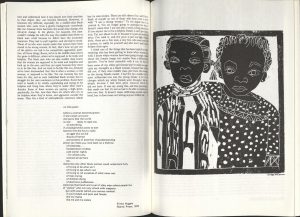
“no title poem,” formatted next to an article and an image in Up From Under, vol. 1, no. 4.

In Ericka Huggins’s “no title poem,” printed in vol. 1, no. 4 of Up From Under in 1971, the speaker writes about the world “if you’re black and poor and female / like my mama / like me and my sisters”—a world that is “ready to rape you / of everything” (28-30, 4-5). Huggins writes this poem from the Niantic Prison in 1970, and her speaker also realizes that “prison can make you look back on a lifetime / of bitterness…” (11-12). This poem appears in a section dedicated to Black women, wedged between essays “Who I Am” and “From One Generation to Another.” The works, grouped together because they are about Black women, demonstrate a larger trend of Up From Under. In each publication, the editors include exactly two, four, or six pages on women of color, including Vietnamese and Black women; clearly, these women are deemed “other” enough to constitute their own sections, separate from the rest of the writing about white women. This formula contributes to the tokenization of women of color throughout all of Up From Under. In this publication, just like the Feminist Poetry Movement, American white women too often minimized women of color and their poetic voices.

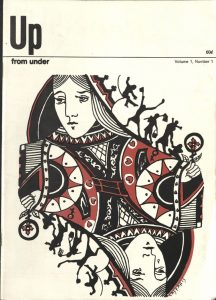
The cover of Up From Under, vol. 1, no. 1, published in 1970.

The cover of Up From Under, vol. 1, no. 5, published in 1973. This cover features images of both white and Third World women, demonstrating the progression of Up From Under.


Sources:

Huggins, Ericka. “no title poem.” Up From Under, vol. 1, no. 4, 1971.

Mayhen, Betty Thomas. “To My Black Sisters.” Up From Under, vol. 1, no. 3, January 1971.

Morgan, Robin. “Guerrilla Woman.” Up From Under, vol. 1, no. 1, May 1970.

Morgan, Robin. “The Vigil.” Up From Under, vol. 1, no. 1, May 1970.

Up From Under, vol. 1, no. 1, May 1970.

Up From Under, vol. 1, no. 2, August 1970.

Up From Under, vol. 1, no. 3, January 1971.

Up From Under, vol. 1, no. 4, 1971.

Up From Under, vol. 1, no. 5, 1973.

“I am Brown”: Third World Women and History

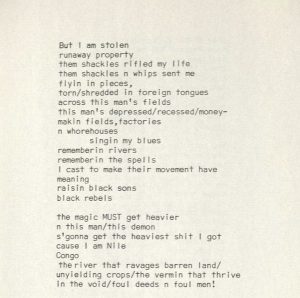
In Thulani Nkabinde’s “I am Brown,” the speaker, “a child of the third world,” remembers and embodies a centuries-long history of slavery, resistance, and female empowerment (2). She exists both “in this world” as an “illegitimate seed / mishap of the honkies goodtimes” and yet she is “stolen / runaway property”: she exists both in the present and in the past alongside her enslaved ancestors; she is their modern reproduction (6-7, 54-55). In this poem, printed in Third World Women, the speaker explores her heritage, rejecting “the westerner” while embracing her “sister” (24, 41).

The final stanza of Thulani Nkabinde’s “I am Brown.”

The sea—powerful, touching many continents—represents the speaker’s origin and identity. From the start of this poem, the speaker remembers “the sea n my real home” and then embodies that sea, saying that “many rivers flow into my waters” (9, 14). Her origins are as numerous and diverse as the streams that flow into an ocean. She controls this water as she is “rememberin rivers/ rememberin the spells / I cast to make their movement have / meaning” (64-67). Her sister is also “murmurin chantings” as she “gives the rivers their flow” (39-40). Nkabinde likens the power of these women of color to magic—a magic that “the westerner… rich n ignorant” cannot understand because “he aint hip to magic” (24, 26, 28). The speaker’s origins and mystical power converge in her repeated declaration: “I am Nile / Congo / the greatest waters of the earth / the falls they call / Victoria” (49-53). In these lines, she refers to the white colonizers who christened a Zimbabwean waterfall Victoria Falls. Like this body of water, the speaker has been shaped by Africa and re-named by a white society. The speaker personifies the powerful waters of the ocean.

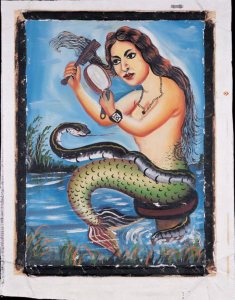
A painting of Mami Wata (“Mami Wata”).

In this personification, Nkabinde alludes to Mami Wata, an African water spirit. Usually embodied by a woman, Mami Wata (literally, “Mammy Water”) is fabled to live in the waters of the Atlantic Ocean, connecting the coasts of Africa and the Americas and luring voyagers with her beauty and power (“Mami Wata”). At once dangerous, sexual, and a nurturing mother, Mami Wata is the female embodiment of multiple transcontinental origins. The speaker in “I am Brown” is also a mother, “raisin black sons / black rebels,” and also a female sorcerer, “workin voodoo madness” (68-69, 30). She too comes from several places and a history as vast as the sea. Therefore, the speaker acts as a modern Mami Wata who stretches through time and space: through generations, across the continents of the globe.

“I am Brown” symbolizes the larger aims of Third World Women. The editors of this book note that Third World Women “is only a beginning”: published in 1972, it marks the official entrance of women of color into the Feminist Poetry Movement. The speaker in “I am Brown” embodies the mythical traditions of Africa as she grapples with her identity in the modern world. Similarly, the writers and artists featured in Third World Women nod to their diverse ancestors as they insert themselves into a growing movement of American women.

Sources:

“Mami Wata.” Smithsonian National Museum of African Art, https://africa.si.edu/exhibits/mamiwata/intro.html. Accessed 10 December 2019.

Nkabinde, Thulani. “I am Brown.” Third World Women. Third World Communications, 1972.

Third World Women. Third World Communications, 1972.