“Case in Point” by June Jordan

“Case in Point” by June Jordan
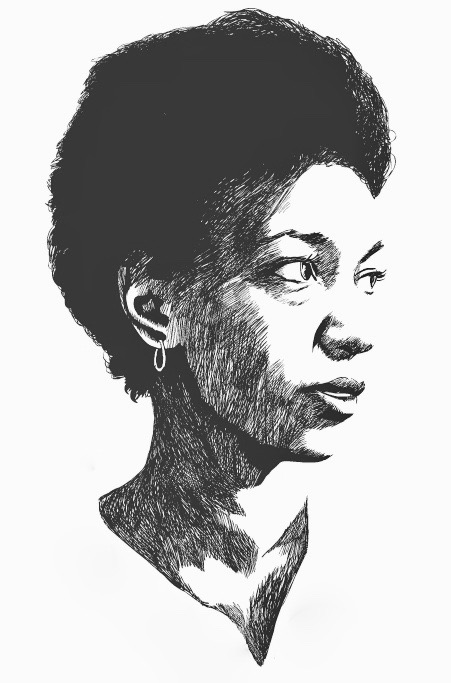
Drawing of June Jordan

June Jordan addresses the trauma of rape from an intersectional perspective: she is a woman but she is also black. Her title, “Case in Point,” uses legal language to state her point that the patriarchy’s depravity uniquely cripples women, especially women with intersectional identities, through a demonstrative example. Rape is that example. Jordan argues through ethos and pathos that rape is a case in point that proves that the patriarchy brutally silences women.

Through a casual tone, Jordan utilizes ethos to present the narrator as a credible source to a skeptical audience. The first evidence of such occurs on lines five and six: “there is no silence peculiar / to the female” (Jordan, lines 5-6). While the words themselves create a conversational tone, they serve the purpose of explaining an extreme scene of sexual violence. By doing so, Jordan starts to achieve the ethos she needs in order to be heard and taken seriously. Being a female African American, Jordan was well aware of the stereotypes and prejudices that stood in the way of her narrator. Women were often branded as being hysterics creatures, so if the narrator entered into the topic matter with a destructive, emotional tone, her words would have been pronounced as nothing more than girlish babble and her argument cast aside. If Jordan portrayed the narrator as exuding too much femininity, the argument would have lost credibility. Jordan uses irony to prevent such an occurrence. “I have decided I have something to say” (Jordan, line 7) breaks the silence in a matter of fact voice that is both nonchalant and definitive. Once again, Jordan enters into a grim topic through irony. Nonchalance allows the narrator to come across as non-threatening. She merely “decided” that she has “something to say” and anyone is free to listen at their own will. When people are commanded to do something, often their first impulse is to rebel against it. When people are invited to do something, often they are more inclined to accept. When people are told something is going to happen and they are not commanded to join nor offered an invitation, often, curiosity and the human desire for inclusion leads them into action whether they realize it or not. Jordan does precisely that. “I have decided I have something to say” is a declarative sentence, presenting only the fact that the narrator has “something to say” and will most likely say it. The narrator does not demand the audience’s attention nor does she invite the audience to listen; thus, her resolve and indifference tickles the audience’s curiosity and draws them into her words. Jordan begins the final stanza with the shortest sentence in the entire poem: “he was being rhetorical” (Jordan, line 35).This quippy line follows a lengthy description of a horrifying incident, and in the context of the preceding question,  “d’ya want to swallow my big dick; well, do ya?” (Jordan, lines 23-4) the line appears to state the obvious, but it serves a much greater purpose. After reliving the entire traumatic incident, the narrator returns immediately to a matter-of-fact tone. Jordan achieves ethos in this line. Jordan proves that the narrator is not an unstable little girl whining about a man hurting her, but a clear-headed adult, stating the facts of her case. Because Jordan the narrator’s credibility, so too is her argument made credible, thus, audience becomes inclined to pay attention.

Finally, through various poetic devices, Jordan utilizes pathos to let the reader’s emotions
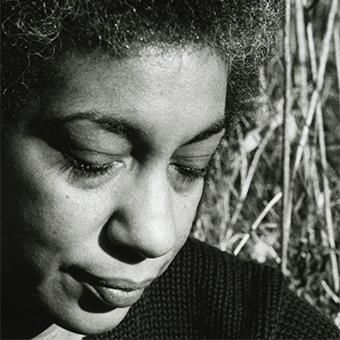
June Jordan

inspire a changed perspective. Pathos evokes empathy. Empathy catalyzes action. Action prompts change. But pathos is a difficult element to master, for the line between too much and too little is fine. “I was raped for the second / time in my life the first occasion / being a whiteman and the most recent / situation being a blackman actually / head of the local NAACP” (Jordan, lines 10-4). No punctuation breaks these lines. Not even a period concludes this stanza. The repeated enjambment makes the last line of mere description appear to be an after-thought. The fact that this line proceeds the adverb “actually” makes the information regarding the second criminal was a “blackman” and “head of the local NAACP” have a peculiar note of surprise. The NAACP was meant to protect the civil rights of black people. The narrator, a woman of color, is supposed to trust this organization and those who lead said organization. But the rape breaches her trust. Who is she supposed to turn to now? She turns to her own voice. “Whiteman” and “balckman,” like the titles of two species, are the only indicators of distinction between perpetrators. The act is the same. Hence, the colors, “white” and “black” appear separate from the act. This poem crystallizes this devastating moment in a way only poetry can. Stanza 2 describes the episode in graphic detail. “Stradling,” (Jordan, line16) unclear whether acting as a participle or a verb, and “forcing,” (Jordan, line 19) describing “his […] powerful left hand,” (Jordan, line 18) are both present sense and in action. “Stradling” and “forcing” speed up the scene until “while” (Jordan, line 20) breaks the rhythm and the past tense verbs “rammed,” “described,” and “shouted” reduce the last lines to a crawl. The languid pace weighs down the final lines; their significance becomes unavoidable and sobering. While the lines “he rammed / what he described as his quote big dick / unquote into my mouth” (Jordan, line 20-23) explains the rape literally. The fact that the following words, “and shouted out” (Jordan, line 24) continue with the same pace and tense indicate that the question the man shouts and the silence that follows is too part of the rape. This entire scene, the ebb and flow of the cadence and the crushing progression of violence brought to life with each poetic device, throws the reader into the scene with the rape victim.

Just as the title “Case in Point” suggest, the narrator’s argument is proved within the example itself. Her argument being that rape is an example of society’s depravity.



Continue reading

“Rape Joke” by Patricia Lockwood

“Rape Joke” by Patricia Lockwood

The Second Wave changed the discussion and legal view of rape significantly. However, antirape activists have yet to win the war. The rape epidemic continues, so poetry is once again used to confront it, as exemplified by Patricia Lockwood’s “Rape Joke.” Teenagers, however, are beginning to employ this classic method of evoking empathy to combat sexual violence through poetry with a twist. Hence, the genesis of Pain Memes.

Painting of Patricia Lockwood

Patricia Lockwood’s “Rape Joke” is a modern poem about a rape incident, that addresses the same issues about rape as presented in Adrienne Rich’s “Rape,” Sylvia Plath’s “The Jailor” and June Jordan’s “Case in Point,” for even though the Second Wave changed the legal landscape, rape itself has not changed. A similar element Rich’s “Rape” poem is “the rape joke said you were the one who was drunk, and the rape joke said you remembered wrong, which made you laugh out loud for one split-open second” (Lockwood 5). Lockwood utilizes anaphora, repeating “the rape joke said you“ to emphasize the rape joke’s shifting of the blame. Such is the case Rich makes in the question “will you swallow, will you deny them, will you lie your way home” (Rich, line 30). The woman knows the truth even if the whole world forces them to lie. Rape has not changed. Lockwood’s “Rape Joke” connects to as well to Plath’s “The Jailor” in the line “the rape joke is he wants almost murdered a dude by throwing him through a plate glass window” (Lockwood 2). “Murdered” is a strong, grotesque word. “Dude” is a layman’s term that belittles the event. This demonstration of violent, raw power cast aside through casual wording was a crucial element in “the Jailor” as well, for in both poems the rape victim futilely wishes to their situations were less grim. Rape has not changed. The “Rape Joke” and “The Jailor” end similarly as well. Lockwood wrote on the last page of the “Rape Joke” “So, you did dream of killing the rape joke for years, spilling all of its blood out, and telling it that way. The rape joke cries out for the right to be told” (Lockwood 6). The girl in the “Rape Joke” dreams “of killing the rape joke” just as the captive wife in “The Jailor,” wishes her husband “dead or away” (Plath, line 38). Both women fantasize about killing their demon but neither one can. Rape has not changed. The “Rape Joke” shares an element of Jordan’s “Case in Point” too in the line “the rape joke is that he was your boyfriend” (Lockwood 1). The reader stumbles upon the devastating realization that the man who raped the narrator of the “rape joke” was a man who she had trusted: her “boyfriend.” A betrayal like this happens to the narrator of “Case in Point” for her perpetrator was the “head of the local NAACP”

(Jordan, lines 14). Rape is always a form of betrayal. Rape has not changed. Like in “Case in Point” the “Rape Joke” tells the story of the silence that falls upon the raped woman in the line “the mattress felt a specific way, and your mouth felt a specific way opened against it, as if you were speaking, but you know you were not. As if your mouth were open 10 years into the future, reciting a poem called Rape Joke” (Lockwood 4). The narrator repeats “felt a specific way,” as she replays that moment in her mind. She relives the experience so acutely that she can find no other words to accurately
describe it, yet she describes the silence perfectly. The victim’s silence in that moment gave her a voice in the future. That is the silence Jordan states is “peculiar to the female” (Jordan, lines 26-7)  in her poem “Case in Point.” The silence when a girl is raped and her silence that follows her rape is what halts the outcry against the crime committed against her. One thing has changed. Through Pain Memes, these girls are starting to find their voice.

Teenagers on YouTube, both young girls and young boys, are beginning to use Richard Dawkins’s “Meme Theory” as their modern vessel to carry their uproar against the rape epidemic. Meme Theory is Richard Dawkins’ principle that certain ideas have the ability to spread though cultures like wildfire if the presentation of the idea and the idea is ideal for such the conditions of the time. Teenagers have found the ideal “meme” for transmitting their stories about rape: Pain Memes. According to Kaitlynn Mendes, the author of “Digitized Narratives of Rape: Disclosing Sexual Violence Through Pain Memes,” Pain Memes are “a means of storytelling in which a script is written as a short passage, conveying painful personal experiences through the visceral means of hand-crafted signs.” This multimedia storytelling device is as elegant as it is simple. In each video, words, written in informal text, appear on a screen either digitally or on flashcards. Music plays and no words are spoken as the words appear and disappear. Using this platform, rape victims make their stories known to their audience both conceptually and emotionally. The personal touch of different forts and languages, the alluring ambient music, the silent victim behind the screen all draw in the viewer and allow them to connect on a deeper level with the story they read. No longer are rape victim’s words begin monitored by the patriarchy. They can share their experiences without being immediately judged to their face. The Pain Memes have proved to be a personal form of healing for those still suffering from the trauma. YouTube gives them the feeling that they are being heard, and many of them are. Millions upon millions of people have access to and actually watch YouTube. And rape victims have the access to share their story with them all. As Kaitlynn Mendes writes in her examination of the modern outcry against sexual violence, “finally, although it is unlikely that everyone who shares their experience of rape considers this to be an activist, or even a feminist, act, making oppression visible has always been a key tenet of feminism” (Mendes). There is still hope.


Continue reading

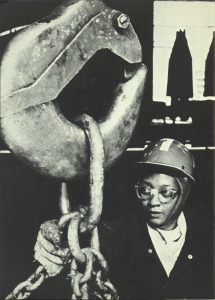
Women’s Demand for Equality in the Workforce

Image

From “Unions on the Line: Myth vs. Reality” by Judy Edelman. Found within Up from Under vol. 1 issue 1

In her article “Unions on the Line: Myth vs. Reality,” published in the feminist journal Up from Under in 1970, Judy Edelman confronts the inequality women faced in the work-force, calling our attention to one of the major issues taken up by Second Wave feminists in the 1970s: the significant wage gap between men and women. In 1970, women earned just 58 cents to every dollar a man made. While Title VII had been passed in 1964, prohibiting employment discrimination based on sex, it was only the beginning of the reform necessary to provide equity in the workplace for women. Edelman’s article, one of many that appeared in the more than one hundred feminist periodicals of the period, presents the numerous myths used to justify discriminatory hiring practices. She goes on to debunk these myths. One mentioned, and a common myth of the period, is that “welfare women don’t want to work. They just want to lie around and collect checks” (34). The author points out that the reality is actually quite different: as Edelman explains, “most women on welfare cannot find jobs which pay enough to keep them alive” (34). The wage gap affects all women, but especially those in the working class because they must work in order to survive. Yet when women are paid “58% as much as men’s wages,” (35) how can they be expected to live above the poverty level? This wage gap effectively forces women to be dependent on men.

Not only are women confronted with unequal treatment and pay at work, but, if they work and also have a husband and family, they are expected to also run the household: “The idea that housework is women’s work is so commonly accepted,” Edelman writes, “that even if a woman works all day she is still expected to shop, cook, clean, and take care of the children” (35-36). Addressing the role women are forced into, this article challenges the very notion of these roles’ existence. These ideas are so “commonly accepted” that people do not question them. Looking more closely at the wage gap, Edelman informs readers that female factory workers “earned a median wage of $3,282” compared to a man’s “$5,752,” while the median pay for women of color was “$2,647” (35). Failing to pay women equally was a profitable business, Edelman argues, as bosses would profit an extra “$60-85 billion per year by paying women less than men” (35).

Edelman’s article goes on to provide information on unions with growing numbers of women, while also contesting unions themselves for their sexist practices. She first commends the United Auto Workers (U.A.W) and the International Union of Electrical workers (I.U.E) for fighting, “consistently for legislation to guarantee full rights and improved conditions for women” (35). U.A.W had “over 200,000 women members” and I.U.E consisted of “a large percentage of women numbers” (35). While these unions were making headway, the larger culture of unions remained sexist. Within the majority of unions, “there [were] no women in positions of leadership” (36). The lack of women in these higher positions allowed their problems to be silenced and ignored. One problem mentioned is that of young mothers who must work, but cannot leave their children alone as “few unions realize the desperate need of  young working mothers for child care centers” (35). Failing to elect women to leadership positions widens the gap of inequality, contradicting the baseline ideas of unionization. Women’s underrepresentation further discourages their participation in unions as “most union and community meetings are held at night” (35). This is a problem for women with families, because it is in the evenings when they are expected to perform the duties of a housewife such as cooking dinner. As a result of the sexism in unions, “Out of 28 million working women, only 3.7 million are organized into trade unions” (35). Edelman’s piece, as a whole, works to inform its readers on the importance of educating all women and unions on the vitality of fighting for full equality for women in the workforce.

Edelman, Judy. “Unions on the Line: Myth vs. Reality.” Up from Under, vol. 1, no.1, 1970. (33-37).

Women’s Welfare: A Matter of Survival

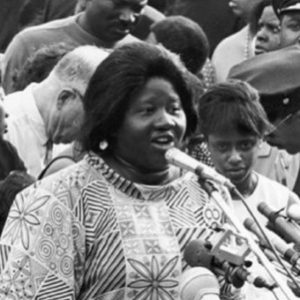
Johnnie Tillmon

The wage discrimination women faced led many to rely on funding from the government to survive. Johnnie Tillmon’s “Welfare is a Women’s Issue”, published in Liberation News Service in 1972, examines the unfair treatment women on welfare faced, and called for a restructuring of the entire welfare system of the 1960s. Tillman begins the essay bluntly stating, “I’m a woman. I’m a black woman. I’m a poor woman. I’m a fat woman. I’m a middle-aged woman. And I’m on welfare” (106). Her choppy lines demand that the reader attend to each component of her description. She goes on to explain that if you qualify as any of those previous statements, “you count less as a human being,” and if you are all of them, “you don’t count at all. Except as a statistic” (106). As a 45-year-old mother of six who is on welfare, Tillmon has seen the inequity women face first hand, especially those in the working class. Tillmon paints a moving image of the direct discrimination women face, and how they are actively pushed into this position. She explains that “44% of all families are headed by women” (107), meaning there is no man in the picture. In this case “a woman with just three kids,” who is “earning the full federal minimum wage of $2.00 an hour, is still stuck in poverty” (108). And that only if this woman is paid the full minimum wage, which is unlikely. As Tillmon writes, “There are some ten million jobs that now pay less than the minimum wage, and if you’re a woman, you’ve got the best chance of getting one” (108). Working class women had no way of supporting themselves, or their families. The oppression they faced was insurmountable, made worse by the vicious stereotypes (their laziness, for instance) to which they were subjected.

Tillmon’s document challenges the unfair policies of the Aid to Families with Dependent Children (A.F.D.C), an organization that decided welfare aid at this time. As she discusses the unfairness of the A.F.D.C’s current system, she describes a welfare woman’s relationship with the A.F.D.C as a “supersexist marriage” where “you trade a man for the man” (107). In this example “the man” is the current welfare system in place that controls exactly how much money women receive. Tillmon discusses the rule that no family with an “able-bodied” man in the home is allowed to qualify. Thus, if a family is poor and needs welfare, the man must leave the house. The family must disband in order to get enough money from the government to survive, perpetuating inequality and stereotypes against the working class. The wage discrimination women face already strips them of the ability to support themselves and a family. As Tillmon argues, “The problem is that our country’s economic policies deny dignity and satisfaction of self-sufficiency” to “the millions who suffer every day in underpaid dirty jobs—and still don’t have enough to survive” (108). No matter what she does as a black woman who is poor, Tillmon will never be self-sufficient because of the intersectional oppression she faces as a black working class woman.

Tillmon’s organization was the National Welfare Rights Organization (N.W.R.O). It was founded by George Wiley in 1966, and Tillmon was appointed as the leader in 1972. This group “put together [their] own welfare plan, called Guaranteed Adequate Income (G.A.I), which would eliminate sexism from welfare” (109). In this new plan there would be no discrimination or categorization of any kind: “you’d get paid according to need and family size only,” and it would pay attention to the department of labor’s estimates on what sufficient costs of living would be. Overall, Tillmon’s fight for women’s welfare fit more than perfectly into the feminist movement, and empowered working women to fight for what they deserved.

Tillmon, Johnnie. “Welfare is a Women’s Issue.” Rpt. in The American Women’s Movement, 1945-2000: A Brief History with Documents, edited by Nancy Maclean. Bedford/St. Martin’s, 2009. Print.

The Foundation Set from Title VII

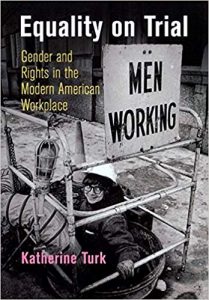
Cover of Equality on Trial by Katherine Turk

In 1964, Title VII of the Civil Rights Act, prohibited sex discrimination in employment. While this law did not clearly define sex discrimination, or how to cure it, it set a foundation of the working woman’s fight for equality. In the following decades, Title VII revolutionized women’s status in the American workplace (2). In her book Equality on Trial, Katherine Turk explores how Title VII served simultaneously as an inspiration and detriment to progressive visions of workplace gender equality. She examines how numerous groups such as workplace caucuses, feminist organizations, and unions, use this law to, “reset the terms of economic citizenship from laboring women’s perspective” (9). Turk’s work fits in nicely with Edelman’s article “Unions on the Line: Myth vs. Reality”, as well as Johnnie Tillmon’s essay “Welfare is a Women’s Issue”, both works that were made possible after the discussion and controversy that different interpretations of Title VII inspired.

Turk, Katherine. Equality on Trial: Gender and Rights in the Modern American Workplace. University of Pennsylvania Press, 2016. JSTOR, www.jstor.org/stable/j.ctt1btc5x9.

Redefining the Common Woman

Aside

Cover of Judy Grahn’s The Common Woman

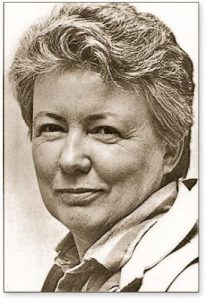
Judy Grahn’s Common Woman is a seven poem collection published in 1978 within her larger piece The Work of a Common Woman. These poems zoom in on different female characters and serve as a tribute to their lives. Grahn’s raw and honest portrayal of these women provides a balanced picture of them as true human beings, confronting the stereotypes that exist. Below, I take a closer look at a few of these poems, including “III. Nadine, resting on her neighbor’s stoop” and “VII. Vera, from my childhood”.

Image of Judy Grahn

“III. Nadine, resting on her neighbor’s stoop”

Judy Grahn’s, “III. Nadine, resting on her neighbor’s stoop” comes third in her seven-poem collection, The Common Woman, and accentuates the integral role common women play as mothers and leaders. Grahn details Nadine’s value to her community beginning with the title of the poem itself. The word “resting” is used deliberately in explaining why Nadine is there. She is exhausted from taking care of others and must take a break on her neighbor’s stoop. Grahn challenge’s the false notion of poor women being lazy, similar to Judy Edelman in her article “Unions on the Line: Myth vs. Reality”.

The poem begins by celebrating how Nadine “holds things together” in her community (line 1). While Nadine does keep things together, she is not perfect. No one is. As she hosts a “Sunday social she would spike / every drink, and offer you half of what she knows, / which is plenty’ (lines 3-5). Grahn’s description of Nadine is authentic, leaving no details out. She “holds things together”, but she also drinks too much. Nadine is still generous despite this shortcoming, as she “spike[s] every drink” as well as “offering” her knowledge and experience to others. Nadine’s supportive nature is further portrayed in the poem as she is, “raising 15 children, / half of them her own” (lines 13-14). Nadine cares for everyone in the neighborhood, not just her own family. Those in the community depend on her to the point that, “The neighborhood / would burn itself out without her” (lines 14-15), but frustration still arises in her experiences as, “one of these days she’ll strike the spark herself” (line 16). With all Nadine does to take care of the neighborhood, she may be the one to let it crumble. She holds everyone together, but that does not mean she does so with ease. Perhaps she ponders what life would be like if  her neighbors did not rely on her. What would happen if she stopped holding everything together? Would she go down in flames with it? Would she move on and forget it ever existed? Grahn invites the reader to think about these questions.

Throughout the poem, Grahn uses architectural and tool metaphors to describe Nadine. This imagery enhances Nadine, and reinforces the overarching idea of her strength and her role in “holding things together.” The speaker describes Nadine maneuvering herself around the city, “like an armored tank; but she thinks / of herself as a ripsaw cutting through / knots in wood” (lines 5-8). An armored tank can be useful, but it is large and lacks nuance or subtlety. In contrast, a ripsaw is a handheld device that is powerful, yet more subtle than a tank. Nadine may have a distorted view of her effectiveness, but she ultimately supports the community as a helpful tool, holding it together. The poem goes on to compare her to a shelter, describing Nadine as, “a mud-chinked cabin in the slums” (line 11). This comparison shows how Nadine is weathered from her experience, but remains sturdy and effective at holding the community together and providing a home for many. Nadine may not be perfect, but people depend on her, and she gets her job done with the consistency of a machine, “made of grease / and metal” (lines 17-18).  The poem concludes, “The common woman is as common as / a nail” (lines 20-21). Nadine is the embodiment of the common woman and, much like a nail, holds things together under pressure (family, friends, neighborhoods). As nails do in fact “hold things together,” we return to how the poem starts. The whole neighborhood depends on Nadine to keep moving forward. While she may want to give up at times, or must drink to cope at others, she continues to serve as a vital component, a powerful mother and leader within this impoverished neighborhood.

Grahn, Judy. “III. Nadine, resting on her neighbor’s stoop.” The Work of a Common Woman: the Collected Poetry of Judy Grahn 1964-1977. Crossing Press, 1980. (65).

“VII. Vera, from my childhood”

As the final poem in this collection, “Vera” represents one of a number of Grahn’s “common women,” giving us an example in poetry of the numerous problems working class women faced. The poem stands as an ode to honor Vera’s story, and serves to help the women who follow. The poem begins with the speaker talking directly to Vera, “Solemnly swearing / to swear as an oath to you… as if an oath could be wrapped around / your shoulders / like a new coat” (lines 1-5). This oath to Vera is to make sure her story is told. The comparison of this oath to a “new coat” “wrapped around [her] shoulders” suggests the warmth and connection developed as the speaker shares Vera’s story. The speaker stands in solidarity with her and the experiences she endured as a working class woman. After swearing an oath, the speaker goes on to tell Vera’s story, “for your 28 dollars a week and the bastard boss / you never let yourself hate” (lines 6-7). Vera was a woman who worked for low pay and faced harassment in the workplace. She could not let herself hate her boss because she needed this job. Standing up for herself would just leave her jobless, unable to support herself, an enormous problem millions of women faced at this time. And while Vera worked all day for low wages, dealt with awful bosses, she must come home and face “all the work you did at home / where you never got paid” (lines 8-9). She also dealt with tragedy, watching her husband drink himself to death, as the speaker states Vera was “watching the hard liquor break your fine husband down / into a dead joke” (lines 12-13). The death of her husband leaves Vera on her own, left to try and make enough money to support herself and her children without a living wage.

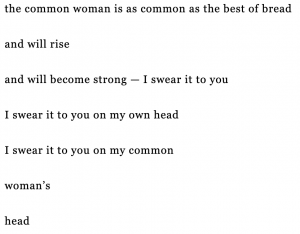
Lines 26-32 of “VII. Vera, from my childhood” found in The Work of a Common Woman

This first half of the poem describes the insurmountable struggles Vera faced as a “common woman”. It is through this ode to Vera’s adversity that Grahn empowers the women who come after Vera. As we know from the title of the poem, this woman is from the speaker’s childhood and cannot be saved. The speaker retells this story to save the women who will come after Vera, however. Grahn returns to the repetition found at the end of each of her previous six poems in this collection, and drives this repetition home using it numerous times in the final lines. The poem reads, “the common woman is as common / as good bread / as common as when you couldn’t go on / but did” (lines 20-23). The common woman is compared to bread, the sustenance of life. While Grahn emphasizes her importance, she further commends the ability of the common woman to endure adversity and continue moving forward. As the poem wraps up, the final lines become an anthem for the feminist movement, “the common woman is as common as the best of bread / and will rise / and will become strong—I swear it to you” (lines 26-28). These lines were instrumental in pushing the women’s movement forward; often recited at rallies, meetings, on the radio, and in bookstores across the country.

Grahn puts the struggles of common women into poetry that can be passed on from woman to woman to help them “rise” and “become strong”.


Grahn, Judy. “VII. Vera, from my childhood,” The Work of a Common Woman: the Collected Poetry of Judy Grahn 1964-1977. Crossing Press, 1980. (73).

The Legacy of This Bridge Called My Back

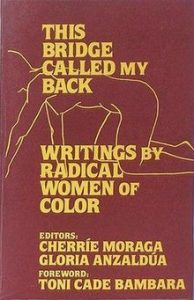
This Bridge Called My Back was one of the first feminist anthologies devoted to representing the voices of women of color. It was first published in 1981 in response to the racism of white feminists in the second-wave feminist movement. This anthology frequently criticizes the lack of solidarity between white women and women of color throughout the movement and highlights the importance of recognizing the intersectionality of identities.

This is the first edition of This Bridge Called My Back. It was first published in 1981.

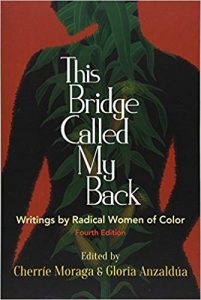
In their introduction, Cherríe Moraga and Gloria Anzaldúa, the editors of the anthology, note that the process of creating this book led to a “greater solidarity with other feminists of color across the country” (1st edition, xxiv). The anthology soon became a reflection of “an uncompromised definition of feminism by women of color in the U.S.” (1st edition, xxiv). There are now four editions of This Bridge Called My Back, with the most recent edition published in 2015. In the introduction to the fourth edition of the anthology, Moraga emphasizes the importance of political memory in order to ensure that “we are not always imagining ourselves the ever-inventors of our revolution” (4th edition, xix). The continued publication of the anthology serves as a form of political memory that Moraga encourages us to recognize; however, it also calls attention to the following question: Why do we still need to create platforms for women of color in order for their voices to be represented? 

Moraga argues that This Bridge Called My Back ought to be considered an “archive of accounts of those first ruptures of consciencia where we turned and looked at one another across culture, color and class difference,” (4th edition, xxiv). However, the ultimate purpose of this fourth edition of the anthology is for “the next generation, and the next one” (4th edition, xxiv). This anthology seeks to create solidarity among women of color and through this edition, across generations. When the first edition was published, it was “created with a sense of urgency” and “from the moment of its conception, it was already long overdue” (1st edition, xxiv). The activists of that time recognized that this “was a book that should already have been in [their hands]” (1st edition, xlv), and, in creating this anthology, they were ensuring the existence of this platform for future women of color.

This is the fourth edition of This Bridge Called My Back. It was published in 2015, making it the most recent edition.

Moraga believes that the women who contributed to the first edition of the anthology would call the next generations their “ ‘familia’– [their] progeny,” entrusting the next generation “with the legacy of [their] thoughts and activisms, in order to better grow them into a flourishing planet and a just world” (4th edition, xxiv). The anthology serves to remind its readers to recognize the efforts made by previous activists and that we cannot expect to see the end of the movement. The introduction lists the deaths of several contributors to the anthology, including the editor Gloria Anzaldúa, both as a tribute to their work and an acknowledgement that their work must be continued. This Bridge Called My Back continues to combat the silencing of women of color within the feminist movement and unites generations of activists. 

Sources: 

Moraga, Cherríe, and Gloria Anzaldúa, editors. This Bridge Called My Back: Writings by Radical Women of Color. Persephone Press, 1981.

Moraga, Cherríe, and Gloria Anzaldúa, editors. This Bridge Called My Back: Writings by Radical Women of Color. 4th ed., State U of New York P, 2015.

Confronting Our Own Oppression

In her essay, “La Güera,” Cherríe Moraga delves into the observations and experiences that led to her understanding of oppression and intersectionality. Moraga recognizes the privilege she had by being “‘la güera:’ fair-skinned,” meaning that she was “born with the features of [her] Chicana mother, but the skin of [her] Anglo father” (23).

https://cherriemoraga.com/index.php/about-cherrie-moraga-1

Although she faced oppression as a result of her heritage, she recognizes the other privilege she had by being educated. The intersectionality of her identities provided Moraga with opportunities she wouldn’t have had otherwise. But it was not until she understood her sexuality that she began to understand the full extent of the workings of oppression. Moraga argues that “danger lies in ranking the oppressions” and that “without an emotional, heartfelt grappling with the source of our own oppression, without naming the enemy within ourselves and outside of us, no authentic, non-hierarchical connection among oppressed groups can take place” (24). “La Güera” explores Moraga’s claims that “it wasn’t until [she] acknowledged and confronted [her] own lesbianism” that she began to empathize with her “mother’s oppression–due to being poor, uneducated, and Chicana” (23). Moraga’s lesbianism served as a platform for her understanding of oppression and the silencing of these oppressed groups.

Moraga teaches us that the divisions in the feminist movement between white women and those of color results in not acknowledging how one can be both oppressed and oppressor. In order to admit one’s role as an oppressor, one must ask “some very frightening questions,” writes Moraga: “How have I internalized my own oppression? How have I oppressed?” (25). Moraga describes this as the “oppressor’s nightmare” because people are “afraid to look at how [they] have failed each other” (27). They are “afraid to see how [they] have taken the values of [their] oppressor into [their] hearts and turned them against [themselves] and one another,” and, most of all, they “are afraid to admit how deeply ‘the man’s’ words have been ingrained in us” (27). Although we may fear recognizing our internalized oppression, Moraga ask readers to acknowledge their privilege and their oppression in order to begin to understand how they are the participants of the oppression faced by other communities. Only then will we be able to combat the divisions within the feminist movement. 

Source:

Moraga, Cherríe. “La Güerra.” This Bridge Called My Back, edited by Cherríe Moraga and Gloria Anzaldúa, 4th ed., State U of New York P, 2015, pp. 22-29.