Author Archives: Leah Rosenfeld

Little Charlie Bucket, Our Savior

If we look beyond the colorful fields of edible grass and chocolate rivers in Willy Wonka’s chocolate factory, we might find a something a bit less sweet to the taste. In the well-known version of the story, Charlie and the Chocolate Factory (2005), Charlie Bucket, an impoverished, yet kind-hearted English boy, finds the final golden ticket for a competition to win an unknown prize from Willy Wonka himself. Freddie Highmore, who plays Charlie, does a terrific job collecting a fan club for Charlie, the underdog, as he gets closer and closer to winning. But in Tim Burton’s rendition of Charlie and the Chocolate Factory, Charlie represents much more than a lucky little English boy. In fact, the plotline that we all know has a racial script that the movie simultaneously follows that establishes a racial hierarchy.
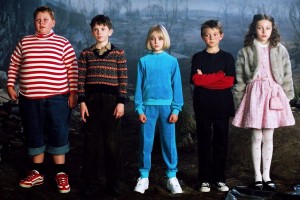
 

charlie-and-the-chocolate-factory-warner-bros-everett-052615-1276x850

From left to right: Augustus, Charlie, Violet, Mike, Veruca
screen-shot-2016-12-15-at-8-32-26-pm

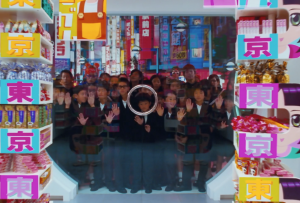
The racial script begins most obviously with the abundance of white actors in the movie. Upon Willy Wonka’s announcement of the five hidden golden tickets, the movie cuts to a clip of Japanese children scrambling to buy as many bars as possible in a store in Tokyo, and then to a clip of Moroccans bartering for Willa Wonka bars in a marketplace. But despite the appearance of a worldwide sale of chocolate bars, the winners of the golden tickets include two British children, Charlie Bucket and Veruca Salt, two American children, Violet Beauregarde and Mike Teavee, and one German child, Augustus Gloop, all white. So, here we have a white world-renowned factory owner, with five white kids and their white parents (or grandparents) as the main cast in the movie. By choosing children from Western Europe and America, and omitting minority groups, the movie seems to want us to associate whiteness with success and dominant mainstream society. This serves to make anyone outside this category become estranged to the audience, as we will see with the Oompa Loompas.

4952_3

a28b35f0-bce2-44e2-9c87-0f2efd2d9108_dd2e11e6_image

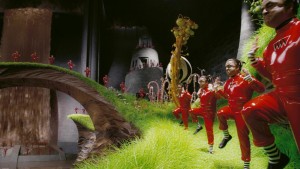
With the exception of a few very brief on-screen appearances, the movie’s most prevalent non-white characters are the Oompa Loompas, Willy Wonka’s little factory workers. Fifteen years prior to the movie’s present day, Willy Wonka fired all of his workers, Charlie’s Grandpa Joe explains, and shut his factory off from the world. In his seclusion, Willy Wonka explored the world looking for “exotic new flavors for candy” and came across Loompaland, where he found a population of small, hard-working, dark-skinned, Loompaland natives who would become his new factory workers. Willy Wonka extends an offer to the Chief Oompa Loompa: their labor in return for cocoa beans, the Oompa Loompa’s most prized possession. After exchanging a few hand signs and grunts, the Chief agrees to bring his people to work for Willy Wonka in his factory. I refer to Oompa Loompas collectively as an entire population, but perhaps the most interesting part of this population is that they are all played by the same actor, Deep Roy, who was born in Kenya to Indian parents, and whose height of 4’4” reflects the miniature physique of the Oompa Loompas in the movie. So let’s get this straight; the Oompa Loompas are identical, tiny, dark-skinned, foreign, large in numbers, receive no monetary pay, and work for a white guy. Does the movie mean for us to align the “race” of Oompa Loompas with Latinos?  In the historical context of the original book, the immigration of Latino immigrants, especially in England, certainly is not relevant, but I point out the similarities in the context of present-day associations, keeping in mind the movie was made in 2005. They share characteristics with the unfortunate present-day stereotype of Latino immigrants: petite, tan, hard-working, and replacing white workers for lower pay. The Oompa Loompas wear identical shiny, metallic suits with antenna-like hairstyles, a costume that strongly resembles that of aliens, or should I say immigrants?
screen-shot-2016-12-15-at-8-39-30-pm

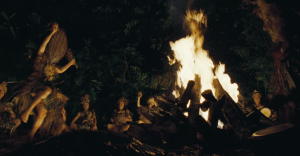
Oompa Loompa’s dancing in a ceremonial gathering. The dancing Oompa Loompa wears a cocoa bean on his head.

screen-shot-2016-12-15-at-8-42-37-pm

Willy Wonka exploring Loompaland.

Alternatively, the movies intends for us to align Oompa Loompas with Central African tribal culture in the Congo Rainforest. In one clip the Oompa Loompas dance in grass skirts and other ceremonial adornment. Uncoincidentally, Roald Dahl’s original version of the book (1964) describes Willy Wonka’s factory workers as “3,000 amiable black pygmies… imported by Mr. Willy Wonka from ‘the very deepest and darkest part of the African jungle’”(Treglown). Associations with the Pygmy People of Central Africa are uncanny; they are little people, as are the Oompa Loompas in the movie, as is Roy Deep in real life. This also brings to mind the history of European colonization of Africa. The movie connects the Oompa Loompas, whose land was exploited by a white explorer (Willy Wonka), and whose labor is now vital to the production of the factory’s goods, to the history of the exploitation of African land and slaves. Despite the grim connections, it actually turns out that it does not matter whether the movie aligns the Oompa Loompas with Latinos, African people, or another non-white group, because the simple fact that they are not white is good enough. According to the movie, the anything-but-white race sits lower on the racial hierarchy. They work for the the white businessman, the white golden ticket holders.

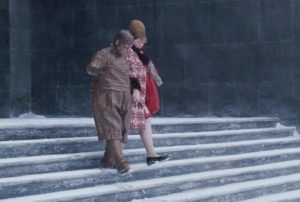
But then the racial script gets even more complicated when sub-hierarchies of race emerge. In order to see this, I must introduce Richard Dyer’s The Matter of Whiteness. Whiteness, he says, is defined by the ability “to transcend” (Dyer 17) the physical body. It is embodied by “its energy, enterprise, discipline and spiritual elevation” (Dyer 21). He even compares whiteness to Christian culture by way of the “link between the body and spirit” (Dyer 18). Contrastingly, blackness confines people to their physical bodies, and we see this in Charlie and the Chocolate Factory most conspicuously in the Oompa Loompa’s musical performances, which makes up the bulk of their screen time. We must look closely, however, to notice a sub-hierarchy within the cast of white characters. As Willy Wonka gives a tour of his chocolate factory, each child faces an obstacle that ultimately requires physical repair. For example, the demise of Augustus Gloop, the fat, candy-loving German boy, occurs when he falls into the river of chocolate and gets sucked up by a pipe. He exits the factory with his body covered head to toe in brown chocolate. Violet Beauregarde, who takes immense pride in her accomplishments, specifically her gum-chewing championship, faces her downfall when she chews gum that Willy Wonka has not yet perfected; she turns violet-colored and blows up into a huge blueberry, and is then brought to the juicer. As she exits the factory, we see her new violet, ultra-flexible body twisting in unnatural ways. Spoiled Veruca Salt decides she wants a squirrel from the factory (Willy Wonka employs squirrels to crack open nuts). But when the unhappy squirrels deem her a “bad nut”, they throw her down the garbage chute to the incinerator. She leaves the factory covered in garbage. Finally, Mike Teavee shrinks to the size of a human hand when he misuses one of Willy Wonka’s new inventions, a chocolate bar teleporter. He is then taken to the taffy stretcher to be elongated. So there you have it, a picture of white people, transforming into discolored, deformed beings and in the process, losing their whiteness. Not only have Violet and Augustus literally changed skin color, all of them become confined to their bodies in some very conspicuous way, which implies blackness. Willy Wonka, simply by leading a tour of his factory, has rooted out the “bad nuts”, the children who, despite their whiteness, are deemed unworthy of victory. That leaves us with Charlie, the sweet, harmless, British boy who, by virtue of everyone else’s forfeits, has won the grand prize: heirdom to the factory. By emphasizing the children’s physical discolorations and deformities, the movie confines them to their bodies and essentially de-whitifies them, placing them lower down on the movie’s racial hierarchy.
screen-shot-2016-12-15-at-8-44-38-pm

Augustus and his mother, leaving the factory.

Violet and her new body.

Violet and her discolored body.

So the children lose their status as white people. But what makes Charlie superior and, therefore, deserving of the grand prize? The movie’s central plot calls for an heir to run the chocolate factory, and it cuts out the entire population of the world except for Americans, Germans and the English. Even then, the story sends an underlying message to keep the power within British people. The British boy is next in line to power (note that the snobby British girl loses out, which is the movie’s way of placing a greater value on male, working class Brits). That Charlie is British and of the working class cannot be reason enough to declare his superiority though, so what else does the movie offer as key components to the ideal victor?
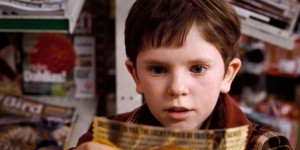
Charlie Bucket.

Charlie Bucket.

Charlie’s virtuous ways align him with Christian morals. He possesses generosity, as seen when he shares his singular birthday chocolate bar with all six family members. When Charlie asks Violet why not start a new piece of gum, she responds “because then I wouldn’t be a champion, I’d be a loser like you” to which Charlie barely reacts, showing his composure and forgiveness. Contrastingly, each of the four real losers exhibits one of the seven deadly sins: gluttonous Augustus, prideful Violet, greedy Veruca, and raging Mike, who seems to always be mad. Kara Keeling and Scott Pollard write that not just the four children, but everyone in the world except for the Buckets have a strange obsession and desire for food, which accurately speaks to the sinfulness and gluttony of the world (Critical Approaches to Food in Children’s Literature). Charlie’s Christian whiteness surpasses not only that of the immoral children, but that of the gluttonous, lustful world around him.
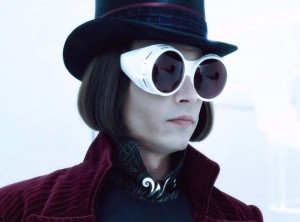
rs_1024x759-160316194913-1024-johnny-depp-charlie-and-the-chocolate-factory-ms-031616

Willy Wonka.

Willy Wonka at the Bucket Family dinner.

Willy Wonka at the Bucket Family dinner.

It turns out that the movie’s take on whiteness goes even beyond Christian morals. In fact, the movie seems to want us to associate ideal whiteness with heterosexuality and the traditional family unit (father, mother, and child). Willy Wonka’s unusual appearance, made up of a top hat, velvet coat, bug-eye goggles, and an effeminate hair style, combined with his lack of family, and questionable sexuality sets him apart from mainstream society. When Violet’s tall, thin, blond mother conspicuously flirts with Willy Wonka, he stares at her blankly, clearly either not interested or not able to pick up on the social queue. Something about him feels  uncomfortable; maybe it is his eccentric dress, his social awkwardness, or his queerness. Stuart Aitken writes in Composing identities: Films, families and racism about Heidi Nast’s argument “that “race” is inherent in modern conceptions of heterosexuality that constructs a normative family quadrad comprising Mother, Father, Son, and the Repressed (the Wild or Bestial). The Mother-Father-Son triad is encoded as white while the repressed Bestial is colored”. This applies to the Buckets, a family whose lack of financial stability is made up for in love, support, and an overall attractiveness as a family unit. Though he is not “colored”, Willy Wonka fills the role of the “bestial”. He lacks social skills, heterosexuality, and a family. But when Charlie, the superior white character wins the contest, he adopts Willy Wonka into his stable family and begins a process of “fixing” Willy Wonka’s queerness. The movie, then, tells us that even though Willy Wonka is white, he is not ideally white and so he must strive to be more like Charlie and his family, which he ultimately does in the final family dinner scene. We end with a movie that defines a racial hierarchy that, as it turns out, does not depend purely on appearance. Rather, Rather, Charlie and the Chocolate Factory establishes a vision of ideal whiteness embodied by Charlie Bucket, our little Christian white savior.
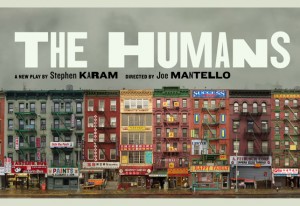

The Humans: Realism as an Alternative Entertainment

The glamorous world of the show business attracts a large audience, and for a good reason. The combined effort and talent of the playwright, actors, directors, and set designers can produce a beautiful product: awe-inspiring shows. But why are humans so captivated by entertainment? Not everyone has the knowledge and experience to appreciate or criticize entertainment the way professional show or movie critics do. For most people, it is simply because they enjoy the experience. That is, they leave the play feeling better than how they arrived. Many plays (and movies, for that matter) offer the viewers a picture of a better, more perfect world than the one in which they actually live. Richard Dyer, in his essay “Entertainment and Utopia”, writes that entertainment, specifically show business, present elements of the utopian through the plotline, characters, set, and music, in a way that enthralls the audience; they can temporarily enter into an idealized world. This appears in Wicked The Musical, most obviously during the song “Defying Gravity”, when Ephaba rises from the stage, suspended in mid air, surrounded by artificial fog, as she sings about about her newfound power and freedom. Wicked attracts a worldwide audience because it tells a story about love, true friendship, and valuing others for who they are at the core, not on the surface. But could there be a different type of entertainment that succeeds without offering an idealized version of the world? A type that still attracts crowds, but possibly for different reasons? In an alternate type of entertainment, realism replaces utopianism, and the world on stage allows the viewer to acknowledge and relate to the universal experience of humans as we are, rather than the idealized vision of how we would like to be.

the-humans-poster

In the play, The Humans (New York opening 2016), written by Stephen Karam and directed by Joe Mantello, we enter the lives of the Blakes, a middle-class American family, during their Thanksgiving celebration. The play takes place in the new home of Brigid Blake (Sarah Steele) and her boyfriend, Rich (Arian Moayed), in their tiny, two-story Manhattan duplex. But as with many family get-togethers, any seemingly ordinary event can quickly turn into a nightmare. A sudden influx of familiar faces revives past arguments, and provides an open-mic for honest, and sometimes harsh, opinions. Throughout the course of the play, the multi-layered complexities of the Blakes unravel and the tension grows until they reach their breaking point. In the opening scene, Brigid’s family arrives from Scranton, Pennsylvania. Her father, Eric (Reed Birney), her mother, Deirdre (Jayne Houdyshell), her sister, Aimee (Cassie Beck), and her grandma, Momo (Eric’s mother, played by Lauren Klein) who has dementia and resides in a wheelchair, all eventually settle into the less-than-homey apartment. The couple, Brigid and Rich, have not completely moved in yet, so the already dreary apartment looks especially barren and “a touch ghostly” on this Thanksgiving evening. The set includes a narrow metal spiral staircase that connects the top floor to the basement, and a folding table with plastic chairs. Someone hung a singular string of Christmas lights over the kitchen in attempt to brighten the permanently dull space. The apartment is nothing special, and everyone in the audience recognizes the characters as ordinary, middle-class human beings.

the_humans_off_broadway_cred_joan_marcus-jpg-606x455_q100

What good is a play that depicts an ordinary world in which nothing seems exciting or amusing? In other words, what are we, as the audience, to gain by watching this play? It does not captivate us for its grandiose music, costumes, or sets in the way that other plays do. Jill Dolin in Utopia in Performance: Finding Hope in Theater writes that utopian entertainment “calls the attention of the audience in a way that lifts everyone slightly above the present, into a hopeful feeling of what the world might be like if every moment of our lives were as emotionally voluminous, generous, aesthetically striking, and intersubjectively intense”(5). Rather than depicting “what the world might be like” or what humans could be like, realism appeals to an audience for another reason. It allows us to focus in on a universally relatable topic: what it means to be human. Nothing in the play, no songs, sound effects, costumes, or anything within the realm of the utopian, distracts the audience from this because they do not exist. The director, Joe Mantello, and set director, David Zinn, successfully make the set of the play so common and generic, so real, that the audience forgets that these people are actually actors in a play, not just, say, our next-door neighbors. The audience feels at home with the Blakes, they welcome us into their family holiday to be a part of their evening. The Blake’s world is our world, and as they become more and more real, their lives on stage take on the characteristics of our lives: unstaged and unscripted

From left to right: Eric, Deirdre, Aimee, Brigid, Rich

From left to right: Eric, Deirdre, Aimee, Brigid, Rich

Certain sentiments arise in the play that undeniably relate to most humans. For example, the feeling that life is a never-ending list of chores and responsibilities. Eric and Deirdre have worked for decades in the same jobs, as a school maintenance worker, and as a office manager at a firm, respectively. Despite their many years of work, they still face financial insecurity. Eric says “I’ll tell you, Rich, save your money now. I thought I’d be settled by my age, you know, but man, it never ends. Mortgage, car payments, Internet, our dishwasher just gave out”. Karam does a wonderful job capturing how difficult it is for people to make ends meet. Another source of disagreement springs from Eric and Deirdre’s interactions with their daughters in sort of battle between generations. Even the location of their homes shows a divide. Brigid has just moved to the glamorous New York City, while Deirdre and Eric live in suburban Scranton, Pennsylvania. Additionally, they are devout Christians who constantly nag their daughters for their disinterest, which is made obvious when Brigid says, “no religion at the table!”. Eric says to Brigid, “you put your faith in juice cleansing…”, in another stab at the younger generation. And Deirdre makes her point crystal clear when she gives the young couple a statue of the Virgin Mary as a housewarming gift. Another disagreement arises between Brigid and Deirdre, who cannot for the life of her understand why Brigid and Rich have not gotten married yet! Never missing an opportunity to bring it up, Deirdre responds to Brigid’s reference to her “mother-in-law” by saying under her breath, “She isn’t your mother unless you get married”. Furthermore, Eric stigmatizes mental illness and refuses to pay for Brigid’s therapy, despite her constant insistence on needing it. “Well, save some of the money you spend on organic juice and pay for it yourself” he says to Brigid, a harsh response, indicating clearly their differing views. These interactions between the family members on stage feel all too real to us audience members. The ability to relate to to these characters almost has an effect of breaking down the fourth wall between the audience and performers, as if we are present in the room with them.

605

The Humans reaches another level of realism through its use of humor. Despite the dark reality that this play depicts, Karam still manages to incorporate humor into the script, and its response by the audience is both expected and puzzling at the same time. At the dinner table, Eric asks Rich if he takes medication for his mental illness, because “in our family, we don’t have that sort of depression”, to which Aimee responds “yeah, no, we just have a lot of stoic sadness”. The audience, myself included, laughed. Moreover, Deirdre sends articles to her family via text and email all the time, mostly articles about faith and homosexuality (because Aimee, the elder daughter, is gay). Brigid, annoyed with her mother’s constant messages says, “you don’t have to text her [Aimee] every time a lesbian kills herself”. The audience responded to that remark with a kind of uncomfortable laugh. But how can we justify laughing at these topics? Depression, sexuality, and suicide are serious matters that hit uncomfortably close to home for so many people, so why did we laugh? In The Culture Industry, Adorno explains that “there is laughter because there is nothing to laugh about. Laughter, whether reconciled or terrible, always accompanies the moment when a fear is ended” (112). Similarly, The Freudian Relief Theory states that “laughter is a physical manifestation of the release of nervous energy” (Bardon, 9). Maybe one of these theories can offer some insight as to why human’s response is laughter, since undoubtedly some element of fear or anxiety associated with these topics exists. Karam understands the human aspect of it; what provokes genuine laughter, but also what the effect of this laughter is. When an actor said something, everyone in the audience laughed together, along with the characters who chuckled on stage. In the presence of discomfort or fear, everyone responded the same way through laughter. The shared laughter creates solidarity between audience members. In a sense, laughter in this play brings people closer together into a community of shared experiences, shared fears, and shared anxieties.

The small gestures, subtle remarks, and dark humor that feel so genuine to us point to an even bigger picture of humanity. According to Karam, The Humans explores the “big existential horrors of life that everyone deals with”(Lecture Series), and the Blakes perfectly embody these “horrors”. After years of facing financial difficulties, Eric asks the heart-wrenchingly revealing question, “Don’tcha think it should cost less to be alive?” Not only Eric feels hopeless about life. Aimee faces the possibility of being fired from the law firm where she has worked for years. Even more, her ulcerative colitis has worsened and she may need surgery. And on top of all of this, she is heartbroken over a recent breakup with her girlfriend. How’s that for perfect timing? In utopian entertainment, a character might resolve his/her issues on the premise of the saying, when life gives you lemons, make lemonade. Take Forrest Gump, for example. In this utopian world, he never meets a challenge he cannot overcome. But the overriding message in The Humans reflects the more realistic sentiment that when life gives you lemons, it is awfully difficult to make lemonade. Forrest Gump survives a war, makes millions as a shrimper, and runs across the country with few, if any, setbacks. Eric Blake cannot even retire. If utopian entertainment offers its viewers impossibilities, why not look to realism for a better understanding of what is possible?

the_humans_production_still

People are drawn to entertainment that offers a more perfect world, but in analyzing The Humans, it becomes clear that Stephen Karam sees greater value in representing the real world. The play offers satisfying and refreshing depiction of reality. No sugarcoating, just true hard life. So, to return to my question, what are we, as the audience, to gain by watching this play? The answer is a greater understanding and appreciation for humans, with all of our imperfections. By using realism rather than utopianism in his play, Karam offers us a greater understanding of ourselves, the humans around us, and the world in which we live.

Segregation, or Integration?

The idea of the white savior is simple: a white, typically privileged character helps the non-white characters in their struggle and by doing this, he/she becomes a morally enlightened human. Take The Blind Side, for example. Leigh Anne Tuohy (Sandra Bullock) is an white upper class woman, bored with her daily routine as a suburban mother and socialite, who rediscovers meaning in her life when she adopts a homeless black boy, Michael (Quinton Aaron), and helps him succeed as a student and athlete. Or look at The Help, which tells the story of Skeeter (Emma Stone), a girl of the Southern Debutante class, who wishes to pursue her career as a writer, and in doing this, allows the voices of the black housemaids to be heard. These characters are often presented in blaringly obvious ways; Leigh Anne Tuohy is rich and white, Michael Oher is poor and black. But the white savior can exist in subtler forms. Now I will diverge from the mainstream white savior archetype and discuss a more peculiar form, in which the saviors are no longer superior to, but rather identify with those they save.

Whether you have or have not seen Hairspray (2007), you probably associate it with its eccentric costumes, fun songs, and dances, all of which are based on the culture of Baltimore in 1962. The movie tells the story of Tracy Turnblad, an overweight, white, high school girl. Her dream is to dance on the Corny Collins Show, a local TV show that features “nice white kids” who dance and sing to the latest hits. One day, Tracy decides to pursue her dream and audition for the show, but she is rudely rejected by Velma Von Tussle, the snobby manager and mother of the show’s star performer, when she says, “And so my dear, so short and stout, you’ll never be in so we’re kicking you out!”. Right off the bat, the viewer sides with Tracy as the underdog. That same day in detention, Tracy meets and befriends a group of black kids (Seaweed and his friends), who are infatuated by her confidence and stylish dance moves. They tell her, “you one of us” since she fits with their crowd. Seaweed and his friends later face an identical rejection when Von Tussle tells them that Negro Day (the one day per month when they are allowed to perform) is officially over. Tracy and Seaweed (and his friends) have similar struggles, experiences, and dreams to perform on the Corny Collins Show. Though each briefly get the chance to perform, both face discrimination and cannot pursue their dreams because of physical appearance.

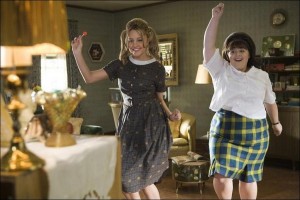
Tracy (right) and her best friend, Penny, dance to the Corny Collins Show.

Tracy (right) and her best friend, Penny, dance to the Corny Collins Show.

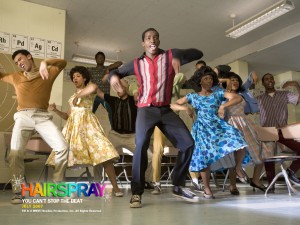
Seaweed and his friends dance in detention.

Seaweed and his friends dance in detention.

Given everything I have discussed about this movie so far, (this being very little), it is easy to think that the issue with this particular type of white saviorism requires less attention than the more typical type, since Tracy is depicted as equal to, rather than superior to, the black people. I will tell you why this idea is wrong, but first let me ask this question: to what extent can society’s criticism of bodies (commonly known as fat shaming) be viewed with equal importance as the issues of racism and segregation? This seems especially egregious in Baltimore, a city that still today faces immense racial separation and socioeconomic divides. I cannot imagine putting fat shaming into the same category as segregation and racism, given their historical significance and impact on our nation. The movie, Hairspray (2007) diminishes the importance of the segregation faced by the black characters by comparing them to the problems Tracy faces as an overweight person.

The initial interaction between Tracy and Seaweed and his friends takes place in detention. Tracy enters the room and is immediately taken by the smooth moves of the kids around her. When she joins in, she is warmly received by the group, who all clap after she puts on a little solo. Contrastingly, when Link Larkin, the Corny Collins Show’s lead singer and heartthrob, attempts to join in, he is given the cold shoulder. The movie equates Tracy and the black characters by situating them both in detention, and then reinforces that exclusively Tracy is one of them when Link is outwardly rejected. Following Tracy’s brief fame on the Corny Collins Show, the detention room suddenly transforms into the coolest room on campus. When Penny, Tracy’s friend, appears at the door, Tracy casually says, “She’s with me” the way a rock star would give a friend access to the VIP section. She makes detention, a previously negatively connoted space, a hip place for her new friends to hang out in and feel good about. This scene enforces that Tracy can be compared to the black characters because of their similarities.

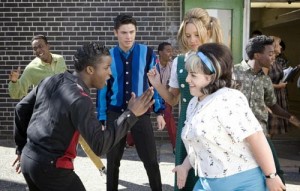
Tracy and Seaweed dance while Link watches.

After detention lets out, Seaweed and Tracy dance while Link watches.

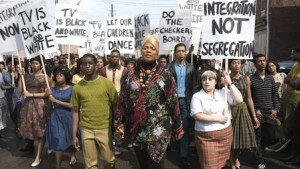
A similar trend appears later on in the movie. Tracy, in her role as white savior and agent for change suggests “If we can’t dance, let’s march” to Maybelle (Seaweed’s mother). Soon thereafter, a non-violent march processes through the streets of Baltimore. Tracy, with her “Integration Not Segregation” sign in hand, leads the pack until they meet face to face with the Baltimore Police. They cannot proceed, but Tracy will not back down without a fight. When the police officer turns his back on the protesters, Tracy hits him on the back with her sign. The police officer then threatens to “take the whole lot in”, and the scene erupts into violence.

Seaweed, Maybelle, and Tracy lead the march.

Seaweed, Maybelle, and Tracy lead the march.

Now I am coming closer to making my point. The movie reinforces over again the depiction of Tracy as an ally to the black characters. So, it is believable that Tracy would actively participate in the march, stand at its forefront, and even hit a police officer for a cause she believes in. But in presenting Tracy in this way, Hairspray gives the impression that Tracy, because of her struggles as an “outsider”, truly can identify with the black characters and their struggle with racism. However, this is wrong. She is not an outsider just because she is overweight, even though the movie portrays her as such. The fact that she is white and will never experience what a black person experienced in Baltimore in 1962 brings me to my point that Hairspray trivializes the real struggles that people faced in their fight for civil rights when Tracy, who is also presented as facing social discrimination, effortlessly unites people and creates change for civil rights.

That a march for civil rights could have been led by a teenage girl as easily as Tracy did in the movie, or that protesters could have escaped police arrest and violence as easily as Tracy and others did in this movie, brings me to my next point, which concerns the misrepresentation of Baltimore in the 1960s.

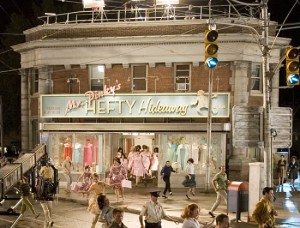
In the “Welcome to The 60s” scene, Tracy drags her hermit mother out of their house for the first time in ten years. To Edna’s surprise, the whole world has changed for the better! The scene is full of vivid colors, action shots, and lots of sparkles. The 1950s did not cater to the plus size woman, but the 1960s do! Edna walks out of a dress shop in a pink sequined dress, a dramatic contrast to the drab clothing she previously wore. The scene implies that the coming decade will bring a new and improved version of everyone and everything. But the song misrepresents the reality of life in Baltimore in the 1960s, and puts an idealized, white washed version on display instead. The Dynamites, three beautiful black female performers, ironically sing, “take your old-fashioned fears, and just throw them away”, and “the future’s got a million roads for you to choose.” In reality, black people had a lot to fear in the coming decade; the Riot of 1968 brought on deeper racial divides, police violence, and anything but “a million roads for you to choose” from. The movie’s representation of Baltimore in the 1960s shows what a white girl might see in her own idealized future, but ignorantly overlooks the fact that this was not at all the case for black people, which is ironic considering the story is supposed to be about racial integration.

Tracy and her mother, Edna, walk out of Mr. Pinky's Hefty Hideaway in their new pink sequined dresses.

Tracy and her mother, Edna, walk out of Mr. Pinky’s Hefty Hideaway in their new pink sequined dresses.

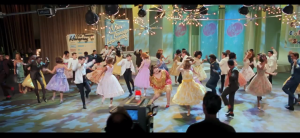
Performers on the Corny Collins Show are now integrated.

Performers on the Corny Collins Show are now integrated.

The final scene, “You Can’t Stop The Beat” really hits home my final point. The characters, all different colors and sizes, come together on The Corny Collins Show in the grande finale. Tracy and her black friends have succeeded! But what exactly have they succeeded in? Throughout the movie, Tracy wishes for her own right, and for the right of black people to perform on television, but in obtaining this goal, the group becomes homogenized to the white way of doing things. After performing solo, Little Inez wins “Miss Hairspray”, a traditionally white prize and status. The integrated group of dancers perform to “You Can’t Stop The Beat”, a song that views the future with immense optimism for all people. But the song is white-sounding, especially when compared to “Big, Blonde and Beautiful” or “Now Run and Tell That”, both of which are performed by black characters in the movie, and both of which also have a traditionally black, soulful sound. So, Tracy triumphs in the successful integration of the Corny Collins Show, but Hairspray the movie ultimately enforces the idea that the white way is the right way.