Author Archives: Christopher Ochoa

Mean Girls and Male Dominance in Feminism

Among millennials, Mean Girls is one of the most well-known films of the past decade. It’s written by the highly-acclaimed comedian Tina Fey, who “you can never give … too much credit for [steering] popular culture” (Yarnall), and it is lauded for being an integral part of today’s “new wave of female comedy,” which many consider to be a “new space … [that] feminism is disruptively creating.” (The Times). But the movie is riddled with latent patriarchal sentiment that doesn’t pass as “just a joke” to be cast aside and deemed unimportant; the film itself doesn’t even seem aware of it. The desired feminist story is subverted by non-feminist means, and the movie actually arrives at an unexpected, yet somehow unsurprising, assertion.

The motion picture unintentionally falls back into pop culture’s pattern of male domination by placing men at the center of women’s plotlines. In fact, much of the movie is simply the aftermath of meeting a boy. Essentially, the protagonist develops a crush on the man sitting in front of her in math class, and she is henceforth doomed to exist for male attention. The character learns to wear makeup, style her hair, and clothe herself with the goal of gaining the attention of men, both character and viewer. But it’s not just her.

A female teacher is seen topless in the first few minutes of the film (in which she is simultaneously reduced to a divorcée whom a man is attracted to). The protagonist’s mother is never in a scene without her husband, although he can exist without her just fine. And another mother is only ever alone, but she, in compensation for lacking a male presence, is emphasized as having the same male-driven propensity for maintaining appearance as the teenaged girls.

While the film plays out, the characters’ struggles fluctuate and grow; yet in the end they can all be solved by a man. Specifically, the movie’s denouement is codependent to the pairing of each woman with a man. Once this happens, the chaos that stemmed from being independent of men is appeased and turned to harmony.

Some might say that the motion picture asserts, and brings viewers to agree, that female desire for male attention is a frivolous tendency, since comedic material is drawn from it. But when the underlying concept that women are unable to exist in film without a dependency on men is actually maintained by the final conclusion of the film, the satire of these instances is nullified.

The film also invites viewers to regard women as men would—for pleasure. This of course entails that the film is heteronormative, but more on that later. The women of the film are consistently portrayed as being one of two things: intensely worried about how their bodies are viewed, or flaunting them. (How could they exist without fashioning some relation to men?)

This corporeal focus is terribly clear in the fact that the most popular girls in the school are known as The Plastics. They have achieved social importance and high ranking by being the most attractive, to such a degree that they’re directly associated with plastic surgery—which, in its own right, is referenced quite a number of times. But in order to maintain their appearance, they must have the utmost scrutiny with their own bodies. There are always wrongs they must try to better or fix, or simply bemoan. “God! My hips are huge.” “Oh, please. I hate my calves.” “I’ve got man shoulders.” “My hairline is so weird.” “My pores are huge.” “My nail beds suck.” (19:38) Altering their physical appearance to be rid of these anxieties allows the girls to be teen royalty on campus, with Regina (Latin for “queen”) as their head.

And on the other side of the social desirability spectrum are the “desperate wannabes” (9:43). The girls with abnormal bodies: the physically disabled, small in stature, and fat. They display the unattractive qualities that The Plastics vehemently avoid, to such a degree that they are just to be laughed at, used as oddities to execute the film’s jokes. Or they are just the ones we hope will get prettier, we hope will somehow gain the means to attract a man. They are, in fact, only accepted into the main cast as reward for showing up made prettier, for wearing a dress or having intricately styled hair.

So these women have the opportunity to gain their importance in the movie, but what if men can’t gain pleasure from the character? What fate is he/she left to? It seems the male dominance of film is fraught with intricacies in how the male gaze should address those who innately lack the possibility of providing pleasure to straight men.

Homosexuality is shunned and made “other”, that much is clear. In providing a male dominated view of women’s existence and bodies, the motion picture must address how that gaze will react to non-heterosexuality. One major aspect to investigate in this movie is the inclusion of a heavily stereotypically gay character as one of the protagonist’s two main friends. In his case, the film can’t hide behind social-norm-attacking comedy, the joke is that he is flamboyant, fashion-driven, beauty product knowledgeable, and sassy – among other stereotypes. There is no societal prodding or questioning, it’s just funny that he’s so gay (as the currently derogatory phrase goes).

The movie has by this point made an intention to both laugh at and use the non-normal, seemingly because it means that the person can’t build the necessary relationship with a man that they require to be significant. In the case of this friend, there is not a single other homosexual man, presumably, in the entire school (certainly not to any extent pertinent enough to be mentioned and which comes into great importance later on). There is, however, a looming, fluctuating, threat of female homosexuality.

An interesting pattern in our culture is the greater acceptance for women to behave more masculine than for men to behave more feminine. This extends into the film during the scenes of girl-on-girl aggression being cheered on by bystander men (as Sarah Hartzell puts it, “for the realization of a man’s vision … violence against women is ‘worth it.’”), and even more so in scenes of sexual girl-on-girl action. Even just the stating of phrases like “girl-on-girl” and “the girls have gone wild” proposes the notion of sex between women (which viewers are expected to enjoy) (1:07:44).

So women leaning towards homosexuality is acceptable and encouraged – when in front of men. It is strikingly not so when amongst only women. And this is where the protagonist’s other friend comes in. We see this friend struggle with The Plastics’ belief and gossiping that she is lesbian. She had actually been “best friends” with Regina, head of The Plastics, until they started to think she was homosexual. “I couldn’t have a lesbian at my party,” Regina recounts of their falling out (33:50). There is an apparent duality behind when it’s okay, correlating to when it can be used to gain more male attention.

So, there is the momentarily funny and quickly forgotten gay friend, who is used to humorously tokenize gay males through his stereotypes and singular incidence, and the girl friend who epitomizes the constant reluctance women should feel to separate from the fetishistic bond they have with men. It is interesting then to see how these characters come out in the end. The girl friend who had been all but accused of lesbianism, ends up with a man (we see them in the final scene kissing on the lawn of the school). Thus, she is happy and unconditionally welcomed into the clique. Yet, in the same scene, as the camera pans to show each character harmoniously being brought into the group, the gay friend is notably left out.

Some might argue that his presence in itself includes him in the revelry, but it’s important to understand how he is presented among the others, and in the context of the overall motion picture. He’s there, but he has gained nothing, he’s not happier in the end. And according to the gender script of the film, this would be because heterosexual men don’t get pleasure from homosexuality in other men, no matter the condition. So the girl friend can be happy and accepted at the end, despite her ostensible transgressions, and the gay friend is doomed to be unhappy and unimportant.

Mean Girls is known as “one of the most quoted movies of all time … nestled into the hearts of fans” (Yarnall). Teaching girls to reject aggressive behavior towards each other, it is praised for the advancement of feminist beliefs and practices. But in its declaration of these notions, it upholds the dominant position of men in determining a woman’s worth. It tells female viewers that as long as they are able to relate themselves to a man’s pleasure, even by just successfully eliciting his attention, they will be happy and important. If you cannot, as gay men are doomed to be unable and lesbian women threaten to be, you will be neither happy nor important (at least not increasingly). A normative ending resolves the purposely overdone patriarchy that Fey used to make a point, and ironically sweeps feminism (and her point) under the rug. With a musical adaptation in the works, it turns out Tina Fey may actually have to consider rewriting this iconic script, if she is willing to lose fans over a potentially unsatisfying ending.

(might as well watch it again, basically all my points in 3 mintues of the film)


Works Cited

“How to Work The Red Carpet – And Other Lessons From Amy Schumer.” The Times: 16. Sep 17 2016.

Hartzell, Sarah. “What it Means to be a Woman in Film.” University Wire. Dec 07 2016.

Mean Girls. Dir. Mark Waters. By Tina Fey. Perf. Lindsay Lohan and Rachel McAdams. Paramount Pictures, 2004.

Schilling, Mary Kaye. “Tina Goes to War.” Town and Country: 14. April 2016.

Yarnall, Erin. “Mean Girls’ Celebrates 10 Years as One of our Generation’s most Iconic and Quotable Films.” University Wire. Feb 23 2016.
The City of (Fraudulent) Light

          Amélie, released in 2001, is a French film directed by Jean-Pierre Jeunet that was met with great international success and remains “the highest-grossing French-language film in the United States” (Gibbs). Despite its large popularity and critical acclaim, the movie has been condemned for its “lack of realism” (Ezra 86). Rosemary Wakeman likewise argues that Jeunet crafted qualities of a “beloved, intimate, old-fashioned world” that are not found “in any of the city’s contemporary sites”. Analyses into how this ideal world is formed focus primarily on the motion picture’s digital manipulations (Ezra; Kelly). Although the effects from such manipulations contribute heavily to the film’s fantastical quality, the portrayal of a traditional France and the interactions among minor characters are large players in the film’s perception as amiable and largely better than our own.

Digital-enhancement is the more frequently attributed foundation of Amélie’s overall impression. Producers primarily used digital-enhancement to create a bluer sky and dramatize the entirety of the film. They removed visible graffiti from many of the sets and permeated the film with a continuous golden glow that “imbues even the edgier locales and situations with a tinge of nostalgia” (Ezra 87). These revisions are even more highly criticized for the fact of the film’s setting in Montmartre, where in reality its “[suburban] housing projects … lack [any] kind of ‘conviviality and rootedness’” (Wakeman). The “crime, social exclusion, and institutional racism” present in Paris, and even more so in this locale, is “glossed over” by the edits (Ezra 87). The digital modifications are clearly meant to romanticize Paris, and these revisions exist to produce an experience that entertains and makes its viewers happy. One of the greatest ways to accomplish this goal, and arguably the ultimate mode of entertainment, is through depiction of utopia, markedly so in this film. However, creating a more visually pleasant Paris is not the only contributing factor to its formation; there are reconciliations of society’s shortcomings in many other aspects of the film that together create its renowned “feel-good” liberation (Wakeman).

screen-shot-2016-11-18-at-8-40-47-pm

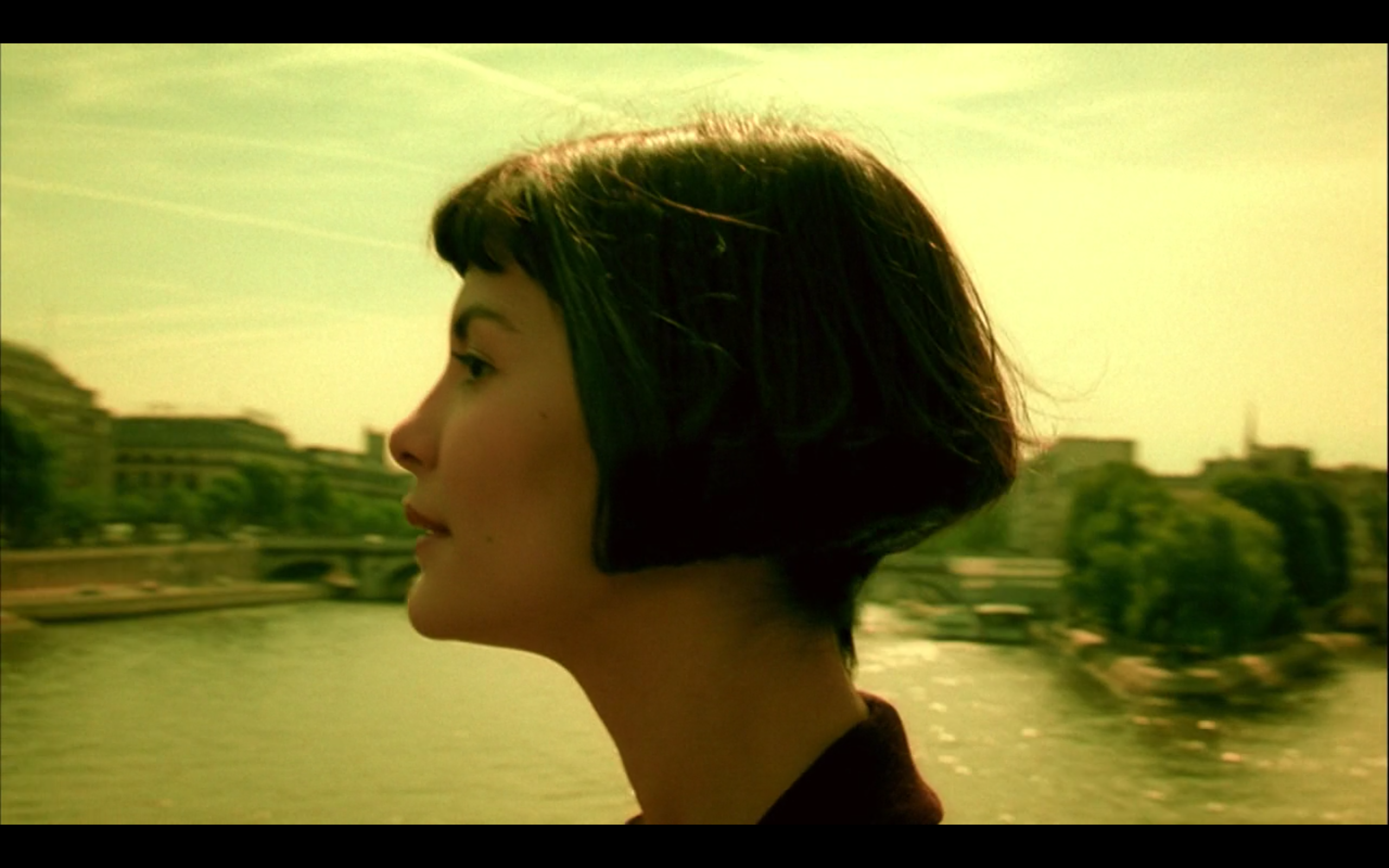
Amélie walks along the Seine after finding joy in helping others.

First, Amélie, the shy, whimsical, and ingenious protagonist of the film, actively decides to become a force of good in others’ lives (15:52; 35:08). In doing so, Amélie necessitates a focus on the formation of community, and the outcomes and experiences of minor characters become immensely important to the success of the protagonist’s quest. One major point of this is that most of, if not all, the people Amélie chooses to help are initially isolated in some way. Georgette, a nervous hypochondriac coworker of Amélie’s, and Joseph, a recently cynical-of-women customer at the diner, experience a short-lived romantic relationship together. It is notably initiated by the transparent and open attitudes they display for each other, and Amélie’s fabrication of those attitudes nonetheless allows for the formation of an honest relationship.

screen-shot-2016-11-18-at-4-30-36-pm

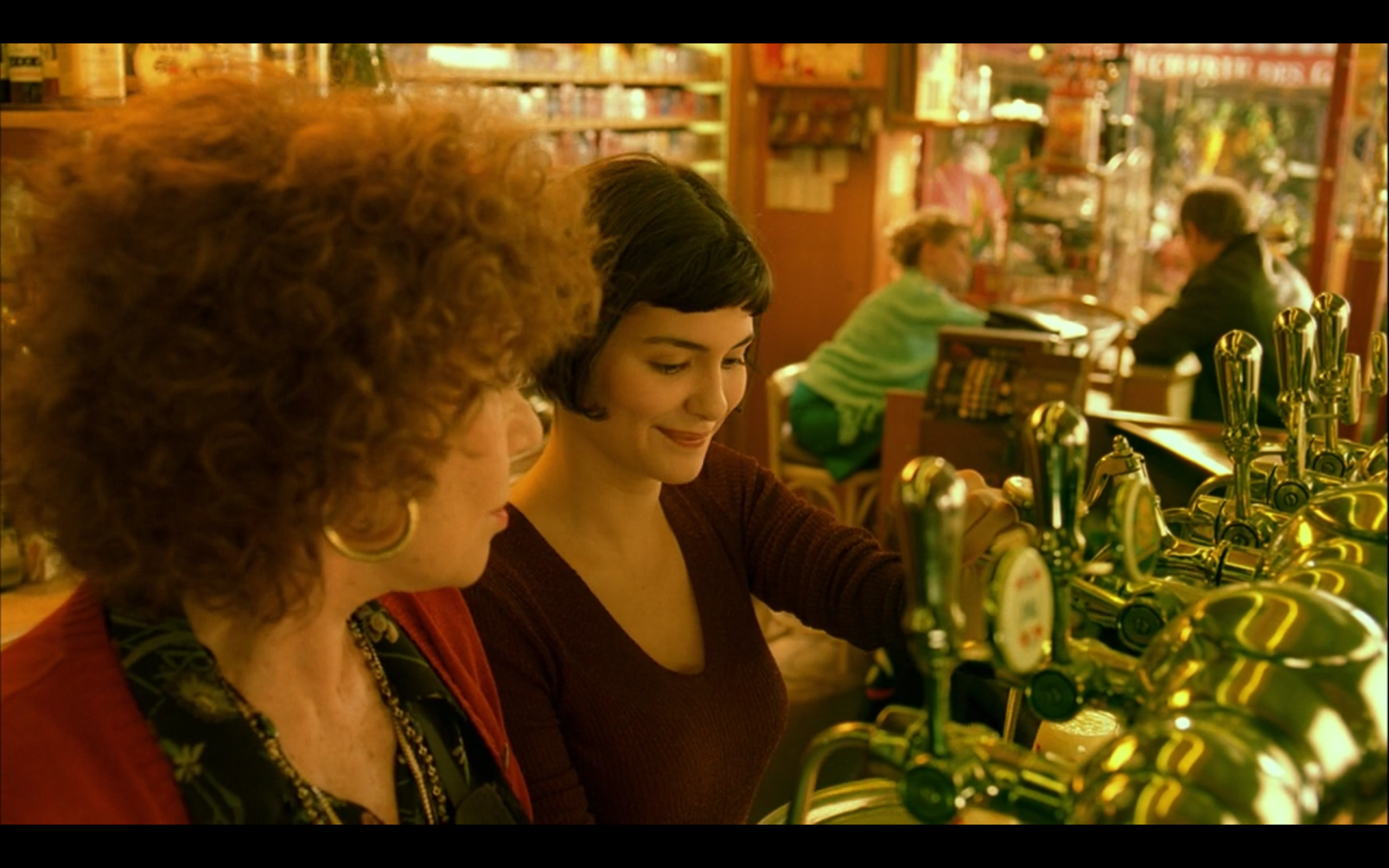
(left to right) Suzanne, Amélie, Georgette, and Joseph at the diner, after Amélie has told Georgette and Joseph they have feelings for each other.

Although the two characters do not continue this relationship past their first sexual relation, they are incorporated into the social world around them in a way they hadn’t been at the start of the movie – a lady notices Georgette and calls, “It’s ages since I saw you, you look good!” (52:13), and Joseph’s overriding characterization as the “jealous ex-lover” is offset by joy and real discussion with others (1:18:25). Yet, these are merely two examples – the film presents improvements in the social lives of multiple characters, with profound effect on each of them, and the community, no matter their temporality.

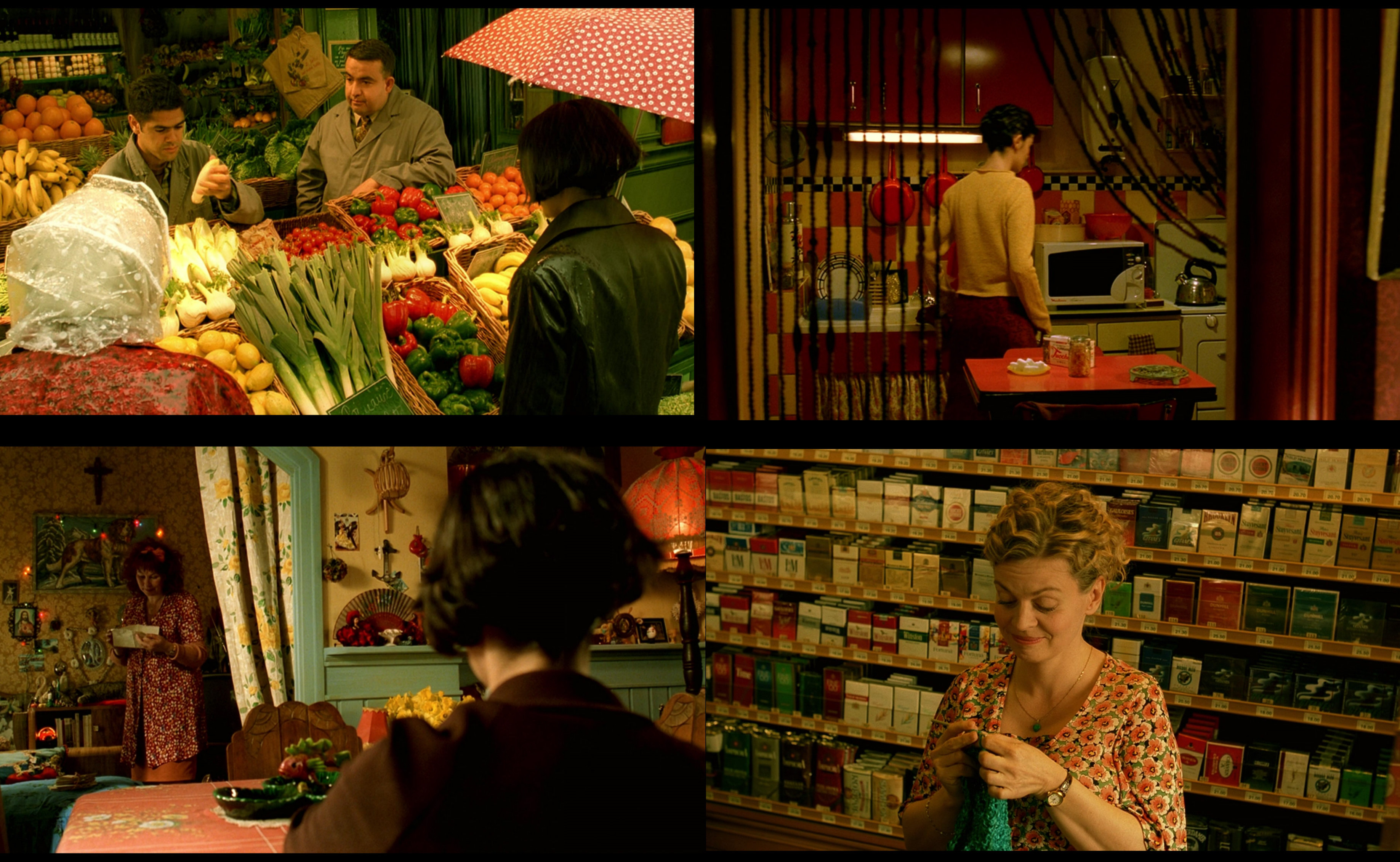
Moreover, it is evident that the film “feels good” in part because of the sheer abundance and simultaneous lack of poverty it portrays. Just in terms of physical profusion, there are countless scenes in which the sets are riddled with “stuff”. For instance: the wall behind Georgette’s counter in the diner is lined with dozens of cigarettes brands; both Amélie’s and Madame Wallace’s rooms are covered in knick-knacks; Nino collects probably hundreds of photos in a large book; and there remain many other instances of plain and simple copiousness.

untitled-1785

(clockwise from top left) The grocery stand where Amélie often goes, Amélie’s kitchen, Madame Wallace’s apartment, Georgette’s counter.

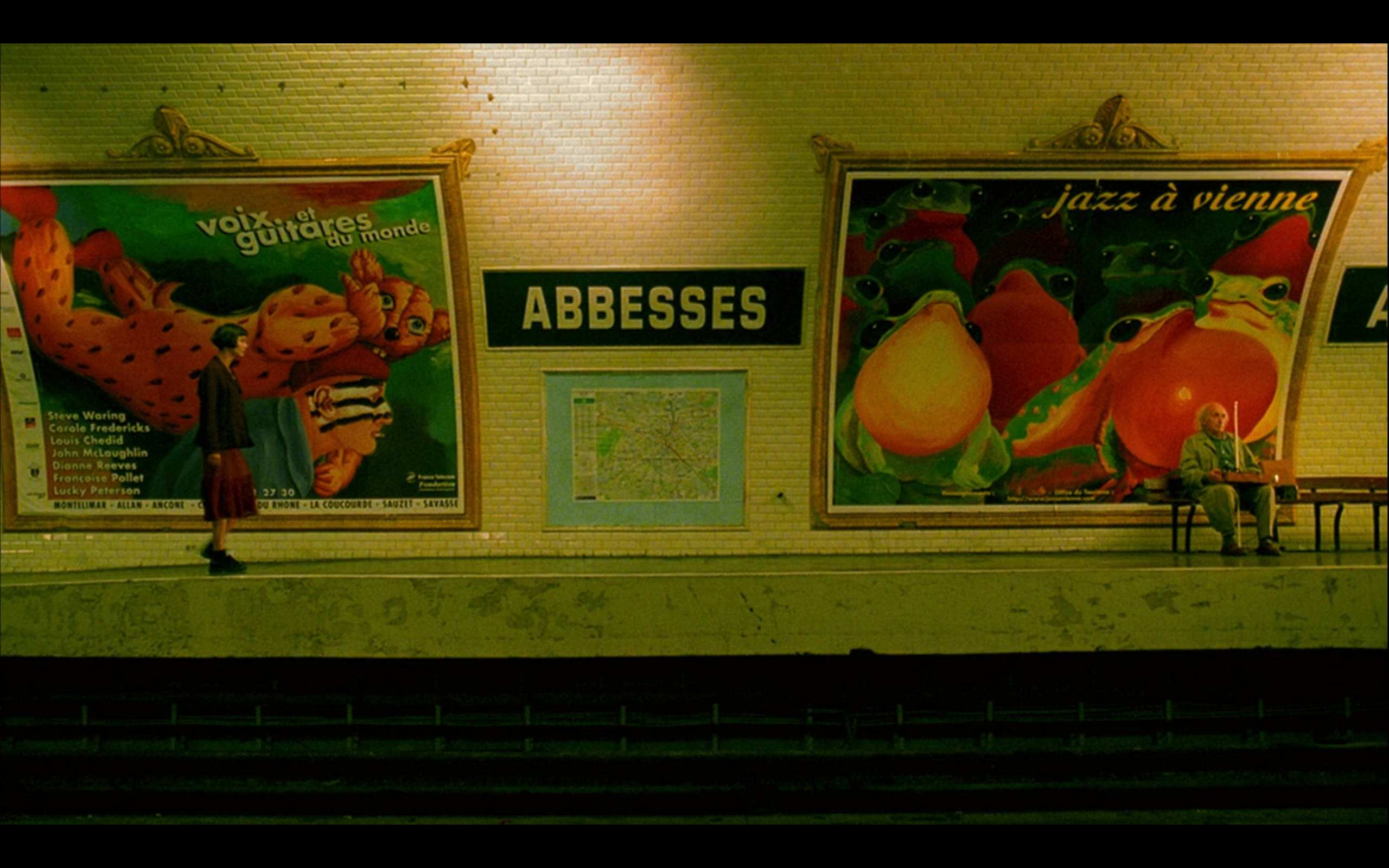
This kind of visual gratification is coupled to the film’s likely deliberate elimination of poverty, or satirizing of it. For example, before going to see her father, Amélie is walking on a train platform and attempts to offer a presumably homeless man some money. He refuses the money and tells her “Non merci ma petite dame, je travailles jamais dimanche,” which translates to “No thanks, madam. I never work on Sundays” (11:25). His refusal, and his claim of having days off, is a complete surprise that cinematic technique communicates as a light moment of blissful happiness, by the inclusion of airy French street-music and smiles from both characters. Even the poor man on the street is happy in this film. Soon after, when Amélie is again going to visit her father, another presumably poor man, in this case now a blind man, is on the subway platform playing Fréhel’s “Si tu n’étais pas là” on a mobile record player. The song is classically French, reminiscent of the early 1900’s “French Chanson”, and its use in conjunction with the poor, blind man has similar effect as the previous example – his status as impoverished is diminished in importance, and he’s just a man listening to music like all the others in the station.

Amélie approaches the poor, blind man on the subway platform.

Amélie approaches the poor, blind man on the subway platform.

The desperately poor are made equal to those who live comfortably by being portrayed as similarly comfortable with obviously less-favorable situations, so that we, as viewers, can find pleasure in knowing that they are just as happy as anyone else.

untitled-167

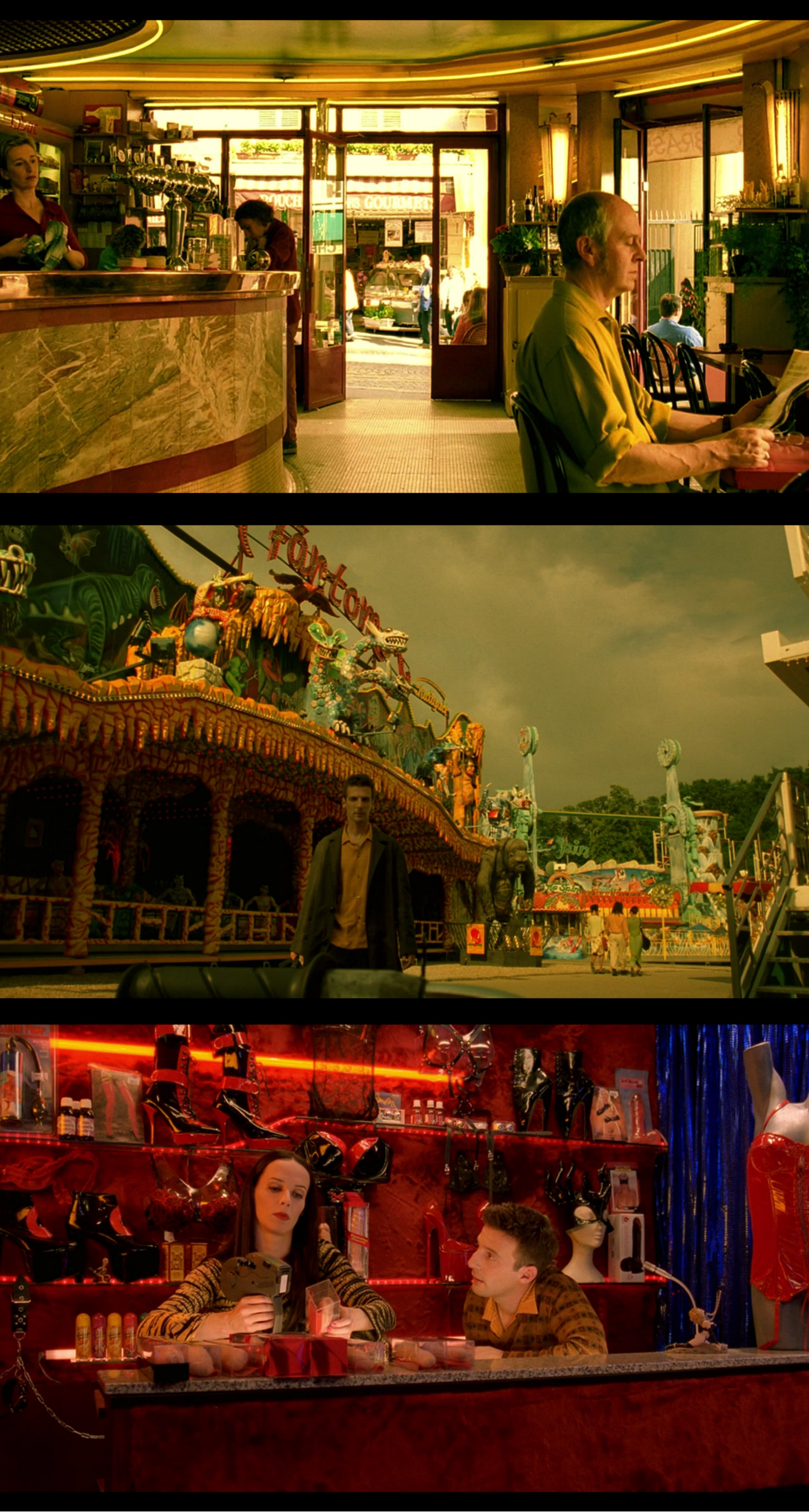
(top to bottom) The diner workplace of Amélie, and the Funfair and Porn Palace workplaces of Nino.

Furthermore, the plot and characters possess continuously great energy and intensity, qualities our regular day-to-day lives often lack. Much of the film takes place in Amélie’s workplace, where she logically spends most of her day; the diner is in no way dull however, and neither are the workplaces of Nino, Amélie’s romantic interest to whom the film also devotes large amounts of screen time. The intensity of the location derives largely from it being the place where the relationships between Georgette and Joseph as well as Amélie and Nino develop, and from it being where a number of Amélie’s creative schemes unfold. By the same token, her first meeting with Nino nearly occurs at his part-time workplace, the Porn Palace, and the excitement and romance of this near-meeting is captured in charming quality that’s imbued to even that locale. She then goes to the Funfair, Nino’s second workplace, to continue what would best be described as a game of cat-and-mouse. Here again, Amélie makes play the central theme of a space where most people would uphold a high level of wearisome uniformity. Instead of doing so, Amélie sends Nino on a scavenger hunt with arrows drawn in blue chalk and made of colorful sprinkles (1:13:15). Alongside these scenes of playfulness, there are similarly utopian scenes of excitement, via rapid progression. One such scene occurs when Amélie takes the blind man we had seen previously by the arm and walks down the main street, past delis and bustling crowds, while describing to him their surroundings. The amalgamation of fast-paced dialogue, swelling accordion/orchestral music, and quick camera movements promotes an intensity for the audience and the man, who is left in a colorful daze of clarity (36:20).

The film thus relies heavily upon core concepts of traditional utopia in entertainment, to consistently provide a sense of what an ideally better world would look like. Without the qualities provided by the series of minor characters, and subsequent idealized-French feel, the extremely utopian element of the film would be lost, and so would the following insight that such an overly utopian cultural artifact can poignantly provide.

Despite the film’s attempt at dreaming up a utopian France, there remains the question of who’s utopia is being presented. By excluding the desires of marginalized groups from this essentially “perfect” imagined-world, those groups’ desires and sufferings are made illegitimate. Therefore, the level of forthright utopia in Amélie, aides in the conveyance of the exclusion of racial and sexual minorities and their struggles in pop media. Not a single racial-minority character is featured, nor is any LGBTQ character, yet the movie experienced astounding success. This is a concept Richard Dyer proposed of all entertainment, as all entertainment harbors secretly utopian elements, and his explanation points to capitalism as the origin for such a lack. It then becomes relevant to note that the communication of cultural entities is currently controlled by a commercial system that relies upon capitalistic determinants for its leaders. And since those who own the productive means for the creation of films are largely rich, white, males, the qualities we desire from pop culture’s depiction of utopia remain unchanged across all forms of it, and the products of pop culture become industrial in their creation.

          Amélie provides a uniquely utopian cultural artifact for the observance of how the current capitalistically-controlled pop culture industry denies the validity of minority group sufferings, and their desires for what should be present in a massively better world. Yes, the film is utopian according to the standards we currently hold for entertainment, but in being so to such a large extent, we can see the deficits of our own industry-imposed criteria.


Works Cited

Amélie. Dir. Jean-Pierre Jeunet. Perf. Audrey Tautou and Mathieu Kassovitz. UGC-Fox Distribution, 2001.

Ezra, Elizabeth. Contemporary Film Directors: Jean-Pierre Jeunet. Champaign, US: University of Illinois Press, 2008. Print.

Gibbs, Ed. “CLASSIC REVIEW.” Sunday Age: 15. Dec 08 2013. Web.

Wakeman, Rosemary. “Paris Dreams, Paris Memories: The City and its Mystique.” French Politics, Culture & Society 32.2 (2014): 151-3. Web.

Human Perfection in the Midst of Cannibalism

the-road-la-carretera-004

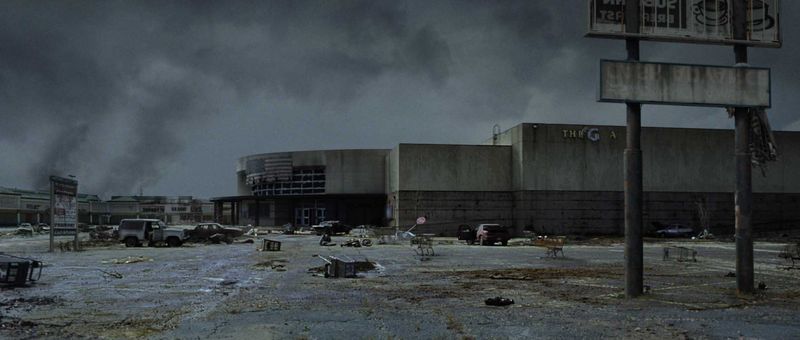
The land was gullied and eroded and barren. The bones of dead creatures sprawled in the washes. Middens of anonymous trash. Farmhouses in the fields scoured of their paint … all of it shadowless and without feature. A marsh where the dead reeds lay over the water. Beyond the edge of the fields the sullen haze hung over earth and sky alike. (McCarthy 177)

Lengthy descriptions such as these are frequent in Cormac McCarthy’s The Road, and comprise the majority of the novel’s content. So, in response to passages like this one, many readers are justifiably led astray to think of the work as simplistically hopeless and forlorn, and lacking in real depth or worth. One reader and online reviewer even summed up the book as follows: “A boy and his father travel south in a post-apocalyptic United States, then the father dies” (Sullivan). Despite what this summary suggests, I find that the novel actually strives, through somber description, to make us discover the vein of goodness that runs deep in its story. A tale riddled with desperate wandering and repulsive human acts, this books exposes the goodness in humanity that we, as humans in the modern world, attempt to rediscover, or even create, in our similarly troubled everyday lives.

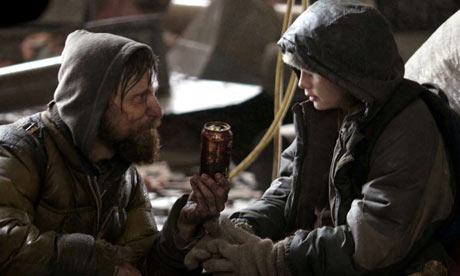
The tale follows a father and son’s journey through the vast expanse of an unspecified, post-apocalyptic world. The man’s son is all he has left, and it is clear from the very onset of the novel that every action the father takes is for the betterment of his son’s life, character, and humanity.  McCarthy clearly portrays the man’s selfless objective through the father’s actions towards and teachings to his son. Although there are several instances in which the father demonstrates his deep desire to better his son’s life, the earliest instance of this occurs when the father finds a can of Coca Cola and hands it to his son. McCarthy writes this of the scene:

What is it, Papa?

It’s a treat. For you … Go ahead, he said.

The boy took the can. It’s bubbly, he said.

Go ahead.

… You have some, Papa.

I want you to drink it.

You have some.

He took the can and sipped it and handed it back. You drink it, he said. Let’s just sit here.

… Okay, the boy said. (McCarthy 23)

d87e6f38-5694-471f-82a7-c44b9b7665f4

Acts of kindness such as these, all the more powerful and striking in the post-apocalyptic context of the novel, contrast distinctly with the cruelty of the greater world surrounding the main characters. Most importantly, they are difficult acts to demonstrate in the world is so different from the one the father knew. And although the son does already seem to possess some level of innate altruism, as seen by his returned generosity with the drink, and the father undoubtedly examples selfishness at times, I argue that the father maintains a continuous role of moral teacher by becoming responsible for the instillation of rationality, that I will further explain later.

Furthermore, it is important to note that throughout this entire work McCarthy writes the story and actions of unspecified characters; neither the boy nor the man are ever named. They are never described. They may easily be any and every man or child. Additionally, the story’s third-person voice makes moments in which, the author directly addresses the reader, in lieu of the father, especially clear. The multitude of instances where McCarthy breaks this fourth wall suggests the author’s aim to be a foil of sorts to the father, and, in this way, make the reader a parallel of the son. By then establishing this real relationship beyond the pages, McCarthy actually relays the father’s wisdom, as the fictional character does to his son, to the reader.  The reader becomes the recipient of the father’s moral lessons – at times even being substituted as the father – and it becomes clear that McCarthy’s true intent is to inspire readers to act selflessly even in the face of dire situations, and to desire that their children do as well.

One of the most important aspects to the father’s goal of instilling positive characteristics in the boy is reminding him that they “are the good guys” (McCarthy 67). Continuing the previous interpretation of subject ambiguity, good guys are to be taken as people who resist the loss of not only hope, but cultural/societal knowledge as well. The father portrays this when he alludes to the old world’s explicit customs, an event seldom seen, but in which there are distinct attempts to preserve old ways:

He’d carved the boy a flute from a piece of roadside cane and he took it from his coat and gave it to him. The boy took it wordlessly. After a while he fell back and after a while the man could hear him playing. A formless music for the age to come. Or perhaps the last music on earth called up from out of the ashes of its ruin. (McCarthy 77)

When the father passes on these ways of the past to his son, of how to make music, of playing card games, of not resorting to cannibalism no matter what, his son is made better and distinct from the “bad guys” for having learned and kept more of the past, suggesting the notion of “good” being retention of the past (McCarthy 67). McCarthy furthers this notion by utilizing comparison to the positive connotation of music – the high, soft notes of a flute – in a way that creates appreciation for the opportunity to carry a remnant of the past into “the [coming] age” (McCarthy 77). And it is when the boy’s music is thought to be the last that will ever exist, that the past is depicted as a ruin covered in ashes. By viewing the father and son as simple representations of necessary teaching and change across generations, this imparting and receiving of knowledge is indicative of the now commonplace role of family and schools, and their “wordless” exchange.  Although some readers may point out that the boy later throws away the flute, and thus the knowledge given to him, the actions of the boy do not alter the hope and necessity the father felt in providing the boy with the opportunity to preserve the knowledge of the past. The boy’s later action stuns the father, so it seems clear that it is neither expected nor wanted and actually supports the claim I make here – that McCarthy pleads us to find gratitude for the past and the envoys for its proliferation, if only because family and school keep beauty and human knowledge in our world. But those envoys do not do so alone.

The father has become their aid, taking on the role of both the family and the school, the singular entity that can provide his child with what he needs to be moral and human. Again, the notion of each character representing separate generations comes into play when interpreting this peculiarity, of dual roles that are split with fervor in today’s society. In this case, the past generation becomes responsible of assuring that the most essential of knowledge, the most important facets of humanity, are passed down into the new generation. This may be most explicitly stated in the symbolic “fire” of goodness that the boy imagines the father to be holding throughout the entire novel (McCarthy 129). It is only in the father’s dying breaths that the son takes the fire, by finally understanding its significance and true nature:

You have to carry the fire.

I dont know how to.

Yes you do.

Is it real? The fire?

Yes it is.

Where is it? I dont know where it is.

Yes you do. It’s inside you. I can see it. (McCarthy 278-279)

The boy has by this point associated the fire to whatever keeps them alive and “good”, from the father’s survival skills to his opposition to cannibalism, and in this moment those essential facets of being human are passed down. The father acknowledges s that he has given what he can, and he has brought his son closer to human greatness by ensuring the passing down. Ultimately, McCarthy tells the reader, “You, as what will become the past, are the most important factor in giving the next generation a head start towards human perfection.”

the-road-movie-image

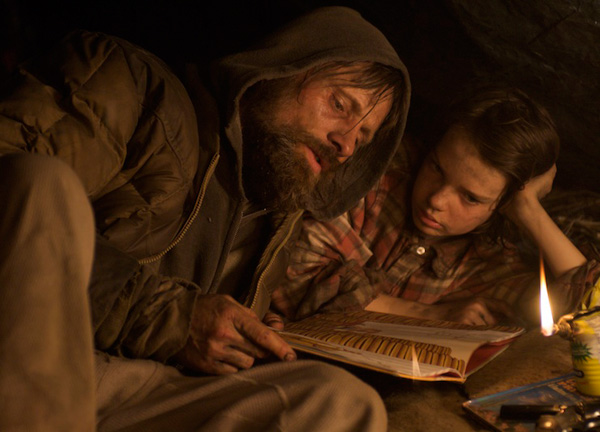
The “fire” inside the boy – the goodness, humanity, and knowledge within him – that the father keeps alive must be protected and fostered because it is what makes life worth living, especially in the toughest of times. When readers allow themselves to be receptive without criticality, the novel provides lessons of morality that lead us to an understanding of what offers a head-start on the path to universal human perfection. It is important to study great works of art, and especially great works of literature such as The Road, because they give you a head start on the path of human perfection without raising readers to the defensive. They help make you fit for a humane existence, and help you plan out a life worth living.


The Road. Directed by John Hillcoat, performances by Viggo Mortensen and Kodi Smit-McPhee. Icon Productions, 2009.

McCarthy, Cormac. The Road. New York: Alfred A. Knopf, 2006. Print.

Sullivan, Robin. “A Review of the Road.” Goodreads, 31 Jan. 2009, http://www.goodreads.com/review/show/35257193?book_show_action=true&from_review_page=1.