
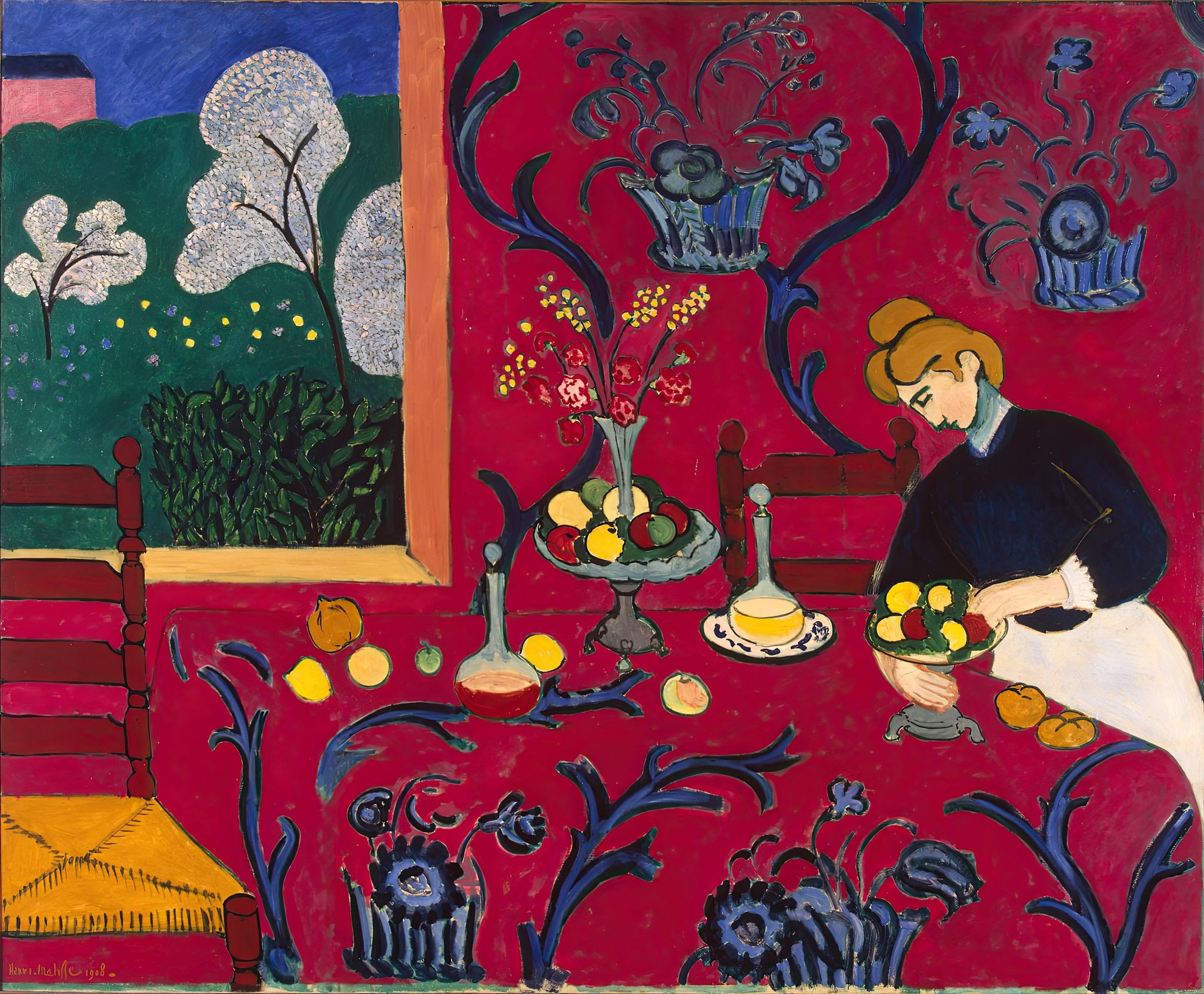
The Dessert: Harmony in Red (The Red Room), 1907. Creator: Henri Matisse. (Photo by Heritage Art/Heritage Images via Getty Images)
The task in front of us now is to get comfortable with the German word Aussage. Let’s start from scratch by noting that Aussage tacks the prefix aus- to the root –sag-. These happen to be two German words with near English equivalents that show very little etymological drift and whose meanings you could accordingly guess: aus means “out”; -sag- means “say.” Together, they form the verb aussagen, “to say out,” or, better, “to state” or “declare.” In modern German, you are most likely to hear the word Aussage—a “saying out”—in one of two domains. 1) Aussage is a legal term meaning “testimony” or a “statement.” You can tell a German policeman that you wish to make an Aussage. In Germany, you can’t exactly plead the fifth, but you can “withhold die Aussage.” Perjury is false-saying-out: one word, no hyphens. 2) At the same time, Aussage appears routinely in philosophical writing, where it means “a proposition”—a sentence capable of being true or false: an assertion. In German, propositional logic is Aussagenlogik.
So apparently the lesser German existentialists and neo-mandarins took a shine to the word Aussage. I hadn’t noticed this before Adorno pointed it out, but he seems to have been right about this. We don’t have to take his word for it. We might consider, for instance, a short essay that appeared in 1969 in the house journal of the Union of Swiss Freethinkers. The author of that essay wants his readers to know that he’s not all that impressed by Europe’s generation of 1968—the longhairs, the student activists, the young leftists tossing around words like “establishment” and “revolution.” As best he can tell—and this really is the heart of the essay—the hippies just want to play pinball. (“I walk into a restaurant stocked with arcade games of all kinds, and I never get over my amazement at the rapture, nay, the ecstasy, with which young people have at these contraptions.”) The essay quickly sketches in a few antitheses; it names the opposites of pinball, various activities that carry the substance that pinball machines putatively lack. The first is what I think I am meant to call lovemaking: “When I was young, I had better things … to do with my girlfriends than play arcade games.” One is charmed, at least, to find a European conservative complaining that the hippies were insufficiently interested in sex. The second, more predictably, is reading: “It is impossible to imagine one of these young people ever picking up a book, except perhaps some tawdry crime novel.” Third, and most tellingly, the essay identifies what should really be going on in a bar: People should be talking, and not just talking, but attitudinizing, sounding off, insulting politicians, being disagreeable. This kind of barstool punditry, the author says, gets a bad rap: It might be ill-informed; it might barely be cogent; but a visitor will marvel even so at the sight of half-drunk men speaking their minds. The essay’s point, then, is that one cannot envision Switzerland’s hairy and pinball-besotted teenagers holding their own at the Stammtisch. And its way of putting this is to point out that young people “do not sit together in order to have a conversation, because they have nothing to say”—or rather: they “are have no Aussage at their disposal.” They “neglect the life of the mind”; they are—and this is the name of the essay—a “Youth without Aussage.”
The following year, a Swiss humor magazine published a single column complaining that Aussage was taking over conversational German like an invasive species, a rapidly growing weed: “like ribwort.” This second author clearly had educated German-speakers in mind. It’s the sort of word, he says, that people reach for to gussy up a late modernist art that has lost its ability to surprise: “the composer who has the underside of the piano beaten with a hammer, the playwright who banters his thrownness-into-nothingness into the bottomless depths of sheer boredom.” Artists of this kind “have nothing to say, and yet they make an Aussage.” These are the usages that survive in everyday German, even now, when the word gets used in connection with film or literature or art. “That novel makes a strong political Aussage.” “What was that movie trying to say? What was the Aussage?” If something is “meaningful” or “substantive” or “persuasive,” or if it “carries weight,” you can say that it is aussagekräftig: statement-strong. It doesn’t have to be a museum installation. It could be, like, your cover letter. The word has plainly survived the Swiss satirist’s scorn. “Aussage,” he wrote in 1970, is a meaningless, “nothing-saying” word. Some writers, the ones who can’t “scrape together anything readable,” can at least “scrape an Aussage into the light.”
Adorno was not alone, at any rate, when he wrote the following:
The word Aussage [statement or testimony] … would have us believe that the speaker’s very existence communicates itself along with the [statement’s] subject matter and that it is the former that confers upon the latter its dignity. All it would take to render speech inauthentic, the jargon intimates, would be to remove the surplus furnished by the speaker—an utterance that paid strict heed to the matter at hand [aka the thing] would be a fateful lapse.
As of the early 1960s, an Aussage derived its authority from “the surplus furnished by the speaker.” What we can say now, then, is that the jargoneers’ use of Aussage was in some respects rather close to the contemporary American idiom “I’m just speaking my truth.” Both suggest a determination to speak authentically, to convey the substance of one’s experience without trimming it to fit and without caring if the declaration rubs other people the wrong way. And both achieve authenticity only by subjectivizing truth, transforming a conviction into an immediate, non-negotiable claim on reality. Of course, the two idioms—“to make an Aussage” and to “speak your truth” occupy rather different sociological registers. Adorno is about to tell us that the word Aussage reeks of Augurenernst—the “solemnity of the augurs,” Roman priests interpreting the will of the gods. And indeed the word seems to have been favored by West Germany’s hierocrats—professors and intellectuals and well-spoken radio pastors. An Aussage is —or was—spoken by initiates to signal the profundity of educated men. “Speaking your truth,” meanwhile, emerged out of humanist psychology, 12-step recovery programs, and feminist consciousness raising. Its paradigmatic speaker is thus the survivor or self-actualizer. And yet both rely on a double shot of subjectivity to shut down further reflection: once a statement is grounded in existential authenticity, questioning its factual accuracy or logical coherence is framed as a breach of ethics or an attack on personhood. The Swiss hater-of-pinball said that the bearers-of-Aussage need possess neither “knowledge” nor “insight”; it is enough for a person to have a position. A German art critic, writing in the 1950s, praised the Fauves for giving up on illusionism—for no longer trying to capture what the eye sees—for seeking a merely “formal order” of bold outlines and unmixed color. “The main Aussage” of a Fauvist canvas, he wrote, “lies in its color harmony,” an “arrangement” of bright blocks that delights the viewer before he even registers what the painting is representing. Haftmann went so far as to say that this formalism initiates “the destruction of the object.” (91) And there it is: The Aussage cancels the thing, the matter, die Sache. (Haftmann also wrote, of Max Beckmann, that “every one of his pictures is an existential statement”—an Aussage aus der Existenz. (273)) And with that, Adorno has identified yet one more way in which the subject can smother the object—bracket it—render it irrelevant: You can extinguish the object with your truth.