
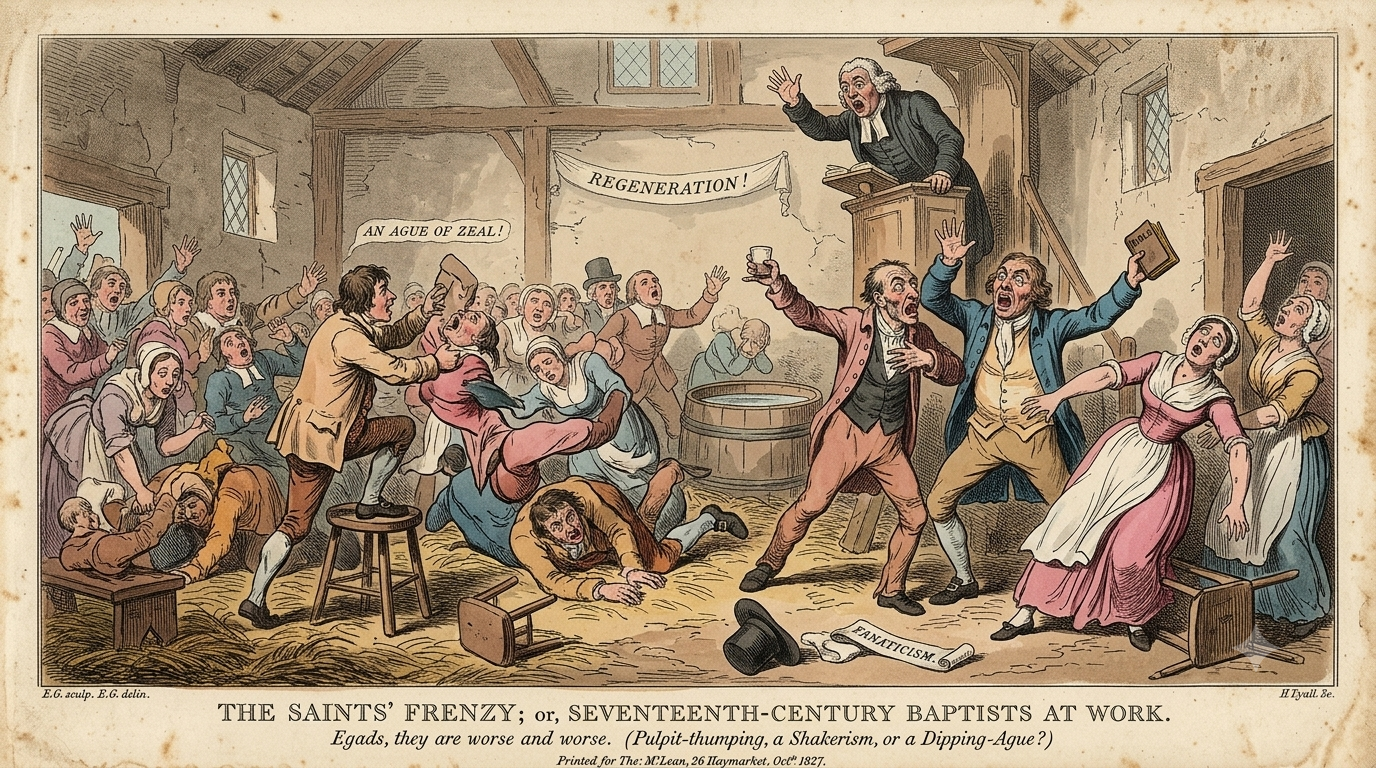
This next bit of Adorno we should sidle up to. We set out from a far-flung question: What happens when a scholar sets out to study small Protestant churches in the American South? Does anything of note transpire when a sociologist of religion and a squirming of Pentecostals find themselves in the same room? There are any number of books you could consult in order to answer that question: You could read the Brown University ethnographer who traveled to Virginia year after year to record “speech, chant, and song in an Appalachian Baptist church.” You could read the LSU linguist who spent his 20s transcribing sermons preached in the Baptist churches of rural Texas. You could read the PhD medievalist who ditched Chaucer in order to study folk preachers in North Carolina and Oklahoma and migrant California. So again: what happens when an anthropologist shows up in a Kentucky meetinghouse with a clipboard and a tally counter? Any of these books will lead you to three observations:
First, the scholar will engage in close observation: The man in front of the congregation is speaking in something like conversational cadences. His tone might be emphatic, his voice might be charged with emotion, but he is still in some recognizable sense addressing the worshippers, trying to make himself understood: “As the old book says…” Before long, however, explanation edges into exhortation, and the speaker’s rhythms begin to tighten. Short, repeated sentences replace longer, expository utterances. Words begin to fall into a musical meter, often a swaying, compound pulse. A sound now punctuates every period—a distinct, audible intake of breath or holy grunt; the preacher is marking time as he draws breath. In some cases, his voice compresses to a rapid, nasal monotone, as the sermon morphs into improvised, tumbling chant. In other churches, speech gives way to something like song, as the preacher’s voice locks into a musical key, selecting a tonic and then modulating to defined pitches. Sometimes, the preacher routes his speech through his nose on the high end of a phrase to pierce the room, only to drop into a low, raspy groan on the exhale.
Second, and beyond mere description, the scholar will find things to count, measuring the inner light, calculating the motions of the spirit: a tick in one column every time the preacher barks an end-stop; an x in a second column whenever a neighbor woman breaks out into spontaneous prayer. Grunts fall at three-second intervals. … A preacher typically utters between five and ten syllables between breaths. … Typically, a full minute of conversational preaching is followed by roughly thirty seconds of chant. There are charts to be generated: What percentage of the congregation’s exclamations are addressed to the preacher and what percentage to God? What does the whoop look like on a sonogram?
Third, the scholar will contravene the preachers’ account of their own conduct—and especially of its sources or causes. A hot Protestant preacher will insist, of course, that the words he speaks when preaching aright are not genuinely his own—that he “is being led by the Spirit,” that “the power is all over him,” that he chants only when the “Holy Ghost has hit him.” When he uses phrases like these, he is letting you know that his remarks have not been prepared; he is not sharing his considered wisdom. Quite the contrary: He is speaking God’s own words, which have arrived in instants of sudden, unreflective inspiration, and is thus burbling an insight that might be new to him at the very moment of its utterance. The most important thing in this scenario—the only way to stay open to the Spirit—is to relinquish a certain rhetorical effort, to “not try to do it within yourself.” Rubbish, says the Brown University ethnomusicologist, not to the preacher, but sotto voce to the reader: Holiness preaching is a “performance,” and like any performance, it is “intentional” and “rule-bound.” One folklorist thinks we can account for Pentecostal preaching by deploying the Parry-Lord theory of oral composition, as though revival-tent stompers were Homeric bards or Bosnian guslari, Shenandoah jongleurs with a stock of verbal formulae pilfered from old country gospel 45s. In a Virginia up-country church, writes the professor, “Affect is brought into being by performance.” Spirit gets reclassified here as a method or technique; a skill; a vibe generator and feeling machine.
The original for all such arguments is a short text first published in 1704, usually referred to as “The Mechanical Operation of the Spirit.” It is, to all appearances, a “philosophical letter” written by an unnamed gentleman scholar with connections to the Royal Society and addressed to a fellow virtuoso living somewhere outside of England. Before the existence of scholarly journals, such letters were the primary way that scientific research was shared. In the 1660s, the Secretary of the Royal Society effectively invented the scientific periodical by contriving to have his inbound mail printed and sold: one correspondent announces that he has discovered tiny, living animalcules in human saliva; a second describes Jupiter’s Great Red Spot; a pair of experimentalists writes in to detail their attempts at transferring blood from a sheep to a human. Our author’s contribution to this invisible college is “to examine, by what Methods [a Quaker or Baptist] Teacher arrives at his Gifts or Spirit or Light; and by what Intercourse between him and his Assembly, it is cultivated and supported.” To this end, he carefully describes the Nonconformists at worship, their “perpetual Motion of See-saw,” their “long Hums at proper Periods.” He devotes a long passage to the preacher’s “Skill in tuning and toning each Word, and Syllable, and Letter, to their due Cadence”—hence, his unusual “dwelling and dilating upon” the spoken language, a “conveying of the Sound thro’ the Nose” that congregations seem to find thrilling, even if it is a kind of “Snuffling.” It is on the basis of such observations, enumerated across some twenty pages, that the scientist feels licensed to identify a causal mechanism. How, after all, do Quakers kindle the inner light? On what fuel does it run?
If I say now that a “Mechanical Operation of the Spirit” reads a lot like some improbably early entry in OUP’s Religion in America series, it is only so I can pivot and insist that the early text has some distinctive features of its own. A genteel amateur writing under a Stuart monarch will not notice exactly the same things or propose exactly the same explanations as a Berkeley-trained literary critic writing in the 1970s. Let’s take stock of the three most consequential differences:
The 1704 essay is forthrightly hostile to spiritualist religion. The distinction here is perhaps a tad subtle: The modern folklorist cannot help but classify the Pentecostal preacher as a kind of folk artist—it is the category readiest to hand—ranking the man of the spirit alongside the mining-town fiddler and the keeper of community lore and so framing the preacher’s conduct in terms that the Protestants being studied would have to reject. It’s just that the folklorist knows to screen his critique behind a murmur of admiration: He tells his learned readers that he writes in defense of the mountain people—theirs is not a “backward and deviant culture of poverty.” “I must admit I find much to admire in their efforts.” “They are outstanding performers of religious language”—and there it is, the word “performers.” Everyone stand and clap for the choir. The scholar praises the Blue Ridge Baptists for doing to a perfection something they don’t think they are doing at all—performing. Lacking the courage of his pugnacity, the folklorist demystifies the folk despite himself, this enlightener who says he rather likes the atmospherics of a dimly lit room. “The Mechanical Operation of the Spirit” isn’t like that. It drives a gleeful wedge between the spiritualist self-understanding of the early Baptists and the novel modes of materialist explanation that the natural philosopher deploys to analyze the anima. You can probably hear this in the essay’s very title, with its teasing reductionism and near-paradox: “The Mechanical Operation of this Non-mechanical Non-thing.” But that’s just the start of it. Keep reading and by the time you have finished the pamphlet you will have learned: 1) that the first preacher to achieve a penetrating, high-nasal tone landed on that adenoidal hum because syphilis had eaten away the bridge of his nose; and that others decided to emulate this, the pitch of the French disease, but without going to the trouble of contracting it first; 2) that Puritans first took to “the Twang of the Nose” to replace the droning of the bagpipes that they had more or less banned—the Nonconformist preacher makes up for Sunday’s missing music with his own rhinal skirl; 3) that Quaker men “in the Height and Orgasmus of their Spiritual exercise” commonly ejaculate into their plain, gray breeches. The difference between the old text and the new can be telegraphed in a single letter: What the modern folklorist calls “chant,” the late-Stuart virtuoso calls “cant.”
That’s the first important difference.
The second difference is that the 1704 essay is a fake, a gag, a prank. That’s the big swerve, obviously—the early letter is not real: It’s a satire, which you would have figured out already if I had told you at the outset that it was written by Jonathan Swift, who one imagines did not actually believe that Quaker women were all sex addicts. “The Mechanical Operation” first appeared in a collection alongside two other texts: A Tale of a Tub, Swift’s jokey allegory defending the Church of England against Catholicism and Dissent; and The Battle of the Books, his mock-epic recounting of the conflict between writers ancient and modern, in which the volumes of a well-stocked reading room metamorphose into their very authors and fight each other to the death on the library floor. There is thus little danger that an early eighteenth-century reader would have mistaken “The Mechanical Operation of the Spirit” for an actual scientific tract. At one point, Swift’s philosopher explains why Quakers quake: Because Quaker men never remove their hats, the heat that would otherwise dissipate through their brainpans gets trapped, blocked by a broad disc of undoffed felt, which accordingly forces the heat back into the Quaker’s body, transforming his torso into a seething kettle. This human pressure cooker will now jiggle like a stovetop regulator, rocking and dancing in frustrated cycles of lift and release. That’s why Quakers quake. The pamphlet is therefore not a materialist account of spiritualist Protestantism; it is a mock-materialist account of same; and this will have some important consequences of its own. To wit:
The 1704 pamphlet is not vindicating science but parodying it. If the modern ethnographers attempt an awkwardly twofold affirmation, endorsing both old-time religion and their own protocols of materialist explanation by simply ignoring the evident conflict between the two, Swift is content to turn this procedure upside-down, negating both terms rather than reconciling (or failing to reconcile) them. Such is the peculiar temper of Swift’s talent, beyond his uncanny ability to parody in advance an entire category of scholarly writing—a Dewey decimal number—that didn’t exist in 1704. The “Mechanical Operation” is unmistakably burlesquing the Quakers and the Baptists; it is making them look ridiculous. But it is simultaneously sabotaging the materialist idiom that is spiritualism’s demystifying antithesis. In large part, this sabotage is the spontaneous effect of skilled mimicry. Imitation will tend all by itself to initiate a skepticism toward the imitated thing, reducing the discourse in question to a rhetoric, a set of conventions, a way of talking. Parody calls attention to the performative dimensions of its targets and thereby makes it harder for these to function as vehicles of truth, wisdom, or authority. If you can convincingly simulate the mechanical philosophy, then you are demonstrating to your reader how easy it is to fabricate outrageous lies in scientific prose.
Some clarification: By going after natural philosophy, Swift ends up mimicking the conventions of at least two other genres, since these were (some of) the ingredients out of which early scientific discourse was compounded. The first tag-along genre is travel writing, with which natural philosophy enjoyed a symbiotic relationship: Philosophers relied heavily on travelers to gather raw data about the natural world, even as travel writers gradually adopted the prose styles of the new science to lend credibility to their accounts. Swift’s fake philosopher thus sends his regards to the gentleman scientists of the Iroquois and complains that it’s been ages since he last had a letter from the indigenous researchers of the Brazilian interior. More to the point, he says that Quakers and Baptists are England’s own version of Islamic militants or Chinese millenarians—the White Lotus of Whitechapel.
The second tag-along genre is the so-called book of secrets. In a culture that lacked strong commitments to public knowledge, books of secrets were by modern standards fairly unremarkable how-to books or household manuals, which claimed, however, to be disclosing hitherto protected artisanal techniques, the steps and methods that guilds supposedly compelled their members not to share. A book of secrets would promise to initiate you into the esoteric mystery of, say, making shampoo. Swift uses this language throughout: His scientist is in a special position to analyze radical Protestant worship because he has been “initiated into the Mystery” of the chant. It will turn out, however, that the mystery is unmysterious—that the Quakers’ “venting of spiritual Gifts is nothing but a Trade.” The mechanical philosopher thus pledges to teach the reader “the whole process … as it hath fallen under my Knowledge or Experience.” The word mechanical in the satire’s title thereby acquires a second meaning. Alongside “machine-like” or “mathematizing” or “Cartesian,” mechanical also means “plebeian.” Spiritualist Protestantism is religion for mechanics—an “operation … performed by our British Workmen.”
The point I don’t want us to miss is that when the satire parrots the language of travel writing and the book of secrets, it is not altogether disclaiming the knowledge produced by those genres. You can plausibly read Swift as maintaining that Nonconformists really are like religious rebels in other parts of the world—that they present a threat that has already demonstrated itself in Safavid Persia or Almoravid Morocco. Nor is Swift just riffing when he refers to radical Protestants as “workmen”; lay preachers were in fact a conspicuous feature of early English Baptistry—shoemaker-preachers, soap-boiler preachers, a lace-maker preacheress. In these passages, then, the satire is generating something like claims: that the Quakers are a rabble, that radical religion is more heathen than Christian; &c.
But when Swift goes directly after the mechanical philosophy, this is no longer the case. The residue of epistemological sincerity is washed away. This might be easier to show than to explain. At one point, Swift’s scientist offers to give a materialist account of the brain, and if we paraphrased his claims at a high enough level of abstraction, we could make him sound like a modern neuroscientist. The brain, he says, is a composite organ. Writing around the year 1700, he obviously can’t talk about neurons and glial cells, and he doesn’t exactly understand the brain as a network of differentiated sub-structures—an organ of organs—but he insists even so that the brain is a multiplicity. What he says, specifically, is that the “Brain is only a Crowd of little Animals … like Bees in a perpendicular Swarm upon a Tree, or like a Carrion corrupted into Vermin, still preserving the Shape and Figure of the Mother Animal.” The brain is a writhing heap of maggots. And to this he adds the claim that thought is nothing more than the agitation of the brain’s sinew, though he forgivably lacks any account of neurons firing in pyrotechnic unison or chemicals traveling across synapses. What he says instead is that the brain’s skull-grubs, when exposed to heat, will bite—will “imprint the Marks of their little Teeth.” It is these lice-bites, then, that activate the nerves and so produce thought: different thoughts for different kinds of bite, different sets of the mouth or angles of dental attack. A hexagonal lice-bite “produces Poetry,” a “conical” lice-bite makes a person want to write about politics, and so on. And the only reason that Pentecostal preachers are able to discourse so fluently about God is that they’ve figured out how to keep their brain-lice hot. (“It is unlikely,” writes the ex-Chaucerian, “that all of the [Baptist] churches are hot all of the time, but it always feels that way. The buildings, often fibre or plywood siding nailed on wooden uprights that barely support the low ceiling, are in effect dutch ovens. Everyone is sweating all the time.”) This is what I meant when I said that Swift’s parody of the mechanical philosophy was subtly different from his mimicking of the travel writers or the spillers of secrets: The natural philosopher’s claims are so outlandish as to discredit themselves. Along the way, Swift produces what is perhaps the most repugnant image in the history of mind-brain reductionism: Mucus, he says, is the excrement produced by the tiny worms that make up the brain, and the runny nose you had last March was thus really maggot diarrhea. (Sooner or later, some scholar will have to examine gross-out humor’s contribution to philosophical skepticism.) This is the perfect Swiftian passage: Swift is saying that what hot Protestants take to be the voice of God is really just the buzzing of cranial mosquitoes—but he has found a way to couch that point in a materialist idiom that you will not be tempted to credit. The insult lands, and its vehicle promptly dissolves, like the self-destructing message sent by headquarters to the super-spy. Spirit isn’t just a bone; it’s a bug bite.
With Swift still open in front of us, we’re in a good position to notice some important features of Adorno’s writing. We look back to The Jargon—Adorno has just been describing how existentialist notions of authentic “utterance” give priority to the speaker over what he is speaking about:
This formal character makes the jargon well suited to demagogic ends. A person well-versed in the jargon does not need to say what he thinks, nor even really to think it: the jargon takes care of that for him and cancels the thought—it punches thought’s ticket. Authentic: the pivotal thing is that a man speaks with his whole being. In the process, something happens that the jargon itself styles an Event or an Enowning. Communication clicks into place, advertising a truth that ought to be deemed rather suspicious by virtue of the prompt and collective consensus it elicits. The attunement of the jargon carries something of an augur’s solemnity, indiscriminately conniving with any and all initiates.
Adorno is aligning three concepts here: demagogy, mechanism, and abstraction. First, he’s flagging the German existentialists’ fondness for gurus and masters. Philosopher-pilgrims trek into the Black Forest to gather kindling with Heidegger, phenomenologizing amidst the silver firs. Authenticity breeds acolytes. Adorno, of course, is taunting the neo-mandarins here: The opponents of mass society turn out to be just another iteration of the demos, a higher rabble, ontology’s fanboys. When theory boys form a circle, then, they do so mechanically, which is to say unthinkingly, brandishing philosophemes like passwords, stoked to see anyone wearing an Agamben T-shirt, flashing a thumbs-up to anyone with a Hannah Arendt sticker on their water bottle. (Mechanically: The jargon voids each thought like a canceling machine voiding a postage stamp; when speaker and listener both know the buzzwords, “communication clicks into place.”) And this automatism is only possible because the buzzwords that theory boys use in one another’s presence have ceased to mean much of anything; they have been attenuated into higher abstraction. If you have latched, for instance, onto the word “network,” you now face a rather daunting choice. Whenever you find yourself proclaiming that x (the US government, a car battery, a scientific fact) is not a thing but a network, you can either clear your schedule and do the hard work of mapping out the network’s many lines, channels, knots, and nodes; or—you can not bother. You can just dub the state a rhizome and move on. In the second case, you are flaunting the concept without actually having the thought—without synthesizing the object into the appropriate thought-form. And Adorno holds that it is the truncation of cognitive categories into unrealized verbal tags that makes it easy for theory types to form into clubs and cliques: Under-thought thoughts produce the facade of mutual understanding, simply by leaving so little to adjudicate.
To this, Swift allows us to add two important observations:
First, Adorno here slips into something rather like parody. Along the way, he actually lets you know that he has started using the jargon, which is perhaps a lapse of satirical technique: Something happens that the Heideggerians themselves call an Ereignis. Adorno elbows you in the ribs, at which point you might look back over the last few sentences and realize that he has already begun writing in mandarin.
•This begins with the word kernig. What I have translated as “the pivotal thing” seems to have enjoyed something of a vogue among German intellectuals after World War II: “Kernig ist….” That’s non-standard German, unlisted in this usage even in large German dictionaries. The word kernig is ordinary enough—it’s an adjective derived from the noun Kern (a “core” or a “kernel” or the “pit” of a stone fruit). In modern German, it means “pithy” or “robust” or “hearty,” even something like “down-to-earth.” But none of those translations work here. If you stick with “core,” however, the meaning is clear enough. “The core thing is…” “That a man speaks with his whole being” is the crux, the key, the root. The petty existentialists seem to have used the word to boast that they were cutting to the heart of the matter. Kernig is meant to carry a grounded, unpretentious weight, evoking something pared down and foundational—it’s an agrarian riff on plain speech and maybe even a kind of hayseed Wesenschau: “Corny is….”
•“Attunement” you probably recognize—it’s Heidegger’s Gestimmtheit, a fundamental mood, a way of being attuned to the world, an emotional coloration that allows some of the world’s things to appear readily and others not at all.
•What an English-speaker is unlikely to catch is that even capital-K Kommunikation was existentialist jargon when Adorno was writing. “Communication” was a term strongly associated with Karl Jaspers, for whom it meant a rare, radical openness between two human beings or the “loving struggle” of people in unguarded dialogue; Adorno is thus harrumphing when he observes that existentialist communication is actually perfunctory, snicking into place like a handle catching in a latch. And across these sentences, he is suddenly piling on the jargon, stringing its buzzwords together in what briefly resembles pastiche. A lot of readers like Adorno best when he’s being catty, but it’s more than that: One is reminded here that dialectics is and always has been a close cousin to satire, declining to contradict its philosophical rivals from the outside, reluctant to oppose their claims with some finally elective counter-claims of its own, temporarily inhabiting any position that catches its attention so as to discern the latter’s failures through feats of extrapolation and exaggeration.
The other thing that Swift brings to the table is that double negation: both he and Adorno describe the mechanical operation of the spirit while endorsing neither the mechanism nor the spirit. It’s easy to get this wrong when discussing Adorno: You might have read “The Culture Industry” and concluded that Adorno was striking a conventionally anti-industrial pose. You might even recall that the word “culture” began as a synonym for “growing” or “farming” or “tending the land”: agriculture, the farming of crops; silviculture, the farming of trees; viticulture, the farming of grapes for wine. The word “culture” is intrinsically agrarian; our familiar use of the term asks us to see art as the practice of self-cultivation or as a way of tending humans the way one might tend stalks—helping them grow. All by itself, the word associates painting and music and literature with peasants and provincials. It should be harder than it is to treat the word “cultured” as a synonym for “urbane.” And the term “culture industry” thus teeters on oxymoron in almost exactly the same register as “factory farming.” Each phrase suggests a process that has swallowed up its historical antithesis—same (technological) process, same (rural) antithesis. At no point does Adorno sound more like a mandarin than when he comes out against industrialization in this way; and when he identifies the automatism of the jargon—of language that punches thought’s ticket—he is thus dinging the neo-mandarins of the 1950s with one of their own arguments. The people most likely to reject mechanism lapse repeatedly back into intellectual mechanism. If we stopped here, however, we would be left with the impression that Adorno was defending culture in the terms that come most readily to the humanist—as the domain of independent thought and free inwardness. But that obviously isn’t Adorno’s way. His more typical position is to target philosophy’s hubris—its elevation of Mind or Spirit to an absolute self-generating principle that denies its material dependence. To wit:
•The signature of every idealism is rage. [Negative Dialectics]
•[The typical intellectual] hypostasizes as an absolute his intellect [his Geist, his spirit], which was only formed through contact with economic reality and abstract exchange relations, and which can become intellect [spirit] solely by reflecting on its own conditions. [Minima Moralia]
•Idealism … is governed unknowingly by an ideology which says that [anything that is other to thought] is worth almost nothing, so that the unity of the self-sustaining thought can devour it in good conscience. [Negative Dialectics]
•Philosophy of any ambition treats as suspect the idea that the object has primacy; resistance to that idea has been institutionalized since Fichte. [Negative Dialectics]
The challenge when reading Adorno, then—and it is this challenge that Swift obligingly alerts us to—is to grasp a critique of mechanism that does not issue mechanically in an affirmation of the non-mechanical spirit. Adorno is going after the jargoneers not only for their routinized use of language, but also for the elevated and putatively autonomous intellectualism that this language claims to enable but actually undermines. Nor can we be all that surprised to find Adorno refusing to pit spirit against mechanism (or, by extension, culture against industry). Pitting A against B is not how the dialectic works. The dialectical philosopher cannot stand on one side of the cracking wishbone and boast about coming up with the longer piece.