
Adorno was just arguing that the jargon of German existentialism is not, in fact, a specialized terminology; it is, rather, a tone, a line reading, a way of hitting even ordinary words so as to insinuate that these carry higher meanings, trans-semantic sublimities recorded in no dictionary. He goes on. The jargon…
…takes control of the pre-conceptual, mimetic element of language and directs it toward its own desired circuits of response (or networks of effect).
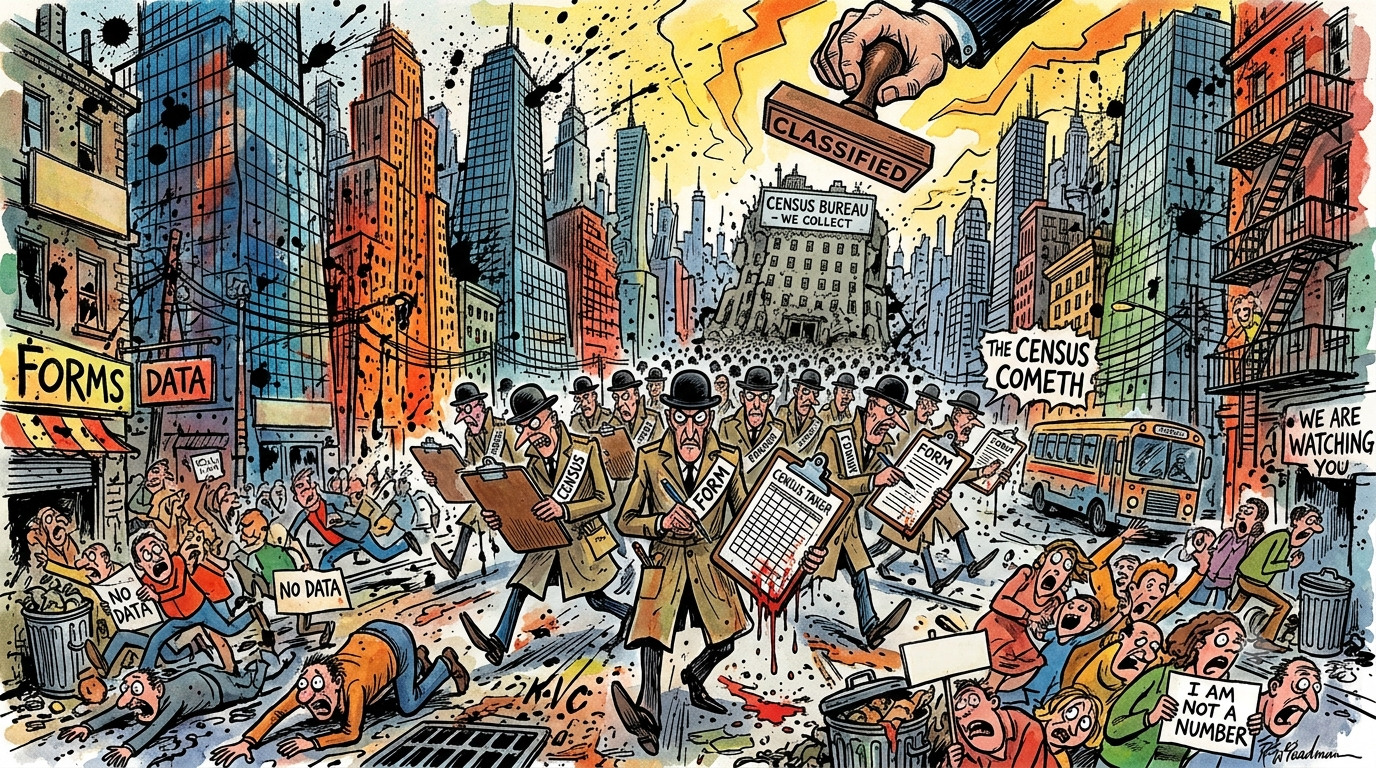
There is an unease in this sentence that won’t be apparent until we have parsed a couple of its terms. First, “pre-conceptual”: The jargon, we read, seizes hold of “the pre-conceptual element of language.” That claim immediately pushes us onto terrain that will perhaps be unfamiliar to an apprentice Adornian. Let’s recall a much quoted sentence from the opening pages of Negative Dialectics, to the effect that “objects do not go into their concepts without leaving a remainder.” Here, at least, we are on solid footing, setting out from one of critical theory’s most widely shared insights: that the administered society exercises power over the motley stuff of the world by slotting it into a homogenizing grid of classification. The Chinese government, preparing to conduct a census, first determines in some informal way that its citizens currently claim more than 400 different ethnic identities, 85% of which it has preemptively eliminated by the time the census forms go out. Administration’s first and most insidious act is to impose an artificial legibility upon the world. But this is not actually what Adorno is saying in Negative Dialectics—far from it. Instead, he has taken that familiar Left Weberian case and radicalized it in two directions at once. First, Adorno has, via Kant, identified classification as a mental faculty and to that extent de-historicized it. Classification is not just the persistent program of the world’s modern bureaucracies; it has aways been one of the mind’s most fundamental compulsions. Judgment, after all, is thought’s own sorting mechanism; Verstand ongoingly synthesizes sense data into objects and then with judgment’s help organizes these into sets or classes. This idea would seem to take the wind out of any Left Weberian political project—any anti-authoritarian bid to dismantle the mechanisms of discipline, surveillance and administration. For try as we might to mobilize against digital tracking online or to abolish the DSMIII, there surely isn’t much point in protesting standardization at its cognitive source, otherwise known as the mind’s readiness to call a plate a plate.
And yet at the same time, Adorno is claiming that the mind—the Verstand, “the concept”—does face resistance. “Objects do not go into their concepts without leaving a remainder.” Concepts, this is to say, cannot capture the specificity of the many objects that they bundle together. In order to successfully and accurately classify this object as “an apple,” the mind has to disregard an open-ended list of this apple’s characteristics: its varietal, its shade of red or green or both, the orchard of its provenance, its sheer thereness. Normally, one writes such sentences in the spirit of nominalist indignation. But by the time he was drafting Negative Dialectics, Adorno had apparently decided that the concept’s insulting indifference to the object’s particularities was also a mercy. Concepts, I just said, cannot capture the specificity of objects. Something about the object—all objects—remains uncaptured, elusive, at liberty. What we often take to be true of certain self-emancipating groups—the queer, the nomadic, those who will not be governed—turns out to be true of all things. The Ding an sich is always a fugitive, concealed in the fastness of its epistemological marronage.
Next step: If you were called upon to explain Adorno’s position (in Negative Dialectics), you might find yourself spontaneously translating his claim into linguistic terms. Where Adorno writes “concept,” you might instead say “term” or “word” or “name.” I have definitely done this. Thus, when glossing Kant’s third Critique, you might say that the person contemplating the world aesthetically and finding it beautiful is, for the moment, losing the names for things. So, too, you might say here, in order to explain the doctrine of non-identity, that no thing disappears into its name, or even: There is something in the thing that resists its naming, that the name cannot touch.
It is because this is such an attractive paraphrase that we need to reach back to the beginning of this section and retrieve the sentence with which we started: The jargon takes control of the pre-conceptual element of language. That’s a humdinger. We were juts treating “the concept” and “the word” as near synonyms, in a manner that many if not all semioticians would endorse; they are the mind’s twin tools of classification and categorization. “What is this? What do I call this? How do I label this?” But Adorno, we can now appreciate, is allowing that there is after all a difference between concepts and words—that something in language is itself non-conceptual. And in that case we actually have in front of us two different exits from the box-ticking constrictions of the Understanding. One doesn’t usually read Adorno and find the avenues of escape multiplying. But there it is: The concept’s grasp on language is no more complete than it is on the object.
Grand—but what does this actually mean? Adorno’s point is not actually all that abstruse. If anything, it will, once explained, risk seeming disappointingly familiar. It’s what English professors have known since the 1940s as “the heresy of paraphrase—that mantra of the undergraduate literature classroom; the idea, in other words, that how a piece of writing is written is at least as meaningful as what it is nominally saying. The literary critic is the person with a knack for looking at a sentence, grasping its meaning, intuitively considering all the different ways—the other ways, the rival ways, the untaken ways—this same meaning could have been couched, and then spelling out the significance of the author’s having chosen this formulation and not any of those hypothetical others. The literary critic is a specialist in the “pre-conceptual element of language”—form, style, tone, sundry non-propositional verbal effects. (“Pre-conceptual”? One is tempted to correct Adorno by substituting “non-conceptual,” since the suffix “pre-“ requires one to adopt and when called upon defend some notion of sequence: tone comes first—or came first. Anyone determined to stick with the pre- could point to the many philosophers of language who have speculated that language must have begun with coos and twitterings and averbal chatter. Concepts came later.)
The word to which Adorno conjoins the adjective “pre-conceptual” is “mimetic”: the non-conceptual element of language is also mimetic. There is a lot to say about the role of this term in Adorno’s thinking, but for now, it might be enough to swap in two other m-words, either of which will approximate his point well enough. The first is “materialist.” If you strip away everything that is conceptual in a sentence—anything that resembles a definition or an idea, anything one might call “content”—then all that is left is words as sounds or marks. Sometimes as I speak, not often, my lungs force a blast of air upward into my throat, which then presses its way through my rigid, constricted vocal chords. My throat tightens and my jaw flares, and my words emerge with a sharp, distorted timbre: I am angry. If I now note that the other word is “magic,” as in Walter Benjamin’s Sprachmagie, I am only making the same point: Words can make things happen regardless of what they mean and even if they mean nothing at all. Language considered as material is for many purposes indistinguishable from language considered as magic.
For the moment, the one thing to know about the word “mimesis” is that it names the cognitive stance that Adorno most champions. It is the concept that scholars point to first when they want to insist that Adorno wasn’t the anti-political pessimist that caricatures and intro courses make him out to be. Mimesis is the alternative to Enlightenment or the belly-turned-mind. Sometimes the mind (or reason or the subject) seems determined to absorb the world into itself, to overcome the subject-object antithesis by letting the subject swallow its opposite number. But sometimes, less often, the mind does not insist on its own priority, and the subject yields to the object. That’s mimesis. Adorno, then, is once again flagging his proximity to the post-war neo-mandarins. They care about the right things: the non-conceptual, the mimetic. But he is also describing the process by which repetition latches onto the non-standardizable and so standardizes it after all. When American critical theorists began promoting the word “queer,” were they registering their discontent with sexual classification as such? Or were they molding that very discontent into a new classification, training the non-identical how to function as an identity?