
A Brief History of Rape Law
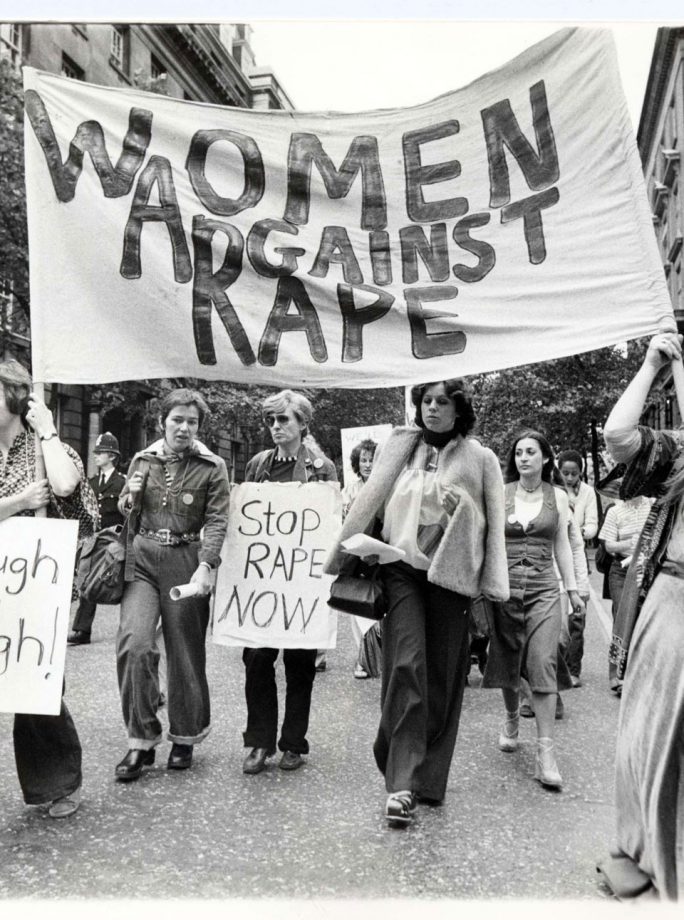
The fist rape law emerged in Babylon during c.1900 BC. The Code of Hammurabi dictated that if a man forces sex upon another man’s wife or if a man forces sex upon a virgin woman that “is living in her father’s house,” then “that man should be put to death” (Gold). This set a legal precedent that rape was merely a form of theft and vandalism, since women were considered property. Hence, the idea of a husband “forcing sexual intercourse” upon his wife was deemed the man’s legal right. Ancient society viewed rape as morally depraved, not because it caused the woman harm, but because it harmed male honor. Society viewed raped women as damaged goods and no longer marriageable assets. Speaking toward this idea that rape was merely an issue of one man damaging another man’s property, Winnie Tomm concludes that “by contrast, rape of a single woman without strong ties to a father or husband caused no great concern” (Tomm). This view remained constant for centuries until English law in the 1600’s created the first shift in society’s perception of rape by re-defining the criminal act as “the carnal knowledge of any woman above the age of 10 years against her will” (Gold).
These two laws were combined in the United States. Common law in the US declared that “a person commits rape when he has carnal knowledge of a female, not his wife, forcibly and against her will” (Gold). The law’s structure and general concept mirror English law quite closely; however, the Code of Hammurabi’s shadow belied the underlying morals. The qualification injected into the center of the law, stating that rape is only considered a crime when it is committed outside the bonds of marriage, alludes to the principles in ancient Babylonian law that define women as male property. United States’ past common law can be broken down as follows: “Carnal knowledge“ was further defined in US law in 1954 via Copeland v. State trial, which declared that “it shall not be necessary to prove the actual omission of seed, but the crime shall be deemed complete under proof of penetration only” (Copeland v. State). “Forced and against her will” indicates that the incident is not considered rape unless it meets both of these qualities beyond a reasonable doubt. It must be thoroughly proved that the woman was violently forced (the court often demanded to see physical injury to satisfy this aspect) and that the woman in no way desired sexual intercourse at the time (Kilpatrick).
Because “non-consent” was an integral element of the crime and because the US law
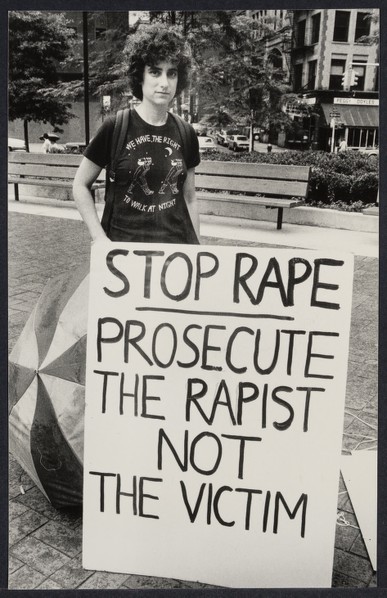 states that a criminal is innocent until proven guilty, the burden fell upon the woman to prove that she offered no indication of consent. Society pre-judged women in rape trials as guilty of promiscuous behavior, so to provide irrefutable proof of victimization was a Herculean feat. At the time, when a woman was raped, she would enter the legal system addressed as a defendant and witness. She was not declared a victim unless at the close of the trial the man was found undeniably guilty of forcing sexual intercourse upon her without any indication whatsoever, of her desire for said intercourse (Kilpatrick).
Women were forced off the streets and forced into silence. Women knew that if they were the object of a sexual assault, the law would not protect them (Bevacqua). Then, the Second Wave feminist movement began. Women started encouraging each other to speak out and act out against the injustices they faced. Writers like Susan Griffin in 1970 began shocking people out of their complacency about rape calling it a “form of mass terrorism.” Griffin wrote about how rape restricted women’s lives because they lived in terror, in abject fear of going out alone: “[women] will not be free until the threat of rape and the atmosphere of violence is ended, and to end that the nature of male behavior must change” (Griffin). Anti-rape activists worked within the Second Wave feminist movement to address the issue of rape on a variety of levels: consciousness raising, support, and legal changes.
Three of the various ways in which feminists brought awareness to the rape epidemic and the need for change were through consciousness raising groups, large public events, and poetry. In the late 1960’s, women began gathering in small groups and sharing their personal stories about rape incidents and other traumatizing experience. These little gatherings were called consciousness raising groups. On January 24, 1971, The New York Radical Feminist group held their first Speak-Out, a large public gathering where women could share their stories with each other. This event was so successful that The New York Radical Feminist group held a follow-up conference about rape that April (Rose). More events like this emerged throughout the nation. A series of marches began in 1976 called Take Back the Night marches. Numerous women participated in these rallies to protest sexual assault and fight for the right to walk the streets at night without fear (Hibsch). However, events like these and physical get togethers were not the only forms of consciousness raising. A third form was poetry printed in radical publications and read aloud in community poetry readings. Such poetry is the primary focus of the posts to follow.
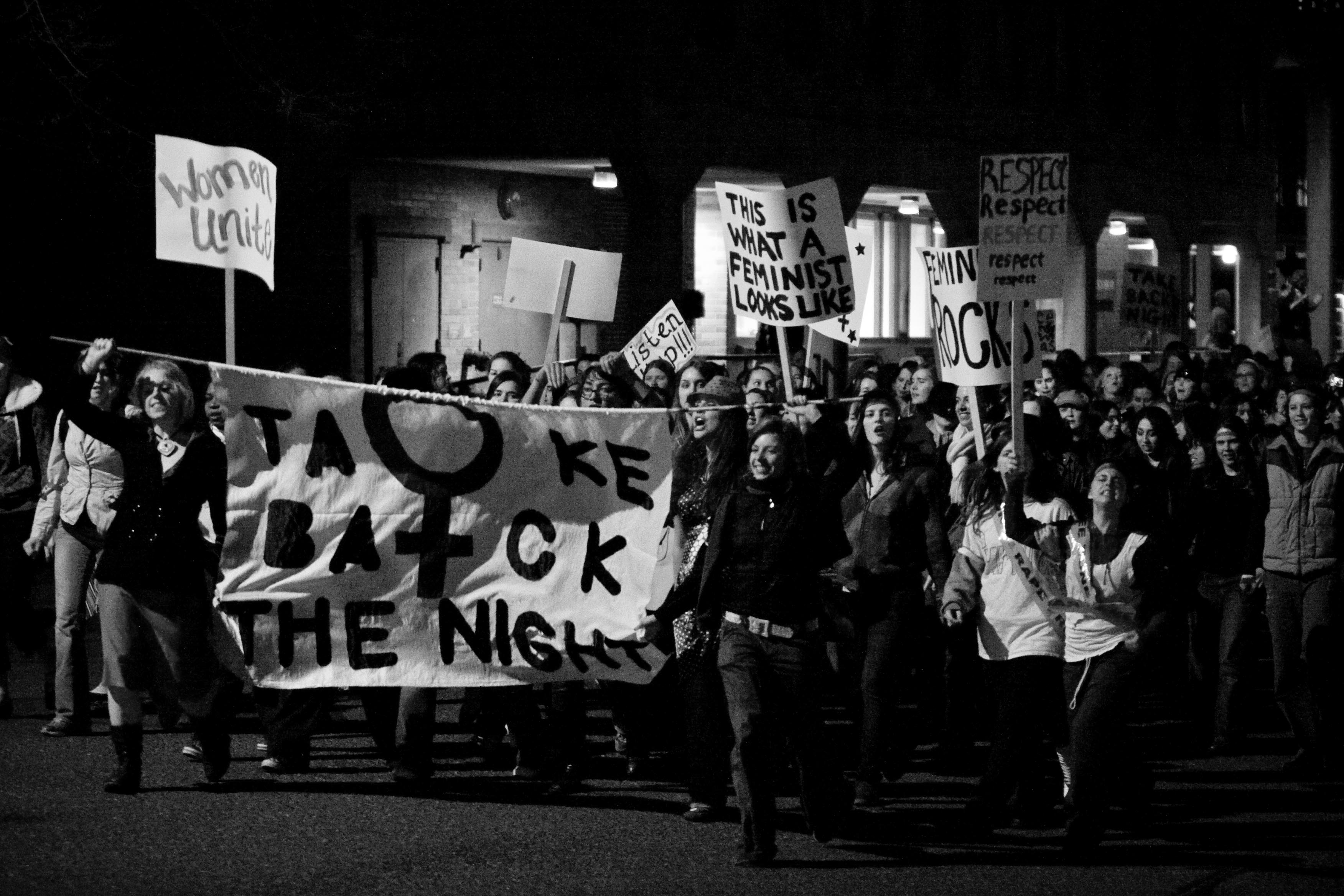
First Take Back the Night March
Support of rape survivors was another important strategy. Community gatherings, as mentioned above, provided a significant degree of moral and emotional support to rape survivors, but one of the critical breakthroughs that arose from the Second Wave feminist movement was the establishment of rape crisis centers. The Bay Area Women Against Rape (BAWAR) opened the first two rape crisis centers in 1971, located in California and Washington DC (Kilpatrick). According to BAWAR’s website, their founding mission was, and still is, to “establish a place where rape and incest survivors could receive quality counseling and advocacy they need” (BAWAR).
Finally, the most crucial need that anti-rape feminists devoted themselves to resolving was legal change. Spearheaded primarily by the National Rape Task Force, a subsection of the National Organization for Woman, feminists began campaigning relentlessly to redefine rape as a crime of violence (National Organization for Women). And, in 1974, Michigan created the first successful attempt to legally redefine rape. Known as the Criminal Sexual Conduct Law, this bill not only established a broader definition of rape, but it also outlawed spousal rape (Bevacqua). Other states followed Michigan’s example, and finally in 1996, Georgia, the last of the fifty states, outlawed marital rape as well (Degnan). Today, due to changes made in 2012, the FBI defines rape as “the penetration, no matter how slight, of the vagina or anus with any body part or object, or oral penetration by a sex organ of another person without consent of the victim” (Savage).
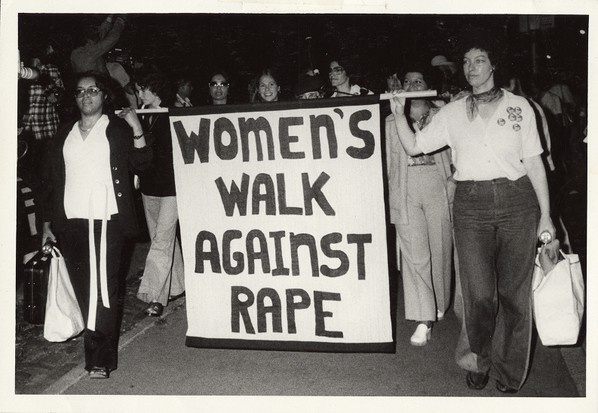
Even with the incredible changes, catalyzed by activists in the Second Wave feminist movement, the war against rape has still yet to be won.
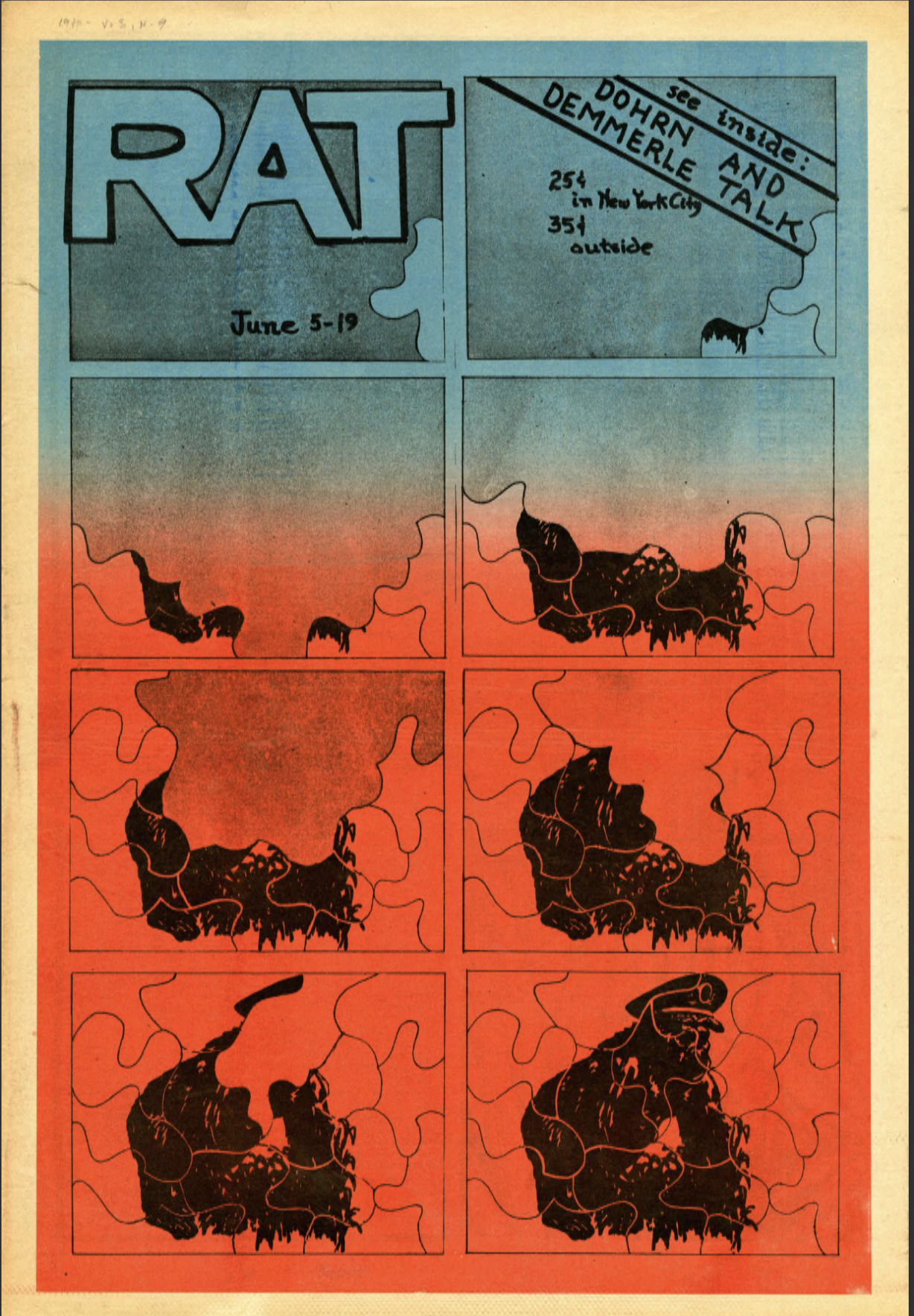 declarative manner, horror the wife faces as irrefutable fact. “I have been drugged and raped” ( line 6) is past tense and passive voice with a hidden agent that gives the voice a tired, dragging tone.
 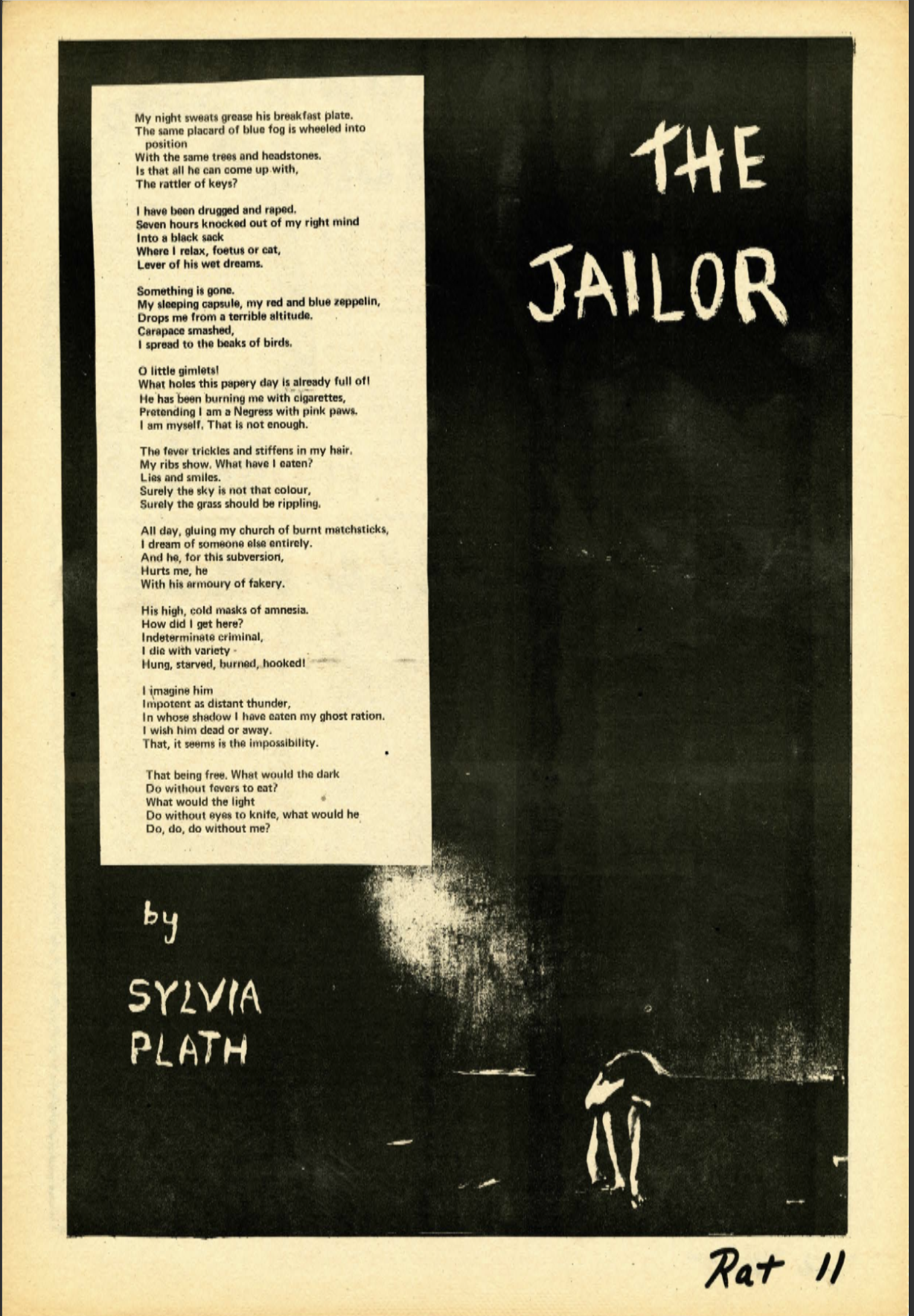 first line “my night sweats grease his breakfast plate” (line 1). “Night sweats” has several likely references. “Night sweats” are often linked to stress and anxiety correlated with feelings of worry, fear, and dread as “night sweats” can also be a symptom of certain drugs or diseases. Drugs are mentioned again in line six, “I have been drugged and raped” (line 6). “Night sweats” could also be a vague reference to “sex sweat,” for sex is also mentioned in line six. “Grease” suggests sexual lubricant, as well as bacon grease on a breakfast plate. These equivocal definitions tweak the normal picture of a housewife serving her husband breakfast to an image of a sickly, terrified sex slave serving breakfast and her body to her master. A sickly distortion of a common image occurs in the fifth stanza as well. “The fever trickles and stiffens in my hair” (line 21) points to sickness and to sweat, once again, yet the “stiff” product in her hair suggests a link to a common trend at the time for housewives to fill their hair with expensive hairspray, and style it in a way that would please their husband. A second reference to a common trend emerges in the next line: “my ribs show. What have I eaten?” (line 22). Skinniness was considered beautiful at the time. But as opposed to her stiffened hair and slender frame alluding to glamor and beauty, Plath’s diction portrays the woman as skeletal and diseased. Plath portrays the wife as one who feeds off of the “lies and smiles” ( line 23) that she presents to the world. She is a woman who ingests the insubstantial façade of marriage as her only source of nourishment. And because of this, her ailments fester and grow worse. But it is not just she who interacts with the facade, for as the metaphorical “armory of fakery” (lines 30) suggests, “fakery” is her husband’s weapon of choice, one of these weapons being “his high, cold mask of amnesia” (line 31). Height equates with power. When it is her word against his, society will always believe him. So, when he dawns a “mask of amnesia,” whatever he claims he “doesn’t remember” the rest of the world will believe never existed. Thus, the wife is forced to continue playing a role in this lie that is her marriage, until death does, she part.
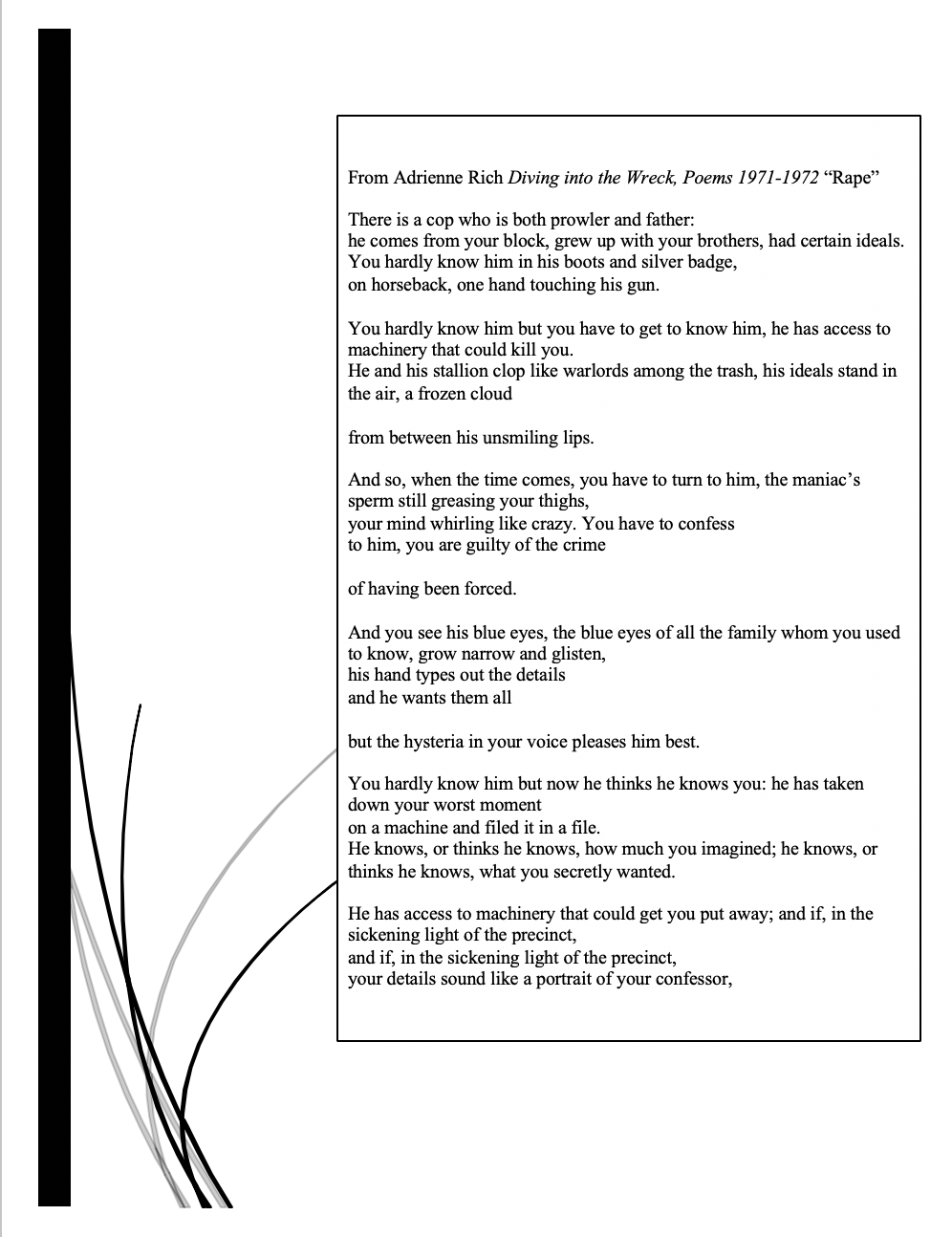

 “Greasing” is a metaphor in itself. The connection between “sperm” and “grease” illuminates the intentionality behind the word “maniac” appearing so similar to “mechanic.” The man who raped her also belongs to that great and terrible machine, the patriarchy. Imagery in the fifth line of the cop being “on horseback” (Rich, line 5) stages the cop as seated above the rape victim. The cop looks down upon her. This physical depiction joined with the simile in line eight, “like warlords,” (Rich, line 8) paints a portrait of the officer’s tyrannical power. “Among trash” (Rich, line 8) continues the imagery. All else in the portrait is depicted as garbage beneath the stallion’s feet; hence, the rape victim is garbage too. These descriptions position the officer and the girl on polar opposite ends of the power spectrum.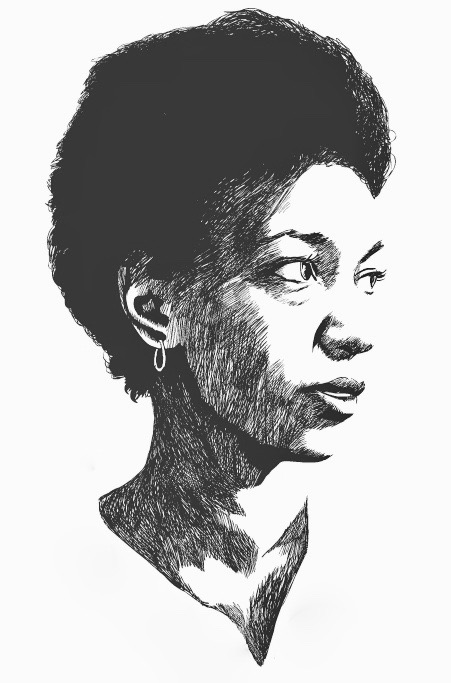

 (Jordan, lines 14). Rape is always a form of betrayal. Rape has not changed. Like in “Case in Point” the “Rape Joke” tells the story of the silence that falls upon the raped woman in the line “the mattress felt a specific way, and your mouth felt a specific way opened against it, as if you were speaking, but you know you were not. As if your mouth were open 10 years into the future, reciting a poem called Rape Joke” (Lockwood 4). The narrator repeats “felt a specific way,” as she replays that moment in her mind. She relives the experience so acutely that she can find no other words to accurately