The Readers—Oh! Where Are We?

[i]The boy stood on the burning deck

Eating peanuts by the peck;

His father called, he would not go

Because he loved those peanuts so. (“Poetry”)

“The boy stood on the burning deck” by James E McConnell

If you did not know the history behind these lines, you would probably assume it is a poorly-written nursery rhyme. A parody of the poem “Casabianca” that originally narrates a boy dying for his country in war, the verse preserves only the first line of the heroic ballad. But at least the poet, Felicia Hemans, would be pleased to know that her poetry has endured—not only endured, but took on a life of its own that she could not have imagined. How did this transformation happen? How can it be that a poem that addressesthe solemn subject of nationalism gave rise to such farcical parodies? It seems that whatever the readers thought when they wrote the parodies, their understanding of the poem is drastically different from how it was first perceived.

[ii]The answer is simple: a change in readership. Initially published in 1826 in a British literary magazine that had about 5,000 readers, the poem was only moderately received (“Monthly”). But shortly after Hemans’s death, the poem was selected as recitation material for British elementary school children and became the most anthologized work in nineteenth-century textbooks (Robson, “Standing” 151). School children, memorizing and reciting “Casabianca” without knowing the Mrs. Hemans who wrote the poem or her intentions in writing the poem, were free to interpret it (or not interpret it since the main goal was memorization and not actually analysis) as it appeared to them. Reading and reciting the poem aloud bring forth a distinctive feeling of excitement that otherwise would have been buried under the heavy content. Imagine that you’re a fourth-grader and read aloud the following stanza:
They wrapped the ship in splendour wild,

They caught the flag on high,

And streamed above the gallant child,

Like banners in the sky. (29-32)

Reading aloud really magnifies the energy in the iamb “ti-dum ti-dum ti-dum” meter (Robson, “Standing” 158). The rhythm naturally drives you forward into the next as if you were singing along with beat music. The innate vitality in the meter, therefore, renders the task of memorization more exciting and pleasurable. The simple and straightforward rhymes also make the poem relatively easy to remember, certainly easier than the lines from Shakespeare that the children also needed to learn (Robson, Heart Beats 90). Furthermore, words such as “spendour” and “gallant”, combined with the image of the flag flying high in the sky, convey the sense of pride that the children could relate to when they successfully recited the lines in the front of their class. Even if the poem is about death and contains more somber words such as “despair,” the beats and affirmative adjectives transform the poem from an account of death to a celebration of courage to be enjoyed with pleasantly familiar rhythms. It does not matter that the “they” in these lines refer to the flames that eventually consume the child—better yet, the image of flames surrounding the boy dramatizes him as romantic hero figure to be idolized.

Certainly we cannot blame the school children for “misinterpreting” the poem. After all, the children were free to think about the poem in whatever way that appealed to them regardless of what Felicia Hemans wanted to convey. Moreover, we cannot even know Hemans’s intentions to judge whether the children were misreading (or misreciting) it or not. But how “free” were the children in understanding the poem, presuming that they did at least have some sense of what the poem is about? And if the children really did not have any idea about the message of the poem, how much of their failure to grasp meaning resulted from their own incapability to comprehend because of young age? To answer these questions, we need to trace the chain of events that led the majority of children from the mid-nineteenth to mid-twentieth centuries to come in contact with the poem in the first place.

Nineteenth-century England witnessed an unprecedented boom in education that resulted from a series of education reforms. These reforms were largely influenced by the social and political climate at that time and especially by the dramatic rise of the working class. From only a few available schools sponsored by the Church of England and an average education of two years in the beginning and middle of the century, the establishment of free and compulsory education at the end of the century ensured seven to eight years of schooling for more than ninety percent of the children (Robson, “Standing” 152). Because of this drastic rise in education access, regulations and standardization became necessary. To ensure equal education in children across the country, competence in memorization became one measurable effect of learning. The pupils’ recitation to visiting examiners determined whether the school received merit or monetary penalties, and the recitations, in turn, also decided whether the children would be physically punished by their teachers (Robson, “Standing” 153). Under this system, schooling consisted mainly of memorization instead of interpretation, and this contributed to the devaluation of meaning in literary works at an age where meaning, especially complex and subtle meanings, did not come naturally to their audience. Since no one lectured the children on Hemans’s authorial intention or on the historical background of the poem, one might think that they could exercise their unobstructed freedom in construing the meaning of the poem. But in the context of the British school system at the time, it’s reasonable to imagine that the children were too terrified to fail their recitation to think about any deeper significance of the poem at all. Moreover, as they stood in front of the class to recite, it is hard to say whether their energy derived from the exciting rhythmic beat of the poem or their own palpitations. Whatever their interpretations may have been, their understandings can hardly be separated from the circumstance in which the poem was introduced to them.

James Wells Champney, Schoolroom at the Mill and Bars: Recitation Day (1877–87)

But what about the pride and patriotic sentiments so blatantly expressed in “Casabianca”? Even if some subtler meanings can be colored by the particular conditions the children were in, surely they should have realized the glorification of the boy as a hero in the last two lines by themselves : “But the noblest thing which perished there, /Was that young faithful heart” (39-40). The children, however, seemed not to have interpreted but directly internalized the lesson through the compulsive repetitions that served to meet the education standards imposed by the British government. Growing up in the patriotic society, the lessons of filial and civic duties were well learnt before fourth grade. The boy’s act of sacrifice in “Casabianca”, therefore, serves more as a confirmation of the children’s preexisting beliefs than material for analysis that requires their thinking. Indeed, American poet Elizabeth Bishop’s response, written more than a century later after the publication of Hemans’s “Casabianca”, illustrates the parallel she saw between the boy in Hemans’s poem and the school children who recited the poem. In the poem, also titled “Casabianca”, Bishop compares the schoolroom platform where the schoolboys recited “Casabianca” to the burning the deck the boy stood on (lines 1-3). The boy and his decedents are similar in their steadfast devotion to their country, but this fidelity becomes their only identity, as Bishop opens her lines with “Love’s the…” (1) and substitutes the subsequent object with the schoolboys, the other sailors who also died in the naval battle but brushed aside in Hemans’s poem, and “the burning boy” (line 10). In committing the acts of love, the boys lose their own identities and become the love they stand for. They become the symbol of loyalty that they strive for through both their literal and metaphorical self-sacrifice.

While Bishop’s response is illuminating, it also complicates the reading of “Casabianca” for readers today who want to make sense of the original “Casabianca” in an unrestricted way. It seems that simply erasing the name “Felicia Hemans” and her history from our thoughts is not enough to obtain the readers’ freedom, because we have new questions to worry about: what does it mean to have two poems called “Casabianca” that are so closely related? Should Bishop’s poem be regarded as a poem in its own right or as a part of the whole “Casabianca” phenomenon that need to analyzed together as a whole? Can we really ignore the effect of the parodies that have become ubiquitous, even if we have not read all of them?

An obvious solution to these problems is to simply read Hemans’s “Casabianca” by itself and shut our eyes to any other source that may cloud our understanding, be it scholarly or not. This solution, however, soon becomes less promising if we think about the situation in which we encounter the “original” “Casabianca” in the first place: in a neatly anthologized textbook for English class, likely juxtaposed with other popular Romantic and Victorian poems fortunate enough to have remained over time. In this highly artificial situation, our response to the poem, perhaps already biased by what we’ve read about general Romantic and Victorian literary styles that have been curated by others, are largely based on our personal values. But where do our own values come from? While we individually form our own opinions, the larger sociological, historical, and cultural backgrounds also play important roles. This does not mean that we cannot interpret the poem in our own ways or that no one can escape the influences of these larger backgrounds—indeed, people in similar environment often end up with quite different value systems, and each reader has a slightly different image of the burning boy and a distinct attitude towards him that cannot be shared by another. Nonetheless, changes in filial responsibility over time and the extent of nationalism that is accepted as social norm also impact our judgements. When we deem the boy not as a heroic figure but a victim under unresponsive patriarchy, it would be wise to consider whether this presumably “free” thought is bounded by the cultural beliefs of our own time. Similarly, literary style has changed significantly since Hemans’s time, and by today’s standard, “Casabianca” would be an example of a “bad” poem in not only its meter and rhyme but also its patent sentimentality (Lootens 120). When the once standard literary convention has already become a cliché, how are we to judge the merits and faults of poetry written in such style?

As readers of a piece of literature, we automatically adapt the piece to our own situations, but this unconscious adaptation does not guarantee our freedom, even if the author’s intention is set aside. So how can we claim the reader’s freedom that we desire? One way, counterintuitively, is to go back to where “Casabianca” came from. An objective reading demands us to examine the history that allows it to exist in its forms today, both in the poem itself and in its numerous parodies. This approach is difficult, since its history is invariably loaded with more biased interpretations, and we may eventually get caught in the myriad opinions of others. Another way, perhaps more counterintuitive than the first, is simply admitting that we do not indeed have as much freedom as we would like, and to be a reader is always to exist in a larger background that unconsciously influence our interpretations. But this acknowledgement is liberating because you know that others, too, whether scholars or school children, are also bound by the same constraints. The meaning that you interpret will always mean something uniquely to you, and that’s a freedom that no one can take away.


This essay was read by Miranda Wang.

[i] This essay is inspired by two sources. The first is a prompt for my Literary Theory class: It is the reader, and neither the text not nor the author, who determines the meaning of a poem, novel, play, or movie. Writers lose control of what they write. You already have—and have perhaps never needed—permission to play with a text or to adapt it to your circumstances. You shouldn’t be bound by what the author meant or by a concern for what a given collection of words “really means.” The second is Roland Barthes’s essay, “The Death of the Author.”

[ii] The Monthly Magazine, n.s.2, 1826, p164. HathiTrust Digital Library, https://hdl.handle.net/2027/hvd.32044092623271?urlappend=%3Bseq=174.

Works Cited

Bishop, Elizabeth. “Casabianca.” North and South. Boston: Houghton, 1946. 6.

Hemans, Felicia. “Casabianca.” The Monthly Magazine. August 1826. Web. 20 Apr 2018. Google Books.

Lootens, Tricia. The Political Poetess: Victorian Femininity, Race, and the Legacy of Separate Spheres. Princeton University Press, 2016.

“Monthly Magazine and British Register, The.” Waterloo Directory of English Newspapers and Periodicals, 1800-1900. Web. 22 Apr 2018.

“Poetry Friday: Parody.” Semicolon, 25 Sept. 2009, www.semicolonblog.com/?p=7063. Accessed 22 Apr. 2018.

Robson, Catherine. Heart Beats: Everyday Life and the Memorized Poem. Princeton University Press, 2012.

Robson, Catherine. “Standing on the Burning Deck: Poetry, Performance, History.” PMLA 120.1 (2005): 148-162. Web. 20 Apr 2018.

Freud’s Ego: The Narcissism of Psychoanalytic Literary Criticism

The theme of creation as reflective of its creator is rather ubiquitous, taking forms as diverse as Frankenstein, the La-Z-Boy, and in the knowing sighs expelled in the presence of a particularly abstract Van Gogh because you know it must mean the approach of the dismembered ear. Artists undoubtedly expend much of their blood, sweat, tears, and souls in their acts of creation, and there is a large and raging theoretical debate over the intelligibility of creation in communicating, inevitably, the intricacies of the consciousness of a creator – whether every portrait, in any medium, is a self-portrai t. Perhaps one of the most extreme iterations in the range of positions on the subject can be found in the genre of artistic psychoanalysis, the interpretation of a work of art, often a work of literature, as means for psychoanalytic diagnosis of an artist, often author. This technique relies on the principle of creation as a mirror into the depths of the creator’s mind, the cerebral recesses of which even the creator his or herself is unaware. Upon inspection, it is the necessary inflexibility of this assumption that puts into question the legitimacy of this psychological methodology, as well as the stability of the normative definition of authorship.

Freud, and many students of the psychoanalytic tradition that has followed him, often used works of literature as legitimate subjects for psychoanalytic inspection of their authors – a methodological decision that relies upon a unique and complicated theory of both authorship and language. Most obviously, by virtue of the substance of their particular flavor of psychology, it discounts the debate over authorial intention because conscious intention does not matter. It denies the suggestion by William Empson and others that the authorial position is important because written language is, as other modes of communication are, an intentional transmission between communicator and interlocutor, both of whom are equally important in the success (in terms of objective intelligibility) of the message. While authorial psychoanalysis does not preclude the legitimacy of this theory, it relies on the principle that the author at the very least communicates more than was intentional, that his or her creation is, to some degree, a projection of his or her unconscious thoughts, fantasies, and dreams to-be-interpreted. These messages, furthermore, are uniquely meaningful because they are the only ones not tainted by the socialized deterministic constraints of Freud’s ego and superego, a tainting necessarily implicated in Empsonian mass communication. They are, instead, the only true reflections of the human condition – consciousness without the categorical imperative, artist without motive.

To determine the meaning of the expression of the unconscious, the psychoanalysts must have an understanding of contextual relationships, life stages in relation to expected psycho(sexual) development, and events to which the id could be creatively reacting. To do so, they rely on biographical evidence, a source that has further ramifications for the underlying theory of authorship and literature. Because they necessarily reject the validity and importance of Wimsatt’s Law, which posits the innate unknowability of the author, their position better interacts with that of Foucault in his essay, “What Is an Author?” Foucault asks, “What is necessary to its composition, if work is not something written by a person called an ‘author?’… If an individual is not an author, what are we to make of those things he has written or said, left among his papers or communicated to others?” (Foucault, 1969). He recognizes the distinction between an author and a writer as analogous to the implied greatness in the designation “work.” This glorification occurs at the hands of readers or audiences who determine, although the determinations can shift with cultural changes, which pieces and people deserve the lasting honorifics of “works” and “authors.” Further, an individual author is defined by his or her work in relation to its representation and interpretation among its readership. This determination of the author by his or her function as the characterization of “the existence, circulation, and operation of certain discourses within a society” (Foucault, 1969) establishes an author as the product of his or her own literary images, subject to the interpretations and representations of his or her life, work, and self by readers.

With every psychoanalytic literary critique, there is an implicit agreement with Foucault’s recognition of the pregnancy of the designation “author” as expressing a difference in esteem as compared to “writer” or a similar term. It is the ordination of greatness by the masses upon which the authority of psychoanalytic methodology rests. The position of authorship opens up the realm of psychoanalytic investigations informed by the biography of the author because the greatness of the designation provides legitimacy. If, for example, Freud were to come across an anonymous diary on an Austrian street that evidenced his psychosexual hypotheses, no one would care enough to read an essay on the subject. The diarist would be, quite simply, a freak. The acclaim of a work, and thereby of an author, suggests an innate universal resonance that provides the legitimacy necessary to make sweeping claims about human psychology in psychoanalytic literary criticism. The psychoanalysts must, however, diverge from the Foucauldian argument before its next conclusion, and do so without methodological defense or explanation. They cannot recognize the knowability of individual authors as limited to their images in an equally-literary body of writing and an array of subjective interpretation because the psychoanalysts rely on the factuality of biography and the existence of an intelligible, stable, and true authorial personhood. While Freud claims medical objectivity, Foucault claims that the doctor’s patient is an amorphous, shifting blob of social construction upon which testing would be futile and diagnoses, moot.

Freud’s writings on the Shakespeare authorship question provide a particularly clear, almost comically-literal example of this apparent methodological dissonance. Most famously, he provides a critical explanation for Hamlet’s seeming inability to avenge his father’s murder as “rooted in the same soil as Oedipus Rex” in The Interpretation of Dreams. He explains that Hamlet is unable to kill his uncle who has murdered his father and subsequently married his mother out of shame that the murderer is no better than himself – his uncle has only achieved the realization of Hamlet’s deepest desires. Freud follows his interpretation with the assertion that “It can, of course, be only the poet’s own psychology with which we are confronted in Hamlet; and in a work on Shakespeare by Georg Brandes (1896) I find the statement that the drama was composed immediately after the death of Shakespeare’s father (1601)- that is to say, when he was still mourning his loss, and during a revival, as we may fairly assume, of his own childish feelings in respect of his father” (Freud, 1911). Indeed, he concludes that in making this connection he has “attempted to interpret only the deepest stratum of impulses of the creative poet” (Freud, 1911).

Some years after the publication of the first edition of The Interpretation of Dreams, Freud discovered a fault in the methodological assumptions upon which his understanding of the Shakespearean unconscious relied. It became known to him that Georg Brandes’s biographical scholarship was flawed, and that, in fact, the merchant of Stratford’s father died some years after recorded performances of Hamlet. In the late 1920s, Freud became fascinated with a theory put forth by J. Thomas Looney in a book entitled ‘Shakespeare’ Identified in Edward de Vere. Looney’s methodology is not so epistemologically different from Freud’s authorial psychoanalytic assumptions employed up to this point. In reaching his conclusion, “Looney developed a list of attributes of the author through a close study of Shakespeare’s works, then read biographies of Elizabethan writers, before concluding the best match was with Edward de Vere… [the psychoanalytic portrait] matches de Vere much more than it matches the scanty biographical evidence about Stratford’s William Shakspere” (Waugaman, 2016). Freud’s seduction by Looney’s argument was magnified by the realization in the context of his Hamlet theory that “the Earl of Oxford’s beloved father had died when the supposed playwright was still a boy and his mother (whom he later repudiated) had quickly remarried” (Holland, 1960).

Freud’s correspondences and theory evolution after his discovery of the Oxford thesis demonstrate his developing subscription. In 1930, Freud edited his section on Hamlet in the new edition of The Interpretation of Dreams to include a footnote clarifying that he had “ceased to believe that the author of Shakespeare’s works was the man from Stratford” (Holland, 1960). It was not his theories about Hamlet, however, that lead to his eventual outright Oxfordian conversion. In a March 1934 letter to Shakespeare translator James S. H. Bransom, Freud reveals that biographical similarities to his Oedipal interpretations of The Tragedy of King Lear provide convincing evidence:

I have already taken the liberty of hinting to you my belief in the identity of Shakespeare with Edward de Vere, the seventh Earl of Oxford. Let us see if this assumption contributes anything to the understanding of the tragedy. Oxford really had three grown-up daughters (other children had died young, including the only son): Elizabeth, born 1575, Bridget 1584 and Susan 1587. I will call your attention to a striking change Shakespeare made in his material. In all the accounts of the sources the daughters are unmarried at the time of the love test and got married only later. In Shakespeare the two older are married at that time (Goneril already pregnant), and Cordelia still single. When we date the composition of Lear – surely with right – in the poet’s late years then we have a striking agreement. Elizabeth married Lordy Derby in 1505; Bridget married Lord Norris in 1599. Since Oxford died in 1604 and Susan, our Cordelia, married Lord Pembroke only in 1605, she was single throughout her father’s lifetime. (Jones, 1957).

“He later unequivocally states that it is this evidence that persuaded his unqualified subscription. In a November 1935 letter to fellow-Oxfordian Percy Allen, he cites this correspondence with Bansom and explains that he ‘wrote to him that Lear could only be understood psychologically on the assumption that Oxford is the author, and that I believe Edward de Vere tohave been the creator of all the other genuine Shakespeare plays’” (Waugaman, 2016).

The fault in Freud’s analysis of Shakespearean authorship is his acceptance, and subsequent continuation, of the methodological approach employed by Looney. In a 1938 letter to Looney, Freud indeed proclaimed ‘Shakespeare’ Identified in Edward de Vere “a remarkable book, to which I owe my conviction about Shakespeare’s identity, as far as my judgment in this matter goes” (Holland, 1961). Both men, working from pre-determined analyses of the playwright’s unconscious expressions in his works, not only select biographical facts of an author that suit their critical interpretations, but in effect invent an entire authorial biography – superego, ego, and id in all – grounded exclusively in their particular psychoanalytic accounts of Shakespeare’s fictional characters and events. The first epistemological mistake is in the assumption that every noticeable suggestion of an unconscious expression or vague implication of a contemporarily popular psychoanalytic theory should be directly attributable to a biographical event, in this case limited to those as impersonal as to be recorded in the Elizabethan equivalent of census data – births, deaths, marriages. This illogic of this judgment verifies Foucault’s recognition that the image of the author is in part fractured and infinite because of interpreter’s identifications of authorial subjectivity across works, characters, and narrative psyches. Second, and crucially, psychoanalysis of authors relies on objectivity of the literature surrounding an inherently literary figure. Freud could not afford to question whether Brandes’s biographical scholarship could have been affected by his own literary prejudices as a reader obviously passionate about Shakespeare because his Oedipal theories hinged so heavily on its accuracy. He could not consider the inherent subjectivity of a methodology that is entirely based on an individual reader’s opinions about the Shakespearean corpus and its creator’s basest psychosexual desires (doubtless first influenced by Freud’s own interpretations) because “On Repression in Hamlet” had already been published. For if he had, he would have discovered that the distillation of all of his scientific writings on the subject of Shakespearean psychology reveals only a tautological loop of his own psychoanalytic literary confirmation bias.

While Freud and the Oxfordians literally create an author around their readings of literary works, the incongruence between the asserted scientific objectivity of their interpretations and the inherent intangibility of the unconscious relationship between creator and creation demonstrates the degree of veracity of the Foucauldian argument that an author is defined by the literary world of his or her readership. Psychoanalytic literary critiques are presented and marketed as part of the development of objective scientific theory; My sources were housed at Schow, not Sawyer, and the essays were published in medical journals of psychology, not literary magazines. Certainly in the Oxfordian example, and, I conjecture, in many other theses from the critical genre, the objectivity masks the unconscious and overwhelming influence of the literary reader. Authorial biographers, similarly, have literary prejudices, as evidenced by the fact that they have undergone great effort to communicate an image of an author that implies his or her importance, that inevitably impact their own decisions as to structure, inclusion and exclusion of facts, and tone. They are, initially and fundamentally, readers. The way in which any reader interprets and imagines the image of an author is always originally rooted in the reader’s experience of the work, an experience, as Freud demonstrates, that is inevitably affected by his or her prejudices, desires, and self. Foucault’s author-function is inescapably subjective and indeterminable – a product of a literary world determined and propagated by an infinite multiplicity of unique reader positions, each a reflection of individual (un)consciousnesses.

Absolute Relativism: Dangers of Interpretive Liberty

THERE are a lot of opinions, these days, about opinions – about their validity, more specifically. Some opine, of course, that their opinions aren’t really opinions after all – that they’re actually something approaching absolute truth – gospel, if you think in those terms. We have learned, all of us, to be wary of these tyrants – so much so that many have sprinted in the opposite direction, arriving at the opinion that all of them – all opinions, that is – are equally worthy of merit.
The theoretical roots of this anti-authoritarian dash, at least partially, lie buried in the garden of post-structural literary theory, a fancy name that’s less important than that of Roland Barthes, one of its chief gardeners, who famously argued, in literary terms, for the kind of democratization foundational to our run from absolutism.

Celebrations, especially of liberty, have little patience for the cautious, but I’ll raise the question anyway: have we run so hastily – so blindly – that we’ve actually just come full circle? Let me explain.

To be very clear, Roland Barthes was not eulogizing: he was crying out for literary blood. “We know that to give writing its future,” he famously proclaimed, “the birth of the reader must be at the cost of the death of the author” (Barthes). In other words: when interpreting a work of literature, we must give exclusive rights to readers’ subjective judgments, discarding especially – in a violent way – authorial intentions: that same self-serving despotism constructed by opportunists and politicians (even authors themselves) for their own ends. Only the blood of authorial tyrants, so to speak, can properly refresh the tree of literary liberty.

Such a thoroughly democratic suggestion seems – now as then – occasion for rejoicing. We might, to take just one example, celebrate – as Barthean freedom’s finest fruits – the mid-century counterculture’s re-appropriation of J.R.R. Tolkien’s books as a collective, subversive transcendence of that author’s self-admittedly racist intentions. But some – more cautious celebrants, perhaps – might insist upon raising the hypothetical: what if it had happened the other way around?

Speaking more generally: are there situations in which the freedom attending authorial sacrifices upon readers’ altars comes at too high a price? Strictly speaking, after all, the Barthean ethic necessarily grants universal legitimacy to as many interpretations as there are readers, including those some might best characterize as, to put it mildly, less than benign. The cautious, however, are wrong – wrong to present the case as a hypothetical, that is. It’s a story we’ve already seen before.

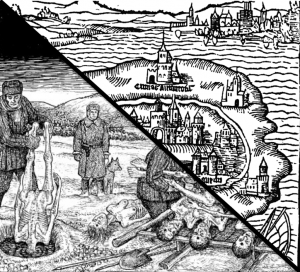
Frontispiece of More’s Utopia, depicting the island commonwealth.

IN at least two senses, Thomas More is dead. Biologically speaking, he’s been dead for a long time: since 1535, in fact. But he has, in some way, lived on through Utopia, his most famous work; it adroitly treads the line between literature and political philosophy, offering a fictionalized account, via frame narrative, of an ideal island commonwealth in the (then-new) New World. Raphael Hythloday, traveler-turned-narrator, describes the socio-cultural, political, and economic practices of the Utopian people to “More,” written into the story as a fictional character. Utopia’s most notable feature is that all private property has been abolished – its citizens live communally within a moneyless economy.

But beginning with the front cover, it’s a tale marked by contradiction: the word utopia is a contrived Greek compound, translating roughly to “no-place,” but could be read alternatively as a pun on the Greek eutopia, meaning “fortunate place.” In many ways, it seems to hold up to the latter interpretation – its citizens’ basic needs are universally met and labor is light and evenly distributed, leaving plenty of time for social, artistic, intellectual and leisure pursuits. At the same time, legal rigidity comes with those benefits – even leisure is regulated by fixed hours, traveling requires permission from the government, and despite broad religious freedom, atheism is outlawed. To ensure their continued safety and security, the Utopians employ mercenaries to conduct pre-emptive strikes against potential threats – acquiring slaves and becoming a quasi-colonial power in the process.

Beyond seeming moral contradictions inherent in the commonwealth’s construction, the prose is punctuated by wry ironies. Originally published in Latin, “More” would’ve appeared as “Morus” – from which we get our word “moron.” Raphael, the narrator’s first name, refers to the biblical archangel who announced Christ’s birth as the coming of a new age, but his last name, Hythloday, means “nonsense peddler.” But the greatest puzzle comes at book’s end. Hythloday affirms his admiration of the Utopian system; a reflective “More,” despite doubts about the feasibility of a moneyless economy, states: “I freely confess that in the Utopian commonwealth there are very many features that I would like, rather than expect, to see” (More, 113).

READERS, upon finishing the slim volume, might find themselves searching, flipping furiously back through the pages, for an author to kill – More’s tangled ironies and contradictions create a vacuum of meaning tantamount to authorial suicide; in his relation to his own work, the authorial More is functionally dead, little more than a name on the spine. Utopia and its contents are up for grabs: to be, respectively, interpreted subjectively and marshaled freely by any and all.

Even academics, those most ostensibly dispassionate interpreters, continue to have serious and wide-ranging disagreements about More’s book; its contents are so contradictory that even scholarly attempts to ‘resurrect’ the author’s intentions by historical means have yielded little consensus, if not generated further controversy. Perhaps W.S. Allen has put it best: that More – if he can be assigned intent – leaves readers “with an ambivalent and puzzled view” (118) about the merits of Utopian life. But that hasn’t stopped others from trying to narrow it down. Quentin Skinner recounts that one theory, initially propounded by R.W. Chambers in 1935, claims that More “aimed to picture the best state that reason can hope to establish in the absence of revelation” (Sir Thomas More’s Utopia, 123). Skinner names another school, of which Brendan Bradshaw is a recent defender, that holds that More meant any praise of the Utopian commonwealth ironically – that he held “serious reservations about the ideal system” (Ibid., 124).

But an opposing 1888 reading by Karl Kautsky perhaps merits the most serious interest, which “[sees] More as a the tragic figure of a socialist born out of his time” (Foundations of Modern Political Thought, 257) Skinner notes that Kautsky’s interpretation “appears to have been Marx’s view” (Ibid., 257) and indeed, John Guy notes that Marx and Englels, in The German Ideology, “ranked More alongside the Levellers, the Owenites and the Chartists as a forerunner of socialism” and that Williams Morris “announced that Utopia was ‘a necessary part of a Socialist’s library’ ” (95). Here we are reminded that debate over Utopia is not one restricted exclusively to ivory towers; ideas formed there descend, manifesting themselves in reality, and etching themselves – in this case, quite literally – upon the monuments of history. Eighteen names were inscribed upon the Alexander Garden Obelisk of Moscow, repurposed by Lenin following the Russian Revolution, to honor Soviet influencers: Marx and Engels headed the list; ninth from the top is ‘T. More’ (Ibid., 96).

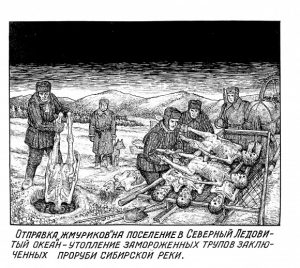
To avoid digging graves in the permafrost, frozen inmate corpses were disposed of in the Arctic Ocean. (from “Drawings from the Gulag” by Danzig Baldaev, a former Soviet prison guard)

To Aleksandr Solzhenitsyn, a survivor of the brutal Soviet Gulag work camps developed initially under Stalin, More’s presence on the Alexander Garden obelisk seemed grimly ironic. After being awarded the 1970 Nobel Prize in Literature, Solzhenitsyn’s 1973 Gulag Archipelago insisted that More had foreseen both slavery and forced labor as necessary prerequisites to support a system like the one the Soviets had implemented (Bloom & Hobby, 174). But in the end, it didn’t matter whether Utopia had been read ‘properly’ or not – during the Stalinist period, an estimated two to three million lives were claimed, on top of millions of others under the Soviet regime, in those camps alone (Snyder).

It would be a dramatic overstatement, no question, to draw an absolute red line from Thomas More to Marx to Stalin’s atrocities. This isn’t to say, either, that Stalin’s execution of Marxist thought is its authoritative, or exclusive, manifestation. But this lesson from history should alert us to three axioms for our own time.

FIRST, writers – having written – inevitably lose control of their work, but especially so when – like More – ambiguities fractionate into a panoply of conflicting interpretations.

SECOND, literary debates are deadly serious. Powerful ideas are distilled from, among other sources, the interpretation of literary works – ideas with inbuilt potential to germinate, physically, in reality.

THIRD, and most importantly: anyone unabashedly enthusiastic about Barthes’ birth of the reader should pay careful attention to those first two axioms. The problem with sanctioning the validity of every literary interpretation is that you must sanction all of them, even those you yourself find repugnant. It’s only a half step from literary interpretations to opinions of any kind: anyone committed to absolute relativism in opposition to absolutist despotism, in the end, has done nothing but make tyrants of us all.

In a world where the legitimacy of truth resides equally, at all times, in each individual, we cannot judge nor be judged. Such mandates can be dangerous things; they possess a kind of latent malleability that can, to the enterprising mind, be bent into tools – weapons – for settling personal scores, or worse. Much worse.

Those less than convinced should, perhaps, heed Solzhenitsyn’s warning: “You may suddenly understand it all someday – but only when you yourselves hear ‘hands behind your backs there!’ and step ashore our Archipelago” (Gulag Archipelago, 518). We don’t want to imagine what happens next.

Works Cited

Allen, W. S. (1976). “The Tone of More’s Farewell to Utopia : A Reply to J. H. Hexter”. Moreana, 13 (Number 51)(3), 108-118.

Barthes, R. “The Death of the Author”. Retrieved from http://www.ubuweb.com/papers/

Bloom, H., & Hobby, B. (2010). Enslavement and Emancipation. New York, NY: Blooms Literary Criticism.

Guy, J. (2000). Thomas More. London: Arnold.

More, T. (2003). Utopia (G. M. Logan, Ed.; R. M. Adams, Trans.). Cambridge: Cambridge University Press.

Skinner, Q. “Sir Thomas More’s Utopia and the Language of Renaissance Humanism.” The Languages of Political Theory in Early-Modern Europe, edited by Anthony Pagden, Cambridge University Press, Cambridge, 1987, pp. 123–158. Ideas in Context.

Skinner, Q. (1978). The Foundations of Modern Political Thought. Cambridge: Cambridge University Press.

Snyder, T. (2011, March 10). “Hitler vs. Stalin: Who Killed More?” Retrieved from http://www.nybooks.com/articles/2011/03/10/hitler-vs-stalin-who-killed-more/

Solzhenit︠s︡yn, A. I. (1974). The Gulag Archipelago, 1918-1956: An Experiment in Literary Investigation (H. Willetts, Trans.). New York: Harper & Row.

Black Reconstruction and the Truth of Historical Literature

Aside

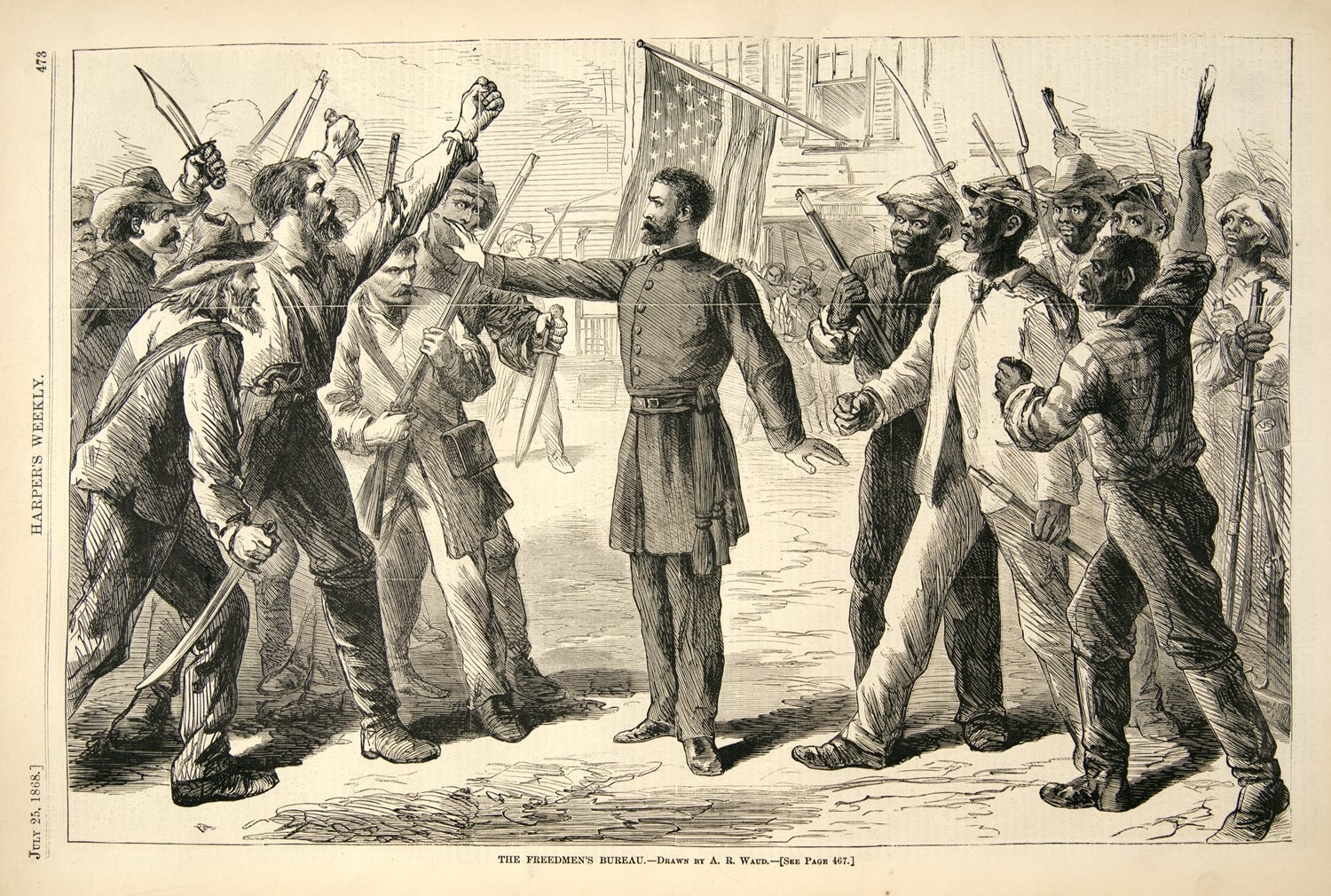
Image result for web dubois black reconstruction(Waud, 1868)

The reminder that we exist not in the past but in the present may seem so obvious that it could be easily dismissed as unnecessary; regarding the discipline of history, however, it is important to consider what this proposition truly means. Since the past cannot be directly observed, no historian can guarantee with certainty that their work is a perfect reconstruction of past events. Instead, ”We must be interested in [a historical document], if at all, for what it is and not for what it was” (Becker, p.328), and so it becomes the duty of the historian to collect, analyze, interpret and present a set of “historical facts” in the form of a narrative relevant to current circumstances. As such, the goal of a good historian is to affirm events that are said to have occurred, while organizing dry historical facts into the form of an interesting and insightful story.

So how can a historian claim that their work is true if it is removed from the immediacy of the past and transformed into a narrative form? Herein lies an unsurprising point: the story that a historian chooses to tell must work with whatever evidence is available to support its veracity. This means that there are multiple stories one could tell when looking at any historical event, but some are better and more truthful than others. The narrative scheme used to organize a set of historical facts is more empirically correct if it can be better corroborated by a network of supporting evidence. The essential aspect of historical knowledge lies in the understanding that history is an interpretive discipline. As an interpreter of the past, the historian is therefore engaged in two sets of ongoing dialogue: First, a dialogue with the sources appropriate to the problems of interest to that historian; second, a dialogue with other interpreters interested in the same problems or related problems. Through the dialogue—and argumentation—between and among various historians seeking to develop arguments about the past that are more rather than less persuasive, historians strive to produce analytical narratives that are closer to truth and further from fiction.

When W.E.B. Du Bois wrote Black Reconstruction: an Essay toward a History of the Part Which Black Folk Played in the Attempt to Reconstruct Democracy in America, 1860-1880, his account of the post-Civil War United States, he produced a radically different narrative from the previously dominant historical account of Reconstruction, which had hitherto been written by white, southern historians (Foner 2014, Preface). Du Bois was, of course, met with much resistance from those with whom his argument clashed, not due to the lack of the truthfulness of his narrative but because of the story it told (MacDonald). While neither Du Bois’s account, nor the one it contradicted, provides a definitively true story of the past, Du Bois’s history of reconstruction better corroborates its own narrative through a network of supporting evidence. Therefore, Black Reconstruction tells an empirically better story of the postbellum period, and to consider it fictitious on the sole basis that it utilizes narrative schemes is incorrect.

A significant portion of Black Reconstruction is dedicated to examining and disproving the romanticized myths propagated by southern historians to justify American slavery and the Civil War, to demonize postbellum policy and northern influence, and to pretend that African-Americans played an insignificant role in their own emancipation and enfranchisement. In doing so Du Bois explicitly acknowledges the subjective nature of historical narrative, noting in his preface the significant effect that a reader’s predisposition will have on their perception of the truth of his argument. “If he believes that the Negro in America and in general is an…ordinary human being,” Du Bois writes of his reader, “then he will regard this story and judge it by the facts adduced. If, however, he regards the Negro as a distinctly inferior creation…then he will need something more than the sort of facts that I have set down” (Du Bois, p.1). He concludes by asserting that “this latter person, I am not trying to convince…I am assuming the truth of the first” (Du Bois, p.1). In these lines lie several key facets of Du Bois’s argument regarding narrative historical truth. He notes that historical literature, his included, is a “story,” and that the truth of any facts that may be enclosed in a historical narrative rely on the reader’s belief that they are in fact true. This does not mean that historical writing is inherently fictitious—historians must be careful when choosing how they tell a story, because some literary forms allow for a more accurate depiction of certain events than others.

negro_rule.jpg                    (Core, 1898)

The interpretive framework of the white Redeemer historians was based on their belief that blacks were racially inferior; looking at past events from the perspective of the freed slaves was beyond them. By contrast, that perspective is at the center of Du Bois’ interpretation. So he looks at some evidence which they never considered, and he interprets evidence they had considered in very different ways. The connotations these facts hold differ greatly with the different storytelling methods; according to Carl Lotus Becker, an American historian “the simple fact turns out to be not a simple fact at all. It is the statement that is simple – a simple generalization of a thousand and one facts” (Becker, p.329). This is a crucial acknowledgement to make, one echoed in the words of the historian E.P. Thompson who wrote that “the discipline of history is, above all, the discipline of context; each fact can only be given meaning within an ensemble of other meanings” (Thompson, p.45). Becker and Thompson both look at ways in which history is above all an interpretive discipline, in which the historian gives meaning to the facts (because as Becker says, the damn things themselves don’t say anything at all). Becker emphasizes that historical knowledge can’t be separated from the perspective, interests and values of the individual historian. Each historian seeks to develop an evidence-based interpretation that is more persuasive and more accurate than others. Thompson suggests that the ‘fact’ must be interpreted in relation to the ensemble of facts in which it is embedded. The belief of the reader in the truth of any historical fact may be garnered by way of “an ensemble” of supporting facts that conglomerate to convince the reader of their veracity. However, Du Bois notes that the prejudices of the reader may play an indomitable role in the perception of history by asserting that “this later person, I am not trying to convince.” By doing so he illustrates the idea that historical narratives can either manipulate and omit facts to fit into a desired form, or mold their argument around the evidence at hand.

Now I want to take a closer look at the implications made by the statement that historical writing cannot rely on facts to speak for themselves. It is for this reason that in his refutation of previous accounts of Reconstruction, Du Bois examines the same historical events from a new perspective, and by doing so tells a very different story. Furthermore, the support he gives his perspective through the use of documented evidence serves to convince his reader, according to a contemporary review of the book, “not only how abysmally wrong some eminent ‘authorities’ on reconstruction have been…but also how a surprising number of them appear to have sinned against the light” (MacDonald) by disregarding the crucial importance of basing historical writing on fact rather than belief. To this end Du Bois works to dispel the myth summarized by journalist James Pike–that black enfranchisement and leadership during reconstruction resulted in chaos and violence (Pike). This belief was accepted and promoted by many notable and reputable historians of Du Bois’ time, despite its lack of evidence. To directly disprove Pike’s claim Du Bois quotes the writings of Sir George Campbell, a member of British Parliament who visited the South during reconstruction, to provide evidence that “whatever  violence and disturbance there was, was not on the part of the black majority, but on the side of the white minority who, instead of trying constitutional methods to gain power, preferred Klu Klux Organizations and such violent methods” while “black men used their victory with moderation” (Du Bois, 419). Here Du Bois finds support from a reputable primary source; not only was Campbell a knighted member of parliament, giving him an esteemed reputation, he was also British and as such better able to provide a less biased view of American Reconstruction. Throughout Black Reconstruction there are countless similar examples of Du Bois using valid evidence from both primary and secondary sources to combat the racist, flawed story of reconstruction that had been told by “schoolbook writers…The Encyclopedia Britanica…Columbia and Johns Hopkin’s Universities” (MacDonald), all of whom erred “badly in omission [of evidence] and emphasis” (MacDonald). By consistently corroborating his argument, Du Bois builds a stronger and more correct depiction of the postbellum era.

But what of the role of literary form in allowing Du Bois to produce a more empirically accurate work of historical writing? How, exactly, does one narrative style work better than others in the pursuit of truth? We know that any historical writing worth being read tells a story, using evidence to portray its characters, settings, plots and themes. To this end, Du Bois tells the tale of the reconstruction era as a story of “extraordinary social and political progress” in which freed slaves played an important part and depicts its end as “as a tragedy for democracy, not just in the United States but around the globe” (Foner 2015, p. 4). The southern Redeemers, on the other hand, had forced reconstruction into the literary form of a tragedy, contending that the fall of the honorable planter elite led to poverty, corruption, disorder and violence for which the northern Republicans were to blame (Foner 2014, preface). For this version of the story to be told, countless facts and accounts of the benefits of reconstruction policy had to be omitted; the narrative was essentially a myth. The literary forms of Black Reconstruction instead facilitate the incorporation of substantial evidence to illustrate the positive effects of the Reconstruction effort and the roles freed slaves played in achieving them.

Du Bois’ account of the reconstruction era is not a perfectly accurate model of exactly what occurred in the American South following the civil war. Even if all he had done was state facts about the past he could not have produced a definitive account of the postbellum epoch, since his book was written years after the events being described took place. But Black Reconstruction, like most historical writing, is not simply a dry statement of data; it is written as a story, using narrative schemes to interpret and understand the events that took place, not in the context of history but in the context of Du Bois’ present. This does not mean that his account is fictitious because of its literary nature; in fact it is quite the opposite. The contrast between Du Bois’ revised story of reconstruction and that told by the Southern Redeemers illustrates just how important an author’s method of storytelling is regarding the truth. Some narrative forms are better able to incorporate factual evidence in support of the stories they tell, while others force the author to omit evidence for the sake of the story itself. Thus it is crucial that when writing about history, the author makes the conscious decision to build a narrative that is easily supported by fact, because such a narrative is empirically truthful.


Works Cited

Becker, Carl L. What Are Historical Facts? Institute of Government, University of Utah. Salt Lake   City, Utah. 1955.

Core, Dublin. “The Vampire That Hovers over South Carolina.” Medium, News and Observer (Raleigh, NC), 27 Sept. 1898, cdn-images-1.medium.com/max/1600/1*D-kXOPYgECjmolrJ2Km27g.jpeg.

Du Bois W. E. B. Black Reconstruction: an Essay toward a History of the Part Which Black Folk Played in the Attempt to Reconstruct Democracy in America, 1860-1880. Harcourt, Brace and Co. New York City, New York. 1935.

Foner, E. Reconstruction: America’s Unfinished Revolution, 1863-1877: Updated Edition. Perennial Classics. New York City, New York. 2014.

Foner, Eric. “Why Reconstruction Matters.” The New York Times, 28 Mar. 2015,         www.nytimes.com/2015/03/29/opinion/sunday/why-reconstruction-matters.html.

MacDonald, W. “The American Negro’s Part in the Reconstruction Years”, The New York Times. The New York Times. New York City, New York. 1935.

Pike, J. The Prostrate State: South Carolina Under Negro Government. D. Appleton and Co. New York City, New York. 1874

Thompson, E.P. ‘Anthropology and the discipline of historical context’, Midland History. 6. 1972.

Waud, A. R. Harper’s Weekly, 25 July 1868, cdn-images-1.medium.com/max/1600/1*D-kXOPYgECjmolrJ2Km27g.jpegp. 473.

Passage to What? • Christian Thorne


If you stick with this one, I think I’ll be able to explain how it is that fascism can be made appealing to ordinary Americans, and no fooling. I want to be clear that by “ordinary Americans,” I do not mean Birthers and Teabaggers. I mean the rest of us: suburbanites, semi-sophisticates, people who sometimes vote for Democrats, carriers of canvas tote bags. And by “fascism” I don’t mean any politics to the right of my own; I don’t mean traffic cops and my gym coach. I mean unpleasant Italians in the 1920s, Teutonic ghastliness, the Spanish clampdown. I’m not saying that I can show you how a generically right-wing politics appeals to the American Right; there’s not much that needs explaining on that front. I’m saying, rather, that I can show how something rather like National Socialism can be made appealing to you.

It all starts with Salon.com, which is, I grant, an unlikely place to begin a conversation about fascism. Salon, after all, is an unmistakably “progressive” undertaking: based in San Francisco, founded by a former editor at Mother Jones, temperately anti-war, feminist, queer-friendly, &c. The site represents a kind of publication that has never really existed in print form or on glossy paper: a lifestyle magazine for middle-class liberals, a site where you can get in one click from some fairly trenchant analysis of the US government’s misplaced “imperial priorities” to recipes for “the best burger I ever had” (and in the event, also pretty good). Salon is perhaps the closest thing Statesiders now have to an American version of the UK Guardian, the sort of magazine that will occasionally let itself engage in utopian speculation, when no idiom is more foreign to official writing about politics than that. One recent article introduced its argument with a brief thought experiment about an “imaginary classless society.” But if you look just a little bit harder at that same article, it turns out that such a society would have a “universal middle class.” Socialism as the apotheosis of the middle classes, their driving of all other players from the field: that’s Salon.

Earlier this summer, Salon decided to start a book club: the magazine’s readers would all read the same long novel, at roughly the same time, and would have a public, on-line discussion about it over the course of three weeks. The first book that Salon chose was The Passage, a new vampire apocalypse by a writer who teaches at Rice named Justin Cronin. It’s a little misleading to single out Salon for pushing The Passage this way. The novel has been getting all sorts of attention: declarations of love from Time and The Guardian, a book deal so big that it was reported as a news item in its own right in 2007. Ridley Scott has already bought the rights. There has been touting. Salon was making sure it kicked things off with a novel lots of people were going to be reading anyway.

They were also making a clean break with Oprah, by throwing boy-readers a book they could gnaw it. There are at least two different ways of telegraphing what it’s like to read The Passage. One way is to note its literary affiliations: The novel basically just takes the premise of Richard Matheson’s slender, economical I Am Legend—vampires have taken over the world—and bulks it out to a length that is prolix and Tolkienian: so not just one survivor, as in Matheson, but an entire village of survivors, then a quest narrative, which eventually ramps up into an out-and-out war story, a cage match cosmic and Manichean, between the men of the West and what are really just bioluminescent orcs.

The other way is easier: The Passage is a fast-zombie movie in prose. One suspects that Cronin has called his monsters “vampires” only because, in the fashion cycle of collective dread, vampires are back. Gone, mostly, are the zombies of the last decade—the dilatory, the dawdling, the pointlessly milling dead. Pop culture once again prefers its ghouls to have purpose and penetrating stares. Cronin’s cannibals resemble bloodsuckers in some respects, and the walking dead in others; five years ago he would have called them zombies; but it’s 2010, so he calls them vampires. I want to be careful here. At some level, it’s pointless to try to segregate out from one another Hollywood’s vampire and zombie populations. Monsters routinely intermarry. There have been lots of vampire-zombie splicings, not the least of which is I Am Legend itself. Or rather: I Am Legend was, via its first film version—not 1971’s The Omega Man, but a 1964 Italian production starring Vincent Price—one of the major sources for Romero’s Night of the Living Dead, which means that the zombie movie as we know it actually began as a mutation in the vampire code. But we can just as well leave that history aside. The broader point is that any time a movie, 30 Days of Night, say, has its vampires attack in numbers—any time it deploys them against humans in formations larger than three or four—it’s going to start looking, whether it means to or not, like a zombie pic. Humans will board up their windows and huddle in locked rooms. They will fall to multiple, scrabbling hands.

So vampires often look like zombies. And then there’s the simple point that filmmakers and especially novelists have woven so many variations on the vampire that they, like the queer people they are often made to resemble, come in all possible forms: vampire politicians, vampire mechanics, the vampire homeless. It seems useless to insist that vampires are really one way and not another. One wishes to say all the same that the genre’s anchoring works—the stories and novels that have set the horizon for the form: Polidori, Stoker, Anne Rice—have always given special emphasis to aristocracy, etiquette, seduction, intelligence. For a creature to register emphatically as a vampire—for it to be recognizable as something other than a zombie—it needs to seem like a superior being, Luciferous and more than human; and it needs to be something you could possibly make the mistake of falling in love with. All I mean is that a certain Byronism is pretty well wired into the thing.

Cronin’s “vampires,” meanwhile, are dim and scavenging herd animals, not superhuman but rather the opposite: degenerate and cretinous. Rigor commands that I also list the ways they are not like zombies: They are light-sensitive; they don’t turn everyone they bite; a very small number of them emit their memories and commands in a manner extrapolated from antique vampire mind-control or mesmerism; they are fairly hard to kill. But these are secondary characteristics, whereas the monsters’ zombie traits are central to one’s experience of the novel: They don’t have manners, and they (mostly) don’t have minds. Most important: They come in nests and pods and swarms and packs and scourges and hordes.

I want to stick with “hordes.” It’s important to get the matter of genre right, because to opt for the fast zombie, as your particular horror niche, is to place in front of a readership a distinctive set of historical or sociopolitical concerns, concerns that are at this point built into those monsters. Here’s the quick-and-dirty version: Fast zombies, as cinematic and now literary figures, are built almost entirely out of perceptions of Asians and Middle Easterners and Africans and native Americans, some of them new—fast zombies sometimes get framed as terrorists—most of them old: they are above all savages. (They are in this sense unlike slow zombies. I’ve argued out the distinction here.) This was already true of the landmark fast-zombie movies—28 Days Later and Zack Snyder’s Dawn of the Dead remake—and Cronin simply follows suit on this front. When the zombie epidemic erupts, the novel begins to incorporate all sorts of Bush-era GWOT-speak, which means that its vampire apocalypse is at some level nothing more than the War on Terror imagined as lost. But then Cronin has at the same time found a way to reactivate some very old colonial nightmares: One scene has a settlement of human survivors—the creepy survivors; the bad survivors—readying a human sacrifice, to placate the vampire-zombies, in what is clearly a replay of early Spanish lore about the Aztecs. This association is then cemented by Cronin’s notion of where vampirism comes from: It is a virus, let loose from deepest Bolivia, a kind of bat-Ebola, and its sinister work will be to make the United States equatorial. Fast-zombie stories take civilization as their highest good—that might sound like an uncontroversial proposition, but it isn’t—lots of stories don’t. They then designate the zombies as that-which-can-cancel-civilization, a baggy category that can include both al Qaeda and Zulus. Or to put this another way: Fast-zombie stories are devices for making palatable some of the old imperial beliefs, or, if you like, for manufacturing neo-imperial anxieties, though they have their own distinctive way of doing this, one that rather than flaunting the sturdy supremacy of civilization, emphasizes instead the latter’s tenuousness and so the possibility that culture and progress and refinement might collapse in their very hubs and capitals.

What I want to do at this point is list a number of things that early reviewers have said about The Passage; itemize this generic praise back into its commonplaces; and then work out what those vague and blurbish abstractions, with particular reference to this specific novel, actually mean.

  • 1) Reviewers have routinely described the book as “epic.” This was inevitable, because the book is long, 750 pages and counting. But for once that tag seems appropriate; it seems to indicate something more than just length. The Passage shares with the classical epics—Homer, Virgil, Dante, and the link—techniques and scenes that one doesn’t typically find even in other big, multiplot novels: above all, a vast and prophetic time scheme that, strictly tallied, covers more than a thousand years. The novel falls roughly into three sections: The first part recounts the outbreak of the zombie contagion and the collapse of the US government and American society; the second part jumps ahead a century and describes the workings of a survivor colony living behind walls in the interior of California; the third part follows a band of adventurers as they peel away from that colony and march across the American West, battling zombies, briefly joining a sinister counter-colony, and then enrolling, some of them, in the rump US Army—or rather the Army of the Republic of Texas, which it turns out has been on the ground all along and is the novel’s rootin’-tootin’ deus.

What Cronin shares with the Mediterranean and Mediterranean-style epics, in other words, is their long-durée concern with the Fate of Civilizations, a concern that requires his distended and decidedly non-novelistic narrative canvas, the span of generations. It is from the epic, too, that he has borrowed his descriptions of the zombie armies, though perhaps unwittingly and at two or three removes. Epics are utterly fixated on the distinction between fully settled people and still tribal or semi-nomadic ones. The final books of The Aeneid describe a small army of Trojan survivors as they invade Italy and conquer its indigenous people. Milton’s Paradise Lost describes Adam and Eve as two dwellers in the wilderness, naked foragers in “the new world.” The first American epic, Timothy Dwight’s Conquest of Canaan, recounts in heroic terms a righteous people’s war of extermination against a nation of savages whose land they regard as earmarked. The affinity matters because it is in some of its epic qualities that The Passage is least like a fast-zombie movie, since the films generally have compressed time-frames; are interested only in the apocalypse and its immediate aftermath; and almost never show survivors successfully fighting back. This is how we know that Cronin is not just cashing in—because to write a fast-zombie epic is something entirely different from, say, just novelizing Dead Alive, simply by virtue of letting the novel proceed past page 250, past the nuclear explosions over Boise and Bend, Oregon—simply, that is, by allowing that there might be, even after the swarming, more story to tell.

This then brings us to the next claim that reviewers have been making, which is that…

  • 2) The Passage is a wonderfully hopeful book. Time magazine called it “a story about human beings trying to generate new hope.” One of Salon’s readers remarked that “the post-apocalyptic world feels more hopeful than what preceded it.” Another reader agreed that the book’s middle and late sections are “immensely hopeful.” This hope is one of the things in the novel that most needs specifying, because Cronin has produced a full-on civilization narrative. It is hard to stress this point with the banging emphasis it deserves. The mood is one of settler expectancy, of pilgrims surveying a land whose savage inhabitants are dying of an introduced disease, though they still lurk ferociously in forests and canyons. The Passage, in other words, is trying to counter the despondent vibe of the long Iraq-Afghanistan decade by retelling the old America myth the way that public school textbooks are no longer allowed to tell it; by trying to get you to occupy the valiant position of the embattled pioneer, to imaginatively inhabit the geography of early settlement, what we used to call the frontier.

There are actually two major historical models that Cronin has incorporated into his book. The first is medieval Europe, especially in its early stages, the systole and diastole of contraction and expansion, the post-Roman heartbeat: villages in Normandy gathering in their borders like so much extra fabric; towns building walls; lords building castles; and then—back out into the wastelands; the outgrowth of an armed agrarianism; planned settlements for serfs beyond the Elbe, generous terms, no labor service, five years rent-free!; Teutonic Knights; Frankish machine-men with their monster-horses and their death-arrows; northern crusades into the heathen Baltic; the Spanish Reconquista—and no historical meme looms larger in The Passage than that: the Reconquest of America. The book’s survivors live in a walled city and have something like guilds and wear tunics and have all but abandoned books and carry crossbows, which was the tenth century’s great advance in military technology, a weapon that was so unsportingly good at killing people that the Church tried to limit its use and crossbowmen were briefly pariahs.

The survivors also ride horses, though this image obviously does double duty. For beyond its medievalism, The Passage is most obviously a zombie Western—Cronin himself has said as much—subcategory siege, with the California settlement doubling as fort. Survivors trek across Nevada and Colorado. They cook jonnycake. A man in a remote house pours boiling water into a tub for his pregnant woman and sits watch at night, shotgun across his lap, armed against whatever may come stalking out of the woods.

The Passage, then, generates “hope” only because it’s underlying notion is that we’ve been through this all before; it is telling, through proxies and vampire-puppets, a history whose ending we already know; and so reassuring us of a certain cycle or historical repetition. Cronin’s answer to our usual bum and apocalyptic trip is to help us envision another round of colonization. North America will get to resettle itself. Indian Wars will be refought. To this end, the novel works in five or six documents form the distant future—conference papers from some symposium a millennium down the line—which is our guarantee, from an early point in our reading, that civilization has survived somewhere and in some form.

Another claim out of the reviews…

  • 3) The Passage is especially interested in what one reader calls “the civic structure of the colony.” This is true—and it’s an extension of the last point—because it involves “hope” again—and this horror novel’s unexpected interest in hope’s proper literary form and vehicle, which is utopia. Absolutely nothing about The Passage is more surprising than the moment that comes about a third of the way through, after you’ve read hundreds of pages of an utterly routine X-Files/outbreak plot, and you turn the page, and that plot is gone, and a full-blown utopia has taken its place, which is another way of gauging Cronin’s sense of his own writerliness, since the genre-swap—from apocalypse to utopia—is among other things a shift over from a heavily cinematic form to a quite peculiarly literary one. I don’t know that film is structurally barred from attempting outright utopias; I do know that it almost never does. Cronin, for his part, goes so far as to reproduce in its entirety the survivor colony’s written constitution, which is how you know that he has the genre’s canonical texts in mind—Thomas More, William Morris, and the like—that he is actually speculating about the daily workings of an alternate political order. That list of basic laws is the token of Cronin’s utopian seriousness (and is one of the feature’s of utopian writing that a commercial film would have the hardest time reproducing). Salon’s book critic, Laura Miller, said that the utopia was her favorite section of the book, but she is professionally disallowed from using that word, so what she actually said was that she “loves stories about how people form and sustain communities.” “Isn’t life in this last city kind of ideal?” a reader asked, “—if you ignore the vampire bit.”

It is under cover of phrases like these—“sustaining community,” “ideal city life”—that the novel’s fascism rides in. This is itself rather fascinating, since utopia often seems like the special province of the political Left, in some another-world-is-possible kind of way. The term itself, officially neutral, nominally harnessed to no particular ideology, was claimed by socialist thinkers early on. Fredric Jameson continues to use it as a euphemism for “communism.” So it is all the more remarkable to watch an American novelist, in apparent sincerity, attempt a utopia with strong fascist elements. There are at least three:

  1. a) The first thing the constitution does is establish sovereignty, a “final authority” charged with “safeguarding DOMESTIC ORDER” and empowered to declare “CIVIL EMERGENCY.” This is Schmittian boilerplate, and generically authoritarian rather than specifically fascist, but it is worth noting that Cronin’s California does, in fact, break with the main lines of Anglo-American political thought, which—with their doctrines of mixed monarchy, the division of powers, check-and-balances, institutional cantilevers and counterweights, programmed-in gridlock and indecision—have always been hostile to sovereignty of precisely this kind. Montesquieu and Madison are among the books that no-one in the future will be reading.
  2. b) This second one will take a little more explaining. Some social historians think that modern politics came into being in the seventeenth century when European governments began allowing themselves to worry about demography, which is to say to worry about the size and health of their populations. This led, in a hundred different ways, to a politics of the body; a medicalized politics of health and hygiene and sanitation; new political initiatives around birth and death; &c. One way of thinking about fascism is that it marked the culmination and cancerous transformation of this centuries-old development, which, however, continues to mark all modern governments, and especially the social democracies, to some greater or lesser degree. The important point about Cronin, then, is that his utopian colony is nakedly biopolitical in just this way, a utopia of eugenics and euthanasia. Fully a third of the constitutions provisions involve quarantine. There are entire chapters devoted to mercy killings; when colonists are dragged away by vampires, their closest family have to ritually keep watch on the colony’s walls and cut them down if they return. Cronin calls this “standing the mercy.” Women in his utopia are taught trades, but then forced to abandon them when they become pregnant, relegated into compulsory motherhood, in a special building they are not allowed to leave. It is Cronin’s bleak gift to make such a scenario seem reasonable to an ordinary American reader—to make plausible that old physiocratic preoccupation with demography, with keeping the numbers up—by forcing us to imagine a human population reduced to some few hundreds.
  3. c) The colony is also pervasively militarized, which is one of the ways its order is most like a fascism and least like an ordinary authoritarianism, since yer run-of-the-mill authoritarian wants the leadership to preserve a monopoly on force. In Cronin’s future, everyone is taught how to fight. There are weapons ready in every room. This is an ethos of war and blood, a society that has regenerated itself by abandoning the pacifism and potbellies of liberal society, though on a casual read, this all registers only as a low-level Spartanism. Nine-year olds get put through their daily samurai drills: “Where do they come from?” “They come from above!” “And what do we get?” “We get one shot!”

That’s how the passage looks if you organize its utopian qualities, hence its imagined innovations, its breaks with the established order of 2010—and it’s worth underscoring that these add up to a kind of political argument, since Cronin is trying to explain the difference between a society that knows how to survive a terrorist-savage threat and the United States, which, in the novel’s terms, mostly hasn’t. To that extent, these breaks all have the force of recommendations, what the U.S. could have done, but failed to do, to keep itself intact: Streamline the political chain of command, make sure pregnant women stop working, strictly limit the rights of immigrants, lie to the children, seal the borders, build a wall around them, shoot anyway who gets close.

But we can also run the argument in the other direction, and emphasize instead those features of our readerly present that Cronin’s settler-utopians would preserve. The novel’s medievalism is something of a red herring, since its survivors see themselves as the keepers of American techno-civilization; the guardians of illumination in a vampire dark age, though that word now refers to halogen lamps and not manuscripts; the ones who can keep running—literally; this is in the novel—the Humvees of the lost world. The novel’s premise is that civilization has collapsed, and yet it remains most interested in the people who have inherited American achievement. Civilization will only be possible again when people figure out how to re-activate its machinery. The middle sections of the novel are accordingly made up of three stock scenes regularly repeated: Characters try to improvise a patch on some machine they consider essential but no longer know, curved-arch-like, how to manufacture. Characters leave the colony to scavenge century-old goods from decaying strip malls and military bases, hunter-gatherers foraging for high-tops like they’re loganberries. Characters encounter some forgotten or never-before-seen device and wonder what it is and how to use it. This aspect of the novel becomes more and more important until it effectively takes over, since the novel’s final order of business is to fold the colonist-survivors into the U.S. Army, which is a techno-survival of an entirely different order, the novel’s strange belated admission that civilization didn’t really collapse after all, certainly not to some zero point. What destroys the first host of vampire-zombies, then, is a nuclear bomb left over from the military, which Cronin sees as straightforwardly providing the solutions to any problems it might create. Salon’s Laura Miller says she likes that the colonists come to the realization that they “need the outside world,” but “the outside world” could mean just about anything, when the novel is in fact much more specific: They need the military and things that go boom.

The one observation that Miller makes that is flat out wrong is that the novel’s idiom is not ethical or religious. She has said this more than once: “Cronin’s novel isn’t about the clash between good and evil, but about humanity’s struggle to forge a better world.” “Cronin’s characters, unlike [Stephen] King’s [in The Stand], are not caught up in a struggle between Good and Evil.” It’s true that Cronin is being a little sneaky on this front. The survivor colony is nominally post-Christian; they remember Christmas only as a rumor or a legend; the have adopted a new calendar that makes no reference to Domini. But then Cronin makes it his business to sneak back in all the Christian language that this framework officially disallows. The Passage, indeed, is so stupidly ethical that it features not only a demonic head vampire whose name contains the word cock, but two supernaturally good characters, as well, the more important of whom is a pre-pubescent girl, and cock and girl appear to one character by turns in a dream and tell him respectively to murder and not to murder a woman in that dream, as in: Cartoon devil on your left shoulder, cartoon angel on your right. That the other radiantly moral figure is a Catholic nun should sufficiently confirm the point. In fact, by the time the novel ends, readers will have to swallow: an immortal nun, an act of heroic martyrdom, characters galvanized upon hearing Bible stories, a set of fiendish counter-apostles called “the Twelve,” and a group fighting these hellhounds led by a man named Peter, about whom sentences like this are written: “He inched his way forward, each step an act of faith.” (712)

More generally, The Passage is packed with writing borrowed from the traditions of sentimental and domestic writing. This is another of the ways—indeed, the most pervasive way—in which The Passage tries to make literature out of its cinematic scenario. Everything is POV, free indirect discourse, interior monologue. Events are endlessly focalized, and an intimacy is thereby intruded on this Gibbonesque-Hobbsean story of civilizations falling and original contracts being formed. It is hard to overstate just how much family writing there is in this book, writing about the ferocious attachments one feels to one’s closest kin: The only moment of love the colony’s leader ever felt was when his daughter was born. One woman reflects at length on how “wonderful” it was “to feel a baby moving inside her.” A tough warrior out on the quest confesses that what he misses most are “the littles.” Time praised the book for its “psychological insight.” Laura Miller said it was a vampire-zombie story “with heart.” In sentences like those we see a hard Right politics being made psychology plausible to a contemporary readership—and the psychology in play is a reassuringly familiar one, the psychology of Uncle Tom’s Cabin or a PTA meeting, the known term that carries you to an unknown place. Fascism is something you do for the kids.

What we can say now, then, is that Cronin’s utopio-fascism is tempered by a certain conservatism. But then fascism, of course, came in all sorts of different forms; it had national variants for one; and each fascist intellectual dreamed up a slightly different fascism, none of which corresponded precisely to any of the fascisms that actually existed on the ground. In the interests of precision, then: Cronin is helping us make our peace with an American fascism, but his is not the fascism of the intellectuals and the avant gardists, not a Nietzschean and anti-bourgeois fascism, which would, let’s face it, probably prefer the vampires. His is a fascism that has in certain key tenents—respect for Christianity and a conventional military hierarchy—joined forces with the conventional Right: a Spanish fascism, if you follow me, rather than a German one.

But then it’s not enough to name, however precisely, which particular historical variant of fascism Cronin is trying to resurrect. The important point, rather, is that Cronin is trying to imagine a version of fascism that has never existed, and this gets us to the crux of the matter: How, after all, do you engineer a fascism that will be palatable to a contemporary American audience, and not just to any audience, but to a Salon audience, a bunch of literate Lefties, the type of people who participate in book clubs? The answer, I think, is quickly given: You subtract race from the equation. For Cronin’s colonists are all multi-racial; the novel makes a big deal of this early on. Racial categories are, like the Jesus story, one of those things from Before that the survivors have heard about but barely understand. The novel is more cunning than this even. The utopian section begins with a kind of oral history recorded by the last survivor from Before, the last person who was born before the vampire apocalypse. And she’s an old black woman, although the novel never out and tells you this; it expects you to hear it in her cadences. That’s a far cry from, say, Tolkien, who is sheerest poison, Wagnerite Anglo-fascism without the tunes. Tolkien’s racialism was always all but overt, just under the surface, like Norplant: all those Celtic-Viking heroes and elephant-riding bad men from the East; that scheming, greedy golem-Jew; those monstrous Urak-hai-sounds-like-Iroquois. So whatever Cronin is up to, it’s not that. Instead, he has worked out a more subtle kind of racial feint: making a black woman our gateway into the fascist utopia. The novel actually does something similar in matters of gender, since our colonist-heroes end up visiting two other survivor compounds, each of which treats women much worse than the novel’s central settlement, which means that readers can tell themselves that the colony, whatever its policies on pregnant women, has achieved a fair degree of gender equity. And then that’s it right there: A fascism in which people of all races and genders can participate (almost) equally—that’s how one creates a fascism that will pass first-line liberal scrutiny. If you make it so that fascism isn’t primarily racial, an American reader won’t even recognize it as fascism. But then, of course, Cronin can only produce this de-racialized version of fascism because he has transferred the entire apparatus of race onto the zombies, who are sometimes just called “the Many” and who are, of course, a population of the killable; he can loosen racial categories among the survivors, because he has preserved the lethality of race at a higher and more abstract level. Not that any of this is buried in the novel, since the survivors have a series of different racial epithets for the zombies, one of which is “smokes,” which, well, if you don’t know, you should probably look it up, is all I’m saying. One of the Salon’s readers said that “smokes” was “invented language.” And it just ain’t…neat, I mean…or invented.