
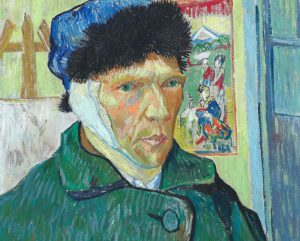
The theme of creation as reflective of its creator is rather ubiquitous, taking forms as diverse as Frankenstein, the La-Z-Boy, and in the knowing sighs expelled in the presence of a particularly abstract Van Gogh because you know it must mean the approach of the dismembered ear. Artists undoubtedly expend much of their blood, sweat, tears, and souls in their acts of creation, and there is a large and raging theoretical debate over the intelligibility of creation in communicating, inevitably, the intricacies of the consciousness of a creator – whether every portrait, in any medium, is a self-portrai t. Perhaps one of the most extreme iterations in the range of positions on the subject can be found in the genre of artistic psychoanalysis, the interpretation of a work of art, often a work of literature, as means for psychoanalytic diagnosis of an artist, often author. This technique relies on the principle of creation as a mirror into the depths of the creator’s mind, the cerebral recesses of which even the creator his or herself is unaware. Upon inspection, it is the necessary inflexibility of this assumption that puts into question the legitimacy of this psychological methodology, as well as the stability of the normative definition of authorship.
Freud, and many students of the psychoanalytic tradition that has followed him, often used works of literature as legitimate subjects for psychoanalytic inspection of their authors – a methodological decision that relies upon a unique and complicated theory of both authorship and language. Most obviously, by virtue of the substance of their particular flavor of psychology, it discounts the debate over authorial intention because conscious intention does not matter. It denies the suggestion by William Empson and others that the authorial position is important because written language is, as other modes of communication are, an intentional transmission between communicator and interlocutor, both of whom are equally important in the success (in terms of objective intelligibility) of the message. While authorial psychoanalysis does not preclude the legitimacy of this theory, it relies on the principle that the author at the very least communicates more than was intentional, that his or her creation is, to some degree, a projection of his or her unconscious thoughts, fantasies, and dreams to-be-interpreted. These messages, furthermore, are uniquely meaningful because they are the only ones not tainted by the socialized deterministic constraints of Freud’s ego and superego, a tainting necessarily implicated in Empsonian mass communication. They are, instead, the only true reflections of the human condition – consciousness without the categorical imperative, artist without motive.
To determine the meaning of the expression of the unconscious, the psychoanalysts must have an understanding of contextual relationships, life stages in relation to expected psycho(sexual) development, and events to which the id could be creatively reacting. To do so, they rely on biographical evidence, a source that has further ramifications for the underlying theory of authorship and literature. Because they necessarily reject the validity and importance of Wimsatt’s Law, which posits the innate unknowability of the author, their position better interacts with that of Foucault in his essay, “What Is an Author?” Foucault asks, “What is necessary to its composition, if work is not something written by a person called an ‘author?’… If an individual is not an author, what are we to make of those things he has written or said, left among his papers or communicated to others?” (Foucault, 1969). He recognizes the distinction between an author and a writer as analogous to the implied greatness in the designation “work.” This glorification occurs at the hands of readers or audiences who determine, although the determinations can shift with cultural changes, which pieces and people deserve the lasting honorifics of “works” and “authors.” Further, an individual author is defined by his or her work in relation to its representation and interpretation among its readership. This determination of the author by his or her function as the characterization of “the existence, circulation, and operation of certain discourses within a society” (Foucault, 1969) establishes an author as the product of his or her own literary images, subject to the interpretations and representations of his or her life, work, and self by readers.
With every psychoanalytic literary critique, there is an implicit agreement with Foucault’s recognition of the pregnancy of the designation “author” as expressing a difference in esteem as compared to “writer” or a similar term. It is the ordination of greatness by the masses upon which the authority of psychoanalytic methodology rests. The position of authorship opens up the realm of psychoanalytic investigations informed by the biography of the author because the greatness of the designation provides legitimacy. If, for example, Freud were to come across an anonymous diary on an Austrian street that evidenced his psychosexual hypotheses, no one would care enough to read an essay on the subject. The diarist would be, quite simply, a freak. The acclaim of a work, and thereby of an author, suggests an innate universal resonance that provides the legitimacy necessary to make sweeping claims about human psychology in psychoanalytic literary criticism. The psychoanalysts must, however, diverge from the Foucauldian argument before its next conclusion, and do so without methodological defense or explanation. They cannot recognize the knowability of individual authors as limited to their images in an equally-literary body of writing and an array of subjective interpretation because the psychoanalysts rely on the factuality of biography and the existence of an intelligible, stable, and true authorial personhood. While Freud claims medical objectivity, Foucault claims that the doctor’s patient is an amorphous, shifting blob of social construction upon which testing would be futile and diagnoses, moot.
Freud’s writings on the Shakespeare authorship question provide a particularly clear, almost comically-literal example of this apparent methodological dissonance. Most famously, he provides a critical explanation for Hamlet’s seeming inability to avenge his father’s murder as “rooted in the same soil as Oedipus Rex” in The Interpretation of Dreams. He explains that Hamlet is unable to kill his uncle who has murdered his father and subsequently married his mother out of shame that the murderer is no better than himself – his uncle has only achieved the realization of Hamlet’s deepest desires. Freud follows his interpretation with the assertion that “It can, of course, be only the poet’s own psychology with which we are confronted in Hamlet; and in a work on Shakespeare by Georg Brandes (1896) I find the statement that the drama was composed immediately after the death of Shakespeare’s father (1601)- that is to say, when he was still mourning his loss, and during a revival, as we may fairly assume, of his own childish feelings in respect of his father” (Freud, 1911). Indeed, he concludes that in making this connection he has “attempted to interpret only the deepest stratum of impulses of the creative poet” (Freud, 1911).
Some years after the publication of the first edition of The Interpretation of Dreams, Freud discovered a fault in the methodological assumptions upon which his understanding of the Shakespearean unconscious relied. It became known to him that Georg Brandes’s biographical scholarship was flawed, and that, in fact, the merchant of Stratford’s father died some years after recorded performances of Hamlet. In the late 1920s, Freud became fascinated with a theory put forth by J. Thomas Looney in a book entitled ‘Shakespeare’ Identified in Edward de Vere. Looney’s methodology is not so epistemologically different from Freud’s authorial psychoanalytic assumptions employed up to this point. In reaching his conclusion, “Looney developed a list of attributes of the author through a close study of Shakespeare’s works, then read biographies of Elizabethan writers, before concluding the best match was with Edward de Vere… [the psychoanalytic portrait] matches de Vere much more than it matches the scanty biographical evidence about Stratford’s William Shakspere” (Waugaman, 2016). Freud’s seduction by Looney’s argument was magnified by the realization in the context of his Hamlet theory that “the Earl of Oxford’s beloved father had died when the supposed playwright was still a boy and his mother (whom he later repudiated) had quickly remarried” (Holland, 1960).
Freud’s correspondences and theory evolution after his discovery of the Oxford thesis demonstrate his developing subscription. In 1930, Freud edited his section on Hamlet in the new edition of The Interpretation of Dreams to include a footnote clarifying that he had “ceased to believe that the author of Shakespeare’s works was the man from Stratford” (Holland, 1960). It was not his theories about Hamlet, however, that lead to his eventual outright Oxfordian conversion. In a March 1934 letter to Shakespeare translator James S. H. Bransom, Freud reveals that biographical similarities to his Oedipal interpretations of The Tragedy of King Lear provide convincing evidence:
I have already taken the liberty of hinting to you my belief in the identity of Shakespeare with Edward de Vere, the seventh Earl of Oxford. Let us see if this assumption contributes anything to the understanding of the tragedy. Oxford really had three grown-up daughters (other children had died young, including the only son): Elizabeth, born 1575, Bridget 1584 and Susan 1587. I will call your attention to a striking change Shakespeare made in his material. In all the accounts of the sources the daughters are unmarried at the time of the love test and got married only later. In Shakespeare the two older are married at that time (Goneril already pregnant), and Cordelia still single. When we date the composition of Lear – surely with right – in the poet’s late years then we have a striking agreement. Elizabeth married Lordy Derby in 1505; Bridget married Lord Norris in 1599. Since Oxford died in 1604 and Susan, our Cordelia, married Lord Pembroke only in 1605, she was single throughout her father’s lifetime. (Jones, 1957).
“He later unequivocally states that it is this evidence that persuaded his unqualified subscription. In a November 1935 letter to fellow-Oxfordian Percy Allen, he cites this correspondence with Bansom and explains that he ‘wrote to him that Lear could only be understood psychologically on the assumption that Oxford is the author, and that I believe Edward de Vere tohave been the creator of all the other genuine Shakespeare plays’” (Waugaman, 2016).
The fault in Freud’s analysis of Shakespearean authorship is his acceptance, and subsequent continuation, of the methodological approach employed by Looney. In a 1938 letter to Looney, Freud indeed proclaimed ‘Shakespeare’ Identified in Edward de Vere “a remarkable book, to which I owe my conviction about Shakespeare’s identity, as far as my judgment in this matter goes” (Holland, 1961). Both men, working from pre-determined analyses of the playwright’s unconscious expressions in his works, not only select biographical facts of an author that suit their critical interpretations, but in effect invent an entire authorial biography – superego, ego, and id in all – grounded exclusively in their particular psychoanalytic accounts of Shakespeare’s fictional characters and events. The first epistemological mistake is in the assumption that every noticeable suggestion of an unconscious expression or vague implication of a contemporarily popular psychoanalytic theory should be directly attributable to a biographical event, in this case limited to those as impersonal as to be recorded in the Elizabethan equivalent of census data – births, deaths, marriages. This illogic of this judgment verifies Foucault’s recognition that the image of the author is in part fractured and infinite because of interpreter’s identifications of authorial subjectivity across works, characters, and narrative psyches. Second, and crucially, psychoanalysis of authors relies on objectivity of the literature surrounding an inherently literary figure. Freud could not afford to question whether Brandes’s biographical scholarship could have been affected by his own literary prejudices as a reader obviously passionate about Shakespeare because his Oedipal theories hinged so heavily on its accuracy. He could not consider the inherent subjectivity of a methodology that is entirely based on an individual reader’s opinions about the Shakespearean corpus and its creator’s basest psychosexual desires (doubtless first influenced by Freud’s own interpretations) because “On Repression in Hamlet” had already been published. For if he had, he would have discovered that the distillation of all of his scientific writings on the subject of Shakespearean psychology reveals only a tautological loop of his own psychoanalytic literary confirmation bias.
While Freud and the Oxfordians literally create an author around their readings of literary works, the incongruence between the asserted scientific objectivity of their interpretations and the inherent intangibility of the unconscious relationship between creator and creation demonstrates the degree of veracity of the Foucauldian argument that an author is defined by the literary world of his or her readership. Psychoanalytic literary critiques are presented and marketed as part of the development of objective scientific theory; My sources were housed at Schow, not Sawyer, and the essays were published in medical journals of psychology, not literary magazines. Certainly in the Oxfordian example, and, I conjecture, in many other theses from the critical genre, the objectivity masks the unconscious and overwhelming influence of the literary reader. Authorial biographers, similarly, have literary prejudices, as evidenced by the fact that they have undergone great effort to communicate an image of an author that implies his or her importance, that inevitably impact their own decisions as to structure, inclusion and exclusion of facts, and tone. They are, initially and fundamentally, readers. The way in which any reader interprets and imagines the image of an author is always originally rooted in the reader’s experience of the work, an experience, as Freud demonstrates, that is inevitably affected by his or her prejudices, desires, and self. Foucault’s author-function is inescapably subjective and indeterminable – a product of a literary world determined and propagated by an infinite multiplicity of unique reader positions, each a reflection of individual (un)consciousnesses.