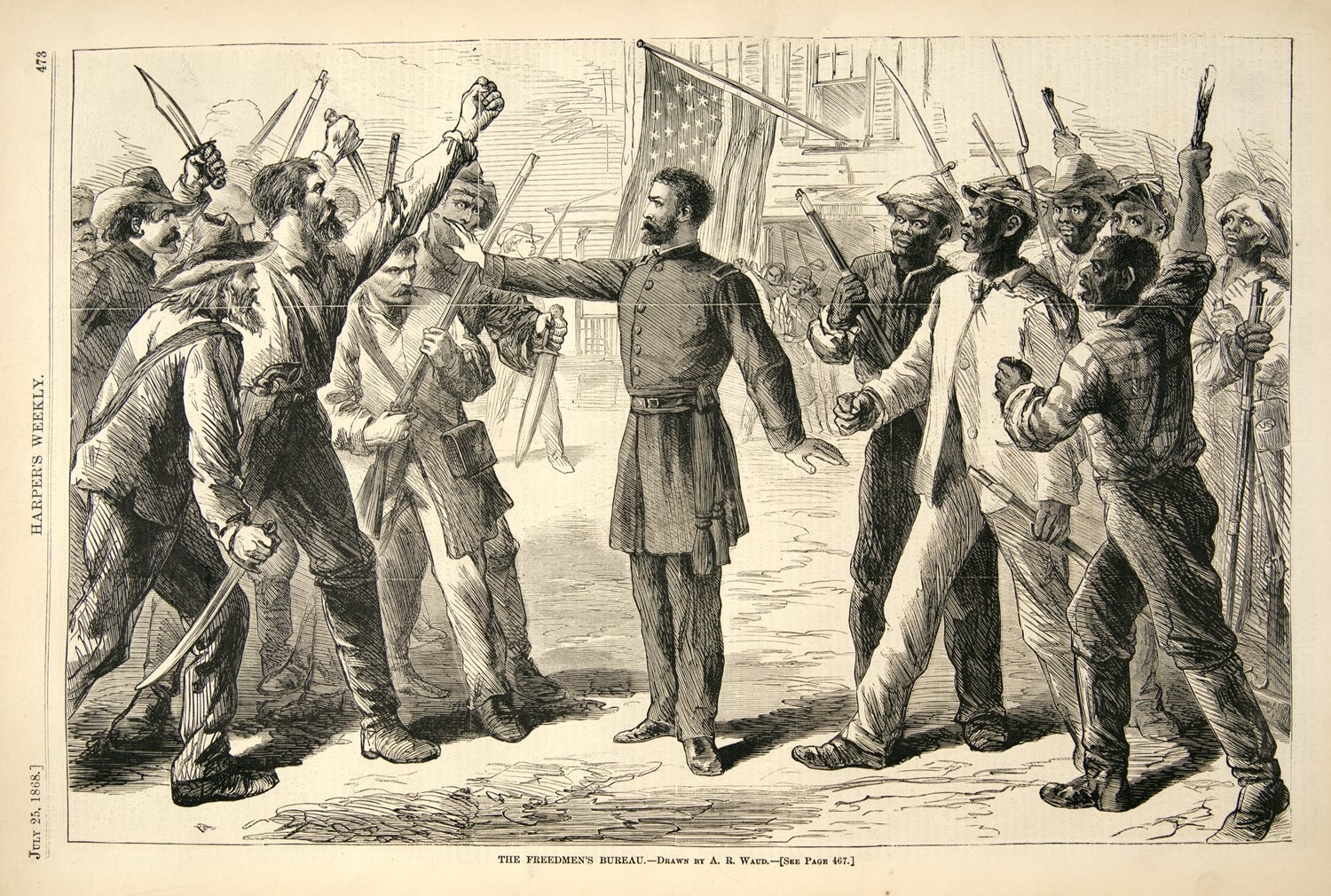
 (Waud, 1868)
The reminder that we exist not in the past but in the present may seem so obvious that it could be easily dismissed as unnecessary; regarding the discipline of history, however, it is important to consider what this proposition truly means. Since the past cannot be directly observed, no historian can guarantee with certainty that their work is a perfect reconstruction of past events. Instead, ”We must be interested in [a historical document], if at all, for what it is and not for what it was” (Becker, p.328), and so it becomes the duty of the historian to collect, analyze, interpret and present a set of “historical facts” in the form of a narrative relevant to current circumstances. As such, the goal of a good historian is to affirm events that are said to have occurred, while organizing dry historical facts into the form of an interesting and insightful story.
So how can a historian claim that their work is true if it is removed from the immediacy of the past and transformed into a narrative form? Herein lies an unsurprising point: the story that a historian chooses to tell must work with whatever evidence is available to support its veracity. This means that there are multiple stories one could tell when looking at any historical event, but some are better and more truthful than others. The narrative scheme used to organize a set of historical facts is more empirically correct if it can be better corroborated by a network of supporting evidence. The essential aspect of historical knowledge lies in the understanding that history is an interpretive discipline. As an interpreter of the past, the historian is therefore engaged in two sets of ongoing dialogue: First, a dialogue with the sources appropriate to the problems of interest to that historian; second, a dialogue with other interpreters interested in the same problems or related problems. Through the dialogue—and argumentation—between and among various historians seeking to develop arguments about the past that are more rather than less persuasive, historians strive to produce analytical narratives that are closer to truth and further from fiction.
When W.E.B. Du Bois wrote Black Reconstruction: an Essay toward a History of the Part Which Black Folk Played in the Attempt to Reconstruct Democracy in America, 1860-1880, his account of the post-Civil War United States, he produced a radically different narrative from the previously dominant historical account of Reconstruction, which had hitherto been written by white, southern historians (Foner 2014, Preface). Du Bois was, of course, met with much resistance from those with whom his argument clashed, not due to the lack of the truthfulness of his narrative but because of the story it told (MacDonald). While neither Du Bois’s account, nor the one it contradicted, provides a definitively true story of the past, Du Bois’s history of reconstruction better corroborates its own narrative through a network of supporting evidence. Therefore, Black Reconstruction tells an empirically better story of the postbellum period, and to consider it fictitious on the sole basis that it utilizes narrative schemes is incorrect.
A significant portion of Black Reconstruction is dedicated to examining and disproving the romanticized myths propagated by southern historians to justify American slavery and the Civil War, to demonize postbellum policy and northern influence, and to pretend that African-Americans played an insignificant role in their own emancipation and enfranchisement. In doing so Du Bois explicitly acknowledges the subjective nature of historical narrative, noting in his preface the significant effect that a reader’s predisposition will have on their perception of the truth of his argument. “If he believes that the Negro in America and in general is an…ordinary human being,” Du Bois writes of his reader, “then he will regard this story and judge it by the facts adduced. If, however, he regards the Negro as a distinctly inferior creation…then he will need something more than the sort of facts that I have set down” (Du Bois, p.1). He concludes by asserting that “this latter person, I am not trying to convince…I am assuming the truth of the first” (Du Bois, p.1). In these lines lie several key facets of Du Bois’s argument regarding narrative historical truth. He notes that historical literature, his included, is a “story,” and that the truth of any facts that may be enclosed in a historical narrative rely on the reader’s belief that they are in fact true. This does not mean that historical writing is inherently fictitious—historians must be careful when choosing how they tell a story, because some literary forms allow for a more accurate depiction of certain events than others.
 (Core, 1898)
The interpretive framework of the white Redeemer historians was based on their belief that blacks were racially inferior; looking at past events from the perspective of the freed slaves was beyond them. By contrast, that perspective is at the center of Du Bois’ interpretation. So he looks at some evidence which they never considered, and he interprets evidence they had considered in very different ways. The connotations these facts hold differ greatly with the different storytelling methods; according to Carl Lotus Becker, an American historian “the simple fact turns out to be not a simple fact at all. It is the statement that is simple – a simple generalization of a thousand and one facts” (Becker, p.329). This is a crucial acknowledgement to make, one echoed in the words of the historian E.P. Thompson who wrote that “the discipline of history is, above all, the discipline of context; each fact can only be given meaning within an ensemble of other meanings” (Thompson, p.45). Becker and Thompson both look at ways in which history is above all an interpretive discipline, in which the historian gives meaning to the facts (because as Becker says, the damn things themselves don’t say anything at all). Becker emphasizes that historical knowledge can’t be separated from the perspective, interests and values of the individual historian. Each historian seeks to develop an evidence-based interpretation that is more persuasive and more accurate than others. Thompson suggests that the ‘fact’ must be interpreted in relation to the ensemble of facts in which it is embedded. The belief of the reader in the truth of any historical fact may be garnered by way of “an ensemble” of supporting facts that conglomerate to convince the reader of their veracity. However, Du Bois notes that the prejudices of the reader may play an indomitable role in the perception of history by asserting that “this later person, I am not trying to convince.” By doing so he illustrates the idea that historical narratives can either manipulate and omit facts to fit into a desired form, or mold their argument around the evidence at hand.
Now I want to take a closer look at the implications made by the statement that historical writing cannot rely on facts to speak for themselves. It is for this reason that in his refutation of previous accounts of Reconstruction, Du Bois examines the same historical events from a new perspective, and by doing so tells a very different story. Furthermore, the support he gives his perspective through the use of documented evidence serves to convince his reader, according to a contemporary review of the book, “not only how abysmally wrong some eminent ‘authorities’ on reconstruction have been…but also how a surprising number of them appear to have sinned against the light” (MacDonald) by disregarding the crucial importance of basing historical writing on fact rather than belief. To this end Du Bois works to dispel the myth summarized by journalist James Pike–that black enfranchisement and leadership during reconstruction resulted in chaos and violence (Pike). This belief was accepted and promoted by many notable and reputable historians of Du Bois’ time, despite its lack of evidence. To directly disprove Pike’s claim Du Bois quotes the writings of Sir George Campbell, a member of British Parliament who visited the South during reconstruction, to provide evidence that “whatever violence and disturbance there was, was not on the part of the black majority, but on the side of the white minority who, instead of trying constitutional methods to gain power, preferred Klu Klux Organizations and such violent methods” while “black men used their victory with moderation” (Du Bois, 419). Here Du Bois finds support from a reputable primary source; not only was Campbell a knighted member of parliament, giving him an esteemed reputation, he was also British and as such better able to provide a less biased view of American Reconstruction. Throughout Black Reconstruction there are countless similar examples of Du Bois using valid evidence from both primary and secondary sources to combat the racist, flawed story of reconstruction that had been told by “schoolbook writers…The Encyclopedia Britanica…Columbia and Johns Hopkin’s Universities” (MacDonald), all of whom erred “badly in omission [of evidence] and emphasis” (MacDonald). By consistently corroborating his argument, Du Bois builds a stronger and more correct depiction of the postbellum era.
But what of the role of literary form in allowing Du Bois to produce a more empirically accurate work of historical writing? How, exactly, does one narrative style work better than others in the pursuit of truth? We know that any historical writing worth being read tells a story, using evidence to portray its characters, settings, plots and themes. To this end, Du Bois tells the tale of the reconstruction era as a story of “extraordinary social and political progress” in which freed slaves played an important part and depicts its end as “as a tragedy for democracy, not just in the United States but around the globe” (Foner 2015, p. 4). The southern Redeemers, on the other hand, had forced reconstruction into the literary form of a tragedy, contending that the fall of the honorable planter elite led to poverty, corruption, disorder and violence for which the northern Republicans were to blame (Foner 2014, preface). For this version of the story to be told, countless facts and accounts of the benefits of reconstruction policy had to be omitted; the narrative was essentially a myth. The literary forms of Black Reconstruction instead facilitate the incorporation of substantial evidence to illustrate the positive effects of the Reconstruction effort and the roles freed slaves played in achieving them.
Du Bois’ account of the reconstruction era is not a perfectly accurate model of exactly what occurred in the American South following the civil war. Even if all he had done was state facts about the past he could not have produced a definitive account of the postbellum epoch, since his book was written years after the events being described took place. But Black Reconstruction, like most historical writing, is not simply a dry statement of data; it is written as a story, using narrative schemes to interpret and understand the events that took place, not in the context of history but in the context of Du Bois’ present. This does not mean that his account is fictitious because of its literary nature; in fact it is quite the opposite. The contrast between Du Bois’ revised story of reconstruction and that told by the Southern Redeemers illustrates just how important an author’s method of storytelling is regarding the truth. Some narrative forms are better able to incorporate factual evidence in support of the stories they tell, while others force the author to omit evidence for the sake of the story itself. Thus it is crucial that when writing about history, the author makes the conscious decision to build a narrative that is easily supported by fact, because such a narrative is empirically truthful.
Works Cited
Becker, Carl L. What Are Historical Facts? Institute of Government, University of Utah. Salt Lake City, Utah. 1955.
Core, Dublin. “The Vampire That Hovers over South Carolina.” Medium, News and Observer (Raleigh, NC), 27 Sept. 1898, cdn-images-1.medium.com/max/1600/1*D-kXOPYgECjmolrJ2Km27g.jpeg.
Du Bois W. E. B. Black Reconstruction: an Essay toward a History of the Part Which Black Folk Played in the Attempt to Reconstruct Democracy in America, 1860-1880. Harcourt, Brace and Co. New York City, New York. 1935.
Foner, E. Reconstruction: America’s Unfinished Revolution, 1863-1877: Updated Edition. Perennial Classics. New York City, New York. 2014.
Foner, Eric. “Why Reconstruction Matters.” The New York Times, 28 Mar. 2015, www.nytimes.com/2015/03/29/opinion/sunday/why-reconstruction-matters.html.
MacDonald, W. “The American Negro’s Part in the Reconstruction Years”, The New York Times. The New York Times. New York City, New York. 1935.
Pike, J. The Prostrate State: South Carolina Under Negro Government. D. Appleton and Co. New York City, New York. 1874
Thompson, E.P. ‘Anthropology and the discipline of historical context’, Midland History. 6. 1972.
Waud, A. R. Harper’s Weekly, 25 July 1868, cdn-images-1.medium.com/max/1600/1*D-kXOPYgECjmolrJ2Km27g.jpegp. 473.