
If someone had told me a couple years ago that I would be placing Jay-Z and Foucault into dialogue for the sake of an essay on literary theory, I would have said several things: Uh, what’s literary theory? Who’s Foucault? Why Jay-Z? Wait, this will be for a college class? Wait… Jay-Z can write?
The overwhelming probability that I would have posed that last question is what now leaves my stomach churning. There have been too many tense car rides with my parents or awkward intrusions by them into my bedroom jam sessions because of their specific distaste for modern rap music. Don’t listen to that nonsense. Those rappers just talk about drugs and taking advantage of women. Do you believe in those kinds of things? Don’t you have respect for yourself? Don’t let them get into your head. What ever happened to the old hip-hop? It’s not the same anymore. And thus, my parents’ conditioning of my music tastes as I grew up left me with an unconscious hesitancy towards analyzing rap as a meaningful and culturally transcendent art form.
 So I would sit there, changing the radio station or turning down the volume on my cell phone, knowing that I would never stop enjoying hip-hop music, but also knowing that I would have to keep my interest in it hidden from my parents. Unlike when I would casually contemplate lyrics from Pink Floyd or Stevie Wonder with my dad, blasting their songs from our living room speakers, I only listened to rap through my headphones, while I was commuting to school, when I was alone with similarly interested friends, or when I went to a party and the DJ knew what was up. But I’ve grown tired of the secrecy! It’s too fatally ironic to feel pressured into dismissing an art form that in itself seeks to combat oppressional institutions and the silencing of people of color. I believe that it was the combined instances of being unable to passionately converse about post-90s rap with my family, watching Netflix’s Hip-Hop Evolution, and reading from Jay-Z’s Decoded that has now led me here. The words that particularly struck me from Jay-Z were: “The reason hip-hop is controversial: People don’t bother trying to get it. The problem isn’t in the rap or the rapper or the culture. The problem is that so many people don’t even know how to listen to the music.”[1]
And now, here I am, seeking to kill two birds with one stone, or should I say, wanting to scratch two hip-hop records with one ink-soaked needle, by sitting Jay-Z and Foucault down at the same table. Maybe we can start to “get” hip-hop by placing it in dialogue with a more traditionally academic text — Michel Foucault’s “What is an Author?” In it, the French philosopher posits that the writer of any piece of literature is a part of the fiction and language itself via their creation of an ego, or persona.[2] And certainly, hip-hop personas are a common occurrence throughout the music industry. Not all rappers create music under the name on their birth certificate, with Shawn Carter “Jay-Z” being no exception. Beyond that, there are unifying themes throughout rap music that serve to enhance, embellish, exaggerate the lavish and dangerous lifestyles of those hip-hop personas — what Jay-Z calls “braggadacio” rap.[3] He explains: “It’s like a metaphor for itself; if you can say how dope you are in a completely original, clever, powerful way, the rhyme itself becomes proof of the boast’s truth. And there are always deeper layers of meaning buried in the simplest verses.”[4]
 So let’s take a sample from Jay-Z’s “99 Problems:” “Rap mags try and use my black ass / So advertisers can give ’em more cash for ads, fuckers / I don’t know what you take me as / Or understand the intelligence that Jay-Z has.” Mags, ass, cash, ads, as, has — the words themselves provide familiar imagery of popular rappers living the high life while also trying to avoid being played by the entertainment industry. And the fact that the lyrics all rhyme on top of a booming hip-rock beat, complete with a surprisingly infectious cowbell (that we’ll always need more of), reinforces the recognition of that identity even when the words are missed. As Jay-Z says, even when the story itself isn’t real, it is an artist’s ability to formulate, mix, and remix words along with music that grants them the clout they deserve. With rap, we can say, it is not only the type of language that creates these hard-hitting, hustling, hypermasculine rap personas, but more importantly, the composition of those words on a page and then to a beat — the sound of those words as they are spit in succession.
So you can see why I’d feel uneasy to readily label Jay-Z’s work and image as inherently fictitious or void of meaning, that his persona is somehow not an extension of the realities that made up his life growing up in Bedford-Stuyvesant. I want to specifically look at Foucault’s statement that, instead of caring about the authenticity of an author’s existence, “we should reexamine the empty space left by the author’s disappearance.”[5] Or, in other words, “‘What matter who’s speaking?’”[6] There’s something unsettling there, in large part because hip-hop is nothing if not about visibility. Maybe it’s just me feeling selfish, maybe you could argue that language can be more greatly appreciated and analyzed when we are able to detach it from its creators, but let me tell you, hip-hop is one of few exceptions. Rap music and its creators are meant to be all up in your face, your space, your headphones and your waist. In an era where black voices are continually silenced, where black bodies are continually destroyed, where black history is continually diluted and rewritten, hip-hop shakes you and says “I matter! I’m going to speak my truth! And if you don’t know, now you know! So don’t get it twisted!” In this context, when Foucault says that authors “are objects of appropriation,” he’s right in more ways than one, and I’d argue that it isn’t to say that that mentality shouldn’t be eradicated.[7]
We can even look back at “99 Problems” to note how the appropriation of rap personas hinders listeners from realizing the socio-political messages contained within their songs. If you’re unfamiliar with the hook of “99 Problems,” it goes: “Ninety nine problems but a bitch ain’t one / If you having girl problems I feel bad for you son / I got ninety nine problems but a bitch ain’t one, hit me.” So on a base level, yes, anyone could assume that Jay-Z’s rapping about have a successful romantic life, despite all of the hardships he faces from being a successful hip-hop artist. The hook pounds and repeats until those are the only lyrics left in your head — which is precisely the point. Then, take snippets from any of the verses — “Rap critics that say he’s “Money Cash Hoes” / I’m from the hood, stupid, what type of facts are those? … This is not a ho in the sense of having a pussy / But a pussy having no goddamn sense try and push me / I tried to ignore ’em, talk to the Lord / Pray for ’em, cause some fools just love to perform” — and you’ll see Jay-Z’s explicit hook is more of a testament towards the mainstream, low-down, one-dimensional view of hip-hop than a dedication to the stereotypes of rap. All listeners have to do is listen, not just to the curses or hook of a rap song, but to the verses, to see that there is more to it than girls and money and drugs — and there’s always been more to it than that. It’s about being appropriated, taken advantage of, played. Jay-Z himself testifies that “the story—like the language used to tell it—has multiple angles. It’s a story about the anxiety of hustling, the way little moments can suddenly turn into life-or-death situations.”[8] In other words, there are layers to the shit.
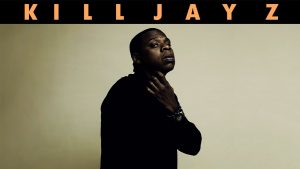 Okay, so the “disappearance” of an author from her writing, or a rapper from her lyrics, or a human entity from her persona, can be contested in some aspects of hip-hop music. But what happens when there is a purposeful self-erasure and redefinition of an author’s persona? Maybe in looking at the first song on Jay-Z’s latest album, “Kill Jay Z,” we can realign ourselves with some aspects of Foucault’s thinking. Michel believes that “the author also constitutes a principle of unity in writing where any unevenness of production is ascribed to changes caused by evolution, maturation, or outside influence,” and we need only take a short look at the lyrics in “Kill Jay Z” to see the ways in which Jay-Z’s content has matured as he has.[9] Jay-Z explains the killing of his previous stage name, Jay Z, on 4:44 as a way of owning up to his infidelity, his history of drug dealing, and his shortcomings as a father: “Fuck Jay Z, I mean, you shot your own brother / How can we know if we can trust Jay Z?… You got people you love you sold drugs to / You got high on life, that shit drugged you… You almost went Eric Benét / Let the baddest girl in the world get away.” Here is an open willingness on Jay-Z’s part to account for the spaces inbetween the stereotypical hip-hop persona and close that gap with a singular dash. He calls out the strife in his life that has not only come about due to his involvement in the music industry, but because of his weaknesses as a human being. By shedding himself of a harder exterior persona through the same medium as “braggadacio,” Jay-Z acknowledges that not all rap personas are worthy of praise, and that hip-hop lyricism grants him the agency to remake himself, improve upon himself, and still keep it real.
In a world where the voices of marginalized peoples are always shushed, and where Foucault posits that authors should be taken simply as an enhancement of a story, rap emerges in order to attend to the context of words and their writers, and to realize the humanity of black artists. Persona or not, embellishment or not, Jay-Z remains standing as a testament to the significance of engaging with an art form that makes it a goal to evolve while also remaining candid, to cover the highs and the lows, to make listeners feel a full range of emotions. From “99 Problems” to “Kill Jay Z,” Shawn Carter could never be a dub for me. I know it’s more than being from the same city as him — it’s about me being able to see him through his use of language. His lyrics will leave your heart pounding: “Cry, Jay Z, we know the pain is real / But you can’t heal what you never reveal.”
This essay was read by Nohely Peraza.
Bibliography
Foucault, Michel. “What Is an Author?” Screen, vol. 20, no. 1, Jan. 1969, pp. 299–314. www.open.edu/openlearn/ocw/pluginfile.php/624849/mod_resource/content/1/a840_1_michel_foucault.pdf.
Jay-Z. Decoded. Spiegel & Grau, 2010, ia601207.us.archive.org/6/items/DecodedByJayZ/Decoded by Jay-Z.pdf.
[1] Jay-Z, Decoded, Spiegel & Grau, 2010, ia601207.us.archive.org/6/items/DecodedByJayZ/Decoded by Jay-Z.pdf.,40.
[2] Michel Foucault, “What Is an Author?” Screen, vol. 20, no. 1, Jan. 1969, 309, www.open.edu/openlearn/ocw/pluginfile.php/624849/mod_resource/content/1/a840_1_michel_foucault.pdf
[3] Jay-Z, 26.
[4] Jay-Z, 26.
[5] Foucault, 303.
[6] Foucault, 314.
[7] Foucault, 305.
[8] Jay-Z, 42.
[9] Foucault, 308.