 THERE are a lot of opinions, these days, about opinions – about their validity, more specifically. Some opine, of course, that their opinions aren’t really opinions after all – that they’re actually something approaching absolute truth – gospel, if you think in those terms. We have learned, all of us, to be wary of these tyrants – so much so that many have sprinted in the opposite direction, arriving at the opinion that all of them – all opinions, that is – are equally worthy of merit.
The theoretical roots of this anti-authoritarian dash, at least partially, lie buried in the garden of post-structural literary theory, a fancy name that’s less important than that of Roland Barthes, one of its chief gardeners, who famously argued, in literary terms, for the kind of democratization foundational to our run from absolutism.
Celebrations, especially of liberty, have little patience for the cautious, but I’ll raise the question anyway: have we run so hastily – so blindly – that we’ve actually just come full circle? Let me explain.
To be very clear, Roland Barthes was not eulogizing: he was crying out for literary blood. “We know that to give writing its future,” he famously proclaimed, “the birth of the reader must be at the cost of the death of the author” (Barthes). In other words: when interpreting a work of literature, we must give exclusive rights to readers’ subjective judgments, discarding especially – in a violent way – authorial intentions: that same self-serving despotism constructed by opportunists and politicians (even authors themselves) for their own ends. Only the blood of authorial tyrants, so to speak, can properly refresh the tree of literary liberty.
Such a thoroughly democratic suggestion seems – now as then – occasion for rejoicing. We might, to take just one example, celebrate – as Barthean freedom’s finest fruits – the mid-century counterculture’s re-appropriation of J.R.R. Tolkien’s books as a collective, subversive transcendence of that author’s self-admittedly racist intentions. But some – more cautious celebrants, perhaps – might insist upon raising the hypothetical: what if it had happened the other way around?
Speaking more generally: are there situations in which the freedom attending authorial sacrifices upon readers’ altars comes at too high a price? Strictly speaking, after all, the Barthean ethic necessarily grants universal legitimacy to as many interpretations as there are readers, including those some might best characterize as, to put it mildly, less than benign. The cautious, however, are wrong – wrong to present the case as a hypothetical, that is. It’s a story we’ve already seen before.

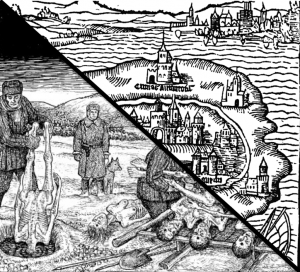
Frontispiece of More’s Utopia, depicting the island commonwealth.
IN at least two senses, Thomas More is dead. Biologically speaking, he’s been dead for a long time: since 1535, in fact. But he has, in some way, lived on through Utopia, his most famous work; it adroitly treads the line between literature and political philosophy, offering a fictionalized account, via frame narrative, of an ideal island commonwealth in the (then-new) New World. Raphael Hythloday, traveler-turned-narrator, describes the socio-cultural, political, and economic practices of the Utopian people to “More,” written into the story as a fictional character. Utopia’s most notable feature is that all private property has been abolished – its citizens live communally within a moneyless economy.
But beginning with the front cover, it’s a tale marked by contradiction: the word utopia is a contrived Greek compound, translating roughly to “no-place,” but could be read alternatively as a pun on the Greek eutopia, meaning “fortunate place.” In many ways, it seems to hold up to the latter interpretation – its citizens’ basic needs are universally met and labor is light and evenly distributed, leaving plenty of time for social, artistic, intellectual and leisure pursuits. At the same time, legal rigidity comes with those benefits – even leisure is regulated by fixed hours, traveling requires permission from the government, and despite broad religious freedom, atheism is outlawed. To ensure their continued safety and security, the Utopians employ mercenaries to conduct pre-emptive strikes against potential threats – acquiring slaves and becoming a quasi-colonial power in the process.
Beyond seeming moral contradictions inherent in the commonwealth’s construction, the prose is punctuated by wry ironies. Originally published in Latin, “More” would’ve appeared as “Morus” – from which we get our word “moron.” Raphael, the narrator’s first name, refers to the biblical archangel who announced Christ’s birth as the coming of a new age, but his last name, Hythloday, means “nonsense peddler.” But the greatest puzzle comes at book’s end. Hythloday affirms his admiration of the Utopian system; a reflective “More,” despite doubts about the feasibility of a moneyless economy, states: “I freely confess that in the Utopian commonwealth there are very many features that I would like, rather than expect, to see” (More, 113).
READERS, upon finishing the slim volume, might find themselves searching, flipping furiously back through the pages, for an author to kill – More’s tangled ironies and contradictions create a vacuum of meaning tantamount to authorial suicide; in his relation to his own work, the authorial More is functionally dead, little more than a name on the spine. Utopia and its contents are up for grabs: to be, respectively, interpreted subjectively and marshaled freely by any and all.
Even academics, those most ostensibly dispassionate interpreters, continue to have serious and wide-ranging disagreements about More’s book; its contents are so contradictory that even scholarly attempts to ‘resurrect’ the author’s intentions by historical means have yielded little consensus, if not generated further controversy. Perhaps W.S. Allen has put it best: that More – if he can be assigned intent – leaves readers “with an ambivalent and puzzled view” (118) about the merits of Utopian life. But that hasn’t stopped others from trying to narrow it down. Quentin Skinner recounts that one theory, initially propounded by R.W. Chambers in 1935, claims that More “aimed to picture the best state that reason can hope to establish in the absence of revelation” (Sir Thomas More’s Utopia, 123). Skinner names another school, of which Brendan Bradshaw is a recent defender, that holds that More meant any praise of the Utopian commonwealth ironically – that he held “serious reservations about the ideal system” (Ibid., 124).
But an opposing 1888 reading by Karl Kautsky perhaps merits the most serious interest, which “[sees] More as a the tragic figure of a socialist born out of his time” (Foundations of Modern Political Thought, 257) Skinner notes that Kautsky’s interpretation “appears to have been Marx’s view” (Ibid., 257) and indeed, John Guy notes that Marx and Englels, in The German Ideology, “ranked More alongside the Levellers, the Owenites and the Chartists as a forerunner of socialism” and that Williams Morris “announced that Utopia was ‘a necessary part of a Socialist’s library’ ” (95). Here we are reminded that debate over Utopia is not one restricted exclusively to ivory towers; ideas formed there descend, manifesting themselves in reality, and etching themselves – in this case, quite literally – upon the monuments of history. Eighteen names were inscribed upon the Alexander Garden Obelisk of Moscow, repurposed by Lenin following the Russian Revolution, to honor Soviet influencers: Marx and Engels headed the list; ninth from the top is ‘T. More’ (Ibid., 96).
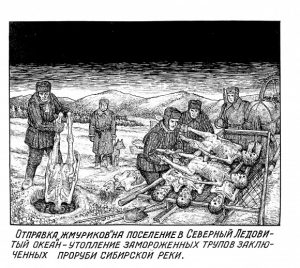
To avoid digging graves in the permafrost, frozen inmate corpses were disposed of in the Arctic Ocean. (from “Drawings from the Gulag” by Danzig Baldaev, a former Soviet prison guard)
To Aleksandr Solzhenitsyn, a survivor of the brutal Soviet Gulag work camps developed initially under Stalin, More’s presence on the Alexander Garden obelisk seemed grimly ironic. After being awarded the 1970 Nobel Prize in Literature, Solzhenitsyn’s 1973 Gulag Archipelago insisted that More had foreseen both slavery and forced labor as necessary prerequisites to support a system like the one the Soviets had implemented (Bloom & Hobby, 174). But in the end, it didn’t matter whether Utopia had been read ‘properly’ or not – during the Stalinist period, an estimated two to three million lives were claimed, on top of millions of others under the Soviet regime, in those camps alone (Snyder).
It would be a dramatic overstatement, no question, to draw an absolute red line from Thomas More to Marx to Stalin’s atrocities. This isn’t to say, either, that Stalin’s execution of Marxist thought is its authoritative, or exclusive, manifestation. But this lesson from history should alert us to three axioms for our own time.
FIRST, writers – having written – inevitably lose control of their work, but especially so when – like More – ambiguities fractionate into a panoply of conflicting interpretations.
SECOND, literary debates are deadly serious. Powerful ideas are distilled from, among other sources, the interpretation of literary works – ideas with inbuilt potential to germinate, physically, in reality.
THIRD, and most importantly: anyone unabashedly enthusiastic about Barthes’ birth of the reader should pay careful attention to those first two axioms. The problem with sanctioning the validity of every literary interpretation is that you must sanction all of them, even those you yourself find repugnant. It’s only a half step from literary interpretations to opinions of any kind: anyone committed to absolute relativism in opposition to absolutist despotism, in the end, has done nothing but make tyrants of us all.
In a world where the legitimacy of truth resides equally, at all times, in each individual, we cannot judge nor be judged. Such mandates can be dangerous things; they possess a kind of latent malleability that can, to the enterprising mind, be bent into tools – weapons – for settling personal scores, or worse. Much worse.
Those less than convinced should, perhaps, heed Solzhenitsyn’s warning: “You may suddenly understand it all someday – but only when you yourselves hear ‘hands behind your backs there!’ and step ashore our Archipelago” (Gulag Archipelago, 518). We don’t want to imagine what happens next.
—
Works Cited
Allen, W. S. (1976). “The Tone of More’s Farewell to Utopia : A Reply to J. H. Hexter”. Moreana, 13 (Number 51)(3), 108-118.
Barthes, R. “The Death of the Author”. Retrieved from http://www.ubuweb.com/papers/
Bloom, H., & Hobby, B. (2010). Enslavement and Emancipation. New York, NY: Blooms Literary Criticism.
Guy, J. (2000). Thomas More. London: Arnold.
More, T. (2003). Utopia (G. M. Logan, Ed.; R. M. Adams, Trans.). Cambridge: Cambridge University Press.
Skinner, Q. “Sir Thomas More’s Utopia and the Language of Renaissance Humanism.” The Languages of Political Theory in Early-Modern Europe, edited by Anthony Pagden, Cambridge University Press, Cambridge, 1987, pp. 123–158. Ideas in Context.
Skinner, Q. (1978). The Foundations of Modern Political Thought. Cambridge: Cambridge University Press.
Snyder, T. (2011, March 10). “Hitler vs. Stalin: Who Killed More?” Retrieved from http://www.nybooks.com/articles/2011/03/10/hitler-vs-stalin-who-killed-more/
Solzhenit︠s︡yn, A. I. (1974). The Gulag Archipelago, 1918-1956: An Experiment in Literary Investigation (H. Willetts, Trans.). New York: Harper & Row.