Author Archives: Nathaniel Jones

Inception, Gender Politics, and Perspective: Answering the Masculine Malaise

Christopher Nolan’s filmography seems “driven by a deep-seated desire to satisfy the so-called ‘masculine malaise’, in which it will be understood that he offers his male (anti-)heroes the fictional means and pathways to ‘un-truths’ to transcend the limitations of their ‘fractured’ male existence” (Deakin 85). The various crises of modern masculinity—a set of problems ill-defined in the concrete but best named as the perception of the loss of masculine power and identity on systemic and individual levels—come to a head for Nolan’s characters. Leonard asserts himself and his right to vengeance in Memento’s anonymized world. Bruce Wayne transcends the confines of his playboy archetype to become a hyper-masculine hero in the Batman trilogy. And Inception’s Dom Cobb seeks to return to being a father but must first overcome his malignant deceased wife,[1] in sum needing to defeat the feminine to reach his masculine destiny. For Cobb, does Deakin’s perspective hold up? Is his ‘masculine malaise’ solved by letting him transcend reality (in whatever sense that word can describe the film) or through another solution?

Answering those questions about Inception’s perspective gender politics requires answering another question first, specifically as to how the camera connects on-screen action to the audience. During dialogue, Nolan likes to shoot from the person talking at the person listening. When the conversation is between Ariadne and Cobb, he portrays them differently. As Ariadne talks, we still see her head in the corner of the shot. But as Cobb talks, he disappears as the camera watches Ariadne. The camera can be construed as coming from the man, but refuses to identify with a woman.

From the opening scene, the movie constructs the world through male eyes. The movie’s starting scene contains a shot of Cobb’s children playing on the beach that reappears marked clearly as his memory later in the movie.[2] This memory returns later in one of the floors of the dream world Cobb enters every night. It also is plucked from the beach and placed into different dream levels during the titular mission to indicate the fragility of his mental state. Only Cobb can see this shot; the movie begins inside his head and with his eyes. In the opening conversation with Saito, the camera does not employ the perspective reversals of Ariadne and Cobb’s conversation. Instead, as the camera switches focus from Cobb to the corporate mogul and back, the camera can legitimately serve as the perspective of either. While Cobb talks, a wine glass ever-so-briefly crosses the shot—an intentional yet subtle acknowledgment of the first-person perspective of the camera. The movie introduces itself as the product of masculine perspectives, and then lets Ariadne in primarily to be observed.

https://www.youtube.com/watch?v=Fjyk83SQiRA

(watch the beginning 35 seconds to see Cobb’s memory; watch closely around 2:24-2:26 to see the wine glass)

If this view of the movie is right, then watching Inception turns its viewers into men, exiting the theater having spent two hours seeing the world as men see it. The consequences of this should be clear. To name them, the movie would have forced audience identification with masculinity, likely in conjunction with perceiving the feminine as simultaneously worse-than-men and dangerous to men, and erecting one more roadblock to female representation[3] in film.

Looking at where the movie doesn’t get dominated by men—where it either takes the camera from masculine perspective, extends it to feminine perspectives, or does both—should indicate the limits (if any) to this Mulvey-esque perception of Nolan’s camera as a fundamentally male gaze. One such example comes from Ariadne’s first dream creation, as Cobb teaches her the tricks of his peculiar trade. As she alters the underlying physics of the dream, she alienates Cobb’s subconscious and its manifestations in ‘projections’ of people. The camera adopts her perspective so it can portray a masculine subconscious directing its antagonism at the camera. If the movie’s perspective indicates a sort of audience alignment with whoever it represents, then Inception would seem to display the fears of women threatened by strangers in public spaces. Sympathy for cat-calling victims seems to be at odds with a masculine-controlled camera. Later in the same scene, the camera ever-so-briefly adopts Ariadne’s perspective again as she is stabbed by Mal. The adoption of the point-of-view shot to witness first-hand violence against women—to make the viewer a victim of phallic violence—seems to indicate a dynamic more complex[4] than the masculine gendering of the camera and bond between it and the audience.

(watch around 1:50-2:05 to see the first set of POV shots; watch around 4:15-4:19 closely to see the second set)

A similar complication comes in the reversal of masculine technique from before. I mentioned the way the camera refused to be point-of-view for certain characters. After entering Cobb’s dreams uninvited, Ariadne discovers his continual engagement with and attempts to fix his past, and challenges him. When she does so, the angle repeats the techniques of prior conversations, but flips the gender of each. The viewer now sees a foregrounded corner of Cobb, preventing the camera from being mistaken for an extension of the scene’s masculine presence. The double-sided deployment of this technique and the allowance of some POV shots to be both feminine and depicting violence against women indicate cracks in a belief of the always-masculine viewer relating to POV as his own. But it doesn’t, and shouldn’t, fully disprove the thought. The broader undermining of this theory of the movie comes from the unmooring of its assumptions of characters’ fixed and easily understood gender roles.

The first challenge for this narrative is the movie’s own Gender-Bender, Eames, who shifts shapes and genders. Within dreams, he serves as both a rich, flushed old man and a pretty young woman, convincing his mark with each. The film places an emphasis on him learning others’ mannerisms in addition to replicating their appearance. Gender fluidity exists because gender is a learned behavior, not a strict one. This both pulls the rug out from understandings of perspective dependent upon rigid gender distinctions; Saito was even fooled by the convincing gender performance of Eames, which nods to the socially constructed role of gender and casts doubt upon masculinity and femininity as occupying two separate, distant planets.[5]
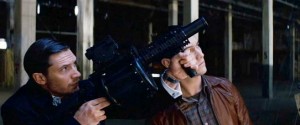
Eames on the left
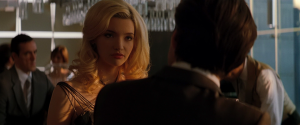
Eames, again on the left


Eames’ performance moves us closer to a broader gender-bending element of the movie, namely the fact that one of the two women is really just a man. Mal is introduced as an oppositional force to Dom, but later revealed to be a projection of his subconscious. The feminine threat of the film reveals itself as coming from a masculine force. There are a couple implications here that I feel the need to describe. As an initial note, this offers another chance to display gender as performed; Cobb’s subconscious contains a significant feminine presence, which he does not display but does at least possess. The public self can be hyper-masculine while the body still hosts multiple gender identities. Next, this complicates the already mentioned understanding of the stabbing shot of Ariadne. Before, the choice of a woman carrying a knife could be the temporary masculinization of Mal, as the weapon “represents male power and violence” (Indick 39). But the decision to use a knife, a penetrative object, instead of a gun or other weapon, represents the true nature of Mal and reinforces the masculine violence of the phallic stand-in of the POV shot, which certainly discredits any understanding of the viewer as a heterosexual male scopophile. The last note of interest is how this interacts with Deakin’s claims. To him, Mal’s character is the current iteration of Nolan’s “seeming myopic sense of female malignity” (Deakin 93). The movie certainly introduces her that way, but over time her villainy becomes a product of Cobb, as an invention of either his mind or victim of his first attempt at inception. Male mistakes causing guilt in the male subconscious does not seem to be a cause for “female malignity” of any sort.

Don’t believe this? Look to the film’s construction of male nostalgia, which ostensibly provides the emotional charge to Cobb’s goals. He wants the golden-tinged domesticity of his children and his wife, who reappear as a visual reminder of his mental state throughout the movie. But when we get to see his memories played out, as Ariadne joins him in his dream, what shows up doesn’t exactly resemble Cobb’s idyllic home. The elevator that travels through his subconscious has bars for doors—which don’t show up in the elevator in his literal dream home in the semi-purgatorial state of Limbo—even though he created the material substance of the dream. That enables a shot, as Ariadne and Cobb retreat into the elevator, of Mal on the ground, behind bars. Male nostalgia for a domestic past as a prison for women; the camera asks for a recognition of what nostalgic gender politics look like to those who don’t resemble Leonardo DiCaprio.
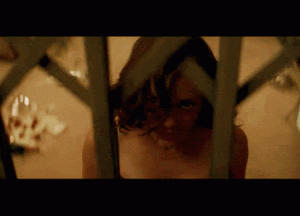
Prison of male nostalgia

Right after that shot comes the scene where the camera accepts Ariadne’s visual perspective but not Cobb’s. Rather than let the camera return to male perspective, the movie rejects it. That conversation prompts Ariadne’s inclusion in the dream layers for the Inception mission, and she ultimately guides Cobb to a reunion with his children. The solution to crises the movie has revealed as masculine in nature is not Deakin’s “fictional means” or “un-truths” but a practical path: let the one real woman in the story have a role in the decision-making. Allow people to play with gender perceptions. Realize the danger of the femme fatale is a creature of the masculine subconscious. The movie supposedly challenges us to “dream a little bigger, darling”, but it’s only dreaming if the idea of fluid gender roles and substantive feminine representation get read as impossible fantasies, and not a better future.

[1] Helpfully named Mal, her name points to her (potentially) harmful nature from the start of the film.

[2] To clarify, this is a scene chronologically located towards the end of the movie used at the beginning with a recurring shot from throughout added in. Nolan can’t resist rejecting other movies’ Simple Order of chronological shots.

[3] Representation here meaning not the presence of women, which Hollywood already has, but the on-screen portrayal of femininity as something other than the object of male desire or subject of the male gaze.

[4] That is not to say that Mulvey and her advocates’ argument is simple, as much as to say that the actual shots of the film complicate the outlined narrative.

[5] The “boys go to Jupiter to get more stupider” school of thought. Not just a playground taunt, but also a common perception of gender as two strictly defined, strictly separated, definitely-not-overlapping categories.

This essay was written in the style of David Foster Wallace.

Leah Rosenfeld provided feedback.


Works Cited

Deakin, Peter. “Men in Crisis: Christopher Nolan, Un-Truths and Fictionalising Masculinity.” The Cinema of Christopher Nolan: Imagining the Impossible, Edited by Jacqueline Furby and Stuart Joy, Columbia University Press, 2015, pp. 85–98, www.jstor.org/stable/10.7312/furb17396.12.

Indick, William. Psychology for Screenwriters: Building Conflict in Your Script. Studio City, CA: Michael Wiese Productions, 2004. Print.
 

A New Ending but an Old Story: Alternative History for Tarantino


Inglourious Basterds is Quentin Tarantino’s alternative to one of America’s more comfortable historical narratives. World War II’s morally simplistic narrative of good versus evil is relatively uncontested. Especially in the European sphere, a continent away from the nasty questions of atomic weapons and internment camps, the West celebrates American heroism and its conquering of Nazi evil. When George Bush wanted to label his enemies, the conquered alliance of WWII offered a name: the Axis of Evil, which wasn’t the descendent of the Axis Powers historically but was forced into that narrative rhetorically. The war’s memory might not be fresh among living Americans, but it still offers a shortcut for accessing feelings of American victory over evil. What should we make, then, of Tarantino’s new ending to the war?

Critic Jonathan Rosenbaum, formerly of the Chicago Reader, offers a critical takedown of the movie’s new ending: “Inglourious Basterds makes the Holocaust harder, not easier to grasp as a historical reality,” (italics his). That is, by ignoring some of the horrors of reality, Basterds’ fantasy encourages historical amnesia. However, this seems challenging to reconcile with the opening scene’s portrayal of the coldblooded murder of Jews to the delight of an SS officer. An officer who responds to being called the Jew Hunter with relish, for he “love[s] the title.” The movie contains depictions of the day-to-day horror of the bureaucratic work that supported the Holocaust, and takes the time to capture Shoshanna’s fear in response to it. Her gulps of air, after Hans Landa stops questioning her, sound like she has been choked by fear. Ignoring the Holocaust would be problematic, but Basterds doesn’t deny its existence, or even its horror. Additionally, this probably isn’t the right line of inquiry. Rosenbaum-and critics like him- seem occupied with representation of history. But with Tarantino’s construction of a new history, the larger concern should be with the implications of the new ending. What does it show about the stories we want to be true, as compared to the ones that are?

One path to an answer is through the movie’s recasting of the victors, specifically how the alternate conquerors defy Nazi categories of racial purity. The US army fighting on the European front was ethnically diverse; black Americans discriminated against at home fought for the country at war. But Basterds replaces an ethnically mixed group of soldiers with a group of Jews, led by a Native American man. Lt. Aldo Raine “got a little Indian in,” him, and the script suggests his noticeable but never mentioned neck scar comes from a noose. While Raine looks white (he’s played by Brad Pitt!), his backstory grants him the mantle of the racially impure. The other Basterds backstories are easier; they are Jews fighting the Third Reich, two from Austria and Germany, the rest from the States. This shift in history offers the chance for the World War II Jew to be more than a victim. Not only do they escape a pitying victimhood, but the movie invests time and energy into the creation of what Christian Thorne calls the “image of the tough-guy Jew,” so it can celebrate Jews pumping Hitler full of lead, castrating a Nazi via bullets, or lunging in slow-motion to kill Hitler’s bodyguard. But the movie’s character creation doesn’t stop there. The other revenge plot features two conspirators: a Jewish woman and her black lover. She escapes the Nazis before plotting their death. While she does not represent the same vein of Jewish machismo as the Basterds, Shoshanna still offers Jewish resistance. Fredrick Zoller, the Nazi sniper and boy wonder, chases after the Frenchwoman’s love, and expresses an entitlement to her body during the fateful scene in the projection room. The Nazis view her as inferior for her identities as both a woman and a Jew. Her black lover’s inferiority gets taken as fact by Goebbels, who won’t even let Marcel perform his job as projectionist because of his race. Contrast their success with the film’s two white heroes, Bridget von Hammersmark and Archie Hicox, who die before they can come close to defeating the Nazis.  The movie’s resistance comes from the very people the Nazis made a national project of oppressing.

The alternate history’s alternate heroes offer a direct repudiation of Nazi ideology. America’s victory clearly indicated that racially integrated troops could defeat the Aryan army. But the Allies real-life win is complicated by America’s ugly racial past, a point made clear by an SS officer’s pointed jab at “the history of the Negro in America.” Where the US can’t be a perfect hero, the victims of Nazi violence can be. The new world constructed by this alternate fiction places power in the hands of those the Nazis hate, and allows them to defeat their enemies. Basterds’s victory shows us what a world looks like where Nazi ideology doesn’t just lose, but loses to those it hates the most.

Tarantino’s alternate history offers a new path to salvation through ethnic and religious minorities, but also via culture. The conflagration in the theater positions the “movie as WMD, destroying the Third Reich, ending the war,” Ben Walters claims, which is “an alluring idea, indeed, but a flagrantly fantastical one.” (20) A combination of homemade and classic culture destroys both propaganda and Nazis as the whole. Old reels offer the kindling to destroy Nazi culture and society. Two amateurs film offer a narration of the destruction. Movie culture saturates Basterds; Operation Kino is German for cine, as in cinema; Hicox and Hammersmark are a critic and a star respectively; German directors of the period get namedropped; Aldo Raine comes from Aldo Ray; and so on, the movie’s accoutrements forming a veritable mountain of referential winks and nods. The movie indicates a desire to care about movies, and to show that it cares. Movies matter, Tarantino says, and says, and says. The climax comes from movies offering a response to propaganda, with the antidote to poisonous culture coming from its genuinely good variants. The better ending to World War II comes with a cultural solution. Good movies save us from the bad.

This reading of the movie sees it as genuinely transformative. For two and a half hours, the path to a new-and-improved world gets put on display. In this world, the victimized strike back decisively against their oppressors, and movies aid in their fight. But Tarantino doesn’t make this an easy escape to a better world. What critics describe as a fantasy is more complicated than escapism. There are two problems with it. The first comes from the realm of the Basterds.

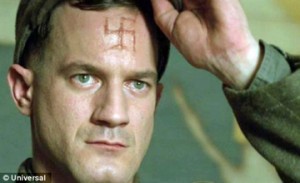
The Basterds’ obsession with marking their enemies doesn’t indicate a desire to create a new world, but to solidify the hierarchy of the old. The second-to-last shot of the movie is Aldo’s knife carving a swastika into Landa’s forehead, with blood gushing, the victim screaming, and the camera lingering on the butchered skin. Then, the camera flips perspective to a smiling Aldo and Utivich, admiring their “masterpiece.” The stated rationale is that, post-war, Landa will remove his uniform and become anonymous, just another rich man on Nantucket. The scars keep the recognition of Landa’s evil. Preserving the moral hierarchy of the past seems unnecessary-after the real war, Nazis get sent to jail, and even a colonel with immunity likely wouldn’t escape notice as a German who fought on behalf of the Nazis. Beyond redundancy, the markers indicate a desire for a moral hierarchy for the future derived from the status quo. Rather than offer a solution to the conflicts of the old world, the new creation apparently should maintain the old’s battles. Not only is Raine’s practice cruel and bloody, but it passes up transcendence for preservation.

The Basterds' scars

The Basterds’ scars

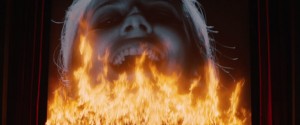
The second issue with Inglourious Basterds as a solution comes from Tarantino’s treatment of film. The movies-as-savior narrative doesn’t align with the film’s actual stance. Rather, Tarantino forces both film and its creators to die a fiery death. Zoller and Shoshanna die; Marcel and Goebbels die; Nation’s Pride and the unnamed revenge flick both burn. Shoshanna responds to Zoller’s film question “Who has a message for Germany?” by saying she does, for she is the “face of Jewish vengeance.” Then everything bursts into flames. Jewish vengeance answers Nazi patriotism, and the consequence is it all dies. At best, vibrant movie culture serves as a rejoinder to overzealous propaganda. At worst, it cancels it out. Either way, movie culture fails to offer enduring salvation.

Face of Jewish vengeance? Sure. Film representation of a path to utopia? Less clear

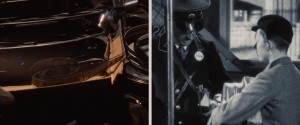
Even in Tarantino’s references to movie history, movies create tragedy. One of the weirdest little injections of outside culture comes from the scene where nitrate film’s explosiveness gets explained to the moviegoer. A split screen effect allows for the left side to pan over spools of film while the right contains a clip from Alfred Hitchcock’s 1936 film Sabotage. After the part excerpted for Inglourious Basterds, the boy shown with nitrate film from the sample makes it onto a bus. The package under his arm turns out to be a bomb, which explodes, and the nitrate film amplifies the explosion. The innocent boy dies. Movies can’t be relied on to defend us; we shouldn’t even rely on them to avoid killing us.

Sabotage (1936) on the right, as inserted by Tarantino

Even as Tarantino “both salutes and problematizes the power of film,” as Walters describ es it, he draws comparisons between the actions of the Nazis and their Allied counterparts. (22) Thorne shows this through in a series of paired images; the carving of the swastika in the forehead and Nation’s Hero carving a swastika into wood; Eli Roth and Zoller taking the same angle down the barrel of their guns; the Apache comments from Aldo Raine and the drunken German. Look at the only two times the camera zooms in on a cigarette. First, Hans Landa stabs it into a delectable strudel, ruining the dessert. Next, it rotates in slow-motion after Marcel’s throw before lighting the pile of film. The seemingly unnecessary shot of strudel protruding from cigarette can’t pass without an equally extraneous shot of a cigarette preparing to hit the nitrate. Walters describes a parallel between Landa and Tarantino’s pacing. “The multilingual, dialogue-heavy longueurs that precede each chapter’s concluding ecstasy of violence map onto Landa’s taking his time with his victims, stringing out the small talk, having another glass of milk, not eating the strudel before the cream arrives,” with both the director and the SS officer relishing that suspense. (22) That parallel phrasing produces the uncomfortable comparison of the audience, of us, to the victims. The power of film certainly is “problematized,” for it ties together all-too-tightly the fascists and their opponents.

But then the film reaches off-screen to make sure its critique hits home, too. Both Walters and Thorne point out the callous laughter of Hitler as echoing the cackles within the theater during the exact same show. “Only a thoughtless viewer will not see him or herself reflected in shots of Hitler cackling,” Walters proclaims, with the implication that there are lots of thoughtless viewers. (22) The audience can’t be inoculated from viral ill-will just because it’s separated by a screen. Watching the movie and celebrating its deaths makes you resemble Hitler, which would merely be like the baser elements of internet name calling if Tarantino didn’t lodge this critique through an elaborate visual schema of similarities.

Looking at the film’s alternate history seems misguided as an exercise in finding political messages. Though it creates a new history, that history is subsumed to a larger message. The movie takes on the Third Reich not to prove a point about resistance to fascism, though it comments on it along the way. Rather, the moral logic of Nazism, and our abhorrence for its associations, lulls an audience into cheering for the reversal of Nazi evil as justice. Rosenbaum’s concern- “Basterds makes the Holocaust harder, not easier to grasp as a historical reality,”- gets it perfectly wrong. Basterds makes it possible to grasp the Holocaust as a modern possibility.

Works Cited

Rosenbaum, Jonathan. “Some Afterthoughts about Tarantino.” Blog post. 27 Aug. 2009. Web. 17 Nov. 2016. <www.jonathanrosenbaum.net/2009/08/16606/>.

Thorne, Christian. “Tarantino, Nazis and Movies That Can Kill You-Part 1.” Blog post. Commonplace Book. Williams College, 9 June 2011. Web. 17 Nov. 2016. <http://sites.williams.edu/cthorne/articles/tarantino-nazis-and-movies-that-can-kill-you-part-1/>.

Thorne, Christian. “Tarantino, Nazis and Movies That Can Kill You-Part 2.” Blog post. Commonplace Book. Williams College, 17 June 2011. Web. 17 Nov. 2016. <http://sites.williams.edu/cthorne/articles/tarantino-nazis-and-movies-that-can-kill-you-part-2/>.

Walters, Ben. “Debating Inglourious Basterds.” Film Quarterly, vol. 63, no. 2, 2009, pp. 19–22. www.jstor.org/stable/10.1525/fq.2009.63.2.19.

Empire Looks Better in a Cape

The Dark Knight is “clearly one of the top conservative films ever made,” in the eyes of Breitbart, a news organization dedicated to satiating racists. (Shapiro) It identifies right-wing politics with a protagonist that “utilizes full scale surveillance, beats up a terrorist during an interrogation, and takes heat while doing it, all in order to save civilization from monsters,” placing the Christopher Nolan film at the center of authoritarian aggression-and delighting in it. Batman becomes a weapon of state authority against the Other, and does so while flouting liberal checks. Meanwhile, John Ip from the University of Auckland claims the film proves that “society ideally should not rely on heroic vigilantes, that the people themselves need to show resoluteness and courage, and that, in the long run, the law—together with the legitimacy it confers—is not a liability, but an asset,” arguing the film’s politics value civic virtue. (229) Ip refuses to valorize the vigilante, but rather finds the blockbuster’s hero in unnamed civilians who refuse to give in to their baser instincts while finding refuge in civic institutions. These views fundamentally clash- Breitbart’s demeaning of governing checks can’t be reconciled with Ip’s celebration of the rule of law. Each critic places a separate ideology across Batman’s shoulders, conscripting the movie into political service. But the film itself doesn’t buckle under the weight of varied political views. Rather, the movie accepts and promotes simplistic politics.

Simple, partially because it’s so familiar. Comic books and the accompanying film genre carry with them plenty of associations. Capes, chiseled chins and criminal masterminds ensure you don’t confuse it with anything else. When critics praise The Dark Knight as “the first superhero film that makes a serious bid to transcend its burgeoning genre,” they mean that it retains genre trappings while seemingly filmed with minimal access to sunlight. (Orr) Or, alternately, that the movie concerns itself quite clearly with its own importance. The Dark Knight refuses to accept being ‘just’ a superhero movie. Its plot is overlaid with overt political references.

After all, Christopher Nolan can be accused of many things; subtlety isn’t one of them. The Dark Knight exults in brash symbolism. Harvey Dent’s coin conveniently burns one of its two faces, and the camera rests, languorously, upon the altered side. Don’t you get it? Now he’s been turned into a different person, just like the coin has changed. The movie’s politics similarly shout to be noticed. I want to spend the next few paragraphs nailing down these images-not because of any inherent complexity, but because the sheer amount of effort devoted to the symbolism by Nolan.

First, let’s focus on the film’s animating force: Heath Ledger’s Joker. One critic came close to describing the essence of Ledger, who “seems less the creation of a living self than the annihilation of one, an exercise in the center not holding,” as he embodies an intentionally confusing evil. (Orr) The Joker’s aims to disrupt the established order for the purpose of disruption. He employs suicide bombers and continuously jerry-rigged (or, say, improvised) explosive devices, importing the tactics of the Green Zone to Gotham. Shaky, handheld videos of hostages unnerve, and proclaim a kinship of style with Osama Bin Laden’s video messages or hostage videos worldwide (take a look at the embedded image and video to see). Even when his violence doesn’t fit neatly within preexisting categories, it fits the understanding of terrorism as aimed at terrifying the populace. Dead bodies slam into glass, pencils pierce eye sockets-the violence is used for shock value, as ways to distinguish him from any other criminals. After all, he just wants to “watch the world burn.” In one unsuccessful attempt, the Joker impersonates an officer and launches an attack on an elected official. Of course, the infiltrator had a clear-as-day mark of his irregularity on his face. Not his skin color (this time), but the type of simple signifier that “extreme vetting” could notice. Harvey Dent names this threat accurately at the press conference-the Joker is a “terrorist,” which in America means a Muslim man. To make explicit what Nolan almost does, the Joker is a stand-in for Islamic terrorism. He’s the sort of caricatured enemy that “hates us for our values,” and delights in violence in pursuit of an anarchic ideology.

(watch through 0:21)

This screenshot comes from a hostage crisis with an ISIS-affilate in the Philippines.

This screenshot comes from a hostage crisis with an ISIS-affilate in the Philippines; clearly after the movie, but bearing a stylistic resemblance to the clip in a way all-too-many images do

Next, I’ll turn to the hero of The Dark Knight: Batman, the caped crusader (or is it Crusader?) and his attempts to save his city, his woman, and his moral code. The valiant fighter combatting a shifting order amidst moral decrepitude. Batman aspires to be omnipresent-the primary fictional invention of the movie allows Batman to hear and see everything. His retort to Alfred asking him to be more cautious is to proclaim his power, for “Batman has no limits.” The superhero’s attempts at control extend far beyond the city of Gotham; “Batman has no jurisdiction,” as he reminds us. Unlimited, across the globe, Batman wages a unilateral war on evil. Ring any bells? This distillation of Bush-era imperialism is enlivened by the movie’s portrayal of certain acts from the War on Terror. Batman drops a crime-lord from a building, snapping his ankles, so he can ask a few questions. He mercilessly beats the Joker. Torture is justified- it gets him the information he wants about Rachel and Harvey Dent. And with the Joker, there’s no sign we should even care about the torture. The recipient of the beating laughs through it. The irrational enemy doesn’t suffer pain like we do; they don’t need the protections we do, either. After that, we see Batman create an expansive surveillance system- through our cellphones- to save the city. While the movie was released before the Snowden leaks, knowledge of broad surveillance programs created under the Patriot Act already existed. The empire depended upon surveilling at home to monitor threats. Batman serves as a not-so-subtle stand-in for American empire post-9/11, and his violence should be understood as our own.

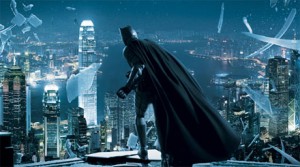
Batman proudly claims Hong Kong's skyline as his own

Batman claims Hong Kong’s skyline as his own

With the dual structural supports for the politics of The Dark Knight in place, the rest of the symbolic framework can be sketched in. Like, for example, the geopolitical hints created by character’s nationalities. The mob coopted by the Joker prominently contains “the Chechen”. The quintessentially American Wayne Enterprises almost enters into a major business relationship with a Chinese company-but doesn’t, because China’s accounting is rigged. Nolan takes care to dismiss Hollywood’s other geopolitical bogeymen. The USSR exists only as a small-time cog in a criminal machine and China’s rise depends upon a willful suspension of disbelief. The real threat comes from Muslims. If nothing else, the film argues for its own existence, for its fictionalized account of a social threat as most deserving your attention.

The story’s symbolism continues. Like, for example, the technological wizardry of Lucius Fox. He describes his plan for extracting Batman and Lau as inherited from an old CIA plot, and that’s probably a good way to start understanding him. He creates new technologies for Batman, like a new suit. What changes are made to Batman’s armor? It becomes more flexible in response to new threats. With a military now asked to fight asymmetric threats, the movie’s focus on armor carries the paradigmatic shifts of the armed forces. Fox, then, doesn’t just stand-in for the CIA; he’s the director of a vast national security apparatus. In this capacity, he reconnoiters abroad, and controls surveillance at home. He even intimidates an admittedly-craven whistleblower. If Batman fights for American empire, Lucius Fox sits at the helm of its bureaucracy.

More time could be devoted to this symbolism. Harvey Dent as the false hope of elected officials; the wizened Alfred representing his own country and its faltering empire; the unnerving clown masks, which substitute for the visual shorthand of brown faces with beards. But I’d like to address some of the critic’s views of the film’s politics, put them to the test of the movie’s persistent symbolism, and see the consequences.

First, let’s explore John Ip’s view of the movie as a testament to civic virtue. He accepts the War on Terrorism motif, but sees the movie’s relationship to Bush-era human rights abuses as reflecting negatively upon them. His qualms are too legalistic to accurately deny the movie’s political goals. Ip claims the overseas capture of Lau “cannot be interpreted as any kind of endorsement of the Bush Administration’s practice of extraordinary rendition, because…it is not that kind of rendition,” which imposes a knowledge requirement on the layman in the theater. (216) Distinguishing between the legal terms ignores the imagery of the vigilante traveling overseas to snatch a criminal away for prosecution at home. The only unusual aspect of the capture is the inverted nature of certain imperial escapades of the past; this time, empire entered under the guise of corporate interests, instead of the other way around. Ip next dismisses the film’s use of torture as providing little useful information. While true, the characters don’t blame the torture for this as much as they blame their inability to act sooner. The film doesn’t indict the torture; instead, as discussed above, it ignores its potential for real pain. The injured mobster continues a conversation despite his shattered ankles. The Joker laughs it off. Torture should be ignored, because even the Batman can’t cause all that much pain. Ip similarly addresses Wayne Enterprises cell-phone based mass surveillance, claiming it differs in type from the actual War on Terror and thus can’t be understood as a defense of the same. Part of the strength of the film’s endorsement comes from its dissimilarity to real actions. Rather than bear the burden of advocating mass surveillance, it defends a specific, fictionalized instance. After all, the stand-in for our national security bureaucracy doesn’t even want the surveillance. Someone in a position of power will look out for us, because authority figures abide by the audience’s moral standards.

(note, as an aside, the way the complex debate over surveillance is reduced to less than 80 seconds)

Other critics attempted to identify the film’s central premise. Like, for example, one argues that its “less a film about good versus evil than about order versus chaos.” (Orr) That broad claim ignores the way the film merges the two. The film’s evil is chaos. The Joker substitutes sewing chaos for a fleshed-out ideology. Even his backstory is murky- he always tells different stories about he received his scars. Nothing can explain the Joker, as the movie reminds us. Islamic terrorism lacks history, and thus a motivating purpose. The Joker can’t be traced back to anything at the county jail-not fingerprints, DNA, a single prior identity. Viewing the Joker in this light vindicates us of any possible role in creating the monster society must deal with.

Orr also posits that the “film [is] about politics by other means,” which necessarily evokes von Clausewitz’s famous formulation: “war is the continuation of politics by other means.” Complete the circle and say it with me: The Dark Knight’s about war. Not just any war, but a Huntington-esque clash of civilizations. The War on Terror can’t be rationalized. Instead, it pits the impenetrable mystique of the Other against the just empire. As much as I dislike claiming this, Breitbart’s analysis rings true. When it claims Batman “save[s] civilization from monsters,” it accurately diagnoses the film’s biggest fear: America subjugated by Islam.

I want to jump to the end of the film. After Batman sacrifices his reputation for that of Harvey Dent, Jim Gordon’s son points out plaintively that Batman “didn’t do anything wrong.” The child seems to be voice of reason. Empire just saved everyone, and it’s sent to hide away (in its luxurious mansion). The movie’s sense of outrage isn’t derived from shattered bones but from the morally immaculate empire being scorned. The Dark Knight seems to answer most of its own questions, but leaves this one hanging. Why don’t you defend empire? After all, Nolan spent the previous two hours and thirty-two minutes doing the best he could. American empire needs you; will you answer the Bat-Signal?