A Squeeze at Hunt Valley
Played with my mom in the Baltimore Mid-Atlantic regional bridge tournament August 12-18, 2013. Here’s a hand where I as North wanted to make six clubs. Continue reading ‘A Squeeze at Hunt Valley’ »
Math, Teaching, and Other Items of Interest
Played with my mom in the Baltimore Mid-Atlantic regional bridge tournament August 12-18, 2013. Here’s a hand where I as North wanted to make six clubs. Continue reading ‘A Squeeze at Hunt Valley’ »
The famous Wallet Paradox invites two similar individuals to lay their wallets on the table, the one with the lesser amount of money to win both. Paradoxically, each might reason: “I have the advantage, because if I lose, I lose just what I have, but if I win, I win more than I have.” A follow-up analysis assumes that each has the same expected amount of money and asks for the best probability distribution or “best strategy” with that given mean. The following note is based on a senior colloquium talk. Continue reading ‘Pradham ’13 on Wallet Paradox’ »
Note added 5 June 2016. A noncompact counterexample is given by Nardulli and Pansu, arxiv.org. On the positive side, see the comment below by Milman and Flores/Nardulli [FN].
Note added 21 March 2018. A 2D (noncompact) counterexample is given by Papasoglu and Swenson [PS], via expander graphs.
Given a smooth Riemannian manifold, the isoperimetric profile I(V) gives the infimum perimeter of smooth regions of volume V.
Proposition 1. In a compact smooth Riemannian manifold of dimension at least two, the isoperimetric profile is continuous. Continue reading ‘Isoperimetric Profile Continuous?’ »
 My mom and I just had a great time on the first ACBL Regional at Sea, an Alaskan cruise with the inimical Billy Miller. My mom won enough gold points to become a Life Master. In that fateful session Thursday afternoon, July 18, 2013, as West she played one hand at 3N which should only make 2N and she somehow made 5N:
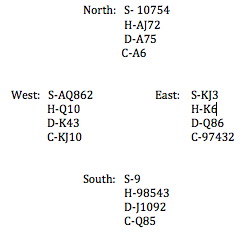
Continue reading ‘Alaskan Bridge Cruise with Billy Miller’ »
Jian Ge’s recent ArXiv post on “Comparison theorems for manifolds with mean convex boundary,” Theorem 0.1, has a generalization to manifolds with density, here within a factor of 2 of sharp for constant density: Continue reading ‘Distance to Boundary of Manifold with Density’ »
In Rn or in a Riemannian manifold, one may consider regions R with density given by an integrable nonnegative function g, with volume ∫R g. If everything is smooth, the perimeter is given by ∫∂R g, or more generally by Stokes’ Theorem. For finite perimeter, these are the so-called normal currents of geometric measure theory. All of this can be done in a manifold with density f (unrelated to g).
In Rn, if you allow regions with density, there is no isoperimetric optimum for given volume, because large balls with low (constant) densities approach perimeter 0; similarly in any space for which P/V has no minimum. In a space of finite volume, such as Gauss space Gn (Rn with Gaussian density) there is an optimum: the whole space with appropriate constant density has perimeter 0. At the other extreme, in R with density exp(x3), a left halfline with high density approaches perimeter 0.
Note that if a region with density is isoperimetric, it remains so for all multiples of that density.
In principle one may allow regions with variable density f, the variability contributing to the boundary, but since any such region is an integral of regions Rd = {f ≥ d} with constant density d, one need consider only regions with constant density.
For a manifold with density with isoperimetric profile P = I(V), the least-perimeter region with density with unit volume just minimizes cI(1/c); in a space of infinite volume its perimeter to volume ratio is the Cheeger constant inf P/V.
In R2 with density exp(r2), where classical isoperimetric regions are balls about the origin, among regions with density the isoperimetric optimum for every area is the same disc of radius r ~ 1.1 (solution to exp(r2) = 2r2 + 1) with appropriate constant density.
Proposition. In Rn with smooth, uniformly log-convex radial density f(r), an isoperimetric region with density exists.
Guest post by Neeko Gardner, Caroline Atwood, Paul Friedrich, Llewellyn Smith
On Saturday, February 16th, the recently formed Williams College bridge team participated in the collegiate qualifying bridge tournament online on bridgebase. Having just come off an intensive month-long winter study class on bridge, we decided to test our newfound skills against other collegiate teams. We were up against Stanford, UPenn, CalTech, Hamilton, UChicago, Cornell, Dartmouth, NYU, and UWashington. Our first round we lost to Dartmouth, then beat NYU, tied against Hamilton, beat Stanford, and lost to UPenn in the final round. With our final loss to Penn who was playing precision and had been partners for over 5 years, we barely lost out qualifying. It was a great showing for Williams, and considering we’d only been playing for a month we did very well. Next year we hope to come back even stronger and qualify. Here’s an interesting hand from our match against Hamilton: Continue reading ‘Williams at Collegiate Bridge Tournament’ »
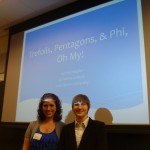
Participated in the excellent Moravian College Student Mathematics Conference February 16, 2013. Many thanks to my hosts Nate Shank and Kevin Hartshorn, Dean Gordon Weil, student presider Eric Sullivan, and all workers and speakers.



Here in Williamstown we got just about a foot of snow.









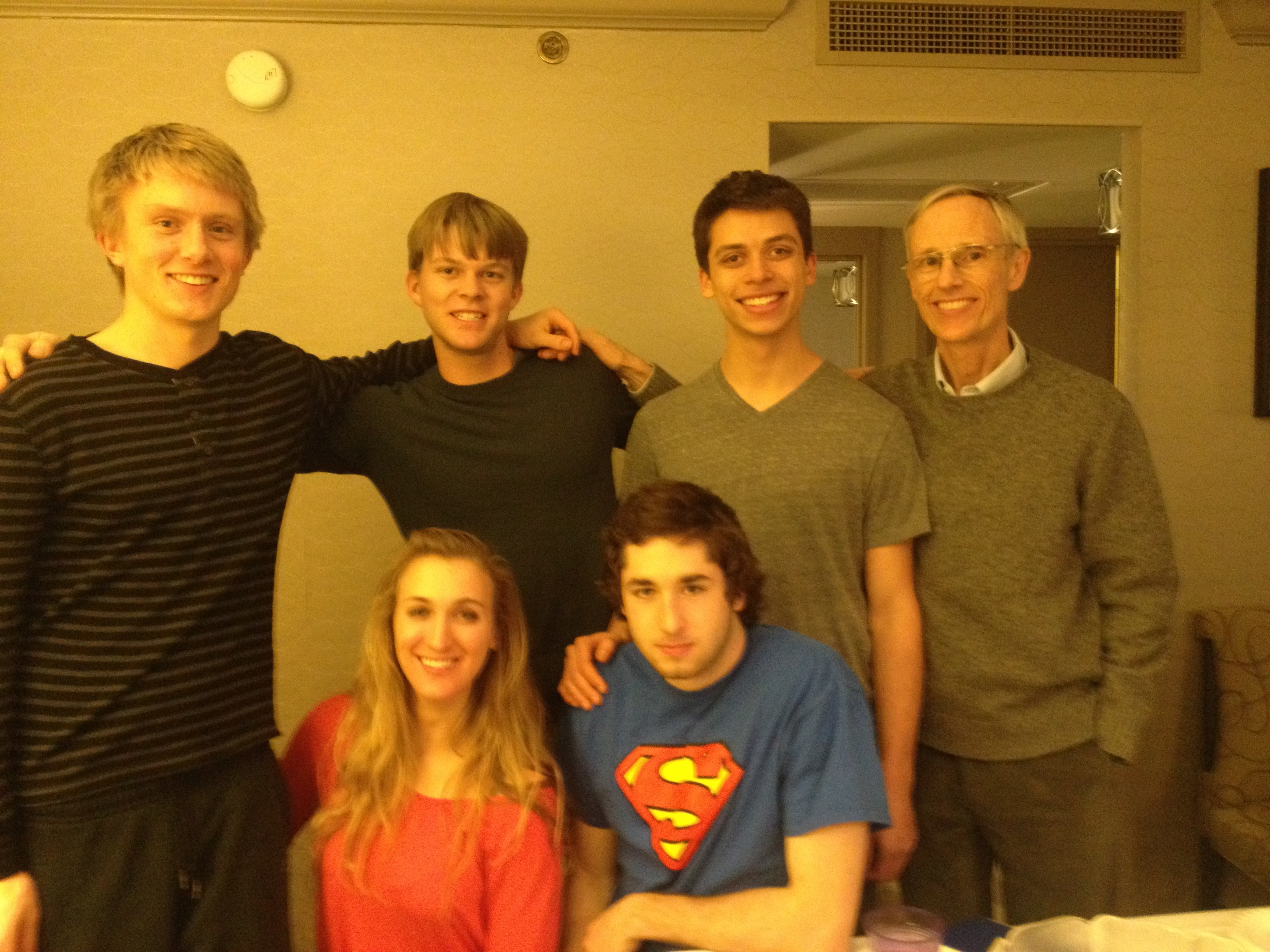
Every January Williams students take one special course. Faculty, every other year, teach whatever they like. In 2013 for the second time I taught “Tournament Bridge.” The five first- and second-year students and I studied, practiced, and played in tournaments in Pittsfield, Newton, Rye, and Schenectady.
Paul Freidrich, Neeko Gardner, Ben Hoyle, Professor Frank Morgan, Caroline Atwood, and Llewellyn Smith at the Rye Regional
 Welcome to my blog. I also have a blog at the