Hazel’s Bridge Club in Toronto

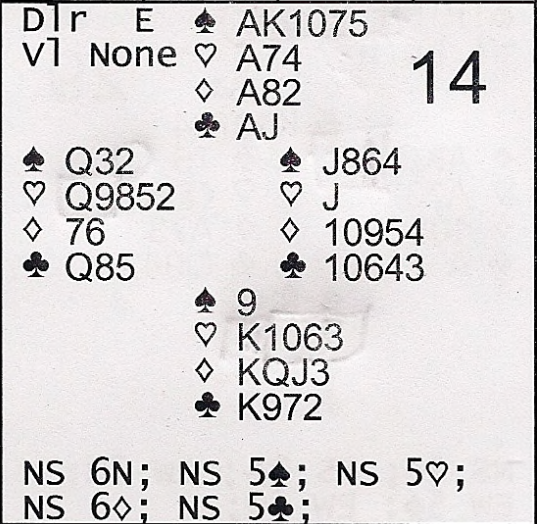
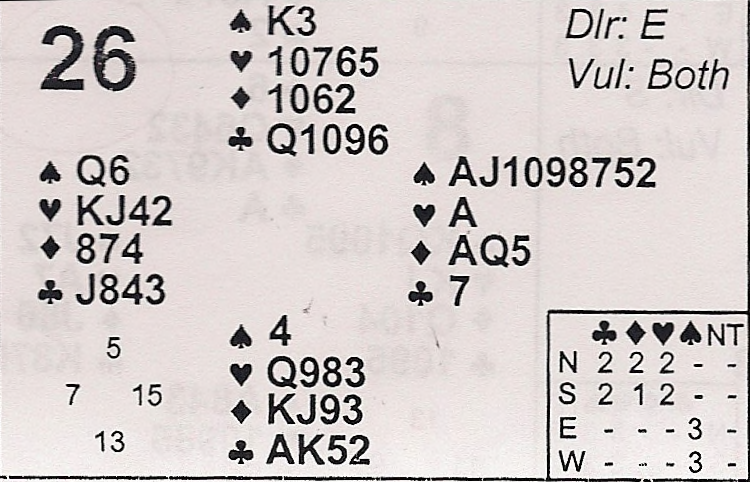
When I was at the Field’s Institute in Toronto on sabbatical in the fall of 2010, I played duplicate bridge with 25 different partners. Here’s an interesting hand from Hazel’s Bridge Club on September 6, with Joyce Fraser. I was East at 4S. Do you see how to make it? The key after taking the heart ace is to force an entry to dummy by leading a low spade to the 6. This was good for 10/15 matchpoints.

Actually it can be set by perfect defense. Do you see how? South has to underlead the AK of clubs to North’s Q, so that North can return a diamond to eventually score two diamond tricks.

Royal Caribbean Bridge with Larry Cohen and Jeff Meckstroth

Here’s an interesting hand from a Royal Caribbean regional bridge tournament cruise (with 6000 passengers and 2000 staff on the Allure of the Seas) with Larry Cohen in December, 2012. After my partner (Lois Hausman) opened 1D, I took her to 6N. After a heart lead, she properly advanced the 9 of spades and West properly covered, leaving East with the J86 after dummy’s A1075. Do you see how to make the hand? Take the club finesse and the AK, play out the red winners, and then put East in with the club 9 to his 10. Now he must lead from his spades. Continue reading ‘Royal Caribbean Bridge with Larry Cohen and Jeff Meckstroth’ »

Isoperimetric Regions Bounded

An ingredient in proving the existence of isoperimetric regions and clusters of prescribed volume(s) is the boundedness of isoperimetric regions of smaller volume(s). One proof of boundedness is by monotonicity. The proof in my Geometric Measure Theory book (Lemma 13.6) uses a non-sharp isoperimetric inequality for small volume and has the advantage of applying to convex integrands more general than area; the requisite isoperimetric inequality follows immediately from the isoperimetric inequality for area. All of this works equally well in the presence of a density. For more delicate results see

Frank Morgan and Aldo Pratelli, Existence of isoperimetric regions in Rwith density, Ann. Global Anal. Geom. (2012); arXiv.org (2011)

and Cinti and Pratelli.

My book comments that existence similarly holds in any smooth Riemannian manifold M with compact quotient M/G by a group of isometries. Monotonicity still yields boundedness; even with density (bounded above and below by compactness) the classical mean curvature is bounded and hence classical monotonicity applies. To use my alternate proof, which applies to more general integrands, one needs the isoperimetric inequality for small volume, which follows immediately from such an isoperimetric inequality for area without density. For the latter in a more general setting, see Theorem 2.1 of Morgan and Ritoré “Isoperimetric regions in cones” after Berard and Meyer. In this simpler setting of M/G compact, you can just cover M with congruent balls with a bounded number of balls meeting each point and apply the relative isoperimetric inequality in each ball. Incidentally the same covering can be used to replace the division into cubes in the existence proof 13.7 in my book.

New Journal “Analysis and Geometry in Metric Spaces”

Analysis and Geometry in Metric Spaces” is one of a number of new open access journals to be funded by author fees, such as the Gowers-Tao Forum of Mathematics. The idea is that long-term it will be much cheaper for institutions to pay author fees than subscription fees, but the transition will be difficult, since while the major journals are on the old model, institutions cannot drop their subscriptions and may not pay author fees, and authors would rather publish for free in established journals.

“Analysis and Geometry in Metric Spaces” provides a journal for an important and rapidly growing modern area of mathematics and to its credit it does it on this new open access model of the future. I wish my good friend and the editor Manuel Ritoré of the extraordinary Department of Geometry and Topology at the University of Granada every success.

My Favorite RRR Brooks Trail

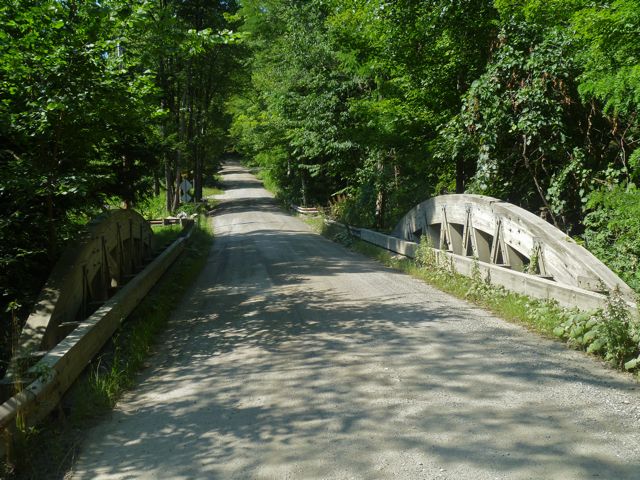
This morning I found the Sara Tenney loop to complete my favorite RRR Brooks Trail. The trail heads right off Bee Hill Road, just past a bridge, about a block above where it forks right off Routes 2/7 South out of Williamstown.

.  

Continue reading ‘My Favorite RRR Brooks Trail’ »

Bridge at Philadelphia Nationals

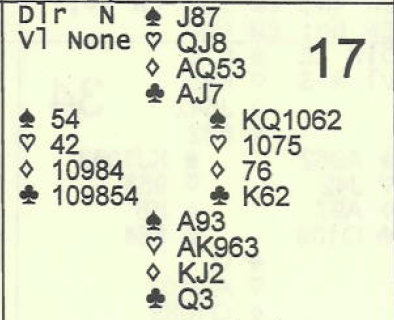
I just spent four enjoyable days at the ACBL Bridge Nationals in Philadelphia, playing with five pick-up partners from the partnership desk and one old friend. The most memorable hand for me involved a squeeze play for a small slam in Notrump. I was North. When the dummy came down, it looked like the contract depended on the Club finesse, but East was looking suspicious. I asked myself if there was any way to make it if East had the Club King, and I realized he could be squeezed. To keep that option open and rectify the count, I let the Spade King take the trick. He puzzled over the continuation, convincing me he had the Club King. When he finally led a red card, I ran the nine red winners, ending with Spade A and Clubs Q 3 in dummy and Spades J 8 and Club A in hand. On the ninth trick, East, holding Spades Q 10 and Clubs K 6 agonized over the discard as hoped. I turned to him and mumbled quietly, it doesn’t matter. When he finally discarded the Club 6, I came to the Club A in hand and watched him play his Club King under my Ace, leaving the dummy’s Spade A and Club Q good for the last two tricks. Of course if he had discarded the Spade 10, I would have played the Spade Ace dropping his Q, leaving the Club A and Spade J in my hand good. What he should have done was discard the Club 6 2 early on, leaving some doubt when he could have discarded the Spade 10 at the end, keeping the Spade 6 with his Q.

It could have been easier. At other tables East bid, pegging him for all the missing cards. And of course if he doesn’t lead the Spade, it is easy to set up a Club trick even if the finesse loses. At one table East discarded so poorly (all his Clubs) that North made 7 without any squeeze.

Energy-minimizing Double Cells

Steve Zottoli and I, in attempting to model biological cells, came up with the following theorem on the shape of planar double cells in which the tension of an interface is a strictly convex function of the linear density. One could conjecture a similar result in 3D.

 Theorem. For a double planar cell of prescribed areas A1, A2, consisting of three interfaces of prescribed mass meeting at two points, the configuration of least energy, computed for each interface as the integral of the tension with respect to arclength, is given by three circular arcs of constant density, as in Figure 1. The angles at which they meet are determined by tension equilibrium and their curvatures ki and tensions ti satisfy

                    k1t1 = k2t2 + k3t3.

This is the same as the energy minimizing cluster for two immiscible fluids inside a third.
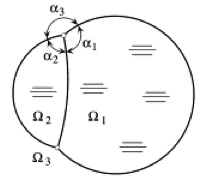
Figure 1. An energy-minimizing double cell consists of three circular arcs in equilibrium. Figure from Slobozhanin and Alexander.

Remark. Even if the enclosed masses instead of areas are prescribed, the minimizer will still be minimizing for whatever areas it has and will hence have the stated form. If total mass rather than the mass of each interface is prescribed, then each interface will have the same density and tension and the double cell will be the same as the energy minimizing soap bubble cluster, with angles of 120 degrees.

Proof. A minimizer has constant density on each interface (because on any fixed curve of prescribed mass, constant density uniquely minimizes energy, because tension is a strictly convex function of density). Circular arcs are best. A fortiori, the minimizer minimizes weighted length, with a different weighting constant for each interface, which is the immiscible fluids problem.

Remark. The immiscible fluids problem can be posed in great generality in geometric measure theory [M1, Chapter 16], allowing very general, disconnected regions. That the minimizer still takes the above form can be proved by the same simple argument that Hutchings [M2] provided for the case when all weightings are equal, the “double soap bubble problem,” as was pointed out by Cotton and Freeman [CF, §2.1].

[CF]  Andrew Cotton and David Freeman, The double bubble problem in spherical and hyperbolic space, Intern. J. Math. Math. Sci. 32 (2002) 641-699.

[M1]  Frank Morgan, Geometric Measure Theory: a Beginner’s Guide, Academic Press, third edition, 2000.

[M2]  Frank Morgan, Proof of the double bubble conjecture, Amer. Math. Monthly 108 (March 2001) 193-205.
Dante’s MIT

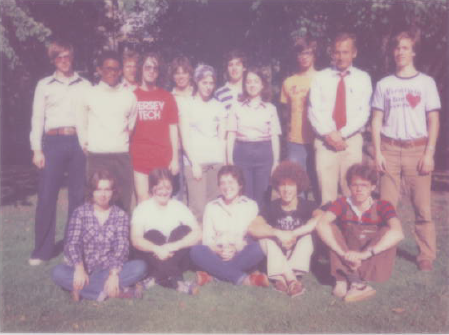
Seeing my old friend A. R. Gurney, the illustrious playright, at his 60th Reunion here at Williams College and addressing the 25th Reunion dinner at MIT, all last Saturday, brought back many happy memories.

Gurney and I taught a freshman seminar at MIT on “Math and Literature,” in which he had to do all the homework I assigned on the Euler characteristic and I had to do his assignments in literature, including a parody of Dante’s Inferno which I call Dante’s MIT.

At the MIT 25th Reunion Dinner, in the dazzling new Media Lab with its breathtaking view of the Boston skyline and the Charles River, I began with an old segment from the nationally syndicated PM Magazine from May 30, 1984, referred to in some old exams. My old students followed my talk on “Soap Bubbles and Mathematics” with their old enthusiasm and acuity. I’m very proud of them and all that they have accomplished.

Madison

My Transit of Math