
Part 1: Plot
Sequence 1: Animal activists break into a laboratory and free monkeys that have been infected by “rage.” A monkey attacks a woman, infecting her.
Sequence 2: Jim wakes up alone in a hospital. He walks through the abandoned streets of London, entering a church only to be attacked by an infected priest. Two people, Selena and Mark, rescue him from infected people by blowing up a gas station. In an abandoned store, Selena and Mark tell Jim about the deadly disease.
Sequence 3: The next morning, they chance a trip to Jim’s parents’ house. He finds them dead and a suicide note telling him, “Don’t wake up.” That night, the trio is attacked by an infected person. Mark is infected and Selena kills him, telling Jim she would do the same thing to him.
Sequence 4: They make their way to an apartment with Christmas lights in a window. As they arrive, an infected person chases them and a man in a mask defends them. A young girl, Hannah, lets them into the apartment where they formally meet Frank, her father. Frank shows them a looping radio broadcast advertising “the answer to infection.” He convinces them to go with him and Hannah to find the answer.
Sequence 5: They make their way through the city in Frank’s cab. In a tunnel, they blow a tire and quickly repair it as infected people rapidly approach. They narrowly escape then drive through the countryside, becoming closer and more relaxed. They spend the night in ruins and Selena gives them drugs to sleep. Jim dreams that they have left him.
Sequence 6: They reach the blockade, where they thought they would find help. It is deserted. As Frank looks around for signs of life, a drop of blood falls into his eye, infecting him. Soldiers arrive and kill Frank.
Sequence 7: The survivors are taken to a militarized mansion. Major West gives Jim a tour of the building, including introducing him to Mailer, an infected black soldier whom West is keeping in order to learn about the disease.
Sequence 8: The soldiers defend the mansion from attack. Afterwards they harass and threaten Selena. West stops them then reveals to Jim that he has lured the trio to the mansion because he “promised them women.”
Sequence 9: Jim, Selena, and Hannah are caught trying to escape. Jim is imprisoned with a dissenting soldier, Farrell, who speculates that the country is being quarantined. Selena temporarily keeps the soldiers from raping her by kissing one.
Sequence 10: Jim and Farrell are taken to a pile of dead bodies in the woods. Farrell is killed and Jim hides among the bodies until the others leave. Jim attacks West and a soldier then releases Mailer. Selena, Jim, and Hannah run to their car where West shoots Jim. Hannah backs up the car, smashing into infected people who take West. To escape, Hannah crashes the car into a locked gate.
Sequence 11: Jim dreams of Selena trying to save him in a hospital. He wakes up in a house in the countryside and finds her sewing. Hannah rushes in, saying she heard something. They go outside and lay out out the word “HELLO.” A plane flies overhead and Selena asks if they think they have been seen.
Part Two: Analysis
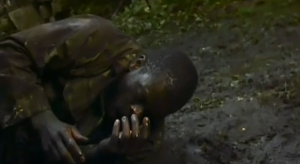
At 1:12:50 the film rests on a shot of Mailer, lying on the ground after a dramatic attempt to reach West and Jim from where he is leashed. This frame is a close up and feels intimate due to Mailer’s closed and protective body language. The frame is not so close as to cut out his arms which characterize the way he is laying as a sort of fetal position, reminiscent of a baby or someone dying. The camera angle is canted and tilted downward giving the audience the point of view of West or Jim, peering down at Mailer from the safety of the doorway.
The mise en scène is almost completely brown. There is a sparse scattering of green grass in the background of the frame which works to emphasize the brownness. Throughout the larger scene, Mailer’s uniform transforms from a muddy green to wholly brown, as he rolls in the mud. He appears to be blending into the mud or returning to the mud, since the part of him which is not brown, his clothing, becomes brown. This suggested transition to mud supports West’s dialogue during this shot which asert’s Mailer’s lack of futurity.
West says, “He’s telling me he’s futureless.” This conclusion is drawn from the preceding statements that, “he’ll never bake bread, farm crops, raise livestock.” Mailer’s loss of the ability to provide labor for the community of soldiers constitutes a loss of futurity. Later in the film, West returns to the requirements for futurity saying, “Women mean a future” (01:21:35). This example clearly demonstrates the necessity of reproduction for futurity. The women, notably Selena whom, unlike Hannah is not treated as a child to be protected, are valued for their ability to provide literal reproductive labor. Mailer is assessed for his ability to support the reproduction of white society through his physical labor. Though Mailer’s usefulness is diminished by the infection, West uses him as a tool to understand the “rage.” The information is collected in order to give the soldiers, and the envisioned future humanity which will come from them, a better chance at survival and reproduction.
This lack of futurity, supplies a missing link between the contemporary period of the movie’s release and the future depicted in many other science fiction films in which black people have disappeared. In 28 Days Later, we see black people, potentially the last black people, still alive but depicted as without futurity, going to starve to death or used for their ability to reproduce white society. The film ends with Jim, Selena, and Hannah forming a sort of family of survivors. Hannah functions as a surrogate daughter to the couple, with the trio’s paternal relationship foreshadowed by Selena’s realization of the importance of motherhood earlier in the film while looking at Hannah and her father (00:55:20). Hannah then is the white child of the future, the product of the graphic mixing of blood depicted in Jim and Selena’s reunion (1:42:35).